







Abstract
Teeth and the periodontal tissues represent a highly specialized functional system. When periodontal disease occurs, the periodontal complex, composed by alveolar bone, root cementum, periodontal ligament, and gingiva, can be lost. Periodontal regenerative medicine aims at recovering damaged periodontal tissues and their functions by different means, including the interaction of bioactive molecules, cells, and scaffolds. The application of growth factors, in particular, into periodontal defects has shown encouraging effects, driving the wound healing toward the full, multi-tissue periodontal regeneration, in a precise temporal and spatial order. The aim of the present comprehensive review is to update the state of the art concerning tissue engineering in periodontology, focusing on biological mediators and gene therapy.
Keywords
Introduction
Together, teeth and periodontal apparatus represent a highly specialized functional system. Their development starts early in the embryo and is characterized by a complex sequence of events, which eventually results in the eruption of teeth and the formation of the periodontal tissues. The periodontal apparatus includes, indeed, four specialized tissues: the cementum that lines the root surface, the periodontal ligament (PDL) that connects the tooth to the next component, the alveolar bone, and the gingiva (Figure 1(a) and (b)). All such components, in physiological conditions, have different peculiar functions: they not only hold the tooth in place, but they also adapt the tooth to the masticatory forces, allow dental migration, and offer protection against the penetration of oral bacteria in the connective tissues and bone. Periodontal diseases are inflammatory conditions of the the periodontal apparatus that are spread worldwide. Periodontitis occurs due to an excessive presence of bacteria or an altered inflammatory response of the host toward bacteria (individual susceptibility). As a result, a destructive process of the tissues occurs and bone resorption, in particular, progressively leads to tooth mobility and, eventually, its avulsion. In case of hopeless teeth, the use of dental implants to replace the missing dental element is a safe and effective procedure, but it requires the presence of an adequate amount of bone tissue. Implant osseointegration, in particular, represents a pivotal step to be addressed, and a plethora of studies have tried to enhance the implant–bone interface acting on the surface properties of implants, reducing their susceptibility to be colonized by bacteria1,2 and enhancing their roughness.1,3
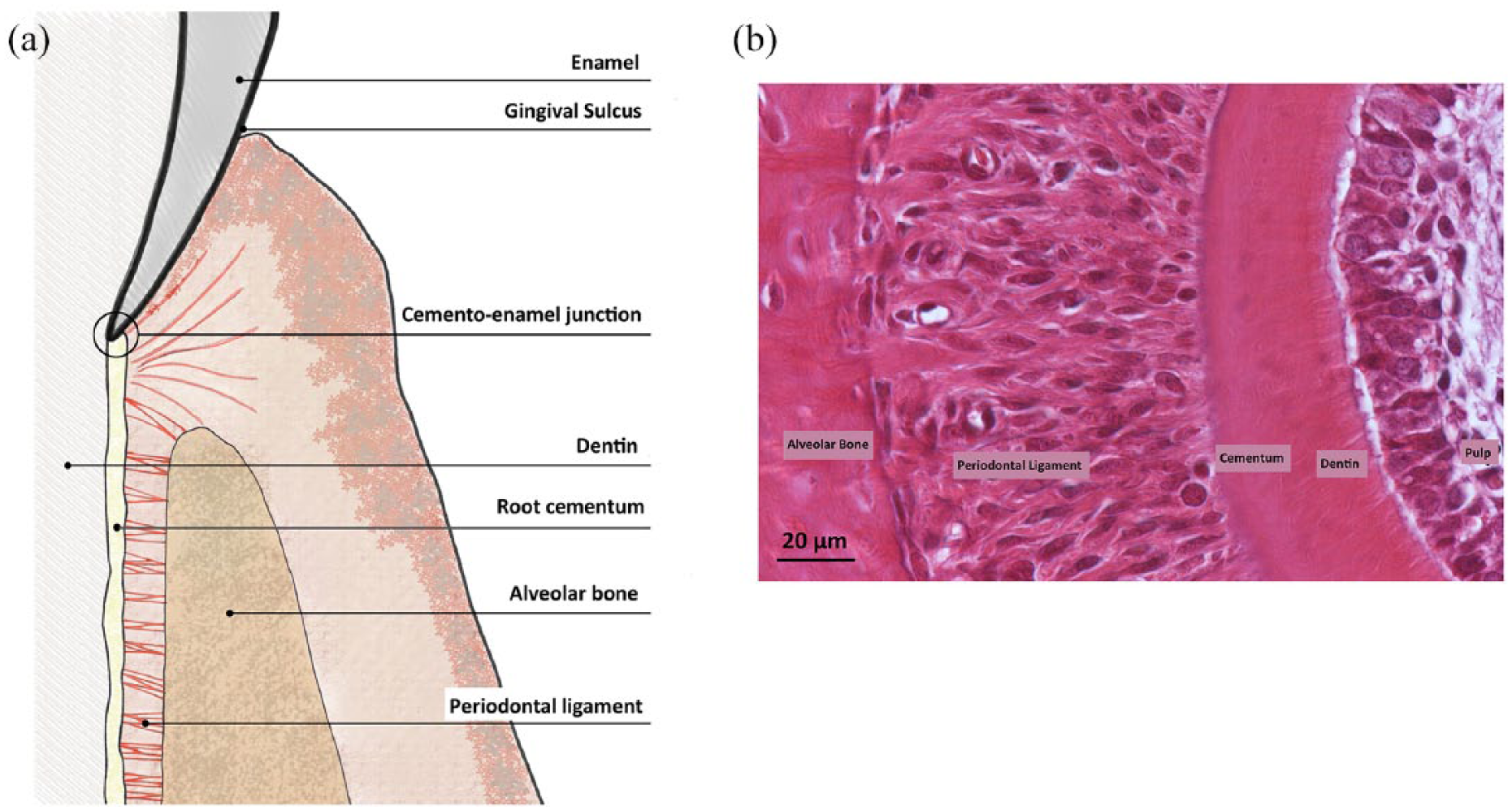
(a) Anatomy of periodontal apparatus. Four tissues compose the periodontal complex: alveolar bone, gingiva with gingival sulcus, root cementum, and periodontal ligament connecting alveolar bone to cementum. (b) Histological image of the periodontium. The tissues drawn in Figure 1(a) are shown in a histological image showing a horizontal section of a rat’s tooth. Hematoxylin eosin. Original magnification 600×.
The goal of periodontal therapy is to arrest the development of periodontal disease and, when possible, to regenerate the lost periodontal tissues, restoring both anatomy and function. Researchers are now focusing on techniques, biomaterials, and treatments that might result in the full recovery of the periodontal tissues,4–6 and when the tooth is lost and/or the alveolar bone heavily resorbed, in the preservation and/or the reconstruction of the bone in a predictable, reproducible, and simple way. 7 The application of growth factors into the defect has shown encouraging effects in periodontal regeneration; 8 however, this therapeutic approach does not allow controlling the spatio-temporal distribution and activity of these proteins. To overcome these limitations, the use of highly compartmentalized scaffolds for molecules’ delivery and gene therapy has been proposed4,9,10 (Figure 2).
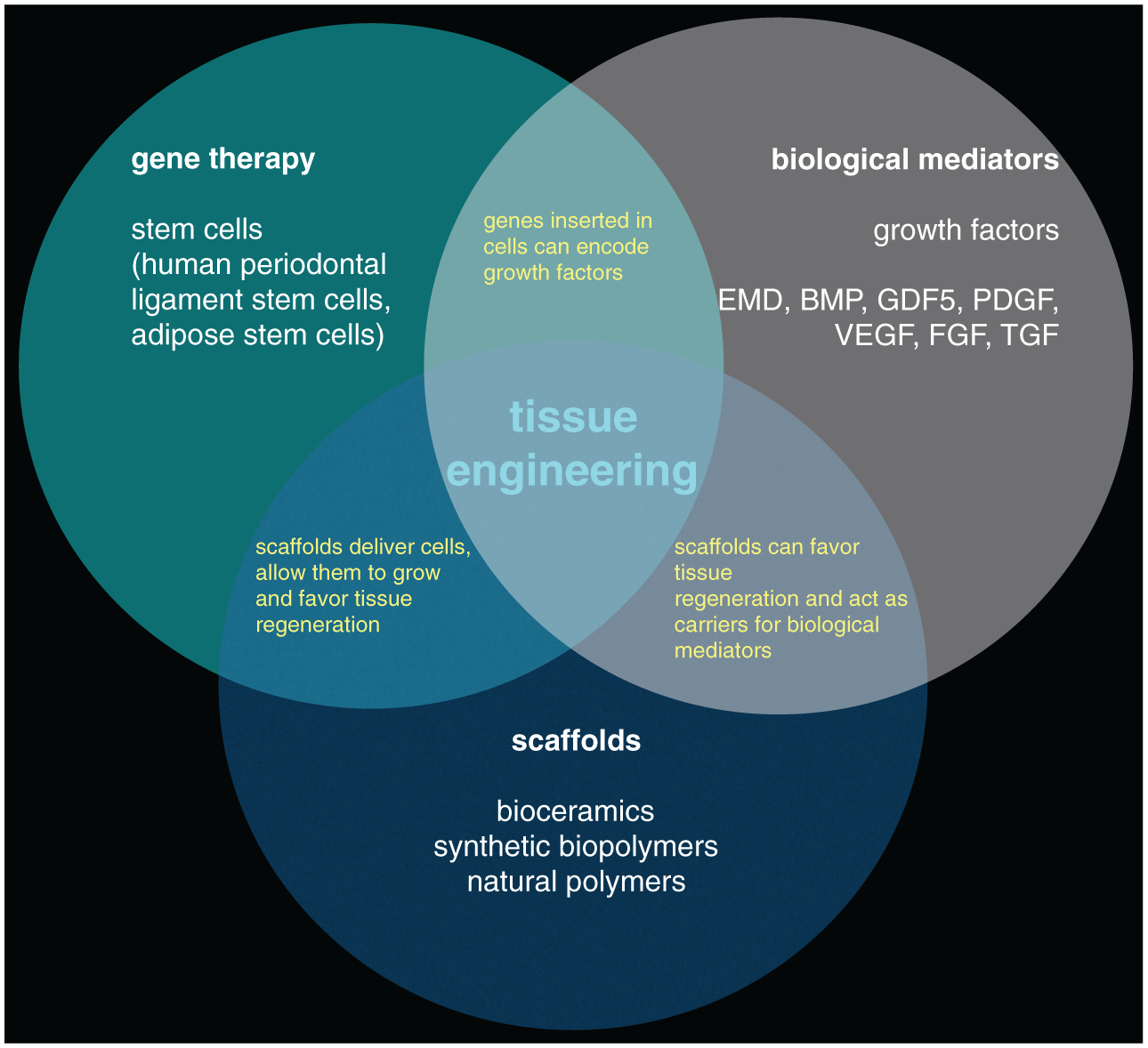
Scheme of regenerative periodontal therapy biotechnological approach. Schematic image representing how the principles of tissue engineering discussed in the text interconnect in periodontology.
The aim of this comprehensive review is to provide the most updated state of the art on tissue engineering in periodontology with focus on biological mediators and gene therapy.
Growth factors
Growth factors are proteins that affect cell differentiation and division, in order to stimulate the growth of specific tissues. Together with the transforming growth factor β (TGF-β) family, bone morphogenetic proteins (BMPs), growth differentiation factors (GDFs), inhibins, and activins belong to the TGF-β superfamily, a group of proteins involved in growth, development, tissue homeostasis, and regulation of the immune system. 11
Growth factors are proteins expressed in the tissue during its physiological remodeling activity or following a trauma, that guide the cellular behavior toward proliferation and differentiation. To be effective, they should reach their biological target in an adequate dose and following a specific timing. Gene expression and stem cells differentiation finely regulate their production. In addition, such factors can, thus, be delivered directly at the specific site or be loaded on scaffolds, alone or in combination with other molecules in form of cocktails, allowing their release in a controlled manner.
The growth factors tested, so far, for periodontal regeneration are the following ones: enamel matrix derivate (EMDs), BMP, growth differentiation factor 5 (GDF-5), platelet-derived growth factor (PDGF), vascular endothelial growth factor (VEGF), fibroblast growth factor (FGF), and transforming growth factor (TGF). PDGF, VEGF, FGF, and TGF-β derive from platelets, and they are included in platelets concentrates. Table 1 provides a summary of such growth factors and their main target and/or action.
Growth factors used in regenerative periodontal therapy with sources of derivation, main targets of action, experimental tests and commercial availability.
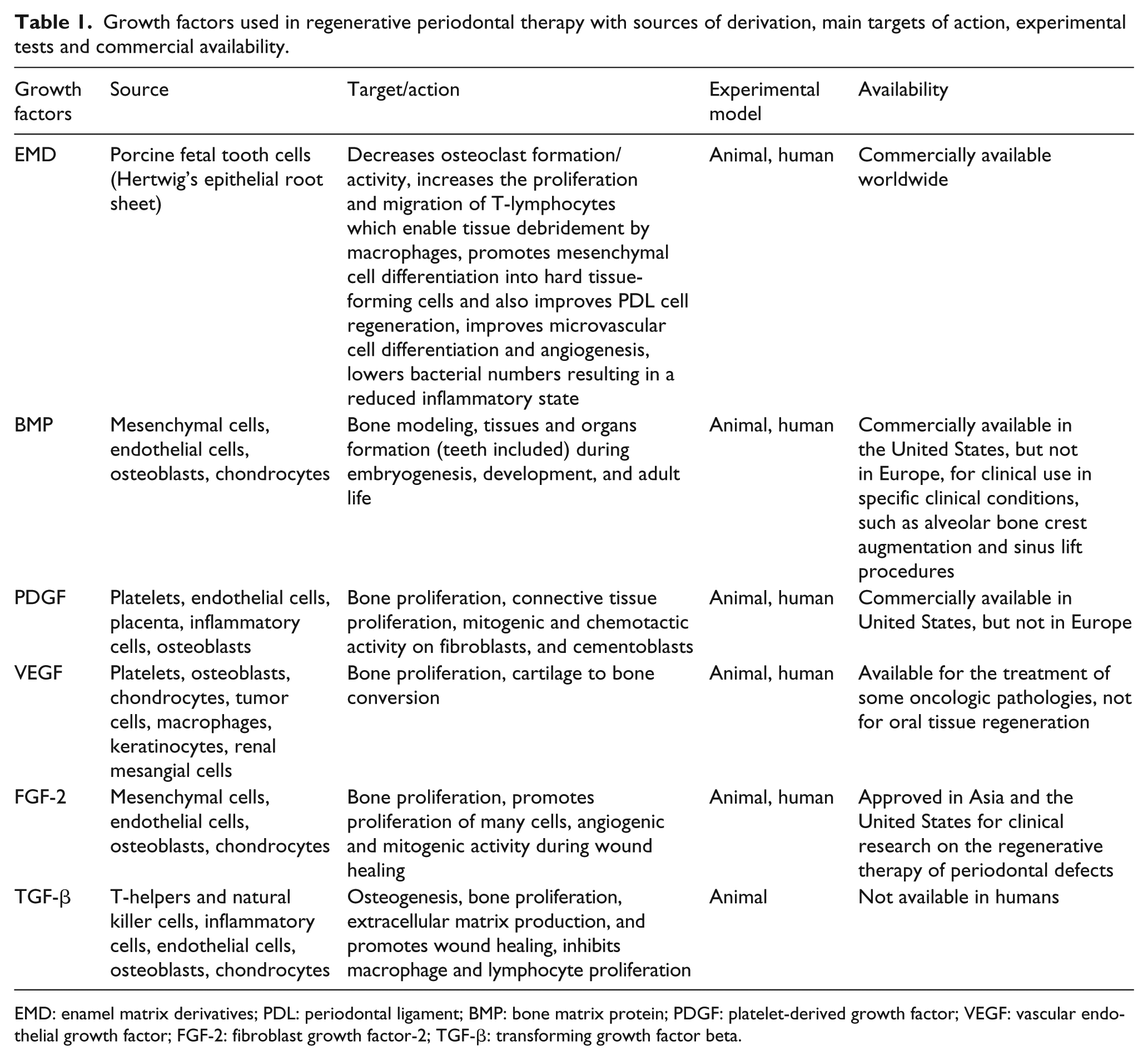
EMD: enamel matrix derivatives; PDL: periodontal ligament; BMP: bone matrix protein; PDGF: platelet-derived growth factor; VEGF: vascular endothelial growth factor; FGF-2: fibroblast growth factor-2; TGF-β: transforming growth factor beta.
Table 2 summarizes the main findings of the trials included in the following sections.
Summary of the main findings of trials reported in the text.
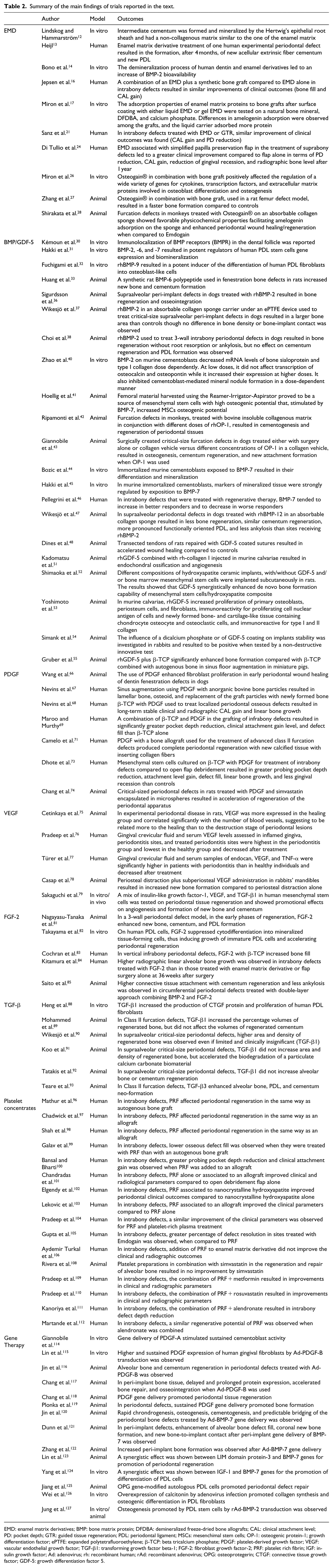
EMD: enamel matrix derivatives; BMP: bone matrix protein; DFDBA: demineralized freeze-dried bone allografts; CAL: clinical attachment level; PD: pocket depth; GTR: guided tissue regeneration; PDL: periodontal ligament; MSCs: mesenchimal stem cells; OP-1: osteogenic protein-1; growth differentiation factor; ePTFE: expanded polytetrafluoroethylene; β-TCP: beta tricalcium phosphate; PDGF: platelet-derived growth factor; VEGF: vascular endothelial growth factor; TGF-β1: transforming growth factor beta-1; FGF-2: fibroblast growth factor-2; PRF: platelet rich fibrin; IGF: insulin growth factor; Ad: adenovirus; rh: recombinant human; rAd: recombinant adenovirus; OPG: osteoprotegerin; CTGF: connective tissue growth factor; GDF-5: growth differentiation factor 5.
EMDs
EMDs (amelogenins) are well-known bioactive molecules, which are involved in tooth, root, and cementum formation. 12 They have been reported for the treatment of periodontal intrabony defects 20 years ago by Heijl. 13 Such proteins derive from the Hertwig’s epithelial root sheet, self-assemble to form an extracellular matrix, and control the organization of the enamel components. Concerning the cellular level, EMDs can influence different cell types in terms of cell attachment, proliferation, and differentiation; they also play a role in the expression of growth factors, cytokines, and other mediators that control bone remodeling.8,14 Concerning wound healing, EMDs promote soft tissue regeneration and angiogenesis. Animal experiments and clinical trial on the use of EMDs for regenerating different types of periodontal defects have shown better results than open flap debridement alone, in terms of bone formation and PDL and cementum regeneration. Nevertheless, results were not always consistent: 15 EMDs’ contribution to periodontal regeneration may rely on other factors, such as the type of wound and the clinical conditions of patient, 16 the type of bone graft used, and the absorption and stability of amelogenins at the target site. 17
Overall, EMDs can promote periodontal regeneration when used in association with a surgical approach, with or without bone grafting, for the treatment of periodontal defects. More in detail, the use of EMDs has been investigated, over the last two decades, in almost 1000 studies, including in vitro, in vivo, and in human trials. 18 When applied alone in the treatment of intrabony defects, EMDs have shown positive, though highly variable, results in improving clinical attachment level (CAL) and probing pocket depth (PPD) reduction,19,20 similar to those achieved with guided tissue regeneration (GTR), though the latter was more frequently associated with complications. 21 When used together with bone grafts or GTR, 22 most studies report no further benefit. EMDs have been tested in soft tissue surgery for the correction of gingival recessions and, given the known variability of this procedure, have resulted in similar or better results over coronally advanced flaps alone or associated with connective tissue grafts. 23 Concerning supra-bony defects, few studies now available have reported clinical success in terms of PPD and CAL, when EMDs were associated to flap surgery.24,25
EMDs have a fluid consistency due to their propylene glycol alginate (PGA) carrier and do not have the capacity of maintaining space. To overcome this problem, EMDs are often used in association with graft materials that aim at preventing flap collapse during the process of regeneration. However, the use of graft materials has risen the question whether EMDs mixed with grafts are available at adequate amounts, once placed at the target site. As a consequence, research has recently focused on studying and developing amelogenins in a liquid form without PGA: the result is a product (Osteogain®) that improved cell adhesion, proliferation, differentiation of osteoblasts in vitro, protein adsorption, surface coating, penetration within the graft materials, and a gradual release of amelogenins over time. 26 Osteogain®, tested in an animal model together with a bone derivative, resulted in a faster new bone formation at defects created in rats femur, compared to negative controls and defects filled with natural bone mineral alone. 27 Shirakata et al., 28 in 2016, compared Osteogain®, used with an absorbable collagen sponge, to Emdogain® for the treatment of class III furcation defects in non-human primates. A larger amount of amelogenin was adsorbed on Osteogain® than on Emdogain®, resulting in higher amounts of new attachment, cementum, and bone, although no complete fill of the furcation defects was reached in any case. 28
BMPs and GDF-5
BMPs have been discovered about 40 years ago by Marshal R. Urist, who described a series of proteins hosted in the bone matrix, able to induce bone tissue formation. BMPs are involved in bone modeling, tissues, and organs development (kidney, eye, nervous system, lung, teeth, skin, and heart). 29 There are about 20 known BMPs, which can be classified into subfamilies according to their sequence and function: BMP-2, BMP-3 (osteogenin), BMP-4, BMP-5, BMP-6, BMP-7 (osteogenic protein-1), BMP-8, BMP-14 (also known as GDF-5 and cartilage-derived morphogenetic protein 1), BMP-9, BMP-10, BMP-12 (also known as GDF-7), and BMP-13 (also known as GDF-6).
BMPs, together with their receptors, have been found within the periodontal tissue. 30 BMP-2, BMP-3, BMP-7, and GDF-5, 29 in particular, were investigated for their potential to enhance periodontal wound healing and regeneration. While BMP-3 and BMP-7 localize mainly to alveolar bone, cementum, and PDL, BMP-2 localizes to alveolar bone stringently. Predentin, dentin, odontoblasts, osteoblasts, osteocytes, osteoid, cartilage, and chondrocytes positively expressed all these three BMPs, while ameloblasts were positive just for BMP-7.
As Hakki et al. 31 showed in vitro using human stem cells derived from third molar PDL, BMP-2, -6, -7, and -9 regulated the mRNA expression of mineralized tissue-associated genes, affecting PDL formation. 31 In human PDL fibroblasts, in particular, BMP-9 was more effective than BMP-2 in enhancing alkaline phosphatase activity, thus promoting the expression of bone-related genes and tissue mineralization. 32 Along these lines, Huang et al. 33 reported the use of BMP-6 loaded in a collagen sponge to manage periodontal fenestration defects in rats: at week 4, complete bone healing and cementum formation was observed.
BMP-2 and BMP-7 are now approved by the Food and Drug Administration (FDA) for clinical use under certain clinical conditions, including alveolar bone crest augmentation and sinus lift procedures. 34 Several studies on sinus lift confirmed an important increase in bone tissue ingrowth, especially when BMP-2 is used. In a recent systematic literature review, Freitas et al. 35 reported that BMP-2 can be successfully employed in alveolar bone crest preservation. In addition, BMP-2, tested to treat supraalveolar periodontal defects in animal models, resulted in higher bone deposition, but limited cementum formation, and dental root resorption and ankylosis.36–39 Evidence suggests that BMP-2 cannot promote cementum and PDL regeneration, 38 as it inhibits differentiation and mineralization of cementoblasts. 40 Differently from BMP-2, BMP-7 is involved in osteogenesis, angiogenesis, and PDL regeneration.34,41 Both Ripamonti et al. 42 in baboons and Giannobile et al. 43 in dogs used this BMP for the treatment of furcation defects and observed newly formed cementum together with Sharpey fibers and a PDL-like tissue; nevertheless, root resorption and ankylosis at the regenerated sites were observed. BMP-7 can promote cementogenesis when it is in contact with dentine extracellular matrix, 42 promoting cementoblast differentiation and mineralization activity.44,45 In a study in humans, Pellegrini et al. 46 evaluated the levels of BMP-7 and matrix metalloproteinase-1 following regenerative therapy or open flap debridement in the treatment of periodontal pockets and observed that BMP-7 increased in patients who better responded to therapy.
Nonetheless, BMP-12 has been successfully used subcutaneously and intramuscularly in inducing tendon formation and ligament-like tissues. In a pilot study, Wikesjö et al. 47 compared the effect of BMP-12 to BMP-2 in treating supraalveolar periodontal defects, in dogs: BMP-2 stimulated bone regeneration and resulted in root ankylosis more frequently than BMP-12, although cementum regeneration was similar.
BMP-14 (also called GDF-5 or cartilage-derived morphogenetic protein-1 (CDMP-1)) shares about half of sequence homology with BMP-2 and BMP-7. It plays a critical role in cartilage, bone, tendons, joints, and ligaments development and formation48,49 and is angiogenic. 50 BMP-14 has been studied in various experimental models in association with different carriers and has shown to act on mesenchymal cell differentiation: this protein enhances intra-membranous or endochondral ossification, depending on the carrier where it is loaded on,51,52 by up-regulating the expression of genes related to pre-osteoblast and secretory osteoblast phenotypes. BMP-14 has been tested with promising results for enhancing bone, cartilage, and tendon/ligament formation and repair, and for the treatment of long bone fractures and osteotomies. 49 When applied to calvarial defects in rats and mice, BMP-14 promoted new bone deposition; 53 thus, BMP-14 was proposed as coating for titanium implants, 54 even in association with sinus lift procedures in guinea pigs, 55 resulting in an acceleration of bone formation and higher implants osseointegration and stability. Consistently, in saddle-like alveolar defects in dogs, 56 BMP-14 resulted in significantly enhanced local bone formation and implants osseointegration, compared to control sites treated with beta tricalcium phosphate (β-TCP). Similar results were obtained in lateral jaw augmentation procedures using particulate or block bovine biomaterials with both recombinant human (rh)BMP-14 and rhBMP-2. 57 Always in dogs, Polimeni et al. 58 tested rhBMP-14 coated implants in critical-size supramandibular defects and showed the implants successfully osseointegrated with increased bone deposition in presence of the protein, following a dose-dependent manner. Furthermore, BMP-14 is also involved in the development of periodontal apparatus, 59 since its expression in PDL, alveolar bone, and cementum has been observed in rats during root development, especially at those sites where the ligament fibers were inserting in cementum. BMP-14 down-regulation, in turn, occurred once the root development was completed. BMP-14 was detected in human periodontal cells, during mitosis and matrix depositing activity, but not during osteoblastic differentiation. 59 In intrabony one-wall defects in dogs,60,61 BMP-14 produced highly oriented PDL-like tissue and, significantly, more bone and cementum formation compared to controls (i.e. β-TCP, collagen sponge, or surgery alone). The association of BMP-14 and β-TCP provided the best results, probably because the biomaterial allowed preserving the space and stabilizing the wound. These findings were consistent with further studies62,63 which compared BMP-14 to PDGF, after their loading on β-TCP scaffolds: significantly higher bone and cementum formation were observed in the defects treated with BMP-14. Along this line, Stavropoulos et al. 64 investigated, in a clinical trial, the effect of BMP-14 associated with β-TCP over the surgery alone, to treat severe periodontal lesions. They observed that BMP-14 treated sites were characterized by more favorable, although not statistically different, results concerning PPD reduction, CAL gain, alveolar bone, and periodontal regeneration compared to controls. 64
Further randomized clinical trials are necessary to validate the promising role of BMPs in periodontal tissues regeneration, including larger populations.
PDGF
PDGF is a platelet-derived protein that plays a key role on the healing of periodontal tissue by enhancing proliferation and chemotactic activities of fibroblasts and cementoblasts. 65 PDGF presents several isotypes (AA, AB, BB). Wang et al. 66 demonstrated in a dog model that the application of PDGF on root surfaces enhanced fibroblast proliferation at 1 and 7 days after surgery when compared to the groups without PDGF.
Recombinant human PDGF isotype BB (rhPDGF-BB) has been approved by FDA for regenerative therapy of periodontal defects and it is commercially available in United States, but not in Europe. 67 This growth factor has been tested clinically in both intrabony and furcation periodontal lesions. In intrabony defects, PDGF-BB + β-TCP demonstrated improved clinical and radiographic regenerative response compared to control sites treated with β-TCP alone.68,69 A case report showed the first application of a customized 3-D printed bioresorbable scaffold embedded into PDGF-BB solution for the treatment of intrabony defects in a patient, 70 although to date clinical trials are lacking. Histologic analysis on class II furcation defects treated with PDGF + demineralized freeze-dried bone allograft resulted in the regeneration of bone, cementum, and PDL coronal to the original osseous crest and to a reference notch. 71 Recently, systemic reviews and meta-analyses found that sites treated with PDGF-BB + β-TCP had significantly more of bone percentage fill, more linear defect fill, and higher gain of CAL compared to those treated with β-TCP alone.65,72
To increase the regenerative potential of PDGF-BB on wound sites, this growth factor has been associated with stem cells and drugs. Mesenchymal stem cells cultured on β-TCP produced significantly higher clinical and radiographic benefits compared to open flap debridement. 73 PDGF-BB associated with the differentiation factor simvastatin, encapsulated in microspheres, accelerated the regeneration of periodontal tissues in critical-size periodontal defects of rats. 74
VEGF
VEGF is a protein mainly involved in vasculogenesis and angiogenesis, but also in cartilage physiology, hematopoiesis, wound healing, proteolytic enzyme secretion, and migration through chemotaxis. Others types of cells, including tumor cells, macrophages, platelets, keratinocytes, and renal mesangial cells, can produce VEGF.
The role of VEGF in periodontal inflammation needs to be fully understood, yet. VEGF (mainly isoform A) in human gingival biopsies or crevicular fluid has been shown to be overexpressed during gingivitis, periodontitis, and peri-implantitis, particularly in the aggressive forms, compared to healthy tissues and during periodontal healing.75,76 A recent study by Türer et al. 77 showed VEGF levels, together with other biomarkers, were higher in patients with periodontal disease than controls, and decreased following cause-related therapy. In addition, VEGF promoted osteogenesis in a rabbit model of mandibular periosteal distraction 78 and, when associated with β-TCP and a fibrin sealant, promoted larger bone healing, compared to scaffold and fibrin sealant alone, in critical-size bone defects. All together, these findings suggest that VEGF is involved in periodontal and bone healing; thus, it has been proposed for periodontal regenerative therapy in cocktails with other factors, 79 and/or associated with scaffolds. In a clinical trial involving patients having two-wall intraosseous defects, Devi and Dixit 80 investigated VEGF associated with recombinant human insulin-like growth factor-I (rh-IGF-1), β-TCP, and polylactide-polyglycolide acid (PLGA) membrane during the post-surgical healing period. Six months later, sites treated with IGF-1 and VEGF resulted in greater improvement in periodontal PPD reduction, CAL gain, and osseous fill (95.8%) compared to sites treated with VEGF alone (>50% bone fill), IGF-1 alone, or control sites. A recent study, 54 using a dog class II furcation defect model, has evaluated the regenerative effect of a cytokine cocktail, which included IGF-1, VEGF-A, and TGF-β1, on periodontal tissues in comparison with EMD: after histological analysis, the cytokine cocktail significantly promoted osteogenesis and angiogenesis, while cementogenesis was similar to EMD. 54
Fibroblast growth factor-2 (FGF-2)
FGF-2 has been studied for periodontal regeneration because of angiogenic and mitogenic activity during wound healing. This protein accelerates the proliferation of fibroblastic cells, enhances the angiogenesis, and increases the expression of BMP-2 and osteoblast differentiation markers, thus promoting bone deposition. 81 Takayama et al. 82 observed in vitro that FGF-2 enhanced the proliferative responses of PDL cells, while inhibiting their mineralizing activity and the induction of alkaline phosphatase. The suppression of cytodifferentiation of PDL cells into mineralized tissue-forming cells by means of FGF-2 might lead to an acceleration of periodontal regeneration. 82
FGF-2 has been approved in Asia and the United States for clinical research purposes on periodontal regenerative therapy. A recent randomized clinical trial in 88 patients, in which FGF-2 at different doses alone was compared to human recombinant (rh)FGF-2 + β-TCP in the treatment of intrabony periodontal defects, demonstrated that rhFGF-2 + β-TCP and the highest doses of FGF-2 leads to increased bone fill over controls or the FGF-2 lower doses. 83 Similar data have been reported in recent systemic reviews and meta-analyses that found a statistically significant higher bone fill and linear bone growth using rhFGF-2 + β-TCP than using the carrier alone.65,72 A large multicentric clinical trial showed the superiority of rhFGF-2 to EMD and open flap debridement for the treatment of patients with pockets of 6 and 4 mm or deeper and intrabony defects. 84 Finally, in a dog model, FGF-2 showed enhanced new bone formation, connective tissue attachment, and cementum regeneration when associated with BMP-2 in double-layer, besides reducing ankylosis compared. 85
TGF-β
TGF-β is the first discovered cytokine of the TGF-β superfamily. TGF-β is produced by all body cells in the extracellular matrix in three isoforms: TGF-β 1, 2, and 3. All cells possess receptors for TGF-β, as well. This cytokine is involved in many biologic processes, such as cellular proliferation and differentiation, embryonic development, wound healing, and angiogenesis. 86 In particular, TGF-β1 can promote proliferation of mesenchymal cells 87 and production of extracellular matrix also in PDL fibroblasts. 88
TGF-β1 was investigated in class II furcation defects experimentally obtained in sheep premolars and proved to promote bone regeneration, especially when used in association with GTR, without effects on cementum formation. 89 In contrast, rhTGF-β1 failed to enhance GTR, in supraalveolar critical-size periodontal defects surgically obtained around dog premolar teeth. 90 In order to understand whether rhTGF-β1 is active or inactive once used in vivo, in a similar experimental model, some researchers investigated its capacity to promote biodegradation of calcium carbonate particles used as cytokine carrier.91,92 Consistently with previous findings, no increased new bone formation could be found, but the density of the calcium carbonate carrier was reduced at sites receiving rhTGF-β1 compared to controls.91,92
TGF-β3 associated with Matrigel® was successfully tested for treating class II furcation defects surgically obtained in the molars of non-human primates.39,93
Platelet concentrates (PC) in periodontal regenerative therapy
PC are blood extracts, obtained after processing a whole blood sample, mostly via centrifugation.94,95 The first generation of PCs include platelet-rich plasma (PRP) and plasma-rich-in-growth factors (PRGF), both of which require anticoagulants to be used during processing, thereby resulting in a weaker fibrin clot. They are usually available in liquid or gel forms. A second generation of PCs, called leucocyte- and platelet-rich fibrin (L-PRF), derives from patient blood after centrifugation, and has excellent mechanical properties, displays a slow continuous release of growth factors over a 7–14 days period, and does not require the use of anticoagulants. 94
Most studies compared PCs to autogenous bone grafts 96 and allografts97,98 for bone regeneration and showed similar outcomes among these biomaterials, although one study showed, instead, more stable results with autogenous bone. 99 Moreover, several authors demonstrated that PCs greatly improved their performance when used in combination with bone grafts.100–102
In periodontal regenerative therapy, PCs have been used alone or in combination with other biomaterials and were proven to increase PPD reduction, CAL gain, and bone fill more than open flap debridement alone.100,103 PRF and PRP showed a similar performance. 104 Another study comparing the use of PRF and EMD showed that both products were effective in the regeneration of intrabony defects, but EMD resulted in a significantly higher percentage of defect healing. 105 The use of EMD and PRF, in combination, did not result in better outcomes than using EMD alone. 106 A recent meta-analysis of L-PRF used alone or in combination with other biomaterials for the surgical treatment of intrabony defects showed higher benefits in terms of PD reduction (mean difference: 1.1 mm, confidence interval (CI): 0.6–1.6), CAL gain (mean difference: 1.2 mm, CI: 0.5–1.9), and bone fill (mean difference 1.7 mm, CI: 1.0–2.3) when compared to open flap debridement alone. However, Castro et al. 107 concluded that standardized protocols for the preparation and use of L-PRF are needed.
Recently, combinations of PRF with various drugs having with osteoinductive properties, such as simvastatin and derivates, 108 have also been developed. Some of them (metformin 1%, 109 rosuvastatin 1.2%, 110 alendronate 1% 111 ) showed additional benefits, whereas other ones (atorvastatin 1.2% 112 ) did not produce a better performance than PRF alone.
Gene therapy
Wound healing is a sequence of events guided by molecular signals, which are expressed following a precise temporal and spatial order. The application of growth factors into the defect by means of carriers showed encouraging effects in periodontal regeneration; however, this therapeutic approach does not allow controlling the exact distribution and activity of these proteins within the site. Gene therapy helps to overcome some issues, such as growth factor cost, commercial availability, delivery at the site of interest, and half-life. This approach is based on the transfer of genetic material within a certain cell population to introduce, suppress, or manipulate specific genes, able to mediate the therapeutic effect. 4 Hence, gene therapy may induce a sustained production of protein/growth factor, directly and locally, by patient cells in a personalized manner. 4 In particular, two methods can be applied to deliver genetic material within the cells: in vivo, by transferring genes to a local or systemic cell population, or ex vivo, by transferring genes to a specific population of cells obtained from tissues. 4 Non-viral and viral vectors have been proposed to deliver genetic material to target cells. Plasmid and DNA polymer complex are non-viral vectors, show non-immunogenicity and low toxicity, and do not incorporate the DNA into the host genome. 4 The main disadvantage is the low transduction efficiency. 4 Viral vectors, instead, include adenovirus, lentivirus, retrovirus, and adeno-associated virus (AAV). Adenovirus can infect a variety of cells with no need to integrate into host genome; unfortunately, these vectors have potential immunogenicity and a transient expression. 4 AAV can infect dividing and not-dividing cells, have low immunogenicity, and are not pathogenic in human, but due to their small dimension, AAV can carry only small genes. 113
In regenerative periodontal therapy, gene therapy has been used to deliver several growth factors within the periodontal defect in order to promote mitosis, migration, differentiation, and synthesis of extracellular matrix of target cells, that is, cementoblasts, PDL fibroblasts, endothelial cells, keratinocytes, and osteoblasts. The final aim is to induce the simultaneous regeneration of periodontal tissues. 113 Gene therapy has the advantage, over the other approach, to overcome those limitations related to the topical delivery of growth factors within the periodontal defect, including transient biological activity, protease inactivation, and poor bioavailability.
Genetic material encoding for several proteins with stimulating activity on periodontal regeneration has been pre-clinically tested. An in vitro study demonstrated that PDGF-A gene delivery stimulates DNA synthesis and subsequent proliferation of cementoblasts. 114 The adenoviral vector encoding PDGF-B (AdPDGF-B) has been used to improve regeneration of periodontal and peri-implant defects. Human gingival fibroblasts transfected with rhPDGF-BB exhibited a higher and sustained signal transduction than those treated with a single dose of rhPDGF-BB. 115 PDGF-B gene delivery also demonstrated to stimulate alveolar bone and cementum regeneration in vivo. 116 The application of PDGF-BB in peri-implant defects produced an initial and robust mitogenic cellular response that turned within few days into osteogenic differentiation. 117 AdPDGF-B induced a delayed and prolonged protein expression that deferred the timing of osteogenic differentiation, and resulted in increased bone regeneration and implant osseointegration. 117 Furthermore, data on AdPDGF-BB delivered in a collagen matrix within periodontal lesions demonstrated an acceptable safety profile for possible use in human clinical studies. 118
Recently, a novel gene-activated matrix-delivering polyplexes of polyethylenimine (PEI)–plasmid DNA encoding PDGF was investigated for evaluating the transfection efficiency in human gingival fibroblasts and PDL fibroblasts, and also it was evaluated for promoting periodontal wound repair in rodents: the study showed a prolonged PDGF production by transfected fibroblasts that induced a delayed new bone formation. 119
Adenoviruses were also used as vectors for BMP-7 in periodontal and peri-implant defects. Fibroblasts transduced with adenoviral vector encoding BMP-7 (AdBMP-7) and transplanted into alveolar bone defects demonstrated rapid chrondrogenesis, with subsequent osteogenesis, cementogenesis, and predictable bridging of the periodontal bone defects in a rat model. 120 AdBMP-7 loaded on collagen scaffolds was also tested for the treatment of peri-implant defects and promoted bone regeneration over controls.121,122 An in vitro and in vivo study showed that a transcription variant of LIM domain mineralization protein, 123 namely AdLMP3, induced matrix mineralization in primary human PDL cells and, when combined to AdBMP-7, induced a significantly greater newly formed bone volume and tissue mineral content than AdBMP-7 alone. 121 Moreover, the synergistic effect of BMP-7 and IGF, using the gene delivery approach in human PDL cells, showed enhanced osteogenic differentiation, with the up-regulation of alkaline phosphatase activity and mRNA levels of collagen type I and Runx2. 124 PDL cells transfected with adenovirus encoding osteoprotegerin (AdOPG) and loaded on collagen membrane scaffold were transplanted into periodontal defects: improved cementum and alveolar bone formation were reported in comparison to membrane alone or membrane + non-transfected PDL cells. 125 Human PDL cells have been infected also with adenovirus carrying the calcitonin gene, and exhibited increased expression of TGF-β1, collagen type I and III, and osteoblastic markers including BMP-2/-4, alkaline phosphatase, and osteocalcin. 126
When applied to stem cells, gene therapy revealed promising results. Human PDL stem cells (hPDLSCs) were infected with adenovirus which encoded BMP-2 and they exhibited significantly higher expression of BMP-2 and alkaline phosphatase. These modified cells, when transplanted in ectopic sites, formed, at 8 weeks, a greater amount and better quality of bone than hPDLSCs alone, rhBMP-2 alone, or hPDLSCs + rhBMP-2. 127
To date, phase I/II clinical studies reported that gene therapy is a safe and promising treatment of several human diseases.128,129 For periodontal regeneration, the feasibility of both the in vivo and ex vivo approaches has been proved, but no clinical trials have been published yet.
Concluding remarks and future perspectives
This review has focused on describing the state of art concerning the use of biological mediators and gene therapy for periodontal regeneration. Overall, the research has been often experimental and carried out either using in vitro or in animal models, or involving particular clinical settings with experienced researchers. Many of the mediators described are not commercially available and allowed only for research in selected cases, except for EMDs, which have a long and successful literature history and are currently supported by preclinical and clinical evidences of efficacy. EMDs are now commercially available and widely used in everyday practice worldwide. Gene therapy, on the contrary, still needs to be better investigated, improving its application in periodontal regeneration, although most studies suggested its promising role. Further studies are expected to find further successful and easy-to-handle biological mediators as well as to deliver gene therapy efficiently. The final perspective will be to make them easily usable and commercially available for all specialists.
Footnotes
Declaration of conflicting interests
The author(s) declared no potential conflicts of interest with respect to the research, authorship, and/or publication of this article.
Funding
The author(s) received no financial support for the research, authorship, and/or publication of this article.