






Abstract
Panton-Valentine leucocidin producing methicillin-resistant Staphylococcus aureus infections are rare but associated with very high mortality rates. We report the case of a 14-year-old patient with Panton-Valentine leucocidin producing methicillin-resistant Staphylococcus aureus infection and Influenza B pneumonia requiring veno-arterial extra-corporeal membrane oxygenator for refractory shock. In the absence of response to conventional therapy, we have inserted a Cytosorb® cartridge within the extra-corporeal membrane oxygenator circuit. A spectacular decrease in vasopressor requirements followed. Since clindamycin, a key component of Panton-Valentine leucocidin producing methicillin-resistant Staphylococcus aureus treatment, might be removed by Cytosorb® hemoadsorption, we have performed serial plasma concentrations measurements of the drug. Based on these measurements, we were able to develop a pharmacokinetic model incorporating variable plasma clearance. Patient’s exposure was estimated before, during and after Cytosorb® hemoadsorption. According to this model, Cytosorb® hemoadsorption did not seem to result in significant clindamycin removal. Cytosorb® hemoadsorption during Panton-Valentine leucocidin producing methicillin-resistant Staphylococcus aureus infection appears safe and feasible and no adaptation of clindamycin dosage seems necessary
Keywords
Introduction
CytoSorb® (Cytosorbents, New Jersey, USA) is a new device designed for extra-corporeal blood purification by hemoadsorption (HA). CytoSorb® cartridges contain biocompatible polystyrene divinylbenzene copolymer beads capable of adsorbing molecules of medium molecular weight using a combination of hydrophobic interactions and size exclusion. 1 They can easily be inserted in most extra-corporeal circuits (extra-corporeal membrane oxygenator (ECMO) or renal replacement therapy (RRT)). CytoSorb has been shown to effectively remove pro- and anti-inflammatory cytokines from the blood 2 as well as exotoxins such as Staphylococcus α-toxin, toxic shock syndrome toxin-1 and Streptococcus pyrogenic exotoxin B as shown in vitro. 3 To date, the role of CytoSorb® HA in sepsis remains to be determined; however, it is sometimes considered in refractory septic shock.
Infections with Panton-Valentine Leucocidin (PVL) producing Staphylococcus aureus are associated with extremely severe presentations. 4 Necrotizing pneumonia, which involves primarily young and healthy patients, is associated with mortality rates up to 75%.5,6 In these situations, extra-corporeal cytokine removal and toxin clearance might be beneficial. However, given CytoSorb’ unselective adsorption properties, concerns can be raised about clindamycin removal by the technique. This is of major importance, since clindamycin represents the cornerstone of antibiotic therapy in such infections as this antibiotic has been shown to markedly decrease PVL expression. 7
We report the successful use of a Cytosorb® cartridge in a 14-year-old patient suffering from such a severe infection with refractory septic shock caused by PVL producing S. aureus and influenza. Plasma concentration monitoring allowed the development of a pharmacokinetic model accounting for clindamycin disposition. Patient’s exposure was estimated before, during and after Cytosorb® HA, to evaluate its impact on clindamycin disposition. The patient’s parents gave their written informed consent to publication.
Case presentation
Emergency services were called for a previously healthy 14-year-old patient (body weight 75 kg), with a 2-day history of flu-like symptoms, and a combination of altered mentation, fever, hypotension and hypoglycaemia. In the face of probable septic shock, he received fluids and vasoconstrictors as well as empiric antibiotic therapy (Ceftriaxone). He was intubated and protective ventilation was initiated. Despite these early measures, he remained hypoxic and hypotensive on hospital admission, with severe metabolic and respiratory acidosis on blood gases analysis. His condition continued to deteriorate despite further fluid resuscitation and corticotherapy, with increased vasoconstrictor need, worsened hypoxia and persistent lactic acidosis. Pulseless activity cardiac arrest occurred, followed with return of spontaneous circulation after 5 min of cardio-pulmonary resuscitation. A peripheral veno-arterial ECMO was inserted, and the patient was admitted to the paediatric intensive care unit (PICU).
Chest X-ray revealed bilateral infiltrates with nearly complete white left lung and blood tests were consistent with massive inflammatory syndrome (Table 1). Tracheal aspirates revealed Influenza B virus and PVL positive, methicillin-resistant S. aureus (PVL-MRSA). Anti-infectious therapy was switched to intravenous zanamivir, amoxicillin-clavulanate, vancomycin and clindamycin.
Inflammatory parameters in the first 10 admission days.
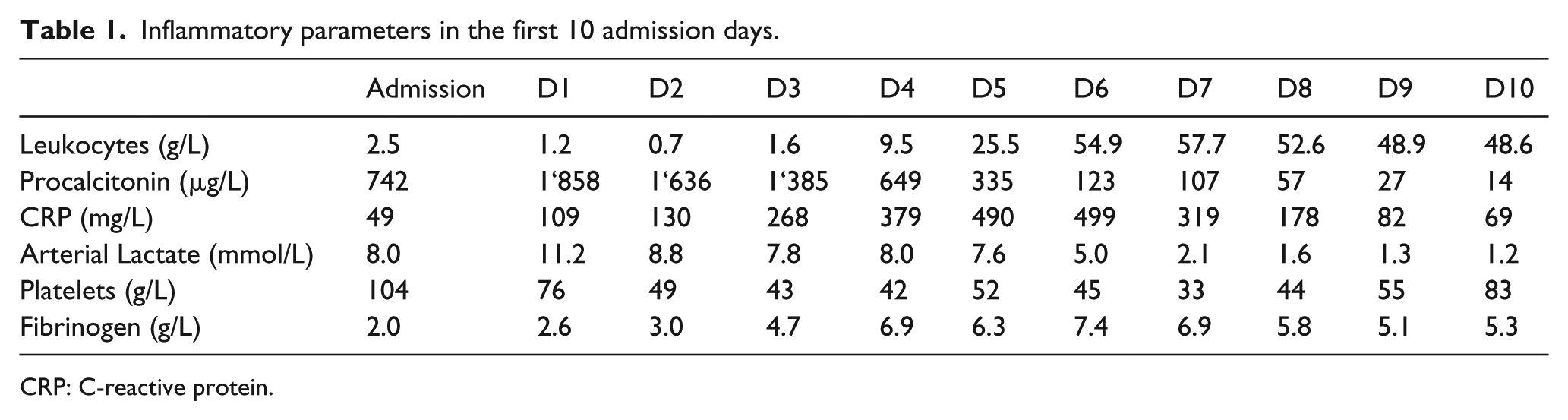
CRP: C-reactive protein.
On the following day, arterial cannulation was responsible of right leg ischemia requiring emergent thromboendarterectomy. Peripheral ECMO was converted to central ECMO.
Despite adequate anti-infectious therapy, the patient’s condition failed to improve with persistent lactic acidosis and high dose vasoconstrictors requirements over the following 3 days. At this stage, the decision to insert a Cytosorb® cartridge directly into the ECMO circuit was made, and the therapy was initiated on the evening of day 3 post admission. The first cartridge clotted 9 h after insertion due to inadequate setup. However, as shown in Figure 1, this insertion was followed with rapid haemodynamic improvement. Within 12 h of Cytosorb® therapy, we observed a rapid decrease in vasoconstrictors requirements and lactate level. Three further cartridges were then subsequently inserted for a total therapy duration of 81 h. Continuous RRT(continuous veno-venous hemofiltration, replacement fluid Multibic® 0 K-4 K, 25 mL/kg/h, heparin anticoagulation) was applied from day 6 to 10.
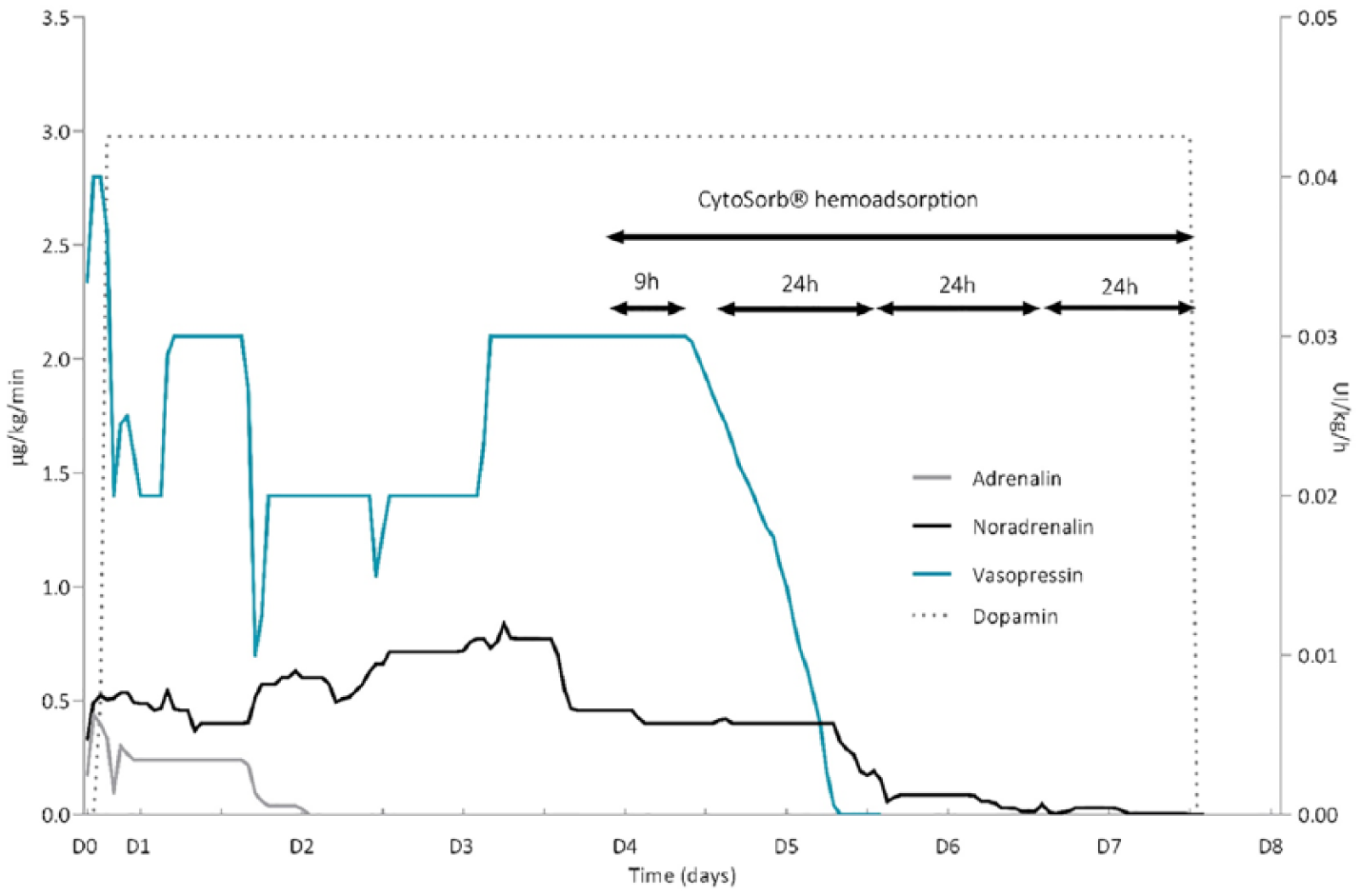
Evolution of vasopressor and inotropes in the first 7 admission days. Cytosorb®’s insertion within the ECMO circuit was associated with a rapid and sustained decrease in noradrenalin, vasopressin and dopamine requirements. A total of four adsorbers were consecutively inserted for a total duration of 81 h.
Despite these improvements, VA-ECMO could not be weaned until day 31, when it was transitioned to VV-ECMO (complete left lung necrosis and persistent air-leak). Tracheotomy was performed on day 36 and VV-ECMO weaned on day 39.
Unfortunately, due to right leg ischemia, transtibial amputation of the right inferior limb was required on day 43. Finally, a left pneumonectomy was performed on day 86.
The patient was discharged alive from ICU on day 114 and eventually from hospital on day 156 without any neurological sequels.
Pharmacokinetic study
Since Clindamycin is key in PVL-MRSA infections treatment, drug levels were closely monitored during HA therapy (Figure 2). The applied dosage remained constant throughout therapy. Several clindamycin blood samples were drawn at variable times after last dosing. A pharmacokinetic approach was thus required to interpret them. A one-compartment model was applied to predict plasma concentrations of clindamycin using published pharmacokinetic parameters. 8 An a priori plasma concentration curve was computed based on usual pharmacokinetics parameters (Figure 2). An a posteriori plasma concentration curve was also constructed, taking into account the observed plasma clindamycin concentrations, and assuming that variations in clindamycin clearance accounted for the observations. Therefore, clearance values were adjusted continuously by linear interpolation to bring predicted plasma concentrations close to the measured values. Distribution volume was assumed to be constant. Modelling was performed using Microsoft Excel 2016 (Microsoft Corp., Redmond, WA, USA) with the SolverTM add-on.
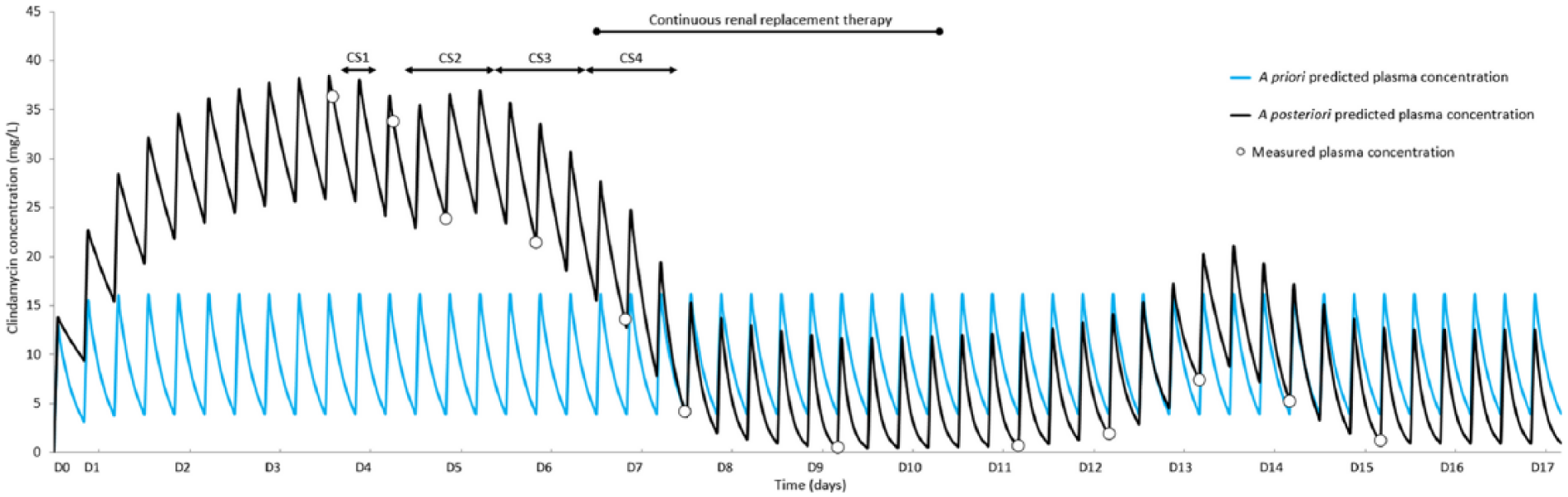
Clindamycin plasma levels throughout Cytosorb® therapy. Clindamycin plasma concentrations were estimated thanks to a pharmacokinetic model respectively a priori (blue line) and a posteriori (black line). The a posteriori model takes into account measured concentrations (open circles) over time. Cytosorb® sessions (CS) are indicated by black left right arrows. Continuous RRT is indicated by continuous line ended with circle markers.
Clearance values showed a high variability throughout the therapy. No significant changes were observed during the first two sessions (estimated clearance ranging between 3.6 and 4.1 L/h). A higher clearance was observed during the third (6.1 L/h) and mostly the fourth (15.5 mL/h) sessions. Given the extreme variability of these estimations and the absence of a rebound effect at the end of the therapy, it appears highly unlikely that these changes would be related to the adsorber but rather related to other processes of care in the context of a very sick patient. Hence, Cytosorb® does not seem to show any significant effect on the clindamycin plasma concentration.
Due to the severe septic state, the target trough clindamycin plasma concentrations was at least equal to the MRSA’s minimal inhibitory concentration (MIC) corrected for clindamycin protein binding (i.e. 95%, mainly to alpha-1-glycoprotein). As no MIC had been determined for the patient’s strain, we took the epidemiological cut-off values of 0.25 mg/L, leading to a target concentration of 5 mg/L. As all trough levels measured remained above this value, no dosage adaptation was required during the whole Cytosorb® HA treatment. Later on, sub-MIC concentrations were observed during the recovery period. At this stage, given the clinical improvement, the decision not to adjust drug dosage was made.
Discussion
We report a spectacular decrease in catecholamine requirement following Cytosorb® cartridge insertion within an ECMO circuit in a patient with refractory septic shock. The addition of the Cytosorb® cartridge to the ECMO circuit was practical and safe. No adverse events occurred.
Beyond the temporal association, the causative role of Cytosorb® in this striking improvement is plausible. Indeed, other authors have reported a clear beneficial effect of Cytosorb HA in a similar situation. 9 Although we do not have data to support this, it might be related to cytokine removal or by direct removal of the PVL toxin. Indeed, in vitro-studies have shown Cytosorb®’s ability to effectively remove exotoxins such as Staphylococcus α-toxin, toxic shock syndrome toxin-1 and Streptococcus pyrogenic exotoxin B. 3 However, the rapid correction of the leukopenia might represent an indirect sign of PVL toxin removal as this toxin is a known cytotoxic factor for human neutrophils.10,11
Potential benefits of Cytosorb® HA in such situation must be weighed against associated risks. In the context of a VA-ECMO, issues related to vascular access and anticoagulation are practically irrelevant. However, potential antibiotic removal through HA is a major concern, since these drugs are the only effective and causative therapy for sepsis.
Cytosorb® has been reported to only mildly adsorb aminoglycosides, piperacillin combined with tazobactam and carbapenems, with blood levels sustained at 80% of initial level. For those drugs, minor dosage adjustments are therefore suggested. 12 However, significant dose adjustments are required for piperacillin, linezolid and potentially for glycopeptides. Regarding clindamycin, a cornerstone medication against PVL producing MRSA, very little data are available. Some characteristics of clindamycin might predict its adsorption on HA cartridges. In a case report including only two measurements (pre- and post-device), a 15% decrease in clindamycin levels across the device was observed. 13 However, authors did not specify where in the circuit the samples were taken, hence sample issue, dilutional effect or other biases are not excluded. On the contrary, our observation, based on multiple plasma concentration measurements and a thorough pharmacokinetic model, suggests the absence of a significant adsorption of clindamycin on Cytosorb®. Consequently, no dosage adjustment seem required.
Of note, the initiation of continuous renal replacement therapy (CRRT), prior to Cytosorb® insertion, is unlikely to have influenced clindamycin pharmacokinetics since its primary route of elimination is hepatic 14 and is minimally affected by CRRT. 15
Conclusion
Cytosorb® HA within an ECMO circuit was associated with a spectacular recovery in a patient with refractory septic shock secondary to PVL-MRSA infection. According to our pharmacokinetic model based on multiple blood samples throughout the therapy, Cytosorb® HA did not result in significant clindamycin removal. Therefore, standard dosages can be applied during this therapy. Antibiotic therapeutic drug monitoring remain, however, strongly advised during Cytosorb® HA.
Footnotes
Acknowledgements
Elettra C Poli and Chiara Simoni as well as Thomas Ferry and Antoine G Schneider contributed equally to the work.
Declaration of conflicting interests
The author(s) declared no potential conflicts of interest with respect to the research, authorship, and/or publication of this article.
Funding
The author(s) disclosed receipt of the following financial support for the research, authorship, and/or publication of this article: Dr. A.G. Schneider is supported by a grant from the Leenaards Foundation.