







Abstract
Aim:
This research aimed to evaluate sleep quality and fatigue among individuals undergoing hemodialysis and to explore the determinants affecting these variables.
Methods:
This observational investigation was carried out among 78 who were regularly receiving hemodialysis therapy. The research was carried out between May and October 2025 in three different public hospitals among individuals undergoing hemodialysis treatment. Data were gathered using the Patient Information Form (PIF), the Fatigue Severity Scale (FSS), and the Pittsburgh Sleep Quality Index (PSQI).
Results:
The mean score of the hemodialysis patients on the FSS is 4.97 ± 1.11, and the mean PSQI value is 7.76 ± 3.64. A moderately positive and statistically noteworthy relation was observed between the PSQI and FSS scores. Additionally, a low negative meaningful correlation was seen between ferritin levels and the FSS scores, as well as between calcium levels and the PSQI scores. The use of medications related to chronic disease and the PSQI scores were identified as significant predictors of the FSS scores.
Conclusion:
Fatigue and sleep quality in individuals receiving hemodialysis treatment are related to each other, as well as to biochemical balance and treatment adherence.
Introduction
The commonness of poor sleep quality among dialysis patients has been reported to be considerably high, ranging from 11% to 97.5%. Low sleep quality has been shown to correlate not only with adverse physiological indicators, but also with depression, smoking, and stimulating behaviors. 1 In another study, 2 variables such as female gender, the type of primary renal disease, elevated systolic blood pressure, the presence and severity of pruritus, depression, restless leg syndrome and anxiety were shown to be connected with poor sleep quality. These conclusions imply that impairments in sleep quality may be linked to the presence of kidney failure and may be improved through appropriate interventions. Hence, describing and targeting risk factors connected with sleep quality in dialysis patients may represent a critical step in enhancing overall quality of life.
Another frequently encountered symptom that negatively impacts the lives of hemodialysis patients is fatigue. This is a multidimensional phenomenon that encompasses physical, emotional and psychological parts. 3 In addition to chronic fatigue, two specific fatigue patterns associated with the dialysis process have been identified in this patient group: (1) intradialytic fatigue (IDF), which begins before dialysis and persists throughout the treatment session, 4 and (2) post-dialysis fatigue (PDF), which emerges after the session and may last for several hours. 5 Indeed, fatigue has been identified as the most commonly reported symptom in 72% of patients undergoing hemodialysis treatment. 6
Although sleep disturbance and fatigue may appear to be independent conditions, they are thought to be interrelated through two primary mechanisms. The first involves sleep disturbances leading to excessive daytime sleepiness, and the second pertains to the biological mechanisms associated with various sleep disorders. Excessive daytime sleepiness, insomnia, sleep apnea and restless leg syndrome are commonly observed in patients undergoing hemodialysis. 7 Impairments in sleep initiation, adequacy and maintenance have been significantly connected with lower levels of vitality in patients.8,9 Furthermore, in a large-scale study involving 894 dialysis patients, symptoms of restless leg syndrome were found to be associated notably with poorer physical and mental health, reduced vitality, increased bodily pain, and poor sleep quality. 10 This study aims to examine the contributors to sleep quality and fatigue levels in patients undergoing chronic hemodialysis, who frequently experience multiple interrelated symptoms during the treatment process. In doing so, it is intended to contribute to the systematic evaluation of these symptoms in clinical follow-up and to support the development of strategies aimed at improving patients’ quality of life. Accordingly, the study seeks to answer the subsequent fundamental question: “Which factors influence sleep quality and fatigue levels in hemodialysis patients?”
Methods
Study design
The main goal of this cross-sectional research is to focus on the factors linked to sleep quality and fatigue levels in patients undergoing hemodialysis, and to contribute to improving patient well-being by emphasizing the importance of monitoring these symptoms within clinical follow-up procedures.
Sample and setting
The population of this investigation comprised patients undergoing hemodialysis at Bitlis State Hospital, Tatvan State Hospital, and Kelkit State Hospital. Conducted between May and October 2025, the study included all individuals who consistently participated in scheduled hemodialysis sessions at the aforementioned hospitals during this timeframe.
The sample consisted of individuals from the aforementioned population who were 18 years of age or older, literate, had been receiving hemodialysis treatment continuously for at least 3 months, and voluntarily agreed to participate in the study. Individuals who were not literate in Turkish, who had additional medical conditions that could influence symptoms of fatigue or weakness (e.g. heart failure, liver failure, malignancy, active infection, or malnutrition), or those who declined participation were excluded from the study. In line with these criteria, the aim was to reach all eligible individuals, and the research was completed with a total of 78 hemodialysis patients.
Data collection forms
Researchers personally administered the PIF, FSS, and the PSQI to collect the study data. The duration of data collection per participant averaged between 5 and 10 min.
Ethical considerations
The study received ethical approval from the Bitlis Eren University Ethics Committee for Non-Interventional Clinical Research (dated 16.04.2025, reference no: E.7177). Furthermore, institutional authorization was obtained from the hospitals in which the research was implemented (E-39320161-770-273727912; E-60037490-044-285270227). Received a full explanation of the goals and significance of the study, and the voluntary nature of their involvement was emphasized. Individuals who consented to participate were included after signing informed consent forms, and the research procedures were carried out in compliance with the ethical guidelines of the Declaration of Helsinki.
Statistical analysis
Statistical analyses were performed using IBM SPSS v27. Continuous variables were expressed as minimum–maximum and mean ± standard deviation, and categorical variables as frequencies and percentages. Statistical significance was set at p < 0.05. Skewness values within ±1 indicated normal distribution 16 ; therefore, parametric tests were used for scale scores. Pearson correlation was applied for normally distributed laboratory variables, and Spearman correlation for non-normally distributed variables. Multiple linear regression was conducted to determine the extent to which predictor variables explained variance in the dependent scale scores.
Results
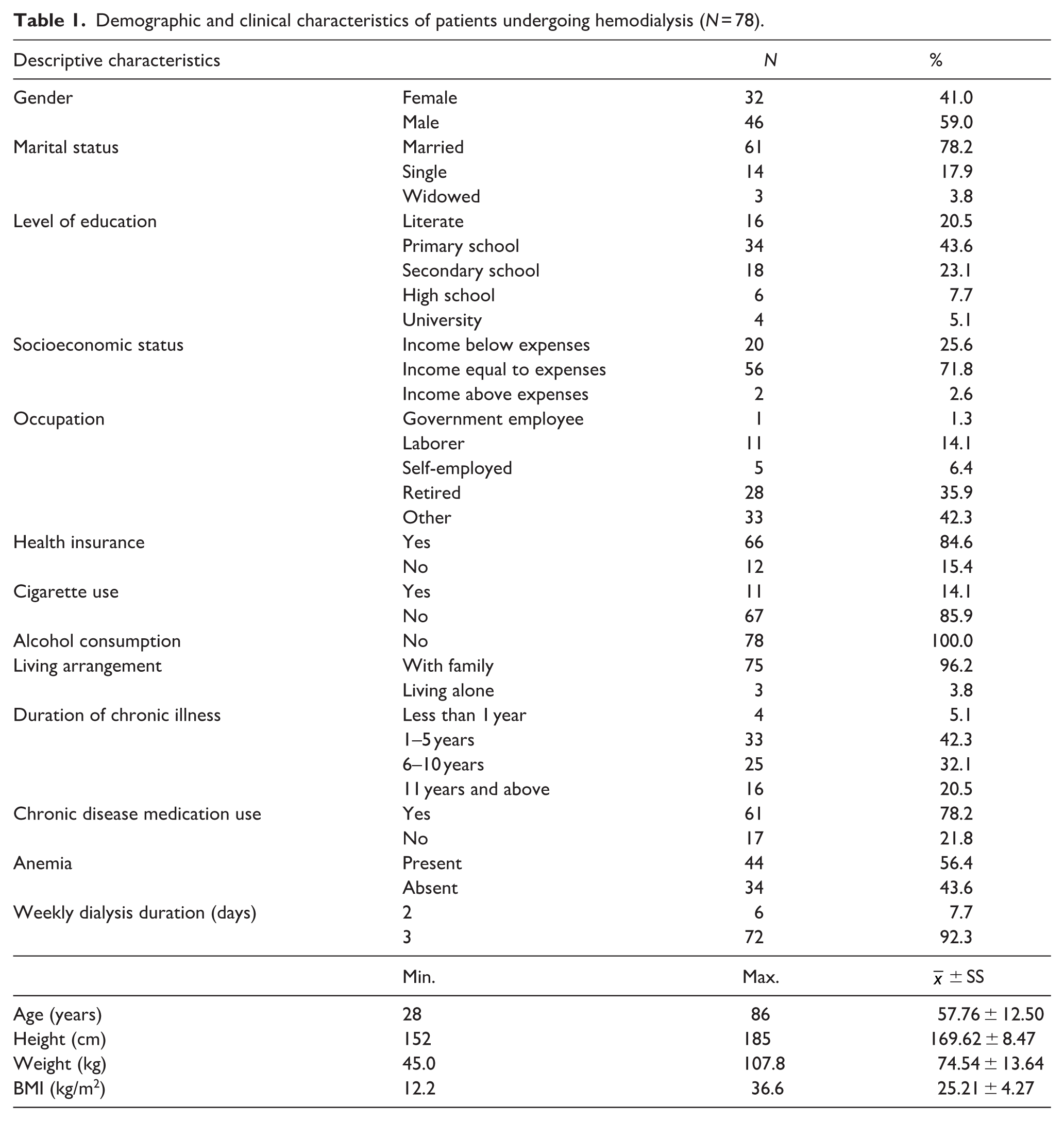
The demographic and clinical attributes of the study’s hemodialysis cohort are summarized carefully in Table 1.
Demographic and clinical characteristics of patients undergoing hemodialysis (N = 78).
We see that the mean FSS score of the hemodialysis patients is 4.97 ± 1.11, which is above the scale’s midpoint. Next, the mean PSQI score is 7.76 ± 3.64, which is below the scale’s midpoint. Moreover, a moderate, positive, and statistically meaningful relation was found between the PSQI and the FSS scores (r = 0.310, p < 0.01). This result indicates that poorer sleep quality is associated with greater fatigue severity (please check Table 2).
Descriptive statistics and correlation analysis of fatigue severity and sleep quality scores among hemodialysis patients (N = 78).
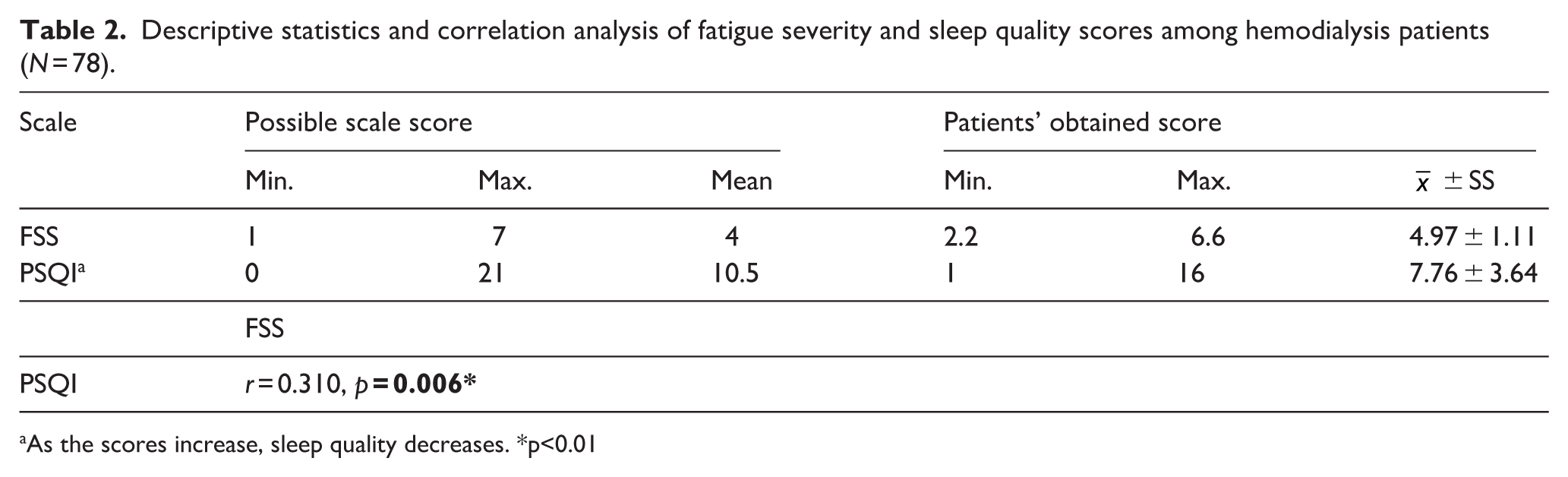
As the scores increase, sleep quality decreases. *p<0.01
A low, negative, and statistically noteworthy connection was identified between ferritin levels and the FSS scores (r = −0.252, p < 0.05). Similarly, a low, negative, and statistically significant correlation was observed between calcium levels and the PSQI scores (r = −0.236, p < 0.05). This finding indicates that higher calcium levels are associated with better sleep quality (please check Table 3).
Correlation analysis (N = 78).
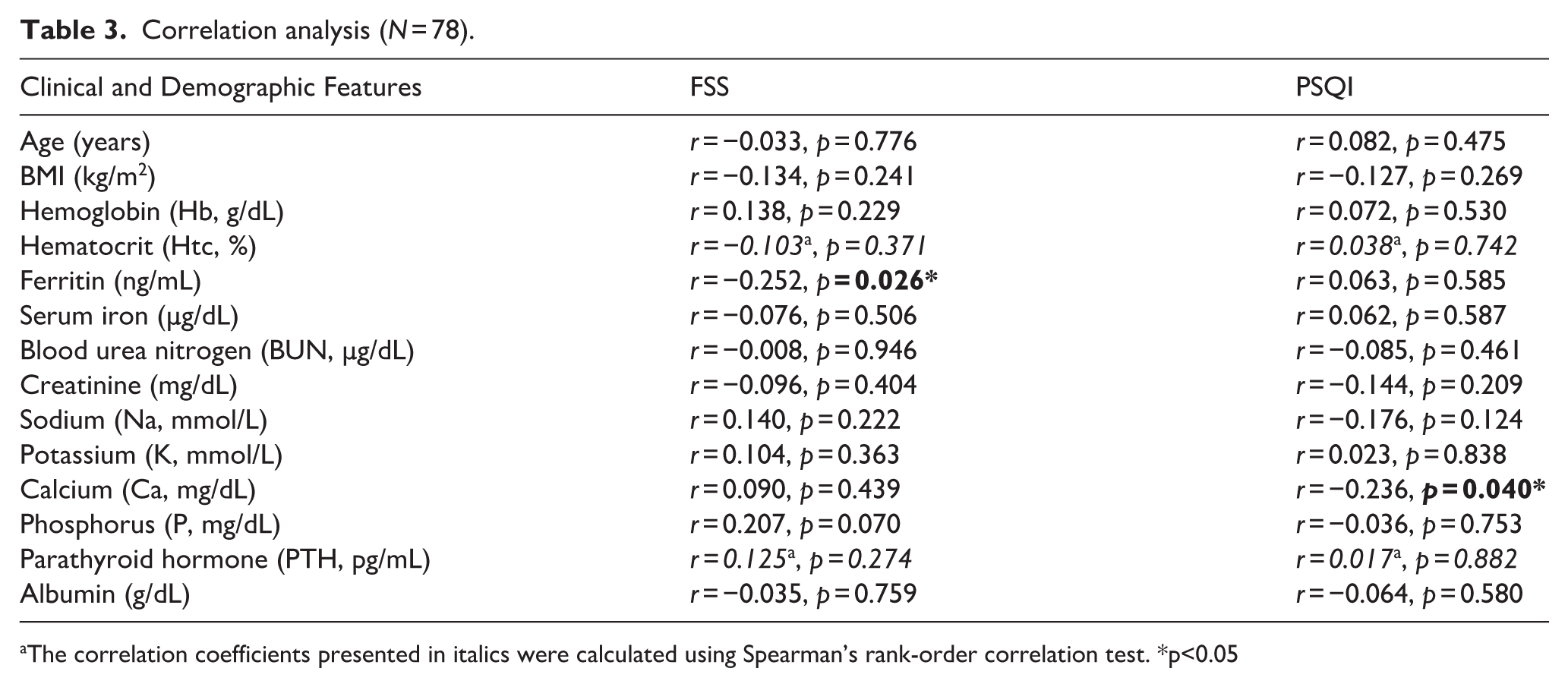
The correlation coefficients presented in italics were calculated using Spearman’s rank-order correlation test. *p<0.05
The outcomes of the multiple linear regression analysis undertaken to examine the effects of the hemodialysis patients’ descriptive characteristics, blood parameters, and the PSQI scores on their FSS scores are presented inTable 4. The VIF values for the predictor variables were within acceptable limits (<5), leading no significant multicollinearity among the independent variables. The Durbin–Watson statistic was not significant (p > 0.05), suggesting the absence of autocorrelation. These results indicate that the regression model is reliable. The overall regression approach was statistically notable (p < 0.05), and the predictor variables explained 21.5% of the variance in the Fatigue Severity Scale scores. Chronic disease medication use and the PSQI scores were significant predictors. The effect of chronic disease medication use on fatigue severity was positive, such that individuals who did not use medication had higher fatigue scores compared to those who did (β = 0.86, 95% CI [0.17–1.56], p < 0.05). Additionally, the PSQI scores were found to be a positive and significant predictor of fatigue severity (β = 0.32, 95% CI: [0.06–0.57], p < 0.05), demonstrating that lower sleep quality corresponds to greater fatigue severity (the reader may check Table 4).
Analysis based on a multivariate linear regression (N = 78).
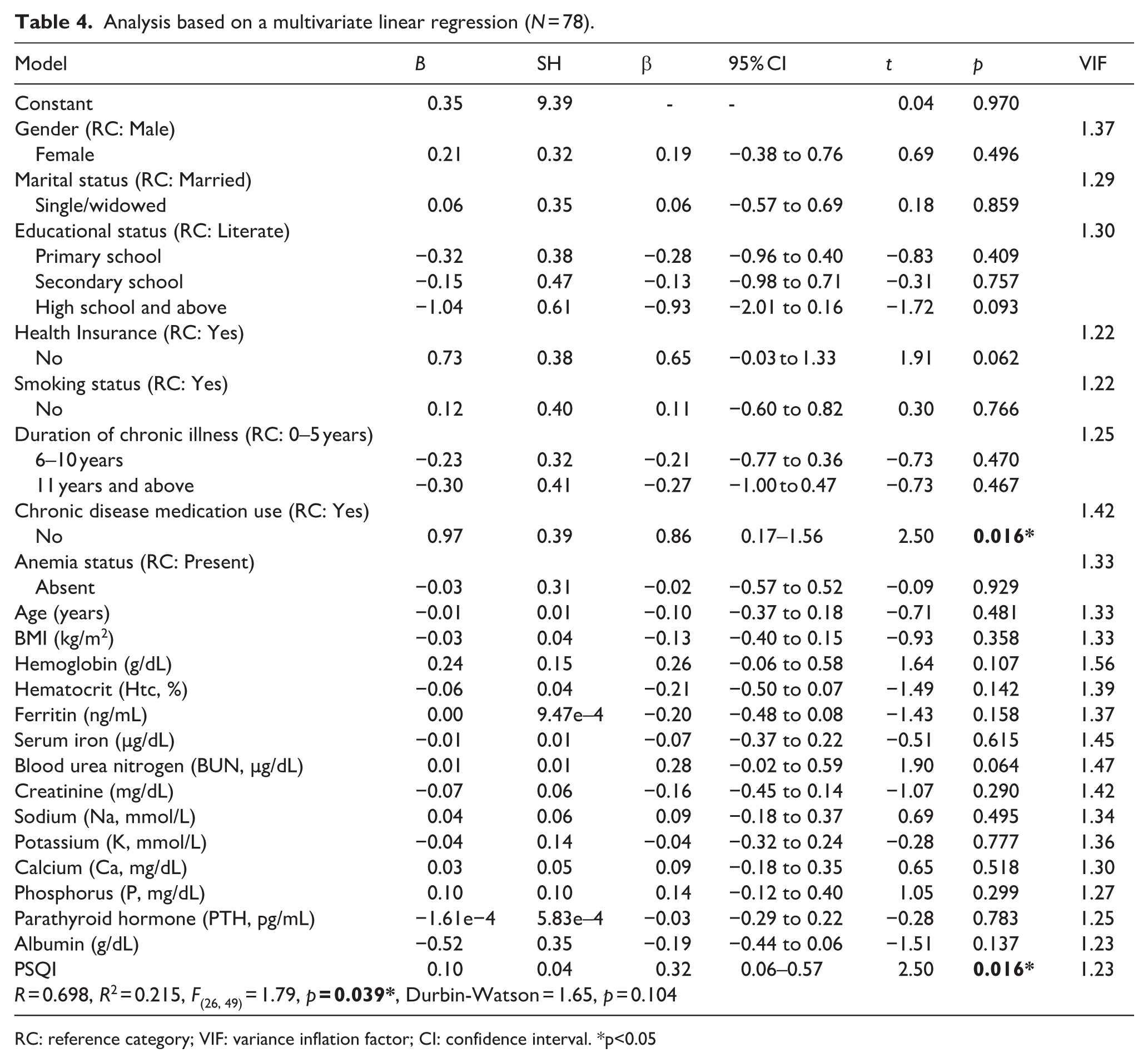
RC: reference category; VIF: variance inflation factor; CI: confidence interval. *p<0.05
Discussions
In the present study, the fatigue severity and sleep quality levels of patients undergoing hemodialysis treatment were evaluated, and the factors influencing these conditions were examined. The findings indicate that fatigue is a significant and prevalent problem among individuals receiving hemodialysis. Consistently, the Kidney Disease Improving Global Outcomes (KDIGO) guidelines 17 report that fatigue is the most common symptom experienced by individuals with chronic kidney disease, with a prevalence of approximately 70%.
In our investigation, the mean FSS score of the patients was found to be 4.97 ± 1.11. This value is above the midpoint of the scale, indicating that a considerable proportion of the patients experience moderate to high levels of fatigue. Consistent with our findings, the literature also reports high levels of fatigue among hemodialysis patients.3,18–20 The differences between the findings of our study and those reported in the literature may be explained by several individual and treatment-related factors, such as the amount of ultrafiltration applied during hemodialysis sessions, session frequency and duration, age, coexisting chronic conditions, self-care capacity, life satisfaction, and muscle strength. In addition, our study revealed that patients who did not use medications related to their chronic condition had higher fatigue scores compared to those who did. The regression analysis also identified medication use as a significant predictor of fatigue. This finding is consistent with previous studies suggesting that regular medication use in chronic diseases may help maintain metabolic balance and consequently reduce fatigue levels.3,21 However, it was observed that fatigue is associated not only with behavioral factors but also with biochemical parameters. When examining the biochemical variables related to fatigue, a low, negative, and statistically significant correlation was found between ferritin levels and the FSS scores. Ferritin is an indicator of iron storage, and low ferritin levels may indicate anemia. This finding is consistent with studies reporting that anemia is an important physiological factor contributing to the development of fatigue.22–24 The reduction in oxygen-carrying capacity due to anemia leads to a decrease in cellular energy production, which in turn results in an increased sensation of fatigue. 25 Therefore, regular monitoring of ferritin levels and individualized planning of iron supplementation are clinically important in hemodialysis patients.
The mean PSQI score in the present study was 7.76 ± 3.64, indicating relatively favorable sleep quality among the participants. Nevertheless, previous research consistently shows that sleep quality is typically impaired in hemodialysis patients.26–28 This discrepancy may be related to the patients’ consistent attendance in the dialysis program and the quality of care delivered in the hemodialysis unit. Furthermore, sleep quality appears to be influenced not only by behavioral and environmental factors but also by biochemical parameters. In our study, serum calcium levels showed a low but significant negative correlation with sleep quality, indicating that higher calcium levels were associated with better sleep quality. This finding aligns with previous research demonstrating a similar positive relationship between serum calcium and sleep quality.29–31 The improvement in sleep quality associated with increased serum calcium levels may be explained by the role of calcium in melatonin synthesis and the regulation of circadian rhythm. 31 The findings of this study indicate that biochemical balance and electrolyte levels are important physiological determinants in maintaining sleep quality among hemodialysis patients. Therefore, it is recommended that nursing care approaches aimed at supporting sleep quality be integrated with the regular monitoring of biochemical parameters.
In this study, a moderate, positive, and statistically significant relationship was found between the total PSQI score and fatigue severity. Similarly, Almutary et al. reported a moderate positive association between fatigue and sleep quality in patients undergoing hemodialysis. 32 This finding supports the well-established link between sleep disturbances and fatigue in chronic disease populations and is consistent with previous studies in the literature.32–34 Poor sleep quality may exacerbate fatigue, while persistent fatigue may, in turn, impair sleep quality, creating a vicious cycle that negatively affects the physical and psychosocial well-being of hemodialysis patients. Therefore, it is essential to assess both sleep quality and fatigue concurrently in clinical practice and to develop integrated interventions targeting both conditions. Moreover, longitudinal studies are needed to better elucidate the potential causal relationships among sleep disturbances, fatigue, and clinical outcomes in hemodialysis patients, and such research would provide valuable insights for future clinical strategies.
Conclusions
This study showed that fatigue and sleep quality are interrelated and clinically significant in patients undergoing hemodialysis. Patients had moderate to high fatigue levels, while sleep quality was generally favorable. Medication use predicted fatigue, and significant associations were found between ferritin and fatigue, and calcium and sleep quality. These findings suggest that biochemical balance and treatment adherence are crucial for both outcomes. Nursing care should therefore assess fatigue and sleep quality together and implement holistic, biopsychosocial interventions.
Footnotes
Declaration of conflicting interests
The authors declared no potential conflicts of interest with respect to the research, authorship, and/or publication of this article.
Funding
The authors received no financial support for the research, authorship, and/or publication of this article.
