






Abstract
High-flow priapism is a rare condition characterized by prolonged and painless erection. It is defined as contusion or thrombosis of the cavernous body of the penis usually secondary to blunt trauma. Due to the rarity of the disease, there is no well-defined consensus about treatment. Conservative treatment is often applied with non-steroidal anti-inflammatory drug. We present a case of 58-year-old man with proximal partial priapism that developed secondary to blunt trauma to the penis. The patient did not benefit from non-steroidal anti-inflammatory drug therapy and then was successfully treated with selective embolization.
Priapism is defined as prolonged erection that lasts more than 4 hours without sexual desire or stimulation. The American Association of Urology has classified priapism as high-flow (non-ischemic) and low-flow (ischemic) priapism. 1 Whereas, the most common type of priapism, low-flow type, is characterized by little or no blood flow to the penis due to the lack of blood flow, the high-flow (non-ischemic) type is caused by an irregularity in addition to an increase in arterial blood flow and a prolonged erection with no pain.
The cavernosal aspiration and/or an injection therapy do not have an indication in the treatment of high-flow priapism. Since the high flow priapism usually does not require urgent treatment, the initial treatment is only close follow-up of the patient’s condition with the conservative treatment including ice compresses to the area exposed to trauma and the anti-inflammatory medication. The selective arterial embolization is the treatment modality in resistant cases of the high-flow priapism which do not recur spontaneously. 2
Case report
A 58-year-old male, height of 176 cm and weight of 80 kg, with a previous history of a blunt trauma to the proximal part of the anterior penis 9 days ago admitted to our clinic. We learned from the history that due to this trauma, slight laceration of penile skin, and a small amount of bleeding which stops spontaneously had occurred. After the wound was closed within 3 days, a swelling of the penis and a pain in the perineum started. He applied ice compression to swollen area for 1 day. The physical examination of the patient was good with vital signs of 130/80 mm Hg arterial pressure and 96/min pulse rate. There were no signs of a penile fracture or hematoma. A solid and sensitive mass was palpated in the left cavernous body of the penis. The remaining parts of the penis, both testicles and the scrotum were normal in the examination of the genital area.
The laboratory findings including complete blood count, renal and liver function tests, urine analysis were normal. The peripheral blood smear did not show any spherocytes or abnormality in the morphology of the blood cells, and the coagulation profile is totally normal. Color Doppler Ultrasound was performed immediately to demonstrate the characteristic flow patterns of priapism and an arteriovenous fistula was detected in the root of the penis on the left side and an extensive edema was present in the cavernous bodies. The integrity of corpus cavernosum and spongiosum tissues was normal in Doppler ultrasound (Figure 1).
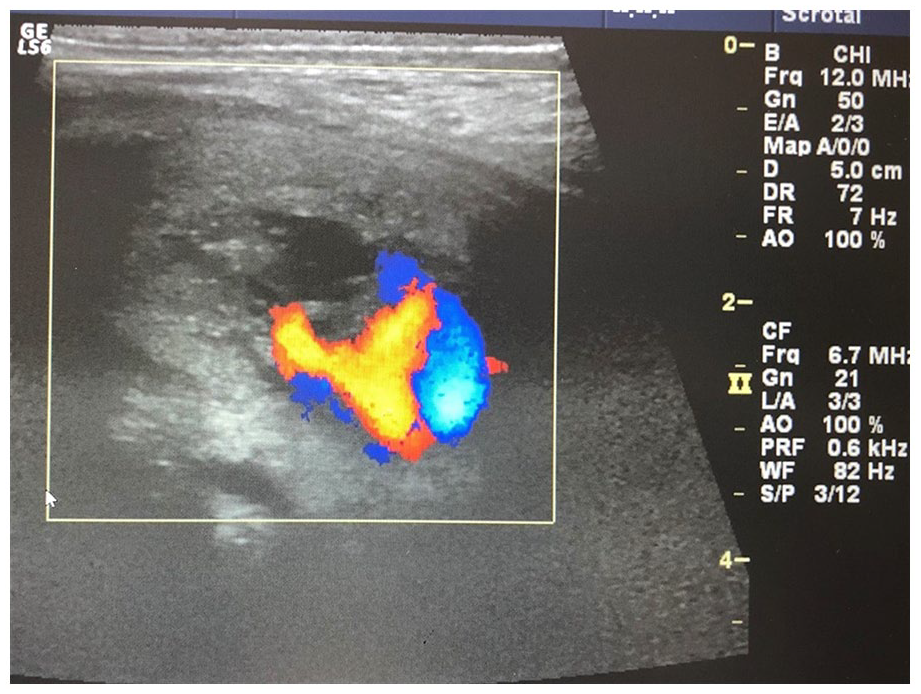
Cavernosal artery pseudoaneurysm. Color doppler images shows turbulence of flow in the pseudoaneurysm at the root of the penis.
Under these conditions, the patient was prescribed 50 mg of diclofenac sodium tablet twice a day for pain and swelling. After 1 month, his pain was much less but swelling still continued and he reported that he could not reach full erection. Therefore the Doppler ultrasound was performed with the same findings as the previous one. Afterwards, because of the clinical course, an iliac arteriography to fully evaluate the shunt formed between the cavernous artery and cavernous bodies was performed. The seldinger technique via femoral way with placement of 5F catheter was used. The arteriography with selective catheterization of the left internal iliac artery revealed arteriocavernosal fistula at the level of the penis root feeding from the left pudendal artery. Microcoil embolization was applied with superselective transcatheter (Figures 2 and 3). No complications were seen during and after the procedure. The patient was hospitalized for 1 day and discharged from the hospital after his priapism was decreased and pain disappeared.
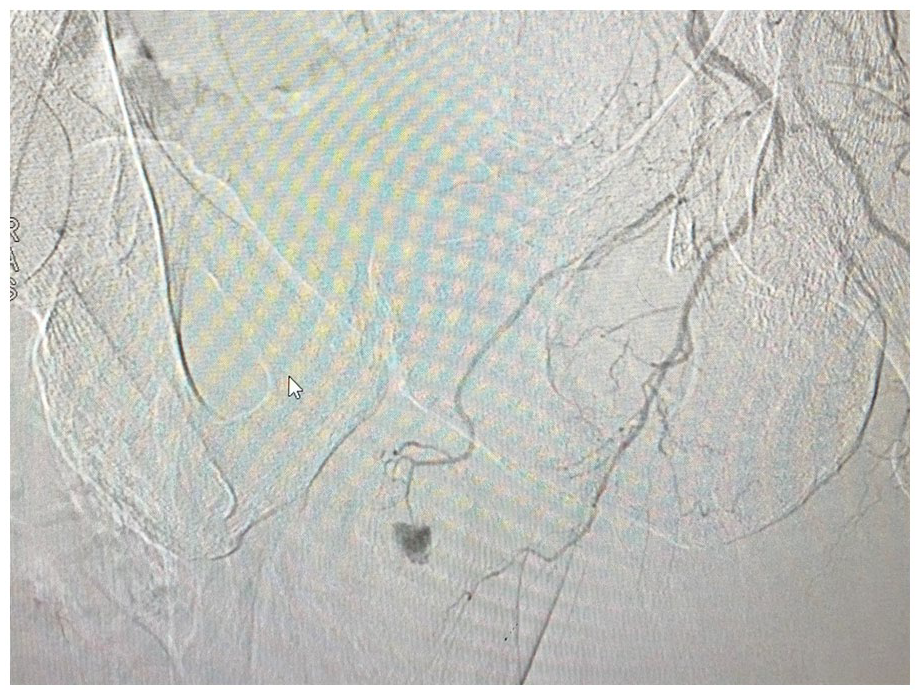
Left internal iliac artery angiogram shows internal pudendal artery with pseudoaneurysm filling through left cavernosal artery.
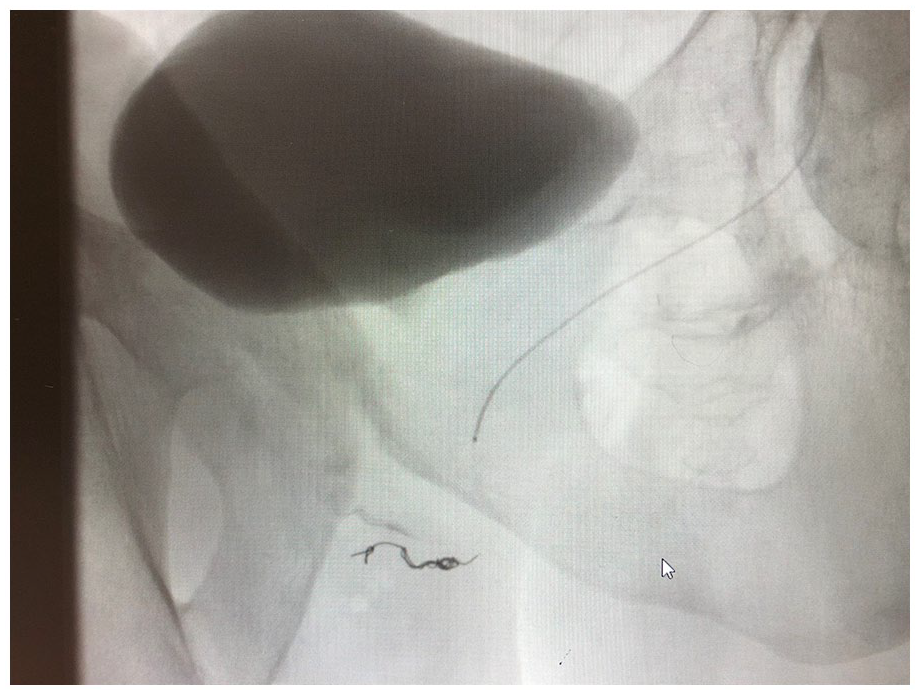
Postembolization microcatheter angiogram shows complete obliteration of pseudoaneurysm.
A week later after the selective embolization, the penis was normal on physical examination, the patient had the history of normal nocturnal penile erections with no pain. Color doppler ultrasonography showed normal corporal bodies and arterial flow. On the sixth week, he reported normal penile erection during sexual intercourse with a longer duration and a same rigidity of erection than previous attempts.
Discussion
The cause of high-flow priapism is usually a traumatic arteriocavernosal fistula that does not cause ischemia but cause painless growth of corpus cavernosa. An external trauma, violent sexual activity, cycling, and some hematological diseases (leukemia, sickle cell anemia) have been suggested as risk factors for this type of priapism. 3 Likewise, the presenting patient had a history of straddle type of trauma to the genital area.
Similar to our case, the men with high flow priapism reported in the literature are generally those in their young and middle ages. 4 The cause of high-flow priapism is usually an arteriocavernosal fistula after trauma that causes non-ischemic, painless growth of corpus cavernosa. 5 A painful perineal mass has been reported because of the involvement of the proximal part of the cavernous bodies. 6 In the diagnosis of high flow priapism, the sensitivity of color doppler ultrasound in the detection of arteriocavernosal fistula is found as approximately 100%. 7
The conservative treatment came into use to be first option in the management of this kind of priapism cases, because there is a 60% chance of spontaneous recovery. 8 Most authors recommend conservative therapy to their patients with anti-inflammatory drugs, acetylsalicylic acid, and intravenous LMW heparin. In addition to these, ice compresses application to the area exposed to trauma and to the pelvic region were found to be successful. They state that the success rates of this type of conservative approach are very high.9,10 In our case, unfortunately, such a conservative treatment did not succeed, and a selective arterial embolization was planned 1 month later due to the continuation of the complaints. Wear et al. described selective arterial embolization in 1977 for high-flow priapism. The selective arterial embolization is accepted as the treatment method of choice for high-flow priapism cases refractory to conservative treatment. However, some kind of erectile dysfunction may develop after this procedure at a rate of 5%–39%.2,7
In high-flow priapism patients, selective arterial embolization is performed with many embolizing agents such as autologous blood clots, gel-foam, polyvinyl alcohol, some coils, and N-butyl cyanoacrylate. Of these, the microcoils are permanent occlusive agents used as embolizing agent with a theoretically increased risk of erectile dysfunction due to permanent vascular occlusion. 2 In the present patient, we did not experience any loss of erection; even he stated that his erection was better and longer than earlier sexual intercourses after the procedure.
Conclusion
Priapism is one of the most common emergencies encountered by urologists. It is important to distinguish whether priapism is high-flow or low-flow during the initial assessment, because pathophysiology and treatment modalities are different. Conservative treatment must be primary treatment option in high-flow priapism. In patients with high-flow priapism, those who do not improve with conservative treatment, selective arterial embolization is indicated. Although erectile dysfunction has been reported with this procedure, patients with high flow priapism who are refractory to the conservative approach are recommended to undergo selective arterial embolization.
Footnotes
Declaration of conflicting interests
The author(s) declared no potential conflicts of interest with respect to the research, authorship, and/or publication of this article.
Ethics statement
The present study protocol was reviewed and approved by the institutional review board of Hisar Intercontinental Hospital Local Ethical (Reg. No. 2019.04.12). Informed consent was submitted by all subjects when they were enrolled.
Funding
The author(s) received no financial support for the research, authorship, and/or publication of this article.
