







Abstract

Dear Editor,
Prevalence of the ureteral stones has been doubled in the past 15 years due to different diseases including diabetes mellitus (DM), metabolic syndromes, and obesity.1,2 The top treatment priority of these stones is to help pass or remove all of them with minimal harmful ways. In order to achieve this goal, some medications known as medical expulsive therapy (MET) and least invasive modalities (e.g. ureteroscopy and shock wave lithotripsy) are advised. 3 Studies have demonstrated that MET is an effective option for initial treatment in patients with ureteral stone especially more than 5 mm in size. Medical expulsive therapy facilitates the process of spontaneous passage of stone and is suggested in patients with a high threshold for pain and well-functioned kidneys. There are two groups of medications administered in MET: alpha-adrenergic antagonists and calcium channel blockers. 4
Herbal supplements are generally used worldwide as home remedies and studies have revealed that some herbal medications can dissolve or inhibit the process of kidney stones formations. Some of these herbs including Aerva lanata, Boerhavia diffusa, and Phyllanthus niruri prevent formation of kidney stones by inhibiting crystallization of calcium and inducing diuresis; however, just a little has been studied about these plants and herbals. 5 P. ginseng is a herbal remedy that has been used for over 2000 years worldwide for pharmacological reasons such as stamina and immunity functions. The word Panax means “cure for all diseases” and ginseng is derived from a Chinese word meaning “man herb” which represents the man shape of the root, the part of the plant that is commonly used for medicinal purposes.6–8 Ginseng has more than eleven species such as P. ginseng (Korean ginseng), P. notoginseng (Chinese ginseng), and P. quinquefolius (American ginseng). 9 Moreover, the considered safe dose of ginseng is a maximum oral intake of 4 g of daily use for up to 3 months. 10 Studies have shown that ginseng has inhibitory effect on alpha-1-adrenergic receptors and is also a calcium channel blocker.11,12 In addition, it has been elucidated that it helps the recovery of renal function in patients with obstructive uropathy and the short-term consumption of ginseng is completely safe.13,14
Alpha adrenergic receptors are widely expressed in smooth muscle cells of the ureter and prostate gland. Thus, one can assume that administration of alpha blockers in patients with ureteral calculi leads to relaxation of the ureter and subsequently, it helps the easier expulsion of ureteral stones. 15 One herbal medicine that has been shown to have alpha blocking activity is P. ginseng. In a study by Kim et al. 11 found out that ginseng seems to suppress the mRNA expression of alpha-1d receptors and hence, it may be useful in the treatment of BPH due to its alpha1 adrenergic inhibitory effect. Thus, P. ginseng can be considered a potential candidate in helping the process of spontaneous removal of ureteral stones via inhibiting α-adrenergic receptors. Also, it has been suggested that P. ginseng can have calcium channel blocker activity as well. Nah and McCleskey 12 conducted a study on the potential effect of Panax ginseng on blocking calcium channels of sensory neurons in animal models and it was demonstrated that ginseng has voltage-gated calcium channel blocking activity. As a result, one can conclude that P. ginseng can help the process of spontaneous ureteral stones expulsion by inhibiting calcium channels. As mentioned before, alpha blocker and calcium channel blocker agents are prescribed in MET for shortening the passage time of medium-sized distal ureteral stones. Therefore, we hypothesize that using ginseng can be a good choice of treatment in the spontaneous passage of ureteral stones since studies have showed that it has both alpha-blocking and calcium channel blocking activity.
Interestingly, contemporary data have suggested that short-term use of P. ginseng is not only safe but it can prevent kidney damage and fibrosis as well. Studies have explored the potential effect of ginseng constituents including maltol and ginsenoside on animal models with unilateral ureteral obstruction and they found out that the mentioned constituents can prevent kidney damage and attenuate renal interstitial fibrosis by inhibiting oxidative stress.13,16,17 Another study investigated the probable effects of germanium (Ge), which is a constituent of P. ginseng, on renal function such as urine output, glomerular filtration rate (GFR), and urine creatinine and the results suggested that normal dosages of ginseng (up to 4 g daily for 3 months of oral use) would not cause renal damage and dysfunction at least on a short term use (Figure 1).10,14
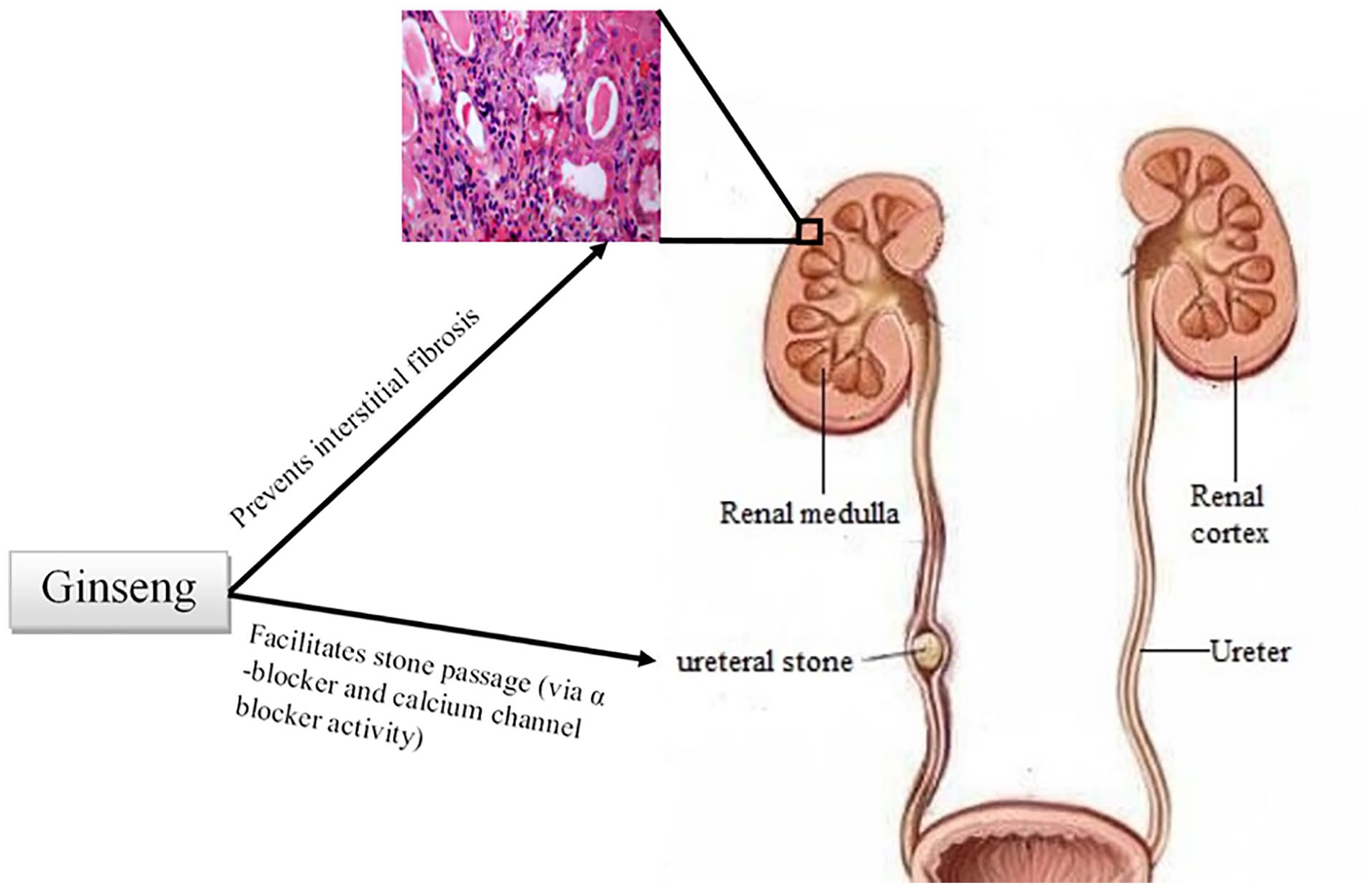
The effect of ginseng roots on facilitating the ureteral stone passage and protective effects on renal cortex tissue.
Taken together, since herbal supplements are popular home remedies all over the world, adding herbal medications such as P. ginseng to the conventional regimens of treating distal ureteral stones can help develop more effective treatments in facilitating the passage of ureteral stones. P. ginseng should be considered a potential herbal supplement for shortening the passage time of medium-sized ureteral stones and its short-term use is safe since it can prevent damage and fibrosis as well. These findings should strongly encourage future studies to test this potential.
Footnotes
Declaration of conflicting interests
The author(s) declared no potential conflicts of interest with respect to the research, authorship, and/or publication of this article.
Funding
The author(s) disclosed receipt of the following financial support for the research, authorship, and/or publication of this article: The Vice-Chancellery of Research and Technology of Shiraz University of Medical Sciences financially supported this study.
