






Abstract
Background:
The Ureteral Stent Symptom Questionnaire (USSQ) is the gold standard for evaluating stent-related symptoms. While validated in multiple languages, no validated Greek version currently exists.
Objective:
To perform a cross-cultural adaptation, and psychometric evaluation of the Greek USSQ.
Methods:
The USSQ was translated and culturally adapted following established forward–backward translation methodology. A cohort of 100 patients with temporary ureteral stents was prospectively enrolled and completed the Greek USSQ at predefined time points. Psychometric evaluation included internal consistency, test–retest reliability, construct validity, convergent validity, and responsiveness after stent removal. Comparative correlation was performed using International Prostate Symptom Score (IPSS), International Consultation on Incontinence Questionnaire Female Lower Urinary Tract Symptoms Modules (ICIQ-FLUTS), and 36-Item Short Form Health Survey (SF-36) questionnaires.
Results:
Internal consistency was good for urinary symptoms (α = 0.82), pain (α = 0.79), work performance (α = 0.77), and general health (α = 0.74), while sexual matters demonstrated moderate consistency (α = 0.68). Test–retest reliability was strong with ICC values ranging from 0.72 to 0.86. Significant correlations were found with IPSS (ρ = 0.68, p < 0.001), ICIQ-FLUTS (ρ = 0.52, p < 0.01), and SF-36 domains (ρ = −0.55 to −0.62, p < 0.001). All domains showed statistically significant improvement following stent removal (p < 0.001).
Conclusion:
The Greek version of the USSQ demonstrates strong reliability, validity, and responsiveness, confirming its suitability for clinical and research use in evaluating ureteral stent-related symptoms in Greek-speaking populations.
Keywords
Introduction
Ureteral stent placement is an essential and frequently performed procedure in contemporary urological practice, primarily used to ensure adequate urinary drainage, relieve ureteral obstruction, preserve renal function, and facilitate postoperative healing following endourological interventions. 1 Despite their widespread clinical utility, ureteral stents are commonly associated with a broad spectrum of adverse symptoms that significantly impair patients’ quality of life. 2 These symptoms include lower urinary tract symptoms, pain, hematuria, urinary urgency, sexual dysfunction, and reduced work performance, with previous studies reporting that up to 70%–80% of patients experience bothersome stent-related morbidity during the indwelling period. 3
Given the substantial symptom burden associated with ureteral stents, the accurate and standardized assessment of patient-reported outcomes has become increasingly important in both clinical practice and research. To address this need, Joshi et al. developed the Ureteral Stent Symptom Questionnaire (USSQ), a validated multidimensional instrument designed to quantify the impact of ureteral stents across six domains: urinary symptoms, pain, general health, work performance, sexual matters, and additional problems. 3 Since its introduction, USSQ has become the gold-standard tool for evaluating stent-related morbidity and has been widely used in clinical trials, comparative studies of stent design and materials, and investigations into pharmacological strategies aimed at reducing stent-related discomfort.
The cross-cultural validation of the USSQ has been successfully performed in more than 10 different languages, consistently demonstrating strong psychometric performance, good internal consistency, reproducibility, and responsiveness to clinical change.4–18 These findings support the universal applicability of the questionnaire and reinforce its role as a standardized instrument for evaluating stent-associated symptoms across diverse patient populations.
Despite these international efforts, a validated Greek version of the USSQ had not previously been available. The absence of a culturally adapted and psychometrically validated instrument limits the ability to accurately assess stent-related morbidity in Greek-speaking patients and restricts participation in multicenter and comparative research studies. Therefore, the aim of the present study was to translate, culturally adapt, and clinically validate the Greek version of the USSQ, and to evaluate its reliability, validity, and responsiveness in a prospective cohort of patients with temporary ureteral stents.
Methods
Translation and cultural adaptation
The study was approved by the Institutional Review Board of the Hospital (Protocol Number: 7683/02.04.2024). Written informed consent was obtained from all participants prior to enrollment. The original English version of the USSQ underwent translation and cultural adaptation according to established forward–backward translation methodology. Two independent forward translations from English into Greek were performed by two native Greek-speaking bilingual translators fluent in English. One translator had medical/urological knowledge, while the second translator had no medical background, allowing both conceptual accuracy and lay comprehensibility to be assessed. The two forward translations were compared and reconciled into a single preliminary Greek version by the study team.
Back-translation into English was then performed independently by two bilingual translators whose native language was English and who were blinded to the original USSQ. The original, translated, and back-translated versions were reviewed by the study investigators. Discrepancies were discussed and resolved by consensus, with particular attention to preserving the meaning of the original items while ensuring that the Greek wording was clear, natural, and understandable for patients.
The pre-final Greek version was tested through cognitive debriefing in 10 patients with ureteral stents to assess clarity, acceptability, and cultural relevance. Patients were asked whether any items were difficult to understand, ambiguous, inappropriate, or culturally unsuitable. Minor wording modifications were made where necessary before finalization of the Greek USSQ.
Study design
This was a prospective observational study conducted in patients undergoing temporary ureteral stent placement. The study was designed as a linguistic and psychometric validation study rather than as an analysis of clinical predictors of stent-related symptoms. Eligible patients were adults with temporary ureteral stents who were able to understand and complete the Greek questionnaires. In line with previous USSQ validation studies, patients with conditions likely to substantially confound the assessment of stent-related symptoms, such as severe pre-existing lower urinary tract symptoms, overactive bladder, chronic pelvic pain, neurogenic bladder, active severe urinary tract infection, long-term ureteral stenting, or inability to complete the questionnaires, were excluded where applicable. A total of 100 adult patients were enrolled after given informed consent.
Assessment time points:
T1: 1 week after stent insertion
T2: 2–4 weeks later for test–retest reliability
T3: 4 weeks after stent removal for responsiveness analysis
A 2–4-week test–retest interval was selected to ensure clinical stability while minimizing the risk of symptom fluctuation. Patients completed the Greek USSQ, International Prostate Symptom Score (IPSS), International Consultation on Incontinence Questionnaire Female Lower Urinary Tract Symptoms Modules (ICIQ-FLUTS), and 36-Item Short Form Health Survey (SF-36) questionnaires at the designated time points.
Statistical analysis
Statistical analysis was performed using R software, version 4.3.2 (R Foundation for Statistical Computing, Vienna, Austria). Continuous variables were summarized as mean ± standard deviation or median and interquartile range, depending on distribution. Categorical variables were presented as frequencies and percentages. Normality was assessed using visual inspection of histograms and Q–Q plots and the Shapiro–Wilk test. Because several questionnaire-domain scores were not normally distributed and because questionnaire data were ordinal or non-parametric in nature, non-parametric methods were applied where appropriate.
Internal consistency of each USSQ domain was assessed using Cronbach’s α, with 95% confidence intervals. Values ⩾0.70 were considered acceptable, although slightly lower values were interpreted cautiously in domains with fewer applicable responses, particularly the sexual matters domain. Test–retest reliability between T1 and T2 was assessed using intraclass correlation coefficients with 95% confidence intervals. The ICC was calculated using a two-way mixed-effects model, absolute agreement definition, and single-measure estimates.
Construct validity was evaluated using inter-domain Spearman correlation coefficients. Convergent validity was assessed by examining correlations between relevant USSQ domains and established external instruments, including IPSS, ICIQ-FLUTS, and SF-36 domains. Responsiveness after stent removal was assessed by comparing T1 and T3 scores using the Wilcoxon signed-rank test. A two-sided p-value < 0.05 was considered statistically significant.
Results
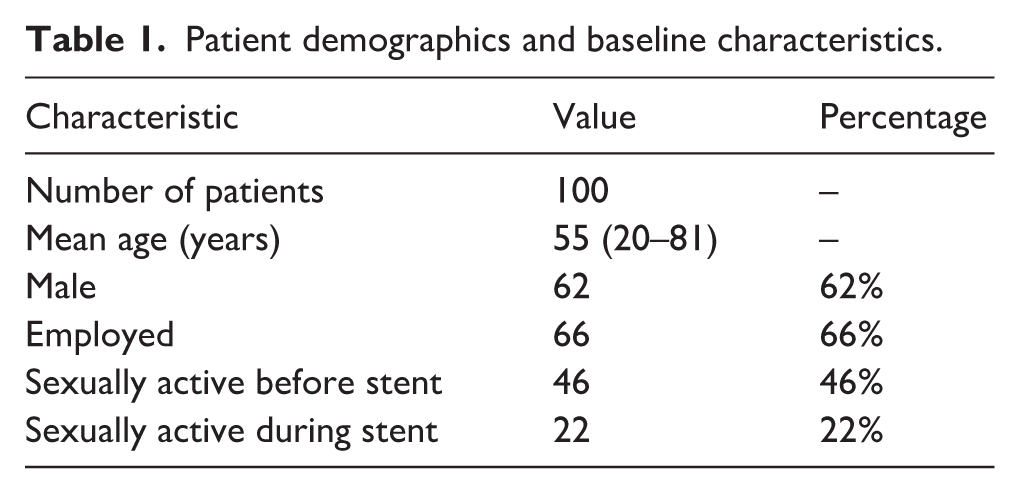
A total of 100 patients were included in the final analysis, with a mean age of 55 years (range 20–81), of whom 62% were male and 66% were employed. Prior to stent insertion, 46% of patients reported being sexually active, whereas this proportion decreased to 22% during the stent indwelling period. The baseline demographic and clinical characteristics of the enrolled patients are presented in Table 1.
Patient demographics and baseline characteristics.
Internal consistency analysis demonstrated good reliability across most domains of the Greek USSQ. Cronbach’s α coefficients were 0.82 for urinary symptoms, 0.79 for pain, 0.77 for work performance, and 0.74 for general health, while the sexual matters domain showed moderate internal consistency (α = 0.68). The internal consistency of each USSQ domain is detailed in Table 2.
Internal consistency (Cronbach’s α).
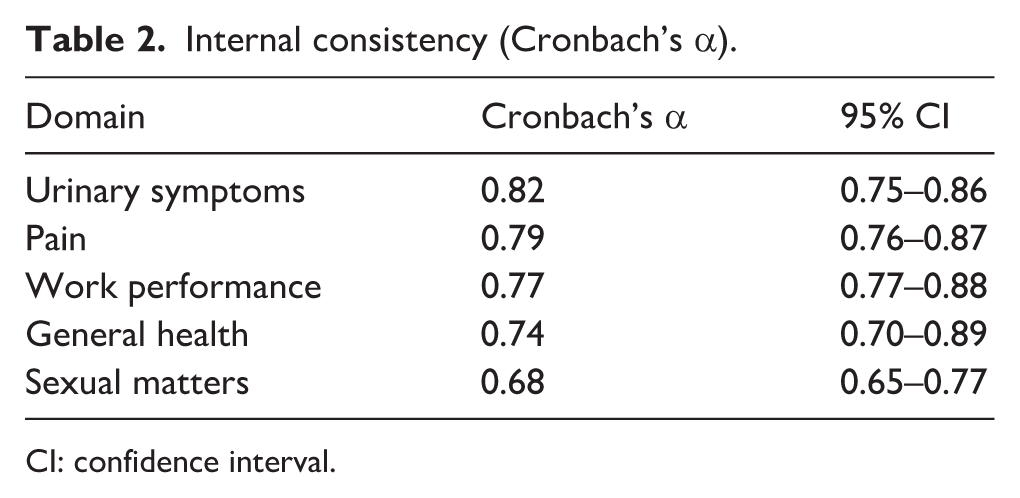
CI: confidence interval.
Test–retest reliability analysis showed excellent reproducibility, with intraclass correlation coefficients (ICC) ranging from 0.72 to 0.86 across domains. The urinary symptoms domain demonstrated the highest reproducibility (ICC = 0.86), followed by pain (ICC = 0.84), work performance (ICC = 0.81), and general health (ICC = 0.80), while the sexual matters domain remained acceptable (ICC = 0.72). Test–retest reliability results for all domains are summarized in Table 3.
Test–retest reliability (ICC, T1–T2).
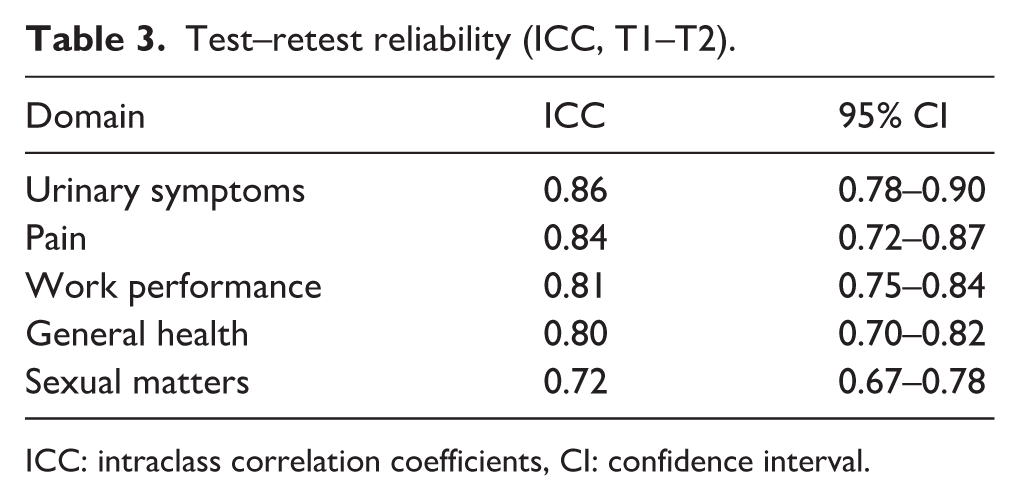
ICC: intraclass correlation coefficients, CI: confidence interval.
Inter-domain correlation analysis revealed moderate associations between urinary symptoms and pain (ρ = 0.52), pain and work performance (ρ = 0.48), and urinary symptoms and general health (ρ = 0.42), supporting the internal structure of the questionnaire. Convergent validity testing demonstrated statistically significant correlations with established instruments. The urinary domain correlated positively with IPSS total score for male patients (ρ = 0.68, p < 0.001) and ICIQ-FLUTS score for female patients (ρ = 0.52, p < 0.01). The pain domain showed a strong negative correlation with the SF-36 bodily pain subscale (ρ = −0.62, p < 0.001), while the work performance domain correlated negatively with the SF-36 role physical domain (ρ = −0.55, p < 0.001). The general health domain correlated positively with both IPSS quality-of-life for men (ρ = 0.46) and ICIQ-FLUTS quality-of-life for women (ρ = 0.44). Detailed results of the convergent validity analysis are shown in Table 4.
Convergent validity with external instruments.
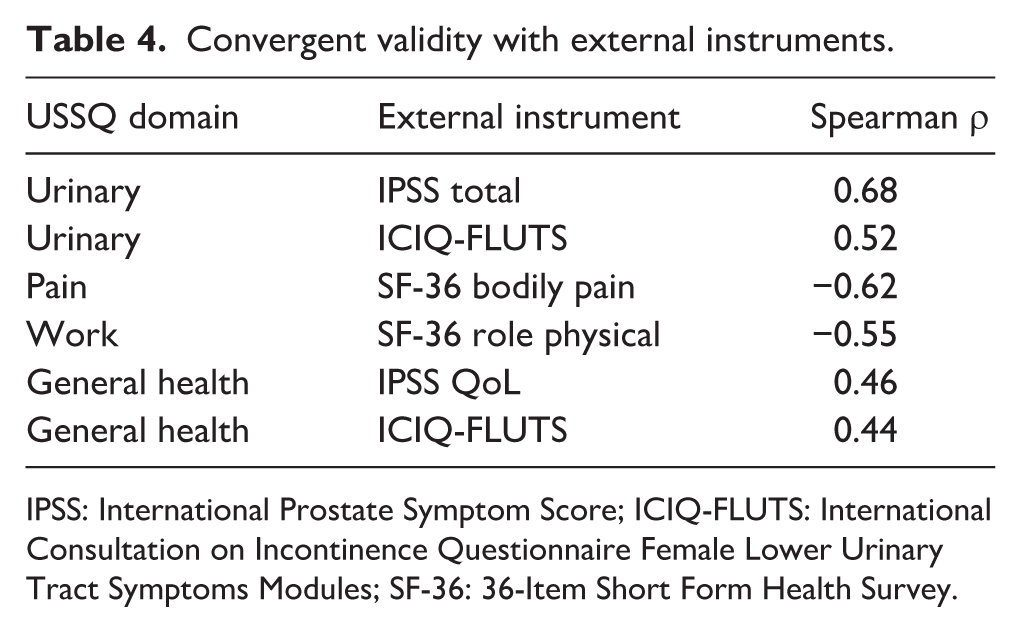
IPSS: International Prostate Symptom Score; ICIQ-FLUTS: International Consultation on Incontinence Questionnaire Female Lower Urinary Tract Symptoms Modules; SF-36: 36-Item Short Form Health Survey.
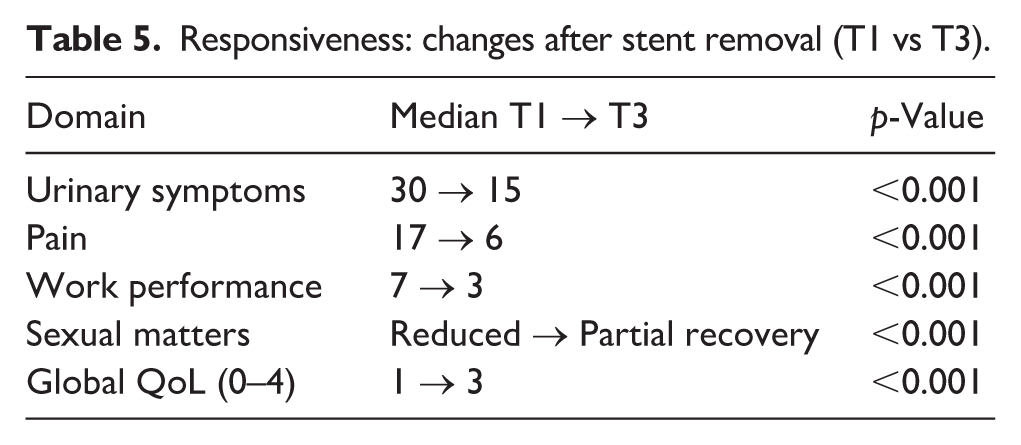
Responsiveness analysis demonstrated significant improvement in all domains following stent removal (p < 0.001). Median urinary symptom scores decreased from 30 to 15, pain scores from 17 to 6, and work performance scores from 7 to 3. Sexual function showed partial recovery but did not return to pre-stent baseline levels. Global quality-of-life scores improved from 1 to 3 on the 0–4 scale. Changes in USSQ scores following stent removal are summarized in Table 5.
Responsiveness: changes after stent removal (T1 vs T3).
Discussion
The present study provides a comprehensive psychometric evaluation of the Greek version of the Ureteral Stent Symptom Questionnaire (USSQ) and demonstrates that it is a reliable, valid, and responsive patient-reported outcome measure for Greek-speaking patients with an indwelling ureteral stent. These findings support its use in both routine clinical practice and research, enabling standardized assessment of stent-related morbidity and facilitating meaningful comparison with international cohorts. The rationale for such a tool is well established, as the original USSQ was developed through a rigorous multi-phase process integrating patient interviews, pilot testing, and formal validation, ultimately producing a multidimensional instrument that captures urinary symptoms, pain, general health, work performance, sexual matters, and additional problems; the original validation demonstrated strong internal consistency and reproducibility, and clear sensitivity to change after stent removal, with the sexual domain often showing less marked change. 3
In our cohort, internal consistency was good across most domains (Cronbach’s α 0.74–0.82 across urinary symptoms, pain, work performance, and general health), while the sexual matters domain was lower (α = 0.68), a pattern also described in several linguistic validations. Interpretation of the sexual domain should consider that the proportion of sexually active participants decreased from 46% pre-stent to 22% during stenting, which can reduce precision and contribute to lower internal consistency in this domain. This limitation has been explicitly noted in the Korean validation, where only a small proportion of patients reported an active sex life with the stent in situ and the authors cautioned that this restricted the robustness of sexual-domain analyses. 13 Similarly, the Danish validation reported significant improvement in all domains after stent removal except sexual matters, supporting the view that sexual outcomes are frequently constrained by applicability and response patterns rather than questionnaire failure. 6 This pattern is aligned with multiple linguistic validations, including the German version, which reported good internal consistency and strong test–retest reliability (ICC values in the high acceptable-to-excellent range), supporting the robustness of the instrument across healthcare systems and languages. 8 On the other hand, the Persian validation highlighted that work-related items may show lower internal consistency in certain settings, emphasizing that this domain can be influenced by cultural norms, labor patterns, and baseline employment status rather than stent symptoms alone. 14 Collectively, these international experiences support the interpretation that the core symptom domains (urinary and pain) tend to be the most psychometrically stable across cultures, whereas domains such as work performance and sexual matters may be more sensitive to population structure and sociocultural factors.
Test–retest reliability in the current study was excellent to good across domains (ICC 0.72–0.86), demonstrating that the Greek USSQ yields stable measurements when clinical conditions are unchanged. This finding is consistent with the German validation, where reproducibility was strong across domains, and with the broader validation literature supporting the USSQ as a dependable longitudinal tool. 8 The importance of this property is practical: because stent-related symptoms may fluctuate and interventions are often evaluated over short timeframes, reproducible measurement is essential for both clinical monitoring and trials comparing stent types, dwell times, or symptom-control strategies.
Construct validity was supported by the expected inter-domain relationships. Moderate associations between urinary symptoms, pain, work performance, and general health in our cohort reflect the clinical reality that irritative voiding symptoms and pain commonly co-exist and jointly contribute to functional limitations and reduced quality of life. Comparable domain interrelationships have been described across validations, including the Danish and Chinese studies, reinforcing that the USSQ captures a symptom constellation that behaves similarly across different populations. Importantly, the fact that these correlations are not uniformly strong also supports the multidimensional nature of the USSQ, each domain contributes distinct information and should not be collapsed into a single global score, which is also consistent with the original conceptual framework. 3
Convergent validity in our study was demonstrated through significant correlations between the urinary domain and established measures of lower urinary tract symptoms and incontinence burden, and between the pain/work domains and relevant health-related quality-of-life components. This performance is comparable to prior validations that used established instruments for external benchmarking. The Italian validation is particularly informative in this regard, reporting strong associations between the USSQ pain domain and a visual analog pain scale and meaningful correlations between urinary symptom scores and instruments such as IPSS (in men) and UDI-6/IIQ-7 (in women), supporting the external validity of the USSQ domains. 11 Likewise, the Korean and Japanese validations reported satisfactory correlations between USSQ domains and validated symptom and quality-of-life instruments, confirming that the questionnaire behaves predictably when compared with external standards.12,13 Taken together, these findings support that the Greek USSQ not only performs well internally, but also aligns with internationally accepted measurement constructs, reinforcing its suitability as an outcome tool.
Responsiveness analysis showed significant improvement after stent removal across domains, confirming that the Greek USSQ is sensitive to clinical change and can detect symptom resolution consistent with patient experience. This is a key property repeatedly confirmed in the validation literature. The Danish and Japanese validations observed substantial reductions after stent removal in most domains, while the German validation also reported significant sensitivity to change across all measured domains. The Chinese validation similarly demonstrated discriminant ability and sensitivity to change, but highlighted that evaluation of sexual matters is frequently limited by the small proportion of sexually active participants during the stent period. 5
Our findings are fully consistent with this: sexual domain metrics are often constrained by abstinence during stenting, reluctance to report, or variability driven by cultural and interpersonal factors rather than the stent alone. This limitation has been explicitly described across multiple validations, including Danish, Korean, and Japanese cohorts, and it likely explains why sexual outcomes can show weaker internal consistency or less consistent change after removal. Clinically, this emphasizes the need to counsel patients proactively regarding sexual activity and expectations during stenting, and to interpret sexual domain scores with awareness of context and applicability.
The strengths of this study include a robust sample size and a comprehensive psychometric assessment encompassing internal consistency, reproducibility, construct validity, convergent validity, and responsiveness. However, several limitations should be acknowledged. First, this was a single-center study, which may limit the generalizability of the findings. Second, although additional clinical variables may influence stent-related symptoms, including indication for stenting, stent characteristics, dwell time, medication use, infection status, prior stent history, and pre-existing lower urinary tract symptoms, the present study was primarily designed to validate the Greek version of the USSQ rather than to identify clinical predictors of symptom severity. Therefore, subgroup analyses according to these variables were not performed. Third, specific demographic and sociocultural factors, including employment distribution, baseline sexual activity, and cultural attitudes toward symptom reporting, may have influenced certain domains, particularly work performance and sexual matters. These limitations are not unique to our cohort and have been acknowledged in previous linguistic validation studies of the USSQ, reflecting the inherent challenges of measuring socially mediated outcomes. Future larger multicenter Greek studies should further evaluate the generalizability of the Greek USSQ and assess whether clinical variables such as post-ureteroscopy status, stent size, dwell time, medication use, or prior stent history influence domain-specific USSQ scores.
Conclusion
In conclusion, the Greek version of the USSQ demonstrates good internal consistency, strong test–retest reliability, appropriate construct and convergent validity, and excellent responsiveness following stent removal. Its psychometric performance is comparable to the original instrument and major international validations, supporting its use as a standardized patient-reported outcome measure for quantifying ureteral stent–related morbidity in Greek-speaking patients. This validated tool can facilitate routine symptom monitoring and enable high-quality clinical and multicenter research in Greece.
Footnotes

Ethical considerations
Study was fully approved by ethical board (protocol no. 7683/02.04.2024).
Consent to participate
Written informed consent was obtained from all participants prior to enrollment.
Funding
The authors received no financial support for the research, authorship, and/or publication of this article.
Declaration of conflicting interests
The authors declared no potential conflicts of interest with respect to the research, authorship, and/or publication of this article.