







Abstract
The article reconsiders how capitalist diversity is conceived of in the mainstream institutionalist “comparative capitalisms” literature. It highlights the division between centers and peripheries as a differentiation prior to national varieties, subsequently introducing the concepts of “nuclei of accumulation” and “nuclei of state implication.” It proposes to analyze (peripheral) varieties of capitalism as results of the conformation and change of these nuclei, their interrelations, and their insertion into global economic and political networks.
Keywords
1. Introduction
The central objective of this article is the reconsideration of the predominant mode in which capitalist diversity is currently conceived of in the mainstream institutionalist “comparative capitalisms” (CC) literatures. It highlights the significance of the division between centers and peripheries as a fundamental axis of differentiation that is prior to the constitution of individual varieties, but which remains neglected or severely underestimated by most approaches in this literature. The article draws on contributions from different critical political-economy sources, including regulationist perspectives on capitalist stages, Latin American dependency thinking, and its offspring, World System Theory (WST). At the same time, it seeks to incorporate the insight that the fundamental center-periphery differentiation is permanently changing and associated with specific localized dynamics, making for a “rational kernel” (Jessop 2015) of institution-centered CC research. Hence, the conceptual framework to be developed here seeks to do two things simultaneously: to analyze the structural, uneven, and hierarchical reproduction of capitalism and the differentiation of centers and peripheries as such, and to highlight those elements of peripheral variants of capitalism that explain their specificities and divergences.
With this objective in mind, the article introduces a number of novel conceptual elements to research on capitalist diversity, in particular, what we call “nuclei of accumulation” (NA; Fajnzylber 1983) and “nuclei of state implication” (NSI; Chibber 2003, 2009; Evans 1998; Kohli 2004, 2009). The theoretically relevant and oft-discussed differences between the successful East Asian “late developers” and their less successful Latin American cousins will form an important empirical point of reference for this article. It seeks to demonstrate that the nuclei notions can guide an understanding of why—both through accumulation processes and particular forms of state involvement—the trajectories of these world regions diverged so markedly, in other words, why political and economic elites in East Asia (Amsden 2001; Johnson 1982) could develop responses to the peripheral condition that permitted them to bring about structural change while Latin American countries largely remained in their original positions (Fernández, Lauxmann, and Trevignani 2013).
We do insist, however, on the necessity of placing these instruments within an analytical frame that does not lapse back into mainstream CC’s confines (Hall and Soskice 2001) of methodological nationalism and underappreciation of model change. We, therefore, propose to analyze these nuclei in part as unstable and changing results of their dialectical and conflictive relationship with global economic and political networks and the transnational actors that characterize the current phase of capitalism.
The remainder of this article is divided into five sections. In the first, “Conventional CC Approaches and Their Global Dissemination,” we expand on the present state of CC research and debates, and their global dissemination, as we see them from a vantage point in the Latin American semiperiphery. The second section, “The Earlier Variety: Reconceptualizing Capitalist Diversity and Change Between Center and Periphery,” provides a number of theoretical elements that contribute to our reconsideration of capitalist diversity, in particular, concerning the fundamental differentiation of global capitalism into central and peripheral economies and temporal variations in central and peripheral varieties of capitalism. Following this, in “NA and NSI: Concepts to Explain Differentiated Trajectories of Varieties of Capitalism,” we introduce the two sets of concepts alluded to above: NA and NSI.
The fourth section “East Asian and Latin American Development Reconsidered
2. Conventional CC Approaches and Their Global Dissemination
The contemporary CC literature is centrally concerned with the study of the institutional variations between different, territorially (normally nationally) conceived “varieties” or “models” of capitalism and their long-term unequal performance in terms of economic and social development. It was Peter Hall and David Soskice’s (2001) emblematic “Varieties of Capitalism” (VoC) approach, with its trademark distinction between “liberal” and “coordinated market economies” (LMEs/CMEs), that led CC to its present prominence in scholarly and policy-making circles, as well as contributing decisively to its global dissemination throughout recent years (Coates 2015). This approach has reached Latin America especially through the work of the U.S.-American business historian and political scientist Ben Ross (Schneider 2009, 2013; Schneider and Soskice 2009). By applying Hall and Soskice’s “relational view of the firm” to the region, he sought to characterize the capitalist varieties he observed in the large Latin American economies as exemplars of an underperforming “hierarchical market economy” type, dominated by business groups and foreign transnational corporations (TNC).
The intellectual contributions that VoC has made to our understanding of capitalist diversity and its political significance are recognized even by many of its critics (see, for example, Coates 2015). However, the debates, which VoC’s appearance on the scene has triggered, have similarly exposed a large number of flaws and omissions inherent in the approach and extending in many aspects to the entire global VoC-inspired research agenda (for a recent summary overview, see Bruff, Ebenau, and May 2015). The reasons for which these problems ensue, their empirical relevance, and their politico-intellectual consequences have been amply documented and discussed elsewhere (specifically, on the Latin American context, see Boschi 2011; Ebenau 2012; Fernández and Alfaro 2011; Fishwick 2014), and we do not intend to repeat these arguments here. Rather, with David Coates (2015: 24), we hold that now “[i]t is time for New Directions”: for the development of alternative perspectives on capitalist models that move beyond the shortcomings of conventional perspectives such as VoC, likely drawing in the best of critical institution-centered approaches and combining them with critical materialist theory.
In what follows, we therefore only very briefly restate some of the fundamental lines of the critique of VoC theory insofar as they are relevant to our following reconceptualization. Four such lines are noteworthy in the present context:
The first concerns VoC’s tendency to reify the ideal-types it construes for analyzing capitalist diversity (LMEs, CMEs, etc.). This, as many critics have pointed out, leads to a number of analytical shortcomings and omissions, including the undue disregard toward aspects of differentiation not considered as part of these types and the underestimation of the actually existing degree of capitalist diversity (see, for example, Boyer 2005; Hay 2005).
The second, related line of critique refers to the conformation of an analytical approach that accords priority to (institutional) stability over change and that consequently underestimates the extent and complexity of both historical and contemporary processes of politico-economic transformation unfolding in Latin America and elsewhere (see, for example, Hay 2005; Lane and Wood 2009).
Arguments within the third of our lines point out that VoC (like most institutionalist CC research) applies a sub-complex, closed mono-scalar analytical model when construing its ideal-typical varieties. This is a product of a theoretical and methodological nationalism that disregards the permanently shifting balance and interrelation of different scales and the contemporary redefinition of the functional logic of the national scale (see, for example, Brenner 2003; Peck and Theodore 2007).
Finally, the fourth line tackles the scarce treatment given to nonbusiness actors. Early on, the underestimation of the state or even its analytical dilution as “just another institution” (Schmidt 2007) has been pointed out, a criticism picked up by Latin American scholars in the (neo)developmentalist tradition (see, for example, Boschi 2011). More recently, the virtual absence of any serious treatment of organized labor has also been criticized as an omission (see, for example, Fishwick 2014).
What ties these points together and makes them salient for our purposes is a factor that has been less often discussed in critical debates in the CC field, namely, that the logic of its global dissemination has followed—to its considerable detriment—the usual spatial logic of emergence and transference from the center to the periphery. This means that, implicitly or explicitly, the characteristics and trajectories of capitalist varieties in the former are universalized and unduly used as reference frames for the latter (Tilley 2015). 1 This is, in our view, the ultimate cause for the unsatisfactory analytical performance and the questionable political implications of the extended VoC and similar approaches when it comes to understanding capitalism in the periphery (documented in many of the critical contributions cited above).
3. The Earlier Variety: Reconceptualizing Capitalist Diversity and Change between Center and Periphery
The flaws and omissions described in the previous section are at the heart of our case for the need to reconceptualize the way we think about varieties of capitalism. We argue that to do so, a redefined understanding of capitalist diversity is needed in at least three regards: first, through a broadening of our attention to incorporate both the differences/variations and the commonalities among territorially distinct variants of capitalism, including, in particular, its fundamentally contradictory and crisis-prone nature; second, through reconceptualizing the manifold, regionally specific variants of capitalism as integrated and structurally coupled within the frame of the world market; and third, through putting the processes of politico-economic change (institutional and otherwise) into their appropriate context, as processes intimately related to broader transformative changes in the capitalist centers and their relation with the periphery. Let us now briefly elaborate upon each of these points.
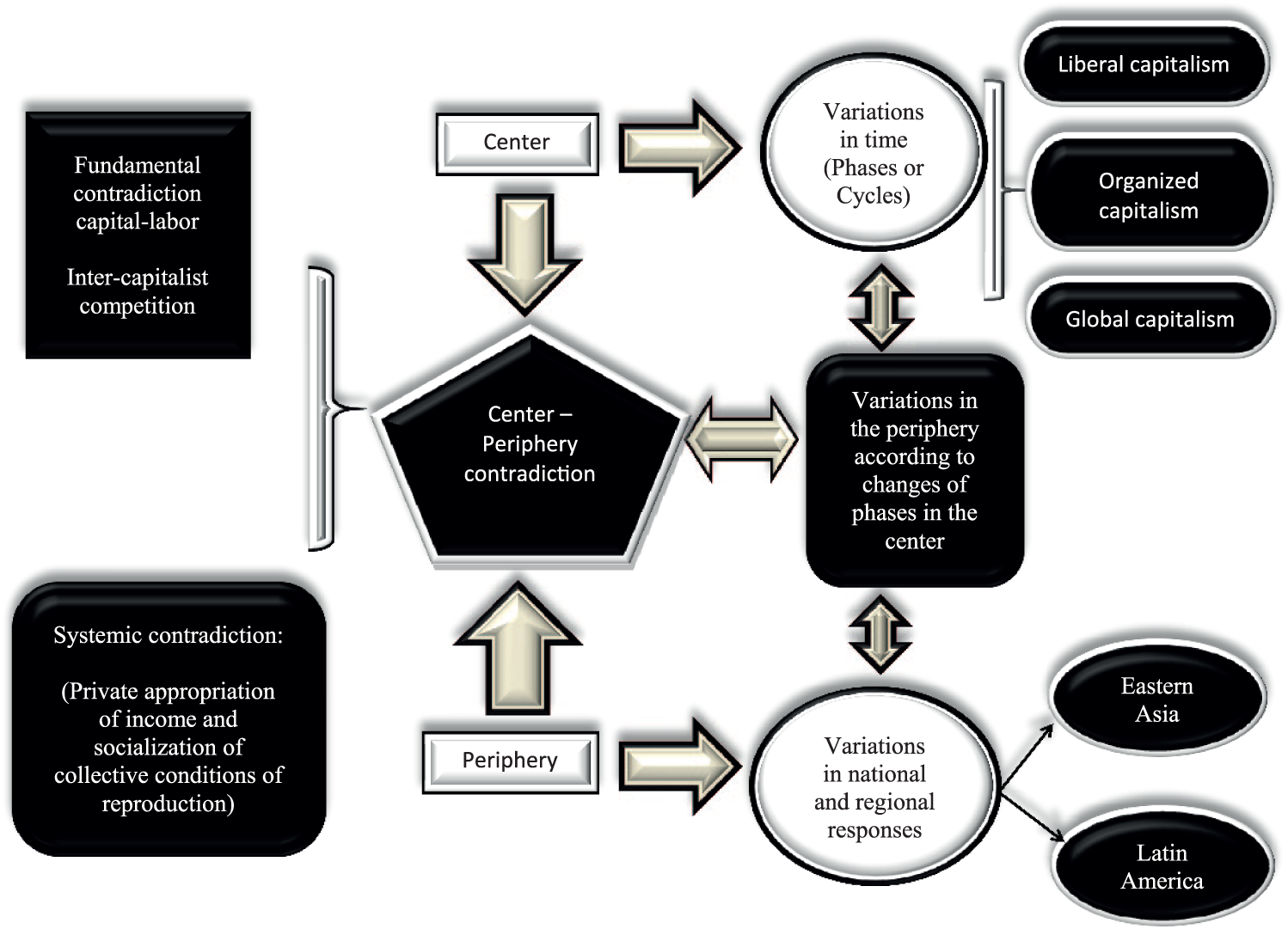
On the first aspect, the historical logic of any model of capitalism is that it is based on a contradictory social relationship between capital and human labor. At the same time, individual capitals stand in a relation of permanent competition in different, tendentially global markets. These conflictive and tension-laden relationships between capital and labor on one hand, and between different capitals on the other, can be considered the “founding contradictions” of capitalism (Marx 1989; regarding the application of this insight to CC research, see Jessop 2015), which are, in turn, at the heart of its structural crisis-proneness. The first of them provides the basis for the emergence of social classes, where capitalists can access the benefits of accumulation to the detriment of the masses (labor). The second leads, over the long run, to a dual dynamic of concentration and centralization, and, thus, the displacement of individual capitals, which is associated with economic and social dislocations (Sweezy 1981).
The aforementioned contradictory logics, inherent to any model of capitalism, form part of a spatially differentiated global system of accumulation. Thus, the multiplicity of locally specific politico-economic configurations and their institutional expressions that are the individual varieties of capitalism are to be analyzed while taking into account the historically and analytically prior, more fundamental differentiation of the world capitalist system, namely, its division into center-periphery structures. This analytical division was represented in Latin America particular through the work of the early structuralists and dependentistas (Cardoso and Faletto 1979; Furtado 1979; Marini 1973; Prebisch 1949) and was most famously systematized by Immanuel Wallerstein (1974). According to theorists of the world system, the twin notions of center and periphery refer to the positioning of specific space-economies in the global chains of production and distribution. Over the course of history, a pattern has emerged where the strategic nodes of these chains are controlled quite consistently by capitalists rooted in some spaces that, thus, become centers. This is to the detriment of the capitalists rooted in the peripheral or the intermediate semiperipheral spaces, who are relegated to performing less beneficial operations. This pattern tends to be extremely durable, meaning that profound changes in the positioning of one or the other space economy are historically exceptional (Wallerstein and Hopkins 1977; see also Arrighi and Drangel 1986). The ensuing contradiction between central and peripheral formations might be labeled the “global systemic contradiction.” Specific capitalist varieties must, in part, be understood as related to the specific spatiality and temporality of the overarching world system.
Regarding the remaining aspect of temporality, it is our key contention that processes of change in individual varieties of capitalism always need to be analyzed with reference to the different historical stages that the capitalist system as a whole has undergone. In each one of the main stages, changes affecting the dominant patterns of capital accumulation and the regulation of the accumulation processes in the central economies have effected a conditioning influence on the political and economic positioning of the peripheral countries (for more on the notion and evolution of capitalist stages, see McDonough 2015). Generally speaking, since the end of World War II, two main world historical stages under capitalist dominance have been identified. These are important for contextualizing the empirical argument following later in this article.
After World War II, a new mode of development established itself under the aegis of the Pax Americana: “organized capitalism” (Kotz 2002). The immediate postwar decades are, in many respects, to be characterized as the “golden age” of capitalism in the core economies (Boyer 1984). Nevertheless, what did not materialize throughout these decades were structural alterations concerning the center-periphery dialectic, as acutely shown by the failure of the import-substituting industrialization (ISI) strategies that were pursued throughout the region between the 1940s and 1970s (Di Filippo and Jadue 1976). Rather, bottlenecks in the industrialization process and the strategies of overcoming them with the help of foreign TNCs, adopted by many of the governments of the time, led to the development of a productive matrix where these external actors controlled the key technologies while being scarcely linked to local firms.
Toward the mid-1970s, organized capitalism eventually entered into a terminal crisis (widely interpreted as a profitability crisis; Gordon, Weisskopf, and Bowles 1987). The protracted period of crisis and transition led to a strengthening of certain segments of productive and—increasingly—financial capital. These came into positions that enabled them to orchestrate and take advantage of alterations in the spatial and temporal dimensions of accumulation processes and thus to overcome the limitations imposed by the institutional structures underpinning the previous order (Jessop 2005). The result was the emergence of what might be called “globalized capitalism.” The strengthening of global production networks (GPN) crystallized as one of the key features of this new phase (Lu-Lin and Gereffi 1994). In this phase, national political and economic actors from peripheral spaces are put into highly controversial scenarios of interests, actions, and scalar agreements in which to pursue their strategies (Harvey 2003).
It should by now have become clear how our reconceptualization of capitalist diversity indicates a different orientation for CC scholarship than conventional (VoC and similar) approaches. To be more concrete: the analytical approach suggested here incorporates the recognition of an earlier variety, namely, that of center and periphery. This variety changes over time as a result of changes in the predominant modes of accumulation and regulation and in the ways central and (semi-)peripheral spaces are interconnected.
Our theoretical propositions up to this stage are summed up, in a graphical and highly condensed fashion, in Figure 1.
Source: Own elaboration.
The notions of NA and NSI are introduced to concretize the previous, rather abstract considerations, and make them operational for concrete research endeavors. The first of these concepts refers to the specific forms in which processes of accumulation are constituted in a given space economy, while the second one addresses the specific characteristics of the state and the ways in which it is enmeshed in the former.
We shall now develop these concepts and subsequently demonstrate how they are instrumental for one of the major development debates of the last decades: the comparison of East Asian and Latin American development trajectories. We argue that these notions and the underlying reconceptualization of capitalist diversity permit us to inform an understanding—in ways that conventional CC approaches such as VoC cannot—of why, in the former region, a small and selected group from among the peripheral varieties could manage their insertion into global economic and political networks in such a way so as to change their macro-structural positioning in the world system.
4. NA and NSI: Concepts to Explain Differentiated Trajectories of Varieties of Capitalism
The concepts of NA and NSI are to be understood as intermediate concepts, focused on the stylized analysis of the institutional configurations of specific political economies and the underlying, transnational class relations, consistent with the more abstract understanding of capitalist diversity developed above (for more on intermediate concepts, see Mavroudeas 2012). They, thus, permit us to move toward a more concrete analysis of how particular varieties of capitalism evolve in the context of the overarching center-periphery relations. The way both types of nuclei are constituted depend on what we call structures of internal viabilities and external permissiveness (more on this below). Any given NA and NSI is constitutively interrelated. This is not to say that there is an all-encompassing conditioning of one nucleus over the other, but their respective properties permanently influence each other and may enter into virtuous or negative synergies. It is their dialectical relation and how it changes through specific historical processes that conditions the evolution of specific varieties of capitalism.
Conceptually speaking, the NA is configured by four relevant variables. Note that each of these variables transcends the internal/external divide, thus going beyond VoC’s (and other mainstream CC approaches’) methodological nationalism.
The first of these variables is the origin and control of the capitals that dominate the cycle of industrialization, and the integration of transnational capital into the national accumulation process. In this regard, it is important to consider whether the complexes of economic activities associated with high degrees of generation and retention of value-added are controlled by actors principally rooted in the same space economy or by external ones. We may, thus, speak of either endogenous or exogenous NA.
The second variable, which is closely related to the first one, concerns the constitution of and the control over the financial system. In this regard, a higher degree of endogeneity of the local financial circuits grants states greater capacity to purposefully direct them. Highly exogenous and foreign-dominated financial systems, on the contrary, may exert a conditioning influence over the state.
The third variable concerns the dominant form of reproduction of capital. Here, it is particularly important to distinguish between dynamic processes of generation of value-added, through processes of learning and innovation, and static ones, normally based on quasi-rents derived from capitalizing on natural advantages.
The fourth variable, finally, is the level of articulation between financial and productive capital. This variable overdetermines the other three: ideal-typically speaking, where financial capital is largely self-reproducing and weakly integrated with the productive system, the possibilities of developing more endogenous and dynamic types of NA are limited, because resources for financing collective learning and innovative activities are scarce. A close interrelation between productive and financial capital, under the preeminence of the former, is generally more conducive to developing these kinds of NA.
The different kinds of NA have consequences both for the socioeconomic structures internal to any given space economy and for their external insertion into the world market. An endogenous and dynamic type of NA will normally lead to a more complex and homogeneous productive matrix, which, in turn, will favor a relatively more equal distribution of income. An exogenous and rent-based NA, in turn, will tendentially be associated with heterogeneous and disarticulated productive and associated unequal social structures. An endogenous and dynamic NA will also be closely related to a global insertion through the “high route” of GPNs, that is, those segments where the most attractive economic activities are concentrated, while an exogenous and rent-based NA comes with a subaltern insertion into low value-added segments.
The NA of any specific space economy is, as indicated above, closely intertwined with the prevailing NSI. The state plays a highly significant role in shaping the particularities of the respective NA. We propose to define the NSI on the basis of the following four broad variables:
The first is the quality of the organizational structure, which is defined by the conceptual and operational basis, as well as the recruitment patterns, of bureaucratic staff. In ideal-typical terms, we may distinguish two types of configurations: on one hand, there are those where the conceptual perspective of the bureaucracy is oriented toward endogenous and competitive development strategies, accompanied by meritocratic selection processes. On the other hand, there are those configurations where the state bureaucracy and its personnel are largely focused on responding to external and internal actors’ demands.
The second variable that defines the NSI is the existence (or not) of nodal instances giving articulation and cohesiveness to the structures and actions of the state bureaucracy and its apparatuses, thus creating the possibility of genuinely steering processes of accumulation and industrialization. Where such nodes are absent, fragmentary structures will prevail.
The third variable is the existence (or not) of state control or steering capacity regarding financing productive and industrialization strategies, on which the state’s capacity to subordinate financial capital to its strategies will depend.
Finally, a fourth variable is the presence (or absence) of instances that permit the state to exercise control over or strong influence both on capital and organized labor (as well as other civil society organizations). In pluralistic societies, these would usually take the form of sociopolitical coalitions lending support to the state’s strategies of intervening with respect to the NA.
It is our contention that whether specific (semi-)peripheral varieties of capitalism develop the capacities to successfully respond to their peripheral condition or not will to an important degree depend on the characteristics of the NA and the NSI, as well as their interrelations. In our next section, we attempt to illustrate this argument in empirical terms, with regard to a comparison of the differential macro-regional trajectories of East Asia and Latin America.
5. East Asian and Latin American Development Reconsidered
When comparing the East Asian and Latin American experiences to illustrate the significance of the NA and NSI concepts in explaining the specific development trajectories of different varieties of capitalism, three sets of questions open up. They are addressed one after another throughout this section.
How did these nuclei, their properties and interrelations, influence the unfolding of the different national trajectories on which the macro-regional scenarios of East Asian and Latin America rest?
What are the external and internal conditions that intervened to make the formation of these nuclei in their respective form viable or to inhibit them?
How did the specificity of these nuclei impact upon the national and regional responses encountered to the globalized phase of capitalism, and how sustainable were these responses?
It is our most basic contention that the introduction of the nuclei as analytical concepts allows us to recognize from amid the manifold national specificities those regularities that have permitted a select few countries from the East Asian region to overcome their peripheral condition. The existence of these regularities in their national trajectories is associated with a set of contextual elements, both external and internal, that made the formation of the nuclei in their given form possible.
The dynamic process of productive development in East Asia—led in particular by Japan, South Korea, and Taiwan, on which we focus in the following—depended crucially on the articulation of two processes: ISI and a dynamic external insertion (Gereffi 1989).
Beginning in the period after World War II in the case of Japan and in the 1960s in those of Korea and Taiwan, significant processes of (re-)construction of local capitalist actors were initiated. They were based on political protection, which was made dependent upon specific performance requirements and patterns of external insertion. Local firms were obliged to advance from the simpler steps of ISI to more complex ones. The main result was the conformation of NAs that were both endogenous and dynamic. These could attend to two essential aspects of capitalist development (Prebisch 1949): first, a progressive and more powerful positioning of local capitalist actors in the functions of higher valorization within the global chains (Blyde 2014), and second, the development of more complex and internally articulated productive structures that combined rises in productivity, income, and rates of employment. These NA favored social structures characterized by a more integrative character, lower rates of labor informality, less income inequality (etc.) as regards other parts of the periphery (Jomo 2006; Lu-Lin and Gereffi 1994).
It was the type of NSI that allowed to both subject external capitals to strict conditions and strategically direct economic actors in general (Kohli 2004). This kind of NSI implied the capacity not only to afford protection to certain economic actors but also to discipline them so as to prevent this protection from taking on a character that would have gone against attempts to bring about innovation and collective learning processes (Chibber 2003; Woo-Cumings 1999). Through nationally specific processes, the states in question developed coherent and bureaucratically qualified structures with centralized agencies to formulate accumulation strategies (Chibber 2003; Johnson 1982; Kohli 2004), and strategies that allowed state authorities to exercise influence over corporations through their direct control of the financial sector and their ability to direct financial capital toward the productive sector (Baek 2005; Woo-Cumings 1999; Zysman 1983).
In Latin America, in contrast, both kinds of nuclei and their forms of interaction overwhelmingly developed different characteristics. Generally speaking, the type of NA that came to prevail in the region has a highly concentrated and exogenous foundation and includes a strong tendency to obtaining quasi-rents, derived from advantages in natural resources, rather than generating processes of collective learning (Schuldt and Acosta 2006).
The historical constitution of local capitalist sectors—strongly concentrated, associated with static comparative advantages in natural resources, averse to risk, and alien to innovation—did not undergo substantial modifications during the ISI period, but rather came to form its limiting social basis. Thus, most national ISI strategies pursued up until the 1970s at one point or another lapsed into a kind of “frivolous protectionism,” favoring both local and foreign companies, but not the development of innovative productive structures (Fajnzylber 1983; Levy-Orlik 2009). Attempts at confronting the resulting problems in advancing to the more complex phases of import substitution through the promotion of the influx of transnational capital tended to intensify the problematic socio-productive heterogeneity even more, without significantly contributing to advancing the dynamism or the complexity of local accumulation processes (Amsden 2001, 2007; Sunkel 1970).
The type of NA that took shape throughout the Latin American region, thus, lacked the dynamism and the strong endogenous base that could be found in East Asia. While it had a weak basis for learning and innovation, it became increasingly transnationalized in terms of both the leading actors and sectors. Regarding results, these NA were characterized by a greater relative weakness of generation and local control over the surplus of production, imposing strong limitations both on political attempts at redistribution and on a potential expansion of the base of accumulation. Externally, they lacked the capacity to sustain a successful insertion of local productive actors in high-value activities.
These characteristics and dynamics of the type of NA predominant in Latin America fomented the emergence of a kind of NSI with often opposite properties to those found in East Asia. With the partial exception of Brazil, there were no national trajectories where the state was genuinely capable to direct economic development. Rather, during the postwar era, Latin American states more often than not turned into sets of institutions that were progressively “captured” by corporate interests, both local and foreign (Faletto 1989; Portantiero 1989). In addition, they were charged with the necessity to attend to the redistributive demands associated with the cyclical activation of popular sectors (O’Donnell 2011). As a result, Latin American states generally constituted highly fragmented organizational structures (Castellani 2002), incapable of building the centralized, coherence-generating agencies necessary for disciplining capital actors and giving the process of accumulation a strategic orientation toward dynamism and endogeneity. All this came coupled with weak degrees of control over the—scarcely developed—financial system.
In consequence, the nuclei that prevailed in Latin America were caught up in a kind of negative synergy, in which the NSI lacked the ability of steering the NA while the latter—and their protagonists—came to inhibit the development of the necessary institutional and political capacities.
While the analysis, up to this point, is to some degree compatible with conventional CC approaches, even while going beyond their conceptual horizon, our dependency and WST-inspired framework urges us to expand our vision further. Such an expanded vision permits us to appreciate how the divergences in the configuration of the nuclei in East Asia and Latin America were in good part the results of differences in what might be called the surrounding structures of external permissiveness and internal viability (Beeson 2003; Jaguaribe 1979).
With respect to the former, the leading countries of the East Asian region formed part of a U.S.-led geopolitical strategy oriented at strengthening them as allies within the region (Castells 1996; Chibber 2003, 2009; Evans 1998; Glassman 2011). This means that they benefited from a particular structure of geopolitical permissiveness. 2 This involved, among other things, the promotion of their productive nuclei through ISI and the opening-up of the vast North American market for successively advancing from the former toward an export-led industrialization.
In relation to the internal viability, one important factor was that the local capitalist classes had been severely weakened by the war, something that made them much more inclined to collaborate with the state to benefit from access to the U.S. market and to accept, in turn, its disciplining interventions (Chibber 2003, 2009). This conjunctural weakness was further exacerbated by the effects of the agrarian reforms (Kay 2007) that had preceded, in the countries in question, the processes of industrialization. In addition to having important redistributive effects, they prevented the formation of concentrated and rent-oriented capitalist sectors that could have blocked state intervention and disciplinary action (Castells 1996; Davies 2004; Kay 2007). The labor force, in turn, was on one hand relatively well qualified, but on the other, only weakly organized and thus largely subjugated to the economic strategies imposed by state and capital (Deyo 1987).
In terms of the NSI, Japan’s Meiji tradition and the Korean, respectively, Taiwanese colonial heritages (Kohli 2004), as well as their particular elite configurations (Vu 2007), facilitated the constitution of state apparatuses more capable than others to direct the processes of economic development in the desired direction via a mixture of consensus-building and disciplining action vis-à-vis capital (Amsden 1989).
In the Latin American region, in turn, a clearly different scenario of viabilities and permissiveness prevailed. Regarding the structure of internal viabilities, the limited reach of agrarian reform (Kay 2007) left the concentrated power of local capitalists largely untouched. This came combined with the equally concentrated power of transnational actors, increasingly present from the 1950s onward. At the same time, workers throughout the region were rather well-organized, and the cyclical social upheavals obliged the state to internalize their redistributive demands (O’Donnell 1973). Thus, both groups of actors came to develop conditioning influence on state apparatuses in the region, leading to the conformation of a fragmentary matrix of state organization, dependent upon traditional, often patrimonialist practices (Acemoglu and Robinson 2012).
The infeasibility of constituting either an endogenous and dynamic type of NA or a kind of NSI with the necessary steering capacities was bolstered by a structure of external permissiveness that was much less favorable than in the case of the East Asian countries in question. This was due to both the impenetrability of the North American market for Latin American products and due to the hostility—in line with that of the local oligarchies—toward the political projects of “industrializing nationalism” that might have altered the subordinated nature of international economic integration of the region (Fiori 2014).
Let us finally turn to analyzing the most recent turns of events, associated with the crisis of organized and the shift to globalized capitalism that led, from the 1970s onward, to a qualitative change both in the processes of accumulation and in the modes of state intervention. Two key variations in the national and regional trajectories within the periphery have to be addressed to provide an answer to this question:
The way in which the nuclei consolidated during the phase of organized capitalism, which helps explain the differences in which these two macro-regions have reacted to the changes just described.
The issue of the (in)sustainability of the nuclei, their characteristics and interrelations throughout these processes.
Regarding the first of these dimensions, in the Latin American case, arguably the key impact of the multiple processes of global capitalist restructuring was their contribution to the economic exhaustion of the ISI strategies and the growing limitations they imposed upon the states of the region for sustaining them. Accumulation processes in the region entered into a prolonged stagnation that extended well into the 1980s. With the resulting debt crisis and the Washington Consensus, those capital factions—both financial and productive—that occupied privileged positions in the GPNs went on the offensive, thus drastically debilitating the national regulatory structures that had once underpinned import substitution (Ocampo 2011). Capital account deregulation (French-Davis 2005) and the foreign penetration of the financial system, in turn, removed a fundamental instrument from the NSI for directing the NA (Soto 2013). As a result of the former, the exogenous character of the prevailing type of NA and the lack of dynamism associated with it deepened even further (Cimoli 2005).
Seen as a whole, the Latin American response to the changing conditions was a subaltern attachment to the—often rather unfavorable—global networks, both due to the described weakening of countervailing tendencies in the NSI and the continuity of the exogenous and scarcely dynamic character of the NAs. In consequence, both a reduction in growth rates and a premature deindustrialization of the region took place (Arceo 2005). On a more structural level of economic development, the prevailing socio-productive heterogeneity became exacerbated, leading to the conformation of ever more informal, unequal, and dualized societies throughout the region (Portes and Hoffman 2003).
In contrast with what occurred in Latin America, the constitution of the nuclei, as well as their virtuous interaction, conferred upon states in the East Asian region a much higher capacity to respond to the incursion of global networks. The state-directed defense of the NAs’ endogeneity and dynamism did not only facilitate an external insertion of local productive actors into parts of the GPNs where operations with higher value-added are performed (Blyde 2014) but also helped sustain the greater societal homogeneity and social equality that had long characterized the region (Jomo 2001).
However, as indicated in our theoretical considerations above, capitalist variegation within the periphery, and the differentiated national and regional trajectories associated with it, cannot be analyzed assuming a unidirectional relationship between localized nuclei and global networks. Rather, we ought to take into account the bidirectional, changing, and often conflictive interactions that exist between them and that constantly generate changes in the structures of permissiveness and viability, eventually offsetting the stability of existing nuclei, virtuous or otherwise. Thus, the East Asian models of capitalism eventually had to confront processes of crisis and deep-reaching restructuring as well.
From the late 1980s onward, a drawn-out financial crisis and stagflation developed in Japan, while in 1997, a massive economic crash occurred in East Asia, drastically slowing down the former “tiger” economies. The gestation of these crises, as well as the political changes that stemmed from them, were strongly influenced by political pressures toward the dismantling of the existing developmentalist type of NSI, something that occurred gradually in Japan (Estevez-Abe 2008; Schoppa 2006) and more brusquely in other countries, such as Korea (Crotty and Lee 2005). The agents of these pressures were both transnationalized capital factions and international financial organizations, in other words, the controlling stakeholders of global economic and political networks. In fact, one structural change, compared with earlier periods, was the appearance on the scene of strongly globalized and increasingly financialized capital factions seeking to consolidate and increase their control over crucial segments of accumulation processes. Particularly, they pushed for financial deregulation, thus putting into question one of the pillars of East Asian developmentalism, namely, capital’s dependence on—and, hence, inclination to accept—the intromission of the state in its affairs (Chang and Evans 2005; Crotty and Lee 2001, 2002; Evans 1998).
The resulting pressures were further reinforced by various external factors. One of them was a notorious change in the structure of permissiveness for East Asian economic development, due to the end of the Cold War and the associated protectionist and expansionist turn in U.S. foreign economic policy (Gowan 1999; Ji 2013). In sum, the postwar context of permissiveness and viability transformed to one in which strong transnational influences came to bear ever more openly, as those mechanisms that had sustained strongly state-directed processes of economic development became increasingly dismantled (Crotty and Lee 2005; Jomo 2006). To be sure, this dismantling was neither automatic nor all-encompassing. Rather, it long coexisted with a still proactive role of the state (Yeung 2000). Still, the transnational and increasingly financialized capital factions imposed upon the functioning of the East Asian economies a new logic, distinguished by that prevailing during earlier periods, especially by its short-termism, associated with the increased capital mobility (Epstein, Schlesinger, and Vernengoet 2014; Lapavitsas 2013). Thus, the previous relationship between capital and the state was increasingly redefined. This redefinition was urged on by the international financial institutions, particularly the International Monetary Fund (IMF), which forcefully argued for the state to retreat from the economic sphere (Lee 1999; Rosenberger 1997). Significantly, this narrative was also developed and propagated from within the state apparatuses themselves (Crotty and Lee 2001; Thurbon 2003).
The penetration of transnational capital, through both global economic and political networks, impacted upon both kinds of nuclei in East Asia. With respect to the former, said penetration affected the dynamism, as well as the endogeneity of accumulation processes: the former was curtailed by the weakening of the kind of “patient capital” that had underpinned collective learning processes; the second came under threat from the increasing transnationalization of the financial system and the ever more strongly exogenous orientation of local capitalist groups. These qualitative changes in the region’s NA were facilitated by—and, vice versa, contributed to—the weakening of the NSI’s capacity to shape the processes of accumulation (Henderson 2011). Somewhat paradoxically, states intervened actively to curtail their own role in the latter, limiting their autonomy and adjusting their modes of functioning to the short-termism with which transnational capital factions acted (Chang and Evans 2005; Crotty and Lee 2002; Kiely 1998).
The process just analyzed demonstrated that when analyzing capitalist variegation in the periphery, even virtuous elements of the nuclei and their interrelation are generally unstable, subject to capitalism’s own contradictory logics described earlier. National trajectories may thus become subordinated to global economic and political networks and the actors that occupy dominant positions within them. Of course, this direction of change is by no means inevitable, as recent neodevelopmentalist experiments in the Latin American region itself have shown.
6. Concluding Remarks
As should have become clear over the course of this article, perspectives such as WST and dependency approaches allow for a convincing contextualizing interpretation of capitalist variegation and differential performance starting from the significance of an earlier variety that is by and large ignored in mainstream CC approaches. In contrast, the focus on temporal variations within the periphery and particularly on trajectories of state involvement is crucial for avoiding the functionalist and structuralist risks that accompany these macro-theories (Skocpol 1982).
We have proposed two key analytical concepts for putting into practice such a theoretical approach, namely, NA and NSI. Both are, in their different ways, the products of the local articulation between capital and labor, the influence of outside capital and the abilities of state actors to order and direct the resulting relationships. They are particularly relevant when we seek to understand the unequal struggle over the control of the desirable functions in GPNs and the divergent capacities of states to control, steer, and discipline capital. The analysis of different historical experiences—even if this has proceeded in a regionally aggregated form (East Asia vs. Latin America)—has shown how these concepts can help to elucidate both virtuous and problematic institutional and structural features of capitalist variegation.
Furthermore, we have argued that national trajectories and the specificities of localized NA and NSI can only be understood on the basis of a consideration of their dialectical relationship with global dynamics, operating through transnational economic and institutional networks and actors. The endogenous strength of the NA and the political steering capacities associated with NSI will—particularly in peripheral contexts—always be challenged by transnational actors. Thus, when analyzing differential trajectories in relation to these nuclei, it is mandatory to take into account both the economic and the geopolitical rationalities (Desai 2013) that influence them from the outside. For instance, the geopolitical dimension has been signaled as a crucial context variable that permitted (the Cold War context in East Asia) or inhibited (the neoliberal turn in Latin America) state actors from acting in certain ways to alter their respective national trajectories (Fiori 2014; Glassman 2011).
We must not, therefore, consider the relationship between national nuclei of accumulation and state implication on one hand and global networks on the other as unidirectional and/or static. Interestingly, this latter point has proven its salience in recent years with regard to the East Asian experience, which throughout this article has so far served mainly as a positive contrast with the flaws we have attributed to the NA and NSI predominantly found throughout the Latin American region: recently, there has been a clear retrogression in the endogenous configuration in the NA in many East Asian countries (particularly in South Korea), the result of strong deregulatory pressures and the loss of state control over the financial sector, as well as the gradual loss of disciplining power of the state vis-à-vis domestic business groups that have become more and more transnationalized and less dependent on state direction and support. The control over international political networks exercised by the international financial institutions has also been important in this regard (Crotty and Lee 2005; Evans 1998; Ji 2013).
To sum up: it is central, for giving new legitimacy to CC research, to highlight that capitalism is a system characterized by different contradictions, among them that between center and periphery. Within this frame, as we have seen, peripheral spaces are not only subject to epochal shifts between different phases of development of world capitalism, with their respective consequences for processes of accumulation and regulation, but they also develop differentiated, national and regional trajectories. What is at stake in our reconceptualized perspective on different models of capitalism is the structural and institutional conditions that need to hold for these trajectories to be virtuous in the sense of permitting the spaces in question to transform their peripheral position in the global economy.
Footnotes
Declaration of Conflicting Interests
The author(s) declared no potential conflicts of interest with respect to the research, authorship, and/or publication of this article.
Funding
The author(s) received no financial support for the research, authorship, and/or publication of this article.
1
To give just one crucial example for the resulting omissions, the role of state actors is often far more important for the development trajectories of (semi-)peripheral economies—think, for instance, of the large emerging economies in Asia and Latin America, such as Brazil, China, or India—than for the central economies upon which the Varieties of Capitalism (VoC) approach is modeled ( ).
).
2
One fundamental aspect of this geopolitical permissiveness was the overwhelming influence of the United States during the Cold War period. In this context, the United States had to rely on solid and friendly “aircraft carriers of accumulation,” situated in the proximity of its enemies (China, Vietnam, Korea, among others; Glassman 2011; Medeiros 2001). Said geopolitical situation induced the United States to promote the development of the East Asian countries in question through what came to be called “development by invitation” (Arrighi 1994), including a selective tolerance to the neomercantilist kind of capitalism that emerged in the region and a self-imposed limitation on its interventionist energies (Stubbs 2005). In contrast, U.S. geopolitical strategy vis-à-vis Latin America was not only characterized by a strong resistance to the conformation of relatively autonomous local industrial platforms that might have triggered a process of regional integration ().