







Abstract

Fifty Years of Radical Economics: Beginnings in Ann Arbor
Fifty years ago, the first issue of the Review of Radical Political Economics (RRPE) boldly issued forth in decidedly amateurish form, only a small step removed from the output of a mimeograph machine (can any reader recall such an antediluvian apparatus? See Figure 1). In that initial number, there appeared an exchange between me and Michael Zweig, who recently retired from State University of New York at Stony Brook but not from being a radical activist (Weeks 1969; Zweig 1969).
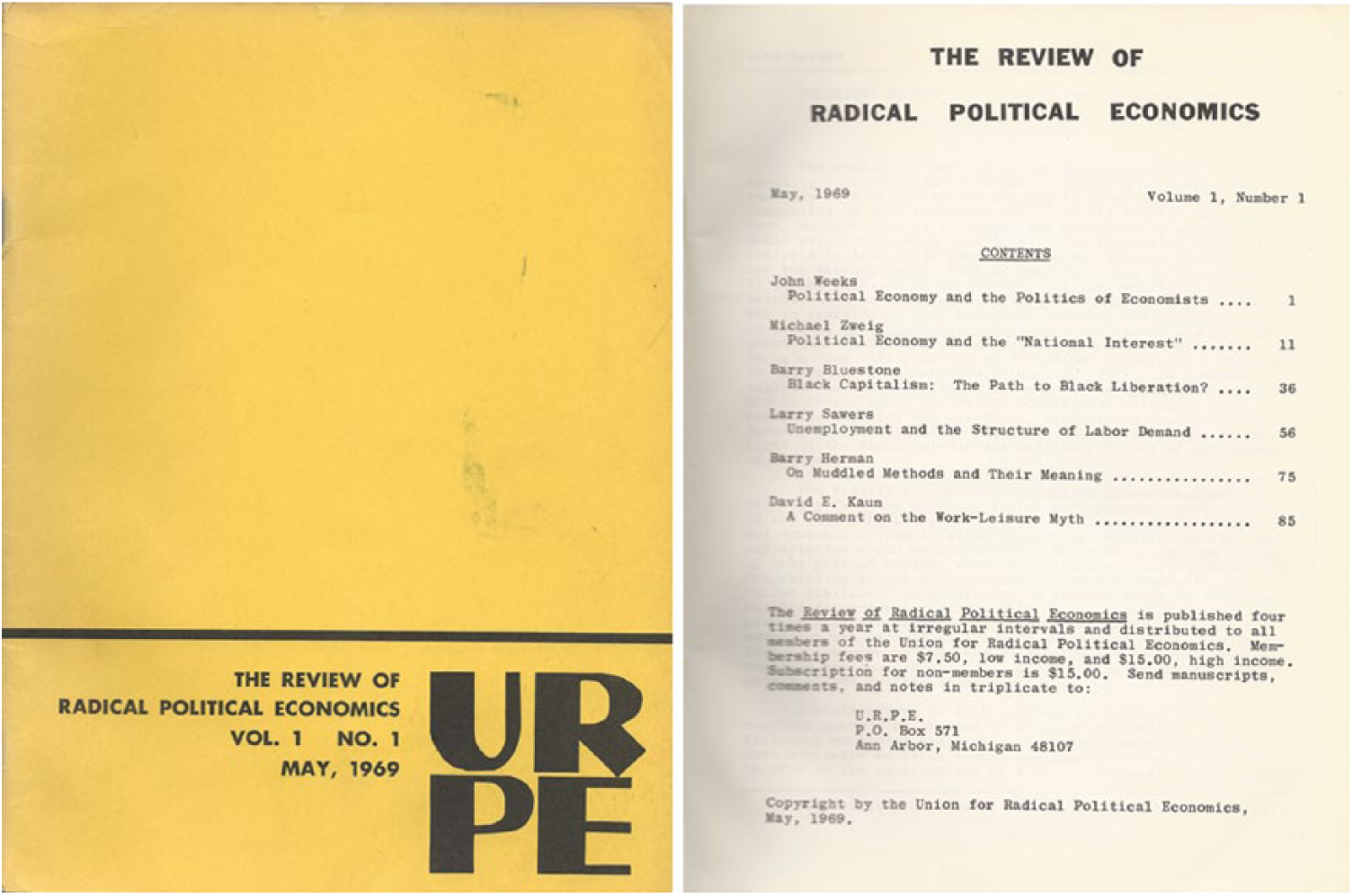
Cover and Table of Contents of First Issue of the Review of Radical Political Economics.
The issue in contention in that exchange was whether the reactionary nature of our profession resulted from the nature of economics or the predilections of economists—is it economic theory that is reactionary (my position) or economists that are reactionary (Zweig)? Looking back and combining the past context with the present, I conclude that we were both correct, but I never dreamed how reactionary both would become.
As we reflect on fifty years of the Union for Radical Political Economics (URPE) and the RRPE, we should recall that our organization began as a revolt among graduate students against the mainstream economics of the 1960s. To deepen our current critique of the profession, it is instructive to reflect on what the small group of radicals in Ann Arbor and counterparts in Cambridge revolted against. I shall limit myself to the Ann Arbor insurrection of which I was a part.
The University of Michigan (UofM) economics department in the 1960s was solidly in the mainstream of the profession. “Economics” meant the Keynesian version of the “neoclassical synthesis.” The then-head of the UofM economics faculty had made a notable contribution to that synthesis with an oft-cited article, “A Graphical Exposition of the Complete Keynesian System” (Smith 1956).
In the context of the 1960s, the UofM department was solidly on the left of the profession, as were the departments in the Universities of Minnesota and Wisconsin on the other side of Lake Michigan. These Midwest departments were very much the economics establishment. UofM provided President Lyndon Johnson with the chair of the Council of Economic Advisors, Gardner Ackley, whose predecessor Walter Heller came from Wisconsin.
The UofM faculty were Keynesian-interventionist in policy orientation and strongly pro-union. I can recall one of my professors saying of Milton Friedman and the other hard-right economists, who populated the then-infamous department at the University of Chicago, that they were “more than a bit crazy.” Given that UofM was solidly on the progressive wing of the profession, against what were we rebelling?
Asking the question demonstrates how far to the right the economics profession has moved in fifty years. Today, those Ann Arbor Keynesians with whom we so vigorously disagreed would not be accepted in any mainstream US economics department and in very few in Canada and Great Britain. A long list of unforgiveable sins would condemn them. Among the more egregious would be the analytical commitment to active macroeconomic management, and treating trade unions as having a positive economic role. The latter position followed in the strong pro-union tradition in Midwestern universities established by the great progressive at Wisconsin, Richard T. Ely. Ely founded and was first head of the American Economic Association. I suspect that few mainstream economists may know this and would be loath to admit it if they do.
Our revolt at UofM, inseparable from the antiwar movement, focused on what we considered two fundamental failings. These were the gross inadequacy of the economics we were taught, and the failings of those who taught it. The first fundamental failing derived from our assessment that the subject matter of our courses failed to address the pressing issues of the time. These pressing issues included first and foremost, for many of us, imperialism and its causes. Among the rebels was a near-consensus that imperialism was central to understanding the dynamics of the Vietnam War and, more generally, the Cold War.
A second pressing issue was that our courses provided no guidance to analyze the ethnic conflict unfolding in the United States, “racism.” Third, and in face of resistance or indifference by the men of the revolt, was the emerging awareness of a near-total lack of gender analysis in economics writing and teaching, mainstream or radical. These latter two issues lay the basis for rebellious forays into other topics, such as income and wealth distribution, and labor market discrimination broadly defined.
The glaring omission of these societal ills prompted the conviction that mainstream neoclassical Keynesianism was incapable of moving beyond its pedestrian focus on macroeconomic policy tools and microeconomic efficiency analysis. For several of us this led to investigation of and conversion to the political economy of Karl Marx. For me that would come several years later while teaching at Birkbeck College, University of London, where I had several colleagues strongly influenced by Marx’s analysis.
Parallel to the analytical failings of economics went the rebellious conviction that those who taught us engaged in de facto reactionary political practice. Here the Vietnam War loomed large. Keynesian and pro-union as they might be in the mid-1960s, few UofM economics faculty were, with a few honorable exceptions, fierce anticommunist critics of the war. Several were active supporters as a result of their close links to the Johnson administration.
Zweig’s and my articles in the first issue of the RRPE reflect this dual antagonism among the rebellious graduate students, against the failings of what we were taught in the classroom, and the reactionary politics outside the classroom of those who taught us. Fifty years later, so-called economic theory has degenerated into depths of reactionary dogma far beyond my imagination to anticipate in the 1960s.
Despite, or perhaps because of, that dogmatic degeneration of the mainstream, URPE and the RRPE continue as a thriving haven for those who harbor rebellious urges in face of an economics profession dedicated to the faithful service of the 1 percent.