







Abstract
This article reviews three models of Democratic Economic Planning, those of Pat Devine and Fikret Adaman, Michael Albert and Robin Hahnel, and Paul Cockshott and Allin Cottrell. Part of a larger research project aiming to merge certain features of these models, this article proposes five criteria to evaluate them. Following a proposal made by David Laibman, it adopts the organization and regulation criteria and add three others to them: limitation, formalization, and scope. Finally, the article offers a brief analysis of the models from those criteria.
Keywords
1. Introduction
Between 1988 and 1993, as the Soviet Union and its economic system of centralized planning was falling apart, four books about three new models of democratic economic planning were published: Pat Devine’s Democracy and Economic Planning (1988); Michael Albert and Robin Hahnel’s first two books about participatory economics (1991a, 1991b), and Paul Cockshott and Allin Cottrell’s Towards a New Socialism (1993). These books did not come out of nowhere. Since the beginning of the twentieth century, many debates had happened where socialist economists engaged each other or their orthodox counterparts about economic planning (Backhaus, Chaloupek, and Frambach 2018; Carlson 2018; Ritschel 1997). If the most well known of these exchanges—the socialist calculation debate—was about the possibility of planning a complex economy (Lavoie 1985), many others took place between socialists about how to organize a socialist economy (Castoriadis 1988b: 90–154; Luxemburg 1961; Pannekoek 1947).
Within this broad history, the three models we focus on came to existence in a specific context. On the one side, the Soviet Union’s demise was interpreted by many as demonstrating the failure of economic planning and the triumph of capitalism (Fukuyama 1992). On the other side, many socialists had turned their backs on planning to advocate “market socialism” instead (Aganbegyan 1988; Brus 1972; Elson 1988; Hodgson 1984; Kornai 1990; Miller 1989; Nove 1983; Roemer 1994). As such, the argument for democratic planning aimed both to convince a broader audience that an alternative to capitalism was still possible after the crash of the USSR and at the same time to show to fellow socialists that giving ground to a market-based solution was not the way forward.
Today, while the idea of democratic economic planning has endured, provoking stimulating intellectual exchanges, the models themselves remain in many ways steeped in the historical context in which their creators designed them. While they offer solid points against a market-based solution that remain relevant, they are almost thirty years old and have not evolved much over time. In particular, these models offer only unsatisfactory and partial answers to people who think that the environmental issue is now crucial for social change. Moreover, while the models are close to each other in many respects, they failed to offer a joint proposal that could underpin a strong popular movement toward democratic economic planning.
I address the latter issue in this article: the absence of a joint proposal—leaving the environmental aspect to another publication (Planning for Entropy 2022). The analysis follows the work I did on those models (Tremblay-Pepin 2015, 2018) and the insights of David Laibman (2012, 2015). Our main question is, preliminary to merging the models, which criteria should one use to assess postcapitalist models and identify the features that should be integrated into a common framework? I argue that the current divisions (market/plan and vertical/horizontal) are not helping to understand the functioning of a future socialist economy or merge the different models. Instead, I propose five spectra of tension in which postcapitalist models need to strike a balance: organization, regulation, limitation, formalization, and scope. The analysis of how different models are positioned on each spectrum made in the last section of this article points at how a merger could be feasible and desirable.
1.1 A few notes on vocabulary and concepts
The word “model” is used a lot in this article. It is the best way I found to describe the complex interlink between economic and political institutions that the authors studied here propose. It also shows their specificity. Many authors had “ideas” or “visions” of what a postcapitalist economy might resemble. The three groups of authors at the center of this article went further and described a coherent system, a model.
“Democratic economic planning” is, I think, the overarching notion under which the models studied here can be united. It first helps us distinguish them from another family of models: market socialism. Second, it focuses on their common ground; they want to differentiate themselves from central planning by offering a democratic version of economic planning.
I stated in the introduction that one of the goals of this research project is a merger between the models. What I mean by “merger” is an effort to devise a joint or common framework incorporating various elements of these models to take advantage of the significant similarities between them. The result is not prewritten: Will this be a new model? Will this mean adapting an existing model inspired by some features of other models? It remains to be seen.
However, some criteria are necessary to understand what we should do with the models. Unfortunately, there are no objective criteria available to judge economic models. The opposition between capitalism and central planning is at the center of the lexicon we use to understand and assess politico-economic models. However, the goal of the models we study is to offer a third way between these poles. I argue that we need to look elsewhere for criteria to evaluate them: in the debates the heterodox left had while contesting both social democracy and orthodox Marxist-Leninism.
2. Presentation of the Models
Since the models we study in this article have been presented various times by their authors, both in this journal (Goldstein et al. 1992) and elsewhere (Campbell 2012; Devine 2002; Laibman 1992), I offer only a short description in this section, the aim of which is to bring forth elements I analyze later. For readers who do not know the models and would like to have a more precise idea of what they propose, the best is always to read the books their designers wrote (Cockshott and Cottrell 1993; Devine 1988; Albert and Hahnel 1991b; Hahnel 2021). However, a brief sketch of negotiated coordination, participatory economics, and computerized central planning 1 is also available online (Legault and Tremblay-Pepin 2021).
Negotiated coordination is a model designed in 1988 by Devine, who did much of the later work on the model in collaboration with Fikret Adaman. This model is firmly based on representative democracy. It is organized around representative assemblies and governing bodies for production units to which groups from civil society send representatives to ensure that every stakeholder is represented in the decision-making process. The model keeps “market exchange” (the exchange of consumption goods) but bans what the authors call “market forces” (production decisions and the planning of investment by atomistic agents based on the profitability criteria). Instead, a national planning commission designs an investment plan. A representative assembly then adopts it, and sectorial negotiated coordination bodies do the local allocation of resources where various stakeholders choose which production unit to invest in based on quantitative (mainly rate of return) and qualitative information.
Participatory economics is a model developed by Albert and Hahnel from 1991 onward. Two types of councils organized in concentric circles are at the center of the model: workers’ councils organized in each workplace and consumers’ councils divided geographically. Helped by iteration facilitation boards (IFBs) that play the perfunctory role of emitting and adapting price values, the councils propose production and consumption plans and make iterations to those plans until there are no goods or services in excess demand or supply. This model is based on direct democracy and worker self-management, with remuneration based on effort and sacrifice.
In their 1993 book Towards a New Socialism, Cockshott and Cottrell proposed a computerized version of central planning. They show that planning the allocation of resources to produce millions of products is now possible with modern technology. For them, labor time is the best common denominator to calculate the value of what is produced and serve as a token for access to consumption. However, even if the plan is made in a centralized way, Cockshott and Cottrell say it should be coupled with a direct democracy like the one used in ancient Athens but helped by new technologies. Those democratic institutions are conceived to manage the political aspect of social life that cannot be reduced to quantitative data like labor time.
3. Evaluating and Comparing Models: The Problems
All these models are interesting in their own way. One can study their features at length and debate each of them in detail. However, what if someone wanted to select a model between those three to advocate for a better society. What if someone wanted to compare parts of these models—for example, their price system or their remuneration scheme—to see which is the most interesting and how one can influence and transform the other? For such purposes, the current terminology and reference points in political economy are not helpful. I exemplify this lack of valid criteria by presenting the limits of two familiar pairs of concepts used to describe politico-economic models. Those two pairs of concepts are market/planning and vertical/horizontal; the first is more economical while the other is closer to political science, but both are used in common parlance, so I am not spending time defining them in detail.
As mentioned in the introduction, the models presented are opposed to “market socialism.” Thus, the authors frequently used “planning” to describe their models and differentiate them from market-based proposals. In practice, rhetoric and discursive positioning aside, the distinction between democratic planning and market socialism is not always as evident as it may seem. Furthermore, the planning/market division is not particularly useful to differentiate one model of democratic planning from another. For example, do we find more markets in negotiated coordination than in participatory economics? Negotiated coordination says it keeps “market exchange,” so we could think that goods and services are exchanged on a marketplace similar to the markets we know under capitalism, but it is not exactly the case. In negotiated coordination, one can go to a shop and buy an apple with the money in one’s wallet, but the seller cannot modify the price of this apple according to how many apples he has sold that week: prices are set on production costs, and production units adapt to changes in demand by modifying the number of goods or services they produce (Devine 1998: 238–43). In a participatory economy, a consumer had announced a year ago that she would be consuming fruits. She, therefore, has an amount of credit available to buy an apple on her account. She goes to a place where consumer goods are made available, takes an apple, and swipes the equivalent of a credit card through a reader, and the amount equivalent to its price (also based on production costs) is withdrawn from her account (Hahnel 2021: 165–66). One could say that no market is at play here, but wait, the price of the apple can also be influenced by demand, as in a market. Indeed, IFBs and federations can modify a price to curb demand when consumption patterns do not seem to follow what was planned (Hahnel 2021: 167–70).
Is one model more “marketish” than the other? No. What we call “market” is a conjunction of economic functions that these models tear apart (one could say the same thing about planning). As we are accustomed to recognizing market features, when we see some of them, we tend to say that the model includes a market or an institution that is “marketish” (Hahnel and Wright 2016: 28–30). However, to call “marketish” some features (like the exchange between goods and money or the modification of prices according to demand) that resemble part of what a market should be according to neoclassical economics is more confusing than enlightening for our task of comparing the models. First, it postulates that something that resembles a market is a market when it is not always the case (Hahnel 2021: 170–72). Second, there are no criteria to establish what feature of a market makes it a market or makes it more of a market than another feature. Therefore, we end up comparing democratic economic planning models by looking for things that would resemble some sort of market, and when we find some, we either condemn or celebrate the model, depending on our vision of markets. It can be a useful rhetorical tactic to favor a model instead of another, but it does not give us much content in terms of comparisons.
The more political couple vertical/horizontal, our second pair of concepts, is equally useless. Let us take another example. Is computerized central planning more vertical than participatory economics? At first sight, the critical role of the planning bureau in Cockshott and Cottrell’s book gives it a top-down look. The adoption of the economic plan by a combination of a jury selected by lot and a referendum (Cockshott and Cottrell 1993: 186–88) and the selection of most of those who rule enterprises by lot (Cockshott and Cottrell 1993: 188–90) changes that first perception. However, upon closer examination, workers do not have a specific place to communicate their concerns or desires as workers of their specific workplace. They do have a vote on the national plan, but when they return to their workplace, they must apply it as is. No one is “on top” giving them an order, but it feels pretty constraining nevertheless.
On the opposite, participatory economics has been conceived as a horizontal system. A more detailed examination of the first versions of the model (as I mention below, this changed in recent years) shows that if there was plenty of horizontal structure to resolve day-to-day local problems, nowhere in the original model could people debate about the form of the economic model or on broader issues that concerned society as a whole. In a participatory economy, one could participate in decision making as a worker member of a workplace or as a consumer living in a specific community, but never as a citizen of a larger society (Tremblay-Pepin 2015). Even though everyone had access to all the information the society generates, each individual takes decisions not based on the greater good of the larger society but always from their situation as workers or consumers. Individuals could participate in the decision making at their workplace or in their neighborhood, but the destiny of their society as a whole would nevertheless feel out of grasp as if controlled by an impersonal force.
The vertical/horizontal opposition is thus neither helpful to differentiate the models nor identify their problems. As for the market/planning duo, the vertical/horizontal pair contains many different features. There is the spatial question: Where are decisions taken? There is a status question: Who has more power than whom? There is an information question: Who knows what? There is also a question on consequences: Who will be affected by the decision and who will not? The models of democratic economic planning have a different answer to each of those subquestions than the typical vertical or horizontal patterns. Using vertical/horizontal or market/planning to compare those models can therefore only lead to the cherry-picking of some of its elements to fit them in one category or another where they do not fit.
4. New Criteria
Rather than being framed within the debate imposed by the rupture between central planning and capitalism, evaluative criteria should give us a way to precisely answer the critiques made by those contesting both central planning and capitalism. Since they concern both planning and market, those critiques are at the same time more precise and more general than the classical duos of market/planning and vertical/horizontal. More precise because they concern only certain specific features, and more general because those features are present in both systems.
In that vein, Laibman (2015) proposed two criteria: organization and regulation. Organization “represents the polarity between central and decentral organizational forms” (Laibman 2015: 328). A more central model is organized around one decision center, while a more decentralized one has multiple decision centers. Organization is not comparable to the difference between market and planning (markets can produce centralized decision making, and planning can be decentralized), and while it has much to do with the vertical/horizontal division, it is only a part of it. The question here is where decisions are taken. Verticality and horizontality imply a difference in status: some are on top of others, which is not necessarily the case between centralization and decentralization. The debate on the centralization of politico-economic systems has been an essential part of the discussion since at least the nineteenth century, and the critiques of capitalism and central planning are not the only ones to tackle the issue. Nevertheless, it certainly was at the core of the attacks on the authoritarian turn in the Soviet Union (Castoriadis 1988a: 44–55; Kornai 1992) and of the oligarchic and oligopolistic features of late capitalism (Baran and Sweezy 1966; Galbraith 2007).
The other criterion Laibman proposes is regulation. It is about how decisions are taken, and it “ranges between a ‘quantitative/digital’ extreme. . . and a ‘qualitative/verbal’ one” (Laibman 2015: 329). Is the information transmitted to take the decision and inform others of the decisions taken quantitative data (prices and quantities, for example) or qualitative text (words, arguments, instructions)? This issue cannot be reduced to verticality and horizontality (a dictatorship can take decisions based on numbers or words, as a confederation of anarchist communes can), and while it is closer to the division between market and planning, it is much more specific. Markets imply much more than decisions taken on quantitative data, and planning can rely on both quantitative and qualitative data. Here again, the question of reducing society to (often inadequate) quantitative data as being part of a reduction of the plurality of the world was used to attack capitalism (Dardot and Laval 2017; Mirowski 2014) as much as central planning (Ellman 1973; Nove 1990).
If those two scales for evaluating models are undoubtedly relevant, they are insufficient, and they primarily serve Laibman to present his proposed model (Multilevel Democratic Iterative Coordination [MDIC]) as the perfect middle way between different postcapitalist models (Laibman 2015: 329). Regulation and organization are not the only criteria on which we should base our evaluation of models. We cannot cover all the questions a model must answer to be a valuable politico-economic alternative to capitalism and central planning with only those two aspects. Tremblay-Pepin (2015) presented three others based on the critiques made to capitalism and central planning. I combine them with the two put forward by Laibman to better assess the models.
A crucial criterion to add to the list is limitation, considering our critical ecological situation. For decades, critiques of capitalism and central planning demonstrated that their inherent productivism and growth imperative made them institutionally incapable of limiting economic activity to protect the environment (Gorz 1980; Latouche 2010; Illich 2001; Bookchin 1977). However, limitation is not just an ecological question, as Castoriadis showed. This issue has been central since the beginning of democracy in ancient Athens. Avoiding human hubris was then focused on warfare and relationships between different “nations,” but the problem remains the same: How can an autonomous community limit itself in its relation to the outside world (Castoriadis 1983)? Limits to human action can come from two sources: human volition or objective constraints. If democracy, a common ground for all our models, tends toward autonomy to fight against heteronomous forces (be they ancestors’ will, god’s prescriptions, or the accumulation of value by the “automatic subject”—Marx 1976: 128), the environment we live in poses a physical limit that is radically heteronomous to human will. Nevertheless, humans must always mediate objective constraints inside the models, which is often the role of scientists and researchers, but activists can also do it. Therefore, the central question about limitation is how a self-conscious autonomous society integrates those constraints democratically.
The formalization of the system is part of an old debate in anticapitalist thought that roughly follows the division between anarchists and socialists. To what extent should every aspect of social life be part of formal institutions? Alternatively, how much space must be left for the spontaneous and informal activities of those living in those societies? The critiques of capitalism’s “anarchy of production” (Engels 1978), of the disorganization of the industrial system in the Soviet Union (Castoriadis 1988a: 107–58; Nove 1990: 352–55), and of bureaucracy in both systems can also be seen under this light (Castoriadis 1988a: 159–97; Graeber 2015; Djilas 1957; Stanisevski 2004). One side of the spectrum is structured and well represented by Edward Bellamy’s utopia in Looking Backward (1982), while the other is spontaneous, like William Morris’s News from Nowhere (2017). However, formalization is not only an aesthetic debate between nineteenth-century utopian writers. It begs the question of what André Gorz called “auto-production” (2010) and what feminists popularized under the notion of care work (Gaard and Gruen 2002). We can take care of people we love (our families and friends), and then this care has a particular value to us. We can also give care to people we are not akin to in the more formal job context (as nurses and elementary school teachers do). How does a democratically planned economy take into account the work people do to take care of their loved ones or to answer their will to fulfill their desires by producing themselves what they need? What balance do models strike between that spontaneous, often purposeful, but sometimes scattered organization of economic life and the often efficient but sometimes restrictive structure offered by formal institutions?
A fifth criterion, the scope of involvement and conflict, is about how the models allow people to be involved in every aspect of society, from the micro to the macro level. On what issues do people have decision-making power, and where do they enter into conflict with one another? At the “specific problems” end of the spectrum, there is the necessary solving of day-to-day issues by directly concerned people. At the “broad issues” end, we find the opportunity for participants to influence the general direction in which society should go—including how to modify the very institutions of the models. Here again, this is an old debate about the nature of democracy. Should it be seen as a very local system where one decides what matters directly in their life (Bookchin 1995)? Or is it a political space open for profound disagreement and strife on the nature of society (Lefort 2012)? Once again, the objective is to strike a balance between the two polarities and find a way to treat issues from a general perspective or a particular one when deemed appropriate.
5. Analyzing the Models
Laibman (2015) already analyzes the three models using his two criteria: organization and regulation. However, he only gives three possible results for each criterion: one end of the spectrum, a middle point, and the other end of the spectrum. He also mentions that because of space constraints, he cannot document his choice with material from each model. Nevertheless, Laibman’s classification has evident heuristic qualities. It allows him to classify models on a simple two-axis table, and the simplification he operates highlights some central thrust of the models that are not visible otherwise. However, this strategy is limited if we want to go into details about the models and when we want to consider a more nuanced portrait of how the models manage the inherent tensions that Laibman has fruitfully described. One of these limits is that Laibman’s table mixes two things: a polarity on which to inscribe different features of the models (e.g., this aspect of the model is more centralized, while this other is more decentralized) and a judgment on the capacity of the models to strike a desirable balance between the two poles. Considering Laibman’s goal—classifying models in a way that shows how valuable his MDIC model is—this is a strength. However, for our analytical purpose, some detailed work must be done before understanding how to strike a balance. Therefore, the first step is to establish, for each model, what features stand on each pole of the spectra.
As shown in table 1, our three models are quite different from one another in terms of organization, but their differences might be a little less pronounced than what Laibman interpreted. He is right not to find any element of decentralization in Cockshott and Cottrell’s model. If they sometimes reach a certain level of deconcentration in decision making, they never get to a genuine decentralization of power. The model was made in part to show that centralized planning is possible, so centralization is one of its explicit features.
Organization.
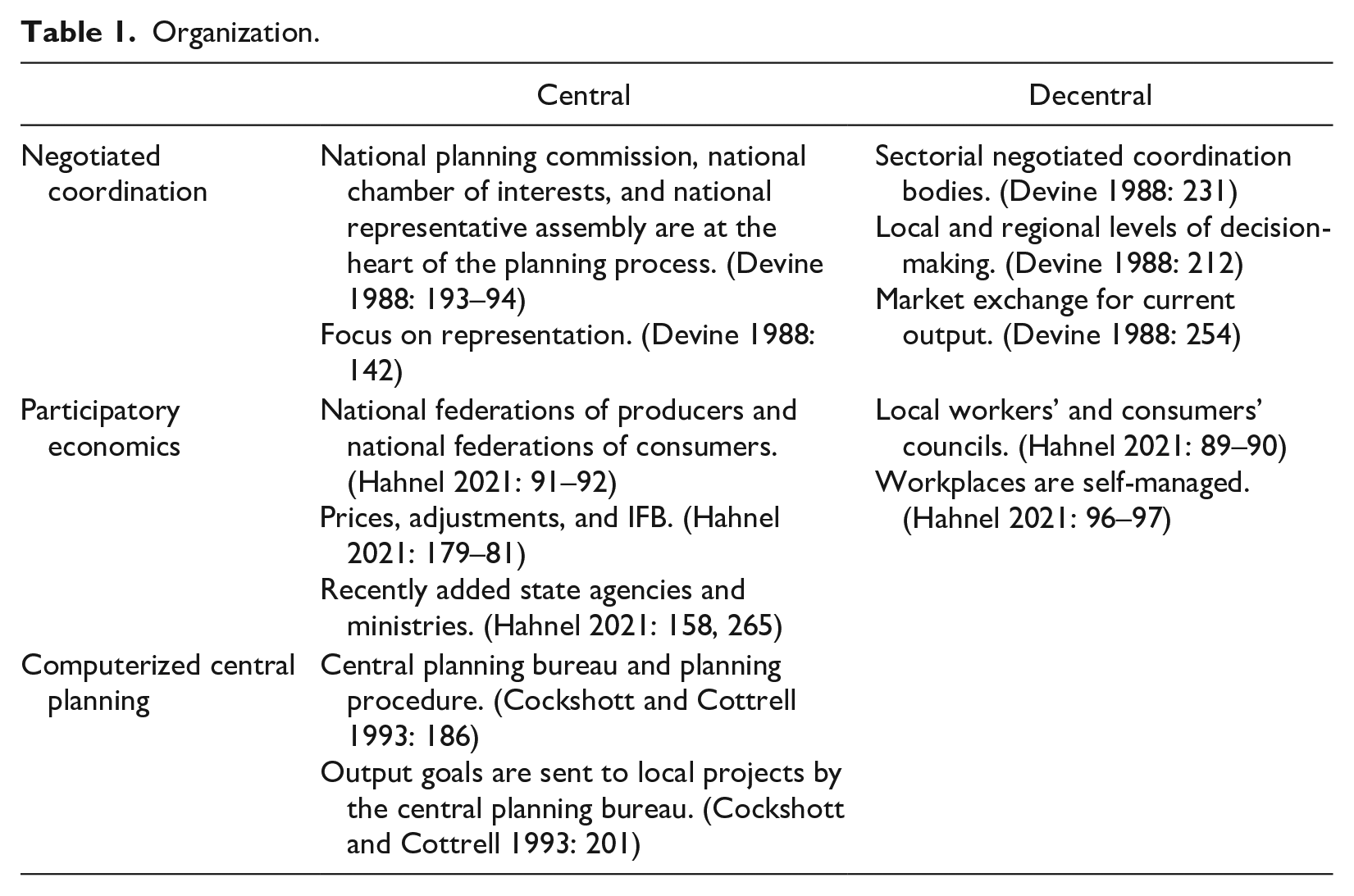
The difference in organization between negotiated coordination and participatory economics is subtler than Laibman presents. Negotiated coordination has features that tend to centralize and decentralize because it explicitly tries to balance centralized and decentralized features. For example, investments are planned by specialists and elected representatives in a centralized way, but when the time comes to apply the plan, to produce or exchange, decentralized institutions like negotiated coordination bodies and market exchange take the lead. It is true that participatory economics naturally pushes more toward decentralization. However, with the more recent development made on investment and development planning, it now has a new centralized process also based on representatives, while annual planning remains highly decentralized. So, if centralization is clearly a way to distinguish Cockshott and Cottrell’s model from the two others, the difference between participatory economics and negotiated coordination is much more nuanced.
Of the three models, participatory economics has recently found an interesting balance between centralized and decentralized features. Centralized institutions have specific roles when a broader overview is necessary, but they are not “on top” of local councils, and referenda approve their plans. On the other hand, the local councils make decisions during annual planning based on what affects them directly, so they decide things they know about while being constrained in their decisions by the more general development plans approved by the whole society.
In participatory economics and computerized centralized planning, the distinction between quantitative and qualitative data is central to the model as can be seen in table 2. Albert and Hahnel want to avoid the multiplication of meetings and debates. Therefore, their model relies heavily on quantitative data to make decisions. Qualitative and verbal exchanges are left to problems that cannot be otherwise fixed and to adopt long-term plans. Cockshott and Cottrell divide the world into two: economics, which can be reduced to a unique quantitative value, labor time; and politics, which is irreducible to numbers, and that must be the subject of debates through direct democratic processes. Devine and Adaman’s model is not strictly qualitative as Laibman argues; it is more of a crossing between the two modes of regulation. While it is true that it gives much space to negotiation and representation, it is also centered on quantitative data such as return rate and prices. Also, the current output is distributed through market exchange, so mainly with the help of quantitative data. In negotiated coordination, quantitative data is also an instrument that helps the qualitative debate.
Regulation.
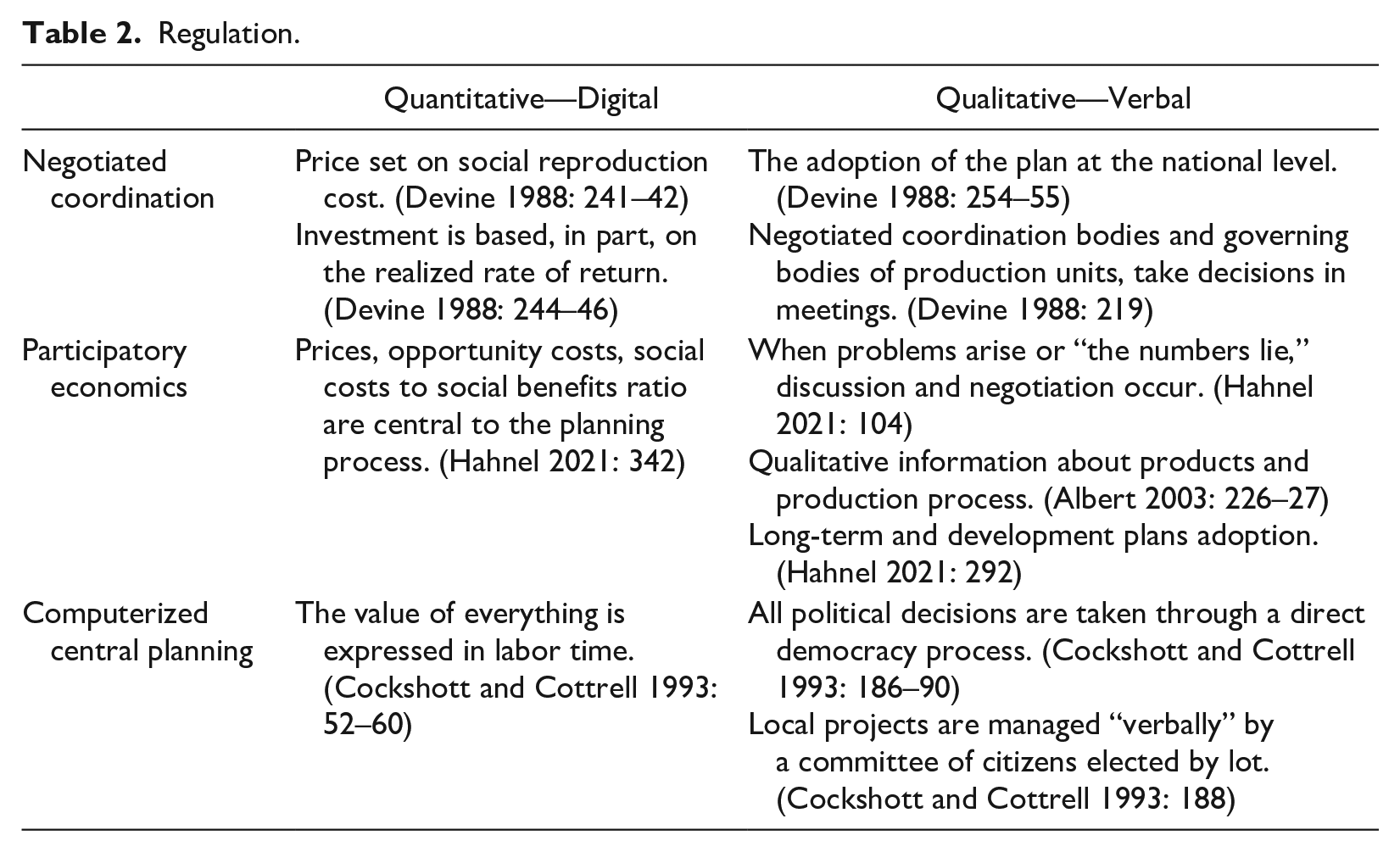
The politics/economics division proposed by Cockshott and Cottrell quickly appears limited. With a democratized economy, economic decisions are deeply politicized. For example, to the extent that there will often be externalities to economic transactions that cannot simply be corrected by revising prices, a qualitative process will frequently need to be added to the price system. The balance between qualitative and quantitative regulation within negotiated coordination and participatory economics seems more promising. However, the devil is in the details: the way prices and rates of return are calculated is an element at least as crucial as how much space they take as a regulation tool. Unfortunately, many details are either missing or unsatisfying about prices formation in the models. For example, in negotiated coordination, a “rental” is included in the price of natural resources (Devine 1988: 201). If the idea is potentially interesting, how and by whom this rental is calculated is never clearly detailed. Cockshott and Cottrell have a similar problem; they evoke a rent or license for natural resources to “ensure environmental conservation” (1993: 211) but never again mention how these would be calculated and included in their prices emanating from a labor theory of value. Qualitative information (very present in the first version of participatory economics—Albert and Hahnel 1991b: 61–62) is equally ill defined. There are different types and uses of qualitative information, and participatory economics never clearly tells us how this nondigital information will “improve the quality of estimates of true social costs and benefits” (Albert and Hahnel 1991b: 91).
Limitation is about how a democratic society can constrain itself in its relationship with its environment (in the broadest sense, i.e., what is exterior to this society). In the models we are studying, limitation is reduced primarily to two questions: ecology and international relations. Table 3 shows that the three models are reluctant to impose objective constraints on both accounts and instead use a process based on human volition. Devine and Adaman did not publish any detailed proposal about international trade and negotiated coordination, but they recently became more interested in environmental issues. Since its inception, negotiated coordination has included an objective constraint about ecology: a rental fee is imposed on the use of natural resources based on their depletion rate. However, that objective constraint is not central to the model and is barely mentioned in later articles, even those discussing environmental issues. For both authors, the level of consciousness that negotiated coordination will bring to society is its core contribution to resolving these issues. Absent the capitalist logic of accumulation, the door is open for a fully conscious understanding of the means and ends of production and establishing a more harmonious relationship with nature.
Limitation.
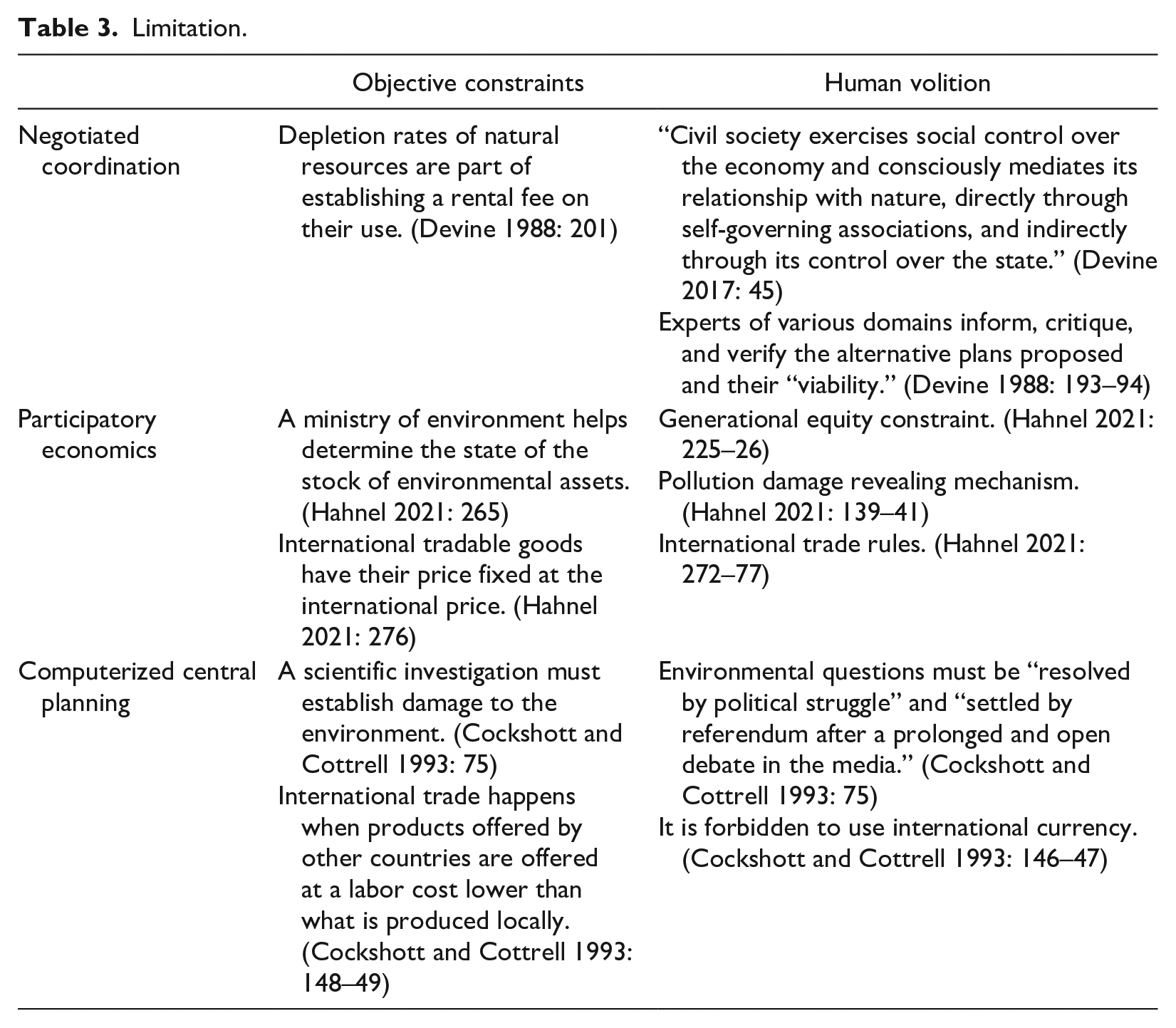
Until recently, participatory economics did not have anything resembling an objective constraint. However, in 2021, Hahnel added two elements, very briefly addressed, that look like objective constraints. First, a Ministry of Environment takes part in establishing an environmental development plan. It is responsible for estimating “the costs of environmental protection/enhancement—understanding that often what we need to know are the effect of declining stocks of environmental assets on future production” (Hahnel 2021: 265). This brief quotation can give us the impression that this ministry would have scientists at its service and measure the empirical destruction of environmental assets and its consequences on the ecosystem. Then these elements will be considered in the conception of the environmental development plans that impose a constraint on investment and annual planning. Second, in the same book, Hahnel explored how could a participatory economy trade with other economies. His solution brought in an external constraint: during annual planning, goods and services that can be exported or imported will be exchanged at fixed international prices, with no possibility for the IFB to change them. So, the international market acts as an external objective constraint on a participatory economy.
Nevertheless, as for negotiated coordination, participatory economics mostly trust human volition to be the vector of autolimitation. For ecological purposes, the collective will to protect the environment is based on individual interest: people who are getting polluted have a direct interest in making polluters pay, even more when they receive compensation. Moreover, the generational equity constraint forces a generation to limit itself now to invest in the future while knowing that the next generation will have a similar cap to its consumption. Participatory economics also establishes rules about international trade to make sure less developed countries will get more of the deals than more developed countries.
Cockshott and Cottrell’s model makes only a little space for objective constraint on the ecological question: if there is environmental damage, it must be established by a scientific inquiry, but what to do about that damage will always be decided politically. As mentioned earlier, they evoke a rent on resources but never mention how it fits in their price system. On international trade, the objective constraint is more considerable; a good coming from another country must be available to exchange against another good produced in the home country for fewer work hours than the first good; otherwise, no international trade is possible. Once these goods are found, it is forbidden to contract loans or to use international currency, but this constraint is endogenous to the model and does not come from an external agent.
The difficulty here is to force democracy to consider its effect on other systems that might not influence society directly without falling to authoritarian measures. For example, reducing biodiversity might not directly affect anyone in a society today; maybe no one will even complain about it. Hoping it will nonetheless be protected because people are more “conscious” appears naïve. Moreover, since a loss of biodiversity can have a longer-term or an indirect effect on the economy, not taking it into account because no human is directly “affected” now adds a perverse bias to the evaluation of social and opportunity costs. Taking advantage of power inequalities when trading with less developed partners will probably benefit a society economically, so how does one ensure that the models do not permit or, even worse, favor such behavior? A solution would be that the models’ prices integrate those objective constraints, so actors in the model consider bad behavior less advantageous. This situation relates to our preceding comment on a more detailed work about price formation in those models.
The idea of a yearly cap of consumption on some natural resources determined by a crossing of scientific expertise and political approval also comes to mind. Another option is to design an institution—maybe at the judicial level—to evaluate the data (about the state of the environment or the international inequalities) and apply laws, rules, and constraints (it could go from a tax on certain products to a prohibition of specific actions) that cannot be easily contested. Both options are somewhat present in the models but never clearly defined. Their designers seem to trust that democracy will consciously choose not to surpass its limits. This optimism is difficult to uphold considering the actual climate crisis. On the other hand, democracy is always democracy; in the end, even with the more constraining legal system, if most people choose to do otherwise, it is not laws written on pieces of paper that will block them. Nevertheless, some institutional complexity and political gravitas might refrain people from breaking the laws, or it might at least slow them.
Formalization is a tricky issue for postcapitalist models. Since their goal is to propose institutions and systems, they tend to focus on the formal elements and only leave little space for spontaneous action. Even when their designers mention there should be space for such spontaneity, they rarely show where. It is even truer of democratic planning models with their complex relationship to spontaneous action that is often linked to market behavior. However, if self-management does mean something, it should concern not only workplace organization but also the capacity to initiate small projects and get some social recognition for the work done in the private sphere. Table 4 presents how the three models interact with formalization. Small-scale activities in Devine’s models leave a space open for having a job that is not in a production unit. It can be done simply and quickly and can serve as a complement to someone’s more formal job or to a retired person who wants to consume a bit more than her allowance permits. The commune in Cockshott and Cottrell (even though it is only mentioned in their first book and never really developed in detail) allows doing some work in a smaller community and have it recognized as work that gives access to consumption, even though it is not in a formal “project.” Recently, participatory economics added a feature on care work being done at home; someone can take care of a child or an elderly person and get compensation for the work done. Otherwise, if someone wants to do a productive activity outside of the planning institutions of participatory economics, it needs to start as an unpaid voluntary project that can, someday, become a “real” workplace and get access to resources and payment when recognized by the planning process. Outside of those particular and very marginal features, the rest of the model is only structured institutions, but we must remember that the form taken by these institutions can be adapted locally.
Formalization.
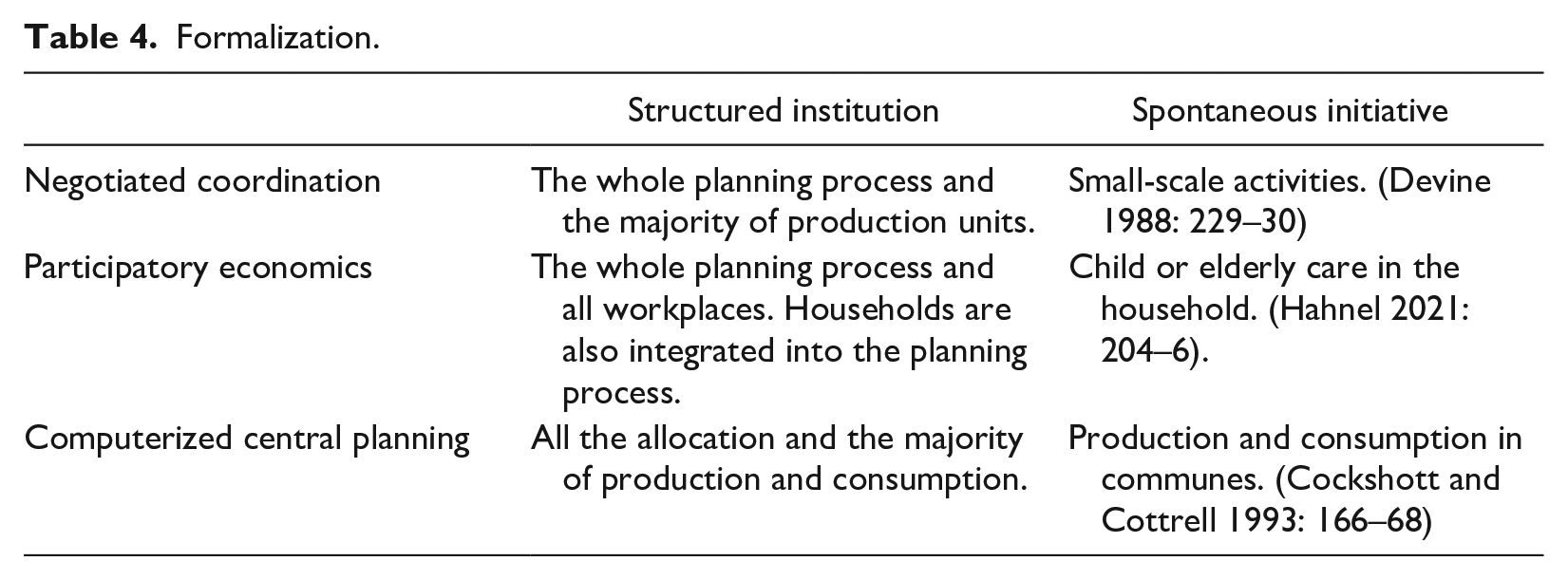
The way each model found to provide some space for spontaneous organization is a form of “loose institution” to regroup individual initiatives. We could expand this idea and design similar loose institutions to integrate the work done by people on their own and integrate it into the planning institutions: home-based agriculture or collective gardens, graphic design, home repair and maintenance work, craftmanship, etc. Uniting individual workers in those institutions would allow them to have their work recognized. Such production can potentially be planned based on previous annual production. It would provide purpose to those doing it and be a valuable use of resources in many cases. However, it would need more detailed work to integrate it into the models.
On what issues can people be involved, and where can conflict emerge in the different models? As can be seen in table 5, Cockshott and Cottrell’s answer is straightforward: there can be debates and conflicts on broad national issues when the plan is in conception, but it is always from a broad perspective. We can imagine that the model allows for some room to fix local issues at the management level of the individual projects, but no information or political expression coming out of those local workplaces is used for planning purposes. For a long time, participatory economics was at the exact opposite: the sole point of view was on specific problems and, when aggregated, the answers to those specific problems formed the global plan for the whole society. As we saw before, there was no specific place to discuss where society, in general, was going. This situation changed with the improvements Hahnel brought to the model in the last decade: long-term and development planning are made through discussions and are open to a national public debate through representatives and referenda. This process has many similarities to Devine’s proposal for taking care of investments: a national debate followed by a local democratic instance taking care of distribution.
Scope of Involvement and Conflicts.
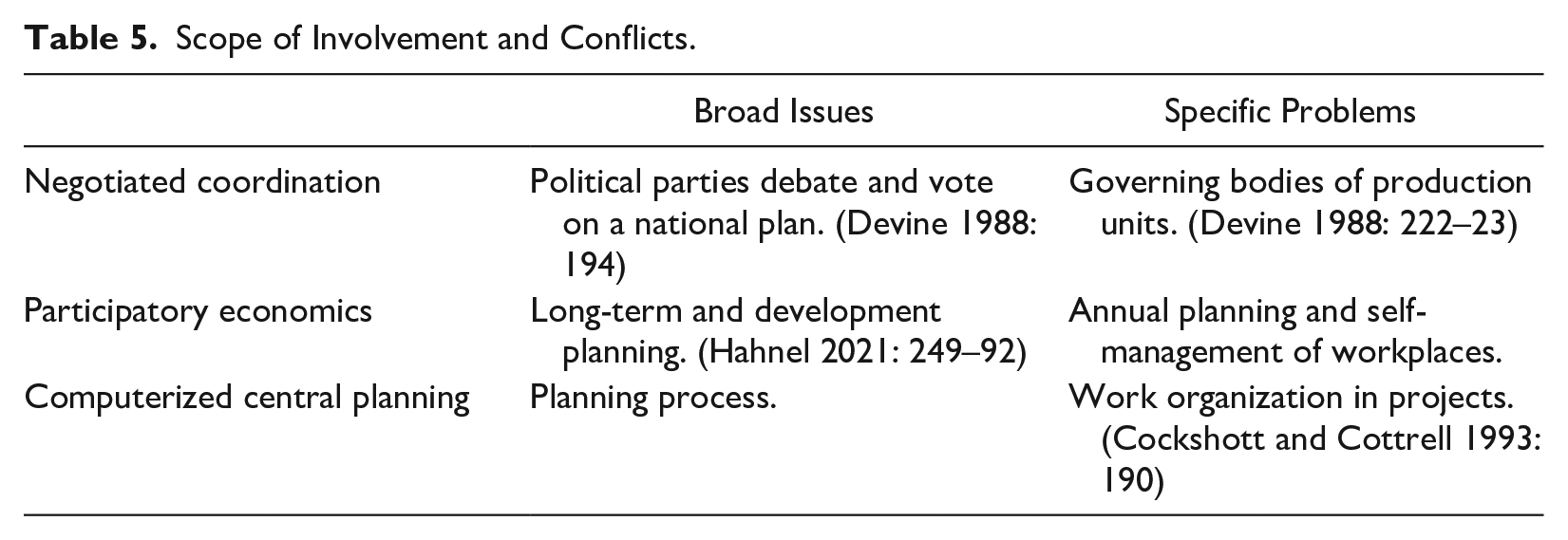
Both negotiated coordination and participatory economics strike an interesting balance, but they both have their limits. Negotiated coordination chooses to talk only about investment, leaving a gap on long-term and development planning. As for participatory economics, it tends to reduce education and environmental planning to questions strictly related to production, while these issues are much broader. It is easy to see how these development plans tell us how much to invest in education, but it is much less clear how to decide what kind of education a society chooses to provide. Leaving it in the hand of consumers’ and producers’ federations helped by a little-defined ministry of education presupposes that our choices in education are guided by the needs that consumers expressed. The design and development of education systems need to be based on what society considers a good education; hence, they need to be based on what citizens (and not workers or consumers) think about what is culturally valuable to transmit from one generation to another. The same is true about environmental development planning and infrastructure, or international trade planning. To answer the broader questions needed to prepare a development plan, one must ask oneself in which kind of society one wants to live. Thus, all subjects are interrelated. An option to consider would be to produce a general development plan, including all the sectoral development plans, and to make a recurrent debate on where society is collectively heading. Spaces to imagine, discuss, and confront different development plans would then be needed.
The idea of Devine to maintain political parties might be of interest here but could use some improvement. Political parties have two significant features in a representative government: they generate political programs and contend for representative power. In a postcapitalist system, parties could be these political spaces where people sharing the same political orientation imagine and propose general development plans according to their vision of society. Debates between the different visions would occur in a large public forum, and a referendum would adopt the plan. Political parties would not enter into an electoral challenge to get elected to apply the plan; they would only be able to propose plans or elements in the plan. The final plan would be adopted by a referendum and implemented by the already democratic planning institutions.
6. Conclusion
The elaboration of the five criteria to assess the models is the first step of a broader merger process where different features from different models could combine to strike a better balance on the different spectra. What did our first analysis using those criteria bring us? The organization criteria showed us that the newest version of participatory economics offers a valuable balance between central and decentral features. On regulation, the balance will be found in having more details about the price formation process and the inclusion of qualitative features to the valuation of goods and services; none of the models is unambiguous on those accounts. The inclusion of objective constraints to impose limits on production and consumption is something where very little work has been done, and should be done considering the actual environmental crisis. This work could be combined with what needs to be done to the price systems since prices could impose some limitations. The idea of “loose institutions” where individuals with small-scale projects are united and connected to the broader planning process might be a way of leaving more space to spontaneous involvement, but they must be more carefully thought to fit in the process while being more generalized to regroup a variety of activities. Finally, a deeper reflection on political institutions is needed to find equilibrium about the scope of involvement. For the moment, either the models simply copy existing political systems (the British parliamentary system in negotiated coordination and the Athenian direct democracy in Cockshott and Cottrell) or they do not have a coherent political system and make some institutions appear when needed without telling us how they are linked to the rest of the model (as the new ministries and agencies in Hahnel’s most recent innovations in participatory economics). A political system more tightly linked to the economic institutions could provide a way to think about broader issues without forgetting specific problems.
As we saw, those criteria give us a way to assess and understand the models on questions that are not linked to divisions like market/planning and vertical/horizontal. Instead, they open avenues of research to improve the models, starting from their internal logic and tensions. This mindset is more fruitful if the goal is to build economic models that are “post” capitalists and not confined inside the ideological markers of the very systems we want to leave behind.
Footnotes
Acknowledgements
Many thanks to Marie Léger-St-Jean for her thoughtful and precise comments on this text, and to Mathieu Dufour for his very useful comments on the most recent version of the text. Also, I want to acknowledge the patient and generous work of the reviewers of this article; their comments were of great help.
Declaration of Conflicting Interests
The author declared no potential conflicts of interest with respect to the research, authorship, and/or publication of this article.
Funding
The author(s) disclosed receipt of the following financial support for the research, authorship, and/or publication of this article: This article draws on research supported by Canada’s Social Sciences and Humanities Research Council.
1
This is how I call Cockshott and Cottrell’s model. This model has fluctuating designations since its designer did not give it a name per se. Laibman (2015) uses new socialism because of the title of their 1993 book. But I find this denomination too general; any of the models we study could be denoted by this term.  uses “Scottish model” because of the origins of Cockshott and Cottrell, but I do not find this name descriptive enough. “Computerized central planning” seems a clear, short, and descriptive way to name it.