







Abstract
The COVID-19 pandemic has underscored the importance of social protection programs such as India’s Mahatma Gandhi National Rural Employment Guarantee Act (NREGA). And yet, acute crises such as pandemics are layered upon existing inequalities of gender and caste in India. We show that a distinctive feature of twenty-first-century Indian capitalism is a restructuring of the caste-gender division of labor in rural India, such that women’s unpaid labor of social reproduction has increased, particularly for women from marginalized castes. Thus, patterns of participation in NREGA cannot be understood without understanding the specifics of the underlying crisis of social reproduction for labor. Social protection programs that do not consider the labor of social reproduction and are unaccompanied by broader socialization of such labor then likely fall short of mitigating deep-rooted inequalities.
1. Introduction
There is increasing interest in the design of social protection programs to mitigate the effects of global shocks and crises, especially as the COVID-19 crisis threatens to roll back decades of progress on poverty reduction, school attainment, and food security across the world. As calls to expand these programs increase in urgency, an examination of such programs for their inclusivity of groups marginalized not only by class but also by hierarchies of gender, caste, or race is warranted. In this article, we use a social reproduction feminism (SRF) framework to examine first, the particular restructuring of caste-gender divisions of labor in response to a long term crisis of social reproduction for labor in India even before COVID-19; and second, the extent to which one of the world’s largest workfare programs, the Mahatma Gandhi National Rural Employment Guarantee Act (MGNREGA, or NREGA henceforth), was embedded within this restructuring, mitigating caste-gender hierarchies in some ways, while reproducing them in others.
There is a significant body of literature on agrarian distress in India from the late 1990s to the mid-2000s, as India’s liberalization policies impacted the agricultural sector (Reddy and Mishra 2010; Vakulabharanam and Motiram 2011). Our article contributes to a smaller literature that emphasizes the restructuring of gender-caste-class divisions of labor that occurred during this period (Deshpande 2011; Neetha 2014; Naidu and Ossome 2016, 2018; S. Rao 2018; Naidu 2021). We draw on an extension of the SRF framework to the crisis literature, to argue that the agrarian crisis in India can be understood as a crisis of social reproduction for labor. The SRF framework builds upon the rich feminist literature on the ways that gender, race, caste, and class are articulated into the capitalist social order (Davis 1981; Collins 2000) and its concrete specificities in India (Sehgal 2005; A. Rao 2009; Hensman 2011; Kapadia 2017; Menon 2019; John 2021). Social reproduction here refers to the gamut of activities—be they waged or unwaged—that enable the creation, maintenance, and restoration of capitalist and laboring classes (Mohandesi and Teitelman 2017). The labor of social reproduction, therefore, encompasses the effort and work involved in the daily and generational production and maintenance of human life (Katz 2001). This theoretical framework makes visible how particular gendered and caste-based reorganizations of reproductive labor were central to Indian rural households’ response to the agrarian crisis pre-COVID (Naidu and Ossome 2018). We argue that these same reorganizations also influenced the NREGA outcomes observed for gender and caste.
First initiated in 2006, NREGA was designed to provide social protection against chronic crisis. The Act is premised upon a “right to work” philosophy and guarantees the provision of at least 100 days of wage employment per year, paid at the minimum wage, to every rural household that demands it. The program is entirely demand-driven; that is, no screening or targeting takes place. The arduous nature of work assignments provided under this scheme—largely building rural infrastructure such as wells, tanks, canals, roads, etc.—is considered an adequate screening mechanism. The program addresses a very broad demographic category—all rural households—rather than being narrowly targeted to households of a certain income (as with many anti-poverty programs), or narrowly defined “productive” workers (as with unemployment insurance or other employment-based benefits). A failure to provide this employment to any rural household that has a job card and wishes to use it to obtain wage employment under this scheme requires the state to provide unemployment insurance after 15 days of the application. Before the pandemic, it was estimated that the program served about 15 percent of the Indian rural working age population on average, albeit with a fair bit of variation across states (Ramnarain and Rao 2020).
A much remarked upon feature of NREGA has been the relatively high participation of women beyond the 33 percent quota provided for women, now exceeding 50 percent (Khera and Nayak 2009; Narayanan and Das 2014), in striking contrast with low and falling women’s participation rates in the rural labor force more generally. The participation of Dalits, historically India’s most marginalized caste group, and its indigenous peoples, Adivasis, in NREGA is also higher than their share of the population in most states, although in line with their share of poor, low-wage, laboring households. 1
Most literature has attributed these relatively inclusionary outcomes to progressive aspects of the scheme (supply-side factors) such as equal wages for equal work, or the lack of explicit income-based targeting. Women’s participation has been attributed to gender-mainstreaming features such as the provision of work within a five-mile radius, and crèches to be set up for care of young children. Ramnarain and Rao (2020) argue, however, that the high participation of women in NREGA in a context of declining participation of women in the labor force belies the role of supply-side factors alone. For the pre-COVID context, Ramnarain and Rao (2020) highlight three interconnected “demand-side” factors driving women’s participation in NREGA, especially that of women from marginalized castes: (1) the reconstitution of class, gender, and caste relations with agrarian distress; (2) the failure of nonagricultural employment growth to absorb women; and (3) the gender-, caste-, and class-differentiated burdens of reproductive work that made NREGA the type of paid “outwork” that was feasible given these burdens.
In this article, we build upon these arguments by empirically examining the links between agrarian distress, nonagricultural employment, and women’s and marginalized castes’ participation in NREGA. Based on this analysis, we argue that the falling women’s labor force participation rate in India and the high participation in NREGA are two sides of the same coin, both indicating the exclusionary nature of Indian economic growth over the last thirty years. We then consider the somewhat contradictory role of NREGA in addressing a crisis of social reproduction for labor without sufficient consideration of the labor of social reproduction in the workfare provided, within a wider context of insufficient additional efforts to socialize social reproduction in India.
2. Social Reproduction, Crisis, and Social Protection
Feminist economics literature on crises—financial or economic, natural or ecological disaster, or violent conflict—has tended to focus broadly on three inter-related questions: first, how gender impacts the production of different vulnerabilities of caste/race/location/age; second, how gender relations in households and communities may shape responses to crises and practices around survival, coping, and management; and finally, how the crisis itself impacts the trajectory and evolution of gender relations to produce new inequalities as well as possibilities for change (Sparr 1994; Enarson 1998).
This literature has shown how women’s work acts as a social safety net for families and communities facing crisis, given that the responsibility for the production of food and collection of materials such as fuel, water, or fodder lies with women in most contexts. Several case studies—ranging from those documenting the adverse impacts of neoliberal restructuring, to those studying the aftermath of natural or man-made disasters such as famine, environmental events, or violent conflict—highlight how women’s paid work and reproductive work both provide a flexible and seemingly inexhaustible resource for the continued survival of the household and community in situations of distress (Davis 1981; Elson 1991; Deere, Safa, and Antrobus 1997; Naidu and Ossome 2016). Indeed, these gendered responsibilities, argues Enarson (1998: 159), place women “at the center, not the margins” of global trends. An effect, for instance, of austerity policies across the world in the 1980s and 1990s was to intensify the time poverty of low-income black and brown women in particular (Sparr 1994; Deere, Safa, and Antrobus 1997).
Marxian theory focuses on economic crises as endemic to the capitalist system. Crisis in a capitalist system has been attributed variously to the tendency of the rate of profit to fall, the tendency of capitalist classes to overaccumulate, or the tendency of the population to underconsume (Luxemburg [1913] 2003; Sweezy 1946). While several debates on the causes and nature of crisis continue to unfold, there is broad agreement that crisis in capitalism is the rule and not the exception, because of the contradictions inherent in the processes of capital accumulation. The Marxian view of crisis has thus tended to focus on crisis as largely a crisis for capital, that is, conjunctures, largely emanating from within the productive sphere, where the ability to accumulate or to realize surplus is somehow threatened (Marx 1981).
Marxist feminists, however, have frequently pointed to the way in which capitalism is fundamentally reliant upon reproductive work often performed within the household without pay, given that this labor produces and reproduces the labor power that all other production depends upon (Dalla Costa 1996; Mies 1998; Hensman 2011). SRF builds upon these feminist insights about the importance of paid and unpaid labors of social reproduction to capitalist accumulation processes, and vice versa. Fraser (2017) points out that struggles over who bears the costs of social reproduction are inherent in capitalism. Such struggles, along axes of race, caste, and gender, may take place interconstitutively with the struggle between capital and labor over the distribution of surplus (John 2021; Bannerji 2020). 2 Thus, an understanding of social reproduction is central to understanding crises under capitalism as well as the emancipatory struggles unfolding against capital.
A further distinction may be drawn between a crisis of social reproduction for capital and that for labor (Rao and Vakulabharanam 2019; S. Rao 2021). S. Rao (2021) argues that this distinction is critical to further the integration of feminist insights into Marxian notions of crisis. Since the constant production and renewal of capitalism’s fundamental commodity labor power is a prerequisite to profit making, any disruptions to the former can throw capitalist accumulation into crisis, creating a crisis of social reproduction for capital. At the same time, ordinary laboring households struggle to reproduce themselves when, in attempting to resolve crises of profitability or realization, capital is successfully able to transfer the burdens of this adjustment onto working class households. Thus, laboring households may suffer a crisis of social reproduction for labor, even as capital is more able to accumulate surplus (S. Rao 2021).
This article takes as its starting point an understanding of twenty-first-century Indian capitalism as marked by a crisis of social reproduction for labor. As we show below, a distinctive feature of this phase of Indian capitalism has been a restructuring of the caste-gender division of labor in rural India, as the relative significance of different mechanisms of surplus extraction has changed. In the Indian case, accumulation has long been fueled by the extraction of surplus from the “self-employed” in the form of monopoly and oligopoly rents and interest on debt (Banaji 2011). The “real subsumption” of a small urban enclave of salaried urban professionals working for corporations, was and is important, but small as a proportion of the labor force (Vakulabharanam and Motiram 2011). Since the late 1990s, two other categories of surplus extraction have increased in importance. The first is the exploitation of a growing class of precarious migrant workers who switch between agricultural and nonagricultural work and rural and urban contexts (Breman 2010; Mishra 2021). The second—if we view women’s unpaid labor of social reproduction as a subsidy to capital—is an expansion of this subsidy as the share of women performing this labor has grown, particularly among women from marginalized castes (Neetha 2014; John 2021). From the perspective of the social reproduction of laboring lives, these forms of surplus extraction have resulted in a deep contradiction between the instability of precarious migration and the spatial and temporal stability that is crucial to social reproduction.
In this context, programs of social protection are attempts to mitigate crises of social reproduction for labor. While we may question the overall nature of workfare as a viable form of social protection and acknowledge that it can be constructed upon stigmatizing discourses of “dependency” and entail the imposition of work requirements to residualize welfare (Fraser and Gordon 1994; Peck 2001), we argue that NREGA occupies a somewhat unique position in this debate, due both to its inception—a result of intensive grassroots struggle and mobilization—and its scope. For one, NREGA decrees a right to work, which provides (on paper, at least) a guarantee where “schemes come and go” (Dreze 2017: 146). Secondly, the program avoids the income- and productivity-based conditionalities that have limited the impact of other social protection programs. Finally, the specific ancillary benefits of NREGA—potentially reducing precarious rural-urban migration, prioritizing women’s employment, and the creation of rural assets—were deemed as important by the architects of the Act as the direct impact on alleviating poverty and hunger (Dreze 2017). NREGA is unquestionably a crucial entitlement for the vulnerable in rural India.
Nevertheless, social protection programs, including NREGA, are designed to reproduce labor, which may mean reproducing some of the gendered, caste-based, or racialized divisions embedded in the social worlds of laboring households (Fraser 2013; Naidu and Ossome 2016). This political economy is what we wish to examine. The designers of NREGA did attempt to navigate one aspect of this tension through quotas for women, alongside the other women-friendly design features mentioned earlier. Without an accompanying reorganization of reproductive labor more broadly, however, our empirical analysis suggests that the participation of both women and marginalized castes may have been driven as much by the exclusionary features of post-liberalization India’s crisis of social reproduction as it was by the inclusive design of NREGA (see also Ramnarain and Rao 2020).
3. Chronic Agrarian Crisis as a Crisis of Social Reproduction for Labor
3.1. Background and context
In this section, we place India’s two phases of agrarian crisis within the larger feminist political economy framework of crises of social reproduction, allowing us to explicitly integrate struggles over social reproduction into the analysis of struggles over surplus.
As table 1 indicates, a first phase of neoliberal India’s agrarian crisis lasted until about 2005 with an unevenly distributed revival in agricultural growth from 2005 to about 2013 (Chand and Parappurathu 2012; Nagaraj et al. 2014). After 2014, however, there were once again nationwide signs of an agriculture in distress (table 1). Growth rates of output and yield had already slowed between 2008-2014, but the growth rate of output halved after 2014, and the total cropped area decreased. And this time, the slowdown in agricultural growth was accompanied by falling nonagricultural GDP growth rates as well (Mehrotra and Parida 2019). The Indian economy was thus in a second phase of agrarian crisis before the onset of COVID-19.
Average Annual Growth Rates of Area, Output, and Yield.
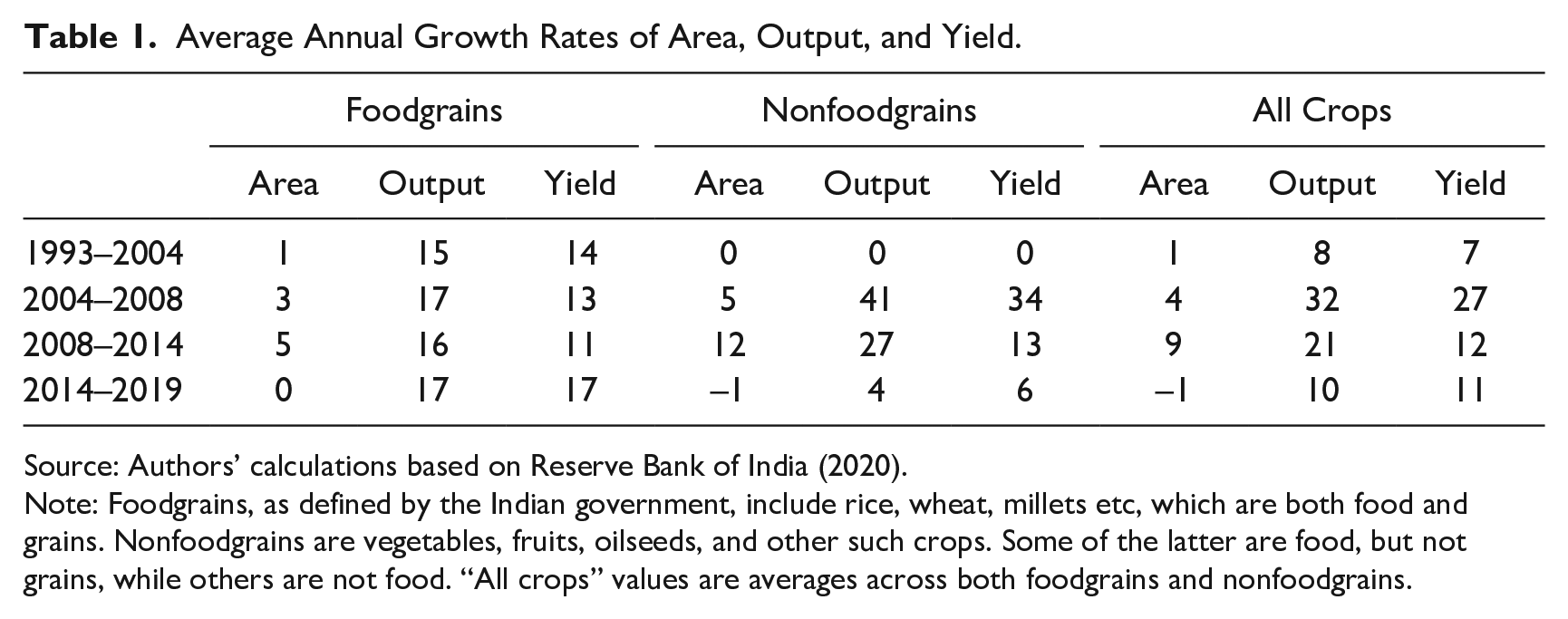
Source: Authors’ calculations based on Reserve Bank of India (2020).
Note: Foodgrains, as defined by the Indian government, include rice, wheat, millets etc, which are both food and grains. Nonfoodgrains are vegetables, fruits, oilseeds, and other such crops. Some of the latter are food, but not grains, while others are not food. “All crops” values are averages across both foodgrains and nonfoodgrains.
While the agrarian crisis was a crisis of accumulation for some percentage of larger farmers, it had a far greater impact upon the livelihoods of small farmers and the land-poor, whose ability to eke out livelihoods from agricultural self-employment and wage employment diminished sharply after the 1990s (Basole 2019). Agriculture’s demise as a safety net propelled a desperate search for livelihoods outside of agricultural own-cultivation and wage work. In the absence of vibrant nonagricultural development in rural India, the primary resolution to this crisis for laboring households was an exodus of temporary migrants to urban areas (Mosse et al. 2002; Breman 2010).
Reliable national- or state-level data on precarious, internal migration in India does not exist. Field studies, however, indicate the very specific caste- and gender-based segmentations of these streams of migration, with marginalized castes being restricted to the most precarious forms of migration and male migrants constituting a majority of urban-rural temporary migrants (see Deshingkar 2021 and Mishra 2021 for reviews of this literature). These growing masses of precarious “footloose labor,” traveling across India in search of work, provided urban capital with a cheap labor force that had little capacity to bargain for wages or benefits (Breman 2010; Rao and Vakulabharanam 2019; Basole 2019). Overall, the ability of Indian capital to accumulate in the aggregate was only enhanced by this first phase of agrarian distress. Led by growth in the nonagricultural, urban economy, India achieved its highest ever GDP growth rates even as farmers with marginal holdings (less than a hectare) were committing suicide in the thousands. This crisis is thus best understood as a crisis for labor, rather than for capital, and one that explicitly called upon gendered labors of social reproduction as a means of survival for labor (Naidu 2021). The tragedy of the second phase of the agrarian crisis is that it was accompanied by a slowing down of the nonagricultural economy as well, blunting the coping effect of migration, and potentially making the labor of social reproduction even more critical.
3.2. Sources of data and limitations
To understand how India’s crisis of social reproduction for labor propelled a vast restructuring of the gender/caste division of labor, we turn to data from India’s National Sample Survey Organization (NSSO) Employment surveys. NSSO data on the individual employment status of household members minimally captures class relations at the individual level, allowing us to distinguish between those engaged in self-employment or petty production, casual wage workers, and the category of “domestic and allied activities.” Feminist critics of the NSSO’s definitions of “economic” activity and thus of “employment” point out that these categories exclude many forms of own-use production that women are likely to be heavily involved in (Deshpande 2011; Hirway 2012). The NSSO’s categories of domestic and allied activities are defined minimally, as almost a residual category (Naidu and Rao 2018). We refer to the latter as “reproductive labor (NSSO definition)” to mark the fact that this category does not fully encompass what we understand as the labor of social reproduction.
Furthermore, the NSSO only records work that respondents self-report as their “principal occupation” (economic activities carried out for 183 days or more in a year) and “subsidiary occupation,” economic activities pursued for 30 days or more. These categories fail to capture the forms of sporadic, fragmented livelihood generation activities that women (and men) are likely to pursue in postliberalization rural India. The NSSO did conduct its first ever nationally representative time use survey—the Indian Time Use Survey (henceforth ITUS)—in 2019 (published 2020), which we use below to demonstrate that the time burdens of reproductive labor fall most greatly upon women in these most marginalized caste and class groups. 3 We also use cropping output and irrigation data from the Directorate of Economics and Statistic (DES) in formulating agrarian crisis indicators.
3.3. Class, caste, and gender: Interconstitutive analyses of crisis
As an imperfect proxy for a Marxian class categorization, we use a household typology that the NSSO itself provides, which groups rural households by their self-described primary source of income, a grouping that is highly correlated with men’s occupational status (see S. Rao 2018). The latest round of NSSO data on employment from 2017–2018 shockingly omitted any data on land holdings, constraining our ability to distinguish between farmers with marginal holdings and those with more land. As a result, the household class categories presented here are (1) agricultural self-employed; (2) nonagricultural self-employed; (3) agricultural casual wage worker; (4) nonagricultural casual wage worker; and, since 2011–2012, (5) salaried wage worker households.
Table 2 4 shows that as of 2017–2018, the principal source of income for almost 60 percent of rural adults came from self-employment/petty production, primarily agricultural, with casual wage labor accounting for another 24 percent. The shares were similar for Adivasi households, but more evenly split for Dalits, with 43 percent living in households deriving their primary income source from petty production/self-employment, and 40 percent from casual wage labor. The historical legacy faced by Dalit households because of caste-based restrictions and discriminatory exclusion from land ownership has led to their lower landholdings (Thorat 2002; A. Rao 2009).
Share of All Rural Adults (≥15 Years of Age) by Principal Source of Income of the Household a , and by Caste.
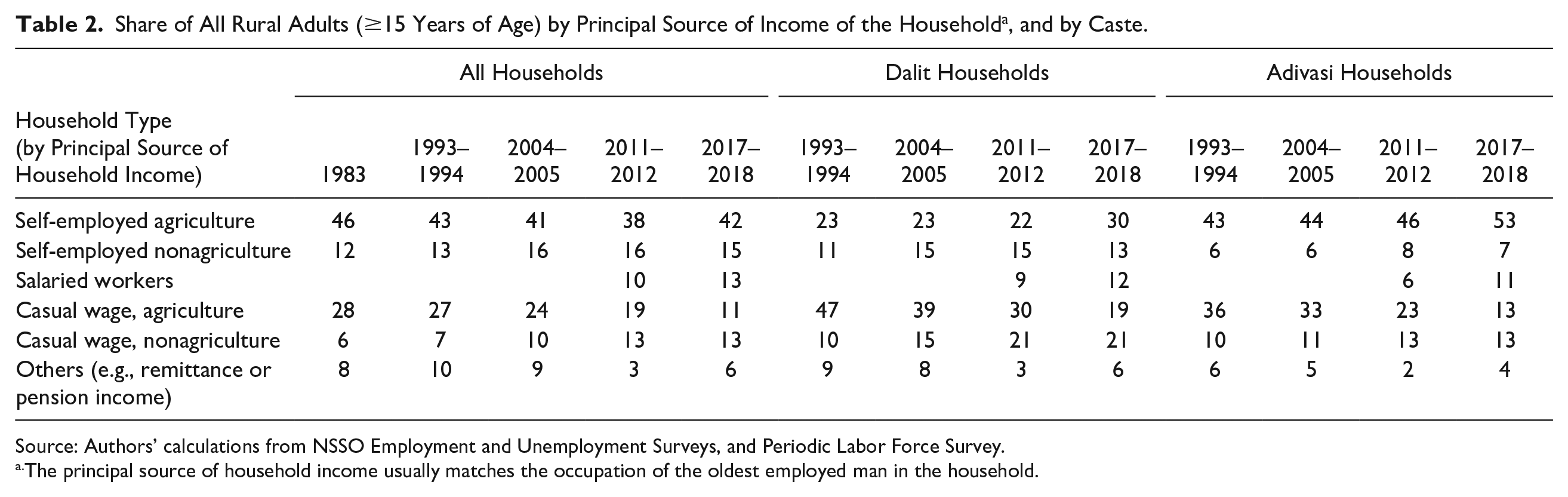
Source: Authors’ calculations from NSSO Employment and Unemployment Surveys, and Periodic Labor Force Survey.
The principal source of household income usually matches the occupation of the oldest employed man in the household.
Until 2012, table 2 also shows a very gradual decline in the non-Adivasi adult population share of households whose principal source of income was agricultural self-employment. This decline came primarily from a fall in the share of cultivator households with 10 acres or more, as median land holdings fell to below 2 acres (S. Rao 2018). Notably this minimal decline, and the even slower increase in the share of self-employed and casual wage nonagricultural households were reversed in 2017–2018 for non-Adivasi households, likely as a result of the slowdown in nonagricultural GDP growth during the second phase of the agrarian crisis. As of 2017–2018, the level of dependence upon agriculture was highest among Adivasi households.
Table 3 shows us that while the first phase of the agrarian crisis began around 1997, a restructuring of the gender division of labor in rural India became visible in the data only after 2004–2005. 5 Notably, it is also in the early 2000s that field studies began to report sharply rising precarious urban-rural migration across new interstate pathways (Breman 2010; Deshingkar 2021). We discuss below the implications of this conjuncture.
Share of the “Employed” and of Students in the Population of Working Age (15–64 Years) Rural Women.
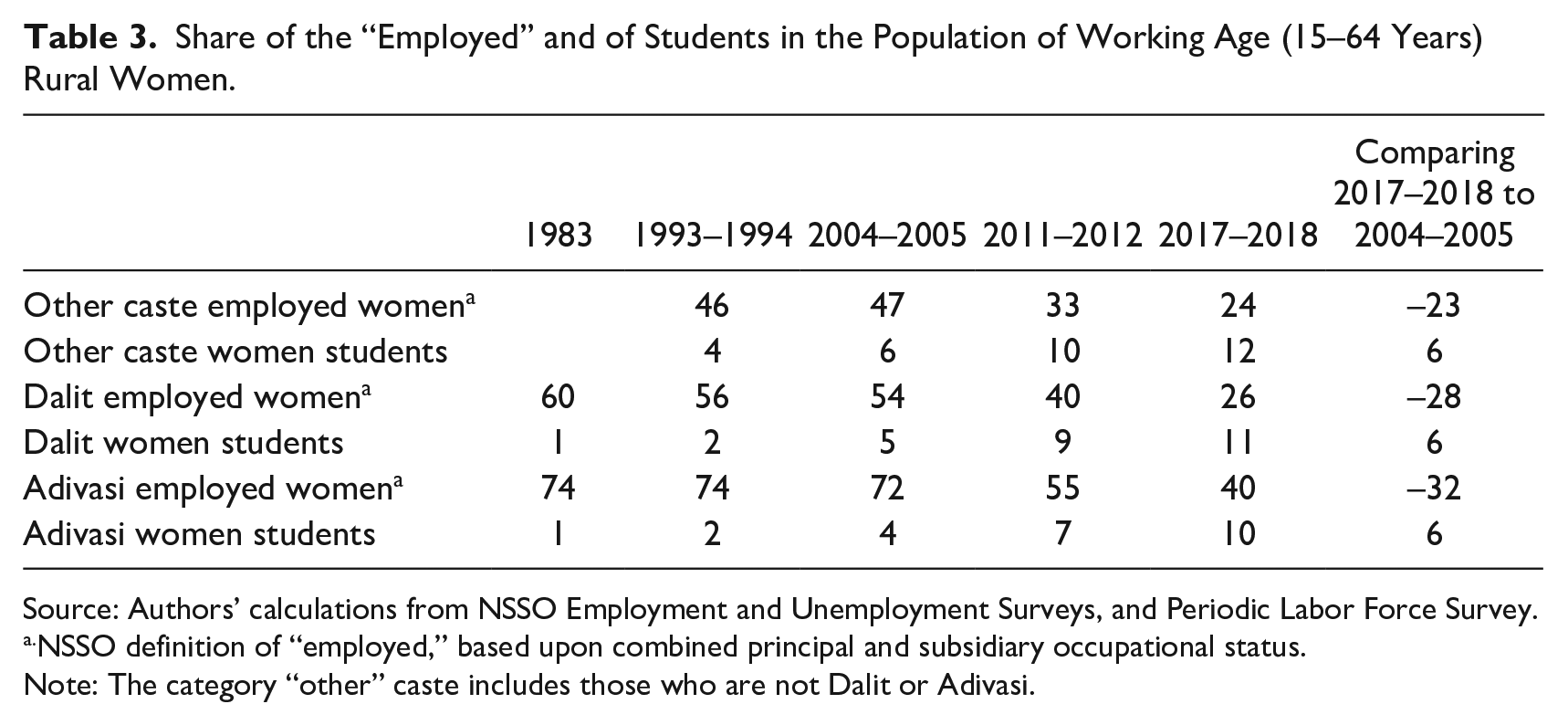
Source: Authors’ calculations from NSSO Employment and Unemployment Surveys, and Periodic Labor Force Survey.
NSSO definition of “employed,” based upon combined principal and subsidiary occupational status.
Note: The category “other” caste includes those who are not Dalit or Adivasi.
The decline in women’s labor force participation continued through the second phase of agrarian crisis, indicating that it was not a cyclical phenomenon. Table 3 shows us the falling shares of employed women in every caste category. However, these declines were even greater among Dalit and Adivasi women and were not accounted for by the rise in the share of the student population. Kannan and Raveendran (2019) also show that the declines were highest in the poorest three consumption quintiles.
Disaggregating this decline in overall employment, figure 1 shows the collapse in both agricultural self-employment as well as casual wage labor of all kinds for women across all castes. Women’s engagement in nonagricultural self-employment, already low, also fell over this period for all caste groups. By 2017–2018 reproductive labor, as defined by the NSSO, dominated the reported activities of both other caste and Dalit women. While this share was still under 50 percent for Adivasi women, it had doubled compared to 2004–2005.
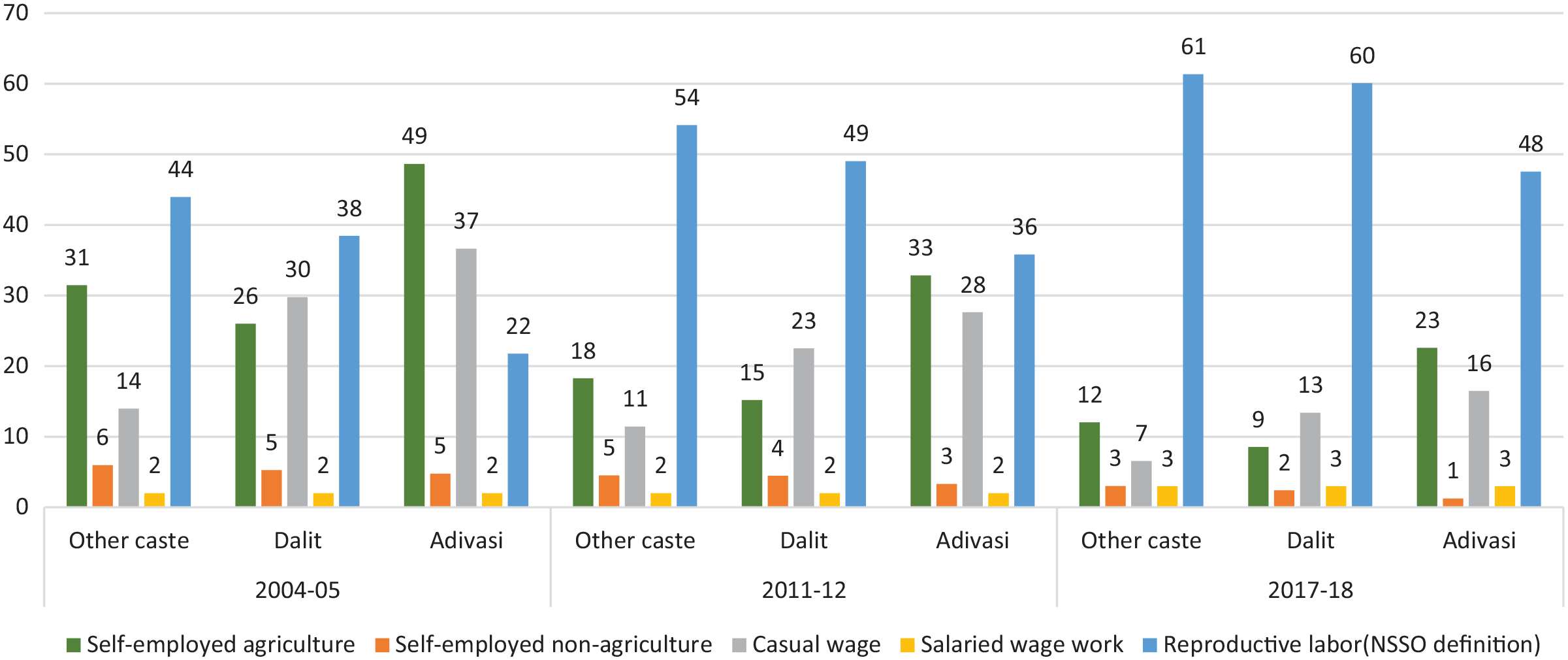
Rural working-age women (age 15–64 years) percentage, by type of work and caste.
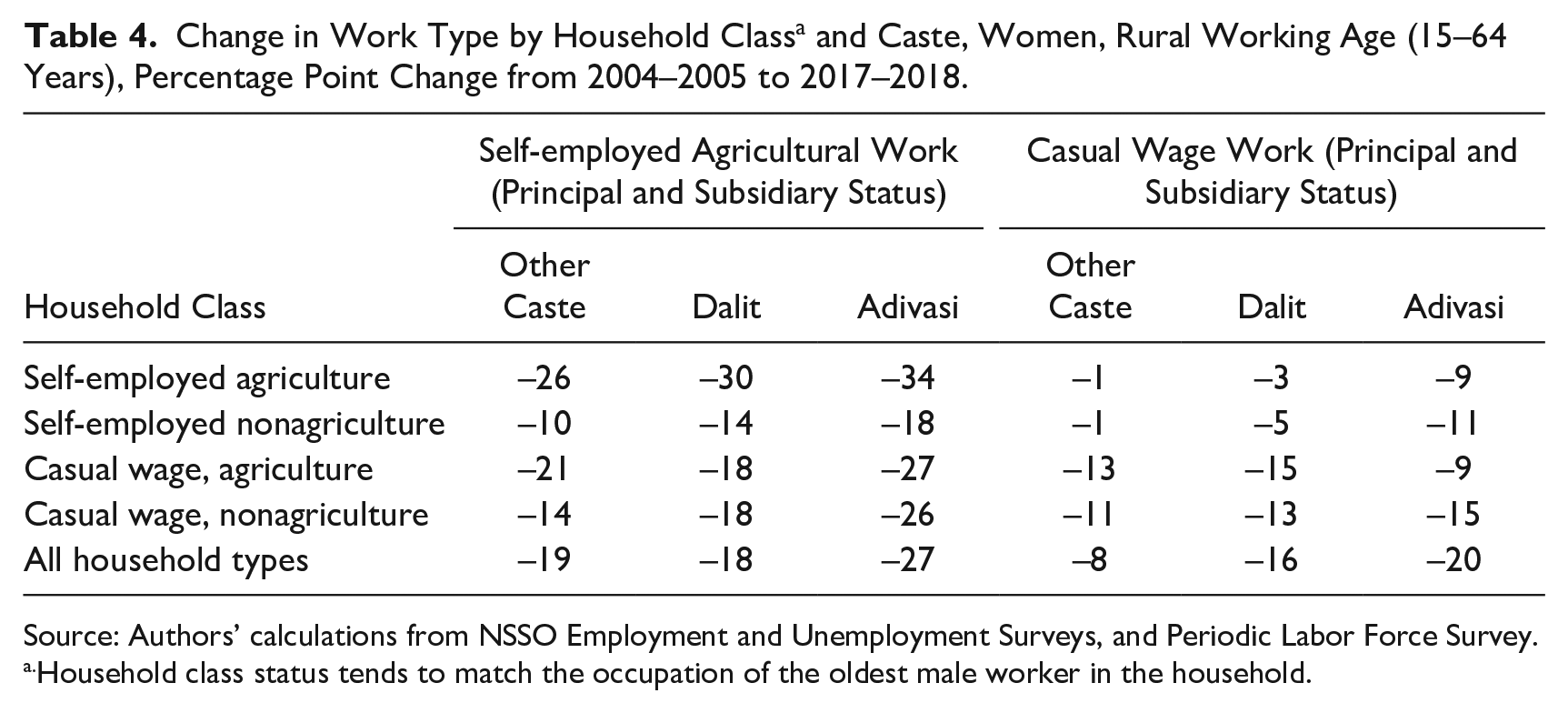
Layering our proxies for household class categories across women’s individual class relations, we further explore the collapse in women’s agricultural self-employment and women’s engagement in casual wage labor in table 4.
Change in Work Type by Household Classa and Caste, Women, Rural Working Age (15–64 Years), Percentage Point Change from 2004–2005 to 2017–2018.
Source: Authors’ calculations from NSSO Employment and Unemployment Surveys, and Periodic Labor Force Survey.
Household class status tends to match the occupation of the oldest male worker in the household.
The decline in self-employment in agriculture cuts across the main household class categories, with the decline within cultivator households having the largest quantitative impact. The declines in casual wage work are highest in agricultural casual wage labor households, at least for other castes and Dalits. As discussed below, these different data points suggest the role of falling demand for women’s agricultural labor across this period in a “discouraged worker” effect. But the time-use data we present below suggests that the need to intensify reproductive labor to ensure survival cannot be underestimated as a factor.
3.3. Analysis of women’s work during crisis
SRF’s interconstitutive lens provides a way to pull together this particular set of outcomes: falling women’s labor force participation in rural India, and increases in reproductive labor as defined by the NSSO, both particularly concentrated among women from marginalized castes (Neetha 2014). To summarize the patterns in the data above, three interlocking factors seem to be driving this outcome: a discouraged worker effect, a discrimination/occupational segregation effect, and a double burden effect.
First, given women’s concentration in agricultural employment, the decline in agricultural employment in India disproportionately affected women, constituting a discouraged worker effect (Kannan and Raveendran 2012). As shown above, the drop in agricultural self-employment as well as wage employment has been higher for Dalit and Adivasi households who have less access to land. Falling median land holdings have lowered the demand for women’s labor, with women’s agricultural self-employment reducing the most among farmer households with less than a hectare of land (Kannan and Raveendran 2019).
Further, when women seek work outside agriculture, they encounter barriers in the form of occupational segregation and discrimination that stigmatizes certain labors and confines women and marginalized castes to certain kinds of work (Neetha 2014; Kapadia 2017; John 2021). This was exacerbated by the slowdown in the nonagricultural sector alongside the second phase of the agrarian crisis. Thus, as we saw above, nonagricultural self-employment fell for women over this period. The fastest growing rural nonfarm sectors during the 2000s were construction and transportation, both historically closed to women, while rural manufacturing, where a significant share of women was employed, actually saw an absolute decline in employment (Ramnarain and Rao 2020). The one bright spot was the growth in salaried wage work for women, which was more evenly distributed across castes but remained at an extremely low level of 3 percent in 2017–2018 (figure 1).
Finally, as Naidu (2021) and Naidu and Rao (2018) point out, women also face an intensified “double burden” problem: any wages they earn are too low to mechanize or commodify the labor of social reproduction, making paid work difficult to reconcile with available forms of nonagricultural work. One of the striking failures of the Indian development model going back decades is its failure to subsidize and socialize the basic tasks of social reproduction, namely health care, child and elderly care or access to clean water, cooking fuel, and basic food security (Sehgal 2005; Palriwala and Neetha 2011). The 2000s did represent some progress on these fronts, but not sufficiently to address the extent of the need. Thus, where the ability to substitute for this labor through commodities, mechanization, or public services is restricted—which occurs to a greater extent among the most economically disadvantaged households—the double burden of performing labors of production and reproduction becomes unsustainable, resulting in workers who drop out of the labor force altogether.
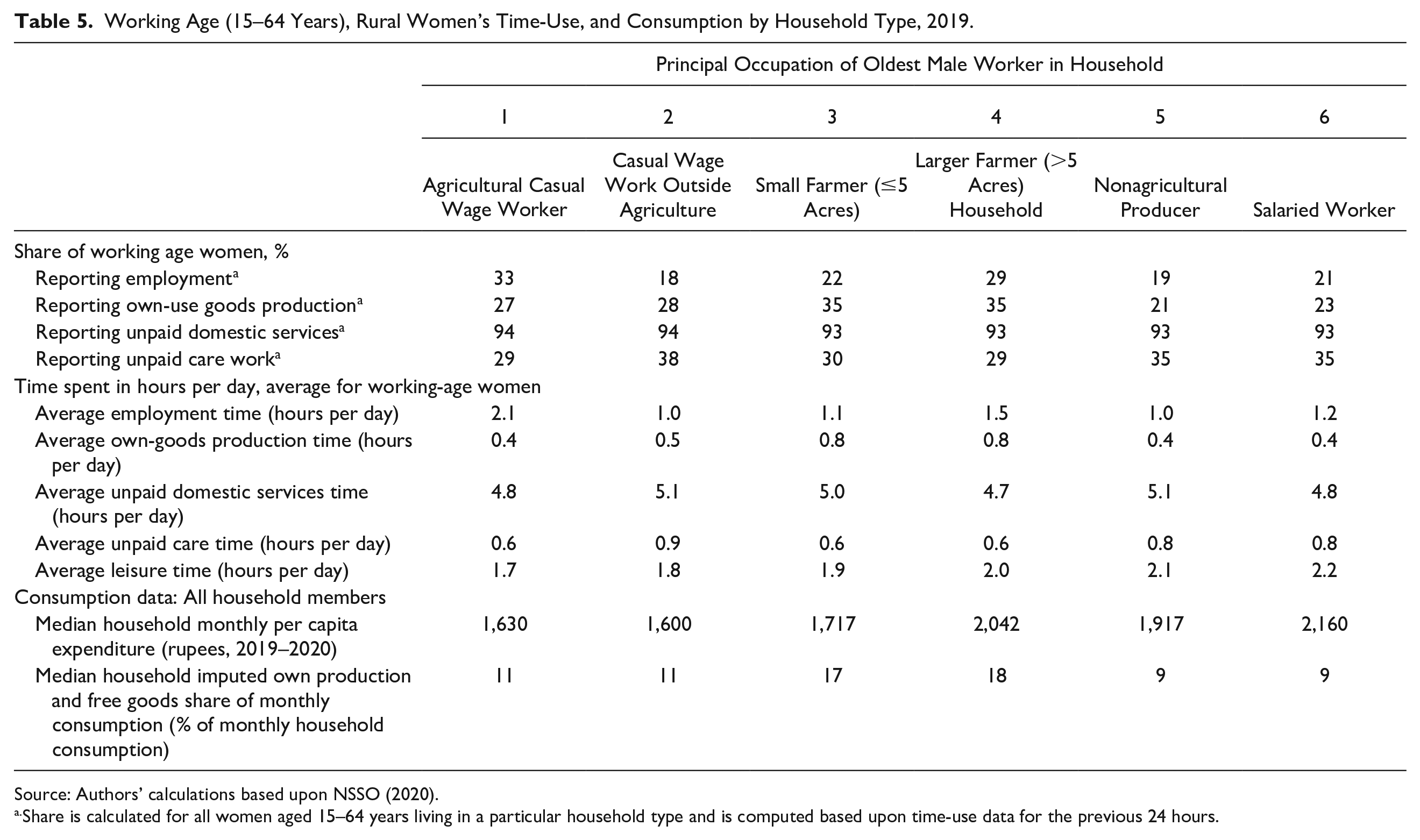
Naidu (2021) shows the higher shares of participation in, and time spent upon, labors of social reproduction for women in the marginalized castes and lower consumption quintile. We show below a disaggregation of women’s time use by our proxy for Marxian household class categories, the principal occupation of the oldest male in the household, together with landholding data (the ITUS 2020 unfortunately did not include a question on the household’s primary source of income). As table 5 shows us, average leisure time is lowest for women in the poorest two groups of households, represented in columns 1 and 2 . Women in nonagricultural casual wage worker (column 2) households have the highest average time spent on unpaid domestic service production as well as unpaid care work, while women in casual agricultural wage labor households (column 1) have high average hours of employment as well. Women’s leisure times are also relatively low in small farmer households (column 3).
Working Age (15–64 Years), Rural Women’s Time-Use, and Consumption by Household Type, 2019.
Source: Authors’ calculations based upon NSSO (2020).
Share is calculated for all women aged 15–64 years living in a particular household type and is computed based upon time-use data for the previous 24 hours.
Clearly unpaid domestic services take up the largest shares of women’s time (table 5). Unpaid care services are in fact a relatively small fraction of women’s reproductive labor in the rural Indian context (Naidu 2021). While own-goods production does not account for very large amounts of time spent, according to the NSSO’s calculations, own production accounts for around 11 percent of the monthly consumption in the two poorest groups of households (columns 1 and 2), and 17 percent in the next poorest group of small farmers (column 3). Unsurprisingly, these three groups are also where Dalit and Adivasi women are concentrated. According to the ITUS data, 47 percent of Dalit working-age rural women lived in casual wage worker households, and another 24 percent in small farmer households, while 35 percent of Adivasi working-aged women lived in casual wage worker household with an additional 40 percent in small farmer households (authors’ calculations, NSSO 2020).
Last but not least, the ability to engage in temporary, precarious migration is also more circumscribed for women from marginalized caste groups. Barriers to their employment in nonagricultural sectors reduce the likelihood of employment in urban areas (Basole 2019). Caste-based restrictions prevent Dalit women’s access to the best-paid and least-stigmatized forms of paid domestic service, including cooking and child and elderly care (Menon 2019). Finally, commutes or migration to work sites in towns or cities involve more spatial and temporal separation from sites of reproductive labor, increasing the difficulty of managing double burdens (Rao and Vakulabharanam 2018).
4. NREGA in the Context of Agrarian Crisis
The launch of NREGA in 2006 was the result of a conjuncture of different events: powerful social movements, a more activist court, and a political realignment from 2004–2014 that resulted in a central government that was somewhat more interested in measures to reduce inequality.
As a program whose implementation devolves to state governments, the degree to which NREGA was available to rural Indians varied sharply by state (Pellisery and Jalan 2011). The capacity and commitment of different class-caste based political formations at the regional and local level shaped the extent to which work was available upon demand, for a reasonable duration, without delays or corruption when it came to payments of wages (Carswell and de Neve 2014; Reddy 2013). Nevertheless, across both low-performing and high-performing states, it was clear by 2011–2012 that rural women’s participation in NREGA was exceeding the official quota of 30 percent that policymakers had imposed (Ramnarain and Rao 2020). Additionally, in most states, the share of Dalit and Adivasi NREGA person-days was also higher than the share of Dalits and Adivasis in the population. As we noted above, these were also the caste groups within which the restructuring of gender divisions of labor to cope with the crisis of social reproduction for labor seemed to be most intensive.
In seeking to understand how NREGA outcomes connect to underlying agrarian distress, we constructed state-level indicators of agrarian crisis for the nineteen largest (by rural population) states in India. Studies that focus on the impacts of the agrarian crisis upon the rural Indian population have tended to highlight four characteristics of agrarian regions that may indicate the potential for crisis. These indicators were collected from a variety of different governmental sources, as listed below.
Share of marginal farmers (NSSO 2014): Marginal farmers are farmers holding less than one hectare of land. Such farmers tend to have almost no safety net in terms of savings, or ability to borrow against collateral. A large share of marginal farmers is therefore an indicator of vulnerability to crisis.
Share of nonfoodgrain crops in cropping output (DES 2017): As is well known, the global (and domestic) prices of foodgrains tend to be less volatile than the prices of nonfood crops such as cotton, sugarcane, oilseeds, etc. That latter may also be more vulnerable to pests and weather fluctuations. The share of nonfoodgrains in cropping output (in 1,000 tons) is therefore another indicator of vulnerability to crisis we consider.
Share of cropped area that is irrigated (DES 2017): On average, around 49 percent of the cropped area in India was irrigated as of 2015, the last year for which data are available. The variation across states in irrigated crop area is another indicator of vulnerability to crisis since in the absence of irrigation, dependence on seasonal rainfall increases.
The percentage of agricultural households in each state that report being indebted (NSSO 2014): Indebtedness, particularly in a context where debt is likely to be sourced from high interest, informal sector sources, can be devastating to a household’s ability to reproduce itself. The tragic waves of farmer suicides throughout the 2000s, while very complex phenomena, do seem to have a significant association with indebtedness (Nagaraj et al. 2014). About 52 percent of agricultural households in India reported being indebted in 2013 (NSSO 2014), likely an underestimate because of the difficulties of capturing flows of informal debt. These data are not available after 2014, and thus could not be included in table 7, which covers the 2017–2018 period.
Finally, we include two other indicators that help capture some of the underlying features of the local agrarian economy:
Women’s share of the rural labor force (NSSO 2013, 2019): As noted above, the decline in this share does appear to capture the specific gender dynamic of the agrarian crisis.
The share of the rural population that reports living in a household whose principal source of income is casual nonagricultural wage work (NSSO 2013, 2019): We use this indicator to capture the importance of precarious nonagricultural work, which may include forms of temporary migration.
In our analysis below, we focus on 2011–2012 and 2017–2018 because the labor force participation data and data on the population shares of nonagricultural worker households are derived from NSSO household surveys conducted in 2011–2012 and then in 2017–2018.
The measure of participation we use here is the NREGA share of person-days for women, and for marginalized castes (Dalits and Adivasis). A person-day is the unit of analysis in official NREGA data, defined as a day of NREGA work completed by a person. These data were obtained from the official NREGA data portal (www.nrega.nic.in). 6 Unfortunately, the official data report the share of NREGA person-days worked by women, Dalits, and Adivasis separately. This nonconstitutive categorization of the data means we cannot analyze the category of Dalit women or Adivasi women, but rather have no choice but to analyze women and marginalized castes separately in this case.
4.1. Participation in NREGA: Women and marginalized castes
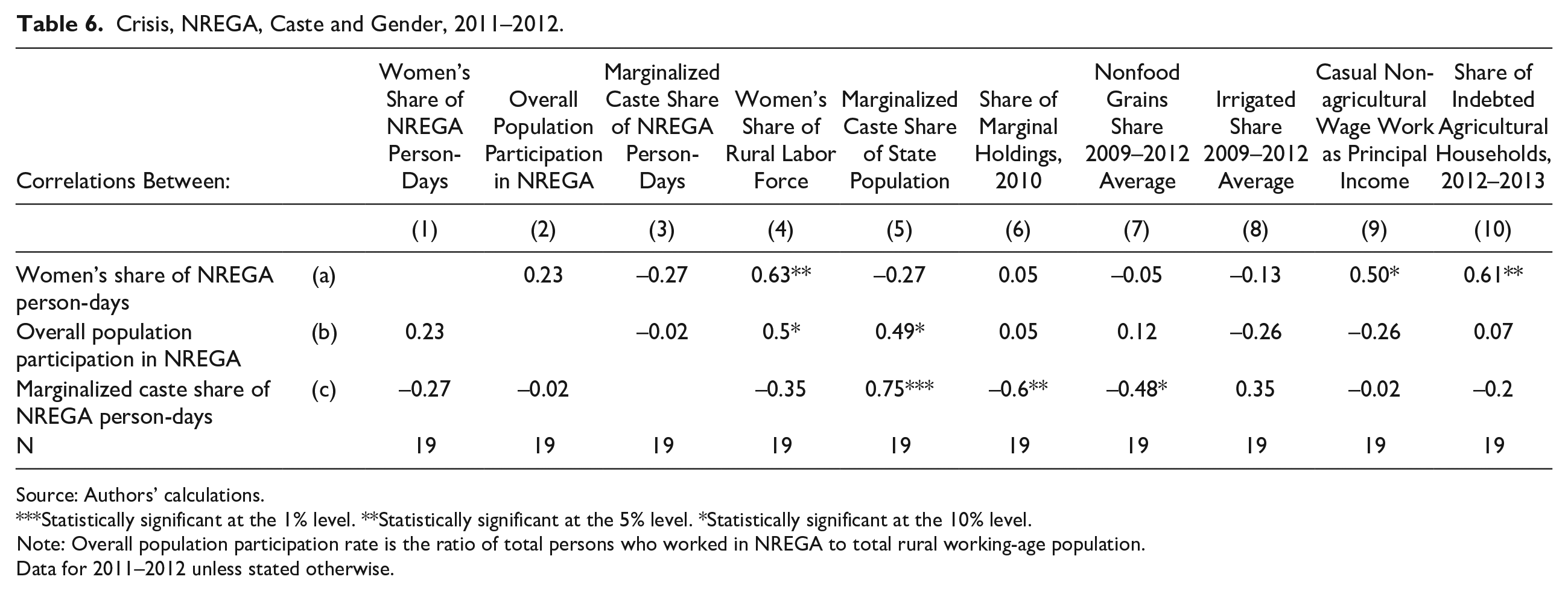
As table 6 shows, the first three indicators listed above—namely, the share of marginal holdings, the share of nonfood crops in cropping output, or the share of irrigated cropped area represented in columns 6, 7, and 8 respectively—are not statistically significantly correlated with the women’s share of person days in NREGA. This lack of meaningful correlation may be a function of the small sample size, and of intrastate variations in each of these indicators, as well as NREGA work availability. This lack of statistical correlation is also a reminder that NREGA was not large enough to be anything more than an occasional safety net during this period of distress. Instead, other coping mechanisms such as migration and increases in unpaid/subsistence work likely played a much more significant role.
Crisis, NREGA, Caste and Gender, 2011–2012.
Source: Authors’ calculations.
Statistically significant at the 1% level. **Statistically significant at the 5% level. *Statistically significant at the 10% level.
Note: Overall population participation rate is the ratio of total persons who worked in NREGA to total rural working-age population.
Data for 2011–2012 unless stated otherwise.
The other indicators of distress, however, did prove to be correlated with the women’s share of NREGA person-days.
As column 10 rows a and b of table 6 indicate, the share of indebted agricultural households was highly correlated with women’s share of NREGA person-days without being correlated with the participation of the population as a whole in NREGA. There is a particularly gendered impact of debt upon agrarian livelihoods that results in women being more likely than men to participate in NREGA.
Further, states where women constituted high shares of the total rural labor force (by the NSSO’s criterion of at least 183 days of employment in the year) are also states where they constitute a high share of NREGA person-days worked. The strength of this correlation in column 4 row a shows that even though the former was low and falling, while the latter was high and rising during this period, reinforces the sense that when available work can bridge the triple barriers of the discouraged worker effect, discrimination/occupational segregation, and women’s double burdens, we see higher rates of participation by women.
Finally, in column 9 row a, we see a strong correlation between the share of rural households in a state reporting their principal source of income as being from nonagricultural daily wage work and women’s share of NREGA work. A household’s self-reported principal income source being nonagricultural casual wage work usually means that one or more male workers in the household engage in that form of livelihood (S. Rao 2018). States with high shares of nonagricultural casual wage households are thus states where men have more successfully moved into nonagriculture (and who perhaps migrated to do so), leaving NREGA work to women. The specific gendered mechanisms used by households to respond to the agrarian crisis have thus shaped participation in NREGA.
The same indicators produced quite a different set of results when correlated with NREGA person-day shares of marginalized castes, indicating that caste and gender operate in ways that are interconstitutive but certainly not identical. As table 6, column 5 row c, reveals, marginalized castes’ share of NREGA person-days was strongly positively related to the share of marginalized castes in the rural population as a whole. But beyond that, the meaningful correlations were with the share of nonfoodgrain output and the share of marginal holdings in columns 6 and 7 row c. The direction of the correlations is particularly important. What the data indicate is that marginalized castes were more likely to benefit from NREGA where crisis indicators were muted, where more stable foodgrain output constituted a higher share of crops grown, and where there were fewer of the smallest, most vulnerable farmers in the population as whole.
This finding, like our previous one linking higher women’s NREGA participation to men’s greater ability to leave agriculture, suggests that NREGA is indeed subject to the same exclusionary dynamics as the rest of the economy. Broadly, it is in contexts where other castes are not as much in need of this particular safety net, and where men are able to find other options, that space opens up in NREGA for women, Dalits, and Adivasis (Sudarshan, Bhattacharya, and Fernandez 2010; Narayanan and Das 2014; Roy 2015).
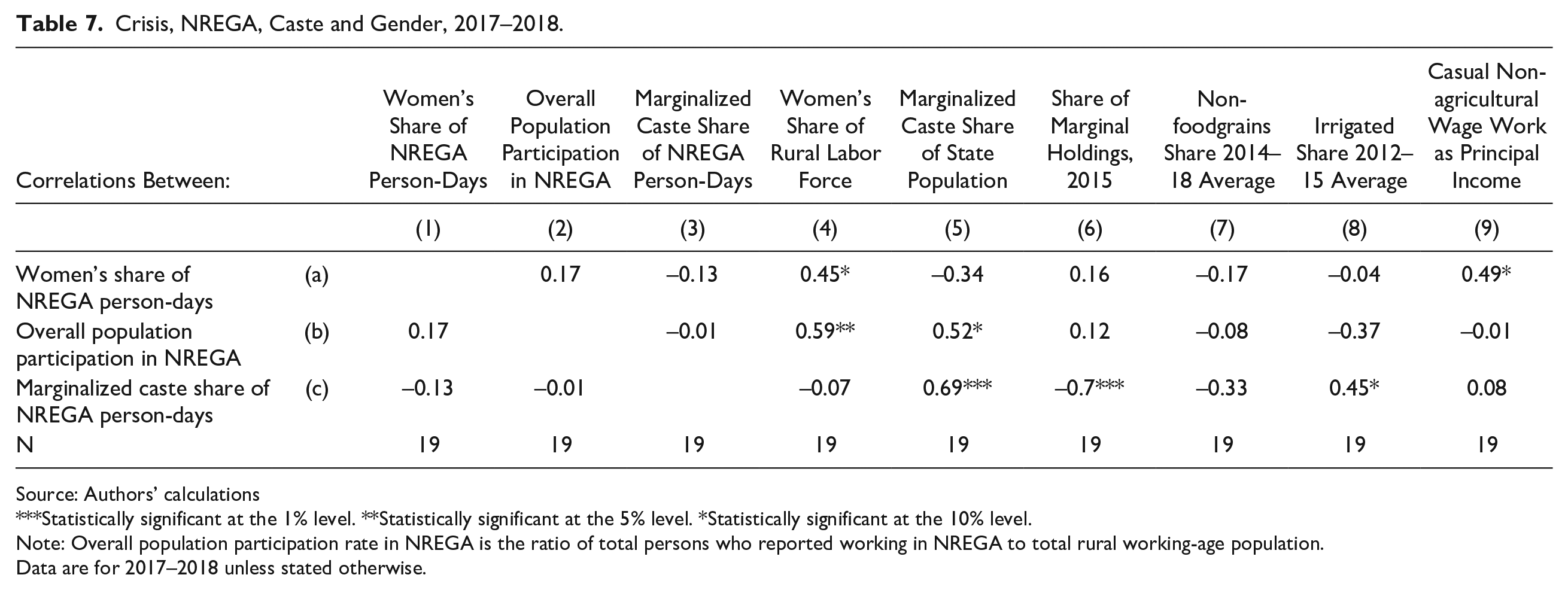
In table 7, as of 2017–2018, the size and direction of correlations we observed in table 6 had not changed much. Women and marginalized castes were more likely to benefit from NREGA when men and nonmarginalized castes were less in need of a safety net. In fact, over the period 2011–2012 to 2017–2018, the share of marginalized castes in NREGA person-days for India as a whole fell from 38 percent to 37 percent, and further to 36 percent in 2019, even as women’s share of person-days by and large increased (NREGA data portal 2021). This suggests two explanations that might have played out slightly differently in each state. The first, that Dalit and Adivasi male movement away from the village economy accounted for both the drop in overall participation as well as the drop in lower-caste participation, without reducing the participation of Dalit and Adivasi women; an alternative explanation is that other-caste women were taking the place of Dalits and Adivasis, both women and men.
Crisis, NREGA, Caste and Gender, 2017–2018.
Source: Authors’ calculations
Statistically significant at the 1% level. **Statistically significant at the 5% level. *Statistically significant at the 10% level.
Note: Overall population participation rate in NREGA is the ratio of total persons who reported working in NREGA to total rural working-age population.
Data are for 2017–2018 unless stated otherwise.
While this aggregated data does not allow us to disentangle these explanations, it does suggest to us that the relatively inclusionary outcomes we see in NREGA had as much to do with the dynamics of the underlying crisis of social reproduction for labor as they did with the government’s capacity for and commitment to implementing NREGA’s progressive provisions.
We now turn to the ITUS (NSSO 2020) for some more disaggregated data on the participation of women across different caste groups. Unfortunately, the ITUS does not record participation in NREGA specifically, but it does allow us to identify reporting of casual wage labor that is paid for and is performed for government bodies, or what the NSSO calls “public works.” NREGA is the single largest public works program in rural India, and thus we can see these data as indicative of NREGA outcomes.
Table 8 columns 1 and 2 present the share of working-age rural women by class and caste participating in public works wage labor for just the single day of the ITUS. Table 8 columns 2 and 4 show the average time spent in hours for those who did report participation. Since the ITUS covers only a single 24-hour period that varies by region, the participation shares are relatively low. We thus interpret the average time spent with caution, given the small underlying sample. Row b shows the relatively higher participation rates and times spent on public work activities by women from nonagricultural wage worker households, confirming our prior state-level analysis. As row f shows, both are also relatively higher for Dalit and Adivasi women, for whom the declines in labor force participation rates were also the greatest. We also see relatively high participation rates but lower average time spent for women from agricultural wage worker households across caste groups (row a). We know from table 5 that these are women with already low leisure times. Double burden effects may thus limit their participation times.
Public Works Activities Reported in Time-Use Data, by Household Class and Caste, Rural Working Age Women (Age 15–64 Years), 2019.
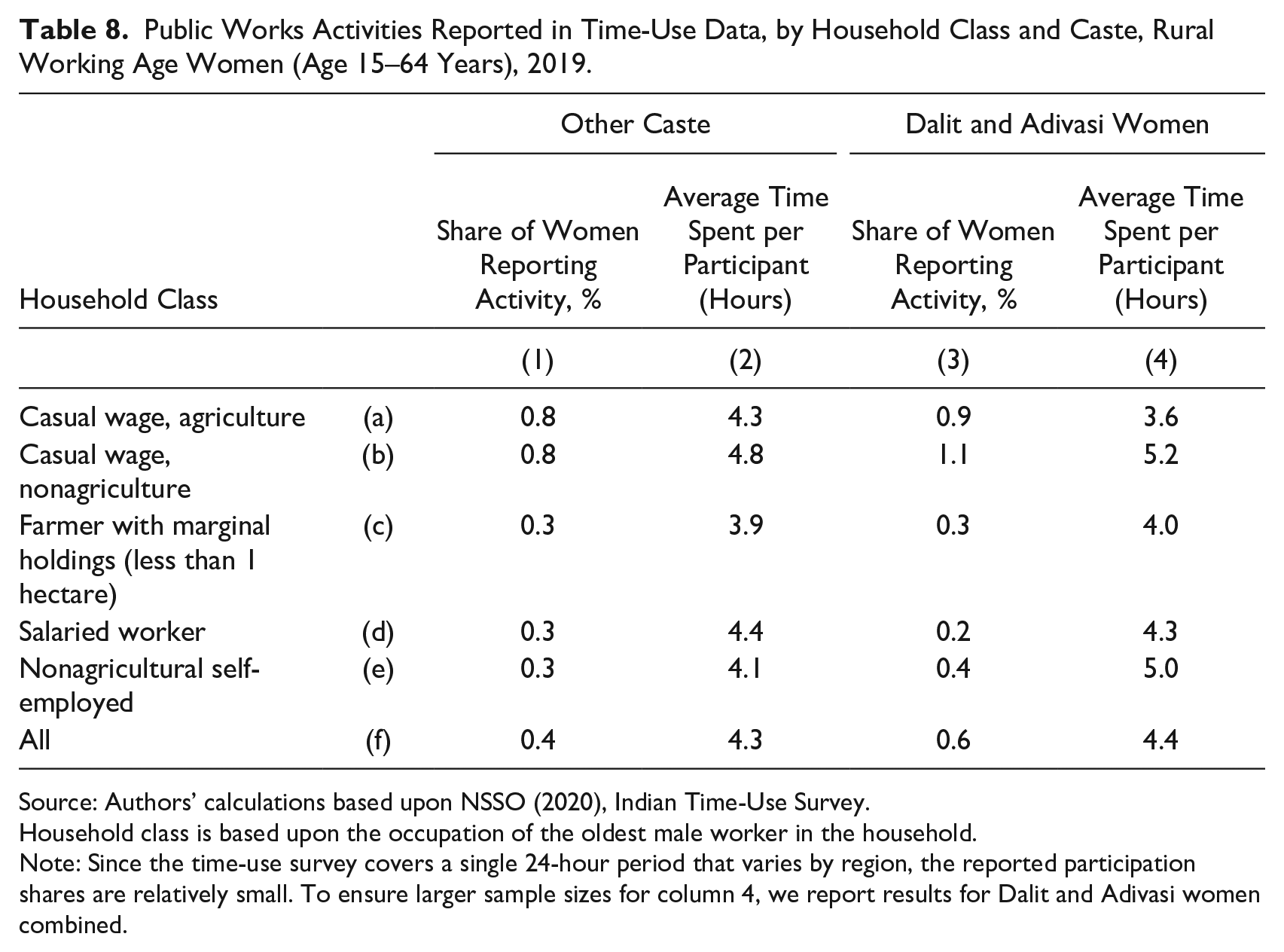
Source: Authors’ calculations based upon NSSO (2020), Indian Time-Use Survey.
Household class is based upon the occupation of the oldest male worker in the household.
Note: Since the time-use survey covers a single 24-hour period that varies by region, the reported participation shares are relatively small. To ensure larger sample sizes for column 4, we report results for Dalit and Adivasi women combined.
5. Concluding Discussion
In previous work, we raised the issue of demand-side factors driving women’s participation in workfare and argued that not all of this participation may be reason for celebration, especially if it is being driven by dire inequalities of class, gender, and caste (Ramnarain and Rao 2020). Postliberalization processes of capital accumulation have relied upon the “cheap” labor of precarious rural-urban migrants and the even “cheaper” labors of social reproduction of Indian women (Mishra 2021). While the literature suggests that precarious rural-urban migration is more likely to be undertaken by men, we have used a variety of sources to indicate that increases in unpaid reproductive labor (NSSO’s definition) are concentrated among women from marginalized castes, and from households where the principal source of income (correlated with men’s occupations) is casual wage labor, particularly nonagricultural wage labor.
We then argued that women’s participation in NREGA is also concentrated in the same marginalized groups, with household debt having a particularly significant effect upon the share of women person-days in NREGA. Together with our result for the share of marginalized castes in NREGA person-days, our analysis confirms the highly gender-caste-class segmented responses to crisis, including participation in NREGA itself, and the reproduction of existing caste-gender hierarchies to the extent that women’s and marginalized castes’ access to NREGA has depended upon men and other castes having other options (Sudarshan, Bhattacharya, and Fernandez 2010).
We recognize the vital importance of NREGA as one of the world’s largest social protection programs. This importance was underscored during the pandemic, when even a central government that was otherwise hostile to NREGA was forced to expand the program, providing a vital source of employment amid a devastating economic shock. 7 However, despite an overall expansion of person-days by 54 percent in 2020, official data show a small drop in women’s share of NREGA person-days in 2020, and stagnation in the share of marginalized castes’ person-days. As of December 2020, women accounted for 53 percent of all NREGA person-days for the year, as compared to 55 percent in 2019–2020. This decline in the national number is counter to past trends. Marginalized castes’ share of NREGA person-days had already declined from 2011–2012 to 2017–2018 and there was no sign of a revival in 2020, These findings require further research and confirmation, particularly through field studies, but their general direction confirms our sense that demand from men and other (non-Dalit) castes may crowd out the participation of Dalit and Adivasi women in NREGA (Kumar 2020).
A persistent critique of workfare programs is that they are only ameliorative and not transformative in the sense of fundamentally impacting entitlements and rectifying power imbalances that create and sustain vulnerabilities in the first place (Waring et al. 2013; Sabates-Wheeler and Devereaux 2008). Since its introduction, NREGA has, according to existing evidence, made some partial inroads into transforming rural power relations: the program has contributed to enhancing the bargaining power of rural workers and in bolstering rural workers’ wages (Chandrasekhar and Ghosh 2011; Carswell and de Neve 2014). And yet, considered in light of our findings on the time spent upon the labor of social reproduction for women—especially women from the marginalized castes—in a context of long-standing crisis, NREGA does not incorporate a sufficiently broad and holistic understanding of this labor.
For example, while NREGA aims to provide child care for women who participate in it, ITUS data indicate that it is unpaid domestic services (particularly cooking and cleaning), rather than care work, that constitute many rural women’s reproductive labor (table 5 above). Thus, the provision of highly subsidized cooked food to participants, along the lines of programs in some parts of South India, 8 might address women’s double burdens more effectively. Furthermore, NREGA itself provides only “productive” employment. Expanding NREGA to cover care work would recognize the value of this labor of social reproduction (Basole 2019). As an example, a currently existing community health program utilizes Accredited Social Health Activists (ASHA). 9 As the pandemic unfolded, ASHA health workers were in the front lines of defense against the spread of infection. And yet, this critical work was largely unpaid or underpaid. As the pandemic continued, overburdened ASHA workers have been at the forefront of struggles demanding better conditions of work (including protective gear), better pay, and for the social recognition of the critical reproductive work they perform (Niyati and Mandela 2020; Hemalata 2020). A workfare program that included care work would help value the labor of social reproduction, and support women doing this work in their communities. Valuing and including this contribution by marginalized groups adequately in the provision of social protection is, for us, the next frontier for transformative social protection.
Another limitation of NREGA as a solution to a compounded crisis of social reproduction for labor comes from the larger context of the highly privatized organization of social reproduction in India. Neither the state nor capital have sufficiently subsidized or internalized the provision of basic components of social reproduction such as health care, child or elderly care, and the provision of sanitation, shelter, or clean water. In the absence of such socialization, the ability of marginalized groups, particularly Dalit and Adivasi women, to engage even in the sporadic income generation opportunities provided by programs such as NREGA remain limited and fragile. This is an argument we would extend to Basic Income Payments as well, which we see as complementary to, rather than substitutes for, programs such as NREGA. As feminists have argued, greater state, corporate, and community investment in the infrastructure of social reproduction—sanitation, clean water, public health, and food security—should be understood as central to struggles against capitalism.
Footnotes
Acknowledgements
The authors would like to thank the Cascading Project at the Brandeis Women’s Studies Research Center for supporting this project and providing feedback. We thank Cynthia Kipkorir for invaluable research assistance. We are also especially grateful to the patient and valuable feedback provided by the three reviewers: Sirisha Naidu, Ipsita Chatterjee, and Marlene Kim.
1
Authors’ calculations based on official NREGA data, available upon request.
2
Given the importance of caste in India, we focus on the interconstitution of caste, gender, and class in this article. Wherever the data permits, we focus on the experience of Dalits and Adivasis in particular, as historically the most marginalized. There is tremendous variation across castes other than Dalits and Adivasis, but given the constraints of article length, we do group “other” castes together, as all those other than Dalits and Adivasis, in the analysis here.
3
For a description of the ITUS and its limitations, see Swaminathan (2020). For an outline of some important findings of the ITUS, see  .
.
4
The Ns for our calculations from the NSSO data in tables 2, 3, 4, 5 and 8 are available upon request. All reported shares are weighted by NSSO provided sample weights. To provide a sense of the sample size, the unweighted N for all rural adults (age ≥15 years) in each of the years we analyze is as follows: 1983 = 245, 573; 1993–1994 = 227,021; 2004–2005 = 263,519; 2011–2012 = 197,161; 2017–2018 = 184,935. The ITUS data has an unweighted N for all rural adults (age ≥15 years) of 230,439. The smallest unweighted N across tables 1–5 and , is 331 (Adivasi women self-employed in nonagriculture in figure 1).
5
Liberalization began in India around 1991–1993, and the actual implementation of changes in trade and agricultural polices occurred over the next 5–10 years. Thus, it may not be surprising that shifts in labor force data occur in the early 2000s. In fact, the appearance of these shifts around 2004–2005 have been seen as indicating a structural break point ().
6
We chose to use correlational rather than regression analysis both because of the small number of states (and thus our N) and because regression analysis may not be appropriate where so many of the variables are closely related to each other from a theoretical perspective.
7
A Hindu right-wing government that was far less supportive of NREGA won the national election in 2014 and again in 2019. The program stagnated rather than expanded after 2014 (until COVID-19) despite the resurgence of the agrarian crisis. However, the program’s vital role in alleviating the economic shock of the pandemic may have secured its existence for the foreseeable future.
8
9
ASHA workers are community workers responsible for promoting basic health education in rural communities. ASHA workers receive some remuneration, but this work—premised upon the natural predisposition of women to perform care work for their families and communities and derive satisfaction from it in lieu of monetary compensation ()—is largely considered volunteer work.
Declaration of Conflicting Interests
The author(s) declared no potential conflicts of interest with respect to the research, authorship, and/or publication of this article.
Funding
The author(s) received no financial support for the research, authorship, and/or publication of this article.