







Abstract
In the past year, I have utilized two series of games to teach a predominantly white classroom the barriers that race plays to labor organizing. Students play Prisoner’s Dilemma and Stag-Hunt games, without and with player inequality. Player inequality is designed to mirror power asymmetry in the abstract but also white supremacy specifically by mirroring scenarios in Noel Ignatiev’s posthumous memoir of his time at the Gary Works—Acceptable Men. Though players are predisposed to cooperation, inequality between players strains solidaristic play. This cooperation exceeds that found in Acceptable Men, and students are encouraged to reflect upon why this may be the case.
Introduction
When teaching the economics of race within the framework of radical political economics, it is vital to engage students with the material basis of racialization within capitalist and imperialist modes of production. Integral to this is the study of how race and racism influence capitalist social relations.
The exercises that follow were developed to engage students at a predominantly white institution, which is also an emerging Hispanic serving institution, in analysis of the influence of racism on worker solidarity within an introductory course on the economics of racial inequality and discrimination. While classes were far less densely populated by white students than the remainder of those offered by the economics department, the racial composition of the university is conducive to heightened awareness of their race by racially minoritized students while lowering the racial awareness of white students. As a result, these exercises were designed to mirror the themes of Acceptable Men by Noel Ignatiev, which highlight the challenges to working-class solidarity posed by white supremacy (Ignatiev 2021).
Course Context
The course requires no prerequisites and is designed to teach students the influence of racialization on economic processes. As a course fulfilling a general education requirement for undergraduate students at a large public university, class sizes were large. Sections typically featured 60 students enrolled, though half or a third attended class.
Analysis of white supremacy as a social system is a key practice within Economics 212: Racial Discrimination and Inequality. A course on the economics of race is unique, especially given how little discussion of the subject occurs within mainstream introductory economics education (Koechlin 2019). While the subject is examined in a variety of contexts throughout the course, the exercises to follow are undertaken within a unit expressly discussing the influence of racialization on economic class. As a cross-class political coalition between whites emerging alongside capitalism, white supremacy functions to tie the interests of working-class whites to those of bourgeois whites, differentiating elements of the working class along racial lines. As such, an anticapitalist politics reliant upon the activity of the working class must further contend with the tendencies of white racial affiliation to push white members of the working class away from anticapitalism, which would threaten their receiving social and psychological benefits because of their race (Roediger 2007).
Published posthumously in 2021, Noel Ignatiev’s Acceptable Men is an autobiographical novel of Ignatiev’s time at the Gary Works in Gary, Indiana. Acceptable Men details the racial stratification of the Gary Works between white “skilled” workers and Black and Latine “unskilled” workers. This stratification, Ignatiev argues, is perpetuated by plant managers, white workers, and the white-dominated United Steelworkers; these parties benefit most from the racial Fordian labor peace, which would be threatened by taking seriously the concerns of nonwhite workers (Ignatiev 2021). While not universally true, the convergence of white worker and union interest in maintaining racial hierarchy has long characterized the behavior and outlook of organized labor in the United States (Foner 2017).
Alongside lectures and discussion on the subject, Acceptable Men is assigned to push students to engage the impacts of racialization on capitalism. The book is a short read, at around one hundred pages. Compared to more thoroughly academic treatments of the subject, students find autobiographical vignettes of work at the Gary Plant engaging and are far more likely to read the book than other readings assigned in the course.
Game Theoretic Exercises
After discussing Acceptable Men via online and in-person forums, students were asked to engage in the following exercises designed to highlight the themes of the work and the unit. These exercises were adapted from common game-theoretic scenarios. Game theory is a framework utilized often in economics to analyze strategic action by rational actors, and its use in this context is twofold: to render cogent the conflict of Acceptable Men to students who, for whatever reason, had been unable to divine it from their assigned reading and to reframe the conflict of Acceptable Men as a problem of collective action among unequal parties.
To facilitate student participation in the exercises described below, students were divided into triplets, or, if necessary, into pairs. Each group plays each set of games simultaneously after the instructor relays the rules and context of each game. Within groups, students determine roles in each game, with two players and a judge. The players, without communicating with each other, are responsible for deciding which action they will take in each scenario described below and will communicate their decision to the student acting as a judge without also communicating that decision to the other player. The judge is responsible for determining, given the actions of both players, the outcome of each exercise.
The exercise to follow takes the form of four games, played consecutively. Before any games are played, the students are told that the games are designed to mirror prior class discussion of Acceptable Men and the influence of white supremacy on the economy. Before each game, the students are briefed with an anecdote, contextualizing the scenarios wherein the games take place and explaining the rules, actions, and potential results of each game. Following the play of each game, the results of all groups are discussed, and explicit explanations for the ties of each game to Acceptable Men are made. The first two of these games are an unmodified and modified Prisoner’s Dilemma, while the second two are variants of a Stag-Hunt game. Following all games, students were asked to reflect, briefly and in writing, on the relationship between the games and the unit’s material.
Gameplay and Outcomes
In this section, each of the four games are described. Tables 1 through 4 contain a matrix of player actions and payoffs under the Framework heading, on the left-hand side of each figure. On the right-hand side of each figure, under the Outcomes heading, are approximate proportions of each potential result. These outcomes are approximations because of the noncollection of data in the earliest implementations of the games. In total, these games have been implemented across four class sections per academic year for the past year and a half. Each class section formed, on average, twelve groups (each with three members). Student behavior in these games is consistent across semesters and sections of the class, making such approximations appropriate illustrations.
Unmodified Prisoner’s Dilemma Framework and Outcomes.
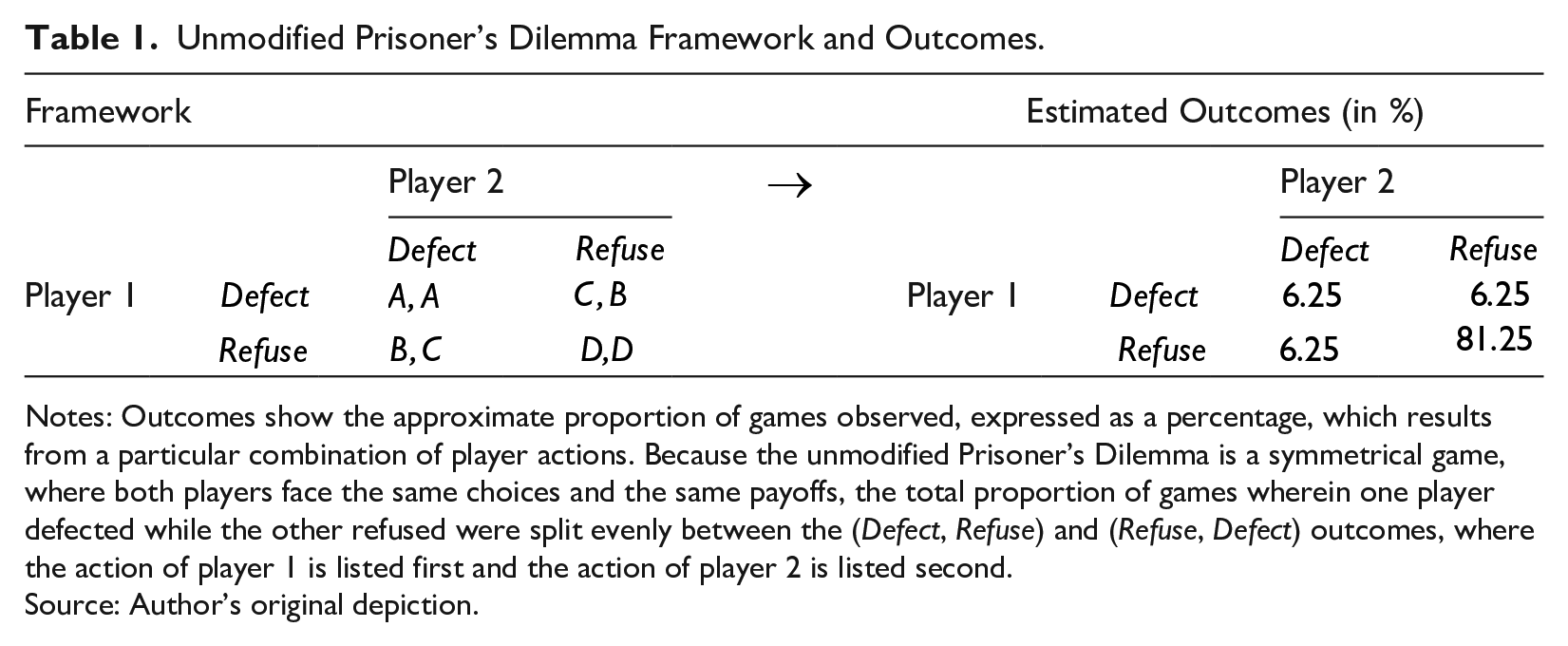
Notes: Outcomes show the approximate proportion of games observed, expressed as a percentage, which results from a particular combination of player actions. Because the unmodified Prisoner’s Dilemma is a symmetrical game, where both players face the same choices and the same payoffs, the total proportion of games wherein one player defected while the other refused were split evenly between the (Defect, Refuse) and (Refuse, Defect) outcomes, where the action of player 1 is listed first and the action of player 2 is listed second.
Source: Author’s original depiction.
To demonstrate the material advantages of cooperation, students first play an unmodified version of the Prisoner’s Dilemma. While rational players of the Prisoner’s Dilemma will both defect, this result is suboptimum compared to both players refusing to defect.
Table 1 illustrates, under the Framework heading, the payoffs associated with the unmodified Prisoner’s Dilemma game and, under the Outcomes heading, the outcomes observed. Player 1 chooses an action (
As shown in figure 1 under the Outcomes heading, most groups saw both players refuse to defect. This result is in sharp distinction with the Nash equilibrium of the game, of reciprocal defection. When asked, students highlighted the stigma surrounding informing on a fellow criminal and lack of desire to see another incarcerated as primary motivations as to why they refused to cooperate with the police. As a competitive game, then, such results indicate the students are highly willing to engage in risky and cooperative play; such play is risky because of the potential for a player who refuses to cooperate to face their largest possible punishment if their peer were to inform on them, and cooperative because of the stated motivation of students refusing to defect to avoid burdening their peer with maximal punishment. This cooperation is cheap in the abstract context wherein the game is played, so the second game seeks to strain cooperative play by increasing its costs.
Following this first round, the game parameters were modified such that the players’ payoffs were asymmetrical. No longer were both players equal, but one was wealthy and stood to be disinherited if incarcerated. The same wealthy player could, in addition, hire a more skilled lawyer than the other player and could, thus, face less harm when both players refused collaboration. While the prior play had typically led to refusal to defect by players, this asymmetric structure strongly encouraged wealthy players to inform on their peer.
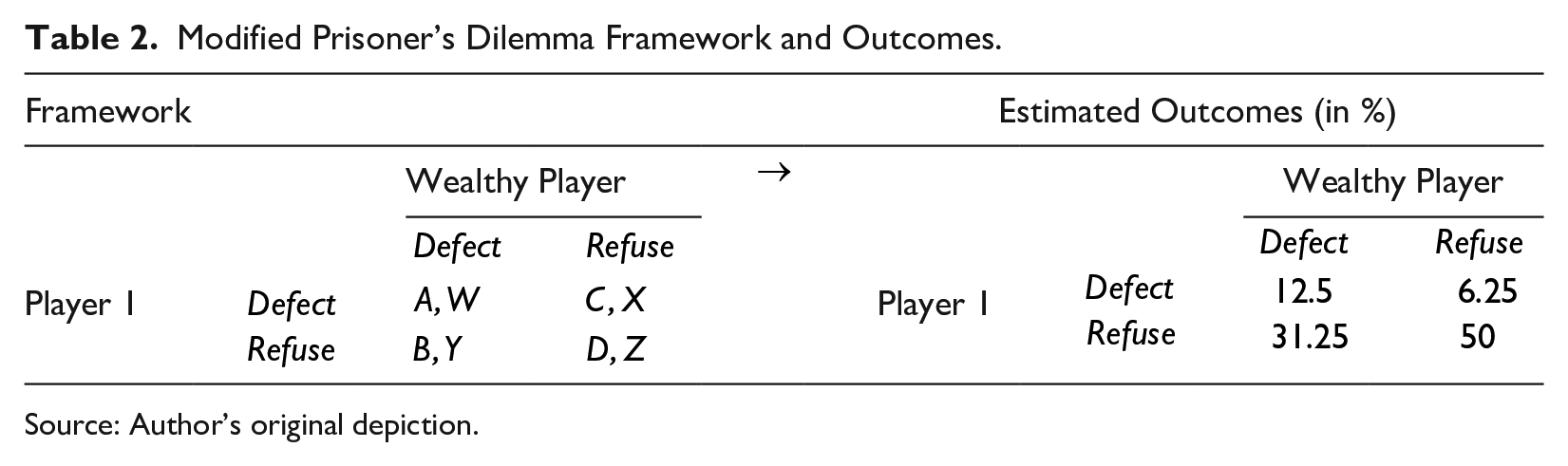
Table 2 illustrates, under the Framework heading, the payoffs associated with the modified Prisoner’s Dilemma game and, under the Outcomes heading, the outcomes observed. While player 1 remains the same, player 2 faces more extreme payoffs with higher benefits to defection, higher costs when facing defection from player 1, and more benefit in the socially optimum cooperative result (with both players refusing to defect). Utility values
Modified Prisoner’s Dilemma Framework and Outcomes.
Source: Author’s original depiction.
As shown under the Outcomes heading in figure 2, the modified Prisoner’s Dilemma saw significant increases in the number of defections compared to its unmodified form. While both players were more likely to defect, most defections were of the wealthier player who was far more likely to face defections themselves. Poor players defecting while the wealthy player refused to were exceptionally uncommon, while the inverse was common.
As a baseline, the unmodified Prisoner’s Dilemma serves to illustrate how the best possible outcome for both players often follows cooperation within a framework that discourages it. While this form of cooperation more closely mirrors the form of cooperation undertaken by two individuals deciding to leave work and fish instead (Ignatiev 2021), the introduction of power asymmetry—analogous to white supremacy within a workplace—in the modified Prisoner’s Dilemma clarified how tenuous the stability of cooperation may be. Furthermore, the use of these two versions of the prisoner’s dilemma serves to prime students to engage in strategic thought, especially with regard to the play of a peer who may be unwilling to cooperate, in the following Strike-Scab game.
Following both versions of the Prisoner’s Dilemma, students played a recontextualized version of the Stag-Hunt game, called Strike-Scab, to illustrate the influence of power asymmetries on labor organizing. In Acceptable Men, Ignatiev describes the Gary Plant as racially segregated along traditional “trade” and “unskilled” lines, with white workers occupying management positions and skilled positions while Black and other workers of color worked in unsafe and physically demanding roles. White workers, the white-dominated union at the plant, and capitalists all worked to maintain this segregation (Ignatiev 2021). The following three games—the unmodified, modified, and modified sequential Strike-Scab games—demonstrate the barriers to multiracial unionism posed by white supremacy, where the emergence and empowerment of a white "labor aristocrat" undercut the capacity for workers to organize.
In the unmodified Strike-Scab game, both players work at a workplace with poor pay and unsafe conditions. If both choose to go on strike, they could force management to increase their wages and increase workplace safety. If neither struck, they could maintain the status quo. If, however, one struck and the other refused, the scab would be rewarded with a raise (though smaller than that which could be won with a successful strike), and the striker would be fired.
Table 3 illustrates, under the Framework heading, the payoffs associated with the unmodified Strike-Scab game and, under the Outcomes heading, the outcomes observed. Player 1 chooses an action (
Unmodified Strike-Scab Game Framework and Outcomes.
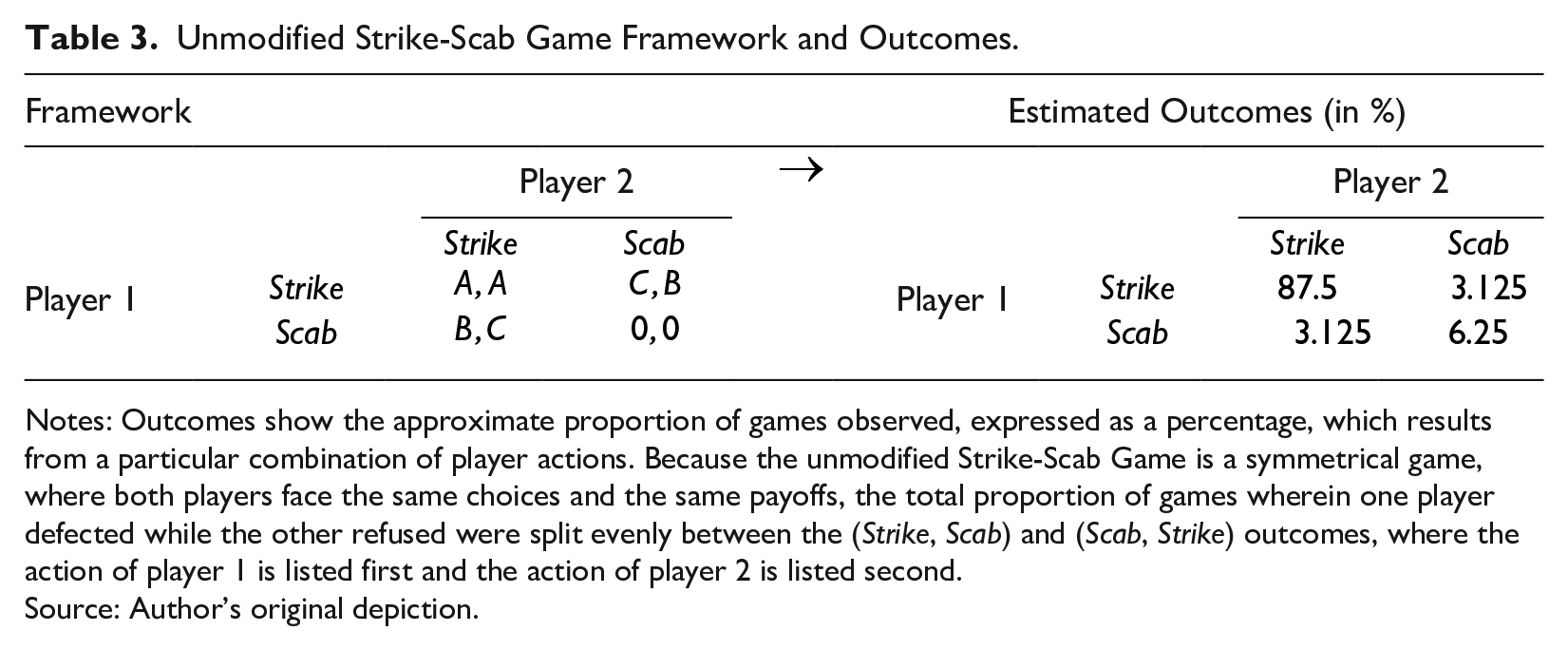
Notes: Outcomes show the approximate proportion of games observed, expressed as a percentage, which results from a particular combination of player actions. Because the unmodified Strike-Scab Game is a symmetrical game, where both players face the same choices and the same payoffs, the total proportion of games wherein one player defected while the other refused were split evenly between the (Strike, Scab) and (Scab, Strike) outcomes, where the action of player 1 is listed first and the action of player 2 is listed second.
Source: Author’s original depiction.
While undergraduates have thus far not typically played “rationally” (with results in accordance with the Nash equilibria of each game), the unmodified Strike-Scab game is an exception. Here, students overwhelmingly tend to opt for cooperative play, with those players who refuse to strike citing their concern regarding the risk associated with striking.
The modified version of Strike-Scab, as with the earlier modified Prisoner’s Dilemma, exploits power asymmetry and most closely mirrors labor struggles in the racially bifurcated Gary Works of Acceptable Men. In this, one player, the labor aristocrat, is in a privileged position in the workplace. Like the w workers who, Ignatiev notes, dominated the “skilled” and supervisory roles at the mill, the labor aristocrat holds a much more desirable position, with higher pay and safer conditions. In contrast, the common laborer, as before, works in an unsafe and poorly compensated role; this player closely mirrors, in their status, the Black and Latine workers in the Gary Works. As in the unmodified version of the game, both players may choose to strike or not, and both players would benefit from a winning strike, with both players earning raises and increased workplace safety. The labor aristocrat, however, stands to lose far more if they strike while the common laborer crosses the picket line. In this scenario, the labor aristocrat would be fired and the scab would take their place. The labor aristocrat crossing a picket from the other player would earn a nominal raise, as in the unmodified game. As before, if neither the common laborer nor labor aristocrat went on strike, the workplace would remain the same.
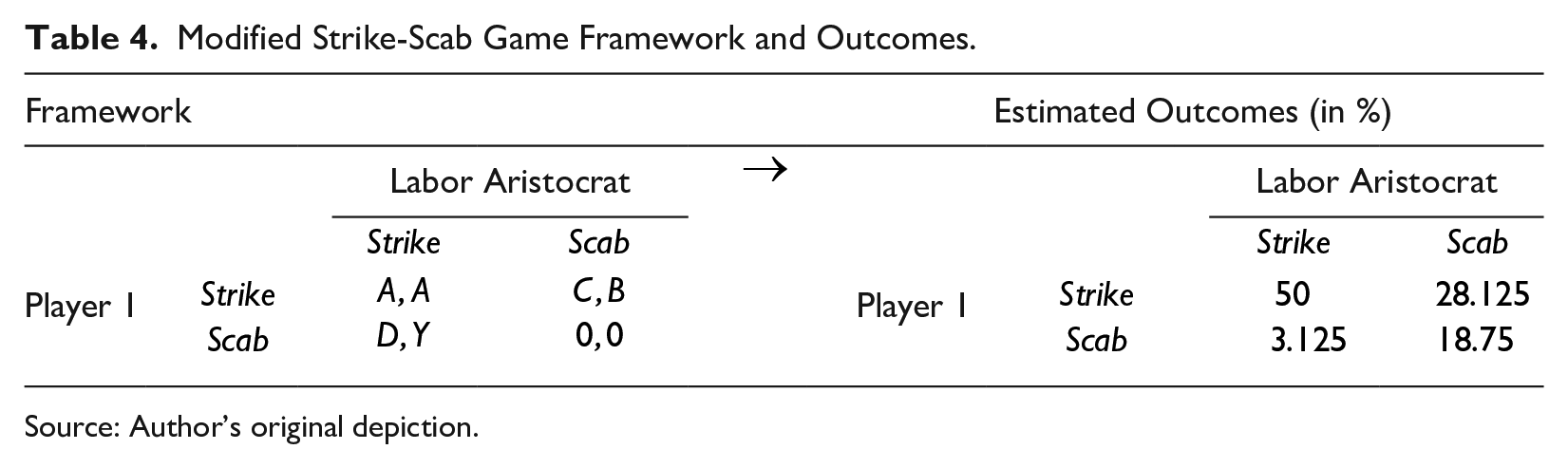
Table 4 illustrates, under the Framework heading, the payoffs associated with the modified Strike-Scab game and, under the Outcomes heading, the outcomes observed. Player 2 assumes the role of the labor aristocrat with payoffs
Modified Strike-Scab Game Framework and Outcomes.
Source: Author’s original depiction.
As with the modified Prisoner’s Dilemma, the introduction of power asymmetry theoretically and empirically undercuts cooperation. Labor aristocrats may refuse to strike to prevent the loss of their status. Further, common laborers may refuse to strike either because of concerns that labor aristocrats will refuse to cooperate or due to a desire to claim the position of the labor aristocrat (had the labor aristocrat struck). This strategic situation, while oversimplifying the range of actions labor aristocrats and common laborers could take to improve their status, mirrors the impasse that holds at the Gary Works throughout Acceptable Men: Black and Latine workers were unable to improve their workplace conditions because of white skilled and supervisory worker disinterest.
Student Behavior and Reflections
Students demonstrate a consistent tendency, when playing these games, to opt for cooperative outcomes even when these results are not “rational” (and thus, such results do not comply with the Nash equilibria of the games). These tendencies are undercut, however, with the introduction of power asymmetries, as shown in the two modified games. While these modifications abstract from the real emotional, intellectual, and material costs and benefits associated with cooperation, the demonstrated changes in behavior with nominal (i.e., nonmaterial) changes in context show student engagement with the games.
Group outcomes were far more cooperative than those found in Acceptable Men (though these games were far less complex than those in the Gary Works). These results assuredly reflect the abstraction of the game format; it is far easier to refuse to cooperate with police when you are not facing actual incarceration, and a simple choice to join an existing strike certainly papers over the long organizing process necessary. This cooperation is easier, too, because of the level of trust built after months in the course. Students had worked together on presentations and had discussed many articles and many more probing questions offered by the instructor. Racial makeup was likely a factor, too. While these courses featured high levels of racial diversity, most groups were composed of individuals with similar gender and racial identities. Future utilization of these exercises ought to consider constructing groups with greater and lesser similarity within the group on identity grounds; race differences within groups would probably serve as a large impediment to student cooperation.
It is important to follow these games with reflection exercises that encourage students to think critically about the games and their outcomes, especially in relation to course material. The following is a nonexhaustive list of prompts to encourage student thought: What can the game do that lectures, discussion, or reading cannot? What did the games not cover that, itself, is a vital element in understanding the impacts of white supremacy on capitalism? What role could these games, or games like them, play in a fight to reform or overcome capitalism?
Conclusion
Noel Ignatiev offers concrete examples in Acceptable Men of the power of white supremacy to stifle solidarity within the working class. Versions of the prisoner’s dilemma and the hawk-dove games were recontextualized and modified to relate directly to cooperation and labor organizing across racial lines. Before each game, students were given context through which to motivate the games and player actions. Following each game, students were invited to reflect upon the game results and to explain their actions. At the end of all exercises, students reflected on the exercises and the broader unit.
Students were far more likely to choose more cooperative actions that led to results that did not align with the Nash equilibria of the games. This tendency to cooperation was hampered by the introduction of power asymmetries, which sought to mirror the racialized structure of the capitalist economy in the United States as shown in Acceptable Men. Students were more cooperative than characters within Acceptable Men, which likely follows from the abstract context of the decisions they are asked to make, the ease of the decisions, and the tendency for individuals with similar races and genders to form groups together. Such discrepancies with the plot of the book, and with the unit, broadly, pose an excellent opportunity for student reflection and critical evaluation of the exercises as learning devices.
Footnotes
Acknowledgements
I would like to thank Alexandra Bernasek, Smita Ramnarain, and Geoffrey Schneider for their helpful comments on an earlier draft of this paper, and Enid Arvidson for editorial feedback.
Author’s Note
Robert Haggar is now affiliated to SUNY Cortland, Cortland, NY, USA.
Declaration of Conflicting Interests
The author declared no potential conflicts of interest with respect to the research, authorship, and/or publication of this article.
Funding
The author received no financial support for the research, authorship, and/or publication of this article.
