







Abstract
This article offers new insights on the issue of student-centric pedagogy. First, it underscores the significance of threshold concepts in teaching radical political economics. Second, it offers a new way to empower students by giving them a role of co-producers of knowledge in the classroom. The framing of threshold concepts is an important topic, but it has been understudied in the context of radical political economics. To initiate a dialogue on this issue, the article proposes the term “equality of opportunity” as a conceptual tool to recontextualize the significance of the role of government in the economy. We argue that the notion of equality of opportunity offers an advantageous vantage point for radical political economists to offer a holistic understanding of the dialectic of government-economy.
Keywords
1. Introduction
In the United States, the provision of basic public goods such as universal health care and social welfare spending programs are highly contested across ideological lines. This is an outcome of a concerted effort by a segment of corporate elites that has methodically engaged with academia (economics profession in particular), civil society, and Hollywood to make US Americans loathe government intervention in the economy (Oreskes and Conway 2023). In this process, terms such as “freedom” and “meritocracy” are being appropriated in a way that have become synonymous with “free market” neoliberal capitalism (Oreskes and Conway 2023). Further, government regulations, taxation, and social welfare programs are portrayed as attacks on economic freedom and prosperity. Consequently, many undergraduate students (especially those who are interested in majoring in economics) in the United States may consciously or unconsciously come to classroom with negative preconceived notions about the role of government in the economy.
As teacher-scholars, especially in the tradition of radical political economics, it is important for us to (a) acknowledge and value different perspectives of our students on ideologically/politically “contested” issues and (b) invite open-mindedness and critical thinking among students toward new and challenging ideas. But simply expecting open-mindedness from students especially when they are presented with ideas/concepts that are likely to contradict or challenge their existing ideas/perspective is a big ask. In this context, the significance of language/framing of issues (topics) cannot be overstated if the goal is to encourage open-mindedness and promote critical thinking among students. The manner (including language) in which concepts are framed have a major impact on students’ sensibilities (Sussman and Olivola 2011; Bernans 1999). This brings us to the central theme of this article: threshold concepts. In the context of this article, threshold concepts are defined as concepts/framework which open up “a new and previously inaccessible way of thinking about something” (Meyer and Land 2003: 412). The threshold concept “exposes the hidden interrelatedness of phenomenon. Mastery of a threshold concept often allows the learner to make connections that were hitherto hidden from view” (Cousin 2006: 4).
In the realm of teaching radical political economics, threshold concepts are critically important because they can allow students to be open-minded toward concept-phenomenon on which they already have made their minds. Yet, little has been written on the issue of thresholds concepts in the tradition of teaching radical political economics. To fill this void in the literature and initiate a conversation on this issue, the article introduces the term “equality of opportunity” as an important threshold concept for undergraduate economics courses to contextualize the role of public goods, redistributive economic policies, and social spending programs in the economy. Our novel contribution is to contextualize the term equality of opportunity as a pedagogical tool to understanding the role of the government in the economy. It is important to contextualize why equality of opportunity is an effective threshold concept for teaching issues pertaining to radical political economics. On the surface, everyone in the mainstream, irrespective of their political/ideological inclinations, tends to agree with the notion of promoting equality of opportunity in the United States. For example, former president Barack Obama (liberal) and former speaker of the United States Congress Paul Ryan (conservative) both tend to advocate for equality of opportunity. Obama has been quoted saying, “While we don’t promise equal outcomes, we have strived to deliver equal opportunity” (Mathews 2015). Similarly, Speaker Ryan has said that “Instead of focusing on equality of outcomes, we should be focusing on equality of opportunity” (Mathews 2015). The notion of “meritocracy,” one of the most hegemonic ideas in the age of neoliberalism, rests on the premise of equality of opportunity (see Wrenn 2019). A true merit-based system implicitly requires a basic level playing field (equality of opportunity) for everyone in the society. But what entails equality of opportunity in the real-world economy remains an open-ended question. Is equality of opportunity even possible within the structural constraints of capitalism?
We argue that the tradition of radical political economics is best suited to address these issues and offer a holistic understanding of the notion of equality of opportunity in the contemporary economy. Further, the article finds the plurality of possibilities in terms of what can be characterized as equality of opportunity as a key pedagogical moment to critically engage with students and delineate a highly misunderstood dialectic of government-economy. The notion of equality of opportunity provides a new framework to students to reconceptualize provision of public goods and redistributive policies of the government (e.g., social welfare programs) in a more nuanced manner. In other words, equality of opportunity “represents a transformed way of understanding, interpreting, or viewing [government intervention in the economy]” (Meyer and Land 2003: 412). Overall, this article offers new insights on the issue of student-centric pedagogy in the following two ways: First, it underscores the significance of threshold concepts in teaching radical political economics. Second, it offers a new way to empower students in the classroom by giving them a role of co-producers of knowledge. This can be actualized by allowing students to concretize the notion of equality of opportunity by specifying concrete policies/programs through classroom discussions and group activities.
The remainder of the article is structured as follows. In section 2, we contextualize our article in the existing literature on teaching radical political economics. We argue that our intervention in the literature—framing of threshold concepts—builds and extends existing discussions on real-world economics and classroom structures. In section 3, we discuss equality of opportunity as a framework to better understand the role of government in the economy and provide classroom evidence to substantiate our claims. It also critically discusses some limitations of our approach. Section 4 offers a conclusion of the article.
2. Teaching Radical Political Economics
The issue of inequality that is intricately tied to equality of opportunity has been a central theme of concern for radical political economists. The issue of rising inequality has gained attention in the mainstream economics after the Great Recession of 2008 (Piketty 2014). But one of the major theoretical limitations of the mainstream approaches (e.g., neoclassical economics) is that they tend to overlook the intrinsic power asymmetries in the real-world economy (Kvangraven and Kesar 2023; Mearman, Berger, and Guizzo 2022; Rao and Ramnarain 2023; Naidu 2023; Cherry 1988; Cullenberg 1988). For example, systemic and historical inequities across class, gender, race, and sexuality are likely to remain muted in mainstream undergraduate economic courses, and markets are generally portrayed as a panacea for all socioeconomic ills. In other terms, equality of opportunity is often implicitly assumed in the mainstream approaches. Therefore, government interventions in the economy (except in the case of market failures) are not just portrayed as unnecessary but highly problematic. In the real-world economy, socioeconomic inequities have increased steadily in the United States since the rise of neoliberalism (Kotz 2017). In particular, economic deprivation for a large number of working people in the United States (including white working-class men) have accentuated because of neoliberal policies, which were previously vehemently advocated by the mainstream of economics discipline. In other words, equality of opportunity does not exist in the real-world economy, and this brings us to the role of the government/state in the economy and radical political economics.
Equality of opportunity is a multidimensional issue, and it is mediated through an intersection of class, gender, race, religion, and caste depending on time and space (see Zein-Elabdin 2016; Schneider 2010). History plays an important role in shaping contemporary socioeconomic institutional arrangement (Kvangraven and Kesar 2023; Khan 2023). Given the immense history of racism, sexism, and classism in the United States, it is imperative to deconstruct how those injustices directly and/or indirectly continue to mediate contemporary socioeconomic outcomes. Further, power asymmetries between classes/groups play a central role in regulating socioeconomic outcomes and possibilities. One of the strengths of radical political economics 1 is its relatability to the actual existing economies (see Mearman, Berger, and Guizzo 2022; Andini 2009). This makes the framework of radical political economics not only well suited to critically analyze equality of opportunity but it also provides an appropriate vantage point to delineate the contours of equality of opportunity. In particular, radical political economic approaches (feminist, institutional, Marxian, post-Keynesian, and post-colonial) offer unique and relevant entry points to analyze and delineate equality of opportunity in the economy (see Folbre 2021; Charusheela and Zein-Elabdin 2004; Resnick and Wolff 1987).
Among radical political economists, there has been a steady progress in terms of developing a more pluralistic economics curriculum at the undergraduate level (see Schneider 2022; Provencher and Ramnarain 2019; Mearman, Guizzo, and Berger 2018; Underwood 2004; CORE-Econ 2024). Course content(s) and classroom structure are intricately tied to each other (Schneider 2010). Rose (2005) emphasizes the need to move away from the traditional lecture-based teaching to facilitate alternative pedagogy in the classroom. In her experience, highly structured group projects and simulations work better than lecture. In her classroom simulations, Rose (2005) divides students into different groups to represent different schools of economic thought. They debate from the perspective of their assigned group, which they may or may not agree with personally. This assignment forces students to argue in favor of—and come to understand the logic behind—different points of views. Banks, Schneider, and Susman (2005) and Susman (2009) emphasize the role of “service learning” in teaching radical economics. For example, students can volunteer in the community to help understand and resolve real-world economic issues. This allows students to connect previously abstract theory to real-life scenarios where they can have an impact. Visano (2018) emphasizes the significance of building student-centric pedagogy in radical political economics. She has shown the significance of a discussion-based course that allows students to challenge their own commonsense ideas about capitalism. One method through which she does this is by having students create economic systems and means of exchange beyond the realm of the capitalist mode of production. For example, in one assignment she asks students to construct an economy for a subsistence-based community. This assignment allows students to arrive at their own conclusions, which often “contradict their prior taken-for-granted belief in the ‘rightness’ of the capitalist mode of production and offer the class an opportunity to reflect on principles of fairness in resource distribution” (Visano 2018: 194).
Johnson, Doerner, and Malloy (2019) have emphasized the significance of experiential and active learning strategies in the classroom. They have illustrated that active learning and class simulations help students improve their comprehension of abstract theories and concepts. Building on this rich strand of literature in teaching radical political economics, we identify an important arena of intervention, that is, contextualization of the role of the government in the economy against the backdrop of equality of opportunity.
3. Equality of Opportunity in the Economy
Inadequate public spending, especially underprovisioning of public goods, creates a socioeconomic imbalance in the favor of large corporations and affluent households at the expense of working classes (Galbraith 1958). Further, there is a growing sense of distrust and skepticism among a large segment of the population on the role of the government in the economy. Oresekes and Conway (2023) argue that this as an outcome of decades-long concerted efforts on the part of corporate elites to make US Americans loathe government and love the “free market.” Government “intervention” 2 —note that the term intervention implies that the economy operates independent of the government—is framed as the antithesis of “freedom.” Collegiate student bodies, being microcosms of broader society, also tend to carry some of the misconceptions about the role of the government in the economy. One of the most popular perceptions about the state/government is that it is inherently inefficient vis-à-vis large corporations. But in reality, we have historical and contemporary evidence that shows state/government has played an effective/active role in processes of economic development of many countries (see Chang 2011). For example, Amsden (1989) and Wade (2018) have shown the significance of a “developmental state” in the context of East Asian economies. Similarly, Mazzucato (2013) has argued that the role of the state/government should not be restricted to regulations but with the right set of institutional arrangement, we can build an “entrepreneurial” state.
Moreover, markets are socio-institutionally embedded; therefore, it is important to critically reflect on the binary of market versus state (Charusheela and Zein-Elabdin 2004). One potential way to go beyond the conventional ontological dualism of market versus state (government) is to recontextualize the role of state/government against the backdrop of equality of opportunity. In the absence of equal opportunities, the role of government becomes a necessity rather than an option. Progressive taxation, provision of public goods, social welfare programs, and providing support to workers-owned cooperatives can be seen as mechanisms through which historically marginalized and less affluent households are given an opportunity to compete with more privileged and affluent households.
To analyze the impact of a threshold concept—equality of opportunity—we focused on an undergraduate course called “Political Economy of Inequality” offered in the Spring 2022 semester at Franklin & Marshall College. It was an elective course, and twenty students were enrolled in it. Given that it was an elective course, it may have attracted students with a preexisting interest in issues pertaining to inequality, but it is also worth noting that economics majors are required to complete at least 4 electives at Franklin & Marshall College, which might have led some students to enroll for scheduling convenience rather than a specific interest in inequality. We collected students’ perceptions pertaining to the role of the government in the economy through two surveys, similar to a pretest and a posttest. The first survey was conducted before students were introduced to the concept of equality of opportunity in the context of government intervention in the economy. The survey consisted of a series of questions designed to elicit anonymous and voluntary responses on “contentious” economic issues in the context of the United States. The topics covered included progressive taxation, paternity leave, universal basic income, federal minimum wage, affirmative action, reparations for Black US Americans, tuition-free college, redistribution of school funding, free childcare, and monetary compensation for unpaid family work. Students were asked to anonymously fill the questionnaire, and they were given a choice to opt out of this survey as well.
After collecting these surveys (roughly speaking, think of them as a baseline), students were introduced to the concepts of equality of opportunity and the role of government in the economy as interacting forces. Through his lectures, one of the authors of this article (D.K.) explained how the government can positively or negatively impact equality of opportunity. These lectures were focused on underscoring historical inequities that exist in the United States across race, gender, and class lines.
Afterward, we did a second survey that included the same questions but framed around the concept of equality of opportunity. We hypothesized that invoking this term would lead students to consider the real-life impact of these policies more deeply and might result in more openness toward the role of government in the economy. We anticipated that students would show greater willingness to support wealth redistribution, enhanced social safety nets, and worker’s compensation in this second survey.
Results of our survey are given in figures 1 and 2. In figure 1, a higher number means more support for progressive taxation, more weeks of paid leave, and a higher minimum wage. As it can be seen in figure 1, introducing the concept of equality of opportunity on average made students more willing to favor higher tax rates on top income earners. This shows that students are more open toward progressive taxation when contextualized as a tool to achieve equality of “opportunity” rather than “outcome.” This presents intriguing implications for Sussman and Olivola’s (2011) case study, which suggests that the term “taxes” in general invokes negative feelings among the US public. Our findings indicate that contextualizing discussion on progressive taxation in terms of equality of opportunity could potentially garner wider support on this issue.
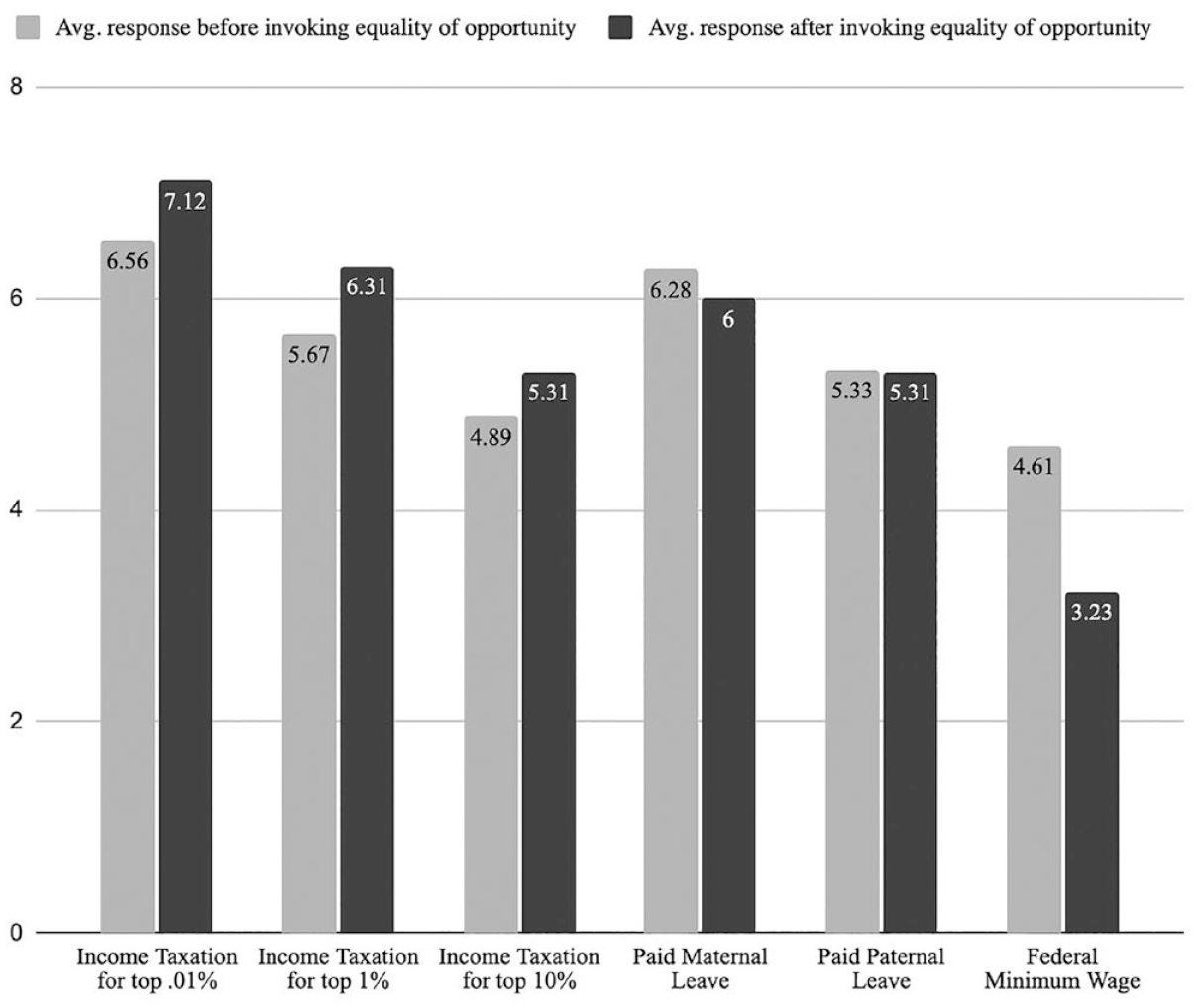
Questionnaire responses of students regarding equality of opportunity in relation to income taxation, parental leave, and minimum wage.
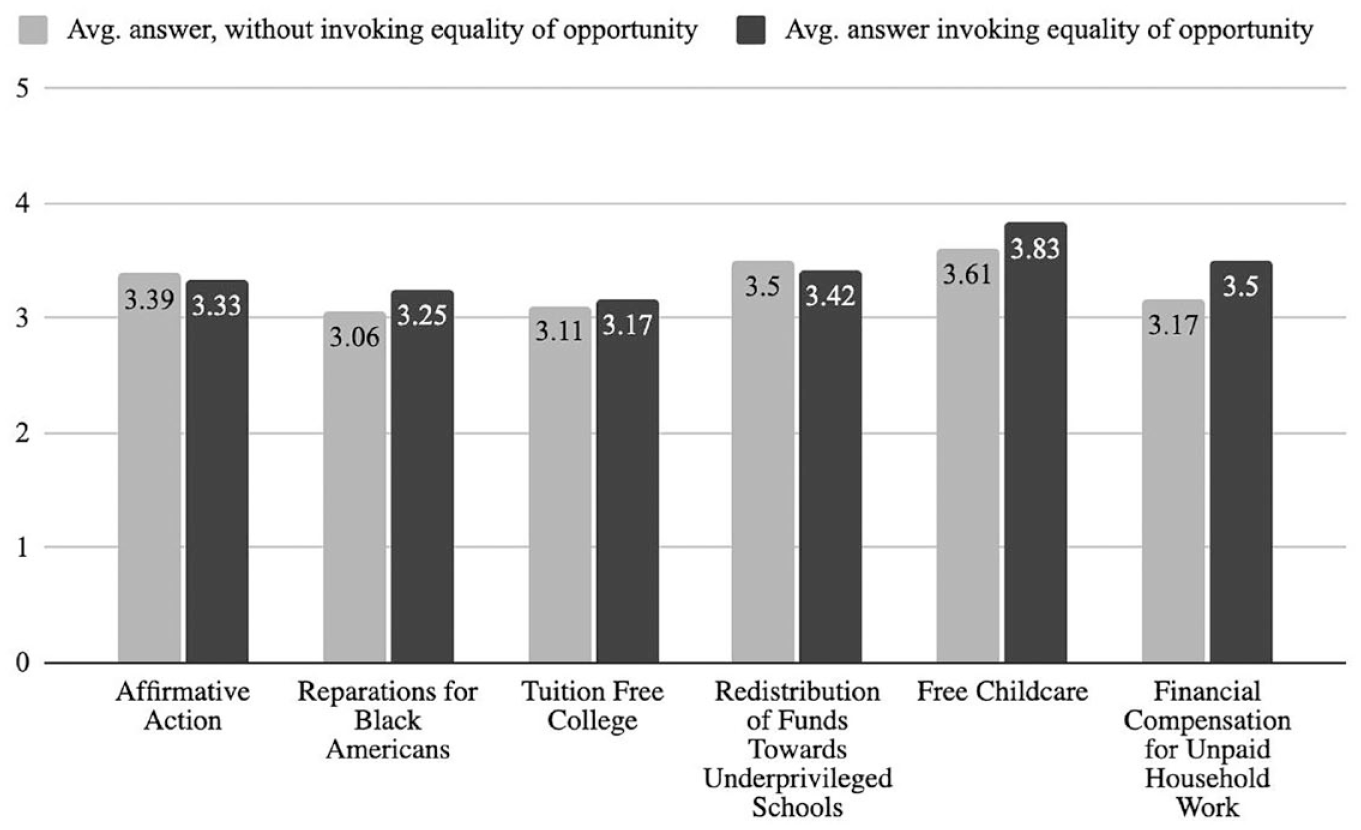
Questionnaire responses of students regarding equality of opportunity in relation to affirmative action, reparation for Black Americans, tuition-free college, redistribution of school funding from privileged to underprivileged communities, free public childcare services, and financial compensation for unpaid household work.
On the topic of paid maternal leave, the support for more generous maternity leave declined after invoking the term “equality of opportunity,” while there was a negligible change on the issue of paternity leave. One possible explanation is that the phrase “equality of opportunity” has been interpreted by students in terms of equalizing unpaid leave for mothers and fathers. On the issue of federal minimum wage, we noticed a substantive decline after invoking the term “equality of opportunity.” Given that our class discussions were primarily focused on equality of opportunity in relation to the provisioning of public goods/social welfare programs, little focus was directed to minimum wage. 3
In figure 2, a higher number implies stronger support for the given (social welfare/redistributive) programs/policies. As can be seen in figure 2, invoking the term “equality of opportunity” has resulted in more support for reparations for Black Americans, tuition-free college, free public childcare services, and financial compensation for unpaid household work. On issues of affirmative action and redistribution of school funding from privileged to underprivileged communities, we observed a marginal decline. Discrepancies in results in both figures 1 and 2 also show that using the term “equality of opportunity” as a framing tool can have its own limitations and cannot necessarily be effectively invoked in every socioeconomic context. Also, our sample size was very small and not representative of the student body; therefore, we acknowledge the inherent limitations of our results.
To promote critical reflection, students were engaged through constructivist class activities.
4
For example, in one class activity, students were asked to reflect on the following scenario:
Two children are born in the United States on the same day. One is born to parents in a low-income inner-city neighborhood and the other one is born to affluent parents living in a high-income suburban neighborhood. Critically discuss potential socioeconomic opportunities and future prospects of both children.
Students were divided into small groups to critically reflect on this hypothetical scenario. There was a unanimous consensus among students that future opportunities are likely to be skewed in favor of the child born in a rich suburban neighborhood. This activity allowed students to recognize that in a class-based unequal society, socioeconomic outcomes are largely regulated by the class status and cannot be fully reduced to individual effort or hard work. In other words, equality of opportunity needs to be actively created through collective effort (e.g., government/state policies and/or community initiatives). In another class activity, students were divided into small groups of three to four to brainstorm, discuss, and debate policies and programs that can maximize the equality of opportunity in the economy. The purpose of this exercise was to help students arrive at a set of policies/programs that should be provisioned by the government to promote equality of opportunity. Every group was required to develop a consensus and could only put forward policies or proposals that everyone had agreed to. From a pedagogical perspective, it was a useful exercise because it allowed room for group discussions, provided students a chance to deliberate and debate with each other, and helped foster the skill of building consensus. We believe that consensus-building is an important real-world skill that should be taught to students. 5 Our goal was to explore how students understand and relate to equality of opportunity when they were not provided with predetermined choices. It was interesting to find out that the majority of them went for an economy where public goods and social services are provided by the government to ensure universal access. In other words, students opted for what we can broadly characterize as a Nordic-style social welfare democracy.
It was a unique pedagogical moment because students arrived at an interesting conclusion on their own; that is, Nordic-style social welfare democracies offer better equality of opportunity vis-à-vis the United States. It shows that when there is a broader consensus on an entry point of analysis (in this case equality of opportunity), students seem to be more open toward ideas/outcomes that they may have deemed “troublesome knowledge” at the beginning. Meyer and Land describe “‘troublesome knowledge’ which appears counter-intuitive, alien (emanating from another culture or discourse), or seemingly incoherent” (Meyer and Land 2003: 7). This shows that a well-thought-out framing of a threshold concept can make formerly troublesome knowledge appear as a common sense.
We would like to highlight three important caveats here. First, equality of opportunity in an economy cannot be reduced to a fixed set of policies but rather it must be seen as a continuous process. 6 As the economy evolves owing to new technological changes, the set of government policies and programs need to adapt accordingly to ensure equality of opportunity. We have primarily focused on public goods and redistribution policies as tools to promote equality of opportunity but how production processes are organized is critically important as well. For example, artificial intelligence (AI) is likely to result in mass unemployment for a large segment of population. In addition to basic social safety programs, it would be necessary for a government to set up programs that provide initial capital and support to community-based workers owned and managed cooperatives to create employment opportunities in local communities (Kristjanson-Gural 2011). Similarly, people with disabilities must get continuous support from government programs to ensure equality of opportunity for them. In other words, framing of threshold concepts must be attuned to the historical and socio-institutional context of the society. Second, the notion of equality of opportunity presented here is most relevant in the context of the United States; it might have limited application in other countries. Therefore, which set of policies/programs would constitute promoting equality of opportunity would vary based on the prevailing bargaining power of different classes/groups in a society. Finally, these results were achieved in the context of a small sample. It would be interesting to see how this research holds up in larger classes, particularly in a broader course such as introductory micro- or macroeconomics.
4. Conclusion
The article shows that the framing of threshold concepts has significant implications for students' openness toward new and challenging ideas. As of now, not much attention has been given to the significance of threshold concepts in teaching radical political economics. To address this issue, the article proposes the term “equality of opportunity” as an alternative framing tool to contextualize the role of government in the economy. Framing the contours of an equitable and inclusive economy (a core theme of radical political economics) in the context of “opportunities” rather than “outcomes” tends to encourage open-minded engagement among many undergraduate economics students in the United States. This is directly tied to the fact that equality of opportunity has become a hegemonic idea, at least at the level of rhetoric if not practice, in the United States. Therefore, the framing of equality of opportunity provides a unique learning opportunity for students to reflect on their pre-existing biases and openly interrogate new ideas without the resistance that may emerge from vocabulary associated with specific political ideologies.
It allows students to transcend the prevailing ontological dualism of government versus market. Furthermore, it encourages students to critically rethink the role of government/state by empowering them to deconstruct the abstraction of economy by specifying concrete government/state programs and policies that can promote equality of opportunity in the economy. This process allows students to draw from their own unique experiences and class, race, gender, and sexual sensibilities to (a) reimagine an “inclusive” economy and (b) become an active co-producer of knowledge in the classroom. Overall, we hope that this article paves the way for a robust dialogue and discussion on student-centric pedagogy in the tradition of radical political economics.
Footnotes
Acknowledgements
We would like to thank Mary Wrenn and Smita Ramnarain for their valuable and insightful feedback on an earlier version of this article.
Declaration of Conflicting Interests
The author(s) declared no potential conflicts of interest with respect to the research, authorship, and/or publication of this article.
Funding
The author(s) received no financial support for the research, authorship, and/or publication of this article.
