







Abstract
Scholars have long contrasted the gradualist trajectory of China’s economic reforms with the shock therapy implemented in the former USSR. Our research, however, reveals a more nuanced story: China’s path combined gradualism with targeted, bold structural adjustments. We present three key findings. First, gradualism overwhelmingly characterized the reform process. Even at the height of market reforms, the most severe structural adjustments were short-lived, affecting a geographically bounded share of the national economy and population. Second, the specific mix of gradualism and shock therapy was shaped by the pre-reform political economy, particularly developmental legacies and labor relations. For example, provinces that were more industrialized under the planned economy often experienced more radical adjustments. Finally, our analysis indicates that regions subjected to more intensive structural reforms subsequently tended to exhibit slower growth in the following decades.
Keywords
1. Introduction
Since the 1980s, China has gradually transitioned from a planned economy to a market economy. This process has been characterized by sustained high growth rates and the absence of a uniform nationwide “shock therapy” in either the political or economic sphere. This transition experience stands in sharp contrast to the experiences of countries with similar Soviet-type institutions, such as Russia. After the collapse of the Soviet Union in the early 1990s, Russia and many other former Soviet republics adopted radical strategies to dismantle their planned economies and subsequently suffered prolonged recessions. Around 1990, Russia’s GDP—measured in constant 2015 US dollars—was roughly comparable to China’s (World Bank 2025). However, Russia did not regain its 1990 GDP level until around 2006, following a decline of more than 40 percent caused by shock therapy reforms. During the same period, China’s GDP grew by nearly 400 percent.
Against this backdrop, scholars from various traditions have conducted comparative studies of the divergent market transitions in China and Russia (see Sachs and Woo 1994; Burawoy 1996; Kotz 2005). Most of this literature frames the issue as a dichotomy between gradualism (China) and shock therapy (Russia). Central to these comparisons are questions about how these former planned economies diverged in strategies and outcomes, and what factors account for their different trajectories. In particular, because China’s gradualism differed sharply from the then-standard prescription of shock therapy, researchers have focused on the political economy of China’s transition and offered three distinct explanatory perspectives on the origins and consequences of its gradualist approach.
The first perspective attributes China’s gradualism primarily to the leadership’s cautious attitude toward market reforms and argues that such gradualism contributed to China’s economic success (Nolan and Ash 1995; Kotz 2005; Naughton 2018; Weber 2021). As Barry Naughton (2018: 98) argues, China adopted gradualist reforms because government leaders sought to maintain control and limit the extent of potentially disruptive changes. This is perhaps best illustrated by Deng Xiaoping’s well-known phrase: “crossing the river by feeling the stones.” Scholars point out that, unlike the Russian-type reforms, China’s approach allowed the market mechanism to grow out of the plan in phases. For example, a commonly cited strategy of the gradualist transition was the dual-track approach to liberalization, in which market prices coexisted with planned prices, while the share of the market economy gradually surpassed that of the planned economy (Naughton 2018; Weber 2021). Following these arguments, China’s gradualist approach assigns state intervention and regulation a central role in the market economy, not unlike a robust Keynesian policy framework, which helps stabilize the macroeconomy and guides the national economic development.
The second perspective, however, differs significantly from the first. Represented by Jeffrey Sachs—the chief architect of shock therapy—this group of scholars argues that China adopted gradualism not out of political caution but because of its specific socioeconomic conditions, such as a large agrarian sector and the absence of a political consensus for rapid reforms (Fan 1994; Sachs and Woo 1994, 1997). Moreover, Sachs and Woo (1997) contend that China’s growth success resulted from the convergence of its institutions toward those of capitalist market economies, rather than from the continued leading role of non-market institutions emphasized in the gradualist approach. These scholars further argue that China’s gradualism left core issues in its market reforms unresolved, making it unclear whether the gradualist approach can outperform shock therapy in the long run (Fan 1994; Sachs and Woo 1997).
Situated largely within the same neoliberal camp, the third perspective adds important twists to the second. Scholars in this group argue that China’s gradualism was a deliberate—yet ultimately counterproductive—choice made by its leadership. For example, Huang (2012) contends that China had already adopted many key neoliberal policies in the 1980s but reversed course in the 1990s. As Huang (2012) and Pei (2006) note, this reversal extended beyond economic policy to matters of political governance. Similar to the second perspective, these scholars believe that gradualism will ultimately constrain China’s economic and social development.
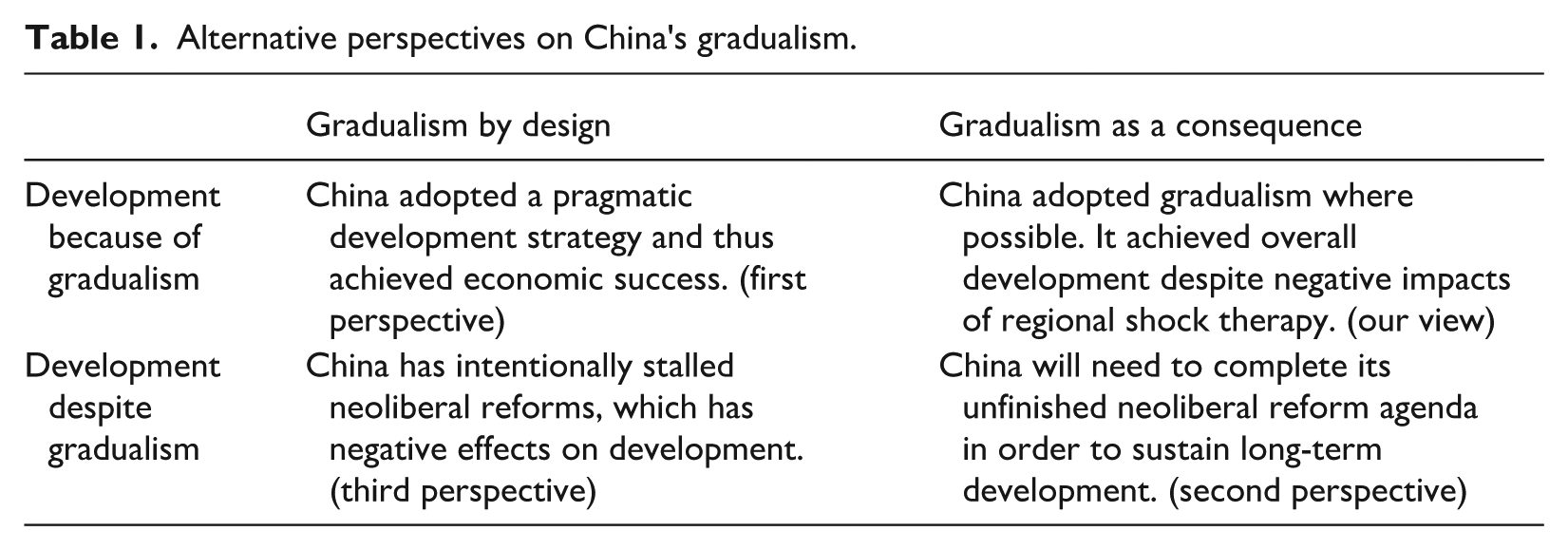
Among these perspectives, the first attracts a diverse group of supporters, ranging from pragmatic mainstream scholars to Keynesian and Marxian researchers. In contrast, the second and third perspectives are typically endorsed by conservative economists and proponents of neoliberalism, who would generally recommend further structural adjustments in China. Table 1 summarizes the three major perspectives along two key dimensions: whether China’s gradualism was a deliberate strategy or the result of specific historical conditions, and whether China’s economic success occurred because of—or in spite of—gradualism.
Alternative perspectives on China's gradualism.
We propose a different perspective, one that emphasizes how China’s transition has been shaped by class-based political economy. While cautious leadership certainly played a role in moderating the pace of market reforms, we argue that China’s gradualism emerged more as a consequence of historical conditions than as a deliberate design. 1 In practice, China adopted a mixed strategy combining gradualist reforms with elements of big-bang policies, and the specific regional policy trajectories were shaped by uneven development patterns inherited from the planned economy. For example, provinces that were more industrialized before the reform period often underwent more radical structural transformations during the 1990s and 2000s. In contrast, provinces with lower levels of industrialization and urbanization absorbed surplus rural labor and large-scale internal migration, functioning as a reserve army of labor that enabled the gradual construction of a new market-based economic order. Over time, the gradualist approach became dominant as market development increasingly powered national growth. Contrary to the claims of Sachs and other neoliberals, we contend that it was precisely this gradualist strategy that helped China avoid some of the most damaging outcomes typically associated with neoliberal reforms. We demonstrate this through a comparative analysis of the long-term economic performance of regions that experienced shock therapy adjustments versus those that followed more gradual trajectories.
The rest of the article is arranged as follows. The next section briefly reviews the history and political economy of China’s market transition. The third section presents further empirical evidence that provides a nuanced understanding of China’s structural adjustment and its consequences. The final section provides some concluding remarks.
2. The Political Economy of Market Transition
Contrary to some popular perceptions, market reforms in China and Russia began from broadly similar starting points. Ideologically, both countries were significantly influenced by prevailing neoliberal doctrines. At the outset, there is little evidence that Gorbachev intended a more radical departure from the traditional Soviet model than his Chinese counterparts. While the role of Western advisers in promoting neoliberal reforms in the Soviet Union is well known, China in the 1980s was equally—if not more—receptive to neoliberal economic ideas. A frequently cited milestone in China’s transition was an international conference held in 1985 on a cruise ship along the Yangtze River. This event brought together leading neoliberal economists from around the world and key Chinese scholars and policymakers. Co-sponsored by the World Bank and the Chinese government, the conference promoted a neoliberal reform agenda, whose elements were subsequently adopted by the Chinese state (Li 2025).
As for concrete policy packages, both countries started their reforms with decentralization measures and greater autonomy for state-owned enterprises (Kotz and Weir 2007: 76; Qi 2018). These policies were intended to encourage socialist units to operate more like competitive market entities while still retaining socialist features such as full employment and generous welfare provisions. At the same time, both governments introduced policies to encourage and promote the development of new private businesses alongside state-owned enterprises. With the expansion of market mechanisms and enterprise autonomy, China and Russia both experimented with a dual-track system: the state-owned enterprises fulfilled mandatory procurement at planned prices. At the same time, they were permitted to engage in external market transactions, typically at much higher prices (Sachs and Woo 1994).
Unsurprisingly, the initial gradualist experiments in both China and the Soviet Union proved unsuccessful. Among other reasons, with traditional socialist institutions and workers’ power still largely intact, enterprise autonomy and decentralization tended to result in higher employee compensation, lower capital accumulation, and reduced state tax revenues (Sachs and Woo 1994; Kotz and Weir 2007: 76–77; Qi 2018; Xu 2018: 70–72). These dynamics contributed to mounting economic disorder and crisis in both China and the Soviet Union.
From a political economy perspective, the common feature of the initial gradualist experiments in both China and the Soviet Union was the introduction of market mechanisms without a corresponding dismantling of existing institutions or effective discipline of the working class. However, regardless of its specific form, the transition from a planned economy to a market economy inevitably entails profound changes in the social relations of production. All market transitions in the late twentieth century involved the commodification of labor power and of essential goods and services. The pursuit of profit and the inherent anarchy of the market would, over time, overshadow the authority of socialist politics and undermine the traditional social contract between socialist states and their citizens.
The working class had little incentive to support the core demands of such reforms. Thus, market transitions—whether implemented through shock therapy or gradualism—always had to be imposed from above, and a politically weakened working class became a prerequisite for their implementation. In typical market economies, a vital mechanism that disciplines labor is the reserve army of labor, which, as Marx (1967: 592) argues, constitutes “the condition of existence of the capitalist mode of production.” Capitalists must maintain a “natural” level of surplus labor; otherwise, if the threat of unemployment does not sufficiently constrain workers, the economy may encounter profitability problems or even crisis (Kalecki 1943; Pollin 1998).
In socialist planned economies such as China and the Soviet Union, there was no meaningful reserve army of labor, as open unemployment was officially eliminated and employment was administratively guaranteed, while urban workers enjoyed stable jobs and extensive welfare benefits (Yanitsky 1986; Sachs and Woo 1994; Kotz and Weir 2007). However, if segments of the working population could be transformed relatively easily into a reserve army, this potential reserve army could profoundly shape reform trajectories (Xu 2023). In a planned economy, such potential reserve armies often arise from uneven regional or sectoral development. Workers employed in relatively low-compensation regions or sectors within the planned system would have strong incentives to shift into higher-paying sectors or regions once market mechanisms are introduced.
Conceptually, a larger potential reserve army implies a market-transition path that requires less overt coercion, because reformers can more easily divide and conquer the working population and establish disciplining mechanisms. Conversely, when the potential reserve army is small, reformers must forcibly create a reserve army of labor to proceed with the transition to a market economy—essentially another way of describing the logic behind shock therapy.
The contrast between China and Russia in this regard is quite clear. Sachs and Woo (1994) attribute the difficulty of implementing gradualism in the Soviet Union and Eastern Europe to the high level of state-sector employment, “over-extensive” welfare programs, and “over-industrialization,” among other factors. The rural-urban gap was minimal, and workers in both the state sector and rural collectives had little incentive to move into emerging market-based sectors. In sharp contrast, China entered reform as a predominantly agrarian economy. In 1980, only about 19 percent of the population was urban and roughly 69 percent of employment remained in agriculture (National Bureau of Statistics of China 2010). Rural-urban income disparities were substantial, with urban incomes far exceeding those in rural areas (Chen et al. 2010). By comparison, the Soviet Union was already highly urbanized and industrialized, with about 64 percent of the population living in urban areas and the majority of the labor force employed outside agriculture in 1982 (Yanitsky 1986). The Soviet Union’s income inequality and rural-urban gaps were relatively modest (Alexeev and Gaddy 1993; Flakierski 1992). These structural differences imply that China possessed a substantial potential reserve army of labor, whereas in the Soviet Union such a potential reserve army was negligible. Following setbacks from the first wave of gradualist reforms, China took a decisive step in the early 1980s to dismantle the rural collectives (Xu 2023). The resulting large, depoliticized rural labor force became the primary source of migrant workers for the emerging private sector and effectively formed a functioning reserve army of labor. It was not until the 1990s—when the private sector had already expanded significantly—that Chinese reformers began implementing structural reforms in the urban economy.
In contrast, Soviet leaders confronted a fundamentally different socioeconomic structure. With virtually no potential reserve army, the Soviet Union could not sustain its initial gradualist reforms. Ultimately, reformers were compelled to confront the entire Soviet working class directly, leading them down the path of shock therapy. This theoretical framework suggests a general relationship between the size of the potential reserve army of labor and the degree of gradualism in market transition. Specifically, regions with a larger pre-reform state sector and a smaller potential reserve army should experience more abrupt and concentrated employment contraction. In contrast, regions with a larger potential reserve army should follow more gradual adjustment paths. Guided by this implication, the next section examines the specific contours of China’s structural reforms and their consequences.
3. Empirical Evidence
Our empirical analysis draws on official Chinese statistics from three primary sources: the China Compendium of Statistics 1949–2008 (NBS 2010), the National Bureau of Statistics “National Data” platform (NBS 2025), and the China Statistical Yearbook (various years, including 2024). When inconsistencies arise across publications, priority is given to the most recent official release. Data are reported at the provincial level, including both provinces and directly administered municipalities. Throughout the analysis, the term “province” refers to all provincial-level administrative units, including directly administered municipalities. China has four such municipalities—Beijing, Shanghai, Tianjin, and Chongqing—which report directly to the central government and are treated as provincial-level units in the data.
The data consist primarily of longitudinal series covering employment, population, and output over several decades. These series examine the timing, intensity, and spatial distribution of restructuring in China’s state-owned sector, as well as its association with long-run development outcomes.
Ideally, an analysis of state-sector restructuring would rely on a single statistical category that directly captures the entire state-owned sector. Unfortunately, no such unified measure exists in China’s statistical system (NBS 2004). Instead, we rely on a proxy: the employment in state-owned units as a share of urban employment. 2
State-owned units refer to economic units whose assets are wholly owned by the state, including government agencies, public institutions such as education and healthcare, and sole state-owned enterprises. This category captures the core institutional units of the planned economy. It is particularly informative for analyzing restructuring during the 1990s, when mass layoffs and enterprise closures were concentrated in these entities.
It is worth noting that China’s reforms combined radical measures in an overall gradualist trajectory. The structural adjustments of the 1990s constituted a major shock, marked by large-scale privatization, marketization, and widespread unemployment. According to China’s NBS, state-owned units employed nearly 110 million formal workers in 1995, but this number fell sharply to 79 million by 2000 (NBS 2001). Although the decline continued thereafter at a much slower pace, by 2023 the number of employees in state-owned units had dropped further to 54 million (NBS 2024).
Table 2 reports the shares of China’s population and GDP in provinces that experienced considerable annual contractions in state-owned unit employment from 1990 to 2005. Two key observations emerge. First, China’s localized episode of "shock therapy" was concentrated in the late 1990s. The pressure peaked in 1998, when provinces with employment declines exceeding 10 percent in this sector encompassed approximately 61 percent of the population and 59 percent of GDP. A second, less extensive adjustment occurred in 2000, with affected provinces accounting for roughly 20 percent of the population and 16 percent of GDP.
Population and GDP shares of provinces experiencing large annual declines in state-owned unit employment, 1990-2005.
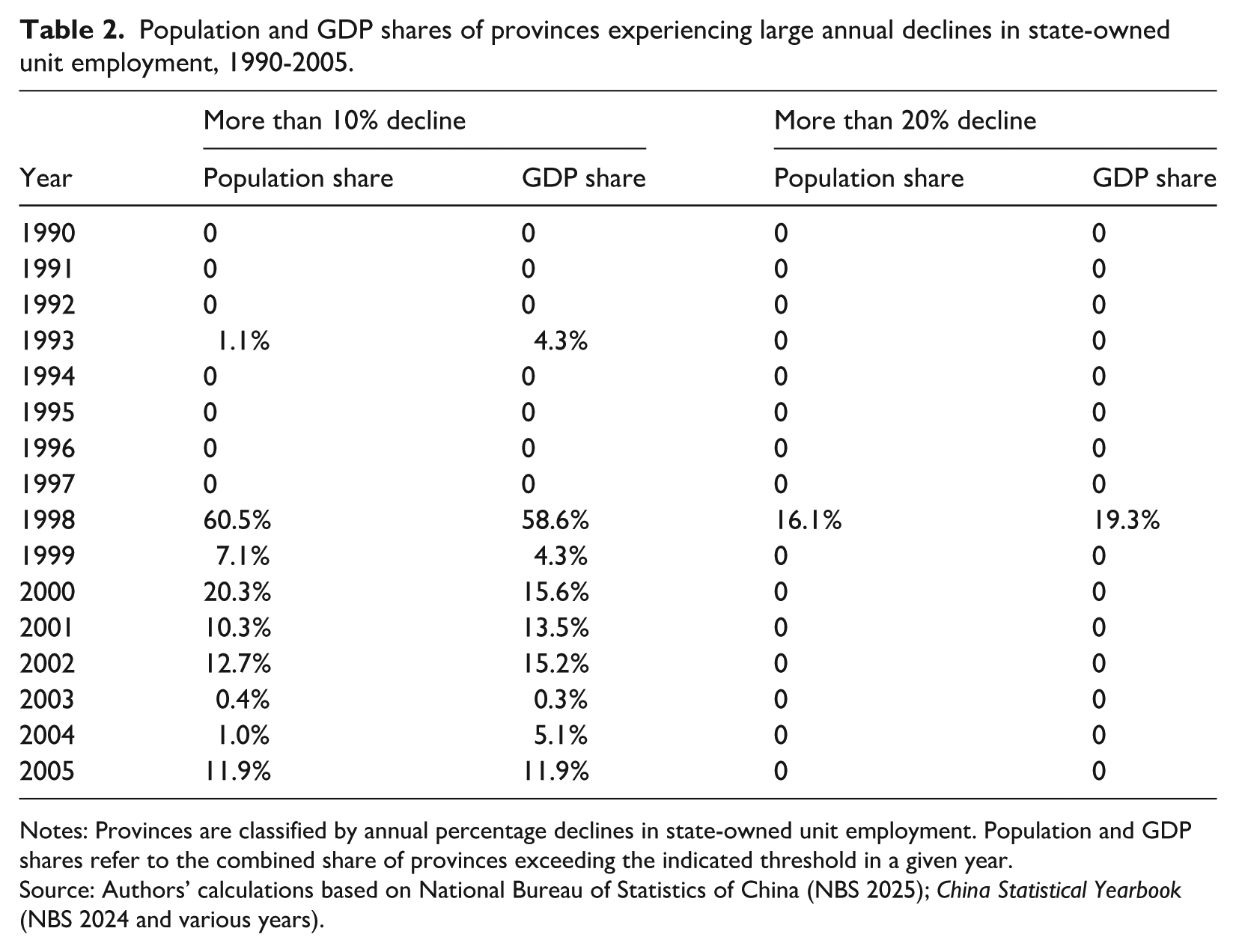
Notes: Provinces are classified by annual percentage declines in state-owned unit employment. Population and GDP shares refer to the combined share of provinces exceeding the indicated threshold in a given year.
Second, even at their peak, these employment shocks were geographically contained rather than nationally diffused. The most severe restructuring—involving annual declines greater than 20 percent—was particularly short-lived. This extreme shock was evident only in 1998, affecting roughly 16 percent of the national population and 19 percent of GDP. In all other years, the population and economic output exposed to contractions of this magnitude were substantially smaller. In fact, for most provinces during much of the reform period, annual declines in state-owned employment remained below 10 percent.
Overall, table 2 demonstrates that during the 1990–2005 period, shock-therapy-style reductions in state-owned unit employment were temporally concentrated and geographically limited, rather than continuous or nationwide. Even at their peak, the most severe annual declines affected only a subset of provinces and did not characterize the reform process as a whole. This pattern stands in sharp contrast to cases of comprehensive shock therapy, where intense, synchronous adjustment persists across most regions for a longer time.
The geographical unevenness of the reform process, as revealed in table 2, also provides a unique opportunity to examine the political economy of market transitions. The regional differences are stark. Consider, for instance, China's northeastern provinces—Heilongjiang, Jilin, and Liaoning—which served as the nation's industrial heartland under the planned economy. In 1995, around 60 percent of Heilongjiang’s workforce was employed in the urban sector. Between 1995 and 2000, however, the province lost 2 million urban jobs, a contraction from which it never fully recovered (NBS 2010, 2024). Today, the region is widely regarded as China’s "rust belt."
In contrast, Guangdong Province in South China had only about 30 percent of its workforce in the urban economy in 1995. Its urban employment remained relatively stable throughout the late 1990s, and after the structural adjustments, Guangdong’s industrialization accelerated rapidly. Guangdong has since become a major global manufacturing hub, and its urban employment increased by more than 500 percent between 2000 and 2023 (NBS 2010, 2024).
In line with these facts, our theoretical framework suggests that a region with a larger pre-reform state sector—and thus a smaller potential reserve army of labor—would undergo a more intense shock-therapy-style adjustment. Figure 1 tests this proposition by plotting the cumulative decline in state-owned unit employment (1990–2005) against the initial share of state employment at the outset of the reform period. A positive relationship emerges: provinces with a greater pre-reform concentration of state-owned employment generally experienced larger employment losses during the restructuring.
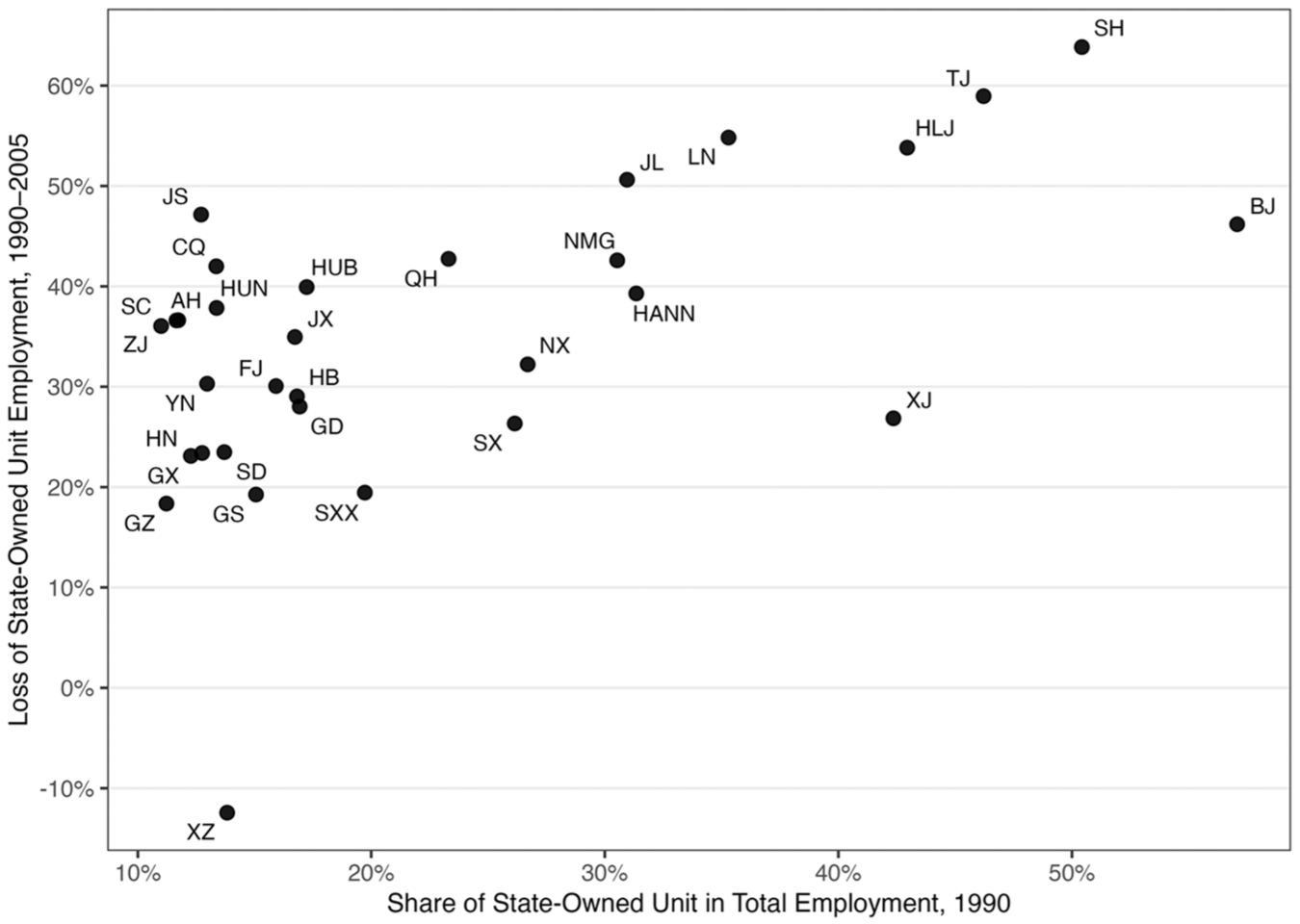
Initial share of state-owned unit employment and subsequent loss of state-owned unit employment.
The bottom-right corner of figure 1 shows the northeastern provinces (Liaoning, Jilin, and Heilongjiang), China’s historical heavy-industry core, which had exceptionally high concentrations of state-owned enterprises and industrial workers. These provinces combine high initial state-sector employment shares with especially large subsequent employment contractions. A similar pattern is observed in the directly administered municipalities of Beijing, Tianjin, and Shanghai, which also entered the reform period with substantial state-sector employment and later experienced pronounced employment losses.
The concentration of these provinces among the most severely affected cases indicates that shock-style restructuring disproportionately affected locations that had once constituted the backbone of China’s socialist industrial economy. In 1980, the combined industrial output of the three northeastern provinces and the three municipalities accounted for roughly one-third of national industrial production (authors’ calculations based on data from NBS 2010, 2025). This share declined to about one-quarter by 1990, to one-fifth by 2000, to one-seventh by 2010, and to roughly one-tenth by 2020. These longer-run shifts underscore the historical weight of the restructuring process and situate the observed employment losses within a broader trajectory of industrial reallocation and regional transformation.
The changing shares of the industrial economy within China imply that the uneven restructuring experiences can have significant long-run consequences for economic development. As mentioned previously, neoliberal advocates argue that China’s lack of a big bang constitutes a major hurdle to its development. If this were the case, we would likely observe a comparable or higher growth rate in the long run for the post-shock-therapy economies. The country-level comparison already shows that, even in the long run, a gradualist economy like China’s grew faster than post-shock-therapy Russia. The contrasting cases of Russia and China demonstrate that, even when markets are the ultimate goal, sustained state direction and regulation are indispensable during the transition (Kotz 2005; Naughton 2018). The implementation of shock therapy in Russia effectively undermined the organized working class. However, this came at the cost of demolishing the existing socioeconomic framework and eroding the state's capacity to govern the economy. These profound disruptions have proven persistent, presenting a sustained challenge to long-term development.
By implication, within the Chinese economy, barring substantial external financial and political support, a province subjected to shock therapy would be expected to grow more slowly than a comparable province following a gradualist path. To better understand the divergent long-run development trajectories, figure 2 plots provincial long-run GDP growth from 2005 to 2024 against cumulative losses in state-owned unit employment from 1990 to 2005.
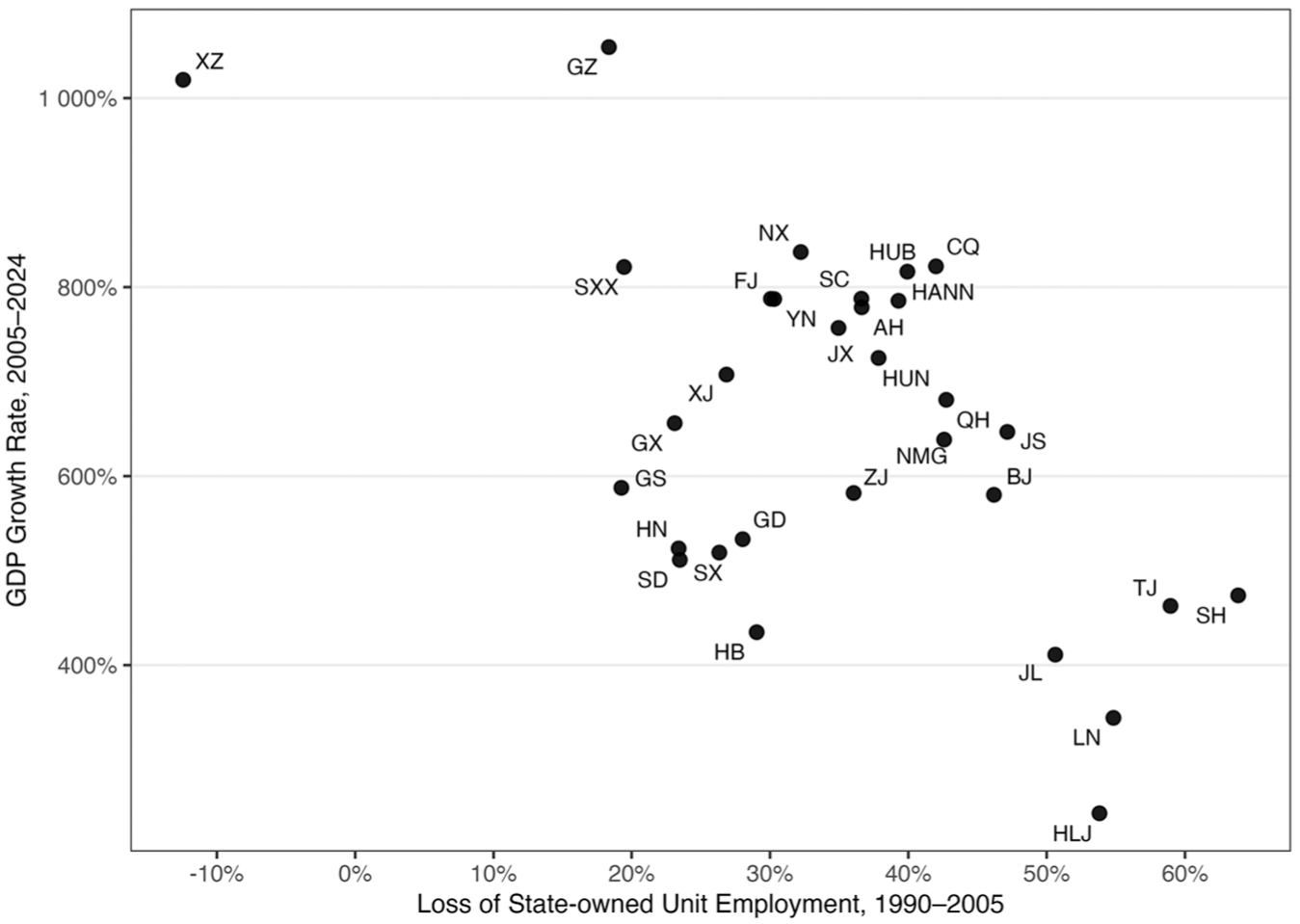
Loss of state-owned unit employment and long-run GDP growth.
The plot suggests a negative association: provinces that experienced larger contractions in state-owned employment during the reform period tend to exhibit weaker subsequent growth performance. This pattern suggests that the intensity of state-sector restructuring is related to long-run development outcomes rather than being economically neutral or merely transitory.
Several provinces that experienced the most severe state-sector contractions—most notably Liaoning, Jilin, and Heilongjiang—also display relatively weaker growth performance in the subsequent period. These northeastern provinces, which constituted the core of China’s socialist industrial base, combine high restructuring intensity with comparatively low growth between 2005 and 2024.
By contrast, regions with more limited state-sector contraction—such as Xizang, Guizhou, and Shaanxi—tend to exhibit stronger long-run growth performance. These regions entered reform with a less dominant state industrial base and experienced more incremental adjustment, supported by expanding private sectors.
Several coastal and central provinces occupy intermediate positions. Places such as Chongqing, Hubei, and Hainan experienced around 40 percent state-sector employment losses yet maintained long-run growth, potentially reflecting stronger fiscal capacity, more diversified economic structures, and preferential access to investment in the post-reform period.
The long-lasting growth disadvantage associated with shock-style restructuring can also be understood in terms of labor demand in emerging non-state sectors. In China, gradual reform coincided with the rapid expansion of township and village enterprises and later private and export-oriented firms. These sectors generated employment opportunities that absorbed surplus rural labor before large-scale urban state-owned sector restructuring intensified. Regions combining substantial rural labor reserves with dynamic non-state sector growth were therefore able to adjust more gradually, sustaining economic expansion during the transition. By contrast, regions heavily concentrated in state-owned heavy industry and lacking strong alternative sources of labor demand experienced sharper contraction and slower recovery. Reserve army dynamics and demand-side expansion thus operated jointly in shaping the uneven geography of reform. Overall, figure 2 implies that shock-style contraction of state-owned unit employment had persistent developmental consequences. Although outcomes differ across provinces, the negative relationship suggests that beyond a certain threshold, the costs of abruptly dismantling the socialist industrial core outweigh the gains from subsequent growth.
In sum, the empirical evidence points to an interpretation of China’s reform as a complex process wherein localized shock-style adjustment coexisted with aggregate stability, ultimately producing durable regional divergence. These findings bolster the new perspective proposed in this article: that China’s adoption of gradualism was a historical contingency, and its robust growth unfolded despite, not in the absence of, shock therapy in certain regions.
4. Concluding Remarks
This article develops a political economy analysis of China’s reform trajectory that centers on uneven development, class structure, and structural adjustment. We examine how and why China adopted a gradualist reform program, avoiding the most severe consequences of neoliberal policies. Our analysis argues that China’s transition—and market transitions more broadly—was not solely a product of deliberate design but rather of historical factors, including state policies, levels of industrialization, and class interests. China’s uneven development created conditions conducive to this gradualist path.
Drawing on the empirical analysis, this article highlights three findings. First, China’s reform strategies incorporated both gradualist and shock-therapy elements, with their specific implementation shaped by historical conditions and class relations. Second, more industrialized regions under the planned economy were more likely to undergo harsher structural adjustments. Third, while provincial growth trajectories are shaped by multiple interacting factors, provinces exposed to more concentrated shock-style restructuring generally did not exhibit stronger long-run growth performance than provinces that adjusted more gradually, suggesting that the abrupt disciplining of labor carried lasting regional consequences.
Prevailing accounts of China’s reforms are polarized: They are often presented either as a straightforward, market-driven success or as a top-down, deliberately gradualist model. This article challenges the binary, offering a more critical perspective that provides scholars and policymakers with deeper insights into China’s actual development path and the consequences of neoliberal doctrines.
Footnotes
Funding
The authors disclosed receipt of the following financial support for the research, authorship, and/or publication of this article: This research received funding from the National Social Science Fund of China under the project titled “The Political Economy of the Socialist System with Chinese Characteristics in the Perspective of Global-Comparative Studies” (Project No. 24&ZD014).
Declaration of Conflicting Interests
The authors declared no potential conflicts of interest with respect to the research, authorship, and/or publication of this article.
1
In 1992, the 14th National Congress of the Communist Party of China formally endorsed the establishment of a socialist market economic system as China’s overall reform objective, emphasizing marketization as the guiding direction of economic transition ( ). Central documents from this period, including the 1992 report itself, did not specify uniform numerical targets for reducing the share of state-owned enterprise employment across provinces. Instead, the emphasis was on structural reform and systemic change rather than on precise cross-regional quotas.
2
We also replicate the analysis using employment in state-controlled industrial enterprises as an alternative indicator of the state sector. The results are substantively similar and available from the authors on request.