






Abstract
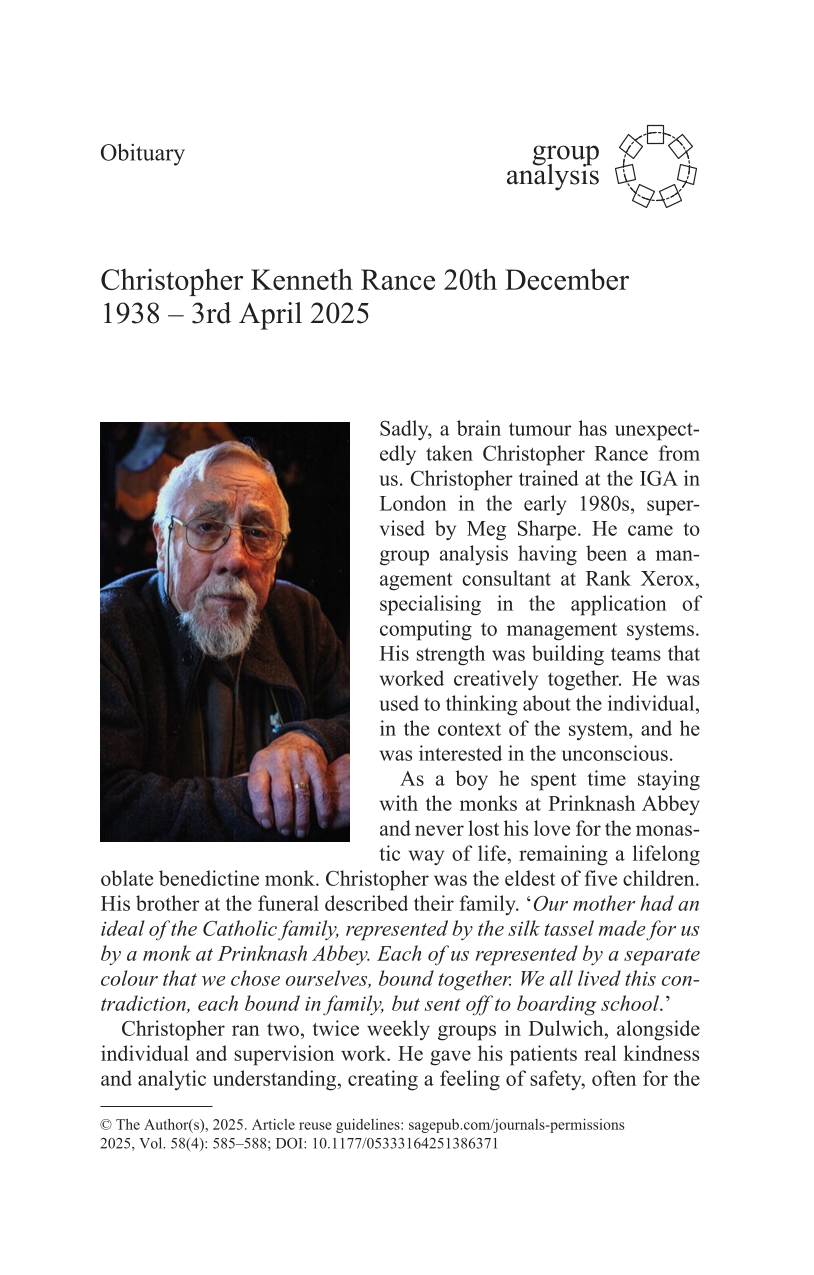
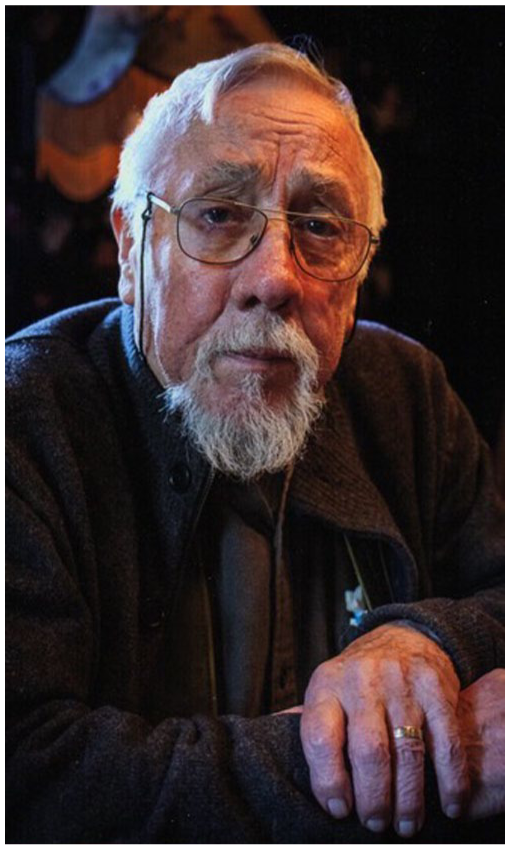
Sadly, a brain tumour has unexpectedly taken Christopher Rance from us. Christopher trained at the IGA in London in the early 1980s, supervised by Meg Sharpe. He came to group analysis having been a management consultant at Rank Xerox, specialising in the application of computing to management systems. His strength was building teams that worked creatively together. He was used to thinking about the individual, in the context of the system, and he was interested in the unconscious.
As a boy he spent time staying with the monks at Prinknash Abbey and never lost his love for the monastic way of life, remaining a lifelong oblate benedictine monk. Christopher was the eldest of five children. His brother at the funeral described their family. ‘Our mother had an ideal of the Catholic family, represented by the silk tassel made for us by a monk at Prinknash Abbey. Each of us represented by a separate colour that we chose ourselves, bound together. We all lived this contradiction, each bound in family, but sent off to boarding school.’
Christopher ran two, twice weekly groups in Dulwich, alongside individual and supervision work. He gave his patients real kindness and analytic understanding, creating a feeling of safety, often for the first time in their lives. Supervisees will have benefitted from his intelligent thought, wide experience of how things work in the real world, and his ability to use language to reframe a difficulty in a way that empowered the supervisee to tackle the issue. Christopher was Hon Treasurer for the GAS and Chaired the library committee. He took an active interest in the journal, and the forum.
Foulkes established the roots of Group Analysis at the Maudsley hospital. Years later Christopher and others ran an in-house foundation course there, bringing Group Analysis to nurses, occupational therapists, therapists, psychologists and psychiatrists in South London, many of whom went on to qualify as members of the Institute. He embraced Ralph Stacey’s work on complexity theory and was central to the Hertfordshire University management consultancy course. Innovative teaching methods challenged the management consultants to think like group analysts and the group analysts to think like management consultants. Christopher brought complexity theory alive in the real world. It should have been a major contribution to the world of psychotherapy, but it drifted away from the IGA to academia.
He liked to think of work as a social opportunity to earn a living doing something pleasurable. Colleagues were invited to desist from ‘simply shuffling familiar ideas in their mind’ and instead, engage in quality conversation. He believed that good management was less about controlling others and more about managing yourself—your actions, gestures, and responses—especially in the presence of others involved in the project.
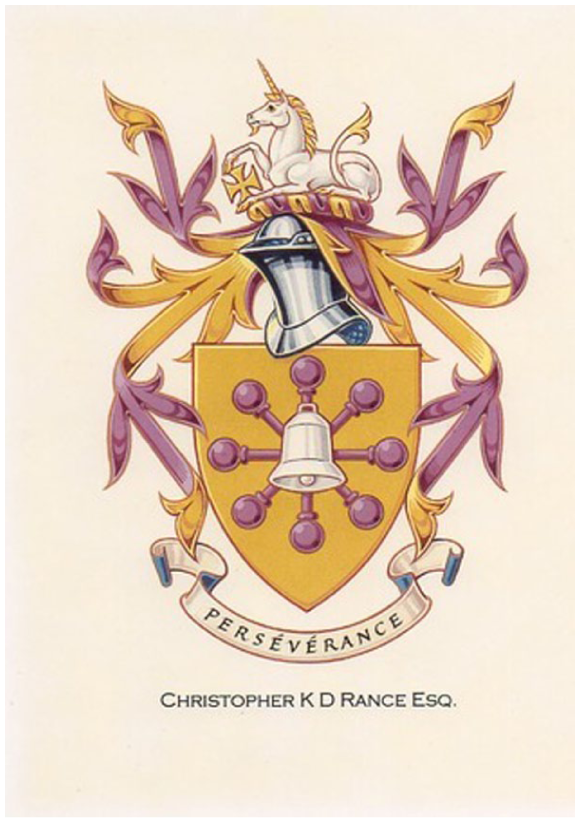
There was a considerable loss and sadness in the first half of Christopher’s life. The training gave Christopher something more valuable than new ideas. At Barts he met Sue, his second wife, a senior psychiatrist, psychoanalyst, and influence for the good. To her, he was clever, wise and funny. They shared a passion for bell ringing and sailing in the Blackwater Estuary in Essex. He bought a dhow based in Lamu and renovated a typical Swahili house using traditional materials and craftsmen. The boat, inexplicably, failed to earn its keep with rentals, despite Sting, the Queen of Denmark and other luminaries using it. Christopher explained to sceptical listeners, that the teak construction was worth enough to justify the expenditure. He was determined to live life to the full. Christopher applied to have the standing of a gentleman, with his own coat of arms issued by the College of Arms, reproduced here. One of his proudest possessions was an Orrery, a beautiful mechanical model of the Solar System that demonstrates the relative positions and motions of the planets and moons.
Ideas were important to Christopher, and he expressed them in writing, often from a theological perspective. He taught at the Judge Institute, Cambridge. His first degree was in scholastic philosophy and political economy, at Queen’s University, Belfast. There he was known as ‘Critical Chris Rance’, having positively reviewed an early Seamus Heaney poem.
After Belfast, he pursued postgraduate studies at Blackfriars, Oxford for four years, where he was a cantor, before finally deciding he was not cut out to be a monk. After years of study and contemplation, he completed ‘A note on the meaning of Incarnation for our Life of Meditation’ an as yet unpublished, beautiful reflection, expressing his understanding that, to be human, is to be aware of our co-inherently incarnate divinity.
In group analysis he wrote in depth about consultancy work (Rance, 1987, 1989,1992, 1998),
The assertion that group analysis has nothing special to offer in the field of organizational consultancy ignores Foulkes’ own view that it is a powerful model for researching and understanding organisations . . . It may be of interest for colleagues to hear how I have found the group-analytic world-view invaluable for my own consultancy work. (Rance, 1998)
In the early days, taking snuff was Christopher’s calling card. It gradually became clear to those who took an interest, that there was so much more to him. He somehow managed to be simultaneously at the centre and the edge, of the group analytic community.