







Abstract
This paper explores a case of artistic debt towards the end of the 17th century in the Netherlands and more particularly in the city of Dordrecht. Arent de Gelder, Rembrandt’s allegedly most faithful pupil, continued to pursue the – by this time – unfashionable manner of his teacher. Shortly before, Rembrandt had to face a heavy artistic and financial crisis. De Gelder’s debt was not only that of a mere pupil. His own social and financial independence fully allowed him to explore and experiment with the Rembrandtian manner, even in more radical ways than Rembrandt himself. In Dordrecht, De Gelder moved in a social milieu that still cherished the Rembrandtian manner. Former Rembrandt pupils, many of whom came from Dordrecht, had already successfully chosen other artistic paths, as the new taste of the Dutch elite evolved in favor of a grander, more ‘aristocratic’ habitus and hence manner, that greatly differed from Rembrandt’s. This article focuses on this both creative and contradictory nature of artistic debt.
The Hundred Guilder Print
A painting in Saint Petersburg that was executed around 1700 has been interpreted as a self-portrait of Arent de Gelder, the late and so called most faithful Rembrandt pupil (1645–1727), as well as a portrait of Jacob Moelaert, a collector and friend of De Gelder (Figure 1). 1 The sitter’s long hair looks somewhat oily and the bristles on his face lend him an unkempt look. He holds an etching in his hands while leaning on a table covered with an expensive table carpet. He turns to look at the viewers, his lips slightly parted as though he is about to speak to them. One half of his face is in the shadow. His head is turned to look over his shoulder while his body is in profile, rigid and statue-like, an impression underscored by the suggestion of lace on his chest. A closer look reveals that the print he holds is no other than Rembrandt’s famous Hundred Guilder Print of 1649 (Figures 2 and 3). It is one of the rare examples in the history of art that an artwork became its title through its economic value, which was a huge sum at the time. Looking closely at the picture within the picture one notices that it is a free interpretation rather than a mere copy of the print, a sketch that also bears De Gelder’s signature for the whole painting. It offers an artistic commentary, an acknowledgement of his indebtedness to an object and its maker. Both the pose of the sitter and the composition of the picture are reminiscent of Rembrandt’s portraits and self-portraits of the 1630s and 1640s, as, for instance, his 1641 self-portrait in London (Figure 4). At the same time the painting bears the unmistakable stamp of De Gelder’s facture. Thus, references to various formal characteristics of Rembrandt’s work are present within the painting itself; De Gelder articulated his commitment to the older master and, likewise, to chiaroscuro painting. However, this commitment was by no means in the form of blind worship, but rather as a way to perpetuate the tradition of powerful contrasts of light and shade. At this time, at the dawn of the 18th-century, the debt to Rembrandt is still visible although Rembrandt himself was not that much à la mode as he was until the 1650s and before having his big financial crisis and debt in the late 1650s (Crenshaw, 2006). Rembrandt had put money in investments but lost almost all his fortune during the Amsterdam stock market crisis (his second wife and son then took, at least pro forma, on the ‘Rembrandt enterprise’ to quote Svetlana Alpers (1988)).
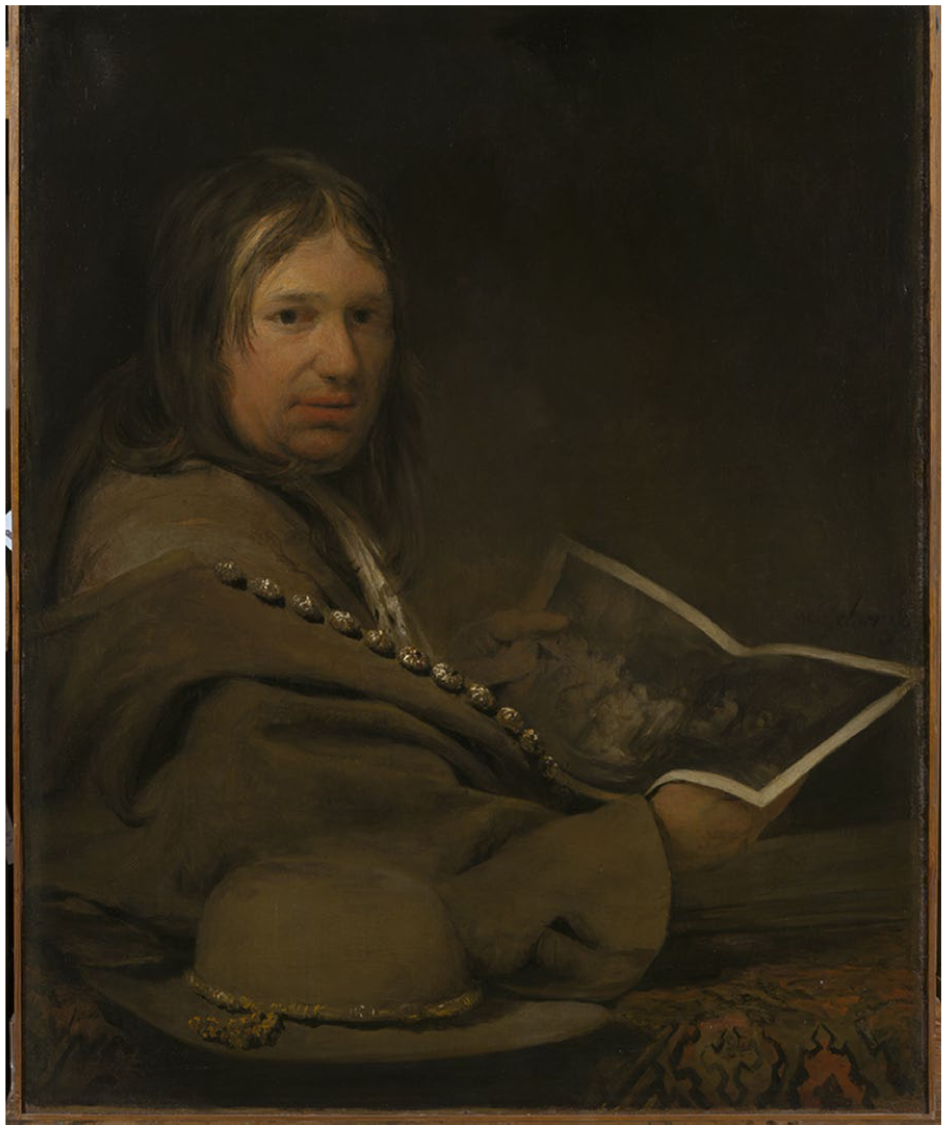
Arent de Gelder, Portrait of a Man, c. 1700/5.
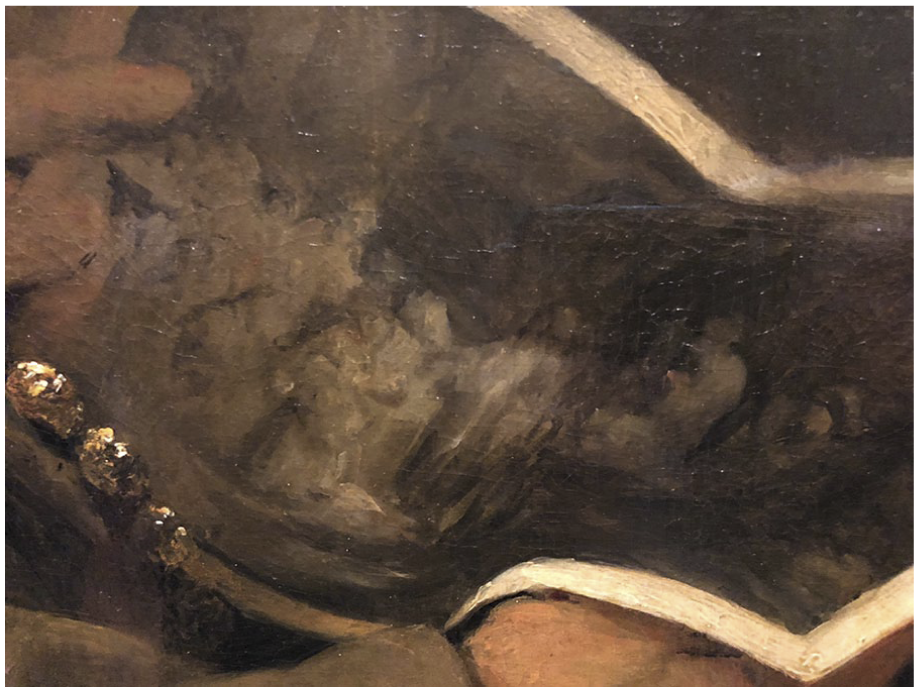
Detail Figure 1.
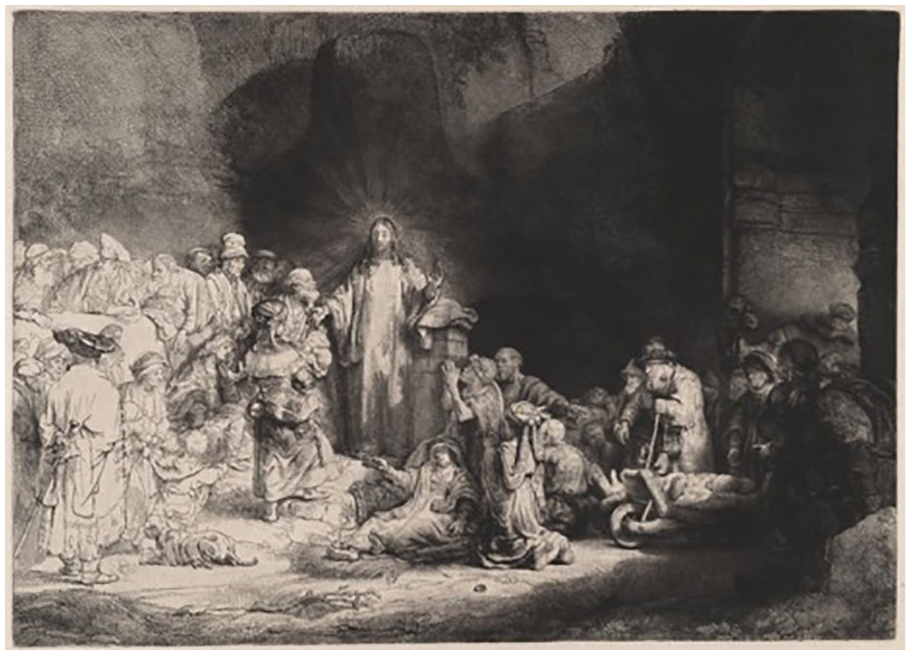
Rembrandt, The Hundred Guilder Print, c. 1647/49.
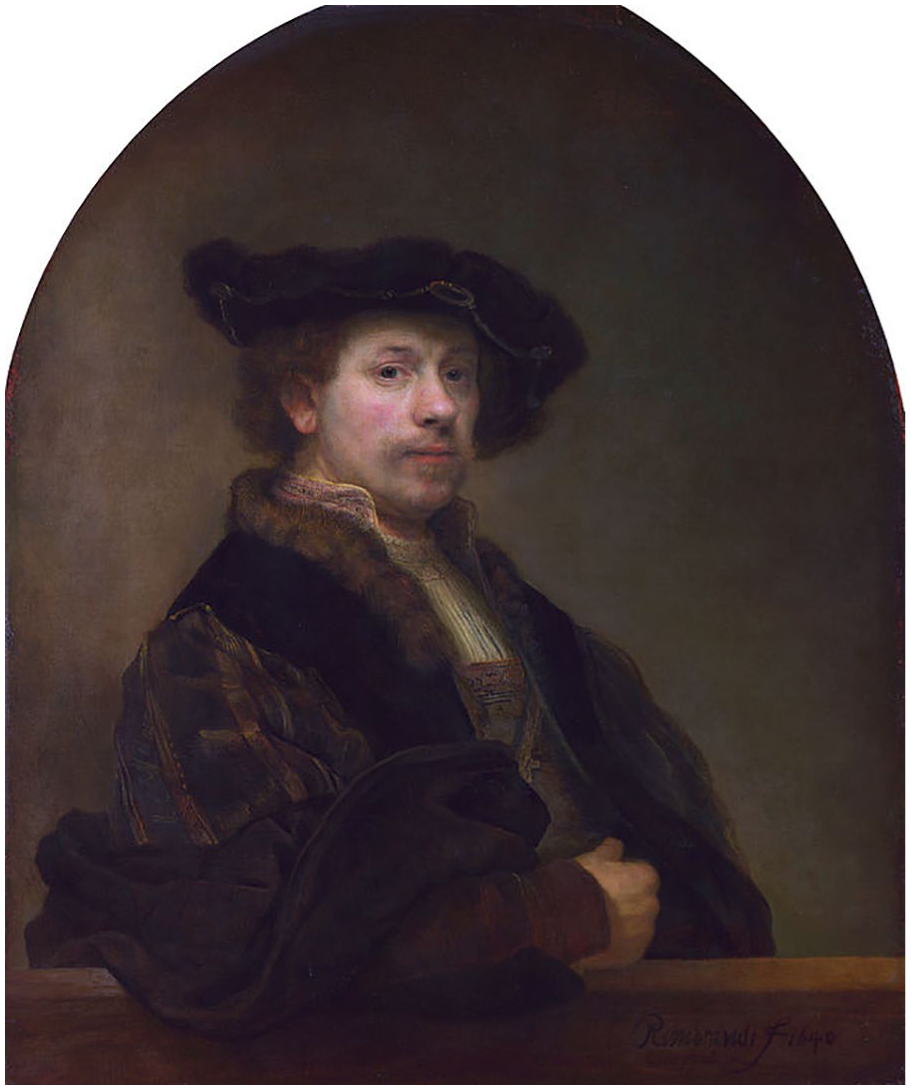
Rembrandt, Self-portrait at the Age of 34, 1640.
Arent de Gelder and his native city of Dordrecht
Except for the years in Amsterdam with Rembrandt, De Gelder spent almost his entire life in Dordrecht. The historical circumstances of the city’s social and economic environment, where the social position of the artist and his patrons enabled them to get appropriate allowances, provide a basis and an opportunity for studying the multifaceted element of artistic means.
Dordrecht had been a major economic hub since the 13th century. Owing to its harbor, located at the confluence of the Maas, Merwede and Waal rivers, trade in wood, wine and fishing especially flourished (see Loughman, 1993: 21–36). But with the expansion of Amsterdam and Rotterdam taking over the role of the main ports in Holland, Dordrecht experienced an economic decline, which set in around 1620 and reached its lowest ebb in the 18th century. The city was the oldest in the northern Netherlands and was allowed to mint its own coinage; it also had the right to vote for the raadpensionaris (grand pensionary of Holland and Zeeland), giving rise to local patriotism and an island mentality. Dordrecht remained a provincial city and never attained the cosmopolitan character of cities like Amsterdam, Rotterdam or The Hague.
The art of Dordrecht was influential only locally in the region. A characteristic of its painting was the focus on Rembrandt, a model that strove to be distinctly Dutch. 2 Painters seeking financial security had to move to the larger economic centers in the Netherlands, as Nicolaes Maes did by relocating to Amsterdam.
Major artists from Dordrecht, such as Ferdinand Bol, Samuel van Hoogstraten, de Gelder, or Nicolaes Maes, Jacob Levecq and Benjamin Cuyp pursued the Rembrandtian manner each in their own way.
But why did their interpretation and emphases of the tenets of Rembrandt’s painting vary? Can this be explained by a local preference? Was it because the inhabitants of Dordrecht, tradition-conscious as they were, regarded Rembrandt as the artist who best expressed their ideals in his art and embodied the ‘middle mode’ of ‘bourgeois’ art, as Gérard de Lairesse phrased it in the 18th century (De Lairesse, 1740)? At the same time, it must be emphasized that inclination toward Rembrandt differed greatly depending on whether it favored his art of the 1640s or 1660s. In the 1640s, Rembrandt’s handeling (meaning in Dutch one’s artistic manner or handling of an instrument) was at the peak of its success. Houbraken mentioned this in his biography of Govert Flinck (another very successful Rembrandt pupil in the 1630s who turned his back on Rembrandt by abandoning his manner of painting and gaining even more financial success). But two decades later the great master’s popularity had, by and large, declined (Houbraken, 1753: 20–21. For Govert Flinck, see Museum Kurhaus Kleve, 2015). As the example of De Gelder demonstrates, appropriating Rembrandt’s handeling was a matter of principle, even an ideological decision. 3 There is in that way a selective debt to a particular manner of painting that goes beyond the mere financial success by someone who is, however, economically independent and builds up their social network through this particular kind of ‘productive debt’ to Rembrandt.
Portrait painting and financial situations
Portrait making was a lucrative business. Rembrandt painted most of his portraits between 1631 and 1635, and established an Amsterdam clientele. As soon as he was no longer financially dependent on Hendrick van Uylenburgh ‘academy’, the urgency of painting portraits diminished (Lammertse and Van der Veen, 2006: 126–160). In the treatises of art theory produced in the 17th-century Netherlands and elsewhere, portraiture enjoyed little prestige. Likeness and financial success are Carel van Mander’s, Samuel van Hoogstraten’s and Gérard de Lairesse’s keywords in discussing the genre. How portraiture and moneymaking went together is brilliantly shown in Van Hoogstraten’s perspective box in London. On each of its three sides he painted a putto holding a roll, with, respectively, the words lucri causa, amori causa and gloria causa, the three major motives for practicing the noble art of painting. Significantly, the lucri causa putto pours out a sack of golden coins from his cloud (Figure 5). In the background, Van Hoogstraten included a painter who looks like him, working on a portrait.
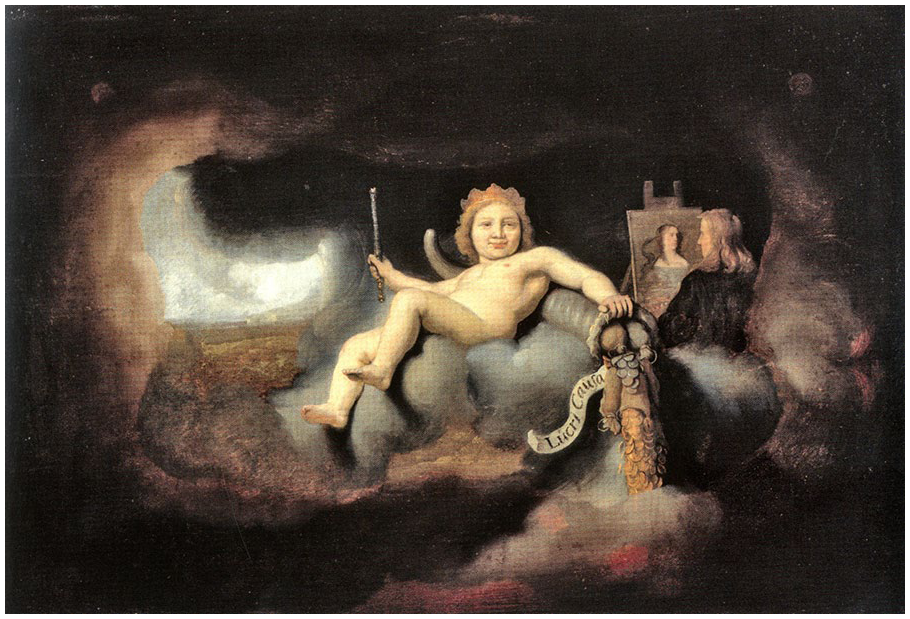
Samuel van Hoogstraten, Lucri Causa (perspective box), c. 1660.
We must take into account De Gelder’s relationship to his patrons, many of whom were his friends, in order to clarify the special status artists enjoyed at the time and to substantiate the hypothesis that paintings – and in De Gelder’s case portraits especially – were painted for social rather than economic reasons, like, for instance, the portrait of Ernest de Beveren Lord of West-Ijsselmonde and De Lindt (Figure 6). He was the scion of an ancient noble Dordrecht family. De Beveren was mayor and postmaster general of the city. To a certain extent, Dordrecht’s upper middle class had reservations about the fashions followed by the nouveau-riche elite in other cities (Classicism and Frenchification depicted in the so-called fine manner of painting; see Roodenburg, 2004). Thus, it seemed only logical to support painters such as De Gelder, who in the eyes of Dordrecht’s inhabitants followed the tradition of Rembrandt, continuing where the latter left off. We only have records of a few collectors who owned works by De Gelder. Simon van Vugt, who could boast about having one De Gelder in his collection, likewise owned a painting by Gerbrand van den Eeckhout, among other evidences that show his preference for Rembrandtesque artists in Dordrecht (Loughman, 1998: 43).
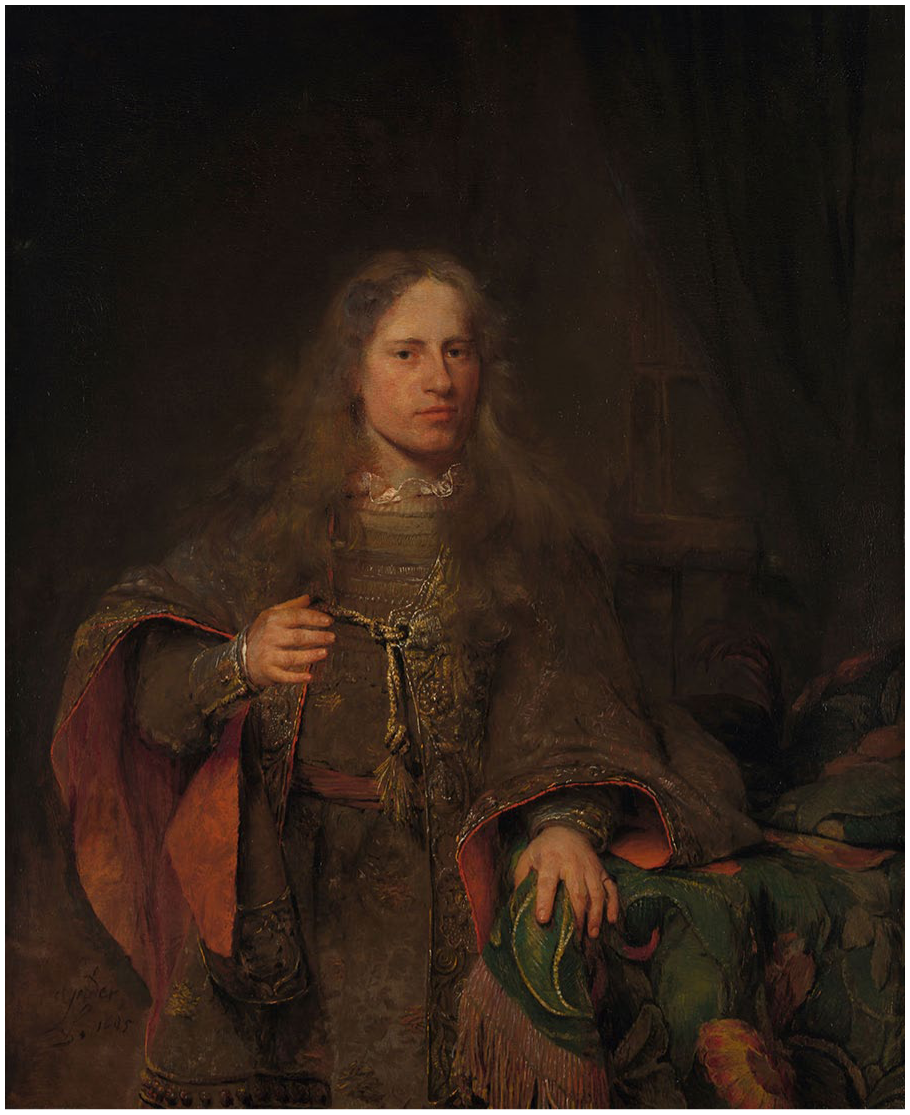
Arent de Gelder, Ernst de Beveren, 1685.
The inclination toward Dordrecht artists, even toward those long dead, is yet another sign of this conservatism and of the local patriotism of Dordrecht collectors and their penchant for Dutch art, the ‘contemporary art’ of the time. The inventories, too, show the traditionalist leanings of the collectors (Loughman, 1993: 298–305). Therefore it is no accident that Dordrecht’s most successful painter between 1680 and 1719 was none other than Aelbert Cuyp, who died in 1691.
De Gelder had no financial issues. In view of the taxes he paid, his assets must have amounted from about 10,000 to 20,000 guilders (Pastoor, 1994: 6). Ferdinand Bol, a Rembrandt pupil, who abandoned Rembrandt’s manner of painting and had a big financial success, stopped painting after marrying into money to his second wife (Te Slaa, 2017). Another very successful painter, Godefridus Schalcken, was considered wealthy at the time and had assets worth between 1,000 and 4,000 guilders at his disposal, while the average overall assets of artists in Dordrecht were under 1,000 guilders (Dordrechts Museum, Wallraf-Richartz-Museum, 2015). De Gelder’s fortune was ten times that amount. Records and sources frequently refer to De Gelder as ‘de Heer’ or ‘captain’, and comparatively seldom as ‘painter’, demonstrating that he enjoyed a high social standing in the community. Houbraken mentions that De Gelder spent more time socializing at church or with friends than painting. 4 By mentioning this, the artist’s friend resorted to a trope to express De Gelder’s effortlessness, which most certainly played on his financial independence. Another biographer, Jacob Campo Weyerman, emphasized De Gelder’s ‘Schilderachtige’ (picturesque) lifestyle (Weyerman, 1729: 44). On the one hand, this can be understood as a reference to the artist’s handeling and, on the other, as his unconventional lifestyle. Samuel van Hoogstraten (De Gelder’s first teacher before the latter went to Rembrandt and who was himself a former Rembrandt pupil) was convincingly described as an artist who had succeeded in raising his social status from that of an artist to that of a Dordrecht patrician (Brusati, 1995). De Gelder’s father advanced socially within the hierarchy of his department in the Dutch West India Company and, consequently, his son too was able to cement his social standing through commissions. Many of his famous patrons had connections to his father and family, were neighbors or served in the same civic guard.
Based on a map of Dordrecht (dated c. 1645) decorated with the insignia of the city’s most important economic resource, wine, carried by cherubs, we can clearly see that De Gelder’s network was limited to several of the most elegant streets (Voorstraat, Wijnstraat) of the city center (the area at the upper left in the map) (Figure 7).
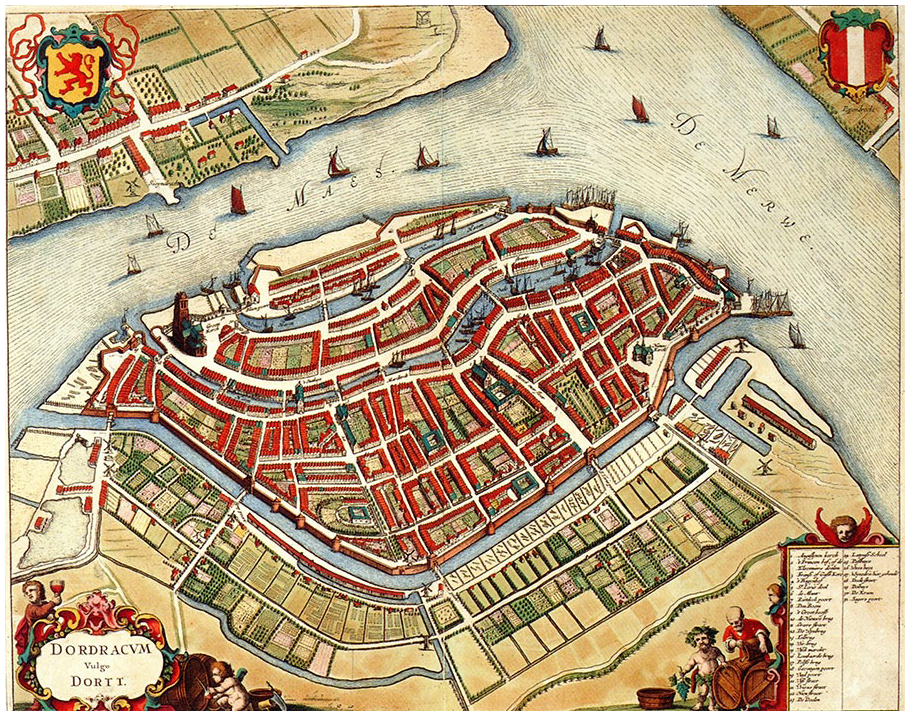
Artist unknown, Dordrecht, 1640–1647.
The assertion that De Gelder painted solely for the pleasure of his friends appears to be only half the truth (Metropolitan Museum of Art, 1995: 31–32). Even though a number of pictures listed in his inventory are considered as having been executed by him, it does not support the fact that De Gelder painted only for the love of it. According to scholar Joachim von Moltke, records and documents mention many more pictures than we know of today. 5 This means that De Gelder did not need the money, nor was he an amateur who painted just as a diversion. Rather, his pursuit of art was something in between. As an artist, he was able to experiment with painting because he was financially independent. As a gentleman and captain, he moved in an elite circle in Dordrecht, as an equal of his friends and patrons, and with the help of his art consolidating his social connections and enhancing his status.
De Gelder’s social contacts
De Gelder had a highly influential friend who was both an amateur artist and collector, namely Jacob Moelaert, who had learnt the art of painting from another Rembrandt pupil, Nicolaes Maes. In his last will and testament he left three albums of prints and drawings to De Gelder, one with drawings by Rembrandt, which confirms that the two men had mutual interests and taste (Schoon, 1998: 16). These records clearly evidence that the friends moved in similar social circles. 6 Moelaert was the quintessential art lover. He owned an impressive collection as well as a large library with theoretical writings about art. It included volumes such as the Schilderboek by Carel van Mander and the treatise by Gérard de Lairesse as well as De Schilder-konst der Oude (Painting of the Ancients) by Franciscus Junius and, not to forget, Samuel van Hoogstraten’s Inleyding tot de hoogeschoole der schilderkonst. 7 In other words, Moelaert possessed the major works of art theory produced in the 17th-century Netherlands. Not only discussions about art and its practice, but also Moelaert’s collection must have served as an important source of inspiration for De Gelder, who was the owner of a large library himself – as his inventory discloses, although it does not list the contents in detail (Golahny, 2003: 216; see the inventory of Arent de Gelder in Von Moltke, 1994: 203). At any rate, he was an exceptionally erudite painter. Moelaert and De Gelder were thereby sharing similar ‘debts’ concerning their reading not only on art theory but also, to a certain degree, on artistic practice.
Many portraits De Gelder are private in essence (Figures 8 and 9). Several of them can with reason be said to have been gifts to cement social contacts, as already mentioned (they are based on what I call ‘formal polyfocality’, meaning the use of different manners, not per se styles, even within the very same painting) (Zell, 2002: 181). Just as we are meant to view Rembrandt’s self-portraits, which likewise demonstrate artistic diversity, as studies for a specific circle of art lovers (Van de Wetering, 1999), De Gelder’s portraits too can be seen from the angle of a pronounced inclination toward experimentation. They signify exclusiveness in the noble circles of the painter’s friends and assert the artist’s social status and financial independence. As the elder Pliny informed us, Zeuxis worked for his own pleasure alone and gave his paintings away as gifts because their value could not be estimated in monetary terms (Zell, 2002: 192). And De Gelder depicted himself as Zeuxis as it will be shown below.
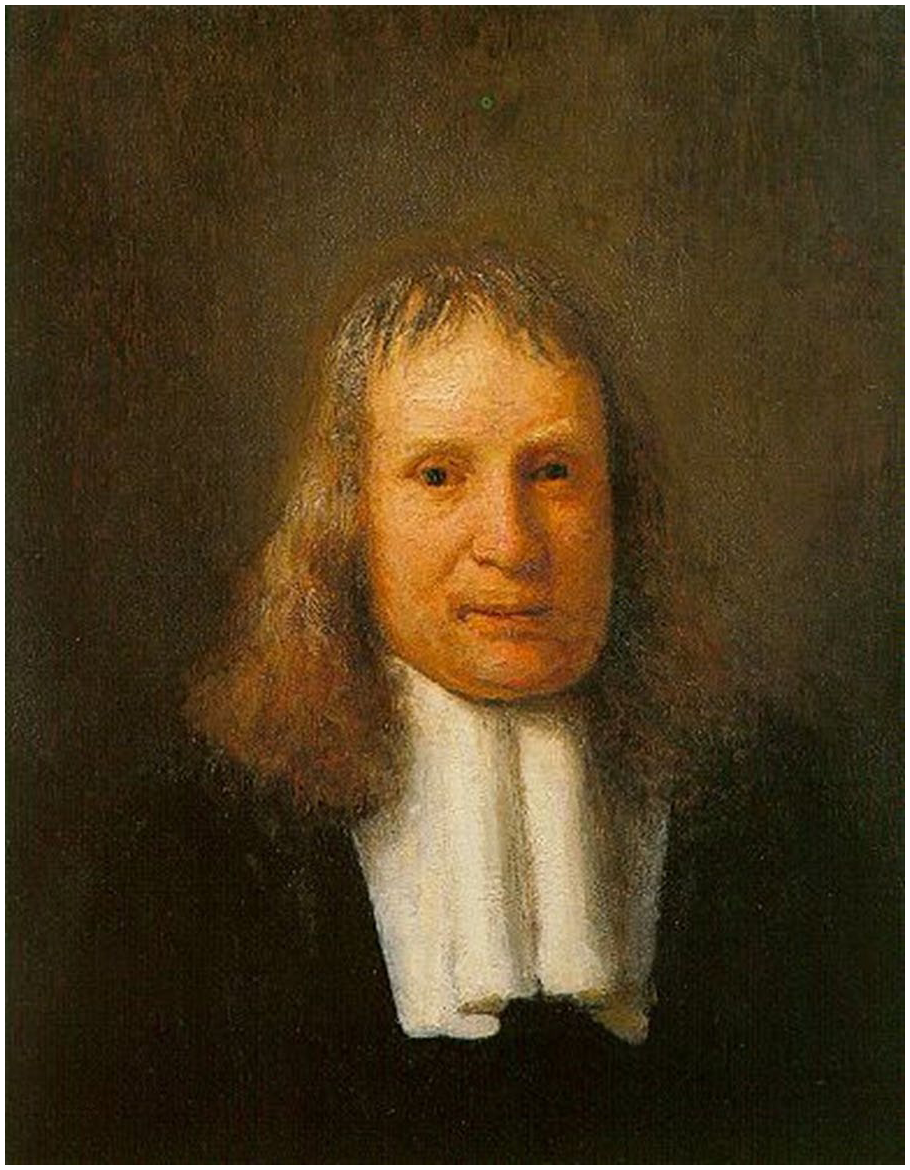
Arent de Gelder, Portrait of a Man (The father of the painter?).
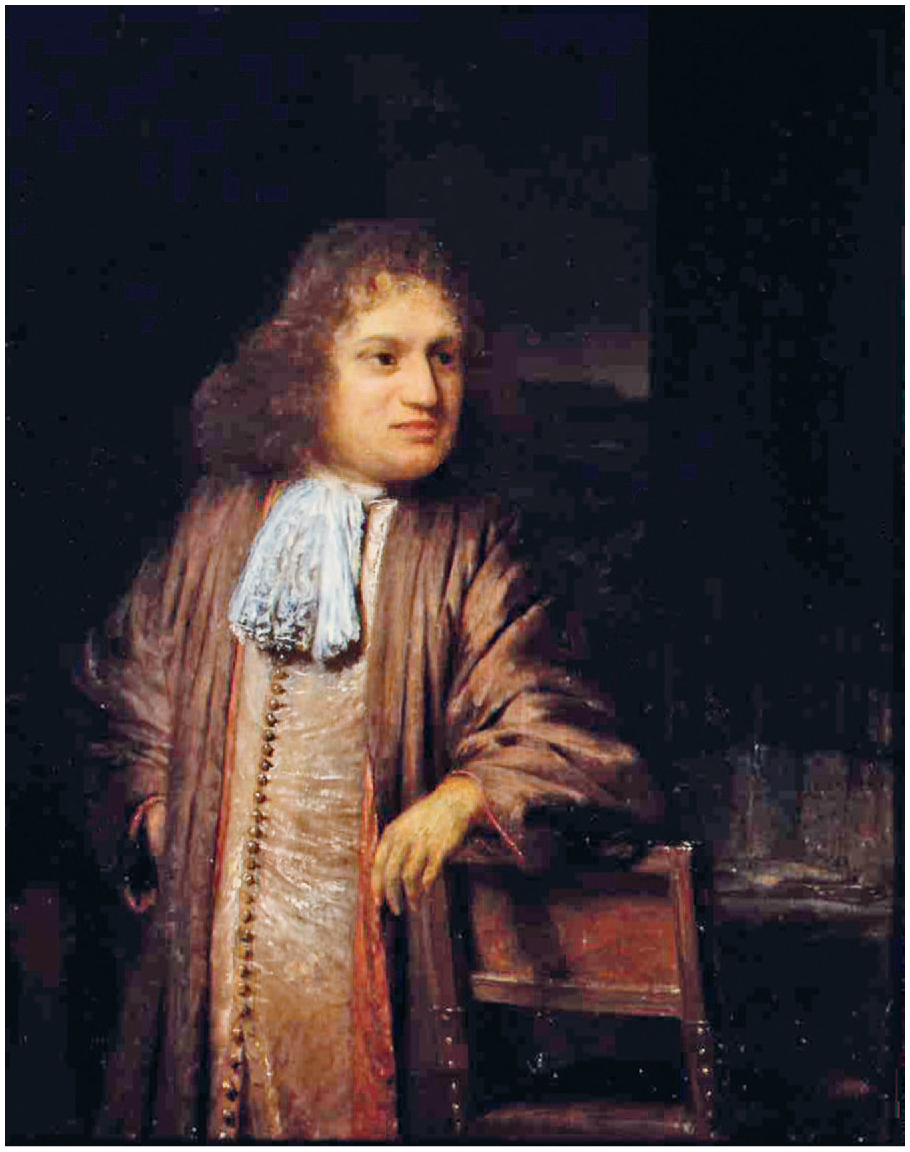
Arent de Gelder, Portrait of a Man in his Study Room, 1680.
Each and every portrait by an artist constitutes a unique case, an exception, an unconventional undertaking. Despite the fact that one and the same painter executed all these works, their formal diversity is apparent. Even an individual portrait incorporates various painting modes. This is all the more astounding if we take into account that the artist Abraham Bosse was still calling for ‘portraits in a mannerless manner’ in the 1640s. Within the genre of portraiture, De Gelder produced various likenesses in the ‘mannered manner’ by having recourse to diverse kinds of handeling. His use of the brush and the effects generated by the manipulation of the paint can be viewed as the indirect expression of the Dordrecht artist’s social and financial status. The artist’s gifts were a guarantee for his own social standing and were as well allowing him to keep up the important connections he needed.
New fashions, new manners
As mentioned above, the demand for painting specific to Dordrecht formally embraced the late Rembrandt and simultaneously fostered his reservoir of motifs from the 1630s and 1640s – his most successful period. De Gelder overhauled the art of his teacher when it went out of fashion, responding to the – at the time fashionable – Classicism, while nevertheless maintaining the older artist’s characteristic handeling.
As the painter Arnold Boonen noted, Nicolaes Maes left Dordrecht because, despite being fertile ground for producing painters, the city could not provide him with a living in the long term. 8 Maes moved to Amsterdam in 1673, only after Bartholomeus van der Helst had died, where he concentrated on painting portraits owing to a shortage of portraitists in the city. Originally he painted in the same manner as Rembrandt (Figure 10), but from about 1658 onward he fell under the sway of the so-called Van Dyck fashion (Figure 11). 9 This is clearly manifested on the one hand in the portrait of the politician Jacob De Witt with its Rembrandtesque couleur, and on the other in the portrait of a lady with her white skin and fine painted surface. Maes underwent a change in style that Houbraken had already affirmed in his account of Flinck’s biography, voicing the opinion that it was a conscious decision on the part of the artist: ‘Later through a lot of work and great effort he was able to give up this manner, at the time when the world, even before Rembrandt died, had its eyes opened by the real connoisseurs and the influx of Italian art, opening the doors for practicing the light manner again’ (Houbraken, 1753: 21). Thus, when Rembrandt died, the ‘genuine connoisseurs’ opened up their eyes to the Italian manner of painting (according to Houbraken, explicitly not for the French or the Flemish), that is, for the light (helder), ‘refined’ manner (manner of painting is put in linguistic terms together with social distinction or not, as the expression ‘raw manner’ reveals, which was associated with Rembrandt).
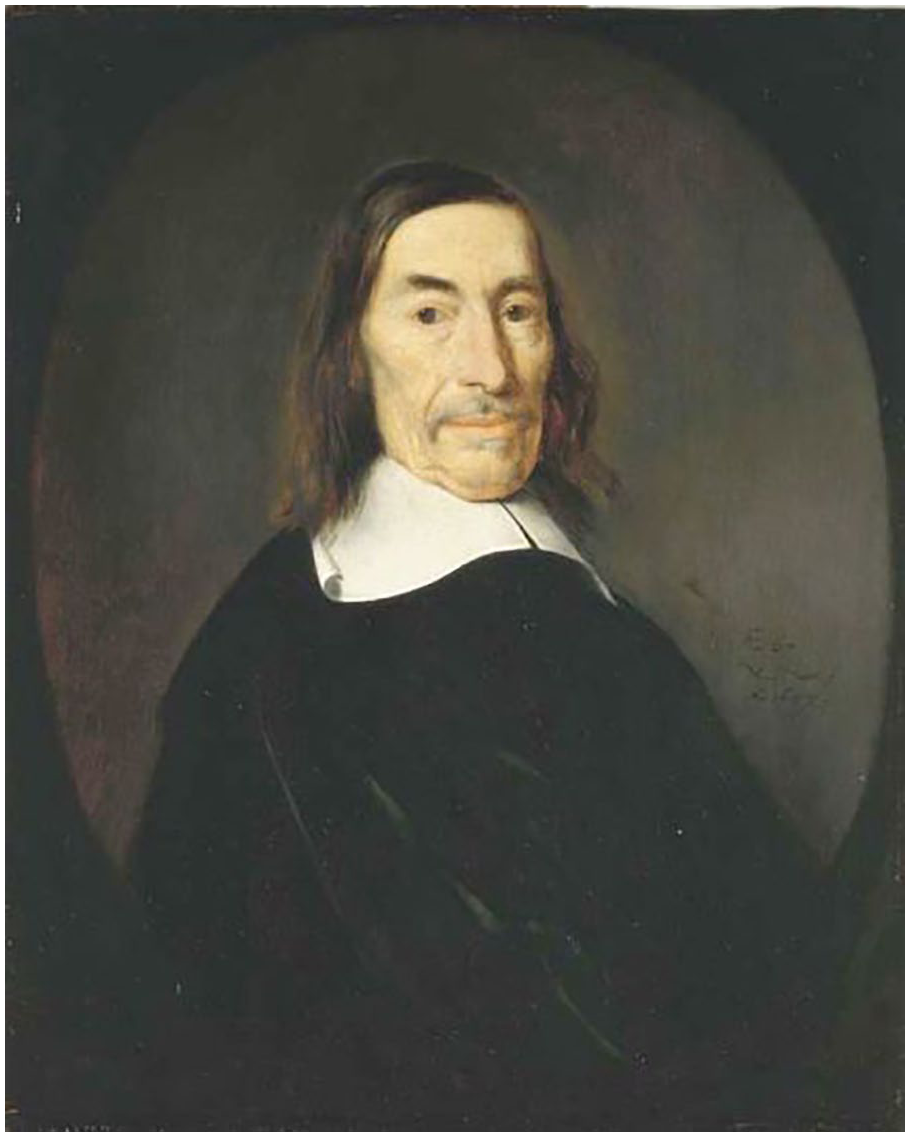
Nicolaes Maes, Jacob de Witt, 1657.
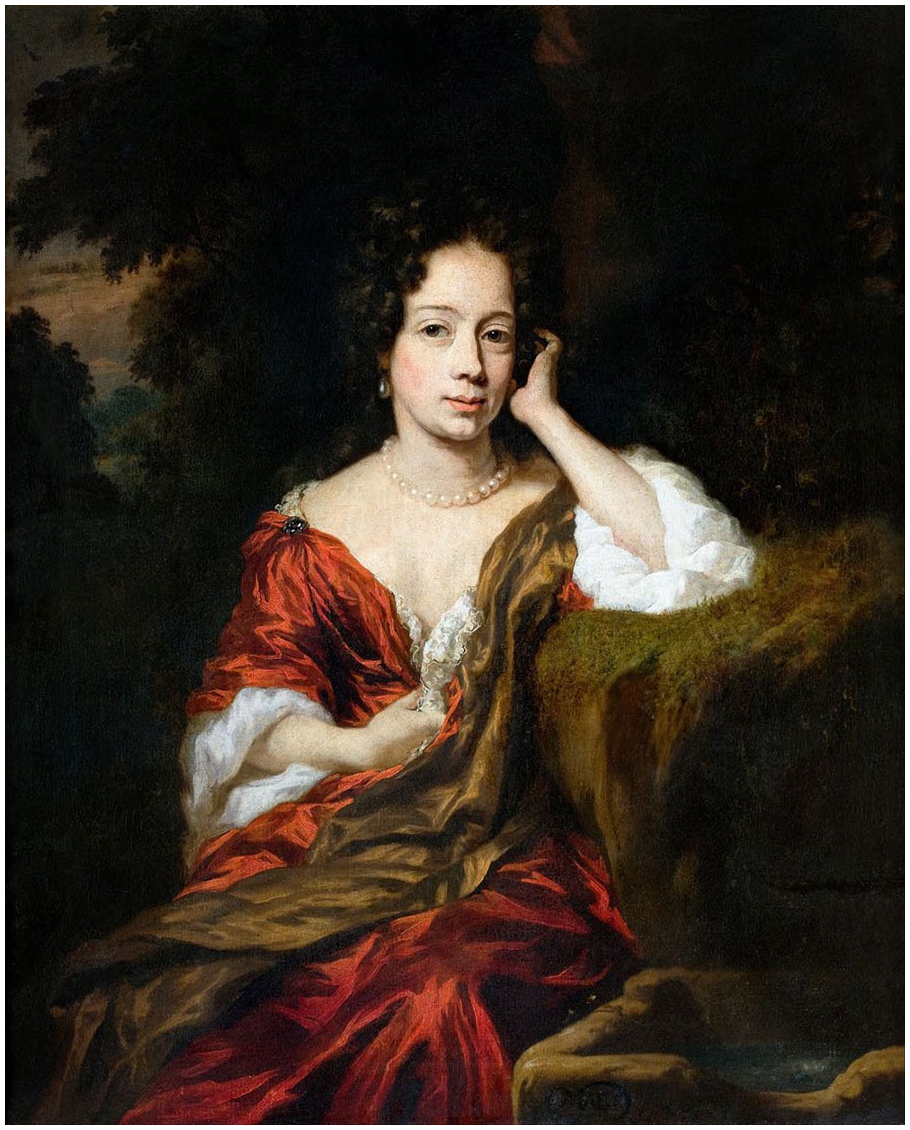
Nicolaes Maes, Portrait of a Woman, 1680.
Around 1670 Maes abandoned Rembrandt’s manner to pursue a more generalized, idealized manner of painting, as Houbraken explained: ‘He ceased painting in the manner of Rembrandt already at an early date, when he began to specialize more and more on portrait painting and realized that especially the women took a greater liking to the use of light colors than of brown hues’ (Houbraken, 1753: 274; see also Franits, 1995: 395). Maes gradually replaced his predominantly dark palette with a lighter one, adapting his brushwork and colors to the lighter manner. Houbraken remarked that women found this appealing, whereby the artist received commissions for portraits. Thus he evolved from painting in a naturalistic manner to an idealized mode and so satisfied the demands of the upper class in the Netherlands, which was strongly oriented by French and Flemish culture; a taste catered to by the former Rembrandtists, among others. 10
De Gelder and Nicolaes Maes
The void left by Jacob Levecq’s death (another former Rembrandt pupil) and Maes’s move to Amsterdam potentially resulted in commissions for De Gelder, who was in the same militia guild (he even became its captain) as Levecq and Maes (Chong, 1994: 16; Schoon, 1998: 14). De Gelder repeatedly responded to compositions by Maes. The difference between the two artists became especially marked when Maes no longer painted in the Rembrandtesque manner. For example, De Gelder responded strongly to Maes’s art in his signed painting Old Woman Praying (Figures 12 and 13) (Sumowski, 1983: 4006–4007; Dordrechts Museum, Wallraf-Richartz-Museum, 1998: 197–198). Both the motifs and the formal aspects are consistent with Maes’s manner. Closer inspection of the way the paint has been applied makes it clear that the work can be ascribed to De Gelder. The painting illuminates this in the artist’s formal experimentation. De Gelder challenged Maes’s manner here, not Rembrandt’s.
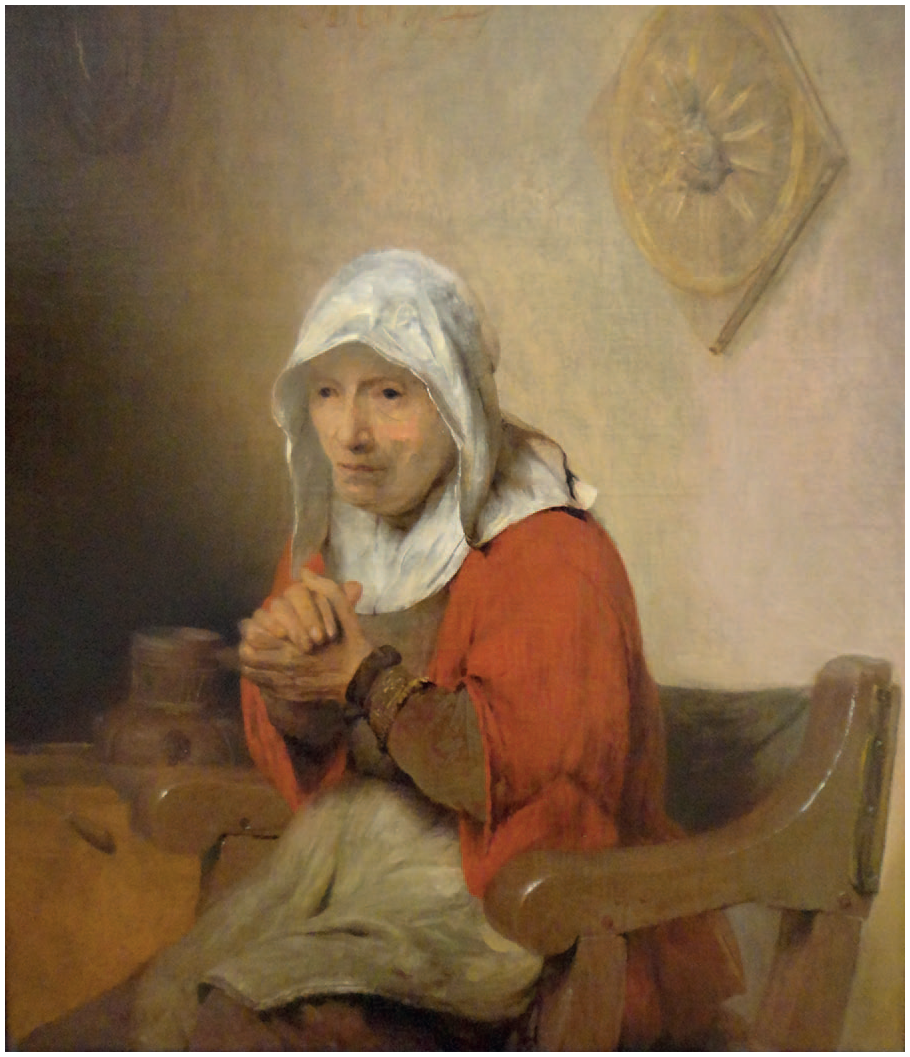
Arent de Gelder, Old Woman, c. 1700.
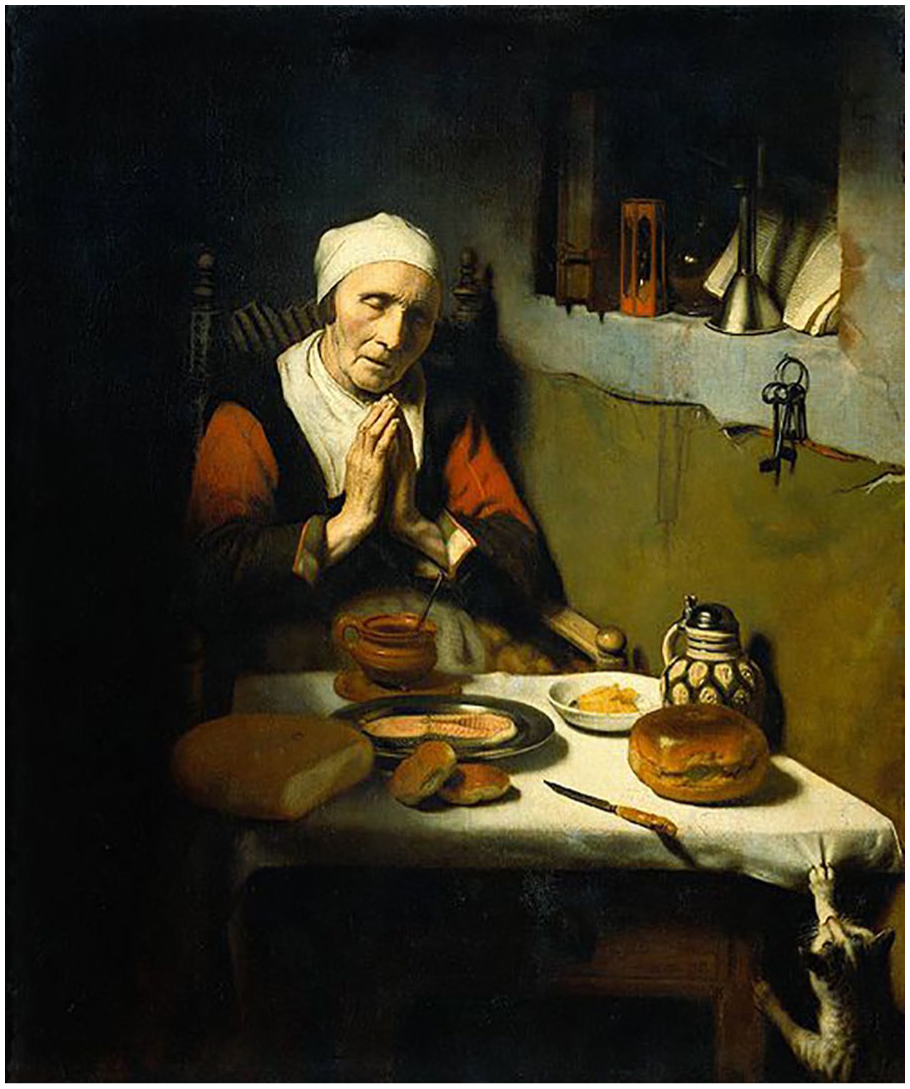
Nicolaes Maes, Old Woman Praying, c. 1655.
The painting features a three-quarter-length figure of an old woman bent in prayer and wearing clothes associated with poverty (Figure 12). She sits in an armchair in an interior and clasps her hands. On the table next to her are a jug and a knife on its edge. Decorating the wall are a hat at the upper left and a molded ceramic or plaster item at the upper right (Dordrechts Museum, Wallraf-Richartz-Museum, 1998: 197). The chair is arranged diagonally in the composition and the left armrest of the chair seems to jut out of the picture. Parts of the primer are visible in the old lady’s lap. If the dating of the work to around 1700 is correct, this would point to a renascence of the formal vocabulary typical of the early stages in Maes’s artistic career (Maes had died in the meantime).
We could speak of an updated version of Maes’s old manner in the tradition of chiaroscuro and Rembrandt, which is emulated in the initial phase of the artist’s career in Dordrecht. An even more accurate description would be: synagonism in Dordrecht. 11 This can be understood as De Gelder’s historical and geographical programmatic message. De Gelder has abandoned the manner of Maes’s Amsterdam painting, which can be directly compared with the art from the Delft School (such as the work of Pieter de Hooch), replacing these with his own specific painting technique. Even the knife has been placed on the edge of the table in a similar way to the one in Maes’s painting (Figure 13). Due to the figure’s diagonal placement, the picture has a more intimate character than the portrait executed by Maes. The wall has recourse to Maes and even to Vermeer (again not singular but multifocal kind of debts!); it has been carefully rendered and at the same time loosely painted in various layers of different cultured paint. The jug, the woman’s right shoulder, and the brown background are paler and rendered with less definition than the rest. These details not only refer to Maes’s motifs, but also to his use of color. As in his other portrait compositions, in this work too De Gelder emphasized the left shoulder, which appears two-dimensional in comparison to the other one, and hence shows the conscious adoption of Maes’ sense of form within one and the same painting. De Gelder adopts Maes’s early manner while maintaining his own characteristic way of handling the brush.
Self-portrait as Zeuxis and the debt to antiquity
A further kind of debt, more of a subversive one for art theory, manifests itself in the work Self-portrait as Zeuxis that was previously mentioned (Figure 14). Two figures can be discerned in the foreground of the spacious interior of a studio. A painter holding the tools of his trade and about to finish a portrait of a woman has momentarily turned his head to look at the viewer with a wide grin, partially revealing his teeth. His model, an old lady, assumes a genteel pose and holds an orange in her hand. Shown in profile, she is posing for the painter, who is also seated. He looks like he has just sat down himself, as the tassel of his belt is caught in motion, swinging freely to the left. Next to the painter is the likeness of the female sitter, as a picture within a picture, and she gazes out at the beholder with a serious countenance. Her hand is obscured by the painter’s body, so that the beholder cannot say whether she holds a piece of fruit too. Behind the easel another portrait (generally accepted as a self-portrait of De Gelder) can be discerned in the gloom, suggesting that the artist is featured in this picture as a prolific portraitist (Neumeister, 2010: 104). Various pots of paint and tools clutter the chalk-smudged table. The artist points to his paints or to a pot of oil (used to bind the pigments) (Figure 15). In this way, De Gelder accentuates the aspect of craftsmanship, a view that could appear to repudiate his social standing, at least indirectly. The painting is essentially a manifesto of artistic principles. Searching for the attributes of a humanistic artist would be useless. De Gelder is a painter who ‘thought’ with his hands. This keeps up with the tradition of the thinking hand, a tradition that places physical exertion above all (Hadjinicolaou, 2016a: 77–95). The figures are wanting in the anatomical precision demanded by the classical rules of art. The artist seems to have no use for the dividers, which have been banished to the edge of the table. Instead he extols the advantages of paint in the artwork. In harmony with De Gelder’s palette, the scene is dominated by tonal gradations of dark, reddish hues consistent with the requirements of chiaroscuro (Gage, 2009[1993]: 182). Earth colors predominate, as is characteristic of the Rembrandtists. 12 They are in marked contrast to the classicists, who favored a palette based on rainbow colors in their compositions (Kern, 2012: 111). In scholarly research dedicated to this painting, signed by the artist and executed in 1685, it is unanimously considered a self-portrait as Zeuxis. The work was instrumental in identifying Rembrandt’s Self-portrait as Zeuxis Laughing in Cologne (Figure 16). 13
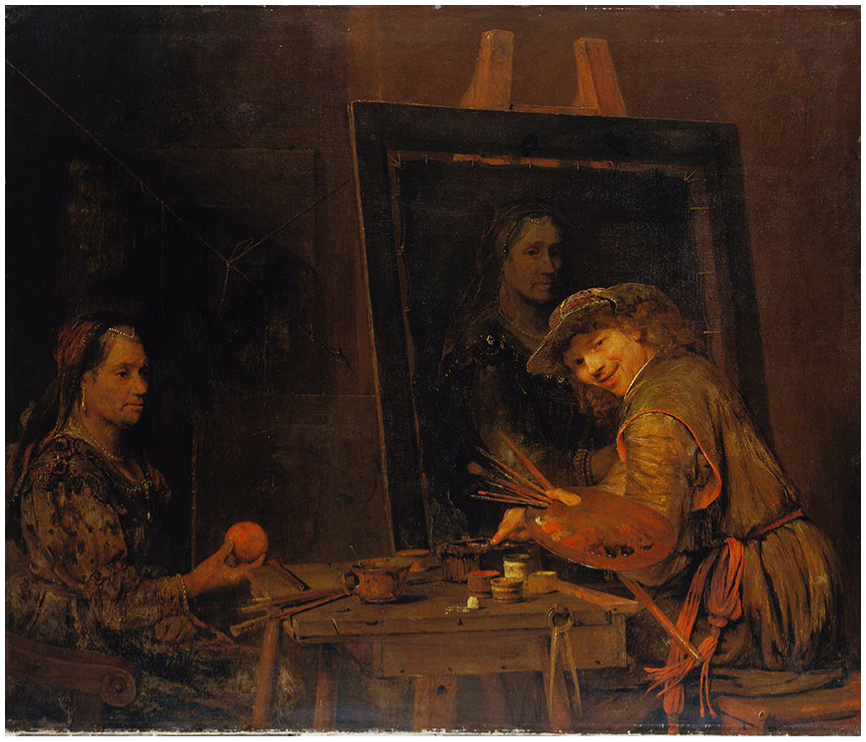
Arent de Gelder, Self-portrait as Zeuxis, 1685.
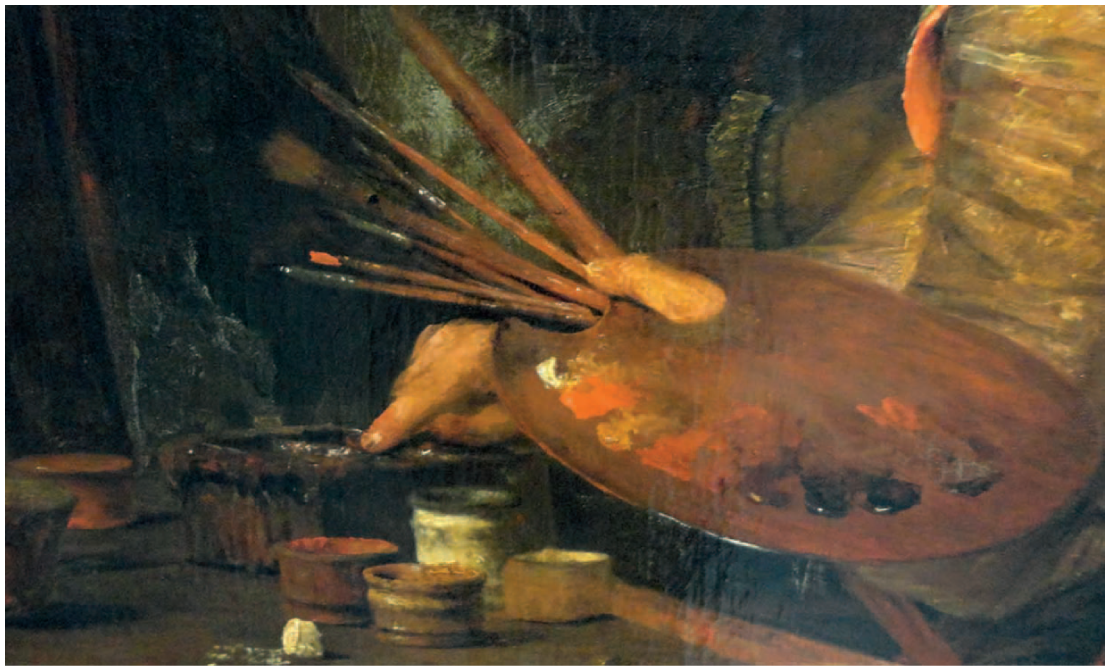
Detail Figure 14.
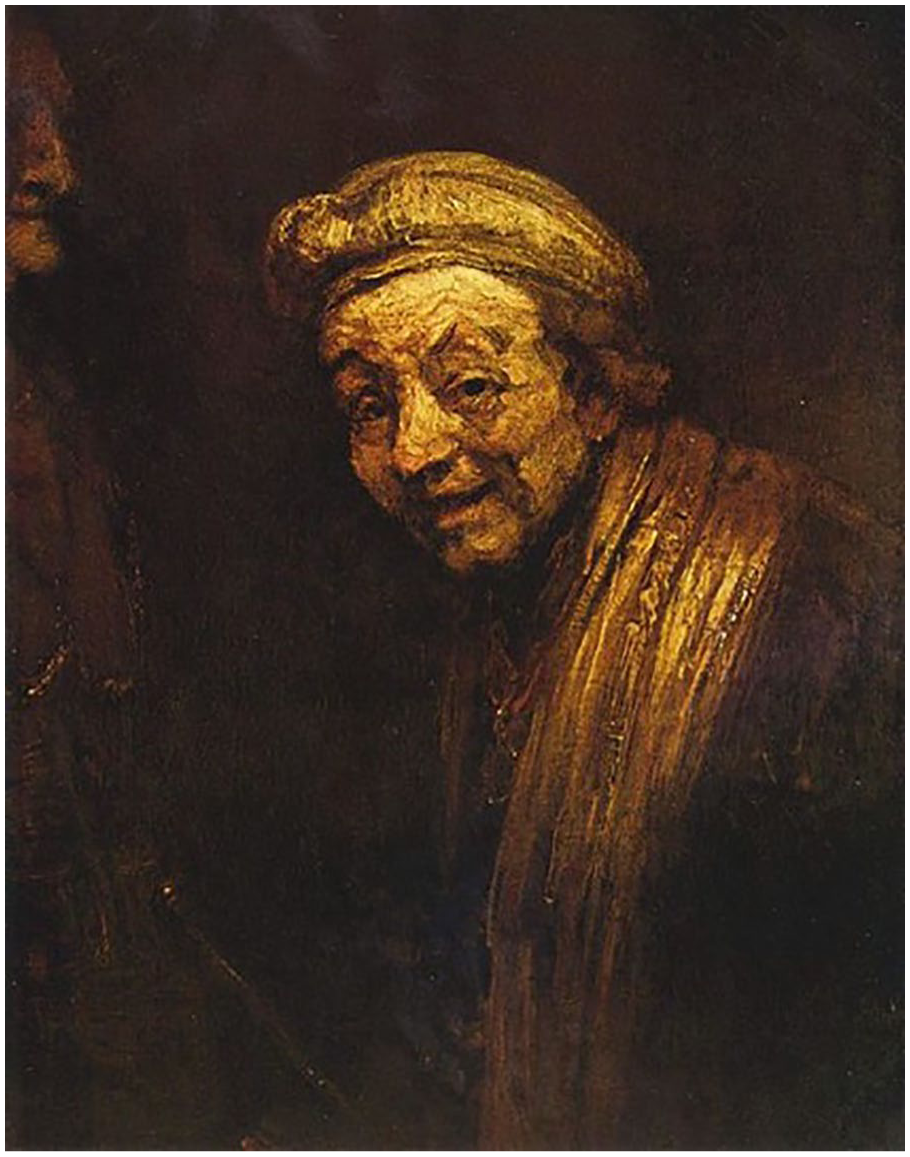
Rembrandt, Self-portrait as Zeuxis, c. 1662.
The hues of the painting in Frankfurt appear to be programmatic. Besides his palette, the artist holds a maulstick and a good number of brushes in his left hand, several of them seem to point to the painting or even touch its surface. The picture in a picture, which is being painted before the beholders’ eyes, underscores that, in this painting, form manifests itself in a processual manner, a key characteristic of De Gelder’s artistic practice.
His commitment to the anti-idealistic tradition of chiaroscuro plays a more important role than his commitment to Rembrandt (Blankert, 1973). After all, the former represents a wider context. De Gelder is a champion of the sketchy manner (Dordrechts Museum, Wallraf-Richartz-Museum, 1998: 174). In the work in Frankfurt, he foregrounds the paint, not the dividers. The painter’s smock is spattered with paint, as if his mind has left the traces of its operations on the canvas (Figure 17). In visual terms this example seems to counter Filippo Baldinucci’s criticism of Rembrandt, which was published in 1686 and relied on information supplied in Rome by Bernhard Keil, who was a former Rembrandt pupil from Denmark (De Gelder painted his Self-portrait as Zeuxis a year before this). Baldinucci characterizes Rembrandt as a peasant (‘una faccia brutta e plebea’) because while working he had the habit of wiping his paint-besmeared hands on his painting smock (Baldinucci, 1686: 79. See also Slive, 1988: 113). 14 Baldinucci asserted that such habits were not those of an independent noble artist, but rather of the craftsman. Paint stains on the garment signalized a lower social standing. In the Self-portrait as Zeuxis, the painter’s old-fashioned clothes (an artist’s smock from the 16th century) and the figure of the woman are a reference to a mode of painting considered outdated by contemporaries (De Winkel, 2006: 162). De Gelder engaged in a debate with Rembrandt and the role of clothing in his self-portraits. Neither the model nor the painter exhibits the slightest hint of idealization. Ironically, the motif of the orange, which he liked to incorporate in his paintings, is an attribute one would rather expect to find in the hands of the ‘femmes fatales’ of mythology, like in the painting Vertumnus and Pomona (Figure 18). The orange was often meant to represent fertility and normally accompanied nubile female beauties. The reference to Zeuxis refers to exactly this in an ironic way. An apple would have implied temptation and also suggested the Judgment of Paris. The key message, however, is not contained in this detail (Neumeister, 2010: 108). For his self-portrait, De Gelder resorted to genre-like elements, for which his grin stands. This would not have been possible in a traditional portrait for this time (Neumeister, 2010: 111). These kinds of likenesses combine elements of genre and history painting. Additionally, the content of the painting comprises a commentary on painting practices. The Self-portrait as Zeuxis is a presentation of the art of chiaroscuro painting and simultaneously comments, at least implicitly, ironically on Van Hoogstraten’s reflections (in his previously mentioned Inleyding) on Rembrandt and Titian. It also anticipates Gérard de Lairesse’s later much harsher criticism. The irony expresses a commitment to an alternate, non-academic style.
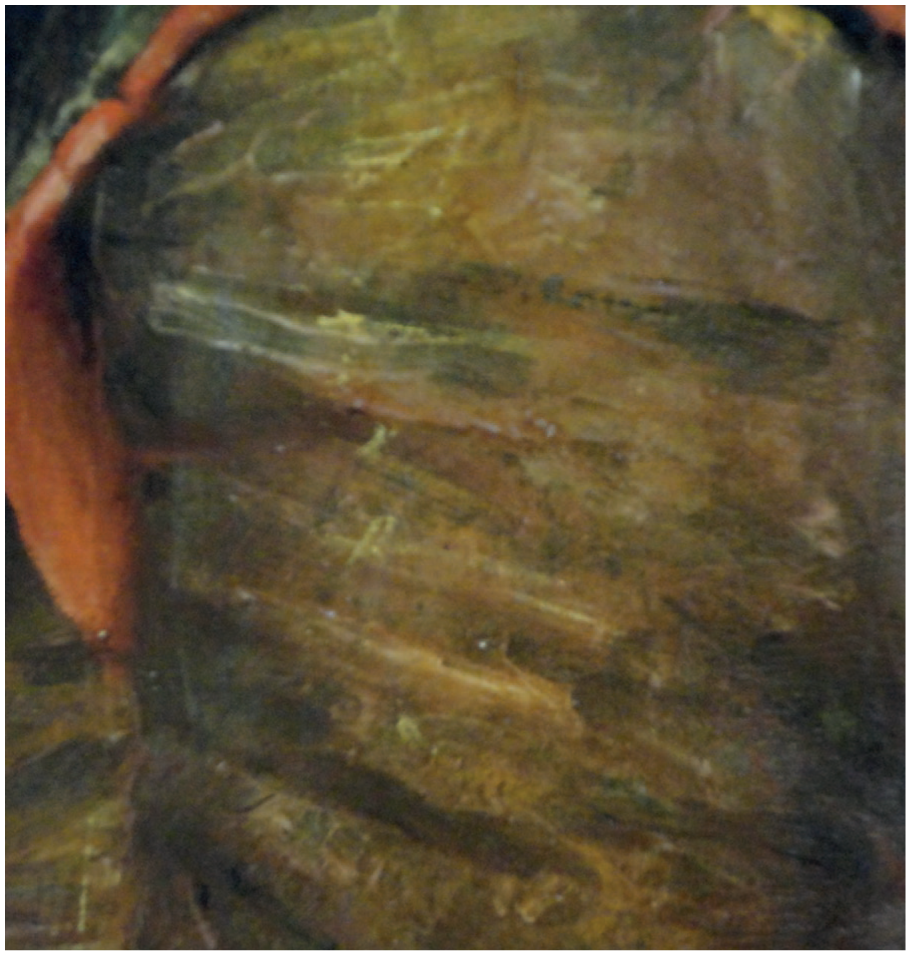
Detail Figure 14.
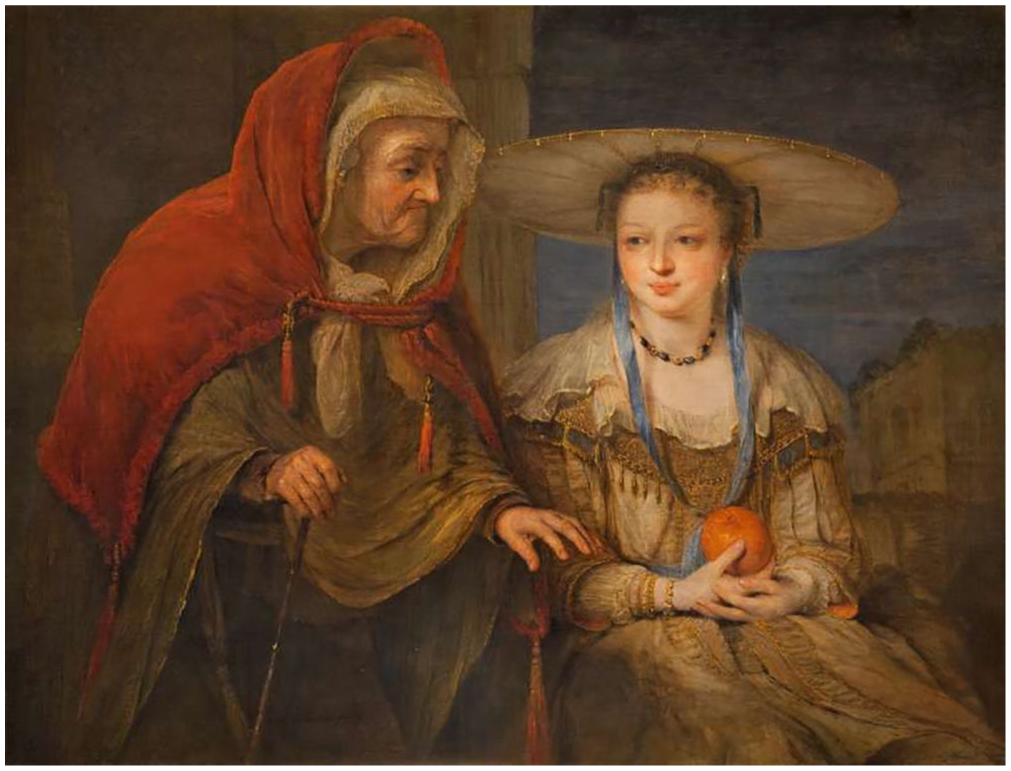
Arent de Gelder, Vertummus and Pommona, c. 1700.
The painting engages with a criticism of Rembrandt in regard to likeness and verisimilitude. Both the figure of the painter and the portrait on the easel embody this aspect. The woman’s face in the picture within a picture appears to be darker than that of the sitter. The three-quarter profile in the portrait lends to the figure more animation. The lighting enhances her leathery skin, creating a marked contrast to the light flesh tones of the idealized women of the fine painters like Maes after his move to Amsterdam. The painting on the canvas displays compositional structures typical of De Gelder’s portraits, such as accentuating one side of the body so that one shoulder stands out more than the other, as well as the figures holding their lower arm parallel to the frame.
Should the artist be depicting Zeuxis, it is not in the historical sense. Contemporary dress and role-play are involved, toying with the clichés about this historical figure and supplying De Gelder with the means of commenting on the art of painting. In literary sources Zeuxis counts as the great master of emotions in painting (Golahny, 2003: 204–205). De Gelder stages himself as such an artist, who alternates between sensitivity and aloofness. The picture oscillates between Zeuxis laughing to death and De Gelder’s self-irony – or the beholder joining in and laughing at the painter: laugh with those who laugh. Zeuxis represents an unsound attitude toward the world around him and toward indulgence. Accordingly, the painting addresses the issue of moderation and the role of exaggeration in art (like, for instance, the way he portrays the old and ugly woman). De Gelder plays with his own radicalism, which he expresses in a charged Rembrandtism, which, in some ways, is more Rembrandtesque than the master himself, for example in his manipulation of the paint and scratching.
By depicting himself as Zeuxis, he is drawing again on another dimension of the life of this painter from Antiquity that has reached us: excellence in the simple imitation of nature (as the birds come and pick at his painted grapes, not to mention the beautiful women of Croton). Zeuxis was seen as the paradigmatic imitator of nature, just as classicistic criticism viewed De Gelder and Rembrandt. 15 However, the self-portrait has an even more abstract dimension, revealing a certain disposition toward painting (hence the sensual thinking hand) that preoccupied not only De Gelder but also the other Rembrandtists. In this sense the De Gelder puts here the debt to antiquity upside down.
Creation and reception
Rembrandt’s old-fashioned manner fascinated De Gelder, who transformed it into an avant-garde visual language from our vantage in the present. The older his sense of form and its articulation was, the more modern it appears to us today; from the 18th through the 20th century, artists in Germany and England productively appropriated the Rembrandtist handeling for their own use. 16 A closer look at another work of De Gelder (Jacob’s Dream) illuminates this: the motions of the artist’s hand have shaped the signature with a whittling knife (Figures 19 and 20). It has obviously been scratched into the ground together with the bushes, suggesting that the signature, like the bushes, is a product of nature herself. The scratches signify landscape. However, De Gelder seems to want to reverse the relationship between the signifier and the signified acting as if nature produced the scratches, although the motion of the artistic hand is visible. The signature and the abstract form of the scratches simultaneously address the tension between the finished and the unfinished, again revealing the painting process (Figure 21). While scratching breaks up the paint, it also lends the work a sculptural, almost relief-like quality; the materiality of the support becomes visible so that it can play too its part in the painting process. The impasto of the tree trunks might even have been applied by the artist using his fingers, as another example of how the medium’s plasticity plays a central role. The material defines the tree trunks in a radical and abstract way and their toughness and wooden quality is conveyed by means of impasto. Here, paint is used to lend a composition form while also being perceived as material as well as the material it seeks to represent. A statement of Van Gogh’s displays amazing parallels to the techniques and application of paint for the trunks of the trees in Jacob’s Dream: ‘I pressed . . . the roots and trunks directly out of the tubes’ (Wagner, 2002: 30). The thinner branches of the trees in Jacob’s Dream have also been rendered by scratches. The artist thus emphasized both their thinness and abstraction. Similarly to the Self-portrait as Zeuxis, he worked the paint as a material with various tools and means to evoke a certain materiality that also partakes in creating a structured form.
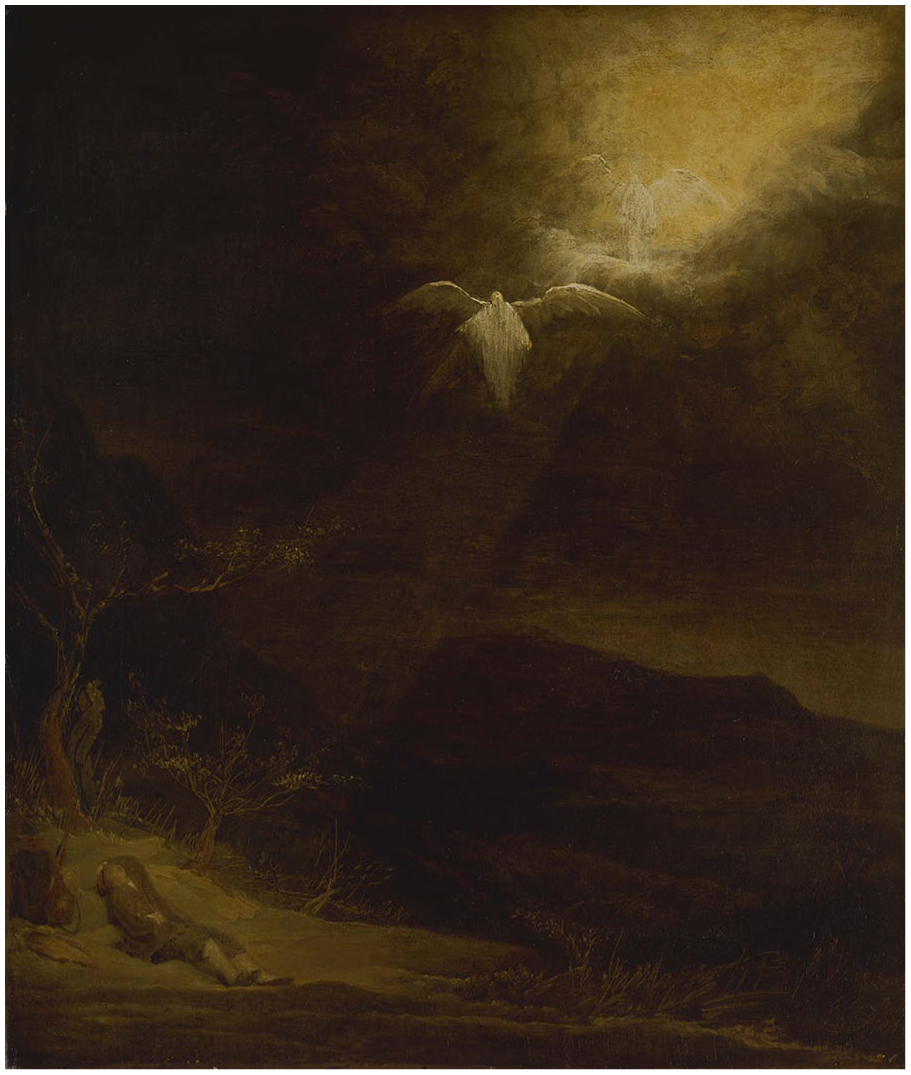
Arent de Gelder, Jacob’s Dream, c. 1715.
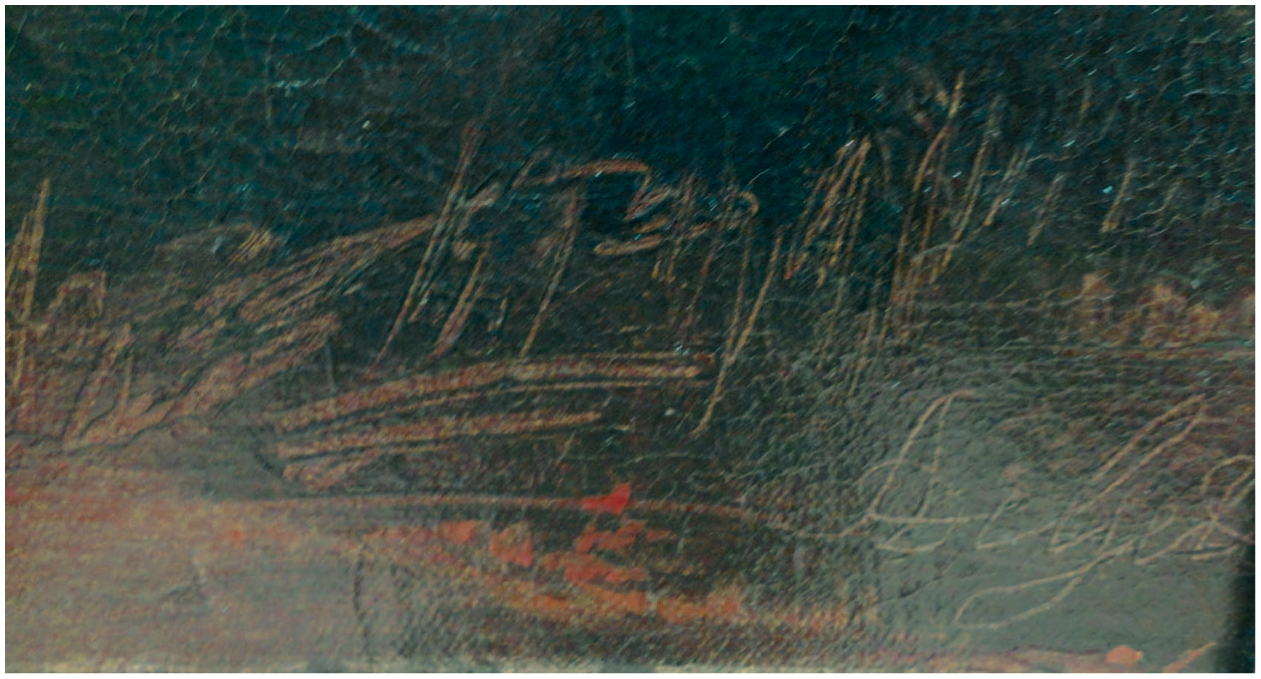
Detail Figure 19.
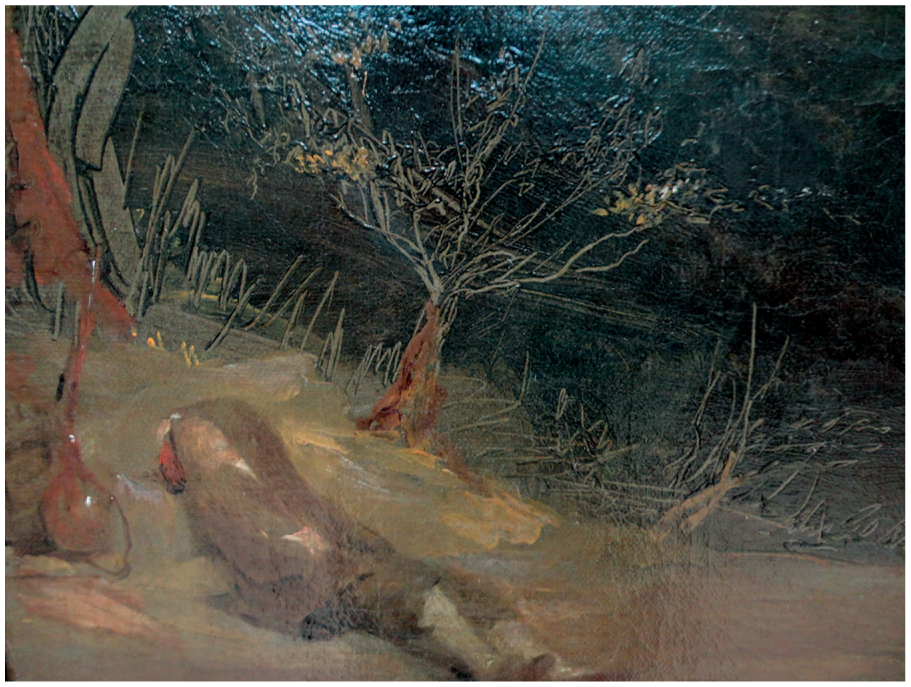
Detail Figure 19.
In 1802 Jacob’s Dream was sold as part of the collection of the Polish King at an auction in London, and the Dulwich Picture Gallery purchased it in 1807, where it still is today. William Hazlitt (1824) and James Russell Lowell (1855) were enthusiastic in their ‘romantic’ remarks on what was believed to be a Rembrandt at the time (see Van Fossen, 1969: 32–33; Dordrechts Museum, Wallraf-Richartz-Museum, 1998: 246). The work inspired Turner in his Vision of Jacob’s Ladder (Figure 22). Turner’s powerful thin layers of paint that nevertheless have opaque passages remind one of De Gelder’s surface. Turner’s enthusiasm about De Gelder’s Jacob’s Dream might explain why the artist explored the tradition of chiaroscuro as well as chance and the art of making figures from inkblots (klecksography). 17 De Gelder’s work also fascinated Constable, Turner’s antipode (Figure 23). 18 He translated the painting into a composition comprising exclusively dark and light areas, that is, in the tones of drawing, as if he were exploring the older artist’s search for form in the amorphous, chaotic and accidental, as developed by De Gelder in his painting technique. The attribution of the painting at the Dulwich Picture Gallery to Rembrandt was first negated in 1946 (after discovering the signature scratched into the paint), when it was finally ascribed to De Gelder. A debt to Rembrandt turned out to be a debt to the pupil.
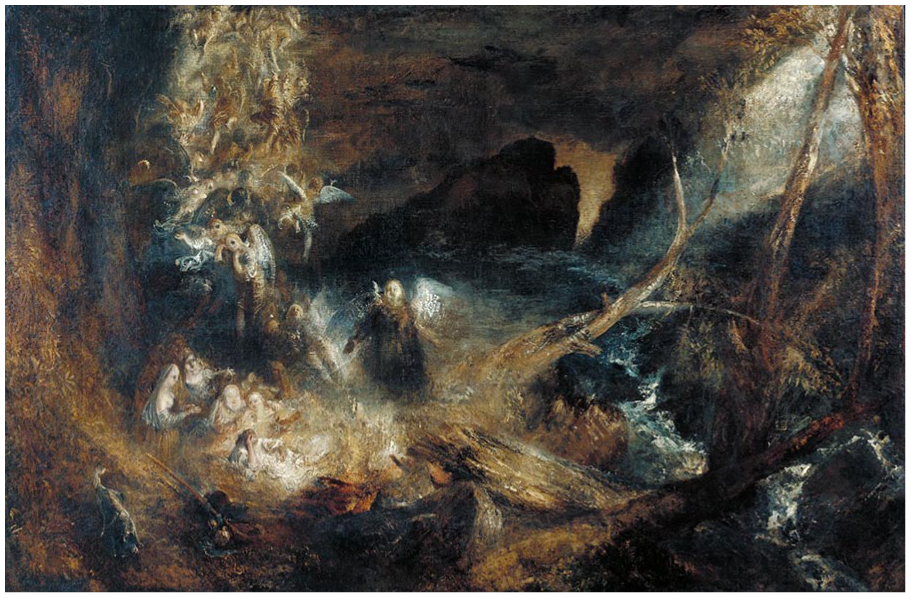
Joseph Mallord William Turner, The Vision of Jacobs Ladder (?), c. 1830.
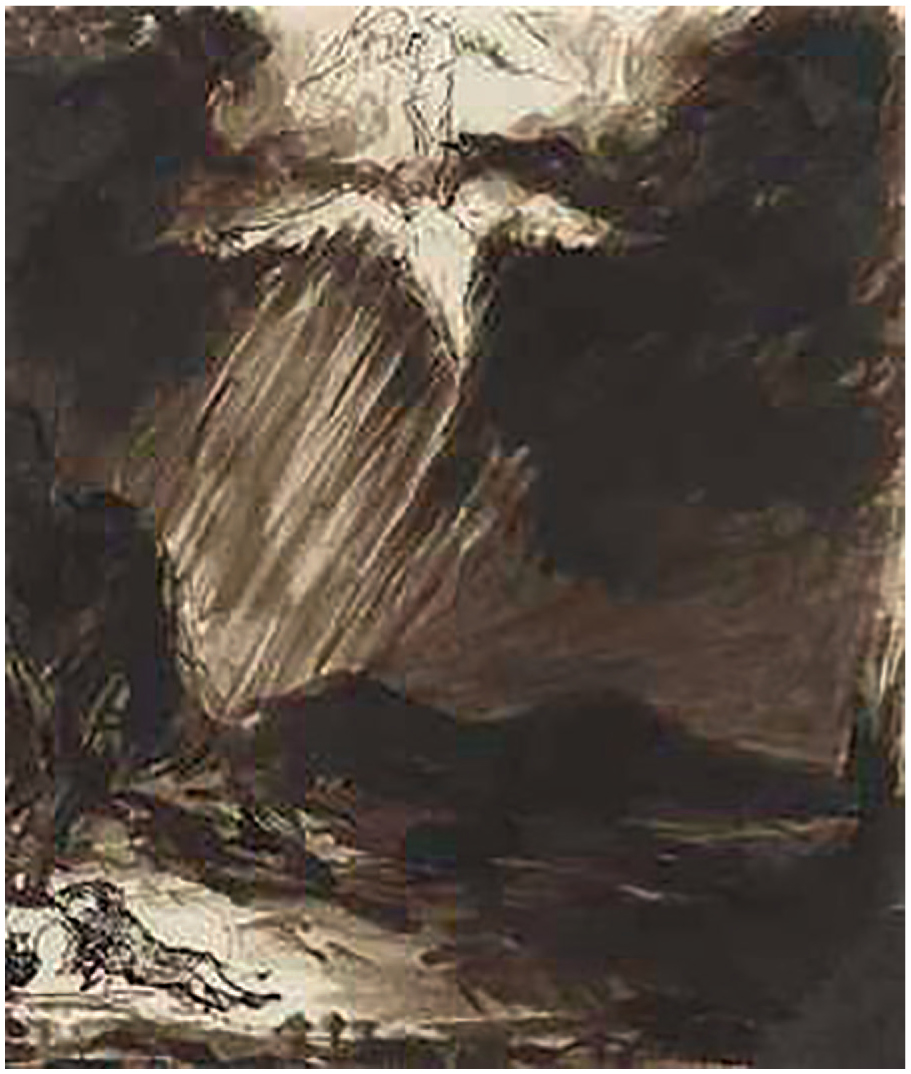
John Constable, Study after Arent de Gelder’s Jacobs Dream, c. 1810.
In 1903, in a letter to the German painter Max Slevogt, the art historian Karl Voll commented on De Gelder’s Self-portrait as Zeuxis: ‘But just think of that extraordinary pupil of Rembrandt, of De Gelder. One of his paintings hangs in Frankfurt. It is the self-portrait opposite the large Rembrandt. Its arresting colors and spatial depth and feeling actually anticipate Degas – as other paintings of the artist do also, but you are not acquainted with them. Unbelievable but true’ (Stückelberger, 1996: 113). This illustrates that not only was Rembrandt still en vogue at the time, but that the radical protagonists of his kind of handeling were as well, especially in regard to the autonomous dynamism and agency of paint. In his application of color, De Gelder has been said to directly anticipate such painters as Slevogt and Degas.
De Gelder’s financial independence enabled him to experiment with various manners, and at the same time answer to expectations among his fellow townsmen, revolving (as mentioned above) around Rembrandt’s artistic heritage. In this way, De Gelder strengthened not only his local prestige and social relations with the Dordrecht elite, making himself accepted in return, for bestowing some of his work as a counter gift, in the Maussian sense (Mauss, 1923/24). He could also pursue a manner that was still indebted to Rembrandt and that proved to be, at the same time, rather than a mere ‘archaic’ imitation, radically modern for painters in later centuries.
Artistic indebtedness functions here productively as a catalyst generating new artistic worlds. It becomes an instrument for creating originality through verisimilitude, so that the very essence of portrait making, such as De Gelder’s, comes alive.
Footnotes
Funding
The author(s) received no financial support for the research, authorship, and/or publication of this article.
