







Abstract
This article examines synthetic empathy as a sociotechnical model of understanding in digitally mediated environments. Rather than asking whether artificial intelligence can genuinely feel or possess inner emotional states, the study analyzes how empathy is translated into computational categories, institutionalized within algorithmic infrastructures, and normalized through everyday interaction. Drawing on the sociology of technology, communication theory, and interdisciplinary scholarship on affect, the article develops a theoretical framework that reconceptualizes empathy as a structured and operational construct embedded in data-driven systems. The analysis argues that synthetic empathy represents a shift from relational interpretation toward predictive modeling, in which emotional responsiveness is formalized through classification, probabilistic inference, and calibrated output. This transformation contributes to a broader reconfiguration of care and understanding, aligning them with institutional priorities such as scalability, consistency, and optimization. In this process, complex emotional experiences are frequently translated into simplified computational categories that enable scalable interaction across digital platforms. As algorithmic mediation becomes embedded in social life, the criteria for attributing understanding increasingly reflect performance-oriented benchmarks shaped by platform logics. By situating synthetic empathy within sociotechnical processes rather than ontological debates about machine consciousness, the article offers a conceptual contribution to contemporary discussions on digital mediation, emotional labor, and the social construction of intelligence. It demonstrates that artificial intelligence does not simply simulate empathy but participates in redefining the cultural grammar through which empathy and understanding are recognized in digital societies.
Introduction
In contemporary digital societies, artificial intelligence (AI) systems are increasingly embedded in domains that require forms of emotional responsiveness, including customer service, mental health support, education, and organizational management (Dwivedi et al., 2021; Makarius et al., 2020). As these systems evolve beyond pattern recognition toward affect-sensitive interaction, they are designed to interpret, classify, and respond to human emotions in ways that resemble social understanding (Lomas et al., 2024). This development signals not only a technical shift but also a transformation in how emotional intelligence and care are conceptualized and operationalized within sociotechnical environments. As social relations are increasingly mediated by digital infrastructures, the modeling of empathy in AI systems becomes part of a broader reconfiguration of social interaction and communicative practice (Cuadra et al., 2024; Susen, 2020). Rather than approaching these developments as a metaphysical question about whether machines can truly understand human beings, this article situates synthetic empathy within the sociology of technology and examines how specific forms of understanding are constructed, institutionalized, and normalized through AI-driven systems (Kappas, 2023; Rezaev and Tregubova, 2025).
The proliferation of empathetic AI systems raises significant sociological questions about how emotional understanding is formalized within technical architectures. When conversational agents apologize, adapt their tone, or offer therapeutic suggestions, they enact particular models of empathy that translate affect into data structures, classificatory schemes, and predictive outputs. These models do not emerge in a vacuum. They are shaped by institutional priorities, market incentives, and dominant theories of emotion circulating within psychology and human-computer interaction research (Lomas et al., 2024; Makarius et al., 2020). In this sense, synthetic empathy can be approached as a sociotechnical formation that reflects and reorganizes prevailing norms about care, responsiveness, and relational competence.
From the perspective of the sociology of technology, technologies are not neutral tools but mediators that participate in structuring social expectations and practices. As Susen (2020) argues, social relations are constituted through processes of recognition and resonance, and these processes are increasingly mediated by digital infrastructures. Similarly, research in human–computer interaction demonstrates that users interpret machine responsiveness through culturally available scripts of social intelligence (Cuadra et al., 2024). By embedding emotional recognition and response mechanisms into everyday platforms, AI systems contribute to redefining what counts as appropriate listening, timely response, and legitimate care. The question, therefore, is not whether machines possess inner emotional states, but how particular operationalizations of empathy come to shape collective understandings of social interaction in digitally mediated environments (Kappas, 2023).
This conceptual flow highlights how digital empathy is reshaping care in modern society. The stakes are high. As social beings, our relationships are built not only on the exchange of information but on mutual recognition, emotional resonance, and the shared labor of meaning-making (Susen, 2020). When machines begin to assume roles that require empathy—counselors, companions, educators, and even lovers—we are compelled to rethink the very architecture of social intelligence (Cuadra et al., 2024). This is not just a technological issue; it is a profoundly sociological and philosophical one. The rise of affective computing and empathetic AI challenges long-standing assumptions about what it means to be human, to relate, and to care (Kappas, 2023).
The novelty of this article lies in its interdisciplinary synthesis and its critical stance. While existing research has often focused on the technical feasibility of creating emotionally responsive AI (e.g. affect recognition, natural language processing, sentiment analysis), this article shifts the focus to how these systems reshape human expectations and interactions. By drawing on theories from communication studies, sociology of technology, affect theory, and cognitive science, the article presents a holistic examination of the cultural and symbolic dimensions of empathetic AI—dimensions that are often overlooked in engineering-centric discourses.
Moreover, this article moves beyond binary narratives that either celebrate AI as a revolutionary enhancement of human capacity or dismiss it as a dangerous impersonation. Instead, it offers a more nuanced analysis that interrogates the gray areas where human–machine affective interactions unfold. The article does not argue against the use of AI in emotionally charged contexts; rather, it asks us to consider what kinds of emotional worlds we are constructing when we delegate empathy to machines. What norms are being encoded? Whose emotions are being modeled? And how might this shift the terrain of emotional labor, especially for historically marginalized groups who are often overburdened with care roles in both digital and physical economies?
This contribution is especially significant in light of the growing deployment of AI in health care, education, and social services—fields that require high levels of emotional intelligence and interpersonal nuance. For example, AI chatbots are now being used to support mental health interventions, with some platforms reporting millions of users. These systems are often praised for their accessibility and scalability, yet they also risk flattening complex emotional experiences into computationally manageable formats. The article argues that such simplifications may erode not only the depth of individual self-understanding but also the collective vocabularies we use to express care and vulnerability.
From a sociotechnical perspective, this process may also be understood as a form of functional simplification. Technologies frequently operate by reducing complex social phenomena into manageable operational categories that can be processed within technical systems. In the case of emotional AI, this simplification does not merely represent a technical limitation but a structural feature of algorithmic mediation, through which diverse emotional expressions are translated into standardized computational signals. As some sociological analyses suggest, technological systems often stabilize social complexity by transforming interpretive practices into simplified operational models that enable scalable coordination (Cárcamo-Petridis, 2025).
What distinguishes this article from previous literature is its explicit effort to reframe the debate around AI and empathy from a relational and cultural perspective (Guo et al., 2025; Kerasidou, 2020; Srinivasan and González, 2022). Many existing studies in this area of research focus narrowly on the performance of empathetic behaviors by machines—such as voice modulation, facial recognition, or linguistic sentiment (Dong et al., 2025; James et al., 2018; Shi et al., 2025). This article, by contrast, interrogates the underlying assumptions about human emotion and sociality that are embedded in the design and reception of such systems. In doing so, it reveals how our desires for recognition, connection, and understanding are increasingly mediated by, and entangled with, machinic representations of care.
The article also offers a conceptual vocabulary to describe what it terms synthetic empathy: the simulation of affective responsiveness by non-human systems that are not conscious, not embodied in the same way as humans, and not capable of suffering or joy in any phenomenological sense. While synthetic empathy may produce useful outcomes—calming anxious users, providing a sense of companionship—it also raises concerns about authenticity, manipulation, and the commodification of emotion. When care becomes a product delivered by a machine, what happens to the moral and ethical responsibilities that traditionally undergird human empathy?
In order to investigate these concerns, the article adopts a qualitative, critical-interpretive method. The article engages with representative cases discussed in prior scholarship as illustrative sites of analysis rather than as objects of original empirical investigation. By analyzing these technologies through the lenses of affect theory and relational communication, the article aims to uncover the hidden assumptions, cultural logics, and emotional economies at play in the deployment of empathetic AI.
This article examines how synthetic empathy operates as a sociotechnical model of understanding within AI-mediated environments. Rather than treating empathy as an inner psychological capacity that machines either possess or lack, the analysis approaches it as a structured set of practices, classifications, and response protocols embedded in algorithmic systems. By drawing on insights from the sociology of technology and contemporary debates in digital mediation, the article analyzes how emotional recognition and response are formalized, standardized, and institutionalized in AI-driven platforms. In doing so, it advances three interconnected arguments: first, that synthetic empathy represents a shift from relational interpretation to datafied modeling; second, that this shift redefines prevailing norms of care and responsiveness; and third, that AI systems participate in shaping collective expectations about what counts as understanding in digitally mediated social life.
Literature review
Emotional intelligence and algorithmic formalization
Empathy has long been conceptualized within psychology as a multidimensional construct involving affective resonance, cognitive perspective-taking, and regulatory processes. However, when incorporated into AI systems, these dimensions are translated into computationally tractable categories such as sentiment polarity, facial expression mapping, voice modulation detection, and behavioral prediction. This translation does not simply replicate human empathy in digital form. Rather, it reorganizes it into measurable and programmable components aligned with data infrastructures and optimization logics. Research in human–computer interaction demonstrates that emotional recognition systems rely on probabilistic inference and classification models that abstract from contextual nuance in order to achieve scalability (Lomas et al., 2024; Makarius et al., 2020). In this process, empathy becomes operationalized as pattern detection and response generation, shifting from relational interpretation toward algorithmic modeling.
The foundational work of Rosalind Picard (2003) on affective computing marked a decisive shift in the technological framing of emotion as a domain amenable to computational modeling. By proposing that emotional states could be detected, classified, and simulated through measurable signals, affective computing established a paradigm in which empathy could be operationalized within technical systems. Subsequent developments in natural language processing, facial recognition, and biometric sensing extended this paradigm across domains such as mental health technologies and customer service automation (McStay, 2020). Rather than simply reducing emotion to data, this tradition institutionalized a particular epistemology of affect in which emotional states are rendered legible through quantification.
Scholars such as Suchman (2006) have emphasized that action and meaning are situated, embodied, and relational. From this perspective, the formalization of empathy into computational categories inevitably abstracts from the lived and contextual dimensions of emotional experience. This abstraction does not invalidate the technical system, but it highlights the transformation that occurs when relational practices are reformulated within algorithmic architectures.
Taken together, these developments illustrate how empathy, when translated into algorithmic architectures, becomes redefined as a formalized and operational construct embedded within technical infrastructures. This transformation establishes the foundation for synthetic empathy as a sociotechnical model rather than a purely psychological phenomenon.
Care, mediation, and sociotechnical norms
Care has never been a purely private or purely emotional phenomenon. Sociological research has long demonstrated that practices of care are structured by institutional arrangements, professional norms, and technological infrastructures. What counts as attentive listening, appropriate responsiveness, or legitimate support is historically and culturally situated. As digital platforms increasingly mediate social interaction, these infrastructures participate in organizing how care is expressed, perceived, and evaluated (Susen, 2020).
The integration of emotional recognition systems into service platforms, therapeutic applications, and customer support interfaces introduces new criteria for responsiveness. Timeliness, consistency, and scalability become central features of care when it is mediated by algorithmic systems. These systems do not simply simulate empathy; they standardize it through predefined scripts, feedback loops, and performance metrics. In this context, care is reformulated as a measurable outcome that can be optimized and adjusted according to user engagement data (Cuadra et al., 2024).
Rather than framing this shift as a decline of authentic relationality, it can be understood as a sociotechnical reorganization of affective labor. AI-mediated empathy redistributes the boundaries between human professionals and technical systems, reshaping expectations about availability, emotional neutrality, and communicative efficiency. Through these processes, synthetic empathy becomes embedded within institutional logics that redefine what it means to provide and receive care in digitally mediated environments.
Recent scholarship has also emphasized the importance of analyzing AI as a cultural phenomenon rather than merely a technical artifact, highlighting how algorithmic systems participate in shaping social meanings, expectations, and institutional practices (Yolgörmez, 2024).
Modeling understanding and the social construction of intelligence
Understanding is not a fixed or purely internal cognitive state. Within sociological and interactionist traditions, understanding is constituted through observable practices such as appropriate response, contextual alignment, and mutual recognition. What counts as understanding is therefore stabilized through social expectations and communicative conventions rather than grounded solely in inner mental states. In digitally mediated environments, these conventions are increasingly shaped by platform architectures and algorithmic feedback mechanisms.
Research on emotion recognition and affective computing suggests that users often interpret coherent and timely responses as indicators of comprehension, even when they are aware that the system operates through statistical inference (Kappas, 2023). Related concerns about the attribution of understanding have been raised by scholars such as Turkle (2024), who documents how users may experience AI interactions as emotionally meaningful. Rather than framing this as deception, such accounts illuminate the social processes through which understanding is projected onto responsive systems.
Emotional AI systems contribute to this process by operationalizing understanding as successful prediction and context-sensitive response generation. When a system identifies distress in a user’s language and produces a calibrated reply, it performs a recognizable script of attentiveness. Over time, repeated exposure to such interactions may normalize the association between responsiveness and understanding.
This dynamic does not imply that human and machine understanding are equivalent. Rather, it highlights how sociotechnical systems participate in redefining the criteria by which understanding is attributed. As algorithmic mediation becomes embedded in everyday communication, predictive accuracy, speed, and consistency may become central benchmarks for evaluating comprehension. In this way, synthetic empathy contributes to the social construction of understanding as a model-based and performance-oriented phenomenon within contemporary digital societies.
Method
This article adopts a theoretical and conceptual methodology grounded in the sociology of technology and interdisciplinary scholarship on digital mediation and affect. Rather than conducting empirical fieldwork or experimental evaluation, the study develops an analytical framework through critical synthesis of existing research in human–computer interaction, affective computing, communication studies, and social theory. The objective is not to assess the technical performance of empathetic AI systems but to examine how empathy is conceptualized, formalized, and institutionalized within algorithmic infrastructures.
The methodological approach can be described as interpretive conceptual analysis. It involves reconstructing how key concepts such as empathy, care, understanding, and intelligence are translated across disciplinary domains and operationalized within technological systems. By tracing these conceptual transformations, the article identifies the sociotechnical assumptions embedded in synthetic empathy and clarifies the shift from relational interpretation toward model-based prediction.
This strategy draws on established traditions within science and technology studies and the sociology of mediation, which treat technologies as socially embedded formations rather than neutral tools. Through close engagement with secondary literature and representative cases discussed in prior research, the article synthesizes theoretical insights in order to articulate synthetic empathy as a sociotechnical model of understanding. The contribution of the study therefore lies not in empirical generalization but in conceptual clarification and theoretical integration.
As depicted in Figure 1, the methodological strategy integrates discourse analysis, conceptual critique, and comparative synthesis in a deliberately layered and interdisciplinary framework. This approach allows for a reflexive engagement with how synthetic empathy is theorized, narrated, and operationalized within diverse technological and cultural settings. Rather than pursuing empirical generalization, the framework foregrounds the socio-political textures of AI design and reception, emphasizing the embeddedness of emotional technologies in power structures, normative discourses, and cultural imaginaries. In doing so, it prepares the ground for a critical interpretation of synthetic empathy as a phenomenon that cannot be divorced from the ethical, relational, and institutional contexts in which it emerges.
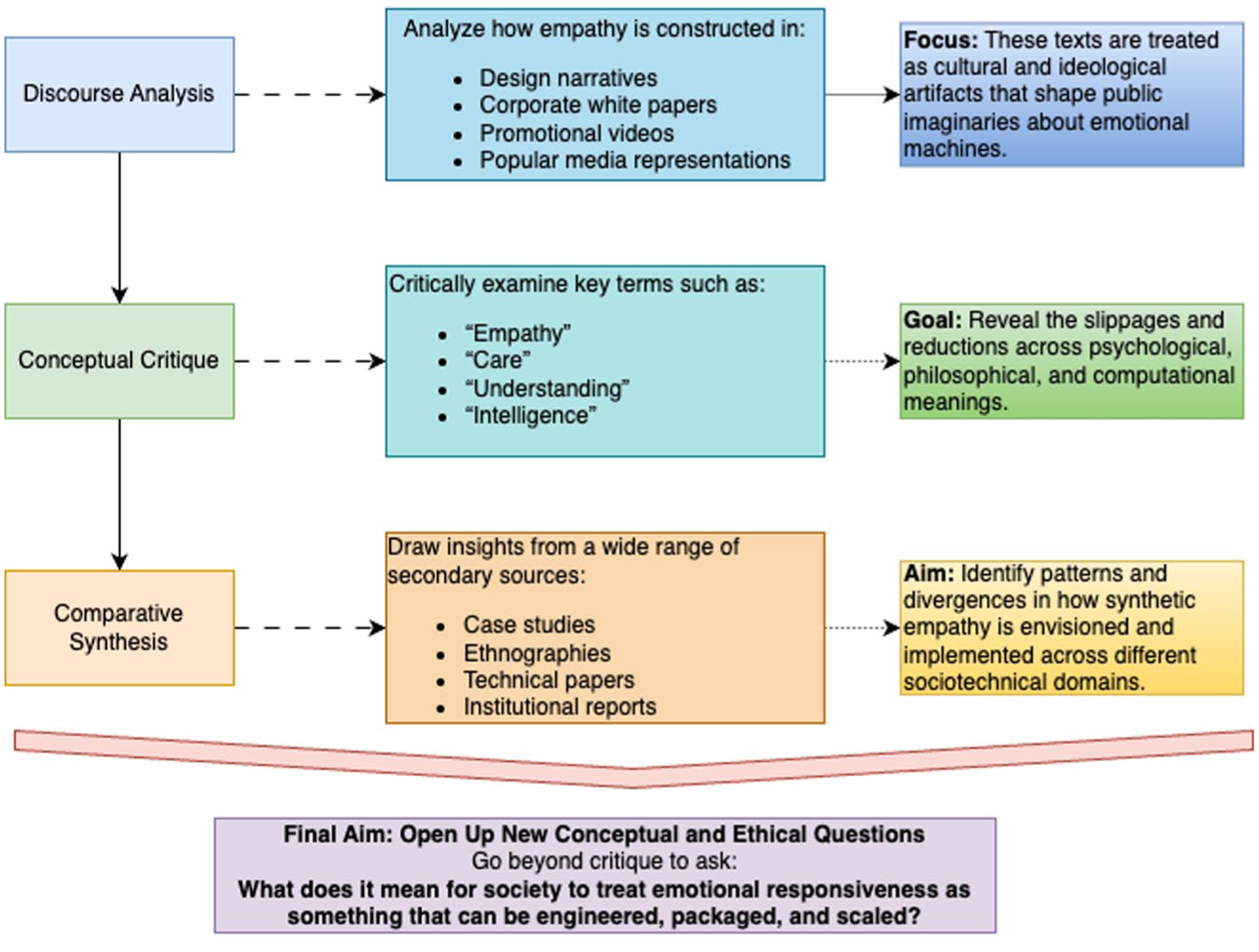
Methodological strategy.
To maintain analytical grounding, the article also draws on representative cases frequently discussed in prior scholarship on emotional AI and digital platforms. These cases are not examined as original empirical objects but as illustrative examples that clarify how synthetic empathy is operationalized in existing technological systems. Examples such as mental health chatbots, AI-based customer support agents, and emotionally responsive conversational interfaces provide concrete sites through which the sociotechnical dynamics discussed in this article can be analytically observed. Their inclusion allows the conceptual framework to remain connected to observable technological practices while preserving the theoretical orientation of the study.
Findings and discussion
From relational empathy to datafied modeling
This analysis suggests that synthetic empathy operates through a structural transformation in how understanding is organized within mediated environments. In relational settings, empathy emerges through situated interpretation, embodied responsiveness, and ongoing mutual adjustment. It is context-sensitive, temporally unfolding, and dependent on shared histories of interaction. By contrast, in AI-mediated systems, empathy is operationalized as a sequence of classificatory and predictive procedures. Emotional signals are translated into structured inputs, processed through probabilistic models, and rendered as calibrated outputs aligned with predefined response protocols.
In this shift, understanding becomes closely associated with model accuracy and response coherence. Emotional recognition is framed not as interpretive engagement but as successful pattern detection. Responsiveness is evaluated in terms of latency, consistency, and predictive alignment rather than relational accountability. Synthetic empathy therefore does not simply replicate human emotional understanding in digital form. It reorganizes empathy into a datafied and model-based logic that privileges scalability, standardization, and computational optimization.
This transformation does not imply that AI systems fail to engage affectively. Rather, it indicates that empathy is being reformulated according to the epistemic norms of data infrastructures. When emotional states are rendered legible through classification systems and probabilistic inference, the criteria for recognizing empathy shift accordingly. What counts as attentiveness becomes inseparable from what can be measured, modeled, and predicted.
Illustrative cases of synthetic empathy in digital platforms
The sociotechnical dynamics described above can be observed in several widely discussed applications of emotional AI. Although this article does not present original empirical data, representative cases documented in existing research provide useful illustrations of how synthetic empathy operates within contemporary digital infrastructures.
Mental health chatbots such as Woebot, for example, employ natural language processing and pre-structured conversational scripts to simulate supportive dialogue with users experiencing emotional distress. These systems detect linguistic markers associated with anxiety or depression and generate calibrated responses intended to convey understanding and reassurance. Empathy in this context is operationalized through probabilistic classification and scripted response generation rather than through interpretive engagement.
A similar dynamic can be observed in AI-based customer service systems deployed across large digital platforms. Automated support agents frequently incorporate standardized empathetic expressions such as apologies, acknowledgments of frustration, or supportive phrases as part of their interaction design. These expressions are not spontaneous emotional responses but predefined interactional templates optimized for speed, consistency, and scalability.
Conversational AI companions represent another illustrative example. Systems designed to provide companionship often simulate attentive listening and emotional affirmation through pattern recognition and response modeling. Through repeated exposure to such interactions, users may begin to associate responsiveness and coherence with forms of emotional understanding.
These cases illustrate how synthetic empathy becomes institutionalized within algorithmic infrastructures. Emotional responsiveness is translated into operational scripts embedded in platforms that prioritize performance, reliability, and user engagement. Rather than reproducing the full complexity of relational empathy, these systems stabilize simplified and standardized forms of affective interaction that align with the functional logics of digital platforms.
The reconfiguration of care and responsiveness
The formalization of empathy within AI systems contributes to a broader sociotechnical reconfiguration of care. Care, as sociological research has long emphasized, is never purely private or purely emotional. It is structured by institutional norms, professional standards, and technological mediations. When responsiveness becomes embedded within algorithmic systems, care is increasingly associated with availability, consistency, and computational speed.
In AI-mediated contexts, listening is translated into affect detection, support into response calibration, and attentiveness into interaction metrics. Systems designed to provide emotional assistance or companionship often emphasize reliability and scalability as core virtues. These qualities align with institutional logics that prioritize efficiency and performance optimization. As a result, care is reframed as a measurable outcome that can be monitored, evaluated, and improved through iterative feedback mechanisms.
This shift should not be reduced to a narrative of decline or inauthenticity. AI does not eliminate care; it standardizes and redistributes it. Emotional labor becomes partially embedded within technical architectures, and responsibilities once carried exclusively by human professionals are shared with automated systems. However, this redistribution also reshapes normative expectations. Availability becomes continuous rather than bounded. Emotional neutrality becomes a feature rather than a limitation. Responsiveness becomes an indicator of system performance rather than an expression of relational commitment.
Through these processes, synthetic empathy becomes institutionalized within organizational and platform logics. It contributes to redefining what it means to provide and receive care in digitally mediated societies.
Modeling understanding as social expectation
Beyond individual interactions, the institutionalization of synthetic empathy has implications for how understanding itself is socially constructed. Within sociological and interactionist traditions, understanding is not treated as a hidden mental state but as an accomplishment displayed through appropriate response and contextual alignment. What counts as understanding is stabilized through communicative conventions and shared expectations.
As algorithmic systems increasingly mediate communication, these expectations are gradually recalibrated. When users encounter systems that generate coherent, timely, and context-sensitive replies, they may attribute understanding on the basis of observable performance. Predictive accuracy, speed, and consistency become salient benchmarks for evaluating comprehension. Over time, these attributes may shape collective criteria for what counts as being understood.
This development does not collapse the distinction between human and machine cognition. Rather, it highlights how sociotechnical systems participate in redefining the grounds upon which understanding is recognized. Synthetic empathy functions as a model of understanding in which prediction substitutes for interpretation and calibrated output stands in for dialogic engagement. The attribution of intelligence becomes linked to successful performance within structured interactional scripts.
In this sense, synthetic empathy contributes to the social construction of understanding as a model-based and performance-oriented phenomenon. It stabilizes a particular configuration of comprehension that aligns with algorithmic properties while marginalizing dimensions that resist formalization, such as ambiguity, moral hesitation, and situated relational accountability.
Tension and limits of synthetic empathy
The central tension, therefore, does not concern whether machines genuinely feel. The more consequential issue lies in how sociotechnical systems redistribute the boundaries between interpretation and prediction, recognition and calculation, care and optimization. Synthetic empathy foregrounds responsiveness as a technical achievement while backgrounding the ethical and relational labor that exceeds formal modeling.
By embedding emotional responsiveness within scalable infrastructures, AI systems normalize a vision of understanding that is measurable, repeatable, and continuously available. This normalization has cultural and institutional consequences. It may recalibrate expectations of human interaction, influence professional standards of care, and shape broader imaginaries about emotional intelligence.
Synthetic empathy should thus be understood not as a technological illusion nor as a straightforward enhancement of human capacity but as a sociotechnical reconfiguration of affective norms. It reorganizes the conditions under which empathy is recognized, attributed, and valued in digital society. Through this reconfiguration, AI does not simply simulate understanding. It participates in reshaping the social criteria by which understanding itself is defined. Table 1 summarizes the analytical differences between relational empathy and synthetic empathy across key sociotechnical dimensions.
From relational empathy to synthetic empathy: Analytical comparison.
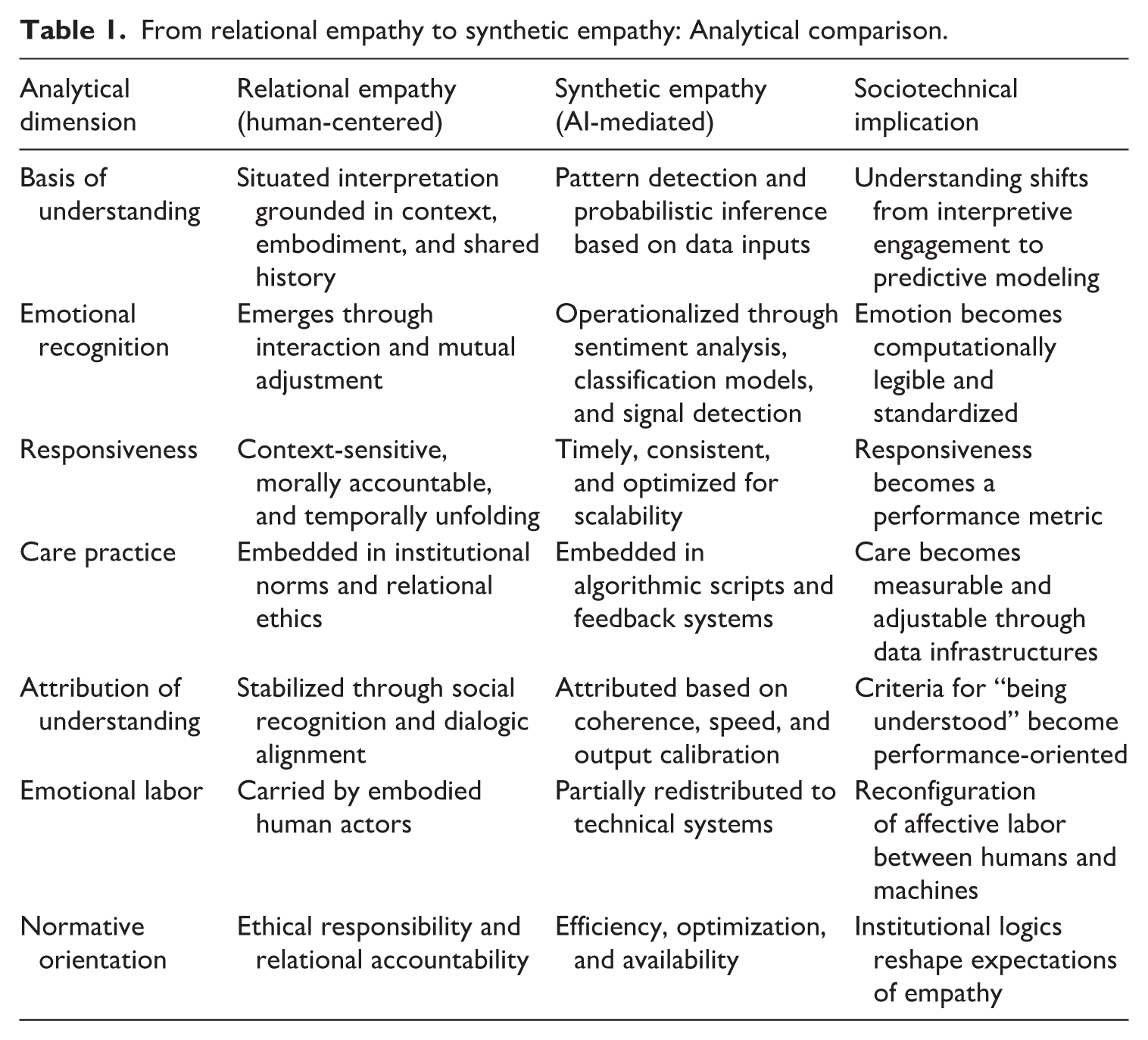
The analytical comparison presented above clarifies that synthetic empathy is not merely a technological extension of human emotional intelligence but a reconfiguration of empathy within sociotechnical systems. This shift carries several important theoretical implications for communication studies, sociology of technology, and affect theory.
First, the findings suggest an epistemic shift in how empathy is defined and recognized. Within algorithmic architectures, empathy becomes legible through quantification, prediction, and output calibration. This challenges classical psychological and dialogic models that treat empathy as a relational and interpretive achievement grounded in situated interaction. Theoretically, this calls for a reconceptualization of empathy not as a stable inner capacity but as a performative construct stabilized through institutional and technological infrastructures.
Second, the analysis highlights an ontological shift in the locus of emotional agency. Empathy is no longer confined to embodied human actors; it becomes distributed across hybrid assemblages of users, platforms, data systems, and institutional logics. This supports perspectives from science and technology studies that treat agency as relational and networked rather than individually possessed. Synthetic empathy thus complicates traditional distinctions between subject and tool, suggesting that emotional practices are increasingly co-produced by human and non-human actors.
Third, the study underscores a normative shift in the evaluation of care and understanding. As responsiveness becomes associated with speed, consistency, and predictive accuracy, the criteria for what counts as “being understood” are subtly redefined. This does not eliminate relational ethics, but it introduces performance-oriented benchmarks shaped by optimization logics. For social theory, this raises critical questions about how institutional priorities—efficiency, scalability, and engagement—reshape moral expectations surrounding care.
Taken together, these implications position synthetic empathy as a critical site for rethinking the sociology of emotion in digital societies. Rather than asking whether AI can truly feel, the more theoretically productive question concerns how algorithmic mediation transforms the cultural grammar of empathy itself. In this sense, synthetic empathy should be understood not as an imitation of human care, but as an emergent sociotechnical formation that redefines what empathy is taken to mean in contemporary life.
Conclusion
This article has examined synthetic empathy as a sociotechnical model of understanding rather than as a question of whether machines can genuinely feel. By tracing how empathy is translated into computational categories, embedded within institutional infrastructures of care, and normalized through everyday interaction, the analysis has shown that synthetic empathy represents a structural transformation in how understanding is conceptualized and enacted in digitally mediated environments.
Rather than approaching AI as either a successful emulator or a failed imitator of human emotional intelligence, this study has argued that synthetic empathy should be understood as a reconfiguration of relational norms. Through processes of quantification, prediction, and scripted responsiveness, empathy becomes formalized, standardized, and operationalized within algorithmic systems. In doing so, AI-mediated environments subtly reshape the criteria through which understanding, care, and attentiveness are socially recognized.
This transformation does not imply the disappearance of human empathy, nor does it suggest that machine and human understanding are equivalent. Instead, it points to an ongoing redefinition of what counts as understanding within contemporary sociotechnical life. As responsiveness becomes associated with consistency, immediacy, and predictive accuracy, the cultural grammar of empathy shifts toward performance-oriented benchmarks shaped by platform logics and data infrastructures.
By situating synthetic empathy within communication theory, sociology of technology, and affect studies, this article contributes a critical framework for analyzing how emotional norms are institutionalized through digital systems. It invites scholars to move beyond ontological debates about machine consciousness and toward a sociological examination of how algorithmic mediation transforms collective expectations about care, relationality, and moral responsibility.
In an era where emotional responsiveness can be engineered, scaled, and optimized, the central question is not whether machines truly understand us, but how the modeling of understanding itself reshapes social life. Synthetic empathy thus emerges not as a technical achievement alone but as a contested cultural formation that redefines the boundaries between feeling, performance, and recognition in digital societies.
Footnotes
Acknowledgements
The authors would like to thank the anonymous reviewer for constructive and insightful feedback that significantly strengthened the analytical clarity and theoretical contribution of this manuscript.

Funding
The authors received no financial support for the research, authorship, and/or publication of this article.
Declaration of conflicting interests
The authors declared no potential conflicts of interest with respect to the research, authorship, and/or publication of this article.
Data availability statement
This article is a purely theoretical and conceptual study and does not rely on empirical datasets.