







Abstract
Dynamic stochastic general equilibrium (DSGE) modeling remains the workhorse of contemporary macroeconomics despite a growing number of critiques of its ability to explain the aggregate properties of an economic system. For the most part, those critiques accept the DSGE presumption that traditional macro data are primitive, causal data. This leads to a stipulative style of analysis where macro variables are explained in terms of one another. In contrast, we set forth an open-ended evolutionary (OEE) framework for an OEE macroeconomics. Within this framework, systems data are not primitive, but are derived from prior microlevel interactions without any presumption that those macrolevel derivations reflect systemic equilibrium among the microlevel primitive sources of action. We explore some contours of an OEE framework by placing coordination games within an ecological setting where there is no agent who has universal knowledge relevant to that ecology of games.
The Problem of Vision in Macroeconomic Theory
Without doubt, dynamic stochastic general equilibrium (DSGE) is the predominant vision around which macro theorists orient their work. To be sure, that vision divides into two main branches, depending on whether theorists think economies are better represented as perfectly competitive (for instance, Kydland & Prescott, 1982; Lucas, 1980; Prescott, 1986; Lucas & Sargent, 1979) or imperfectly competitive (for instance, De Grauwe, 2010; Greenwald & Stiglitz 1986, 1987; Stiglitz, 2017; Romer, in press). Within both branches, theorists are concerned with the entirety of an economic system, as distinct from microlevel observations that pertain to various parts of that system. The key feature of either branch of DSGE is the presumption that an economic system can be apprehended in its entirety at the macrolevel. Hence, macro variables are primitive variables that can be meaningfully related directly to one another in a causal manner. In contrast, the open-ended evolutionary (OEE) modeling we explore here treats macro variables as derivative from prior microlevel interactions. Macro variables do not act directly upon one another and are not direct objects of choice. Instead, macro variables emerge through microlevel interactions. There are thus no microfoundations for macro in the standard sense of resting macro theory on some model of rational choice. There are, however, microfoundations in the emergent sense of a macro whole bearing an emergent relationship to the microlevel interactions that comprise the macro system.
OEE and DSGE both pertain to systems-level observations, but they differ in how they conceptualize human population systems. DSGE modeling starts at the systems level, posits a system in equilibrium, and examines whether the evidence confirms or rejects the postulate of systemic equilibrium. In contrast, the OEE vision starts with individual-level actions and derives system-level observations through interaction among individual entities. This leads to an ecological or emergent style of reasoning, and of conceptualizing the relationship between the parts of an economy and the whole of that economy. So far as we can determine, the first explicit reference to a distinction between micro and macro levels of economic analysis is Eric Lindahl (1919, translated and reprinted in Lindahl, 1939). Our effort to set forth OEE as an alternative vision for macro theory descends from Lindahl (1919) while recognizing that contemporary tools of thought regarding complex systems have made it possible to work analytically with situations where microlevel interaction does not aggregate directly to macrolevel outcomes. There are phenomena that emerge through interaction among individuals that do not pertain to individual action. A solitary Crusoe on his island will not have property rights, will not have conflicts with neighbors, will not generate institutions to resolve those conflicts, and will not generate knowledge through interaction. OEE recognizes that a system of interacting agents cannot be reduced reasonably to a representative or average agent because of nonlinearities introduced through interaction among micro entities.
Furthermore, OEE and DSGE differ in the objects or variables that comprise their analytical foregrounds. For DSGE, resource allocations are the objects of prime analytical interest, as reflected in inquiries as to whether observed resource allocations are Pareto efficient. For OEE, by contrast, primacy of analytical interest resides in interactions among action-taking agents, which brings the institutional arrangements governing those interactions into the analytical foreground. Within the DSGE framework, macro theory pertains to a synchronized system of economic interaction; observing an economy is equivalent to observing a team of synchronized swimmers. These swimmers might be regarded as either perfectly or imperfectly coordinated, but they are a team of synchronized swimmers in either case.
By contrast, OEE theories make no claim that economies resemble teams of synchronized swimmers. Economic actions will be generally but not universally coordinated, but in no case is societal coordination truly a team activity. To the extent coordination appears to occur, it is a feature of independent actions undertaken by teams of participants inside the economic system, as illustrated by Potts and Morrison’s (2007) insertion of a meso level of analysis between micro and macro levels. Different institutional arrangements governing those interactions can generate different macrolevel observations. For instance, unemployment would not be related causally to some such alternative macro variable as government spending. Measured unemployment would emerge out of microlevel interaction, as that interaction is framed by such institutional features as conventions regarding employment contracts, the extent of public support for being unemployed, and entrepreneurial plans and beliefs pertaining to the creation of new enterprises. In any case, the logic of OEE macro proceeds from simpler action to more complex interaction, as befits the micro–macro relation as one of parts to whole. Accordingly, the analytical mode must be generative or emergent, along the lines of the papers that Epstein (2006) collects, or as described in Howitt and Clower (2000). Rather than starting macro analysis by stipulating that observations pertain to states of systemic equilibrium, equilibrium would be a possible outcome of a model and not an input into it. Perhaps the network of economic activities is fully synchronized. But if it were, the analytical challenge for OEE modeling would be to explain how this state emerged from some preceding state where those activities were not fully synchronized, and in a setting where no person or office has possession of the knowledge necessary to impose synchronization, as against explaining how synchronization might emerge out of some nonsynchronized state when synchronization was not part of any entity’s intention or capacity.
To be clear, we recognize that all economists know the economy is complex. Our motivation in setting forth a new tool with which to shine light on the features of the complex economy is to bring certain crucial social phenomena that lie outside the equilibrium method’s explanatory ability into a scheme of macro theorizing, along with the infrastructure to explain it. We believe the equilibrium method cannot be expanded in a way to sufficiently capture these phenomena, and therefore find ourselves seeking to develop a new theoretical apparatus with which to explain them. While there are clear points of commonality between OEE theorizing and macro theory in the tradition of Austrian economics, there are also notable points of analytical difference that lead us to emphasize analytical framework over historical heritage. For further elaboration, see Lewis and Wagner (2017).
OEE theorizing recognizes that societies entail turbulence of various forms, and with many economic practices and institutions arising in the process of people dealing with that turbulence (Wagner, 2012a, 2012b). Just as some agents each period inject new enterprises into society, other agents disband enterprises they had previously created. Either way, turbulence is injected continually into the ecology of plans as other enterprises and agents must respond to and adapt to the new information that continually is inserted into the economic nexus. OEE accepts the presumption that people seek to execute their plans effectively, for whoever heard of someone trying purposively to be ineffective in whatever he or she sets out to do. It does not, however, impose the presumption that people are seeking to achieve systemic coordination. To the contrary, it entails the presumption that people are seeking to pursue their plans as fully as they can, even though those plans will often conflict with the plans of others. Some enterprises succeed while others fail, and this is a feature of any system of human action. The extent of actual coordination among individual actions and plans is a systemic quality that lies outside individual choice, even the choices of what conventionally are described as “policy-makers.”
Some Problematics in Choosing Between Macro Visions
To have a good fit between model and data is important, but so is congruence among model, data, and the purposes a theorist is pursuing in creating models. With respect to purpose, macrolevel theories pertain to systems of human interaction. For the most part, macro theorizing seems to have been pursued more for engineering-like purposes of systemic maintenance and repair (Mankiw, 2006). There are, however, also significant scientific issues raised by the very conception of an economic or social system, which James Coleman (1990) explained pithily: “The only action takes place at the level of individual actors, and the system level exists solely as emergent properties characterizing the system of action as a whole” (p. 28). Within a framework of systemic interaction, the system is not an object that can be acted on in its entirety, which means that maintenance of the system is a product of congruity among individual actions within the system.
Although individual actions may utilize such system-level information as prices, there is no point at which individual action can be abstracted away in favor of only considering the movements and relationships among system-level variables or properties. The actions of individuals are entangled with the actions of other individuals, and the structure of that entanglement is as important to the emergence of system-level properties as is the plan an individual executes to attain her goals. In this respect, Barkoczi and Galesic (2016) show that group performance is as intimately entwined with the shape of the group’s communication network as with the social learning strategies adopted by each individual group member. To understand the group-level properties, it is not sufficient to abstract away from the individual.
The problem the DSGE vision encounters is that resources cannot allocate themselves, for only people can do that. But people do not act within the DSGE model, they merely respond to the allocative imperatives of the equilibrium model. To find loci of action requires a shift of analytical focus to human governance within alternative arrangements, recalling Nathan Rosenberg’s (1960) distinction between institutional structure and resource allocation in his explanation that Adam Smith was more concerned with institutions than allocations. Elinor Ostrom (2010) proposed a richer understanding of how institutional arrangements could overcome commons problems without the need to resort to reallocative policy measures. In similar fashion, OEE modeling is concerned primarily with the systemic properties of different institutional arrangements for human governance, including the comparative properties of private and public ordering of economic interaction.
Imagine, after the spirit of Thomas Schelling (1978), that a homogeneous plane is divided into a large number of squares after the fashion of Schelling’s checkerboard. There are 100 people located on that plane, and they constitute a social economy. Individual action within that society conforms to two rules. First, by the principle of private property no person will move onto a square occupied by someone else. Second, presuming those people comprise a society means that no one will allow more than, say, three squares to arise between themselves and their nearest neighbor. This society can be described in either DSGE or OEE terms, which raises questions of the comparative advantages of the different visions. At any instant, the society can be described as DSGE. Alternative locational patterns at different instants can also be described by DSGE, with the changing patterns of location attributed to exogenous changes in relevant parameters. Parameter changes are ad hoc and not determined by properties of the system or its parts. The DSGE model itself gives no guidance relevant for systemic maintenance or repair because those activities, being changes to the system, are exogenous to the model.
In contrast, OEE seeks to explain macrolevel properties as unplanned resultants of individual actions. This spontaneous order approach to macro theory does not deny the significance of the planning process to the quality of economic interaction. Quite the contrary, OEE emphasizes that quality in that it attributes planning to all economic agents rather than limiting it an external controller or expert. The overall society itself, however, is not an object that is planned in its entirety. The society is not controlled by Adam Smith’s (1759) chessmaster, who moves people about as if they had no internal laws of motion. To the contrary, a society is an ecology of interacting plans, some of those plans complementary with others and some competitive. OEE focuses attention on the governance of interaction among those plans, which provides a position from which questions of systemic maintenance can be raised from inside the model.
Suppose during each time period that five members of our grid-like society change location. In consequence of the principles of private property and recognition that these people constitute a society, as against being just a set of randomly located hermits, the movement of the five will induce movement elsewhere within the society. This repeated movement over time in response to five people changing their planned locations can be captured within the DSGE model. The claim that this society is in stationary equilibrium cannot be rejected at the 5% level of significance. DSGE can fit the data this model generates.
But OEE can also fit the data our model generates. Our model has been constructed as an ongoing algorithmic process that reflects movement through time in a potentially open-ended fashion that may or may not come to a state of rest. The prime movers of our model are entrepreneurs seeking new locations in commercial space, recalling Schumpeter’s (1934) treatment of entrepreneurship as the locus of leadership in a capitalist society and Kirzner’s (1997) treatment of entrepreneurship as the locus of the discovery of new locations in commercial space.
DSGE provides a framework for interpreting our observations, but so does OEE. For DSGE, the primitive observation is the alternative locations at the end of each period. For OEE, the primitive observations pertain to the entrepreneurially creative acts that induce readjustments within the society. The changing locational pattern through time is an emergent response to entrepreneurial action. To be sure, our Schelling-like construction of an OEE model conforms with standard statistical convention of being unable to reject the hypothesis of a stationary state at the 5% level of significance. And yet the illustration is constructed so as to portray a society in continual motion.
Our comparison of DSGE and OEE modeling relates directly to Box’s (1976) observations on why scientists choose some models rather than others, knowing in advance that all models are incomplete or even wrong. If we only care about the average locations of entrepreneurs in commercial space, a no more than 5% difference in each period is sufficient to answer the analytical question. Suppose, instead, we care about why the system grows at x percent per period instead of y percent per period. In that case, the 5% may account for a large portion of that growth. In the first example, we need only the locations of the entrepreneurs; a DSGE analysis would suffice. In the second example, we require information about entrepreneurial plans that led to the resulting locational pattern; a DSGE analysis would no longer suffice, but an OEE analysis might.
Furthermore, information about the individuals who constitute a macro economy is irrelevant to the DSGE framework, for such information can only clutter the model without offsetting advantage because plans are stipulated as being pre-coordinated without any action having taken place. It matters little why one of the entrepreneurial 5% change their location in commercial space, as every other member of the commercial space has the same information and processes it as relevant or not to their business plan in the same way. Any advantage to be had from exploiting a discovery is symmetrically dissipated through the entire system, meaning that which individuals did what does not matter for our analysis of how the system advanced from its initial to final state. Recognition that systemic or macro observations are derivative from individual action and interaction has no analytical work to do in DSGE modeling because the only data of relevance for that class of model pertain to aggregate outcomes. The presumption of systemic equilibrium—pre-coordination—renders irrelevant any information pertaining to individual plans or actions. It renders irrelevant how individuals gain and use knowledge to form new models of cause and effect and to update their plans, and how this process ripples through the system to change the models that others use and the failure or success of their plans. All plans are statements of future expectations (Shackle, 1972, 1974). Although the DSGE model does not claim that expectations about the future on which present actions are based are invariably accurate, it presumes they will be accurate on average which, in turn, can mean that they are never accurate with respect to particular instances. An estimate can be invariably wrong while being accurate on average all the same. Many people guess the weight of a cow, and there is good basis for thinking that the average of the guesses is an unbiased estimate of the cow’s weight. Many people guess what a measure of aggregate output will be at the end of the year, and there is likewise good reason to think that the average of those guesses will be an unbiased expectation of that output.
Economic phenomena, however, illustrate patterns of organized complexity (Weaver, 1948). There are discernable patterns to economic activity, with those patterns emerging through the planned activities of numerous people each of whom acts with some degree of independence from other actors. At this point, we come to one of those analytical forks in the road. Along one branch of that fork lies the postulation of systemic equilibrium, which enables reduction of that system to simplicity by rendering macro phenomena of the same order of simplicity as micro phenomena. Both micro actions and macro outcomes reflect outcomes of choice. Yet it is surely strange to think that the entirety of an ecology of interactions is reducible to the choices of any single entity within that ecology. At the very least, it is surely unsatisfactory to reduce the entirety of an ecology of interactions to the choices of a single entity through simple stipulation rather than explaining how such an outcome might come about, which within OEE requires an explicitly constructed generation of macrolevel observations from microlevel interactions. DSGE can make synchronic statements using value theory that start from one timeless pre-reconciled state and move to another, but these statements are not explicitly constructive (Lewis, 1985; Velupillai, 2008). OEE provides a stage for the unfolding of diachronic processes where situations grow one out of another (Shackle, 1972).
Pre-reconciliation implies simultaneity of action, even in the face of shocks to the system. When a shock occurs, the end state of the system is predetermined; furthermore, the path from the initial state to the new state entails a well-behaved transformation from one fixed point to another. With OEE, by contrast, the process of transformation is not necessarily the well-behaved one of individual agents learning of the shock, updating their plans according to their understanding of its implications, and dealing with the ramifications of the corresponding changes in the plans of others. How agents adapt is not of central concern to DSGE. In contrast, how agents adapt is central to the process-oriented nature of OEE. The diachronic nature of OEE reintroduces to macro theory the concept of time through the unfolding of un-prereconciled individual actions.
Generation Versus Stipulation in Systems Modeling
The diachronic theoretical schema we associate with OEE modeling treats a society as an ecology of agents and plans, with ecology taken substantively to denote a locus of interaction among nonidentical entities (Scheiner & Willig, 2011). This ecological formulation ramifies throughout the domain of macro-theoretic inquiry. Any such effort at theoretical construction must start at the level of parts, with the whole being something to be assembled and with the process of assembly being the object of theoretical inquiry. Within this alternative analytical framework, system variables do not act directly on one another because those variables emerge through interaction among microlevel entities within the system of interaction; moreover, the injection of novelty is continuous as against being discrete, and thereby subject to a theory of punctuated equilibrium.
A simple illustration of this sort of construction follows from recent work on the theory of how the assemblage of work teams relates to the productivity of the team. It is not enough to put five strangers in a room and expect them to successfully complete a project. To whom certain tasks are assigned, and the flow of project steps, matters a great deal to how well and quickly a project is completed. If specialists are assigned tasks that exploit their specialty, perhaps by a coordinator in the team who can assess tasks and assign them to the proper person and then manage the flow of tasks from person to person, the work team works better. It turns out it is not necessary to plan out this structure of connections between agents; it can emerge naturally from repeated interactions (Peltokorpi, 2008). Agent’s work teams develop “who knows what” directories that act as instructions as to who best can help them complete a certain type of task. The structure of connections in a mature productive team, where edges represent task-completion chains (1 is connected to 2 if 1 goes to 2 to complete task C), differs substantially and predictably from random networks with the same number of members and edges between them (see Figure 1). Abstracting from the structure of work teams to consider productivity in the form of, say, GDP per capita, leaves out institutional information about the team that is crucial to its capabilities as a social order.
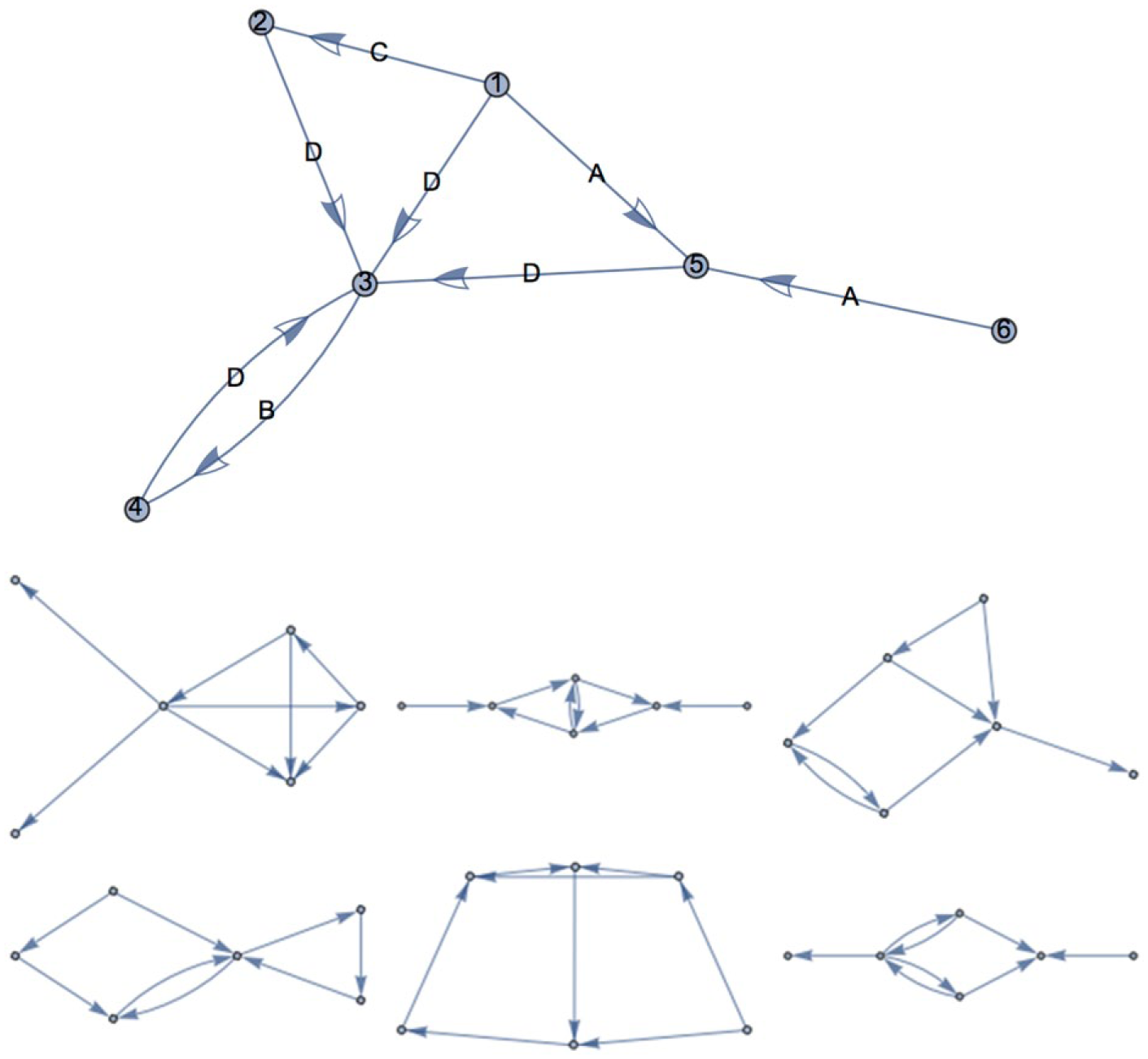
Example of a mature work team network with six agents and eight interactions (top), and a set of six random networks with six nodes and eight edges (bottom).
For the most part, economic theories are formulated within the framework of noncontradiction, where propositions are either true or false. Without doubt, there are domains where the principle of noncontradiction pertains. A philosophy classroom in classical logic is one of them. But there are also domains where it surely does not apply, and where some dialectical principle like yin-and-yang can offer superior insight. At the individual level, this is the world of creative experimentation where utility functions would be described as only partially ordered, as complete ordering requires the nonconstructive solution to a fixed-point problem (Lewis, 1985). This dialectical setting contrasts with noncontradiction along the lines that Ross Emmett (2006) portrayed Frank Knight’s critique of the Stigler–Becker claim on behalf of invariant utility functions. For Knight, a significant part of individual action entailed reflection-induced change. Hayek’s theory of the market order placed reflection-induced change within a complex economy (Hayek, 1945, 1964). In today’s terminology, a market constituted by reflective and purposeful individuals would be a complex adaptive system.
We believe that the dialectical framework is best represented by an OEE system where changes can enter the system both from recombination of existing resources in the system and from interaction from within the system to a resource space outside of the system (Adams, Berner, Davies, & Walker, 2017a; Adams, Zenil, Davies, & Walker, 2017b). Suppose we have a system with N elements and thus 2N combinations of elements at time t. 1 Each combination represents a possible plan, that is, combinations map to outcomes via a model algorithm constructed by the agent. Advantages are conferred to agents from recombination of system elements and redefinition of the mapping to outcome space. As agents act as part of a system of other agents, advantages conferred by recombination and the fine-tuning of models dissipate through time (see the discussion by Prigogine, 1997, about dissipative emergent structures). Dissipation of advantages within the confines of a fixed combinatorial space is the “yin.” This type of theoretical framework, moreover, must entail continual movement through time, in contrast to equilibrium theories where time has no work to do.
When the dialectical framework is applied to the social level, what shows itself as contradiction appears. At any moment, a central mass of people might well act as price takers. At the same moment, however, there will be outliers who are inserting new data into the society. It is, however, impossible for everyone to insert new data at the same time. The very ability to insert new data requires that other people accept data. To think dialectically requires the theorist to think in terms of distributed populations and not in terms of averages or representative agents (Hartley, 1997; Kirman, 1992). For OEE macro theory, GDP data might serve some useful purposes but those data do not denote the objects that an OEE theory would seek to explain. Synchronic macro theory conceptualizes a society as an economizing entity, with the GDP accounts summarizing the outcome over some accounting period. In contrast, an OEE macro conceptualizes a society as a vessel that holds numerous economizing entities, with efforts to account for the vessel being distinct from the accountings conducted by the entities inside that vessel.
To carry forward the OEE vision, societies must be treated as ecologies of plans (Wagner, 2012a). Each individual owns his or her plan, though there is no Walrasian-like process through which those plans are coordinated in advance of action, as this presumption implicitly requires insertion of a fictive coordinator. Even public actors act on the same playing field as private actors within OEE macro, though their positions may differ in a way that places them in influential locations on the field, as conveyed by Koppl’s (2002) theory of Big Players. At any historical instant, some plans are initiated and other plans are abandoned, while many plans created in the past continue to operate. The mere recognition that plans are created and abandoned as time elapses is sufficient for setting an a diachronic or ecological research program in motion. At any moment in time many and perhaps most plans are still in progress, having yet to bear fruit to their creators; at no time can we say the system has come to rest, for rest would imply the end of all plans and the initiation of no new plans. It is unclear how meaningful it would be to ask what would happen if no new plans were initiated after a certain point of time. Such a thought experiment cannot serve to provide much information about some future path of the system compared with some alternate future path, as the economy is no longer a system undergoing a market process but rather more like the staggering of a body without a head. The economy evolves in an open-ended way, with no state of rest in the mind of its acting individuals or some analogical market coordinator.
To carry forward an OEE conceptualization requires two points of difference from DSGE schemes of thought. First, individual preferences must be only partially ordered to allow space for creative experimentation. Second, there is no Walrasian starting line where all plans are created and enter operation at the same instant. At any instant, some new plans are injected into an existing sea of plans, while some previously created plans are undergoing revision or abandonment. It is perhaps worth noting that Walras (1954) offered a brief glimpse of what might be involved in conceptualizing an economy as an ecology of plans that generates turbulence. He did this in contrasting his formulation of an annual market of pre-coordinated activity with what he called a continuous market, which he described as resembling a lake where the water is agitated by the wind, in contrast to the placidity of the water in the annual market. Walras’s continual market allowed variable turbulence as a systemic feature of microlevel interaction, only he abandoned this insight in favor of the analytical closure that he thought equilibrium modeling offered.
To pursue a program of OEE macro theory, there must be continual entry and exit of plans, which continually inserts new actions and information into the ecology of plans. A plan that is doing well might turn negative because a new plan attracts away its customers. Alternatively, an input supplier whose product is valuable to someone’s plan might abandon business, leading to a weakening of the plan in question. At any instant within the ecology of plans, some plans are being created and others are abandoned, and with those plans located at particular places within abstract enterprise space. The abandonment of plans frees inputs while the creation of plans creates demands for inputs, though there is no reason why these should be offsetting in terms of microlevel detail nor why they should have a linear effect on resultant system variables. The actions of outliers may drive a large proportion of the changes in various measures of the system’s activity. One thing it means in any case is that at each succeeding instant new information and activity is being injected into the ecology of plans. This new information will affect the performance of existing plans within the ecology, which subsequently might lead to revision or abandonment of some plans. The ecology of plans will entail natural turbulence, and with the presence of that turbulence also incorporated into entrepreneurial plans as entrepreneurs recognize the need to abandon plans they own in an economizing manner (Wagner, 2012b).
OEE macro theory is a form of spontaneous order theorizing (Aydinonat, 2008; Kochugovindan & Vriend, 1998). It points to plans and interaction among plans as the prime objects of analytical interest. To do this is to recognize that it is the principles and frameworks of human governance more than resource allocations that are of primary theoretical interest because resource allocations derive from human governance and cannot themselves initiate action. An OEE macro theory would thus have a different analytical agenda from a synchronic macro theory, as illustrated to some extent by Clower and Leijonhufvud (1975), Colander (2006), De Grauwe (2010), Katzner (1998), and Leijonhufvud (1981, 1993).
As a simple illustration of this distinction between OEE and DSGE, consider the following two cellular automata evolutions. Cellular automata are simple systems which admit some structure to their output through update rules that instruct each “cell” in a line of cells whether they should turn white or black at the next step (Wolfram, 2002). These rules for the most basic or “elementary” cellular automata are based on the states (colors) of a cell’s two nearest neighbors. In Figure 2, we display the evolutions of two elementary cellular automata, denoted as Rule 70 and Rule 110 in the Wolfram numbering scheme. The density of black cells is exactly 50% for Rule 70; for Rule 110 that density can be described as 50% with 95% confidence. Each rule is evolved from a single central black cell. The width of the evolution is 102 cells for both Rule 70 and Rule 110.
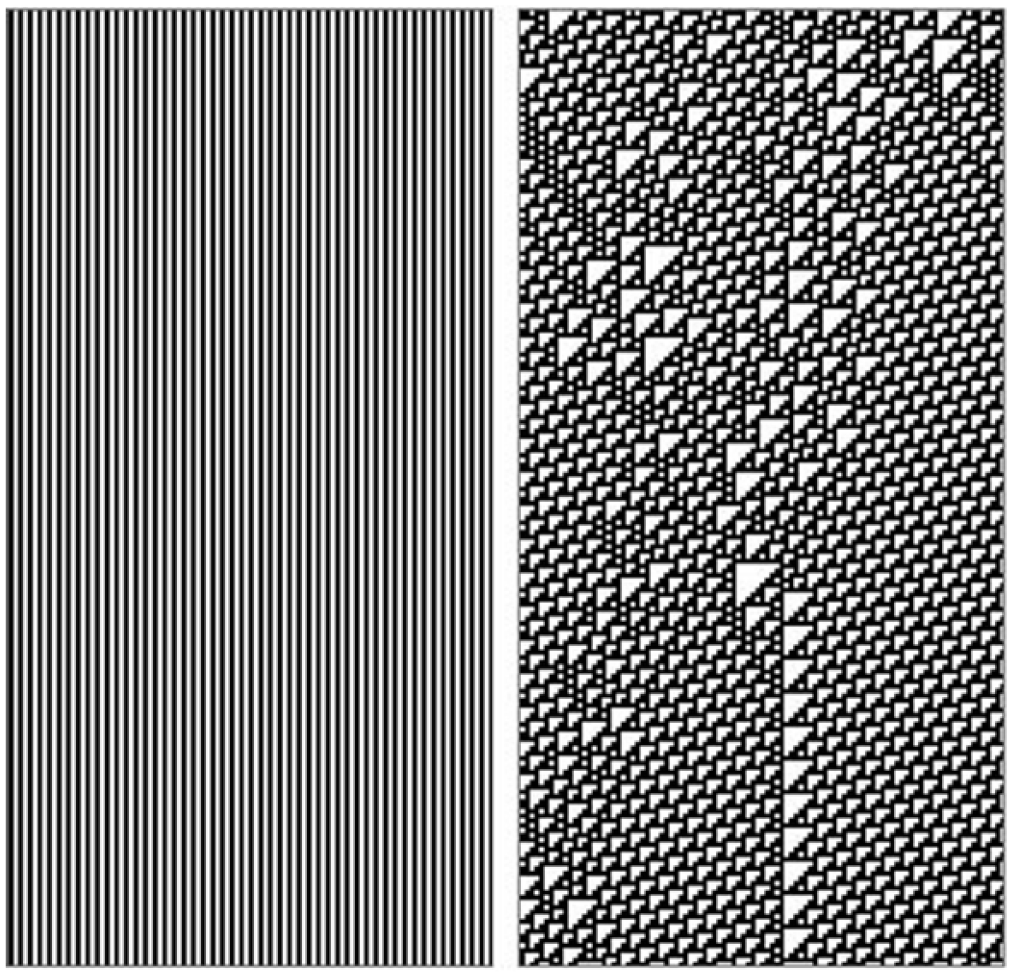
Rule 70 (left) and Rule 110 (right) elementary cellular automata.
Figure 3 displays the evolution of the cells for both Rules 70 and 110. The outcomes the rules produce differ dramatically, even though their aggregate statistical properties are indistinguishable within a 95% confidence interval. Rule 70 maps readily onto DSGE modeling; for Rule 70 the blue and orange lines coincide, as befits a system continuously in macro equilibrium. OEE modeling maps onto Rule 110, in that OEE modeling illuminates microlevel details that generate macrolevel patterns without contesting the macrolevel properties of DSGE modeling. The blue and orange lines never coincide and yet their aggregate values are identical within a 95% confidence interval, as befits a market system with self-ordering properties at the macro level.
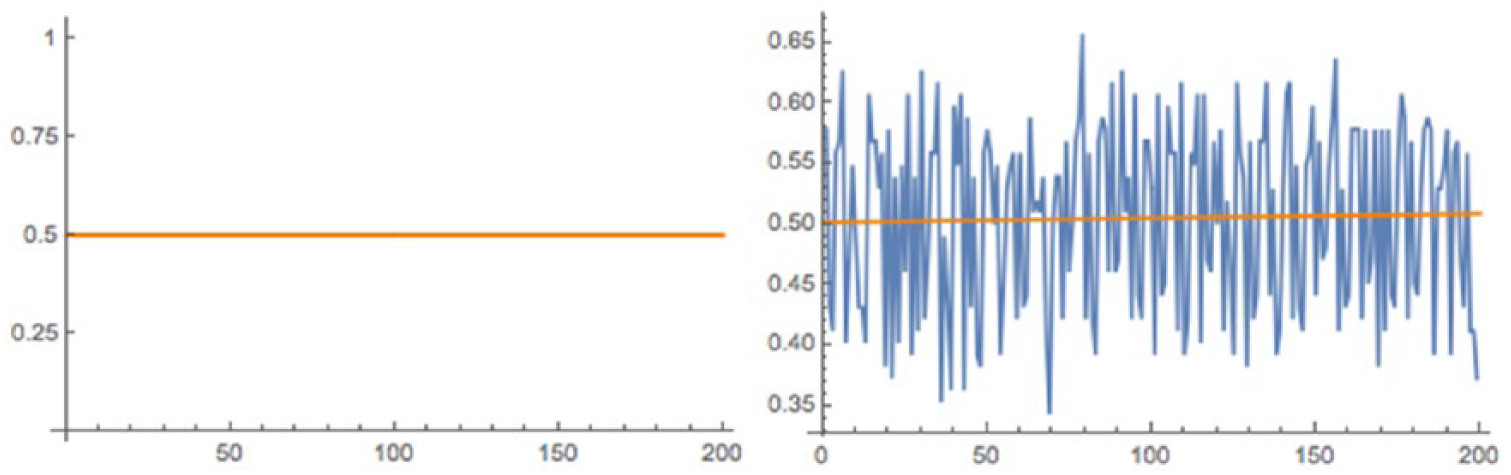
The row-by-row density of black cells (blue) and their line of best fit (orange).
Even though Rules 70 and 110 have very similar densities of white and black cells, as the system evolves from top to bottom (Figure 3), they exhibit wildly different structures. The capabilities of each system as it evolves depends on its rules; the first cellular automaton is not capable of computing anything interesting, while the second cellular automaton is capable of computing everything—it is a universal computer (Cook, 2004; Riedel & Zenil, 2018). That is, the first cellular automaton is not able (without external intervention) to traverse a path from any one state to any other state, while the second cellular automaton can.
For complex evolutions like those embodied by cellular automata or social systems, whether or not intervention is justified is not apparent from looking at the kind of averages embodied by most macro indicators. Neither can we get a sense for how the intervention changes the capabilities of the system to steer its fate by only considering the values of indicators instead of how policy changes percolate through rules and structures of the system.
Macro theorists often work with stylized facts, and seek to explain those facts. Among the facts with which macro theorists seek to explain within the DSGE model are the procyclical behavior of real output and real wages, the acyclical behavior of the real interest rate, and the countercyclical behavior of unemployment. Left out of such examinations are two overwhelming facts that are more than stylized. One fact is that societies work, in the sense that people everywhere are fed, clothed, and housed. This is an observable regularity across time and place. The second fact is that there is continual volatility within societies. Some businesses prosper, others fail. Quarrels among people invariably erupt. Social life has a good deal of roughness and volatility, and by no stretch of the imagination is it placid. Change comes not as exogenous shocks but as eruptions from inside society. That such eruptions occur continually, moreover, meaning that plans are never fully coordinated within a society. Something like Rule 110 more accurately captures the performance characteristics of economic systems than does Rule 70.
Economies have a generally coordinated quality, in that the quantity of grain converted into flour generally matches the amount of bread that bakers want to bake and consumers want to buy. Another such fact is that such coordination is never complete. The production of grain is subject to variability in the weather. Bread that is baked might not reach the store where it was scheduled to be sold because the truck carrying the bread was destroyed in a collision with a train. Alternatively, bakers or truck drivers might be unionized and go on strike. Bread as a staple depends on where you live, with communities who favor rice and noodles gaining influence in many traditionally bread-dominant areas. Furthermore, a good number of consumers might think they should reduce their consumption of bread and other products made from grain. Things like this happen continually, which means that fluidity and change are likewise a stylized fact of economic life, as are the failures of commercial enterprises and the economic dislocations that result (Wagner, 2012b).
Economic life is generally orderly, but the associated orderliness is not that of a parade. It is rather that of a surging crowd of spectators leaving a stadium after an event. Unlike the members of a parade, the members of a pedestrian crowd will not know the exact path of exit they will take until they start their movement from the stadium. The path they discover might require them to walk around a crowd of slow moving pedestrians, or run to catch a bus that is just now pulling into the curb. Rule 110 reflects this form of orderliness, while reducing that orderliness to Rule 70 eliminates from analytical attention the self-ordering properties of alternative economic systems.
The pedestrian crowd is clearly a different species of societal configuration than the parade and requires a different conceptual foundation to explain its coherence. Both configurations are orderly, but the principles that govern that orderliness differ between the configurations. The orderliness of the parade is governed by the musical and marching talents of the members of the parade, as well as of the directional and supervisory talents of the parade marshal. These features have nothing to do with the orderliness of the pedestrian crowd. The orderliness of the crowd depends on such things as the ability of people to read minds as it were, by anticipating other people’s speed and direction of movement to avoid collisions. The pedestrian crowd is a self-organized social configuration; it is an order of independently acting pedestrians. In contrast, the parade is an organization under the direction of a parade marshal.
For OEE macro theory, the relationships of governance among economizing entities acquire central significance. For synchronic macro theories, governance is irrelevant because it has no place within the conceptual framework. For OEE macro, relationships of governance are of central significance. The principles of property and contract that govern market interaction mean that all participants speak the same language of profit and loss. Among other things, this means that participants will abandon failed plans in an economically efficient manner, thereby promoting efficient redeployment of released resources (Wagner, 2012b). Political entities, however, do not speak the language of profit and loss, as Roger Koppl (2002) explains. Big Players lack the budget constraints that ordinary players have, and this absence renders such players less predictable than ordinary players. A central bank, for instance, can buy assets without being concerned about how to pay for those assets or about the returns they expect to receive.
Competition and Coordination Within an Ecology of Plans and Games
Macro theories typically treat macro variables as acting directly on one another, as when monetary or fiscal expansion is modeled as increasing aggregate output. Macro policy, in turn, is treated as an instrument to control the state of macro variables, typically to smooth variability through time in macro variables. This type of analysis treats macro variables as scaled-up versions of micro variables. A number of scholars have pointed to some problematical features of this treatment, as illustrated by Kirman’s (1992) and Hartley’s (1997) critical analyses of representative agent modeling, Janssen’s (1993) analysis of the effort to erect macro on secure microfoundations, Smithin’s (2004) effort to point out that the macrofoundation for micro theory is as much an open question as is the microfoundation for macro theory, and the several efforts in Colander (2006) to move away from Walrasian-style macro theorizing.
This article embraces the general theme conveyed in these critical efforts and seeks to place the micro–macro relationship within an ecological orientation wherein the relationship between micro and macro is one of parts to whole. This scheme of thought entails no presumption that macro observations pertain to states of equilibrium, and rather proceeds within a nonequilibrium framework where macro phenomena emerge out of interaction among micro entities within an evolving ecology of plans (Wagner, 2012a). An ecology of plans entails turbulence because plans can interfere with one another, as when a new product takes away customers from an established business (Louçã, 1997). This turbulence arises because there is no presumption that there exists some preestablished coordination among plans. Instead, some plans fail while others do far better than their creators anticipated, injecting turbulence into the ecology in either case. The generally modest character of this turbulence can plausibly be attributed to the conventions of private property which operate to facilitate the efficient abandonment as well as revision of plans, as Wagner (2012b) explains. Within this ecology, state policy might operate to increase turbulence, due to the inability of policy truly to mirror the pattern of transactions that otherwise would take place within the ecology. Macro variables are not primitive variables that connect directly with the agents whose actions those variables reflect.
Peyton Young (1998) uses a series of simple coordination games to illustrate the emergence of coordinated patterns of economic interaction, as do the essays collected in Friedman (1994). Among the simple illustrations of systems-level phenomena are convergence to a single means of payment, convergence to a single rule for driving on a road, and convergence for a single standard of etiquette. Much of the analytical work done with these formulations comes through the analysis of evolutionary stability, wherein deviations from some established standard are either suffocated or give way abruptly to some alternative standard. Consider the use of the stag hunt game in Figure 4 to illustrate the possibility of an underemployment equilibrium. Two people are assumed to hunt a game animal, which they will consume in common. If each expends great effort, they will catch a deer, yielding the net payoffs (5,5) in Figure 4. Should both slack off in expending effort, they will have to settle for rabbit, with the associated net payoffs being (2,2). Should one slack while the other hunts energetically, only a rabbit will be caught. The slacker will have a net yield of 2, but the vigorous hunter will have a net yield of zero to indicate the disutility of effort offsets the gain from consuming half the rabbit.
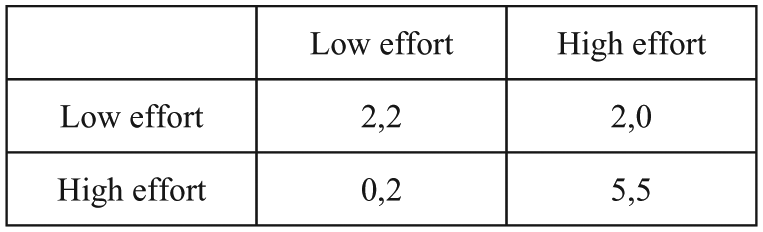
Stag Hunt and Macro Equilibrium.
The stag hunt game can be and has been interpreted macroeconomically as illustrating underemployment equilibrium. Which of the two equilibriums in Figure 4 occurs is accidental, unless some outside authority intervenes to promote jointly high effort. To interpret the stag hunt as representing a macro economy raises issues about what constitutes reasonable reduction of complex realities to simpler representations of that reality. In this regard, the stag hunt surely fails. Such simple games as the stag hunt can only reasonably represent relationships and interactions in isolated settings that encase the participants and hold their exclusive attention. Otherwise, we must recognize that any particular interaction occurs within an ecology of overlapping interactions.
An ecological style of OEE analysis would seek to explain social coordination as an emergent product of a set of interactions within an ecology of games or interactions, as against reducing reality to one universal game. Individuals participate in multiple interactions, and with the identities of the other participants varying among individuals. In classical game theory, payoffs to players participating in any game are deduced from the situation by a theorist or expert and inserted into the payoff matrix. The theorist then searches through a menu of pre-solved one-shot and repeated games to find which abstract ordered payoff scheme matches his setup, as if these are the only trajectories a system of rational agents with coupled outcomes could ever traverse. In practice, game parametrizations are externally derived assertions crafted in a way to represent a recognizable set of attainable equilibria rather than to discover a macro trajectory for the system. There is no discovery in comparing the use of common-pool resources with a Prisoner’s Dilemma. The lack of institutional substructure required for self-management of common-pool resource (CPRs) is built into the payoffs by the theorist. No wonder theorists then conclude there exists no endogenous institutional substructure to assist agent coordination. The Prisoner’s Dilemma is not truly a two-person game because it requires a third person—the warden—who prevents the two prisoners from communicating with each other, as deftly pointed out by Elinor Ostrom (2010) in response to the widespread use of Prisoner’s Dilemma games in CPR analyses.
Market prices are endogenously attained through the competition among firms in their production-cost method in coordination with (local) demand. Market prices for goods are not simply asserted to equal such-and-such by an expert or theorist. Similarly, it would make sense to ask how we could obtain a plausible parametrization of a game by including the belief-formation process in the model. A macro game would then take into account the belief-formation processes of many player types. Belief formation relevant to a macro game may—and, we believe, often—require playing different games with other players. For game theory to shed insight into macro or systemic questions, it must have ecological character. A model of an ecology is necessarily a reduction from any actual ecology; however, within that representation ecological characteristics will remain apparent, as against being reduced out of sight. By treating a macro economy as an ecology of games, we have in mind a model in which systemic outcomes emerge out of interaction among participants across several localized games with overlapping participation among the games.
To use game theory to illustrate systemic coordination, we must work with an ecology of games and not a representative game if we are to avoid embracing a model where one agent can apprehend and act on the entire system of economic interaction. Within the spirit of the stag hunt, suppose the economy entails three sets of interactions: (a) a hunting game, (b) a butchering-and-packing game, and (c) a retailing game. Two hunters search for game, one of whom sells the game to be butchered and packaged, and with one of the butchers distributing the meat to a retail outlet. Within this analytical setup, no player spans the entire set of games that constitutes the economic ecology, though there are at least two players who participate in two games: one hunter makes contact with a player in the meat game while one player in the meat game makes contract with one player in the retail game. Within this setup, information is spread across markets through exchange, yet no participant is able truly to apprehend the entire system. Societal coordination is thus not something imposed or assured by a coordinating agent who stands apart from market interactions but rather is an emergent quality of societal interaction; moreover, the quality of those interactions is likely to vary among possible institutional arrangements. The stag hunt macro game is now broken into a series of three overlapping games with not all the same players in every stage, to provide a reasonable framework to illustrate systemic coordination without a coordinating agent.
A simple example can show how payoffs in one game can determine the payoffs in another game. A parametrization of the game facing hunters, for example, can be obtained from considering the relationships between agents across the chain of games starting with extracting the raw material to selling the final product to consumers.
Suppose there are three games: (a) hunt game, (b) butcher game, and (c) retail game. Refer to these games as
The payoffs attained by hunters depend on the profits attained by the butcher game, which depend on the profit attainable in the retail game, which itself depends on consumer demand. Games are played pairwise, meaning that players form expectations based on beliefs formed about their direct interactions with players in other games. These beliefs may contain some knowledge about upstream games, like a knowledge of market price for the good, but they do not explicitly take into account the details of other games. Games are played locally, which is why players who play more than one game in the chain of games that underlay a “macro” game are so important: they have knowledge of the details of two different games and may be able to use that knowledge to alter the payoff structure of each. Let’s express this formally.
There are five total players in the ecological game: N = 5. Players 2 and 5 only play one game each. The rest of the players play two games each. Players 1 and 2 play the hunter game

The formal expression of game 1 as a tuple is as follows:

In the butcher game, one of the hunters (it does not matter which) sells a whole rabbit/stag to a butcher (
We can express Game 2 as follows:

which is a simple coordination game. The formal expression of Game 2 as a tuple is as follows:

The payoffs to hunters in Game 2 determine the payoffs in Game 1. To make that relationship explicit, assume that Player 2 in Game 1 obtains his payoffs in the same way as Player 1 and note that the payoffs to Player 1 (the hunter) in Game 2 can be written as follows:

where
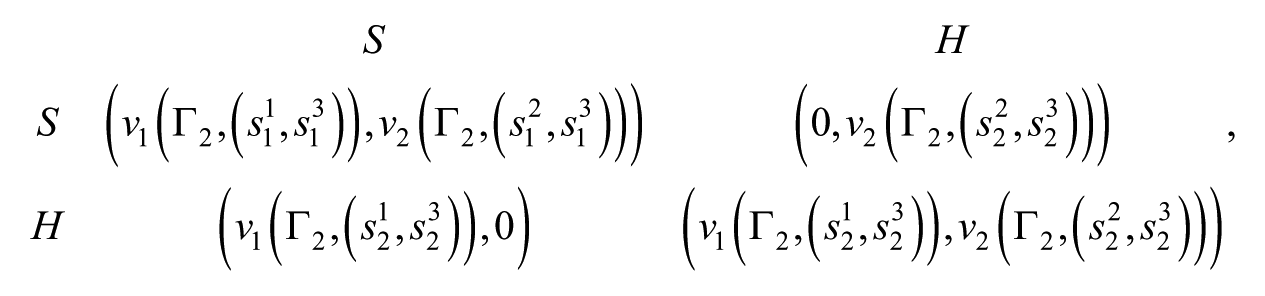
where
To analyze the retail game and show how it is interrelated with the hunt and butcher games, suppose for the sake of simplicity that N = 4 buys from N = 3 at a cost
Suppose that players 4 and 5 play a Cournot game of quantity-setting, given some abstract linear demand for stag meat

is

where
Consider the strategy profile where players 1 and 3 are both playing stag in Game 2. Then, for Player 3 her profits are the same as her payoff

and her input cost is the same as the payoff to Player 1:

where we include

As we are only considering the stag strategy profile at the moment, let us abbreviate


The choice of N = 4 that maximizes his payoff is therefore

The maximum payoff to the retailer is then
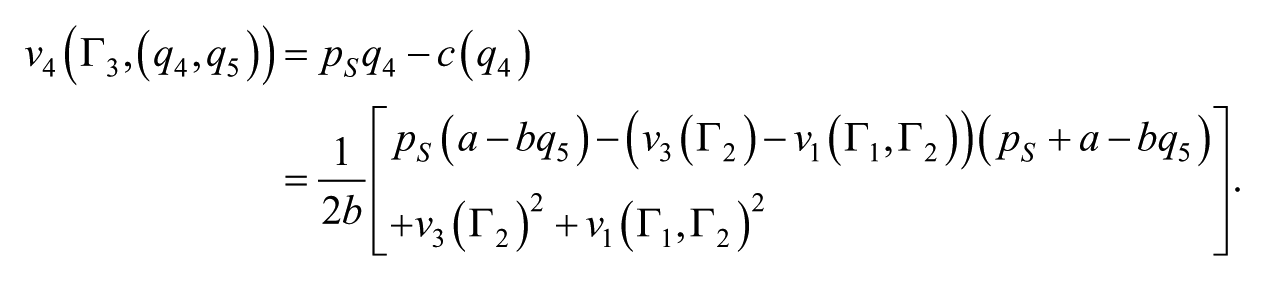
We see that the payoff to Player 4 in Game 3 is nonlinear in the payoffs to players 1 and 3 as determined in Games 1 and 2. Information concerning strategies of a game downstream from Player 4, concerning players of a game in which he is not directly involved, become part of the determination of his payoff. It should be noted that we do not expect Player 4 to be explicitly aware of the payoffs to players 3 and 1; all he needs to know is the cost of buying butchered stag which encodes information about the payoffs to Players 3 and 1.
Notice that the interconnection between games forms a bipartite network of relationships between games, where games which share participants are connected with a directed edge from more to less primary stages of the production process, and participants are indicated by undirected connections to the games they play. Figure 5 represents the preceding stag hunt example by such a network, where the game nodes are indicated in red and the player nodes are indicated in blue. Note that there is one game stage in which the retailer and butcher exchange that is not included explicitly in the example above.
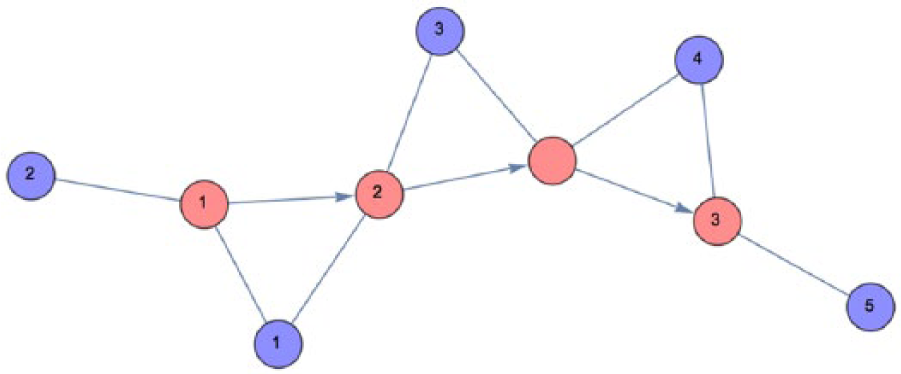
The bipartite network representing the stag hunt ecology of games.
What interconnection among some subset of players across the games accomplishes is some spread of knowledge beyond what is contained within any particular game. This spread of knowledge breaks down the structure of any single stipulated game. Suppose hunters sold their meat directly to consumers of the meat. If there are only two hunters in society and they distrust each other, then consumers may be stuck in a situation where they are only ever supplied hare even though they exhibit a positive demand for stag. But once there is more than one pair of hunters, they compete with each other not just with credibility but by choosing to play variations of the hunting game that may better survive competition by providing a high-valued item to the market.
Or, institutions—like assurance—may be selected for, which enables hunters to change the payoff structure they face. For instance, a participant in the hunter game might deal regularly with a participant in the butcher game. In the course of those transactions, conversations will lead to some sharing of experiences and stories. The butcher player might report his experience that in the majority of cases the other hunters return with rabbits. This exchange of information might inspire the hunter, who knows that he is not a slacker, to spy on some other hunter during one excursion. Suppose that hunter observes the other party to swim in a pond rather than chase deer. At that point the hunter faces several options, other than also becoming a slacker. He could kill the slacker, thereby hoping to secure a more energetic replacement. He could accost the slacker, hoping to induce a change in behavior. He could report the slacker to the Chief, along with perhaps suggesting a remedy whereby communal consumption is abandoned in some fashion. As the hunter benefits if he can be confident other hunters will hunt stag with him instead of slack, he may offer effort or payment to help ensure that other hunters do not slack. As both he and the butcher benefit from the higher profit margins on stags, the hunter may simply relay to the butcher information about other hunters slacking, and the butcher may then decide to offer effort or payment to help ensure hunters do not slack. Retailers all the way upstream may get word from butchers that hunters are slacking, and decide to do something to change the payoff structure faced by the hunters in a way so that stag is selected for.
Our point in raising such a menu of options is to move in the direction of a generative or emergent style of macro analysis where systemic outcomes emerge out of microlevel interactions. By allowing games to compete, and explicitly expressing payoffs as a function of demand and/or expected profits from a producer upstream, we can expose the process of payoff parametrization in such a way that enables us to investigate the ways in which markets operating as usual deal with the kinds of perverse social situations indicated by the stag hunt and prisoner’s dilemma games.
Generally, an ecology of games framework is one in which
Payoffs are coupled between different games.
Games are allowed to compete, that is, games are objects of choice by virtue of endogenized payoffs.
The standard approach of game theory is to stipulate a set of rules and payoffs the players face, which determines the game’s properties. Our suggested ecological framework, however, starts with individuals who interact among other people in a variety of settings, with conventions, practices, and payoffs emerging through those interactions. Where the stag hunt game posits a rule of communal consumption, the ecological formulation is one were rules of consumption and ownership emerge through interactions among the participants. In this respect, we would note the presence of a good deal of anthropological literature that situations of common consumption of game where tribal customs have rules for attributing ownership of game all the same. Whoever receives the attribution of ownership is able to host the meal where the game is served, thus harnessing an interest in status to offset what might otherwise be tendencies toward lassitude.
To put game theory into an ecological framework means that the aggregate or systemic properties of that game cannot be inferred from the solution to a representative game. To the contrary, there must be interaction among games, with the systemic properties stemming from that interaction. At every node in this supply chain, there will be multiple participants connected with one another through webs of expectations and contracts. Performance within the system cannot be reduced to performance at one node within the system nor can a system of independent nodes be reduced to a representative node.
DSGE highlights a system that is well coordinated, accompanied by a presumption that failures of coordination might be overcome with appropriate actions by a political authority. This recourse to political authority appears reasonable, even necessary, when the macro economy is modeled as a representative game. When it is modeled as an ecology of games, however, the macro economy entails internal sources for replacement of lower valued with higher valued practices. Disaster is invariably followed by recovery, though with differences in the speed and quality of recovery across time and place. DSGE provides no insight into processes of recovery, as against asserting that recovery from failure does occur, and might be facilitated by political effort, though possibly not. Where OEE comes into play is in probing the processes and institutions that undergird recovery, facilitating recovery or hindering it. OEE shifts the analytical focus from resource allocation to the institutional arrangements that govern social interactions, and with the macro or systemic properties emerging out of those institutionally governed interactions.
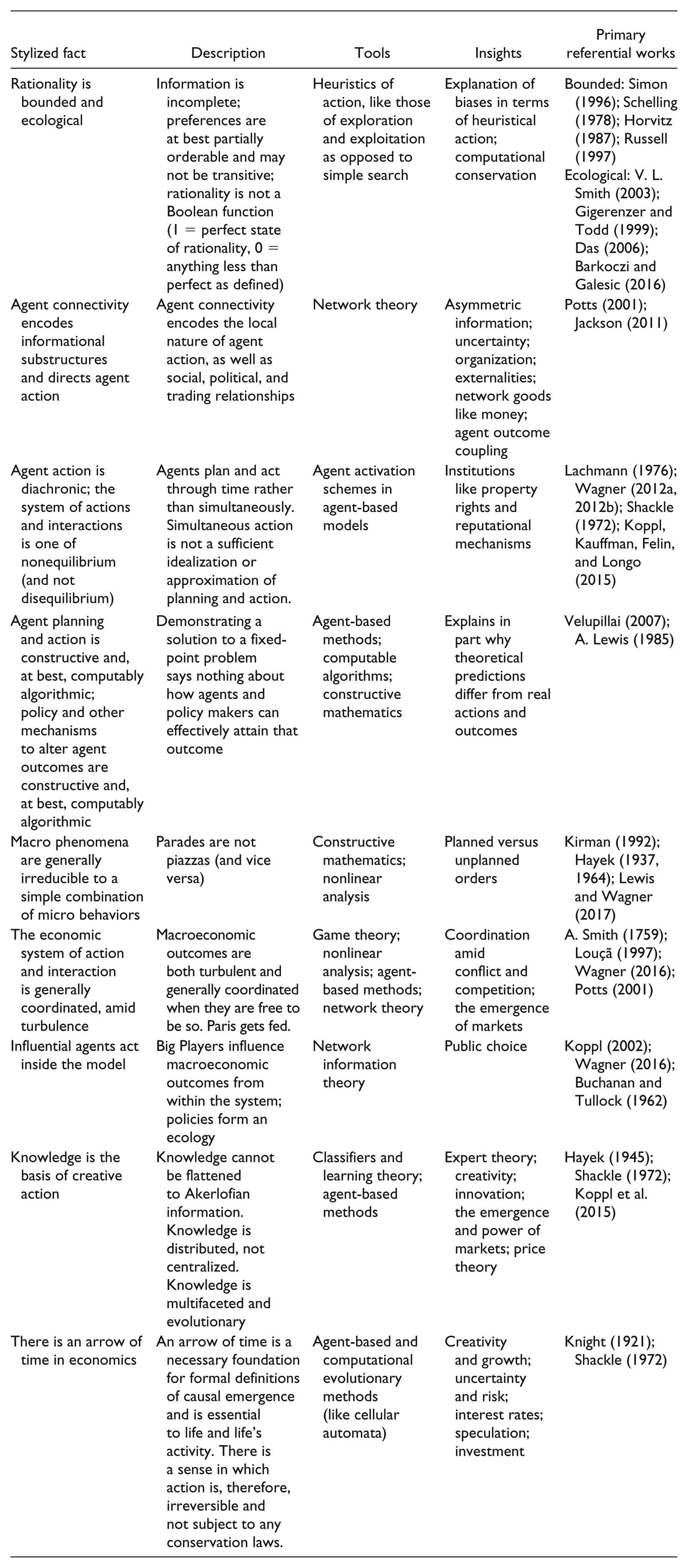
We close this section by summarizing the qualities of an OEE macro theory as a series of “stylized facts” to guide our construction of an OEE theoretical apparatus.
Closing Thoughts
Macro theory has been largely conceptualized as an instrument of applied statecraft, with theorists helping political pilots to steer the ship of state. This vision for macro theory seems to follow almost inexorably from the DSGE framework because there is no place within that framework truly to account for variations in the direction of the ship of state. In contrast, OEE recognizes that modern economies are highly complex networks of interaction that defy easy navigation, as contrasted with recognizing that some institutional arrangements might increase variability in economic systems. Even within the simple stag hunt game, the so-called underemployment equilibrium stems from the presumption that all consumption is in common. Within such institutional arrangements, it would be reasonable to expect a good deal of slacking. It would also be reasonable, however, to wonder about the survival of such arrangements.
With respect to institutional arrangements, it is also reasonable to wonder about the coordinative properties of economic systems with large degrees of public ordering in contrast to systems where private ordering predominates. Within the simple ecology of games we advanced, systemic coordination was an emergent feature of private ordering and its associated calculus of profit and loss. Public ordering replaces the calculus of profit and loss with a political and bureaucratic calculus, the properties of which are still relatively underexplored, probably in large measure because macro theorists have given the predominant share of their attention to wrestling with engineering types of questions rather than wrestling with scientific types of questions that require generative rather than stipulative modes of analysis (Epstein, 2006; Mankiw, 2006). We hope we have illustrated some of the valuable potential an OEE approach to macro theorizing might have for connecting the micro level of human actions, both commercial and political, with the macro or systemic level of the resultants of human interactions.
Footnotes
Declaration of Conflicting Interests
The author declared no potential conflicts of interest with respect to the research, authorship, and/or publication of this article.
Funding
The author received no financial support for the research, authorship, and/or publication of this article.
