







Abstract
This study introduces a comprehensive model of institutional grafting wherein cultural, market, and political forces shape new legal institutions. The model is used to suggest that a country’s growth rates are a function of incongruence between legal institutions and the three forces. We demonstrate that incongruence is large in path-break but tends to be significantly smaller in path-drift. We argue that legal institutions are thereby instrumental to economic growth when a country drifts along the established institutional path and only modestly influence growth rates during institutional path change. In the latter case, the political dimension determines the success of both growth trajectories and institutional reforms. These propositions are tested empirically based on a sample of 106 countries derived from the POLITY IV Project’s website.
Growth theory asserts that good formal institutions are conducive to rapid economic development (see Acemoglu et al., 2019 and Acemoglu & Robinson, 2012 for an overview). Empirical research largely supports this claim but acknowledges that the direction and strength of institutional effects on a country’s performance are not linear. Barro (1997) suggests that formal institutions stimulate economic growth at early stages of their development and retard growth as they mature. Kim and Lee (2010) point out that a formal institutional framework is instrumental during a country’s transition from low to middle income groups and only marginally affects growth of rich economies. Falvey et al. (2009) refer to institutions supporting technological change as a key growth factor in developed countries.
We argue that the mode of institution building can also affect the extent to which formal institutions enhance economic growth. Our analysis’s contribution consists in demonstrating that path-drift legal institutions are important to growth rates because such institutions develop in congruence with existing cultures and local markets. Path-break presupposes that legal institutions are mainly created by the government through a top-down approach in conditions of large-scale, radical political and economic transformations. In this case, the quality of designers of institutional change is more important for the rate of economic growth than legal institutions as the political dimension defines not only the ultimate properties of these institutions but also their congruence levels with dominant cultures and changed markets.
Literature Review and Extension
Institutional economics offers two key modes of institutional change—evolutionary path-drift and designed path-break (see Acemoglu & Robinson, 2012 and Coccia, 2019 for an overview). Evolutionary path-drift refers to bottom-up institutional change undertaken through small cumulative or partial alterations in the existing institutional framework. It is mainly triggered by the evolution in technology or market reorganization requiring from economic agents to introduce informal changes among formal “rules of the game.” These changes are gradually formalized by the political system and acquire the status of formal institutions. Proponents of evolutionary path-drift link institutions to a country’s history and view any institutional set as unique to a society expecting a substantial divergence in the kind of institutional frameworks among countries, both in the short and long run. Boettke et al. (2008) refer to the private international commercial law as an example of evolutionary path-drift.
Designed path-break is defined as an abrupt alteration of the entire institutional framework through the top-down introduction of laws by the government, often by replicating them from more advanced to less advanced societies. Politicians are viewed as designers of path-break, whereas the notion of institution building is reduced to writing formal rules. Proponents of designed path-break deny the historical link of institutions to the past or culture. They recognize both the possibility of determining an optimal set of formal institutions for any given country and the feasibility of introducing radical institutional reforms within a very short period of time. Boettke et al. (2008) suggest that postcommunist transition from socialism to capitalism and Japan’s postwar reconstruction are good examples of designed path-break.
Literature acknowledges that designed path-break can also happen on a smaller scale when a shift to a new logic occurs not in the entire institutional framework but only in few formal institutions. The Patriot Act or the Dodd-Frank Wall Street Reform and Consumer Protection Act are examples of a small-scale path-break in the development of the regulatory framework. Such alterations often occur as a result of a crisis. Higgs (1985) argues that the crises can create new understandings of and convictions about the potentialities and dangers in the economy changing thereby the underlying behavioral structure in society and allowing the government to radically reform the relevant formal institutions.
As no complex system evolves in a strictly linear way, economics, in addition, distinguishes between two nonlinear modes of institution formation: designed path-drift and evolutionary path-break. The designed path-drift is viewed as an introduction of top-down, mainly marginal reforms by the government to a country’s institutional framework. The intentional top-down reforming of institutions often takes place as a reaction to the crisis but have path-dependent alterations in mind. These reforms can also be large scale in nature and embrace entire sectors but they do not change the entire institutional framework and only refer to one or few elements thereof. This enables a country to drift along the established institutional path while adjusting to changed economic or social conditions. The Great Recession represents a good real-world example of designed path-drift that included evolutionary adoption of increasingly obscure derivatives as objects of value and exchange that resulted in a substantial transformation of a financial regulatory framework. Increasing pension age and supplementing public pensions with obligatory private pension accounts are another example of designed evolution of pension systems in Europe.
The evolutionary path-break refers to a bottom-up transformation of institutional frameworks that occurs on such large scale that can be classified as changing institutional path. Institutional alterations are triggered when the economy reaches a threshold that, when exceeded, can lead to large changes in the state of the system. So-called “tipping points” are examples of nonlinear phase transitions that occur at certain parametric thresholds during the normal, seemingly conservative evolution of complex social systems. Haldane and May (2011) refer to “cascades” as an example of evolutionary path-break.
We argue that the mode of institution building can contribute to explaining how formal institutions impact economic growth. We limit the notion of formal institutions to a set of legal rules that structure the behavior of economic agents in the market and that are often called economic institutions. We use Portes’ (2006) sociological model of institutional grafting to construct a base analytical framework. Portes distinguishes between a dual set of forces that shape the institution formation process—culture and social structure. A country’s culture is viewed as values and norms that govern the behavior of economic agents and authority figures. Social structure is derived from the political system and is limited to power and elite who control that power. Both are seen as embedded within a certain class structure with a clearly specified status hierarchy. Portes further suggests that institutions can be created or promoted from one of the two sources by emerging spontaneously from a country’s social norms/customs/beliefs/traditions or imposed by political power and elite. Regardless of the source of their formation, the new institutions must be compatible with both the culture and social structure to survive. If institutions stem from the culture, dominant classes and political elite must be persuaded or compelled to legalize them. If imposed by political elite, institutional reforms must presuppose a shift in the underlying norms and values to enable their cultural acceptance. If it is not the case, the culture and social structure cannot function in harmony and may create opposition to any type of institutional change.
We expand Portes’ approach by arguing that successful legal institution formation or transformation is shaped by three-dimensional forces. The first dimension includes cultural forces drawn upon prevalent values/norms that dictate right and wrong, as well as one’s behavioral compliance with these values/norms. The second dimension is markets that describe the nature of economic arrangements and economic infrastructure in a country wherein economic transactions are undertaken. The third dimension is political, where we distinguish between (a) political elite who deal with the design or formalization of legal institutions, and (b) political institutions that refer to the regulatory framework according to which prevailing political interests are organized into legal institutions.
We adopt Portes’ assumption that legal institutions should be congruent with the logic of all three dimensions to function effectively. We attribute the degree of this congruence to the distance in the level of development between legal institutions and the dimension items. Our key premise is that the three distances should be minimized to enhance a country’s economic growth. We suggest that the odds of minimizing each form of distance may vary among the modes of institution building.
We simplify our further analysis to path-drift and path-break. This simplification is justified by the fact that the empirical data do not provide enough information to make a clear distinction between the four cases and group the selected countries according to their institution formation mode. We define path-drift as evolving new institutions through marginal cumulative changes within the established political and economic regimes. Radical institutional alterations are recognized possible in path-drift only if they modify not the entire set of economic laws but one or few of them. The institutional grafting process presupposes that institutional change stems from markets and results from advances in technologies or market organization principles. The cultural dimension adjusts to these shifts by introducing informal rules and norms. The political elite capture the informal institutions and formalize them through the existing political institutions.
We define path-break as creating a new institutional framework, with the majority of new institutions being very different to previous ones, that occurs in conditions of changed political and economic regimes. Here, the institutional grafting process starts from the political dimension. With a political regime transition, new political elite come to power initiating radical reforms in the political system and legal institutions. In this case, cultures and markets remain away from institution creation and are often expected to adjust themselves to new political and legal conditions through learning.
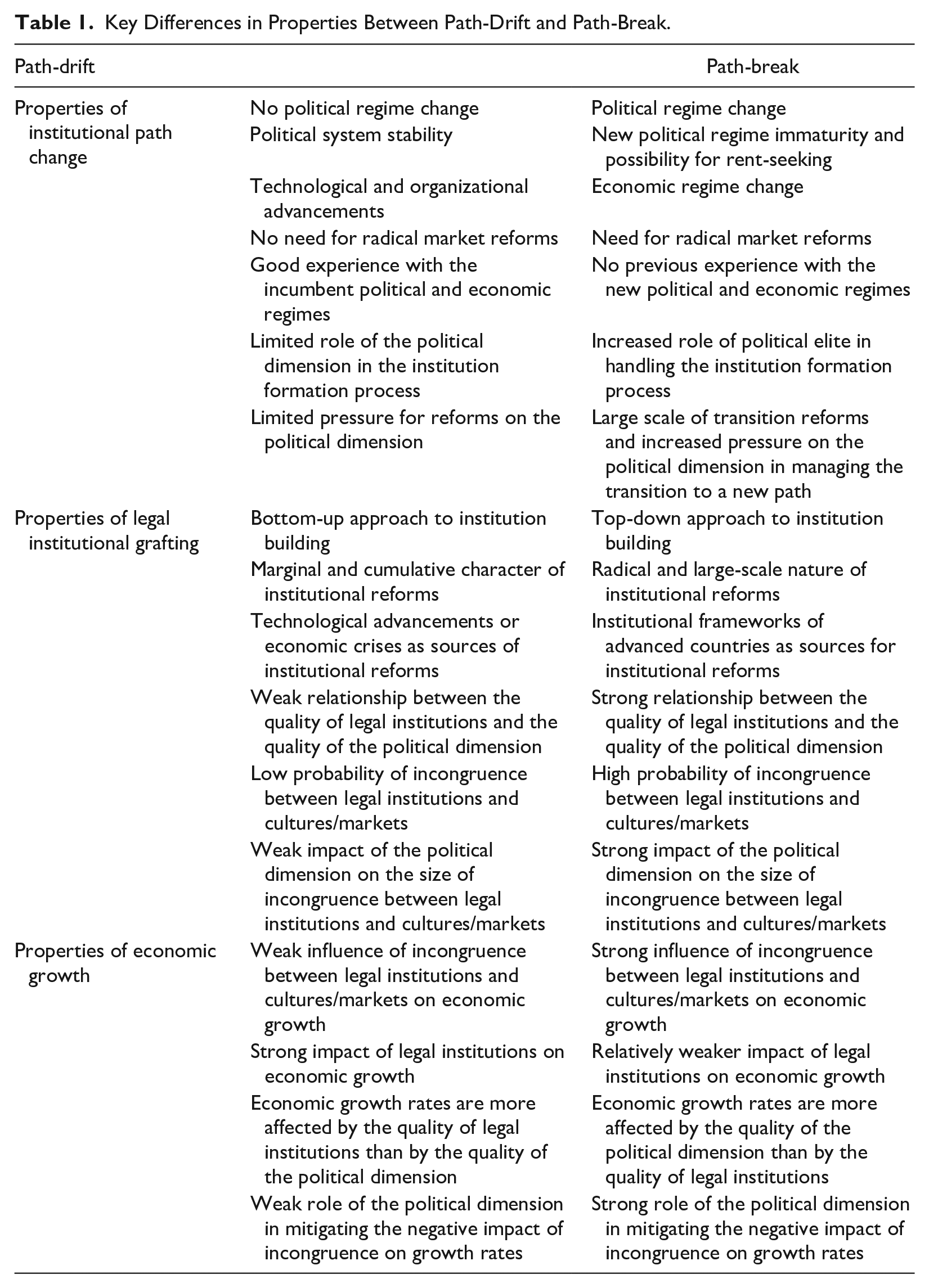
The key distinction between the two modes of institution formation is that, unlike path-drift, path-break in legal institutions unfolds in the state of radical change in a country’s political dimension. Fidrmuc (2003) characterizes it as a unique feature of breaking to a new institutional path that a political regime alteration always precedes institutional reforms. Aslund (2018) emphasizes that this feature has considerable implications for the entire transition process by determining the scale of reforms that should be introduced in path-break: Political regime change presupposes change not only in the political elite or political system but also in the logic of economic and social processes requiring profound political, economic, and structural reforms. By contrast, political regime stability entails no such need and can unfold within the same political institutions, market organization principles, and economic conditions. This means that in contrast to path-drift, path-break is characterized by a larger scale of transformations that embrace political and market domains and should usually be undertaken in parallel with legal institutional reforms. Kolodko (2020) effectively demonstrates the complexity of reform packages by using the example of Polish postcommunism transition. In the course of a political shift to democracy, Poland had to implement a multilayered program that included market-oriented economic, structural, social, and institutional reforms.
In addition to the scale of reforms, political regime change can have essential implications for the nature of such reforms. When a political system undergoes radical alterations, market and legal reforms are also radical and aim at creating regulatory frameworks that are not only very different to previous ones but often unfamiliar to the political dimension, local cultures, and markets. The scale and the radical nature of transformations presuppose that the top-down approach in handling the transition prevails in path-break and that the political elite are expected to design and guide the entire transition process.
With large-scale and radical transformations in path-break, managing the transition may create enormous pressure on the political dimension and set many pitfalls. Aslund (2007) suggests that the new political institutions’ initial immaturity may create temporary power vacuums and opportunities for a country’s political or economic elite to seek rents through the new legal institutional framework. Even if the rent-seeking is not the case and cultural preferences dominate in path-break, the new legal institutions’ quality depends on whether the political elite, incumbent to handle the institutional grafting, are sufficiently familiar with the new political and economic regimes and relevant legal rules. Pejovich (1999) asserts that as such knowledge and skills are often missing, institution building becomes limited to borrowing legal rules from countries with political and economic orders similar to those desired. The new legal institutions can thereby develop substantial distance to cultures and local markets as institutional grafting unfolds away from these two dimensions. Initially, the scale of incongruence is limited to how far the existing cultures and local markets are away from the properties of the desired political and economic regimes. But in the end, the political elite or their ability to encourage the formation of new behavioral norms and introduce local market reforms define the ultimate size of incongruence between legal institutions and cultures/markets.
Overall, path-drift is more likely to produce legal institutions that are congruent with local cultures and markets than path-break. Note that our juxtaposition’s key concern is the issue of congruence, not the efficiency of legal institutions. Tullock, (1965) or Wagner and Harris (2016) warn, for instance, that path-drift does not always spur efficient formal institutions as the formalization process can represent a source of rent-seeking even for countries on a stable institutional path. The process of path-drift institutional grafting can ensure, nonetheless, greater congruence between legal institutions and local cultures/markets than path-break. This congruence by itself contributes to supporting the functioning of legal institutions and the economy by providing a legally regulated environment, understood by local cultures and actually used to structure the functioning of economic agents in the local markets.
The high risk of incongruence has essential consequences for a country’s growth rates in path-break. In such conditions, economic growth is strongly affected by the ability of political elite to handle institution building properly and introduce adaptation measures minimizing incongruence or its negative impact on markets and the economy. The large extent of political and economic transformations in path-break, coupled with their radical nature, only intensifies the influence that the quality of political elite and their policies conduct on growth patterns of economies. Based on this, we suggest that compared with path-drift, path-break eases the dependence of economic growth on legal institutions as such. Instead, path-break increases the dependence of growth rates on the quality of the political dimension that handles the institution creation process and introduces political and economic reforms.
We summarize this juxtaposition in Table 1 and test the following hypotheses:
Key Differences in Properties Between Path-Drift and Path-Break.
Data and Method Description
To test our hypotheses, we rely on Eicher and Leukert’s (2009) approach of splitting the sample into subsamples. In forming our subsamples, we use the idea that path-break presupposes a profound transformation of the entire institutional framework resulted from a political regime transition. To identify whether a country has experienced a political regime change, we use the POLITY IV Project’s website (http://www.systemicpeace.org/polity/polity4.htm), which provides information about political regime characteristics and transitions between 1800 and 2015. A country’s annual polity score varies from −10 to 10, with values six and above denoting full democracy and −6 and below denoting full autocracy. In our analysis, a country has experienced a political regime change if (a) polity score values shifted from at least −6 or below to at least six and above, (b) this change is rapid and occurred within a few years, and (c) this change occurred after 1980. Any earlier transition is expected to produce institutions that would adhere to the local cultures and markets through the learning process and eliminate any incongruence. In this case, the new formal institutions would follow a path-drift-like maturation process; (d) the change is stable with no signs of reverting to the previous regime in the following years; (e) there have not been persistent fluctuations in the regime trend of more than three points since 1980. Regime trend fluctuations denote political instability, which is a separate issue in economics with respect to growth analysis.
Based on polity score trends, we form two subsamples (see Appendix): path-break and path-drift (due to space limits, we do not provide a country choice description but can send it upon request). Our path-break subsample includes 51 countries that transitioned to a different political regime involving a radical change in political and economic regulatory frameworks. The selected countries are heterogeneous in their starting points. This does not contradict the purpose of our analysis since the quantitative impact of initial conditions on the selection of reforms and rates of economic growth is small and tends to rapidly decline over time (Falcetti et al., 2000).
Our path-drift subsample is limited to 55 countries that have not experienced political regime change or have experienced profound but gradual change (each stage of change not being greater than a 3-point fluctuation in the polity score). These countries are also heterogeneous in their characteristics and include both democracies and autocracies, as well as developed and developing economies.
We are primarily interested in comparing how formal institutions impact economic growth for the two subsamples. The quality of legal institutions is approximated through a contract enforcement and property rights protection index sourced from the Economic Freedom of the World online data (see http://www.freetheworld.com/ for a detailed description of the index composition). The values vary from 1 (bad legal institutions) to 10 (good legal institutions), viewing legal institutions as “good” when they are clearly defined and well-enforced.
The political dimension’s quality is measured through the control of corruption in government, government effectiveness, quality of regulation, and voice and accountability indexes provided by the World Bank Group database. Their initial values vary from −2.5 (bad political situation) to 2.5 (good political situation). The four indexes are highly correlated, with the voice and accountability showing the greatest uniqueness in its variance (due to space limits, we do not report factor loadings and uniqueness variances but can send them upon request). We use this index to describe democratic settings in a country and hence the quality of political institutions. By using the factor loadings, we combine the three remaining indexes and construct a single measure approximating the quality of political elite and their policymaking.
In measuring the cultural dimension, we draw upon the idea of Gorodnichenko and Roland (2011) that economic growth is sensitive to individualistic or collectivist cultures. Individualism emphasizes personal freedom and achievement by awarding social status to personal accomplishments, such as important discoveries, innovations, etc. Collectivism encourages conformity and discourages individuals from standing out, which dampens innovations and completion. As data on individualism and collectivism are not available for the entire set of selected countries, we link culture to the concept of collective action and use a centralized collective bargaining index to approximate how individualistic or collectivist a country’s culture is. Gorodnichenko and Roland (2020) demonstrate that individualism makes collective action more difficult than collectivism, as individuals pursue their own goals without internalizing collective interests. We also established a strong correlation (.380) between the centralized collective bargaining scores and Hofstede’s single measure of culture that is often used to approximate a country’s cultural characteristics (due to space limits, we do not report our robustness check with a single measure of Hofstede’s cultural scores but can send it upon request. We do not utilize Hofstede’s cultural scores for our key analysis, as the data on Hofstede’s indexes are only available for 49 out of 106 countries in our sample).
To maintain our data set as a balanced panel, we utilize yearly data for the centralized collective bargaining index and source them from the Economic Freedom of the World website (see http://www.freetheworld.com/ for a detailed description of the index composition). The values vary from 1 “more collectivist culture” to 10 “more individualistic culture.” Using yearly data for the cultural variable is in line with recent findings demonstrating that cultural change is absolute rather than relative: Countries’ scores on the cultural dimension remain stable relative to the scores of other countries but still change their absolute values over time (Beugelsdijk et al., 2015).
We operationalize the markets dimension through the following set of Economic Freedom of the World index groups: private sector credit, capital controls, foreign ownership/investment restrictions, and starting a business (see http://www.freetheworld.com/ for a detailed description of the index composition). By using factor loadings, we combine the selected items into a single construct with values ranging between 0 “underdeveloped markets” and 1 “well-developed markets.” Table 2 reports descriptive statistics for the key variables.
Descriptive Statistics for Key Variables Used in the Analysis.
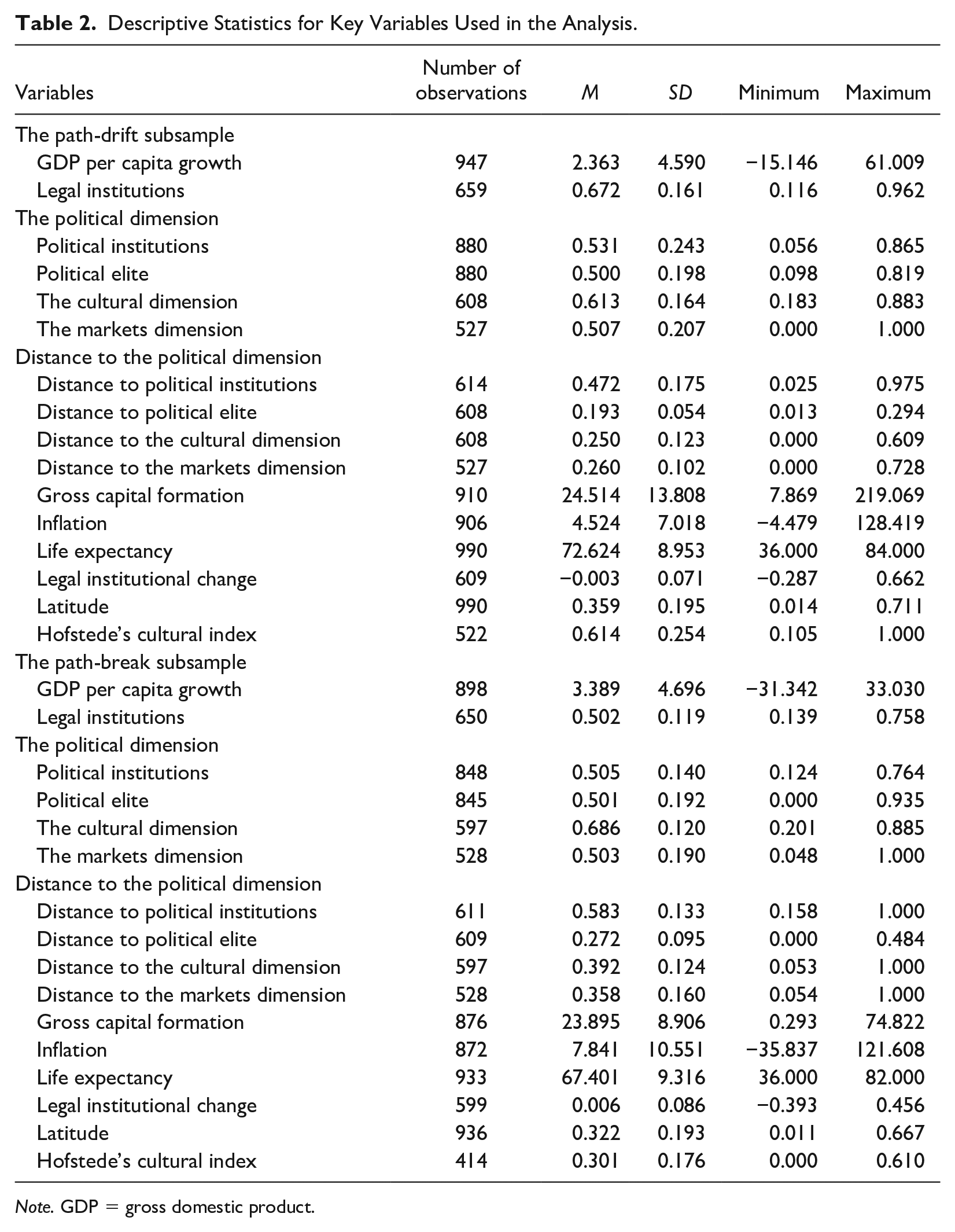
Note. GDP = gross domestic product.
To test our hypotheses empirically, we utilize the dynamic generalized method of moments (GMM) proposed by Arellano and Bond (Arellano & Bover, 1995; Blundell & Bond, 1998). The GMM estimator possesses numerous advantages in studying economic growth (Bond et al., 2001). First, the procedure provides estimates that are no longer biased by any unobserved country-specific effects. Second, the use of instrumental variables allows parameters to be estimated consistently in models with the endogenous right-hand-side variables, such as institutional scores in the context of a growth equation. Third, using instruments enables consistent estimation even in the presence of measurement error.
The procedure for applying this technique is well documented by Lee and Kim (2009). It requires that the equation is first-differenced to eliminate the heterogeneity in production function. Then, an instrumental variable method is applied on the differenced model, with lagged values of the endogenous variables used as instruments for the variables themselves. The GMM estimator may generate multiple instruments overfitting endogenous variables and leading to imprecise estimates of the optimal weighting matrix (Roodman, 2007). To avoid an overfitting bias, we restrict instruments to few lags of the respective variables and collapse them by creating one instrument for each variable and lag distance rather than one for each time period, variable, and lag distance. As literature gives little guidance on what instrument count is optimal (Ruud, 2000), we try to minimize the number of instruments in the analysis and test robustness of the key results to variations in the instrument count where the space permits. In selecting the count of lags, we use the idea that the inclusion of deeper lags improves efficiency by introducing more information (Anderson & Hsiao, 1982). We choose the system instead of difference GMM and estimate simultaneously in differences and levels, the two equations being distinctly instrumented. Bond et al. (2001) suggest that a system estimator has superior finite sample properties for the random-walk variable, such as economic growth, where past changes may be more predictive of current levels than past levels are of current changes.
To demonstrate the correctness of the instrument choice, we report the number of instruments generated by the model and ensure that the instrument count does not exceed the number of countries causing the overfitting of endogenous variables. We also provide the results from the Hansen overidentification test that tests joint validity of the instruments, and the Arellano–Bond test for AR(2) serial correlation in the residuals that tests for autocorrelation in the idiosyncratic disturbance term that may render some lags invalid as instruments (Roodman, 2006).
As the analysis has a relatively short time span, we may still encounter the problem of dominance of the cross-country dimension over the time dimension (Deaton, 2010). To account for this, we introduce a strictly exogenous regressor, such as a latitude variable, by considering it a standard IV-style instrument with one column in the instrument matrix per variable. Latitude was shown to shape human attitudes which determine both the creation and survival of various formal institutions (Acemoglu et al., 2005). We measure latitude as the distance to the equator.
We follow Bond et al. (2001) and treat all growth model variables as endogenous by generating GMM-style instruments for them. We include time dummies where possible to prevent the contemporaneous correlation. We request a two-step GMM instead of a one step as it provides covariance matrix which is robust to heteroscedasticity and autocorrelation and gives robust Hansen J-test for overidentification. We also request small-sample corrections to the covariance matrix estimates, resulting in t instead of z test statistics for the coefficients and an F instead of Wald _2 test for overall fit.
We utilize yearly data for the period from 1996 to 2014. Note that the vast majority of path-break countries moved to a new institutional path in the second half of the 1980s—beginning of the 1990s as a result of socialism’s collapse. We choose the year 1996 as a starting point for our analysis and exclude the initial transition years that entailed profound systemic changes (Fidrmuc, 2003) and were characterized by disruption, as well as political and economic instability. This analytical strategy is in line with previous studies (see for instance Eicher & Schreiber, 2010 or Falcetti et al., 2000). We use yearly data for estimating model parameters to maximize the time dimension and keep it close to the subsamples’ cross-country dimension (18 years vs. 50 countries). Focusing on yearly data is also consistent with findings demonstrating that economic and institutional reforms have considerable short-term effects on economic growth in countries that moved to a new institutional path (see Falcetti et al., 2000; Fischer et al., 1996).
We apply the same models to both subsamples while using a standard set of conditioning variables and standard periods. Our base growth model includes investment and inflation. Investment is considered a key predictor in growth models whereas macroeconomic stability is viewed as a precondition for economic recovery in path-break (Fischer et al., 1996):

where Yit is a measure of economic growth operationalized through an annual real GDP growth rate, Yit-1 is one-period-lagged economic growth. K stands for the investment measured through gross capital formation as a percentage of GDP. MS represents macroeconomic stability captured by annual consumer price inflation. The main source for the above variables is the World Bank electronic database.
We begin the analysis by calculating incongruence between legal institutions and the three dimensions as: Distance = [(dimensions’ value—legal institutional index)/legal institutional index]. We further rescale their values to vary between 0 “no distance” and 1 “large distance.” The distance variables’ impact on growth rates are modeled as:

where D_ is a measure of incongruence between legal institutions and one of the three dimensions. We further test the hypotheses about variations in the impact of legal institutions (LI) on economic growth between the two subsamples, as:

Similarly, we include the political dimension (PI) into the base model:

To explore how the political dimension impacts legal institutional change, we run the following model:

where LI_change stands for an annual change in the legal institutional index calculated as [(Legal Institutional Index in year t–Legal Institutional Index in year [t–1])/Legal Institutional Index in year (t–1)]. LI it-1 is a lagged value of the legal institutional index, PI is political dimension scores, and Life_expect stands for life expectancy (as in Acemoglu et al., 2001; Islam, 2004). Life expectancy captures a country’s disease environment (McArthur & Sachs, 2001), which is believed to have predetermined the kind of formal institutions that initially emerged in a country and persisted over time. Unlike settler mortality rates, this variable is available on a yearly basis for the entire sample. As formal institutions may influence the quality of life and impact life expectancy, we consider this variable a GMM-style regressor.
The political dimension’s impact on incongruence between legal institutions and cultures/markets is modeled as:

where D_variables are the distances that legal institutions develop to cultures and markets. D_variablesit-1 is a lagged value of the distance variables, PI is political dimension indexes, and Life_expect stands for life expectancy. The political dimension’s impact on the relationship between incongruence and growth rates is analyzed by introducing interaction terms in the base growth model as:

where PI*D_Culture and PI*D_Markets are interaction terms between the political dimension indexes and the distance variables.
Empirical Results
We commence our empirical analysis by checking the assumption that incongruence between legal institutions and the three dimensions depends on the mode of institutional change. As Table 3 shows, the distance values are significantly greater for path-break than for path-drift. Note that our concept of “distance” is not linked to any optimal or ideal level that either legal institutions or the three dimensions should attain. The distance variables only capture how far legal institutional score are from the scores measuring the dimension items. Table 4 supports our key assumption that incongruence between legal institutions and the three dimensions is a negative factor for economic growth. This relationship largely holds true for path-break than for path-drift. In the case of path-drift, we did not establish any serious negative effect that distance variables conduct on growth rates.
Mean Values for the Distance Variables, by Mode of Institutional Grafting.
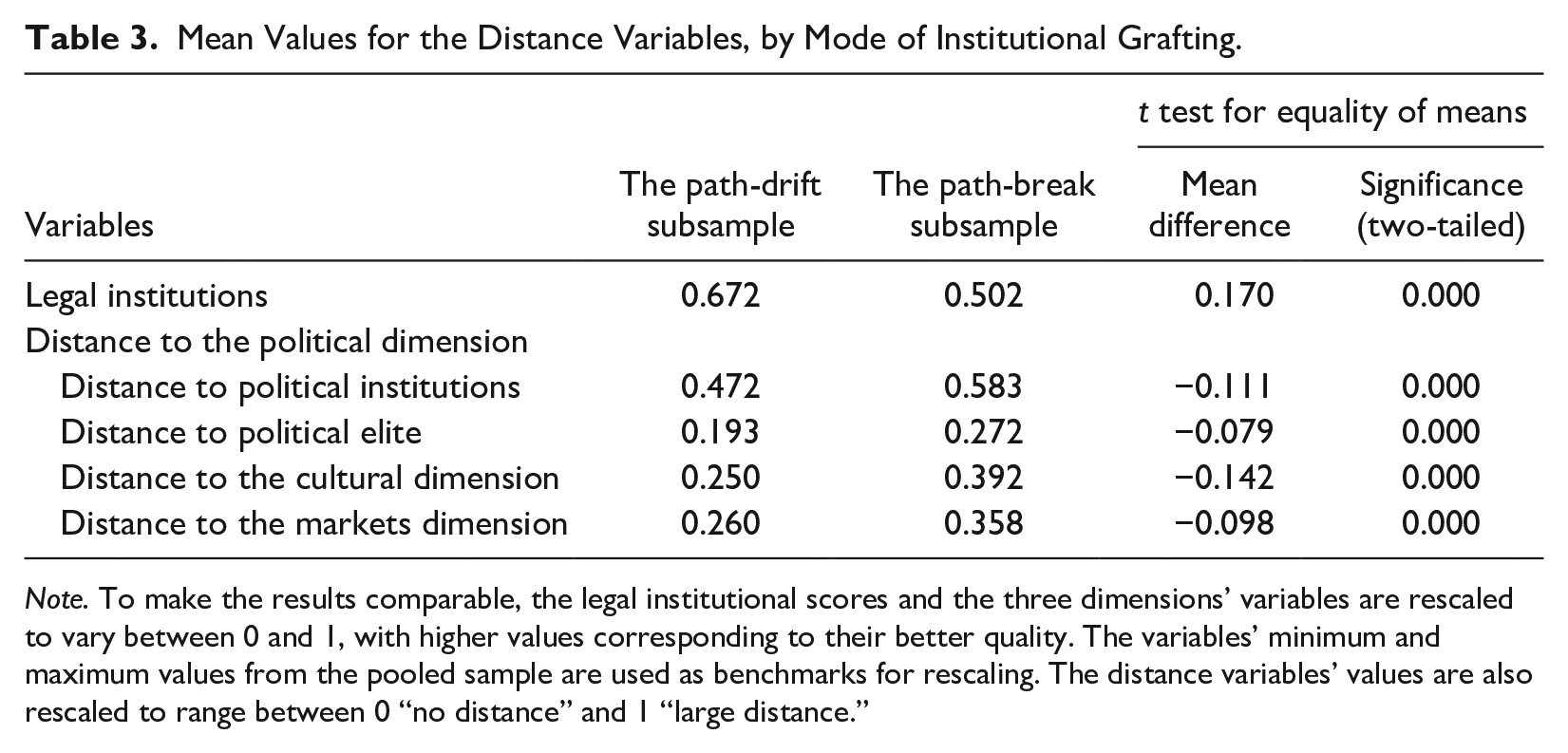
Note. To make the results comparable, the legal institutional scores and the three dimensions’ variables are rescaled to vary between 0 and 1, with higher values corresponding to their better quality. The variables’ minimum and maximum values from the pooled sample are used as benchmarks for rescaling. The distance variables’ values are also rescaled to range between 0 “no distance” and 1 “large distance.”
The Distance Variables’ Impact on Economic Growth, by Mode of Institutional Grafting.
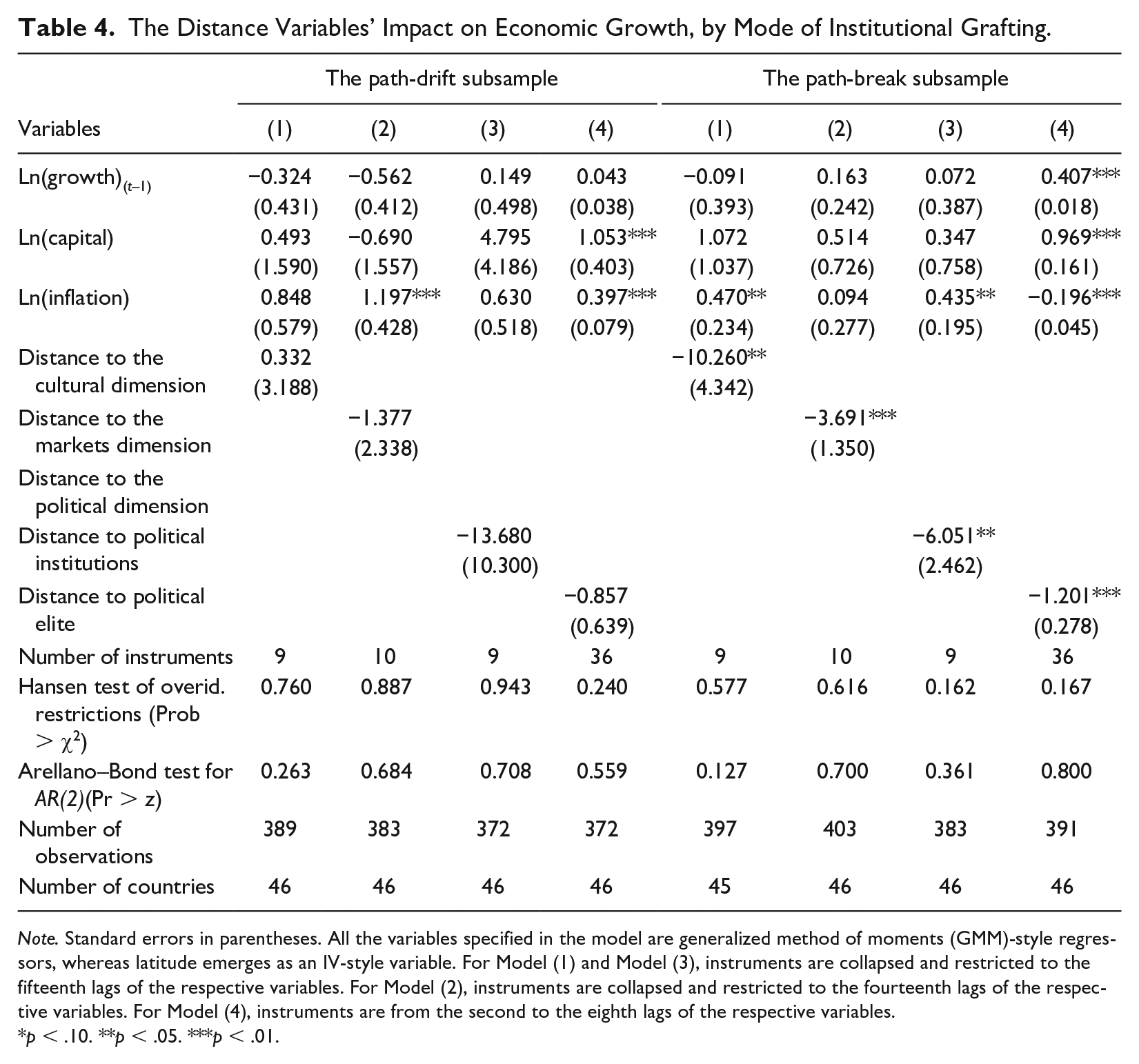
Note. Standard errors in parentheses. All the variables specified in the model are generalized method of moments (GMM)-style regressors, whereas latitude emerges as an IV-style variable. For Model (1) and Model (3), instruments are collapsed and restricted to the fifteenth lags of the respective variables. For Model (2), instruments are collapsed and restricted to the fourteenth lags of the respective variables. For Model (4), instruments are from the second to the eighth lags of the respective variables.
p < .10. **p < .05. ***p < .01.
As expected in H1, legal institutions are instrumental to growth rates of economies in path-drift, whereas this relationship is weaker in path-break. The results stand up to the alternative model specification choices and to the exclusion of resource-rich countries from the analysis (see Table 5). Results in Tables 6 and 7 support H2 and suggest that growth rates during path-break are highly sensitive to the quality of political institutions or political elite. We do not find any positive relationship between the political dimension and growth for path-drift. Rather, our analysis points out that when countries drift along the established institutional path, a strong political dimension can constrain their economic performance. These results remain robust to alternative model specification choices, the exclusion of resource-rich countries from the subsamples, and limiting the number of instruments generated by the system GMM estimator. In Column (3) of Tables 5–7, we follow Windmeijer (2005) and aggressively reduce the instrument count. As the instrument count falls, the coefficients only slightly change their values and do not lose significance, whereas the overidentification tests still remain valid.
The Impact of Legal Institutions on Economic Growth, by Mode of Institutional Grafting.
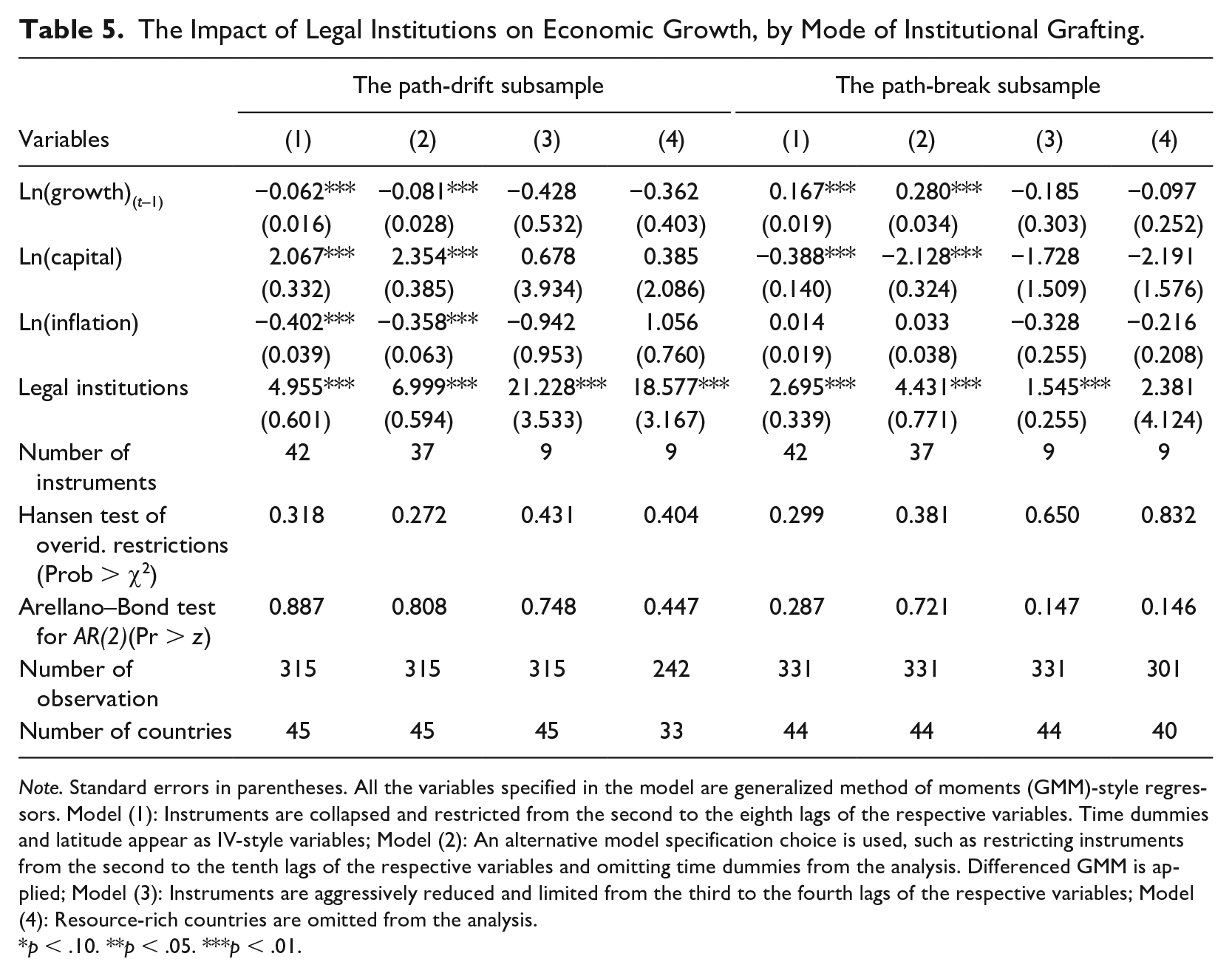
Note. Standard errors in parentheses. All the variables specified in the model are generalized method of moments (GMM)-style regressors. Model (1): Instruments are collapsed and restricted from the second to the eighth lags of the respective variables. Time dummies and latitude appear as IV-style variables; Model (2): An alternative model specification choice is used, such as restricting instruments from the second to the tenth lags of the respective variables and omitting time dummies from the analysis. Differenced GMM is applied; Model (3): Instruments are aggressively reduced and limited from the third to the fourth lags of the respective variables; Model (4): Resource-rich countries are omitted from the analysis.
p < .10. **p < .05. ***p < .01.
The Impact of Political Institutions on Economic Growth, by Mode of Institutional Grafting.
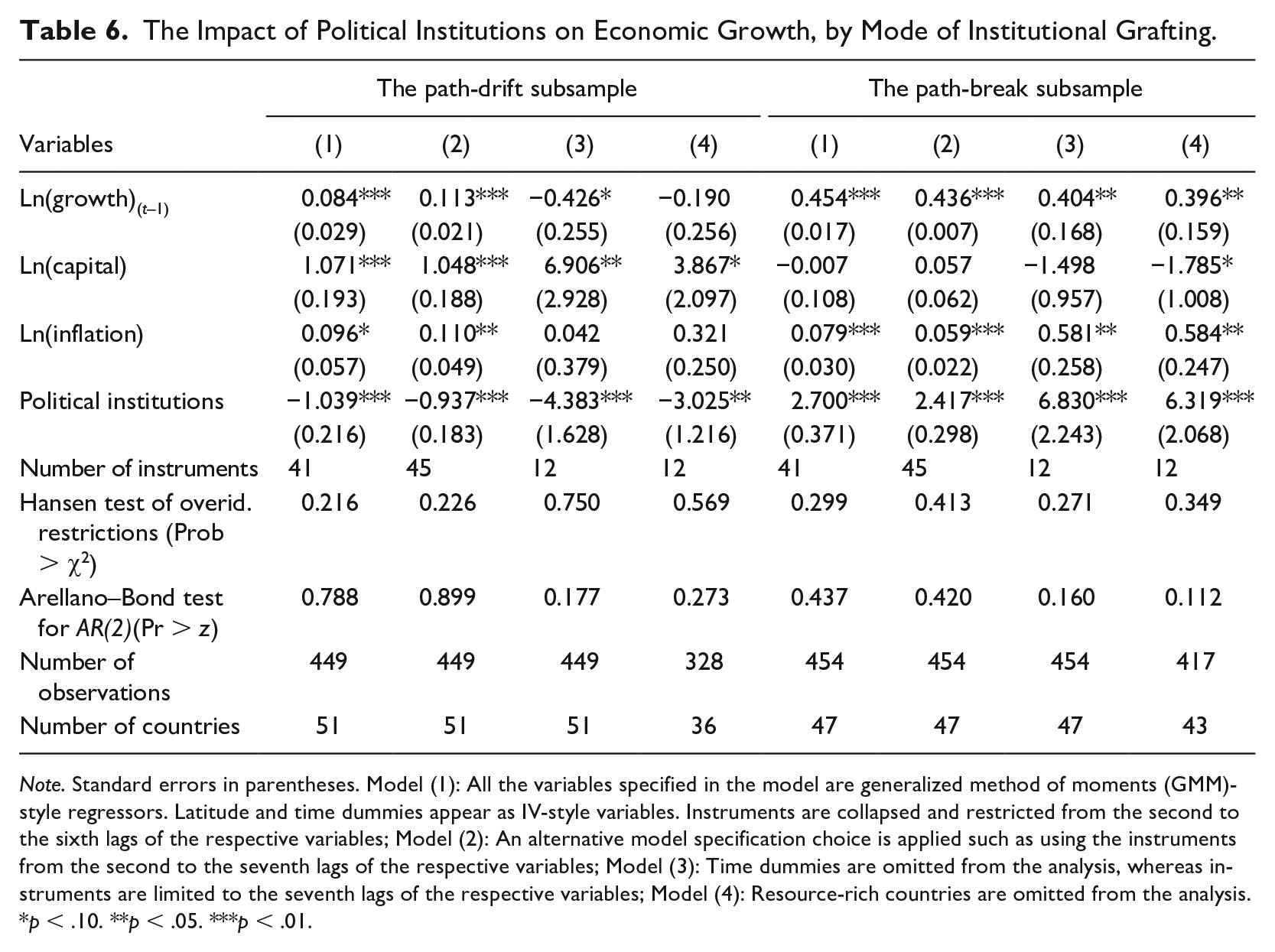
Note. Standard errors in parentheses. Model (1): All the variables specified in the model are generalized method of moments (GMM)-style regressors. Latitude and time dummies appear as IV-style variables. Instruments are collapsed and restricted from the second to the sixth lags of the respective variables; Model (2): An alternative model specification choice is applied such as using the instruments from the second to the seventh lags of the respective variables; Model (3): Time dummies are omitted from the analysis, whereas instruments are limited to the seventh lags of the respective variables; Model (4): Resource-rich countries are omitted from the analysis.
p < .10. **p < .05. ***p < .01.
The Impact of Political Elite on Economic Growth, by Mode of Institutional Grafting.
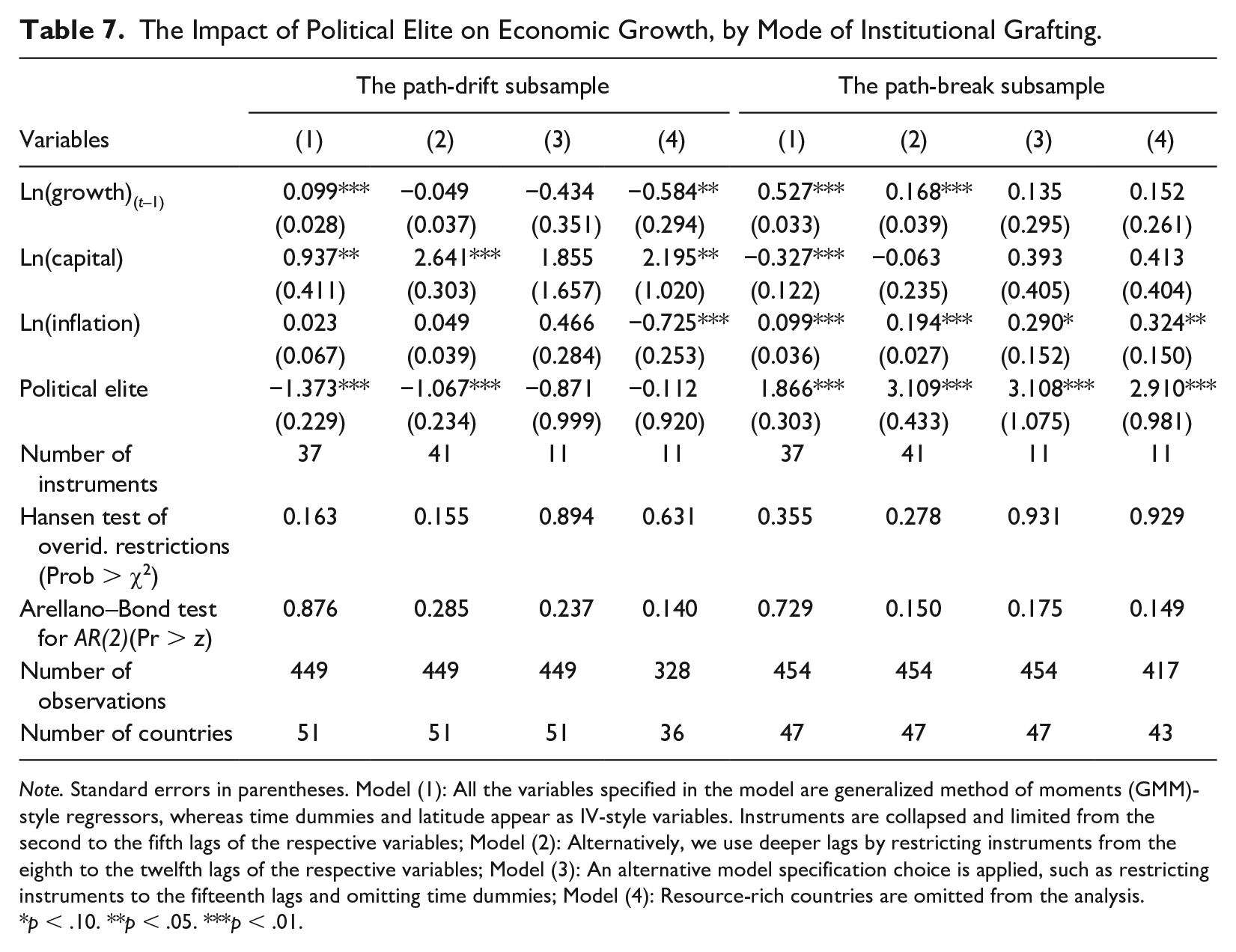
Note. Standard errors in parentheses. Model (1): All the variables specified in the model are generalized method of moments (GMM)-style regressors, whereas time dummies and latitude appear as IV-style variables. Instruments are collapsed and limited from the second to the fifth lags of the respective variables; Model (2): Alternatively, we use deeper lags by restricting instruments from the eighth to the twelfth lags of the respective variables; Model (3): An alternative model specification choice is applied, such as restricting instruments to the fifteenth lags and omitting time dummies; Model (4): Resource-rich countries are omitted from the analysis.
p < .10. **p < .05. ***p < .01.
Our analysis also confirms H3 that institutional grafting or change is more sensitive to the political dimension in path-break than in path-drift (see Table 8). In addition, our data are in line with H4 and suggest that legal institutions tend to shift closer to cultures and markets when the political dimension is stronger, especially in path-break (see Tables 9 and 10). When distances between the new legal institutions and the two dimensions persist, their negative impact on economic growth can be offset with a superior political dimension (see Table 11). The positive interaction terms in our analysis support the rationale presented in H5. Surprisingly, this positive interaction is stronger in path-drift than in path-break.
The Political Dimension’s Impact on Legal Institutional Grafting, by Mode of Institutional Grafting.
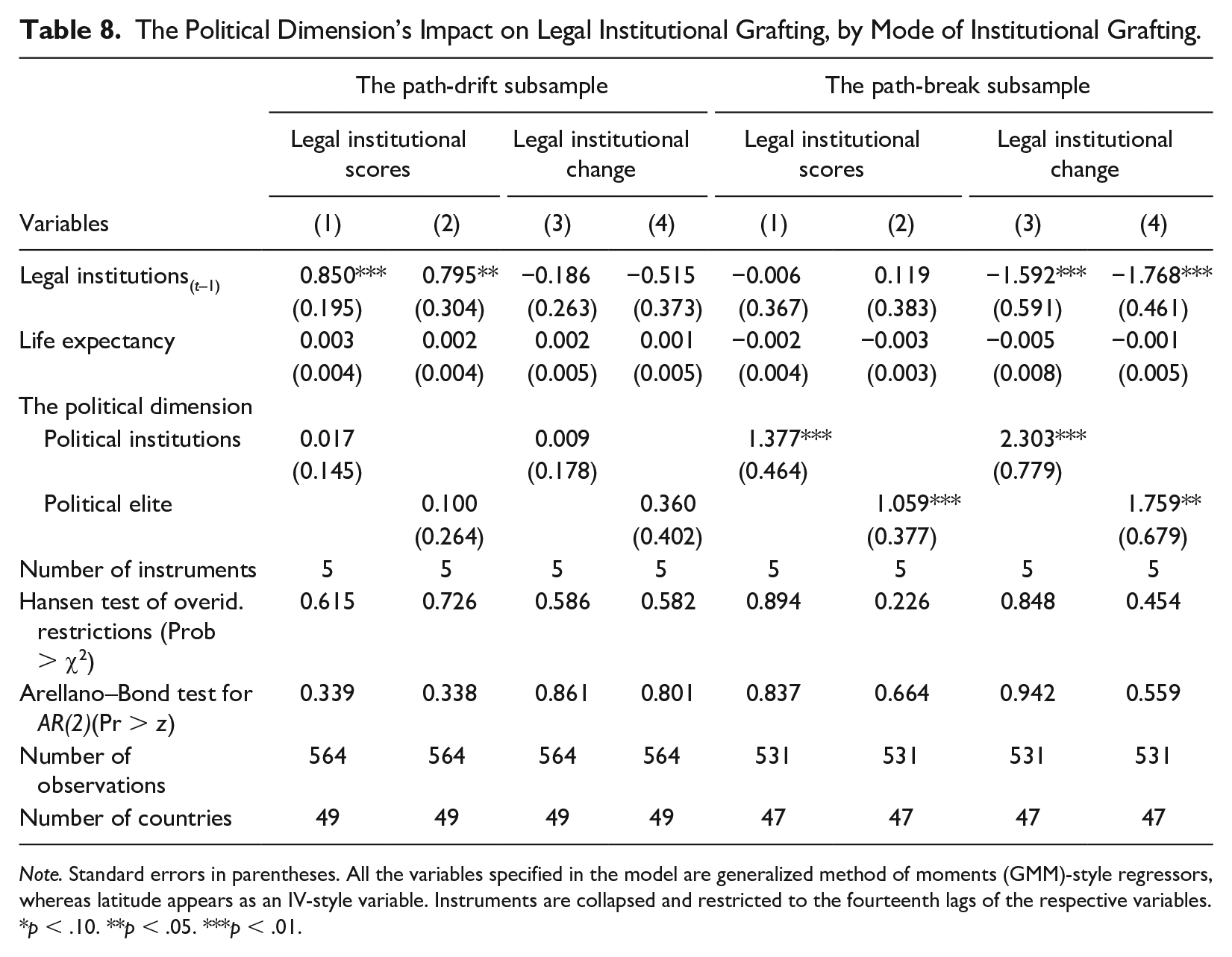
Note. Standard errors in parentheses. All the variables specified in the model are generalized method of moments (GMM)-style regressors, whereas latitude appears as an IV-style variable. Instruments are collapsed and restricted to the fourteenth lags of the respective variables.
p < .10. **p < .05. ***p < .01.
The Political Dimension’s Impact on the Distance Variables, the Case of Path-Drift.
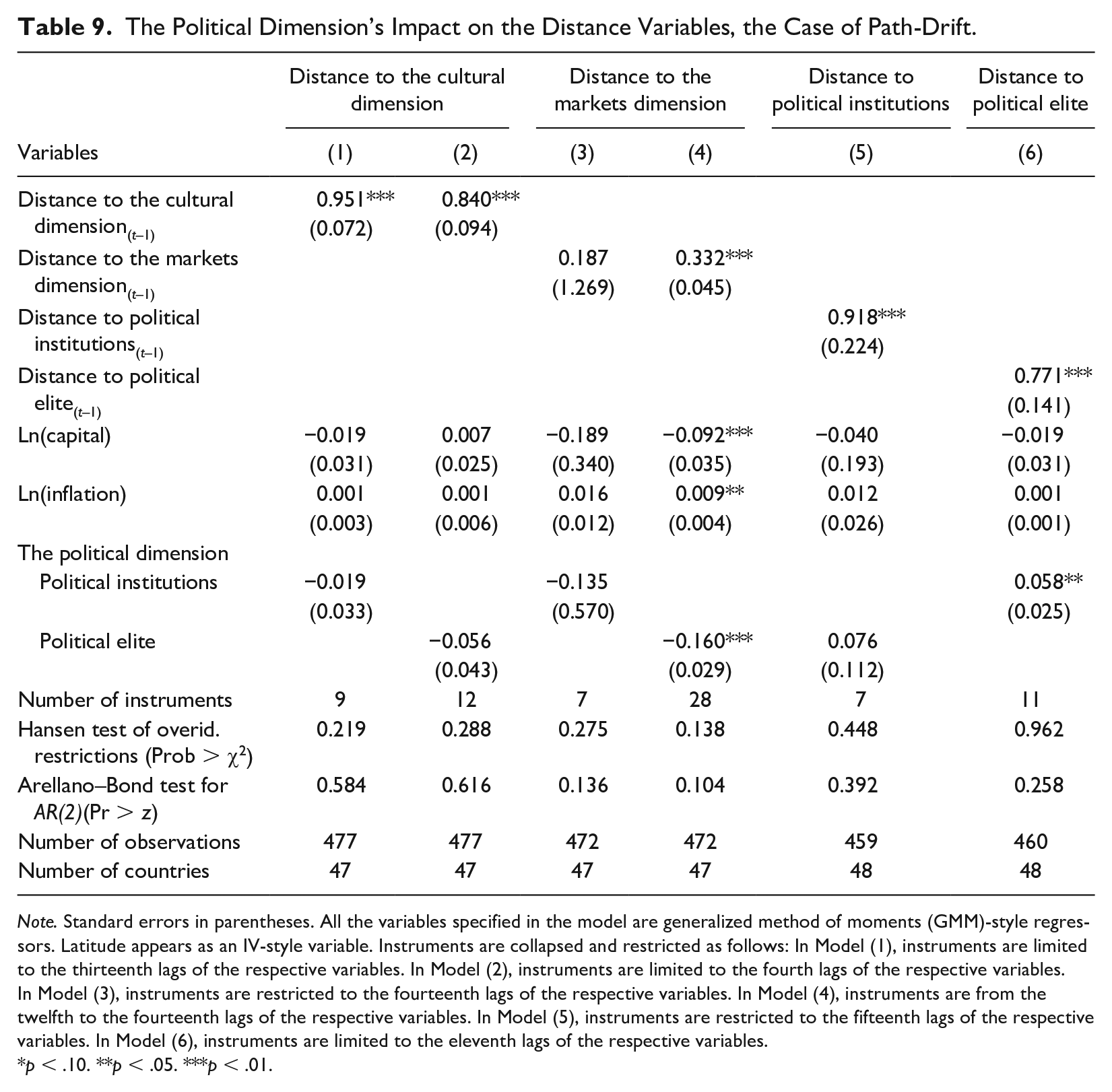
Note. Standard errors in parentheses. All the variables specified in the model are generalized method of moments (GMM)-style regressors. Latitude appears as an IV-style variable. Instruments are collapsed and restricted as follows: In Model (1), instruments are limited to the thirteenth lags of the respective variables. In Model (2), instruments are limited to the fourth lags of the respective variables. In Model (3), instruments are restricted to the fourteenth lags of the respective variables. In Model (4), instruments are from the twelfth to the fourteenth lags of the respective variables. In Model (5), instruments are restricted to the fifteenth lags of the respective variables. In Model (6), instruments are limited to the eleventh lags of the respective variables.
p < .10. **p < .05. ***p < .01.
The Political Dimension’s Impact on the Distance Variables, the Case of Path-Break.
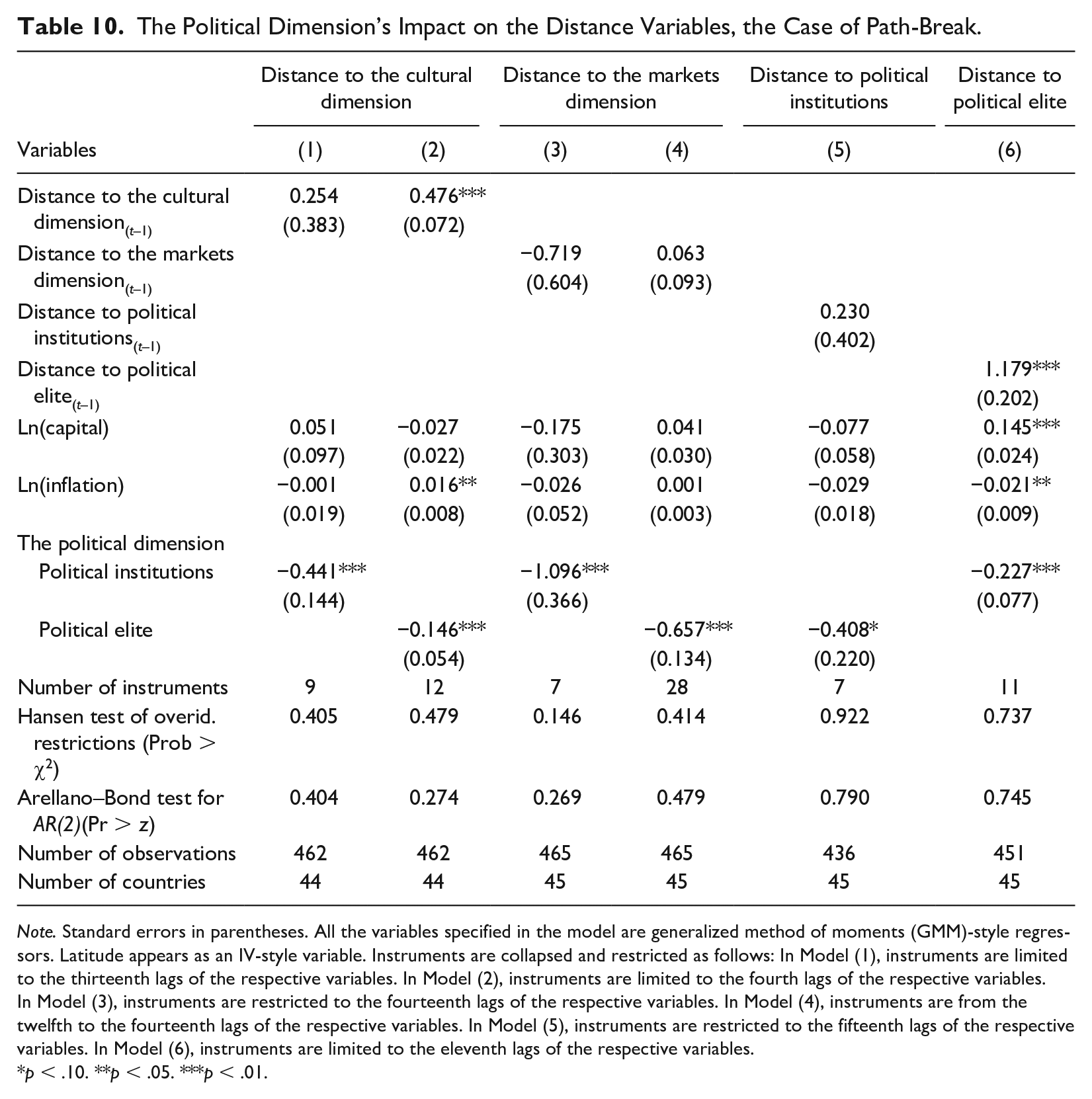
Note. Standard errors in parentheses. All the variables specified in the model are generalized method of moments (GMM)-style regressors. Latitude appears as an IV-style variable. Instruments are collapsed and restricted as follows: In Model (1), instruments are limited to the thirteenth lags of the respective variables. In Model (2), instruments are limited to the fourth lags of the respective variables. In Model (3), instruments are restricted to the fourteenth lags of the respective variables. In Model (4), instruments are from the twelfth to the fourteenth lags of the respective variables. In Model (5), instruments are restricted to the fifteenth lags of the respective variables. In Model (6), instruments are limited to the eleventh lags of the respective variables.
p < .10. **p < .05. ***p < .01.
Interactions Between the Political Dimension and Distances in Their Impact on Economic Growth, by Mode of Institutional Grafting.
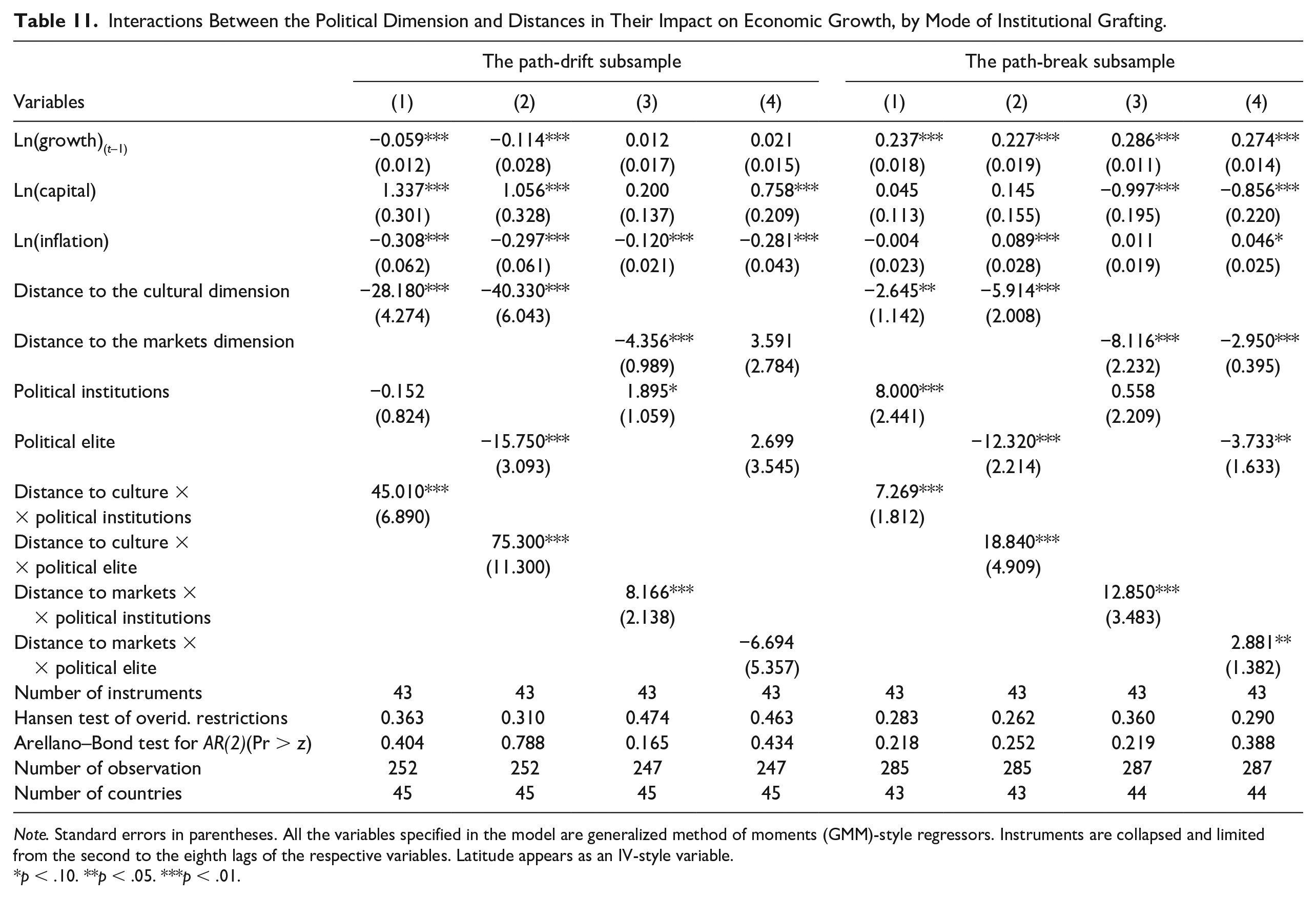
Note. Standard errors in parentheses. All the variables specified in the model are generalized method of moments (GMM)-style regressors. Instruments are collapsed and limited from the second to the eighth lags of the respective variables. Latitude appears as an IV-style variable.
p < .10. **p < .05. ***p < .01.
Overall, our empirical results reveal that the political dimension should restrict its role when institutional change evolves as path-drift. When a country breaks into a new institutional path, the political dimension may impact the legal institutional change trajectory, the extent of incongruence between new legal institutions and existing cultures/markets, and how significantly this incongruence affects a country’s economic growth patterns.
Conclusion and Discussion
We demonstrate that path-drift produces legal institutions that are congruent with cultures, markets, and the political dimension. By contrast, path-break spurs legal institutions that develop large distance to the three dimensions and thereby influence a country’s growth rates marginally. Rather, economic growth of path-break is strongly impacted by the quality of its political dimension that might determine not only the dynamics of legal institutional change but also the extent of incongruence between new legal institutions and the prevalent cultures or markets, and how this incongruence impacts economic growth. The political dimension has less impact on the country’s economic growth in path-drift. A strong political elite and their policymaking can harm economies if they directly intervene in the institutional change process. They can only foster economic growth by mitigating the negative impact of incongruence between legal institutions and cultures/markets, if such incongruence emerges.
Despite the fact that our empirical testing is based on data from 1996 to 2014, our results have considerable value for understanding institutional reforms of both the past and the future. Regarding the past, our model, along with its central concept of incongruence, can shed more light on explaining failures and successes of postcommunist transition for instance. Equally, our findings can have essential policy implications and provide useful insights into the choice and design of future institutional reforms, especially those implemented in the underdeveloped part of the world.
Future research should expand the focus of our analysis. First, the analysis should integrate countries with unstable regime trends. Second, a better operationalization is needed for our path-break versus path-drift typology to enable measuring the type of institutional change in a more continuous way. This may permit resorting to the pooled sample as the basis for empirical investigations and capture not only the modes of institutional change but also the effect of timing of institutional transformations on a country’s economic performance. Third, the analytical framework should be expanded to incorporate judicial intervention into the political dimension. History shows many examples of radical institutional changes realized by judicial powers, such as legalizing gay marriage for instance.
Footnotes
Appendix
List of Countries Used in the Analysis.

| The path-drift subsample | The path-break subsample | ||
|---|---|---|---|
| Australia | Laos PDR | Albania | Lesotho |
| Austria | Luxembourg | Argentina | Liberia |
| Bahrain | Mauritius | Armenia | Lithuania |
| Belgium | Mexico | Bangladesh | Macedonia |
| Botswana | Morocco | Benin | Madagascar |
| Cameroon | The Netherlands | Bhutan | Malawi |
| Canada | New Zealand | Bolivia | Mali |
| China | Norway | Brazil | Moldova |
| Colombia | Oman | Bulgaria | Mongolia |
| Costa Rica | Papua New Guinea | Burundi | Mozambique |
| Cyprus | Portugal | Cabo Verde | Nicaragua |
| Denmark | Rwanda | Chile | Panama |
| Djibouti | Saudi Arabia | Congo, Dem. Rep. | Paraguay |
| Dominican Republic | Singapore | Croatia | Philippines |
| Egypt | Sri Lanka | Czech Republic | Poland |
| Equatorial Guinea | Swaziland | El Salvador | Romania |
| Finland | Sweden | Estonia | Russia |
| France | Switzerland | Georgia | Serbia |
| Germany | Syria | Guatemala | Sierra Leone |
| Greece | Trinidad and Tobago | Guyana | Slovak Republic |
| Guinea | Tunisia | Hungary | Slovenia |
| India | Turkmenistan | Indonesia | Taiwan |
| Ireland | United Arab Emirates | Kenya | Ukraine |
| Israel | United Kingdom | South Korea | Uruguay |
| Italy | United States | Kyrgyzstan | Zambia |
| Jamaica | Uzbekistan | Latvia | |
| Japan | Vietnam | ||
| Kazakhstan | |||
Declaration of Conflicting Interests
The author(s) declared no potential conflicts of interest with respect to the research, authorship, and/or publication of this article.
Funding
The author(s) received no financial support for the research, authorship, and/or publication of this article.
