







Abstract
This is an exploratory study that examines the effect of social information on gender differences in selection into a winner-take-all tournament, using a simple addition task. Participants perform this task in multiple rounds and then select into a competitive or non-competitive pay scheme. Prior to choosing payment schemes, participants are shown selected results about average performance and choices in a similar experiment. I find that the inclusion of social information eliminates any extant gender gap in competitive choices in every treatment. The reduction in the gender gap is not due to greater efficiency of choices by men or women, even though inefficient choices by low-performing individuals are mostly eliminated. Rather, the inclusion of feedback causes men and women to select into a competitive pay scheme in a similar manner, thereby removing the gender gap. Despite these results, the complexity of the social information intervention used leaves some results unexplained.
Introduction
Despite a wealth of advancements for women in the labor market during the last half-century, women are still vastly underrepresented in high-earning executive and managerial positions. As of 2017, women comprised 27% of CEO’s (Solis & Hall, 2017). Using a data set from US firms, Bertrand and Hallock (2001) find that women only account for about 25.5% of high level executives as of 1997. Even when accounting for differences in ability, this gap remains; Bertrand and Hallock conclude that women are “virtually absent” from the corporate world. When looking at specifically CEO’s, Wolfers (2006) finds that women only account for 1.3% of CEO’s from 1992 to 2004. If differences in ability do not explain this divergence in representation, then social and behavioral explanations may shed light on why these differences both exist and persist. A recent explanation for these differences in outcomes is the existence of differences in preferences for competition. If men and women have dissimilar preferences for competitive work environments, then this could help explain the existence of this gender gap.
The study of gender differences in outcomes and behavioral preferences is not new. Evolutionary psychologists have long studied how the socialization of children can lead to differences in attitudes by adulthood. An illustrative example of this is “the play styles that both sexes adopt. Boys often play ‘games’ which are considered to be competitive interactions governed by rules aimed at specific goals. While girls are more involved in ‘play’ which is considered a cooperative activity in which there is no winner and no clear endpoint” (Cambell, 2013). fn1 Economists focus heavily on gender differences in labor market outcomes and wage differentials. Recently, the focus has broadened to include a rigorous study of gender differences in the preferences which underlie economic decision making. Research has assessed gender differences in altruism, where women tend to be more altruistic (Andreoni & Vesterlund, 2001), risk aversion, where men tend to be less risk averse (Eckel and Grossman, 2002, 2008), cooperation in negotiation, where women tend to be more cooperative when making deals (Eckel, de Olivera, and Grossman, 2008), selfishness in dictator games, where men tend to be more selfish (Eckel & Grossman, 1998), and more recently, competitive preferences have come into focus.
Psychology looks at the degree to which nature or nurture forces can account for gender differences. Some economic research adds to this discussion by showing that cross cultural differences in behavior of men and women exists. Gneezy et al. (2009) perform a simple competitive task in both a patriarchal and a small Matrilineal society. They find that in the patriarchal society, men have a much greater preference for competition than women. In the Matrilineal society, women have a much greater preference for competition than men. The matrilineal women are actually as competitive as the patriarchal men, which suggests that preference for competition has strong ties to socialization and gender norms in a society. Buser,et al., (2021) find that on a high stakes game show, men are not only more competitive than women, but are able to anticipate that women are less competitive, while women shy away from competing against men.
Niederle and Vesterlund (2007) assess gender differences in competitive preferences using a simple experiment meant to mimic selection into competitive jobs; they find that men and women have dissimilar preferences for entry into a competitive environment, despite there being no performance differences in the task they use. Many successive works sought to replicate this result and modify the experiment to assess the robustness of the findings. These studies find that these differences exist and persist over the life cycle (Mayr et al., 2011, and Samek, 2013). Croson and Gneezy (2009) find that men and women have significant differences in risk preferences, social preferences about the well-being of others, and competitive preferences. Niederle and Vesterlund (2011), who provide reviews of many of these works on gender differences in economic experiments, find that the main reason women are more reluctant to enter competitive environments is due to men being more overconfident about their abilities, relative to women.
More recent works emphasize the role of different mechanisms, and their role in reducing or eliminating the gender gap in competitive choices. Brandts et al. (2012) find that intergenerational advice is able to eliminate the gender gap in choices, Niederle et al. (2012) investigate the role of including ex-ante affirmative action quotas on competitive selection, Wozniak et al. (2014) find that including information about relative performance induces more efficient competitive pay scheme choices and eliminates the gender gap in competitive entry. Kessel et al. (2021) find that simple advice can be effective in reducing the gender gap in competitive preferences in both a university and field setting. Buser, Ranehill, and Veldhuizen (2021) find that public observability has no effect on willingness to compete. Balafoutas et al. (2018) show that priming can be effective at both eliminating gender gaps in competitiveness and increasing choice efficiency of participants.
I assess how social information plays a role in alleviating gender differences in competition. Here, when I mention social information, I mean information about how other similar participants fared in a similar experiment to this one. The role of social information as an influential nudging factor in experiments with low stakes is well established. This type of information encourages donations to charity when it is known that others contribute (Frey & Meier, 2004; Martin & Randal, 2008; Croson & Shang, 2008; Shang & Croson, 2009), increases contribution likelihood in public goods games (Fischbacher et al., 2001; Potters et al., 2005), increases contribution to a movie rating website (Chen et al., 2010), and increases payoffs for both parties when social history is included in the trust game (Berg et al., 1995). Social information is also influential in increasing teacher retention and initial hiring in the Teach for America organization (Coffman et al., 2014). Buser et al., (2021) find that gender differences in competitiveness can account for 5 to 10% of the gender differences observed in education and labor markets. Reuben et al. (2021) find that among MBA graduates, gender differences in competitive preferences account for about 9% of the observed gender pay gap.
The aim of this paper is to explore how the inclusion of social information affects preferences of participants participating in competitive and non-competitive pay schemes, based on their performance. Using an experimental structure similar to Niederle and Vesterlund (2007), I investigate the role of social information in reducing or eliminating any gender gap in competitive choices. The social information used is selected average performance information from a related experiment, specifically Wozniak et al. (2014). In three treatments, I assess the effect of gender neutral and gendered performance feedback on selection into a winner-take-all tournament. Including social information successfully eliminates the gender gap in tournament entry, largely due to increased tournament entry of women. However, it does not lead to more efficient sorting by ability. Men and women behave more similarly in the presence of social information. High-performing women enter the tournament when it is efficient to do so, but many low-performing women select the tournament as well. The remainder of the paper proceeds as follows: The Experimental Design section explains the design of the experiment and the three treatments; the Results section presents the results of the experiment; the Discussion section presents a discussion of what could be improved for future research; and the Conclusion section concludes.
Experimental Design
The structure of this experiment is based closely on the design in Niederle and Vesterlund (2007). Here, the baseline condition will be identical to the aforementioned paper, and the treatment conditions will be minor variations of this design where participants receive social information feedback (a “round” in this experiment is equivalent to the “Tasks” in Niederle & Vesterlund, 2007). The baseline condition in its current form assists in assessing if there is a gender gap in tournament entry and replicating previous results. What follows is a short explanation of the design.
In each of the first three rounds, participants spend 5 minutes adding up five sets of two-digit numbers, solving as many as they can. After solving each problem, participants are informed of whether or not they solved that problem correctly. Once an attempt at an addition problem is completed, a new problem is randomly generated. After each round, participants are reminded of the number of problems they solved correctly. Participants are in groups of four, with two men and two women in each group. They are informed that those in their group are sitting in the same row as them. In round 1, participants perform the addition task under a piece-rate payment scheme, where they can earn $0.50 per correct answer. Round 2 is a winner-take-all tournament. In this instance, the individual solving the most problems would receive $2.00 per problem, while everyone else in the group would receive nothing. fn2 Tournament winners in any round are not informed they won the tournament until after the experiment has ended.
Experimental Design.
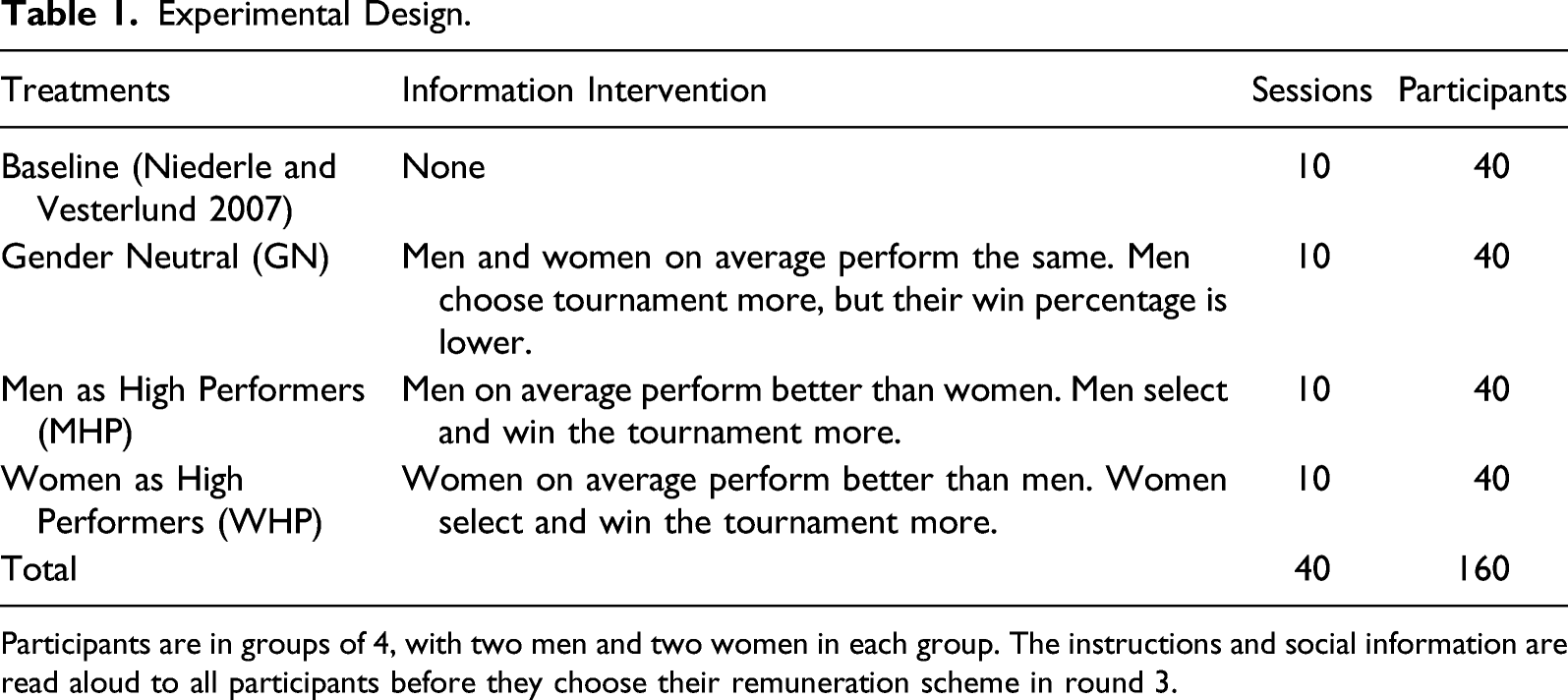
Participants are in groups of 4, with two men and two women in each group. The instructions and social information are read aloud to all participants before they choose their remuneration scheme in round 3.
I use a between-subjects design for this experiment. The experiment was conducted at the University of Texas at Dallas using the subject pool of the Center and Laboratory for Behavioral Operations and Economics (CLBOE). Participants were recruited using ORSEE (Grenier, 2015), an online recruitment system which allowed pre-screening to assure the sample was gender balanced. The experiment was run with z-Tree software (Fischbacher, 2007). Participants earn a $5.00 dollar show-up fee, and an additional $5.00 for completing the experiment. One of the four rounds was randomly selected for payment, in addition to the flat-rate payments. The payment round was randomly selected prior to the sessions using a fair four-sided die. The average payout was $16.74. Experimental sessions took, on average, 30 minutes to run. The majority of participants were majoring in either engineering, computer science, and a business or a business-related field (i.e., accounting and management). The average GPA for participants was 3.57. All demographic characteristics are well balanced across treatments (see Table 7 in Appendix 1 for a complete breakdown of summary statistics for the participants).
Three treatments are conducted to explore the effect of social information on choices in round 3. Feedback is given prior to making the remuneration decision in round 3. fn4 The intention of these treatments is to see if social information showing that men and women perform similarly (or differently) can remove or exacerbate any gender gap in tournament entry. It is important to note that the inclusion of this feedback does not change the nature of the choice with respect to how a participant’s payoff may affect the payoffs of their group members. Each round is still an individual decision task, as before. Yet, this may change a participant’s perspective on their choice from the information presented in each of the treatments. The feedback information itself is exogenous to this experiment (since it comes from a different experiment), and is constructed to test the hypotheses. This type of feedback gives no indication of how an individual performed relative to other participants in their group, but it may give them a benchmark of performance to estimate which payment scheme would be optimal to choose in this round. After round 4 is completed, participants are asked to guess how they ranked relative to their four person group, the average number of problems solved correctly in each of the first two rounds by the session, and to provide their preference for competition on a scale of 1–7.
Treatments
Treatment 1 is the Gender Neutral (GN) treatment. This treatment is constructed to show that men and women performed similarly on average. Participants are informed that both men and women solve 11 problems on average. They are then provided with information as to how many men and women selected the tournament in round 3, and the number who won. fn5 The average subject in round 3 of this experiment solved 12.26 problems correctly. By showing this lower average performance information, individuals may be enticed to enter the tournament at a high rate, regardless of gender. The following hypotheses are based on the assumption that both the gendered aspects and numerical aspects of the social information provided will be salient and effective. fn6
All hypotheses stated are relative to the gender difference found in the baseline condition.
(GN): (a) In the presence of social information, there should be an increase in women entering the tournament, thus eliminating the gender gap in tournament entry. Men are not expected to change their choices in any significant manner. The hypotheses for these treatments address how those who should enter the tournament, but do not, and should not enter, but do (called “under entry” and “over entry,” respectively) are affected by social information. (b) Inefficient under entry by women will decrease, and potentially be eliminated. High-performing women (who do not enter the tournament enough in the baseline condition) should be enticed into entering the tournament in the presence of the social information. (c) Under entry for men will be low, similar to the baseline. (d)Since the average performance information provided in this treatment is low relative to actual average performance, there should be an increase in inefficient over entry across genders. Treatment 2 is the Men as High Performers (MHP) treatment. The intent of this treatment is to exploit any notion or stereotype that men may be better than women at math, even though there is no evidence of performance differences here, or in previous research. Participants are shown that men solved 14.5 problems on average and women solved 10.63 problems on average. Then, information about tournament choices in round 3 is provided. In general, women tend to be more sensitive to laboratory interventions (Croson & Gneezy, 2009; Niederle & Vesterlund, 2011), and thereby, may have a higher propensity to change tournament entry choices than is stated here. This is especially relevant if participants are not particularly responsive to the gendered aspects of the social information provided.
(MHP): (a) If gender is salient, this should lead women away from the tournament regardless of performance. (b) Men will be undeterred in their decisions in the presence of the feedback, and enter the tournament at least at the same rate as in the baseline condition. My general expectation is that the results will be similar to the baseline. Treatment 3 is the Women as High Performers (WHP) treatment. This treatment looks at how participants respond to information that women are the high performers in the math task. Subjects are informed that women solve 14.33 problems on average and men solve 10.64. Again, tournament choices and the number of individuals that won are provided.
fn7
(WHP): (a) Seeing that women are high performers will induce a larger number of women to enter the tournament. (b) This could cause men to shirk tournament entry because they are shown that men perform worse on average. These hypotheses for the MHP and WHP treatment are based on assuming the gendered aspects of the social information are strongly salient. If they are not and participants are more responsive to the numerical portions of the social information, then it is possible results in each of these treatments could be similar.
Results
Mean Performance by Round and Treatment.
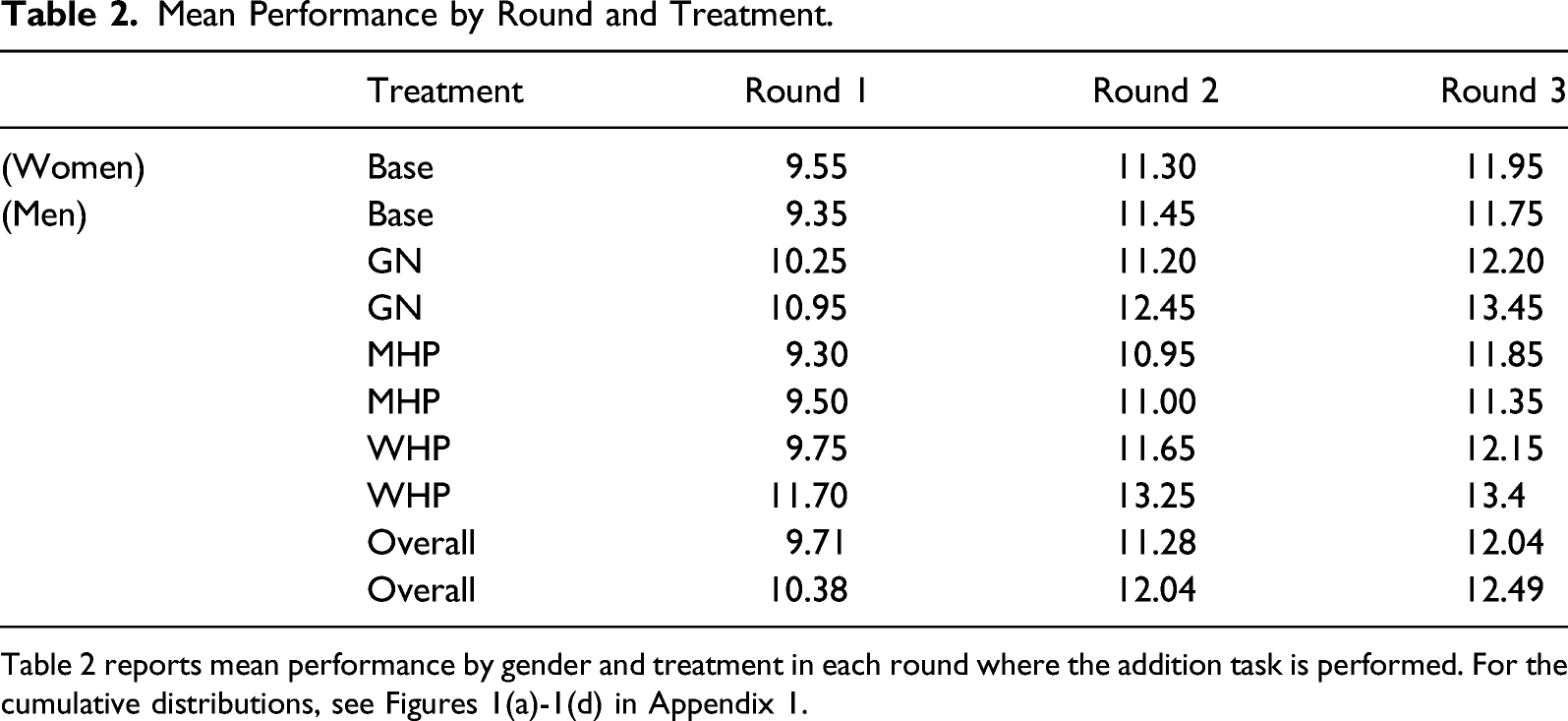
Table 2 reports mean performance by gender and treatment in each round where the addition task is performed. For the cumulative distributions, see Figures 1(a)-1(d) in Appendix 1.
Tournament Entry Across Rounds and Treatments.
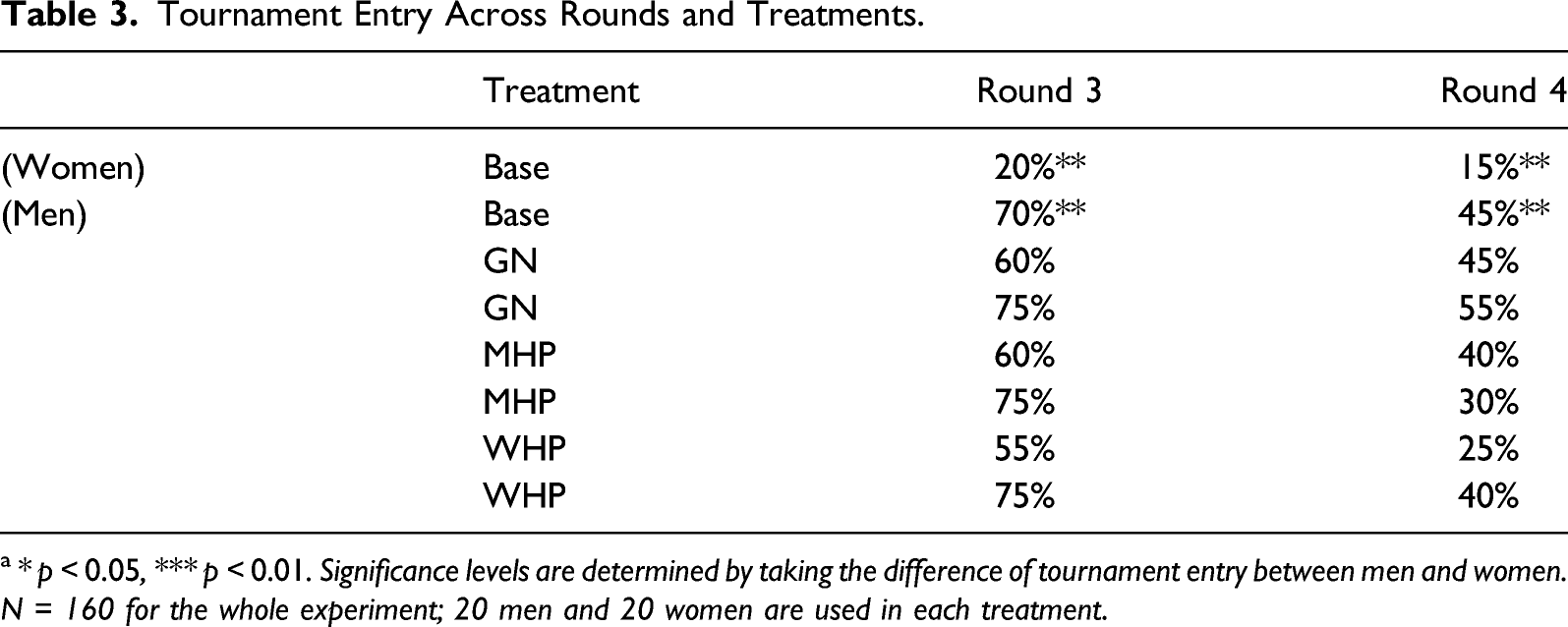
a * p < 0.05, *** p < 0.01. Significance levels are determined by taking the difference of tournament entry between men and women. N = 160 for the whole experiment; 20 men and 20 women are used in each treatment.
This replicates the result from Niederle and Vesterlund (2007) that there are gender differences in both the round 3 and round 4 decisions. However, these gender differences are eliminated in the presence of social information. Relative to the baseline treatment, the increase in tournament entry for women in all treatments is statistically significant. Comparing the baseline condition to both the GN and MHP treatment (since women enter the tournament at the same rate in both treatments), the increase of women’s tournament entry from 20% to 60% is significant at the 95% level using a Mann–Whitney test (z = 0.011). The tournament increase for men between the baseline and GN treatment of 70%–75% is statistically insignificant (z = 0.727). Men increase entry in this manner for each treatment, all of which are insignificant. Comparing the baseline to the WHP treatment for women, the increase from 20% tournament entry to 55% entry is statistically significant at the 95% level as well (z = 0.024). The increase in women entering the tournament in the treatments is what drives the reduction in the gender gap in tournament entry.fn8–10 Round 3 Decision by Treatment (Probit, ME). Dependent variable is choice in round 3. It is equal to 1 if tournament is chosen and zero if piece-rate is chosen. Marginal effects and standard errors from a probit regression are reported here. *** p < 0.01, ** p< 0.05, * p< 0.10. Clustering is at the individual level.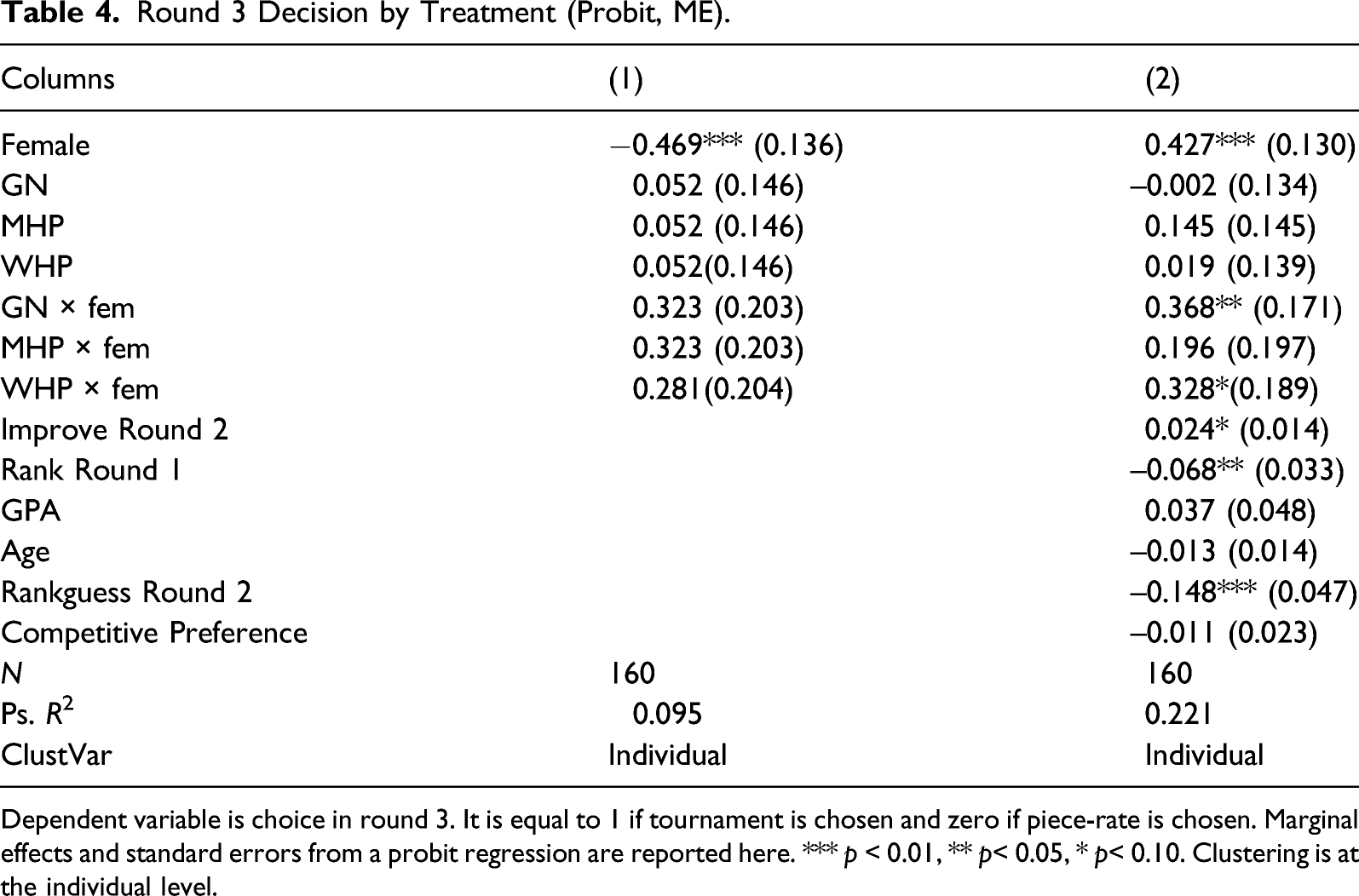
Female is an indicator variable for gender and is equal to 1 if the participant is a woman and zero if they are a man. GN, MHP, and WHP are indicator variables for each of the treatments. GN × fem, MHP × fem, and WHP × fem are interaction indicator variables equal to 1 if a participant is a woman in each respective treatment. Improve Round 2 is a control variable to account for the fact that participants perform almost unilaterally better in the round 2 tournament than the round 1 piece-rate. It is the simple difference between a participant’s Round 2 and Round 1 performance. Rank Round 1 is the participant’s rank in round 1 and is meant to account for any effect that rank may have on tournament entry. Age and GPA are the self-reported age and GPA of the participants. Rankguess Round 2 is the participant’s guessed rank in round 2. This guess is elicited after the experiment is completed, and is intended to control for confidence when making the round 3 decision. Competitive Preference is the individual’s preference for competition on a scale of 1–7, where 7 is the highest preference for competition.
Table 4 shows that after conditioning on performance and other covariates, the gender difference in tournament entry remains significant in the baseline condition.
In the full regression in column 2, women are 42.7% less likely to choose the tournament in the baseline condition. This constitutes a large gender gap, about twice as large as any previous result (other works find this difference to be on the order of 12%–20%; Niederle & Vesterlund, 2011).
fn11
Over and Under Entry into the Tournament. Over and under entry are calculated using a participant’s group rank from round 2. Under entry is selecting the piece-rate when it would have been optimal to choose the tournament. Over entry is choosing the tournament when it would have been optimal to select the piece-rate. What drives the tournament entry gap in the baseline condition (and in previous works) is that men over enter into the tournament at a high rate and women under enter at too high of a rate.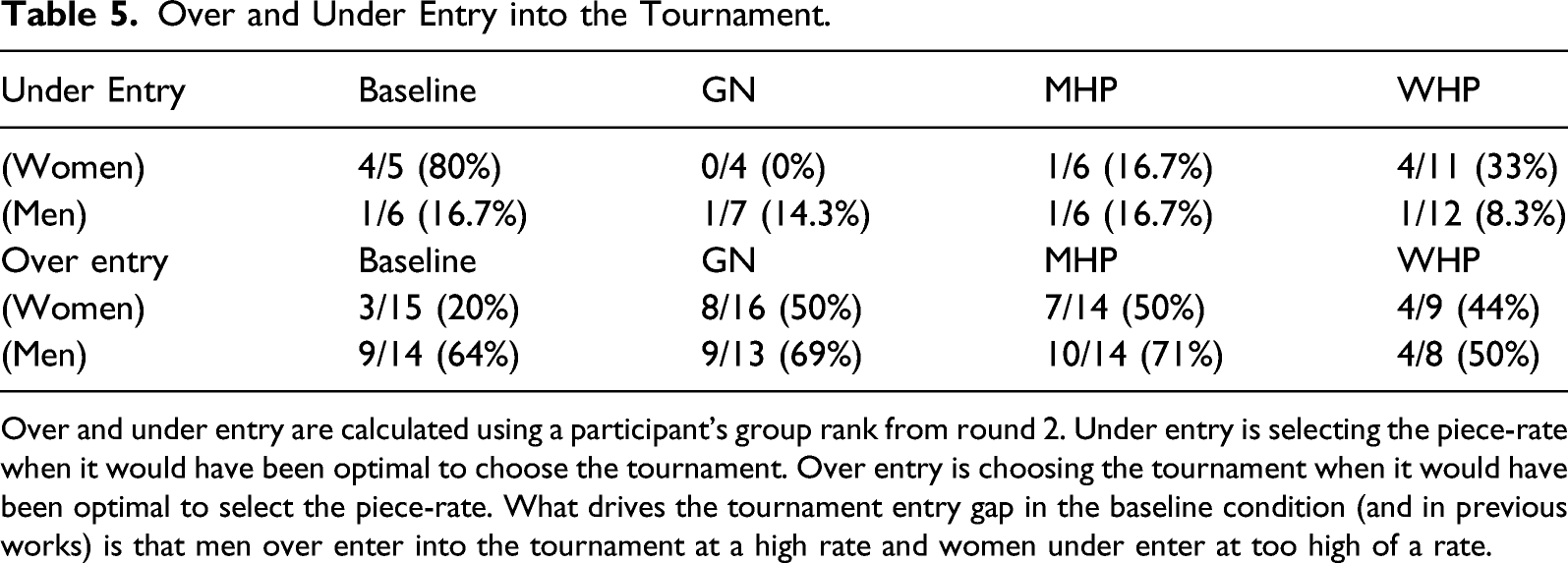
To assess the effect of the treatments on the gender difference in entry, I look at the combination of the female variable in column 2 with each of the MHP × fem, GN × fem, and WHP × fem variables. If I can reject that the combination of these variables are equal to zero, then there is a gender effect which remains in the treatments, suggesting that they may not have eliminated the gender gap.
I am able to marginally reject that there is any remaining gender effect in all three treatments: the GN treatment (p = 0.641), the MHP treatment (p = 0.175), and the WHP treatment (p = 0.457). This confirms that even after all covariates are accounted for, the treatments were successful in eliminating the gender gap in tournament entry. This is also in line with hypothesis 1(a), which says that the GN treatment will cause women to increase their rate of tournament entry relative to the baseline.
What is Driving Changes in Tournament Selection in Treatments?
Next, I need to determine the role of over and under entry into the tournament in round 3 in relation to the reduction of the gender gap. Again, “over entry” is when it would not be efficient for a participant to enter the tournament based on their performance in round 2, but they choose to enter. This is calculated using a participant’s relative ranking in round 2. If a participant was ranked first in their group, then their optimal decision (in terms of maximizing payoffs) is to enter the tournament. Participants ranked second through fourth should select the piece-rate. If a participant was tied for first, their rank is still considered first, and it is optimal for them to enter the tournament, even though they may not have actually won the round 2 tournament. “Under entry” is a similar concept, except that under entry occurs when a participant is ranked first and does not choose the tournament. Both over and under entry are inefficient behaviors with respect to participant sorting.
In previous experiments women tend to under enter and men tend to over enter into the tournament in round 3. This leads to the gender difference in tournament selection. In my baseline treatment, this pattern continues as four out of five women under enter and 9 out of 14 men over enter in the baseline condition. Table 5 shows the results for over and under entry. In the GN treatment, inefficient under entry is almost completely eliminated for men and is non-existent for women. This follows with hypotheses 1(b) and 1(c). With respect to over entry, men behave similarly to the baseline, but women severely increase over entry such that 8 out of 16 women over enter. fn12
In the MHP treatment, there are similar results to the GN treatment. Both men and women have low levels of under entry and high levels of over entry. This is contrary to hypothesis 2(b), because women are still entering the tournament at a high rate in this treatment. For the WHP treatment, women enter the tournament at a higher rate than in the baseline, resulting in four out of nine women entering the tournament when they should not have (over entry). Inefficient under entry decreases considerably, with 4 of 11 women forgoing entry when they should have. Men still enter the tournament at a high rate, and their behavior is similar to the baseline with respect to over and under entry, contrary to hypothesis 3(b).
Including social information causes women to significantly increase their tournament entry and men to stay the same in terms of their entry decisions, instead of reflecting the gendered nature of the feedback information in the MHP and WHP treatment. Women seem to use the numerical reference point to assess where they are in the overall distribution, and that leads to more women entering the tournament. Some of the results for the MHP treatment are contrary to hypotheses 2(a) and 2(b), and the WHP results are contrary to hypothesis 3(b). One possibility is the gendered information content of these two treatments may have some effect on confidence through reactions that participants may have, provided it is salient. The MHP treatment is set to show that men are better at solving math problems (and WHP to show women perform better), even though there is no evidence that suggests that men and women perform differently on simple math tasks (Hyde et al., 1990). One reason that women may enter the tournament more in this treatment is because they feel that the gendered information is a challenge for them to either outperform the feedback or try to prove it wrong (i.e., stereotype threat). Another possibility is that, it is simply the lack of differences in competitive preferences in this treatment that drives this result. A third possibility is that, participants were keying on the numerical aspects of the feedback, not the gendered aspects. A participant receives their performance feedback in the form of the number of problems they solved correctly in a certain round. Since this is the only feedback about their own performance, they receive prior to the social information intervention, it is reasonable to consider that the numerical average performance would have been the most salient to assess the prospect of tournament entry. The results in the WHP and MHP treatments bear that out, showing that the gendered aspect of the social information is not salient. The numerical feedback provides a benchmark with which to gauge what constitutes “high” or “low” performance. This helps participants, especially women in this case, assess if tournament entry is the most efficient remuneration choice. A second, numerical reason why there may be increased selection in the presence of social information is the interaction of the feedback with the way that individuals improve as rounds progress. Feedback in each round is only given in terms of the number of correct problems solved in each round. As this is the only information received after each round, there is reason to believe that the numerical aspects of social information will be more salient. Improvements in performance relative to the social information will also be important using this logic. Participants improve their performance between rounds 1 and 2, as well as rounds 2 and 3. If a participant notices that they have improved considerably after round 2, then it is reasonable to consider that there may be an expectation of continued improvement in round 3, which would lead to selecting the tournament, even if it were inefficient. Participants may feel unrealistically optimistic about the amount of improvement they are capable of prior to round 3, when they make the decision. In round 2, 66.25% of participants improve by at least one correct problem over the first round. The majority of participants continue to improve in round 3, as 50.63% improve by at least one over round 2. This improvement would likely spur greater tournament entry, so long as a participant thought they could continue to improve in future rounds. With social information acting as an added way to assess entry choices, there should be a fair increase in tournament entry, even if it may be inefficient (which I see here). It is common to have significant improvement between the first two rounds due to learning effects, but over time performance generally levels off (Niederle & Vesterlund, 2010). A final possibility is that at the margin, participants may not be terribly sensitive to feedback given the large differences in possible payoffs between the tournament and piece-rate. The allure of earning a payoff in the $50 dollar range if you choose the tournament payoff and win is going to be much higher than earning around §10–$15 dollars for the piece rate. So if students believed themselves to be within striking distance due to the feedback, it is possible the potential for a high payoff led more participants to enter. One general explanation for why gender differences may exist is that men are more overconfident about activities that typically fall under a stereotype of the “male domain,” like math tasks (Niederle & Vesterlund, 2007). It is important to assess whether there is a gender difference in overconfidence, and if there are differences between the treatment and control conditions. Overconfidence is defined by a participant guessing a higher rank than their actual rank in round 2. I find no gender differences in confidence in any of the treatments. This is surprising, given that every previous work on this matter finds that significant differences in overconfidence exist. I still include controls for confidence levels in the regression since confidence may play an idiosyncratic role in a participant’s decision making, but I find no systematic difference in overconfidence between genders.
Round 4 Results
Round 4 Decision by Treatment (Probit, ME).
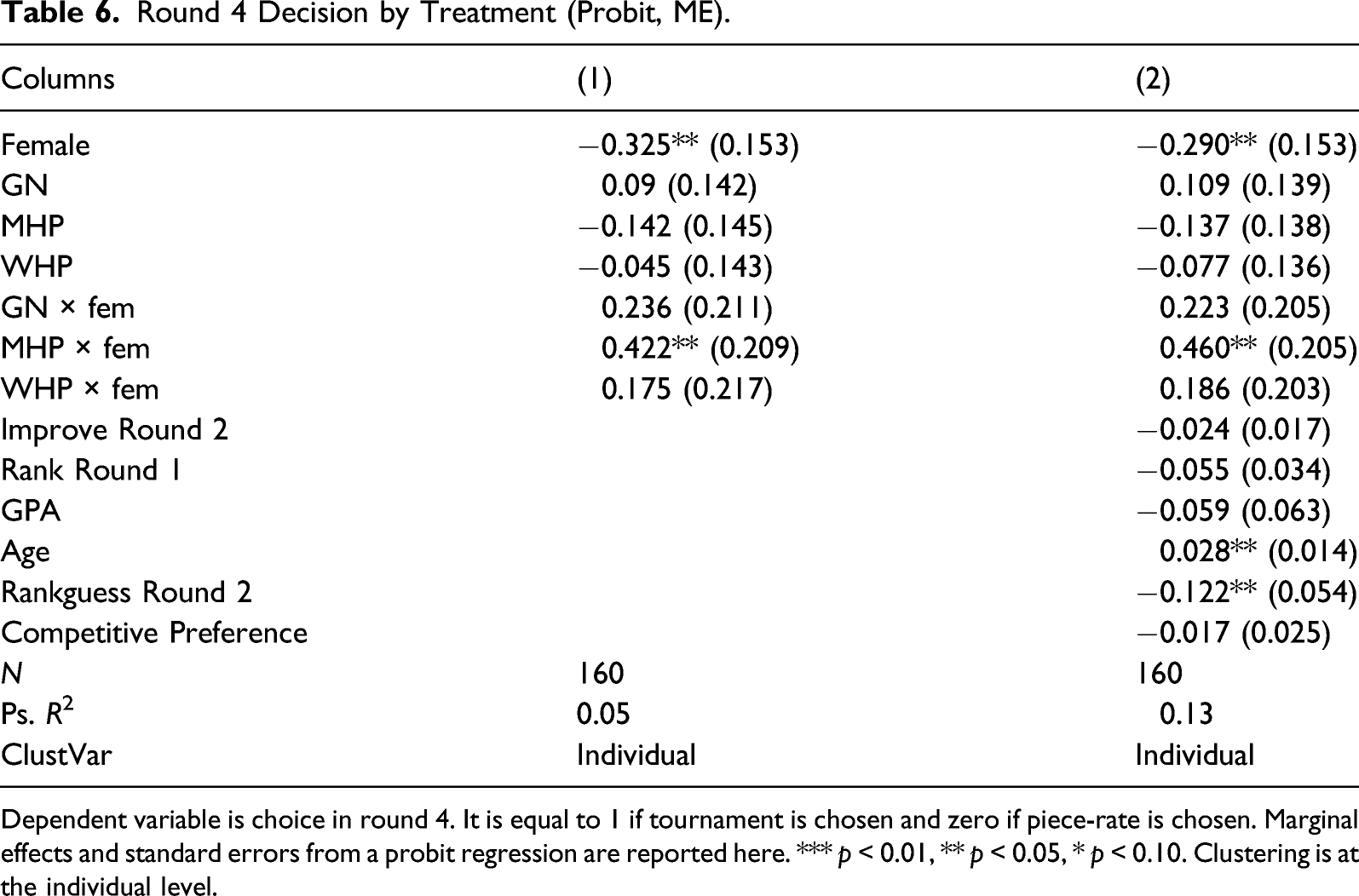
Dependent variable is choice in round 4. It is equal to 1 if tournament is chosen and zero if piece-rate is chosen. Marginal effects and standard errors from a probit regression are reported here. *** p < 0.01, ** p < 0.05, * p < 0.10. Clustering is at the individual level.
Summary Statistics of Participants.
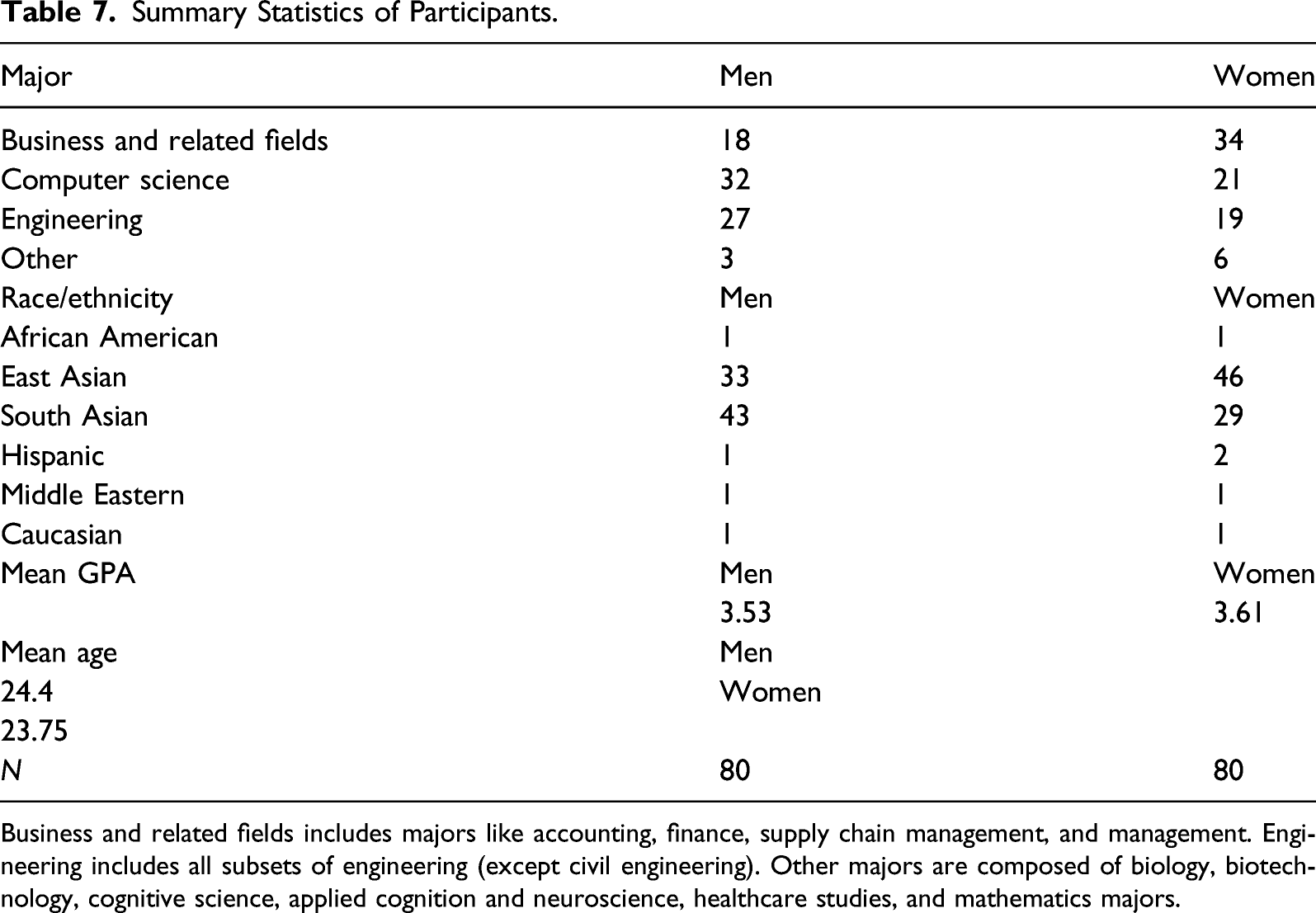
Business and related fields includes majors like accounting, finance, supply chain management, and management. Engineering includes all subsets of engineering (except civil engineering). Other majors are composed of biology, biotechnology, cognitive science, applied cognition and neuroscience, healthcare studies, and mathematics majors.
Next, I assess if there are gender effects that spill over into the treatments in round 4, even though the treatments are not intended to impact the round 4 decision. In each of the treatments, I am able to marginally reject that there is a gender effect (in the GN treatment (p = 0.619), the MHP treatment (p = 0.237), and the WHP treatment (p = 0.443)). There is no significant gender difference in round 4 decisions in any of the treatments. 90% of participants who selected the tournament in round 4 selected the tournament in round 3, whereas 45% of participants who selected the round 3 tournament selected the round 4 tournament. In both cases, selecting the tournament in one round increases your likelihood of selecting it in the next round, suggesting there are spillover effects when tournament entry is high. However, this does not explain the depression of tournament entry in round 4 that I see in the presence of social information. fn13
Discussion
As this is primarily an exploratory paper, it is worthwhile to discuss what works, what does not, and some of the various limitations of this approach. The first item to discuss is the sample size. There are large enough differences statistically to where this has some power, but it would be helpful to have a larger sample size to bear out the magnitude of the differences in preferences in a stronger fashion. This way, the elimination of the gender gap in competitive choices in the treatments would have a larger impact. Given the nature of this paper, the sample size is sufficient as it allows us to learn about the decision making processes of the participants in a helpful way with this set of social information.
Another potential issue of would be whether or not this social information intervention is at least somewhat deceptive, or could be interpreted as such. Even though the information is presented as “selected,” participants may misinterpret that information and think it is representative. It is possible students interpreted the information as implicitly deceptive, even though it is explicitly not intended to be deceptive (no deception was a condition of IRB approval as well). This could lead to distorted results, especially if they have stronger feelings about capabilities of others. It could be that if participants perceive either sex as more or less capable, they may dismiss the social information provided as unrealistic and ignore it. In concert with some of the discussion topics that follow, I think that this issue could be remedied by simplifying the feedback and making the origin more clear.
The crux of concern with the structure of the feedback is that there is a lot of information presented, making it difficult to discern what part of the feedback is more or less important. A good extension would be to include numerical feedback and gendered feedback showing men/women perform differently, separately. This would involve another treatment or two, but it would be worthwhile to see the effect of gendered feedback versus just standard numerical feedback along the lines of “people on average solved 12 problems” or “participants who won their group in round 2 solved 14 on average.” Regardless of specific structure, simplifying the feedback would be essential for future studies, as it would make evaluation of the results clearer, and lessen the informational burden of participants making decisions. Related to this, looking at absolute performance feedback would be helpful instead of how participants did relative to one another as I present in this paper. It also might be interesting to provide some sort of feedback information before round 4, to see if that better informs and/or changes that decision process. It would also be fascinating to include irrelevant information in a treatment and see the effect that may have on decision making in round 3.
Because there is not really an easy way to tease out which parts of the feedback are driving the changes, I have a hard time interpreting the MHP results especially. I offered some explanation as to why these unexpected results occur earlier, but there are some other possibilities. Most of the participants are business, engineering, or computer science majors. Given the mathematical ability of most of those majors, it is reasonable to assume that both men and women have a lot of information about their mathematical ability that may not be terribly manipulable through social information. This could explain why we see the GN, WHP, and MHP treatments result in very similar behavior. If this is the case, women would need to see the numerical feedback to feel more confident choosing the tournament, and men would not. It is also plausible there is some other intrinsic belief activated here in the face of social information. Maybe seeing social information has the effect of improving one’s self-esteem, or some similar notion. Where if you only see your own performance, you are inclined to feel it is poor, but in the face of a metric of comparison may realize your own performance is quite good and then choose the tournament. Ultimately, I think simplifying the social information used by running more treatments would be able to make it easier to tease out what happens in a treatment like this. In addition, it could be helpful to have some follow-up survey questions after the experiment to ask participants what was driving their choice, etc. This is, provided that there is a way to tease out participant feedback in a concrete manner.
Conclusion
Information about your performance relative to others in a variety of scenarios is very difficult to obtain, and can even be impossible to get. A more realistic type of information to provide is social information. This information can be helpful in deciding whether or not to enter into a competitive scenario. In this exploratory paper, I find that including social information eliminates the gender gap in tournament entry, using a simple, real-effort task. The reduction of the gender gap is not due to greater efficiency of tournament selection, but that women significantly increase tournament entry, even when it may not be payoff maximizing. While I account for overconfidence, I find no systematic gender differences in overconfidence in any of the treatments. I find that there is a weak relationship between tournament entry decisions and competitive preferences. When participants make a competitive decision based on performance in the first round, tournament entry decreases sharply. This is especially true when the social information presented gives the indication that a higher number of correct problems are needed to win the tournament. Here, the strength of the results must be tempered against the issues addressed in the discussion section. Buser et al. (2014) find that gender differences in competitive preferences can account for up to 20% of the decision to enter a more prestigious and competitive career path. This suggests that there is an enormous potential benefit for a simple mechanism, like the social information used here, which can alleviate the effects of gender differences in competitive preferences.
Footnotes
Additional Results and Figures
Experimental Instructions
The instructions for the baseline treatment are as follows. The baseline treatment is identical to the one in Niederle and Vesterlund (2007). However, the instructions are slightly different. After the baseline instructions are introduced, the instructions for different treatments are shown in the way that they modify the baseline instructions. The instructions are as they appeared on the zTree screen for participants. All of the social information is from the math task data in Wozniak et al. (2014).
Acknowledgments
I would like to thank Sherry Li for all of her invaluable help, guidance, and encouragement on this project; the Center and Laboratory for Behavioral Operations and Economics (CLBOE) for the use of their laboratory; Vineetha Sadavsan, Mrunal Hadke, and Miryam Ahmadi for their help running experimental sessions and assistance in the CLBOE lab; Shuo Yang for all of his assistance throughout this project; all participants at the 2015 Economic Science Association North American Meeting in Dallas, Texas, for their valuable input; the Negotiation Center for financial support; participants at the Economics Department Brown Bag Seminar at UT Dallas; participants at the CLBOE Seminar at UT Dallas; Wendy Lee for her help with zTree Programming; Holger Rau and Anya Samek for sharing versions of their zTree program; and Michael Coon, Devin Lunt, and Aaron Wood for their helpful comments. I would also like to thank all of the reviewers, associate editors, and editors for their insightful comments which improved this paper. Experimental data and Stata code is available on request.
Declaration of Conflicting Interests
The author(s) declared no potential conflicts of interest with respect to the research, authorship, and/or publication of this article.
Funding
The author(s) received no financial support for the research, authorship, and/or publication of this article.
