







Abstract
This article presents the first report of basic findings from the 2022 online administration of a national survey on teaching methods in Advanced Placement (AP) Economics courses. The authors find that “Chalk and Talk” is the preferred method of instruction in AP courses, but that AP instructors also make use of technology in their presentations via media such as films or movie clips. Those educators offer frequent opportunities for students to engage in classroom discussions with other students and with their instructors. Additionally, the toolbox used by AP instructors includes teaching methods and tools rarely used at the college level, including games and simulations, student self-assessments of learning, cooperative learning/small group assignments, references addressing diversity and inclusion, and databases such as Federal Reserve Economic Data (FRED). Overall, AP Economics instructors seem to offer a diverse range of instructional methods to teach high school economics.
Introduction
According to the College Board, Advanced Placement (AP) courses give “students the chance to tackle college-level work while they’re still in high school” (College Board, 2023b). In fact, many public colleges and universities in the United States, and in more than 100 other countries, grant credit, allow students to skip introductory courses, or do both for qualifying Advanced Placement (AP) scores. Additionally, from 2012 to 2022, the percentage of high school students taking AP classes and passing AP exams with scores of 3 (qualified), 4 (well qualified), or 5 (extremely well qualified) increased (College Board, 2023c). As described in Patterson and Ewing (2013), placement validity studies have shown that students who earn scores of 3, 4, or 5 on AP exams, and skip introductory courses in a variety of subjects at the college level, earn grades comparable to those of non-AP students in advanced university courses (e.g., Morgan & Klaric, 2007; Morgan & Ramist, 1998). The College Board further reports that students who take AP exams and score a 1 or 2 on the tests are more likely to enroll in a 4-year college than academically similar students who do not take AP courses in high school (College Board, 2023c). Furthermore, Evans (2019) shows that students who earn AP credits use them to save time and money, reducing their time to degree completion and enhancing their college studies via double majors or more advanced courses.
In the field of economics, Morgan and Ramist (1998) found that students who earned a score of 4 on the AP Macroeconomics exam could not be shown to earn higher grades in second-level university courses, on average, than students who took a university introductory course. The authors identified a similar finding for students who earned a score of 3 on the AP Microeconomics exam. In a follow-up study that controlled for general academic achievement by using Scholastic Aptitude Test (SAT) scores, Morgan and Klaric (2007) investigated ten AP subject areas and found that AP Macroeconomics was the only area where students who scored a 3 or higher could not be shown to earn the same or better subsequent course grades in college than non-AP exam takers. Furthermore, Melican et al. (1997) analyzed results from a comparability study conducted by the College Board and found that AP Economics students performed better than college students who took the same AP exams—on both the multiple-choice and free-response sections.
The content included in AP Microeconomics and AP Macroeconomics courses is designed to be equivalent to the content covered in college-level principles classes. Given the popularity of AP Economics courses, the recent abrupt changes experienced in education since the COVID-19 pandemic, and the limited amount of scholarship examining AP Economics courses, this inaugural survey was designed to evaluate the current state of instruction in those courses, compare the results to the teaching methods used in undergraduate introductory courses, and serve as a baseline for future scholarship.
Survey Background and Details
This inaugural national survey on teaching methods in AP Economics courses was constructed to align with the National Quinquennial Survey on Teaching and Assessment Methods in Undergraduate Economics, originally developed by Becker and Watts and first administered in 1995. Becker and Watts developed the survey to document how economics was being taught at the college level and to track changes over time. Descriptions of the surveys, the sampling procedures, and the results over a 25-year period have been published in a variety of academic outlets (e.g., Asarta et al., 2021; Becker & Watts, 1996, 2001; Harter et al., 2022; Watts & Becker, 2008; Watts & Schaur, 2011). The overlap between the two surveys was kept to the largest extent possible, allowing for some differences in teaching methods to make the new survey relevant to the target population. For example, questions about scholarly “Literature searches” were eliminated, while questions regarding the use of “AP Daily videos from AP Classroom” and “AP Classroom questions” produced by the College Board were added.
The AP Economics survey was administered online, during the second half of 2022, through the Federal Reserve Bank of St Louis and using the Qualtrics software online platform (Qualtrics, 2023). The survey was emailed by the College Board to a universe of 3,742 AP Economics high school teachers, and the response rate was 10.3%. While lower than the response rate of the latest quinquennial survey on teaching and assessment methods in undergraduate economics courses (Asarta et al., 2021), the current response rate is almost identical to the one reported by Watts and Schaur (2011).
Response Counts and Rates by AP Economics Course.

Scale of Responses for Teaching Methods.
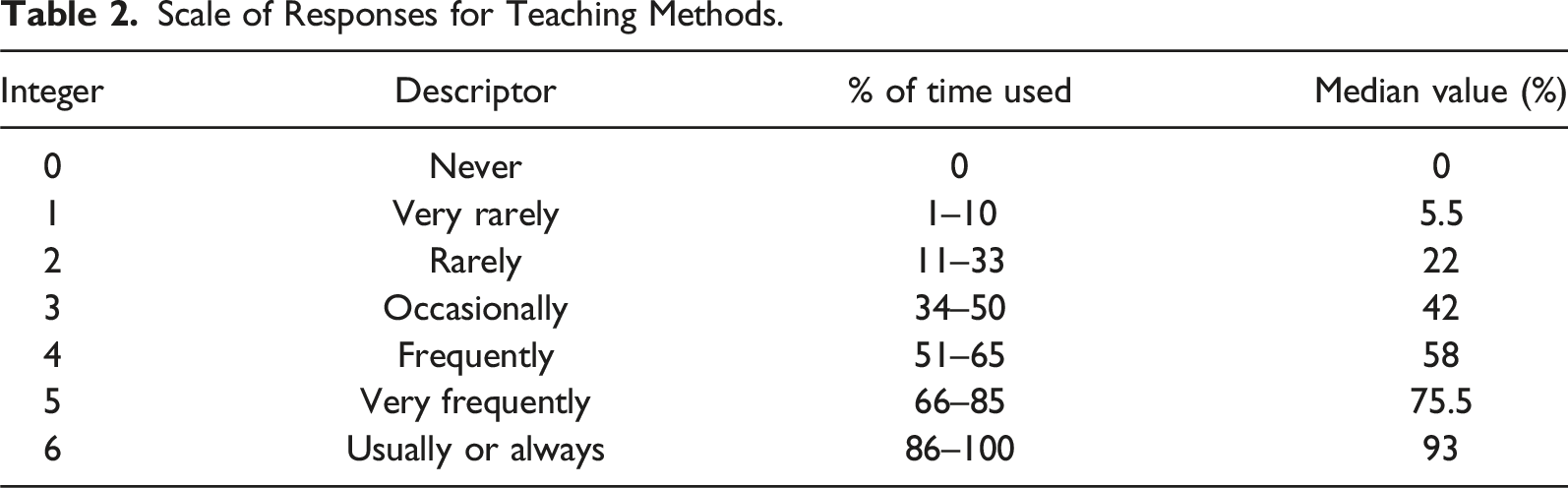
The results reported in the next section use the median values, as provided in Table 2, to translate integer values into a percent of time a teaching method is used in a classroom. This approach is consistent with that used by Watts and Becker (2008), Asarta et al. (2021), and Harter and Asarta (2022).
Survey Results
The results provided below focus on the responses of high school instructors teaching AP Economics courses (N = 385). Fifty percent of survey respondents were male and 90% were White. Sixty-four percent of the respondents held a master’s degree. These AP Economics instructors reported an average of 19 years of teaching experience. We do not have access to descriptive data about the overall population of teachers who teach these AP Economics courses and are, therefore, unable to determine whether respondents are representative of all U.S. teachers of AP Economics courses. For comparison purposes, however, Scahill and Melican (2005) surveyed 1,365 AP Economics instructors and received responses from 296 instructors (a response rate of 21.7%); their sample included a higher percentage of males (66.2%) and nearly the same percentage of White instructors (92%) when compared to the sample used in the current study.
Survey Results on Teaching Methods, Median and Mean Responses in Percentages.
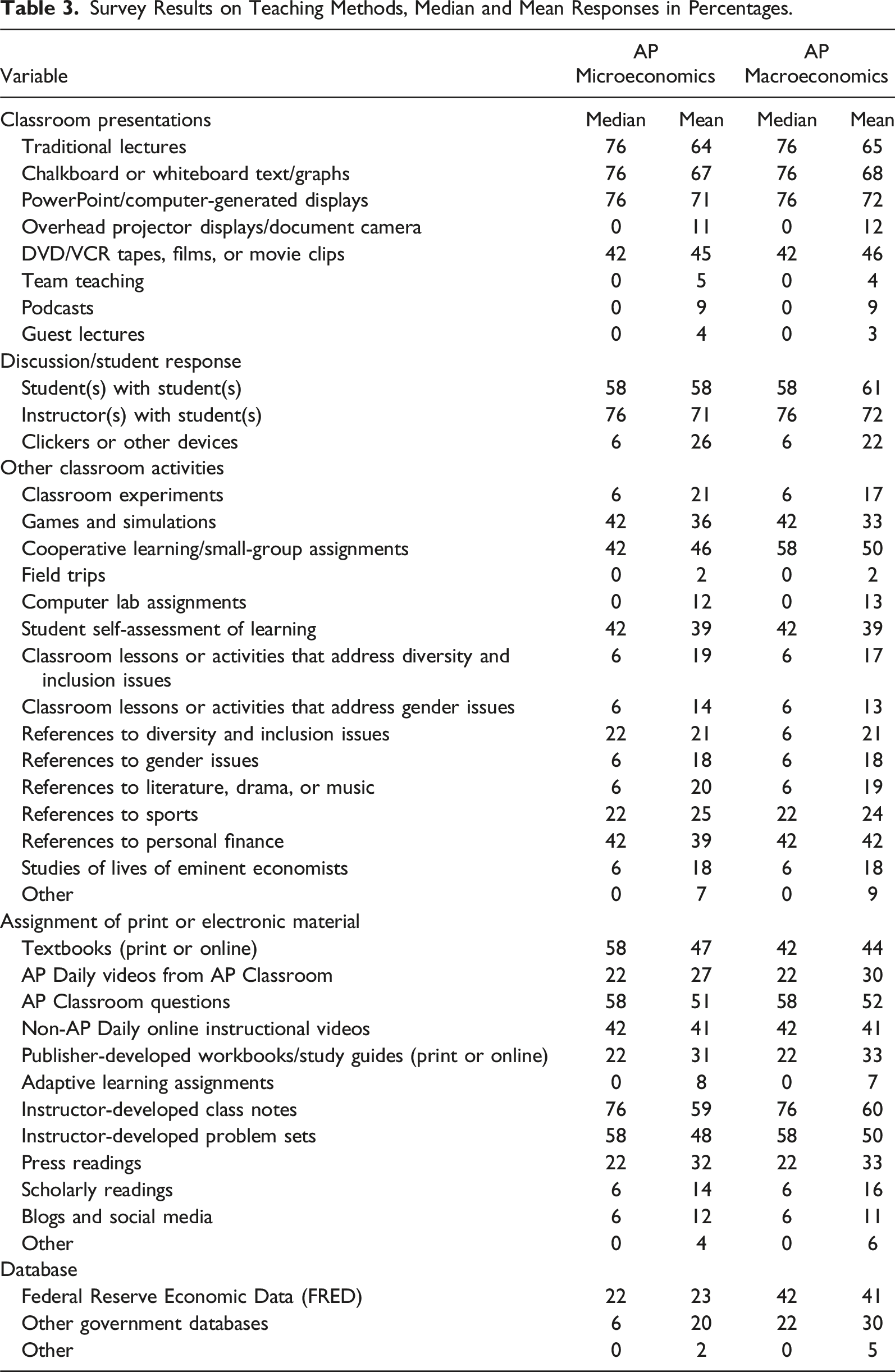
The primary method used by AP instructors for classroom presentations is traditional lectures with a chalkboard, a whiteboard, and/or PowerPoint/computer-generated displays. On the other hand, overhead projector displays and/or document cameras were almost never used in either of the two types of AP courses (median = 0%). These instructors, however, used DVD/VCR tapes, films, or movie clips occasionally (median = 42%) for their classroom presentations.
The results show that AP educators engage with their students in discussions very frequently (median = 76%) and incorporate “Student(s) with student(s)” discussions frequently (median = 58%). Additionally, these instructors very rarely (median = 6%) use clickers or other devices to engage with their students. In terms of other classroom activities, games and simulations are used in both types of AP courses occasionally (median = 42%), while cooperative learning/small-group assignments are also used occasionally in AP Macroeconomics courses but frequently in AP Microeconomics courses (medians of 42% and 58%, respectively). While field trips and computer lab assignments are almost never used in AP Economics courses (median = 0%), student self-assessments of learning are used occasionally (median = 42%).
Regarding the use of classroom lessons and activities about, or references to diversity, inclusion, or gender issues, the general finding is that those are very rarely used (median = 6%) in both types of AP courses, with the exception being references to diversity and inclusion issues in AP Microeconomics courses, which are rarely used (median = 22%). Worth noting is the occasional use of personal finance references in both types of courses, an unsurprising finding given the recent emphasis placed on requiring personal finance standards to be included in the K-12 curriculum.
In terms of assigning print or online materials in their classrooms, AP Economics instructors make frequent use of AP Classroom questions and instructor-developed problem sets (median = 58%). Additionally, these instructors use instructor-developed class notes very frequently in both types of courses (median = 76%). While AP Daily videos are used rarely (median = 22%), instructors seem resourceful and use non-AP online instructional videos occasionally (median = 42%). The finding that Federal Reserve Economic Data (FRED) is used occasionally in AP Macroeconomics courses (median = 42%) is encouraging. Other databases, however, are almost never or very rarely used in these courses, except for “Other government databases,” which are used rarely in AP Macroeconomics classes (median = 22%).
How do these AP Economics survey results compare to those of the latest administration of the National Quinquennial Survey on Teaching and Assessment Methods in Undergraduate Economics? In broad strokes, “Chalk and Talk” is the dominant method of instruction at both the AP and undergraduate introductory economics levels, although instructors in AP courses seem to make use of DVD/VCR tapes, films, or movie clips more often than instructors in undergraduate introductory courses. AP instructors also engage in instructor-with-student discussions more often than their college counterparts. A stark difference between AP courses and undergraduate economics courses can be seen when it comes to the use of games and simulations, student self-assessments of learning, and cooperative learning/small group assignments; in those areas, AP instructors are more inclined to engage their students in active and peer learning. While the frequency with which AP instructors use classroom lessons, activities, and references addressing diversity, inclusion, and gender issues remains low, it is still an encouraging improvement from the median value of zero percent found for all those categories at the college level. Furthermore, while AP instructors make use of textbooks (both online and printed) less frequently than undergraduate economics instructors, they use instructor-developed class notes more frequently than their college counterparts. Finally, FRED and other government databases seem to make their way into AP Economics classes more frequently than into college-level introductory economics courses.
Conclusion
This article presents the first report of basic findings from the 2022 online administration of a national survey on teaching methods in AP Economics courses. The results show that the primary method for classroom presentations in those courses is traditional lectures with a chalkboard, a whiteboard, and/or a PowerPoint/computer-generated display, but that AP instructors also make use of media (e.g., video clips) in their classrooms. Discussions are used frequently in AP classes, particularly when it comes to instructors engaging with their students; yet those instructors are making time for students to also discuss course content with their peers. The toolbox of instructional methods used by AP instructors includes methods rarely used at the college level, such as games and simulations, student self-assessments of learning, cooperative learning/small group assignments, classroom lessons, activities, and references addressing diversity, inclusion, and gender issues, and databases such as FRED. Overall, AP Economics courses seem to offer a more diverse range of instructional methods than undergraduate introductory economics courses. Worth noting is the fact that the latest iteration of the National Quinquennial Survey on Teaching and Assessment Methods in Undergraduate Economics was administered before the COVID-19 pandemic abruptly changed the way education is conducted worldwide (Asarta et al., 2021, p. 26). With that in mind, it is possible that some of the differences between the methods used in AP Economics courses (measured in 2022) and in introductory undergraduate economics courses (measured in 2020) are due to the educational adaptation that followed the COVID-19 pandemic. While undergraduate economics instruction has shown little change since Becker and Watts began their quinquennial survey in 1995, we are hopeful that the changes forced upon all educators since 2020 will alter the ways we teach economics at the high school and college levels.
Footnotes
Acknowledgments
We would like to thank Bill Bosshardt, Bonnie Meszaros, and Mary Suiter for helpful conversations and input during the development of the survey, and Elizabeth Healy for her willingness to distribute the final version of the survey among AP teachers.
Declaration of Conflicting Interests
The author(s) declared no potential conflicts of interest with respect to the research, authorship, and/or publication of this article.
Funding
The author(s) received no financial support for the research, authorship, and/or publication of this article.
Disclaimer
The views expressed in this article are those of the authors and do not necessarily reflect the position of the Federal Reserve Bank of St. Louis or the Federal Reserve System.