







Abstract
The value of higher education is currently being questioned. This article uses microdata from the 2009–2022 American Community Survey (ACS) to analyze the impact of educational attainment, major, and double majors on labor market outcomes. By analyzing earnings and college majors, this research refines our understanding of education’s value for researchers, policymakers, and prospective students. Our work corroborates previous findings that bachelor’s degrees contribute significantly to higher earnings and that the choice of college major affects earnings. We also show that the increased resilience to economic downturns found for bachelor’s degree holders is positive for all majors, and that the positive impact differs by gender. We also show that the wage differential for BD holders follows a bell-shaped curve throughout a person’s lifetime. The decline in the wage premium in later years is particularly pronounced and starts earlier for women.
Introduction
The economic relevancy of education has been a topic of significant research and policy attention over the last half century, and of increasing general public and political interest. Becker (1962; 1964) demonstrated the relevance of the returns to education for evaluating individuals’ human capital investment decisions and fostered the development of a large body of literature examining the effects of education on labor market outcomes. Empirical work measuring the returns to education not only flourished, but also provided strong evidence that education, particularly higher education, is a driving force of income creation and economic opportunities (Abramitzky & Lavy, 2011; Altonji, 1993; Autor et al., 2024; Bailey & Dynarski, 2011; Erisman & Looney, 2007; Kuka et al., 2020; Murnane, 2013). Differences in human capital that are driven by educational attainment have also been associated with differences in regional economic performance (Johansen & Arano, 2016; Prime et al., 2016; Stewart et al., 2020) and pointed to as both the solution to and the culprit of widening economic, wealth, and opportunity gaps (Autor & Dorn, 2013; Chetty et al., 2014; Goldin & Katz, 2008; Katz & Murphy, 1992; Weinstein, 2025). Economic studies show a large positive return to a BD (bachelor’s degree) over high school or some college. However, Autor et al. (2024) using data from the Current Population Survey show a decline in the premium from 2015 to 2023, with a large decrease from 2020 to 2023. Moreover, Aeppli and Wilmers (2022) find a decline in the wage gap between college educated and non-college educated workers starting in 2012. As will be discussed later, our results run counter to those of Autor et al. (2024) and are somewhat consistent with Aeppli and Wilmers (2022), but for reasons that do not impinge on the base arguments of the paper. This article provides a detailed empirical assessment of education’s effect on labor market outcomes throughout the business cycle, adding specificity to knowledge about the returns to higher education for researchers and policy makers.
Large differences in earnings and employment prospects across majors (Altonji, Kahn, & Speer, 2016, Altonji, Arcidiacono, & Maurel, 2016; Altonji & Zimmerman, 2017; Patnaik et al., 2020; Zhang et al., 2024) have, to some degree, contributed to the perceived popular view that college education no longer guarantees a successful career path and that some college fields may not prepare students to meet market demand, and thus, produce graduates who will underperform and experience pay or job placement that would not be significantly better than that of non-college educated individuals. Altonji, Arcidiacono, and Maurel (2016), for example, show that the earnings premium by major differs by as much as 4 standard deviations between Chemical Engineering (high) and Philosophy and Religion (low).
There are also concerns that the employment and income prospects for college graduates decline during recessions. The media has highlighted, for example, “the misfortune of graduating in 2020,” 1 that “job prospects and internships are evaporating for college graduates of 2020” 2 due to the policy-induced recession during the COVID-19 pandemic. Similar views were also present in the media during the 2008 to 2010 financial and economic crisis in the United States. A recent survey by Strada (2020) similarly reported that only 39% of Americans surveyed believed that getting more education would be worth the cost and effort and that 62% of respondents prefer nondegree and skills training options over degree programs including BD or graduate degrees. These popular views run counter to our empirical findings which show that wage and income premiums for a bachelor’s degree over a high school diploma increase during recessions. Additionally, other work by Von Wachter (2020) and Schwandt and Von Wachter (2019) show that the size of the premium is positively related to the severity of the recession. Moreover, our results show that all majors do offer significant protection from unemployment during an economic downturn. While we see significant differences in the wage premium across majors and throughout economic ups and downturns, all majors offer protection from the negative impact of unemployment, especially during a recession. The disconnect between popular understanding of the benefits of a college degree in terms of employment and results may come from the failure to understand the difference between an absolute decline in the earnings and employment prospects of college educated workers and a relative increase in both earnings and employment of these workers over high school educated workers during a recession. All economic studies that we review conclude that college graduates beginning a career in a recession experience worse outcomes initially and that these negative effects persist over long periods of these workers’ careers (Kahn, 2010; Rothstein, 2020; Schwandt & von Wachter, 2020), but it is a mistake to take from this that college offers no or limited protection in downturns.
Our work also addresses another popular perspective regarding the value of a college education. While liberal arts majors begin their careers with lower wages than STEM, economics, and business majors, it is often argued that they catch up in income over time. 3 Other research has found, however, that the choice of the post-secondary field contributes significantly to explain individuals’ earning and overall labor market outcomes (Gemici & Wiswall, 2014; Patnaik et al., 2020). More specifically, science, technology, engineering and mathematics (STEM) fields as well as business and economics majors outperform other majors in terms of compensation or employment (Altonji, Arcidiacono, & Maurel, 2016; Patnaik et al., 2020; Zhang et al., 2024). Our work shows that this initial effect persists throughout careers. For example, we find that the wage premium of economics over both high school and all liberal arts and humanities majors is maintained from the early labor market entrants to 65 plus cohorts. There is no evidence in our results consistent with the contention that liberal arts and humanities majors catch up over time for women or for men. We also find that liberal arts majors who take on a double major, inside or outside of the liberal arts, find little increased returns over their post-graduate career. This might explain why the proportion of humanities, social sciences and education degrees has decreased significantly over time (Patnaik et al., 2020). Our results also show that the wage premium of economics, STEM and business persist throughout downturns and in stronger economic times.
This paper contributes to both popular understanding of the benefits of a BD as well as the economics literature by conducting an empirical analysis that provides a detailed assessment of education’s effect on labor market outcomes throughout the business cycle, and across the cycle of the working life. 4 The article’s objectives are to (i) provide a set of stylized facts on earnings and employment by detailed BD fields by age and sex 5 and (ii) assess which college majors perform better (or underperform) during economic downturn such as that experienced during the 2008–2010 recession in the United States. While it has been reported that holding at least a BD results in lower unemployment rates (Mejia et al., 2023), or increased employments rates (Autor et al., 2024), consistent with a limited literature (Von Wachter, 2020) we find evidence that the choice of major does have a strong impact on the returns to a BD over recessions, increasing lifetime earnings for more recession resistant majors. The effects of major choice are thus much more important than normally recognized since studies find long term persistence from starting a career during a recession (Kahn, 2010; Rothstein, 2020; Schwandt & Von Wachter, 2020Schwandt & von Wachter, 2020). An adverse start due to a recession has also been linked to negative health behaviors and increased mortality (Cutler et al., 2015; Maclean, 2015; Schwandt & von Wachter, 2020), as well as negative effects on family formation (Currie & Schwandt, 2014; Schwandt & von Wachter, 2020) and decreased self-esteem (Maclean & Hill, 2015).
Our analysis makes use of regression analysis and over 17 million observations from the American Community Survey (ACS) from 2009 to 2022 to provide estimates of the returns to education (earnings and employment) across multiple dimensions and by detailed BDs for 30 areas of study. While recent studies such as Autor et al. (2024) and Aeppli and Wilmers (2022) suggest a compression in wage differentials—particularly post-2012—our findings show a sustained or even increasing wage premium for bachelor’s degree (BD) holders, especially from 2020 to 2022. This divergence may stem from differences in data sources (ACS vs. CPS), the inclusion of 2023 in Autor et al. (2024), and the time frame we examine. Our analysis on educational attainment does not map precisely onto income percentiles, complicating direct comparisons with studies focused on wage inequality across the distribution. By disaggregating outcomes by major, gender, and age, and by incorporating double majors, we provide a more granular view of how educational choices shape labor market trajectories. Our results also highlight the resilience of BD holders during economic downturns, a finding that contrasts with popular narratives and aligns with Von Wachter (2020) and Schwandt and von Wachter (2019). Moreover, we show that while the wage premium follows a bell-shaped curve over the life cycle, it remains significant, though declining, into later years—especially for women. Finally, by quantifying the returns to double majors and emphasizing the importance of major combinations and order, our study adds depth to the literature on human capital diversification. In sum, this paper refines our understanding of the college earnings premium by integrating detailed educational pathways with labor market dynamics across economic cycles.
Methodology
We estimate the hourly wage premium using a standard Mincer (1974) equation that includes detailed educational attainment and other controls as explanatory variables. Consider the following equation:

Equation (1) allows the expected wage differential to vary with time. More precisely, the expected wage differential for degree j (compared to high-school degree) at time t is:

We follow Halvorsen and Palmquist (1980) and calculate the wage differential in percentage terms

The wage premium is calculated using only the coefficients in which the null hypotheses


The Halvorsen and Palmquist (1980) transformation is also applied to equation (5) to obtain the expected wage premium in percentage terms. Equation (4) is estimated using the same controls and methods, but to ensure the robustness of point estimates, the model is estimated pooling 2 years (2021–2022) of ACS data. This study provides no discussion of the changes in the wage premium by age cohorts over time. 8
We also estimate a linear probability model (LPM)
9
in which the dependent variable is equal to one if the individual is employed and zero if the individual is unemployed. More specifically, the following model is estimated:


Equation (7) is also estimated pooling 2 years (2021–2022) of ACS data.
Data
The hours, compensation, employment status and other variables required for this study are from the U.S. American Community Survey (ACS). Our analysis starts in 2009 because data for the field in which the person received a BD degree (if the person holds a bachelor’s degree) is only available for 2009 onward. For educational attainment, we use: 0–8 years grade school; 9–12 years—no high school diploma; high school diploma; some college, but no degree; associate degree; 30 major fields of study for those who hold a bachelor’s degree; master’s degree; and Ph.D. and professional degrees. We only consider paid employees in the public and private sectors. Unpaid and self-employed are not considered due to inherent difficulties in obtaining reliable income estimates from the ACS.
Results
Wage Differential
The expected wage differential for degree j,
Variations in the Wage Premium Across BD Fields
The wage premium increases with educational attainment. In 2022 and compared to a person with a high school degree, the average wage differential was 16.5% for male individuals with some college education,
10
27.9% for males with an associate’s degree, 65.6% for males with BD degrees, 107.8% for males with master’s degree, and 161.0% for those with PhD and professional degree (Figure 1, Tables 1 and 2). While similar patterns are observed for women, there are also some differences in the returns to education compared to what is observed for men. More precisely, in 2022 the associate degree to high school wage differential was higher (29.1%) for women, compared to (27.3%) for men, as was the average returns to BD (69.9% compared to 65.6%). On the other hand, in 2022 the master’s degree to high school wage differential was lower (100.7%) for women, compared to (107.9%) for men.
11
Wage Premium Compared to High School by Educational Attainment, 2022. Source: Authors’ Compilation Using ACS Data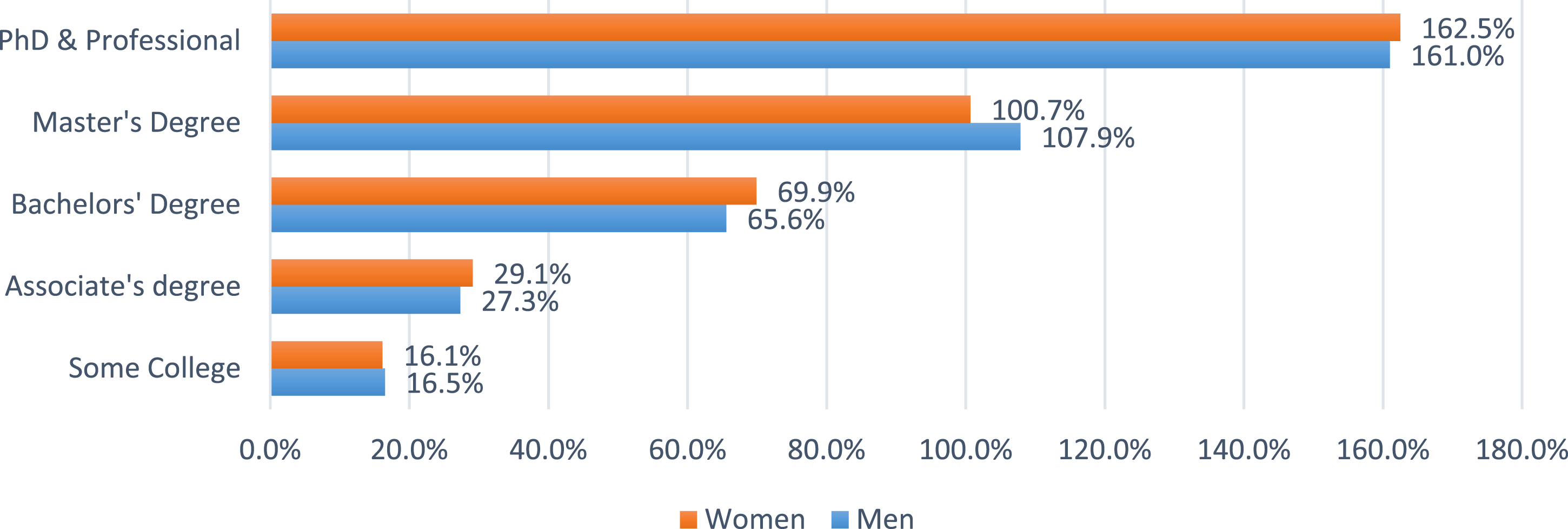
The wage differential varies significantly across fields of BD holders as seen in Figure 2.
12
For both men and women, the highest wage differentials compared to high school are for those who pursued fields of study in engineering, computer and information science, economics, finance, mathematics and statistics, accounting, medical and health science and services, and business. In 2022, the average wage differential for these BD fields ranged from 76% (80.8%) in business for women (men) to 116.3% (112.1%) in engineering for women (men). Regardless of gender, the fields with the lowest wage premium compared to high school diploma are philosophy, theology and religious studies, public affairs, policy and social work, and education administration and teaching.
13
The wage premium for these fields of study are just marginally higher than that observed for individuals who pursued an associate’s degree. Wage Premium Compared to High School by BD, 2022, Women and Men. Source: Authors’ Compilation Using ACS Data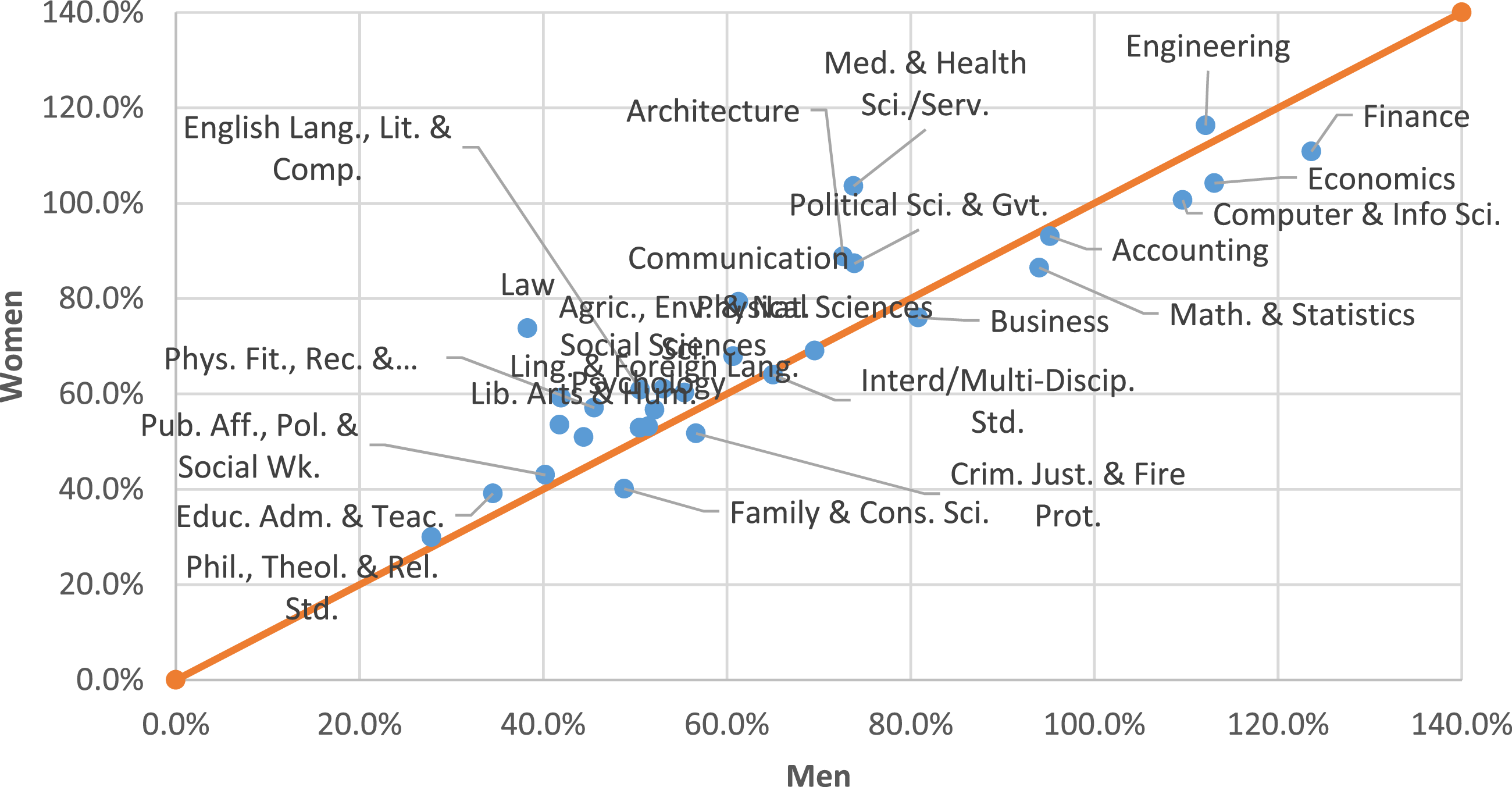
There are noticeable differences in the returns to education by gender. In 2022, the average wage of women with a BD in medical and health science and services was 103.6% higher than that of women with a high school degree, while men with a degree in medical and health science and services received an average of 73.8% more than men with a high school degree. Overall, the within-gender wage premium to education for women with BD in medical and health science and services, linguistics and foreign language, communication, and education administration and teaching is larger than the within-gender wage differential for men with the same degrees. On the other hand, the within-gender wage premium for men with BD in economics, computer and information science, business, criminal justice and fire protection, and family and consumer services is larger than the within-gender wage differential for women with the same degrees. These differences in the wage premium may affect the choice of majors by men and women (Weinberger, 1998; Gemici & Wiswall, 2014).
Change in Wage Premium over Time
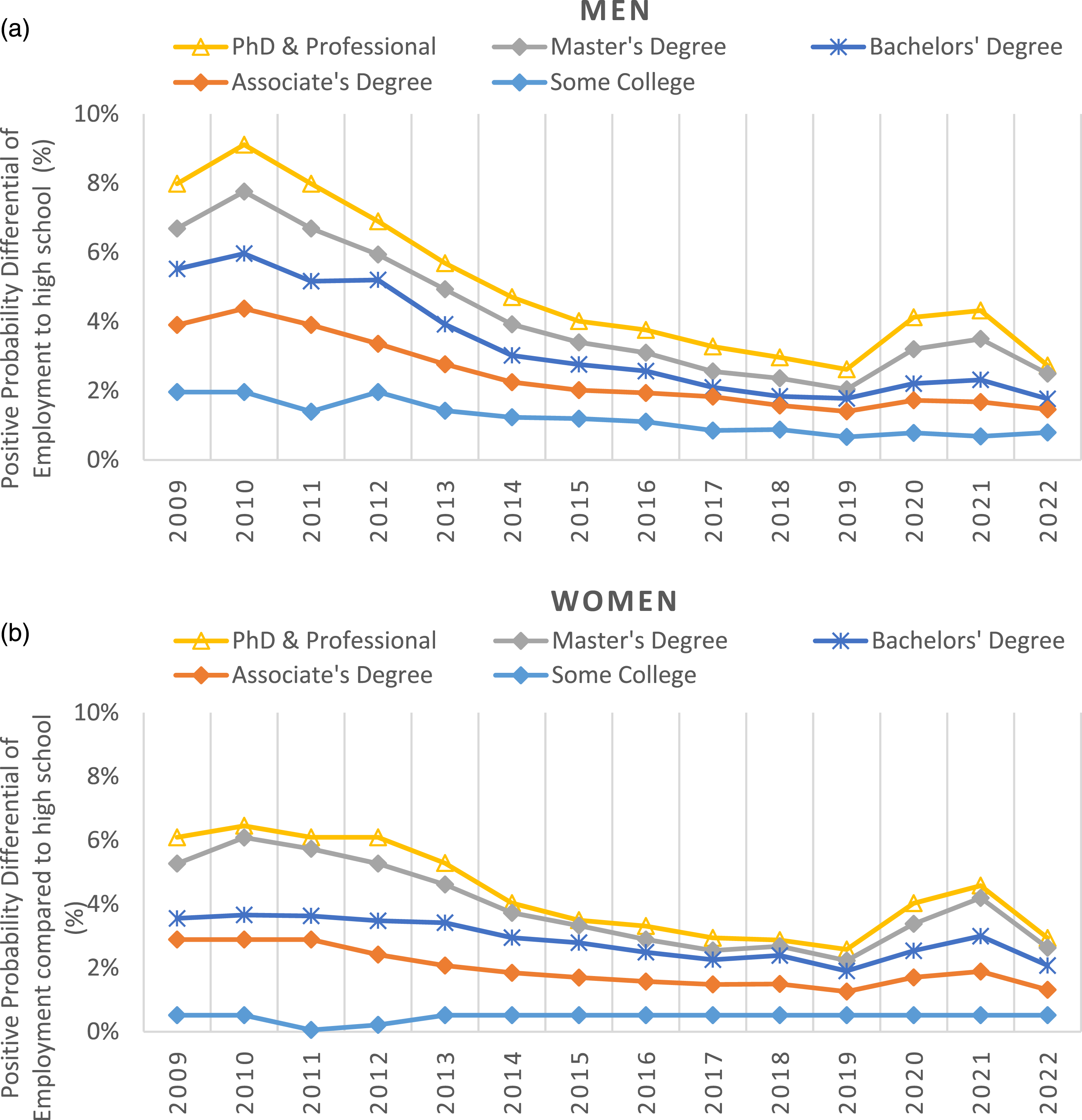
While we find evidence that the return to education across broad educational categories (e.g., Some College, AD, BD, Masters, and Ph.D.) remained relatively stable during the period from 2009 to 2022—a period marked by economic contraction, recovery, and expansion—there were shifts that are statistically significant in the wage premium for BD fields and by gender (see, Tables 1 and 2).These shifts reflect underlying structural changes in the labor market and reveal important differences in how educational value is distributed across disciplines and between genders (Figure 3–6). 2009 to 2022 Change in Wage Premium Compared to High School, Top (Bottom) 5 Fields. Source: Authors’ Compilation Using ACS Data Change in Earnings Premium From Peak Premium to that of Individuals 60 Years or Older, Men, 2021–2022. Source: Authors’ Compilation Using ACS Data Change in Wage Premium From Peak Premium to that of Individuals 60 years or Older, Women, 2021–2022. Source: Authors’ Compilation Using ACS Data Differential in the Probability of Employment by Educational Attainment, 2009 to 2022. Source: Authors’ Compilation Using ACS Data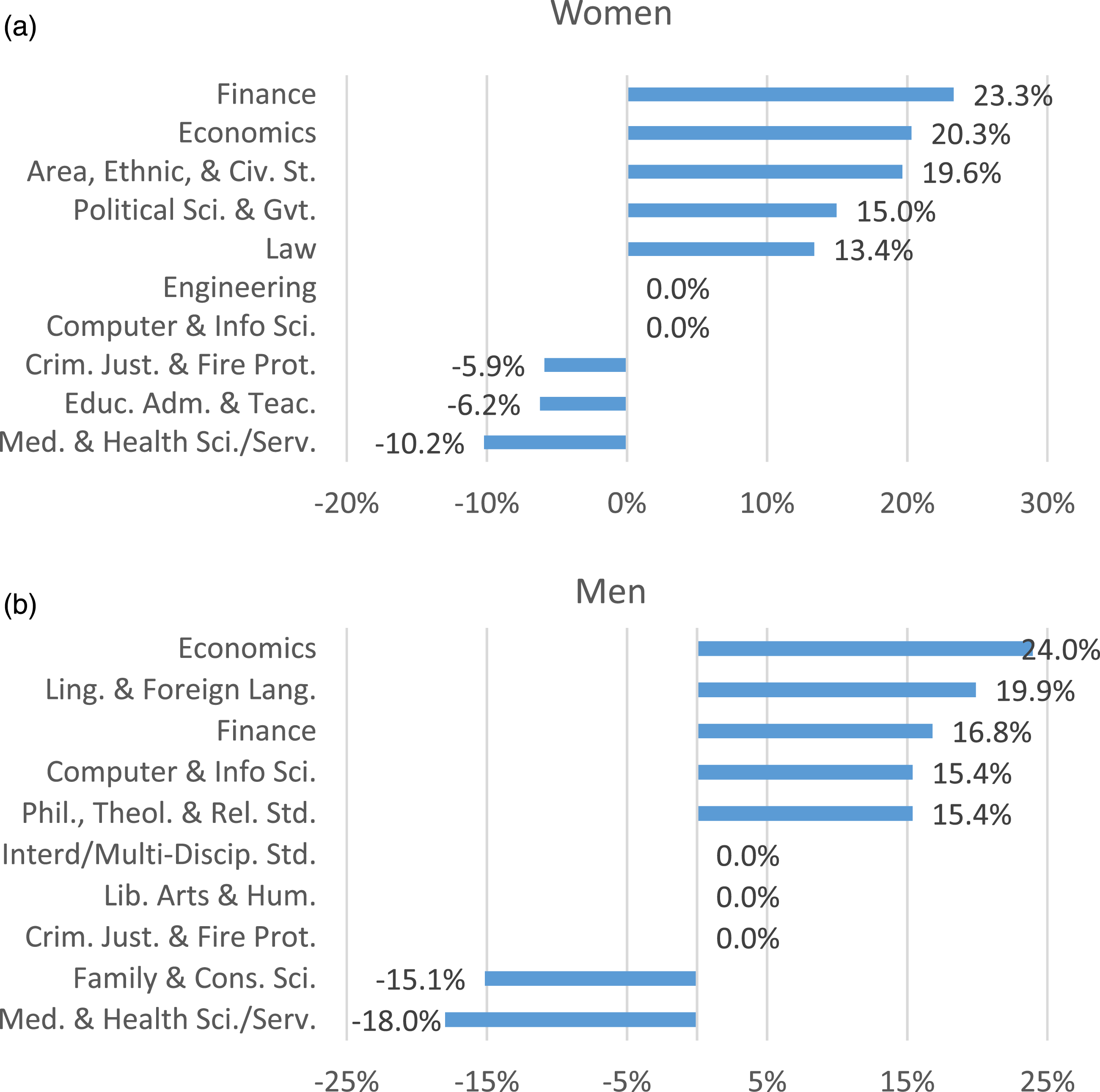
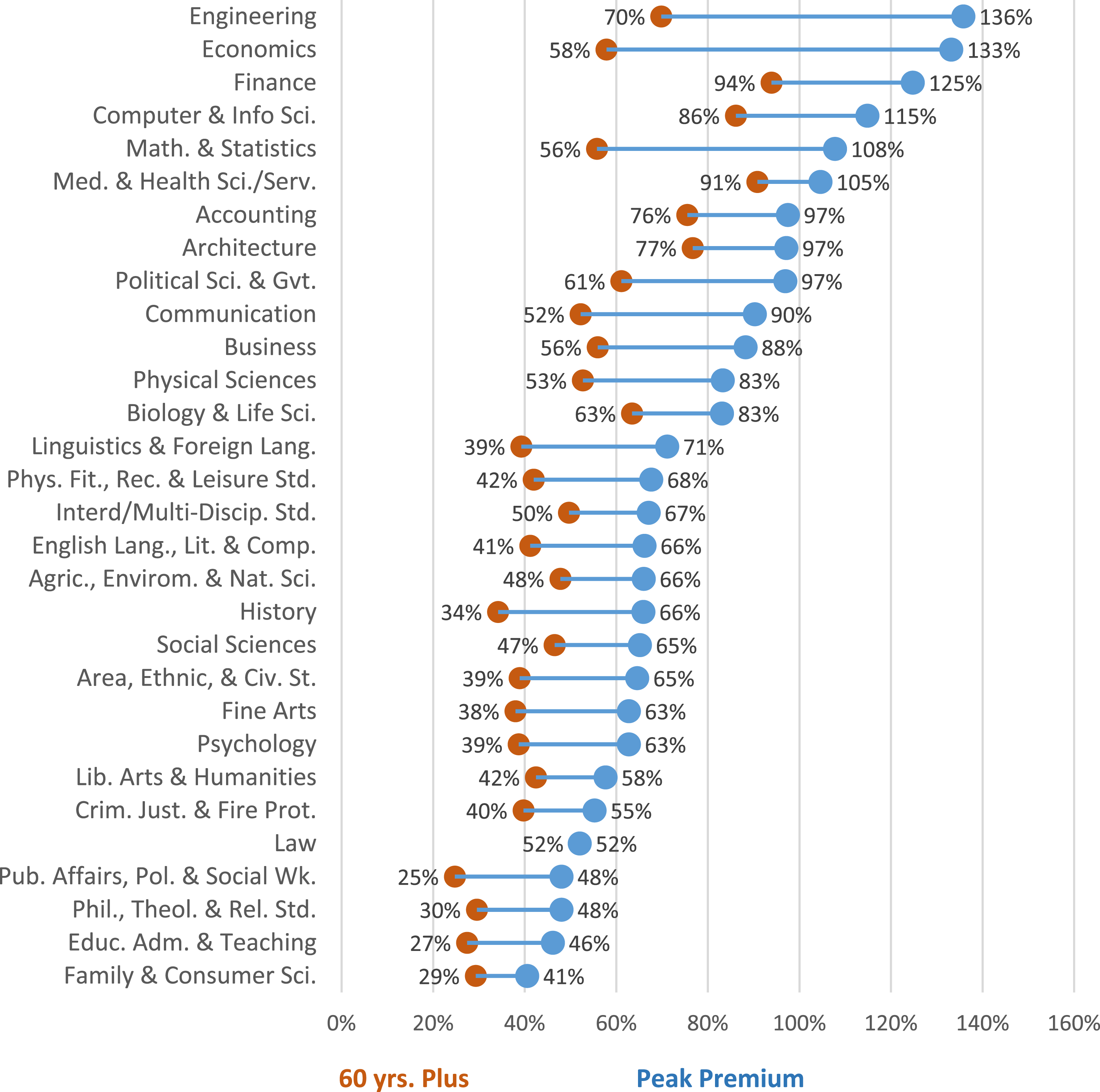
For women, the returns to education decreased in 3 BD fields, stayed the same in 12 fields, and increased in 15 fields. More precisely, the wage premium for those with a BD decreased significantly for women in fields such as education administration and teaching, criminal justice and medical and health sciences and services. On the other hand, the premium increased for those with degrees in Finance, Economics, Area, Ethnic and Civic Studies, Law, Political Sciences and Government, and Law.
Changes in the labor market also affected the returns to education for males, but the impact was markedly different from those observed for females. From 2009 to 2022, the premium for a BD education for men decreased in two fields of study, stayed the same in 8 BD fields, and increased in another 20 fields of study. More precisely, during this period the returns to education decreased significantly for men with BD in medical and health science and services and family and consumer sciences. In contrast, the returns to education increased for men with BD in economics, linguistics and foreign language, finance, computer and information sciences, and philosophy, theology, and related studies.
In sum, results in Tables 1 and 2 show that there are significant labor market benefits from education and that the wage premium increases along with educational attainment. There are, however, noticeable differences in the returns to education of BD education by field of study and by gender. Moreover, the results indicate that the wage premium of college graduates varies significantly and differently for men and women during economic cycles. In the period from 2009 to 2022, the wage differential for college educated women declined or stayed the same in 15 out of 30 BD, compared to 10 BD fields for men.
While the changes in the wage premium have seen a great deal of variation across majors for men and women, a major finding from the ACS is that the BD premium over HS increased by 6.7% for men and 4.8% for women from 2009 to 2022. Moreover, the premium compared with as associate degree increase by 6.7% for men and a whopping 13.4% for women. The importance of these findings is that they come at a time of increased skepticism regarding the economic value of a BD degree. For example, the New York Times recently (9-20-2023) reported in a piece titled “Is College Worth IT” that “new research and polling show that more and more Americans now doubt… that going to college is worth it.” Additionally, The Economist recently had a cover titled the Blue-Collar Bonanza (12-2-2023). In one article, the claim was made that “by the mid-2010s… the revolution [of a rising college wage premium] had matured and the college premium began to shrink.” It goes on to argue that in “2015 the average rich-world worker with a bachelor’s degree or more was paid two-thirds more than the average high-school leaver; four years later, the gap had narrowed by half.” The Economist does not give a source for their statement, and we don’t have an apples-to-apples comparison since we only have data on US workers. But the general message is clear, the wage premium is on the decline. Our results show the exact opposite. 14 For example, if we add our results on the premium for a master’s degree to our results for a bachelor’s degree, as The Economist did, our results strengthen for men and stay constant for women. The wage premium for a BD over a HS diploma in 2022 was 65% for men and 70% for women. Moreover, in anticipation of our results on the probability of employment across two significant recessions, we find that all majors provide protection from unemployment compared with HS graduates. Thus, what we might call the employment-secure wage premium is strong and has gotten larger over time for US workers. 15
As noted in the introduction, our results differ from those found in Autor et al. (2024), utilizing data from the Current Population Survey. They find an erosion in the premium from 2012 and an increase in the pace of that erosion from 2020 to 2023. Our results paint a markedly different picture. We find that the wage premium for BD holders compared with high school increased substantially from 2015 to 2022 with an increase in this trend from 2020 to 2022. Over this period the premium increased 4.6% for men and 4.7% for women. For women, the premium is steady from 2009 to 2020. The entirety of the increase comes from the 2020 to 2022 period. Autor et al. (2024) find that from January 2020 to July 2023, there was an increase in real hourly wages for workers with some college, no major change in wages for those workers with a HS diploma, and a decrease in wages for BD holders. As they state the case, “pronounced wage growth among high school and some-college workers relative to workers with a four-year degree compressed these [wage] differentials by several percentage points between 2020 and 2023” (Autor et al., 2024, p. 15). For men, we find no major movement in wages for any category below those with an associate degree. For women, wages fall for those with less than a high school degree while there is a slight increase of 1.6% increase in wages for associate degree holders. We can find nothing in our data that can explain the differing pictures painted by our two studies. We agree with our referee that the differences in data sets should not produce such dramatically different results. While not definitive, we can provide two potential explanations. First, most of the “action” in Autor et al. (2024) occurred in 2023. From 2020 to 2022, they see a smaller wage decline for workers with a BA. The results, while different, are less stark. Second, Dey et al. (2022) review the general question of wage compression in the US between high- and low-income workers from about 2003 to 2019 utilizing three independent data sets, from the Occupational Employment and Wage Statistics Survey (OEWS), the Current Population Survey (CPS), Internal Revenue Service (IRS). Over the entire period, there is more consistency between these differing data sets than difference. However, for significant periods of time we see dramatically different results. There is consistency in that all three data sets show some decline in the ratio of hourly wages between workers at the 90th and 10th percentile of the distribution from 2015 to 2019, which is broadly consistent with our results. But, from 2009 to 2013 there are significant increases in this ratio reported in the OEWS and CPS data sets but a significant decrease reported from the IRS data. From 2013 to 2016, there is an increase in the ratio in the OEWS and decreases in the other two data sets. Thus, it is not unusual for there to be differences in results coming from different data sets over specific periods of time.
Wage Premium Throughout the Life Cycle
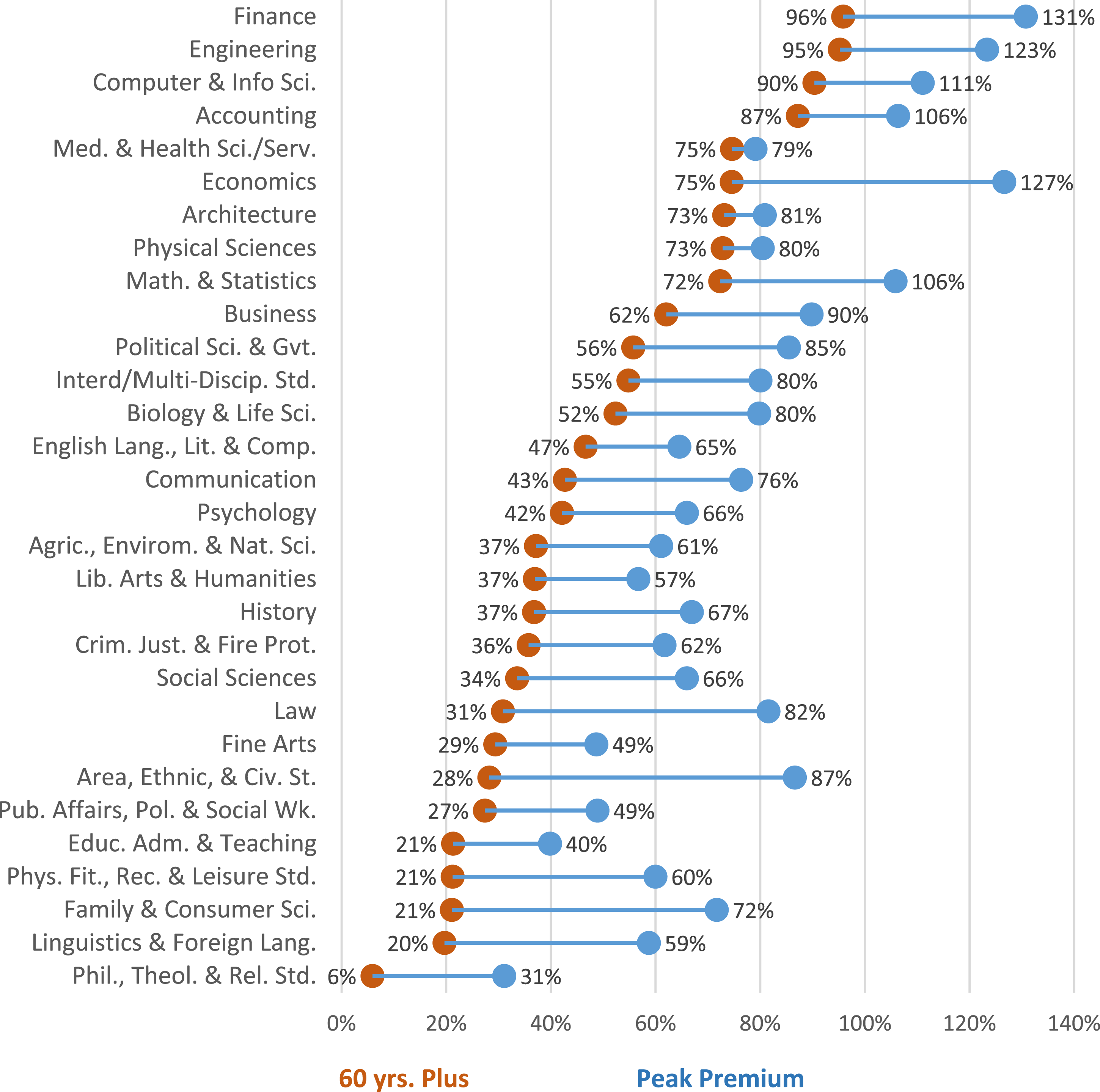
The average wage differential of BD holders varies by age cohort and follows a bell-shaped curve as seen in Table 4 in the appendix. For males, the wage premium for most BD degrees increases with age, reaches a peak for those in the 40–49 years old cohort, and then the premium starts to diminish for individuals 50 and older. The negative effect of age on the wage premium is more pronounced and starts earlier for women. 16 It is important to keep in mind given our bell-shaped results that our data includes individuals who only hold a BD. Since many BD holders will go on or back to school, especially for a master’s or professional degree, the declining premium for older cohorts needs to be interpreted with caution.
The wage premium associated with a college degree reached its peak in 23 fields for male individuals aged 40 to 49, and in five fields for those aged 50 to 59. This underscores the enduring and evolving value of higher education across various professions and age groups for male workers. The wage premium, however, declines considerably for males who are 60 years or older. The decrease in the wage differential—calculated from peak wage premium to that of individuals 60 years or older—is particularly keen for males with BD in Area, Ethnic and Civic Studies (from 87% to 28%), linguistics and foreign language (from 72% to 21%), law (82% to 31%), economics (from 127 to 75%), mathematics and statistics (from 106 to 72%), and communication (76 to 43%). The wage premium, however, decreases slightly with age for males who hold BD in medical and health science and services, architecture and physical sciences.
The adverse impact of age on the wage premium is more prominent and begins at an earlier stage for women. In particular, the peak in the wage premium associated to a college degree occurred in four fields for women aged 25 to 30, in 16 fields for women aged 30 to 39, and in ten fields for those aged 40 to 49. Irrespective of educational attainment or background, the decline in the wage premium for education accelerates notably for women in the 50 to 59 years old and 60 years or older age cohorts. The reduction in the wage premium for women with degrees in engineering, economics, and math and statistics is particularly large and does away with more than one-half of the college wage premium. In 17 out of 30 fields, the wage differential experiences a reduction of one-third or more from the peak wage premium among female individuals in the 60 years and older.
Overall, it is worth noting that the wage differential for BD holders shrinks over a person’s lifetime, however, it still remains significant at the end of a person’s working lifecycle. This implies that the skills acquired through a bachelor’s degree education are not subject to the same degree of obsolescence as those skills acquired through, for example, associate degree programs (Gittell et al., 2017). However, the steep decline in the return to college education for females deserves further study and attention because it may affect the decision of women to choose BD fields in which the wage premium declines precipitously with age, particularly in STEM and business, which are male-dominated fields.
Employment
Differences in the odds of employment for degree j at time t—obtained by estimating equation (6)—are reported in Table 5 for men and Table 6 for women in the appendix. All regressions are estimated using high-school degree as the omitted (base) category; thus, the reported marginal effects should be interpreted as differences in the probability of employment (prob[employed = 1]) for educational attainment j relative to high school degree holders.
The results indicate significant variations in the likelihood of employment based on educational attainment, particularly during economic downturns like those in 2009/2010 and 2020/2021, characterized by heightened unemployment rates. For example, in 2010, men with a bachelor’s degree experienced a 6% higher likelihood of employment, while women with a bachelor’s degree had a 4% higher likelihood. These results suggest that a college education functions as a protective factor, to some degree, mitigating the adverse effects of economic contractions by improving the prospects of sustained employment. Notably, Panels A and B indicate that the positive impact of educational attainment on employment odds was more pronounced for men than women in the early 2010s, although these differences became insignificant from the mid-2010s onward.
There are also significant variations in the likelihood of employment associated with specific bachelor’s degree fields, and these variations appear to persist across the business cycles, encompassing periods of both low and high unemployment. For instance, in 2009—a year marked by a 10% unemployment rate in the United States—the odds of employment, compared to those holding a high school degree, were at least 7% higher for men with degrees in medical and health sciences/services (8.2%), family and consumer sciences (7.7%), criminal justice and fire protection (7.2%), agriculture, environment, and natural sciences (7.2%), and area, ethnic, and civic studies (7.1%) (Table 5 and Figure 7). In the same year, the differential in the odds of employment (compared to high school) for men with bachelor’s degrees in law was 0.8%, 2.6% for architecture, and 3.3% for fine arts. In 2022, a year in which the US unemployment rate hovered below 4%, the fields mentioned maintained their respective positions. They either continued to rank among those with the highest likelihood of employment or remained among those with the lowest odds of being employed. These figures suggest that certain degrees demonstrate greater resilience to economic downturns than others. Differential in the Probability of Employment by BD Field, Men, 2009 and 2022. Source: Authors’ Compilation Using ACS Data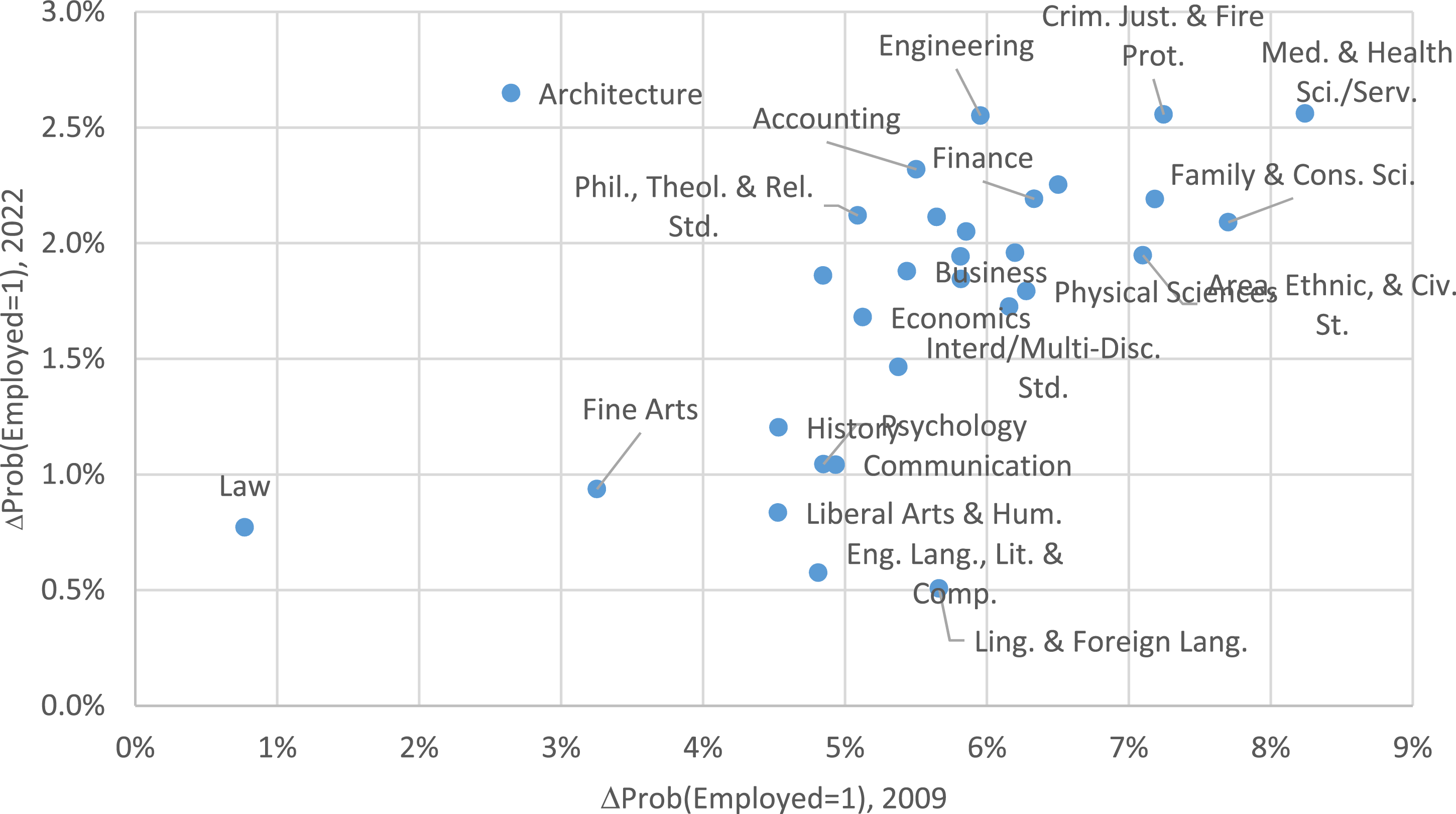
Differences in the odds of employment for women with a BD are similar to that observed for men. For instance, in 2009 women with degrees in medical and health sciences/services, biology and life sciences, family and consumer sciences, and education administration and teaching were significantly more likely to be employed than women with a high school diploma (see Figure 8 and Table 6). Also, similar to what was observed for men, differences in the odds of employment lessened for women across all BD fields as the unemployment rate decreased. As an example, in 2022 and compared to women with high school diploma, the odds of being employed was less than 2% higher for women with a BD in law, fine arts, area ethnic and civic studies. Differential in the Probability of Employment by BD, Women, 2009 and 2022. Source: Authors’ Compilation Using ACS Data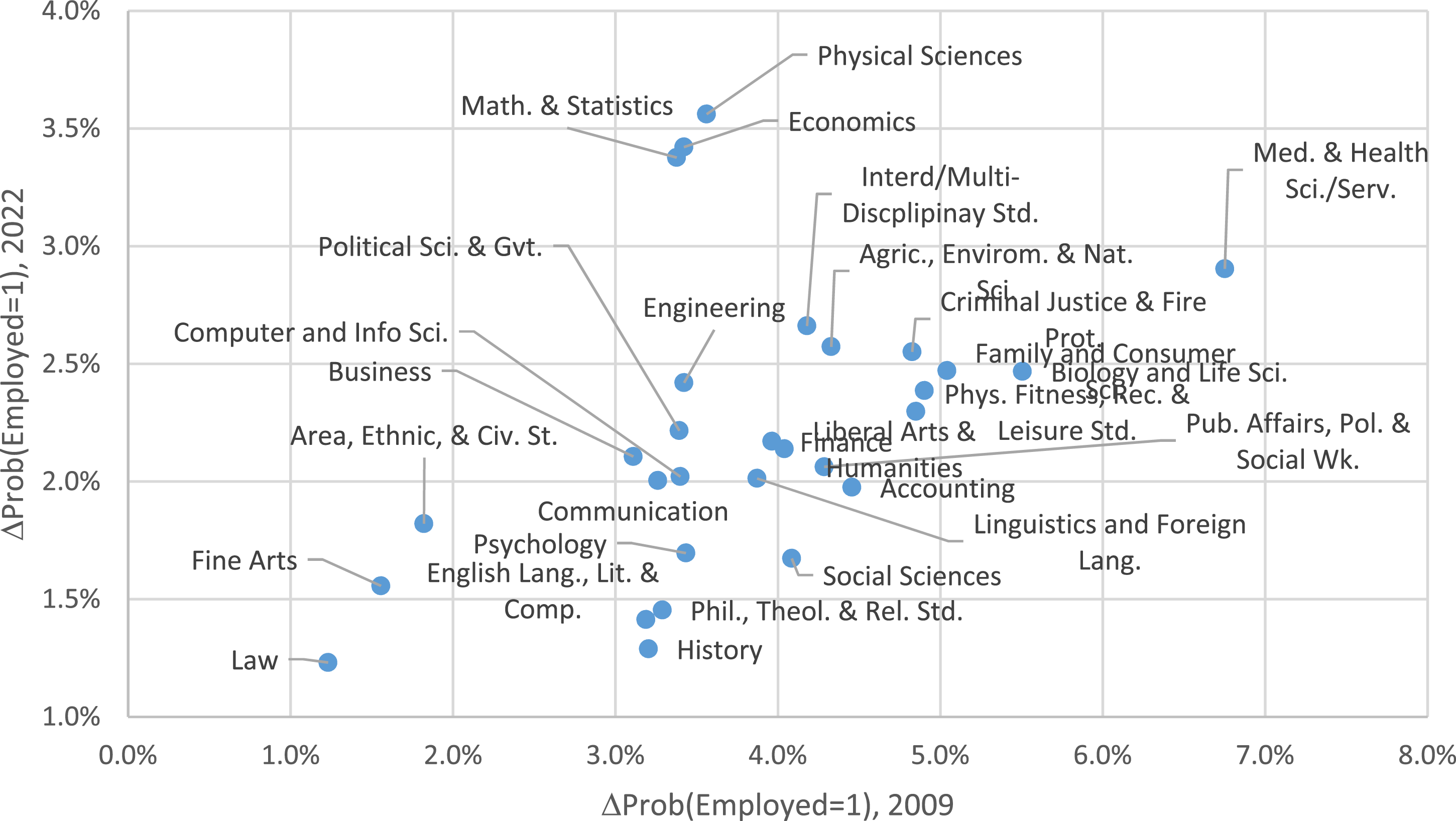
The findings offer support for the notion that possessing a college degree enhances the resilience of workers to economic downturns, making them more likely to retain employment, particularly in periods characterized by elevated unemployment, as in the context of the 2009/2010 recession. Nonetheless, considerable variations exist in the probabilities of employment among individuals holding college degrees associated with the specific academic fields of their collegiate education. Individuals with BDs in disciplines such as inter-/multi-disciplinary studies, English language literature and composition, linguistic and foreign languages, fine arts, history, liberal arts, and humanities still exhibit a comparative advantage over those holding only a high school diploma in terms of employment probabilities, albeit with a marginal differential. Furthermore, both men and women with degrees in medical and health sciences/services, biology and life sciences, family and consumer sciences, and education administration and teaching experience demonstrate a significantly heightened likelihood of employment, not only during economic downturns but also in periods of economic expansion characterized by low unemployment. Also of note, while the wage premium for BD holders rose from 2009 to 2022 for 20 of 30 majors for men and 15 of 30 for women, the employment differential advantage declines or remains constant for all majors over this period for both men and women. The employment advantage exists, but it has diminished over time. A similar decline is also found for master’s and Ph.D. Professional degree holders. However, this result may have to do with the specifics of the policy-driven COVID recession, rather than demonstrating a significant trend.
Life Cycle Employment and BD Education
Labor market outcomes change significantly throughout workers’ life cycles regardless of educational attainment and gender. A previous section showed that the average wage differential of BD holders varies by age cohort and declines considerably for individuals who are 50 years or older. This section shows that, similarly, the positive differences in the odds of employment relative to high school diploma holders decline drastically for all BD fields, broad education categories, and by gender as seen in Table 7 for men and in Table 8 for women.
Figure 9 depicts marginal effects (compared to high school) associated with the probability of employment of broad educational attainment categories by age cohort for men. They show that a college degree or advanced graduate degree positively impacts the probability of employment, but the effect diminishes with age. Specifically, individuals holding a college degree, aged 25 to 29, experienced a 9.7% higher likelihood of employment (compared to high school) during the 2009/2010 period and a 3.9% higher probability of employment in 2021/2022. Conversely, for men between 50 and 59 years old, the likelihood of employment was 3.9% higher in 2009/10 and 1.7% higher in 2021–2022. Notably, for individuals aged 60 years or older, the differentials in likelihood of employment virtually disappear in the 2021–2022 period. Differential in the Probability of Employment by Age Cohort, Men. Source: Authors’ Compilation Using ACS Data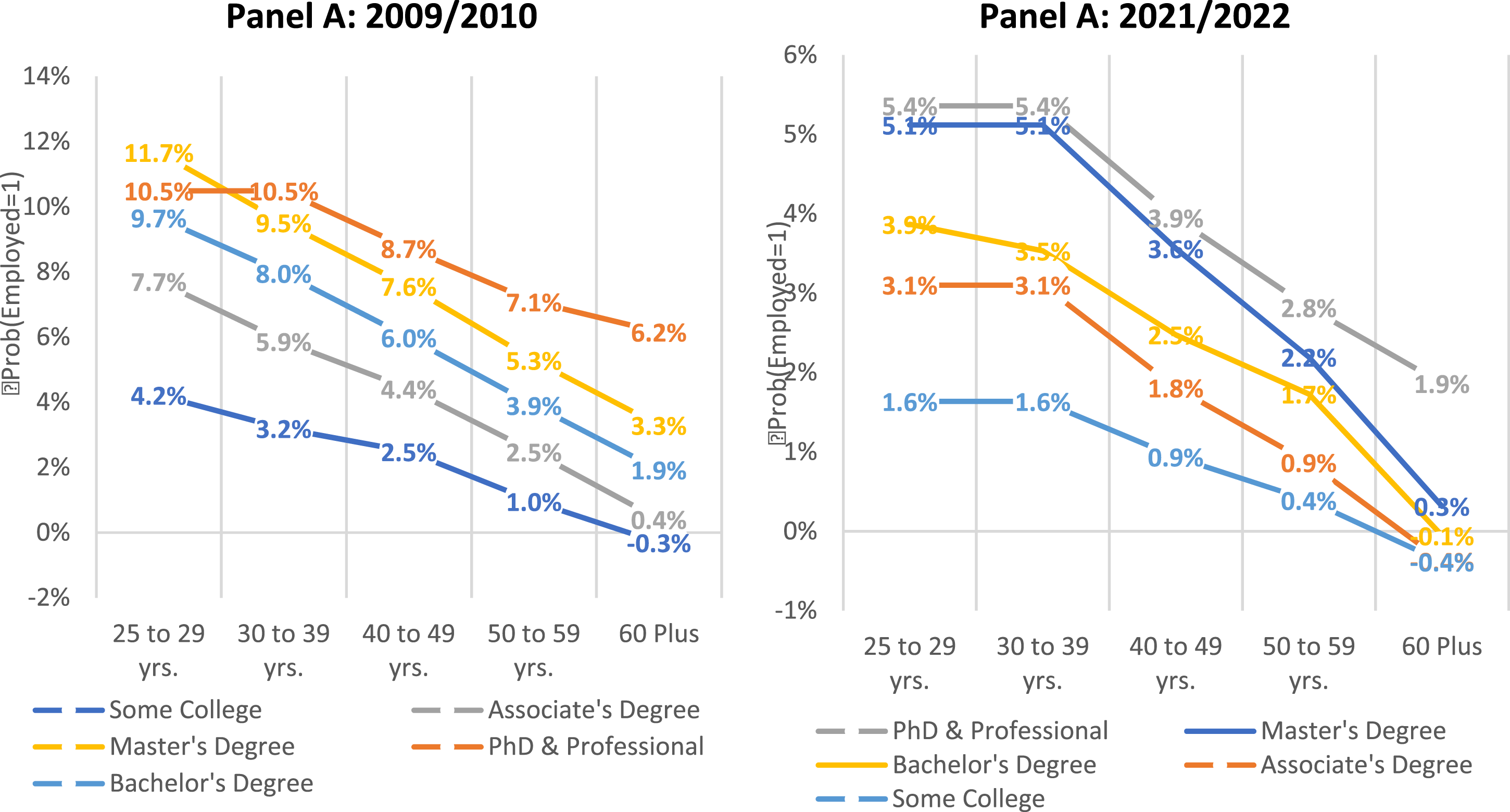
Figure 10 shows that women holding a college degree, aged 25 to 29, experienced a 9.9% higher likelihood of employment (compared to high school) during the 2009/2010 period and a 5.6% higher probability of employment in 2021/2022. On the other hand, for women between 50 and 59 years old, the likelihood of employment was 1.5% higher in 2009/10 and 0.8% higher in 2021–2022. Also, for women aged 60 years or older, the differentials in likelihood of employment disappeared in the 2021–2022 period. Differential in the Probability of Employment by Age, Women. Source: Authors’ Compilation Using ACS Data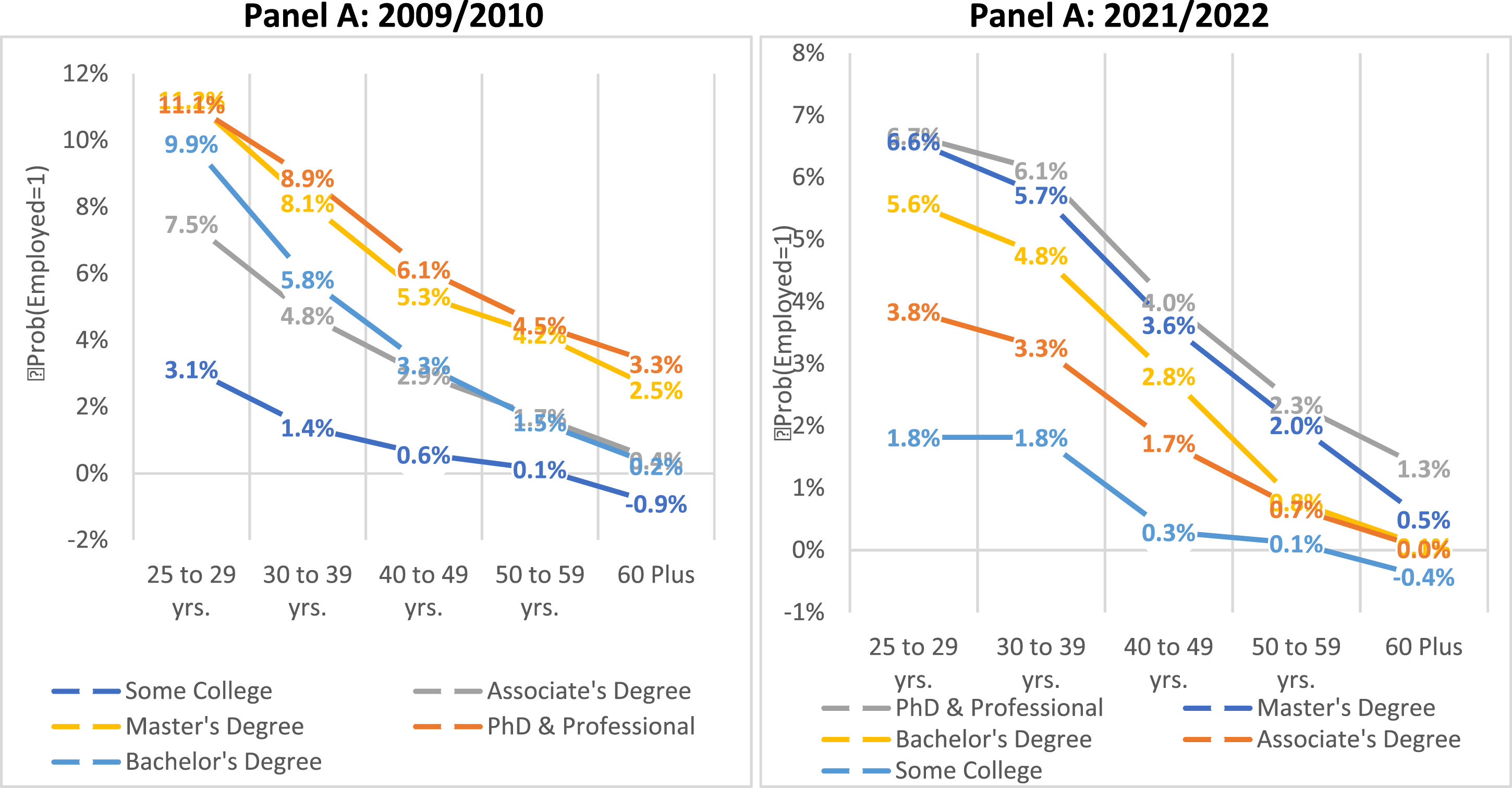
Tables 7 and 8 report the odds of employment relative to high school diploma holders for all BD fields. In general, younger males and females (18–44 years old) with BD in mathematics and statistics, business, biology and life sciences, computer and info sciences, engineering, education, administration and teaching, family and consumer sciences, medical and health sciences and services are significantly more likely to be employed than individuals in the same age cohorts with a high school diploma. In 2021/2022, the employment advantage in these fields, however, completely disappears for men 60 years and older. For women 50 years and older, the differential also vanishes for these degrees except for women with degrees in medical and health sciences and services, biology and life sciences, family and consumer services, and agriculture, but the difference in the odds of employment became quite small.
The ROI: The Cost Side of the Equation
Our empirical work makes it clear that the employment-secure wage premium for a college degree exists and has remained strong for most degree holders in the United States. This alone, however, does not necessarily imply that the return on investment (ROI) of a BD has increased since we have not addressed the cost side of the equation. A widely held belief is that the cost of higher education has increased substantially over the years, decreasing the real ROI of a college education. The cost of college is difficult to measure precisely. However, a reasonable back-of-the-envelope calculation of the full opportunity cost of a BD can be made. 17
The opportunity cost of a BD includes the implicit cost of lost wages that could have been made by working full time straight out of high school, plus the dollar cost of tuition. First, we can conclude that the implicit cost has decreased from 2009 to 2022 for most majors. The average wage premium has grown substantially over time. Plus, the positive employment effect of holding a BD has been maintained throughout the period. Taken together, the implicit cost due to lost wages has fallen overtime for most majors, and for the average BD holder.
Again, the popular perception is that the dollar cost of a BD has risen over time, which conflicts with the data. According to College Board data reported in Ma et al. (2024), the inflation-adjusted published tuition cost for full-time undergraduate students at private nonprofit (public) institutions rose by 17% (20%) between 2009–10 and 2021–22 from $37,690 ($10,350) to $44,130 ($12,460). During this same period, however, the net tuition (after discounting) decreased 9% (28%), from $17,980 ($3,440) to $16,230 ($2,470).
As previously discussed, the popular press has spoken regarding the declining benefits of higher education. Our results based on a full analysis of the ROI of a BD fully refute this popular perception. Whether we examine the benefits or the cost side of the equation, the lifetime benefit of holding a BD in the United States is positive and has grown from the early 2000’s to 2022. The choice of major is a fundamental driver in the determination of the ROI for any individual, but on average the benefits of a BD remain strong.
The Value of a Double Major
No assessment of the value of a BD would be complete without an assessment of the value of a double major. The existing literature generally points to a positive impact from a double major. 18 Results suggest that there are significant diminishing returns to increased depth of study within a single discipline as compared with the additional breadth acquired from the study of multiple disciplines. A recent study on the differential risks of single versus double majors to negative economic shocks, for example concludes that the diversity of skills acquired from a double major increases resiliency (Hanks et al., 2024). Other work on the impact of a double major on earnings find that the benefits vary by major, but average between a 2.3% to 3.2% increase in earnings over single majors (Del Rossi & Hersch, 2008; Hemelt, 2010). Zhu and Zhang (2021) find that, while the positive impact of a double major takes time to appear, by the end of 4 years in the labor market, the returns are positive.
Another major finding is that the value of a double major differs widely depending on the choice of majors (Del Rossi & Hersch, 2008, 2016; Hanks et al., 2024). Our findings are generally consistent with those found in the literature but will add depth to existing results, especially regarding the value of a double major to STEM and liberal arts majors.
To consider the wage premium for double majors, we modify equation (4) to:


Our results on earnings are found in Table 9 (coefficients) and Table 10 (wage premium). The regression for equation (8) is estimated considering only individuals with bachelor’s degrees (all others including those with graduate degrees are excluded) and pooled data for 2021 and 2022. It is important to acknowledge that our analysis about double majors is not causal and should be interpreted as reflecting correlations rather than causal effects. Our findings for double majors are consistent across age groups 19 , so our discussion focuses on recent graduates (the 25- to 29-year-old group). All other majors listed in our data are used as the control. For example, compared with the average of “other majors” there is a 40% increased return to majoring in a single major in a STEM field, a 30% return to an economics major, a 19% return for business, a 6% return to Health, and a negative 9% return to liberal arts for those in the 25–29 age group). As can be seen in Table 10, there is a positive return to a double major for most majors and groups of majors. For example, an economics major with a double major in business earns a 42% premium (compared to “other majors”) compared to 30% for those with a single economics major, a 12% additional premium. Our results indicate that a second major in economics gives the greatest increase in earnings across all categories. A STEM major increases expected returns by 25% by adding an economics degree, business majors add 21%, liberal arts majors add 16%, and health majors add 19%. Note that these results are not symmetrical. The highest additional return, as might be expected given the complementarity, is for economics and business.
The literature has documented that there is a positive return for a liberal arts major taking a second major in business or STEM (Del Rossi & Hersch, 2008, 2016). However, there is no evidence of financial benefits for those pursuing business or STEM to pursue a double major in liberal arts. Our results find generally negative results from a double major in the liberal arts. For a STEM first major, earning a second STEM major provides only a 6% additional return, adding a business major increases the return by 13%, adding health produces no additional earning premium, adding economics increases the return by 25%, and adding a double major in the liberal arts decreases earnings by 17%. In fact, liberal arts is the only major category with a negative expected return from a double major within category. Compared with a single major in the liberal arts, a double major can expect a −5% return to the second major. These results are surprisingly consistent across age groups. They do not seem to change with job experience. There is also no evidence in our data that a double major helps liberal arts majors to catch up with other majors over their careers.
We document that the ordering of major matters. Looking primarily at STEM and economics, it is clear that using the higher returns major as the first major predicts substantially higher returns than if the lower paying major is the first major. This result is consistent with the findings of Zhu and Zhang (2021). Given our data limitations, we cannot give a complete explanation of this. However, it may be that students pursue their passion as the first major and use the second major for the resume resulting in a weaker performance in the second major. Zhu and Zhang (2021) find evidence suggestive of this explanation. Utilizing transcript data, they find that double majors take fewer classes in higher paying majors than do single majors. While they do not test for the specific ordering of majors, it does make sense that this effect would be stronger for a second major. Looking specifically at our results, a STEM plus economics major enjoys a 65% pay increase over our baseline while an Economic plus STEM major enjoys a lower 37% pay bump. An economics plus liberal arts major enjoys a 24% pay increase over baseline while a liberal art plus economics major only sees a 7% bump.
Finally, our results document stronger financial returns for STEM, economics and business majors. A single major in either STEM or economics results in higher returns than any double major combination that does not include these majors. Business majors that double major within the business category (e.g., finance and marketing), also see a return higher than any other combination of majors that do not include STEM or economics. While of interest, these results also point to an issue that follows all studies of returns to majors and returns to double majors. The results may be driven by endogeneity, as more capable or motivated students tend to self-select into higher paying majors and are also more likely to become higher performing workers. No study has been able to definitively determine the causal relationship between major choice and financial returns. Given our data, we cannot contribute anything of substance in making this determination. However, initial work does point to sample selection issues being significant for the positive returns found generally for double majors. Zhu and Zhang (2021) find that selection issues could run in both directions if their results can be applied to ours. They find that double major graduates are more likely to be employed after graduation and are more likely to work longer hours. This indicates that harder working students select themselves into double majors. On the other hand, they also find that double majors are more likely to continue their education by pursuing a graduate degree. Our data on returns contains only those graduates who did not pursue any further degree. This would indicate a general downward bias for our results as those who are more likely to pursue a graduate degree are also those more likely to be the most productive in business.
Conclusion
This study corroborates previous findings and adds to the literature by documenting that the wage premium increases with educational attainment, but there are noticeable differences in the returns to college education by field of the BD, by gender and by age. The wage differential compared to workers with only a high school diploma varies significantly across fields of BD holders, ranging from just under 30% to approximately 120% in 2022. Regardless of gender, the highest wage differentials compared to high school are for those who pursued fields of study in economics, engineering, computer and information science, mathematics and statistics, medical and health science and services, and business. The wage premium in finance and engineering for men and engineering and medical and health science and services majors for women are always higher than we see for holder of a master’s degree. We also find evidence that the wage premium for women in 15 of 30 BD stayed the same or decreased during the 2009 to 2022 period. For men, the premium for a BD education decreased or stayed the same for 10 fields and increased for another 20 fields of study. These findings corroborate previous finding that the choice of college major affects earnings (e.g., Patnaik et al., 2020; Altonji & Zimmerman, 2017; Altonji et al., 2016), but add to discussion by showing that market changes are affecting the returns to education of women and men differently regardless of their choice of college majors.
This study also shows that the wage differential for BD holders follows a bell-shaped-curve throughout a person’s lifetime, but the premium stays significant at the end of a person’s life cycle. More specifically, the average wage differential of BD holders increases with age for individuals who are 25 to 50 years and then it starts to decrease as the person gets older. The decline in the wage premium is particularly pronounced and starts earlier for women, and the wage premium decline along with decline in employment advantage for older college graduates across all fields suggest that BD holders might benefit from lifelong education. There is evidence that a college degree makes workers more resilient to economic downturns by increasing the odds that they will stay employed during times of high unemployment such as that observed in 2009–2010. As discussed in the introduction, there is economic evidence (Kahn, 2010; Rothstein, 2020; Schwandt & von Wachter, 2020) that beginning a career with a BD in an economic downturn has long term employment and income consequences, and that popular press views suggest that a BD does not protect from the negative impacts of a recession. While the economic evidence regarding the poor start is not in dispute, we find that a BD does provide significant protection from the negative effects of a downturn. Regarding the probability of being employed in a downturn, we find significant and positive effects for college graduates, including those starting a career. Our results from 2009–10 make this clear. Compared to those with a high school education, 25 to 29 years old with a BD have about 10% higher probability of being employed for both men and women. While this average differential probability of being employed falls over the life cycle, it remains positive throughout, except for the oldest age group, especially for women. Regardless of age, college provides significant protection from non-employment during a downturn. While there is considerable variation in the size of this protective effect across majors, all majors give some resilience regarding unemployment in a downturn. A similar but slightly lower result is also found for associate degree holders. The largest effect, as expected, is for holders of a graduate degree.
Finally, we demonstrate the significant variation in the financial returns to double majors. Consistent with previous literature we find that the returns to a double major are significant for most majors. We also document the significance of the lead of STEM and economics in terms of financial returns over other majors single or double.
Footnotes
Acknowledgments
We thank the editors and our especially perceptive referee for outstanding suggestions that improved the paper.

Funding
The authors received no financial support for the research, authorship, and/or publication of this article.
Declaration of Conflicting Interests
The authors declared no potential conflicts of interest with respect to the research, authorship, and/or publication of this article.