







Abstract
An archive is an integral part of literate and social life and is in the custody of political institutions for their historical value. It is argued that societies who lack the faculty of recording histories contribute to the archive-making process in a different context. To advance this, the work of anthropologists on the Igorots, more specifically the Kalingas, of the Philippine Cordilleras, and their tattooing practices are considered for heuristic purposes. It is in these societies, where the concept of the Western archive is absent, that the body becomes a repository of significant life events and rituals concretized by tattoos. Tattooing becomes a form of memory on how bodies remember and create narratives and counter-narratives. To serve as a provocation for further research, Derrida’s two-fold understanding of the archive is utilized. The archive, on the one hand, as a commencement that evokes the writing of the archive and, on the other hand, the understanding of the tattoos as disjointed and incomplete, allows us to understand tattoos as a trace.
Introduction
An archive is the ‘collection of documents and a repository of preserving, housing, organizing and making accessible documentary materials … as a body of historical documents systematically maintained for information of continuing value’ (Gracy 1988). The creation of the archive is an integral part of literate life and is in the custody of political institutions for their historical value. The archive is a place and a reflection of social and institutional authority. Edwards (2001: 4) thinks that the archive is not a dead space, but a place where alternative voices can emerge, where there is ‘dense multidimensional fluidity of the discursive practices of photographs as linking objects between past and present, between visible and invisible and active in cross cultural negotiation’.
Contemporary theorizing on the body is concerned with the ‘writing on the skin’, like Foucault’s ‘body as text’, upon which social reality is inscribed (Csordas 1994). A work on Polynesian tattooing tells us that tattoos are artefactually understood to be a registration of a ritual event (Gell 1993). His analysis further informs us that the body is not only a vehicle but also an important source of symbolic readings of embodied experience. Otis (1994: 3), although on a literary approach, also provides an interesting analysis on the relations between body and memory, which she labels as ‘organic memory that placed the past, in the individual, in the body and in the nervous system’.
This paper aims to understand the traditional tattoos found on the bodies of the Igorots of the Philippine Cordilleras as an archive. 1 It utilizes the work of anthropologists about the Kalingas, who do interesting things to their bodies, for heuristic purposes to advance the thinking about inscribed knowledge in modern societies and how a non-literate society used tattoos. I have chosen these Austronesian people of the northern Philippines because societies that lack the faculty of recording histories uniquely contribute to the archive-making process (Wolf 1982). I argue that, in societies whose concept of the Western archive is absent, the body becomes a repository of significant life events and rituals tangibly and symbolically expressed by traditional tattoos; tattoos are a form of individual and collective memory (Connerton 1989) on how bodies remember and create narratives and counter-narratives (Bronwen 1999). I also use Derrida as a provocation to further thinking and nominating questions.
In this sense, tattooing and tattoos are spatial markers such as the ubiquitous Japanese design or a Maori tattoo (Kuwahara 2006: 19). When analyzing space and place, space only becomes place when people conceptualize it. Political and economic powers act upon space and transform it into place where the relations between tattooing, identity and social relationships are intertwined (Kuwahara 2006: 20). In terms of tattooing, the body is viewed as an important space. Tattooing one’s body is exactly the process of making one’s body space into place. By tattooing it, we possess, territorialize, conquer and cultivate our body. Tattooing is understood as the process of making the body space into place by marking the skin and thus exercising agency (Kips 2010).
Kalinga batek as archive 2
To understand the meaning of the Kalinga batek, we must take into account the importance of the rituals associated with the practice of tattooing. However, the understanding of these rituals and their symbols cannot begin before we recognize that a ritual is an attempt to sustain a set of assumptions in which these rites are evident and meaningful (Salvador-Amores 2002: 111). These rites embody the basis for social relations in the community. They are visible expressions that enable people to identify with and know their society. At the same time, people in the community achieve total personhood through these rites (Salvador-Amores 2002: 111). This allows us to look at the rites as determinants and markers of personal development, communal integration, and assimilation.
In 1967, Victor Turner develops the idea of ‘communitas’, which involves the use of symbols for social integration and assimilation into society. The idea focuses on how public rituals with symbolic meanings reinforce a sense of identity and solidarity within a particular society. Salvador-Amores (2002: 128) thinks that the Kalinga batek gives an individual a sense of identification with a culturally defined collective. She believes that Kalinga tattoos are deeply ingrained symbols, used as visual markers in the advancement of a Kalinga’s personhood (Salvador-Amores 2002: 112). When a Kalinga passes from one stage to another, for example from childhood to adulthood, a ritual is performed to mark this advancement. The tattoo is an important symbol in this ritual and visually marks the transformation and growth of the Kalinga. The Kalinga batek thus functions as a marker that helps the community in the determination of the role and position an individual plays in the community.
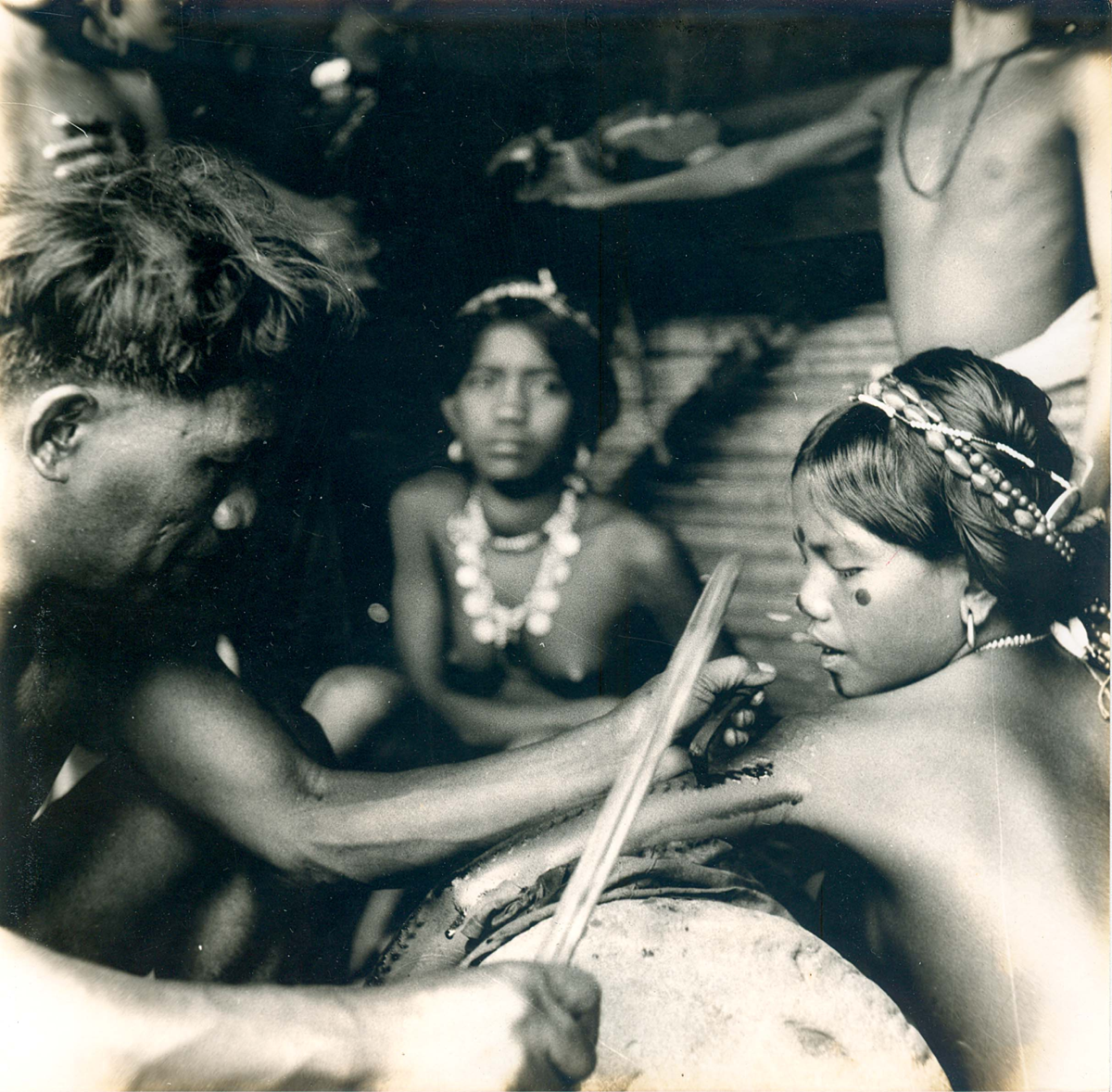
Salvador-Amores (2002: 108) thinks that batek is derived from the sound of the tapping of a stick on the tattoo instrument (American Historical Collection, Ateneo de Manila University).
I adopt the model introduced by van Gennep (1962: 10), who distinguishes three stages in rites of passage: rites of separation, rites of transition and rites of incorporation. Van Gennep (1962: 3) analyzes the changes in the total person that concern the passage from one stage in a person’s life to another whereby the nature and destiny of the body changes accordingly. These could be, for example, birth, puberty, marriage parenthood and advancement to a higher class (van Gennep 1962: 3). Rites of separation have to do with the ritual removal of an individual from society, as in a funeral ceremony in the case of death. Rites of transitions concern the separation of the individual prior to the incorporation back into society, as in the case of initiation. The rites of incorporation involve the reunion of the individual with society or his or her new status. Although the model has some flaws, especially concerning the rigidness of the boundaries between the stages, Salvador-Amores (2002) and Kips (2010) finds it useful in the context of the Kalinga batek.
Rites of separation
At childbirth and pregnancy, we see one of the first tattooing ceremonies in a Kalinga community. The main tattoo, in this context of the literal separation of the child from the womb, is the lin-lingao (Salvador-Amores 2002: 113). These tattoos are small x-marks found on the forehead, both sides of the cheeks and the nose of the pregnant woman. The tattoos provide protection from evil spirits that dwell in the village. The Kalinga believe that these evil spirits belong to their enemies, who were killed by their warriors; these spirits are thought to revenge their deaths by taking away the children. The lin-lingao work to confuse the evil spirits; the x-marks on the face make the spirits unable to recognize the person they want to exact revenge upon (Salvador-Amores 2002: 113). In addition, for some, these specific marks on their face are made for beautification (Kips 2010: 22).
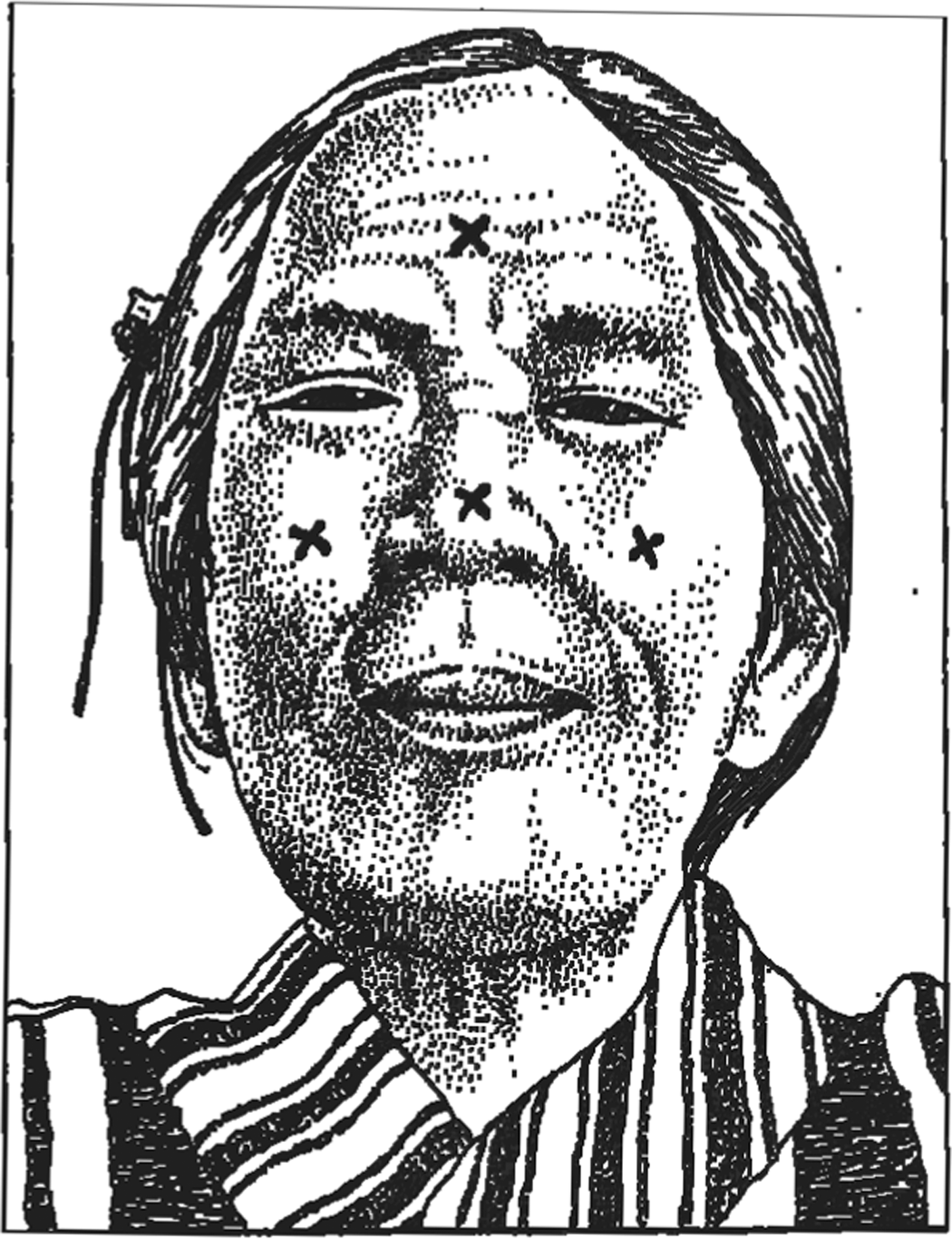
The lin-lingao of an old woman (Salvador-Amores 2002: 134).
If a child survives the first two or three years of his life, he undergoes the gammid. This is a ceremony whereby the grandparents recognize their grandchild. The child is brought to the house of the grandparents where the grandfather holds a feast. The child receives a gift, commonly a necklace made of beads, that is treasured throughout the child’s life (Dozier 1967: 93). This rite of passage can be seen as a rite of incorporation; the child is officially a member of the family and community.
Rites of transition
For males, their childhood lasts until they are about 15 to 18 years old. At this age, a young man is due his igam. This ceremony marks the beginning of adolescence (Salvador-Amores 2002: 114) and is meant to establish his adult status. As an adult, he is able to participate in adult activities such as the headhunt. The igam is composed of several preparatory rites. The first of these is the lames nu wangwang, when the boy is sent out by himself to hunt or fish outside the community. A boy hunts or fishes until he is successful, then returns to the village and jumps over the ladder at the village entrance, called the sipotan. The sipotan is an important passage point as it separates the village from the outside world. The actual jumping over the ladder is a physical and symbolic expression whereby the individual reenters the community; this is a sign too that he did not leave his soul ‘outside’ in the enemy world (Salvador-Amores 2002: 115).
Upon entry into the village, the boy is stripped of all his clothes (or karaka). This ceremony is believed to bestow good health and luck (Salvador-Amores 2002: 115). This is the first step into becoming an adult. From this time on, the boy is allowed to participate in the baruknit (where inter village conflicts are settled) and can join a headhunt (or kayaw). The period of igam (the transition from boyhood to manhood) is finished after the boy has participated in his first successful headhunt.
Dozier (1967: 204) explains how such a first headhunt takes place: An ambitious young man accompanied experienced warriors on his first headhunting expedition. In his first encounter with the enemy he guarded against panic, watched the behaviour of seasoned headhunters and learned to be calm and collected. He also carefully observed the proper wielding of the spear, head axe and shield. If his party took a head in his first headhunting venture, even if he himself did not take part in the kill, he was entitled to his tattoo.
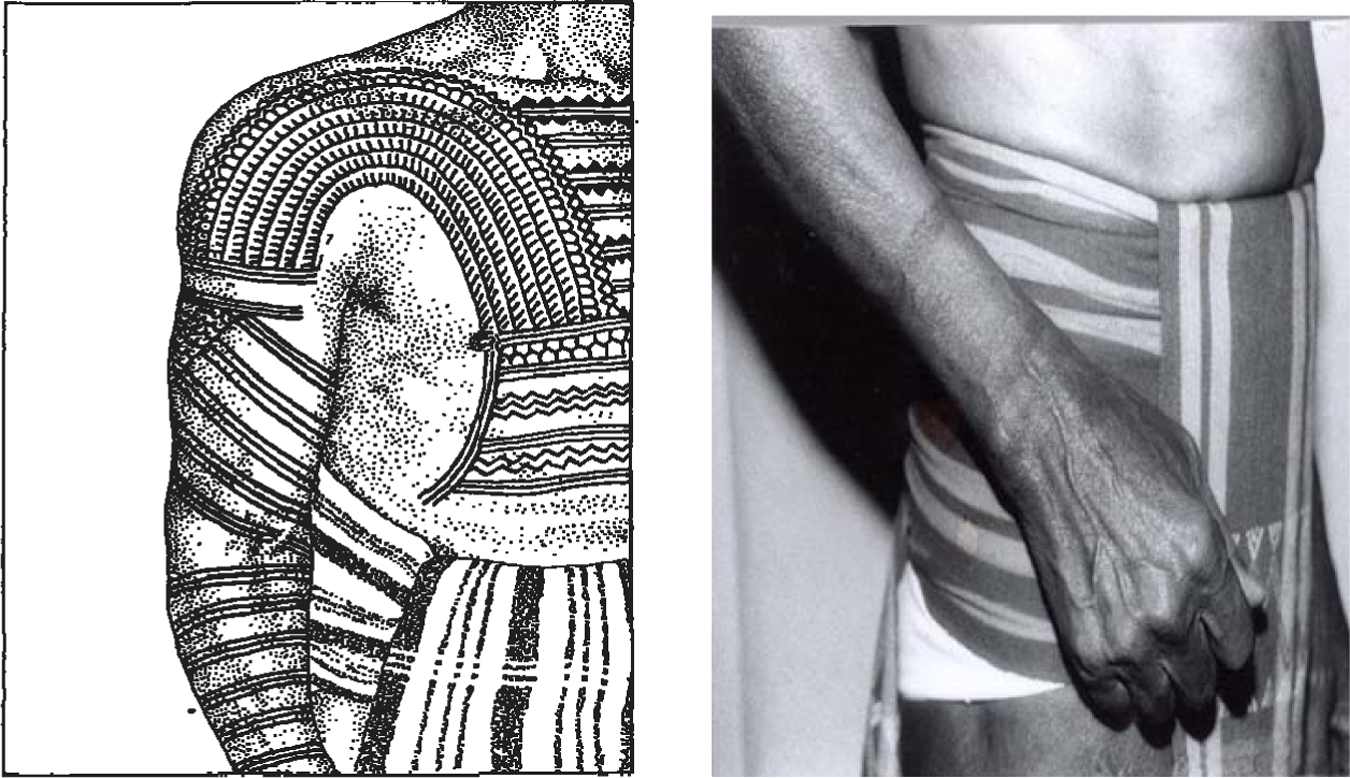
The gulot on the wrists of a warrior (Salvador-Amores 2002: 130, 142).
Dozier (1967: 202) notes that the main reasons for participating in a headhunting operation are: 1) to retaliate against an attack by enemy headhunters, 2) to take a life to please the spirits after a relative has died in an accident or of natural death, 3 and 3) to gain prestige and renown. Dozier (1967: 202) finds the third reason to be the most important, as he found this to be the reason most often cited by his informants together with the fact that a successful headhunter is held with respect and high-esteem by the community.
If the boy is brave and lucky enough, he will participate in further headhunting raids and perhaps be the one who makes the kill and takes the head. This makes him a more experienced warrior. The more he adds to the number of his victims, the more he gains prestige and respect and the more he is awarded with an elaborate chest tattoo or biking (Dozier 1967: 204). This tattoo is perfectly symmetrical and starts with horizontal patterns along the stomach. On the chest several lines, consisting of three smaller parallel lines, flow from the beginning of the chest to the shoulder. The boy is now a feared and respected warrior or maingor. ‘The batek session of the maingor is the solemn milestone in the maturity for males. It marks the total departure from childhood and adolescence’ (Salvador-Amores 2002: 116).
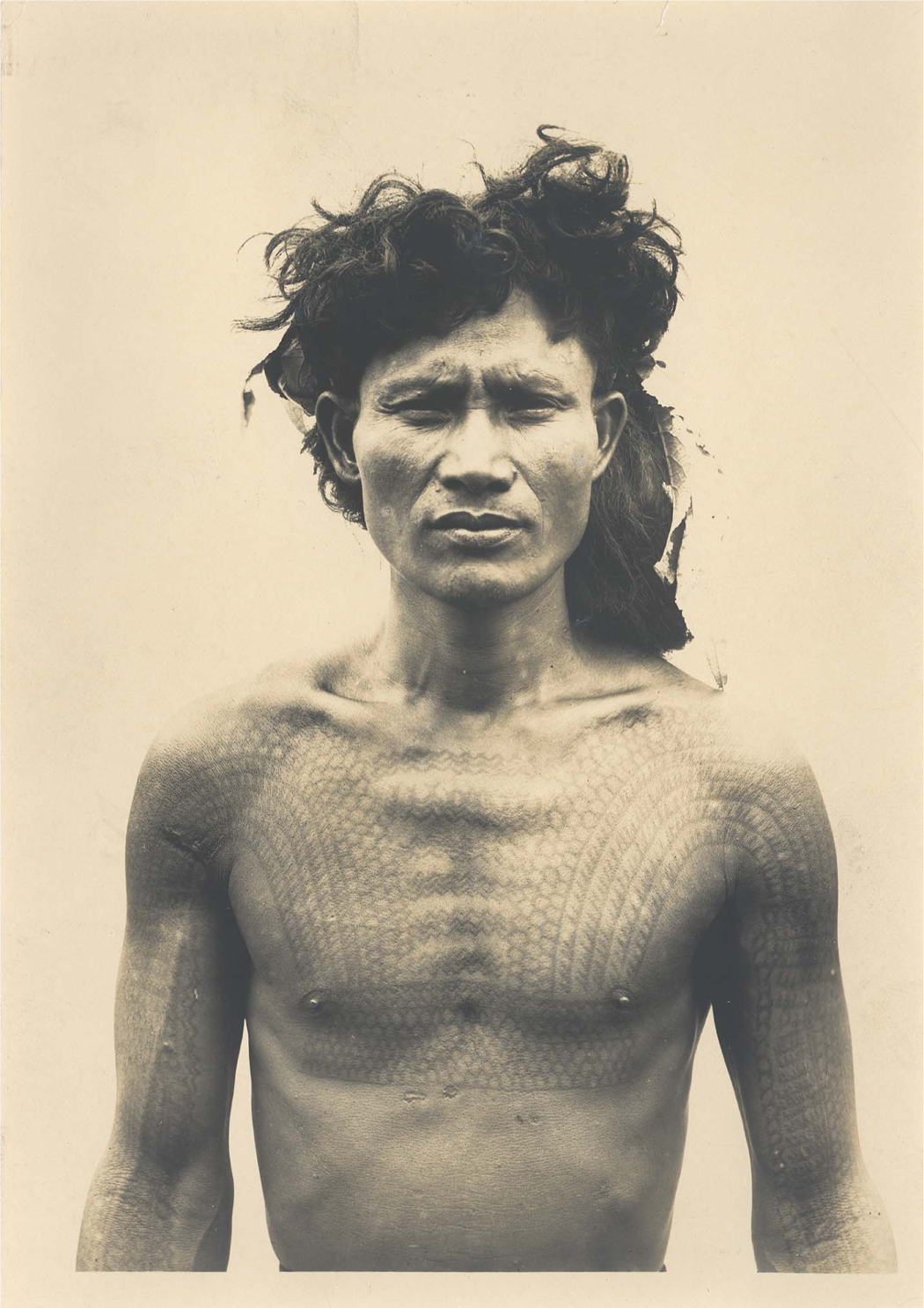
The biking or chest tattoos of a warrior shows the unity and symmetry of the designs (American Historical Collection, Ateneo de Manila University).
Within Kalinga society, male tattoos are a powerful image since they are constitutively connected with being a warrior. As is observed by Dozier (1967) and Salvador-Amores (2002), being a successful warrior used to be the ultimate career path for any Kalinga youth.
Tattooing is not only found among males in Kalinga society. Females also have elaborate tattoos, found mainly around the neck, shoulder blades and on the upper and lower arms. Girls receive these tattoos when they are around 13 to 15 years of age. This coincides roughly with the period of their first menstruation or dumara (Salvador-Amores 2002: 117). Just before, or just after a girl has her first dumara, she is tattooed with designs of the centipede on her arms, neck and shoulder blades.
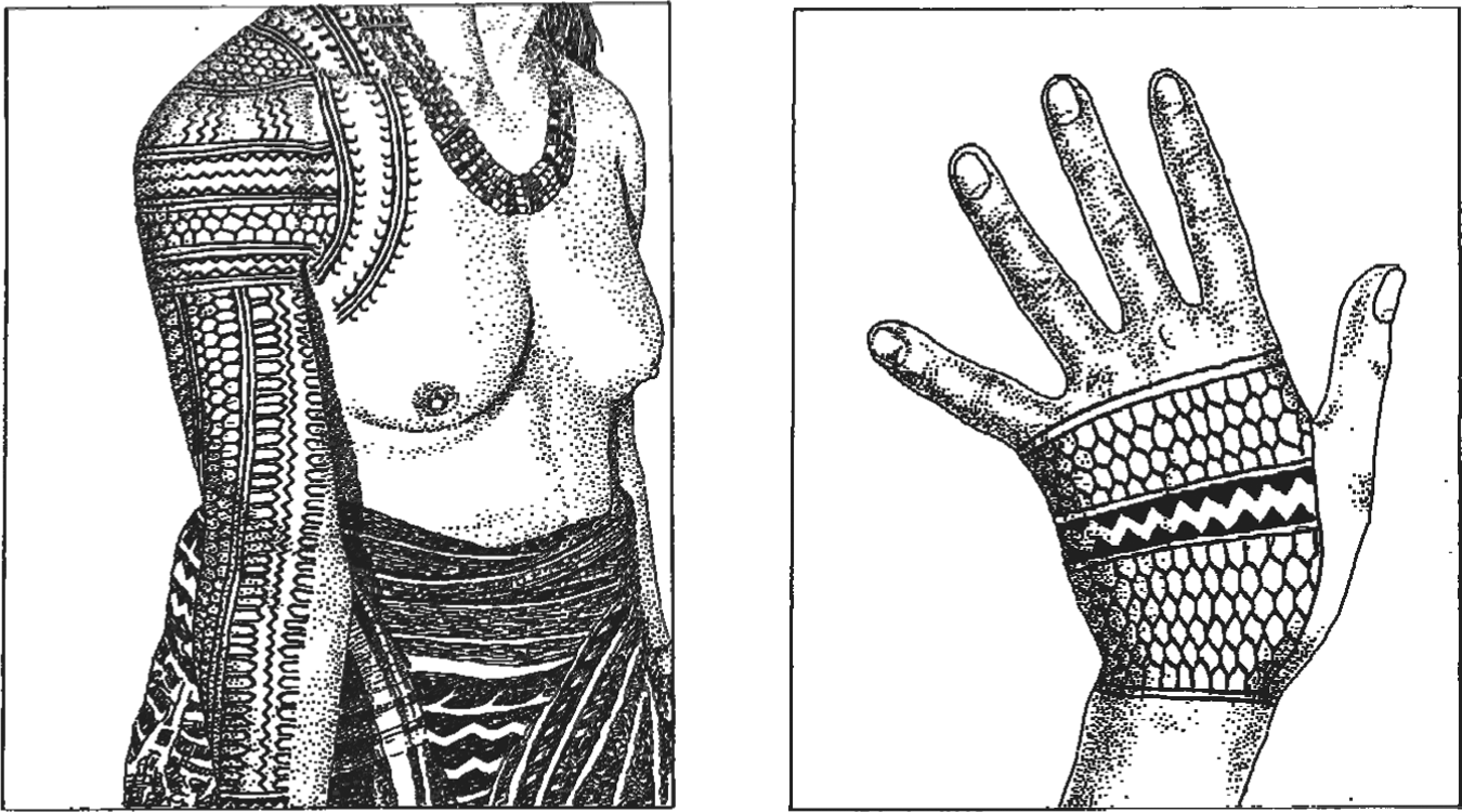
The nirafa-rafat or inufu-ufug tattoo designs are the scales of the centipede. Most women have unfinished tattoos on the lower arm (Salvador-Amores 2002: 135).
According to Salvador-Amores (2002: 117), the Kalingas believe that tattooing girls help the smooth flow of blood from their vagina. Further, the tattoos mark that the woman is biologically ready to have children, which is a prerequisite for marriage.
After girls are tattooed and have menstruated for the first time, they are able to participate in a ceremony called the adumba. The adumba is a dance ceremony conducted when the men return from a headhunt. The men encircle the women during the dance but without touching each other. This dance is an opportunity for a girl to find a potential mate for marriage. Thus, the adumba indicates that a girl is of marrying age and capable of bearing a child (Salvador-Amores 2002: 117). The tattoos on both males and females make them more attractive and, after the dance, the role of the girl is changed. After the girl has participated in her first adumba, she is now considered a woman with the responsibilities and tasks that go along with this new role. The adumba is therefore an important rite of passage for a girl as she changes into an adult. The tattoos and the participation in the adumba signify the acceptance, the sense of belonging to the community and the corresponding identity associated with adulthood and full participation in the social life of the community (Salvador-Amores 2002: 118).
Besides its function as a permanent marker of one’s place in society, the Kalinga batek also carries a strong aesthetic component. Young women with elaborate tattooing are considered beautiful or ambaru. 4 The tattooed women therefore become ambaru when they receive their tattoos. For men, the tattoos make them handsome and strong, or, in Kalinga, mangkusdor (Salvador-Amores 2002: 125). In older times, dinuras or people without tattoos were regarded as weak beings and considered a bad omen for the community (Salvador-Amores 2002: 125). Women with tattoos are, then, considered more beautiful while tattooed men incite fear and respect due to their fierce nature as warriors. Tattooed men and women, therefore, are preferable marriage candidates within Kalinga society.
Batek in rites of incorporation
Marriage in Kalinga society is a clear and an obvious marker of permanent incorporation into a family and society. After the courting during the adumba, the arrangements for marriage begin. A process of dowry exchange takes place between the two families and a wedding date is set. Then the kopya ceremony is performed where a blessing is carried out over the newly wed couple. The in-laws host a large feast for the whole community, celebrating the marriage. Besides a union between two people, a wedding in Kalinga is a union of two collective groups of families now tied through blood. The tattoos of the women in the context of marriage are said to encourage fertility and are therefore a good omen (Salvador-Amores 2002: 118).
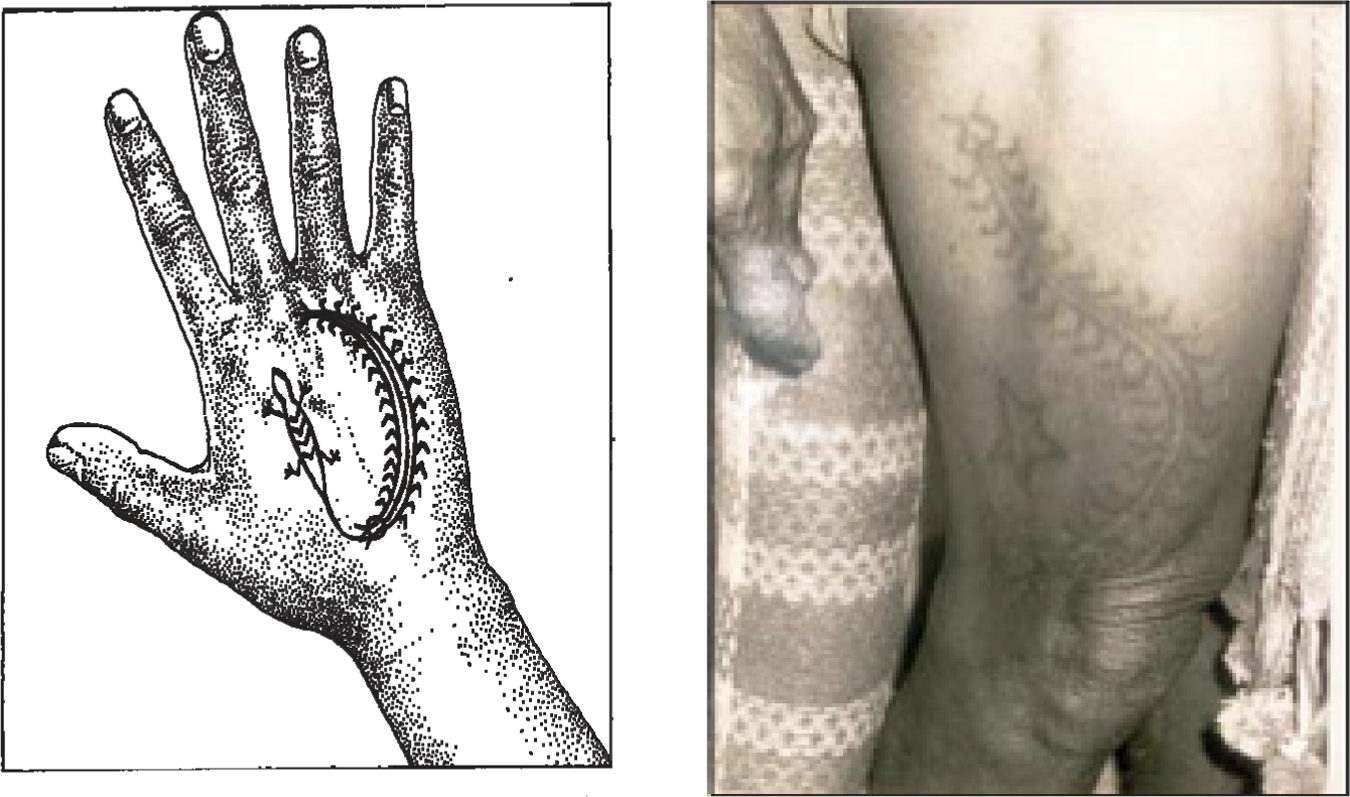
Gayaman nan banas, or centipede-eating lizard. And a special insignia of the bituwon (star) and the gayaman (centipede) (Salvador-Amores 2002: 132, 133).
Male tattoos are also an important visual marker for the incorporation into the warrior (maingor) class. In pre-Spanish times, a dominant warrior class existed called the kamaranan. A warrior could advance to this ‘elite’ warrior class by participating in a number of successful headhunts (Salvador-Amores 2002: 119). Warriors who have killed ten or more are permitted to have elaborate insignias on the side of their stomach, back, thighs, legs or even cheeks to show their immense bravery and fierceness. These include symbols of head axes, stars and lizard-eating centipedes. Barton (1949: 230) calls these tattoos ‘badges of honor’ similar to modern day military soldier badges, and they were proudly worn by the warrior class.
The greatest of these tattoos was the dakag, which is found on the back of a warrior. This tattoo is only tattooed on a warrior who is recognized for exceptional and unsurpassed bravery (Salvador-Amores 2002: 121). This very rare tattoo is the highest achievable ‘badge of honor’ and the culmination of Kalinga manhood. It is the case that a man who had earned tattoos had social privileges, religious roles and political influence in his community (Salvador-Amores 2002): he became a respected elder or a pangat. The pangat is a consultant in peace pacts between communities and tribal groups. Even today, the few surviving tattooed men continue to carry significant roles and influence in their communities.
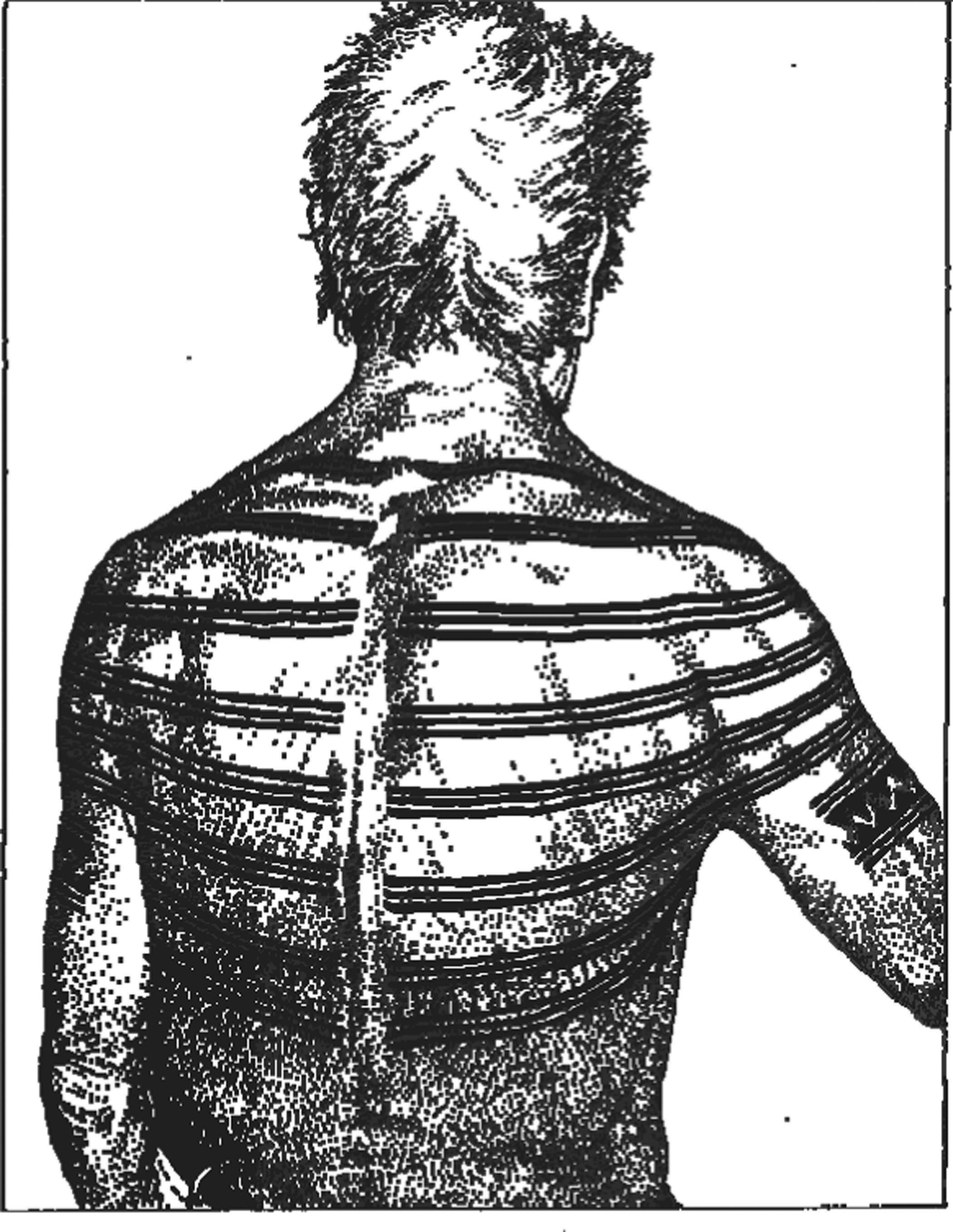
The dakag tattoos found at the back of the undaunted warrior (mu’urmut) is a combination of the binulibud and the gayaman designs (Salvador-Amores 2002: 139).
Salvador-Amores (2002: 128) concludes her research with the relationship between tattoos and the archive and it is worth reproducing here in whole: The markers of the Kalinga body give us a notion of Kalinga reason and beauty, but can likewise be understood as deviations associated with the Kalinga themes of otherness and difference. The visual markers on the Igorot body give an individual a level of identification with a culturally defined collectivity – they enable a sense of community. The body is central to the transformation of the Kalinga self, and is associated with the different rituals brought about by community regimens. Although it is given that the Kalinga identity has experienced episodes of both growth and decline from the past to the present, tattoos still serve as an archive of culture for the group.
Im/possibility of an archive
But to what extent do batek serve as an archive of culture for the group? For Michel Foucault, the archive refers to something more than ‘the sum of all the texts that a culture has kept upon its person as documents attesting to its own past, or as evidence of a continuing identity’. It is an abstract function as ‘the system that governs the appearance of statements as unique events’. He explains further that the archive is also that which determines that all these things said do not accumulate endlessly in an amorphous mass, nor are they inscribed in an unbroken linearity, nor do they disappear at the mercy of chance external accidents, but they are grouped together in distinct figures, composed together in accordance with multiple relations, maintained or blurred in accordance with specific regularities. (Foucault 1972: 129)
Derrida thinks that the word ‘archive’ carries many meanings. It is aporetic and it operates in two ways. On the one hand, it is commencement that evokes the writing of the archive (Derrida 1996: 2). On the other hand, the archive carries a certain untranslatability that makes it disjointed and incomplete (Derrida 1996: 77). We see this in the duality manifested in terms of temporality and spatiality – as a place of ‘commencement’ and as the place ‘where men and gods command’ or the ‘place from which order is given’ (1995a: 9) – in the Kalinga batek.
As the site of commencement, the batek accommodates ‘traces’ of specific objects of the past in the shape of repetitive parallel images. These tattoos were created in the past and are basically subjective productions with histories of their own. Thus, for many, the batek is perceived to signify a relative stability of meaning. Winterbotham asserts that the ‘archive, as a source of evidence denotes the time of ending instability, of creating stasis and the fixing of meaning and knowledge’ (1975: 32). Derrida adopts this notion of the stability of meaning as he identifies the archive with conventional modes of knowledge production. He points to the essential role of the archons (guardians) in the production and maintaining of the archive. Derrida reveals that the archons are considered to possess the right to make or to represent the law. On account of their publicly recognized authority, it is their home, in that place which is their home that official documents are filed. The archons are first of all the documents’ guardians. They do not only ensure the physical security of what is deposited and of the substrate. They are also accorded the hermeneutic right and competence. They have the power to interpret the archives. (1995a: 10)
Cooke argues that the archives are ‘innocent and unmitigated products of processes’ (1985: 90). The archives reflect and provide an image of those historical processes. In this sense, the batek reflects a certain kind of truth compatible with the process that created them. This ‘innocence’ of the batek comes from their unintentionality, since the mambatek had no intent to create a historical record. Cooke further maintains that the archives were not intentionally ‘drawn up in the interest of or for the information of posterity’ (1985: 92). The notion of archival innocence underlines two fundamental aspects essential to the characteristics of archives applicable to the batek: impartiality and authenticity.
Further, the batek understood as archive only gives mark of the past, to use Lana Parry’s term, ‘apertures or windows on the past’ (1998: 77). The past, inscribed as batek and understood as an archive, is constantly reverted to, reread, reassessed, revised, and rewritten. It is in this sense that repetition keeps the archive alive. It is also in this sense that the archive becomes the place from which the past ‘commences’. Yet these commencements are constrained, as the past deposited in the archive is incomplete. The archive, in Spivak’s words, ‘can only hold some traces of some aspects of the past’ (1999: 171). What we are saying so far is that the tattoos do in fact shed light on the past, but that they are only traces of it. We are unable to fully capture the story behind the batek, and ‘that is why the archive is never closed … it opens out of the future’ (Derrida 1995a: 57).
Derrida sees that the archive-making process, and eventually in our argument the batek, is coupled with ‘the function of unification, of identification, of classification’. This process, Derrida adds, ‘must be paired with ... the power of consignation’ (1995a: 12). For Derrida, consignation points to two related processes: one is the ‘act of consigning through gathering together signs’ and the other is the intent ‘to coordinate a single corpus, in a system or a synchrony in which all elements articulate the unity of the ideal configuration’ (1995a: 13). As a result, while the batek as an archive does not, and cannot, accommodate a complete and undivided past, its consignation produces ‘the illusion of being whole’, an illusion that the ‘archive fails to acknowledge’ (Rotman 1987: 82).
For Derrida, the archive is not only the zone ‘from which order is given’ and the zone ‘where things commence’ but is also the locality where memory is deposited. The batek as an archive, therefore, necessitates it repeating, recollecting, remembering, rehistoricizing and remaking. The batek carries, therefore, a struggle played out through regressions, repressions, and reversals.
Thus, the batek is not a depository either of spontaneous memory (mneme) or of the process of remembrance (anamnesis); it is memory in the form of an inscription (hypomnema) (Derrida 1995a: 14). As a depository, the batek is simultaneously related to the process of forgetting that which ‘operates in silence’ and accordingly that which ‘never leaves its own archives’ (Derrida 1995a: 19). The modus operandi of forgetting in the consignation of the batek as an archive is not only innocuous, for the archive rebreeds these silences. It frames what is transferred to the archive as a unified whole and suppresses what is left outside it. We can claim, thus, that batek as an archive is ‘always consigned and ordered ethically as anticipation of the future’ (Derrida 1995a: 27).
The batek as an archive is not about the past, it is about the future. Archivization is not about historization, it is about something ‘to come’ which one does not understand. ‘[W]e will only know in times to come perhaps [what the archive means, what impression it leaves]. Not tomorrow but in times to come, or perhaps never’ (Derrida 1996: 36). One of the reasons one cannot know what impression the archive will leave is that archives are obscured because of unconscious traces deposited in the marks of the archive. In the case of the Kalinga batek as an archive helpful in the reconstruction of personal and local histories, we can say with Derrida that ‘[t]he most private autobiography comes to terms with great transferential figures, who are themselves and themselves plus someone else’ (Derrida 1995b: 353).