







Abstract
This article examines changing modalities of citizenship in a fast-moving, informationalized and connected world. The argument here is that, in an increasingly globalized economic, social and cultural environment, forms and practices of citizenship inevitably – and increasingly – fragment across space and time. While this tendency for citizenship to ‘shape-shift’ politically and socially is not new – and indeed while the spatial fragmentation of belonging has been frequently commented upon, particularly in relation to the claimed decline of the bordered nation-state – the dimension of time in relationship to citizenship has been rather less well explored. By examining the interplay of space and time in contemporary citizenship, understood here in terms of civic and political engagement, identity and belonging, it becomes possible to understand how citizenship practices operate differentially according to degrees of spatial embeddedness, on the one hand, and degrees of temporal ‘thickness’, on the other.
Introduction
This paper explores the ways in which ideas and practices of citizenship are being reconfigured in the face of the dramatic economic, social, cultural and political changes that are confronting contemporary developed societies. To facilitate this exploration of what is, after all, a complex and contested idea, what follows will examine the changing nature of citizenship along two key theoretical dimensions: space and time. The former is foremostly associated with degrees of spatial ‘embeddedness’, the location of citizenship as membership of a territorially defined nation-state occupying one end of a continuum that stretches towards ‘disembedded’ forms of belonging that either draw on more than one source of ‘national’ membership or dispense with the territorial anchor altogether. Time, on the other hand, is associated not only with ‘clock time’ but also with an understanding of ‘instantaneous’ and ‘simultaneous’ notions of time that are related to the concept of ‘network time’. Overall, it is possible to place time on a continuum ranging from ‘thick’ (mainly clock) time to ‘thin’ (mainly network) time. Thick time is associated with either a commitment to, or the demands of, forms of citizenship that require significant amounts of available time to be devoted to engagement with relatively ‘fixed’, spatially embedded institutions. Thin time, conversely, can be related to forms of engagement that are both disembedded and suited to the demands of a progressively more liquid (Bauman 2000) world in which highly informationalized populations are confronted with the challenges presented by increasing instantaneity and simultaneity in disembedded space.
Conceptualizing the idea of citizenship and its variegated practices in this way achieves two things. First, it acts as a reminder of just how essentially contested citizenship is – different understandings of the term apply depending on whether the focus is upon territorially-defined, or broader, conceptions of space. Again, the time dimension points up very different forms of engagement, each of which can be understood in citizenship terms, as discussed below. Second, using the dimensions of space and time in the way outlined here allows for the inclusion of new and emergent forms of ‘connectedness’ associated with recent developments in information and communication technologies. Whether sceptical or not about the nature and extent of the influence of these new technologies, there is sufficient evidence of their use at least as facilitators of various types of citizen activity to suggest that they may be implicated in new forms of spatially disembedded ‘engagements’.
With these conceptual issues in mind, the article proceeds methodologically in the following way. Using key sources drawn from the extensive literature relating to citizenship, the next two sections explore key approaches to territorialized and deterritorialized understandings of the idea, not for the purpose of privileging one above the other, but rather to locate these spatial constructs in a way that permits a clearer ‘mapping’ of different forms of (dis)embeddedness. Thereafter the focus shifts to time and the article again uses significant contributions from the literature on the sociology of time to develop citizenship-specific conceptions of ‘thick’ and ‘thin’ time, and the forms of engagement associated with them. Finally, the dimensions of space and time will be brought together diagrammatically to illustrate how different forms and elements of citizenship can best be configured in the contemporary world. This diagrammatic depiction will then be used to assess how citizenship is best understood at a time when ideas of engagement and belonging appear to be so vulnerable to fragmentation.
(Dis)embedded citizenship: In and beyond the nation-state
One axis of citizenship in the contemporary world involves the degree to which individual citizens consider themselves to be ‘embedded’ as members of a defined community. The meaning of ‘citizenship’ here, as elsewhere, is contested (see Isin and Turner 2002), not only by those who question the territorialized nature of membership and belonging, but also by those who tend to equate the term with one form or other of spatially embedded nation-state membership. For example, civic republican approaches differ from liberal understandings of citizenship in certain key respects, particularly in the priority they accord to the (complex) relationship between the responsibilities owed by members of what they insist must be a closely defined community and the rights that can be derived from membership (Dagger 2002; Miller 1995). Citizens need to behave ‘virtuously’ in ways that enhance the common good and guard against the potentially corrosive effects of unmediated rights claims. One means of insuring against such excesses, as republicans conceive them, is to develop embedded political institutions that provide individual members with a strong sense of community and belonging. For Miller (1989: 245), specifically national institutions give ‘people the common identity that makes it possible for them to conceive of shaping their world together’. Elsewhere, variants of this approach can be seen be seen in the work of Robert Putnam (2000), who stresses the importance of civic engagement in all areas and at all levels of a specifically national civic life. Sandel (2010: 263), too, argues that ‘citizenship, sacrifice and service’ are necessary to embed a strong sense of community, while Taylor (1991: 117) maintains the importance of resisting liberal market fragmentation by encouraging members to ‘identify with their political society as a community’. The key principles that underpin these perspectives are also deployed by Etzioni’s (1994) communitarian perspective, albeit in a more simplistic manner (Delanty 2002).
In contrast to these civic republican approaches, liberals stress the importance of neutrality as the best means of guaranteeing justice understood as the civil, political and social rights of individuals (Marshall 1992; Rawls 1971; Kymlicka 1995). Their key priority is to retain an idea of citizenship that guarantees human liberty through the preservation of core rights such as freedom of speech and association, the right to vote, the right to private property, and rights to welfare, while also ensuring that the social and political institutions designed to entrench these rights are properly representative of the communities, including minority communities, they are intended to serve.
Crucially, both approaches to citizenship assume ‘embedded’ forms of engagement. How engagement is itself conceived naturally differs between the two perspectives – and commentators tend to be rather coy about prescribing its parameters too precisely. Even so, on the republican side, Sandel’s (2010: 268) observation that ‘we need a more robust and engaged civic life’ with the implication that this would involve greater ‘public deliberation about hard moral questions’ provides an indication of the quality of engagement that republicans have in mind. Taylor (1991: 118) echoes this conviction in his argument that ‘a politics of democratic empowerment’ designed to ‘re-enframe’ market-based atomizing technologies is required if social fragmentation and a turn towards instrumentalism are to be avoided. Examples could include participation at local level in activities associated with, say, school governance, or citizen representation on health commissioning boards.
On the liberal side, too, the pursuit and protection of social and political rights in the context of national political institutions also takes an embedded form. As Kymlicka (2001) points out, ‘left wing procedural liberalism’ – the egalitarian version advanced by those like John Rawls – can embrace the pursuit and development of communal identities and civic virtues of the kind discussed by republicans so long as these are understood to play a role secondary to the primary purpose of pursuing liberal neutrality and social justice. Such identities and virtues will be thinner than republicans would demand – and in this sense the liberal state would not be promoting a particular conception of the good life. However, a strong sense of (national) identity can, in Kymlicka’s (2001: 334) view, ‘increase the likelihood that citizens will fulfil their obligations to justice’ because ‘people are more likely to make sacrifices for others if these others are viewed as “one of us”’. In this way, the ‘left wing’ liberal vision of social justice will demand an active public sphere that preserves and protects the ‘right’ while leaving it to individual citizens themselves to judge the ‘good’ (Kymlicka 2001: 334). On this reading, it would be possible to understand social and political activity in the liberal polity as organized around proactive or defensive engagements (Ellison 2000) at local or national levels over rights protection undertaken by a varied, and changing, array of groups and interests carrying differing perceptions of identity and the good. Activities could simply take the form of voting in periodic local and national elections – or they could equally be associated with organized protests to protect or extend rights to welfare.
Influential though the civic republican and liberal perspectives have been, many contemporary theorists now recognize that their concentration on embedded national and sub-national political institutions as the key sources and guarantors of political community take insufficient account of the ‘disembedding’ effects of globalization and the impact that global pressures are exerting both on practices of engagement and forms of belonging (Joppke 2007). There are at least two ways of proceeding once the strength of these phenomena has been acknowledged. First, while recognizing the relative porosity of national borders, some observers argue that it is important not to downplay entirely the continuing significance of spatially embedded forms of membership. While citizenship per se is no longer ‘about’ the nation-state, it nevertheless continues to be at least partly constituted by its association with territory. So, while Isin and Turner (2002: 4, original emphasis) correctly observe that the nation-state has ceased to be ‘the sole source of authority of citizenship and democracy’, this does not mean that it is no source at all. Faist’s (2000, 2009) work on diversity and transnationalism is important here. For Faist (2000: 192), ‘transnational processes are anchored in and span two or more nation-states, involving actors from the sphere of both state and civil society’. Territory continues to matter, although how rights are distributed and membership granted ‘across territory’ will naturally differ according to the groups and countries involved. Nevertheless, by virtue of the capacity of migrant and diasporic groups to develop, for example, solidaristic transnational ties and create transnational spaces of belonging that have implications for national governments, the latter can grant dual citizenship or devise forms of denizenship that bestow specific rights and forms of recognition on particular groups within territorial borders (Kivisto and Faist 2007: 103). These actions, in turn, create possibilities for local- or national-level engagements on the part of transnational communities associated with (civic republican) forms of community participation and/or (liberal) engagements in rights claims. Consequently, while the overall picture conveys less of a ‘container’ concept of citizenship, as Faist points out (2000: 214–15), it can nonetheless be spatially rooted.
Second, however, it is possible to argue that this porosity of national borders is increasing and that the Westphalian nation-state is seeing its sovereignty leaking into supranational governmental and legal institutions that, in specified ways and circumstances, have the power to override the domestic policies of their member states. For example, changing configurations of power from above have seen the European Commission, the European Court of Human Rights and, rather differently, the International Criminal Court, exercising considerable influence over national governments in areas such as competition and labour market policies, and human rights and immigration (Tambini 2001). In each of these cases, rights claims and demands for justice escape national confines, allowing an expanded citizenry, individually or collectively, to challenge prevailing assumptions about rights, obligations and justice. It is in recognition of this changing – and increasingly ‘liquid’ (Bauman 2000) – social and political landscape that ideas of cosmopolitan citizenship have gained purchase. Certainly for Beck (2010: 226) the onset of ‘second modernity’ involves the acknowledgement of ‘a new dialectic of global and local questions which do not fit into national politics’ that can only be debated and ‘answered’ in the context of a developed ‘transnational framework’ capable of representing transnational interests while working simultaneously within national political arenas.
These institutionally focused changes are particularly pertinent because, for Beck and others (see Held 2010), they are viewed as necessary responses to the emergence of a range of phenomena that literally ‘flow’ around territorial borders and the institutions they contain. As Davis’s (2008: 141) assessment of Bauman’s conception of liquid modernity makes clear, the capacity of the sovereign state ‘to administer its territorial space and claim nationality as a simple commonsensical notion has been radically undermined by global processes, [particularly] the escape of economic power from the hands of the state’. Going further, as Fraser (2007: 54) points out, ‘whether the issue is global warming or immigration, women’s rights or the terms of trade … current mobilizations of public opinion seldom stop at the borders of territorial states’. In Benhabib’s (2008: 45) opinion, too, the constitutive elements of citizenship – ‘collective identity, the privileges of political membership and the entitlements of social rights and benefits’ – are being disaggregated in the face of the multifarious impacts of ‘globalization’. Again, for Soysal (2004: 340), ‘rights, membership and participation are increasingly matters beyond the vocabulary of national citizenship’, her contention being that an era of post-national citizenship is likely to point up ‘new marginalizations, and exclusions’, but in an environment that nevertheless creates ‘new grounds for and spaces of claims-making and mobilization [that] facilitate the expansion of rights’. In this emerging cosmopolitan environment, traditional notions of membership, status and community begin to look less secure.
Citizenship as disembedded engagement
To summarize, the deterritorializing effects of economic globalization, together with associated phenomena such as the rising incidence of human migration, will lead to a range of potential ‘citizenships’, some of which are less spatially embedded in terms of the potential focus of membership and rights claims than others. However, it is possible to go further along the embedded–disembedded continuum to argue that in a globally connected environment where the emergence of new, supra-spatial interests is facilitated by sophisticated informational and communications networks, it becomes possible to conceive of types of ‘citizenship’ that owe much less to formal membership and its associated rights, and considerably more to existential ‘engagements’ through which new identities, interests and belongings develop. While these activities will certainly include the demands of migrant and minority ethnic populations, they will also incorporate the claims of a wide variety of movements involved with, for example, disability rights, women’s rights and sexual rights. In this way, citizenship becomes as much about liquid forms of social, political and cultural engagement in the pursuit of interests – and the identities constituted through such actions – as it is about embedded membership status and rights per se (Anderson 2010; Isin 2008). As Isin (2008: 17) argues, there is a need in studies of contemporary citizenship to focus on particular moments of engagement that occur ‘outside’ formal legal processes. It is at these moments, in his view, that ‘regardless of status and substance, subjects constitute themselves as citizens … those to whom the right to have rights is due’ (Isin 2008: 18).
This idea of citizenship as a form of (or series of forms of) disembedded engagement needs to be explored further. In her discussion of the actions of undocumented migrant domestic workers, Anderson (2010: 63) argues that citizenship is ‘a process of constructing relations in which all can be directly engaged including those who are formally excluded from the polity’. As particular groups demand rights ‘through public campaigning and negotiation, so they actively make citizenship’. This sense of constructing, or performing, citizenship through action underpins an understanding of citizenship as primarily ‘about’ engagement – or, better, about multiple sets of engagements. In the above instance described by Anderson the implication is that the targets of rights demands are bordered states, but this does not have to be the case. As Williams (2007) argues, in a globalizing environment characterized not only by increasingly borderless economic flows but also by international migration, ecological change and ‘new forms of cultural and political community that stretch across space’ (Williams 2007: 242), various deterritorialized ‘communities of fate’ can emerge. These communities develop from particular constellations of relations of interdependence, producing in the process of their development a self-awareness that allows them to imagine themselves as a conscious, engaged political agency ‘aimed at some common good’ (Williams 2007: 243). So at global level, for example, where regulatory bodies like the World Trade Organization
acknowledge critiques of their legitimacy by NGO advocates for the environment, women, and labor, they accept that there is a story to be told about the impact of their decisions on these groups and begin to participate in a community aimed at regulating trade and finance according to some standard of a common good. (Williams 2007: 246–7)
Though each of the examples above is conceptually rather different, they are important for present purposes because each makes it clear that no aspects of citizenship can be taken as ‘given’. Instead, in the contemporary world, citizenship is constantly made and remade through acts of engagement that occur across space (and time). While it is of course true that some acts of citizenship can, and do, occur in embedded spaces, others will be far less anchored. Mouffe’s conception of radical democratic citizenship is helpful here. Her idea of the respublica as a contested space – ‘the product of a given hegemony, the expression of power relations’ – can be adapted to provide a detailed account of the potential modalities of citizen engagement in contemporary (global) society. Mouffe conceives of social agents not simply as unitary subjects but as ‘articulations of an ensemble of subject positions constructed within specific discourses and always precariously and temporarily sutured at the intersection of these subject positions’ (Mouffe 1993: 71). This understanding allows for the pursuit of recognition claims (i.e. Isin’s ‘acts’) across a range of ‘collective [forms] of identification’ even as these forms are inevitably contingent (Mouffe 1993: 70). What of the institutional objects or ‘targets’ of such claims? As discussed, the nation-state is now a much less organized entity than it used to be – and there is no reason to assume that Mouffe’s notion of the respublica has to be imagined solely as a nation-state. Papacharissi notes in this regard that in contemporary democracies ‘there is no institutionalized arena where politics resides’. Rather, it is ‘reflexively articulated through discursive practices, which allow the formulation of both agonistically framed arguments, and agonistically exercised claims to power’ (Papacharissi 2010: 79). So far as citizenship is concerned, however, it is important to retain the rather particular understanding of ‘common political identity’ to which Mouffe subscribes. Pace civic republican conceptions of citizenship, this term refers to no more than an identity – possibly temporary – that is characterized by, and established through, recognized ‘rules of civil intercourse … among persons otherwise engaged in many different enterprises’ (Mouffe 1993: 67). Without such a foundation on which to base claims and counter-claims about recognition, rights and belonging it is difficult to imagine how citizen engagement could be articulated.
Citizenship, (dis)embeddedness and time
The above sections have argued that although citizenship continues to be conceived as a form of social and political belonging appropriate to national (and indeed sub-national) spaces, it has also increasingly come to be associated with more liquid understandings of engagement that are less clearly embedded in the nation-state, less essentialized in terms of identity (Mouffe 1993, 2005) and consequently more open to successive reconstitutions as actors are engaged by, and engage in, processes that construct – and lead to the construction of – particular claims. What follows attempts to understand these shifting modalities of citizenship not only as spatially (dis)embedded phenomena but also as series of activities and events that can be understood in temporal terms. Using the dimension of time permits insights into how different types of engagement involve not only different amounts of time, but also different qualities of time. These range from ‘thick’ time-use, which remains largely associated with clock time, to ‘thinner’ forms of time-utilization, associated with accelerated patterns of information and communication that are more suited to an increasingly liquid, electronic world. Once this temporal dimension of engagement has been explored, it will be possible to construct a basic model that displays the main instances of contemporary citizenship organized along the twin axes of (dis)embedded space and thick–thin time.
There is nothing new in the observation that space and time, once so tightly bound together in early industrial societies, have become increasingly disaggregated in global modernity (Giddens 1990, 1991; Adam 1995; Harvey 1996). A key factor in the development of time-space distanciation has been the electronic and informational revolution that has ‘enmeshe[d] our earth in a network of sounds and images’ (Adam 1995: 121). As Adam goes on to point out, electronic communication ‘is not subject to the constraints of time and space in the same way as were the earlier technologies [of the clock and heat engine]: it is in principle available, storable and retrievable instantaneously all over the globe’. Mitchell (2003: 14), too, notes that, whereas ‘the early moderns measured out their lives in clock ticks’, contemporary global society is witnessing the substitution of linear time by ‘simultaneity’ – best understood as ‘a structure of multiple, parallel … cross-connected and interwoven, spatially distributed processes that cascade round the world through networks’. His contention is that ‘today, things are increasingly smeared across multiple sites and moments in complex and often indeterminate ways’ (Mitchell 2003: 14).
Taken to a logical extreme, this conception of the changing nature of time in the context of global capitalism leads to Castells’s (1996) view that ‘network society’ has become all-consuming and that a disjunction exists between the fluid, timeless dimension of networks and the ‘space of places’ – most obviously, but not exclusively, the nation-state. There is a need for caution here, however, because it is unlikely that time and space are quite so markedly separated as this formulation suggests. As Giddens (1991: 17) has noted, the apparent severance of time and space in global modernity does not mean that ‘these henceforth become mutually alien aspects of human social organisation’. On the contrary, this initial separation allows opportunities for different recombinations, or reintegrations, of space and time. This view is confirmed by Hope (2006: 289), who argues that global capitalism is not quite so enmeshed in ‘a “forever universe” of “timeless time”’ as Castells believes. For one thing, capitalism is not an indivisible entity. As a mode of production it is (at least) divided between highly mobile finance capital and more spatially fixed activities associated with large-scale physical production (Hope 2006: 290), and on this reading it is fanciful to believe that time can be escaped altogether. Rather than attempt to conceive time as irreconcilably divorced from space, it is better to try to understand how and when time and space (re)connect and, further, how the nature of the reconnections is likely to differ depending on prevailing social, economic, political and cultural contexts. Turning to citizenship, it is important to explore how different forms of citizenship that, as discussed, have different spatial characteristics, also have different temporalities. In particular, it is possible to imagine a continuum stretching between ‘thick’ and ‘thin’ time, the former taking account of the significance of space, the latter, conversely, charting emergent forms of citizenship that increasingly owe their existence to the instantaneity and simultaneity that are the primary features of real-time electronic communication.
Thick time
Thick time has at least something to do with clock time. Hassan (2003: 233) observes, surely correctly, that clock time has a ‘deep intractability’, while Edensor (2006: 528) reminds us that time is ‘embedded in the enduring consistency of reliable spaces, occasions, procedures and object worlds that persist over time and are anchored in the present’. In one sense, as Edensor argues, daily and annual routines constitute a ‘realm of common sense’ that grounds culture and identity. Social relations develop, habits are shared and this accumulation of ‘repetitive practices and experiences locate people in stable networks of relationships, objects and spaces, producing collective assumptions and unreflexive orientations’ (Edensor 2006: 532). Abstracting from this view, it is possible to understand particular forms of citizenship – forms of identity and belonging – as constructed, consciously or unconsciously, over time. In addition, connections can be drawn between, on the one hand, both the embedded forms of citizenship described by civic republicans and engagement in the construction or defence of rights claims described by liberal theorists, and, on the other, the ways in which the pursuit of these different ‘goods’ is intimately bound up with thick time. Republican or liberal forms of engagement anticipate clock time commitments from citizens, who, as indicated above, are expected to participate one way or another in the public sphere.
It would be inaccurate, however, simply to assume that thick time is solely a property of spatially embedded citizenship. As ‘global synchronicities, time-spaces, habits, rhythms and routines’ (Edensor 2006: 540) increasingly affect everyday lives, so it becomes possible to see how the new forms of belonging and acts of citizenship to which they potentially give rise can ‘take time’. Importantly, of course, electronic forms of communication, and the ‘dynamized structures of organization’ (Hassan 2003: 237) of which they are a part, increasingly drive human interaction across space and time – and Hassan’s concept of ‘network time’ is useful here because it can be used to develop an understanding of the significance of differential time compression (see also Davis in this collection). For Hassan, network time is ‘digitally compressed clock time, and as such operates on a spectrum of technologically possible levels of compression’ (Hassan 2003: 233). Although he is concerned about the potential problems presented by living in network time (see Hassan 2003: 236–8) – particularly issues associated with the need to inhabit a ‘permanent present’, which are considered below – it is nevertheless possible to abstract from his argument to suggest that network time can involve thick, as well as thin, time, at least in certain circumstances. After all, Hassan’s belief (2003: 234, my emphasis) that ‘networks of interconnectivity are set to deepen and widen, spreading [global capitalism’s] temporality across more and more realms of life’ indicates that participation in connected society can be potentially time-consuming. For instance, spatially disembedded digital citizens might use enhanced interconnectivity and ‘ubiquitous computing’ to develop and engage in borderless communities of fate, or become involved in digitally-based protests, that invite time-demanding online presence. Certain aspects of, and actors within, global protest movements provide examples of this combination of spatially disembedded thick time, Greenpeace’s successful campaign in 2011 to pressure Facebook into running its data centres on renewable energy being a case in point. Although the 700,000 signatories worldwide were primarily gathered online and were likely to involve thin time commitment, thick time activities included not only the efforts of key Greenpeace activists in mounting the global campaign, but also ‘celebrities and students [joining] Greenpeace volunteers and activists from Argentina to Zimbabwe, and in every city where Facebook has offices’. It is possible, then, to see how forms of engagement can contain elements of thin and thick time, and also to understand how forms of action that are primarily disembedded can nevertheless ‘touch down’ in certain spaces, at certain times.
Thin time
Thin time may be associated either with less expenditure of clock time in notionally embedded space or, more importantly in light of the dramatic development of global network society, fragmented and temporary engagements associated with the disembedded electronic ‘constant present’. Turning briefly to the first category, forms of supra-national citizenship have an embedded quality because they are located in notionally bordered social and political institutions. The European Union is the clearest example of a political entity whose member states share an over-arching common geographical boundary (i.e. Europe’s borders), allowing those who live within it to understand themselves not only as citizens of a member state but also as European citizens. That said, it is also the case that the commitment to ‘Europe’ on the part of the majority of citizens will be demonstrated largely through voting in periodic elections, which suggests a time-thin form of engagement.
Going further, the cosmopolitan world order as conceived by Held (2010) would naturally include local and national levels, but the objective is to establish ‘representative and deliberative assemblies in the wider global order’ (Held 2010: 178), in this way creating a variety of locations for the exercise and expression of citizenship, some of which are clearly deterritorialized. It is of course arguable whether representative institutions at the global level could hope to achieve a democratic legitimacy sufficient to foster forms of engagement in the public sphere that are as potentially time-thick as those associated with the bordered assumptions of the republican and liberal perspectives – and certainly these ambitions have not been realized as yet. Moreover, while it is possible to imagine well-organized, committed communities of fate targeting, say, human rights claims at cosmopolitan institutions, it is also likely that most citizens could sustain only thin time engagement through elections of country representatives to these agencies of global governance.
As mentioned, the concept of thin time also embraces the disembedded realm of informationalized electronic networks. As Adam (2004) argues, this realm is characterized by instantaneity and simultaneity – characterisations of time that she believes to be defining features of globalized modernity. For her (Adam 2004: 135), we live in ‘accelerated’ times, a core aspect of which is ‘the layering of time, the mixing of tenses, the editing of sequences, the splicing together of unrelated events’ in addition to ‘the general loss of chronological order and context-dependent rhythmicity’. Time, then, not only ceases to be ‘linear’, but in consequence becomes more individualized and personalized (Hongladarom 2002) as individuals seek, in myriad ways, to negotiate the ‘“always on” complexities of modern life’ (Dennis 2007: 147). In this hyper-connected climate, pursuit of the rights and obligations traditionally associated with formal citizenship can appear almost quaint, and the social and political processes attached to them become open to dilution as the possible identities, associations and belongings that may, or may not, find purchase in highly-informationalized cyberspace appear increasingly attractive. Whether the online world can only ‘facilitate’ the development of existing identities and solidarities arising from this intensely networked environment or whether the rapid permeation of the new technologies actively contributes to the emergence of entirely new identities and forms of belonging remains a hotly debated question (Rheingold 2012; Benkler 2006; Fuchs 2009; Dean 2003; Dahlberg 2009), but this issue will not be pursued here. The contention, rather, is that increasing instantaneity and simultaneity – and specifically the personalization of time that can result from these processes – can be associated most appropriately with a concept of thin time and the linked notion of a ‘constant present’. That is to say that, owing to the complex ways in which time becomes packeted in the digital universe, individuals have to become accustomed to processing, communicating and acting on information across a wide range of ‘fields’ literally ‘instantaneously’ and ‘simultaneously’.
Examples of these activities would include forms of ‘clicktivism’ and ‘wikivism’ (Kahn and Kellner 2005; Stacey 2008) that are purely online modes of engagement, focused on social and political issues, but which can be pursued by individuals in the constant present. Online petitions of the kind organized by Change.org, Avaaz or 38 Degrees provide further instances of ‘temporary solidarities’ that can develop briefly in thin time and disembedded space. Occupy, the global protest movement that arose in the wake of the banking crisis and which was briefly influential in the autumn of 2011, provides a more complex example. Although the movement’s global spread was initially in and through thin time, online communications (The Guardian, 2011), its most visible aspect was the establishing of protest camps in thick time and temporary, often globally rather than nationally symbolic, spaces that were sustained over several months. The suggestion is that in certain cases there will be a degree of porosity between thick/clock and thin/network time. ‘Sustainability’ will depend on specific context, including the extent of global media interest, as well as the range of simultaneous interests and activities available to potential activists in the constant present. With individuals’ activities spread increasingly ‘horizontally’ and more variably across the digital spectrum it is likely that any one opportunity for an ‘act’ of citizenship will have to compete with others – or, in a fast-moving liquid world, perhaps none at all. In such a world, as Hassan (2003: 237) notes, ‘the [time consuming] creation and application of reflexive knowledge and reflexive evaluation [consequently] becomes increasingly difficult’.
Conclusion
The key features of the above discussion are depicted ideal-typically in Figure 1. However, it is important to indicate how the key challenges associated with global modernity might affect the different modalities of citizenship considered above. The growing significance of networks and network time means that there is an increasing propensity for acts of citizenship to take place in disembedded space, in thin time, and consequently in the absence (or, at best, the partial presence) of a developed socio-political and cultural hinterland within, and/or against, which the agonistic processes of identity claims and associated searches for belonging take place. Although there is nothing in this formulation to suggest that certain kinds of social and political interests will cease to engage in acts of citizenship associated primarily with thick time activities in the embedded public sphere, it is not clear that these forms of citizenship can be easily sustained in the context of liquid modernity.
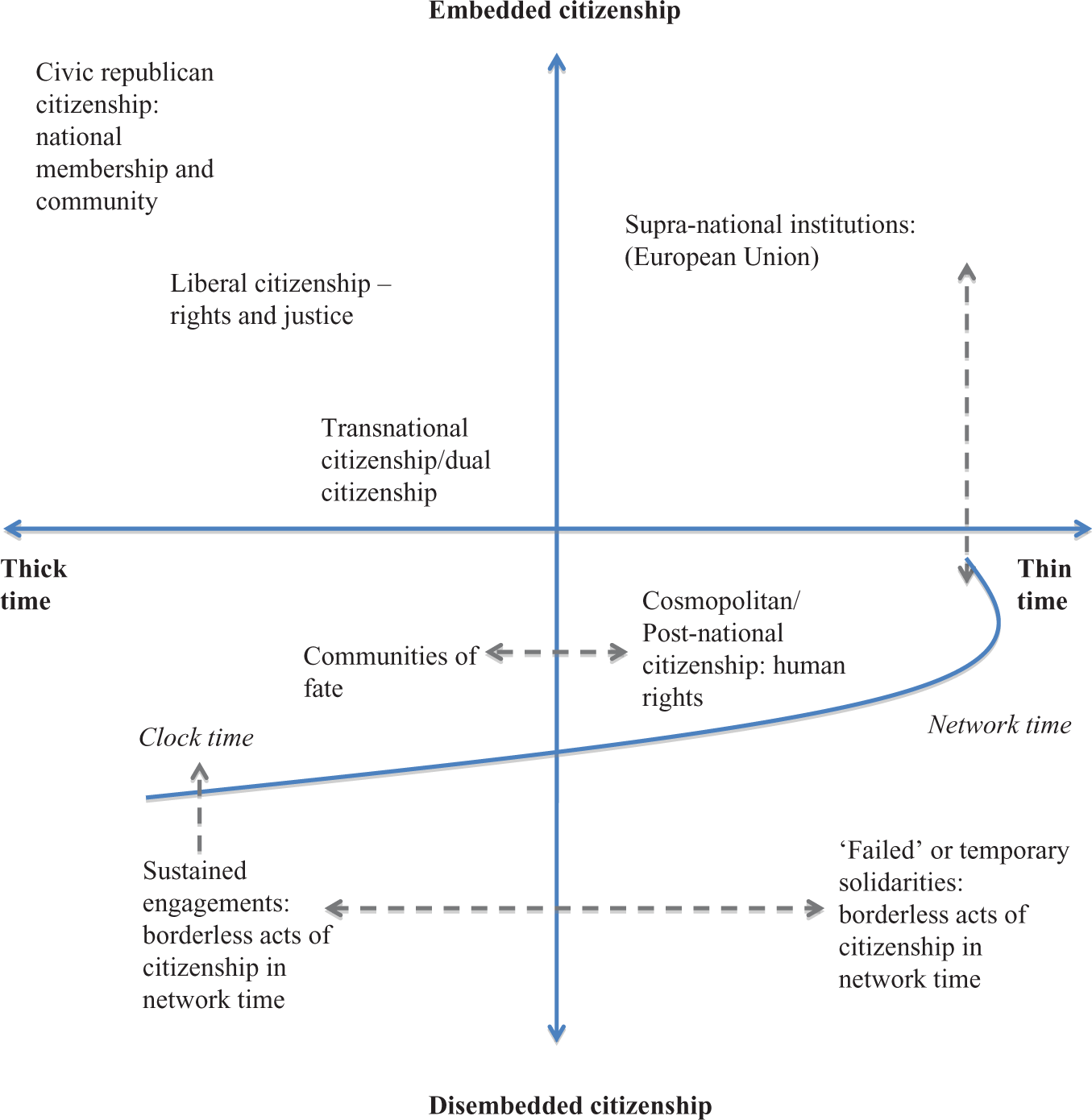
Modalities of citizenship.
To be sure, civic republican and liberal theories and practices of citizenship have continuing relevance, as exemplified in the attempts of local communities in a range of countries to develop policies for ‘social’ and well as environmental sustainability (Cuthill 2010; Davidson 2010; Maloutas 2003), and constant debates about the role and nature of welfare at local and national levels. Again, despite the facilitating role played by social media (Elshahed 2011), the levels of protest witnessed during the Arab Spring, particularly in Egypt, could not have been successfully sustained without thick time commitment in embedded space. Nevertheless, it is hard to deny that embedded, time-thick types of citizenship are encountering mounting challenges as conceptions of the public and private spheres traditionally deployed by republicans and liberals alike are progressively eroded by the liquidizing effects of increasing time space distanciation and digital connectedness. As Papacharissi (2010: 124, my emphasis) notes, the internet stands as a clear instance of ‘a commercially public medium’, her argument being that ‘online technologies afford us spaces, public and private, rather than a public sphere’ (Papacharissi 2010: 127). These spaces, moreover, accommodate ‘a new kind of publicity and privacy, constructed via the amalgamation of private and public interests’.
This intermixing of the public and private in globalized, informationalized capitalism means that the focus of social and political action shifts away from embedded, thick time understandings of engagement in a clearly designated public sphere towards activities occurring at variable times and being of ‘variable duration and commitment’ (Papacharissi 2010: 160) in privatized, disembedded spaces. In other words, the focus moves from the top-left quadrant of Figure 1 to the bottom-right. Is this necessarily problematic? Papacharissi (2010: 162) is optimistic. Although ‘the cultural logic of capitalist production together with the properties of electronic media, augmented by networked and converged technologies’, has rearranged relationships between the personal and political, and the public and private, citizenship itself is transformed rather than reduced. For Papacharissi, (2010: 162) in the new private sphere ‘neither the personal nor the political are prevalent but rather a peculiar mixture of both, which simultaneously renders citizenship less political than it was in the past but more autonomously defined’. The private sphere becomes a ‘sphere of connection and not isolation’, connecting the private individual to polity and society – indeed, it is possible to argue that those who may be relatively powerless in the conventional environment of representative democracy can be empowered as ‘networked citizens’ who are able to come together as individuals but in ways that nevertheless produce particular forms of collectivity and interaction, however fractured and temporary these may be.
Attractive though this vision is, it is not without difficulties. There is widespread concern, for instance, that the online realm is dominated by private and corporate interests whose monopoly over the means of information and communication enables them to reduce the scope of truly public interactions and effectively shape individuals’ interests and preferences in ways that maximize the profits of global corporations (see Beer and Burrows 2007; Beer 2009; Hindman 2009; Morosov 2010). This degree of surveillance and control is clearly inimical to efforts to develop new conceptions of the ‘public interest’ or the ‘public sphere’, however fractured and temporary these constructions may be. A further problem involves the difficulty of explaining how individualized acts of citizenship in disembedded space, played out in thin time, can ‘connect’ in ways that permit them to develop forms of solidarity that in turn allow them to advance claims based upon a relatively coherent conception of a common good. Contemporary citizenship can certainly be fractured and complex, with citizens inhabiting various subject positions as they construct various ‘solidarities’, but, as Mouffe and many others would recognize, in each act of citizenship, however temporary it ultimately turns out to be, there has to be a capacity for (relatively) sustained collective action in pursuit of one version or other of a commonly agreed good. In the digitalized, networked and liquid constant present this level of engagement could be hard to achieve, with significant consequences for both the theory and practice of citizenship itself.