







Abstract
Simon Gilby, Entitlement 1: salt and stainless steel, 155 cm. Bathers Beach, Fremantle.
If it’s the purpose of public art to relate with an imagined audience, inviting a multiplicity of responses while referring directly or indirectly to the physical and social history of a specific site, then Simon Gilby’s Entitlement 1, made of salt and stainless steel, 155 cm tall, is a powerful reminder of human vulnerability in the light of recent government policies and ongoing destructive human practices.
Perth’s two best-known marine sculptures, both conceived and constructed by local artist Tony Jones – Eliza, and CY O’Connor Horse and Rider – function differently, however, in terms of their commissioning, their reception and their more singular narratives. Eliza, a larger than life bronze statue placed some metres from the banks of the Swan River, at the site of the abandoned Crawley Baths, stands on a plinth/diving board, dressed in the female swimming costume of the 1940s, preparing to dive. Situated next to one of Perth’s busiest roads, hers is a figure notable for the playful engagement of her fans, dressing her in different outfits according to whim and rituals associated with seasons and celebrations.
More direct in its narrative focus and site specificity is Jones’s CY O’Connor Horse and Rider, a bronze statue placed some 20m out into the Indian Ocean, off the beach named after O’Connor. The site feels relatively remote, albeit only a couple of kilometres from the centre of Fremantle. There is little traffic on the adjacent road, and the statue is obscured from the road by sand dunes covered with saltbush and coastal heath. Only those who walk the beach perceive the statue, and for much of the winter and at night the beach is empty. The work was commissioned to celebrate the life and mourn the lonely death of engineer CY O’Connor, who committed suicide on the spot in 1902.
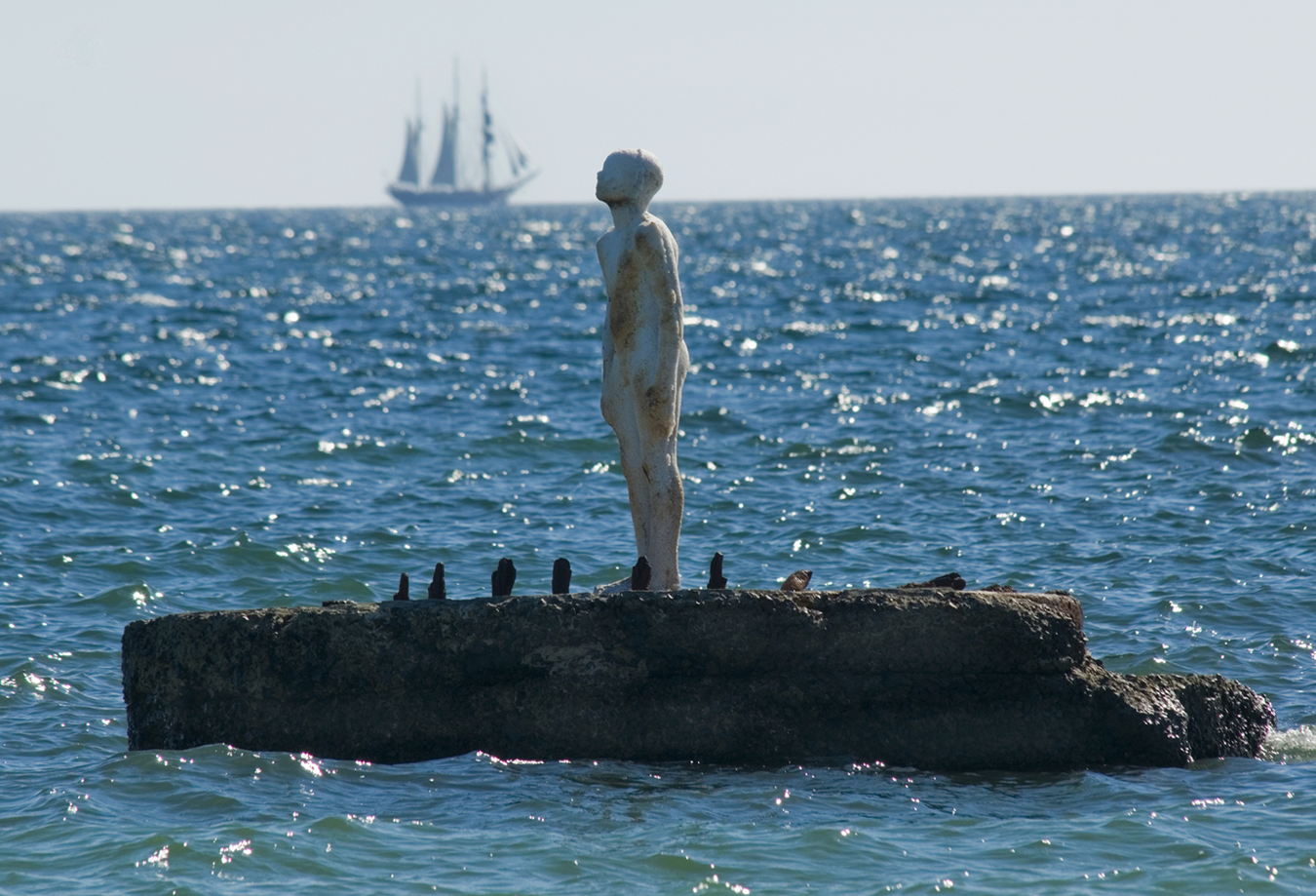
Simon Gilby, Entitlement 1: salt and stainless steel, 155 cm. Bathers Beach, Fremantle. Photographer -Roel Loopers.
If Jones’s Eliza reproduces the youthful poise and expressive vigour of Leni Riefenstahl’s Aryan paragons in Olympia, Jones’s O’Connor Horse and Rider aims to capture a more specific moment in the mythologized narrative that O’Connor’s life has become. The horse’s expression is alarmed, distressed, its nostrils are dilated and teeth bared, its eyes frozen in terror in the moments following the fatal gunshot that felled its rider. The figure representing CY O’Connor, however, is turned back to the port where his wife and children lie sleeping, and his expression is perfectly calm – he is already at peace, and on his way elsewhere. Unlike Eliza, poised and elevated above the water, ‘placed upon a pedestal’, O’Connor Horse and Rider isn’t a static image but maintains both a dramatic tension and a sense of perpetual movement, something heightened by its immersion in the ocean. It is also, in its vital melancholy, suggestive of the loneliness and sense of grief, of loss, of many settler diaries, at a time when the beach wasn’t a site of pleasure so much as a reminder of exile: a windswept and dangerous shoreline, a place where the heat and the light were magnified, their British faces looked wistfully to the west, standing at the border of the familiar and the terrifyingly new, their backs turned against what was, by their reckoning, an underpopulated and alien land.
Simon Gilby’s Entitlement 1 also references this loneliness and anxiety, but in its modern context and the multiplicity of readings it invokes, in its transitory form and ethereal aspects, it is a paradoxically more haunting work. These qualities gather to the salt figure, cast from the body of a 10-year-old boy, essentially by virtue of its materiality, its positioning and transformative properties. Bolted onto a small concrete island, an abandoned gun turret at Bathers Beach, Fremantle, the salt-boy stands as both metaphorical invitation and physical representation; a creature of sensual connection as much as of matter.
From the moment of its placement the figure was responsive to its material conditions, decaying by the hour, albeit silent in its response, and in silence inviting response. Sculpted in the human form, with its feet in the sea-spray; a heat-forged figure baked by the sun and burned by the wind, licked by the tongues of waves, the salt-boy returned to this source over the passage of several months.
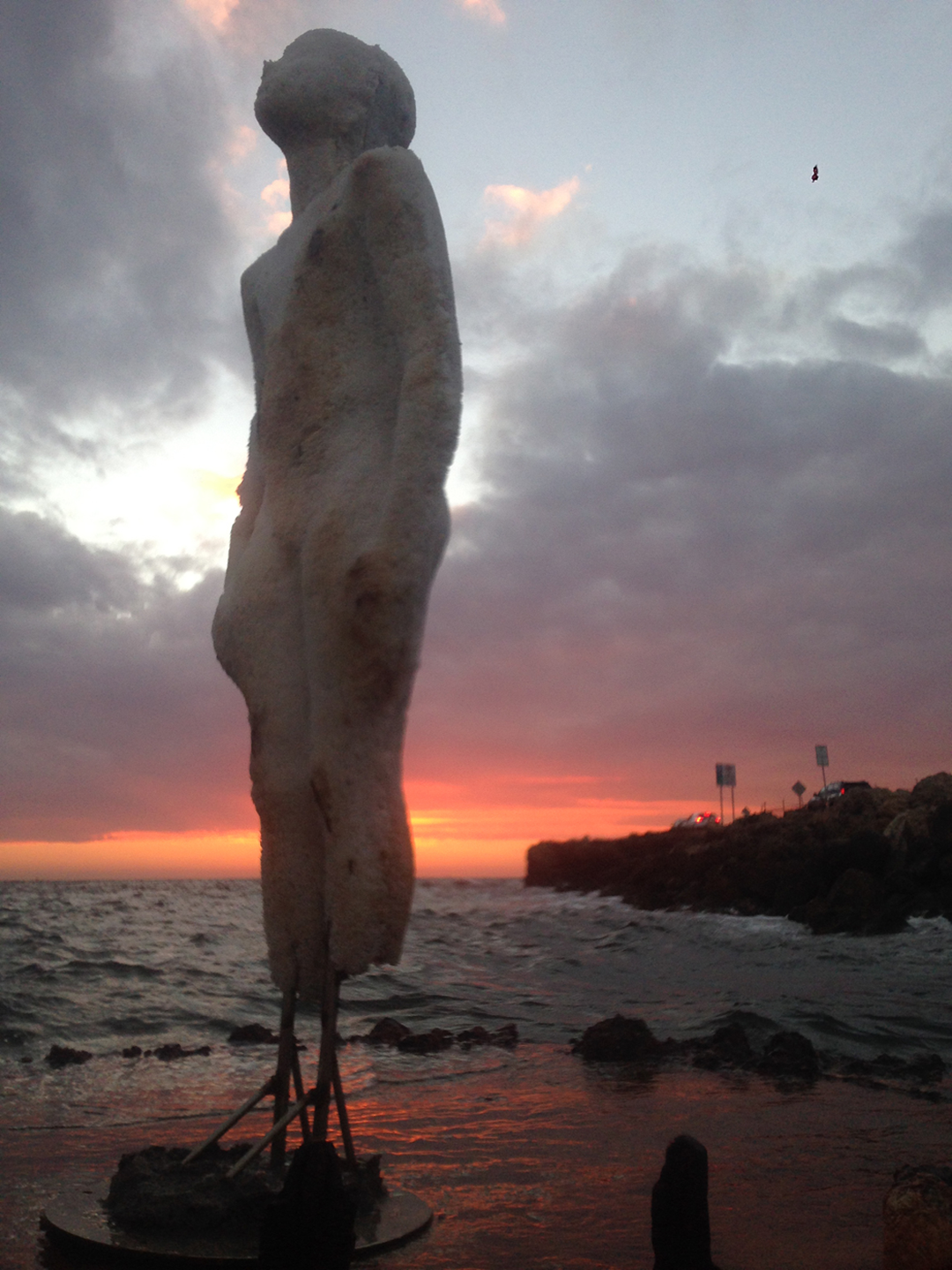
Simon Gilby, Entitlement 1: salt and stainless steel, 155 cm. Bathers Beach, Fremantle. Photographer -Roel Loopers.
Its temporal passage and elemental subjectivity invoke a complexity of experience, in particular around notions of dissolution and decay, of departure and return, of essence and connection. It stands at the site of the littoral, speaking to both the limiting possibilities of a patrolled border, on a coast often seen as the front line of Australia’s Border Protection program, with its refugee boat ‘turn-backs’ and detention centre on Christmas Island to the north, but also in its solitude and vulnerability, Entitlement 1 speaks to a more illuminating potential as a site of immersive understanding.
In light of the work’s title, it is a considered placement, shrouded in its vigil silence, on a gritty-industrial concrete island, scarred with remnant rust and harking back to its military origins, at the entry point of white settlement. By Gilby’s description, the salt figure is a totem of elemental humanity, stateless and vulnerable prior to the ascription of rights and entitlements according to accidents of birth. But what is the figure entitled to, by virtue of its placement, on an island of its own? And what, the artist asks, are our own entitlements, and how did we come by them?
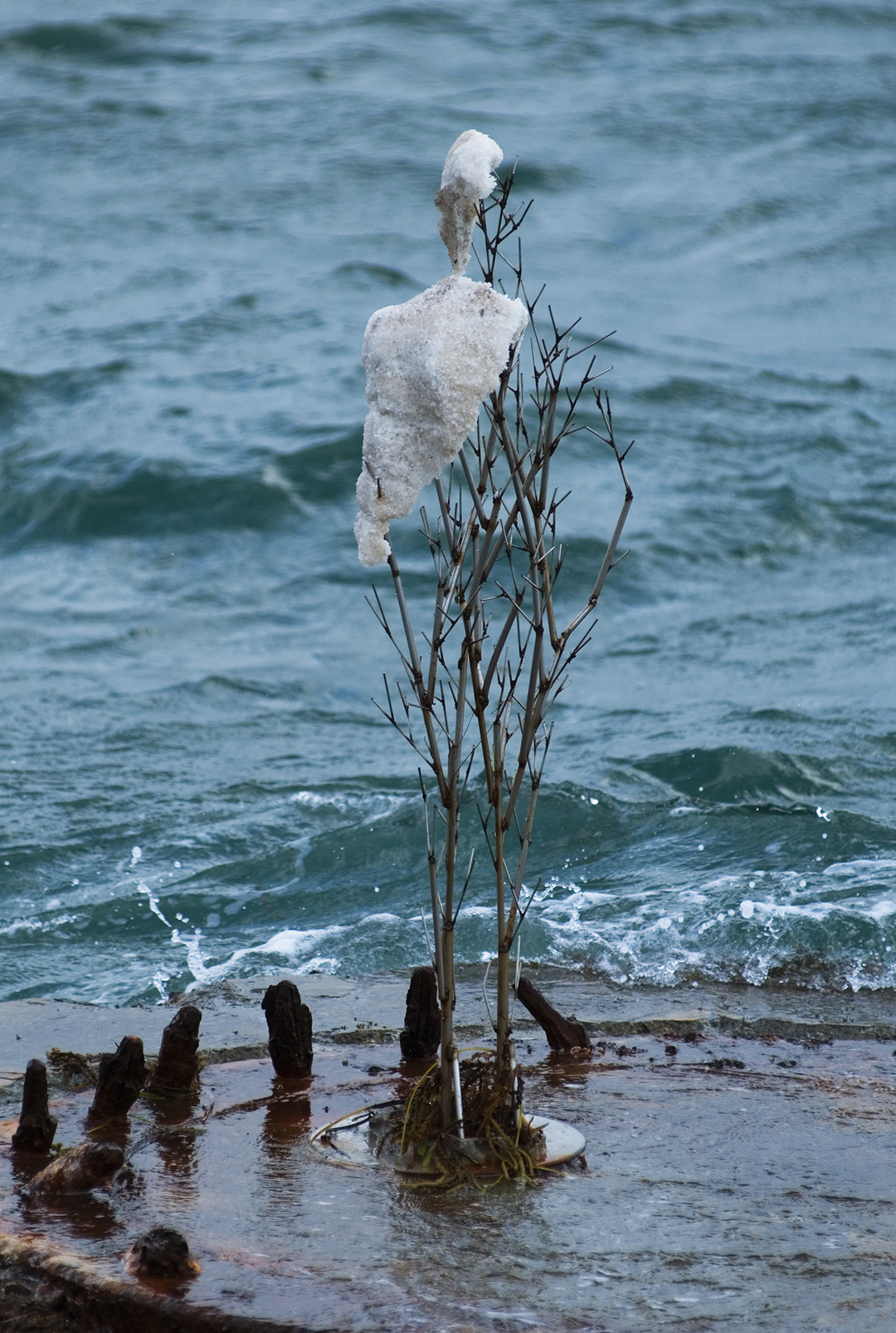
Simon Gilby, Entitlement 1: salt and stainless steel, 155 cm. Bathers Beach, Fremantle. Photographer -Roel Loopers.
To this end, the work resonates with particular meaning in the context of Australia’s asylum-seeker policy, where refugees are commonly described as illegal arrivals, and placed into detention camps and black sites, on distant islands of their own, away from the public gaze and the legal entitlements of its citizens. It is also, according to the artist, in the light of recent Western Australian government threats to close regional Indigenous communities because they aren’t economically ‘viable’, a recognition that our First Nations people aren’t, by virtue of their location or placement, entitled to the same services as other Australians.
More broadly, the materiality of Entitlement 1 also references the environmental issues most relevant to Western Australia, of salinity and deforestation, and more generally the issue of oceanic pollution. While salt is the defining matter of the ocean, in Western Australia it is also an ancient remnant of the once-hinterland seas. In its suspension in the former, salt water is always mobile, subject to oceanic current and tidal flux. In its manifestation of the latter, the primeval sea-beds of inland Australia, salt is both static and buried, until disturbed, when it rises to the surface and poisons the land. In between these two possibilities is the invisibly air-born; salt that can be tasted on the wind, settles on the land, on the skin. In this way, the image of the salt-boy speaks both to the motility of the material and the instability of the boundaries between land and sea, stone and water, conscious and unconscious, self and other.
For more than 120 days the artwork’s transfiguration from human form to remnant tree invoked the life-cycle of the sculpture’s immediate environment, situated in one of Earth’s most ancient, bio-diverse, but fragile eco-systems. In this sense, the erosion of the human form by the natural elements of wind and water is a patient and startling revelation of an original material condition. It speaks of a return to source, hinting in the process at the transmigration of human materials, in particular the toxic flushing of invisible micro-plastics and other waste-products into the ocean.
This representation of first principles, in essence the depiction of a landscape absent of the human figure, is suggestive of both the brevity of the human lifespan in relation to the location’s longer historical reality (which existed in a state of botanical quarantine for some hundred million years before human arrival) and a devastating image of a potential future encompassing climate-change and oceanic pollution.
Entitlement 1, by this reading, also hints at the primary existential feeling of a solitary and vulnerable figure, whose transubstantiation into a more ancient and enduring life-form ultimately reflects a broader and deeper societal and environmental malaise, holding up a mirror to what might be lost. As the vulnerable figure recedes, as the memory of those asylum seekers lost at sea and imprisoned on islands out of sight and out of mind is invoked – a reminder that our entitlements are essentially accidents of birth, denied now to others; as the imagery of the flushing of invisible micro-plastics is suggested materially and metaphorically, the figure of the tree endures – inviting responses that might be hopeful, might be real.