







Abstract
This paper takes the Chinese videogame Eggy Party as the research object and analyzes in depth the behavior and production characteristics of game players under the user-generated content (UGC) ecological model. Against the background of online games as a virtual cultural space, this paper describes Eggy Party's characteristics of breaking the limitations of real space, carrying multi-cultural connotations, and promoting cultural exchange and integration. From the perspective of digital labor, it reveals that players become digital laborers under the UGC model, investing their time, emotions and social resources to carry out non-materialized production, and their production is characterized by intangibility, intertwining of labor and entertainment, and indirect value creation. Based on Marxist theory, it points out the nature of exploitation of labor by capital and the irrationality of value creation and distribution behind this phenomenon. This raises issues of the protection of the rights and interests of digital laborers and the sustainable development of the digital economy, with the aim of providing inspiration for the further theoretical research and practical improvements in the era of digital economy.
Introduction
Eggy Party is a casual, competitive game produced and published by Hangzhou NetEase Thunderfire Technology Co., Ltd., which opened for public beta testing on May 27, 2022, and its core gameplay is Party Breakout. In the game, each player takes on the role of a character called ‘Eggy’ and can choose whether or not to challenge various levels with other users. The standard single-game flow (a complete party) consists of four consecutive levels (preliminary, repeat, semi-final, and final). Players need to pass all four levels in turn and win the final game in order to win the game. The game focuses on social interaction and achieving levels, becoming the no. 1 game of 2023 through its excellent game quality, smooth servers and featured creative workshop content (Chen and Yin, 2023). According to the data of NetEase 2023 fourth quarter and annual financial report, in 2023, the two explosive models of Eggy Party and Against the Shore supported the substantial growth of NetEase games. NetEase games and related value-added services net income in 2023 was 81.6 billion yuan, and the cumulative registered users of Eggy Party exceeded 500 million, which drove the daily users to break through 40 million during the Chinese New Year period. (Chen and Yin, 2023: Insight Research-NetEase 2023, Q4 Financial Report)
Today, with the rapid changes in digital technology, online games have become a key part of popular culture and entertainment, which are deeply integrated into young people's daily lives.
Numerous online games, represented by Eggy Party, not only provide players with a platform for recreation, but also construct a new social and cultural space. In The Production of Space (1991), Henri Lefebvre states that space is not a static container, but a dynamic product of social relations. He categorizes space into a threefold dimension: ‘spatial practice’, ‘representations of space’, and ‘representational spaces’. Eggy Party is precisely the fusion of the threefold space. From the perspective of space theory, the online game field breaks through the limitations of traditional physical space and shows a unique virtuality, which is a reconstruction of representational space. Players produce new social relations through collaboration or competition, constituting spatial practices. While analyzing from the cultural level, it carries multiple cultural connotations and becomes a new carrier for cultural exchange, production and inheritance. At the same time, with the rise of the UGC ecological model in the game field, the role of gamers has changed significantly, from simple game player to game content creators. Behind these changes lies the complex relationship between capital and labor in the digital era. An in-depth study of the attributes of the online game field and the roles and production characteristics of gamers under the UGC ecological model is of great significance to the understanding of the cultural phenomenon, social and economic structure, and the relationship between capital and labor in the digital era.
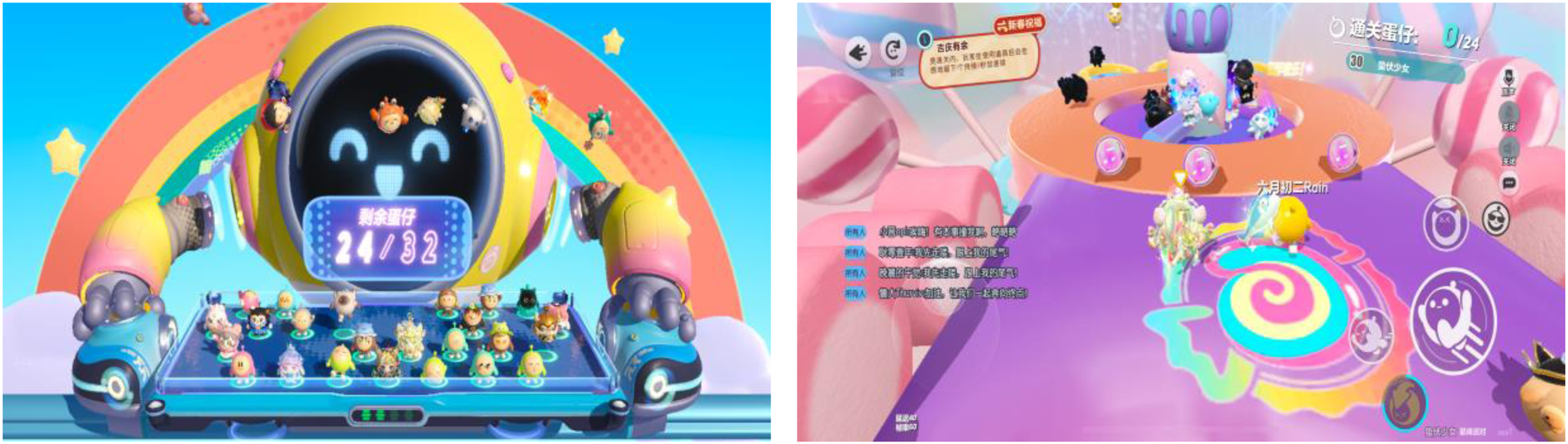
(a) Entering the level game. (b) In the game.
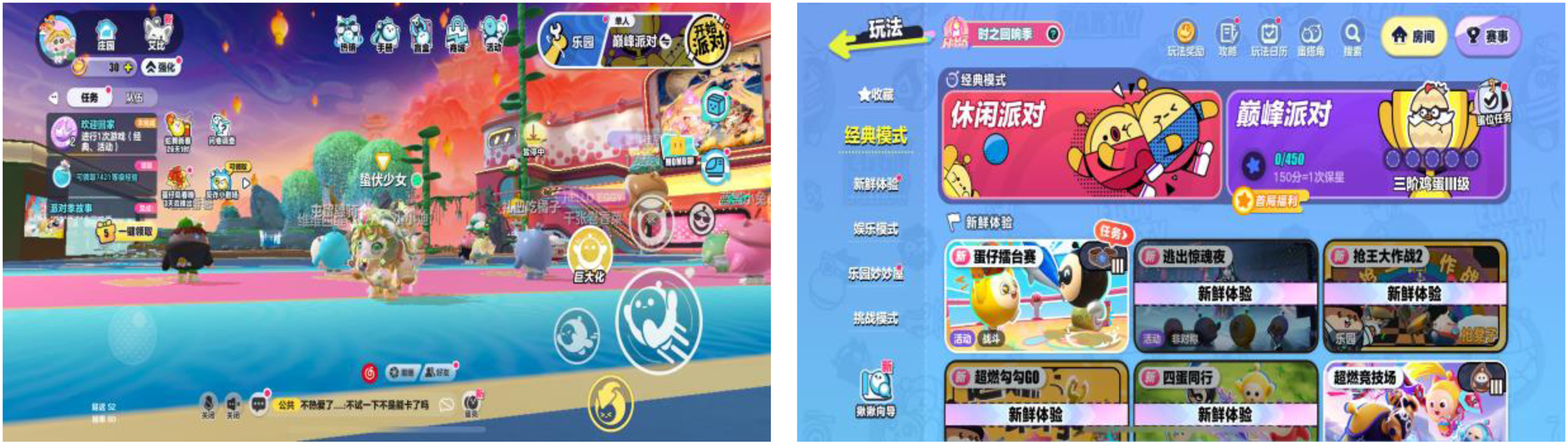
(a) Eggy Island. (b) Play interface.
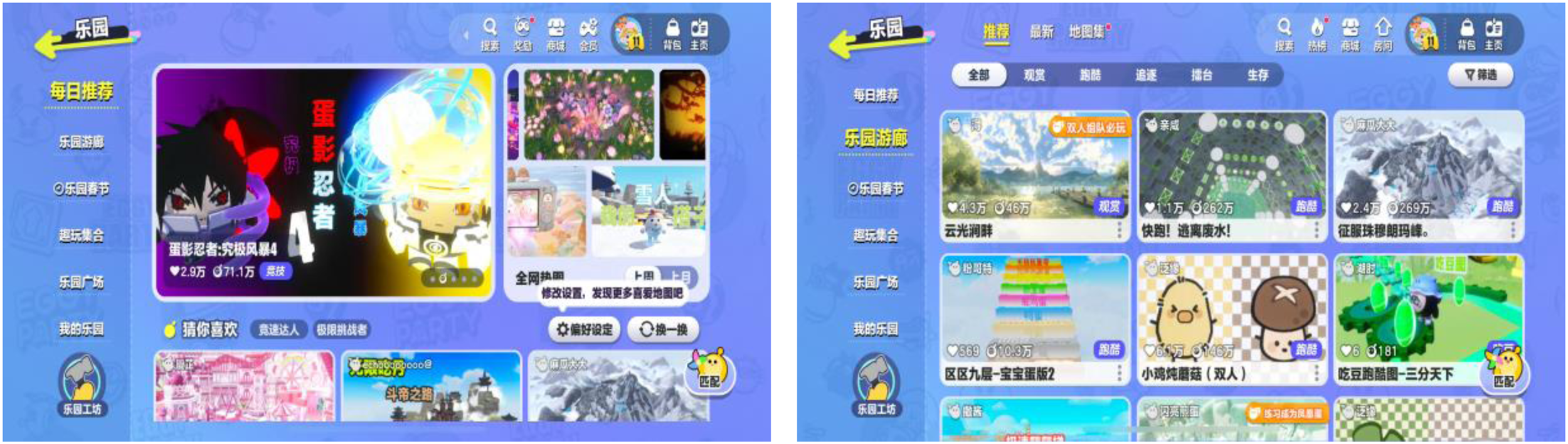
Paradise workshop of Eggy Party by gamers.
The online game field: A virtual cultural space
Online games, as a highly influential form of entertainment, attract hundreds of millions of players around the world. This is not only a simple entertainment activity but also constructs a new ‘space’ form. The online game represented by Eggy Party has created a virtual world beyond the limitations of real physical space due to advanced digital technology. In Johan Huizinga's book Homo Ludens: Study of the Play Element in Culture, play is defined as: an activity which occurs within a fixed time and space, presents a clear order, obeys rules which are agreed on, and is free from material utility and the necessities of the moment. The mood of play is one of jubilance and enthusiasm, which varies according to the situation, being sometimes sacred, sometimes festive. The emotions of excitement and tension are accompanied by dancing movements, and laughter and a sense of well-being follow (Huizinga, 2017: 12).
Play is a rule-based, non-materialistic activity that takes place in a specific time and space and can be full of joyful emotions. Traditionally, games rely on a corresponding real space, such as a board, a court, etc., and players interact with each other in these real spaces/venues. However, with the rapid development of technology, the characteristics of space have been revolutionized. In 1984 Canadian science fiction writer William Ford Gibson creatively used the term ‘cyberspace’ in his book Neuromancer. For Gibson, cyberspace represented, ‘A consensual hallucination experienced daily by billions of legitimate operators, in every nation, by children being taught mathematical concepts … [It is] (a) graphic representation of data abstracted from the banks of every computer in the human system. Unthinkable complexity. Lines of light ranged in the non-space of the mind, clusters of light and constellations of data. Like city lights, receding …’ (Gibson, 2000: 51). Depicting a shared illusion experienced by billions of people, this was the seminal imagining of virtual cyberspace. Since then, as technology has matured, the concept has moved from imagination to reality. Manuel Castells’ ‘space of flows’ suggests that digital networks have broken down geographical constraints, replacing the traditional fixed local space with a new ‘fluid space’: ‘The space of flows is the material organization of time-sharing social practices that work through flows’ (Castells, 2010: 442). In online games, this characteristic of ‘fluid space’ is manifested to the fullest extent. Taking Eggy Party as an example, players are not limited to the same physical location, so long as they have an Internet connection and a mobile device, they can enter the game world anytime and anywhere, with no regard to place. The game breaks through the barrier of geography, allowing players to compete and communicate with partners from different places and regions, completely transforming the traditional game model, from fixed space to virtual space. The rapid development of mobile networks, especially the popularization of 3G, 4G and even 5G technologies, as well as the significant improvement of cell phone performance, provide strong technical support for the expansion of virtual space for online games. This has allowed online games to migrate to cell phones on a large scale, permitting the handheld game industry to burgeon. Handheld games such as Eggy Party make use of the convenience of the mobile network, so that players can easily start the game journey in fragmented time—on the bus, between classes or jobs. Players only need to take out their cell phones, instantly to enter the virtual game world constructed by Eggy Party and interact with other players, further strengthening the virtual character of the online game field.
Henri Lefebvre discusses the close connection between space and culture in The Production of Space (1991), where he emphasizes that space is profoundly influenced by a variety of cultural factors, such as cultural perceptions, values, and social power relations. Culture shapes space. Space is not a scientific object removed from ideology or politics—it has always been political and strategic. ‘The search for a science of space has been going on for years, and this from many angles of approach: philosophy, epistemology, ecology, geopolitics, systems theory (decision-making systems; cognitive systems), anthropology, ethnology, and so on.’ (Lefebvre, 1991: 90–91). In Eggy Party, the setting of its ‘hip’ play theme reflects the pursuit of trendy toys, cute styles, and a relaxed entertainment atmosphere in the current pop culture. The game's colorful eggy images, fun and creative level designs are all based on specific cultural concepts. For example, the level scene design in the game integrates various pop culture elements, such as cartoon and animation style buildings, fantasy props, etc. (Figure 1a & Figure 2a) These elements are not only used to meet the game's fun needs, but are also a visual representation of the cultural concepts behind the screen. The rules and order in the game are an important reflection of culture. Lefebvre suggests that representations of space are tied to the relations of production and to the ‘order’ which those relations impose. ‘This relationship between cutting-up and representation, as it refers to space, has already found its place in the order (and the disorder) of the connections we have been examining.’ (Lefebvre, 1991: 104).
The relations of production and order are themselves part of culture and social structure, they reflect and shape space to a certain extent, suggesting that culture influences the representation of space through relations of production and social order, which in turn influences the production of space and people's understanding of space. The rules of Eggy Party, such as avoiding obstacles and utilizing props to accelerate to the finish line in the speed level, avoiding falling out of the field or being eliminated by the authorities in the survival level, all reflect the logic of competition and survival in real society. The formulation of these rules is not arbitrary but is influenced by social and cultural values about fair competition and challenging oneself. At the same time, the social rules in the game, such as the way players interact with each other and the mechanism of team formation, also reflect the importance of interpersonal communication and teamwork in social culture. Further, space is the bearing and embodiment of culture. Space is ‘a social reality—that is to say, a set of relations and forms … It must account for both representational spaces and representations of space, but above all for their interrelationships and their links with social practice’ (Lefebvre, 1991: 116). Representational spaces are the lived spaces of the inhabitants and users, containing rich cultural connotations and social relations, implying that space is an important carrier of culture. People live, interact and create in specific spaces, which carry their culture, values and lifestyles, etc. Different spaces will reflect different cultural characteristics and social relations.
Eggy Party provides players with rich social interaction methods, such as hugging, lifting, chatting, etc., and also supports players to form a team to break through levels. (Figure 1b)The social relationship established by players during the game carries specific cultural connotations. Through communication and interaction with other players, players not only share their game experience, but also convey their own cultural background, values and attitudes towards life. For example, players collaborate with each other in teamwork, which is an important value advocated by ‘real’ society and culture. At the same time, social interaction in the game also promotes cultural heritage and exchange; players from different regions and backgrounds bring their own cultural characteristics into the game, interweaving and integrating their local cultures with each other. ‘Social space is a social product … every society—and hence every mode of production with its subvariants (i.e. all those societies which exemplify the general concept—produces a space, its own space’ (Lefebvre, 1991: 31). Lefebvre here makes explicit the socio-cultural attributes of space, emphasizing that different social forms (e.g. feudalism, capitalism) will produce unique spaces that conform to their cultures. Social space is always a space of culture: it is neither a completely natural space nor a completely artificial space, emphasizing the inseparability of space and culture. Space is the product and manifestation of culture, and at the same time provides the material basis and place for the inheritance, development and exchange of culture. The contents of the game, such as scenes, characters and props, are all carriers of culture. On the Eggy Island of Eggy Party, all kinds of buildings, decorations and game props carry rich cultural elements. For example, the design inspiration of certain props may come from Chinese traditional festivals or folklore, and players will unconsciously come into contact with and learn about the relevant cultural knowledge in the process of using these props. In addition, the plot tasks and activities in the game are often centered on specific cultural themes, further enriching the cultural connotations of the game. Finally, the global space, mobilizes triads, tripartite conflicts or connections … capitalism cannot be analysed or explained by appealing to such binary oppositions as those between proletariat and bourgeoisie, wages and profit, or productive labour and parasitism; rather, it is composed of three elements, terms or moments—namely land, labour and capital, or in other words rent, wages and profit—which are brought together in the global unity of surplus value (Lefebvre, 1991: 228).
Space enters into modern modes of production and is used for the production of surplus value, a process that not only changes the material form and function of space, but also has an impact on culture.
With the continuous development of Eggy Party, its impact on culture has become more and more significant. The intensity of the game has attracted a large number of players to participate, and the various contents produced by players in the process of the game, such as game strategies and funny videos, have been disseminated and created multiply through content platforms such as TikTok, rednote, and Kuaishou. This content not only enriches the material base of network culture but also promotes the dissemination and development of related culture. For example, some unique gameplay and terminology in games have gradually become popular on the Internet and become part of network culture, influencing people's language habits and cultural cognition. Users took advantage of the comical features of the game's physics engine (e.g. Eggy rolling over after a collision) to edit the ‘Eggy's Confusing Behavior Awards’ compilation, with more than 2 million likes on a single video. Eggy's ‘clumsy’ image was given narrative labels such as ‘swinging’ and ‘bucking’, becoming a symbol of self-deprecating expression for young people. At the same time, culture will in turn affect the way of production and utilization of space. Culture, as an important part of social relations, will also change in this process, reflecting the dynamic relationship between space and culture that interacts and influences each other. Thus, these changes in culture have also had an effect on Eggy Party, impacting, players’ needs and expectations of games. Game developers need to pay constant attention to changes in cultural trends and adjust game content and design to meet players’ needs. For example, with the gradual increase of environmental awareness in society, game developers may add more elements related to environmental protection into the game, such as environmentally themed levels or activities, to guide players to establish environmental awareness.
The game's UGC model encourages players to utilize their creativity and create their own game content. Players of Eggy Party can design unique levels and create interesting storylines in the game, and this creative process stimulates players’ cultural creativity and innovation. Players’ creative works not only add rich content to the game but also provide new ideas and inspiration for the development of cultural and creative industries. In Eggy Party, players establish a deep emotional connection through social interaction. This social and emotional connection not only satisfies players’ social needs in the virtual world, but also has a positive impact on real-life relationships. Players make like-minded friends in the game, and they can extend this friendship to real life, further enriching players’ social circle and emotional experience.
The online game field, typified by Eggy Party, is undoubtedly a new virtual cultural space. It realizes the virtualization of space through technology, and at the same time carries rich cultural connotations through the infiltration of culture, thereby constantly promoting the development of itself and its online culture through the interaction with ‘real-life’ culture. The emergence of an online game field provides people with a new form of cultural communication, production, life and consumption, and profoundly affects the cultural ecology of contemporary society.
Lefebvre's spatial theory reveals the complexity of Eggy Party as a cultural space; Eggy Party is both a ‘pleasure factory’ dominated by commercial logic and a ‘third space’ for players to create culture. The game lowers the threshold by simplifying the operation, but also alienates the players through data monitoring; at the same time, UGC provides the possibility of marginalized expression. UGC not only replicates the hierarchical nature of real social interaction (e.g. Eggy's appearance decoration symbolizes identity), but also creates a decentralized temporary community. Therefore, the game space of Eggy Party is both a container for capital regulation and a battlefield for mass resistance, reflecting the eternal tension between ‘control’ and ‘freedom’ in the virtual space of the digital age.
Gamers in the UGC ecological model: Digital laborers
In digital technology the booming game industry is integral to the Internet economy. It is constantly evolving its industry and style. The rise of the UGC ecological model in the game field provides a broad space for players to participate in the creation of game content. As a typical representative of this model, Eggy Party has attracted a large number of users to participate in the creation of game content by virtue of its unique Paradise Workshop (Figure 3) artificial intelligence generated content (AIGC) tool and rich social interaction mechanism.
The Paradise Workshop created by Eggy Party gives users creative autonomy. The AIGC creation tool equipped with an AI algorithm is like a ‘magic key’, which greatly reduces the threshold of map creation. In the past, ordinary players who wanted to create complex game maps needed to have professional programming knowledge and graphic design capabilities. The AIGC tool allows players without technical backgrounds easily to get started. This makes game content creation no longer the exclusive domain of a few professionals, thereby broadening accessibility to ordinary players. Eggy Party's UGC ecological model has achieved remarkable results, with the number of UGC creators exceeding 26 million, highlighting the model's powerful stimulus to engage players’ creativity. The total number of maps has exceeded 100 million, which means the game has a significant amount of rich and different styles of content resources, providing players with a diversified gaming experience. The highest number of times a single map has been played is 120 million times. This indicates that the content created by players is loved by other players, proving the great success of the UGC ecological model in attracting and retaining users. As the core spatial production mechanism, the game map of Eggy Party forms a multi-dimensional functional system through the visualization of rules (dynamic physical parameters and strategic decision tree), the construction of social presence (cultural symbol system and UGC ecology), and the regulation of lifecycle (limited-time scarcity and skill stratification system). Its design not only reconfigures the experience boundary of traditional competitive games, but also becomes a strategic resource to maintain players’ adhesion. It also drives cultural dissemination through the synergy of ‘spatial narrative-social interaction-ecological metabolism’, which confirms a paradigm shift in the digital gaming space from a functional carrier to a hub of meaning production. Compared with other UGC games in China, Eggy Party is unique in that it actively introduces social attributes and closely integrates the game's built-in rewards, mode challenges and user socialization.(Figure 2b) In the game, players not only create their own maps, but also build maps with their friends. This collaborative approach enhances the emotional exchange between players. At the same time, the in-game reward mechanism encourages players to invite their friends to participate in the game, and by completing specific social tasks or mode challenges, players can obtain generous game rewards. This deep integration of socialization and gaming experience further enhances players’ ‘stickiness’. Stickiness is a core concept in game design and user behavior research, which refers to the behavioral tendency of players continuously to invest time, emotion and social resources in the game experience due to its attractiveness, thus forming long-term stable participation. Its essence is the ‘closed loop of continuous participation’ constructed by the game system through psychological mechanisms, social networks and dynamic content and in doing so, promotes game loyalty.
Such loyalty might be explained by understanding the importance of the audience. Dallas W. Smythe's audience commodity theory in his article, ‘Communications: blindspot of western Marxism’ provides a solid foundation for digital labor studies. He argues that in capitalist societies, the real commodity of commercial radio and television broadcasting is not the program itself, but the audience. In watching television programs, viewers not only perform the necessary sales function for producers of consumer goods, but also unknowingly complete the production and reproduction of their own labor. By watching advertisements, viewers learn to buy specific brands of consumer goods and spend their income accordingly, and the value created in this process is ultimately realized through the advertising surcharge on the purchase of the goods. ‘In advanced capitalist societies, for most people, leisure time is working time, and all time is working time’ (Smythe, 1977: 19). This theory reveals the exploited status of the audience in the capitalist media economy and breaks the limitations of the previous perception of the audience as mere consumer. With the advent of the network era, the widespread application of digital technology has given rise to new forms of labor and labor groups. On the basis of audience commodity theory, scholars following Smythe have proposed the concept of digital labor to refer to groups of people engaged in various kinds of labor working in digital technology. The labor of these groups is no longer limited to the traditional material production field but rather is involved in the non-material field of information production, dissemination and service. For example, people engaged in content creation, data labeling, online customer service, etc. on internet platforms can be regarded as digital laborers. In addition, concepts such as free labor and immaterial labor have also emerged, further refining and enriching the study of new types of labor in the information society. These concepts emphasize the unpaid and immaterial nature of digital labor and its close integration with digital technology.
In the UGC ecological model of Eggy Party, gamers ‘pay’ is much like a labor-capital exchange in the real world. Gamers expend labor and time creating and playing for which they receive material as well as social rewards. This is an unequal exchange. Players spend a lot of time creating maps in the ‘Paradise Workshop’, carefully designing each scene, level and props, and striving to create unique game content. Meanwhile, in the course of the game, players continuously play the maps created by themselves and other players in order to obtain virtual currency, level up and so on. This act of exchanging time consumption for virtual output is similar to traditional labor in which labor time is given to obtain material rewards. The time invested by players becomes a valuable production factor, while virtual currency and levels are the fruits of their labor. Although these virtual outputs do not have a material entity, they have an important value in the game world, and they can help players unlock more game content and enhance their gaming experience. Gamers not only invest their time and energy in Eggy Party but also pour a lot of emotional and social resources into it. Players are often emotionally attached to the maps they create, and they want their work to be recognized and appreciated by other players. In order to realize this goal, players will actively interact with other players and share their own creation tips and game experience. In this process, players gain a unique experience of subjectivity by connecting with others on a cognitive and emotional level. This process of emotional and social engagement is, in essence, a kind of labor. For example, when players form a team in a game to complete a complex map creation project, they need to coordinate their ideas and actions, and resolve differences and contradictions within the team, a process that is not unlike teamwork in the real world of work. The value created by this labor is not only reflected in the construction of social relationships and emotional satisfaction within the game, but also through word of mouth among players, which brings more users and traffic to the game, and then creates commercial value for the game developers.
The power of capital is omnipresent in the UGC ecological model of Eggy Party. Through clever design, the game developer transforms players’ social relationships into a resource that can be utilized, and this resource is likewise monetized. For example, the game's built-in reward mechanism encourages players to invite their real-life friends to join the game, and players’ social circles become an important channel for game promotion. Adolescents are one of the main audiences/players of the game. Their social circles are usually smaller and their relationships are more direct and less complex than those of adults, with fewer stakes involved. Due to the tight social networks of teenagers, information spreads faster among them. Game-related content or trends can spread quickly and create a fad. The game utilizes the psychology of teenagers who are eager to interact and share with their peers, prompting them to promote the game in their own social circles by setting various social tasks and rewards. This marketing model based on social relationships enables the game to spread rapidly among young people realizing the rapid growth of the number of users. In this process, the social resources of players are used by capital and become an important driving force for the commercial success of the game, while the players themselves often do not realize that their social labor is capitalized.
Gamers’ dematerialized production and its characteristics in the UGC ecological model
According to Marx, labor is the sole significant source of value. In the UGC ecological model of Eggy Party, players investment of time and energy in content creation, designing unique game maps, conceptualizing interesting plots, etc. undoubtedly belongs to the category of labor. Such creative labor injects rich content into the game, attracts more players to participate, and greatly enhances the commercial value of the game. However, the value created by players has not been reasonably rewarded in monetary terms. Players only reap virtual rewards and social satisfaction, which is contrary to any principle of rational distribution like that emphasized by Marx. Gamers are performing free labor for an alienating capitalist source. Under the capitalist system, the labor process has distinctive features. Workers labor under the supervision of capitalists, and the fruits of their labor belong to capitalists: The labour process, when it is the process by which the capitalist consumes labour-power, exhibits two characteristic phenomena. First, the worker works under the control of the capitalist to whom his labour belongs …. Secondly, the product is the property of the capitalist and not that of the worker, its immediate producer (Marx, 1990: 291–92).
In Marxist theory, the relations of production are the economic relations that people form in the process of material production, which in the capitalist mode of production manifests itself in the exploitative relations between capitalists and workers. ‘Economic production is going through a period of transition in which increasingly the results of capitalist production are social relations and forms of life. Capitalist production, in other words, is becoming biopolitical’. (Hardt and Negri, 2009: 131). In the field of mobile gaming, capital appropriators deprive and control laborers and the surplus value of laborers, and capital dominates labor through its disciplinary regime. In the UGC ecological model of gaming, game developers are in the position of capital owners and players become digital laborers. By virtue of their ownership and control of the game platform, developers transform players’ social relationships into resources for game promotion through the game's built-in reward mechanism, social tasks, and other designs, and use players’ labor to achieve user growth and maximize commercial interests. Players do not realize that their own labor has been capitalized and is being exploited, which reflects a new form of control over and exploitation of labor in the digital era. The fruits of their labor are exploited by developers, but they do not have the corresponding right to give voice or to distribute revenues. It is impossible for gamers to obtain reasonable economic returns from the increase in advertising revenues and the growth in the sales of paid props brought about by their creation of content. Their labor is appropriated by the developers without compensation, which is similar to the exploitation of laborers by capitalists in the material capitalist relations of production.
The analysis of the immaterialized production process of gamers under the UGC ecological model, from my perspective, presents the following three main characteristics:
The intangibility of the production process and the concealment of value. In traditional manufacturing, the movements of workers assembling parts and the rhythm of production line flow can be captured by the naked eye, and there is a linear correspondence between labor input and output. The creation of UGC players (e.g. designing virtual scenarios) is essentially a data-based projection of cerebral activities, and its core value arises from the thinking process of players interacting with the code. Their dematerialized production process is difficult to be intuitively perceived, and its production process is invisible. The players’ digital creations are not independently existing entities, but are nested within the framework of the game engine in the form of ‘0/1’ codes, which do not directly produce visible material products, cannot be touched like traditional products, and the fruits of their labor mainly exist in the game world in the form of virtualization, such as virtual maps, character equipment, and social relationship networks. Traditional labor value can be constructed as a three-dimensional assessment model through the measurement of hours worked (time dimension), consumption of raw materials (material dimension), and selling price of products (economic dimension). In contrast, players’ immaterial production presents paradoxes such as, time trap, material vacuum, and pricing difficulties. Although the production process is intangible, the player's labor is also condensed in the virtual products, which attract players to participate, enhance user stickiness and activity, and bring economic benefits to the game. The realization and measurement of the game's value needs only to be integrated with the game's commercial operation data, user behavior and other factors, which is more hidden and complex. Intertwinement and alienation of labor and entertainment. In Eggy Party, players often regard creation and play as pure entertainment from which they can secure fun and satisfaction, they are not forced but voluntarily invest their time and energy in the game. However, from the analysis of Marxist labor theory, this kind of seemingly recreational behavior actually has the attribute of labor. Players need to invest a lot of time and energy, use a variety of skills and knowledge, and overcome many difficulties, which is no different from the nature of traditional labor. However, this high degree of integration of labor and entertainment makes players unconsciously create value for game developers while simultaneously concealing the nature of capital's exploitation of labor. Players freely and voluntarily create games, but are caught in a state of labor alienation. Their labor is no longer for their own comprehensive development, but is reduced to a tool for capital to increase its value. While players are not forced in the same way as wage workers, the structural conditions of digital capitalism transform leisure into a site of value extraction. The game's design and the broader economic system ensure that even ‘free’ choices serve capital's interests, perpetuating alienation and exploitation in subtle, culturally accepted forms. This fusion of labor and entertainment makes it easier for players unknowingly to fall into the operation system of digital capital and become a digital laborer. Indirectness of value creation and hidden exploitation by capital. Players’ creation of content and participation in social interactions in Eggy Party are not directly transformed into monetary gains. However, by attracting more users to participate in the game they enhance the game's visibility, activity and user stickiness, which in turn attracts more users to join, bringing commercial benefits such as advertising revenues and sales of paid props to the game developers. For example, players actively share their game achievements and experiences in the game, attracting more potential users to join the game. The addition of these new users may lead to an increase in the value of advertising placement in the game or prompt more users to purchase paid props in the game, thus creating value for the game developer. The players themselves do not receive a direct financial return from the value they create; they only receive virtual rewards and social satisfaction from the game. The indirect nature of this value creation makes the exploitation of labor by capital more insidious, and it is often difficult for players to notice that they are being deprived of their own labor value.
At the same time, game developers capture the surplus value created by players through a variety of means. On the one hand, they encourage players to devote more time to playing and creating within the game, similar to extending working hours, to realize the production of absolute surplus value. Players spend a lot of time creating maps, playing to get virtual currency and leveling up, bringing more user traffic and business opportunities for developers. On the other hand, with the development of game technology and the improvement of players’ creation level, developers can enhance the attractiveness of the game and user experience by means of the AIGC creation tool equipped with AI algorithms. In Eggy Party, the threshold of creation is lower and attracts more players to participate in the creation of the game, so that the players can create more value in the same period of time to realize the production of relative residual value. The players do not obtain more benefits due to the improvement of efficiency.
Examined from a Marxist point of view, the digital labor phenomenon of gamers under the UGC ecological model reveals the unequal relationship between capital and labor and the irrationality of value creation and distribution in the digital era. This not only triggers concern about the protection of digital labor rights and interests but also prompts us to think about the sustainable development of the digital economy. In future research, it is necessary more deeply to explore how to protect the legitimate rights and interests of digital laborers in the process of digital economy development, build a fair and reasonable income distribution mechanism, and strengthen the regulation of digital labor. At the same time, game developers should think about how to give players more reasonable rewards and incentives in the process of using them to create value, promote the game industry, and realize the symbiosis between capital and labor in the digital era.
Conclusion
This paper reveals, through an in-depth study of Eggy Party, the characteristics of gamers’ immaterialized production and the logic of capital operation under the UGC ecological model. As a virtual cultural space, the online game field breaks the boundaries of real space through advanced digital technology, carries rich cultural connotations, and plays a key role in cultural exchange, development and innovation. However, under the UGC ecological model, although gamers have creative autonomy, they have invariably become digital laborers and are exploited by capital. From the perspective of Marxist theory, players’ labor is the source of game value creation, but they have not received reasonable value distribution. The invisibility of the production process, the intertwining of labor and entertainment, and the indirectness of value creation make the exploitation of labor by capital more hidden, making it difficult to protect the rights and interests of players. Game developers further exacerbate this unequal production relationship by acquiring the surplus value created by players through various means of extraction. The entire phenomenon reveals profound contradictions. This will never be just a game.
Footnotes
Declaration of conflicting interests
The author declared no potential conflicts of interest with respect to the research, authorship, and/or publication of this article.
Funding
The author received no financial support for the research, authorship, and/or publication of this article.

Author biography