







Abstract
This article examines the failure of recent political uprisings in post-revolutionary Iran through the framework of Peripheral Capitalist Realism (PCR), extending Mark Fisher's notion of ideological foreclosure. PCR describes a political-affective condition produced by the fusion of authoritarian governance, predatory accumulation, patrimonialism, and neoliberal rationality in a peripheral theocracy. Drawing on survey data from 332 educated, urban middle-class respondents and critical theory, the study argues that beyond state repression, the internalization of neoliberal values and absence of viable alternatives generate resignation and affective withdrawal. Integrating Fisher's ideas of “reflexive impotence” and “privatization of stress” with Lauren Berlant's “cruel optimism” and Marxist analyses of peripheral capitalism, the paper shows how Iranian society embodies a distinctive capitalist realism shaped by its unique blend of Islamic theocracy and predatory economics. Empirical findings reveal precarious labor, psychological distress, and a pervasive desire to emigrate, indicating a socio-political atmosphere where systemic transformation appears increasingly unimaginable.
Keywords
Introduction: peripheral capitalism and the crisis of imagination
The contemporary era of late capitalism (Jameson, 1992; Mandel, 1999) has been marked by a profound ideological exhaustion—the sense that humanity has reached the “end of history” and that, following the collapse of communism, the global spread of capitalism and liberal democracy is the only viable political and economic configuration (Fukuyama, 1992). In this atmosphere, the political imagination suffers from a severe restriction of horizons. This ideological closure is what Mark Fisher (2009: 2) termed capitalist realism: the “widespread sense that capitalism is the only viable political and economic system, and that it is now impossible even to imagine a coherent alternative to it.” The consequence is a foreclosure of futurity where the future appears only as a cyclical repetition of the present, intensifying despair and political paralysis.
This article examines how this global condition of capitalist realism is not monolithic but is transformed and intensified in peripheral, authoritarian contexts. While Fisher's analysis focused primarily on the Euro-Atlantic democracies, the challenge is to understand how this ideological-affective paralysis operates when market rationality is enforced not through democratic consensus, but through coercion, predation, and the state's monopoly on violence.
To address this, I introduce the concept of Peripheral Capitalist Realism (PCR). This framework is employed to investigate a critical paradox in post-revolutionary Iran: why repeated cycles of mass protest—including the 2009 Green Movement, the 2019 fuel protests, and the 2022–2023 “Woman, Life, Freedom” demonstrations (also known as the Zhina uprising)—have consistently failed to produce durable structural change. As Bayat (2023) notes, Iran's protest waves have “profoundly challenged the Islamist regime but failed to alter it.” So, while observers correctly point to the state's brutal repression, I argue that the endurance of political paralysis in Iran is not only a matter of coercion but is also rooted in a deeper ideological-affective condition tied to the dynamics of global capitalism.
Fisher's insights about reflexive impotence and the foreclosure of futurity remain powerful, but in Iran these dynamics are intensified by the fusion of neoliberal reforms, authoritarian governance, and a predatory political economy uniquely inflected by theocratic elements. As Bruff and Tansel (2019) describe under the rubric of authoritarian neoliberalism, regimes can deploy coercive state power precisely to shield neoliberal rationality from democratic contestation. In Iran, marketization and privatization are accompanied not by liberal freedoms but by surveillance, repression, and patronage networks that blend neoliberal rhetoric with Islamic justifications for dispossession. This intensification occurs through a threefold convergence: (1) State dominance equipped with surveillance and repressive tools; (2) Predatory Accumulation (an economy of Anfal and dispossession, following Vahabi (2023) and Harvey (2005)), where Anfal draws on Islamic jurisprudence to legitimize elite appropriation of public resources); and (3) Affective Capture (the normalization of despair and resignation, which intensifies after every setback in protest movements).
Underlying this configuration is what Mehrdad Vahabi (2004, 2023) terms an economy of Anfal and confiscation: wealth accumulation through predation, rent-seeking, and resource appropriation rather than productive investment. This resonates with Harvey's (2005) idea of accumulation by dispossession, but in Iran it is reinforced by sanctions, elite patronage, and the parastatal control of major sectors of the economy, all legitimized through a theocratic lens. Citizens experience not developmental progress but recurring dispossession, insecurity, and de-development. Yet, as Fisher reminds us, material conditions alone do not explain the endurance of the status quo. They are mediated through ideology and affect, shaping how individuals interpret their own lives, with social factors such as family networks, community expectations, and media discourses transmitting privatization of stress from structural to individual levels.
Here, affect theory provides crucial insight. Berlant's (2011) concept of cruel optimism captures how people remain attached to aspirations—the good job, the chance to emigrate, upward mobility—that the structure renders largely unattainable. Ahmed's (2010) analysis of the promise of happiness explains how certain objects—consumer goods, professional success, migration—become imbued with affective weight, even as they rarely deliver fulfillment. In Iran, these dynamics are further complicated by governmental religious narratives, as well as by the increased withdrawal of people following the failure of social movements, repeatedly spreading despair. The affective result is one of exhaustion and déjà vu: each new wave of protest raises hopes of change, only to collapse into familiar disillusionment. Iran's neo-patriarchal gender regime further layers these dynamics, imposing additional constraints on women through discriminatory laws that intersect with economic precarity (Moghadam, 2018).
My empirical evidence underscores these dynamics. Based on a survey of 332 respondents conducted in 2024—68%of whom reside in Tehran and other major urban centers, primarily from the educated middle class—the data reveal a striking pattern. While dissatisfaction with economic and political conditions is widespread, confidence in the possibility of change is extraordinarily low. Thus, with the despair over the possibility of political change (for which state repression is a primary reason), economic hardships also turn into a personal matter for individuals. Affective withdrawal was common, with many participants describing emigration, cynicism, or retreat into private life as the only viable responses. These findings reflect precisely the structures Fisher, Berlant, and Ahmed theorize: a realism that is not only ideological but also affective, embedding the sense that alternatives are unthinkable and futures foreclosed. The survey also highlights class dynamics, with middle-class respondents expressing frustration over blocked mobility. However, it does not incorporate ethnic differentiation, as the questionnaire aimed to reflect the broader societal context without inquiring about individuals’ identities or ethnic backgrounds; this approach acknowledges potential limitations in capturing ethnic identifications, which may play a role in state-society relations through minority marginalization.
This article makes two contributions to critical theory and the historical sociology of the Global South. First, it extends Fisher's theory of capitalist realism beyond its usual Western-democratic setting into an authoritarian, peripheral context. By integrating Fisher's framework of reflexive impotence and the privatization of stress with Lauren Berlant's concept of cruel optimism, alongside Marxist critiques of peripheral capitalism, I conceptualize capitalist realism as a global but uneven phenomenon: one that takes distinctive forms on the margins of global capitalism. In Iran, the state actively promotes a “politics of sadness and grief,” normalizing despair to foreclose collective hope (Golkar and Aarabi, 2024), blending neoliberal rhetoric with theocratic legitimation. Second, the article bridges macro-structural analysis and micro-level subjectivity through empirical research, demonstrating how authoritarian-neoliberal policies and predatory accumulation translate into affective states of despair, withdrawal, and cynicism. My own findings corroborate these trends: participants overwhelmingly felt entrapped and disillusioned, with few believing in the efficacy of collective political action. In short, capitalist realism in Iran manifests not only as the sense that “there is no alternative,” but also as the widespread conviction that “we have no future here.”
Theoretical architecture: authoritarian neoliberalism and affective captivity
This section delineates the theoretical scaffolding of PCR, synthesizing Marxist, postcolonial, and affect theories to illuminate how neoliberal rationality intertwines with authoritarian governance and emotional regimes in Iran. By drawing on Mark Fisher's seminal work alongside contributions from Wendy Brown, Nikolas Rose, Lauren Berlant, Sara Ahmed, Antonio Gramsci, and Gayatri Spivak, I uncover the mechanisms that render alternatives unimaginable. This framework not only adapts Fisher's capitalist realism to a peripheral, non-Western context but also integrates empirical insights from the survey data, highlighting how ideological hegemony fosters affective resignation amid predatory economic structures. To clarify, I disentangle the material (predatory accumulation via Anfal and dispossession) from the ideological (neoliberal rationality as post hoc legitimation, blended with theocratic narratives), showing how they converge in Iran's unique theocratic-patrimonial system.
Capitalist realism and neoliberal subjectivity
Building on Mark Fisher's insight that capitalism projects itself as the only imaginable system (Fisher, 2009), we see in Iran a doubly intensified capitalist realism. Fisher defines capitalist realism as “the widespread sense that not only is capitalism the only viable political and economic system, but also that it is now impossible even to imagine a coherent alternative to it” (Fisher, 2009: 2). In Western democracies, this emerges through media culture and political stagnation; in Iran, it fuses with an authoritarian state and produces a widespread atmosphere of reflexive impotence in which citizens—despite recognizing the systemic flaws of the ruling structure—consider themselves incapable of overcoming it (Fisher, 2011). This intensification is evident in the survey findings, where 79% of respondents expressed disbelief in the efficacy of recent protests—a stance reflected in a deeply internalized belief in withdrawal from any form of engagement.
Wendy Brown's analysis helps bridge the ideological gap between Western theory and the Iranian context. Brown (2015) argues that neoliberalism is not a mere policy agenda but also a new political rationality—a “normative order of reason”—that reshapes all governance into market terms. Under such a regime, democratic ideals are hollowed out, emphasizing “economic, not political” liberty, and individuals are reconfigured as homo economicus or “human capital” (Brown, 2015: 31). In such a situation, the subjectivity of individuals is redefined: success and failure are measured as investments and returns—from education and the reproductive system to social media presence—making them entrepreneurs of their lives. In Iran, this rationality operates under authoritarian neoliberalism, where market reforms are shielded from contestation through coercion, as described by Bruff and Tansel (2019). Here, neoliberalism functions not as a standalone ideology but as a post hoc legitimation for material dispossession, coexisting with theocratic structures that justify predatory accumulation through Islamic concepts such as Anfal. For instance, privatization is framed as religious stewardship of public treasury assets, allowing ruling elite patronage networks to appropriate resources, while moralizing personal responsibility. The result is a society where citizens internalize economic precarity as personal shortcomings.
Nikolas Rose's (1998, 2006) work on neoliberal governmentality dovetails here: under neoliberalism, people come to govern themselves as entrepreneurs of welfare and risk, internalizing the expectation of self-management amid crises. Fisher (2009) himself describes the affective result of this as the privatization of stress, where structural problems become individual pathologies, often treated through pharmaceuticals that profit from the very crises they exacerbate. Foucault's (2008) notion of governmentality—elaborated by Rose—captures this: the state (and its allied institutions) produce “entrepreneurial subjects who internalize risk and responsibility.” In Iran, this means many citizens turn to therapy or resilience to cope with economic problems, rather than collective action. This privatization aligns with broader critiques of neoliberalism in peripheral economies, where affective dimensions amplify exploitation, as noted in studies of emotional labor in the Global South (e.g., affective economies in Latin America, where optimism sustains precarious work).
Furthermore, in authoritarian contexts such as Iran, capitalist realism is not passive but actively cultivated. Recent analyses suggest the Islamic Republic promotes a “politics of sadness and grief” to normalize despair and forestall collective hope (Golkar and Aarabi, 2024). This deliberate project fuses predatory accumulation with neoliberal subjectivity, embedding fatalism into everyday life. The theocratic dimension is key: religion is not opposed to neoliberalism but instrumentalized to legitimate it, with secularism suppressed as Western corruption and class/ethnic identifications fragmented through patronage that favors loyal Iranian urban elites over outsiders (gender, ethnic, and religious minorities). Postcolonial critiques, such as those by Spivak (1988), highlight how subaltern groups—women, ethnic minorities, informal workers—are excluded from dominant discourse, reinforcing epistemic dispossession that complements economic predation.
Affective hegemony and cruel optimism
The transition to affective phenomenology builds on this conceptual foundation, moving from material-ideological structures to their lived emotional registers. The framework conceives affect not as epiphenomenal, but as a mediating layer: material conditions (predatory economy) generate ideological rationalizations (neoliberal-theocratic hybrid), which are transmitted to society through family, media, and communities, and by producing individual affective states, help reproduce the system.
The affective dimension is critical to the persistence of PCR, as it binds individuals to unattainable promises while simultaneously discouraging them from resistance. Lauren Berlant (2011) and Sara Ahmed (2010) add crucial insight into how neoliberalism operates through emotional regimes, particularly in peripheral contexts where coercion amplifies resignation.
Berlant's notion of cruel optimism captures how people remain emotionally attached to aspirations—the good job, the chance to emigrate, upward mobility—that the current structure renders largely unattainable (Berlant, 2011). In Iran, these attachments are compounded by governmental religious narratives, as well as by the increased withdrawal of people following the failure of social movements, sustaining hope in promises that repeatedly disappoint. The affective result is exhaustion and déjà vu: each protest wave raises expectations only to collapse into disillusionment. Survey respondents echoed this, with many describing emigration or retreat into private life as the only viable responses, reflecting social transmission via peer networks and media portrayals of Western success.
Ahmed's analysis of the promise of happiness further explains how certain objects—consumer goods, professional success, migration—become imbued with affective weight, drawing people toward them even as they fail to deliver (Ahmed, 2010). For Ahmed, happiness promises orient individuals toward specific ends, making deviation (e.g., dissent) feel like a “killjoy” act. In Iran's peripheral context, neoliberal-capitalist aspirations—such as stable job, a Western lifestyle—become infused with people's refusal to accept the religious or patriotic values promoted by national media and the governing structure, turning into self-fulfilling scripts. When reality fails these scripts, the result is not only frustration but also a deep sense of déjà vu: the future seems to repeat past disappointments rather than offer novelty (as Jameson (1992), and Fisher warned). In this way, Ahmed's and Berlant's theories show how capitalist realism is also an affective regime—people inhabit “pleasure-expectation” fields that both motivate and immobilize them.
This affective hegemony is particularly potent in authoritarian neoliberal settings, where emotions are policed. The survey reveals gendered dimensions: women, facing neo-patriarchal constraints, report higher precarity (64% of unemployed respondents), layering affective distress with fears over reproductive rights and safety. Postcolonial feminists such as Valentine Moghadam (2018) argue that in peripheral economies, neoliberalism feminizes labor—extending precarity and low pay traditionally associated with women's work to the entire workforce—intensifying cruel optimism. Broader studies on affective economies under neoliberalism in the Global South, such as in Latin America, show similar patterns: hope placed in migration or entrepreneurship sustains exploitation while draining collective energy (e.g., Berlant-inspired analyses of precarity in Brazil). In Iran, the 78% desire to emigrate embodies this, functioning as a “cruel” lifeline—what Hirschman (1970) would term “exit” over “voice”—thereby depriving society of the human capital needed for change.
Cultural hegemony and the closure of futures
The sources of these attachments are both bottom-up and top-down, creating a cultural field where hope coexists with despair. Gramsci's (1971) notion of hegemony—that power reproduces itself by naturalizing the status quo—applies keenly in Iran. The ruling coalition constantly forges “common sense” by blending revolutionary-Islamic ideology with neoliberal rationalizations. State education and themes such as “resistance economy” and values such as sacrifice in national media (following Althusser's concept of ideological state apparatuses, (Althusser, 1970)) infuse notions of sacrifice and self-reliance. However, since no one pays attention to national media anymore, at the same time, by praising the guidelines of the free market and price liberalization—promoted by economists who present themselves as the regime's opposition, as well as through the executive structure of the state—they extol the miracles of the market. Everyday slogans (“Resist!”, “Revive the Revolution!”, “Everyone must be a soldier of the economy”) create a picture in which any alternative for normalizing relations with the United States and opening up the economic situation through integration into the global order, or any other form of non-capitalist economic opening is framed as treachery or naïveté. Stuart Hall (2003) encoding/decoding model is relevant here: even state media allow limited space for negotiated reading, but the boundaries of acceptable critique are tightly policed, channeling dissent into apolitical escapism.
From a postcolonial vantage, this hegemonic field derives from Iran's modern history. Colonialism and Cold War politics taught Iranian ruling elites that strong ideology is needed to keep disparate subjects in line. Intellectuals such as Spivak (1988) warn that in such contexts, voiceless subalterns cannot easily articulate their interests. In Iran, every independent effort—whether labor unionization or women's rights activism—has been met by state narratives labeling it as foreign, sectarian, or destabilizing. This logic effectively erases the subaltern: “subaltern groups—including women, ethnic minorities, and informal workers—are systematically excluded from dominant discourse.” The affective result is a closure of the future: if you (as a young person or a marginalized woman) try to envision a “normal” future (freedoms, fair economy), you find pathways blocked by entrenched power. As Byung-Chul Han (2015) argues, neoliberalism produces “achievement subjects” who internalize failure as personal guilt, amplifying despair in peripheral settings where epistemic violence compounds economic dispossession.
In sum, Iranian society is caught in a triadic interplay: (1) State Ideology—revolutionary and religious narratives providing moral justification for the status quo; (2) Neoliberal Imperatives—market logics demanding individual competition and austerity; and (3) Cultural Intermediation—media, education, and cultural industries encoding these messages. This triad produces a “cultural field” where hope and despair coexist. The few cracks—social media debates, underground art, sporadic protests—hint at alternatives, but they too are quickly channeled back into the existing system (through hashtags or pop-culture tropes), as Ahmed would note about how “promise of happiness” fantasies get rerouted rather than punctured.
The persistence of this ideological-affective realism relies on the constant reproduction of “common sense.” Bringing these threads together, PCR captures a web of mutually reinforcing effects: Iran's authoritarian neoliberal state produces precarious, self-governing subjects (Brown, 2015; Foucault, 2008; Rose, 1998) who internalize the message that systemic crises are unsolvable.
Historical sociology: anfal, dispossession, and the authoritarian state
This ideological “realism” emerges from a distinctive political economy defined by the historical trajectory of post-revolutionary Iran. This section demonstrates how structural forces such as predatory accumulation and authoritarian governance are foundational to the affective capture analyzed previously. Drawing on Vahabi, Harvey, and Bruff, it traces the evolution of neoliberalization while emphasizing Iran's unique theocratic-patrimonial features.
Path of neoliberalization in Iran (1980s to present)
This section examines the post-war class and institutional transformations in Iran that laid the material foundations for a form of neoliberalism adapted to peripheral contexts, drawing on a historical sociology of economic liberalization. The 1979 Islamic Revolution initially lacked a unified economic strategy, with ideological tensions between free-market proponents and social justice advocates. Following the Iran–Iraq War (1980–1988), reconstruction pressures prompted a pragmatic shift toward market-oriented reforms. Under presidents Akbar Hashemi Rafsanjani (1989–1997) and Mohammad Khatami (1997–2005), the first phase of neoliberalization unfolded through structural adjustment programs inspired by International Monetary Fund models, featuring privatization of state assets, subsidy reductions on essentials such as fuel and food, and broader market liberalization. These measures sought to integrate Iran into global capitalism amid ongoing sanctions but often resulted in ruling elite capture. Assets were transferred to politically connected groups, and a “new class” of bourgeoisie emerged that had arisen from wartime profiteering. This process was legitimized through theocratic and nationalist rhetoric, framing privatization as “national production” in opposition to Western import.
During Mahmoud Ahmadinejad's tenure (2005–2013), the second phase privatization accelerated at a rapid and sometimes irregular pace. Privatization in this period was carried out frequently through non-transparent transactions that favored insiders, including parastatal entities linked to security forces. Later governments under Hassan Rouhani (2013–2021) and Ebrahim Raisi (2021–2024) sustained this hybrid model of neoliberalism, blending market-driven reforms with authoritarian controls, though facing challenges such as rising inequality, protests over subsidy cuts (e.g., 2019 fuel price hikes), and persistent elite dominance amid sanctions (Valadbaygi, 2021, 2024). The theocratic element distinguishes Iran: patrimonial networks, rooted in religious foundations (Bonyads), combine a predatory economy with ideological legitimacy, differentiating it from secular authoritarian regimes.
These developments led to the institutionalization of plunder. Foundations (Bonyads), established on confiscated assets post-revolution, became massive private monopolies controlling key sectors such as energy, telecommunications, and financial services. With tax exemptions and subsidies, they stifle genuine private enterprise, channeling rents to loyalists. Similar to what Vahabi (2023) explains in his account of “Islamic economy,” this institutional fusion of state power, revolutionary ideology, and economic plunder is the historical origin of PCR. Recent updates in 2025 highlight ongoing currency shocks exacerbating this situation, with Anfal logic sustaining destructive coordination amid recurrent crises. Historical analyses trace this to post-revolutionary class realignments, where neoliberalism restored elite power under theocratic guise (e.g., critique of Iran's quiet counterrevolution (Raifee, 2018)).
Iran's predatory political economy: accumulation by dispossession and the Anfal regime
Iran's contemporary economy operates not on the logic of productive investment but on one of predatory dispossession—characterized by what Mehrdad Vahabi (2004, 2023) terms an “economy of Anfal and confiscation”: wealth accumulation through predation, rent-seeking, and resource appropriation rather than productive investment. Vahabi's concept of Anfal (originally a theological term for “spoils of war”) refers to a vast class of assets—from oil revenues to national land—treated by the ruling elite as private booty to be grabbed rather than developed. As Vahabi explains, these resources are considered the personal patrimony of the Supreme Leader and his networks, entirely “neither public nor private but … a source of predatory revenue to the clergy,” with no obligation of transparency or social investment. This “modern confiscatory regime” uses dispossession as its power mechanism, with elites viewing crises as tools for reproduction.
This mode of accumulation aligns closely with David Harvey's theory of accumulation by dispossession, where capital expands not by creating wealth but by stripping it from the commons, using force, appropriation, and political power to transfer wealth from the public domain into private hands (Harvey, 2005). Harvey notes that modern capitalism often “uses force and theft to rob the world of value,” from seizing land and resources to converting common property into exclusive capital (Bailey, 2014). In Iran's case, the analogy is striking: public oil revenues, corporate shares, and state enterprises are routinely privatized at fire-sale prices or simply expropriated to loyalists, rather than invested productively (Hakam, 2025; Vahabi, 2023). Iran's ruling factions—the Revolutionary Guard (IRGC), clerical foundations (Bonyads), and allied business elites—engage in fierce internal competition over these spoils, institutionalizing corruption and monopoly, ensuring that a significant share of the economy is captured by unaccountable insiders (Vahabi, 2023). For example, the IRGC controls roughly one-third of the economy through opaque holding companies and benefits from subsidized contracts (Golkar, 2015). The parastatal Bonyads dominate key sectors behind a veil of secrecy (Pesaran, 2011). Foreign sanctions have paradoxically deepened this predatory logic, reinforcing oligarchs under a “resistance economy” by using hardships as an excuse to consolidate monopolies and justify repressing economic dissent (Maloney, 2022).
These mechanisms coalesce into what Vahabi terms a “predatory political economy” and a system of “destructive coordination.” Its hallmarks include constant shortages, devaluations, and managed crises that serve political ends. In this government, economic “crises” are not aberrations but tools: by manufacturing scarcities and keeping the economy volatile, the state ensures that mass relief always flows through politicized channels (such as the Revolutionary Guard or welfare Islamic charities) and never enables broad-based welfare. As Vahabi writes, the Iranian political economy views crises and shortages as “integral to the reproduction of power.” In effect, the system functions more like a giant “protection racket” than a development-oriented economy: it redistributes wealth upward and sideways through coercion and fails to provide a platform for growth and flourishing. The result is stark: over the past decades, Iran has seen economic regression rather than development, leading to de-development. One striking indicator is deindustrialization: manufacturing's share of gross domestic product fell from around 17.8% in 1977 to 11.2% by 2020, despite having oil wealth to fuel growth (Salehi Esfahani, 2022; World Bank, 2023). Rather than building factories or infrastructure, the government has repeatedly looted its oil windfall, with revenues “expropriated … to a large degree, to private hands, without any hope for turning them into productive investments inside Iran” (Vahabi, 2023).
The social effects of this economic structure are dire. One of its consequences is the massive exodus of educated individuals; it is estimated that that between 100,000 and 180,000 educated Iranians emigrate each year (World Bank, 2023). They seek outlets for their skills or attempt to escape the social restrictions imposed by the government, as many skilled professionals, and even mid-level individuals, flee a system where meritocracy has no place. Similarly, rampant resource extraction and mismanagement—from over-pumping aquifers to deforestation—have led to ecological collapse, further eroding the material basis for broad prosperity (Madani, 2021). In short, Iran's authoritarian-neoliberal model destroys the foundation for sustainable economic development.
The cumulative outcome of Anfal and destructive coordination is a political economy that forecloses alternatives. By cannibalizing public assets and prioritizing rent extraction, the government leaves virtually no space for competitive industry, small business, or equitable growth. Investment vanishes under uncertainty and red tape. Vahabi (2023) notes that “By suffocating the private sector and robbing the population of livelihoods, the government has institutionalized poverty and despair.” In other words, the material configuration of the economy produces broad-based hopelessness: the traditional Keynesian picture of rising productivity and middle-class prosperity under capitalism is inverted into stagnation and scarcity (Streeck, 2016). With capital flowing almost exclusively into political cronies and loyalty networks, productive careers are foreclosed for most citizens. Thus, the economy acts as a gatekeeper, not a ladder: educated youth and genuinely private investors find the ladder removed, and remain trapped in this predicament. In Harvey's terms, the Iranian system exemplifies accumulation by dispossession writ large—a capital accumulation strategy grounded in expropriation and parasitic redistribution, not shared development (Bailey, 2014; Vahabi, 2023). This creates the material basis of hopelessness: when even oil wealth cannot generate public welfare, and every failed policy is simply an opportunity for elite enrichment, the everyday outlook becomes one of cynicism and despair.
The state form: authoritarian neoliberalism
Ian Bruff's (2014) theory of authoritarian neoliberalism frames how such predatory politics operate. Bruff observes that intense marketization coexists with limited democracy: state power enforces reforms and represses dissent. In Iran, this coercive-capitalist state (Hanieh, 2018; Valadbaygi, 2021) pursues neoliberal policies—privatization, subsidy cuts, labor precarity—while simultaneously framing these measures as being in the national interest and for economic growth. Bruff and Tansel (2019) highlight how it marginalizes dissent by invoking “economic necessity.” This inverts Keynesian prosperity into stagnation (Streeck, 2016), with de-development as the norm. As Vahabi, Bruff, Spivak, and Harvey reveal, PCR in Iran is built on entrenched dispossession, making economic and welfare alternatives unimaginable. Historical sociology underscores this as a postcolonial pattern, where peripheral capitalism sustains epistemic violence alongside economic plunder.
Iran's theocratic-patrimonial system adds uniqueness: religion legitimates patrimonial distribution, with the Supreme Leader's networks blending spiritual authority with economic control, differentiating it from non-theocratic cases such as Turkey or Egypt.
Research methodology: mapping subjectivity under coercion
This study employs a mixed-methods research design to investigate empirically the manifestations of PCR in Iran. While the theoretical framework provides the conceptual foundation, the methodological approach is intentionally oriented toward capturing both quantitative prevalence and qualitative nuances of the phenomenon—namely, economic precarity, political disenchantment, psychological distress, and the desire to emigrate. In the context of an authoritarian setting, where official data and national surveys often reproduce state narratives, purposive sampling of the educated middle class—who are most engaged with the contradictions of authoritarian neoliberalism—was adopted. Accordingly, the study does not aim at statistical representativeness but rather at critical and analytical representation, prioritizing in-depth insights over generalizability. The primary instrument for data collection was an original self-administered survey, distributed both online and offline. The demographic profile of 332 respondents is as follows:
Age: mean age =32.5 years (range: 18–57). Gender: the gender distribution was relatively balanced (52% male, 48% female). Education Level: most respondents (87%) held a Bachelor's degree or higher. Location: participants were from major urban centers (68% from Tehran and other major urban centers). Employment Status: 55% full-time job, 11% part-time job, 14% self-employed, 12% student, 8% unemployed.
Research design and critical sociological approach
The study employs an explanatory sequential mixed-methods design, in which the quantitative phase is conducted first to identify broad patterns and correlations among key variables, followed by a qualitative phase that provides contextualization and explanation of these statistical trends. This approach aligns with the study's critical theoretical orientation, emphasizing the interpretation of underlying social and political dynamics (Creswell and Plano Clark, 2017; Tashakkori and Teddlie, 2010).
Data collection was conducted via a structured online and offline questionnaire comprising 57 items across six domains: demographic characteristics, economic status, occupational background, mental health, political attitudes, and migration intentions. Sampling followed a non-probabilistic snowball technique (Biernacki and Waldorf, 1981), in which a total of 332 complete responses were collected between June and July 2024. The questionnaire was distributed in Persian through popular social media platforms in Iran, primarily Telegram and Instagram, while offline participants were primarily recruited through two private sector and one public sector employers.
Analytical foci: the questionnaire focused on measuring economic insecurity, political dissatisfaction (Fisher's reflexive impotence), psychological distress (privatization of stress), and migration intentions (Berlant's cruel optimism).
Ethical considerations.
Participation was voluntary, and informed consent was obtained from all participants. No personally identifiable information (e.g., names, phone numbers) was collected. Data were analyzed anonymously and in aggregate to ensure privacy and confidentiality (Israel and Hay, 2006).
Justification of affect theory contribution
Raw data (such as the high rate of desire to emigrate) are analyzed as evidence for “affective economies.” This approach deepens our understanding of governance; it demonstrates how an authoritarian state deliberately employs a “politics of sadness and grief” to normalize despair, thereby neutralizing collective hope. By integrating these empirical insights with affect theory, the study bridges macro-structural analysis and micro-level subjectivity, showing how authoritarian neoliberal policies translate into states of despair, withdrawal, and cynicism.
This empirical component not only validates the theoretical framework but also highlights the critical sociological value of mapping subjectivity under coercion. In a context of authoritarian control, where direct ethnographic work is risky, the mixed-methods design allows for a nuanced capture of how ideological and economic forces manifest in everyday lived experiences. The findings, such as the correlation between political hopelessness and mental health issues, underscore the internalization of systemic failures as personal pathologies, enriching discussions in cultural political economy. Moreover, by focusing on the educated urban middle class—a group often at the forefront of protests yet prone to emigration—the study reveals how affective regimes perpetuate political stasis.
In essence, this methodological strategy serves the article's broader aim: to extend Fisher's capitalist realism through empirical evidence from Iran, demonstrating its uneven global forms. The data illuminate how predatory accumulation and neoliberal rationality foster resignation, providing a concrete basis for theorizing the foreclosure of futures in authoritarian peripheries.
The affective economy of PCR: cruel optimism and the privatization of stress
This section brings the article's empirical findings to bear directly on the theoretical mechanisms articulated by Mark Fisher and Lauren Berlant. It argues that the survey data do not merely illustrate the contours of PCR but also provide concrete, sociologically robust evidence for two interrelated processes central to Fisher's and Berlant's claims: (1) the privatization of structural stress into individual psychopathology (what Fisher described as the privatization of stress) (Fisher, 2009, 2018), and (2) the formation of attachments to unavailable alternatives—Berlant's cruel optimism—manifested here as the widespread imaginary of exit. In what follows I analyze these dynamics in depth, showing how macro-structural conditions (predatory accumulation, authoritarian neoliberal governance) are translated into affective regimes that shape everyday subjectivity.
Reflexive impotence and the metabolization of distress
Fisher's account of capitalist realism insists that systemic crises are frequently internalized as individual failures: the social becomes psychic (Fisher, 2009). The survey data provide a striking empirical instantiation of this transformation. Respondents who express political hopelessness are far more likely to report histories of mental health problems: 59.2% of those categorized as “hopeless” report mental health issues, compared with 21.5% among those who still report some hope for political change. This nearly threefold difference is the strongest single quantitative signal in the study that political defeat and systemic sclerosis are being metabolized into personal distress. Put bluntly: collective failure becomes an individual pathology (Fisher, 2009; Rose, 1998).
This process operates through several intermediate mechanisms. First, widespread economic insecurity works as a chronic stressor. In my sample, 59% of respondents report workplace anxiety and over 70% express dissatisfaction with their income. These pervasive anxieties are highly effective in creating the “hardened subject”: individuals who cultivate emotional reserve, self-reliance, and an ethos of self-management as defensive adaptations to structural precarity (Silva, 2013; Rose, 1998). The survey documents this hardening: 16% of respondents report either “no interest in romantic/sexual relationships” or consider “relationships primarily a source of additional stress.” This emotional retreat is closely linked to economic instability. As Figure 1 demonstrates, this detached group disproportionately experiences economic precariousness, being almost twice as likely to be unemployed and reporting significantly higher levels of income dissatisfaction compared with the general population.
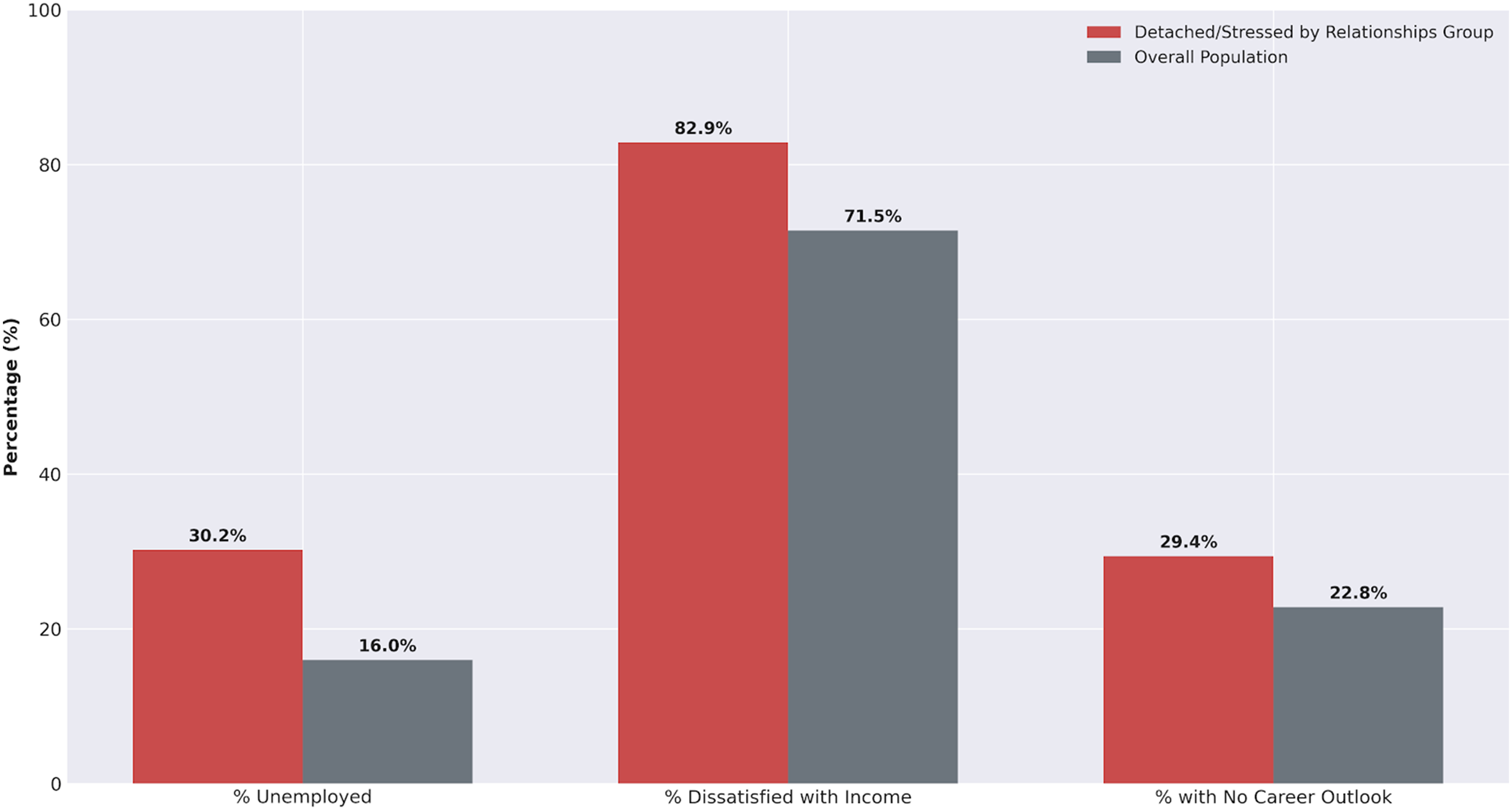
Economic precarity—emotionally detached vs. overall population.
Far from being an incidental personal preference, this emotional withdrawal is a discernible strategy of survival: when public horizons for meaningful collective action are foreclosed, private life becomes the terrain in which to minimize exposure to further harm (Dean, 2009; Fisher, 2009). This internalization of crisis is vividly articulated in the narratives of those who participated in the “Woman, Life, Freedom” uprising. One protester, speaking to New York Magazine, stated plainly: “I’ve been depressed a lot over the past year. So many of my friends … are out of a job because they won’t go along with what the authorities demand” (Shams, 2023). Her words capture a common theme: structural problems such as unemployment and political repression are experienced as individual sorrow. In depression, individuals tend toward the belief that “there is something is wrong with me.”
Second, the privatization of stress is institutionalized through discourses and practices of responsibility. Under authoritarian neoliberal rationalities, structural failures are reframed as individual deficits (Brown, 2015; Rose, 2006). The data show that many respondents adopt self-optimization, therapeutic recourse, and informal side-hustles as coping strategies. These practices do not contest the underlying political economy, but reproduce it by transferring the burden of survival onto individual biographies—Fisher's reflexive impotence. This political impotence is deeply rooted in an anxiety born from economic instability. This aligns with the diagnosis of the Institute for Precarious Consciousness (2014), which argues that successive phases of capitalism cultivate distinct affective climates, with anxiety being the dominant affective climate of the post-Fordist era. My data corroborate this diagnosis. Economic precarity is a dominant theme: 59% of participants report anxiety related to their workplace, 67% state they have insufficient free time, and over 70% are dissatisfied with their income.
Third, the correlation between political hopelessness and mental health problems suggests a feedback loop in which the experience of political impotence exacerbates individual distress, which in turn reduces the likelihood of durable political engagement. Nearly 79% of respondents express disbelief in the capacity of recent protest movements to produce lasting change, nearly half report a sense of hopelessness about their futures, and 37% believe their opinions “carry no weight” in politics. These affective dispositions—despair, cynicism, and withdrawal—are mechanisms through which the reproduction of the status quo is achieved: by eroding the social and psychological resources necessary for collective mobilization.
Fourth, and crucially, the gendered distribution of affective outcomes underscores the sociological depth of these processes. Women in the sample are disproportionately represented among the precarious, and precarity in turn produces gendered affective registers. The data reveal that women constitute 64% of the unemployed respondents and are overrepresented in part-time and informal work; they also bear a heavier burden of emotional labor and domestic responsibility. These patterns produce differentiated forms of psychic distress, which cannot be reduced to a generic “national malaise.” The privatization of stress therefore intersects with structural gender inequalities to produce a layered affective economy in which some social groups are doubly immobilized—by classed economic precarity and by patriarchal constraints that limit both public voice and private autonomy (Federici, 2004).
Finally, qualitative testimony corroborates the statistical picture. Interviews and questionnaire responses echo public reporting on the psychic toll of protest and repression: respondents describe chronic sadness, insomnia, and a pervasive “hollowing out” of expectation—formulations that match journalistic accounts of post-2022 emotional exhaustion (Shams, 2023). Together, the quantitative and qualitative evidence indicate that the privatization of structural stress is not merely a rhetorical claim but also an observable social process in Iran's current conjuncture).
The gendered experience of precarity
Precarity in Iran is not a gender-neutral phenomenon. On top of the general malaise affecting the entire society, women contend with structural patriarchal constraints that exacerbate their economic insecurity. Although Iranian women constitute nearly half the population and a growing share of university graduates, they remain a minority in the formal workforce. According to feminist economist Valentine Moghadam, Iran's political system enforces a “neo-patriarchal gender regime” that deliberately curtails women's labor-market participation. Discriminatory laws, from the mandatory dress code to barriers in inheritance and divorce, systematically disadvantage women (Moghadam, 2018).
The consequences of this regime are starkly visible in my survey data. Women constitute 64% of the unemployed respondents, compared with 36% for men. They also dominate the ranks of part-time and informal work. In contrast, men hold the majority of secure, full-time jobs (approximately 60%). In other words, female workers bear the brunt of the labor market's dysfunctions.
This gender gap in precarity, as evidenced by data and supported by existing scholarship, manifests in several critical ways:
Unemployment and informality: women are the majority of the unemployed and are heavily overrepresented in part-time or informal jobs. For many women, a college degree still does not guarantee a job, since entrenched gender norms and state policies limit their official roles in the economy (Moghadam, 2018). Wage and welfare erosion: owing to social conservatism, jobs deemed “appropriate” for women (often in education, healthcare, and informal services) have been disproportionately defunded or privatized. Meanwhile, market-driven wage competition and subsidy cuts squeeze household incomes, and women often have fewer savings or family support networks to buffer these economic shocks. Work–family conflict: even as both parents must often work to survive, women still carry heavier expectations for domestic labor. This “double shift” amplifies stress. Many women report that economic pressures force them to juggle unsafe working conditions with childcare, social stigma, and legal vulnerability—a direct consequence of a gender regime that devalues their reproductive labor while exploiting their paid labor.
This situation recalls the analyses of feminist scholar Silvia Federici (2004), who argues that capitalism has historically relied on the devaluation of women's reproductive labor to facilitate capital accumulation. In contemporary Iran, a similar logic is at play, creating a system of double exploitation.
Furthermore, a gender-disaggregated analysis of the data reveals the “feminization of labor” (Hardt and Negri, 2009). This concept does not simply mean that more women are working, it also refers to the fact that the characteristics traditionally associated with female labor—instability, low pay, and lack of security—are now being extended to the entire workforce. As Figure 2 shows, although job insecurity is slightly higher among employed women, it has become a pervasive feature for both genders.
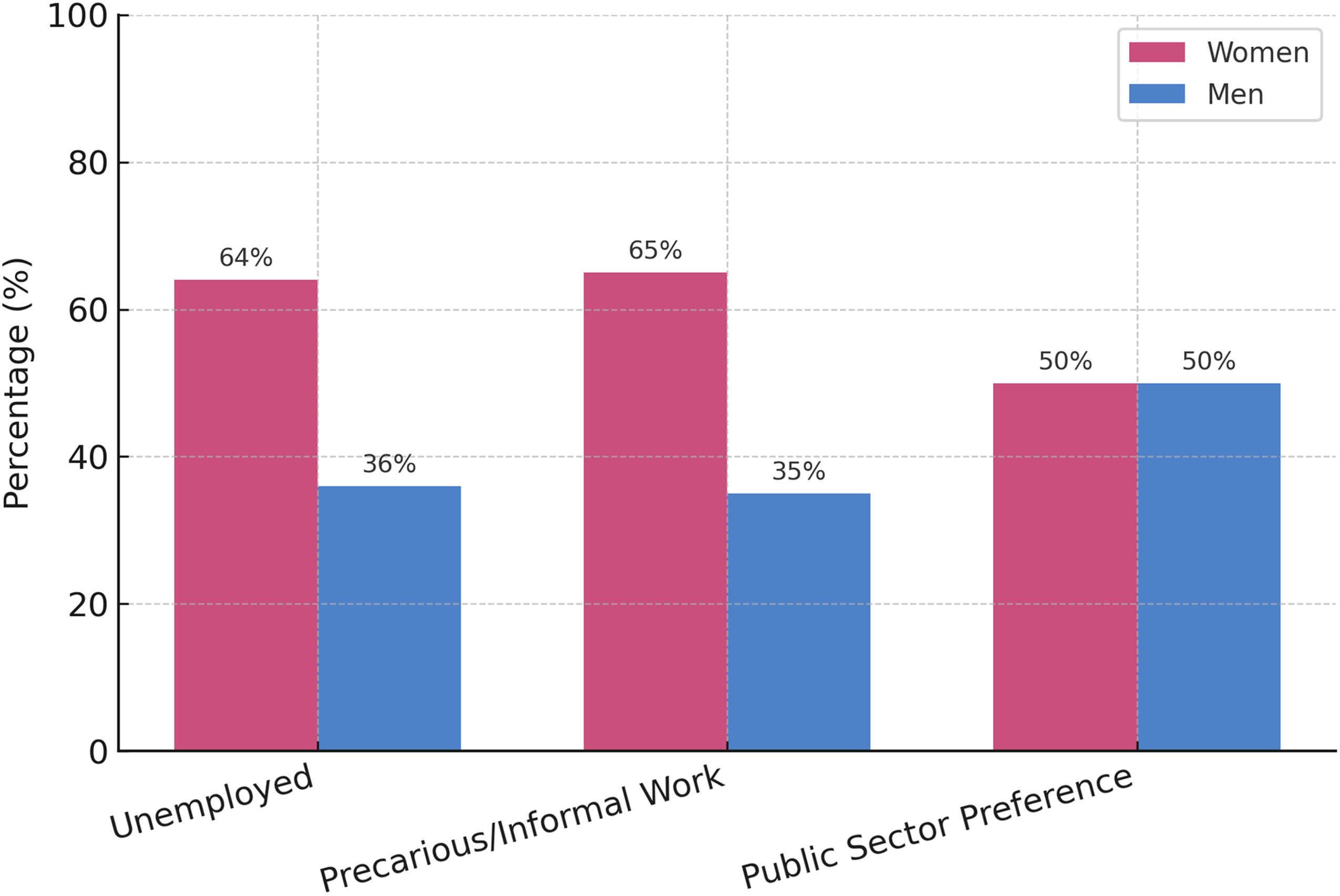
Gendered labor precarity.
Ultimately, the affective politics of precarity in Iran must be understood as fundamentally gendered. The same alienation that produces hopelessness in men is experienced by women through the additional lens of systemic discrimination. As postcolonial feminist theories suggest, the experience of subjugation for women in “peripheral” societies differs from that in the global capitalist “core.” In Iran, the intersection of a predatory economy, an authoritarian state, and a neo-patriarchal gender regime creates a unique and intensified form of oppression. The privatization of stress for women is layered with fears related to personal safety, the lack of reproductive rights, and the control over their bodies. Consequently, the horizon of possibility for women is doubly narrow: neither feminist revolution nor capitalist prosperity seems accessible. This society cultivates an “expectation of failure” in female ambition, reinforcing the notion that under peripheral capitalism, certain subjects are constructed as naturally fit only for marginality.
Cruel optimism and the imaginary of exit
If Fisher's work helps us understand how systemic failure becomes private sorrow, Berlant's concept of cruel optimism illuminates the compensatory attachments that sustain subjectivity in such contexts—attachments that are both sustaining and disabling. In the Iranian case, the dominant attachment is to exit: emigration as the primary horizon of hope. The survey finds that 78% of respondents express a desire to emigrate permanently. This is not a marginal inclination; it is the central strategy around which many respondents organize their choices and investments. Exit functions as a pragmatic adaptation—a pathway to safety, dignity, and livelihood—but it also operates as a fantasy that redirects political energies away from collective transformation.
Berlant's cruel optimism captures this ambivalence. The imagined “somewhere else”—often indexed as “the West”—becomes a fantasmatic object of desire promising normalcy, stability, and dignity. For respondents, the West stands not merely for higher wages or institutional protections but also for a restored possibility of ordinary life: decent public services, predictable careers, and a future not conditioned by predatory accumulation or political repression. This fantasy has real psychological utility: it sustains hope and offers an affective lifeline in situations of chronic despair. Yet it is cruel because it can absorb the very energies that might be channeled into building domestic alternatives. Investment in exit (time, money, emotional labor) diminishes the small but cumulative commitments—to local organizing, to long-term institution-building, to solidaristic struggle—that can produce political capacity over time. In short, exit sustains life individually while undermining the collective infrastructures necessary for systemic change.
Empirically, the co-occurrence of high emigration desire and high psychological distress suggests a dialectic: the more systemic conditions foreclose domestic futures, the more exit becomes a repository for projected hope; the more exit is pursued, the greater the depletion of human and affective capital necessary for domestic contestation. This is the feedback loop identified previously as reproducing paralysis. In my sample, the generational and educational stratifications of migration desire amplify this effect: youth and highly educated respondents are among those most inclined to leave, thereby accelerating a brain drain that further weakens the social bases for reform (Mahmoudi, 2021).
Importantly, reading the exit phenomenon solely as individual calculation would overlook its affective potency. The West, as fantasmatic object, is not a neutral policy preference; rather, it is an affective orientation shaped by mediated imaginaries of Western cultural hegemony—such as Hollywood cinema and media representations of prosperity—as well as the daily experience of humiliation and scarcity. As such, cruel optimism in this context is both a psychological adaptation and a political problem: it sustains individuals in the short term, while in the long term it undermines the collective capacity to imagine and enact alternatives.
The anatomy of the exit strategy: a data-driven analysis.
The reasons given for leaving underscore how migration has become a simultaneous economic and political “solution.” The motivations are divided into three primary categories:
Economic precarity (≈42%): reasons such as “to improve financial situation,” “no hope for a suitable job,” and “barely getting by” were cited as primary drivers. Political and social dissent (≈48%): responses such as “Iran is not livable,” “hopelessness about any political change through protests,” and “I see no role for myself in the country's situation because everything is decided from above”—along with concerns over repression and the lack of personal freedoms—indicate that emigration is as much a political act as it is an economic one. Psychological and educational aspirations (≈10%): peer influence, the social trend of migration, and the pursuit of better educational and mental well-being opportunities also play a role, albeit smaller in scale.
Significantly, these motivations overlap. For many, migration is an attempt to achieve a “normal life” where economic stability is intertwined with human dignity and security. This desire for exit is more acute among specific groups. Cross-sectional analysis reveals that migration is a generational and class-based strategy, particularly prevalent among the youth and the educated (Table 1).
Cross-sectional analysis of emigration desire by age, education, and gender.
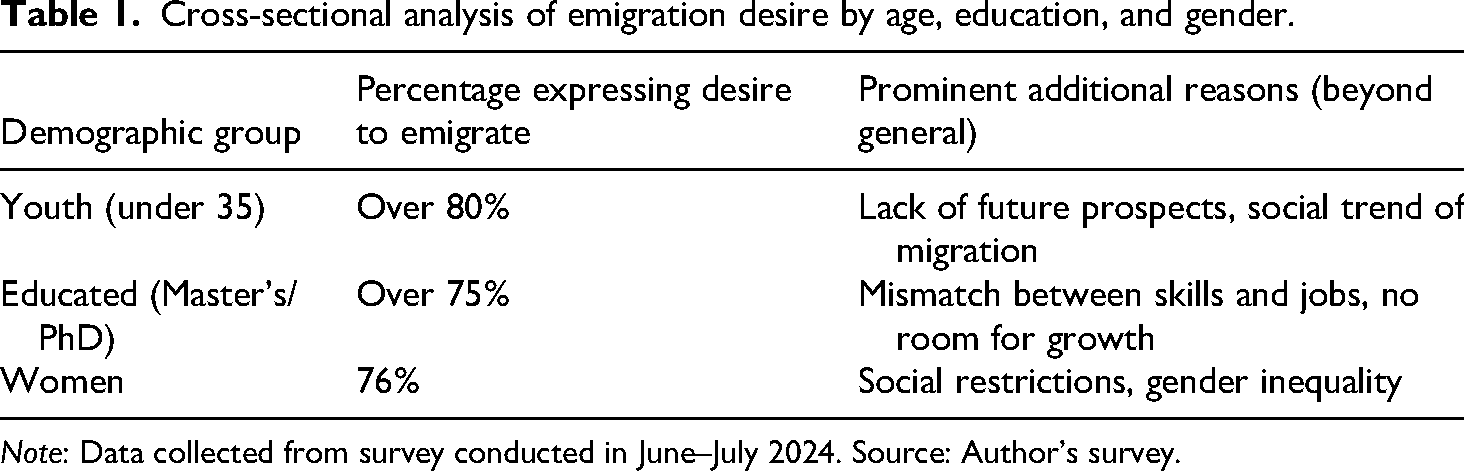
Note: Data collected from survey conducted in June–July 2024. Source: Author's survey.
Regarding the gendered dimensions of the exit imaginary, although women are disproportionately represented among the unemployed (64% in my sample) and hold a smaller share of stable full-time employment (40% of stable, full-time jobs versus 60% for men), and for many women emigration is not merely an economic choice but a strategy to escape legal and social restrictions including those related to dress codes, reproductive rights, inheritance, and divorce, one might expect the desire to emigrate to be higher among women than men. Yet this is not the case. The rate among men is even higher: 41% of those who wish to emigrate are women, and 59% are men. This finding clarifies that the desire to emigrate does not have a direct, linear relationship with the state's systematic discrimination against women. Instead, this pattern likely reflects the greater economic pressure placed on men—a role traditionally expected of them as the primary breadwinners of the household. Under conditions of economic collapse, this role-based expectation may operate as a stronger driver of emigration than direct gender discrimination, though the two are never entirely separable. This does not diminish the reality of gendered discrimination—which remains a daily burden for women inside Iran—but it suggests that the affective logic of exit is shaped by multiple, overlapping pressures, not a single axis of oppression.
Synthesis: affect as mechanism of reproduction
Taken together, the evidence assembled in this section shows that affect is not an epiphenomenon of political economy but a central mechanism through which PCR reproduces itself. Fisher's insight about the privatization of stress gains empirical purchase in the strong correlation between political hopelessness and mental health problems, in the prevalence of workplace anxiety and income dissatisfaction, and in the observable turn toward individualized coping strategies. Berlant's account of cruel optimism finds validation in the pervasive desire to emigrate and in the fantasmatic qualities that sustain that desire. When anchored to the macro-dynamics of predatory accumulation and authoritarian neoliberal governance, these affective processes explain why protest cycles—however intense—have struggled to translate into durable institutional change.
This argument has two implications. First, diagnoses that treat political paralysis as a function solely of repression or organizational weakness are incomplete. They must be supplemented with analyses of how affective economy's structure capacities for action. Second, any strategy to contest PCR must therefore address affect: interventions that only change material conditions without attending to the affective modalities that mediate experience (therapeutic cultures, migration fantasies, practices of self-optimization) will be insufficient. Reclaiming the future is not only an economic or institutional task but also an affective one—a work of reorientation that reconstructs what is imagined as possible, desirable, and collectively worthwhile.
In short, the survey data provide more than descriptive color to the theoretical claims developed earlier in the paper. They constitute concrete empirical evidence that Fisher's and Berlant's mechanisms are active in Iran's peripheral context: systemic dispossession is internalized as personal distress, and the fantasy of exit both sustains life and disables collective projects of transformation. Understanding and contesting PCR therefore requires interventions that engage both political economy and emotional life—that is, policies and practices able to rebuild collective horizons and redistribute not only resources but also hope.
The hauntological rupture of 2026 protests
The validity of the PCR framework is starkly vindicated by the nationwide uprising of December 2025 and January 2026—protests that were brutally repressed, with reports of thousands killed. Sparked by a catastrophic currency collapse—where the rial plummeted to a record low of 1.4 million per U.S. dollar—the “Rial Protests” marked a definitive “paradigmatic rupture” from the intersectional, forward-looking demands of the 2022 “Woman, Life, Freedom” movement. While a comprehensive socio-political accounting of these protests falls outside the scope of this article, focusing on their affective dimensions validates the PCR framework. The resurgence of pro-Pahlavi sentiment is the most theoretically significant aspect of the 2026 protests. Why, in the twenty-first century, does a modern, educated population turn to the slogan “Long live the King”?
Mark Fisher, drawing on Derrida (1993), described hauntology as the agency of the virtual—the way in which the past haunts the present, especially when the future has already been cancelled. From this perspective, this retreat into the symbols of the Pahlavi dynasty represents the “slow cancellation of the future” (Fisher, 2014). Fisher, in describing the “slow cancellation of the future,” discusses how in the era of late capitalism, the sense of the future as something innovative, different, and progressive compared with the present gradually fades away. Instead, culture and society become trapped in a cycle of repeating the past and recycling styles (such as music or fashion), without a real imagination of radical changes. Despite rapid technological advancements, expectations of the future diminish, and we feel as though we are stuck in the twentieth century (Fisher, 2014). When a society is trapped in a state of reflexive impotence, the imagination ceases to project new horizons and instead raids the past for “lost futures.” The Pahlavi era functions here not as a historical reality, but as a “phantasmatic object” of normalcy, developmental competence, and global integration that was interrupted by the 1979 Revolution.
The prevalence of these retrospective slogans, which themselves evoke a kind of “no manifesto politics,” underscores the supreme achievement of the Iranian state's repressive and ideological apparatus. By systematically atomizing civil society and violently foreclosing the emergence of a secular, republican alternative, the government has forced the collective psyche into a melancholic loop. The 2026 uprising, despite its unprecedented scale and the staggering toll of the state's “Babi Yar” crackdown, remains trapped in this hauntological deadlock: in the absence of a viable future, the specter of the “Golden Past” becomes the only imaginable alternative to a catastrophic present. This condition confirms that under PCR, the crisis is not merely economic or political but also an absolute exhaustion of the capacity to imagine a future that is truly new.
However, critical analysis suggests this is a form of cruel optimism. The attachment to a restored monarchy serves as a fantasmatic solution to complex structural problems. It simplifies the arduous task of democratic state-building into a messianic “return.” More tragically, following the crackdown on the protests, many Iranians called for a humanitarian intervention by the United States and Israel against Iran—particularly the diaspora, although many people inside the country also shared this demand. In such a tragic situation, the nature of cruel optimism—and consequently PCR—becomes even more evident. People have not only lost hope in any change through mass struggles and the exercise of political agency but are also asking the United States to drop bombs on their own country! The role of “Iran International”—a 24-hour satellite television channel that has effectively become the official mouthpiece of pro-Pahlavi monarchists is significant in promoting cruel optimism to simplify the so-called humanitarian war and the “cutting off the serpent's head” by the United States. Through its media propaganda, this channel simulated war in the minds of Iranians as a computer game that would supposedly not harm ordinary people—a war that ultimately began in March 2026.
Conclusion: PCR as a global condition
The empirical and theoretical analysis presented in this article converges on a multifaceted pathology PCR is not merely a descriptive label for a set of socioeconomic pathologies in Iran, but a functioning, self-reinforcing formation that helps explain why large waves of protest repeatedly fail to produce durable structural change. Empirically, PCR operates as a vicious cycle in which predatory accumulation and extractive political economy create chronic economic insecurity; that insecurity, in turn, facilitates the metabolization of collective failure into private psychic distress (what Fisher called the privatization of stress), and that distress channels political energy into exit strategies framed by Berlant's cruel optimism. The widespread turn to emigration then depletes the very human and affective resources required to imagine and enact alternatives, thereby reproducing political paralysis.
In Table 2, I have summarized the study's core empirical confirmations in a compact schema: the PCR mechanisms, their survey indicators, and their theoretical anchors.
Empirical confirmation of peripheral capitalist realism.
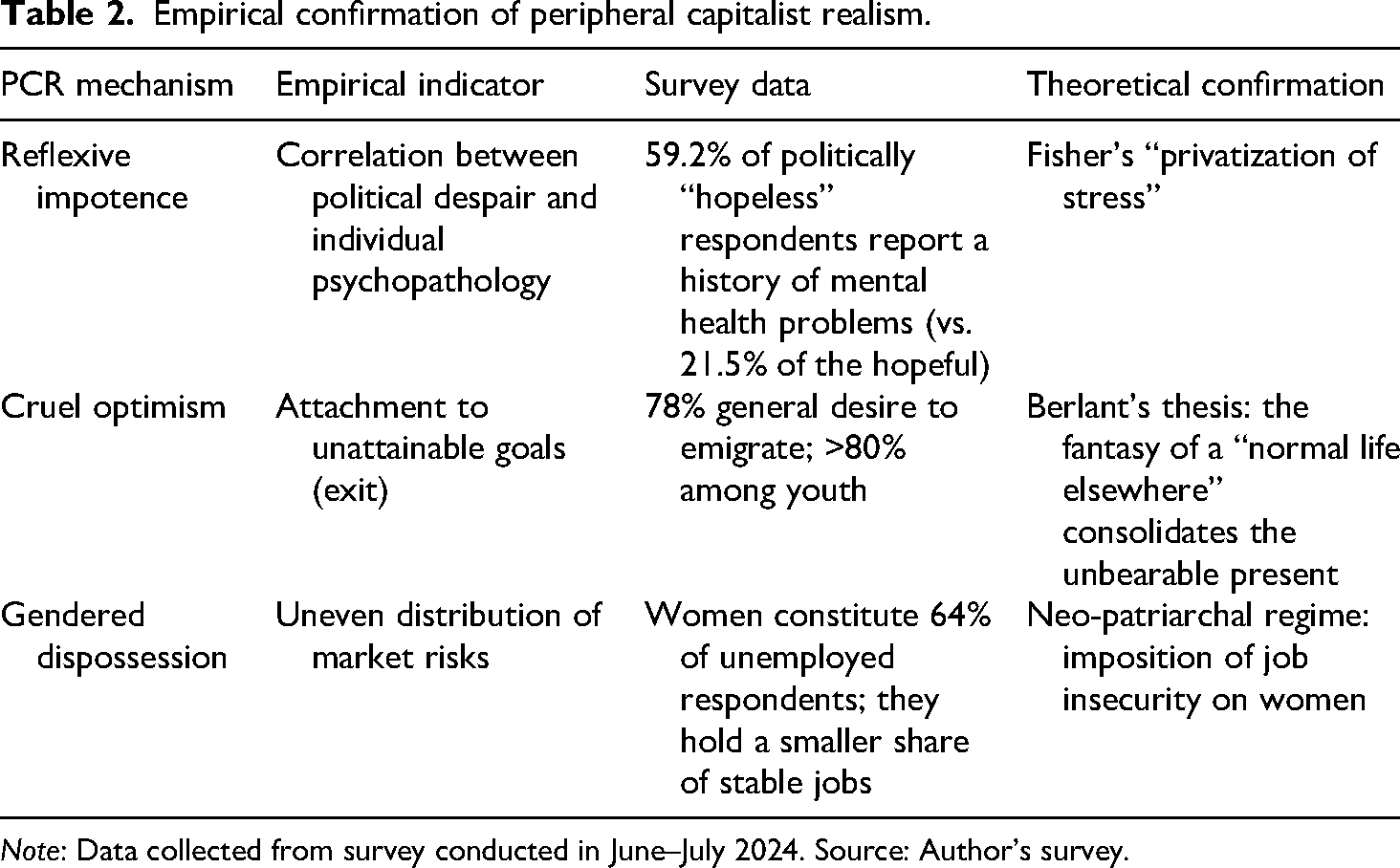
Note: Data collected from survey conducted in June–July 2024. Source: Author's survey.
The import of this table is not merely taxonomic. It indicates mechanism: structural dispossession produces affective states that mediate political capacities. The strong, nearly threefold relationship between hopelessness and mental health problems is especially consequential because it reframes political failure as a psychosocial phenomenon—not only a matter of repression or organizational weakness but also a change in how political possibility is felt and embodied. This is Fisher's insight made measurable: political impotence becomes, for many, a private pathology that narrows horizons of action.
PCR therefore demands a shift in how critical theory and comparative sociology approach both the causes of political stasis and the strategies for change. First, explanations that focus exclusively on coercion, legal restriction, or organizational deficits are incomplete. They miss the mediating role of affective economies: the routinized practices, therapeutic vocabularies, and entrepreneurial subjectivities that convert systemic breakdown into individualized management problems. Second, PCR is a flexible, transposable formation. The combination of hybrid market states, extensive elite predation, and repression of political voice that generates PCR in Iran is not unique; comparable configurations can be found across the Global South (e.g., Turkey, Egypt, Venezuela) where rentier logics and authoritarian neoliberalism produce analogous affective closures (Bruff, 2014; Hanieh, 2018). Thus, PCR is a useful comparative heuristic: it highlights how local histories of dispossession shape the modalities through which capitalist realism colonizes imagination.
A further theoretical implication concerns the gendered structure of dispossession. The survey's gendered indicators show that PCR does not distribute suffering evenly. Instead, it compounds pre-existing patriarchal exclusions: women's greater exposure to unemployment and insecure labor intensifies their embodied experience of hopelessness. Any critical theory that ignores gendered modalities of affective capture will misread both the depth and the unevenness of political paralysis.
The policy and praxis implications follow directly. If PCR reproduces itself by converting structural problems into private stress and by routinizing exit as the primary adaptive strategy, then contestation must do more than dismantle narrow institutional barriers. It must also (a) rebuild collective affective infrastructures and (b) reconnect material reform to practices of shared hope. In practice this requires interventions that combine redistributive economic policy with cultural-affective work: mutual aid networks, publicly supported mental health programs that politicize distress rather than individualize it, and community projects that cultivate durable forms of collective imagination. Interventions that attend only to one register—say, material relief without affective repair, or cultural campaigns without material bases—are likely to be insufficient because PCR operates precisely at the intersection of economy and emotion.
Finally, the article's findings suggest that reclaiming the future is both political and hermeneutic. Politically, it requires rebuilding institutions and redistributing resources so that ordinary life is no longer experienced as permanently precarious. Hermeneutically, it requires cultural practices that contest the plausibility of “no alternative”: pedagogies, narratives, and collective rituals that resituate hope as a practicable and shared horizon. In short, effective resistance must transform what people imagine as possible—a task at once intellectual, cultural, and organizational.
So, the endurance of Iran's contemporary government cannot be fully understood if we treat repression and elite capture as only structural facts. The reproduction of authoritarian-neoliberal orders depends as much on affective technologies—the normalization of hopelessness, and the redirection of political energy into exit fantasies—as on coercive capacities. PCR names this specific entanglement. As a conceptual tool, PCR invites scholars and activists alike to take seriously the affective life of politics: to measure it, to theorize it comparatively, and to design interventions that reorient both material possibilities and the shared imaginings that make them credible.
Furthermore, while PCR manifests across peripheral contexts, its effects vary due to mediating factors such as historical trajectories, class structures, and state-society relations. In Iran, prolonged stasis stems from the deep fusion of theocracy and patrimonialism, which fragments class alliances and suppresses secular alternatives, unlike in some Arab Spring cases (e.g., Tunisia) where weaker religious-state integration and stronger civil society enabled partial transformations despite similar neoliberal pressures. Furthermore, while the Egyptian military maintained a level of institutional autonomy that allowed it to defect, the Iranian military-Bonyad complex is structurally fused with the state's predatory accumulation logic. Because the security elite owns the economy, they view regime survival as synonymous with their own material existence. This comparative clarification underscores PCR's flexibility: in Iran, theocratic legitimation intensifies ideological closure, while in secular authoritarian regimes, class-based mobilizations may disrupt it more readily. PCR is not a natural fact; it is a political infrastructure of hopelessness, built from the ruins of collective imagination. What has been built can be demolished—but only if we learn to see despair not as an emotion, but as a weapon.
Footnotes

Disclosure statement
The author declares no competing financial or non-financial interests.
Funding
The author received no financial support for the research, authorship, and/or publication of this article.
Declaration of conflicting interests
The author declared no potential conflicts of interest with respect to the research, authorship, and/or publication of this article.