





Abstract
With the advancement of biotechnology, genetic resources and their associated traditional knowledge have become increasingly valuable in supporting intellectual property (IP) innovation. However, disparities in technological development have led to conflicts of IP interests and benefit-sharing dilemmas between provider countries and user countries of such resources and knowledge. The WIPO Treaty on Intellectual Property, Genetic Resources and Associated Traditional Knowledge, concluded in 2024, establishes a fundamental framework for addressing IP disputes involving genetic resources and provides macro-level guidance for China to refine its IP rules in line with international trends. Regarding inventions that are based on genetic resources and associated traditional knowledge and for which patent protection is sought, the current patent law fails to align with the international treaty in terms of the subject matter, objects, and sanctions and remedial measures related to disclosure requirements. To further incentivize original innovation and technological diffusion in fields such as biomanufacturing, and to support China’s sustained participation in global biotechnology cooperation and governance, the following improvements are necessary. First, the information disclosure system under patent law should be enhanced by establishing dual disclosure requirements, explicitly indicating both the “source of genetic resources” and the “source of traditional knowledge” for inventions based on genetic resources and associated traditional knowledge. The current legal terminology, which distinguishes between “direct source” and “indirect source,” should be unified under the single term “source.” Second, remedies and sanctions for noncompliance with source disclosure obligations should be introduced, forming a “declaration–examination–remedy/sanction” institutional framework based on applicant declarations. Last, efforts should be made to develop an information system for genetic resources and associated traditional knowledge, thereby enabling both robust supervision and effective utilization of genetic information data.
Keywords
I. INTRODUCTION
Genetic resources serve as the foundational materials for enhancing productivity and quality, as well as sustaining population health, in many countries. The effective conservation and rational utilization of these resources are critical to ensuring the security of biological resources. However, with the rapid advancement of fields such as genetic technology and pharmaceutical technology, frequent occurrences of exploiting technological advantages to plunder genetic resources or their derivatives from other countries for innovation and development activities have become commonplace.
To establish effective and equitable intellectual property (IP) protection for genetic resources and associated traditional knowledge, the World Intellectual Property Organization (WIPO) established the Intergovernmental Committee on Intellectual Property and Genetic Resources, Traditional Knowledge and Folklore (IGC) in 2000, aiming to reach a consensus on international legal frameworks. On May 24, 2024, WIPO adopted the WIPO Treaty on Intellectual Property, Genetic Resources and Associated Traditional Knowledge (hereinafter referred to as the GRATK Treaty) in Geneva, marking a historic breakthrough after more than two decades of negotiations.
As an international treaty administered by WIPO, the GRATK Treaty is of landmark significance: it is the first treaty under the WIPO framework to address the interconnections between genetic resources, traditional knowledge, and IP and also the first treaty to include provisions specifically designed for indigenous people and local communities. The Treaty represents not only the outcome of multilateral negotiations that balanced diverse interests and reduced institutional differences but also an endeavor by the international community to foster technological innovation, knowledge dissemination, and transfer through the IP regime.
While existing scholarship provides a solid foundation for understanding IP protection for genetic resources and associated traditional knowledge, the literature—particularly that published in Chinese—has concentrated largely on three dominant themes: the normative justification for protection, the choice of institutional modalities, and the design of benefit-sharing mechanisms. Within the framework of global IP governance, growing scholarly attention is being directed toward the stewardship of traditional knowledge and genetic resources, aiming to guide the international economic order toward the dual objectives of incentivizing innovation and meeting public interests. 1 Against this backdrop, a unified normative framework should be established in China, covering traditional knowledge, genetic resources, and traditional Chinese medicine, that is both suited to China’s national circumstances and consistent with emerging international norms. 2
However, how to design a protection model for rights associated with genetic resources remains contested. One view, shaped by domestic development imperatives and international interest calculations, argues that a sui generis system for protecting genetic resources is urgently needed. Such a system, it is suggested, should effectively integrate private law protection with administrative governance, unified legislation with specialized laws, general rules with exceptions, and local governance with global governance. 3 Critics counter that a “sui generis rights” approach lacks both legal and theoretical grounding, insisting that any entitlement to benefits from genetic resources must presuppose clearly defined rights boundaries and effective de facto control. 4
Running parallel to this debate over models, the protection of digital sequence information (DSI) on genetic resources also encounters difficulties in interfacing with the IP regime. 5 To render the benefit-sharing mechanism more operational, scholars propose drawing a distinction between commercial and noncommercial uses of DSI. 6 In response to the practical challenges of implementing benefit-sharing, it has been suggested that patent applications should incorporate an “informed consent” requirement concerning the disclosure of origin, coupled with corresponding remedies and sanctions within the patent protection framework for genetic resources 7 , and that the Chinese Patent Law should further refine the legal liabilities for violating the origin disclosure requirement. 8 In addition, with respect to international collaborative research involving human genetic resources, the rules governing the modes of exploitation and transformation of research outputs, as well as the exercise of IP rights among co-owners, remain unclear. Whether human genetic resource data themselves are eligible for IP protection also warrants closer examination. 9
Beyond its presence in biotechnology sectors closely linked to genetic resources, traditional knowledge is transmitted and sustained across a wide range of fields. Chinese scholars have accordingly turned their attention to the protection of traditional knowledge in areas such as traditional Chinese medicine and intangible cultural heritage. 10 The establishment of sui generis rights for traditional knowledge, however, calls for caution: it requires clearly delineating the boundaries of such rights while simultaneously providing “fringe” protection at the margins of the existing IP system. 11 Drawing on the negotiation and conclusion of the Treaty, some Chinese scholars have observed that developing and developed countries diverge on key issues such as the Treaty’s objectives, the subject matter, content, and trigger points of the disclosure requirement and its legal consequences. They accordingly argue that China should calibrate its position in light of its dual identity as both a provider of genetic resources and a rapidly developing user of such resources. 12
Building on the foregoing discussion, a critical research gap comes into clear focus. While existing scholarship has extensively examined whether and how genetic resources and traditional knowledge should be protected under IP law and has broadly affirmed the necessity of patent disclosure requirements for operationalizing benefit-sharing mechanisms, the discussion has largely remained at the level of general normative guidance. What remains conspicuously absent is a systematic comparison of the specific divergences between the GRATK Treaty and China’s Patent Law and a clearly articulated pathway for adapting domestic IP rules in a manner that aligns with the Treaty framework while remaining responsive to China’s distinctive circumstances.
This research gap carries both theoretical and practical urgency. China harbors vast genetic resources of plants, animals, and microorganisms, and its rapidly advancing R&D capabilities are driving a shift in its role from a predominantly provider to a dual-role player—both a provider and a user—of genetic resources. Moreover, national policy has explicitly identified biomanufacturing as a strategic future industry while emphasizing original innovation in core technologies and strengthening national security capacity in the biosciences. This evolving role and policy trajectory together create a pressing demand for a concrete institutional pathway—one capable of both ensuring equitable benefit-sharing and transforming the country’s biological resources and traditional knowledge into a strategic foundation for indigenous innovation.
II. THE TRILEMMA OF GENETIC RESOURCE GOVERNANCE: SOVEREIGNTY, HARMONIZATION, AND FAIRNESS
Genetic resources—materials containing functional units of heredity at the genetic or DNA level—have assumed growing importance across agriculture, pharmaceuticals, chemical industries, and environmental protection, driven by rapid advances in biotechnology. Yet this very importance has generated intensifying struggles over access, control, and stewardship. Several inherent characteristics of genetic resources lie at the root of these tensions. Their uniqueness and irreplaceability mean that specific genetic traits are often obtainable only from particular species or populations, creating concentrated value that is difficult to substitute. Their diversity and renewability, while enabling continuous scientific exploitation through breeding and cultivation, blur the line between naturally occurring material and human-enhanced biological assets. Their geographic specificity ties their value to particular ecosystems and territories, inevitably raising questions of national sovereignty. And their considerable applied and commercial potential—unlocked by technologies such as gene sequencing and editing in drug discovery, crop improvement, and ecological restoration—makes the stakes of control exceptionally high.
The traditional knowledge associated with genetic resources introduces a further layer of complexity. Although no universally accepted definition exists at the international level, WIPO has characterized traditional knowledge in its narrow sense as the knowledge resulting from intellectual activity in a traditional context, including agricultural, scientific, technical, ecological, and medicinal knowledge, as well as biodiversity-related knowledge. 13 Such knowledge—often preserved and transmitted orally across generations—lies outside the protective ambit of the modern IP system, yet innovative outputs derived from it may qualify for protection as patents, know-how, or confidential information. This asymmetry has produced well-documented tensions.
The commercialization of Hoodia gordonii in South Africa exemplifies the socio-ethical and legal quandaries that arise when traditional knowledge is exploited within modern IP frameworks. For generations, the San people—indigenous communities spanning South Africa and Namibia—have chewed the stems of this succulent plant to suppress hunger and thirst during extended hunting expeditions. In the 1990s, the South African Council for Scientific and Industrial Research (CSIR), drawing directly on this traditional use, isolated the active compound P57 and filed patent applications, subsequently licensing the development rights to a succession of multinational corporations, including PhytoPharm, Pfizer, and Unilever. Critically, this commercial undertaking proceeded without the San’s prior informed consent and without any arrangement for benefit-sharing, triggering public protests led by nongovernmental organizations. It was not until 2003 that CSIR entered into a benefit-sharing agreement with the San, which led to the subsequent establishment of a trust fund. However, due to concerns over safety and efficacy, Unilever decided in 2008 to abandon further development of Hoodia as a functional food. In November 2010, PhytoPharm removed Hoodia from its research portfolio and returned all rights of P57 to the CSIR. The Hoodia herbal products available on the market have also failed to generate high profits. 14 This case exposes the core problems in the exploitation of traditional knowledge: indigenous communities’ knowledge is appropriated for commercial R&D without consent; the patent system, as currently structured, fails to adequately protect their contributions; and ex post benefit-sharing mechanisms remain vulnerable to implementation failures and commercial uncertainties.
A parallel case arose in India, where a U.S. patent was granted on the use of turmeric for healing infected wounds—a practice long established in Indian traditional medicine. The patent was successfully revoked after India’s Council of Scientific and Industrial Research submitted evidence of prior art, setting a precedent for developing countries challenging the patenting of traditional knowledge. 15 As such conflicts have intensified, a growing number of countries have pressed for recognition and protection of traditional knowledge—whether within or alongside the existing IP system. Peru’s Law Introducing a Protection Regime for the Collective Knowledge of Indigenous Peoples derived from Biological Resources, for example, formally recognizes indigenous peoples’ rights over their traditional knowledge. 16 It is precisely because of these distinctive economic and strategic attributes that genetic resources, and the traditional knowledge intertwined with them, when subjected to an IP regime designed primarily to incentivize innovation, are drawn into a web of legal dilemmas—over sovereignty, over the distribution of benefits, and over the coherence of international and domestic rules.
A. The societal concern: Resource utilization and the preservation of sovereignty
To render the research and development of genetic resources worldwide more equitable, reasonable, and sustainable, the Access and Benefit-Sharing (ABS) mechanisms have been established. In essence, when a country or enterprise seeks to utilize another country’s genetic resources for research or commercial development, it is required to follow certain rules to ensure that the provider country receives a fair share of the resulting benefits. Indeed, as the negotiation history of successive international legal instruments reveals, both developing and developed countries have recognized—and have sought to harness—IP regimes to support access to and utilization of genetic resources and associated traditional knowledge. Yet the implementation of ABS mechanisms has consistently fallen short of expectations.
Over an extended period, the advanced technological capacities concentrated in developed countries have enabled practices widely characterized in the literature as “biopiracy”—the unauthorized or inadequately compensated appropriation of genetic resources and associated traditional knowledge from provider countries, particularly in the Global South. These practices have contributed to a pronounced asymmetry in the global ABS landscape, generating persistent conflicts of interest between providers and users of genetic resources. Developing countries, in particular, have encountered considerable difficulty in securing equitable access to both the genetic resources originating within their territories and the IP benefits derived from them. In practice, some developers of genetic resources have entered into agreements with the governments or local communities of provider countries, offering financial compensation or public health benefits in exchange for access. Even so, such arrangements have not always sufficed to prevent instances of misappropriation.
At the institutional level, countries have pursued divergent policy objectives and regulatory pathways for the access and utilization of genetic resources and associated traditional knowledge, shaped by their respective development priorities—resulting in considerable variation in the design of specific IP rules. Bilateral and regional mechanisms, exemplified by the Regional Comprehensive Economic Partnership, have advanced mutual benefit between participating states and regions to a certain degree, yet they have not established binding international norms capable of curbing the misappropriation of genetic resources. 17 These observations point to the continued dependence of effective benefit-sharing on the strengthening of international IP rules and suggest that exploring a more-coherent multilateral framework for ABS mechanisms may offer a constructive path toward resolving the challenges associated with biopiracy.
B. The regulatory tension: Bridging international rules and China’s domestic legislation
Given the significant role of genetic resources in fostering the sound and sustainable development of bio-industries, their exploitation should be pursued in tandem with conservation. This requires guarding against resource depletion or species extinction caused by improper exploitation, while simultaneously addressing the IP protection and application issues that arise from biotechnological innovation in international competition. A number of countries have already made active efforts in the IP protection of biotechnologies. The United States, through its Plant Patent Act, permits invention patents on transgenic technologies and high-value breeding achievements, forming a “dual-track protection model” combining patent rights and plant variety rights that reflects a technology-driven orientation and commercial strategy. South Korea’s Seed Industry Act links plant variety rights to agricultural development, establishing a national-level platform centered on the transfer of agricultural scientific and technological achievements. Japan has strengthened IP protection for new plant varieties through amendments to its Plant Variety Protection and Seed Act. 18 These legislative practices further confirm the critical importance of embedding IP protection related to biomanufacturing within legal and policy frameworks. At the same time, the challenges that arise when specific subject matter confronts the interface between international and domestic IP regimes equally warrant attention.
In fact, genetic resources share both commonalities with and differ in important respects from other categories of IP subject matter. The similarities are threefold. First, the uniqueness of genetic resources corresponds to the innovativeness required of IP subject matter: the development of genetic resources typically involves technological innovation in the biological field, and such innovative outcomes are often eligible for IP protection, for instance as patents or trade secrets. Second, genetic resources and associated traditional knowledge, like other IP-protected subject matter, carry economic value, and their application in relevant fields can generate economic returns. Third, the irreplaceability of certain genetic resources mirrors the distinctiveness of certain IP-protected subject matter, particularly innovations that cannot be readily replicated or obtained through alternative means. Besides, notable differences exist. On the one hand, genetic resources are products of the natural world and do not, in themselves, constitute subject matter directly eligible for IP protection; they become protectable only when subjected to technological improvement or innovative application by human effort. On the other hand, the renewability of genetic resources implies their long-standing existence and sustained availability, and the traditional knowledge associated with them has typically been transmitted across generations—a temporal depth that sits uneasily with the requirement of novelty that IP law imposes on protectable subject matter.
C. The domestic dilemma: Striking a balance between knowledge preservation and innovation
Genetic resources are pivotal to the conservation and sustainable use of biodiversity, and the rapid development of fields such as bioinformatics and synthetic biology has continued to enhance their value for both commercial and noncommercial applications. China’s Ministry of Ecology and Environment, in its China Biodiversity Conservation Strategy and Action Plan (2023–2030), has set out a new phase of biodiversity conservation that includes “establishing a management regime for ABS of biological genetic resources”—aimed at protecting biological genetic resources and associated traditional knowledge through ABS mechanisms—as well as strengthening the protection and transmission of traditional knowledge, with the goal of “forming, by 2030, an initial policy framework for the protection of biodiversity-related traditional knowledge.” In recent years, China has made considerable progress in both policy development and practice concerning the protection and utilization of genetic resources and traditional knowledge, enacting a succession of laws and regulations including the Traditional Chinese Medicine Law, the Measures for the Management of Scientific Data, and the Biosafety Law. Yet these instruments offer protection only within specific domains and leave gaps in their regulatory coverage when it comes to defining the boundaries of conduct and the distribution of benefits in innovative activities. The scope and strength of protection thus remain inadequate.
In innovative activities involving genetic resources and associated traditional knowledge, the IP system is indisputably an important instrument for balancing competing interests. However, China’s existing IP laws, including its current Patent Law, confront considerable difficulties in protecting the interests of holders of genetic resources and associated traditional knowledge. The conceptual ambiguity of “traditional knowledge,” the collective nature of rights holders, and the intergenerational character of the protected subject matter all pose challenges to the direct application of existing IP frameworks. The principles of “prior informed consent” and “fair and equitable benefit-sharing,” established under international instruments, are likewise beset by disputes over contractual implementation and resource misappropriation in commercially competitive settings driven by economic incentives. Moreover, while the construction of traditional knowledge databases has commenced, it remains confined to specific fields such as traditional Chinese medicine, and it is yet to be established whether such databases can provide effective defensive protection. In protecting and utilizing genetic resources and associated traditional knowledge, the IP system is called upon to strike a balance among three imperatives: equitable benefit-sharing for holders, protection of the legitimate rights of innovators, and a reasonable accommodation of the public interest. Realizing the effective protection and sustainable use of genetic resources is, in this sense, the central task for which IP rules must be refined.
III. EXAMINING THE GRATK TREATY’S RULES ON IP PROTECTION FOR GENETIC RESOURCES
For a considerable period, the “misappropriation” of genetic resources on a global scale has proven difficult to curb effectively, owing to factors that include insufficient enforcement experience, inadequate regulatory oversight, a shortage of specialized personnel, and low levels of public awareness. 19 Confronted with this predicament, developing countries began, from the late 1990s onward, to press for the establishment and implementation of an international legal framework governing ABS mechanisms’ access to genetic resources—efforts that culminated in the adoption of the Nagoya Protocol in 2010, a landmark achievement of that phase of negotiations. The GRATK Treaty provides a new paradigm for international legislation on IP issues pertaining to genetic resources. By addressing critical questions such as patent disclosure requirements, it lays both the foundation and the safeguard for the construction of an ABS regime for genetic resources.
A. Objectives and subject matter of the patent disclosure requirement
In the course of efforts to regulate the “misappropriation” of genetic resources through the IP system, a number of developed countries opposed the construction of relevant rules on the grounds that such resources lacked novelty. As early as 1999, the Colombian delegation to a WIPO meeting pointed out that its submission on the protection of biological and genetic resources contained two proposals concerning the requirement of legal access, both aimed at protecting a country’s biological and genetic resources through verification of lawful provenance. 20 Although the delegation expressly stated that these proposals were procedural or formal in nature, developed country representatives declined to incorporate them into the patent system on the ground that they touched upon substantive matters of patent law. In response, it has been argued that traditional knowledge evolves over time, therby generating innovative content that meets the novelty requirement under patent law, which in turn justify the legitimacy of its protection. 21 Now that the GRATK Treaty has been concluded, understanding the scope of subject matter and the policy objectives of the patent disclosure requirement is a prerequisite for fulfilling the mandatory obligations it establishes within the international patent system.
As regard their objectives, the patent disclosure requirements are designed to serve as a foundation for achieving benefit-sharing for genetic resources. One of the purposes of the IGC’s deliberations on IP issues relating to genetic resources was to prevent patents from being erroneously granted on inventions developed from genetic resources and associated traditional knowledge that fail to meet the substantive requirements of patentability. On this question, developing countries considered the protection of genetic resources and associated traditional knowledge to be aimed at preventing acts of “misappropriation,” whereas developed countries favored the objective of preventing the erroneous grant of patents and expressed reservations concerning terms such as “biopiracy” and “misappropriation.” 22 Ultimately, Article 1 of the GRATK Treaty reflects the shared objectives of both sides: first, to enhance the effectiveness, transparency, and quality of the patent system with respect to genetic resources and associated traditional knowledge; and second, to prevent the erroneous grant of patents on inventions that lack novelty or inventive step in relation to such resources and knowledge. This suggests that the Treaty, on balance, embodies the perspective of developed countries to a greater degree, and that an understanding of its objectives requires attention to the coordination of interests among all stakeholders in genetic resources and associated traditional knowledge. Interpreting the patent disclosure requirements through the lens of interest balancing is more conducive to the realization of the ABS mechanism for genetic resources.
As regards the definition of subject matter, clearly delineating the scope of genetic resources and associated traditional knowledge is key to enabling both technological innovation and the implementation of a benefit-sharing regime. The discovery and development of new uses for genetic resources depend not only on access to and utilization of the resources themselves, but, in some cases, also on the traditional knowledge accumulated and transmitted across generations by indigenous and local communities. 23 In terms of terminology, the IGC’s basic proposal adopted the definitions set out in the Convention on Biological Diversity, and the final text of the Treaty remains consistent with that approach. 24 The GRATK Treaty defines “genetic resources” as genetic material of actual or potential value and further specifies that “genetic material” means any material of plant, animal, microbial, or other origin containing functional units of heredity. Traditional knowledge, for the purposes of the Treaty, is confined to traditional knowledge associated with genetic resources. In practice, however, the concept of “traditional knowledge” long been explored within WIPO and extends across a broad range of fields, including literature, art, and science. Scholars have noted the differences between various categories of traditional knowledge and have pointed out that the stricter regulation of cross-border flows of genetic resources is conducive to constructing a “traditional resource rights” protection model, which may in turn form the basis for realizing an ABS mechanism. 25 In addressing IP issues related to genetic resources, it is therefore essential to remain attentive to the distinctions between such resources and other forms of traditional knowledge.
Consistent with the function and purpose of the IP system—to encourage innovation—genetic resources as they exist in nature are not, in themselves, eligible for IP protection. However, inventions developed from or utilizing genetic resources and associated traditional knowledge may qualify for patent protection. This is made clear in the explanation of “based on” provided in the glossary of Article 2 of the Treaty: “the genetic resources and/or traditional knowledge associated with genetic resources must have been necessary for the claimed invention, and that the claimed invention must depend on the specific properties of the genetic resources and/or on the traditional knowledge associated with genetic resources.” The material nature of genetic resources means they can be used in tangible form, whereas traditional knowledge is controlled and transferred in the form of knowledge. The coordination of exclusive rights of control between these two modalities is a prerequisite for the orderly realization of an ABS regime. In selecting the subject matter of the patent disclosure requirements concerning genetic resources and associated traditional knowledge, the question of how to delineate their scope therefore calls for careful treatment.
B. Specific items of the patent disclosure requirement
Within the IP system, the detailed disclosure of a technical solution is both the prerequisite for and the price of patent protection for an invention. The inventor’s explanation must be sufficiently clear to be understood and applied by a person possessing the same level of knowledge in the relevant field. This foundational rationale—“disclosure in exchange for a monopoly”—reflects the internal logic of the IP regime. In the context of patent protection, the GRATK Treaty requires applicants to disclose information identifying the origin or source of genetic resources and associated traditional knowledge. This serves not only as evidence that the user has obtained the prior informed consent of the provider but also as a foundation for the sharing of IP benefits arising from such resources and knowledge.
With regard to the substantive content of the disclosure obligation, the GRATK Treaty requires Contracting Parties to impose certain disclosure obligations on patent applicants in two distinct scenarios.
The first scenario involves inventions claimed in a patent application that are “based on” genetic resources. Under Article 3.1(a), where a Party so requires, an applicant must disclose the country of origin of the genetic resources. Meanwhile, Article 3.1(b) provides that, where the country of origin is not known to the applicant or where Article 3.1(a) does not apply, the applicant must disclose the source of the genetic resources. To further clarify the meaning of these provisions, an agreed statement in the Treaty specifies that, where there is more than one country of origin, the applicant must disclose the country of origin from which the genetic resources were actually obtained. Furthermore, “source of genetic resources” is defined in the glossary of Article 2 as any source from which the applicant has obtained the genetic resources, including research centers, gene banks, indigenous peoples and local communities, the Multilateral System of the International Treaty on Plant Genetic Resources for Food and Agriculture (ITPGRFA), and any other ex situ collection or depository of genetic resources.
The second scenario concerns inventions claimed in a patent application that are “based on” traditional knowledge associated with genetic resources. Pursuant to Article 3.2(a), where a Party so requires, an applicant must disclose, where applicable, the indigenous peoples or local communities that provided the traditional knowledge associated with genetic resources. Where the information referred to in Article 3.2(a) is not known to the applicant or where that provision does not apply, the applicant must disclose the source of the traditional knowledge associated with genetic resources. The Treaty defines “source of traditional knowledge associated with genetic resources” broadly, encompassing any source from which the applicant has obtained the information, including scientific literature, publicly accessible databases, patent applications, and patent publications.
Notably, the Contracting Parties reached a consensus, recorded in an agreed statement, on the phrase “ as applicable” in Article 3.2(a). They clarified that this phrase “shall not be interpreted as providing flexibility to the Contracting Party to not to require applicants to disclose the information required in Article 3.2(a). For greater certainty, Article 3.2(a) will be implemented without having any effect on the scope of the disclosure requirement in Article 3.” Simply put, the core purpose of this agreed statement is to prevent certain Contracting Parties from using ambiguous language in the Treaty to weaken or circumvent the legal obligation of information disclosure. Looking solely at the treaty text, “as applicable” could have been interpreted to mean that domestic law determines whether an applicant is required to disclose the providers of traditional knowledge. If domestic law were to establish specific conditions for disclosure, an applicant could readily be exempted from this obligation on the grounds that the condition was deemed “not applicable.” This would lead, in practice, to numerous situations in which the source of traditional knowledge need not be disclosed, thereby undermining the Treaty’s original intent to protect such knowledge. Therefore, to forestall divergent interpretations of “as applicable” by different countries, the agreed statement precludes the possibility of domestic law creating “nonapplicable” scenarios. In this context, “applicable” refers to the circumstance where the applicant’s invention is “based on” traditional knowledge associated with genetic resources. Where this is the case, the applicant is necessarily required to disclose the provider of the information—namely, the indigenous peoples or local communities.
C. Sanctions and remedies for noncompliance with the patent disclosure requirement
With respect to sanctions and remedies for failure to comply with the disclosure requirement, Article 5 of the GRATK Treaty sets out a basic framework for addressing nondisclosure of the required information. Recognizing the diversity of legal, administrative, and policy environments among countries, Article 5.1 provides only general guidance at the macro level, establishing “appropriate, effective, and proportionate” as the standard for implementation, while leaving the choice of specific measures to each Contracting Party. That is, each Party shall implement legal, administrative, and/or policy measures to address situations in which the required information has not been disclosed. This provision constitutes a general requirement for all Contracting Parties and, while refraining from prescribing specific sanctions or remedies, underscores the necessity of establishing measures that are appropriate, effective, and proportionate.
The language of Article 5 indicates that the implementation of sanctions and remedies should be differentiated according to the particular circumstances. Where the patent applicant has not engaged in fraudulent conduct or intent under domestic law, Article 5.2 requires that a Contracting Party provides the applicant with an opportunity to rectify the failure to disclose the information required by Article 3 before imposing sanctions or remedies. Conversely, where the applicant is found, in accordance with domestic law, to have engaged in fraudulent conduct or intent, Article 5.2(bis) permits the Contracting Party to deny such an opportunity for rectification. By establishing distinct rectification procedures based on different subjective states—treating the applicant’s negligence or lack of intent as the general case and fraudulent circumstances as the exception—these two provisions reflect the attention paid by the international treaty to procedural fairness.
With regard to the impact of noncompliance with the disclosure requirement on patent rights, Articles 5.3 and 5.4, respectively, address different scenarios. Where the applicant has no fraudulent intent in relation to the disclosure requirement under Article 3 (as defined by the circumstances in Article 5.4), Article 5.3 provides that “no Party shall revoke, invalidate, or render unenforceable the conferred patent solely on the basis of an applicant’s failure to disclose the information specified in Article 3 of this Treaty.” Conversely, where fraudulent intent is present, Article 5.4 permits Contracting Parties to establish post-grant sanctions or remedies in accordance with their domestic law. These two provisions, in combination with the sanctions and remedies provisions discussed above, serve to promote a balance between the protection of rights and the disclosure of information. On the one hand, in the circumstances to which Article 5.2 applies, Article 5.3 ensures that a patent will not be revoked or invalidated based on the sole fact that the relevant information was “not disclosed.” This preserves the stability of the patent protection system while avoiding any chilling effect on applicants acting in good faith. On the other hand, Article 5.4 permits Contracting Parties to treat “fraudulent intent” as a ground for revocation or invalidation under domestic law. In this context, what affects the validity of the patent is not the mere act of nondisclosure, but rather the fraudulent conduct in the application process (see Table 1).
Specific Circumstances of Sanctions and Remedies Under Article 5 of the GRATK Treaty
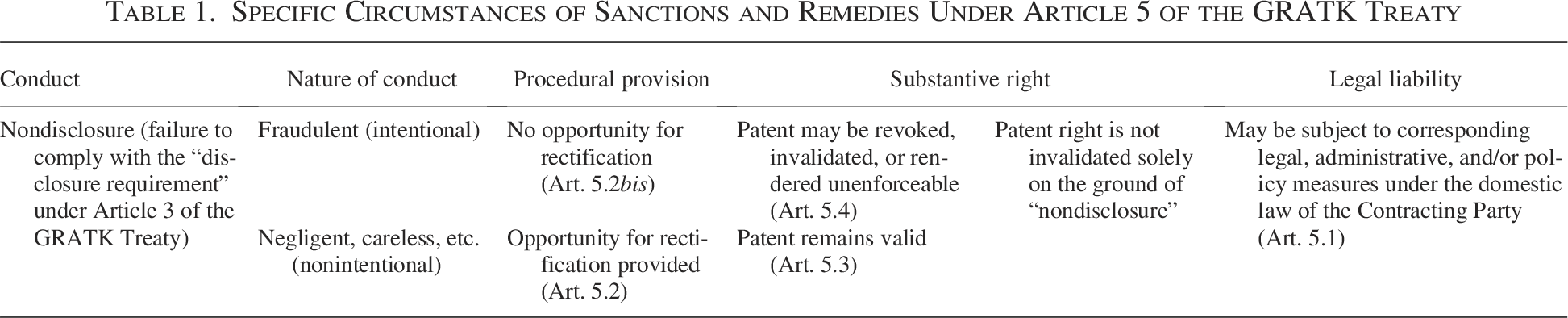
Specific Circumstances of Sanctions and Remedies Under Article 5 of the GRATK Treaty
It is worth noting that Article 5.2(bis), in describing the circumstances that may exclude the opportunity for rectification, employs the phrase “fraudulent conduct or intent” in respect of the disclosure requirement, whereas Article 5.4, in authorizing post-grant sanctions or remedies, refers to “fraudulent intent.” This variation in wording is neither an error nor an oversight, but rather a deliberate choice that takes into account the distinct legislative objectives and evidentiary standards applicable at different procedural stages, reflecting the legislative technique underlying the drafting of the Treaty. Specifically, Article 5.2(bis) functions as a procedural threshold aimed at determining whether an applicant should be afforded an opportunity to rectify during the patent examination process. At the early stage of examination, the “fraudulent intent” concealed within the applicant’s mind is relatively difficult to prove, whereas objectively manifested “fraudulent conduct”—such as the provision of manifestly false information concerning origin, the fabrication of authorization documents for accessing genetic resources, or a clearly deliberate declaration of unknown origin—is more readily identifiable by examiners. The phrase “fraudulent conduct or intent” thus indicates that the grounds on which a Contracting Party may deny an opportunity for rectification are relatively broad: it is sufficient that there be reasonable evidence of fraud. This design reduces the examination burden and cost for competent authorities, enabling them to process suspicious applications more efficiently, while also effectively promoting the realization of the IP interests of countries of origin.
In contrast, Article 5.4, which provides for sanctions where “fraudulent intent” is established after patent grant, is a substantive measure whose purpose is to empower countries to correct erroneous grants of patents resulting from applicant fraud. The limitation of fraud to the level of “intent” reflects the more stringent evidentiary standard that the law requires when imposing severe measures—such as revocation of a patent—that shake the very foundation of the right. In other words, the standard for proving fraudulent intent is higher than that for proving fraudulent conduct, although the subjective state of fraud is usually manifested through objective behavior: “where an actor engages in conduct with an awareness of the risk, this indicates that he has disregarded the corresponding behavioral norm designed to guard against that risk.” 26 Where an applicant has obtained a patent grant by relying on false information concerning the origin or source of genetic resources and associated traditional knowledge, it is necessary to establish the applicant’s subjective bad faith and deceptive purpose before the stringent sanctions under Article 5.3 may be imposed. If, conversely, a patent could be revoked or invalidated based merely on suspicious conduct, this could result in disproportionately severe punishment and the improper deprivation of the opportunity for rectification in cases of mere negligence. The phrase “fraudulent intent” thus serves both to avoid excessively harsh treatment of noncompliant applications and to effectively sanction genuine acts of “biopiracy.”
Taken together, the rules on sanctions and remedies set out in Article 5 constitute a coherent legal framework. Where an applicant seeks to protect an invention based on genetic resources and associated traditional knowledge, Article 5 provides guidance for Contracting Parties in handling failures to comply with the disclosure obligation. These provisions strike an effective balance between the legislative objectives of preserving patent validity and promoting benefit-sharing.
IV. INSTITUTIONAL ALIGNMENT AND CHINESE DOMESTIC RESPONSES: IP PROTECTION FOR GENETIC RESOURCES AND ASSOCIATED TRADITIONAL KNOWLEDGE
Although China’s IP system was, at its inception, a product of legal transplantation, the process of developing a socialist IP legal regime with Chinese characteristics has progressively revealed the public policy dimension of the system. Notably, the creation of IP rights over genetic resources, traditional knowledge, and folklore has come to be regarded as a fundamental model of “national-interest-oriented” IP protection. 27 However, such categories of IP, which privilege national or collective interests, often encounter difficulties when translated into concrete institutional frameworks. Internal consensus within international organizations can offer only general guidance; the effective realization of rights protection ultimately depends on the precise design and rigorous implementation of domestic law.
Viewed in substantive terms, the adoption of the GRATK Treaty represents not only the outcome of interest bargaining between provider and user countries of genetic resources and associated traditional knowledge but also a manifestation of the broader shift-in which China, alongside other developing countries, has played a leading role-from passive recipient to active participant in the international governance system for IP. More broadly, the Treaty prompts a reconsideration of how to ensure that developed countries, in the sovereign act of patent granting, engage in genuine sharing of both technical information and information relating to genetic resources. 28 Against this backdrop, China should clearly recognize its dual positioning as both a provider and a user of genetic resources and, guided by the international treaty framework, explore pathways for refining the IP rules applicable to genetic resources and associated traditional knowledge.
A. Refining the disclosure regime under patent law
To further unlock the informational and economic value of genetic resources and associated traditional knowledge, a long-standing debate persists in the academic literature over how IP protection can best coordinate the interests of stakeholders. One prominent strand of this debate advocates the creation of a sui generis “traditional knowledge right” as a means of addressing the challenges of innovation and application involving traditional knowledge. 29 Drawing on the common features and distinctive characteristics of legal protection for various categories of “traditional knowledge property,” and taking into account the practice of international treaties and domestic legislation, China’s patent system is capable of accommodating and addressing questions of access to and utilization of genetic resources and associated traditional knowledge, thereby advancing the realization of fair and equitable benefit-sharing in this field. Nevertheless, significant differences remain between China’s existing patent regime and the international treaty framework with respect to the protection of genetic resources and associated traditional knowledge. There is thus a pressing need, through the alignment of rules and institutional adaptation, to further promote coherence and harmonization between domestic legislation and international norms. This need is particularly salient in several areas, including improving the disclosure requirements for genetic resources, establishing disclosure requirements for associated traditional knowledge, and optimizing the supporting mechanisms for sanctions and remedies, 30 to which further refinements will be proposed in the discussion that follows.
China’s revised Implementing Regulations of the Patent Law (2023) defines the concept of genetic resources as “materials derived from the human body, animals, plants, microorganisms, or other sources that contain functional units of heredity and possess actual or potential value, as well as the genetic information generated through the use of such materials.” While this formulation largely corresponds to the terminology used in the GRATK Treaty, certain differences in nuance warrant attention. With respect to the scope of protection, the Treaty characterizes the subject matter as “genetic material”—referring to the physical carrier itself—whereas China’s Patent Law additionally encompasses the genetic information derived from the use of such material. It is evident that domestic law has adopted a more refined and expanded definition of the protected subject matter, reflecting a deliberate effort to engage with and adapt international rules.
In fact, the inclusion of genetic information within the conceptual scope of genetic resources represents a response to the needs generated by advances in modern biotechnology. It ensures that innovators who directly utilize dematerialized genetic information—such as gene sequences—in their research and development activities have an equal opportunity to obtain patent protection. Furthermore, the domestic definition of genetic resources introduces the “human body” as an additional source of genetic material and information. Human genetic resources engage a constellation of critical issues, including scientific ethics, individual privacy, and national security. Their inclusion within the regulatory scope of patent law thus carries considerable significance. It enables the construction of a more comprehensive legal framework for the protection of genetic resources, one that achieves effective institutional coordination among the Patent Law, the Biosafety Law, the Regulations on the Management of Human Genetic Resources, and related instruments in China. At the same time, it serves to encourage and regulate the rational utilization of human genetic resources, thereby actively fulfilling international obligations—within the domain of IP protection—to promote public health, national security, and the broader public interest.
Clarifying the Origin Disclosure Requirement
Although China’s domestic law is scientifically informed and forward-looking in its definition of genetic resources—in certain respects aligning with and even surpassing international treaty standards—significant divergences remain between the relevant rules and the Treaty with respect to the disclosure of information in patent application documents. As a textual matter, Article 26 of China’s Patent Law provides that “for an invention-creation accomplished by relying on genetic resources, the applicant shall indicate in the patent application documents the direct source and the original source of such genetic resources.” Here, “invention-creation accomplished by relying on genetic resources” refers to an invention-creation that is accomplished by utilizing the genetic function of genetic resources (Article 29(1) of the Implementing Regulations of the Patent Law), a formulation reiterated in the Patent Examination Guidelines issued by the China National Intellectual Property Administration. 31 Based on the foregoing analysis of the relevant Treaty provisions, it is apparent that the disclosure requirements under China’s Patent Law cannot be seamlessly aligned with the disclosure provisions of the GRATK Treaty. The current Patent Law imposes a mandatory disclosure obligation on applicants only when an invention-creation is accomplished by utilizing genetic resources; it does not address circumstances in which the invention is accomplished by relying on associated traditional knowledge. 32 This more streamlined institutional arrangement clearly falls short of the standards set by the international treaty.
The reason the current law places genetic resources at the center of protection while refraining from introducing detailed provisions on traditional knowledge associated with genetic resources lies, in fact, in the inherent difficulties of protecting traditional knowledge. WIPO has long been engaged in the development of relevant international rules to enable indigenous peoples and local communities to protect, manage, and develop the IP dimensions of their cultural heritage, including traditional knowledge. Despite sustained international efforts to respect the cultural integrity and intellectual contributions of traditional knowledge holders, a series of unresolved difficulties remain: the conceptual ambiguity of traditional knowledge, the indeterminacy of rights holders, and the incompatibility of traditional knowledge with the existing IP protection framework. Against this backdrop, China’s genetic-resource-centered patent protection rules, constructed prior to the conclusion of the relevant international treaty, represent a prudent approach aimed at satisfying international protection standards.
A comparison between domestic and international legislation reveals that the current rules risk affording insufficient protection to traditional knowledge. As a textual matter, China’s Patent Law currently reduces the dual international obligations—requiring the separate disclosure of both the “source of genetic resources” and the “source of traditional knowledge”—into a single obligation. At most, these two obligations could be interpreted as standing in a relationship of merger or absorption, whereby traditional knowledge is treated as a natural attribute of, or ancillary information to, genetic resources. In other words, the disclosure of the source of traditional knowledge, as an independent disclosure obligation, has not been explicitly established in the patent application process. Consequently, where an invention-creation is accomplished based on traditional knowledge, the contribution of the knowledge holders and providers is easily overlooked or even concealed, and the very basis of their right to claim benefit-sharing is weakened at the patent examination stage. Consider the following scenario: if the law requires the inventor to disclose only the source of genetic resources, but tacitly permits the use of undisclosed traditional knowledge for research and development, traditional knowledge holders would have no claim to assert against such acts of “biopiracy,” and any resulting benefit-sharing would have no legitimate destination.
To better enable the IP system to protect genetic resources and associated traditional knowledge, China may consider constructing a protection model that meets the minimum standards of the international treaty. On the one hand, an obligation to disclose the source of traditional knowledge associated with genetic resources should be introduced. Specifically, a provision could be added to Article 26(5) of the current Patent Law stipulating that “for an invention-creation accomplished by relying on traditional knowledge associated with genetic resources, the applicant shall indicate in the patent application documents the source of such traditional knowledge.” At the same time, Article 29(2) of the Implementing Regulations of the Patent Law could clarify that where a patent application is filed for an invention-creation accomplished by relying on traditional knowledge associated with genetic resources, the applicant shall, as is required for inventions relying on genetic resources, provide an explanation in the application and complete the form prescribed by the patent administration department under the State Council. Furthermore, a supplementary explanation could be inserted into Article 29(1) of the Regulations, stating that “an invention-creation accomplished by relying on traditional knowledge associated with genetic resources, as referred to in the Patent Law, means an invention-creation accomplished by utilizing the genetic function of genetic resources.”
On the other hand, the specific objects of disclosure should be more precisely defined. The concepts of “direct source” and “original source” of genetic resources under domestic law also differ from the Treaty’s references to the “country of origin” or “source” of genetic resources and cannot be mapped onto them directly; the scope under the Treaty in fact points to a broader concept of “any source.” 33 To address this, the expressions “direct source” and “original source” in Article 26 of the Patent Law could be amended to a single term, “source/origin,” so as to ensure that resource and knowledge providers can share fairly and equitably in the benefits, and that China can actively exercise its sovereignty over such resources and knowledge in the context of international competition and cooperation.
Refining the Remedies and Sanctions
International law provides countries with basic principles and minimum standards governing remedies and sanctions for noncompliance with origin/source disclosure obligations, while domestic law is responsible for concretizing and implementing these general authorizations. At present, however, a number of gaps exist between China’s patent law and the requirements of the GRATK Treaty, which may undermine the balance of interests and benefit-sharing between providers and users.
With respect to remedies for failure to satisfy the disclosure requirement, Article 3.3 of the GRATK Treaty requires Contracting Parties to provide that an applicant who is unable to identify the relevant source shall make a declaration, and that the applicant must warrant that the content of the declaration is true and correct to the best of the applicant’s knowledge. By contrast, under China’s domestic legislation, Article 26(5) of the Patent Law imposes a mandatory obligation to disclose the original source or direct source of genetic resources and provides that “where the applicant is unable to state the original source, the applicant shall state the reasons therefor.” The most recent edition of the Patent Examination Guidelines further specifies the procedural rule that, in cases of noncompliance, the examiner shall issue a notice of rectification to the applicant, and that “if the requirements remain unmet after rectification, the patent application shall be rejected.”
In substance, the Treaty’s requirement of a declaration that the content is “true and correct” is not fully equivalent to the Chinese Patent Law’s requirement to “state the reasons.” Under the Patent Law, the obligation to state reasons is a duty of explanation within the process of performing the source disclosure obligation, and the risk of noncompliance arises principally at the application stage: the examiner may reject the application if the stated reasons are held to be unfounded or insufficient. Under the GRATK Treaty, by contrast, the examining authority of the Contracting Party focuses its review on the truthfulness of the warranty: where an applicant makes a declaration of ignorance, the authority must assess whether the applicant has discharged its due diligence obligation in accordance with the principle of good faith. The Treaty-required declaration thus imposes a warranty obligation on the applicant, and a breach of the declaration requirement effectively constitutes the provision of a false assurance, exposing the applicant to potential subsequent sanctions for bad faith or fraud. It is thus apparent that, in dealing with failures to meet the disclosure requirement, the remedies provided by the Treaty are more flexible and can be more effectively integrated with the sanctions regime, thereby better serving the balance of interests between providers and users of genetic resources.
As regard sanctions for noncompliance with the disclosure obligation, the GRATK Treaty, as discussed above, emphasizes the imposition of sanctions where fraudulent conduct or intent is present. China’s current Patent Law, however, contains no specific sanctions for breach of the genetic resource disclosure obligation. Under Article 5(2) of the Patent Law, where an applicant “obtains or utilizes genetic resources in violation of any law or administrative regulation and an invention-creation is accomplished by relying on such genetic resources,” no patent right shall be granted. While this provision specifies the circumstances in which invention-creations based on genetic resources are excluded from protection, it does not directly target acts of biopiracy carried out under conditions of fraud.
In sum, the GRATK Treaty provides a regulatory paradigm for the disclosure of the origin of genetic resources and associated traditional knowledge. Should China accede to the GRATK Treaty, it will need to introduce corresponding obligations into its domestic law. To this end, consideration may be given to establishing provisions on remedies and sanctions within the Patent Law, thereby constructing an institutional framework connecting the three stages of “declaration-examination-remedy/sanction,” with differentiated remedies and sanctions calibrated to the applicant’s good faith status. Specific measures could include the following: where the applicant has made a truthful declaration, the patent shall not be invalidated or revoked solely on the ground of nondisclosure of the source; where the circumstances involve negligence, carelessness, or similar nonintentional conduct, an opportunity for rectification shall be provided; and where fraud is present, the granted patent shall be revoked or invalidated, and the applicant may, depending on the seriousness of the conduct, be subject to administrative penalties such as fines or even criminal liability. Moreover, the sanctions and remedies described above should extend not only to the obligation to disclose the source of genetic resources but also to the obligation to disclose the source of traditional knowledge associated with genetic resources. In this way, China’s patent system, while protecting the legitimate interests of providers of genetic resources and associated traditional knowledge, would be capable of combating malicious acts such as biopiracy in a more precise and scientifically grounded manner, thereby achieving the legislative objectives of enhancing the validity, transparency, and quality of relevant patents.
B. Establishing and optimizing information systems for genetic resources and associated traditional knowledge
As a “defensive protection” mechanism and measure against the erroneous grant of patents, databases and other information systems for genetic resources and associated traditional knowledge can assist patent examiners in identifying relevant prior art. In Article 6 of the GRATK Treaty, entitled “Information Systems,” the IGC calls upon Contracting Parties, taking into account their national circumstances and development needs, to actively explore approaches to constructing information systems (databases) for genetic resources and associated traditional knowledge, while leaving Parties considerable room for regulatory design with respect to the modalities of construction and the safeguards applicable to such systems. The nonmandatory obligations established by this “Information Systems” provision are capable of serving the shared interests of all stakeholders and constitute an important instrument spanning the spectrum from institutional infrastructure to international cooperative frameworks.
First, the construction of information systems for genetic resources and associated traditional knowledge can help reduce the difficulty of patent examination. The central challenge in implementing a source disclosure regime lies in verifying the truthfulness of the information provided: patent examiners must evaluate the reasons stated by the applicant or assess the declaration of due diligence. By authorizing countries to establish or designate official databases and to conduct prior substantive verification of relevant information, the information systems provision can enhance the accuracy and authority of patent examination. Moreover, traditional knowledge, characterized by oral transmission and fragmented distribution, is inherently difficult to trace to its origins, posing challenges for patent applications involving such knowledge. The establishment of databases can transform traditional knowledge into searchable and citable technical information, thereby strengthening the evidentiary weight and persuasive force of the background section of patent applications, while effectively preventing the improper patenting of inventions based on traditional knowledge. For example, the Honey Bee Network, established by the Indian Society for Sustainable Technologies and Institutions, has documented over ten thousand innovations and serves as a platform for recording, validating, and disseminating indigenous knowledge. The documentary evidence contained in this database has proven effective in preventing the improper patenting of widely disseminated traditional knowledge, as in the cases of turmeric and neem. 34
Second, the construction of information systems can assist Contracting Parties in achieving a balanced development between the exercise of sovereignty and technological sharing. The wording of Article 6.1, which states that a Party “may take into account its national circumstances” and “should consult with indigenous peoples and local communities and other stakeholders,” indicates that each country may, in accordance with its own resource endowments and regulatory capacity, autonomously decide whether and how to construct a database, reflecting respect for national sovereignty. Article 6.2 further establishes a controlled access mechanism for information systems, requiring, on the one hand, that Contracting Parties authorize their competent authorities (such as the patent office) to access such information systems for the purposes of searching and examining patent applications, while permitting, on the other hand, the establishment of “appropriate safeguards” to govern such access. This enables Contracting Parties to fulfill their treaty obligations while preventing the disclosure or misuse of sensitive biological information or traditional knowledge through database access, thereby safeguarding the interests of the State as well as those of indigenous peoples and local communities.
Third, the construction of information systems can contribute to the development of a global biotechnology cooperation network. Article 6.3 of the Treaty provides that a Contracting Parties’ Assembly may establish one or more technical working groups to address all issues relating to information systems. This appears to signal a future strengthening of international cooperation in the biotechnology field, proceeding through the construction of the international IP regime and aimed at creating a global bioinformation network incorporating unified information formats, search standards, safeguards, and other elements. In this way, the construction of information systems can not only facilitate the processing of international patent applications and examinations under the Patent Cooperation Treaty for participating countries but also serve as a legal instrument for tracking the cross-border movement of genetic resources and associated traditional knowledge and for monitoring the implementation of IP benefit-sharing agreements.
At present, China already possesses a number of databases storing genetic resource information, although most of these are platforms integrating genetic resources and associated traditional knowledge, primarily serving research institutions and large enterprises. Against this backdrop, the optimization of information systems for genetic resources and associated traditional knowledge can proceed along at least the following two lines.
The first is to broaden the channels for accessing and utilizing genetic resources and associated traditional knowledge. Continued efforts should be made to identify, collect, and process genetic resources and associated traditional knowledge, and to realize the storage and circulation of relevant traditional knowledge information through digitization, documentation, and other means, thereby providing a practical foundation for the operation of the benefit-sharing mechanism. 35
The second is to explore models and standards for benefit-sharing relating to genetic resources and associated traditional knowledge. Building on the current state of information system construction and application, further avenues for commercial utilization should be developed consistent with the patent disclosure requirements, and the forms and standards of benefit-sharing for genetic resources should be refined, with a view to ultimately achieving a balance of interests among relevant stakeholders and the innovative application of traditional knowledge. Within the existing management model for biological genetic resources, the ownership regime should be further improved to adequately safeguard the contributions of indigenous peoples to the conservation and cultivation of genetic resources. 36
In the future, consideration may also be given to integrating or transforming existing databases into information systems capable of serving both domestic and international patent examination. On the premise of satisfying the regulatory requirements for genetic information data security, data access rules suited to national circumstances could be established, while preparing for potential accession to the Treaty. Upon accession, China could, through participation in the technical working groups, draw upon its domestic experience to inform the development of international standards, thereby contributing to the ongoing multilateral efforts to strengthen global biotechnology governance and cooperation.
V. CONCLUSION
The preservation and transmission of genetic resources and associated traditional knowledge depend on their use and stewardship by indigenous peoples and local communities across generations. Such resources and knowledge, when utilized in scientific research, often provide the foundation and impetus for inventions in the field of biomanufacturing. The WIPO Treaty on Intellectual Property, Genetic Resources and Associated Traditional Knowledge marks the first time that novel disclosure requirements have been imposed at the international treaty level on applicants seeking patent protection for inventions based on genetic resources and associated traditional knowledge. At present, China remains a major provider of genetic resources and associated traditional knowledge while undergoing a transition toward also becoming a user of such resources. There is thus a need, guided by the international treaty framework, to pursue institutional reforms that are aligned with the country’s evolving circumstances and development needs.
To this end, the IP regime should strike a balance between incentivizing innovation in biomanufacturing and safeguarding genetic resources and associated traditional knowledge. Specifically, the object of the patent disclosure requirement should be expanded from genetic resources to encompass the sources of associated traditional knowledge, and a declaration obligation, with clearly specified modalities and content, should be established for circumstances in which the applicant is unable to identify the relevant source. At the same time, with respect to patent applications for inventions accomplished by relying on genetic resources and associated traditional knowledge, remedies and sanctions for noncompliance with the source disclosure requirement should be appropriate, effective, and proportionate, and clear rules should be adopted to address erroneously granted patents in cases involving fraudulent conduct or intent. As regard the refinement of information systems for genetic resources and associated traditional knowledge, continued efforts should be made to explore diversified channels of access and utilization, and to develop models and standards for benefit-sharing that can provide institutional support and safeguards for the equitable sharing of benefits among all stakeholders.
In the years ahead, the IP system is poised to realize its considerable potential in stimulating knowledge creation, technological development, and the translation of research outcomes in key fields, thereby contributing to the protection of original innovation and the sustainable development of future industries such as biomanufacturing.
Footnotes
AUTHOR DISCLOSURE STATEMENT
The authors declare that they have no conflicts of interest.
FUNDING INFORMATION
This study is supported by the Major Program of the National Social Science Fund of China (No. 23&ZD161) and the Doctoral Scientific Research Foundation of Hubei University of Automotive Technology (No. BK202449).