







Abstract
Few studies have analyzed variation in the motherhood wage penalty by the sex composition of women’s jobs. This study draws on nationally representative data to investigate the motherhood wage penalty for women who work in female-dominated, male-dominated, and integrated jobs. Fixed-effects estimates reveal that women who work in female-dominated jobs pay a larger motherhood wage penalty than women who work in other jobs. This larger penalty is not offset by measurable compensating differentials, such as flexible scheduling or part-time work hours.
Although many forms of gender inequality have declined over the past four decades in the United States, other forms persist (England, 2010). Women continue to be crowded into lower-paying, sex-segregated jobs (Padavic & Reskin, 2002; Reskin & Bielby, 2005; Tomaskovic-Devey et al., 2006), and women pay a wage penalty for motherhood (e.g., Budig & Hodges, 2010; Budig & England, 2001; Glauber, 2007). In the current study, I analyze the connection between these two forms of labor market inequalities by asking whether the motherhood wage penalty is larger for women who work in female-dominated jobs than for women who work in other positions. Do jobs such as nursing, elementary school teaching, or administrative support help women combine work with motherhood? Are women who work in these jobs willing to accept lower pay in return for more desirable “mother-friendly” working conditions?
To answer these questions, I draw on data from the National Longitudinal Survey of Youth (NLSY), and I find that women who work in female-dominated jobs pay a larger motherhood wage penalty than women who work in other jobs. Contrary to the theory of compensating differentials, the penalty is not offset by greater job satisfaction or access to part-time work, flexible work hours, health insurance, paid sick or vacation time, or job-protected maternity leave. Nearly a third of all employed women work in only 10 occupations, with secretaries, managers, cashiers, sales supervisors, registered nurses, and elementary school teachers topping the list (Padavic & Reskin, 2002). These women not only earn less to begin with, but they also pay an additional, larger wage penalty when they become mothers.
Background
Sex segregation in occupations, jobs, and firms remains a pervasive feature of the contemporary U.S. labor market. Estimates of the percent of workers who would have to change their occupations or jobs to achieve full integration range from about a third (Tomaskovic-Devey et al., 2006) to a half (Reskin & Bielby, 2005). Many studies have shown that sex segregation accounts for a large portion of the gender gap in earnings (e.g., Petersen & Morgan, 1995). All else equal, female-dominated jobs pay less than male-dominated or integrated jobs. Both women and men pay an earnings penalty for working in female-dominated jobs, though there is debate over whether women pay a larger penalty than men (see, for example, Budig, 2002; Cohen & Huffman, 2003; Huffman, 2004). Because jobs confer social and economic status, sex segregation supports a whole system of sex inequality (Charles & Grusky, 2004; Padavic & Reskin, 2002; Shauman, 2006).
There is little disagreement over the pay penalty associated with women’s work, but there is less agreement over its causes. The theory of compensating wage differentials proposes that jobs with less desirable working conditions must pay more to attract workers. In contrast, jobs with desirable working conditions can pay less (Becker, 1991). Different groups of workers value different conditions and are willing to make different trade-offs. Williams and Connell (2010), for example, showed that retail workers often trade low wages for deep merchandise discounts. Mothers too may be willing to accept lower pay in return for desirable features—flexible work schedules, access to paid leave, and part-time work hours, to name a few.
Women’s jobs may offer greater access to female supervisors, coworkers, and mentors and a more supportive, family-friendly environment. Some studies have shown that the percent of women in an occupation is positively associated with organizational and supervisory support (Minnotte, Cook, & Minnotte, 2010) and with job satisfaction (Bender, Donohue, & Heywood, 2005). In contrast, Taylor (2010) found that there is a curvilinear association between the percent of women in an occupation and workplace social support. Such support is largest in integrated occupations and then decreases as occupations become more feminized.
Female-dominated jobs may also offer women greater access to part-time work schedules. Most women who choose to work part-time do so out of a desire to integrate their work and family (Garey, 1999). Almost 50% of mothers who are employed full-time would prefer to work part-time, and 80% of mothers who are employed part-time view their situation as ideal (Pew Research Center, 2007). At the same time, part-time work is not a solution to contemporary gender inequality, as part-time workers are marginalized and experience reduced employment prospects, benefits, and earnings (Epstein, Seron, Oglensky, & Saute, 1999). Part-time work also reduces women’s bargaining power within the home (Stier & Lewin-Epstein, 2000)
Other evidence conflicts with the theory of compensating wage differentials (England, Herbert, Kilbourne, Reid, & Megdal, 1994; Glass & Camarigg, 1992; Jacobs & Steinberg, 1990; Kilbourne, England, & Beron, 1994). Jacobs (1989) argued that because women’s occupational aspirations are highly unstable across the life course, their choices cannot fully explain sex segregation. Kan’s (2007) research shows that preferences and constraints shape women’s career outcomes. According to the logic of compensating differentials, wages and desirable working conditions should be negatively correlated, yet most studies show that they are positively correlated (Gariety & Shaffer, 2001; Lowen & Sicilian, 2009; McCrate, 2005).
The Motherhood Wage Penalty
Many studies have shown that motherhood is associated with a reduction in women’s hourly wages (Andersen et al., 2003; Budig & Hodges, 2010). For example, Waldfogel (1997) found that one child is associated with a 3.8% penalty. Budig and England (2001) found that one, two, and three or more children are associated with a 3.2%, an 8.9%, and a 12.1% penalty.
As with explanations for sex segregation, scholars offer competing explanations for the motherhood wage penalty. Human capital theories focus on women’s loss of work experience (Greenman, 2011) and skills following the birth of a child (Kaufman & Uhlenberg, 2000). Budig and England (2001) found that work experience and other human capital variables explain about 36% of the motherhood wage penalty. When these variables are entered into regression equations, the penalty is reduced from 7% to 5%. Others argue that mothers are discriminated against in hiring, promotion, and evaluation decisions (Benard & Correll, 2010; Correll, Benard, & Paik, 2007; Ridgeway & Correll, 2004). Still other research suggests that mothers are less productive at work (Kalist, 2008). Kmec (2011), however, found that mothers and fathers exert similar levels of effort at work. A final explanation rests on compensating differentials—mothers choose lower wages in return for desirable working conditions (Becker, 1991).
Studies of the motherhood wage penalty have included a number of important control variables in their regression models. Budig and England (2001), for example, found that job characteristics, such as part-time work, public sector work, and self-employment, explain about 21% of the motherhood wage penalty. They also found that marriage increases women’s wages and suppresses the motherhood wage penalty. Anderson, Binder, and Krause (2003) showed that part-time work, education, experience, age, occupation, and measures of household resources account for 24% of the wage penalty for one child and 44% of the wage penalty for two or more children. These variables serve as important controls, but even when they are included, a portion of the motherhood wage penalty remains unexplained.
Despite a long tradition of research on both compensating wage differentials and the motherhood wage penalty, few studies have looked at variation in the motherhood wage penalty by the sex composition of women’s jobs. Glass (1990) and Glass and Camarigg (1992) found that women’s jobs are not more mother friendly than other jobs, but they studied working conditions rather than wages. Budig and England (2001) found that job–sex composition does not significantly account for the motherhood wage penalty, but they did not explore differences in the wage penalty by job composition and working conditions. Thus, key questions about women’s work, working conditions, and the motherhood wage penalty remain unanswered.
Measures of Job–Sex Composition
Many studies have shown that occupational segregation increases as the unit of analysis becomes more detailed (Cotter, Hermsen, & Vanneman, 2004). Firms, for example, tend to be more segregated than occupations. Regardless, many continue to rely on national-level data to analyze sex segregation because there are few longitudinal, local, firm-specific studies (e.g., see Budig, 2002; Hultin, 2003). There is a strong correlation among sex composition measures at various levels, and analyses at the national-level may simply provide more conservative estimates of sex segregation.
Studies have also offered various definitions of skewed jobs. Kanter (1977) proposed that groups become skewed when one social type constitutes 85% or more of the group. At this point, token group members become visibly different from the rest of the group. De Ruijter and Huffman (2003) classified an occupation as male-dominated if 15% or fewer of its workers are female and an occupation as female-dominated if more than 65% of its workers are female. Budig (2002) classified a job as female-dominated if 80% or more of its workers are female. Kmec (2005) classified a job as female-dominated if 70% or more of its workers are female. Jacobs (1989) also used 70% as the cutoff for female-dominated jobs.
Hypotheses
Previous research leads to a number of competing hypotheses. If—as proposed by the theory of compensating wage differentials—female-dominated jobs are more mother friendly and offer compensating benefits in lieu of higher pay then:
Hypothesis 1: The motherhood wage penalty will be larger for women who work in female-dominated jobs compared to women who work in male-dominated or integrated jobs.
Hypothesis 2: Differences among the three groups will be explained away by measurable compensating differentials. That is, mothers who work in female-dominated jobs will accept a larger pay penalty in return for greater job satisfaction and greater access to part-time or flexible work hours, health insurance, paid sick or vacation time, and job-protected maternity leave.
Hypothesis 3: These mother-friendly benefits will be negatively correlated with women’s wages.
Hypothesis 4: The motherhood wage penalty will be larger for women who have access to these benefits, primarily because mothers accept lower wages in return.
If, however, female-dominated jobs are not more mother-friendly than other jobs and motherhood penalties reflect labor market discrimination and institutionalized inequalities rather than mothers’ preferences for certain working conditions then:
Hypothesis 5: The motherhood wage penalty will be similar across occupational groups or different across occupational groups and not explained away by job satisfaction and access to part-time or flexible work hours, health insurance, paid sick or vacation time, and job-protected maternity leave.
Data and Method
Sample
I draw on data from the NLSY, which is a national probability sample of 12,686 men and women who were initially interviewed in 1979 when they were between the ages of 14 and 22. Members of this cohort were born between the years 1957 and 1965. They were reinterviewed annually until 1994 and then biennially from 1994 to the present. The current analysis is limited to the years 1989 to 2006, as important measures of compensating differentials were not collected until 1989. Given this time frame, respondents were between the ages of 24 and 32 at their youngest and between the ages of 41 and 49 at their oldest. The sample is also limited to women who were not self-employed during this time. Between 1989 and 2006 NLSY staff conducted 40,082 interviews with the original cohort of young women who were working for pay and not self-employed.
Variables
Hourly wage
The primary dependent variable analyzed in the current study is the natural log of women’s hourly wage at their current or most recent job. Because I include year dummy variables in the regression models, I do not standardize wages. Four percent of the sample is missing data for hourly wage.
Motherhood
Motherhood is measured using the number of step, adopted, and biological children that live in women’s households. I compare years when women have no children to years when they have one child, two children, and three or more children. The results are similar when I exclude adopted and stepchildren that live in women’s households. There are no missing cases for these variables.
Job–sex composition
I determine the sex composition of a woman’s “job” using 3-digit occupation and 3-digit industry data from 5% samples of the U.S. Census conducted in 1980, 1990, and 2000. This measure allows sex composition to vary by a woman’s industry and occupation. Registered nurses, for example, may have a different sex composition depending on if they work in a school or a hospital. I use occupational sex composition as a stand-in for jobs that are populated by fewer than 100 workers. Following Kmec (2005), Jacobs (1989), and other studies discussed previously, I classify a job as female dominated if 70% or more of its workers are female. A job is male dominated if 30% or fewer of its workers are female, and a job is integrated if between 30% and 70% of its workers are female. The results do not change if I use alternative cut points. In the current analysis—restricted to non–self-employed women for the years 1989 to 2006—53% of the sample work in female-dominated jobs, 11% work in male-dominated jobs, and 36% work in integrated jobs. Of the 39,593 cases that are not missing wages, 392 (less than 1%) are missing information on sex composition.
In 2006 the three most common occupations for women working in female-dominated jobs who were not self-employed were secretaries and administrative assistants, registered nurses, and nursing, psychiatric, and home health aides. The three most common occupations for women working in male-dominated jobs were security guards and gaming surveillance officers; bailiffs, correctional officers, and jailers; and police officers. The three most common occupations for women working in integrated jobs were first-line supervisors or managers of office and administrative support workers, first-line supervisors or managers of retail sales workers, and accountants and auditors.
Compensating differentials
I test the theory of compensating wage differentials using six measures of women’s working conditions, including job satisfaction, part-time work, access to flexible work hours, health insurance, paid sick or vacation time, and job-protected maternity leave. These measures are constructed using survey questions that asked respondents if their employer made available to them: (a) flexible hours or a flexible work schedule; (b) medical, surgical, or hospital insurance that covers injuries or major illnesses off the job; (c) sick or vacation days with full pay; and (d) maternity leave that allows them to go back to their old job or one that pays the same as their old job. These questions were not asked of self-employed workers or those working in unincorporated businesses. Part-time is defined as working fewer than 30 hours per week. Results are similar when part-time is defined as working fewer than 35 hours per week. Job satisfaction is also included in the analysis through the NLSY interview question: “How do you feel about your job? Do you like it very much, like it fairly well, dislike it somewhat, or dislike it very much?” I compare those who dislike their jobs to those who like their jobs.
Seventy-six cases are missing information on part-time work status, and 72 cases are missing information on job satisfaction. Another 1,369 cases are missing information on health insurance, 994 are missing information on sick or vacation time, 96 are missing information on flexible work hours, and 1,331 are missing information on maternity leave. These missing cases reduce the sample size to 35,411.
Control variables
The regression models include control variables for age, years of labor market experience, years of tenure with current employer, public sector work (as compared to private sector work), education (highest grade completed), never married and previously married (as compared to currently married), and year. In terms of missing data, 750 cases are missing information on the control variables, which reduces the final sample size to 34,589.
Methods
I present findings from person and year fixed-effects models with cluster robust standard errors. These models have become standard in analyses of the motherhood wage penalty (e.g., Budig & England, 2001; Glauber, 2007). Fixed-effects models correct for bias due to time-invariant unobserved factors that may be correlated with motherhood, the sex composition of women’s jobs, and women’s wages. The models estimate changes in women’s wages as they relate to changes in other characteristics. Fixed-effects models do not compare one woman to another, but instead compare each woman to herself at different points in time. In this way, the models control for individual-level factors that do not change over time. Because race and ethnicity do not change over time in the NLSY, they are controlled for in fixed-effects models.
Results
Descriptive Differences
Table 1 presents descriptive statistics for women who work in male-dominated, integrated, and female-dominated jobs. Compared to women who work in male-dominated or integrated jobs, women who work in female-dominated jobs earn less per hour (US$8.90 compared to US$11.60 and US$10.90). They are more likely to have children, to be married, to work part-time, and to be employed in the public sector. They are slightly less likely to have access to health insurance, paid sick time, and maternity leave. Most women—regardless of their job–sex composition—like their job very much or fairly well.
Weighted Means and Standard Deviations of Variables: NLSY 1989-2006
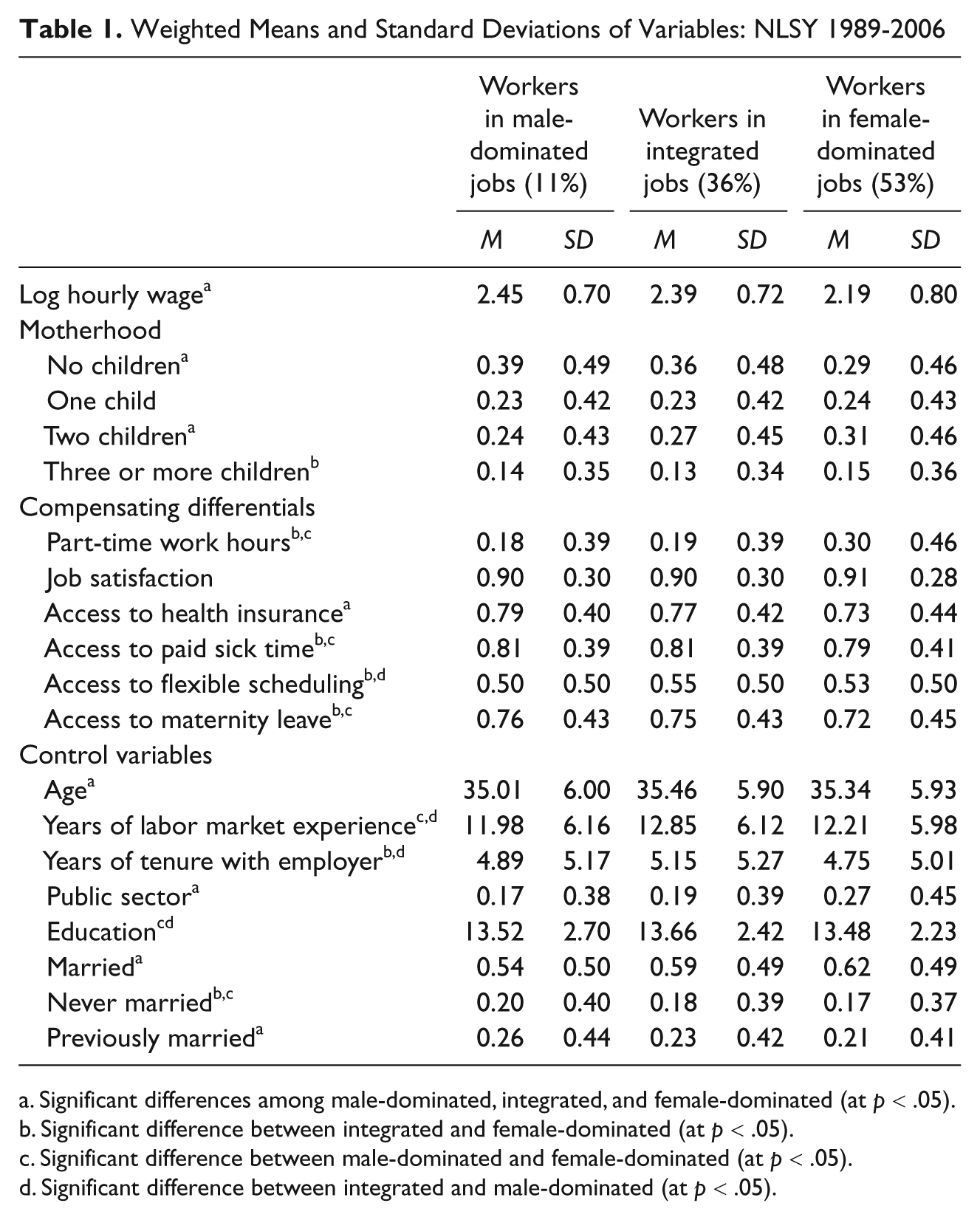
Significant differences among male-dominated, integrated, and female-dominated (at p < .05).
Significant difference between integrated and female-dominated (at p < .05).
Significant difference between male-dominated and female-dominated (at p < .05).
Significant difference between integrated and male-dominated (at p < .05).
Female-Dominated Jobs and the Motherhood Wage Penalty
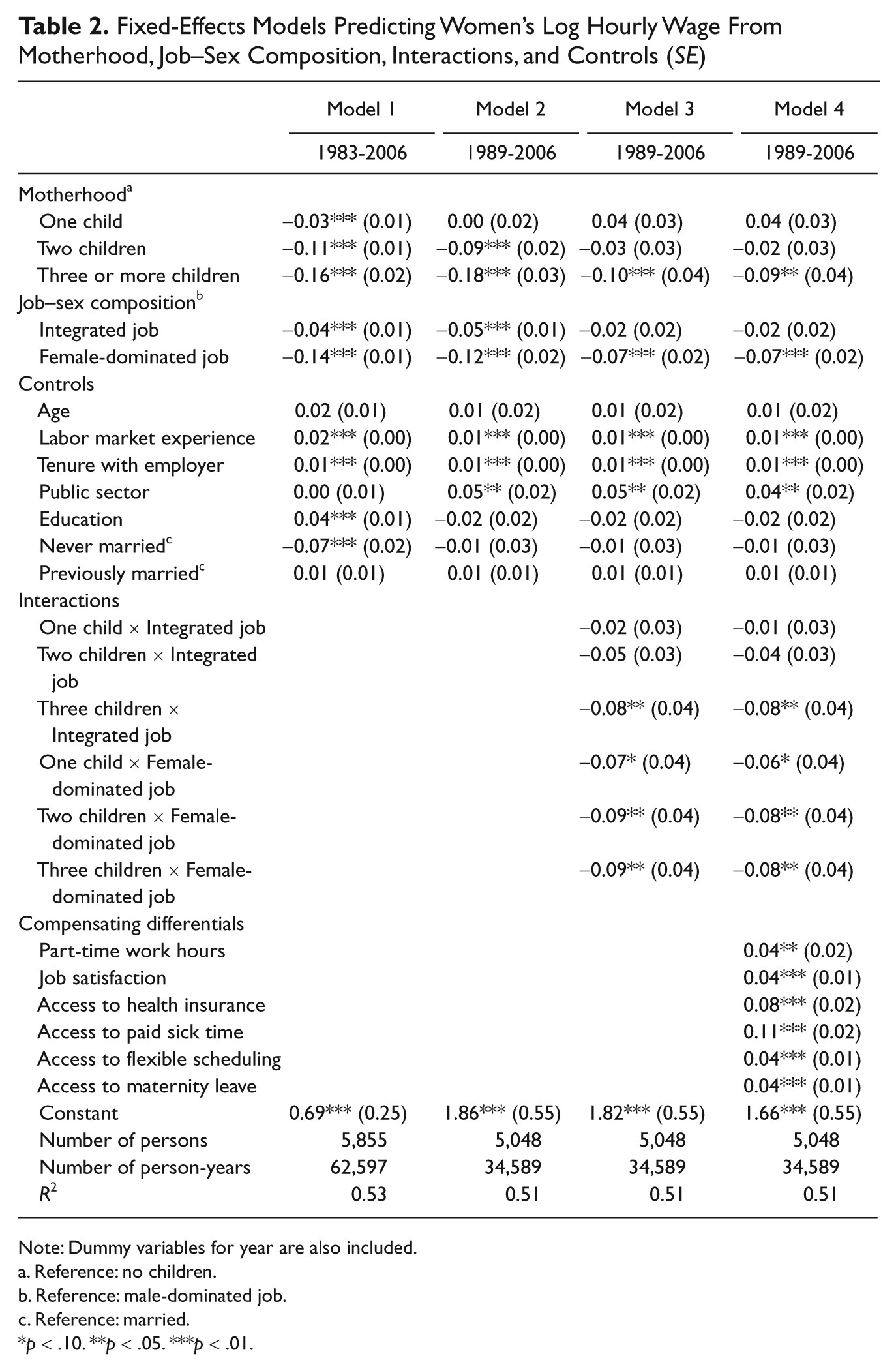
The first model presented in Table 2 replicates previous research on the motherhood wage penalty. The regression model is estimated for the 1983 to 2006 time period, and it does not include women who are self-employed. In 1983, NLSY women were between the ages of 18 and 26. The regression model shows that these women pay a 3% wage penalty for one child, an 11% wage penalty for two children, and a 16% wage penalty for three or more children. The estimates are from fixed-effects models that control for individual-level unobserved characteristics that do not change over time, as well as time-varying characteristics, such as the sex composition of women’s jobs, their age, labor market experience, tenure with employer, public sector, education, marital status, and year. The wage penalty estimates reported in the current study are similar to those presented in previous research. For example, Budig and England (2001) found that women pay a 3% wage penalty for one child, a 9% wage penalty for two children, and a 12% wage penalty for three or more children. Other studies report similar estimates (e.g., Anderson, et al., 2003; Glauber, 2007).
Fixed-Effects Models Predicting Women’s Log Hourly Wage From Motherhood, Job–Sex Composition, Interactions, and Controls (SE)
Note: Dummy variables for year are also included.
Reference: no children.
Reference: male-dominated job.
Reference: married.
p < .10. **p < .05. ***p < .01.
The second and third models presented in Table 2 are limited to the 1989 to 2006 time period, as the NLSY only began to provide detailed measures of job benefits in 1989. By 1989, women were between the ages of 24 and 32. Model 2 shows that these women pay a 9% wage penalty for two children and an 18% wage penalty for three or more children. The estimate for one child is not significantly different from zero. This differs from Model 1, where the estimate for one child is significant and negative. Thus, the age that women become first-time mothers matters. The first-time mothers in the second model, who are between the ages of 24 and 32 at their youngest, do not pay a wage penalty. Two children, however, tip the balance, and these mothers pay a significant wage penalty regardless of their age. This is precisely what Taniguchi (1999) found, namely, that early childbearers pay a larger motherhood wage penalty than late childbearers. The author found that women who give birth for the first time between the ages of 20 and 27 pay a large wage penalty, whereas those who give birth after age 28 do not pay a significant wage penalty.
The job composition estimates presented in Model 2 indicate that women earn 5% less when they work in integrated jobs as compared to when they work in male-dominated jobs. Women earn 12% less when they work in female-dominated jobs as compared to when they work in male-dominated jobs. These wage penalties are not accounted for by women’s age, labor market experience, tenure, public sector, education, or marital status. In an alternative model (not shown), percent female was included as a continuous variable. The estimate was −0.061 and significant, which is very similar to the −0.063 estimate reported by Budig and England (2001).
As expected, Model 2 shows that labor market experience and job tenure are positively correlated with women’s hourly wages. Surprisingly, education and marital status are not significant in Model 2, whereas they are in Model 1. This again has much to do with the sample limitation imposed in Model 2, as women are between the ages of 24 and 32 at their youngest. For the most part, these women have completed their schooling. The education that they receive after age 24 does not affect their wages, controlling for the other variables present in the model.
Most important, the third model presented in Table 2 shows that the motherhood wage penalty is larger when women work in female-dominated jobs than when they work in male-dominated or integrated jobs. Model 3 includes interaction effects for job composition and motherhood. The first two interaction effects for working in an integrated job with one or two children are insignificant. The third interaction effect is significant, and it indicates that women with three or more children pay a larger wage penalty when they work in gender integrated jobs than when they work in male-dominated jobs. The three interaction effects for working in a female-dominated job are all significant and negative, indicating that women incur the largest motherhood wage penalty when they work in female-dominated jobs.
Figure 1 presents predicted wages for women with no children, one child, two children, and three or more children given the sex composition of their jobs and estimates presented in the third model of Table 2. As the figure indicates, women in male-dominated and integrated jobs do not pay a wage penalty for having one or two children. Women in female-dominated jobs start out with lower wages and pay a larger wage penalty for each child that they have.
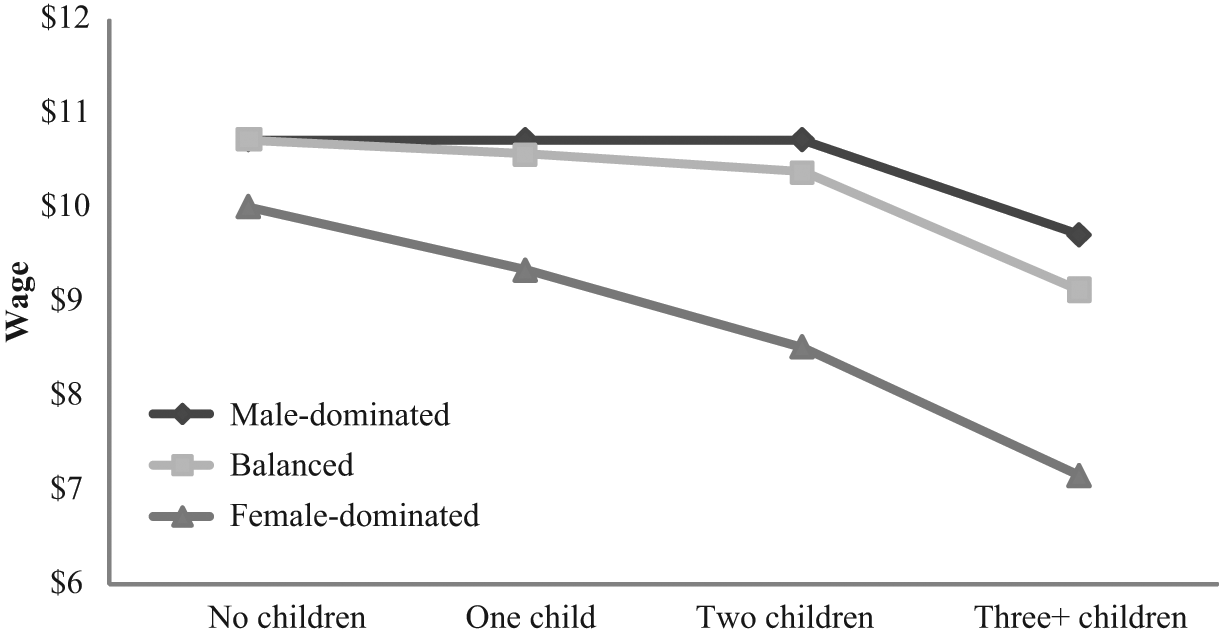
Predicted wages for one, two, and three or more children by job–sex composition
One remaining question is why women in male-dominated and integrated jobs do not pay a wage penalty for having one or two children. It is possible that these women are married to men who reduce their employment, which may free women to be more productive in their own jobs. However, in models that are not shown, I found that married and unmarried women who work in male-dominated and integrated jobs do not pay a significant wage penalty for having one or two children. Furthermore, when I added husbands’ work characteristics to the regression models for married women, the motherhood estimates remained insignificant. Future research would do well to consider other explanations. Perhaps women in integrated and male-dominated jobs increase their productivity on the birth of a child because their husbands spend more time doing housework. It is also possible that these women increase their work intensity because they anticipate discrimination. Finally, women who work in integrated and male-dominated jobs tend to have the highest levels of social, financial, and cultural capital. They may use their capital to purchase partial solutions to their work–family conflict, such as full-time live-in childcare.
The estimates reported in Table 2 do not change with different specifications of female-dominated, male-dominated, and integrated jobs. The appendix presents regression models with two alternative specifications of female-dominated jobs—61% to 100% and 81% to 100%. Although the estimates for working in an integrated job are slightly different across the models, the estimates for working in a female-dominated job are similar across the models. The basic conclusion is robust—women pay a larger wage penalty for motherhood when they work in female-dominated jobs.
Many women leave the labor market on the birth of a child. If selection in or out of the labor market is nonrandom and systematically related to time-varying factors, such as women’s childcare arrangements, then fixed-effects models may be biased because they only control for time-invariant unobserved factors. Moreover, if these factors are correlated with women’s likelihood of working in female-dominated, male-dominated, or integrated jobs, then comparisons across these jobs may be inaccurate. Heckman selection models help to mitigate bias due to nonrandom selection in and out of the labor market. They differ from fixed-effects models in that they control for selection based on time-varying factors. By definition, fixed-effects models cannot control for unobserved time-varying factors. In models that are not shown (but available on request), I estimated Heckman selection models that are identified using the unemployment rate of women’s local labor market. The estimates are similar in direction and magnitude to the fixed-effects estimates, indicating that selection factors do not bias the results. Previous studies of the motherhood wage penalty have come to similar conclusions (e.g., Budig & England, 2001).
Are Mothers Compensated for Their Lost Wages?
The short answer to this question is no. Mothers pay a larger wage penalty when they work in female-dominated jobs, and this larger penalty is not offset by greater job satisfaction or greater access to part-time work schedules, flexible work hours, health insurance, paid sick or vacation time, or job-protected maternity leave. The fourth model presented in Table 2 includes part-time work, job satisfaction, and access to health insurance, paid sick or vacation time, flexible scheduling, and maternity leave. The addition of these compensating differentials does not change the main effects or the interaction effects. Thus, it does not appear to be the case that women in female-dominated jobs pay a larger motherhood wage penalty because they receive compensating factors in return. Furthermore, in direct contrast to the theory of compensating differentials and the third hypothesis presented previously, these factors are positively correlated with women’s wages. Part-time work is associated with a 6% increase in wages, which is surprising, as past research indicates that women pay a wage penalty for part-time work. The positive association reported here has much to do with the correlations among women’s wages, part-time work, and access to fringe benefits. When the fringe benefits are excluded from Model 4, the estimate for part-time work becomes negative.
Access to health insurance is associated with a 7% increase in wages. Access to paid sick time and flexible scheduling are associated with a 12% and a 5% increase in wages, respectively. Access to maternity leave is not significant, though it becomes significant when it is included without the other benefits.
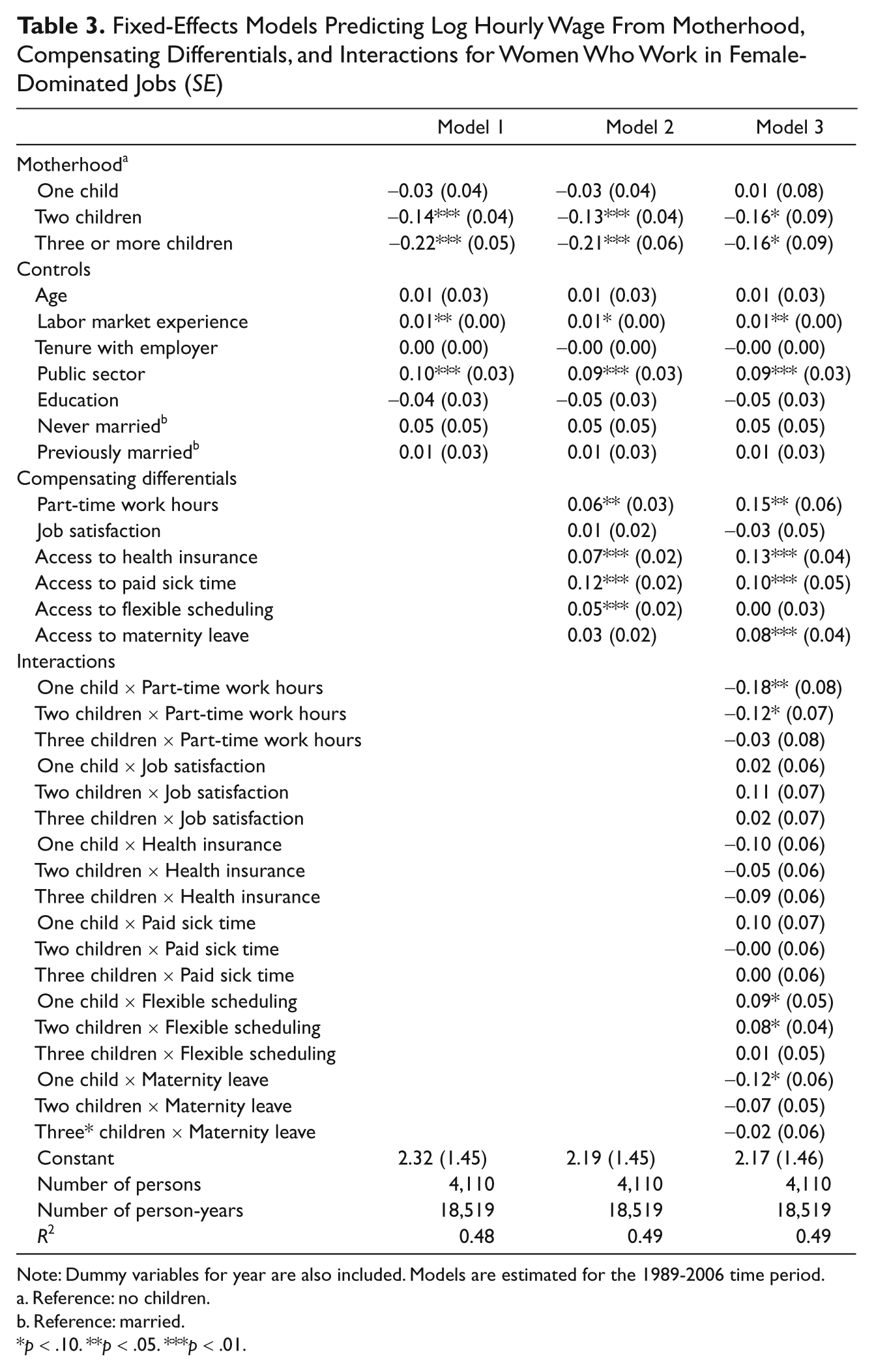
For ease of interpretation, Table 3 only presents regression models for women who work in female-dominated jobs. These models exclude self-employed women, and they are limited to the 1989-2006 time period. The first model presented in Table 3 shows that women who work in female-dominated jobs pay a 14% wage penalty for having two children and a 22% wage penalty for having three or more children. The control variables are correlated with women’s hourly wages as expected.
The second model presented in Table 3 shows that mothers who work in female-dominated jobs are not compensated for their lost wages through greater job satisfaction, access to part-time work schedules, flexible work hours, health insurance, paid sick or vacation time, or job-protected maternity leave. All of these benefits are positively correlated with women’s wages. These findings conflict with the theory of compensating wage differentials, which proposes that women trade lower wages for greater access to mother-friendly working conditions. Women who work in female-dominated jobs earn 6% more when they work part-time. Access to health insurance is associated with a 7% increase in wages. Access to sick or vacation time is associated with a 12% increase in wages. Access to flextime is associated with a 5% increase in wages.
Fixed-Effects Models Predicting Log Hourly Wage From Motherhood, Compensating Differentials, and Interactions for Women Who Work in Female-Dominated Jobs (SE)
Note: Dummy variables for year are also included. Models are estimated for the 1989-2006 time period.
Reference: no children.
Reference: married.
p < .10. **p < .05. ***p < .01.
Nearly all of the compensating factors are insignificant for women who work in male-dominated jobs (results not shown). Part-time work hours, job satisfaction, access to health insurance, paid sick or vacation time, and flexible scheduling are not correlated with these women’s wages. For these women, only access to maternity leave is significantly—and positively—correlated with wages. In addition, women who work in integrated jobs earn 10% more per hour when they work in part-time positions, which again is somewhat surprising. When the other compensating factors are excluded from the model, the estimate for part-time work becomes negative. Women who work in integrated jobs also earn 8% more when they are satisfied with their jobs, 10% more when they have access to health insurance, 8% more when they have access to paid sick or vacation time, and 5% more when they have access to maternity leave.
The final issue explored in the current analysis is if mothers make different trade-offs on wages and working conditions than women without children. The third model in Table 3 presents interactions between motherhood and the various compensating differentials for women who work in female-dominated jobs. The theory of compensating wage differentials proposes that mothers and childless women desire different working conditions and mothers may be willing to accept lower pay in return for better working conditions. Findings on this are mixed. On the one hand, the interaction effects for maternity leave and part-time work are negative, which indicate that the motherhood wage penalty is larger for women who work part-time or have access to maternity leave. These mothers may be willing to accept lower wages in return for access to these benefits. At the same time, it is also possible that women who work part-time are discriminated against when they become mothers. On the other hand, the interaction effects for flexible scheduling are positive, which indicate that women who work in female-dominated jobs pay a smaller motherhood wage penalty when they have access to flexible scheduling. For women in female-dominated jobs, flexible scheduling may help to reduce work–family conflict and improve productivity.
Although the tables focus only on women who work in female-dominated jobs, a final note about women who work in male-dominated and integrated jobs is warranted. For women who work in integrated jobs, none of the compensating differentials significantly interact with motherhood. For women who work in male-dominated jobs, only one compensating differential interacts with motherhood. The motherhood wage penalty for one child is significantly smaller for women who have access to flexible work schedules. Thus, there is no evidence that women in integrated or male-dominated jobs pay a larger wage penalty when they have access to various forms of compensating benefits. Because nearly all of the estimates are insignificant, they are not presented but they are available on request.
Discussion
Four sets of findings are reported in the current study. In line with the first hypothesis, the motherhood wage penalty is larger for women who work in female-dominated jobs than for women who work in other jobs. These women pay a 7% wage penalty for one or two children and a 15% wage penalty for three or more children. In contrast, women who work in male-dominated or integrated jobs do not pay a wage penalty for one or two children, and they pay a 10% and a 12% wage penalty for three or more children.
Second, mothers who work in female-dominated jobs are not compensated for their lost wages through greater job satisfaction or access to part-time work schedules, flexible work hours, health insurance, paid sick or vacation time, or job-protected maternity leave. These findings contradict the theory of compensating wage differentials and the second hypothesis. As with previous research (e.g., Glass, 1990; Glass & Camarigg, 1992; Jacobs & Steinberg, 1990), these findings suggest that female-dominated jobs are not more mother friendly than male-dominated or integrated jobs. Instead, the findings suggest that female-dominated jobs may be less mother friendly than other jobs, as women incur a larger motherhood wage penalty when they work in these jobs.
Third, and again in contrast to the theory of compensating wage differentials and the third hypothesis, access to flexible work hours, health insurance, paid sick or vacation time, and job-protected maternity leave are all positively correlated with women’s wages. As with previous research (McCrate, 2005; Weeden, 2005), I find that workers do not trade benefits for higher wages.
Fourth, among those in female-dominated jobs, the motherhood wage penalty is larger for women who work part-time and have access to maternity leave. These two findings provide some support for the theory of compensating wage differentials. Yet it is not clear whether the larger penalties reflect women’s choices or labor market discrimination. Furthermore, as Risman (1998) argued, part-time work may increase women’s economic dependence on men and gender inequality in the home as well as women’s marginalization at work.
The current study is limited in its focus on access to fringe benefits rather than use. It is not clear whether the same results would hold true in analyses of use. Previous research shows that mothers pay a larger wage penalty when they use family-friendly work benefits (Glass, 2004), as their use may be interpreted as a lack of work devotion (Wharton, Chivers, & Blair-Loy, 2008).
Conclusion
The findings reported in the current study raise a number of questions for future research. First, why is the motherhood wage penalty larger for women who work in female-dominated jobs than for women who work in other jobs? As noted earlier, scholars have argued that women pay a wage penalty for motherhood because they (a) have less labor market experience (Kaufman & Uhlenberg, 2000), (b) are less productive in their paid work (Kalist, 2008), (c) are discriminated against (Correll et al., 2007; Ridgeway & Correll, 2004; Williams, 2000), and (d) trade wages for other compensating benefits (Becker, 1991).
The first explanation is not well supported, as the regression models presented in the current study control for labor market experience. In terms of women’s work productivity, it is possible that women who work in female-dominated jobs experience a steeper drop in their productivity on the birth of a child than women who work in male-dominated or integrated jobs. Women who work in female-dominated jobs may spend more time doing housework and childcare than women who work in other jobs. Mennino and Brayfield (2002) found that women and men who work in female-dominated jobs are less likely to miss important family occasions than those who work in male-dominated jobs.
At the same time, it is possible that women who work in male-dominated jobs do more housework than women who work in either integrated or female-dominated jobs. Women may compensate for working in gender atypical environments by “doing gender” at home. Research shows that women who are primary breadwinners engage in more housework than women who earn less than their husbands (Bittman, England, Folbre, Sayer, & Matheson, 2003). Likewise, men avoid housework when they work in gender atypical jobs (Arrighi & Maume, 2000). To date, few studies have analyzed differences in housework and productivity by the sex composition of women’s jobs.
Thus, there are pressing questions for future research: Do women who work in female-dominated jobs experience a greater reduction in their work productivity on the birth of a child than women who work in other jobs, and does this explain the larger motherhood wage penalty? Alternatively, do women who work in female-dominated jobs suffer from greater labor market discrimination on the birth of a child than women who work in others jobs? Qualitative and experimental research, similar to Correll et al.’s (2007) study, may provide answers to these questions.
A final possibility is that women who work in female-dominated jobs are compensated in ways that are not captured in the current analysis. These women may have greater access to supportive coworkers and supervisors and they may enjoy a more family-friendly workplace environment (see, for example, Minnotte et al., 2010). Taylor’s (2010) research, however, suggests that workers in integrated jobs, rather than in female-dominated jobs, experience the greatest level of workplace social support.
Findings from the current study help to dispel the notion that mothers are compensated in return for lost wages, an idea that is often used to legitimize inequality and discrimination. This study also adds to our understanding of the motherhood wage penalty by considering variation among women. Women who work in female-dominated jobs not only earn less than other workers to begin with but also pay an additional, larger wage penalty if and when they become mothers. This larger penalty is not offset by measurable compensating differentials.
Footnotes
Appendix
Fixed-Effects Models With Alternative Specifications of Job–Sex Composition (SE)
| Model 1 | Model 2 | |
|---|---|---|
| Motherhood a | ||
| One child | 0.03 (0.02) | 0.06 (0.04) |
| Two children | −0.05** (0.03) | −0.01 (0.05) |
| Three or more children | −0.13*** (0.03) | −0.06 (0.04) |
| Job–sex composition b | ||
| Integrated job (40%-60% female) | −0.04** (0.02) | |
| Female-dominated job (61%-100% female) | −0.08*** (0.02) | |
| Integrated job (20%-80% female) | 0.02 (0.03) | |
| Female-dominated job (81%-100% female) | −0.04 (0.03) | |
| Interactions | ||
| One child × Integrated job | 0.01 (0.03) | −0.05 (0.04) |
| Two children × Integrated job | 0.00 (0.03) | −0.09* (0.05) |
| Three children × Integrated job | −0.02 (0.04) | −0.16*** (0.04) |
| One child × Female-dominated job | −0.05 (0.03) | −0.09* (0.05) |
| Two children × Female-dominated job | −0.07** (0.03) | −0.09* (0.05) |
| Three children × Female-dominated job | −0.07** (0.03) | −0.08* (0.05) |
| Constant | 1.84*** (0.55) | 1.78*** (0.55) |
| Number of persons | 5,048 | 5,048 |
| Number of person-years | 34,589 | 34,589 |
| R2 | 0.51 | 0.51 |
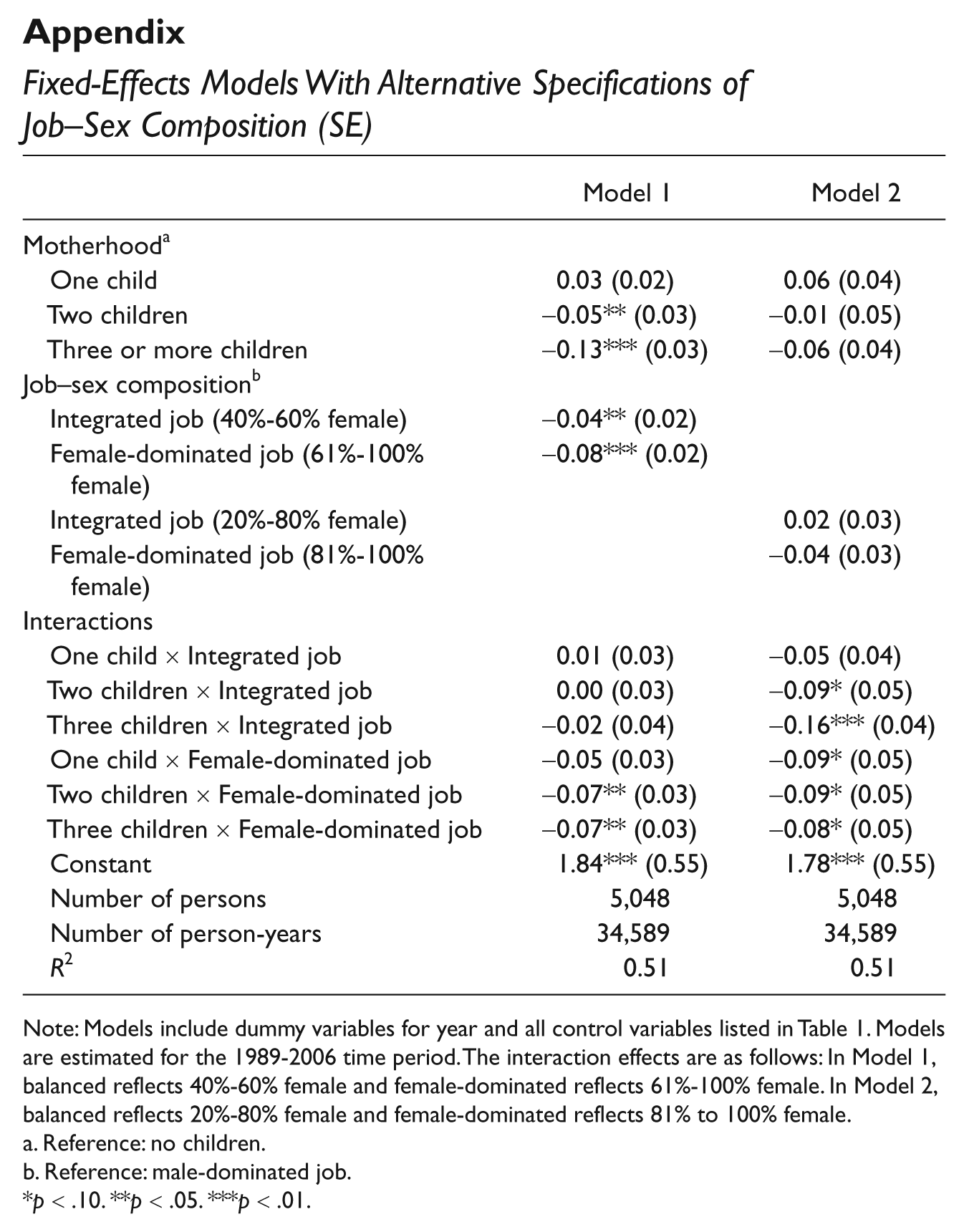
Note: Models include dummy variables for year and all control variables listed in Table 1. Models are estimated for the 1989-2006 time period. The interaction effects are as follows: In Model 1, balanced reflects 40%-60% female and female-dominated reflects 61%-100% female. In Model 2, balanced reflects 20%-80% female and female-dominated reflects 81% to 100% female.
Reference: no children.
Reference: male-dominated job.
p < .10. **p < .05. ***p < .01.
The author declared no potential conflicts of interest with respect to the research, authorship, and/or publication of this article.
The author received no financial support for the research, authorship, and/or publication of this article.