







Abstract
Flexibility stigma, the devaluation of workers who seek or are presumed to need flexible work arrangements, fosters a mismatch between workplace demands and the needs of professionals. The authors survey “ideal workers”—science, technology, engineering, and math faculty at a top research university—to determine the consequences of working in an environment with flexibility stigma. Those who report this stigma have lower intentions to persist, worse work–life balance, and lower job satisfaction. These consequences are net of gender and parenthood, suggesting that flexibility stigma fosters a problematic environment for many faculty, even those not personally at risk of stigmatization.
The structures and practices of workplaces today better reflect post-World War II era work than the demographic realities of today’s workforce. An important source of resistance to redesigning work so that it better fits the needs of today’s workforce is the deep-seated cultural definition of what it means to be an “ideal worker” (Acker, 1990; Williams, 2000). Such an ideal is most closely approximated by a worker (typically a man) “whose life centers on his full-time, life-long job” while someone else (typically a woman) “takes care of his personal needs and his children” (Acker, 1990, p. 149). Furthermore, this ideal worker, especially within professional occupations, is expected to adopt the work devotion schema: the moralized and institutionalized cultural mandate that work demands and deserves total allegiance (Blair-Loy, 2003).
Scholars use the term flexibility stigma to describe negative sanctions toward workers who appear to violate this ideal-worker norm by seeking or being assumed by others to need workplace accommodations to attend to their personal responsibilities (Williams, 2000). Flexibility stigma is distinct from the actual control over the time and place of work that is structurally part of many professionals’ jobs (Freidson, 1973). Schedule control per se is not stigmatized, and work–life policy use is not always met with negative sanctions. However, an individual’s choice to utilize work–life policies for the purpose of family caregiving, or even the choice to have children, may be read by employers and coworkers as a cultural expression of lower career commitment subject to flexibility stigma. 1 Yet, researchers are only beginning to understand the cultural beliefs underlying this stigma and the consequences of flexibility stigma for workers and workplaces. Using the case of science, technology, engineering, and math (STEM) faculty at a top-ranked research university, our article moves the work–life literature forward on both these fronts.
First, we measure flexibility stigma as part of a cultural schema by asking respondents about beliefs in their departmental climate regarding colleagues who use work–life accommodations or become parents, rather than using differential career outcomes as proxies for this stigma. 2 With this measure, we examine the theoretical claim in the literature that (perceived) career penalties for using work–life accommodations are linked to cultural beliefs that mothers (and possibly fathers) violate the organizational mandate for work devotion and are less committed to work (Williams, Blair-Loy, & Berdahl, 2013).
Second, we study the consequences of working in an environment where flexibility stigma is part of the workplace climate. To preview our findings, these consequences include reduced intentions to persist, lower job satisfaction, and less work–life balance. These findings deepen our understanding of the effects of flexibility stigma in work communities more broadly. They also help support a business case for refashioning workplace climates to better fit the needs of workers: Flexibility stigma has negative consequences for all STEM faculty who reported this stigma, not just for those (such as parents) who are directly at risk of being stigmatized.
An Exemplar Case of Ideal Workers
This article uses an exemplar case that highlights the processes of flexibility stigma under study. The employees in our case—STEM faculty in a top-ranked, STEM-intensive research university—closely approach the cultural notion of ideal workers. Science research faculty face cultural expectations to conform to the work devotion mandate (Fox, Fonseca, & Bao, 2011), and our respondents reflect this expectation: nearly 90% agreed that “the specific research I engage in is an important part of my identity.” Respondents work on average nearly 60 hours a week, with more than half of this time (32 hours on average) devoted to research and research management; three fourths of faculty wish they could spend even more time on their research. 3
Further, workplace structures at this university mean that many faculty members are able to exert a great deal of control over how they structure their work. Even faculty who conduct laboratory research enjoy a fair amount of scheduling control, as they rely on postdoctoral scholars, graduate students, and other personnel to conduct the daily maintenance of their experiments (Stephan, 2012). Corroborating this, more than 70% of the sample agrees that they have a lot of control over how they balance their work and personal lives. Teaching loads are also generally low; respondents teach a median of two 11-week courses a year. Thus, there is no sound policy reason to expect or require schedule rigidity in when and where faculty members accomplish their research, writing, and teaching preparation responsibilities.
By examining departmental schemas of flexibility stigma in a population that approaches the ideal-worker norm, we can better understand the operation and consequences of this cultural schema. The flexibility stigma is counterproductive for workers generally, but it is particularly unnecessary among STEM faculty members in a top-ranked university who already enjoy schedule control and display strong work commitment.
The next section outlines our theoretical perspective and frames our hypotheses. Following that, we present our methods and results and offer conclusions, including policy implications.
Theoretical Framework and Hypotheses
Scholars have given the name “flexibility stigma” to the negative sanctions toward employees who ask for or are assumed to need workplace arrangements to attend to family and personal obligations (Williams et al., 2013). This stigma contributes to the low usage rates of formal work–life policies in American corporations, as individuals avoid using these policies out of fear of career setbacks. 4 Much of the existing flexibility stigma literature describes this phenomenon theoretically (e.g., Williams, 2010) or determines where and to whom this stigma is most often applied (e.g., Glass, 2004; Mavriplis et al., 2010; Rudman & Mescher, 2013; Stone & Hernandez, 2013). This literature argues that workers who make reduced hour arrangements (i.e., less than full time) for family reasons are stigmatized as violating their employers’ ideal-worker norms (Acker, 1990) of single-minded dedication to work (Blair-Loy, 2003). These ideal-worker norms vary between professional and nonprofessional occupations (Williams, 2000).
Our study concerns academic professionals. In the legal profession, flexibility stigma has been vividly described as marking “the part-timer” as “less dedicated and thus less professional” (Epstein, Seron, Oglensky, & Saute, 1999, p. 7). Similarly, in the financial services industry, an executive reported her CEO’s views on part-time managers, who, even if they put in almost 40 hours a week, were stigmatized as lacking dedication: The CEO felt very strongly that if you were really on the team for the company, it had to be like the most important thing in your life, and that you were really expected to eat and sleep and dream and work and do everything for it. And he had said no part-time people. (Blair-Loy, 2003, p. 97)
Flexibility stigma has most often been studied with regard to professional women and mothers. When women request schedule accommodations, they are “viewed as double deviants” (Epstein et al., 1999, p. 7), due to long-standing gender stereotypes linked to broader cultural expectation that mothers (Correll, Benard, & Paik, 2007) and potential mothers (i.e., premenopausal women; Turco, 2010) have lower levels of work commitment and work devotion (Blair-Loy, 2003) than other professionals.
Less research has examined how flexibility stigma targets professional men. Some research finds that men are penalized when they ask for family leave (Coltrane, Miller, DeHaan, & Stewart, 2013; Rudman & Mescher, 2013; Wayne & Cordeiro, 2003). Even using modest work–family policies can trigger a penalty for fathers as well as mothers: A study of full-time financial service managers found that fathers who used an occasional sick day to care for an ill child were paid less than other fathers, net of other factors (Blair-Loy & Wharton, 2004). Some scholars (Rudman & Mescher, 2013; Vandello, Hettinger, Bosson, & Siddiqi, 2013) attribute the negative reaction to men’s request for work–life accommodations to the stigmatization of men with care responsibilities as more feminine.
Even fewer studies have examined what flexibility stigma means for men and women who approximate the ideal-worker norm, continuing to work full time while managing other life responsibilities. Not just a reaction to requests for reduced work hours, full-time workers who use formal work–life policies offered by their organization endure flexibility stigma (Glass, 2004). For example, employees in a financial services company avoided using work–life policies because such policies were regarded as career damaging (Blair-Loy & Wharton, 2002). Their fears are well-founded: A study of financial service managers in one firm found that net of a host of job and individual controls, those who used even modest work–life policies, such as taking a few days of sick leave to care for an ill child, had significantly lower earnings than otherwise similar managers who did not use these policies (Blair-Loy & Wharton, 2004). Another study found that financial managers in this firm who used formal work–life policies received lower performance evaluations than their coworkers (Wharton, Chivers, & Blair-Loy, 2008).
This article addresses several gaps in this flexibility stigma literature. First, as noted earlier, theoretical scholarship has argued that workers who utilize work–life accommodations are stigmatized because this usage is seen as violating moral expectations of work devotion and commitment (Williams et al., 2013). However, this theorized linkage has not yet been confirmed in systematic quantitative empirical work. Our article takes a step forward in this direction. We show that perceptions of negative consequences for the use of work–life policies are strongly related to perceptions that mothers and fathers with children at home are viewed as less committed, lending empirical support to the theoretical argument that work–life policy use is penalized because parents are assumed to violate norms of work devotion. This stigma exists in our case of elite STEM faculty regardless of the schedule control provided by their work.
Second, previous studies have operationalized flexibility stigma as negative career outcomes for individuals who request accommodations (Berdahl & Moon, 2013; Blair-Loy, 2003; Epstein et al., 1999), using either personal experiences of marginalization or differences in career outcomes as proxies for such stigma. In contrast, this study assesses flexibility stigma as part of a widely shared cultural schema by asking respondents directly about the beliefs and assumptions within their work unit. This allows us to examine the contours of flexibility stigma as a cultural schema in a real work environment, rather than approximating this stigma in individual worker outcome measures or laboratory experiments. This approach also allows us to see consequences of perceiving flexibility stigma for those who are not personally at risk of being stigmatized.
Third, to our knowledge, no previous study has used quantitative analyses of real worker responses to separately measure workers’ reports of a flexibility stigma and link it to the consequences of this stigma for persistence plans, sense of work–life balance, and overall job satisfaction.
Hypotheses
Previous conceptual work has argued that flexibility stigma is rooted in a durable cultural structure of work devotion (Blair-Loy, 2003): In order to understand the very slow spread of real flexibility in the workplace and to appreciate why the business case so often fails to persuade, we must delve deeper. Resistance to workplace flexibility is not about money. It is about morality … . The schema that drives the flexibility stigma for professionals is the “work devotion schema” (Williams et al., 2013).
Scholars have made two related theoretical arguments. One is that the work devotion schema underlies beliefs that mothers are less committed and competent in the workplace (Correll et al., 2007; Turco, 2010). The second is that the work devotion schema underlies the resistance to using officially available work–life policies, especially among the most high ranking and well-regarded employees (Blair-Loy & Wharton, 2004; Jacobs & Gerson, 2004). Yet, this theorized connection between use of work–life policies and perceived lack of dedication among workers with child care responsibilities has not been empirically examined. We take the first step in making this empirical link.
The next set of hypotheses asks who is most likely to report flexibility stigma within their departmental climate. Being able to recognize processes of disadvantage within one’s work environment is, itself, a culturally mediated process, and one’s own experiences can influence one’s attentiveness to these disadvantages (Cech, Blair-Loy, & Rogers, 2013). Those most likely to be the targets of flexibility stigma should thus be more likely to report it within their departments. As the literature discussed earlier illustrates, women, and in particular, mothers, are more likely than men to be perceived by coworkers or employers as time deviants (Epstein et al., 1999) and as less committed (Correll et al., 2007; Turco, 2010). Men with child care responsibilities may also be targets of this stigma (Mavriplis et al., 2010; Rudman & Mescher, 2013; Vandello et al., 2013). We expect that those who are most susceptible to being stigmatized are also likely to be more sensitive to perceiving flexibility stigma within their departments.
In all our models, we control for whether respondents have used any of the work–life policies (e.g., campus child care, temporary family leave, elder care information and support) offered to full-time academics. The relationship between policy use and perceptions of flexibility stigma in our cross-sectional sample are complex. On one hand, those who have used formal work–life policies may be more likely to perceive stigma because they engaged in a stigmatized behavior. On the other hand, those who recognize flexibility stigma in their departments may be less likely to use these policies in the first place. As such, we do not hypothesize a causal connection between these measures in our cross-sectional analysis and encourage investigation of this connection with longitudinal samples.
The next set of hypotheses concerns the possible negative consequences of flexibility stigma on respondents’ experiences in their departments. First, we expect those who report flexibility stigma will be more likely to consider leaving. We are not aware of previous research on the effects of flexibility stigma on faculty persistence. Research does show a gender gap in attrition: Women have higher rates of attrition than men, net of tenure status (e.g., August & Waltman, 2004; Rothblum, 1988). More related to our sample, women in STEM have stronger intentions to leave and more often cite family reasons for these intentions compared with men, who are more likely to cite dissatisfaction with salary (Kaminski & Geisler, 2012). Additionally, women science faculty in one study express frustration with overly demanding professional expectations and a delegitimation of care responsibilities (Rosser, 2012). Outside of academia, research on women managers shows that many opted out of their jobs when they encountered stigma relating to taking advantage of work–life arrangements (Stone & Hernandez, 2013).
We expect that those in work environments where they perceive flexibility stigma will be less likely to want to remain in those environments. Even those without care responsibilities may see flexibility stigma as a broader signal of a problematic work environment and have less desire to remain there long term. We examine two indicators of intentions to persist: whether respondents have considered leaving academia for industry (a plausible option for STEM faculty [Stephan, 2012]), and whether they intend to stay at the university for the remainder of their career:
Similarly, we expect that respondents who report flexibility stigma in their departments will be less satisfied with their experiences at their university overall. A wide array of studies have examined academics’ job satisfaction, finding that women and faculty of color are less satisfied with their work in general than White men (e.g., Olsen, Maple, & Stage, 1995; Settles, Cortina, Malley, & Stewart, 2006). Only a few studies (August & Waltman, 2004; Seifert & Umbach, 2008) have investigated environmental determinants of satisfaction and none examine how issues related to flexibility stigma affect satisfaction. We expect that, net of respondents’ demographics and career and family characteristics, flexibility stigma will render departments less enjoyable and satisfying workplaces.
5
Finally, we expect that awareness of a departmental climate stigmatizing those who need work–life arrangements will make the work–life balancing act more difficult. Faculty may strain their work–life balance to put in additional hours to signal their work devotion to colleagues.
6
Previous work–life research has documented that women are more likely than men and mothers more likely than fathers to feel overworked (Cha, 2010; Jacobs & Gerson, 2004; Moen, Kelly, & Hill, 2011), since women tend to do more caregiving than men. Net of demographic, career, and family controls, we expect that respondents who perceive a flexibility stigma may also feel overloaded and dissatisfied with their work–life balance.
Data and Methods
Sample
We study an exemplar case of ideal workers: faculty at a top-ranked research university with preeminent science and engineering programs. This population, although not representative of all STEM faculty, is bounded in a single university; this controls for heterogeneity between institutional settings. Our data include information gathered through both academic personnel data and a web-based survey. The university personnel office provided us with confidential data on gender, race/ethnicity, respondent step (i.e., a ranking in the faculty hierarchy), department, and salary, for the entire population of 506 STEM faculty, including lecturers. We then invited all members of the population to participate in an online survey. Of the population, 266 (53%) participated in the survey, which is a relatively high response rate given a population that has many demands on their time. Following the advice of Allison (2001) and others, we use multiple imputation procedures for missing data due to skipped survey questions. 7 Compared with the population of STEM faculty, the survey sample slightly overrepresents women; our nonresponse bias analysis revealed no significant differences in the representation of racial/ethnic groups between the population and survey samples.
Dependent Variables
Flexibility stigma measures
We have three measures capturing interconnected facets of flexibility stigma: respondents’ perceptions that, in their departmental climates, “female faculty who have young or school-aged children are considered to be less committed to their careers than colleagues who are not mothers,” “male faculty who have young or school-aged children are considered to be less committed to their careers than colleagues who are not fathers,” and “for those in my department who choose to use formal or informal arrangements for work–life balance, the use of such arrangements often has negative consequences for their careers” (1 = strongly disagree to 5 = strongly agree).
Persistence measures, job satisfaction, and work–life balance
Means and Standard Errors on Dependent and Independent Measures (N = 266).

Note. SE = standard error; URM = underrepresented racial/ethnic minority; LGB = lesbian, gay, or bisexual.
Demographics and controls
All models include measures of gender (female = 1), self-identified underrepresented racial/ethnic minority status (African American, Hispanic, Native American; yes = 1), self-identified lesbian, gay, or bisexual (LGB) identity (yes = 1), whether respondents are married/partnered (yes = 1), whether they are in a dual-career academic couple (yes = 1), and whether they have child(ren) in the following age ranges: under 3, between 3 and 6, between 7 and 15, between 16 and 18, and older or adult children. We also control for respondents’ academic step or detailed rank in the faculty hierarchy (ranging from step 0 to 30), logged salary, whether they have successfully negotiated a retention offer (yes = 1), and whether respondents have used one of the work–life balance policies available to them (yes = 1). 8 Each model includes dichotomous indicators for department, using the labels Biology Specialty 1, Engineering Specialty 2, and so on to help protect the anonymity of the study site. A multidisciplinary department of faculty who research a particular area of the natural world (the largest STEM department in the university) is the department comparison category in the models.
Demographic, Family, and Work Circumstances Predicting Respondents’ Report of Flexibility Stigma in Their Departments (N = 266).
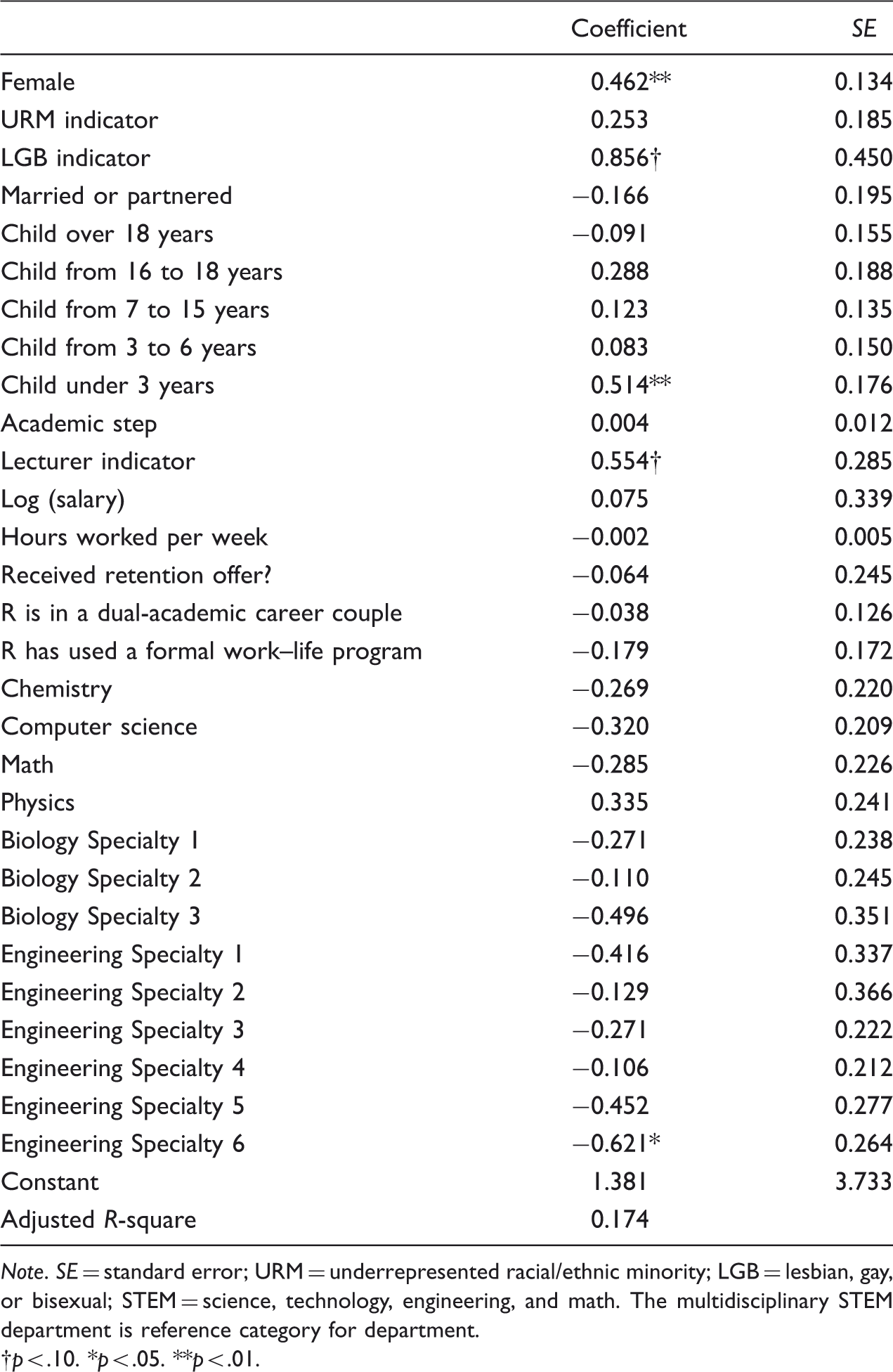
Note. SE = standard error; URM = underrepresented racial/ethnic minority; LGB = lesbian, gay, or bisexual; STEM = science, technology, engineering, and math. The multidisciplinary STEM department is reference category for department.
p < .10. *p < .05. **p < .01.
Results
Table 1 presents the means and standard errors on each of the variables in our analyses. Consistent with existing literature on motherhood penalties (Budig & England, 2001; Correll et al., 2007), respondents are more likely to believe that mothers are considered less committed than they are to believe that fathers are considered less committed (mean: 2.129 vs. 1.754). Respondents overall have low likelihood of intending to leave academia for industry, intend to remain at the institution long term, and are generally satisfied with their experiences at the institution, but the work–life balance measure suggests that respondents, on average, disagree that they have such balance. Consistent with other research universities (Drago et al., 2005), very few (less than 14%) have ever used modest work–life balance policies. 9 Reflecting national patterns on STEM faculty, women and underrepresented racial/ethnic minority individuals are underrepresented in our sample.
We next examine the empirical connection between reports that mothers and fathers of young children are considered less ideal workers and reports that the use of work–life policies incurs negative consequences. We find that beliefs that mothers and fathers are seen as less committed are both highly correlated with the belief that there are negative consequences for using work–life balance policies (Pearson’s coefficients: .335*** and .272***, respectively). Furthermore, in separate ordered logit models predicting the negative consequences measures, we find that, net of controls, the belief that mothers are seen as less committed is strongly and positively related to the negative consequences measure (B = .666, p < .001), as is the measure related to the commitment of fathers (B = .593, p < .001). These results provide strong empirical support for our hypothesis (H1) that these three measures tap into a similar sentiment: those who do not illustrate a single-minded dedication to work by having child care responsibilities or using work–life policies are seen as less ideal workers. As such, we combine these three measures into a single flexibility stigma scale (alpha = .661). 10
Next, we examine who is most likely to report flexibility stigma within their departments (see Table 2). Supporting our hypotheses, women are more likely than men (supporting H2) and parents of children under 3 years are more likely than nonparents (supporting H3) to notice a flexibility stigma. However, contrary to our expectation in hypothesis H4, mothers were not more likely than fathers to perceive a flexibility stigma: interaction terms between gender and each of the children age ranges were added to the model in Table 2 but none were significant (results not shown). This suggests that awareness of flexibility stigma is connected to parenthood, not just motherhood. Finally, consistent with research showing that workers from socially devalued categories may be more sensitive to recognizing problematic departmental climates than those in more privilege categories (Cech et al., 2013), we find that LGB respondents (compared with non-LGB respondents) and lecturers (compared with ladder-ranked faculty) are marginally more likely to perceive flexibility stigma. 11 There is little variation by department in the strength of flexibility stigma, except that faculty in one of the engineering specialties are significantly less likely to report the stigma than faculty in the interdisciplinary department. This lack of department variation could reflect the consistency of the stigma across the institution or across the STEM disciplines. More research is needed to examine how the strength of the flexibility stigma may vary across institutions and professional cultures.
It is interesting that faculty awareness of flexibility stigma in their department does not depend on whether an individual has ever personally used a work–life policy offered by the university (which we control for), such as a leave of absence during the quarter a new child joins the family or use of the campus child care center. As noted earlier, the causal connection between these two measures should be investigated with longitudinal data in future research.
Consequences of Flexibility Stigma
We also examine the consequences of flexibility stigma on respondents’ intentions to remain in their positions, their overall satisfaction with their experiences at the university, and their feelings of work–life balance. Table 3 presents the models predicting each of these four outcomes of interest with the flexibility stigma scale and control measures. In the first two models, those who perceive flexibility stigma in their departments are significantly less likely to want to remain in their current jobs: Perceivers of flexibility stigma are significantly more likely to think about leaving academia for industry and marginally less likely to consider remaining at the institution for the remainder of their career than their colleagues. This supports hypotheses H5 and H6. Related, flexibility stigma is strongly and negatively related to respondents’ reported satisfaction with their experiences in the institution overall (supporting H7). Finally, the last model in Table 3 illustrates that those who perceive flexibility stigma are less likely to feel a sense of work–life balance (supporting H8). These four consequences are represented visually in the bar graphs in Figure 1.
Predicted probabilities on four outcome measures, by low (first quartile) and high (third quartile) reported levels of flexibility stigma. Flexibility Stigma Predicting Respondents’ Persistence Intentions, Job Satisfaction, and Work–Life Balance (N = 266). Note. URM = underrepresented racial/ethnic minority; LGB = lesbian, gay, or bisexual; OLS = ordinary least squares. Models 1–3 are ordered logits; Model 4 is an OLS regression. In the “leave for industry” model, respondents from Engineering Specialty 2 were removed because there was no variation in the response to the item for that subsample. The respondents from that department are removed, bringing the N on that model to 261. p < .10. *p < .05. **p < .01. ***p < .001.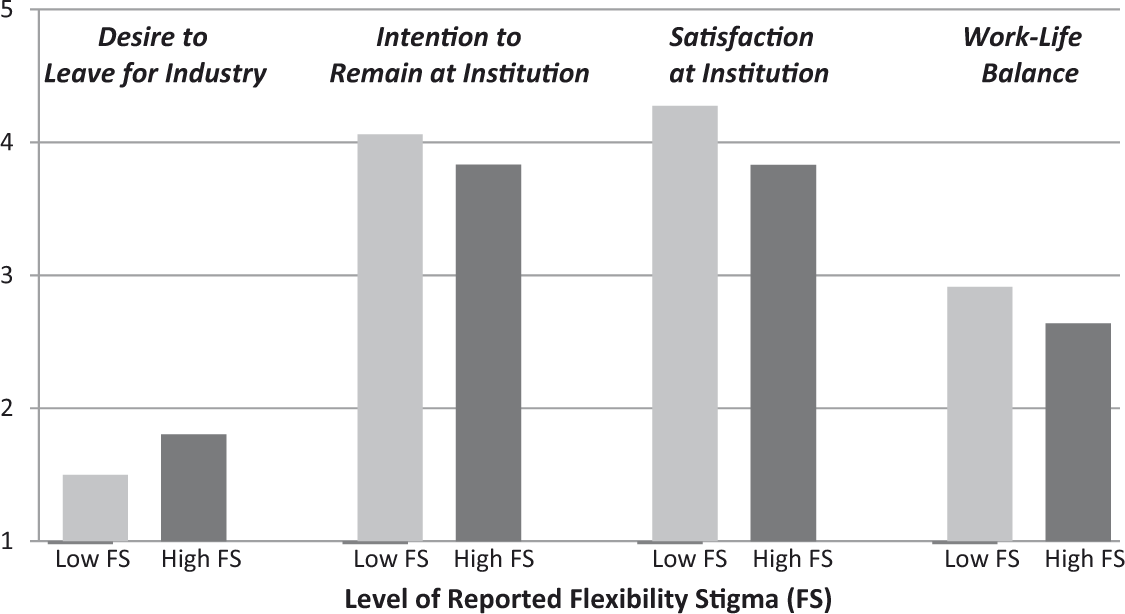

Discussion
The purpose of this article was to examine the empirical patterns and consequences of flexibility stigma among a population that approximates ideal workers. Recent literature has argued that flexibility stigma is an important barrier to addressing the worker–workplace mismatch in many professional workplaces. We used survey data on STEM faculty from a top-ranked research institution to empirically examine the theoretical claim that flexibility stigma against working parents is connected to parents’ perceived violation of the work devotion schema. We identified who is more likely to recognize flexibility stigma in their departments and investigated some of the consequences of perceiving flexibility stigma. We utilized a measure of flexibility stigma in our analysis that captures the cultural beliefs behind this stigma more directly than worker outcome measures or lab experiments used in other research as proxies for this stigma.
We found that, indeed, respondents’ belief that work–life policy use incurs negative consequences in their departments is strongly related to their beliefs that mothers and fathers are seen in their departments as less committed. This linkage supports the theoretical argument that the stigmatization of parents is partly due to their violation of the work devotion schema. Consistent with existing literature that has used either self-reporting of individual experiences of stigma or outcomes-based proxies for stigma, we also find that women and those with children under 3 years are more likely to report flexibility stigma in their departments, net of career and family controls. Importantly, however, we do not find that fathers and mothers of young children differ in their recognition of flexibility stigma. Mothers and fathers are more aware of this stigma than other colleagues, perhaps because they are personally targets of that stigma or see it directed against other parents. In this way, the flexibility stigma may help reproduce disadvantage for those who have parental responsibilities. We also find that lecturers and LGB individuals are more likely than their colleagues to report flexibility stigma, although the reasons why require further investigation.
Finally, our results illustrate several consequences of being employed within a work environment in which one perceives flexibility stigma: those who report this stigma are more likely to want to leave for industry, less likely to want to remain at their university long term, feel less work–life balance, and are less satisfied with their work overall. These results hold net of demographics and career and family status.
The flexibility stigma is part of a cultural schema that is semidetached from the schedule requirements of one’s work. It is not just the demands of work—and how faculty personally negotiate those demands—that may lead faculty to be less satisfied, feel imbalanced, and to consider leaving (as others have shown). Instead, we find that broader cultural beliefs about work also affect these outcomes. The cultural schemas that work units nurture about work can influence faculty outcomes, even if, as with nonparents, individual faculty are not personally targets of stigmatization. In other words, flexibility stigma can be problematic for the workplace community as a whole.
Although we study STEM faculty, these patterns may be echoed in other arenas of the labor force where professionals approach the ideal-worker norm. We might expect, for instance, that full-time lawyers or financiers in firms with flexibility stigma may be more likely to consider leaving, may feel as though they have less work–life balance, and may be less satisfied with their work experiences overall than those in work environments where flexibility stigma is weaker. More research is needed to understand variation in flexibility stigma in other occupations and among workers who bear less resemblance to the ideal-worker norm.
Conclusion
Our findings suggest several implications for the flexibility stigma literature. Flexibility stigma has been theorized as unfair treatment of employees who need, or due to caregiving obligations are presumed to need, work–life accommodations (Rudman & Mescher, 2013; Williams, 2000). Much of the flexibility stigma literature presumes that it is mothers rather than fathers whose parenthood obligations are most likely to trigger stigma. In contrast, we find that flexibility stigma is not just a mothers’ problem; mothers and fathers of young children are equally likely to report the presence of flexibility stigma in their departments. Related, we find that perceived flexibility stigma is negatively related to desires to remain in one’s position, overall satisfaction, and feelings of work–life balance over and above gender, family status, and career-relevant variables.
This study suggests that work units that harbor flexibility stigma may be damaging their own productivity and competitiveness. Departments that foster flexibility stigma may have a more difficult time retaining faculty—even those who do not have children. Turnover is expensive and disruptive, particularly for highly skilled professionals (Moen et al., 2011) such as the faculty studied here. Providing new faculty with laboratories, equipment, and other resources is costly and resource intensive—average start-up packages for new STEM faculty at research institutions, for example, can range from $90,000 in computer science to $394,000 in chemical engineering (NAS, 2007).
These findings thus help support a business case for addressing workplace climates that foster flexibility stigma: our results suggest that flexibility stigma can foster a difficult workplace climate for workers even if they are not personally at risk of stigmatization. Beyond the benefits shown by others (e.g., Moen et al., 2011) of instituting new work–life policies, the reduction of flexibility stigma in work units may help improve persistence, feelings of balance, and job satisfaction, and help close the gap between workplace realities and the needs and desires of professionals in the 21st century.
Our results may also point to a possible silver lining. Many faculty who do not currently have young children at home are nonetheless aware of (and affected by) flexibility stigma in their departmental climates. Broader worker awareness of problematic environments for colleagues with child care responsibilities suggests that at least some professionals who are not themselves targets of this stigma might be potential allies in altering this aspect of workplace climate.
Footnotes
Acknowledgments
We thank Jeanne Ferrante for her assistance and advice throughout the project, Laura Rogers for expert research assistance, Erica Bender for her work on the survey, and Shelley Correll, Lindsey Trimble O’Connor, Scott Schieman, Joan Williams, and three anonymous reviewers for helpful comments on a previous draft. Any opinions, findings, and conclusions or recommendations expressed in this material are those of the authors and do not necessarily reflect the views of the National Science Foundation.
Declaration of Conflicting Interests
The author(s) declared no potential conflicts of interest with respect to the research, authorship, and/or publication of this article.
Funding
The author(s) disclosed receipt of the following financial support for the research, authorship, and/or publication of this article: This research was supported by a grant from the