







Abstract
Recent studies have shown that providing job search assistance to job seekers who violate labor market norms can be costly. Consequently, people with information about jobs are less willing to help deviant job seekers. This implies that job seekers’ conformity to labor market norms should be useful in predicting receipt of job search assistance. The author tests this claim using data from Japan and finds evidence that deviant job seekers receive less assistance. The findings demonstrate the importance of social norms in understanding assistance flows and illustrate the limits of network analysis in explaining access to job search assistance.
Assistance in job search is a valuable social resource that can markedly benefit its recipients. 1 Ranging from tips about job openings to friends’ and acquaintances’ direct intervention in the hiring process, job search assistance increases job seekers’ information about and access to jobs, compared with workers who rely solely on formal search. Although there is contradictory evidence about the relationship between informal job finding and job outcomes (Granovetter, 1995), recipients of assistance have the opportunity to land better jobs, whatever their ultimate job finding method, because they can select the most desirable job from among a larger array of options (Devine & Kiefer, 1991; Mouw, 2002, 2003). Understanding differences in access to assistance therefore illuminates broader patterns of inequality (McDonald, 2011).
With a few exceptions (Marin, 2012; Smith, 2005, 2007, 2010), previous research has focused on how network mechanisms influence access to assistance in job search (e.g., Burt, 1992; Granovetter, 1995; Lin, 1999; McDonald, 2011). However, a growing literature on information holders’ decision making problematizes this networks-only approach. This new literature shows that the presence of a tie between the information holder and the job seeker does not guarantee a flow of resources: In fact, information holders withhold help from job seekers with surprising frequency (Marin, 2012; Smith, 2005, 2007, 2010). Does this decision-making process influence job seekers’ receipt of and access to job search assistance? The literature on information holders’ decision making has not yet systematically addressed this question.
In this article, I use the information holder literature to derive predictions about job seekers’ access to assistance. Based on this literature, I predict that job seeker deviance from norms of oughtness (Hechter & Opp, 2001; Horne, 2001) in the labor market reduces job seekers’ access to assistance. I then test the relationship between deviant labor market behaviors and access to assistance using a high-quality dataset on job changers in Japan, the Working Persons Survey, a sample of employed persons in Japan’s three largest metropolitan regions collected in August, 2000. 2
This article makes several contributions. First, it provides, to my knowledge, the first systematic investigation of the effects of information holder mechanisms on outcomes for job seekers. Second, the study extends sociological literature on the Japanese labor market. Most of the previous English-language scholarship on job finding in Japan has investigated only entry into first jobs (Brinton & Kariya, 1998; Rebick, 2000; Rosenbaum & Kariya, 1989). But as the labor market in Japan has destabilized (Brinton, 2011; Schoppa, 2006; Yu, 2012), understanding how the victims of that destabilization cope with midcareer job change has become increasingly important. My sample consists entirely of male, midcareer job changers, and thus provides new insights into the experiences and opportunities of this vulnerable and understudied segment of the labor market. Finally, in developing recent findings about information holders and testing the implications of these findings on outcomes for midcareer job seekers in Japan, I build new bridges between older networks-only approaches and the new ethnographies that focus more on information holders’ decision-making processes. The marriage of these two approaches provides new theoretical tools to clarify why assistance might not flow to job seekers even when it is present in their networks and to explain and interpret patterns of inequality in Japan and beyond.
Theoretical Framework
Varieties of Job Search Assistance
Although often treated as a single phenomenon, job search assistance can mean many different things. The first and most passive type of assistance is when information holders tell job seekers of a publicly advertised position (Smith, 2010). This type of assistance is less valuable to job seekers than those I outline below, but nonetheless gives job seekers the chance to learn of positions they might otherwise have overlooked. A second type of assistance is when information holders give job seekers information that is not available to the general public. For example, information holders might tell job seekers about opportunities that are not publicly advertised or supply job seekers with other insider insights, such as how and when hiring decisions will be made. Assistance in the form of inside information can give its recipients a relative advantage in hiring (Fernandez & Weinberg, 1997). Finally, the third type of assistance is when information holders intervene directly with the employer on the job seeker’s behalf, for example by personally recommending the job seeker, or even by making the hiring decision themselves. In some cases, this process is formalized when employers deliberately tap employee networks for recruitment (Fernandez, Castilla, & Moore, 2000). This last type of assistance is arguably of greatest benefit to the job seeker because the information holder has the most opportunity to influence the employer in favor of hiring (Lin, 1999).
Because the quality and quantity of assistance available to job seekers tend to be correlated (Montgomery, 1992), having greater access to assistance refers both to receiving more information as well as to receiving more substantive, active kinds of help. Thus, when I describe someone as having greater access to assistance, I mean that they enjoy both a higher quantity and a higher quality of assistance than others.
Network Approaches
Network approaches have demonstrated that job search assistance is not uniformly available to all job seekers. Rather, as researchers working in the network tradition have shown, job seekers’ location in the social structure patterns their access to assistance in consistent ways. These studies have examined job seekers’ number of network ties, the demographic characteristics of their network alters, and the connections among network alters; they have found that larger networks (McDonald, 2011; Montgomery, 1991), particularly those containing more employed contacts (Calvó-Armengol & Jackson, 2004), networks that reach farther into social space (Burt, 1992; Granovetter, 1973, 1983, 1995), and networks that connect the job seeker to high-status alters (Lin, 1999; Lin, Ensel, & Vaughn, 1981; Marsden & Hurlbert, 1988; McDonald, 2011) are advantageous to job seekers.
Scholars have argued that these network configurations make a greater volume of assistance, a better quality of assistance, or both, available to job seekers. For example, network size and presence of employed contacts increases the amount of information about jobs accessible through the ego network (McDonald, 2011). Ties to alters who are unconnected to each other do the same because information from diffuse networks is less likely to be redundant than information from close-knit networks (Granovetter, 1973, 1983, 1995). Finally, high-status alters are both more likely to know about jobs, and better positioned to influence the hiring process in favor of a friend (Lin, 1999). These types of differences in size and composition of networks have been used to explain gender and racial differences in access to assistance and in subsequent labor market outcomes (e.g., Campbell, 1988; Drentea, 1998; Moore, 1990; Royster, 2003).
The left side of Figure 1 depicts the pure network view of access to assistance.
Models of job search assistance.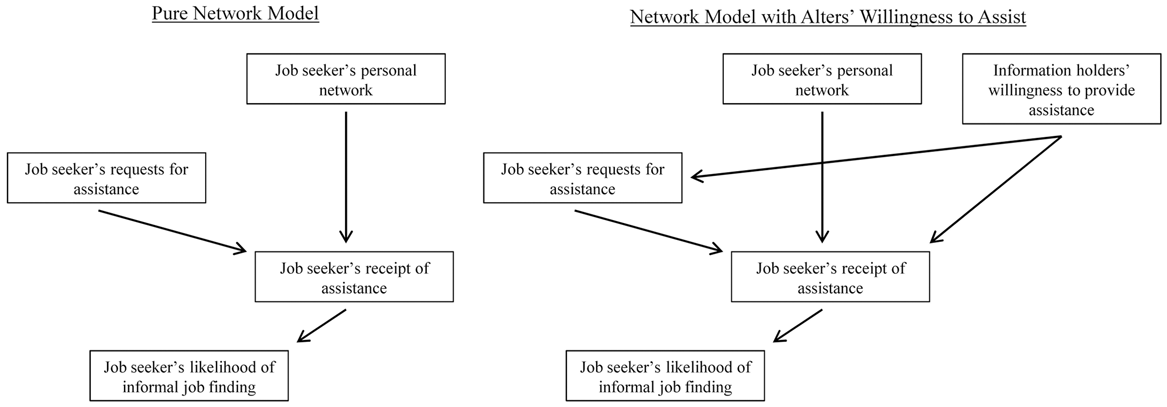
Decision-Based Approaches
Several recent studies, however, draw attention to the limitations of a stand-alone network approach. As Sharone (2014) points out, many network studies have sidelined the important role that information holders’ motives play in their decisions to assist job seekers. Intriguingly, research by Smith (2005, 2007, 2010) and Marin (2012) demonstrates that even when friends and acquaintances can provide assistance, they choose not to with surprising frequency. While network-based approaches tend to assume stochastic information flow through the network, these newer findings call that assumption into question. Rather, they suggest that alters’ decision-making processes about whom to help reroute assistance flows in ways that differ considerably from the stochastic model. 3
This approach is depicted on the right side of Figure 1. As the figure shows, in this model, information holders’ willingness to provide assistance influences the assistance that job seekers receive both directly, and indirectly, through its effects on job seekers’ likelihood of seeking assistance. It implies that even networks that we would expect to be rich sources of job search assistance may not actually supply that assistance to certain job seekers.
How is alters’ willingness to provide assistance patterned, according to the information holder studies? These studies suggest that information holders make cost-benefit decisions when deciding whom to help. For example, if a referred employee performs badly, employers may blame the information holder for the poor performance, leading to sanctions against the information holder, including termination (Smith, 2007). To protect themselves, information holders thus report that they avoid providing substantive assistance to contacts who seem likely to disappoint their employers. But there are costs to providing even the most minimal types of assistance, where the information holder does not have to put his or her name on the line for a job seeker. The information holder studies demonstrate that information holders want to conserve effort (Marin, 2012; Smith, 2007). They do not want to assist those who either cannot use the help, or do not want to. For example, Smith’s informants reported that some job seekers were likely to be such undesirable workers that they would never pass the job interview or, even if hired, would be fired soon anyway. Smith’s informants thought that providing even minimal assistance to these contacts was a waste of time (Smith, 2007).
In both these cases, social norms and cultural scripts help information holders to decide whom it would be too costly to assist (Smith, 2010). Information holders do not have perfect information on how job seekers will behave on the job, or on employers’ preferences. This means they must rely on observations of job seekers’ previous behavior to predict their future job performance, and on general norms of oughtness (Hechter & Opp, 2001; Horne, 2001) 4 as a proxy for employer preferences. As a result, when job seekers’ behavior and characteristics deviate from norms of oughtness, information holders may (rightly or wrongly) fear that, at worst, helping the job seeker could damage their own reputation or material well-being. At best, information holders may shy away from the wasted time and effort of helping such a person (Marin, 2012).
This causal account strongly implies that job seekers’ conformity to or deviance from labor market norms can help us understand when and why even the theoretically most advantageous networks could fail a job seeker. In addition, the decision-based approach suggests we should be able to use knowledge of norms, particularly labor market norms, to predict which job seekers will receive more or less assistance. Specifically, we would expect job seekers who violate labor market norms to receive less assistance than those who conform. This article tests this implication of the supply-side studies.
Labor Market Dynamics and Inequality in Japan
Access to Assistance in the Japanese Labor Market
Japan presents a unique opportunity to test whether violation of labor market norms reduces access to job search assistance. Generally speaking, identifying deviance in a large-n survey is challenging, but Japan has well-documented labor market norms that discourage many workers from changing employers, as I describe in greater detail below. The strong evidence for the norm against job change and the ease with which we can observe conformity or deviance to it make Japan a convenient large-n test case for the general claim that labor market deviance decreases access to job search assistance.
Access to job search assistance in Japan is of substantive interest as well. Japan, like other developed countries, faces rising inequality (Tachibanaki, 2006). In part, this is due to a decrease in employment stability: the likelihood of layoffs and unemployment is growing (Ministry of Health, Labor and Welfare [MHLW], 2011; Rebick, 2005), as depicted in Figure 2.
Involuntary separations leading to unemployment by age group and year (Statistics Japan, 2013).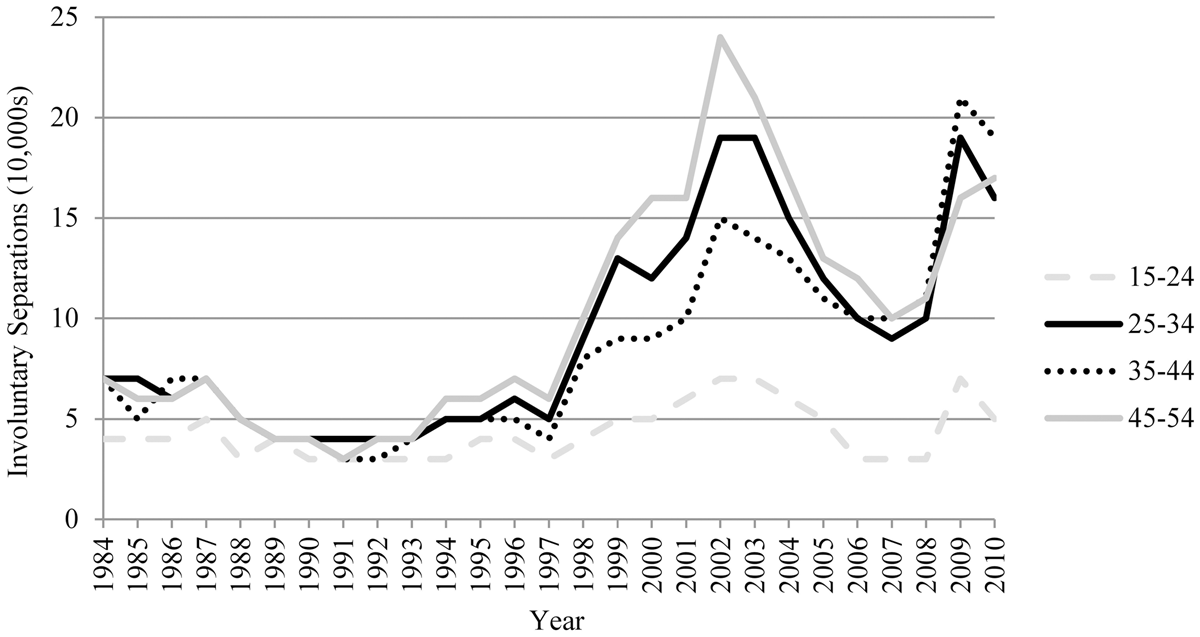
What this means is that assistance in job search is increasingly important for all workers (Ono & Rebick, 2003), but particularly for workers in their mid forties and beyond, who under the long-term employment system receive the highest wages, and thus are the most tempting targets when firms must reduce their core workforce. And yet we know little about Japanese job changers’ access to assistance, and how it might impact stratification. The existing literature in English (Brinton, 2000, 2011; Brinton & Kariya, 1998; Rebick, 2000; Rosenbaum & Kariya, 1989) has focused primarily on institutional social capital—the job finding assistance available to graduating students through their high schools or universities—but this is largely unavailable to job changers, who are much more likely to use personal ties to find work than are new graduates (Kobayashi, 2008).
Japanese Labor Market Norms
My hypotheses rest on one particularly important norm—the enduring proscription against job change for men in Japan’s core labor market.
Japan is known for its system of long-term employment (Ono, 2010). Statistics on labor mobility underscore the persistence of this institution. Despite the increased labor market instability I have described above, labor mobility in Japan has been and remains strikingly low by international comparison (Abegglen, 1958; Cheng & Kalleberg, 1997; Cole, 1979; Dore, 1973; Ono, 2010). In 2000, only 4.1% of Japanese men changed employers (MHLW, 2006), and the average number of jobs held by men aged 45 to 54 was 2.1 (Ono, 2010). In contrast, in 1997, an estimated 16.4% of U.S. workers changed employers (Kambourov & Manovskii, 2008), and in 1998, men in the 45 to 54 age group had held 5.6 jobs on average (Ono, 2010). Despite claims (e.g., Usui & Colignon, 1996) that long-term employment is on the wane, Japanese men’s labor mobility has not increased significantly in the decade since 2000. In fact, between 2000 and 2010, labor mobility among Japanese men actually declined to 3.9%, although this figure remains higher than the 1990 rate of 3.0% (Japan Institute for Labor Policy and Training [JILPT], 2011). How is this possible, given the sharp rise in layoffs shown in Figure 2? Overall, mobility has stayed relatively constant for more than a decade because voluntary separations have declined even as involuntary separations have grown (Ono, 2010).
Why is mobility in Japan so low? For male workers in regular employment, low mobility is a rational response to the economic incentives of the labor market. Seniority-based wage structures, internal labor markets, and company-specific training and pension plans make changing jobs economically disadvantageous to workers (Brinton, 1993; Schoppa, 2006). Moreover, good midcareer jobs are hard to find, as almost half of companies hire no regular employees at the midcareer level (Recruit Works Institute, 2010), and often employ explicit or implicit age cut-offs in hiring (Rebick, 2005). These are deliberate policies on the part of firms to discourage turnover and maintain workforces with high levels of firm-specific human capital. Such policies remain highly popular: A recent survey of medium and large employers (over 300 employees) found that only 3.9% of firms anticipated moving away from the long-term hiring model (JILPT, 2008).
However, low mobility is not solely a response to firms’ compensation and hiring policies. There is also a strong normative component to low mobility that has emerged and developed in concert with economic incentives. Since the 1970s, companies, government publications, and the press have encouraged workers’ loyalty to their employers and associated mobility with dilettantism and a poor work attitude (Rohlen, 1974; Usui & Colignon, 1996). A 1973 report from the Japanese Prime Minister’s Office exemplifies this view, declaring that “… changing employers can be thought of as a response to defective human relations” (cited in Cole, 1979, p. 44). While labor mobility has slowly increased since the 1970s, and competing narratives sometimes paint job change in a positive light, job change is still “viewed with suspicion” (Brinton, 2011, p. 149), and workers feel that censorious attitudes make job change more difficult. In a survey from 2000, 30% of respondents cited damage to their reputation or relationships as a significant barrier to changing jobs, compared with 22% who said that detrimental effects on salary posed a barrier. 5
Employer surveys indicate that job seekers are right to be concerned about negative attitudes toward job change. A 2006 survey of companies found that 52% of managers responsible for midcareer hires had reservations about hiring employees in their thirties with up to three past jobs and 82% had reservations about potential hires with up to five past jobs (Riwanabi NEXT, 2013). Because this survey was conducted by a job placement agency that caters to job changers, on respondents whose responsibility it is to identify and hire human resources at the midcareer level, its results are almost certainly more permissive than average.
However, not all workers are subject to the social and institutional incentives and penalties that restrict job change. The irregular workforce, for example, labors outside of this normative regime. Irregular workers are “short-term contract workers, contract-based part-time employees, seasonal and day laborers, and workers dispatched from temporary employment agencies” (Yu, 2012, p. 737). In 2000, they made up about 26% of employed persons in Japan (MHLW, 2012). Although there are high legal barriers to terminating regular employees, irregular workers do not enjoy these protections, nor do firms provide irregular workers with the social welfare benefits regular employees receive (MHLW, 2012; Yu, 2012). Job change is three times more common in the irregular workforce than in the core labor market for regular employees (MHLW, 2006) and meets with greater social acceptance (Brinton, 2011).
In addition, female workers, regardless of employment status, have generally received neither the formal incentives such as seniority pay, nor the informal pressures to limit their labor mobility that men experience (Brinton, 1993, 2001). Both firms and general social attitudes push women to prioritize family concerns over work (Brinton, 2001; Japan Prime Minister’s Office, 1998), and women are overrepresented in the irregular workforce (MHLW, 2012). Further, even in regular employment, companies predominantly place women in nonpromotional mommy track positions where benefits, training, and wage increases are minimal (Kumamoto-Healy, 2005), in part because firms do not expect women to work long term (Brinton, 1993). 6
Thus, the low-mobility regime where formal incentives and informal norms strongly discourage job change is primarily the province of male workers in regular employment. Because 88.3% of all male employees worked in regular employment in 2000 (MHLW, 2012), we can see that while low-mobility norms are by no means universal in Japan, most male workers have considerable economic incentives to limit their mobility and face suspicion and censure if they do not.
Hypotheses
Where job change is deviant, we can expect that information holders would be less likely to assist job changers. This is because assisting these deviant job seekers exposes the information holder to several potential risks. If an information holder provides substantive assistance to a job changer who then quits unexpectedly, or otherwise performs below expectations on the new job, the new employer may question the information holder’s judgment, or perhaps even mentally tar him with the same brush. In some cases, this may be merely embarrassing to the information holder. However, especially in the long-term employment context of Japan’s regular labor market, these sorts of negative judgments on the part of the employer may also have a chilling effect on the information holder’s own career within the organization. Moreover, because employers are more likely to view deviant job changers askance, assisting these job seekers would be a relatively unprofitable enterprise. Thus, to conserve energy, information holders would tend to proffer more help to new graduates or perhaps to the most infrequent job changers. Due to these risks to information holders who provide either substantive or minimal assistance to job hoppers, we can predict that: Hypothesis 1: Among men in regular employment in Japan, job seekers with more past jobs receive less job search assistance than job seekers with fewer past jobs, ceteris paribus.
This hypothesis stands in contrast to predictions of the stand-alone network perspective. In purely structural analysis, job seekers with more past jobs should have larger, more expansive networks and thus greater access to assistance than those who have held only one or two past jobs.
Because my sample consists entirely of job changers, we might jump to the conclusion that every individual in the sample is deviant. However, not all kinds of job change are equally bad. Particularly when men change jobs due to the financial instability of their firms, this says more about the company than it says about the man (Yu, 2012). Returning to the mechanisms, a man who changes jobs due to employer instability does not signal unreliability in the same way that a man who changes jobs for other reasons does. Thus, the man who changes due to instability is less likely to reflect poorly on his referrer. Moreover, because men who are in danger of losing their jobs would probably be quite motivated to take a job, it is relatively productive for information holders to help them. Thus, we can predict that: Hypothesis 2: Among men in regular employment in Japan, men who change jobs due to bankruptcy or feared bankruptcy receive more assistance in job search than men who change jobs for other reasons, ceteris paribus.
Data
Working Persons Survey
To investigate these hypotheses on how deviance and conformity might shape access to job search assistance in the Japanese labor market, I turn to the Working Persons Survey from the year 2000. This is a high-quality dataset collected bi-annually 7 by the Recruit Works Institute in the Tokyo area (Tokyo, Kanagawa, Ibaraki, Saitama, and Chiba), the Osaka area (Osaka, Kyoto, and Hyogo), and the Nagoya area (Aichi). Although not nationally representative, the 11 prefectures surveyed are home to about 50% of Japan’s population, and the survey allows for inferences about workers in Japan’s three largest urban labor markets. (For other descriptions of the data and use in English-language literature, see Ono, 2007; Ono & Zavodny, 2005; Ueda & Ohzono, 2013.)
The survey uses area probability sampling, with repeated resampling within blocks until the desired sample size is reached. 8 The survey frame includes all persons aged 18 to 59 who lived in the sample area and worked at least one day during the last week of July 2000, excluding students. To adjust for nonresponse bias, the resulting data were weighted based on the distributions of gender, age group, and employment type in the survey region reported in the 1995 Employment Status Survey conducted by the Ministry of Public Management, Home Affairs, Posts and Telecommunications. All models in my analysis use these survey weights. The models do not adjust for clustering by region because the interclass correlation coefficient (ICC) is under 0.01, demonstrating that interregional variation in the outcome of interest is minimal.
The analytic sample (n = 1,102) for the current study consists of men who changed jobs between 1995 and August 2000. These are the only men in the survey who were asked detailed questions about reasons for changing jobs and methods of job search. I exclude all women and men with histories of contingent employment on theoretical grounds: As described above, these workers are not subject to low-mobility norms. 9
Explanatory Variables
Descriptive and Bivariate Statistics for Variables Used in the Analysis of Access to Job Search Assistance.

Other includes problems with coworkers or superiors; dissatisfaction with job fit, company strategy, working hours, pay, commute time, evaluation systems, opportunities of advancement; struggle with mental or physical demands of job; changes in family structure.
Because of missing data on salary, n = 1,009.
p < .05. **p < .01. ***p < .001.
The second explanatory variable is the respondents’ most important reason for leaving the previous job. In the original dataset, this variable has 24 levels. Two of the 24 categories in the original survey, bankruptcy or financial restructuring and I was worried about the financial future of my firm, suggest men who are changing jobs not through any fault of their own, but because of circumstances foisted upon them by their firms’ financial problems. In the analysis below, respondents in both these categories are compared with the reference category, which consists of people who changed jobs for any other reason. (A detailed list of the other reasons appears in the notes for Table 1.) I exclude men in three categories of departures from the analysis. First, I exclude men who report that they left their jobs due to retirement because the postretirement labor market differs significantly from the primary labor market. Second, I exclude men who reported that they changed jobs because a better job came along. My analysis assumes that information holders can gauge job seekers’ conformity or deviance based on their reason for changing jobs and use this knowledge to inform their decisions about whether to help. However, when respondents report that a better job came along, it is quite likely that the job seekers received assistance before making the decision to change jobs. If job seekers receive assistance before the decision to change jobs, it is impossible for their reasons for changing jobs to have influenced information holders’ choices about providing or withholding assistance. Thus, the temporal assumptions of my argument do not hold for this group of job changers. Third, I exclude men who left to take over a family business.
Analytic Strategy
The outcome of interest is respondents’ access to assistance. I estimate access to assistance using the informal job finding variable. This variable is derived from the survey question: How did you ultimately find your current place of employment? It is coded as 1 if respondents found their current jobs through informal methods (i.e. through, friends, coworkers, family, or other acquaintances) and 0 if they found their current jobs through formal methods, including print and online advertisements, and public and private employment agencies. 10 I assume that, all else equal, those who found jobs informally received more and better assistance than those who found jobs formally, although of course access to assistance is measured with error, as some job seekers who receive a great deal of assistance will ultimately find jobs through formal methods, and job seekers who receive very little will occasionally find jobs informally. This is a reasonable assumption if jobs available through informal search are as good as or better than those available through formal routes. In this sample, 442 respondents, or 40% of the sample, found their current jobs through informal methods. The remaining 660 respondents (60%) found jobs through formal methods.
I estimate binomial logistic regression models to examine the relationship between informal job finding and the explanatory variables. If the hypotheses are correct, we would expect a negative association between number of separations and informal job finding and a positive association between bankruptcy and informal job finding.
However, as Figure 3 shows, informal job finding has many potential causes other than information holders’ willingness to assist. Of foremost concern is that mechanisms proposed in the network literature cause associations between the independent and dependent variables. To minimize the likelihood that networks account for these correlations, I include adjustment variables for age and age squared at time of job change, years of occupational experience at time of job change, education level, and a binary measure of management status in previous job in the main analyses. As the network literature has shown, people with more occupational experience, higher education, and management positions tend to have networks that are advantageous for job search (Lin, 1999; McDonald, 2011). I also include a variable for household size as another measure of social connectedness. Here, household size is the number of relationship categories with which the respondent reports coresidence; relationship categories are parents, siblings, grandparents, spouse, children, or other people. This variable thus ranges from 0 to 6, with respondents who lived alone coded as having a household size of 0.
Labor supply-side determinants of informal job finding.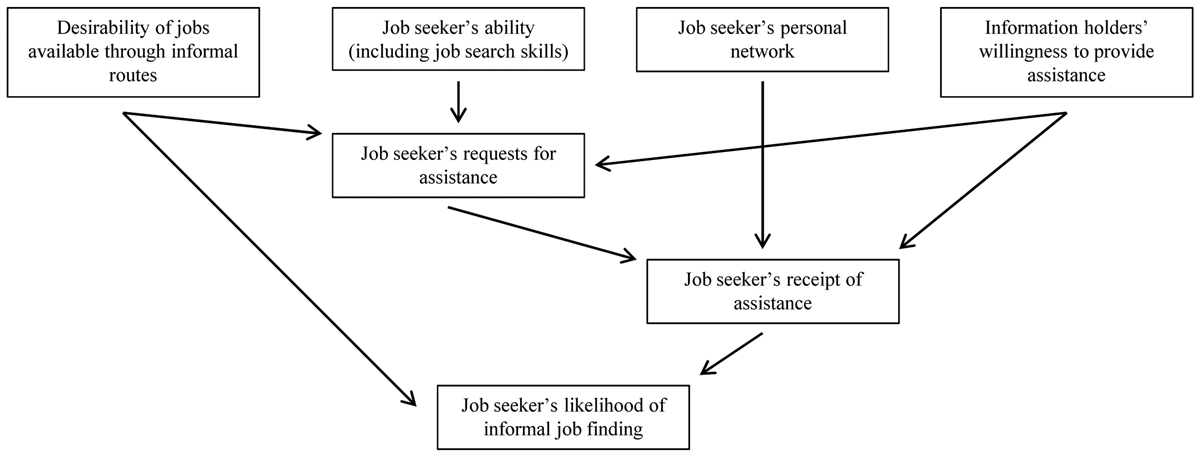
The descriptive statistics in Table 1 suggest that these measures are adequate proxies for network characteristics. As implied by the network literature, informal job finders have more years of occupational experience, are more likely to have held managerial positions in the last job, and have slightly larger household sizes. Including these variables ameliorates concerns that associations between the explanatory variables and informal job finding are reducible to network differences.
For men who change jobs due to bankruptcy, other confounding network effects are not a large concern. These men are selected at the company rather than the individual level, and if anything, we would expect men at failing firms to have networks that are less capable of providing assistance in job search (Calvó-Armengol & Jackson, 2004). Confounding network effects are a more serious concern for frequent job changers. Of course, research in the United States implies that frequent job changers should have networks that are very beneficial for job change because they contain many weak ties (Granovetter, 1995) and span structural holes (Burt, 1992). If this were the case in Japan, the confounding effect would run in opposition to the hypothesized relationship between the dependent and independent variables. However, prior research also suggests that job hopping may actually be deleterious to network formation in the Japanese context. Japanese people have lower generalized trust than Americans (Yamagishi, Cook, & Watabe, 1998; Yamagishi & Yamagishi, 1994). Possibly as a result, Japanese workers are more likely to use strong ties in informal job search than Americans are (Watanabe, 2001). Because strong tie relationships take time to establish (Watanabe, 1987, cited in Brinton, 2011), job hoppers may have fairly small, restricted coworker networks that do not provide much information.
To investigate this possibility, I examine information about the person who assisted the job seeker in finding his current job. If job hopping shrinks network size by breaking job seekers’ ties to former coworkers (or preventing formation of coworker ties in the first place), we would expect the reduction in informal job finding to be driven primarily by a reduction in jobs found through coworker ties. Thus, if frequent job changers have damaged their networks, the likelihood of informal job finding using a coworker’s help should fall with number of job separations, but the likelihood of informal job finding using help from a noncoworker should fall less or not at all. I will test this possibility using multinomial logistic regression, predicting the likelihood of using a coworker tie or noncoworker tie to find a job, compared with those who found jobs through formal methods.
A second potential source of bias is ability, including job search skills. If ability and search skills covary with the explanatory variables, this would mean that informal job finding increases for some workers not because of access to assistance, but because of their decision to seek out or avoid assistance based on their abilities. For example, research suggests that high-ability workers change jobs more frequently because they receive more desirable job offers (Hermalin, 2002; Ono, 2007). High-ability workers are also particularly likely to be head-hunted, a formal job search route. If the frequent job changers in this sample are indeed high-ability types who are contacted by head-hunters, this could lower their motivation to seek assistance from friends and acquaintances and reduce their rate of informal job finding even if family and friends are in fact willing to assist them. Similarly, men departing due to bankruptcy may have so few formal search skills that they have no choice but to rely on informal search; or they may be low-ability types who are particularly unlikely to receive offers without the intervention of friends and acquaintances. To ensure that the main effects are not solely attributable to ability, I add current salary to the regression models as an adjustment variable. High-ability workers and skilled job searchers presumably receive higher wages, so including this control provides a check that information holders’ willingness to provide assistance, not job seeker ability, drives the effects.
A third confounding possibility is the quality or desirability of jobs that use informal recruitment. Although respondents may receive assistance (such as inside information) even for jobs that do not explicitly rely on informal recruitment, more informal hiring will take place when hiring is explicitly informal. If there are differences in the quality of jobs, or types of labor markets that recruit formally and informally, this might mean that correlations between informal job finding and the explanatory variables reflect variation in job seekers’ decisions to accept jobs available through assistance, or to seek assistance in the first place, rather than variation in information holders’ willingness to provide assistance to men in different categories. In the main analysis, I therefore add adjustment variables for new firm size and for management positions in the new job. 11 This mitigates concerns that it is workers’ positioning in different labor markets with different quality jobs and different rates of informal hiring that drives relationships between the dependent and independent variables.
A second concern related to job quality is that informal job finding may lead to better jobs for infrequent job changers and men who depart due to bankruptcy, but not for others. If this were the case, higher likelihood of informal job finding in these groups would be due to their ability to achieve better outcomes through informal job search methods compared with other job changers. To test whether this is true, I run an ordinary least square (OLS) regression predicting respondents’ current annual salaries. I interact the explanatory variables with the informal job finding variable and observe whether men in the categories where informal job finding is common also receive higher salaries when they use informal job finding. If the interaction term is significant and positive in the case of bankruptcy victims, or significant and negative in the case of frequent job changers, this would suggest that use of informal job finding among infrequent job changers and bankruptcy victims may be because of the unusual desirability of jobs available to these workers through informal routes, rather than information holders’ sympathy toward bankruptcy victims and suspicion or distrust of frequent job changers.
Finally, there are other unobserved forces that may cause men to seek or request assistance that are not depicted in Figure 3. (see Sharone, 2014 for a discussion of institutional factors that influence assistance seeking.) The Working Persons data provide a unique opportunity to adjust for this source of bias because the data allow me to control for search strategy. Respondents who changed jobs were asked what sources of information they used in their job searches, whether or not that information led to a job. Response options include newspaper and online advertisements, public and private employment agencies, and of course family, friends, and acquaintances. In the final section, I restrict the analysis to only those who report using family, friends, and acquaintances and use successful informal job finding as the outcome variable. By restricting the analysis to job seekers who used informal job search methods, we can observe the likelihood of informal job finding while at least partially adjusting for job changers’ desire to seek assistance. Of course, because information holders’ willingness to help also affects job seekers’ requests for assistance (Smith, 2010), this adjustment statistically removes these indirect effects on the outcome of informal job finding. Thus, this final analysis provides a very conservative test of the theory that men who violate labor market norms receive less access to assistance because of information holders’ willingness to help.
Results
Primary Models
Logistic Regression Coefficients From Analysis of Job Finding Method.

Note. Robust standard errors in parentheses.
Reference category is other. bReference category is high school or below. cReference category is <50 employees. dBecause Pseudo R2 can be difficult to interpret, I include the percentage of observations correctly classified in each model as an alternative measure of model fit. An observation is considered correctly classified both when (a) the predicted probability of informal job finding for an individual is greater than .5, and the respondent found a job through informal methods and (b) when predicted probability is less than .5, and the respondent did not find a job informally.
p < .05. **p < .01. ***p < .001.
Model 4 adjusts for respondents’ current salaries as a way of accounting for ability and job search skill. Because of missing data on salary, the sample size is smaller in this model. The coefficients for number of job separations, bankruptcy, and feared bankruptcy remain significant, suggesting that the relationships of interest cannot be explained by higher ability of frequent job seekers, or lower ability of laid off workers.
In Models 1 through 4, the effect of number of job separations is constrained to be linear. In Model 4, for example, respondents with one job separation have a 47% predicted probability of informal job finding, compared with a 43% predicted probability for respondents with two job separations, a 39% predicted probability for respondents with three job separations, and so on.
12
However, because the relationship between job separations and informal job finding may not truly be linear, I run additional models (Model 3* and Model 4*, not shown) with number of job separations modeled as a factor variable. Figure 4 displays the predicted probability of informal job finding by number of job separations based on these two additional models, which, except for the nonlinear specification of job separations, are otherwise identical to Models 3 and 4. The nonlinear models demonstrate that the true relationship between job separations and informal job finding is indeed nonlinear. Examining the predicted probabilities based on Model 4*, we see that in fact, the predicted probability of informal job finding for workers with one, two, or three separations falls only slowly from 48%, but drops off sharply for workers with four or more separations to 32%. This suggests that information holders’ decisions about providing assistance have small to moderate effects on job seekers with only a few job changes, and more seriously limit access to assistance for the most frequent job changers.
Predicted probability of informal job finding by number of job separations.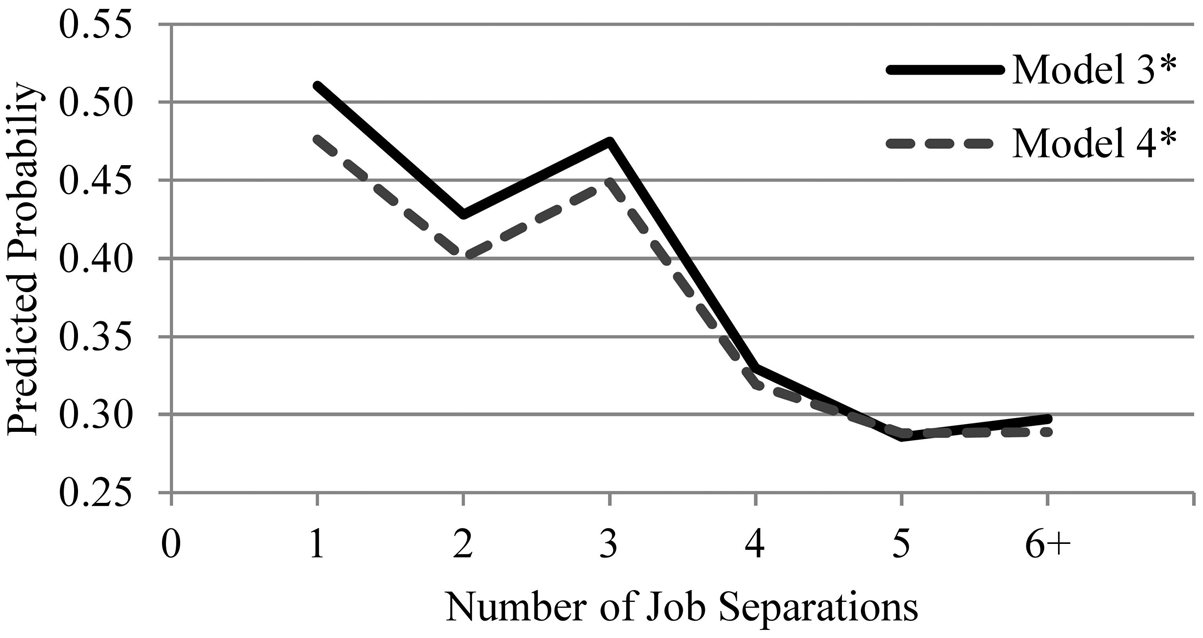
Turning to reason for leaving jobs, in Model 3, the predicted probabilities of informal job finding for men who left due to bankruptcy and feared bankruptcy are 54% and 53%, respectively, compared with only 41% for men who changed jobs for other reasons. In Model 4, men who left due to bankruptcy and feared bankruptcy are both about 16% more likely to find jobs informally, with a predicted probability of informal job finding of 53%, compared with the reference category with a predicted probability of 37%.
Supplementary Analyses
The results presented above make it clear that informal job finding is less common among men with more job separations, and more common among men who leave their jobs due to bankruptcy or feared bankruptcy, after statistical adjustments for network effects, industry demand, and ability. However, it is still possible that other confounding factors drive the observed effects, rather than information holders’ willingness or unwillingness to provide assistance. In the following section, I conduct several supplementary analyses to rule out alternative explanations for these phenomena.
Multinomial Logistic Regression Coefficients From Analysis of Job Finding Helper (n = 1,102).
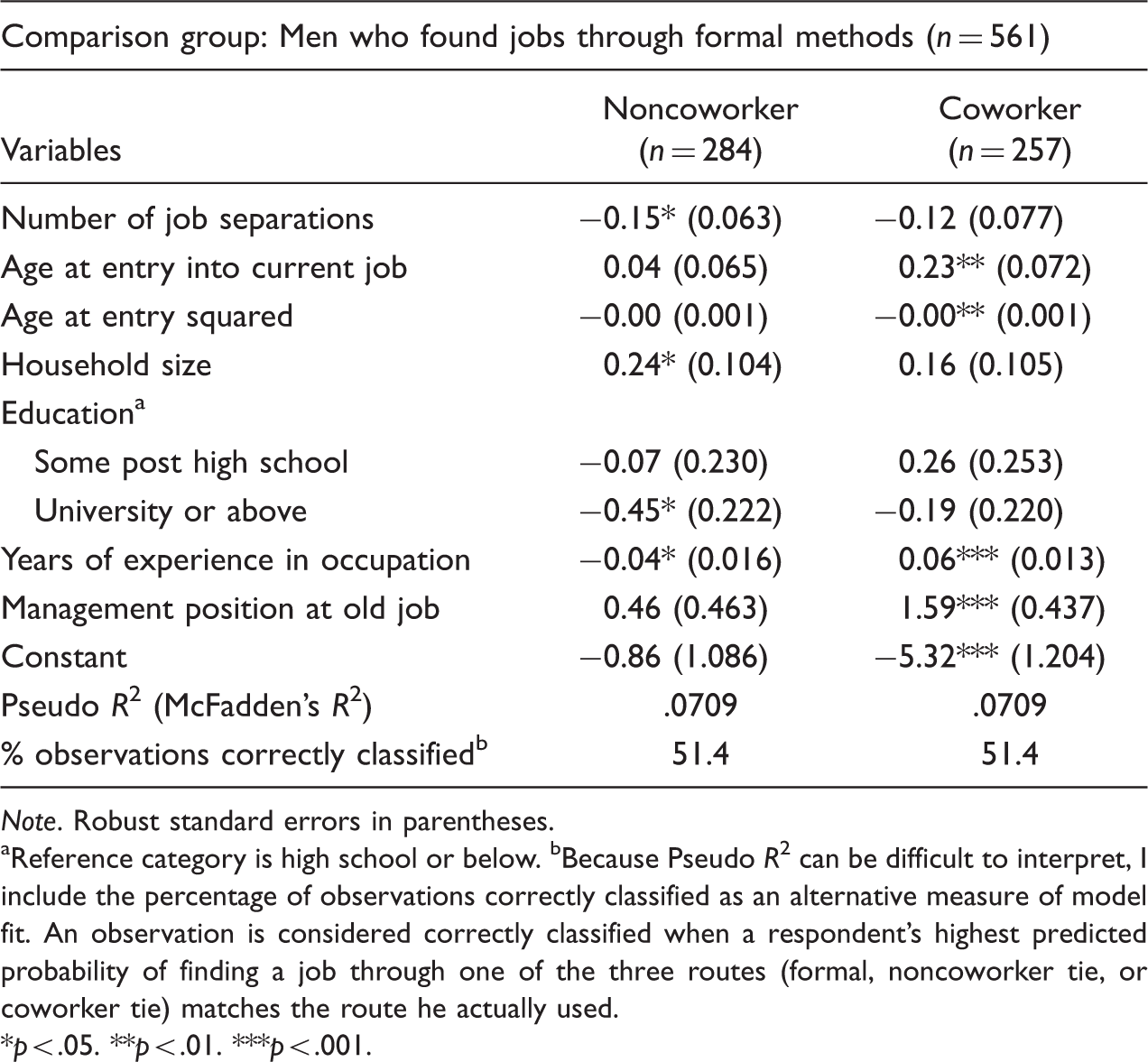
Note. Robust standard errors in parentheses.
Reference category is high school or below. bBecause Pseudo R2 can be difficult to interpret, I include the percentage of observations correctly classified as an alternative measure of model fit. An observation is considered correctly classified when a respondent’s highest predicted probability of finding a job through one of the three routes (formal, noncoworker tie, or coworker tie) matches the route he actually used.
p < .05. **p < .01. ***p < .001.
As we would expect from the network literature, this analysis shows that use of coworker ties increases with age and with occupational experience, and use of noncoworker ties declines with occupational experience. We also see that the likelihood of using both coworker and noncoworker ties declines with number of job separations, but only the coefficient for noncoworker ties reaches significance.
A nonlinear specification of the same model (not shown), plotted in Figure 5, confirms that the predicted likelihood of finding a job through noncoworkers declines more steeply with number of jobs than the likelihood of finding a job through a coworker. If frequent job-changing constricts job hoppers’ social networks, we would expect the decline in informal job finding to be concentrated among those who used coworkers for help. The fact that coefficients for both coworkers and noncoworkers are negative suggests alters’ willingness to provide assistance is a more likely explanation for the relationship between job separations and informal job finding than is different network characteristics.
Predicted probability of finding a job through a coworker or noncoworker.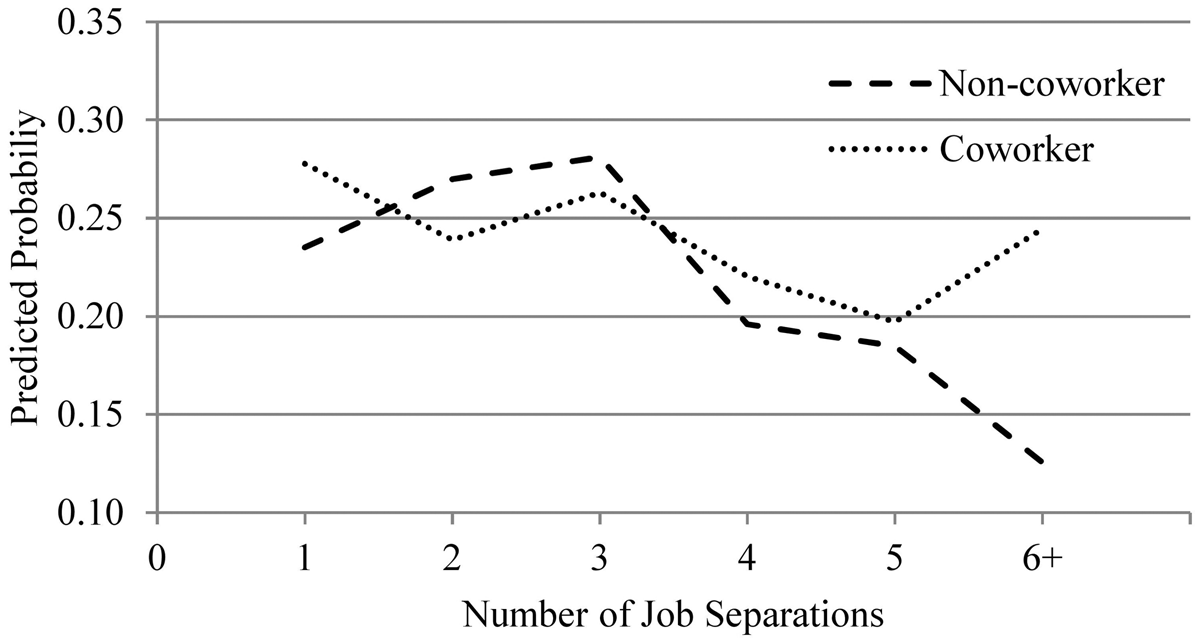
OLS Regression Coefficients From Analysis of Annual Salary.
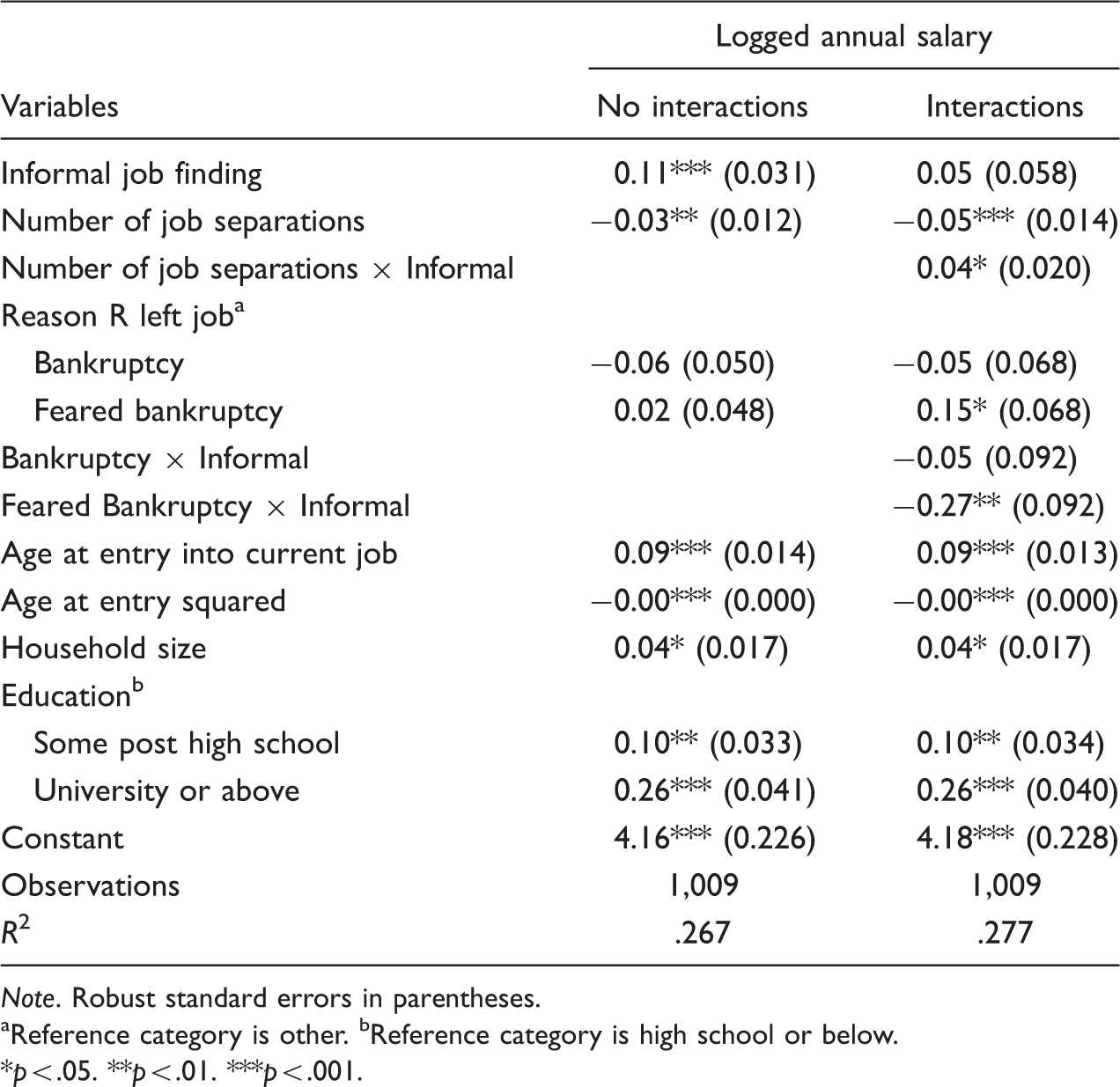
Note. Robust standard errors in parentheses.
Reference category is other. bReference category is high school or below.
p < .05. **p < .01. ***p < .001.
In the interaction model, the interaction coefficient for number of job separations and informal job finding is significant and positive. This implies that frequent job changers, who use informal job finding the least, may benefit from it the most. The interaction coefficient for bankruptcy and informal job finding is nonsignificant, but the interaction for feared bankruptcy and informal job finding is significant and negative. This group uses ties frequently, but benefits less than other job changers. In other words, there is no evidence that the groups that use informal routes the most often benefit more, so quality of jobs available through different routes does not bias the main analyses. 13
Finally, I consider the possibility that men’s job search strategies differ for reasons other than ability, as captured by the control for salary in Model 4. The Working Persons Survey asked job changers to list all sources of information they used in their job search, even if that information did not lead to a job. Of the job changers in this sample, 561 (51%) used only formal methods in their job search, 213 (19%) used only informal methods, and the remaining 328 respondents (30%) used both formal and informal methods. Of those who used both types of methods, 70% ultimately took jobs through informal routes. The final analysis looks at job changers who used informal methods alone or in combination and tests how likely these respondents were to actually take a job found through informal methods. As in the main analysis, I assume that, on average, those who actually took jobs they found through informal methods received more and better assistance than those who used ties but took jobs they found through formal methods.
Logistic Regression Coefficients From Analysis of Job Finding Method: Respondents Who Used Ties.
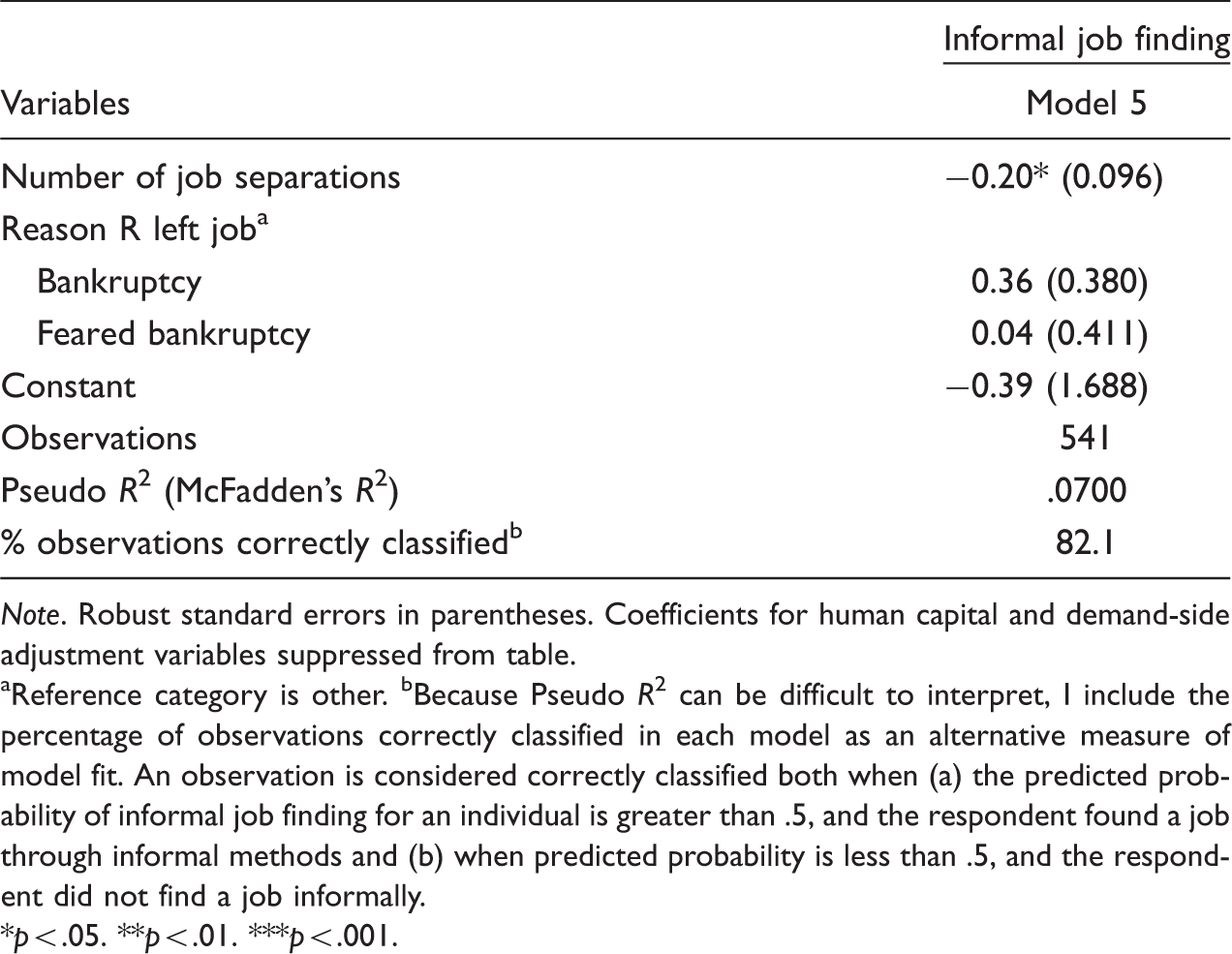
Note. Robust standard errors in parentheses. Coefficients for human capital and demand-side adjustment variables suppressed from table.
Reference category is other. bBecause Pseudo R2 can be difficult to interpret, I include the percentage of observations correctly classified in each model as an alternative measure of model fit. An observation is considered correctly classified both when (a) the predicted probability of informal job finding for an individual is greater than .5, and the respondent found a job through informal methods and (b) when predicted probability is less than .5, and the respondent did not find a job informally.
p < .05. **p < .01. ***p < .001.
Discussion
In this article, I have argued that mechanisms from the information holder literature (Marin, 2012; Smith, 2005, 2007, 2010) imply that job seekers who violate labor market norms will receive less job search assistance. This is because information holders are unwilling to bear the costs that accompany assisting a deviant job seeker, such as potential damage to their own reputations. I have used these mechanisms to derive two predictions about job seekers’ access to assistance in Japan.
In support of Hypothesis 1, I have found strong evidence that frequent job change decreases the likelihood of informal job finding. I have shown that it is unlikely that we can attribute this to networks that are damaged by job change, to desirability of jobs available through informal routes for infrequent job changers, to ability, or even to job seekers’ search strategy. My evidence therefore indicates that the decline in informal job change is most likely due to information holders’ unwillingness to provide assistance.
In support of Hypothesis 2, I likewise found strong evidence that men who leave their jobs due to bankruptcy or feared bankruptcy are much more likely to find jobs informally than men who leave for other reasons. For these men, networks are an unlikely explanation for their higher rates of informal job finding because they are selected at the firm level rather than the individual level. They also do not appear to win outsized benefits from informal job finding (and one model suggests men who leave due to feared bankruptcy may pay a penalty), so quality of jobs cannot explain this outcome. However, after statistically adjusting for search strategy, these men are not significantly more likely to find jobs informally than other men. This null result may be because of the relatively small sample size for this test, but I also cannot rule out the possibility that unobserved factors unrelated to alters’ willingness to provide assistance influence their search strategy and drive higher rates of informal job finding. For example, the victims of bankruptcy may feel more desperate than other job seekers and may press friends and acquaintances harder for assistance than men who do not have an immediate need for a new job. On the other hand, the null finding in the final test does not necessarily indicate that alters’ increased willingness to assist these conformist job changers is not at work. After all, jobseekers’ knowledge of information holders’ willingness to assist also drives search strategy (Smith, 2007). The large differences in informal assistance between the bankruptcy group and other job seekers could be a combination of bankruptcy victims’ desperate pursuit of assistance, and information holders’ increased willingness to provide it. Overall, this study provides strong evidence that social norms around job change make it more difficult for frequent job changers to access job search assistance, and moderate evidence that these norms make it easier for men who change jobs due to bankruptcy to receive assistance.
This study also has some limitations. First, the factors that influence job seekers’ receipt of assistance, including network composition, ability, and desirability of jobs, are measured by proxy variables. However, correlations between the proxy variables and the outcomes follow the patterns we would expect if these variables do capture the underlying effects of interest, mitigating concerns about their reliability. Second, the outcome variable is also an imprecise measure of receipt of assistance; undoubtedly, some job seekers who received a great deal of assistance did not find jobs informally, while others who received only a little, did. Nonetheless, based on the results in Table 4, it seems safe to assume that this error is random, and that while this would make it harder to detect an effect than a more precise measurement, it does not bias the results. Finally, these data do not allow me to directly observe information holders’ decision-making processes. While I have shown that deviant job seekers find jobs informally less often, and that alters’ willingness to assist is a more plausible explanation for this phenomenon than networks, ability, or desirability of jobs, I can only assert that alters’ greater willingness to assist infrequent job seekers and victims of bankruptcy is because of the greater ease and safety that comes from helping these relatively conformist job seekers. However, because the hypothesis is based on studies of information holders’ decision-making process, at the very least the results provide further, if not conclusive, support for the claim that labor market norms, and job seekers’ conformity and deviance can be useful predictors of access to job search assistance.
Conclusion
In addition to demonstrating for the first time that alters’ willingness to provide assistance affects outcomes for job seekers, my results have several implications for inequality and labor market studies of Japan. The most socially desirable and financial remunerative path for men in Japan remains for them to stay in the same job from graduation until retirement (Rebick, 2005), as the results of Table 4 demonstrate. Frequent job changers are already disadvantaged in that they lack the seniority benefits that accrue to employees with longer tenure (Moriguchi & Ono, 2005). The current study makes clear that information holders’ reluctance to assist these job seekers compounds that disadvantage.
Furthermore, the norms against job change that we can observe in these data are likely to discourage or prevent workers from changing jobs, even when it is in their economic interests to do so. Although the long-term employment system is designed to balance the interests of workers in stability, and the interests of firms in reducing the cost of filling open positions (Jacoby, 2005), to the extent that the norms that accompany the low-mobility regime discourage workers from changing jobs to improve fit or salary, the system disadvantages both workers and employers. Indeed, the informal social penalties job changers face may lower the average quality of fit between worker and job, contributing to the extremely low levels of job satisfaction that cross-national surveys (e.g., Lincoln & Kalleberg, 1990) have found among Japanese workers.
Although this normative regime disadvantages frequent job changers, my results also suggest that when men break the rules through no fault of their own—when they leave their jobs due to company financial instability—the price of deviance may be less. If high rates of informal job finding among the financial instability group are due to access to assistance, this would indicate that the very norms that discourage job change to some extent protect these vulnerable workers from downward mobility. This is not to say that men who experience layoffs do not face hardship. However, the norms that have developed in concert with the formal institutions of the Japanese labor market shield this particular category of vulnerable job seeker from the worst effects of labor market inflexibility. Counterintuitively, this implies that men who lose their jobs due to company financial instability in Japan may be advantaged compared to their counterparts in countries with more flexible labor markets because they receive a larger share of available network assistance.
Further research should explore the predictive effect of job seeker deviance in other contexts. The mechanisms I have proposed do not only hold in Japan: In fact, in any industrial or postindustrial labor market, we could likewise expect deviant job seekers to receive less assistance because information holders always face reputational costs for providing substantive assistance to deviant job seekers, or fear wasting time and effort by providing even minimal assistance to hopeless cases who will never find jobs. Of course, the exact cost-benefit calculus is highly dependent on particular norms and institutional contexts (see Sharone, 2014). For example, excessive job change is probably a warning signal of deviance in the United States as well as in Japan. However, in Japan, hiring decisions are of particular importance, both because of the implicit guarantee of long-term employment, and also because of the legal difficulties involved in firing an undesirable employee. Moreover, in the low-mobility regime, information holders are highly dependent on the good opinion of one employer. This makes the costs of assisting a frequent job changer especially high in Japan. On the other hand, in the United States, employers can more easily dismiss undesirable employees, and information holders are less dependent on relations with one employer. Thus, although U.S. information holders may still be less willing to assist job hoppers than more stable employees, effect sizes would likely be smaller, and the threshold for considering job change excessive could be as high as 10 or even 20 jobs, rather than two or three jobs as in the Japanese context.
Another fruitful area for further research is the interaction between deviance and networks. While deviant job behavior in the labor market can be expected to reduce current network alters’ willingness to provide assistance, over the long term, deviance is also likely to reduce alters’ willingness to maintain ties with the job seeker. Thus, deviance may be important for understanding access to assistance not only because of its effects on alters’ willingness to assist but also because of its effects on network formation. These relationships would best be captured in a longitudinal study of job search patterns, deviance, and networks.
Network approaches have provided great insight into who receives assistance and who does not, but they cannot explain why information holders often withhold assistance from job seekers. To fully understand patterns of job search assistance and the inequalities they generate, we need to look beyond social structure and to social norms, how they shape alters’ willingness to provide assistance, and how they influence the formation (and dissolution) of networks themselves. As I have shown in this analysis of Japanese job changers, deviance has a price: Job seekers who violate social norms jeopardize their access to job search assistance.
Footnotes
Acknowledgments
I would like to thank Victor Nee, Kim Weeden, Paromita Sanyal, Filiz Garip, and Hiroshi Ono; the members of the Economy and Society Lab, the Sociology Practicum, and the East Asia Political Economy Reading Group at Cornell; the participants in Hirohisa Takenoshita’s seminar on inequality at Sophia University; and the anonymous reviewers at Work and Occupations for their thoughtful suggestions on this manuscript.
Declaration of Conflicting Interests
The author declared no potential conflicts of interest with respect to the research, authorship, and/or publication of this article.
Funding
The author received no financial support for the research, authorship, and/or publication of this article.