






Abstract
Utilizing a field experiment design, this article examines whether discrimination based on any combination of job applicant gender and recruiter gender occurs in the first stage of the recruitment process, that is, selecting applicants to be contacted. This study includes 1,643 job applications in the Swedish labor market. Overall, based on the callbacks received, male recruiters, unlike female recruiters, are found to contact male applicants more often than female applicants. The results show a pro-male bias by male recruiters in gender-mixed occupations, whereas no significant gender differences in callbacks by recruiter gender are found in male- and female-dominated occupations.
Gender disparities in labor market outcomes are well-documented in the research. In general, men have an advantage over women not only in terms of wages (e.g., Charles, 2011) but also when it comes to reaching positions of authority, and these disparities tend to increase as men and women become parents (e.g., Budig & Hodges, 2010 [United States]; Bygren & Gähler, 2012 [Sweden]). There are different explanations for these gender disparities in the labor market. While they may have to do with the choices men and women make, not least following family formation, it has been suggested that discriminatory practices by employers may play an important role for the different career-related outcomes experienced by men and women (Bygren & Gähler, 2012; Gangl & Ziefle, 2009; Mandel & Semyonov, 2006).
While previous research has looked at gender discrimination in the labor market, particularly in recruitment (e.g., Goldin & Rouse, 2000; Riach & Rich, 2006; Rivera & Tilcsik, 2016; Weichselbaumer, 2004), only a few studies (Booth & Leigh, 2010; Carlsson, 2011) have looked at the role of the employer’s, that is, recruiter’s, gender in relation to the gender of the job applicant in the recruitment process (see Baert, 2018 for an excellent overview of discrimination studies using correspondence testing). However, due to the design of these studies (e.g., the age of the applicants and the type of occupations studied), further research on the topic is needed. To address this need, the purpose of this study is to investigate whether male and female recruiters discriminate, positively or negatively, job applicants on the basis of gender. As it is based on the use of a field experiment, in which the gender of the job applicant is randomly assigned to each application, the study presented in this article is able to isolate causal effects (cf., Gaddis, 2018). This is in contrast with studies that look at the residual effect in survey or administrative data, which often lack information about all the characteristics related to the productivity of job applicants that are available to employers.
Here, the term discrimination refers to the differential treatment of job applicants as measured by callbacks, that is, employers’ responses to job applications. Thus, this study aims to answer the question: Does the treatment of male and female job applicants differ by the gender of the recruiter in the first stage of the recruitment process, that is, when selecting which applicants are contacted and interviewed? Are male recruiters more prone to contact male job applicants rather than female applicants, and do female recruiters more often contact women than men? Moreover, how do these patterns look in gender-mixed, male-dominated, and female-dominated occupations?
Studying discrimination on this basis is important because if discrimination takes place, it may not only harm the applicant who is discriminated against but may also be a disadvantage for the employer and the labor market at large, as it may lead to recruitment decisions being made not on the basis of competence but on the basis of recruiters choosing to contact applicants of the same gender as themselves. Discrimination of this kind may lead to problems such as decreased labor force mobility and a less efficiently functioning labor market.
If individuals of one gender, for example, men, who already have an advantage over women in many respects in the labor market, were to discriminate against applicants of the opposite gender, this might even produce a situation in which the latter would not even be considered for positions for which the recruitment is done by the former. Also, if job applicants were to expect discrimination by recruiters of the opposite gender, they may be hesitant to apply for jobs where they believe the recruitment is done by a person of the opposite gender. If these things were true, discrimination of this kind would contribute to reinforcing gender disparities in labor market outcomes. Potential discriminatory mechanisms of the same kind may also exist throughout the career ladder, thereby influencing gender inequality even at higher levels. Gender discrimination based on the gender of the recruiter could also contribute to gender segregation in the labor market if the underrepresented gender were to be discriminated against in gender-concentrated occupations. Thus, it is also important to study this topic both in order to detect potential discrimination and to raise awareness about potential discriminatory practices in the recruitment process.
In an international comparison, Sweden and the other Nordic countries are often regarded as forerunners in the field of gender equality, with relatively small gender differences in labor market outcomes such as employment rates (Organisation for Economic Co-operation and Development, 2017; United Nations Development Programme, 2016). It is therefore particularly interesting to study the potential interaction effect of gender in the Swedish context, which is characterized by some of the most gender egalitarian attitudes in the world (Brandt, 2011; Inglehart & Norris, 2003).
Theory and Previous Research
Two main theories are often distinguished in the discrimination literature: statistical discrimination (Phelps, 1972; Arrow, 1973) and taste-based discrimination (Becker, 1971). Statistical discrimination refers to a discrimination of individuals based on generalized beliefs about the characteristics of the group to which an individual belongs that occurs when information about the actual productivity of the individual is incomplete (Arrow, 1973; Phelps, 1972). If employers rely on beliefs and stereotypes about the average productivity and behavior of women as a group when evaluating individual job applicants, it may lead to a differential treatment of male and female applicants. Beliefs concerning the lower productivity of women in comparison to men are often related to parenthood, that is, women (of fertile ages) are either seen as being at risk of becoming mothers or have already entered motherhood, with motherhood being associated with negative connotations such as decreased work commitment and competence.
However, as a reliance on stereotypes and a lack of information are fundamental to statistical discrimination, this type of discrimination by men against women might be expected only to occur in male-dominated occupations and not in female-dominated occupations where male recruiters have knowledge about the actual productivity of female employees and thus do not need to rely on stereotypes. Conversely, one would expect discrimination by female recruiters against male applicants only in female-dominated occupations.
Taste-based discrimination occurs when an individual has a negative preference for, or prejudice against, a certain group of individuals, independent of productivity. According to Becker (1971), mutual social and physical distance is an important determinant of discrimination by an individual against a group. If this is true, one would expect recruiters to have a positive taste for job applicants of the same gender as themselves due to the greater social and physical distance that exists between themselves and individuals of the opposite gender as a group, regardless of the gender composition of a given occupation. Thus, a key difference between the theories of taste-based discrimination and statistical discrimination is that the former has to do with a general animus based on a characteristic, whereas the latter arises from a stereotype or a lack of information.
Social psychologists use the concept of in-group favoritism (e.g., Tajfel, Billig, Bundy, & Flament, 1971) in relation to discrimination, and several studies have shown individuals to discriminate in favor of their in-group members relative to members of other groups, with gender being one important basis for such groupings (cf., Brewer & Kramer, 1985). In sociology, the tendency of people to select into relationships with similar others is referred to as homophily (e.g., Kandel, 1978; McPherson, Smith-Lovin, & Cook, 2001). Thus, based on these ideas, if homophily or in-group bias based on gender exists, male recruiters would prefer male job applicants over female applicants, that is, would discriminate against women, whereas female recruiters would prefer to recruit women over men. The underlying premise behind the idea of favoring members of one’s own category appears somewhat similar to Becker’s concept of taste-based discrimination.
In one U.S.-based study, both female and male student evaluators rated mothers applying for a job significantly lower than childless women on a host of measures, while female evaluators penalized mothers somewhat less than nonmothers by comparison with male evaluators (Correll, Benard, & Paik, 2007). In Sweden, women often reduce their work hours after becoming parents, while men usually continue working full time (Kennerberg, 2007). Also, mothers use almost three quarters of paid parental leave days (73% in 2016; Swedish Social Insurance Agency, 2017, p. 20).
Scholars conducting field experiments have detected gender discrimination in the recruitment process in a number of different countries. Discrimination against men is found in female-dominated occupations, whereas discrimination against women is found in male-dominated occupations (cf., Riach & Rich, 2002 [a review of discrimination studies from a number of countries, for example, Australia, Austria and the United States 1 ]; Riach & Rich, 2006 [the U.K.]; Weichselbaumer, 2004 [Austria]). However, a French study (Petit, 2007) found no significant gender differences in employer callbacks independent of job type and no discrimination based on parenthood status.
In Sweden, only slight gender differences in callback rates have been found (Ahmed, Andersson & Hammarstedt, 2013 [focus on discrimination based on sexual orientation]; Arai, Bursell & Nekby, 2016 [when sending equivalent applications]; Bygren, Erlandsson, & Gähler, 2017; Carlsson, 2011). While the results presented by Carlsson (2011) reveal no gender discrimination in male-dominated occupations, his findings for female-dominated occupations show some discrimination against men. Bygren et al. (2017) found no discrimination based on gender, parenthood, or any combination of the two in either high- or low-qualified jobs.
However, Bursell (2014), on the basis of a correspondence test of fairly young fictitious job applicants in the Swedish labor market, found employers in male-dominated occupations to engage in gender overcompensation by favoring female job applicants, while employers in female-dominated occupations favored male applicants with foreign-sounding names, thereby engaging in both ethnic and gender overcompensation. Furthermore, results from another Swedish study indicate more discrimination by employers against ethnic minority men than against ethnic minority women (Arai et al., 2016). On the other hand, stereotypical female characteristics (e.g., being warm and sympathetic) were rated as being more important for success in female-dominated occupations by students in the United States, whereas stereotypical male characteristics (e.g., being competitive and dominant) were viewed as more important for success in male-dominated occupations (Cejka & Eagly, 1999).
Only a small number of field experiments have examined the interaction of the gender of the recruiter and the job applicant, respectively, and not much evidence of discrimination based on this interaction has been found. Carlsson (2011) found that the recruiter’s gender did not influence the difference in callback rates between job applicants in general in Sweden, although he reported some indication of male recruiters favoring female applicants in male-dominated occupations (significant at the 10% level). According to the findings from a field experiment focused on female-dominated occupations in the Australian labor market, female applicants were more likely to be contacted in female-dominated occupations, and especially in occupations in which the proportion of women was 80% or higher, but the gender of the recruiter did not seem to matter (the coefficient for the interaction between female applicant and female recruiter was positive but nonsignificant), and no significant gender difference was found in less female-dominated occupations (Booth & Leigh, 2010).
In these studies, however, the fictitious applicants were either fairly young, between 24 and 29 years of age in the Swedish study (Carlsson, 2011), or they were applying for entry-level positions in female-dominated occupations (Booth & Leigh, 2010). In the former study, not signaling parenthood may have been taken as an indication of the applicants not having children, and recruiters may not consider the work-related disadvantages associated with motherhood as being as great a risk for younger applicants as for female applicants already in their 30s, with or without children. In the latter study, although age was not specified, the risks associated with motherhood, as considered by the employer, may not be as large in entry-level positions as in more qualified jobs in which replacing an employee and training a new one is likely to be more problematic and costly. 2 Furthermore, the external validity of the latter study is limited by the fact that it focused exclusively on female-dominated occupations.
At the same time, a study by Bagues and Esteve-Volart (2010) based on public examinations data for positions in the Spanish judiciary found that female candidates were significantly less likely to be hired if the proportion of women in the evaluation committee was relatively high. The authors’ preferred explanation was that the quality of male candidates was overestimated by committees with a female majority. However, the study only examined the final decision of the committees, not the individual votes of the evaluators.
To summarize, previous field experiments looking at gender discrimination among job applicants based on the recruiter’s gender (Booth & Leigh, 2010; Carlsson, 2011) have found no evidence of such discrimination. However, the study designs, that is, the use of fairly young applicants on the one hand and the inclusion of only entry-level positions in female-dominated occupations on the other, might limit the generalizability of such findings, as the effects might be local to specific jobs or age groups. One might therefore still expect to find gender discrimination on the basis of the recruiter’s gender in this study, which examines 31-year-old applicants across a number of occupations.
While a greater social and physical distance to people of the opposite gender is assumed to result in taste-based discrimination against individuals of the opposite gender, people have a tendency to engage in homophily and to discriminate in favor of in-group members relative to out-group members, for example, the opposite gender. Thus, based on the theory of taste-based discrimination, the hypotheses are (Hypothesis 1) that male recruiters contact male applicants more often than female applicants, that is, discriminate against women regardless of the gender composition of given occupation and (Hypothesis 2) that female recruiters contact female applicants more often than male applicants, that is, discriminate against men regardless of the gender composition of a given occupation.
On the other hand, based on the statistical discrimination perspective, an assumption that men are in general characterized by higher productivity levels would be expected to lead to statistical discrimination against women by men in male-dominated occupations, and male recruiters would only be expected to contact male applicants more often than female applicants in such male-dominated occupations (Hypothesis 3). In female-dominated (and gender-mixed) occupations, male recruiters have more contact with women and therefore a greater knowledge of their work abilities, which would imply that discrimination by men against women should not occur in female-dominated occupations due to the availability of more information and, by extension, less dependence on stereotypes. Conversely, based on the theory of statistical discrimination, women would only be expected to statistically discriminate against men in female-dominated occupations, that is, female recruiters would only be expected to contact female applicants more often than male applicants in female-dominated occupations (Hypothesis 4).
Method
To study potential discrimination in the Swedish labor market, a correspondence test was conducted by sending fictitious applications in response to real job openings, and the employer callbacks for these applications were observed. In this design, the applications are almost identical, with the only difference being that they represent the different groups of interest, that is, men and women, which are signaled by applicant names.
Field experiments have become increasingly popular in the study of discrimination, partly due to the shortcomings of other methods with regard to external validity. For example, laboratory experiments performed under strictly controlled conditions lack the real-world context, whereas analyzing actual recruitment documents or introducing anonymous application procedures in a specific company involves selection issues, as only companies willing to participate can be studied. Also, when it comes to the use of surveys and questionnaires, there seems to be a difference in what employers say and what they actually do in recruitment situations (e.g., Firth, 1981; Pager & Quillian, 2005). While analyzing large-scale observational data is interesting in many respects, it is problematic to use the residual gap between the groups of interest as evidence of discrimination, as information restrictions may play a role. Therefore, although the aforementioned methods have other advantages, field experiments in the form of correspondence tests are seen as a superior means of detecting discrimination because they are implemented in a real-world context while still allowing the researcher a high degree of controllability (cf., Gaddis, 2018, for a discussion of the correspondence testing method and its advantages).
The use of written applications in correspondence testing allows the researcher to control for all the applicant information the employer receives, thereby limiting problems concerning unobservable variables and yielding a more objective measure of discrimination than the use of real test persons. 3 The high degree of controllability also means that other applicant-related characteristics can be altered, thereby contributing to the avoidance of measuring very specific local effect, which in turn leads to higher external validity. 4 However, there are some ethical concerns associated with the method, that is, a lack of informed consent, as the employers cannot be informed about the study.
Experimental Design
A correspondence test consisting of 2,144 fictitious job applications was performed between October 2013 and June 2015, and the employer callbacks were observed. Jobs were mainly applied for in and near Sweden’s three largest cities, that is, Stockholm (including the Mälardalen area), Gothenburg, and Malmö. The jobs were found on the Swedish Employment Agency’s website, which is the largest database for job search in Sweden. Information from the job announcement, such as the gender of the contact person (indicated by a name), was recorded if available. Job applications were restricted to vacancies that accepted applications submitted by e-mail or as attachments via a website but that did not require entering a social security number or filling out the applicant’s qualifications in an online form. 5
For the analysis, the recruiter’s gender is determined firstly on the basis of who made contact with the applicant (name is taken as a signal of gender) and if no such information was available or no contact was made, on the basis of the contact person named in the announcement. 6 This study only includes observations for which there is information on the recruiter’s gender. Thus, jobs for which there is no information on the gender of the recruiter (439 jobs) or for which the announcement named both female and male recruiters (62 jobs) are excluded, thereby yielding a final sample of 1,643 job applications. In most cases, the recruiter’s gender in the job announcement was the same as for the person who contacted the applicant. 7 This fact suggests that one potential problem with the design has been avoided, that is, that of employers using male recruiters to contact male applicants and female recruiters to contact female applicants.
Jobs were applied for in 18 occupations (which were combined into 15 categories for the analysis): accountant, auditor, assistant nurse, chef, cleaner, elementary school teacher, computer science engineer/programmer, engineer in machine technology/industrial economics/electronics, financial assistant, high school teacher, nurse, preschool teacher, receptionist, salesperson, and store personnel/cashier. These occupations differ in terms of their gender and immigrant composition, educational requirements, and sector (see Bursell, 2014). They are also reasonably typical of occupations in the Swedish labor market: Jobs were applied for in 7 of the 10 largest occupations and 14 of the 30 largest occupations.
To distinguish gender-concentrated occupations, three dummy variables indicating the gender composition of the occupation (Statistics Sweden, 2012) have been created for the analysis. Occupations in which the proportion of women is greater than 60% are defined as female-dominated occupations, that is, store personnel/cashier, financial assistant, preschool teacher, elementary school teacher, cleaner, accountant, receptionist, nurse, and assistant nurse. Occupations in which the proportion of men is greater than 60% are defined as male-dominated, and these include salespersons and all engineer occupations in the study. The remaining occupations, that is, high school teacher, chef, and auditor, in which the proportion of women is 40% to 60% are defined as gender-mixed occupations. 8
One application was sent by the author in response to each job opening, either by e-mail or via a website (depending on which method was specified in the job announcement). This method, in contrast to the sending of two or more applications for each vacancy, allows for the use of applications that are identical, rather than merely having equivalent qualifications, minimizes the burden on the employer (which can be regarded as an ethical advantage), and decreases the risk of being detected by the employer (cf., Vuolo, Uggen, & Lageson, 2018). Gender was signaled by the name of the applicant (only distinctive female and male names were used) and was randomly assigned to each application. A computer software package (Lahey & Beasley, 2009) was utilized to randomize the name and other characteristics in the applications. Age was held constant at 31 years, which allows the applicants to be old enough to have attained higher education and some work experience while still not having climbed too high on the career ladder. All applicants had an occupation-specific education and employment history from Sweden. Also, information regarding other applicant-related characteristics that was not of relevance for this study was varied randomly (see Table A1 and Bygren et al., 2017).
Each application consisted of an application letter and a simple curriculum vitae, both unique to the occupation. The documents included the applicant’s personal details (name, date of birth, postal address, phone number, and e-mail address). The curriculum vitae briefly listed previous workplaces, education, language skills (all applicants state Swedish as mother tongue), and computer skills. The application letter was a short biography with information about the applicant’s prior work experience and qualifications together with some personal information. Professional recruiters and practitioners were consulted in order to make sure the applications appeared realistic.
All fictitious applicants were assigned e-mail addresses, telephone numbers connected to a voicemail (a message with the name of the applicant and a request to leave a message was played after a few ring signals), and real postal addresses at which nobody with the same name as the applicant was registered as living. Here, a callback is defined as a nonnegative response from the employer by e-mail or phone (automatic replies were ignored), for example, job offer, invitation to an interview, or a request for more information or to contact the recruiter. Thus, a callback can be taken as a sign of interest in the applicant. If a callback was received, the employer was promptly informed that the applicant was no longer interested in the job.
Results
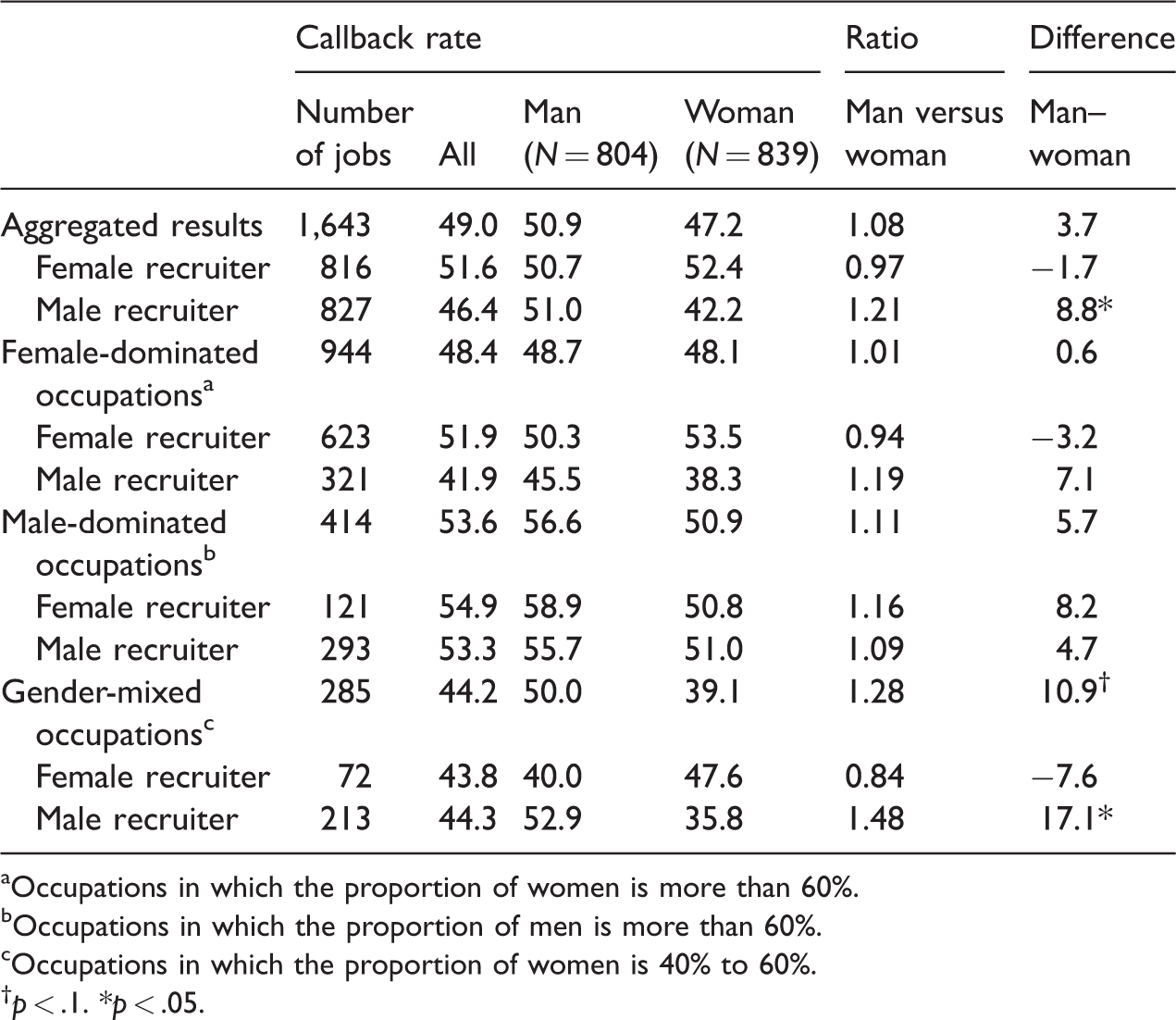
The total callback rate for the sample is 49.0% and is calculated by dividing the number of positive callbacks by the total number of applications sent. In line with previous studies from Sweden (Ahmed et al., 2013; Bygren et al., 2017; Carlsson, 2011), men applying for a job received somewhat more callbacks than women, the callback rates being 50.9% for men and 47.2% for women, but here the difference is not statistically significant. 9
Table 1 presents the number of job applications, the proportion of male and female recruiters and applicants, and the callback rates for the different categories. Male recruiters contact men more often than women applying for a job, with callback rates of 51.0% and 42.2%, respectively, yielding a difference of 8.8 percentage points. With a p value of .011, the difference is statistically significant. Thus, support is found for Hypothesis 1 that male recruiters, in line with taste-based discrimination theory, discriminate in favor of men regardless of occupational type.
Callback Rates by Job Applicant Gender, Recruiter Gender, and Type of Occupation.
aOccupations in which the proportion of women is more than 60%.
bOccupations in which the proportion of men is more than 60%.
cOccupations in which the proportion of women is 40% to 60%.
†p < .1. *p < .05.
Another way to understand the gender discrimination found among male recruiters is to look at the ratio of man versus woman presented in Table 1. The ratio of 1.21 indicates that 10 job applications sent by a male applicant and 12 job applications sent by a female applicant with identical qualifications would result in the same expected number of callbacks from a male recruiter. The callback rates for female recruiters are 50.7% and 52.4% for male and female applicants, respectively. This result is in line with Hypothesis 2, that female recruiters, also in line with taste-based discrimination theory, prefer female job applicants. However, as the rather small difference of 1.7 percentage points in callbacks between male and female applicants for female recruiters is not statistically significant, Hypothesis 2 is not supported.
When it comes to the occupational gender composition, as presented in Table 1, male applicants receive more callbacks than female applicants in all occupational categories, regardless of the proportion of women in a given occupation. The differences in callbacks between men and women are 0.6, 5.7, and 10.9 percentage points, respectively, in female-dominated, male-dominated, and gender-mixed occupations, but only the difference in the gender-mixed occupations is statistically significant and only at the 10% level. However, the absence of a more powerful level of significance may be due to the number of observations, that is, the number of job applications sent for gender-mixed occupations (285 jobs) is rather small in comparison to the other occupational categories.
It is important to note that, as shown in Table 1, female recruiters are clearly overrepresented in the data in female-dominated occupations—an occupational category that comprises 57% of the sample—while male recruiters are clearly overrepresented in male-dominated occupations. This fact, together with the differences in callbacks, essentially maintains a level of gender segregation across occupations. Also, in female-dominated occupations, there is a clear difference in callback rates (for anyone) between female and male recruiters.
Figure 1 illustrates the main finding that male recruiters contact male applicants more often than female applicants, but it also shows that female applicants are more often contacted by a woman than a man. The difference in callback rates for female applicants between male and female recruiters is 10.2 percentage points, and the difference is statistically significant (p = .003). For male applicants, there appears to be no difference in callbacks by the gender of the recruiter.
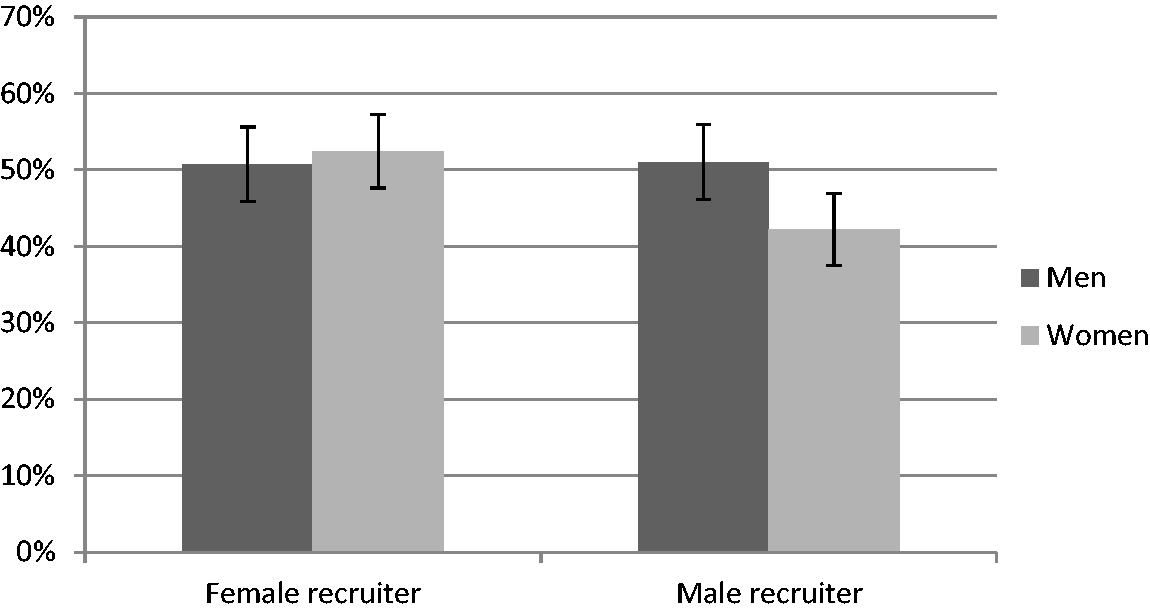
Callback rates by gender of job applicant and gender of recruiter (N = 1,643; 95% confidence intervals).
Similarly, Figure 2 displays the callbacks made to male and female applicants by the recruiter’s gender in gender-mixed and male- and female-dominated occupations. As expected based on statistical discrimination theory, female recruiters contact female applicants more often than male applicants in female-dominated occupations, but the difference is small (3.2 percentage points) and not statistically significant. Therefore, Hypothesis 4 regarding a pro-female bias by female recruiters in female-dominated occupations is not supported. Both female recruiters and male recruiters are found to contact male applicants more often than females in male-dominated occupations, the differences being 8.2 and 4.7 percentage points, respectively. These differences are not statistically significant however. Although this finding is in line with Hypothesis 3 concerning a pro-male bias in callbacks by male recruiters in male-dominated occupations, the hypothesis is not confirmed, as the difference is not statistically significant. However, one should be cautious in interpreting null results here because a type II error cannot necessarily be ruled out. This is because the sample sizes for positive outcomes become small when cells are split more finely.
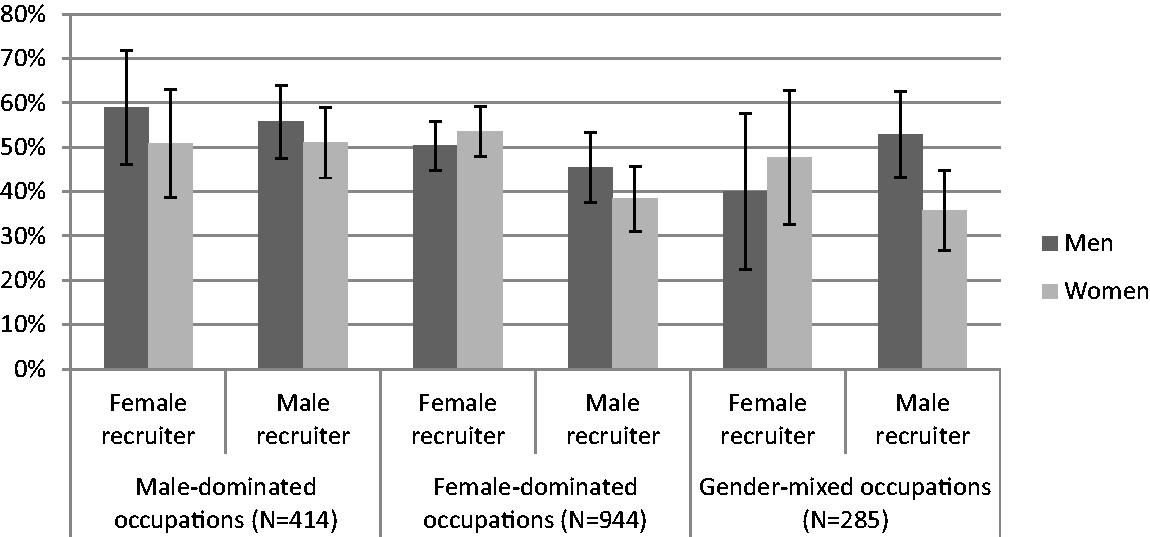
Callback rates by gender of job applicant, gender of recruiter, and occupational gender composition (95% confidence intervals).
As shown in Table 1 and illustrated in Figure 2, in gender-mixed occupations, male recruiters contact male applicants considerably more often than female applicants, the difference being 17.1 percentage points and statistically significant (p = .012). This finding of a significant pro-male bias by male recruiters in gender-mixed occupations is also in line with taste-based discrimination and Hypothesis 1, whereas it is not in line with the argument based on statistical discrimination that men would only discriminate against women in male-dominated occupations (Hypothesis 3).
To control that the results are not due to sampling variation in occupation and other job- and applicant-related characteristics, Table 2 presents the linear probability regression estimates. Thus, all models in Table 2 include a number of control variables (for the quarter of the year in which the application was submitted, employer sector, 10 external recruiter, 11 and characteristics that were varied in the applications) and occupation-fixed effects. Results for the full model are shown in Table A1 in the Appendix A. Multiplying a coefficient by 100, gives the percentage point change associated with a unit increase in the independent variable. It should be noted that the rather low R2 values indicate that the applicant’s gender, the recruiter’s gender, and the interaction between these have little predictive value in relation to callbacks.
Regression of Callbacks (Dichotomous) on Gender of Job Applicant and Gender of Recruiter.

Note. Separate models by occupational gender composition. Linear probability model estimates with robust standard errors in parentheses. The coefficients in all models are conditional on the following (indicator) control variables: occupation, parenthood, quarter of year when the application was sent, sector of employment (private, public, or other), external recruiter (recruitment/personnel agency involved or not), occupation of applicant’s partner (teacher, engineer, or void), ages of applicant’s children (1 and 3, or 6 and 8, or void), applicant’s personality (warm or void), described level of job competence (high or normal), job commitment (additional job commitment or void), and applicant’s name (a foreign-sounding name or a common Swedish name). All estimated coefficients are included in Appendix A.
†p < .1. ***p < .001.
The negative effect of a male recruiter on the callbacks for female applicants remains when controls are added for occupation and other job- and applicant-related variables in Model 1, although it is significant only at the 10% level. This indicates that the gender discrimination by the recruiter’s gender found here is not driven by (sampling) variation in occupation or any other characteristics varied in the applications but rather by the gender of the recruiter. Moreover, Table 2 shows that also with the included controls, the effect of a male recruiter on the callbacks for females in female-dominated occupations (Model 2) appears negative, whereas in male-dominated occupations (Model 3), it is slightly positive, but in neither case is the coefficient statistically significant. Model 4 confirms that the negative effect of a male recruiter on female applicants’ callbacks also remains large and statistically significant (although only at the 10% level) when controlling for occupation and other characteristics.
Discussion
According to the results presented earlier, the answer to the question of whether male recruiters favor male job applicants in the recruitment process is yes, sometimes. The results based on callbacks for job applications show, in line with the expectations, that male recruiters favor male applicants over female applicants. However, this result appears to be statistically significant only in gender-mixed occupations, and it is statistically significant only at the 10% level when all controls are included, while the pro-male bias by male recruiters in male- and female-dominated occupations does not reach statistical significance. Also, in gender-mixed occupations, men are overall favored over women.
When it comes to theoretical considerations, a very tentative conclusion is that male recruiters engage in taste-based discrimination in favor of male applicants. However, not all the results for male recruiters and none of the results for female recruiters are statistically significant, and neither statistical nor taste-based discrimination can be distinguished with certainty as a discrimination mechanism here. However, the direction of discrimination, or to be more precise the pattern found among callbacks, for all combinations of recruiters, job applicants, and occupation types is in line with the idea that male recruiters engage in taste-based discrimination, whereas female recruiters may engage in statistical discrimination even when the difference in callbacks is not statistically significant.
Conclusion
The results from this study show a pro-male bias in callbacks by male recruiters, that is, male recruiters contact male applicants more often than females, which may be taken as evidence of discrimination by men against women in recruitment, at least in gender-mixed occupations. The findings presented here differ from those of two previous field experiments that have looked at the interaction of applicant gender and recruiter gender (Booth & Leigh, 2010; Carlsson, 2011) in that these did not find any evidence of such discrimination, although Carlsson (2011) did find some indication that male recruiters favor females in male-dominated occupations in Sweden. This study includes partly different occupations, somewhat older applicants, and data from a different time period, which may potentially explain why the findings differ from the previous Swedish study. However, the study by Booth and Leigh (2010) only included female-dominated occupations and the results presented here therefore appear to be in line with those of their study, as no (statistically significant) gender bias by recruiter gender was found in female-dominated occupations.
The fact that previous studies have not found gender discrimination by recruiter gender may be due to differences in the job candidates’ age, that is, the applicants in this study were 31 years old, which is the mean age of first-time mothers in Stockholm (Stockholms stad, 2014), where all the fictitious applicants resided. Male recruiters may consider women of this age, regardless of whether they already have children, to be at risk of having children in the near future, which they see as a disadvantage—because they believe women’s working hours and work commitment decrease following motherhood—whereas no such disadvantage of potential parenthood is attributed to men of the same age. If true, this would hint at statistical discrimination as a discriminatory mechanism. 12
Another study (Bygren et al., 2017) using the same data (although the full sample) as this study, but which did not take recruiter gender into account, did not find evidence of discrimination of job applicants by gender or parenthood or any combination thereof. This finding, together with the fact that this study has found no significant gender differences in callbacks, with the exception of applications for gender-mixed occupations, is in line with the argument that it is not parenthood as such that drives discrimination but that what matters, as the results presented here suggest, is the recruiter’s gender in combination with the applicant’s gender.
Other factors may also have contributed to the findings. Although Swedish law prohibits gender discrimination, it does allow for preferential treatment in favor of the underrepresented gender in hiring in order to achieve a more gender-balanced setting (The Discrimination Ombudsman, 2017). 13 Thus, recruiters in gender-concentrated occupations may feel pressured or be formally instructed to look for qualified job candidates from the underrepresented gender (e.g., Petersen & Togstad, 2006). Recruiters may therefore, even if they would otherwise prefer applicants of their own gender, engage in gender compensation in order to reach a more balanced gender composition in a specific company or occupation, or both. This may serve to reduce gender discrimination by recruiter gender in the gender-concentrated occupations, as may have been the case here, and may thus to some extent explain why this study finds significant gender discrimination (by male recruiters) in gender-mixed occupations but not in gender-concentrated occupations, where gender compensation is more likely to play a role.
The callback rates may also be affected by the proportion of female and male recruiters in the occupation as well as by supply- and demand-side factors in general. For example, as seems to be the case here, if female recruiters generally work more often than male recruiters in female-dominated occupations where the demand for labor is greater and positions are rather difficult to fill, for example, preschool teacher and nurse, this is likely to be reflected in a smaller gender difference in callbacks and thereby less or no gender discrimination by female recruiters in these occupations.
It is important to note that the total callback rate for the study, 49.0%, is relatively high. This can partly be explained by the construction of the analytical sample, that is, if there was no information about the recruiter in the job announcement, the observation is excluded from the analysis unless there was a callback that included information about the gender of the recruiter. This should not be an issue however, as this study focuses on the gender differences in callbacks by male and female recruiters and the groups of interest are affected similarly.
One limitation of the study is that, although there is information on the gender of the person who contacted the applicant or on the recruiter stated in the job announcement, and while this person is likely to be involved in the recruitment process, it is not necessarily always the same person who makes the actual decision on whom to contact, invite to an interview, or hire. Also, this study only looks at discrimination in the formal recruitment process, that is, it includes publicly announced jobs and real job applications, while discrimination can also occur in informal recruitment processes, such as recruitment based on networks, internal promotion opportunities, and wage setting, but the discriminatory mechanisms may differ between these processes.
Another limitation of the study is that it only measures discrimination in the first step of the recruitment process and not the final hiring decisions. However, previous research shows that ethnic discrimination more often takes place in the first step, that is, selecting candidates to be contacted for interviews (Attström, 2007), than later in the recruitment process, and almost 90% of such discrimination occurs in the first step (Allasino, Reyneri, Venturini, & Zincone, 2004; Cediey & Foroni, 2008). One may assume these figures to be lower for gender discrimination, as the rate of gender discrimination (if any) is usually lower than the rate of ethnic discrimination.
Finally, it should be noted again that the gender-mixed occupations included here only comprise three occupations (auditor, chef, and high school teacher) so caution should be exercised about drawing conclusions concerning gender-mixed occupations in general. Ideally, one would have a higher number of occupations and observations and thereby also more female recruiters, in the gender-mixed category. For example, it might be the case be that the failure of pro-female bias by female recruiters in gender-mixed occupations to reach statistical significance may be due to the rather small number of observations in this category, and type II errors cannot be ruled out. At the same time, the main finding of this study that male recruiters contact male job applicants more often than female applicants, possibly engaging in taste-based discrimination, in the Swedish labor market and especially in gender-mixed occupations, is intriguing. Therefore, further research on the topic, which includes more occupations and different contexts, together with innovative study designs, is needed in order to reach a broader understanding of the issue.
Appendix A
Full Model.
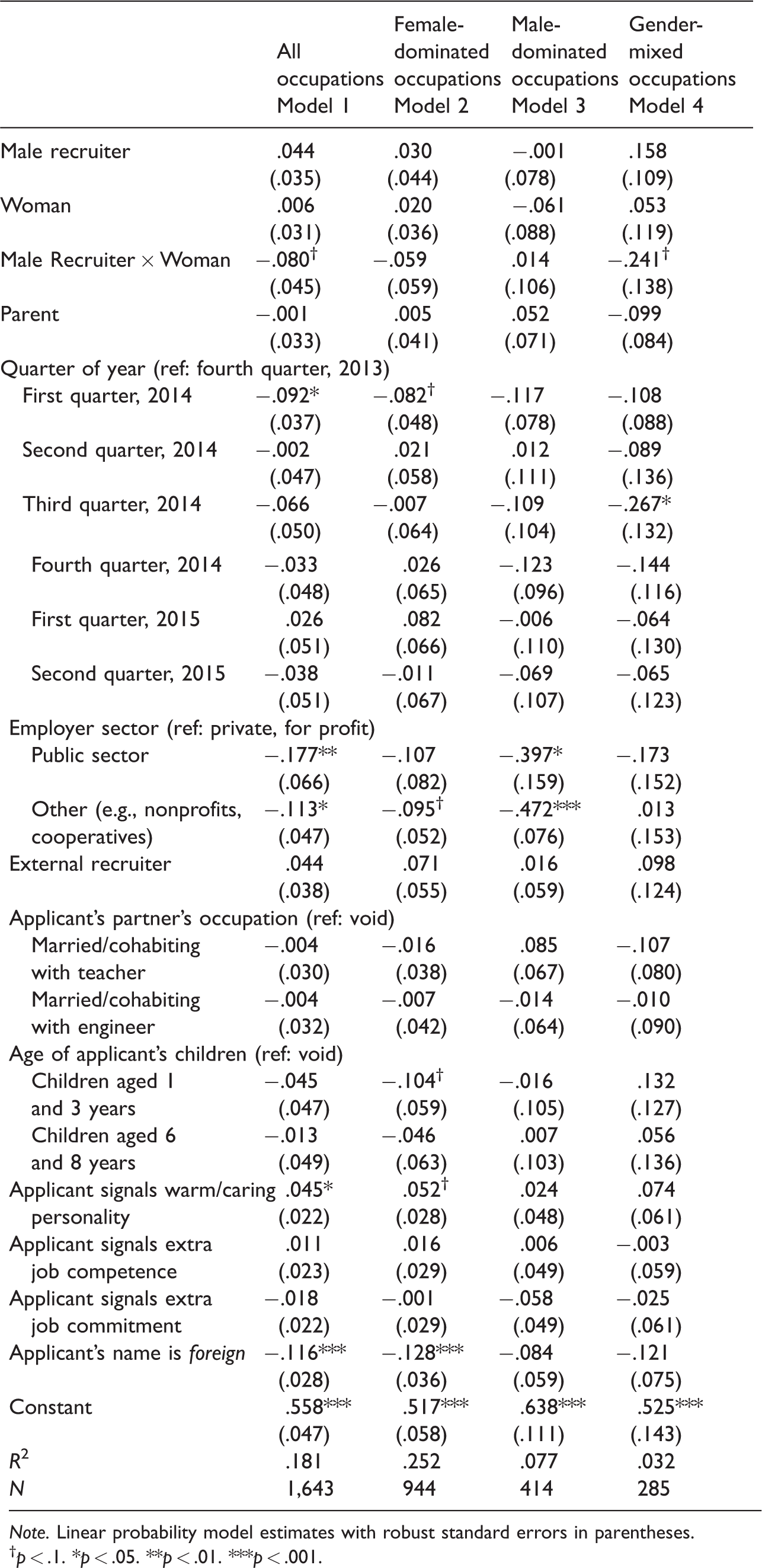
Note. Linear probability model estimates with robust standard errors in parentheses.
†p < .1. *p < .05. **p < .01. ***p < .001.
Footnotes
Acknowledgements
Valuable comments from two anonymous reviewers as well as from Michael Gähler, Magnus Bygren, Karin Halldén and Moa Bursell are highly appreciated. Financial support from the Swedish Research Council for Health, Working Life and Welfare (Forte 2012-0587) is gratefully acknowledged.
Declaration of Conflicting Interests
The author declared no potential conflicts of interest with respect to the research, authorship, and/or publication of this article.
Funding
The author disclosed receipt of the following financial support for the research, authorship, and/or publication of this article: This work was supported by the Swedish Research Council for Health, Working Life and Welfare (Forte 2012-0587).