







Abstract
Why might women who experience gender-based bias and harassment at work shy away from efforts to address gender inequality in their workplaces? Drawing on data from 52 interviews with women working in the Silicon Valley tech industry, I show that efforts to address women's marginalization in the men-dominated tech industry are complicated by the inscription of negative, gender essentialist stereotypes about women into narratives about why such initiatives are necessary. Interviewees voiced two rationales for not explicitly challenging women's marginalization. First, some women—particularly those whose race/ethnicity and age were typical of Silicon Valley tech workers—articulated a concern that such efforts may be interpreted as evidence that women are fundamentally different from, and deficient relative to, men. Second, women across race/ethnicity and age conveyed the concern that such efforts frame women as disempowered victims lacking agency. Both concerns represent a double bind: ignoring the marginalization that women face maintains a status quo rife with gender bias, but seeking to address it risks further entrenching negative stereotypes about women. These results illustrate both the durable nature of the gender status hierarchy and the unique ways that women of different intersecting identities confront it.
In recent years, there have been burgeoning efforts to improve women's representation in men-dominated fields. In the technology industry, for example, there are abundant trainings, conferences, and consulting firms aimed at helping tech companies recruit and retain women (Mundy, 2017; Sharp et al., 2012). These strategies target women's marginalization in men-dominated industries by making salient the gender-based challenges that women experience. For example, initiatives like workplace trainings about gender bias aim to make employees conscious of, and equipped to override, their tendency to make biased evaluations about women.
Efforts to improve women's standing in men-dominated fields are sometimes embraced and championed by the women they are intended to aid. For example, many women in men-dominated fields joined the chorus of voices speaking out against sexual harassment during the MeToo movement (e.g., Benner, 2017), and activism and unionization efforts—some led by women—in the Silicon Valley technology industry have centered women's issues, such as sexual harassment and fair pay (Alphabet Workers Union, 2023; Conger, 2021).
Counterintuitively, though, efforts to address women's marginalization in the workplace are not always looked on favorably by the women they are intended to aid. In interviews with 52 women working in the Silicon Valley tech industry, I heard often about instances of gender bias and harassment that women confronted at work. However, some of the same women who recounted such experiences also voiced hesitation about efforts—either by their organizations, their coworkers, or efforts they contemplated making themselves—to address gender inequality in the workplace. For example, Sonia, a Latina woman in her 30s who had cofounded the startup she worked at, described how investors and other entrepreneurs in her network often solely credited her cofounder—a man—with founding the company and directed their questions about the startup to him. Despite recognizing gender bias in these actions, Sonia felt that drawing attention to gender and racial/ethnic bias at work was potentially disempowering. Similarly, Diana, a white woman in her 50s, described the burnout of “death by a thousand papercuts” that women in the tech industry experienced—a metaphor for repeated microaggressions like being perpetually expected to take notes in meetings or assumed to be more oriented toward family than career. But Diana, too, voiced ambivalence about her own or others’ efforts to address these moments when they occurred, as I detail below. Why?
In this study, I identify a tension in efforts to address women's marginalization in men-dominated fields. When women's underrepresentation is made salient, gender stereotypes privileging men over women may be written into explanations about gender disparities in men-dominated industries like tech. This tension produces two rationales for women to avoid challenging gender inequities in the workplace: the desire to eschew narratives that (1) women are fundamentally different from, and deficient relative to, men; and (2) women are disempowered victims lacking agency. As a result, despite being keenly aware of the bias and mistreatment that women in their workplaces face and eager to rectify these barriers, some women perceive that explicit efforts to address women's marginalization in their workplaces may instead facilitate it. That even efforts to address gender inequalities in the workplace might reinforce gender essentialist stereotypes, I argue, points to the durability of the gender hierarchy.
At the same time, these findings also point to the unique ways that women of different intersecting identities confront the gender hierarchy. Whereas women of various ages and racial/ethnic identities voiced the concern that challenging gender inequities could cast women as disempowered victims, it was primarily Asian and white women, and women under age 40, who voiced the concern that such initiatives may cause them to be othered. I suggest that this is perhaps because—as women minoritized by their gender but not by their race/ethnicity or age in the Silicon Valley tech industry—such women perceived being othered as escapable in a way that their Black and Latina, and older, counterparts did not.
Educating Employees About Women's Marginalization in Men-Dominated Fields
It is well-documented that women working in men-dominated industries face substantial barriers relative to men. Women working in men-dominated fields experience some of the highest rates of sexual harassment, and in interactions with coworkers they are often excluded, othered, or typecast with sexist tropes like being a sex object or mother figure (Kanter, 1977; McLaughlin et al., 2012; Thomas et al., 2019; Turco, 2010). In the men-dominated field of technology, 1 women tend to build professional networks that are smaller and more formal than men's, limiting their access to the career resources that flow from professional networks (Mickey, 2022). Women are also stereotyped as less competent in masculine-stereotyped domains like math (Correll, 2001; Correll, 2004) and experimental audit studies find that in STEM, women are perceived as less desirable employees than identically qualified men (Moss-Racusin et al., 2012; Quadlin, 2018). In the tech industry, even when women are promoted into management—an easier feat for white women relative to racial/ethnic minority women—they tend to be promoted into mid-level management positions that do not have a clear pathway to the top levels of leadership (Alegria, 2019). These dynamics likely contribute to both women's severe underrepresentation in the highest leadership positions and substantial attrition from men-dominated fields, including tech (Glass et al., 2013; Thomas et al., 2019). When I refer to women's marginalization in men-dominated fields throughout this article, I refer to this suite of mechanisms that contribute to women's isolation, alienation, and blocked career-advancement.
The challenges that women face in men-dominated workplaces are shaped not solely by their gender; racial/ethnic minority women face unique professional barriers. For example, racial/ethnic minority women are more likely than white women to feel that they must repeatedly prove themselves at work and face more exclusion, isolation, and perceived lack of cultural fit (Bell & Nkomo, 2001; Ridgeway et al., 2022). Black women frequently encounter workplace climates in which they are taken for granted and treated without dignity (Young, 2023). In the tech industry, Black women find the techniques that white and Asian women use to evade gendered microaggressions ineffective (Alfrey & Twine, 2017), and neither Black nor Asian women experience the same mobility into mid-level management positions that white women do (Alegria, 2019). 2 Moreover, recent evidence indicates that even when tech companies aim to make hires that improve their company's diversity, they tend to favor white women over Black women (or Black men), in part because of the perception that Black workers bring heightened scrutiny and uncomfortable conversations about race to the company that white women workers do not (Weisshaar et al., 2024).
In industries—like the tech industry—that prize younger workers, youth is an asset to be leveraged (Frenette, 2019); thus age, too, shapes workers’ experiences. Sociological research has attended less to age-based discrimination in the tech industry than to discrimination based on gender or racial/ethnic identity, but the fact that the median age of workers in tech is a full decade younger than the overall median age in the labor market suggests age-based discrimination is common (Neely et al., 2023), and ageism in the tech industry has been documented in journalistic accounts (e.g., Hoover, 2024). As I will detail below, age appears to play a role in shaping how women perceive gender initiatives in their workplaces.
How do women confront the challenges that come from occupying a minority position in their workplaces? In her pathbreaking work on women's experiences of being tokenized (i.e., belonging to an extreme minority) at work, Rosabeth Moss Kanter (1977) showed that when women are an extreme minority in the workplace, they are subjected to heightened visibility and othering, and tend to be shoehorned into narrowly defined, constraining gendered roles (e.g., seductress or pet). In response, Kanter found that women adopted a range of individual-level strategies aimed toward advancing despite their minoritized status. For example, some sought to limit the heightened visibility that came with being tokenized, resulting in minimal recognition of their contributions; and others sought to capitalize on their heightened visibility as tokens, often resulting in notoriety; neither strategy facilitated the advancement of women as a group.
Scholars have since tested whether the barriers for tokens that Kanter identifies are generalizable across identities—and identity combinations—beyond gender alone. This work finds that the specific barriers that tokens face are specific to their minoritized identities. For example, as Wingfield (2012) illustrates, Black men who occupy an extreme minority at work face challenges that women do not (such as taking pains to avoid activating the “angry Black man” stereotype) but tend to have an easier time forming social ties with white men coworkers than do women. Nonetheless, this literature illustrates clearly that workers who occupy extreme minority positions in their workplaces do, as a rule, face unique barriers that their majority-identity counterparts do not (Bell & Nkomo, 2001; Wingfield, 2012; Wingfield, 2019; Wingfield, 2023). Across these accounts, a theme is that tokenized members of a group have a limited ability to individually enact change, implying that solutions for tokenized workers’ marginalization lie in organizational, rather than individual, solutions.
Organizations have indeed implemented initiatives to address barriers that women (or racial/ethnic minorities) face at work, yet many efforts to remove such barriers have not proven effective. Popular approaches like mentorship and networking opportunities have had disappointing returns, and diversity trainings, grievance procedures, and job tests actually seem to have detrimental effects on the representation of women and racial/ethnic minorities (Dobbin et al., 2015; Kalev et al., 2006). Moreover, gender and racial/ethnic inequality tend to be treated as separate issues in organizational diversity interventions, rendering the unique concerns of racial/ethnic minority women invisible (Wong et al., 2022). And evidence from the tech industry suggests that when companies do consciously attend to improving either gender or racial diversity in their hiring practices, the technical ability of those underrepresented hires is then called into question (Weisshaar et al., 2024).
Organizational interventions may not only prove ineffective but can result in backlash effects (Dobbin & Kalev, 2019; Kachanoff et al., 2022). For example, when people are told that it is common or logical to hold stereotypes that bias their impressions and evaluations of others, they become more likely to condone and express stereotypic beliefs about others and more likely to discriminate based on those beliefs, suggesting that interventions aimed at educating people about their biases may inadvertently normalize bias (Duguid & Thomas-Hunt, 2015; Tilcsik, 2021). Likewise, when people are told to reduce prejudice or face sanctions, they display more prejudice than those who receive no such message, indicating that authoritarian demands to act more equitably may elicit backlash (Legault et al., 2011). Carefully crafted trainings can circumvent such backlash effects (Duguid & Thomas-Hunt, 2015; Legault et al., 2011; Tilcsik, 2021), but many workplace diversity trainings are not guided by this research.
Qualitative research documenting how women and racial minorities experience organizational efforts to address their respective marginalization likewise finds unintended effects. For example, when organizations explicitly state their intent to address the needs of racial minorities but then fail to do so in practice, it leaves workers of those identities particularly disillusioned (Wingfield, 2023). Further, in a process that Wingfield terms racial outsourcing, organizations may place the responsibility for crafting a culture and norms that are inclusive of racial minority workers onto those workers themselves, which both demands additional unpaid labor of racial minorities within the organization and communicates that the organization sees such work as peripheral (Wingfield, 2012; Wingfield, 2019).
In the case of gender, when efforts to facilitate women's professional advancement are framed as a way to overcome individual differences between women and men, women may internalize the message that gender inequality in the workplace stems from innate gender differences and thus blame themselves for gendered barriers they face (Williams et al., 2014). Moreover, because fields like engineering carry a strong assumption that legitimate advancement in the field is meritocratically earned, efforts to advance women's representation explicitly through quotas or affirmative action are often perceived—by women alongside men—as violating the cultural values of the field (Seron et al., 2018; Sharp et al., 2012).
In this article, I build on research about the limitations of workplace gender initiatives in two ways. First, I show that when such efforts make gender salient, they may not only fail to advance gender equality but also reinforce the very cultural narratives that sustain barriers for women in the workplace. Second, I show that the reservations women hold about such efforts are patterned by their other identities: whereas women across racial/ethnic groups expressed hesitation about efforts that frame women as disempowered victims lacking agency, it was predominantly white and Asian women under 40—whose race/ethnicity and age are that of the typical tech worker—who expressed reservations that such efforts may cast women as other from men.
Contemporary Gender Essentialism in the United States
Why do gender inequalities persist? Scholars studying the puzzle of the persistence of gender inequalities, like those in STEM fields outlined above, argue that such gaps are the result of persistent gender essentialist cultural beliefs (e.g., England et al., 2020; Ridgeway, 2011). Although the content of Americans’ beliefs about women's and men's characteristics and skillsets has changed over time, the belief that women and men have different characteristics and skillsets has not (Eagly et al., 2020). Americans today view women as more affectionate, emotional, sensitive, and communally oriented, and more skilled in domains like child-rearing, whereas men are held to be more confident, strong, decisive, and individually oriented, and more skilled in domains like mathematical ability (Eagly et al., 2020; Hyde et al., 2019).
The widely held belief in women's and men's diverging skillsets can result in self-fulfilling prophecies in which, because men and women are expected to have different capabilities, their own and others’ biased evaluations of their capabilities push them into gender-congruent domains. For example, although girls’ math performance has reached parity with that of boys in the last several decades, people continue to associate math competency with men (Hyde et al., 2019). On the supply side, this results in men's more positive assessment of their own math aptitude and greater persistence in math-related fields relative to women with identical math performance (Correll, 2001; Correll, 2004; Penner & Willer, 2019). On the demand side, employers express a preference for men who have shown high achievement in math and other STEM fields compared to women with identical achievement (Moss-Racusin et al., 2012; Quadlin, 2018). Thus, men predominate in fields requiring mathematical competency in part because of a widely held—but not well-supported—view that men's math ability is superior to that of women.
Gendered beliefs in women's and men's differences can also lead to social sanctioning when women and men behave in ways that clash with gender stereotypes. For example, experiments show that women who behave in a highly agentic way (e.g., those who act decisive or critical) are viewed as less likable, deemed less suitable to hire, and are more likely to be subject to sabotage than either an identical man behaving in the same highly agentic way or an otherwise identical woman behaving in a less agentic way (Rudman et al., 2012). This is also borne out in data on workplace performance reviews, where men who are described as highly agentic receive higher performance evaluations than women who are described as highly agentic (Correll et al., 2020). Thus, women's and men's behaviors are nudged into alignment with gender beliefs through both biased expectations of gendered competencies and negative feedback when gender stereotypes are violated.
Notably, research on the gender essentialist stereotyping of women in the United States has tended to focus on women as a group, without attending to different perceptions of women of different racial/ethnic identities (Rosette et al., 2018). Therefore, such research tends to implicitly describe white women, who make up the majority of women in the United States. However, emerging research suggests that gendered qualities ascribed to American women are shaped by their race/ethnicity. For example, in comparison to white women, Black women are more likely to be seen as dominant, strong, and incompetent, and Asian women are more likely to be seen as intelligent, mild mannered, and subservient; there is relatively little literature about how Latina women are stereotyped (Rosette et al., 2016; Rosette et al., 2018). Given this evidence that women are stereotyped differently across race/ethnicity, it is possible that women of different racial/ethnic identities may also vary in their concerns about activating gendered stereotypes. Indeed, as I will elaborate below, whereas women across racial/ethnic identities expressed concern about activating one set of gender essentialist beliefs, their concern about activating another set of beliefs appeared to be shaped by their race/ethnicity.
Methods
In this paper, I draw on data from interviews with 52 women working in the Silicon Valley tech industry. These interviews come from a larger subset of 87 interviews, including 32 interviews with men and 3 interviews with nonbinary people working in the Silicon Valley tech industry. I focus on the accounts of women because women interviewees were uniquely situated as potential beneficiaries of efforts to address gender inequality in their workplaces. Such efforts almost exclusively focused on enhancing the position of women; as nonbinary interviewees explained, there were rarely parallel efforts designed to address the forms of marginalization—like being misgendered—that gender minorities experienced. If women interviewees considered gender bias a problem in their workplaces and stood to benefit from efforts to address it, why did they express hesitation toward such efforts?
This article's focus on narratives about gender inequality arose inductively. I began the study with a broad interest in sexual harassment and gender inequality in the workplace, and for that reason, interviews covered the interviewee's career progression, workplace environment, and working relationships, as well as sexual interactions experienced at work. The interview closed by asking about interviewees’ perceptions of sexual harassment and gender inequality in the tech industry, and their thoughts on what might help to address these issues. I did not ask interviewees directly about their views on efforts to address women's marginalization at work: the women who described reservations toward efforts to address women's marginalization volunteered such perspectives when describing their views on sexual harassment and gender inequality.
Interviewees were recruited between 2016 and 2020 via messages on LinkedIn, invitations disseminated among my own extended social network and on tech-related listservs, and through snowball sampling. The invitation described the focus of the study as “interpersonal experiences in tech” in the interest of recruiting people with a broad range of experiences. Thirty-three of the interviews were conducted in person in places selected by interviewees (e.g., library rooms, parks, and cafes); 19 interviews were conducted over phone or video calls. Names have been changed to allow interviewees anonymity. Interviewees worked in engineering, marketing, and product development, in organizations that ranged in size from small startups to giant corporations. Up to six employees in the same workplace were interviewed, but most commonly an interviewee was the only person from their organization I talked to, meaning that I captured perspectives from a wide range of organizations. Reflecting demographics of the Silicon Valley tech industry (Neely et al., 2023), most interviewees were younger than 40 and identified as white or Asian (see Table 1), although I purposefully worked to include underrepresented minorities in my sample.
Interviewee Demographics.
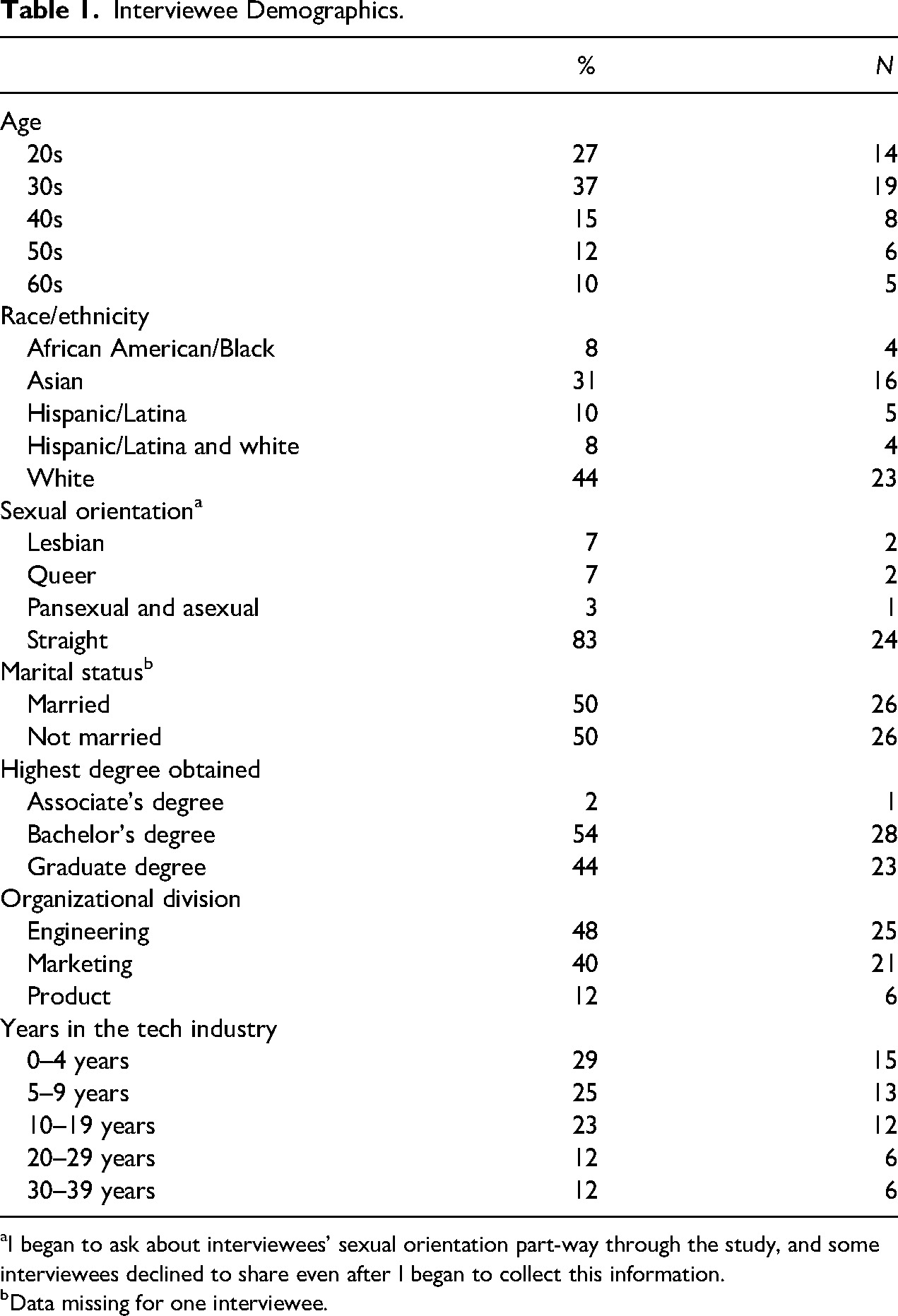
I began to ask about interviewees’ sexual orientation part-way through the study, and some interviewees declined to share even after I began to collect this information.
Data missing for one interviewee.
Interviews were recorded and were transcribed by myself or a trained transcriptionist. 3 Interviews lasted between 30 and 170 min and averaged 80 min. I used the qualitative coding software NVivo to analyze the transcripts. I followed a flexible coding framework (Deterding & Waters, 2021), meaning that I first indexed transcripts with broad codes. The focus of this paper—women's hesitations about efforts to address their gender-based marginalization—was an emergent theme that I initially coded with the vaguely conceived label “tensions.” Once I finished conducting interviews and read through the excerpts that I had filed under the “tensions” code, I came to define the label more concretely as moments in which interviewees expressed hesitance toward efforts—either at the institutional or interactional level—to address women's marginalization in their workplaces. With this definition, I reread each of the transcripts and systematically coded for the tensions theme. Finally, I analyzed the corpus of excerpts coded under the tensions label and organized them into the subcategories around which this paper is structured.
The Impetus to Downplay Gender in Tech Workplaces
To contextualize the hesitation women interviewees expressed toward efforts to address women's marginalization in their workplaces, it is first important to consider the (racialized) gender dynamics of Silicon Valley tech workplaces. Although enacting femininity often pays dividends for women—particularly racially privileged women—(Hamilton et al., 2019), in men-dominated fields, femininity can be a liability (Kanter, 1977). Indeed, in prior work in the Silicon Valley tech industry, Alfrey and Twine (2017) find that women—again, particularly racially privileged women—are subjected to fewer gendered microaggressions when they distance themselves from conventional heterosexual femininity.
This eschewing of femininity was also evident in my data, where women interviewees often described efforts to avoid making their gender salient in interactions with men. When I asked how interviewees chose to present themselves at work, 17 women described carefully avoiding visible markers of femininity at work—dresses, jewelry, the color pink—in favor of the androgynous “tech uniform” of jeans and a t-shirt, sweater, or hoodie.
4
Chrystal, a white woman in her 30s, said that she wore t-shirts and jeans to work because “if I dressed too feminine, I wouldn’t be taken seriously,” and Isabella, a white and Latina woman in her 40s, explained: “For a woman in tech, if you dress too nice […] they talk to you like you’re a moron.” Sam, a white woman in her 20s, perceived similar costs to markers of femininity at work, commenting that “if you look too nice and it's all guys it's weird.” When asked to elaborate, she explained that: Yeah ‘cause then it's just like you’re not one of the guys, right? Very seldomly do I want to be calling attention to the fact that I’m a woman at a hundred percent dude company unless I’m trying to make a point that it's a hundred percent dude company. So if I’m not trying to make that point, it's more like you just want to be in the same ish kind of uniform as everybody else.
White, Asian, and Latina women all articulated a desire to eschew visible markers of femininity by dressing in the casual “tech uniform” of jeans and a t-shirt, but only one of the four Black women I interviewed described constructing her appearance this way. A more common goal articulated by Black women was making themselves legible as professional workers. Gloria, a Black woman in her 40s, described avoiding wearing the “tech uniform” of jeans and a t-shirt to work because “I always assume I’m held to a higher standard.” Indeed, the first day she broke with this practice and dressed casually at work, she was mistaken for a cafeteria worker, although she held a high-level management position. Therefore, she explained, she continued to dress up: “So, in terms of thinking about my appearance, yes, I do dress up more than my peers. I always have a full face of makeup. I wear heels, not every day but more than others.” Here, Gloria highlights that in adopting more formal—and feminized—dressing practices to emphasize her role, she deviated from the norm by dressing up “more than my peers.” Molly, a Black woman in her 40s, also described presenting herself differently from her peers. She explained that she favored simple, solid-colored professional clothing, “Because when [as a Black woman] you walk in the door, [your coworkers] are just processing what the heck are you and how did you get in here. And you need to make it as easy as possible for them to process the fact that you are here.”
For white, Asian, and Latina women, avoiding markers of femininity at work could be a critical strategy for being perceived as similar to, and as competent as, one's peers. Yet most Black women described strategies that departed from this goal. This might be because—as workers who were severely minoritized by their race as well as their gender—Black women either did not consider it possible to blend in with their peers at work or were focused on the more pressing goal of being perceived as professional workers. Alternately, because in American culture Black women tend to be stereotyped with some masculine-coded characteristics like dominance and strength (Rosette et al., 2016), they may have been less concerned about visible markers of femininity heightening perceptions of their differences from men.
The Risk of Reinforcing Narratives of Women's Difference From Men
In a context in which many women often felt they were rewarded for de-emphasizing their gender, 18 of the women I interviewed expressed reservations about efforts—either by their organizations, their coworkers, or those they contemplated making themselves—to address women's marginalization in their workplaces because such efforts made gender salient. These interviewees perceived a risk that in making gender salient, and such interventions were then interpreted by men colleagues as necessary because of women's differences from men. Moreover, perceived differences were often seen as deficiencies rather than mere differences. These interpretations left women feeling othered (i.e., construed as fundamentally different) from their men colleagues and jeopardized their efforts to blend in with their colleagues at work. Notably, however, this was a concern primarily voiced by white and Asian women and women under age 40, patterns I elaborate on below.
Patricia, a white woman in her 30s, offered an example of how essentializing views could be used to justify the need for organizational efforts to improve women's representation. She recalled the chief technology officer's gender essentialist rationale for putting in place a different interviewing policy for women engineers at her company: I was the first female engineer, and we went two years and there were still no more female engineers. And our CTO decided that I should [take part in the interview process] for all female engineers, and then he decided – told me that women's brains worked differently so they weren't doing as well in whiteboard interviews, so I should give them an extra interview at the end. […] I was just kind of so taken aback, because this was a very—I mean, he otherwise has been great, and there's been no kind of… I was kind of in shock.
Another way that efforts to address women's marginalization were construed as stemming from gender differences was the view that such initiatives existed because women expected special treatment. Sada, an Asian woman in her 30s, recalled a prior manager's view that an employee resource group dedicated to women was evidence that women expect special privileges. She described: There was like a “women in [company]” group that I would go to, like a breakfast in the morning, and he would say—he’s this white male—he would say, “There's no white male at [company] group, we don’t create that, why do you need a women in [company] group?” […] So I felt like at that time, okay should I even go to this? Because he's my manager, I trust him.
The view that women and men are different was particularly salient in organizational interventions that addressed sexual harassment at work. Some women interviewees sensed that an underlying message in these interventions was that relative to men, women were viewed as oversensitive about sexual harassment. For example, Courtney, a white woman in her 30s, recalled her impression of a sexual harassment training she attended: I distinctly remember the first time I had to do [sexual harassment training] at work, and it was like the time I felt least comfortable in my professional environment. Because like, I don’t think they were trying to do this, they were billing it like they were talking about general harassment, but a lot of it was about how you should be really careful around women. It's just how it felt.
The fear of being perceived as different from men could also deter women from addressing gendered behaviors that made them uncomfortable, for fear of giving the men they worked with reasons to see them as “other.” Responses like directly confronting behavior or utilizing grievance procedures to report the behavior within the organization could thus feel risky. For example, Diana, a white woman in her 50s, described her reluctance to shut down sexual banter in her workplace that made her uncomfortable because: Saying something puts me at risk of reidentifying myself, or reasserting that I am other. And so, if I say to the guys, stop making dick jokes, that reminds them that I’m not one of them. When I’ve worked pretty hard to be one of them.
Like Diana, Cheryl—a white woman in her 50s—also described feeling reluctant to confront unwanted sexual behavior, in her case at informal drinking sessions where business considerations were discussed among company board members. One reason that Cheryl was motivated not to call out or report the behavior was her desire to maintain her influence at the company, and therefore, the ability to shape the organizational culture in the future. As she explained, her strategy was to: Smile and laugh. Have it roll right over your shoulders. [Sexual innuendo] is treated as their issue, not your issue. Don’t internalize or personalize it to you. […] And then ultimately you look for opportunities to bring in more women into the equation. So you start to change the mix of the dynamics. But if you can’t handle that you won’t get to the top, if you don’t get to the top, you’re not going to see the rewards.
Carrie, an Asian woman in her 30s, was likewise concerned that inadvertently reifying stereotypes about women might harm women's representation in the tech industry in the longer term. Specifically, she expressed trepidation that efforts to place women in leadership roles could backfire if those women did not have training and support equivalent to their men peers: Sometimes I wonder if this push to put women into these more senior positions, are these women the right background? And if not, that's fine. I still think they’re probably capable but are we going to groom them? Are we gonna help them rise or are we just putting them there? And clearly they’re capable but will they not have enough of—this is what they say, right, is to get a really good mentor, [that] you need mentorship.
In many cases, efforts to highlight the challenges that women face in the workplace offered meaningful support: for example, by giving women access to same-gender mentors through women's groups, or raising awareness about the nuances of sexual harassment. Simply ignoring these issues would preserve workplace conditions in which women were disadvantaged relative to men via mechanisms like more limited mentorship or a greater likelihood of experiencing sexual harassment. Yet efforts to address these gendered barriers simultaneously brought harms: they could evoke gender essentialist narratives about women's perceived differences from, and deficiencies relative to, men. Specifically, women described concerns that such efforts promoted ideas that women's cognition is distinct from men's; that women are demanding and expect special privileges; that women are oversensitive, particularly around sexual topics; and that women lack leadership skills. Thus, women sometimes expressed reservations about efforts to address women's marginalization in a men-dominated field because of their othering effects.
Notably, the women who voiced concerns about the othering effects of efforts to address gender-based inequalities in the workplace tended to be those who were typical of tech workers in terms of age and race/ethnicity. Only 4 of the 18 women who voiced concerns about being othered were over age 40—older than the typical tech worker (Neely et al., 2023). 6 An even more striking pattern emerged across racial/ethnic identities: all identified as either Asian or white, 7 the two most well-represented racial/ethnic groups in Silicon Valley's professional workforce (Neely et al., 2023). 8 I revisit this point in the Conclusion, where I consider why women's racial/ethnic identity and age may have shaped their likelihood of voicing concerns about being othered.
Women's Resistance to Being Perceived as Disempowered Victims
A second risk of efforts to address women's marginalization in tech workplaces was the risk that women would come to be perceived—by their colleagues or even by themselves—as disempowered victims. This perception again aligns with extant stereotypes about women: in this case, that women are passive, hesitant, and in need of men's aid. Five interviewees expressed the reservation that organizational practices and colleagues’ efforts to address sexist behavior could inadvertently reinforce the cultural belief that women need protection from men or otherwise lack agency.
Diana offered one way that this played out when she described with frustration how the men she worked with would continually designate her the notetaker in meetings, even when she far outranked them. She ascribed this to the sexist presumption that note-taking duties should fall to women. However, unlike many women I interviewed, whose men colleagues appeared oblivious or unsympathetic to such treatment, Diana had a coworker who actively worked to intervene when he witnessed it: [My colleague Andrew and I had] been with the company the same amount of time. And everyone deferred to him. And so, if we were in a meeting and someone would turn to me and say, “Could you take the notes?” Andrew would pull out his laptop and say no, I’ll do it. […] And on one hand, I adored him for it, because he saw it, he recognized why it was a problem, and he took action. […] On the other hand, I hated that he did it. You know, that we were the same level, the same expertise, that we’d accomplished many of the same things. And he was protecting me. That was frustrating sometimes.
Similarly, other women interviewees described feeling disempowered by narratives in which women were framed as unequivocal victims of sexist treatment. For example, Rachel, an Asian woman in her 30s, described her appreciation of a sexual harassment training in which the facilitator raised the possibility that men, alongside women, could be harassed, explaining: “That kind of made it interesting because it did also help bring home the point that sexual harassment can go both ways, right. It's not just like, oh women are the victims, like no, that is not the case at all.” Though women do experience sexual harassment far more often than men (Graf, 2018; Kearl, 2018), Rachel expressed a preference for conveying the issue in gender-neutral terms that did not emphasize women's victimization.
Courtney was well aware that sexism was a problem in the engineering profession. In the interview, she recounted numerous experiences of gendered mistreatment throughout her career, including being ignored in meetings and sexually harassed by a boss. Yet she, too, was hesitant to embrace a narrative of women as victims—not because she doubted its accuracy but because of the implication that being a victim of pervasive, inequitable processes implies an inability to individually improve one's standing. She explained: I really don’t want to be a victim. And it's partly because I want to be able to craft my own destiny. If I’m a victim, great, I’m just out of luck I guess. There's nothing to be done. So I don’t want to be a victim. They did a study at my workplace that was looking at how women advance, and why there are fewer women at higher levels. And one of the things that I really respected about the study is it came out with like, here are some things that [the organization] isn’t doing well that it could do better, and here are some ways that women can advocate for themselves. And I like that because it kind of builds up both sides. It's like, we’ve got some issues. Also, you’re not totally a victim and you can affect it. And like reading books, I read Lean In, and so some of the studies that are mentioned there [are] about like, if I’m weighing resumes, you know, the same resume with different peoples’ names on it, and that they get ranked lower for women, even for people who want to do the right thing. Like that's really scary to me, because I don't know what we do about it.
Sonia, a Latina woman in her 30s, described a similar reluctance to be typecast as a victim because of her intersectional identity. When her boss warned her about the acute discrimination she would likely experience not only as a woman but as a Latina woman when she moved to the United States from Latin America, she felt demoralized: I remember [my boss] told me when I got [to the United States], she told me, you have to realize that you are part of two minorities here, you are a woman, and you are Latino. So you are going to suffer a lot in the US. […] I remember that was the first time I had to think about that. If you picture yourself as a minority you start feeling as a minority. I was very happy with what I was doing and with my progress, and I remember from that moment on everything changed for me, and I’m not yet sure it was for good. […] I’ve always been in touch with women's empowerment and everything but I’ve never seen myself as a minority, or felt I was being treated differently, until she said that. When she said that I started like, hm, it's probably happening. But I don’t think she left me anything positive.
Molly, a Black woman in her 40s, also described reluctance to be typecast as a victim rather than as an agentic actor able to effectively negotiate her own interactions. Describing her approach to managing offensive jokes in the workplace, she said: “So, when they push, you push back too. And I guess that's part of how I was raised as well. Versus running and saying, ‘oh, that was so offensive, now I’m going to talk to HR about that offensive joke’.” By distancing herself from someone who might seek organizational support for mistreatment, Molly presents herself as highly assertive, rather than dependent on others for support. Yet, she also reflected on how her determination to address such behavior independently may have been shaped by the institutional constraints she had encountered as a Black woman throughout her life: So many times there has not been a formal authority that you can count on and rely on to address any of your grievances so either you take it in stride and handle it with humor or if it's big enough you just try to address it in the moment. So that's definitely going to be more of a Black female, you know, or not even Black female but just females of color, where they are used to having to address things on their own because the authority system around them was not designed for them or with them in mind so that's not an avenue to go get recourse for your issue. You know, so you either take it in stride or you address it in your alternative ways.
Whereas interviewees who expressed concerns about being othered by their colleagues were almost exclusively white and Asian women, Black and Latina women—who belong to underrepresented racial/ethnic groups in the Silicon Valley tech workforce—voiced an aversion to being construed as disempowered victims alongside white and Asian interviewees. Likewise, women over 40 voiced this concern as well as younger women. Though the small number of cases warrant caution, it appears that women across racial/ethnic groups and age feel the pull toward agentic narratives.
In sum, women interviewees sometimes expressed resistance to the implication that as those disadvantaged by gender inequality, they were disempowered and in need of protection or assistance. Instead, they expressed a yearning to be agents who could manage the discrimination or mistreatment they experienced on their own. This approach is largely at odds with the solutions that scholars point to for addressing gender inequality, given that many of the forces through which gender inequality manifests in the workplace occur at the interactional and organizational levels, and are thus beyond individual women's control (e.g., Acker, 1990; Ridgeway & Correll, 2004; Wynn, 2020). However, rejecting narratives that portray women as victims of gender inequality does afford women the ability to understand themselves as agentic actors, and in doing so, reject gendered stereotypes that women are passive, powerless, and in need of others’ protection.
Discussion
There have been significant efforts in recent decades to improve women's representation and inclusion in men-dominated fields like the tech industry, including efforts led by women (e.g., Alphabet Workers Union, 2023; Conger, 2021). Nearly all of the 52 women interviewees in this study, who worked in the Silicon Valley tech industry, encountered sexism at work. However, despite this, 21 interviewees expressed reservations about efforts to address gender inequalities in their workplaces. Why?
My interviewees articulated two rationales for why women who experience gender inequities at work might hesitate to take or support action to address it. Both rationales centered on the risk of reinforcing gender essentialist stereotypes. First, some efforts to address gender inequalities at work raised stereotypes that reified the cultural belief that women are different and deficient relative to men, such as ideas that women are unambitious, less competent, demanding, or oversensitive. When women were perceived this way, they were othered from the men they worked with, which could increase their isolation from their colleagues at work. As I discuss in more depth in the Conclusion, white and Asian women and women under age 40 were most likely to voice this concern.
The second rationale women voiced for not taking or supporting action to address gender inequalities in the workplace was the concern that initiatives to address women's underrepresentation in the tech industry could sometimes play up the notion that women are victims who require men's protection. This evokes a second set of gender essentialist stereotypes that women are passive, powerless, and or require protection. Women across racial/ethnic identities and across age groups expressed an aversion to gender initiatives that construed women as disempowered victims lacking agency. The seemingly more universal nature of this concern may reflect the broad appeal, among Americans, of individualistic ideals in which people are considered responsible for crafting their own destinies.
These backlash effects of addressing women's marginalization and mistreatment create a double bind because the alternative—not addressing them—continues to leave women marginalized. For example, although efforts to raise awareness about sexual harassment could other women from men by creating the perception that women are oversensitive, not addressing sexual harassment could also leave women othered by implicitly condoning their objectification. Thus, although efforts to address the inequalities that women experienced in the workplace could make salient ideas about women's and men's differences, the absence of such efforts preserved the status quo in which women were already perceived as alien from men.
Conclusion
My interviewees’ hesitance to avoid activating gender stereotypes in order to evade bias dovetails with psychological research showing that when cultural beliefs about gender differences are played up, women working in STEM fields experience more bias than when such beliefs are downplayed (Martin & Phillips, 2019). 9 That efforts to address women's marginalization in tech can heighten stereotypes about women's difference from men may help to explain why some efforts to unwind the gender-based marginalization that women experience in men-dominated workplaces, like trainings about bias that make gender more salient, do not improve women's ability to move up the career ladder (Kalev et al., 2006).
In seeking to avoid playing into gendered stereotypes about women, the women I interviewed were not avoiding gendered behavior. Instead, they were embracing masculine-stereotyped behaviors: explicitly, by mimicking the outfits and behaviors of the men coworkers, and implicitly, by working to position themselves as agentic rather than passive. Although the rejection of feminine-stereotyped traits may be advantageous to women as individuals, it subordinates women as a group by subtly reaffirming the higher status and desirability of masculine-typed traits.
It was primarily Asian and white women who articulated one rationale for not challenging gender inequalities in the workplace—that such efforts could inadvertently other women from men. This may be because if gender was not made salient, being othered seemed potentially escapable for these women in a way that it did not for women who were underrepresented racial/ethnic minorities in the tech industry. Notably, Asian people face racialized barriers in the tech industry that white women do not (Alegria, 2019; Chavez, 2021), and so it may seem counterintuitive that their perspectives aligned in this respect. However, Asian tech workers not only represent a significant share of workers in the tech industry (Neely et al., 2023)—potentially limiting the extent to which they are othered on the basis of race—but also tend to deny or naturalize racial bias against Asian people in the tech industry (Chow, 2023).
The concern that challenging gender inequalities in the workplace could cause them to be othered was notably absent from Black and Latina women's accounts. Black women interviewees’ reports of how they presented themselves at work – often dressing more professionally than their peers—suggest that they did not expect to be able to blend in with their coworkers. Indeed, women who belong to underrepresented racial/ethnic groups tend to experience less cultural fit and more exclusion and isolation in their organizations (Bell & Nkomo, 2001; Ridgeway et al., 2022), including in the Silicon Valley tech industry (Alfrey & Twine, 2017). This pattern dovetails with a similar pattern that emerged across age: women under age 40 (i.e., those whose age was typical of Silicon Valley tech workers) were more preoccupied with the risk of being othered than older women, who may have considered being othered somewhat inevitable in a similar way to women whose racial/ethnic identity was atypical of the industry.
Alternately, the racial/ethnic pattern of women who expressed concerns about being othered from the men they worked with may have been driven by the racialized gender stereotypes that women of different racial/ethnic identities confront. For example, because Black women are more likely than white or Asian women to be stereotyped with masculine-coded characteristics like dominance and strength (Rosette et al., 2016), gender initiatives that make salient narratives of women's fundamental differences from men may feel less threatening to Black women relative to white or Asian women. Future research should explore whether either—or perhaps both—of these mechanisms explain white and Asian women's greater concerns about being othered, relative to Black and Latina women.
This research examines women workers’ perceptions of how gender initiatives are viewed by their men coworkers rather than directly capturing those coworkers’ views. Women's reservations about how such initiatives are received is important in its own right, given that the initiatives' goal is to improve, rather than undermine, women's experiences at work. Yet it is also important to understand whether and to what extent such initiatives do generate backlash among men. One approach, paralleling this study, would be to interview men in men-dominated industries about their perceptions of initiatives in their workplaces aimed to address women's marginalization. A benefit of this approach is that it would capture men's reactions to real world initiatives; however, because of the sensitivity of the topic, scholars conducting such research should attend to best practices for minimizing social desirability bias (e.g., Jiménez & Orozco, 2021). Complementing this approach, experimental research could directly test whether exposing study participants to specific types of gender initiatives heighten gender essentialist beliefs about women.
Gender minorities, too, often experience marginalization in the workplace (e.g., Hutchinson et al., 2024); however, in my interviews I heard of few workplace initiatives aimed toward addressing gender minorities’ marginalization at work. As societal recognition of transgender and nonbinary people grows, this may change. Future research should track how gender minorities perceive workplace interventions that they are the intended beneficiaries of. If gender minorities also detect unintended negative consequences from such efforts, understanding how such efforts may backfire would not only have practical implications, but may offer insight into mechanisms that perpetuate the gender hierarchy, as this study does.
How should organizations in which women are marginalized address this issue, if explicit efforts to do so may backfire? One approach is for organizations to look for interventions that preempt the sorts of gendered interactions that may be difficult to confront in the moment without reinforcing gendered stereotypes. For example, I described the case of Diana, who was constantly asked to take notes in meetings, but who felt ambivalent about a coworker protecting her by stepping in to take notes instead. One way that organizations might address an issue like this is to enact a policy that gendered tasks like notetaking duties are rotated or randomly assigned each meeting. This would address the inequitable gendered pattern—here, women disproportionately being asked to take notes—without making gender salient, and thus potentially inviting gender essentialist stereotypes about women to seep into the perceived purpose of the intervention. Prior research has found that efforts to address women's marginalization without explicitly identifying their purpose as such are often quite effective (see Dobbin & Kalev, 2016).
When making gender salient is unavoidable, an intervention may be more successful if its justification proactively addresses the fact that the ostensible purpose of initiatives may be interpreted through gender essentialist narratives. One way to do this is to emphasize the structural conditions that have henceforth created disparities (see Hetey & Eberhardt, 2018). For example, it is difficult for companies that offer resource groups for women employees to avoid making gender salient, but companies could convey that the purpose of these groups is not to give women special treatment, but to offer women access to same-gender mentorship and networking that men take for granted in men-dominated workplaces. Such an explanation may help to emphasize the organizational goal of giving employees equal responsibilities and opportunities. However, an important finding in this manuscript is that organizational interventions designed to address employees’ marginalization sometimes have unintended negative consequences; thus, I offer suggestions like these tentatively and urge the efficacy of interventions to be studied carefully before being widely implemented.
The stereotype-reinforcing interpretations of efforts to address women's marginalization align with larger theories about how gender inequality persists even as social conditions change. Previous work has shown that inequalities between social groups are difficult to eradicate because advantaged groups tend to jointly hold greater status, power, and resources, each of which begets the others (Ray, 2019; Ridgeway, 2011). Thus, people tend to view those at the top of status hierarchies—men, in the case of the gender hierarchy—as deserving of their higher status, whereas they view those lower on the status hierarchy – women, in the case of the gender hierarchy – as at fault for their lower status position (Hunzaker, 2014; Ridgeway, 2006). In this study, I show that even in cases where the status hierarchy is explicitly being challenged by efforts seeking to acknowledge and address men's advantaged position relative to women, such challenges may be met with narratives that naturalize and justify the extant gender status hierarchy via gender essentialist stereotypes that construe women negatively.
Footnotes
Acknowledgments
I thank all of the interviewees who made this research possible by taking time out of their lives to share their experiences. I am grateful for financial support from the Clayman Institute for Gender Research, the Stanford Graduate Research Opportunity Grant, and the Stanford Diversity Dissertation Research Opportunity Grant. I would like to thank Shelley Correll, Cecilia Ridgeway, Aliya Saperstein, David Pedulla, the Stanford Qualitative and Fieldwork Methods Workshop, and the UW-Madison FemSem Workshop for feedback, and Samer Araabi, Thomas Trieu, and Gabriela Nagle Alverio for research assistance.
Declaration of Conflicting Interests
The author declared no potential conflicts of interest with respect to the research, authorship, and/or publication of this article.
Funding
The author disclosed receipt of the following financial support for the research, authorship, and/or publication of this article: This work was supported by the Clayman Institute for Gender Research, Stanford University, Stanford Graduate Research Opportunity Grant, and Stanford Diversity Dissertation Research Opportunity Grant.
