







Abstract
This article builds upon the body of literature confirming that aesthetics matter for finding work by investigating how gatekeepers reflect on the relevance of appearances in their evaluations of job candidates. Starting from the notion that in hiring the relevance of appearance conflicts with ideals of meritocracy and fairness, we seek to understand how gatekeepers solve this dispute and how they morally legitimize the importance of aesthetics. The analyses are based on in-depth interviews with 40 employee gatekeepers from the cultural (n = 17) and corporate (n = 23) sector, and show that although the gatekeepers problematize the importance of beauty, they do acknowledge that it plays a role in their evaluations. Three cultural repertoires for solving this contradiction and for legitimizing appearances as a hiring criterion are discerned from the data: (1) beauty as a business case; (2) appearances express personality; (3) looking right is a matter of effort. What the gatekeepers try to do is to come to a hiring decision using evaluation criteria that can be considered contextually legitimate. Yet, this can lead to applying evaluation criteria and, more structurally, labor market outcomes that they find morally problematic. This study highlights the relevance of cultural repertoires in processes of legitimation for understanding reproductions of inequalities related to appearances.
Keywords
Beauty lies in the eye of the beholder, but what happens if the beholder is expected to ignore the value of being beautiful? It is well established that in industries such as fashion, retail or catering, beauty is explicitly valued as these sectors rely on aesthetic labor to generate profits (Entwistle & Wissinger, 2006; Holla, 2016; Warhurst & Nickson, 2020). But in many other sectors beauty is not supposed to co-determine the worth of workers. A shared belief in the - contestable (Young, 2008 [1958]) - ideology of meritocracy (Dobbin, 2009; Van Pinxteren & de Beer, 2016), as the guiding principle that shapes labor market success, stands in stark contrast with appearances entering as criteria for employment or promotion. However, a torrent of studies has demonstrated that beauty clearly influences labor market outcomes, even beyond sectors marked by aesthetic labor (Anderson et al., 2010; De Keere et al., forthcoming; Hamermesh & Abrevaya, 2013; Kukkonen et al., 2024; Sarpila et al., 2024; Van Campen & Versantvoort, 2014; Williams & Connell, 2010) . This paper tackles this issue by taking the employer's view and follows their logic. The goal here is not to establish, once again, ‘which type’ of beauty is valued or ‘how much’, but to answer the question of how it is entering employee evaluations.
To do so we focus on evaluations of job candidates by employee gatekeepers such as hiring managers, recruiters or HR workers responsible for hiring. Hiring is a critical moment – both for job applicants and for organizations – that is characterized by uncertainty and ambiguousness. Even though gatekeepers may use techniques and tools in an attempt to standardize interviews and to make their evaluations of candidates more objective, many studies have shown that actual evaluations and decisions are informed by cultural codes and signals (Blair-Loy et al., 2025; Brown & Hesketh, 2004; Imdorf, 2010; De Keere, 2022; Nichols et al., 2023; Rivera, 2012, 2015; Roberts & Campbell, 2005). Due to the lack of consensus on which criteria are acceptable and suitable, employee selection is not only about instrumentally finding the ‘best’ or most productive candidate, but also about cultural matching and ‘gut feeling’ (Rivera, 2015), thus adding to the reproduction of inequalities. Furthermore, supposedly ‘objective’ hiring criteria often contain multiple meanings, potentially obfuscating practices of structural discrimination. For instance, as Lauren Rivera illustrated in her research on hiring within elite firms, hiring managers value a ‘polished’ style of dress and demeanor not only for its potential to enhance the firm's image but also due to class-based cultural matching. Cfonsequently, gatekeepers perform a highly complex act when evaluating candidates and making hiring decisions, leading to moral uncertainty and a need to legitimize their choices (De Keere, 2025; Nichols et al., 2023).
This study focuses on how gatekeepers consider the role of aesthetics in their evaluations of job candidates. The role of aesthetics in hiring procedures is particularly interesting given the complex ways in which aesthetics and morality are tied together (Kuipers et al., 2019; Sarpila et al., 2020, 2021) and considering the increasing demands on the aesthetics of workers (Warhurst & Nickson, 2020; Widdows, 2018), which at the same time seems non-meritocratic and possibly illegitimate. We therefore ask: how do gatekeepers interpret and legitimize appearances as hiring criteria?
We understand legitimacy not as something that either is or is not but as something that is interactionally achieved through a process of categorization, solving disputes, justifying criteria and testing arguments, within specific situations (Boltanski & Thevenot, 2006; De Keere & Burchartz, 2025; Johnson et al., 2006; Reinecke et al., 2017). As a point of departure, we take the premise that, as social beings, we experience a felt need to justify our actions and negotiate our social lives (Boltanski & Thévenot, 2000). In other words, and as Charles Tilly (2012) pointed out, we need to always give reasons to our doing in order to maintain our social relationships. One important way people construct these reasons is by employing, what Lamont and Thévenot called, cultural repertoires, which are ‘schemas of evaluation mobilized at the discursive and interactional level’ (2000, p. 8). People fall back on these repertoires to solve questions of value and the appropriateness of criteria we use to evaluate things, ideas and people. In line with this perspective, we argue that these repertoires are not only rooted in people's personal cognitive frames, as social psychological approaches have contented (Fiske, 1998), but that they are as much embedded in the role-based, organizational, and societal context recruiters and hiring managers find themselves.
In order to better understand the persistence of inequalities in the labor market informed by beauty, we need to get insight into the repertoires employee gatekeepers rely on to interpret and legitimize beauty as an evaluative criterion. This study obtains these insights through in-depth interviews with 40 recruiters, HR professionals, and hiring managers in the cultural and corporate sectors in the Netherlands. The interviews employed the interview technique of ‘video elicitation’ (De Keere, 2022; Keesman, 2022), combined with a decision game, which means that the respondents were shown short video resumes, after which they were asked to evaluate and rank the applicants. The goal of the interactive interview method is to move past social desirable responses. It allows gatekeepers to demonstrate their evaluation process during the interviews, rather than simply reflecting on it. The aim of this study is not to demonstrate that appearance plays a role in hiring, nor to examine gatekeepers’ individual biases and preferences, but rather to explore how they legitimize the role that appearance plays in how job candidates are evaluated. By first having them make actual choices, the question of legitimacy becomes acute and urgent. In this way the elicitation method allowed us to arrive at a discussion on beauty and legitimacy which otherwise would have remained purely hypothetical and easier for respondents to ignore or fall back on socially desired answers.
This article first looks into the role of beauty in hiring, and why this role might be considered to be morally problematic or, at least, at odds with meritocratic ideals within hiring. We then go into the insights offered by scholarship about hiring and gatekeeping, and into the question of legitimacy in hiring. The results are organized into two parts. The first part briefly describes how gatekeepers problematize the importance of beauty in hiring, and the second analyzes how they nonetheless legitimize this importance in their own evaluation practices. We distinguish three repertoires for legitimizing appearances as hiring criteria and suggest that these repertoires are the outcomes of a contextually determined need to justify the morally complex decision of selecting and rejecting. These repertoires contribute to the understanding of how discrimination works.
Beauty and Hiring
Beauty counts in hiring. This is clearly the case for jobs in which presentation is central, such as modeling (Entwistle & Wissinger, 2006; Holla, 2016) and acting (Dean, 2005). Also for jobs in retail and hospitality employee aesthetics are evidently crucial, as they are considered to be an important part of the product being sold (Leidner, 1991; Warhurst & Nickson, 2020). ‘Aesthetic labour’ (Witz et al., 2003) is almost self-evidently expected of service workers. Importantly, while the research on aesthetic labour has primarily focused on hospitality and interactional labour (Mann & Rawat, 2023), appearances matter for finding work in general - even when they are not directly related to aesthetic service work (Kukkonen et al., 2024; Sarpila et al., 2024).
Indeed, a large number of studies have found support for relationships between what is perceived to be an attractive or appropriate appearance and being viewed as credible and intelligent, leading to more favorable labor market outcomes (Anderson et al., 2010; Hamermesh & Abrevaya, 2013; Van Campen & Versantvoort, 2014). Evaluations of job candidates are partly defined by whether traits perceptible by the senses (face, hair, body, smell, sound, clothes, accessories, demeanor/posture) are perceived as appealing, or as indicators of health and productivity (Huzell & Larsen, 2012; Ren, 2024). Although some scholars have assumed or sought to find universal standards for what beauty is and how it pays off, it appears that only the importance of beauty is universal in many contemporary societies, whereas the definition of beauty is situational and culturally defined (De Keere et al., forthcoming; Elias et al., 2017; Mears, 2014; Wolf, 2013). Norms and definitions of beauty tend to vary along cultural lines (Kuipers, 2015) and, moreover, beauty does not automatically translate into benefits (Sarpila et al., 2020, 2021). Hence, the importance of aesthetics is not only about a standard ideal of visual beauty, but more accurately about looking, sounding and smelling ‘right’ which is defined across gendered, racial and classed lines (Kuipers, 2015, 2022; Vonk, 2024; Warhurst & Nickson, 2001). Following from this, the importance of aesthetics for finding employment can be at least partly understood in terms of the hiring criterion of ‘cultural match’ communicated through appearances (De Keere, 2022; Moss & Tilly, 1996; Rivera, 2012). The implication of the fact that evaluations of appearance are strongly gendered, classed, and racialized is that lookism is essentially – or at least for a large part - about gender, class, and race. Following Moss and Tilly's (1996) argument that soft skills are seemingly neutral judgment criteria that legitimize racism, the importance of appearance in hiring could be a way in which gender, class, and race-based inequalities in the labor market are perpetuated. This underscores the importance of understanding how the role of appearance in hiring is legitimized. Although we know quite a bit about the effect of appearances on professional careers, we know relatively little about how beauty is actually evaluated by those regulating the gates to the labor market.
Critical perspectives have been invaluable in pointing out and analyzing the disciplining and exclusionary practices by employers in their attempt to gain commercial benefit (Butler, 2014; Butler & Harris, 2015; Elias et al., 2017; Hall & van den Broek, 2012; Williams & Connell, 2010). Several studies have offered strong evidence that exclusion based on aesthetics takes place through choices made in hiring by employers (Warhurst & Nickson, 2020; Williams & Connell, 2010). These studies partly explain the persistence of inequalities, but do not offer us full insight into how exclusion is made legitimate by those who make the decisions (Alexander & Smit, 2001). On top of that, those who implement exclusionary practices might not even intend to do so. We cannot know the individual motives of gatekeepers on the outset, but we can empirically investigate how they ‘give reasons why’ (Tilly, 2012). In this sense, we can temporarily set aside individual biases or cognitive frames and instead focus on the practice of legitimacy. This involves examining which repertoires of justification are considered acceptable, as this provides insight into how people make their own decisions – which can be determined by both individual inclinations as well as structural constrains – justifiable to themselves and their immediate environment As argued, people find themselves in situations in which they need to navigate and justify their actions (Boltanski & Thévenot, 2000; Tilly, 2012). By investigating the cultural repertoires of legitimizing the importance of appearances in hiring, this study contributes to the understanding how and why inequalities are (re)produced. For inequalities to be durable, actors and organizations involved need to – time and again – find ways of making them acceptable.
The Legitimacy of Gatekeeping Decisions
Legitimacy should not be understood as a binary (i.e., it is or it is not) but as always in the making, a process that inevitably involves negotiation and power struggles between multiple actors, both stakeholders and audiences (De Keere & Burchartz, 2025; Friedland & Alford, 1991; Johnson et al., 2006; Reinecke et al., 2017). Consequently, legitimacy is never universal but always subject to situationally defined conditions, norms and conventions. Similar to Tilly (2012), we therefore hold that people achieve legitimacy through reason-giving strategies they employ to explain and justify their practices with the goal of maintaining their social relations. An idea that shows much affinity with Boltanski and Thévenot's (2000, 2006) understanding of legitimacy as emerging out of a sense of justice and search for common ground by testing the appropriateness of different types of justification. Both Tilly and Boltanski and Thévenot share the conclusion that trying to establish legitimacy is therefore more than merely social decorum but comes from the inevitable need to establish proper connections and navigate oneself through social situations. In this regard, Suchman (1995) provides us with a helpful distinction between pragmatic, cognitive and moral legitimacy. While the former two are grounded in either defending one's self-interest or taken-for-granted cultural codes, the latter form of legitimacy is about what is deemed ethically acceptable and appropriate given the social situation one is in.
It is exactly this moral legitimacy that is a pressing concern for employee gatekeepers (De Keere, 2025). The decision of who should and who should not be hired can have large consequences, both for organizational success, for the individual lives of job candidates, and for how inequality is structured in the labor market and society in general (Dobbin, 2009). On top of that, when it comes down to determining the worth of candidates there is a lack of clear consensus on how to evaluate and of which criteria to use (Eymard-Duvernay & Marchal, 1997; Imdorf, 2010). One of the most important reasons for this, as several studies indicate, is that employee gatekeepers usually have to, while assessing the ‘fit’ of the candidate, evaluate both the hard and soft currencies they bring to the labor market (Brown & Hesketh, 2004; De Keere et al., forthcoming; Imdorf, 2010; Jackson, 2006; Nichols et al., 2023). Hard currencies such as degree, years of experience or specialized knowledge are, relatively speaking, easy to assess through setting benchmarks, making direct comparison or employing tests and exercises. Soft currencies, on the other hand, such as communication, self-presentation or sociability, are much harder to grasp which asks for more ambiguous and subjective decision taking. Employee gatekeepers often rely on job interviewing to evaluate exactly this. As many studies have proven, this face-to-face encounter between gatekeepers and candidates is an intricate interaction, shaped by cultural schemas, subjective preferences, status signaling and emotional decision making (Blair-Loy et al., 2025; Brown & Hesketh, 2004; De Keere, 2022; Imdorf, 2010; Rivera, 2016; Roberts & Campbell, 2005). Consequently, the assessment of soft skill always runs the risk of appearing illegitimate as it stand in contrast to conception of the labor market as meritocratic principles. Selection based on ‘merit’ serves two important purposes: fairness (societal positions are not inherited but can be achieved through effort) and efficiency (the person with the best capacities is selected for the job, meaning that talents are optimally put to use) (Van Pinxteren & de Beer, 2016).
Hence, when having to assess the value of candidate, employee gatekeepers find themselves in a situation of moral uncertainty and are therefore in need for cultural repertoires that, as schemas of evaluation (De Keere, 2025; Lamont & Thévenot, 2000), allow them to narrate the logic behind their criteria and decisions. A revealing example of this is Moss and Tilly's research on racial discrimination in the labor market (1996). In their study they focused not only on the level of discrimination but also on the way employers rationalized their decisions by ‘telling stories’. Although not one of the employers admitted to refusing to hiring black people altogether, many of them actually discriminated against black candidates by couching their negative views in terms of soft skills. To legitimize why their choices were disadvantaging black candidates, they argued that their problems in the labor market are a result of individual differences, a failing welfare system or even of candidates growing up in the inner-city. Important here is that they relied on cultural repertoires that appear generally accepted (i.e., it is fair to select on soft skills and racial inequality is a larger social problem) when trying to defend the legitimacy of their choices and reestablish their social relations (with the candidates, their clients, the public and even the interviewer).
In respect to establishing moral legitimacy as a gatekeeper, the role of beauty in producing labor market inequality is particularly interesting. Although beauty clearly comes with benefits (Holla & Kuipers, 2016), and working on beauty has even become a duty (Kuipers, 2022; Widdows, 2018), many people feel a moral unease about the importance of beauty and about ‘using’ beauty for gaining advantages (Sarpila et al., 2021). Seemingly, hiring in particular should be about merit, not about looks. The considerable role of aesthetics hence conflicts with meritocratic ideals in two important ways. First, it means that employment chances are dependent on an aspect of the self that can only be partly manipulated and on aesthetic hierarchies that come into being in unequal power relations (Bordo, 2003; Kwan & Trautner, 2009). In other words: looking good for work is something that not everyone can achieve to the same extent through effort, and the importance of looking good reinforces norms that are racist, sexist or ageist. Second, it means that selection is based partly on characteristics that are not an inherently relevant skill for work – save for, arguably, work in retail and hospitality, which can obviously also be seen as problematic (Warhurst et al., 2009). All this is amplified by the use of job interviewing as a test to evaluate soft currencies. In this context, one's demeanor, facial features, body type or clothing style, can be deployed as capital which increases one's chances of getting hired. This issue is generally acknowledged when it concerns sex and race, but not so much for appearances. We know relatively little of how gatekeepers of employment organizations – i.e., those in the operational role of employee selection – deal with and resolve this tension between meritocratic ideals and the relevance of appearances for employment chances. Therefore, this study aims to gain insight into which cultural repertoires gatekeepers mobilize to legitimize beauty as a criteria to evaluate their candidates.
Methods
This study is part of a larger research project aimed at further understanding hiring processes by looking into the roles of cultural signaling, moral reasoning, and evaluation logics. Other studies within this project have investigated how recruiters and hiring managers decode cultural signals sent out by job applicants (De Keere, 2022) and how gatekeepers deal with the moral unease of hiring through justifications of their evaluations and decisions (De Keere, 2025). The three studies, including the present one, are based on the same data set, consisting of 40 in-depth interviews with occupational gatekeepers.
The previous studies included a comparative aspect and therefore respondents were selected from either the corporate (n = 23, focusing on banks, insurance and multinational companies) or cultural (n = 17, such as museum, concert venues and theaters) sector (see Table 1). The corporate sector sample includes only individuals who hire for private companies, such as large banks, consultancy firms, international logistic service providers, and insurance companies. Given that, at the time of the study, the corporate sector commonly relied on external recruiters to fill vacancies due to high demand, we also included recruiters working for independent staffing agencies. In contrast, the cultural sector, which typically does not use external agencies, tends to keep hiring in-house, with HR staff and departmental managers handling recruitment. In our cultural sector sample, most respondents worked for government-subsidized museums, with the exception of one respondent working at a broadcasting company and two in a private museum (which still receives governmental funding).
Overview of Respondents.
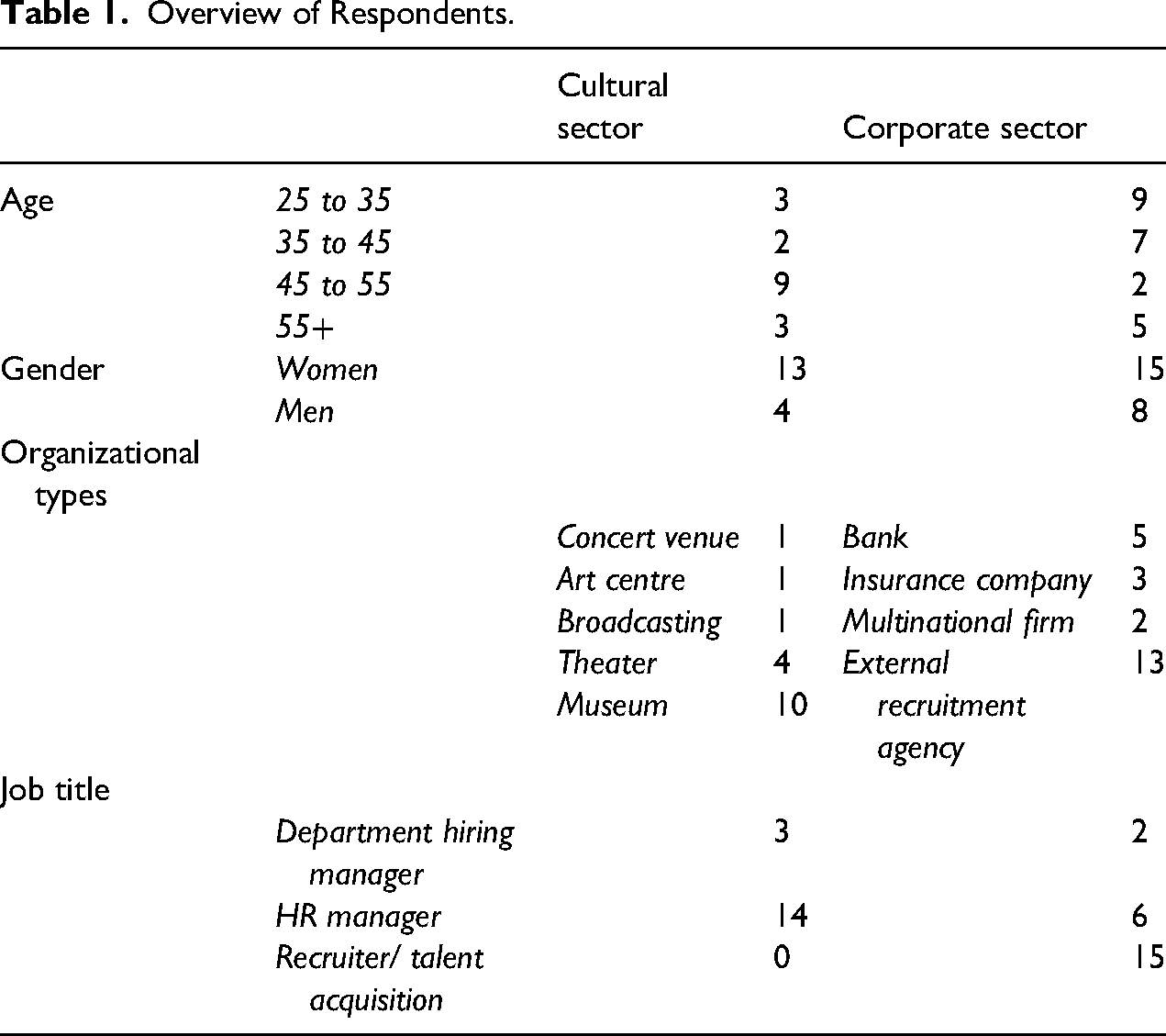
For the purposes of the current paper the comparative aspect is not central, but this set-up of the data collection did allow for a variety of perspectives, as the two sectors vary in the ratio of supply and demand of job openings and candidates, in market pressure, and in organizational size. Moreover, the cultural sector is more commonly associated with aesthetic labor (McRobbie, 2016) whereas the corporate sector is not so much.
Both samples consist only of respondents in operational roles, such as recruiters, HR staff, or departmental hiring managers.They executed directives from higher management and provided HR support to individual departments within their organizations. This is crucial, as in this context, they have little influence over the overall composition of the workforce, which is largely determined by the separate departments and higher managerial levels. Additionally, they rarely hire direct colleagues—except in smaller organizations, which was sometimes the case in the cultural sector, or when recruiting for their own HR department.
LinkedIn and snowbal sampling were used to approach possible participants. Participants were selected based on their professional experience (that is, they did at least five job selections procedures yearly) and field (i.e., cultural or corporate). The interviews were conducted face-to-face and consisted of two parts. The first part consisted of the participants’ reflections on their own hiring practices. In order to not only talk about hiring but to invoke evaluative decisions, the second part of the interview employed a video elicitation exercise (De Keere, 2022; Keesman, 2022). The respondents were asked to watch 3-min fictive video resumes played out by actors, and to then evaluate and rank the fictive job candidates. The videos resumes were based on two different scripts with similar structures, played out by white actors of more or less the same age (23–26), wearing the same clothes. Although the videos resumes were artificial, the visual elements and the game of ranking were helpful because they encouraged our respondents to actually demonstrate how they evaluate and, importantly, how they justify their evaluations. The analytical focus is not necessarily on the respondents’ direct reaction to the candidates in the video, but allowing them to make actual choices creates an interview context in which legitimacy becomes a real concern. More detailed information on the set-up of this video elicitation method can be found in De Keere (2022) and (2025). These articles are based on the data gathered specifically through the method of video elicitation and on the comparison between the two sectors. All interviews were audio-recorded with the participants’ consent and later transcribed verbatim for analysis.
The objective of the present study was to investigate how physical traits, body types or other aesthetic features that the fictive might candidates have, enter evaluation process of the respondents and trigger a demand for legitimacy. For this reason, the reactions to videos were used as springboards to discuss the acceptability of appearances as elements of assessments. Respondents were confronted with the physical appearances of the candidates when viewing the fictive application videos, after which this appearance was or was not a factor in their evaluation of the candidate. Eventually, at the end of each interview, the gatekeepers were also explicitly asked about how they deal with issues of appearances during the hiring process.
It is almost certainly the case that our respondents are aware of the contested role of appearance in the labor market. While they may not have intrinsic issues with using appearance as a selection criterion, they may recognize that it is a contentious issue in society. Although the possibility of socially desirable responses exists, it does not directly affect how we can use the interview to answer our research question. After all, the issue at hand is not whether appearance is used as a selection criterion, but rather how gatekeepers justify the importance of appearance.
Both authors independently coded the entire dataset the interviews with a focus on how aesthetics are discussed. The result of this analysis was compared and discussed, leading towards a more fine-tuned coding schema that was used for a second round of coding by both researchers. This allowed us to look more systematically into how the respondents talk about the aesthetics of the fictive candidates and into how they talk about appearances as criteria for evaluations in their actual selection practices. Further rounds of coding led to discerning three repertoires of legitimizing beauty as a hiring criterion, as will be discussed in the following section.
Context: the Dutch Labor Market
In the Netherlands, laws are in place to prevent discrimination based on attributes like skin color, gender, religion, social background, or political affiliation. It is prohibited to ask questions about these topics during job interviews. However, anti-discrimination legislation does not extend to personal appearance. In fact, the importance of aesthetics for employment is even reinforced by the government. The Dutch Participation Act of 2015 mandates that welfare recipients are required not to “obstruct employment through appearance”, regarding for instance clothing or personal grooming (Van den Berg & Arts, 2019). ‘Inappropriate’ appearance can even be grounds for the government to reduce welfare benefits.
Unsurprisingly, quantitative analyses indicate a correlation in the Netherlands between aesthetic capital and variables such as income and high-level positions, as defined by the International Standard Classification of Occupations. And despite anti-discrimination laws, numerous studies of the Netherlands also show evidence of discrimination based on race and gender (e.g., Di Stasio et al., 2021; Fernández-Reino et al., 2023; Lancee, 2021).
Given that race and gender affect how people evaluate appearances (Kuipers, 2015; Monk, 2021), it is striking that appearance itself remains a legitimate reason for exclusion. As a result, appearance might serve as an effective stand-in for other symbolic cues of discriminated positions, similar to Moss and Tilly's (1996) argument about soft skills.
The Dutch context is particularly interesting because of its historically dominant discourse of egalitarianism and the disapproval of overt displays of status. Snobbery and (class) inequalities are generally not a topic of conversation (van Eijk, 2011). However, this does not mean that the Netherlands is truly an egalitarian country with equal opportunities, as demonstrated by the aforementioned racism and sexism in the labor market. And although there are relatively high levels of social mobility in terms of class (Bukodi et al., 2020), the cultural sector is fairly exclusive (Güveli et al., 2012).
In sum, although the Netherlands likes to see itself as an egalitarian country with equal opportunities, class, gender, and race remain significant factors influencing labor market opportunities. Discrimination on these grounds occurs despite being prohibited. However, exclusion based on aesthetics is not forbidden; on the contrary, it is even endorsed by the law, which states that an appropriate appearance is part of being ‘employable’ This suggests that aesthetics can serve as a means of reproducing structural inequalities (Vonk, 2021, 2024).
Findings
Problematizing Beauty
Aesthetics matter for employment chances, and it could therefore be expected that candidates’ appearances are often mentioned when gatekeepers evaluate video resumes. However, this was not the case in the interviews conducted for this study. When the gatekeepers were asked to make hiring decisions based on fictive clips, they very rarely referred to beauty or looks explicitly. This indicates that the hiring managers are, at least, weary of expressing how they see the candidates in terms of appearances. This is striking, given that research showed that even the smallest detail in appearances can actually influence the chance of being hired. As demonstrated by Pajunen (2021), even something as simple as changing one's glasses for a job interview can impact hiring chances. But in the interviews conducted for the present study, actual mentioning of certain concrete aspects of appearances occurred only a few times, when respondents mentioned glasses, teeth, hair or beard. Consider for instance James, who works in a leading function in the cultural sector, discussing candidates’ teeth as off-putting: James: But the strange thing that stands out immediately are his teeth. I: Yes? J: That's one of the first things that attract attention I: Does he have remarkable teeth? J: Yes, bad teeth, didn’t you notice?
James explicitly mentions a particular aesthetic feature of a candidate as part of his negative evaluation. Note that teeth serve as a clear marker of class. A complete, white, and straight set of teeth has become the norm, but not everyone can afford to shape or maintain their teeth in this way (Craig, 2021; Kuipers, 2022).
The finding that other gatekeepers were not explicit in their aesthetic judgments does not mean that they deny the importance of aesthetics nor that they do not reflect on how aesthetics influence them. In the parts of the interview that were focused on gatekeepers’ reflections on making hiring decisions in general, the vast majority of respondents acknowledged that beauty and appearances influence how they perceive candidates. Consider, for instance, Jacob, who works as an executive director in the cultural sector: ‘Let's face it, when we have a bunch of CVs with pictures on them, and we all think ‘so good looking’… then we do try and get a better look. Even though I myself am against it, it does work that way, that's what you do.’ Jacob expresses the problem of legitimacy of beauty as a criterion here: he is aware of his preference for beauty, but he is also against letting this preference have an influence on who gets invited for a job interview.
The majority of the respondents both acknowledge that aesthetics play a role in their evaluation of candidates, yet they also question the legitimacy of this type of evaluation. Here we notice that it is not merely a matter of having personal biases or not, but when is it legitimate to use your preferences during the selection and when is it not. This might reflect social desirability rather than their ‘actual’ position towards the role of aesthetics in hiring. Yet, for our question at hand, the ‘trueness’ of their hesitance is not relevant. The main point here is that the gatekeepers seem very aware that they run the risk of creating a dispute and the breakdown of legitimacy. Hence, the role of aesthetics in application procedures evidently requires of them to solve the question of the appropriateness of this evaluation criterion (Lamont & Thévenot, 2000).
Legitimizing the Importance of Beauty
This section looks into the cultural repertoires employee gatekeepers use to achieve moral legitimacy of beauty as a criterion for evaluating job candidates. Three repertoires stood out: a) beauty as a business case; b) appearances indicate personality and c) looking right is a matter of effort.
Beauty as a Business Case
The repertoire of ‘beauty as a business case’ entails that aesthetics may serve as grounds for exclusion when there is an economic benefit to it in terms of profit or commercial success. This exclusion is considered acceptable because it, for example, increases client satisfaction, allows the company to meet industry standards, or enhances the organization's image. Put differently, selecting based on appearance is allowed when there is a ‘business case’ for it. As Arciniega (2021) showed in the case of diversity, the notion of a ‘business case’ makes any morally sensitive matter acceptable in a corporate setting by reframing it as an economic concern and thus apparently ‘neutral’ and merely instrumental
The task of evaluating not only technical skills, but also soft skills and ‘match’ with the organizations can be quite different for internal and external recruiters. The first – e.g., personnel officers – work internally in the sense that they try to find a candidate for the organizations which they themselves work for. The latter – e.g., professional recruiters - make employee selection decisions for external, i.e., other, organizations. Hence, these external gatekeepers try to select candidates that match their client's preferences – absolving them even more from personal responsibility. Consider for instance external corporate recruiter Marc, who takes his clients’ preferences regarding aesthetics into serious consideration in his evaluation of job candidates: Marc: It's all fine for me, but if you’re in a motorcycle club in your free time, and you’re applying for a job as a director and I can see that you have lots of tattoos, that's all fine, but I would think: I’m not going to hire you, because I know how my client thinks about these kinds of things. We have a client in Amsterdam (…) that's one of the biggest trade companies in the world. No piercings, no nose rings, no tattoos – nothing. I: So they ask for that? M: Yes (…). That's just their policy. Is that discrimination? Yes or no, I don’t know. But that's what the client wants and it doesn’t matter whether you’re Dutch or Surinamese, that's all the same. (…) They don’t want offensive behavior, they don’t want a girl at the reception with a nose ring.
Somewhat similarly, gatekeepers legitimize the role of aesthetics as economically instrumental by referring to the importance of representativeness. Our respondents tend to agree that workers should meet an undefined minimum standard of self-presentation, often expressed using the term ‘representative’. When asked how beauty plays a role in hiring, external recruiter Jeanette explains the difference between beauty and representativeness: Jeanette: Sure. Yes, we even rate people on that aspect [appearance]. It is not so much about beauty, but more about representativeness. I: What is the difference between the two? Jeanette: Well you can be incredibly beautiful but if you smell bad then you’re not representative. So representative is also.. if someone applies here for working at a bank, then you shouldn’t come to the interview dressed in your old jeans and baggy sweater.
Economic instrumentalism can also apply to the organization itself. Following the classic aesthetic labor logic of trying to appeal to a certain clientele (Butler, 2014; Warhurst & Nickson, 2020), this repertoire is most used when discussing ‘front stage’ as compared to backstage jobs, as illustrated by Albert, who works as a personnel officer in the cultural sector: Albert: Well, it all really depends on the function. For technical jobs it won’t be the case so much, but at the ticket box, if you have a public function then I suppose you sort of have to… […] at a business event we hired someone recently, it was only a temporary function but still that person has to have an agreeable appearance. There are of course plenty of functions for which that is not necessary. But in the majority of functions at [organisation] you are in contact with the public and then you do want to keep up a certain standard.
Since most respondents we interviewed were involved in hiring for both frontstage and backstage jobs, our data does not allow us to establish clear patterns as to whether this would lead to a stronger focus on appearances or preferences for certain bodily traits—which might very well be the case. However, our analysis does reveal strong consistency in the opposite direction of the selection logic: if personal appearance is used to make judgments, it is deemed fully acceptable when it pertains to looking presentable to clients or connecting with customers.
In sum, it is through such an economically instrumental repertoire that ‘lookism’ (Warhurst et al., 2009) becomes pervasive in sectors involving work with audiences or customers. Hence, the exclusion of marginalized bodies in these jobs is ultimately justified by framing it as ‘neutral’ through economic rationality.
Appearances Express Personality
The repertoire of ‘appearances express personality’ legitimizes the role of appearances in gatekeepers’ evaluation by reframing appearances as an indicator of personality, thus presenting exclusionary evaluations as seemingly neutral. Although actual physical traits were mentioned rarely by our respondents when evaluating fictive candidates, less concrete aspects of aesthetics were often voiced by gatekeepers. Confirming the stream of studies pointing out the role of intuition and gut feeling in labor market selection, considerations such as feeling a certain energy, emotional click, liking or disliking the way and frequency a candidate smiles were ubiquitous (Brown & Hesketh, 2004; Rivera, 2015; Sharone, 2014). Strikingly, when asked if and how aesthetics matter in their evaluation of candidates, the majority of our respondents answered by stating that looks should not matter, but that ‘charm’ (in Dutch expressed by using the word uitstraling) certainly does. A small number of respondents, while selecting their top threecandidates based on the videos, would even justify their selection by stating that these candidates just have more ‘charm’ than the others, without going into what candidates actually said during the video clips. Hence, the respondents themselves directly connect aesthetics to personality and aesthetic appeal, and spoke about the general impression candidates give off while avoiding specific physical features.
Following from this, the second repertoire gatekeepers employ in legitimizing aesthetics as a hiring criterion is that looks are a proxy for personality. According to this repertoire, appearances are not about being beautiful, but about hard-to-pinpoint personal traits. This is somewhat similar to Huzell and Larsen's (2012) finding that employers view physical traits related to body size and signs of tobacco use as indicators of qualities such as willpower and self-discipline. The study by Ren (2024), based on interviews with 73 Chinese recruiters, shows how athletic appearance is being interpreted as an important sign of professionalism. Candidates with a fit body type are more readily perceived as disciplined and ambitious. While our respondents remain more vague about actual body types, they do also use appearances as proxies for personality types
Christian's statement about this is exemplary: “I just know that appearances play a role. Whether they are important is a different point, but I just know that appearances - and I’m not saying good-looking or something, maybe I should say charm – that that plays a role.” According to Christian, appearances matter not because of beauty but because of what they express. Not beauty, but aesthetic appeal is taken into consideration when evaluating candidates. Our respondents find it difficult to explain what ‘charm’ is exactly, or how it can be observed. Whereas bureaucratic forms of organizational decision making (including employee selection) are based on explicit rules and technical knowledge, aesthetic appeal is about likeability and compatibility (Brown & Hesketh, 2004, pp. 33–39; Dean, 2005). In hiring, these are not mutually exclusive; after making a first selection based on credentials, technical knowledge and skills, gatekeepers base a further selection on ‘soft currencies’, but the criteria and how to evaluate them are not clear, causing uncertainty. Interestingly, the gatekeepers find that ‘charm’ is a legitimate criterion whereas ‘good looks’ are not. Good looks are understood to be superficial, but aesthetic appeal is linked to personality, as illustrated by recruiter for corporate traineeships Louise's take on the use of visual material in application letters: Louise: So always with some visual material, with faces. If someone adds that, that just speaks to me more. That's personality. It doesn’t really matter what someone looks like, you should hope not, I hope I don’t look at it like that. You try to be objective, but regarding personality and making a connection it can help.
Looking Right is a Matter of Effort
The third repertoire for legitimating the relevance of aesthetic in hiring is the imperative to show effort. According to this repertoire, looking right is equally attainable for anyone willing to put the effort in. Looking representative and dressing in a way that ‘fits’ the organization, is a way for candidates to show that they have put effort into preparing for the interview. In many Western, post-industrial labor markets, finding work requires of job seekers that they enhance their employability by doing unpaid work, for instance on their self-presentation (Vallas & Cummins, 2015; Van den Berg & Arts, 2019). Rather than for instance a sign of respect, making the effort to look right is primarily a means of communicating motivation. Moreover, this repertoire is a reflection of the idea that self-presentation is something that can be controlled and improved by putting in the effort (Kuipers, 2022; Widdows, 2018). As such, the importance of self-presentation is defined as emphatically meritocratic: by putting work into self-presentation or appearance anyone can increase their chances of finding employment. External corporate recruiter Maarten explains that candidates who look well-groomed have a head start: Maarten: I think you cannot escape from [taking looks into consideration], to have an opinion about that as a person. To take that with you in your role, unknowingly. (…) Imagine someone who really tries his best to present himself nicely, and you really don’t have to be a super model, but a nice jacket, tie, shirt, hair neatly, ehm that's fine. Yeah and if another [candidate] doesn’t do that, then that person was also not so willing to put effort in it. I: So clothes are important [for job interviews]? Jeannette: Sure, that also has to do with representativeness. Washed hair, are your shoes polished. And for some it is important and for others it's not, but you just look like: is this person groomed? Whether someone is representative in that sense is not so much about beauty, but about the total picture. Are they fat and wearing a tight top.. nothing wrong [with being] fat, but if you wear a tight top [then] something is wrong. You have to dress accordingly.
This repertoire makes candidates responsible for how their appearance is evaluated: they should put the effort into presenting their body in a certain way and if they do that, they will not be excluded. As such, the seemingly-neutral criteria of effort covers the classist evaluation taking place (Moss & Tilly, 1996; Rivera, 2015). Moreover, this repertoire for legitimizing the importance of beauty in hiring supports the argument made by Widdows (2018), Sarpila et al. (2021) and Kuipers (2022) that in many Western countries working on personal beauty has become a duty. Within this beauty regime, working on your self-presentation for a job interview (or any day at work) is not perceived as vain, but a normal element of the preparations that are expected of job candidates as illustrated by research on the aesthetic advice given by labor market intermediaries in the Netherlands (Vonk, 2024). Furthermore, this study demonstrates that in aesthetic advice, the importance of aesthetics is presented as an opportunity to make a good impression rather than a risk of being excluded based on appearances. Similar to the gatekeepers in the current study, labor market intermediaries deny the exclusionary effects of the relevance of aesthetics in job interviews and present it as a meritocratic way to present oneself as the right ‘fit’ for the job (De Keere et al., forthcoming; Nichols et al., 2023).
Discussion
This article investigated the question of how gatekeepers in the labor market consider beauty as a hiring criterion. Gatekeepers acknowledge that aesthetics matter in their evaluations of job candidates, and they tend to problematize this. We seek to understand how gatekeepers solve this dispute and how they morally legitimize the importance of aesthetics. By including an elicitation exercise whereby respondents had to make choices we were able to make legitimacy a real concern. Interestingly, specific physical elements were rarely mentioned by the respondents when evaluating the fictive clips. However, when prompted about actual recent job interview situations and evaluations of candidates, they discuss how aesthetics actually do play a role in how they evaluate candidates. Our aim was not to again reveal the beauty preferences of hiring agents or to map out the cognitive frames that shape these preferences. However, what remained unclear is how gatekeepers justify selecting candidates based on appearance—both to themselves and to others. To maintain social relations – in this case, between interviewer and interviewee – individuals fall back on socially ‘acceptable’ reasons to legitimize their choices and actions (Boltanski & Thévenot, 2000; De Keere, 2025; Tilly, 2012).
We distinguish three cultural repertoires for morally legitimizing appearances as hiring criteria. The first repertoire is that appearances can be economically instrumental (‘beauty as a business case’) – be it on the level of the sector, organization or the client. This is similar to the typical aesthetic labor logic of gaining revenue through style and looks, and our material illustrates that this repertoire can be extended to sectors outside of hospitality. Second, gatekeepers employ the cultural repertoire that appearances express personality. The third and final repertoire is that aesthetics are a matter of effort, hence making their importance conducive to meritocratic hiring.
Neither of these repertoires should be interpreted as solely personal predilections. Our method does not allow us to examine the minds of respondents and figure out whether they personally believe in these legitimacies or not. What we do know is that they consider these repertoires accepted and convincing enough to justify using appearance, charm, and beauty as hiring criteria. In this sense, we argue that these repertoires are more tied to context and situations than to individuals.
The first repertoire, beauty as a business case, pertains to client demands and job functions, making it more closely linked to organizational and sectoral contexts. This dovetails seamlessly with the literature on aesthetic labor (e.g., Boyle & De Keere, 2019; Warhurst & Nickson, 2020; Widdows, 2018; Witz et al., 2003), service work (Wilson, 2016), and variations in sector standards (Friedman & Laurison, 2019; Rivera, 2016). The second repertoire, which frames appearance and charm as important signifiers of personality, is more embedded in the role of hiring agents as evaluators of people and their suitability, which remains a highly ambiguous task. As research has shown, this ambiguity—especially when assessing soft skills—often leads gatekeepers to rely on gut feeling, interactional signaling, and cultural schemata (e.g., Blair-Loy et al., 2025; Brown & Hesketh, 2004; De Keere, 2022; Imdorf, 2010; Rivera, 2016; Roberts & Campbell, 2005). The third repertoire, which suggests that beauty can be a matter of effort, is rooted in a broader societal belief—or myth—of meritocracy (Dobbin, 2009; Mijs, 2021; Van Pinxteren & de Beer, 2016; Young, 2008 [1958]), where effort and talent are seen as determinants of labor market success. In sum, the repertoires of legitimacy that gatekeepers rely on should be traced back to societal, organizational, or role-based contexts rather than being understood as merely individual beliefs.
What does this teach us about the importance of aesthetics for work? We know that this relevance potentially increases exclusions and inequalities. Earlier studies have been critical of this and have emphasized the systematic exclusions and inequalities related to aesthetics. This study advances the understanding of these persistent inequalities by providing insight into the repertoires employee gatekeepers use to morally legitimize appearances as evaluative criteria. The importance of aesthetics in gatekeepers’ evaluations of job candidates can in effect serve as a legitimation for evaluations that are essentially based on factors such as class, race, or gender.
Our analysis suggests that labor market gatekeepers do not consciously seek to build or maintain these systemic exclusions. Instead, what they attempt to do is have their, often intuitively based, choices pass a test of justification. The highly complex task of evaluating candidates and making hiring decisions causes moral uncertainty among gatekeepers, and therefore a need to legitimize their evaluations and the criteria on which they base their decisions. These criteria may conflict in several ways. For instance, gatekeepers attempt to create equal employment opportunities, but might also feel that they have to meet their clients’ or customers’ aesthetic preferences. Or gatekeepers might, as a rule, only take criteria into account that are relevant for the job, but may argue that aesthetic appeal is indeed relevant. The uncertainty and ambiguousness regarding criteria for evaluating candidates, particularly regarding soft skills, means that there is room to legitimize different – and even conflicting – evaluations and decisions. Importantly, the cultural repertoires that gatekeepers rely on appear generally accepted but nevertheless legitimize lookism and, in effect, structural sexist, classist and racist inequalities. After all, they provide arguments for why it is acceptable, important, or even morally just within specific situations, to consider appearance as an evaluation criterion in job application procedures. While the first and second repertoire primarily emphasize the actual importance of appearance for work and disregard the exclusionary nature of this importance, the third repertoire suggests that taking appearances into account even contributes to making fair selections as everybody is supposed to be able to work on their appearances, it is just a matter of effort.
Conclusions
The repertoires identified in our analysis provide valuable starting points for future research. While the first repertoire (‘beauty as a business case’) has already received considerable attention in studies on aesthetic labor, it is especially the second (‘appearances express personality’) and third repertoire (‘looking right is a matter of effort’) that call for more explicit focus on how beliefs in personal agency underpin the acceptance of lookism and other forms of discrimination. It is clear that employers justify lookism and other systemic inequalities through functional arguments. The third repertoire adds a new dimension by presenting exclusion as inherently just. This raises questions about how lookism relates to broader beliefs in meritocracy, how physical appearance is actually viewed as merit, and how employees and job seekers themselves perceive this.
If lookism should be avoided, these findings have several possible implications. One obvious way of preventing exclusion is through legislation and policy, but the question of what the government can do to prevent exclusion— including racism and sexism—through the logic of aesthetics is a complex one. While recent policy developments have addressed this issue, a satisfactory solution has yet to be provided. In theory, the government could play a more direct role, particularly in the cultural sector. Since this sector is partly publicly funded in the Netherlands, the state has significant leverage to enforce anti-discrimination hiring practices. In 2011 the cultural sector, with explicit support of the national government, launched charter ‘Code Cultural Diveristy’ (renewed in 2019) with the goal of increasing diversity in programs, audience, partners and employees. This charter largely rests on self-regulation and had relatively little impact. On top of that, because it is illegal to register skin color in the Netherlands, Dutch legislation is somewhat limited in achieving explicit diversity objectives besides gender. Government incentives and penalties often rely on the registration of characteristics that are difficult—and perhaps undesirable—to record. And strikingly, policies that focus on equal opportunities in hiring do nothing to address aesthetic discrimination. Unless such policies also address the profound aesthetic discrimination—which is also based on class, gender, and race—they will always fall short in effectiveness.
Next to that, our analysis confirms why training programs aimed at addressing biases and stereotypes are often ineffective (for an overview see Dobbin & Kalev, 2022). People often find justifications for practices they may even understand as wrong or about which they are at least ambivalent. So, only focusing on individual cognitive frames might have limited affect as it misses important contextual dimensions. A more effective approach, therefore, would be to shift the focus toward organizational practices in addressing discrimination. One way of diminishing the role of aesthetics in application procedures is completely reconsidering the way in which these procedures take place, by, for instance, replacing the job interview with a standardized and formalized assessment procedure or a random selection process. Another, perhaps more subtle, way is not only formulating clear criteria for evaluating candidates but also explicating why these criteria are important and making a hierarchical order of the criteria beforehand. For instance, organizations and recruiters could reflect on why a certain aesthetic presentation is important for workers who are in contact with customers, what their idea of what a ‘right’ aesthetic presentation is actually based on, and whether it is indeed attainable for anyone putting the right amount of effort in. Making these considerations and criteria explicit, might indeed lead to awareness and the conclusion that aesthetics as a hiring criterion do not stand the test of legitimation.
In this respect, future research should focus more on how gatekeepers form these perceptions of what looks representative, suitable, or ‘right’ and where these notions stem from. Can they be traced back to the social background of the gatekeepers, or are they born out of field-specific norms? This could, for example, offer valuable insights into why candidates deemed attractive in general surveys don’t always succeed, either in controlled experiments or real-world job markets (see Kukkonen et al., 2024; Kuwabara & Thébaud, 2017). Relatedly, much is to gain by also further examining the impact of the personal social positions – in terms of gender, class, race, or ability – of the gatekeepers themselves on the way they perceive, read, and justify beauty as a hiring criterion. For decades, the focus has been primarily on the appearances of job candidates but turning the telescope towards those who make the actual hiring decisions is still only done sporadically (see also Bills et al., 2017).
Footnotes
Declaration of Conflicting Interests
The authors declared no potential conflicts of interest with respect to the research, authorship, and/or publication of this article.
Funding
The authors disclosed receipt of the following financial support for the research, authorship, and/or publication of this article: This work was supported by the Nederlandse Organisatie voor Wetenschappelijk Onderzoek, (grant number 023.011.040).
