







Abstract
Despite tremendous advancements women have made in higher education, gender inequality has persisted in the labor market, even among college graduates. The present study seeks to understand such paradoxical trends by investigating an underexplored source of gender inequality among highly-educated workers—how educational credentials translate into labor market positions. We operationalize this translational process as education–occupation mismatch, evaluating different dimensions of mismatch (vertical and horizontal) along the occupational allocation and mobility processes. Using longitudinal data from the Survey of Income and Program Participation as well as the National Longitudinal Study of Youth, we find marked gender differences in the incidence and persistence of mismatch and identify heterogeneity by the dimension of mismatch and moderating factors. Specifically, college-educated women were disproportionately more likely to take mismatched occupational positions below their educational level (vertical mismatch) and outside their field of study with lower wages (horizontal undermatch) compared to their peers who are men; meanwhile, they were less likely to secure high-paying positions outside their field of study (horizontal overmatch). Notably, once mismatched, college-educated women tended to remain in such positions longer than their counterparts who are men. The elevated risk of mismatch was primarily faced by married women and mothers. Graduating with advanced degrees or from selective institutions alleviated the gender gap in vertical mismatch, whereas STEM degrees played a nuanced moderating role. Overall, this study pinpoints education–occupation mismatch as an important process that reproduces gender inequality among the growing and increasingly diverse highly-educated workforce.
Extensive research has documented a stalled gender revolution in American society (Cohen et al., 2009; England et al., 2020). One baffling finding is that women's high level of educational success has not translated into greater gender equality in the labor market. Women have surpassed men in grades and in degree attainment at the baccalaureate and advanced-degree levels (England et al., 2020; Snyder et al., 2018) and also increasingly enter traditionally male-dominated fields of study (Diprete & Buchmann, 2013; Downey & VogtYuan, 2005). Nevertheless, women have continued to lag behind men in the workplace on multiple metrics ranging from hiring to wages at every educational level (Correll et al., 2007; England, 2010; Hout, 2012; Quadlin, 2018). The gender wage gap is even more pronounced among highly-educated workers than less-educated workers (Gould et al., 2016).
The reversal of gender difference in education and in the labor market raises an important question about the source of gender inequality among highly-educated workers. Namely, it suggests that the gender inequality among the highly educated is not necessarily a pipeline problem but instead is largely situated in the linkage between education and labor market. Previous research has approached this linkage in two primary ways. One segment of the literature examines the school-to-work transition (Rosenbaum, 2001), but it has focused primarily on high school graduates, operating under the assumption that college graduates navigate a smoother path into the workforce. This assumption, as we find, no longer holds true. The second strand of the literature emphasizes occupational sex segregation as a core mechanism structuring gender inequality (England, 2010; Levanon & Grusky, 2016). However, the increasing representation of women in traditionally male-dominated professions, particularly among college graduates, has weakened the explanatory power of this framework. As measured by the dissimilarity index (in 2015), the level of occupational sex segregation was more than 0.5 for less-educated workers but less than 0.3 for highly-educated workers (England et al., 2020).
These developments suggests that gender inequality among college graduates may, therefore, be driven by education–occupation linkage processes beyond occupational sex segregation. To date, research has yet to fully examine the role of these alternative linkage mechanisms in gender inequality. In the present study, we propose a new allocative process for understanding such inequality as a general process of converting education into occupation: that is, how educational credentials translate into positions in the labor market, which we operationalize as education–occupation mismatch. The proliferation of higher education in recent decades, coupled with stagnation in high-skilled employment opportunities (Beaudry et al., 2016), has led to an overproduction of highly-educated individuals relative to labor demand (Verhaest et al., 2017). This imbalance has brought attention to the global rise of education–occupation mismatch (Leuven & Oosterbeek, 2011; Li & Lu, 2023), positioning it as a critical site for studying contemporary labor market inequalities.
A central question, however, is whether education–occupation mismatch is gendered. As we elaborate below, we argue that both supply- and demand-side dynamics systematically disadvantage highly-educated women in the occupational matching process, undermining their ability to convert collegiate credentials into commensurate or superior labor market positions. While a small number of studies have explored the gendered patterns of education–occupation mismatch in various settings (Bender & Heywood, 2011; Bender & Roche, 2013; Mcgoldrick & Robst, 1996; Robst, 2007; Santiago-Vela & Mergener, 2022), existing findings remain inconclusive, in part due to conceptual ambiguities and methodological challenges. Many of these studies have either focused on a single dimension or measure of mismatch, or have relied on cross-sectional data. To deepen our knowledge, this study advances measurement and methodology to investigate the gender gap in education–occupation mismatch across three critical dimensions: prevalence, persistence, and heterogeneity.
Our study contributes to the literature on gender inequality as well as education–occupation mismatch in several ways. First, we investigate two distinct dimensions of mismatch in a unified framework, namely vertical and horizontal mismatch (discussed in detail below). Existing research notes the importance of studying both vertical and horizontal dimensions of mismatch simultaneously, though only in contexts outside the United States (Di Stasio, 2017; Verhaest et al., 2017). We contend that a joint investigation of multiple dimensions of mismatch reduces omitted variable bias and sheds light on which dimension(s) of mismatch more strongly contribute to gender inequality.
Second, we examine the extent and persistence of mismatch as a potentially important allocative and mobility process that contributes to gender disparities among highly-educated workers. Our analysis of both the incidence and persistence of mismatch permits us to determine whether the two processes compound: that is, if educated women are more likely to experience mismatch initially and/or if they are disproportionately confined to mismatch positions throughout their career. To further our understanding, we explicitly analyze the gendered mismatch patterns across the life course (age effects), over time (period effects), and across generations (cohort effects).
Third, our study explores potential heterogeneity in education–occupation mismatch by examining the moderating roles of family status and educational factors. Regarding the former, we study the extent to which marriage and parenthood exacerbate the gender gap in mismatch. As for the latter, we examine the moderating role of degree level (terminal bachelor's degree versus advanced degree), field of study (STEM versus non-STEM fields), and college selectivity. These analyses take into account the increasing educational stratification among college graduates (Gerber & Cheung, 2008; Posselt & Grodsky, 2017) and thus move beyond the conventional treatment of college graduates as a homogeneous group. Considering women's increasing movement into post-baccalaureate education and male-typed fields, an important question is whether advanced degrees or STEM fields facilitate education–occupation matching and help attenuate the gender gap in mismatch.
We used pooled longitudinal data from the Survey of Income and Program Participation (SIPP 1996, 2001, 2004, and 2008) and from the National Longitudinal Survey of Youth (NLSY79) to study the gender differences in the incidence and persistence of education–occupation mismatch. Given our research questions, we focused on workers with at least a bachelor's degree and compared mismatch patterns between highly-educated men and women with the same educational credentials (educational level and field of study). 1 Overall, the findings demonstrate marked gender disparities in the extent and persistence of mismatch and point to important heterogeneity with respect to the dimensions of mismatch and family status.
The Multi-Dimensionality of Education–Occupation Mismatch
We investigate two conceptually distinct dimensions of education–occupation mismatch 2 within a unified framework, namely vertical and horizontal mismatch. Vertical mismatch pertains to mismatch between workers’ educational level and the level of education required for their occupation (Lu & Li, 2021; Verhaest et al., 2017); it reflects an underutilization of general human capital. Such a scenario arises when college graduates are unable to secure work commensurate with their educational level and end up taking jobs that typically do not require a college degree (non-college jobs with lower status and wages; e.g., college graduates working as retail sales associates).
Horizontal mismatch refers to mismatch between workers’ field of study and the type of education required for their occupation (Somers et al., 2019; Verhaest et al., 2017). This form of mismatch involves the extent to which a worker's knowledge and skills are congruent with the substantive requirements of their occupations; it reflects an underutilization of field-specific human capital. Horizontal mismatch occurs when college graduates work in occupations that are not closely related to their field of study (e.g., engineering majors working as accountants).
We further differentiate different qualities of horizontal mismatch, defining “overmatching” and “undermatching” to describe out-of-field employment that is more or less lucrative, respectively. Horizontal undermatch is the negative form of horizontal mismatch and indicates downward mobility. It involves employment in out-of-field occupations that typically yield a lower wage compared to what is standard for matched occupations in the field (e.g., engineering majors working as accountants). Conversely, horizontal overmatch is the positive form of horizontal mismatch and indicates upward mobility (Li & Lu, 2023; Weber et al., 2024). It occurs when workers pursue more lucrative professional options outside their fields (e.g., social science majors working as managers).
A comprehensive assessment of multiple dimensions of mismatch can reduce the possibility of omitted variable bias that may occur when only one dimension is considered. This approach can also shed light on how each dimension of mismatch potentially contributes to gender inequality. A glossary of different dimensions of mismatch and our conceptual framework is outlined in Figure 1.
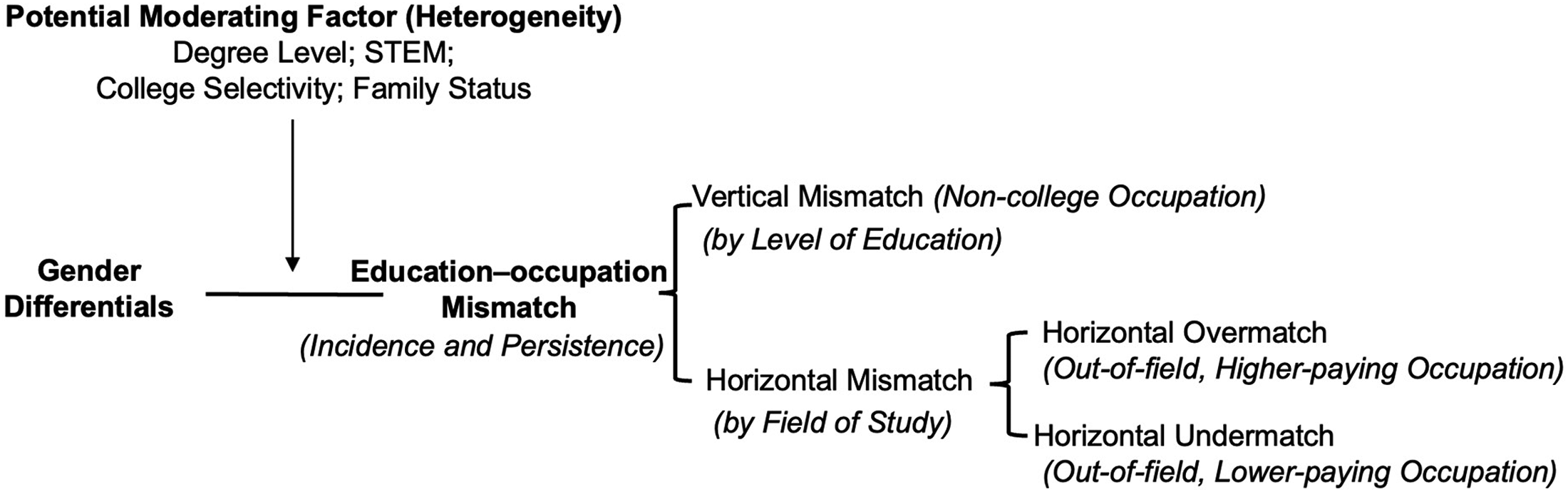
Conceptual Framework and Glossary of Different Dimensions of Education–Occupation Mismatch.
Gender Differences in the Incidence of Education–Occupation Mismatch
We begin by examining mismatch patterns between highly-educated men and women with very similar educational credentials (both in terms of educational level and field of study). A large body of work has identified a combination of demand-side and supply-side processes that contribute to gender inequality in the labor market. We build on the insights from this literature to theorize how such processes may influence gender disparities in education–occupation mismatch among highly-educated workers. We contend that demand and supply-side processes operate in inseparable, mutually reinforcing ways to produce gendered mismatch patterns, specifically by limiting women's capacity to convert their collegiate qualifications into commensurate (or higher) professional positions.
On the demand side, deeply-held societal beliefs regarding gender roles influence perceptions of men and women in the educational and employment realms. These perceptions evolve during the transition from school to the workplace, informed by shifting role expectations, thereby disadvantaging those deemed less suitable for certain roles (Brewer et al., 2020). In educational settings, where student roles are perceived as feminized, women are generally regarded as more proficient than men (Diprete & Buchmann, 2013). In the labor market, however, worker roles are often masculinized. Women, accordingly, are perceived as less capable, dedicated, or suitable for high-status, well-paid occupational positions compared to similarly-educated men (Cech et al., 2011; Quadlin, 2018). This shift occurs even when the school and work settings require the same set of skills (Brewer et al., 2020; Cech et al., 2011). The less favorable evaluation of women in professional roles leads to gender inequality at the point of hiring, promotion, wage setting, and employment termination, all of which hold even among highly-educated women (Joy, 2003; Quadlin, 2018).
The tendency of employers to undervalue educated women over men can translate into gender disparities in education–occupation mismatch in the high-skilled labor market. Because men graduates are seen as better candidates for high-status, high-paying occupational positions (i.e., college-level), they are more likely to secure matched positions than women graduates. Highly-educated women, who tend to be disproportionately channeled away from matched positions, then end up taking lower ranking positions that typically require less education in order to remain employed in the labor market. This process leads to a higher incidence of vertical mismatch for women.
In a similar vein, gender-biased evaluations concerning specialized skills give rise to the belief that women are less suited for certain specialized roles (Doering & Thébaud, 2017; Thébaud, 2015). These beliefs can increase the difficulty for women to secure occupational positions that correspond to their training and steer them into positions outside their field of study, leading to a higher risk of horizontal mismatch. When facing horizontal mismatch, women may be more likely to experience horizontal undermatch (downward mobility) and less likely to achieve horizontal overmatch (upward mobility) than similarly-situated men. The latter scenario reflects the structural barriers women face in climbing the career ladder (Cotter et al., 2001). These barriers arise in part from role incongruity between traditional gender roles and leadership positions that are typically associated with masculine traits (Eagly & Karau, 2002). Women graduates are thus perceived as less suitable for leadership positions and experience greater scrutiny when seeking advancement to these positions than men graduates with comparable qualifications.
On the supply side, gendered preferences and expectations further contribute to gender disparities in education–occupation mismatch. Under prevailing traditional gender role beliefs, women face (or anticipate facing) greater family responsibilities than men and are more limited by the gendered division of labor in the home (Corrigall & Konrad, 2007; Fuller, 2008; Gould et al., 2016). Also, women are prone to downwardly biased self-assessments about their professional competence and their ability to fulfill professional roles while still meeting their personal needs (Cech et al., 2011). Women's self-assessments and professional role confidence are especially biased downward for coveted, high-skilled professions (Cech et al., 2011; Correll, 2001), which are associated with masculine traits.
The preceding processes can dampen the aspirations and ability of women to pursue high-status, high-paying occupational positions, which are typically demanding and offer limited flexibility (Kossek & Lautsch, 2018). Instead, women are disproportionately steered into family-friendly occupational pathways (Correll et al., 2007; Dicke et al., 2019), which are often semi-skilled positions with loosely defined educational requirements but allow them to balance the competing demands of family and work. As highly-educated women forgo occupational match and financial rewards for occupational amenities that enhance a work-life balance (Felfe, 2012; Goldin & Katz, 2016), they are more likely to end up in occupations below their level of education (vertical mismatch) or outside their field of study (horizontal mismatch) than their counterparts who are men.
Whereas many highly-educated women may appear to be freely “opting out” of matched employment, this seemingly voluntary choice should be understood within the broader structural constraints they face. The prevailing “ideal worker” norm (Acker, 1990) and its associated intense work demands and inadequate support for work-life balance in the high-skilled labor market (Cha & Weeden, 2014; Kelly et al., 2011; Schieman et al., 2009) inevitably shape women's decisions. In reality, these decisions often reflect a forced choice, in which trade-offs are made between an inflexible and demanding workplace on the one hand and family responsibilities on the other (Stone, 2007; Wolf-Wendel & Ward, 2006).
Overall, these mutually reinforcing demand and supply-side processes converge to divert highly-educated women away from well-matched jobs into mismatched positions. This produces a higher incidence of vertical mismatch and horizontal undermatch for highly-educated women; at the same time, women graduates are less likely to secure lucrative occupational positions outside their field (e.g., managerial positions) and achieve horizontal overmatch.
Gender Differences in the Persistence of Education–Occupation Mismatch
We next investigate gender differences in the persistence of education–occupation mismatch: that is, whether women are consistently confined to mismatched positions over the course of their careers. Mismatch has greater career consequences if it is a persistent phenomenon. Recent research has underscored the persistent nature of mismatch in general (Büchel & Mertens, 2004; Dolton & Vignoles, 2000; Lu & Li, 2021), suggesting that experiencing mismatch at the onset of one's career can deliver negative signals about one's capabilities in future employment opportunities (Pedulla, 2016). Nevertheless, an overlooked question is whether such persistence varies by gender.
For highly educated women, the demand and supply-side mechanisms outlined above may combine to cause a greater persistence of mismatch. On the demand side, previous mismatched employment could reaffirm employers’ negative perceptions of college-educated women’ competence and commitment to the workplace (Correll et al., 2007). This could exacerbate employer biases toward workers belonging to both categories (mismatch and women), impeding women's labor market mobility and leading to prolonged mismatched periods.
In other words, college-educated women with histories of mismatch employment are often perceived as less committed and competent than similarly mismatched men, which impedes their labor market mobility and increases their likelihood of continued mismatch. This dynamic likely operates in cases of both vertical mismatch and horizontal undermatch, but it may be especially pronounced for vertical mismatch. This is because failing to secure a job commensurate with one's education level sends a negative signal, raising doubts about the graduate's overall capability and dedication. For women, this can be especially detrimental, as it reinforces gendered stereotypes about competence and commitment more broadly, making vertical mismatch a more damaging and enduring form of occupational mismatch.
However, the pattern may reverse for horizontal overmatch. Women in esteemed, high-paying occupations (e.g., leadership positions) often undergo intensified scrutiny and higher performance expectations (Cassirer & Reskin, 2000). As a result, they may face greater challenges maintaining such roles (Sassler et al., 2016). This heightened vulnerability translates into overmatched women being more at risk of slipping down the occupational ladder. This is consistent with what (Jacobs, 1989) describes as the “revolving doors” phenomenon, where gains in occupational status prove difficult to sustain over time.
On the supply side, family responsibilities may intensify as women move through various life stages (e.g., marriage, childbirth, childrearing, and elderly care). These evolving demands can prompt women to consistently prioritize family responsibilities over their careers, further constraining their opportunities for professional advancement and reducing their chances of improving occupational match. For the same reason, women may also be more vulnerable than men in slipping into mismatched positions or stepping back from horizontal overmatch as they go through family transitions.
Heterogeneity in Gendered Mismatch Patterns
We further assess whether certain factors amplify or attenuate gender differences in mismatch. The potential moderating factors we consider include marital and parental status, degree level (terminal bachelor's degree versus advanced degree), field of study (STEM versus non-STEM fields), and college selectivity.
The Role of Marital and Parental status
Extensive research on family and gender inequality show that the previously discussed myriad demand and supply-side processes affect married women and mothers more adversely (Budig & England, 2001; Correll et al., 2007; Gangl & Ziefle, 2009; Killewald & Zhuo, 2019; Loughran & Zissimopoulos, 2009; Lu et al., 2017). This line of literature suggests married women and mothers face an amplified risk of mismatch.
On the demand side, one prominent form of gender stereotyping employers subscribe to is maternal profiling (Kmec, 2011), which leads them to view motherhood as incompatible with a demanding workplace and violating the ideal worker norms. The perception of mothers as less committed and productive than men and childless women gives rise to a “motherhood penalty” in hiring, promotion, and wage setting (Budig & England, 2001; Correll et al., 2007), in contrast to a “fatherhood premium” that benefit men (Killewald, 2013). The motherhood penalty and fatherhood premium may extend to the context of education–occupation match among highly-educated workers. This is in part because the norms of “intensive mothering” or “concerted cultivation” are more prevalent among socioeconomically privileged women (Hays, 1996).
In this context, employers may view educated women as less committed to work than both educated men and less-educated women. Moreover, to the extent that marriage serves as a proxy for expectations of motherhood, there may be anticipatory discrimination on account of women's potential family roles and therefore an independent “marriage penalty” for highly-educated women. These perceptions could make women especially vulnerable to vertical mismatch because employers view them less committed in general, assuming they are more likely to reduce their hours, decline promotions, or exit the workforce.
On the supply side, the competing demands of work and family—which tend to weigh more heavily on women—can lead married women and mothers to forgo occupational match in favor of jobs that offer greater family-friendly amenities (Felfe, 2012; Goldin & Katz, 2016).This trade-off is not limited to standard white-collar roles; it extends to executive and high-level professional positions that require intense investments of time, energy, and emotional labor. For highly accomplished women who are also mothers, these roles can generate profound tensions between career aspirations and family responsibilities. Such tensions are further intensified by prevailing cultural norms that cast marriage and motherhood as a woman's primary vocation, reinforcing the notion that professional ambition must be tempered by familial devotion (Mary Blair-Loy, 2005). In this context, even elite women may find themselves opting out of optimal occupational matches in order to align with societal expectations and manage the ongoing strain of competing devotions.
This situation is exacerbated by the traditional family decision-making process that prioritizes men's careers, especially after having children (Loughran & Zissimopoulos, 2009; Stone, 2007). One manifestation of this dynamic is the mover-stayer pattern that women are bound to: they are often geographically constrained in their own job search, but frequently relocate for the career moves of their husbands, even when doing so undermines their own job prospects (Geist & McManus, 2012; Sorenson & Dahl, 2016).
Overall, these demand and supply-side forces suggest that gender gap in occupational mismatch is likely to be more pronounced among highly-educated workers who are married or parents than those who are unmarried and without children.
The Role of Degree Level
The existing research offers conflicting perspectives regarding whether advanced degrees can reduce the gender gap in mismatch. One school of thought posits an equalizing effect of postgraduate education on the premise that the high-skilled labor market is predominantly driven by meritocracy, and advanced degrees equip individuals with more in-depth specialized knowledge and skills (Alon & Tienda, 2007). Also, postgraduate education does more than confer knowledge; it also signals higher levels of competence, specialization, and professionalization. Such strong credentials and signals could counteract gender biases and mitigate gender discrimination in the workplace. Furthermore, pursuing graduate education may enhance women's evaluation of themselves, bolster their confidence in their chosen profession, and confer greater opportunities for professional development (Tomlinson, 2017). As a result, an advanced degree could enable women to better navigate and secure favorable job opportunities, thereby reducing their likelihood of various types of occupational mismatch.
An alternative perspective emphasizes that advanced degrees are not a panacea for entrenched biases that exist in the labor market. While much of the existing empirical research focuses on class-based inequalities (Posselt & Grodsky, 2017; Torche, 2011; Witteveen & Attewell, 2020), the same mechanisms may extend to gender biases. An advanced degree, for all its signaling power and professional value, may do little to disrupt deeply ingrained gender stereotypes or shift expectations around women's role in the family and workplace. Highly educated women still face implicit biases about their commitment and competence, especially in demanding professions, and they continue to shoulder a disproportionate share of caregiving responsibilities. These processes suggest that the moderating role of advanced degrees to be limited: the gender gap in education–occupation mismatch persists even among advanced degree holders.
The Role of Field of Study
The proliferation of college education has led to increasing horizontal stratification within higher education, as students aim for education that is quantitatively comparable but qualitatively superior (Gerber & Cheung, 2008; Morgan et al., 2013; Torche, 2011). This raises an important question: can certain fields of study mitigate the gender gap in the labor market? We focus here on the distinction between STEM (Science, Technology, Engineering, and Mathematics) and non-STEM fields, which are highly identifiable categories and have been researched extensively (Cech et al., 2011; Goyette & Mullen, 2006; Morgan et al., 2013; O’Dea et al., 2018; Xie et al., 2015).
Because STEM professions have two inherently contradictory characteristics for gender disparity, namely occupational specificity and gender typing, the theoretical expectation regarding the moderating role of STEM fields is not clear-cut. With respect to occupational specificity, STEM fields have highly-specialized and well-defined skill sets, which results in more clearly-delineated occupational pathways (Bol et al., 2019; Roksa & Levey, 2010; Shauman, 2009). This relatively more streamlined process may facilitate the occupational placement of STEM majors into commensurate positions, thus diminishing the gender gap in education–occupation mismatch. Such a process may be more evident for horizontal mismatch, given that occupational specificity mainly refers to the strength of linkages between occupations and field of study. Indeed, recent research finds that STEM fields—particularly the natural sciences—exhibit greater gender egalitarianism than non-STEM disciplines such as the humanities and social sciences (Horowitz & Ramaj, 2024).
In terms of gender typing, STEM fields are also marked by deeply-entrenched male-dominated cultural norms (Cooper, 2000). According to the role congruity theory, workers are evaluated less favorably if they belong to a group whose typical social roles (women—feminine) violate the prescriptive norms of given occupational roles (STEM professions—masculine) (Brewer et al., 2020; Ridgeway, 2009). This misalignment can amplify gender biases, as women in STEM are often assessed against “implicitly masculine ideals” (Glass et al., 2013; Smith-Doerr et al., 2019). In some cases, employers may even employ the notion of “fit” as a tool to circumvent legitimize hiring criteria and reinforce existing gender biases (Nichols et al., 2023)
Also, the gendered process at work in STEM professions may shape women's perceptions of their suitability and overall aspirations and confidence for pursuing and persisting in STEM careers (Cech et al., 2011; Moss-Racusin et al., 2018). A robust body of research has documented a “glass obstacle course”, which depicts the substantial hurdles women face in entering and advancing in STEM (Glass et al., 2013; Knobloch-Westerwick et al., 2013; Moss-Racusin et al., 2012; Reuben et al., 2014; Smith-Doerr et al., 2019). In this respect, women in STEM fields tend to remain more vulnerable to occupational mismatch than their peers who are men. Existing research offers indirect evidence for this, showing that within STEM fields, men are more likely than women to receive a wage premium (Quadlin et al., 2021).
The duality of STEM fields leads us to expect a strong tendency of gender typing to partially negate the equalizing potential of these fields. Such a tendency may be particularly salient for vertical mismatch. For horizontal mismatch, the high occupational specificity of STEM fields could offer some protection for women against this form of mismatch. As a result, the gender gap in education–occupation mismatch, especially vertical mismatch, is expected to remain largely in place for STEM graduates
The Role of College Selectivity
More selective institutions are often thought to confer graduates with a competitive advantage in job placement (Dale & Krueger, 2002; Goldrick-Rab, 2006). This is because elite universities typically provide students with a wealth of resources, robust professional networks, and opportunities, which enhance both their skills and social capital. Additionally, credentials from elite institutions can serve as powerful signals, not only of ability but also of “cultural fit” for coveted positions (Gaddis, 2015; Rivera, 2012). To the extent that these signals lead employers to perceive women graduates from elite institutions as equally competent and suitable as their counterparts who are men, institutional prestige could help mitigate gender biases and narrow the gender gap in education–occupation mismatch.
However, even with an elite education, women may not be fully insulated from pervasive workplace gender biases and structural impediments. Structural barriers—such as inflexible work arrangements, exclusionary organizational cultures, and persistent gender stereotypes—continue to shape their employment outcomes (Borgkvist et al., 2018). From the supply-side perspective, highly educated women often face the same work–family tensions as their less-educated counterparts, navigating a landscape where caregiving responsibilities still disproportionately fall on them (Gangl & Ziefle, 2009). These burdens can constrain women's career choices, mobility, and availability in ways that institutional prestige alone cannot compensate for. Thus, elite education may not fully overcome the gendered constraints that shape women's occupational trajectories (Stone, 2007).
Data and Methods
Data
In the individual-level analyses, we used longitudinal data from the Survey of Income and Program Participation (SIPP 1996, 2001, 2004, and 2008) and the National Longitudinal Survey of Youth (NLSY79) to study gender disparities in education–occupation mismatch among workers with at least a bachelor's degree. The analytic sample was comprised of degree holders aged 23 to 60 within the observation window. We excluded a small number of individuals who were in school, disabled, or in the military at any time during the panel (as they are not fully attached to the labor market), and the self-employed (because they experience the labor market differently from wage workers).
We pooled all four panels of SIPP, with each panel spanning three to five years and individuals interviewed every four months. The final analytic sample contained 109,190 observations from 14,619 college graduates across four SIPP panels.
While SIPP provides a large sample of college graduates spanning multiple birth cohorts, it only covers short-term to medium-term patterns. We thus complemented the SIPP analysis with NLSY79, which is a cohort-based, nationally representative survey of individuals between the ages of 14 and 22 in 1979. The long-term nature of NLSY79 allows us to study mismatch patterns over a longer period. NLSY79 also contains measures of individual ability, which we included as control variables. A drawback of NLSY79 is its modest sample size, which limits the power of moderation analyses. We thus used SIPP for the moderation analyses, apart from interactions by college selectivity (which is only available in NLSY79).
We used all available rounds of the NLSY79 data (28 rounds up to 2018). Additionally, we used work history data to construct mismatch measures for each respondent between the ages of 23 and 55 who were employed during at least one wave. To the greatest extent possible, we used sample restriction strategies similar to those used in SIPP. The final sample for NLSY79 included 29,859 observations from 2,140 individuals.
Constructing Measures of Education–Occupation Mismatch
Measuring mismatch requires first determining the typical educational requirement (level or field) for a given occupation (i.e., match education), and then comparing an individual's actual education with the required education for his/her occupation. Deriving the educational requirements for a given occupation is a challenging task. Various approaches have been introduced, each with their unique strengths and drawbacks. In an effort to provide a comprehensive and robust assessment, we adopt multiple approaches, which include both conventional methods used by other researchers and novel approaches we developed. Our approaches include: 1) a (modified) realized match (MRM) measure derived from the observed educational distribution of worker cohorts in each occupation; 2) a demand-based measure (DM) that uses required education data from job postings; 3) a job analysis (JA) measure based on objective assessments of occupational requirements by professional job analysts; and 4) a hybrid measure combining elements of the realized match approach and subjective evaluations. More details of these measures are in Appendix A. We use the MRM approach in the main analysis because it better accounts for shifting educational requirements and allows for varying number of matched fields for each occupation. In general, different measures produce largely similar results.
We constructed individual-level mismatch measures by merging the derived matched educational requirements from each approach detailed in Appendix A with individual-level data, based on each individual's occupation. We used 465 occupations based on the 2000 Census Occupational Classification System, 7 educational levels, and 22 ISCED fields of study. 3 An individual's match status was ascertained by comparing their actual education (level or field) with the derived matched educational standards for their occupation.
Graduates were considered vertically mismatched if they were employed in occupations that typically require sub-baccalaureate education. Individuals whose field was outside the matched fields of their occupations were classified as horizontally mismatched. We further distinguished between horizontal undermatch (downward) and overmatch (upward) using the median occupational income of highly educated workers from each field in each occupation (derived from ACS). In horizontal undermatch, workers hold out-of-field occupations that on average pay less than matched occupations in their field (based on the median income of workers from the same field in the matched versus mismatch occupations). In horizontal overmatch, workers hold out-of-field occupations that on average pay higher than matched occupations. We also explored separating out a lateral horizontal mismatch category (within a 5% wage difference). However, this yielded a very small category (around 3%). We therefore did not separate out this category in the main analyses.
Other Variables
SIPP
The key dependent variables were the vertical and horizontal mismatch status for each wave. The key independent variable was gender. The control variables at the individual level included age (and age squared), race (non-Hispanic white, non-Hispanic black, Hispanic, and Asian), nativity (native-born versus immigrant), and the marital and parental status at each wave (unmarried, no children; unmarried, with children aged 0–18; married, no children; and married, with children).
We also controlled for educational and labor market experiences. For education, we controlled for years of education and for 22 ISCED fields of study (pertaining to the highest level of education). Recognizing the issue of occupational specificity, we incorporated a local linkage score for each detailed field of study (DiPrete et al., 2017). This score accounts for the possibility that different fields of study have varying degrees of linkage to the labor market. By controlling for these educational variables, we effectively compared college graduates with very similar credentials. Work experience was defined as total years of employment from the first job up until the current SIPP wave, excluding employment gaps. Employment sector was a dichotomous variable indicating whether the respondent worked in the public sector. Additionally, we controlled for horizontal mismatch when studying vertical mismatch and vice versa. We further adjusted for the survey panel and two geographical variables: whether one lives in a metropolitan area and region. These variables account for macroeconomic shifts and regional differences in employment opportunities.
NLSY79
We kept the variable construction in NLSY79 as close as possible to SIPP. Also, we constructed a composite measure of cognitive and non-cognitive ability, following previous research (Addison et al., 2020; Deming, 2017). NLSY79 provides information on higher education institutions via restricted data. We constructed a variable that represented college selectivity of the highest degree by using admission rates obtained from the College Scorecard of the U.S. Department of Education. We followed prior research in using a 25% admission rate as the threshold to distinguish between selective and less-selective colleges (Heil et al., 2014). We also tested different cutoff points ranging from 15% to 40% and obtained similar results.
Because NLSY79 covered a longer time span, we carried out an imputation procedure to reduce missing data. Specifically, we filled in missing data in occupation, marital and parental status, immigration status, metropolitan area, and region with information from the previous year if the information before and after the gap remained consistent. A similar procedure was used for SIPP, which had a lower level of missing data. Hence, we dropped 6.2% of respondents with missing data for any variable. The descriptive statistics of all the variables used in the analyses appear in Appendix B.
Statistical Analyses
To examine gender differences in the incidence of mismatch, we estimated random-effects logit models to predict mismatch status based on gender and other control variables. In the NLSY79 analysis, we additionally included the composite measure of ability, which helped capture the unobserved productivity-related heterogeneity that may explain observed gender differences in mismatch patterns. We estimated separate models for vertical and horizontal mismatch to assess the relative importance of different types of mismatch (while controlling for the other dimension of mismatch).
To assess gender differences in the persistence of mismatch, we used discrete-time event history models (Allison, 2014). Discrete time event history analysis is particularly well-suited for explicitly studying transitions into or out of mismatch because it accounts for the dynamic nature of the labor market experiences and allows us to observe how the likelihood of exiting or entering a mismatched position evolves over time. Also, this approach accommodates right-censored data and varying observation periods across individuals, making it a robust tool for analyzing our research questions. Specifically, we first constructed employment histories for each individual by transforming individual-level data into person-wave (or person-year) data. In the next step, for each dimension of mismatch, we ran two logistic regressions capturing, respectively, the likelihood of exiting or slipping into a mismatched position, based on gender and other covariates. To examine gender differences in transitioning out of mismatched employment, we restricted the sample to individuals who were in mismatched employment initially. To study gender differences in transitioning to a mismatched position, we restricted the analysis to individuals who were in matched employment initially.
We also carried out the Oaxaca-Blinder decomposition analysis to quantify the contribution of mismatch to gender inequality among highly educated workers. The decomposition analysis incorporated data on hourly wages and the status of education–occupation match at the first wave of each panel. The control variables include age, age squared, race/ethnicity, immigrant status, years of education, field of study, marital and parental status, working experience, job tenure, public sector employment, metropolitan area, survey panel and region.
Finally, we studied the moderating role of family status and education (terminal bachelor's degree vs. advanced degree; STEM vs. non-STEM; and institutional selectivity). We did so by estimating the average marginal effects (AME) of gender separately for each category of the moderating variables (first difference) and then testing the equality of first-difference AMEs (second-difference test) to determine any interaction effects (Berry et al., 2010; Long & Freese, 2014).
Results
Descriptive Statistics
Figure 2 presents the basic descriptive statistics of mismatch status by gender using SIPP and NLSY and the MRM method, revealing several key findings. First, both vertical and horizontal mismatch were prevalent among highly educated men and women in the U.S. Second, women were at a greater disadvantage than men in education–occupation match.
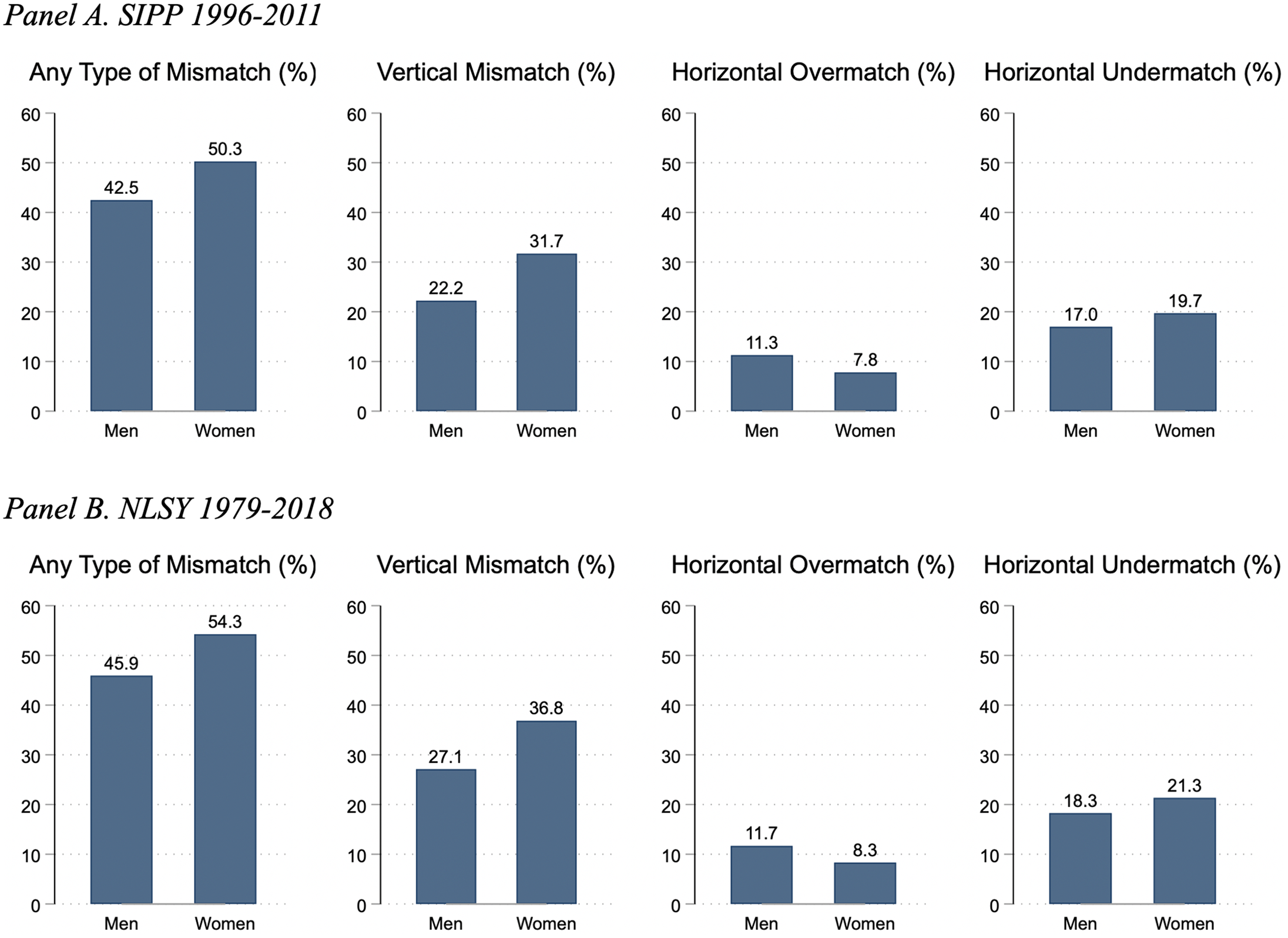
Percentage of Different Dimensions of Education–occupation Mismatch. Notes: The Figure Illustrates the Percentage of Mismatch by Gender using the Modified Realized Match (MRM) Measure. Details of the Measures are Provided in Appendix A. The Y-axis Represents the Percentage of Mismatch. The Number of Individuals is 14,619 in Panel A and is 2,140 in Panel B.
Overall, approximately half of the graduates experienced any type of mismatch. Specifically, between a quarter and slightly over a third of U.S. college graduates were vertically mismatched (i.e., underemployed in occupations typically not requiring a college degree). With respect to horizontal mismatch, the data reveal that over a quarter of college graduates worked in occupations not closely related to their fields of study. Moreover, horizontal undermatch was more prevalent than horizontal overmatch.
Notably, the gender gap was both substantial and consistent between SIPP and NLSY. The proportion of women experiencing any type of mismatch is higher than that of men, with a gender gap of 7.8 percentage points in SIPP and 8.4 percentage points in NLSY79. College-educated women were more vulnerable to vertical mismatch than their peers who are men. They were also more susceptible to horizontal undermatch while less likely to experience horizontal overmatch. We can see that the gender gap in vertical mismatch is approximately 9.5%, while it is about 3.5% and 2.7%, respectively, for horizontal overmatch and undermatch in SIPP.
In addition, whereas the gender gap is similar in the two datasets, the rate of vertical mismatch was higher in NLSY79 than in SIPP. This difference could be attributed to the younger age of NLSY79 cohort, which makes them more susceptible to credential inflation and, as a result, education–occupation mismatch. Another reason could be that NLSY79 spans up to 2018 and captures the rise in mismatch. Below we explore the gender differences more systematically in a regression framework.
Note that the results were largely consistent across different mismatch measures (Appendix C). The hybrid measure showed the highest rates, followed by the job analysis measure. The realized match measure and the demand-side measure produced relatively lower rates of mismatch. It is worth noting that the hybrid measure, which incorporates subjective evaluation, showed higher rates, which might be attributed to the inflation of subjective evaluations.
Education–Occupation Mismatch and Occupational Gender Segregation
Another important finding is the distinction between occupational gender segregation and education–occupation mismatch among highly educated workers. We provided an in-depth discussion and several analyses in Appendix D to highlight that, while both occupational sorting mechanisms are important for gender inequality, education–occupation mismatch is conceptually and empirically distinct from occupational gender segregation for college graduates.
Gender Differences in the Incidence of Mismatch
Figure 3 demonstrates notable gender differences in education–occupation mismatch after controlling for covariates in a regression framework. Essentially, these analyses compare the risk of mismatch among college graduates with similar educational credentials and other background factors. Notably, the pattern was largely consistent in both SIPP and NLSY79. The results also point to important variations across different types of mismatch.
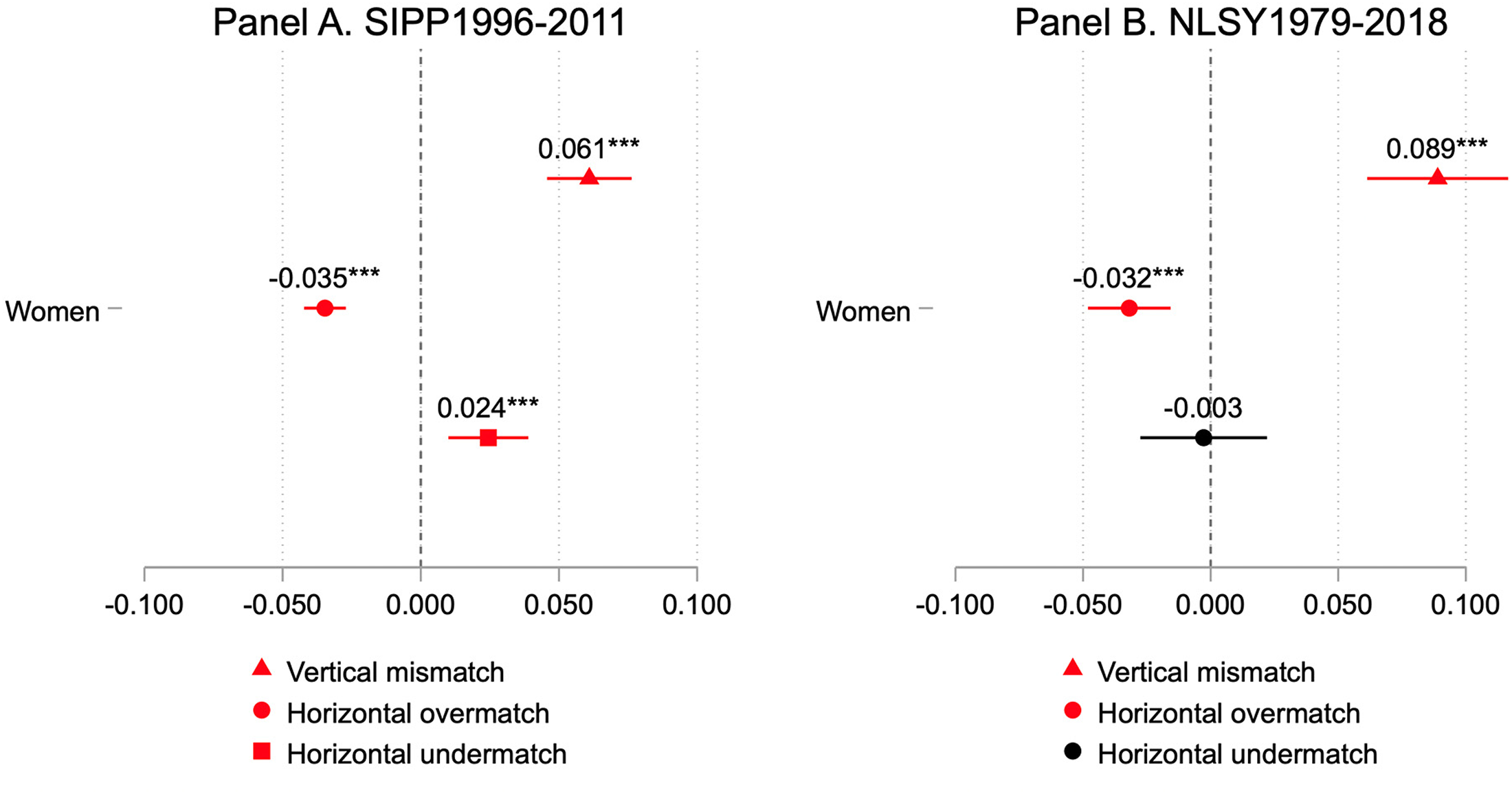
Gender Differences in the Incidence of Mismatch. Notes: The Figure Presents Gender Differences in the Incidence of Mismatch. the Sample is from SIPP 1996-2011 and NLSY79. The Analysis is Based on Modified Realized Match (MRM) Standards. The Average Marginal Effects (AMEs) are Shown. For Vertical Mismatch, we Used Random-Effects Models. for Horizontal Overmatch and Undermatch, we Estimated Multinomial Logit Models While Adjusting for the Clustering of Individual Observations Over Time. The Control Variables in Both the SIPP and NLSY Datasets Include age, age Squared, Race/Ethnicity, Immigrant status, Years of Education, Field of Study, Marital and Parental status, Working Experience, Public Sector Employment, Metropolitan Area, and Region. We Also Controlled for Vertical Mismatch When Modelling Horizontal Mismatch, and Vice Versa. SIPP Additionally Controlled for Survey Panel, and NLSY79 Additionally Controlled for Individual Ability. Red Indicates Statistically Significant Coefficients and Black Indicates non-Significant Coefficients. *** p < 0.001, ** p < 0.01, * p < 0.05.
Specifically, in the SIPP data with the modified realized match (MRM) measure (top panel), women graduates were significantly more vulnerable to vertical mismatch than their counterparts who are men (6 percentage points higher). In terms of horizontal mismatch, college-educated men were more likely to achieve overmatch (out-of-field but more lucrative positions) than women graduates. This reflects a “glass ceiling” effect, whereby women face hurdles accessing coveted, traditionally male-dominated leadership positions (Cotter et al., 2001). Conversely, women had a 2.4 percentage point higher risk of experiencing horizontal undermatch than men did, suggesting that they were more likely to settle for lower-paying jobs outside their field of study. These results suggest that gender differences are larger in vertical mismatch than horizontal mismatch.
The results from NLSY79 (bottom panel), which adjusted for individual ability, are generally similar and highlight the higher risk of vertical mismatch and fewer opportunities for horizontal overmatch that women face. The gender difference in horizontal undermatch was not statistically significant. The similarity in results across the two datasets indicates that gender differences in mismatch are not predominantly driven by preexisting individual differences, at least as captured by the multidimensional ability measure in NLSY79.
We also compared gender differences in mismatch across different measures (Appendix E). These gender differences are highly consistent across most of the measures, with the exception of the hybrid measure that involves self-assessments. Overall, these results provide evidence that college-educated women face greater difficulties in translating their educational credentials into commensurate occupational positions. For common examples of vertical and horizontal mismatch (by gender and STEM fields), refer to Appendix F.
Sensitivity Analyses of the Incidence of Mismatch
We conducted a series of sensitivity analyses, each detailed in the appendices. First, to assess the robustness of our results to potential endogeneity bias, we conducted a sensitivity analysis using the longitudinal system GMM (generalized method of moments) estimation (Appendix G). This method accounts for potential unobserved heterogeneity, such as unmeasured productivity-related attributes. The results align well with our main findings derived from random-effects models, pointing to the elevated risk of vertical mismatch and a lower propensity for horizontal overmatch among college-educated women. This consistency suggests that the observed gender disparities in mismatch are not primarily driven by unobserved heterogeneity.
Second, recognizing that vertical and horizontal mismatch may occur simultaneously, we combined both dimensions to create a joint mismatch measure (Table H1 in Appendix H). This joint measure distinguishes whether an individual is fully matched, only vertically mismatched, only horizontally overmatched or undermatched, or fully mismatched in both respects. In general, a moderate overlap was observed between vertical and horizontal mismatch (32% of those vertically mismatched also experienced horizontal mismatch). Moreover, we obtained similar results that college-educated women were more likely to be solely vertically mismatched and solely horizontally undermatched while less likely to be solely horizontally overmatched than their counterparts who are men. The results for horizontal undermatch suggest that in instances where women were vertically matched, they occasionally had to opt for horizontally undermatched positions. However, no significant gender difference emerged for joint mismatch statuses. It is also worth noting that co-occurrence of vertical mismatch and horizontal overmatch was rare.
We further investigated whether women tend to major in fields with generally high rates of mismatch, and whether women disproportionately experience mismatch even in fields where mismatch is relatively uncommon. As shown in Table H2 in Appendix H, the results indicate that women are indeed more likely to major in fields with elevated rates of vertical mismatch—particularly in health and welfare, arts, humanities, and the social sciences. Furthermore, even within fields where overall mismatch rates are relatively low, women are still more likely to experience vertical mismatch. For example, in law, the mismatch rate is 12.6% for women compared to 6.2% for men; in computing and communication, the rates are 21.5% and 12.6%, respectively, for women and men. Note that these differences are effectively accounted for in our analysis because we control for field of study: that is, we essentially compare college graduates in the same field.
Overall, these additional analyses underscore the challenges women face during their college-to-work transition. In light of these findings, we modelled each mismatch dimension separately for parsimony and sample size considerations (while controlling for the other dimension) in the main analyses. This strategy also enhanced our ability to understand the respective roles of vertical and horizontal mismatch.
Gender Differences in the Persistence of Mismatch
The results from event history analyses reveal a notable gender gap in the persistence of mismatch (Figure 4). Among those initially in vertically mismatched positions (Panel A), women were considerably less likely to transition into vertical match over time. Put differently, women faced greater difficulties in recovering from the negative cycle of mismatch. Moreover, women were less likely to maintain horizontally overmatched positions (e.g., high-paying managerial positions). This indicates downward mobility in economic terms and the higher risk for women to leave high-paying positions such as leadership roles. The patterns of horizontal undermatch were similar between men and women college graduates.
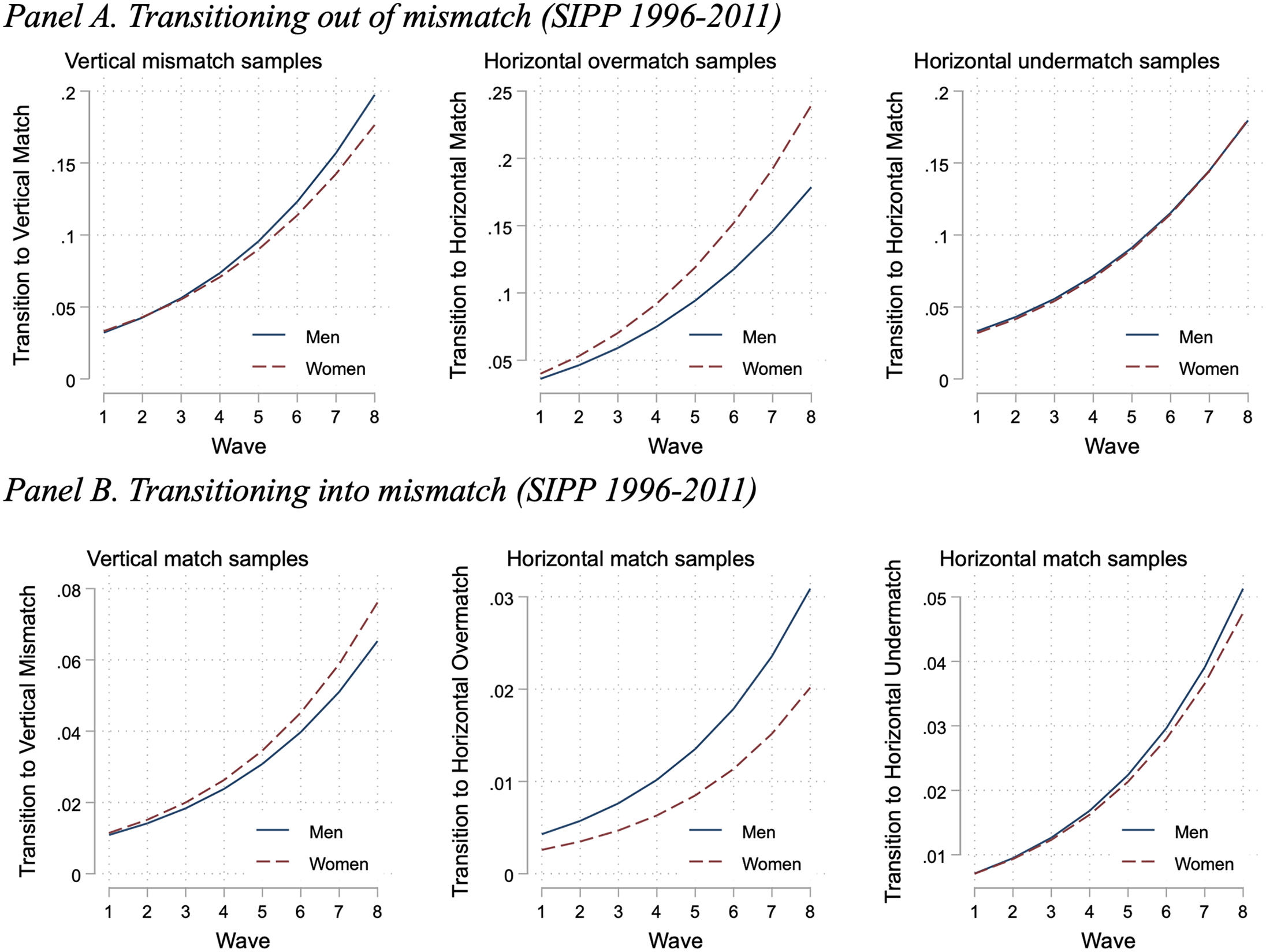
Gender Differences in the Persistence of Mismatch. Notes: The Figure Presents Gender Differences in Transitioning out of and into Mismatch. The Sample is From SIPP 1996-2011, and the Analysis is based on Modified Realized Match (MRM) Standards. The Predicted Transition Likelihood (probability) is Shown. The Y-axis Shows the Probability of Transitioning Into or out of Mismatch. Panel A Includes Samples of Individuals who Experienced Mismatch in the First Period; and Panel B Includes Samples of Individuals Who Were Matched in the First Period. The Control Variables Include Age, Age Squared, Race/Ethnicity, Immigrant Status, Years of Education, Field of Study, Marital and Parental Status, Working Experience, Public Sector Employment, Metropolitan Area, Survey Panel and Region.
Furthermore, the results revealed marked gender differences in the likelihood of slipping from matched into mismatched occupational positions (Panel B). Among graduates initially in matched positions, women were more likely than men to fall into vertical mismatch while less likely to achieve horizontal overmatch. These results indicate that women are exposed to increased risks of downward mobility throughout their careers. Thus, even strong initial positions do not necessarily shield highly educated women from facing downward mobility later on in their careers.
In sum, our findings highlight the challenges highly educated women face both in rebounding from mismatched positions and in their heightened risk of falling into such positions. These patterns are especially pronounced for vertical mismatch and horizontal overmatch, and less evident for horizontal undermatch. This suggests that the experience of vertical mismatch may be especially detrimental, as it tends to send broad negative signals of graduate's overall capability and commitment to work. In contrast, horizontal mismatch signals mostly discrepancies in field-specific expertise rather than general ability.
Hence, college-educated women face disadvantages as a result of multiple compounding processes: an initially higher risk of entering mismatched positions, followed by greater difficulties in recovering from mismatch; and/or greater difficulties in securing and retaining matched or overmatched (upwardly mobile) positions.
We carried out two additional analyses to delve more deeply into the patterns and trends of education–occupation mismatch. The first analysis used sequence analysis to examine the persistence of education–occupation mismatch using longer-term data from NLSY79 (Appendix I). The results confirm the notable persistence of both vertical and horizontal mismatch, with a substantial proportion of workers enduring persistent mismatch throughout their careers.
The second analysis explicitly explored the trend of gendered mismatch patterns along three dimensions: over the life course (age effects), over time (period effects), and across generations (cohort effects). To disentangle these overlapping influences, we employed age-period-cohort (APC) models, which are particularly well-suited for isolating the net effects of each dimension while accounting for the other two dimensions. The APC approach complements the event history analysis by providing a broader temporal perspective on gendered mismatch patterns, beyond the discrete transitions (out of or into mismatch) captured in event history models.
The results in Appendix J reveal that women consistently faced a higher risk of mismatch compared to men throughout the life course. Notably, the gender gap in mismatch begins to widen around age 30. While period effects were relatively modest, women remained disproportionately vulnerable to vertical mismatch across the entire observation window. Furthermore, a pronounced cohort effect emerged, reflected in the expanding gender gap in vertical mismatch across successive birth cohorts. This trend coincides with higher education expansion and the increasing oversupply of college graduates, which appears to deepen structural disadvantages for younger generations of women.
Decomposition Results
To understand the extent to which vertical and horizontal mismatch contribute to gender wage inequality among college graduates, we applied Oaxaca-Blinder decomposition (Jann, 2008) to a model of hourly wage based on various types of mismatch measured at the time of the survey, gender, and other covariates in SIPP. The results, shown in Appendix K, underscore the importance of mismatch for gender wage inequality.
Specifically, about 15.9% of the gender wage gap among college graduates was attributed to various types of mismatch. Most of this disparity, about 12.7%, is due to vertical mismatch—the differential placement of college-educated women and men in non-college level occupational positions, which are associated with adverse wage outcomes. In comparison, horizontal mismatch (net of vertical mismatch) accounts for a smaller proportion of the gender wage gap (3.2% in total). Of this, about 2.9% and 0.3% result from horizontal undermatch and overmatch, respectively. These results suggest that vertical mismatch has a more pronounced impact on the gender wage gap among college graduates than horizontal mismatch does.
In the same model, we also included a variable measuring occupational gender segregation, defined by the gender share of respondents’ occupations. This was carried out in order to evaluate the relative importance of various occupation sorting mechanisms. As shown in Appendix K, occupational gender segregation accounts for 20.5% of the gender wage gap, which is slightly larger than that of mismatch. Nonetheless, both occupational sorting mechanisms represent important factors in understanding gender inequality in the labor market among college graduates.
The Moderating Role of Family Status and Educational Factors
Marital and Parental status
Figure 5 illustrates the moderating impact of marital and parental status on gender differences in occupational mismatch. We found no gender difference in mismatch among highly educated single and childless individuals. All other marital and parental categories, however, showed a clear gender difference, with women at a disadvantage, particularly with respect to vertical mismatch. Married women, regardless of whether they had children, faced a higher likelihood of vertical mismatch (Panel A) and a reduced chance of achieving horizontal overmatch (Panel B) compared to their counterparts who are men. There was no significant gender difference in horizontal undermatch (Panel C).
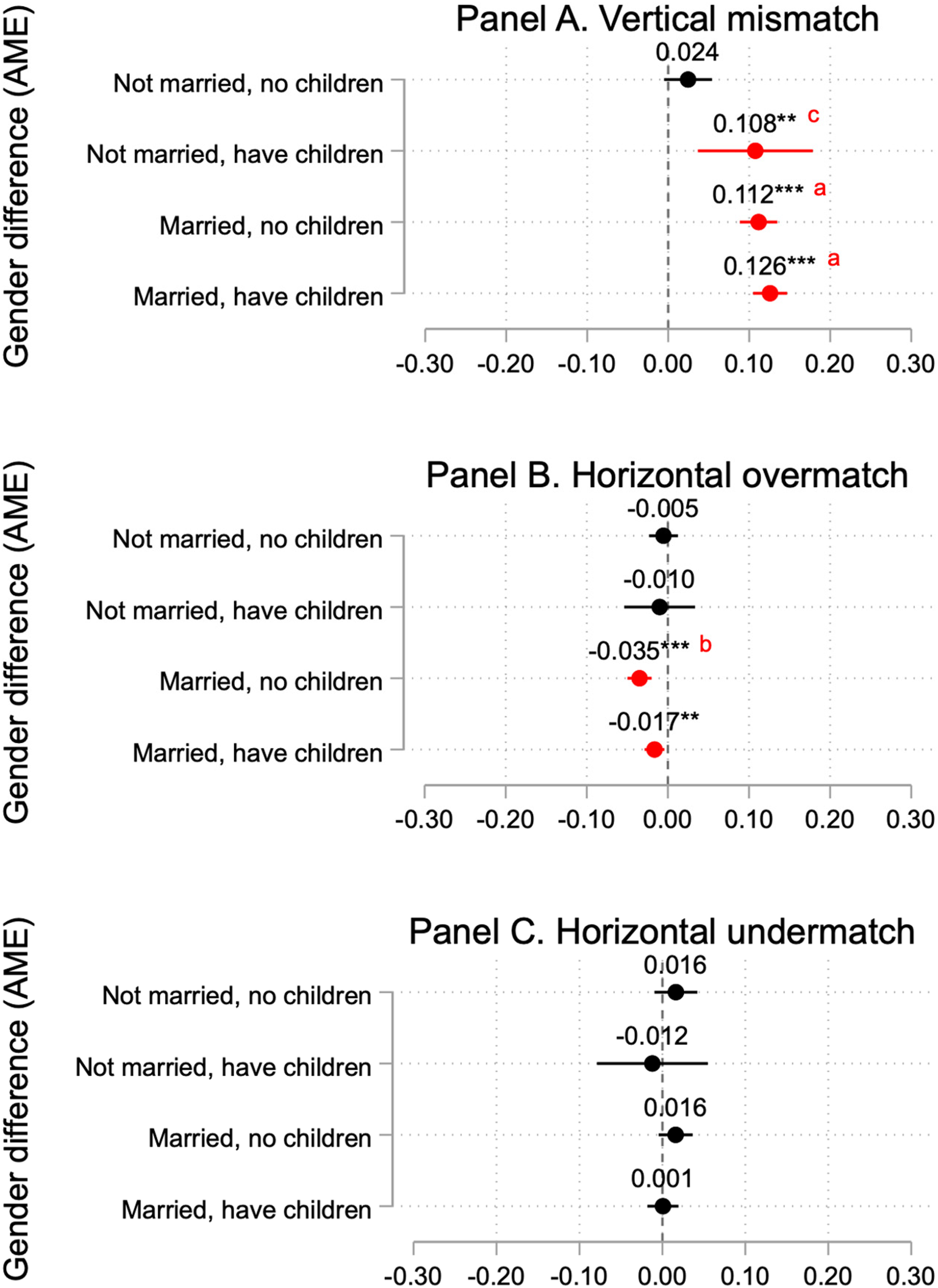
Moderating Role of Family status. Notes: The Figure Shows the Moderation Effects of Family status on Gender Differences in Mismatch. The Sample is from SIPP 1996-2011, and the Analysis is Based on Modified Realized Match (MRM) Standards. The Average Marginal Effects (AMEs) are Shown. The Numbers in the Graph Represent Gender Differences in Mismatch (i.e., First Differences; Women Versus men). The Control Variables Include age, age Squared, Race/Ethnicity, Immigrant status, Years of Education, Field of Study, Marital and Parental status, Working Experience, Public Sector Employment, Metropolitan Area, Survey Panel and Region. We Also Controlled for Vertical Mismatch When Modelling Horizontal Mismatch, and Vice Versa. Red Indicates Statistically Significant Coefficients and Black Indicates non-Significant Coefficients. The Significance Level for the First Difference (i.e., Women Versus men Within Each Family status Category) is Indicated by: *** p < 0.001, ** p < 0.01, * p < 0.05. The Significance Level for the Second Difference (i.e., Difference in the Gender gap Between Each Family status Category and the Reference Category—Unmarried Workers with no Children) is Indicated by: a p < 0.001, b p < 0.01, c p < 0.05.
We carried out second difference tests to evaluate whether the gender disparity in mismatch differed significantly between workers of specific family statuses and the reference group: unmarried, childless workers. Significant differences in vertical mismatch emerged for unmarried workers with children, as well as married workers, both with and without children (Panel A). Regarding horizontal overmatch, the second difference was significant for married workers without children (Panel B).
Taken together, these findings highlight the important role of marital and parental status in moderating the gender differences in occupational mismatch. The challenges women face in achieving vertical match and horizontal overmatch are predominantly observed among married women irrespective of their parental status. This indicates that highly educated women face not only a “motherhood penalty” but also a “marriage penalty.” Simply being married seems to decrease the chances of college-educated women securing matched or overmatched positions, which could result from potential biases arising from anticipation and perceptions about women's future family roles (Rivera & Tilcsik, 2016). These findings resonate with existing research that has highlighted the adverse effects of marriage and motherhood on women's career trajectories (Budig & England, 2001; Correll et al., 2007). In essence, our research emphasizes that the penalties from marriage and motherhood manifest themselves in the occupational match of high-achieving women.
Advanced Degrees
Panel A of Figure 6 presents the moderating effect of advanced degrees. We find that degree level plays a significant moderating role in vertical mismatch. Both women with bachelor's degrees and those with advanced degrees were more likely to experience vertical mismatch and less likely to achieve horizontal overmatch compared to men. However, the gender disparity in vertical mismatch was notably less pronounced among advanced degree holders compared to bachelor's degree holders. This suggests that advanced degrees provide women with some protection against vertical mismatch, although they do not entirely eliminate the gender disparity. The pattern is similar for horizontal undermatch, but the second difference test lacks statistical significance. This could be because advanced degree holders are more frequently found in high-skilled and high-status positions. However, for horizontal overmatch, the gender gap remains pronounced and is of a similar magnitude for both bachelor's and advanced degree holders.
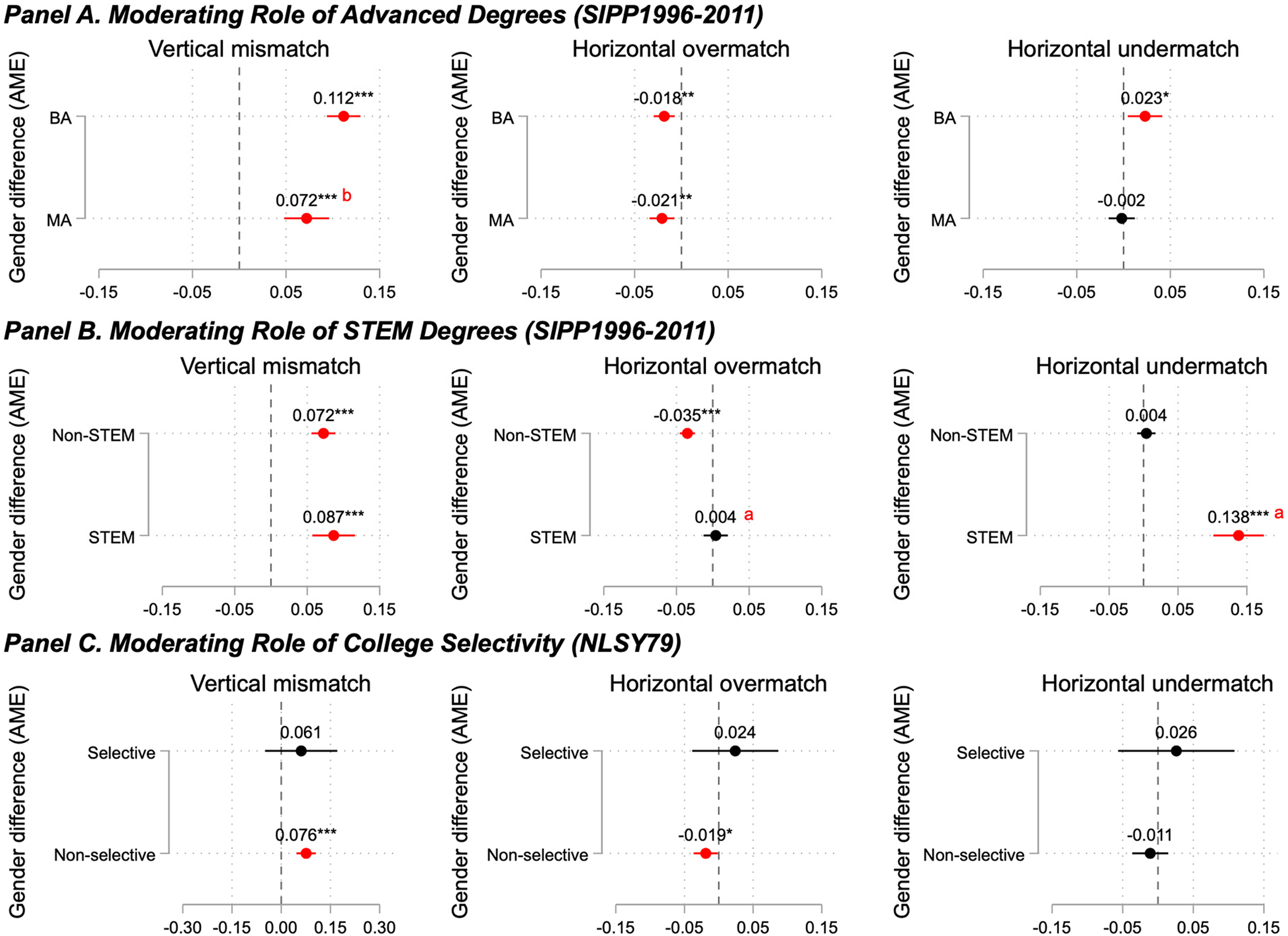
Moderating Role of Advanced Degrees, STEM Degrees, and College Selectivity. Notes: The Figure Shows the Moderating Effects of Advanced Degrees, STEM Degrees, and College Selectivity on Gender Differences in Mismatch. The Sample is from SIPP 1996-2011 for Panel A and B, and NLSY79 for Panel C. The Analysis is Based on the Modified Realized Match (MRM) Standards. The Average Marginal Effects (AMEs) are Shown. The Numbers in the Graphs Represent Gender Differences in Mismatch (i.e., first Differences; Women Versus Men). The Control Variables for Both the SIPP and NLSY Datasets Include Age, Age Squared, Race/Ethnicity, Immigrant Status, Years of Education, Field of Study, Marital and Parental Status, Working Experience, Public Sector Employment, Metropolitan Area, and Region. We also Controlled for Vertical Mismatch when Modelling Horizontal Mismatch, and Vice Versa. SIPP Additionally Controlled for Survey Panel, and NLSY79 Additionally Controlled for Worker Ability. Red Indicates Statistically Significant Coefficients and Black Indicates Non-significant Coefficients. The Significance Level for the First Difference (i.e., Women Versus Men Within each Education Category) is Indicated by: *** p < 0.001, ** p < 0.01, * p < 0.05. The Significance Level for the Second Difference (i.e., Difference in the Gender Gap Between Education Categories) is Indicated by: a p < 0.001, b p < 0.01, c p < 0.05.
STEM Fields
Panel B of Figure 6 reveals the varied moderating role of STEM fields of study. Specifically, for non-STEM majors, a consistent gender disparity was evident: women faced a greater likelihood of vertical mismatch yet were less likely to achieve horizontal overmatch. Among STEM majors, the gender gap in vertical mismatch and horizontal undermatch persisted and even grew. However, for horizontal overmatch, women graduates in STEM performed on par with their men peers. The difference in the gender disparity in mismatch between STEM and non-STEM majors (second difference) was significant in the case of horizontal mismatch (both overmatch and undermatch).
On the one hand, these results indicate that, contrary to expectation, STEM fields sometimes reinforce gender disparities in the negative types of mismatch. Despite a growing number of women graduates in STEM, such qualifications do not necessarily offer women the same leverage as their peers who are men in obtaining field-matched occupational positions. On the other hand, our results also highlight some equalizing effect of STEM degrees for horizontal overmatch. Specifically, the gender gap in horizontal overmatch was not statistically significant among STEM degree holders. Hence, women with STEM backgrounds are equally positioned to achieve horizontal overmatch as their peers who are men. This is congruent with recent studies highlighting the rising representation of STEM women in managerial roles and the growing incentives tech companies offer to attract high-achieving STEM women (Bilimoria & Lord, 2014). Women in STEM fields often exhibit counter-stereotypical qualities, some of which align with leadership attributes. Coupled with the general perception of women's communal nature, these traits can bolster their transition to leadership roles.
Overall, our findings provide a nuanced understanding of the divergent experiences of women in the STEM fields. While some women with STEM education achieve horizontal overmatch, others experience negative forms of mismatch, oftentimes more than their counterparts who are men.
College Selectivity
Panel C of Figure 6 illustrates the moderating effect of college selectivity on occupational mismatch. Among graduates from non-selective colleges, women faced a higher risk of vertical mismatch and were less likely to achieve horizontal overmatch than men. Conversely, among graduates from selective colleges, there was no significant gender difference in the risk of occupational mismatch. This suggests that selective colleges offer a protective effect, leveling the playing field for men and women with respect to both vertical and horizontal mismatch. However, it is important to note that the results from the second difference test were not statistically significant. One should thus interpret this particular finding with caution.
Auxiliary Analyses of Mechanisms Underlying the Gender Differences in Mismatch
We have theorized that various demand-side and supply-side mechanisms operate in mutually reinforcing ways to produce gender disparities in mismatch patterns. While our data do not permit a direct investigation of these mechanisms, we leveraged the available data to indirectly assess their influences by examining differences among college graduates with varied gender role beliefs and family economic conditions (Appendix M). The findings on gender role beliefs indicate that the gender gap in vertical mismatch and horizontal overmatch persists even among highly educated women with more modern gender beliefs who prioritize their careers. This result highlights demand-side mechanisms that restrict women's access to matched and upwardly mobile positions. Additionally, the analysis by family economic conditions shows that this gender gap occurs only in households where women earn less than their spouses, pointing to notable supply-side processes. Thus, the findings provide evidence for both demand and supply-side explanations for gender disparities in mismatch.
Conclusion and Discussion
Education–occupation mismatch is a growing phenomenon that stratifies college-educated workers. The present study investigates mismatch as a potential source of persistent gender inequality among the growing and increasingly diverse highly educated American labor force. It adds to the existing research that has emphasized occupational gender segregation as a crucial occupational sorting mechanism behind gender inequality. This sorting mechanism has become less prevalent among the highly educated as college-educated women have increasingly broken into previously male-dominated fields and professions. Our findings indicate that education–occupation mismatch—i.e., college graduates failing to secure occupational positions commensurate with their educational credentials—represents an additional salient occupation sorting mechanism that generates gender inequality among highly educated workers. It is crucial for future research to incorporate the concept of occupational mismatch when investigating gender disparities among college graduates in the labor market.
Our study makes several contributions to the literature on gender inequality and school-to-work transition. First, this study identifies a new allocative and mobility process that contributes to gender inequality among the growing and increasingly diverse highly-educated workforce: the unequal translation of educational credentials into occupational positions and corresponding wage consequences. Mismatch constitutes an important process that characterizes gendered experiences and reproduces gender inequality in the high-skilled labor market. Also, our study adds to the literature on school-to-work transition, which has focused on high school graduates and overlooked the experiences of college graduates. Our findings illustrate diverse and gendered education–occupation match experiences during school-to-work transition among college graduates.
Specifically, both vertical and horizontal mismatch represent important drivers of gender inequality. Vertical and horizontal mismatch are prevalent features of the U.S. labor market, affecting one quarter and more than one half of college graduates, respectively. More alarmingly, both dimensions of mismatch are strongly gendered: women are less likely than men to convert their collegiate credentials into commensurate occupational positions and financial rewards, even when they hold highly similar educational credentials and abilities (in NLSY79). On the one hand, women are disproportionately channeled into occupational positions below their educational level and outside their field of study with lower wages. On the other hand, women are less likely to attain upward mobility by landing more lucrative positions outside of their field. With respect to the labor market consequences, the influence of vertical mismatch is particularly pronounced, as it carries greater weight in shaping employers’ perceptions and limiting graduates’ career prospects. Together, different types of mismatch account for a notable share of the gender wage gap among college graduates.
We theorized how multiple demand and supply-side mechanisms operate in inseparable, mutually reinforcing ways to produce observed gender differences in mismatch. Although the data lack direct information on demand and supply-side decision-making processes, which is beyond the scope of this study, auxiliary analyses based on indirect tests provide some evidence of both demand and supply-side mechanisms. We therefore call for future research on employment and work-family decision-making to obtain a more complete picture.
The second contribution of this research is its attention to both allocative and mobility processes in education–occupation mismatch, namely gender differences in the incidence and persistence of mismatch. The results demonstrate that the disadvantages of highly-educated women are compounded across these processes: specifically, a higher risk of being steered into mismatched positions early in their careers and (once mismatched) a greater likelihood of being confined to such positions over the course of their careers. Moreover, even when women graduates start in matched positions or attain upward mobility (horizontal overmatched), they are more likely than men to leave these desired positions and experience downward mobility. Put differently, not only do educated women start off on unequal footing relative to men, but they also fall behind further as their careers unfold. These processes are especially evident for vertical mismatch and horizontal overmatch.
These compounding processes produce a cumulative disadvantage for highly-educated women, setting men and women college graduates on divergent career paths into their mid and late careers and, in doing so, solidify the gender gap in career trajectories. It is worth noting that these gendered patterns are found for both new labor market entrants and more established workers (Appendix L). The fact that gender disparity in mismatch arises shortly after graduation is disconcerting. Highly-educated women appear to be at a disadvantage at the very onset of their careers when they presumably have the fewest family responsibilities and constraints.
Third, this research examines the role of family status and education in moderating the gender differences in mismatch. Marital and parental status turned out to be an important moderator. Women's higher risk of vertical mismatch and lower likelihood of horizontal overmatch are largely concentrated on married women and mothers. There is an independent marriage penalty for highly-educated women, irrespective of their parental status. This finding suggests that the challenges married women and mothers face generally also exist for highly-educated women and are manifest in their greater difficulties of securing occupational match.
Education, in comparison, show limited moderating effects, highlighting the ongoing plight that highly-educated women face. The findings suggest that women's increasing integration in postgraduate education and traditionally male-dominated STEM fields does not necessarily translate into a narrowing gender gap in the labor market to the extent measured by education–occupation match. Women remain less likely than men to convert their postgraduate and STEM credentials into commensurate (or more lucrative) occupational positions, though to a lesser extent than their peers with only a bachelor's degree or degrees in non-STEM fields. It is important to point out that our results do indicate some equalizing effect of STEM degrees: namely, women STEM degree holders experience a similar rate of horizontal overmatch as their men counterparts. This could reflect the growing incentives for employers to recruit high-achieving women in STEM fields.
Fourth, this research systematically investigates different dimensions of education–occupation mismatch (vertical and horizontal). We further distinguish between different qualities of horizontal mismatch (i.e., undermatch versus overmatch). Our results establish these types of mismatch as distinct phenomena and vertical mismatch as a more powerful driver of gender inequality than horizontal mismatch. Vertical mismatch, overall, is less extensive but more consequential for gender inequality than horizontal mismatch. The gap in vertical mismatch holds even for advanced and STEM degree holders, but this is not necessarily the case for horizontal mismatch. Also, horizontal mismatch can produce divergent outcomes through horizontal undermatch or overmatch. These findings highlight the need to distinguish among different types of mismatch experienced by highly educated workers.
With respect to horizontal mismatch, this study joins a growing body of international studies on the issue (Banerjee et al., 2018; Di Stasio, 2017; Verhaest et al., 2017; Weber et al., 2024). While only a limited number of these studies address gender inequality directly, those that do generally show that women are disadvantaged in the process (Choi & Hur, 2020; Krasniqi et al., 2022; Lalley et al., 2019). Women who experience mismatch are also disproportionately concentrated in non-standard forms of employment (Pullman, 2018). Our analysis extends this perspective by demonstrating that women are disadvantaged in two distinct ways: they are more likely to be horizontally undermatched and less likely to be horizontally overmatched. Because measurement strategies vary across countries, direct cross-national comparisons are challenging. Nonetheless, there are strong reasons to expect higher rates of mismatch in the United States than in other industrialized societies such as Germany or France, given the relatively weak institutional linkages between the education system and the labor market (Bol et al., 2019; DiPrete et al., 2017). Looking forward, we anticipate that expanding international research on horizontal mismatch will yield valuable insights into the broader dynamics of horizontal education-occupation mismatch and its implications for gender inequality.
Several limitations warrant discussion. First, measuring mismatch is inherently challenging due to the absence of an “ideal” metric. We triangulated multiple conventional and new measures and observed consistency across alternative measures. In addition, we focused on mismatch between education and occupation. Although occupations have been a central locus of inequality research, even the most detailed occupational categories in surveys often conceal heterogeneity in job positions within the same occupation. Ideally, measuring mismatch at a more fine-grained job level is desired but limitations in the available data render such an approach unfeasible. It is worth noting that gender differences in mismatch may be more pronounced at job level, as women are often funneled into lower-paying establishments or lower-level jobs within an occupation (Brick et al., 2023; DiTomaso et al., 2007; Reskin et al., 1999).
Despite these limitations, the integration of education–occupation mismatch into inequality research offers valuable insights into the persistent and growing inequality within the educated workforce. Our study has meaningful practical implications. The concept of education–occupation mismatch provides a useful lens for understanding the stalled gender revolution. Our findings suggest that the unequal education-to-occupation transition continues to reproduce gender inequality among the most educated segment of the population. In addition, our research sheds light on a relatively overlooked dimension of gender inequality: that is, disparities within majors may be greater than those between majors (Black et al., 2006). Horizontal mismatch is a plausible explanation: women face greater difficulties securing occupational positions tightly aligned with their fields of study, including those in traditionally male-dominated fields. When this occurs, they are more likely to experience a downgrade (undermatch) than an upgrade (overmatch). These processes widen the gender gap among workers in the same field.
The results demonstrate that high-achieving women are held back in the labor market partly because they face greater difficulties in translating their educational credentials into commensurate occupational positions and afterwards are less likely to get back on track. The motherhood and marriage penalties remain salient in occupational match for highly-educated women. Educational choices often touted as solutions for closing the gender gap, such as pursuing postgraduate or STEM education, have limited effectiveness since their potential is negated by education–occupation mismatch. Women's greater vulnerability to mismatch could have adverse self-fulfilling effects by further dampening their aspirations and confidence in their education and career choices. Moreover, the premiums of higher education are partially derived from employment in the high-skilled labor market and in positions that meaningfully utilize collegiate credentials. For those who are unable to secure matched positions, the gains of collegiate credentials are diminished, resulting in uneven returns of a college education.
The sheer scale and gendered nature of mismatch in the U.S. labor market underscore the pervasiveness and urgency of the issue. While much focus is given to students’ experiences within higher education, the transition of graduates into the labor market is underexplored. Efforts to promote gender equality, then, should not end at the continued advocacy for gender equality in educational access and achievement. Adequate attention should be paid to addressing inequality in the transition from higher education to the labor market more broadly, such as by better understanding and addressing the education–occupation mismatch issue and gender disparities in mismatch among college graduates.
This represents a promising avenue for future research. Scholars could further disaggregate advanced degree holders—such as those with master's, doctoral, or professional degrees—and explore more granular fields of study. In addition, future work should investigate the intersectionality of mismatch experiences, particularly at the intersections of gender, race, and class. A deeper understanding of the interplay between the supply- and demand-side mechanisms is also essential. This includes examining how employers evaluate college graduates and how workers’ decisions are shaped by factors such as work-family considerations. Advancing this line of inquiry will require high-quality data that link detailed educational histories to labor market transitions and career trajectories over time.
Supplemental Material
sj-docx-1-wox-10.1177_07308884251380099 - Supplemental material for Lost in Translation: Gender Gap in Education–Occupation Mismatch among Highly Educated Workers
Supplemental material, sj-docx-1-wox-10.1177_07308884251380099 for Lost in Translation: Gender Gap in Education–Occupation Mismatch among Highly Educated Workers by Yao Lu and Xiaoguang Li in Work and Occupations
Supplemental Material
sj-docx-2-wox-10.1177_07308884251380099 - Supplemental material for Lost in Translation: Gender Gap in Education–Occupation Mismatch among Highly Educated Workers
Supplemental material, sj-docx-2-wox-10.1177_07308884251380099 for Lost in Translation: Gender Gap in Education–Occupation Mismatch among Highly Educated Workers by Yao Lu and Xiaoguang Li in Work and Occupations
Footnotes
Data Availability
The data used in this article are from the Survey of Income and Program Participation (https://www.census.gov/programs-surveys/sipp.html) and the National Longitudinal Survey of Youth ( ). The codes are available upon request.
Declaration of Conflicting Interests
The authors declared no potential conflicts of interest with respect to the research, authorship, and/or publication of this article.
Funding
The authors disclosed receipt of the following financial support for the research, authorship, and/or publication of this article: This work was supported by the Washington Center for Equitable Growth.
Supplemental Material
Supplemental material for this article is available online.
Notes
Author Biographies
References
Supplementary Material
Please find the following supplemental material available below.
For Open Access articles published under a Creative Commons License, all supplemental material carries the same license as the article it is associated with.
For non-Open Access articles published, all supplemental material carries a non-exclusive license, and permission requests for re-use of supplemental material or any part of supplemental material shall be sent directly to the copyright owner as specified in the copyright notice associated with the article.
