







Abstract
Why people of lower socioeconomic status often support conservative economic policies has been one of the most intriguing puzzles for sociologists. This study tackles this paradox and presents a social psychological explanation that considers the effect of two kinds of psychosocial dispositions—authoritarianism and social dominance orientation—on attitudes toward economic inequality. Using two nationally representative Chinese social surveys and using structural equation modeling for empirical analysis, this article demonstrates that stark rural–urban income disparity in China resulted in large regional–educational inequality and that lower educational levels in disadvantaged areas led to residents’ conservative psychosocial dispositions. This article sheds light on a previously neglected social psychological mechanism of political attitude formation and shows how such a mechanism is embedded in macro-institutional contexts.
Keywords
This study examines the mechanism of political-economic attitude formation by investigating the effect of individuals’ social psychological dispositions on their attitudes toward economic inequality. Existing sociological scholarship on people’s opinions about political and economic issues has focused on individuals’ objective conditions, such as income, class positions, and occupations (Hasenfeld and Rafferty 1989; McCall and Manza 2011; Svallfors 1997); subjective experiences, such as relative deprivation and social mobility (Markovsky 1985; Smyth, Mishra, and Qian 2010; Wegener 1991); or macro-level values or ideology in society (Blekesaune and Quadagno 2003; Feldman and Zaller 1992; Kluegel and Smith 1986; Shepelak and Alwin 1986). In this vast array of literature, however, social psychological mechanisms have received relatively little attention and are underspecified in sociology, especially with regard to how they are manifested in the interaction between macro-level conditions and micro-level psychological processes. The relative paucity of such work is critical, especially since past studies often failed to provide a successful account for why individuals of lower socioeconomic status sometimes express more conservative and tolerant attitudes with regard to a variety of issues concerning inequality and distributive justice (Kelly and Enns 2010). This article argues that our understanding of popular political-economic attitudes can be advanced by taking into account the social psychological determinants of attitudes, to which sociologists have paid limited attention in past literature, and demonstrates how such a psychological process is embedded in structured, institutional conditions produced by historical trajectories and contingencies (Fishman and Lizardo 2013). This endeavor responds to Fiske and Molm’s (2010) call for bridging sociological and psychological approaches to inequality.
For its empirical background, this study focuses on the case of contemporary China, a country whose soaring level of income inequality has led its political leaders, scholars, and numerous foreign observers to forecast that its social stability and the party state’s political legitimacy will be greatly compromised unless the high level of economic inequality is bridled by immediate, active intervention by the government. Even though such predictions and discussions sometimes rely on public opinion polls to tap ordinary people’s sentiments toward major social problems, few studies, except for those by Whyte and others (e.g., Han 2012; Han and Whyte 2009; Whyte 2010), specifically delve into the more useful, specific empirical question of whether, and to what extent, citizens in the lower rung of Chinese society express strong criticism toward socioeconomic inequality and the government’s policies. This study attempts to provide empirical evidence that offers a diagnosis of ordinary Chinese citizens’ attitudes toward inequality and their preference for redistributive policy.
Based on empirical analysis that uses two nationally representative Chinese social surveys, this article demonstrates that individuals’ social psychological dispositions concerning group-based inequality (i.e., authoritarianism and social dominance orientation [SDO]) affect their attitudes toward economic redistribution. This article shows that regional–educational inequality, largely created and institutionalized by China’s extensive state intervention, produced different patterns of individual psychosocial dispositions in urban and rural areas; the consequence of this was more acquiescent and tolerant opinions about inequality in socioeconomically disadvantaged regions. This analysis reveals a hidden mechanism that past sociological studies have largely neglected to investigate in studying popular attitudes toward economic inequality and redistribution and tackles the seeming paradox of the acceptance of social inequalities by disadvantaged actors. It shows that such attitudes are shaped by a complex social process that involves institutionalized regional–educational inequality, sociocultural views and frames concerning social hierarchy, and psychological dispositions.
The structure of the article is as follows. First, I introduce two social psychological dispositions, namely, authoritarianism and SDO, and discuss their characteristics and relationship with education. Second, I discuss the characteristics of Chinese educational inequality and introduce hypotheses about their effects on psychosocial dispositions. Third, I briefly review current scholarship on Chinese citizens’ attitudes toward inequality and paradoxical patterns revealed in public opinion. Then, in the empirical analysis, I examine the effect of psychosocial dispositions on popular attitudes toward redistribution and how the urban–rural gap in overall educational level plays a role in determining the social outcome of such an effect. Individual-level determinants of authoritarianism and SDO will also be examined. Based on the analysis, this study shows how micro- and macro-level forces powerfully condition individuals’ attitudes toward economic inequality.
Psychosocial Dispositions and Attitudes toward Inequality
One of the most widely accepted explanations of the source of people’s attitudes toward economic inequality is the theory based on self-interest and economic utility (e.g., the median voter theorem; Meltzer and Richard 1981). Despite the intuitive appeal of such theories, they are exposed to a number of criticisms. The most prominent problem with the theory is that it cannot explain why people in socioeconomically disadvantaged positions often show stronger endorsement of the status quo and demonstrate conservative attitudes. Previous sociological studies found that such paradoxical attitudinal patterns emphasized the role of the dominant ideology and values in society (Kluegel and Smith 1986). However, this kind of explanation based on a top–down framework has only limited explanatory power for the within-country variation in people’s acceptance of inequality.
In trying to solve this puzzle, social and political psychological studies have shown that there are also bottom–up processes that drive attitude formation, especially through individuals’ psychological tendencies concerning social hierarchy and intergroup bias. The collective body of such studies strongly suggests that individuals’ social, political, and economic attitudes are shaped by various underlying cognitive and motivational factors, including SDO (Pratto et al. 1994; Sidanius and Pratto 2001), authoritarianism (Altemeyer 1996; Stenner 2005), moral intuitions (Haidt 2007), worldview based on unconscious family models (Lakoff 1996), in-group bias in intergroup relations (Brewer 1979; Mullen, Brown, and Smith 1992), and motivated social cognition and system justification (Jost and Banaji 1994; Jost et al. 2003). One common theme across these findings is the importance of stylized psychological orientations, which shape how individuals understand and evaluate the social world, especially regarding the hierarchical organization of society, groups, and individuals. Such orientations tend to assign greater value to one group or one type of individual over another or to a whole group (e.g., family, organization, society, or nation) over individuals.
Authoritarianism and SDO as Psychosocial Dispositions
Of the theories introduced above, the present study focuses on authoritarianism and SDO. The two have been studied in social and political psychological studies for a long time and often regarded as the best constructs that measure distinct dimensions in ideological attitudes such as conservatism versus liberalism, hierarchy versus egalitarianism, tough versus tender, and so on (Duckitt and Sibley 2009:98).
Authoritarianism refers to a psychological need to minimize difference and promote uniformity and social order with a disposition toward intolerance, particularly with regard to political, racial, cultural, and moral issues (Stenner 2005). A strong authoritarian disposition leads to a preference for a strict social order and a tendency to see the world through a black/white schema. Those who score high on authoritarianism feel considerable threats from groups such as immigrants, other races/ethnicities, or sexual minorities, and they show strong hawkish attitudes toward foreign policy and the resolution of conflict (Hetherington and Weiler 2009). Authoritarian orientation also consists of such aspects as conventionalism and authoritarian submission, 1 which are closely related to conservative ideological beliefs and attitudes. Although authoritarianism is generally related to cultural conservatism, there are a few reasons why we can expect that it is significantly associated with economic conservatism such as opinions about the government responsibility for redistribution. First, because authoritarianism captures a tendency to justify the established order and status quo, individuals with a higher level of authoritarianism are less likely to think that the state needs to take action to correct itself. Second, authoritarians generally show the attitudinal tendency of “tough-mindedness” (Eysenck 1954; Rokeach 1960; or “lack of love” according to Lipset 1959), which produces a weaker inclination to care for the poor. Therefore, although authoritarianism does not contain ideas that are directly associated with laissez-faire economics, it tends to show positive association with antiegalitarian attitudes toward economic issues.
The idea of SDO is based on social dominance theory (SDT), which posits that individuals’ preference or taste for inequality can be explained by their SDO, a “generalized orientation towards and desire for unequal and dominant/subordinate relations among salient social groups, regardless of whether this implies ingroup domination or subordination” (Pratto, Sidanius, and Levin 2006). Individuals with high SDO, regardless of their group membership, tend to agree with and desire for an unequal system marked by group-based social inequality, which is ordered along a superior–inferior dimension, and they support social and economic policies that create and maintain inequality. This psychological disposition extends to a variety of group-based forms of discrimination and prejudice and political views. One important function of SDO is to produce “legitimizing myths” that view inequality and hierarchy as fair and moral.
Authoritarianism and SDO share important ideas such as tough-mindedness (Eysenck 1954) and a preference for inequality and hierarchy, and they have similar political implications in the sense that they both tend to be linked with conservative ideas (Pratto et al. 1994; Whitley 1999; Van Hiel and Mervielde 2002); nevertheless, past theoretical and empirical studies have pointed out their differences. One major difference is that those with authoritarian dispositions believe that members of a group should be submissive to order and authoritative figures and that they should be punished if they violate the group’s rules; this is essentially about intragroup inequality. On the contrary, SDO is the idea and justifying belief that the unequal structure and relation between groups is necessary and fair, which corresponds to intergroup inequality. And although both dispositions show an affinity for conservative values, the authoritarian orientation, which desires sameness and submission as the basis of moral order, essentially pertains to sociocultural conservatism, while SDO is more strongly connected with economic conservatism (Duriez and Van Hiel 2002). Another important difference between authoritarianism and SDO regarding their motivational tendencies discussed in past literature is that the two dispositions stem from slightly different motivations and underlying worldviews. Duckitt’s dual-process motivational (DPM) model (Duckitt and Sibley 2009) explains that authoritarianism is correlated with the view that the social world is dangerous and threatening and with an ideology that values conformity, security, traditionalism, order, and structure. On the contrary, DPM proposes that SDO is based on the insights of Social Darwinism and Machiavellianism, which value power, dominance, and achievement and see the world as a competitive jungle (see Duckitt and Sibley 2009).
The theories of authoritarianism and SDO received broadly two kinds of criticisms. One of them is that the two concepts are based on psychological or biological reductionism, ignoring the vast influence of situational and contextual factors (e.g., Schmitt, Branscombe, and Kappen 2003). Another criticism is that studies on authoritarianism and SDO assume the existence of certain personality dispositions, which may not actually exist, to categorize people and fit them into a nominalist typology (Martin 2001). The two criticisms are commonly regarded as criticisms against the limitations of the “individual difference” perspective (Hollander and Howard 2000). In response to these criticisms, several counterarguments have been made that contend that the criticisms are based on several misconstruals (Sidanius and Pratto 2003; Sidanius et al. 2004). The counterarguments say that the original theory that proposed authoritarianism and SDO actually took the effects of situational and institutional factors seriously by recognizing such factors as indispensable in the formation of the psychological dispositions. Felicia Pratto et al. (2006), in explaining the nature of SDO, pointed out that although SDO is affected by individuals’ temperaments and personalities, it is not simply a situationally invariant personality trait but comes from one’s group position, social context, gender, socialization, and hierarchy-enhancing or hierarchy-attenuating experiences (see also van Laar et al. 1999).
In sociological literature, a more interesting perspective was presented by Perrin (2005), who treated authoritarianism (and antiauthoritarianism) as a political-cultural frame and repertoire. This idea follows cultural sociological views that regard schemata, repertoire, and scripts as the key elements of culture (Alexander and Smith 1993; DiMaggio 1997; Sewell 1992). In contrast to the context-free and sanitized version of authoritarianism in the bulk of psychological studies, Perrin (2005:169) proposes an approach that views authoritarianism and antiauthoritarianism as “elements of Americans’ political-cultural repertoire.” Perrin’s approach, however, also entails an unresolved question of whether authoritarianism is essentially an individual trait or a cultural repertoire.
Extending the insights of Perrin, this article defines authoritarianism and SDO more specifically as psychosocial dispositions, 2 which are produced by the interaction between individual motivation and political-cultural frames and repertoires. The motivation aspect is based on the theory of Jost et al.’s (2003) influential article, which uses a “motivated social cognition” perspective to theorize the effects of motivation on cognition. According to this perspective, authoritarianism and SDO as conservative ideological orientations are adopted to satisfy individuals’ existential and epistemological motives, such as “needs for order, structure, and the avoidance of uncertainty and threat” (Jost et al. 2003:341). Integrating the insight of motivated social cognition and Perrin’s political-cultural approach, this article argues that authoritarianism and SDO are affected by individuals’ underlying existential and cognitive motives (bottom–up process) and, at the same time, also shaped and expressed under the influence of social, cultural, and political frames and repertoires (top–down process). The enmeshing of bottom–up and top–down processes is affected by individuals’ different motivational tendencies concerning social hierarchy and their lay theories about the world, social values, and discourse (Furnham 1988; Heaven et al. 2006), which are embedded in locally prescribed political-cultural schema about the hierarchical and unequal organization of society. For example, justification of hierarchical order based on age, gender, ethnicity, or social status in many societies, right-wing extremism based on nationalism and racism, and popular support for an authoritarian or fascist political system are neither simple outcomes of individual personality traits nor purely sociocultural repertoires without any psychological basis: each must intersect with one another through bottom–up and top–down processes. Thus, my study regards authoritarianism and SDO as products of both individual motivational traits concerning group hierarchy and political-cultural schemata related to the hierarchical and unequal organization of society. Such an aspect of the two psychosocial dispositions will be reflected in the methodological approach of the empirical analysis.
Educational Inequality and Its Effect on Psychosocial Dispositions
While social psychological studies largely agree that cultural contexts and psychological traits interact with each other, the role of formal institutions in that process is understudied. I examine how state policies that distribute economic and social resources unequally across different areas can have a strong ripple effect on the social psychological contours of popular attitudes toward inequality, focusing on the empirical case of Chinese society.
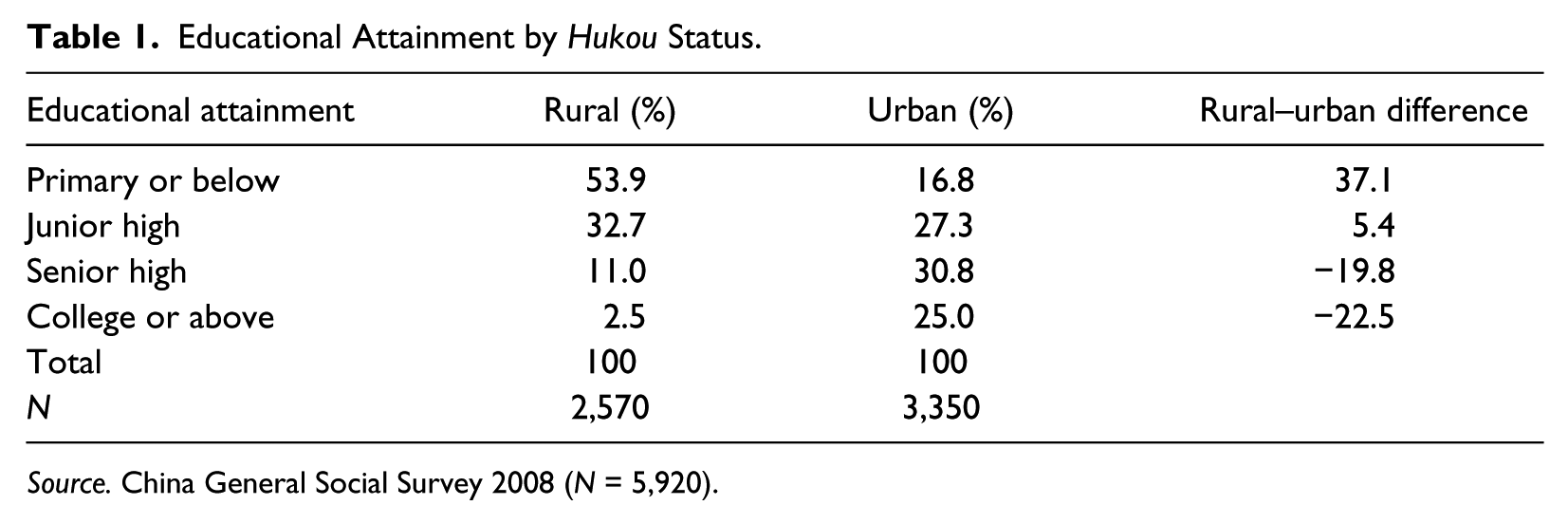
One of the most striking aspects of the educational environment in China is its prominent regional, particularly urban–rural, gap. Despite the government’s efforts to expand educational opportunities, education in rural areas in China has enjoyed fewer opportunities and resources than in urban areas in almost every aspect. The national survey used in this article shows that the average number of years of education of rural hukou (household registration) holders is 5.76, and about 56 percent of the rural population has the educational attainment of primary school or below, whereas the average education of urban hukou holders is 10.63 years. 3 The Chinese General Social Survey (CGSS) conducted in 2008, which surveyed a much larger sample, also reveals a huge educational gap between rural and urban populations (Table 1). 4
Educational Attainment by Hukou Status.
Source. China General Social Survey 2008 (N = 5,920).
The significance of the urban and rural gap in overall educational inequality is found in Qian and Smyth’s study (2007), which shows that the major source of educational inequality is the educational gap between urban and rural areas rather than between coastal and inland areas. Again, this significant educational inequality between rural and urban areas is to large extent due to state policies that favored urban and coastal areas during the socialist period under Mao and the post-reform period, especially during the Deng Xiaoping and Jiang Zemin eras.
This stark difference in educational opportunity has an important political implication for attitudinal differences, as past studies point out the powerful effect of education on individuals’ ideological orientation (Achterberg and Houtman 2009; Kohn and Schooler 1969; Lipset 1959). Based on the pattern revealed in Table 1, I posit that institutionalized regional–educational inequality produced differences in psychosocial dispositions between rural and urban China, which consequently affected the geographical distribution of attitudes toward income redistribution.
More specifically, I examine the following propositions. First, I suggest that the level of authoritarianism is higher in rural areas in China. A number of past empirical studies have confirmed that authoritarianism has a negative association with the level of education (Achterberg and Houtman 2009; Duriez and Van Hiel 2002). The association between education and authoritarianism is usually attributed to the fact that educational attainment increases individuals’ cognitive capacity or breadth of perspective such that they can question authoritarian values, and enhances one’s critical attitudes toward blind submission to authority and unjustified hierarchical systems (Stenner 2005). As the average educational attainment is much lower in rural areas, the general authoritarian disposition would accordingly be stronger in rural areas. Consequently, we can observe a weaker preference for economic redistribution by the state in rural areas, where the average level of authoritarianism is higher than urban areas. The same reasoning is also applied to the case of SDO. The definition and theory of SDO tells us that higher SDO is associated with more accepting views about inequality because stronger SDO means desire for group-based dominance, which legitimizes the unequal conditions or relationships between groups. Individuals with high SDO, regardless of one’s group membership, are more likely to show general preference and tolerance for an antiegalitarian system, inequality, and the hierarchical organization of community or society. Studies on the relationship between education and SDO produced mixed results. Some of the previous studies have found that SDO is not significantly related to the level of education (Duriez and Van Hiel 2002; McFarland and Adelson 1996), whereas other studies confirm that increasing educational exposure decreases the expression of SDO (Sidanius, Pratto, and Bobo 1994, 1996; Sidanius, Sinclair, and Pratto 2006). This study accepts the findings of the latter studies and hypothesizes that the lower level of educational attainment in rural areas increases SDO, which leads to relatively conservative attitudes toward redistributive social policies.
Figure 1 illustrates the chain of influence my study attempts to uncover. In sum, the proposed mechanism is that the relatively lower educational attainment in rural areas, caused by macro-institutional factors, strengthens psychosocial dispositions of authoritarianism and SDO, both of which have a close affinity with conservative ideology. This mechanism will be tested in the empirical analysis using structural equation models.
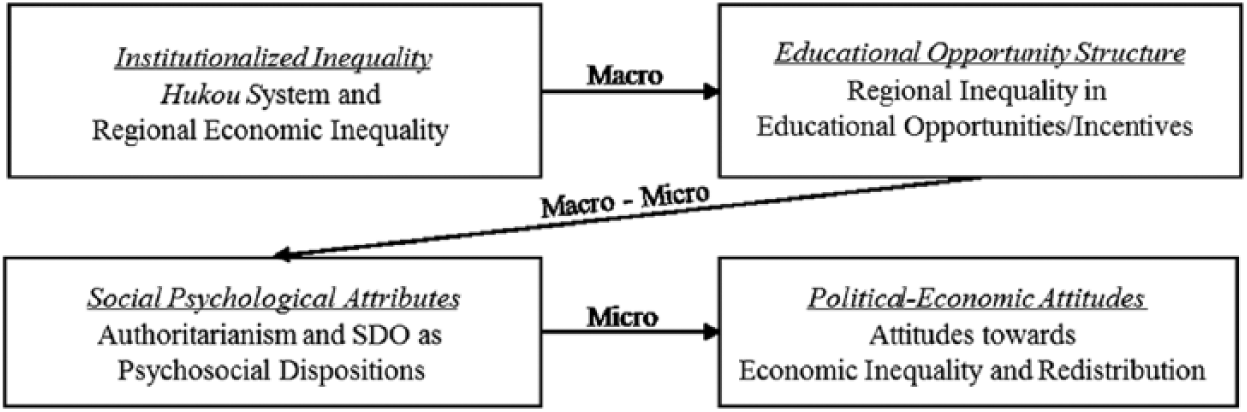
Proposed causal linkage between macro and micro factors influencing popular attitudes toward economic redistribution.
Paradoxical Patterns of Attitudes toward Income Inequality
The empirical study of this article focuses on the case of China, a country that has paid the price for economic growth with a rapid increase in economic inequality. A social survey showed that ordinary Chinese people perceive the wealth gap between the rich and the poor as the most important social concern in the development of a harmonious society (23.73 percent) and that “wealth distribution, income disparity and social injustice” are ranked as the most important topical issues of concern to the public (90 percent) (Wang 2006).
Among many sources of inequality, rural and urban disparity constitutes the major part of the overall economic inequality in China; the urban and rural income gap contributes to nearly 52 percent of national inequality, according to data from 2007 (Guo 2010; Li, Luo, and Sicular 2011). Despite the Chinese government’s iron-hand-in-the-velvet-glove efforts, such as the “harmonious society” program or the slogan of “xiaokang society,” 5 recent figures from China’s National Bureau of Statistics show that the urban–rural income gap is the widest since the economic reform of 1978. Moreover, think-tank researchers predict that the current urban–rural income gap, currently about 4.1 to 1 on average (Li et al. 2011) and the largest in the world (Fan 2008), will continue to increase (Fu 2010). In a public opinion survey, increasing farmers’ incomes is ranked second (35.3 percent) among the public’s foremost economic concerns (Wang 2006).
The rural–urban differences in China have their origins in state-imposed institutions, such as the urban-biased policies beginning in the Mao era (Whyte 1996) and the economic developmental strategies, heavily favoring coastal areas, of the reform era. The impact of these policies has been amplified by the household registration system (hukou system), which resulted in the reinforcement and fortification of this inequality since the 1950s. The hukou system restricts the spatial mobility of the population based on a person’s hukou status (i.e., rural or urban), which causes rural residents to face substantial obstacles in moving to urban areas. The great wall that the hukou system creates, dividing urban and rural areas and exacerbating regional inequality, is often regarded as a Chinese version of apartheid (Chan and Buckingham 2008). This institutional barrier affects a huge population because a large part of the country is still rural: about half of the total population lives in rural areas (50.3 percent at the end of 2010). These conditions have resulted in the multiplication of rural and urban inequality in living standards, social mobility, and socioeconomic opportunities.
How do individuals view this high level of economic inequality, and how does the stark urban–rural disparity affect public opinion on inequality and egalitarian redistribution in Chinese society? Although the burgeoning literature on various aspects of socioeconomic inequalities in China has produced a very large number of empirical studies on objective conditions of inequality in the country (Bian 2002; Davis and Wang 2009; Gustafsson and Shi 2008; Riskin, Zhao, and Li 2001; Walder 2002; Wang 2008; Zang 2002), research on popular perceptions of inequality and distributive injustice in China remains a largely underexplored area in the field, particularly due to the paucity of available data. Exceptions are empirical studies done by Whyte (2010) and Han (2009, 2012), which used a nationally representative survey on popular perceptions of inequality. 6 Their studies have found that, despite the large urban–rural inequality in Chinese society, rural residents do not exhibit more negative attitudes than their urban counterparts in many realms of distributive justice, such as perception of current inequalities, opinions about equality and inequality, demand for government support, and views about individual and social opportunities. Moreover, rural residents often express relatively more positive and accepting attitudes toward such issues than urban citizens (Han 2012; Han and Whyte 2009; Whyte 2010). Figure 2, based on the 2009 China Inequality and Distributive Justice Survey (to be explained later), shows an example of the puzzling patterns that reveals the discrepancy between actual income distribution and attitudes toward inequality and redistribution.
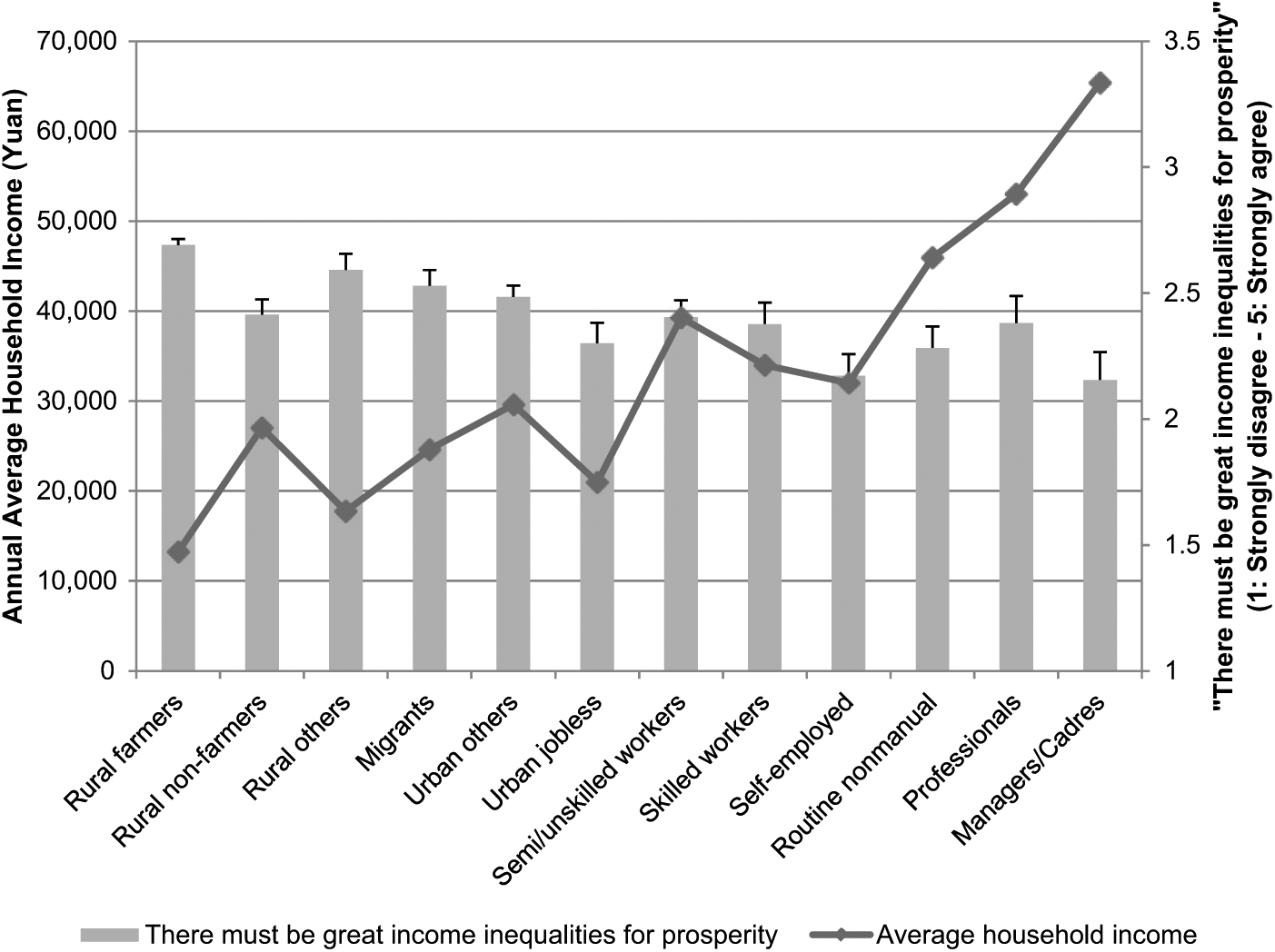
Average household income distribution and distributive justice attitudes by rural–urban occupation groups.
The above figure shows a pattern that departs from expectations, which predicts that rural residents would have significantly more critical opinions on distributive justice than would urban residents. The population with the lowest income, that is, rural farmers, has the highest acceptance of increased inequality for the sake of national prosperity. This kind of pattern can be found in other survey items as well: rural farmers show equally or less critical, and often significantly more positive and accepting, attitudes toward various distributive justice issues such as the appropriate level of inequality and redistributive polices (Han 2012; Whyte 2010). The finding that lower socioeconomic groups express a similar or even greater acceptance of inequality poses a challenge to existing theories of determinants of attitudes toward inequality. For example, rational actor-based models of policy preferences (Meltzer and Richard 1981) and theories that emphasize the effects of class and occupation on attitudes and opinions (Manza and Brooks 2003; Svallfors 1997) all seem to neglect a hidden mechanism of attitude formation because they do not adequately explain the patterns revealed in the Chinese case. The following empirical analyses will tackle this puzzling attitudinal pattern.
Data and Research Strategy
For empirical analysis, I make use of structural equation modeling to test the model presented in Figure 1. The analysis uses two nationally representative Chinese social surveys. One data set is the second-wave data of the Asian Barometer Survey (ABS; 2008). The survey is supported by the Institute of Political Science in Academia Sinica and the Institute for Advanced Studies of Humanities and Social Sciences at the National Taiwan University. ABS has conducted two waves of surveys across 13 East Asian and 5 South Asian societies, and the survey covers various kinds of public opinion and attitudes about political and social values, democracy, and governance. My study uses Chinese cases in the survey, a nationally representative sample gathered through stratified multistage area sampling with probability proportional to size (PPS) measures (except for Tibet Autonomous Region) and face-to-face interviews of voting age adults (18 years old and above) under the direction of the Research Center for Contemporary China at Peking University. The interviews were conducted between December 2007 and June 2008, followed by a supplementary makeup survey in December 2008. With a completion rate of 72.6 percent, the interviews produced 5,098 successful samples in total. (Contact the author for more technical details of the survey.) This survey is useful because it contains items that reflect respondents’ authoritarian orientation. Table 2 lists the items used to construct an authoritarianism scale (Cronbach’s α = .70).
Items Used to Construct the Authoritarianism Scale.
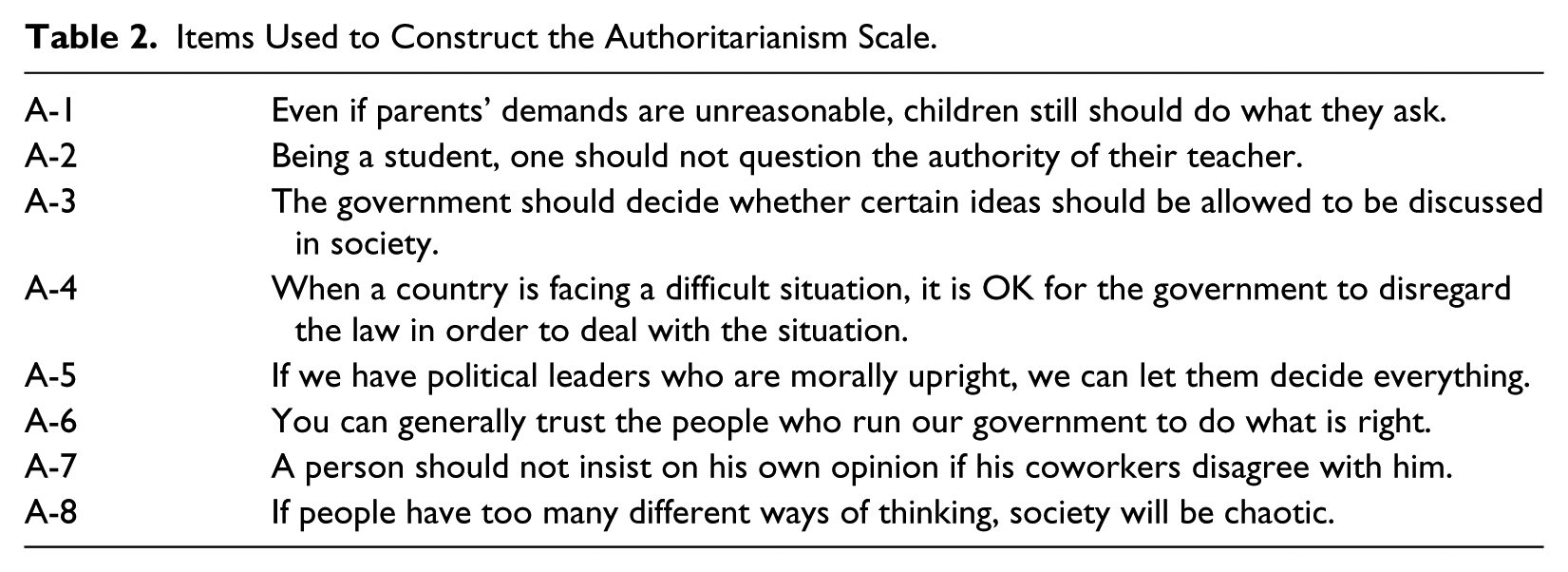
These questions are useful and appropriate items for creating an authoritarianism scale as a latent variable because they all deal with the question of submission to in-groups and authority and support for strong leadership with uncompromising power, all of which are the core attributes of authoritarianism (Whitley 1999). Specifically, these items reflect the key ideas of authoritarianism presented in past literature: (i) childrearing values form the most important ideas that reflect an authoritarian disposition (A-1); (ii) authoritarians tend to think that established authorities are generally right about things (A-2, A-3) and are more inclined to think political leaders are worthy (A-3, A-5, A-6); (iii) authoritarians show greater intolerance toward threatening societal conditions (A-4); and (iv) authoritarians favor enhancing sameness and minimizing difference (A-3, A-7, A-8) (Stenner 2005). Overall, these items capture the submissive and obedient aspects of authoritarianism (i.e., conventionalism and authoritarian submission) rather than authoritarian aggression (Altemeyer 1996).
To examine the relationship between authoritarianism and economic conservatism, the latent authoritarianism variable predicts the following 4-point scale question in the survey: “In order to preserve social justice, the government should prevent the gap between rich and poor from growing any larger” (1 = strongly disagree, 4 = strongly agree). 7
The second data set is the China Inequality and Distributive Justice Survey (2009), a high-quality, nationally representative survey based on a spatial probability sampling method, constructed through joint efforts by several institutions in the United States and China. 8 The spatial probability sampling method used such information as local population estimates, maps, geographic information system (GIS), and global positioning system (GPS) devices to identify and interview 2,967 nationally representative adults between 18 and 70 with a response rate of about 70 percent. For more information about the technical details of the spatial sampling method, see Landry and Shen (2005). The analysis uses survey questions that reflect psychosocial dispositions of SDO (α = .72). It should be noted that my construct is a context-specific SDO because the survey items used in the analysis reference specific groups in Chinese contexts.
Again, the survey items used here (Table 3) show close similarities with diverse SDO scale items used in past studies. Such items include gender-specific SDO questions (SDO-1, SDO-2), “Some people are just more worthy than others” (SDO-3, SDO-7), “It’s OK if some groups have more of a chance in life than others,” “Inferior groups should stay in their place,” “Sometimes other groups must be kept in their place,” “We should do what we can to equalize conditions for different groups” (SDO-4, SDO-5, SOD-6, SDO-8), and “We should strive to make incomes as equal as possible” (SDO-9, SDO-10, SDO-11). One difference from the authoritarianism model is that the items concerning economic inequality and redistribution policy (SDO-9, SDO-10, SDO-11) are not separated out as outcome variables but included as manifest variables that construct the latent SDO because the desire for inequality between different social groups is a fundamental element that constitutes SDO (Duckitt and Sibley 2009; Duriez and Van Hiel 2002; Ho et al. 2012; Pratto et al. 1994). 9 In sum, the analysis will investigate the effect of education on SDO and whether latent SDO is statistically significantly manifested in observed variables pertaining to opinions about economic redistribution.
Items Used to Construct the SDO Scale.
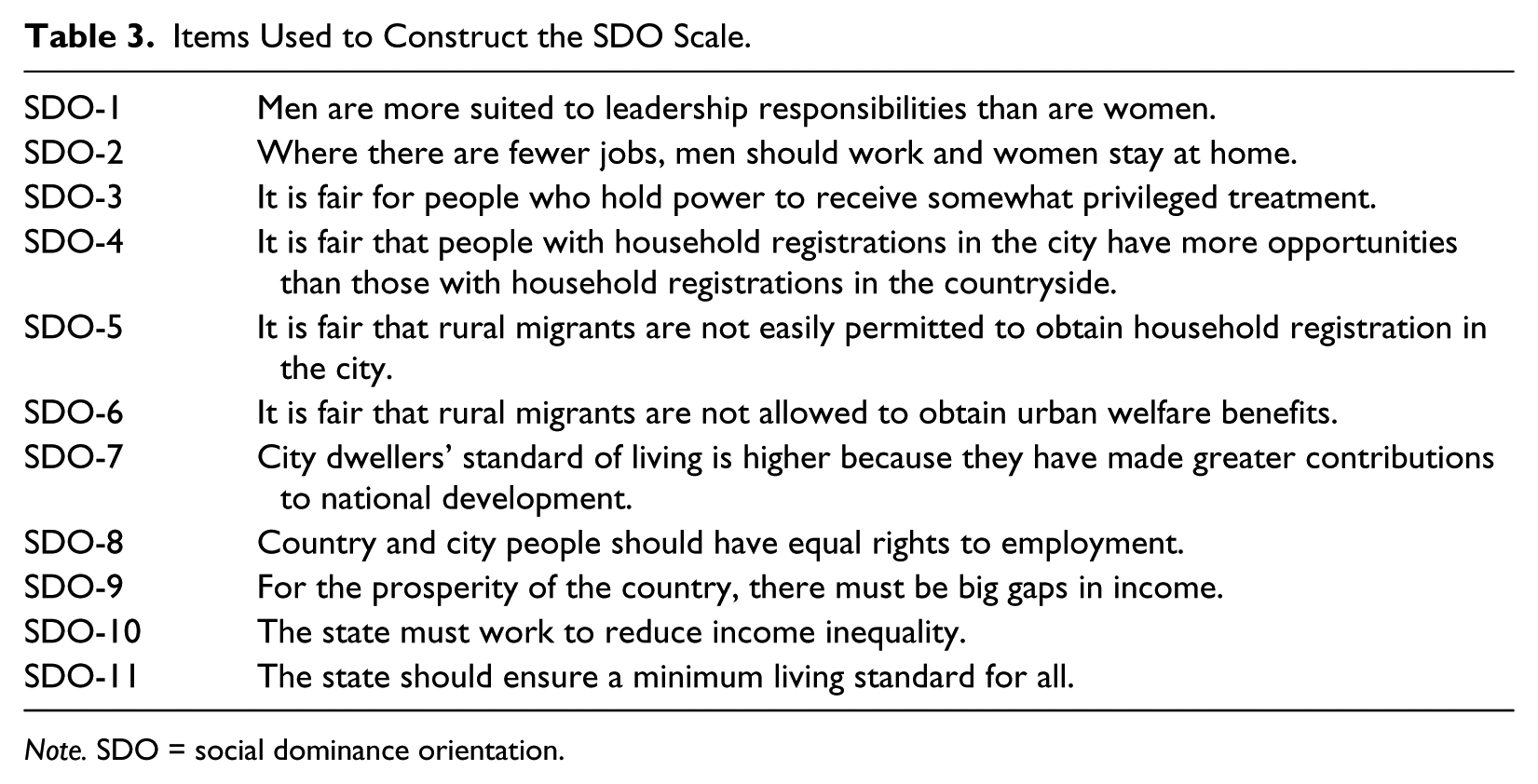
Note. SDO = social dominance orientation.
It is important to note that the survey questions selected for both analyses constitute a China-specific and group-specific version of authoritarianism/SDO scale items used in psychological studies, which are generally abstract and context free (e.g., “It would be good if groups could be equal”). The context-free aspect of the psychological scales have often attracted criticism from the situationalist perspective, which holds that situational factors outweigh the significance, if any, of latent psychological dispositions such that the latter is not a meaningful determinant of people’s attitudes and behaviors in most situations. The novel approach taken by the present study has an advantage over other versions of SDO constructs because it captures the psychosocial disposition as a motivated political-cultural frame and schema attached to concrete, context-dependent, and case-specific examples. The two social surveys used for analysis have another important merit in that they are based on nationally representative samples, providing more useful information regarding the relationship between psychological dispositions and demographic variables.
Results
To test the proposed mechanism of my argument, I used a structural equation modeling technique, which can detect the chain of influence from macro-regional background to individuals’ attitudes toward redistributive social policies. The analysis presented in Figure 3 shows the results estimated by structural equation models, which demonstrate the nexus of relationships that flow from macro-structural conditions (urban–rural disparity), to individual-level status (educational attainment), to psychosocial dispositions (authoritarianism/SDO), and finally to political and economic opinions (the government’s responsibility for redistribution). For simplicity, the figure does not display individual path coefficients of control variables in the model; the effect of control variables and their statistical significance will be presented and closely examined later (Tables 4 and 5).
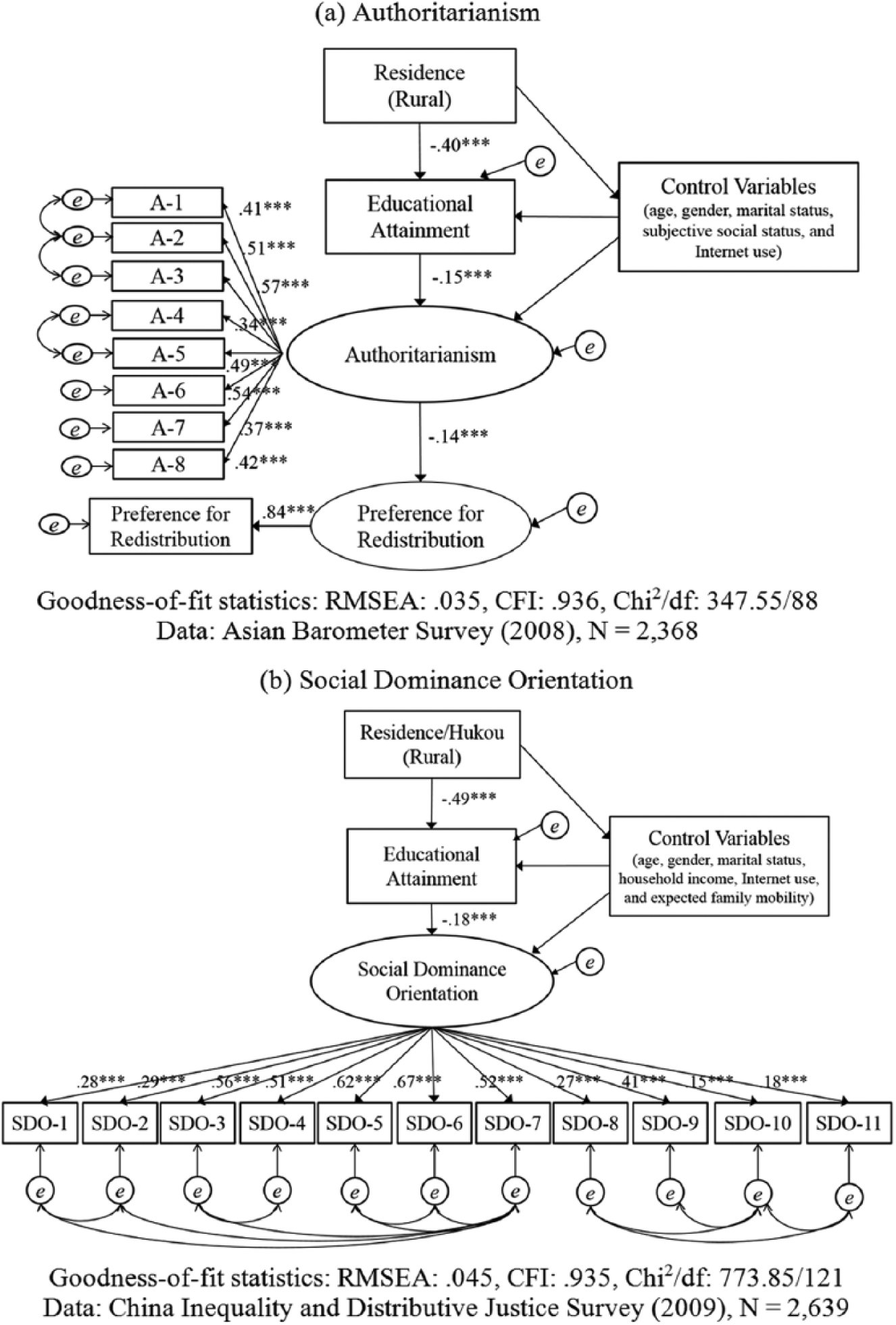
Test of the models of the relationship between region, education, psychological dispositions, and opinion about redistribution (standardized coefficients).
Structural Equation Model Estimates of Paths from Socioeconomic Variables to Authoritarian Attitudes.
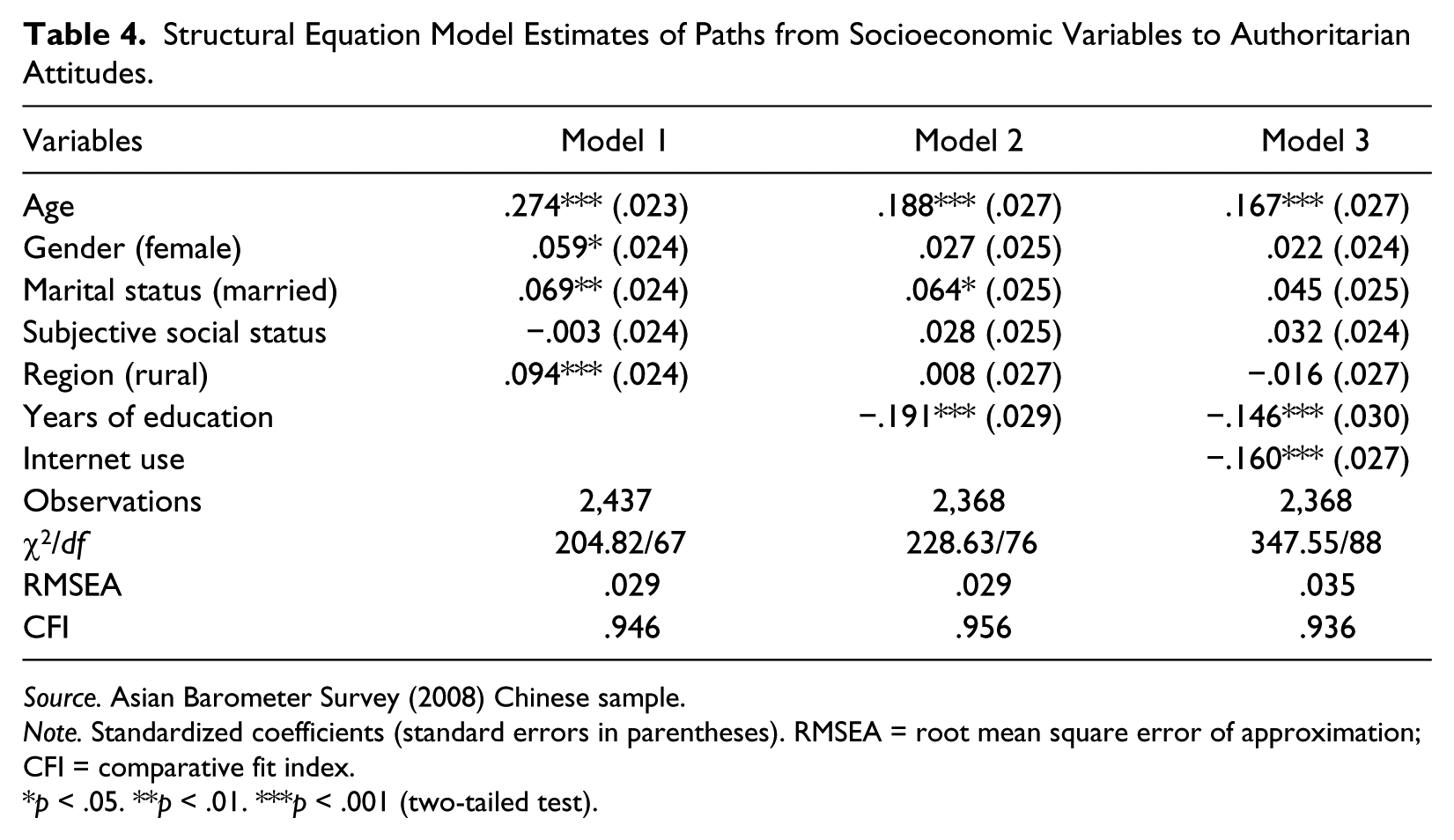
Source. Asian Barometer Survey (2008) Chinese sample.
Note. Standardized coefficients (standard errors in parentheses). RMSEA = root mean square error of approximation; CFI = comparative fit index.
p < .05. **p < .01. ***p < .001 (two-tailed test).
Structural Equation Model Estimates of Relationships between Socioeconomic Variables and Social Dominance Orientation.
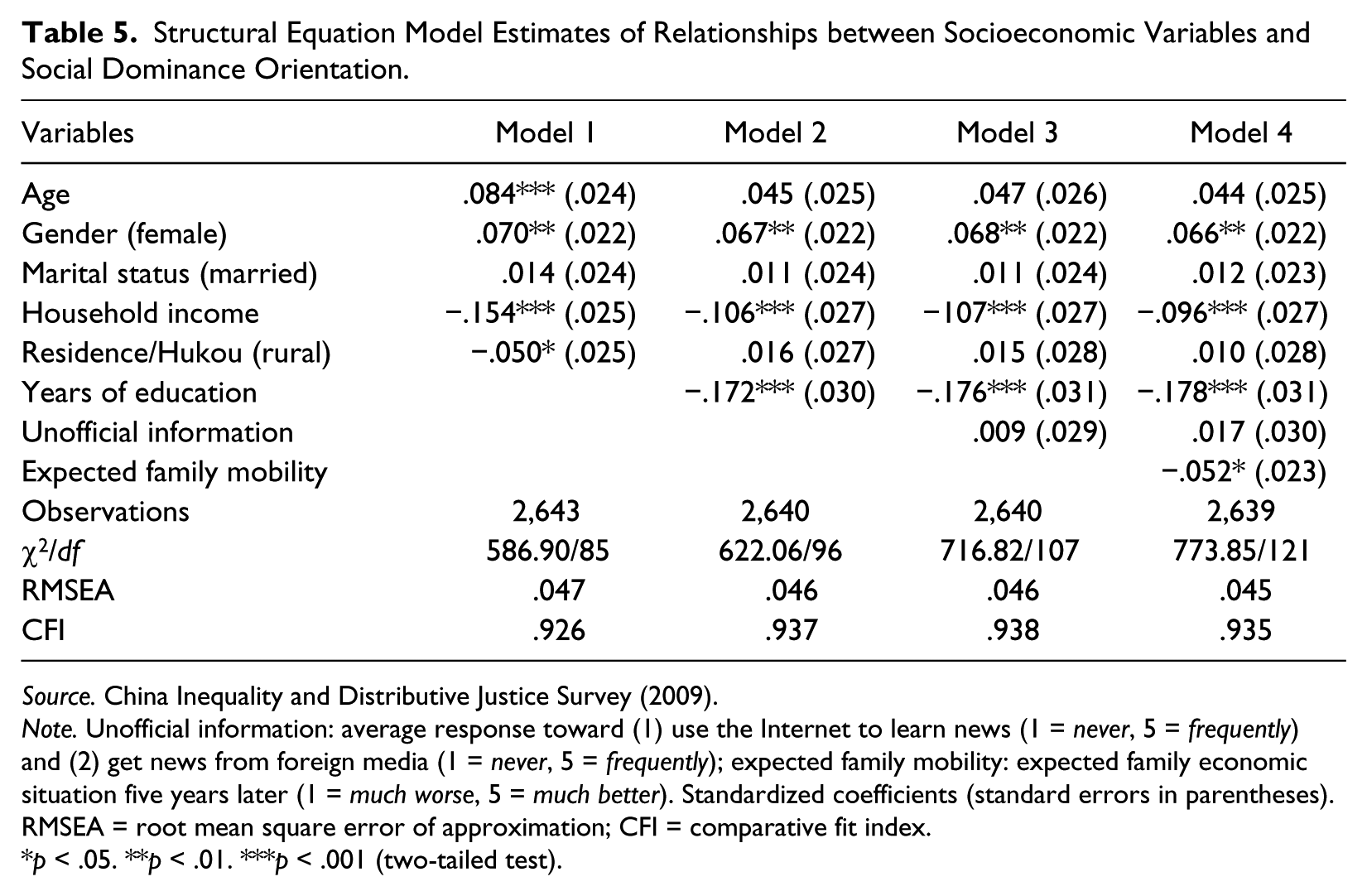
Source. China Inequality and Distributive Justice Survey (2009).
Note. Unofficial information: average response toward (1) use the Internet to learn news (1 = never, 5 = frequently) and (2) get news from foreign media (1 = never, 5 = frequently); expected family mobility: expected family economic situation five years later (1 = much worse, 5 = much better). Standardized coefficients (standard errors in parentheses). RMSEA = root mean square error of approximation; CFI = comparative fit index.
p < .05. **p < .01. ***p < .001 (two-tailed test).
The top figure shows the effect of region (urban–rural) on educational attainment, the effect of education on the level of authoritarianism, and finally the influence of authoritarianism on attitudes toward the responsibility of the government to reduce the income gap. Because individuals’ attitudes toward inequality and the role of the government are measured by a single indicator, it is very likely that the variable does not perfectly measure individuals’ latent attitudes, which is often a problem when a single variable is used to predict a latent construct. To solve this problem, I created a reliability-corrected single-indicator latent construct for the variable (Hayduk 1987). This correction did not substantively change the results. The model shows that rural residence tends to significantly decrease the level of education (β = −.40, p < .001), and a lower level of education is significantly associated with a higher level of authoritarianism (β = −.15, p < .001). Finally, the authoritarianism scale shows a significant, negative relationship with attitudes toward the role of government in preventing income gaps from widening (β = −.14, p < .001), which shows that a higher level of authoritarianism is associated with more conservative economic attitudes.
The bottom figure shows the case of SDO. Similarly, it shows the significant negative effect of region (rural) on education (β = −.49, p < .001), which increases the strength of latent SDO (β = −.18, p < .001), manifested in economic SDO items regarding economic inequality (SDO-9: β = .41, p < .001; SDO-10: β = .15, p < .001; SDO-11: β = .18, p < .001). This result confirms the argument of this article that the lower level of educational attainment in rural areas increases SDO, which leads to relatively conservative attitudes toward redistributive social policies.
Although significant chi-squares are produced due to the large sample size of our data sets, both models show good model fits in terms of alternative fit statistics such as root mean square error of approximation (RMSEA) and comparative fit index (CFI) (Hu and Bentler 1995).
Overall, both models show that rural residents have lower levels of educational attainment and, consistent with this article’s hypothesis, that education has a negative relationship with both psychosocial dispositions. The latent dispositions have negative associations with preference for redistribution, which shows that the conservative ideas underpinning the two psychosocial traits lead individuals to reduce their support for the government’s responsibility to reduce economic disparity. This analysis shows the mechanism of how rural citizens’ acquiescent opinions about inequality are produced. The results also demonstrate the important role played by a culturally ingrained social order that legitimizes hierarchical and categorically differentiated relationships between parents and children, teachers and students, men and women, political leaders and ordinary people, the collective and individuals, and migrants and residents, all of which provide the cognitive-affective schemas and language for authoritarianism and SDO.
In the following, I focus on the effect of other socioeconomic variables included in the SEM models and examine the relationships between individuals’ socioeconomic characteristics and psychosocial dispositions. To more clearly demonstrate the mediating role of education, I present and compare the results of multiple SEM models that include slightly different sets of covariates.
Table 4 presents the results from the SEM models of authoritarianism. As the household income variable in the Asian Barometer Survey has many missing cases, I used information on individuals’ subjective social status (10-point scale variable) as a proxy for individuals’ socioeconomic positions.
Model 1 shows that older people, females, married people, and rural citizens express relatively stronger authoritarian attitudes than younger people, males, nonmarried people, and urban citizens. However, when the level of education is introduced in Model 2, the differences between urban and rural citizens and different genders become statistically nonsignificant. The nonsignificant coefficient of the region variable in Model 2 suggests that the rural–urban difference in authoritarian attitudes is attributable to the difference in educational level, rather than to traditional or hierarchical cultural values often associated with the image of rural life. Such a result does not mean that there is no difference in cultural values between the two regions, but the difference in attitudinal tendencies in the two areas is largely due to the effect of education rather than deeply instilled cultural and local value systems.
One might argue that the significant effect of education is attributable to individuals’ access to information and political knowledge, often regarded as the basis of public opinion, and the urban and rural attitudinal differences depend on the extent to which people have access to information (e.g., different Internet penetration rates in each area). To control for the effect of information, Model 3 includes a variable “Internet Use,” which is coded 1 if a respondent’s main source of news is the Internet (rather than television, radio, personal contact, magazine, or other media). It shows that Internet use is highly significant (p < .001), confirming that increased exposure to (relatively unofficial) information can affect people’s perspectives on authoritarian submission and conventionalism. Including this variable in the model, however, does not substantively change the sign and statistical significance of the regression coefficient of education, which suggests that the effect of education on authoritarianism is not determined by the level of access to information.
On the contrary, all models show that subjective social status does not have a significant net effect on authoritarianism, which is consistent with the claims that authoritarianism is not driven by one’s economic position but by one’s cultural ideas (Achterberg and Houtman 2009), which correlates with educational level.
Table 5 reports the results from the SEM models of SDO. Taking advantage of the greater amount of information available on individuals’ background in the data set, the analysis includes additional explanatory variables, such as one’s household income and expected economic situation of family. Model 1 shows that older people, females, people with lower incomes, and rural citizens have higher levels of SDO. Again, however, as in the case of authoritarianism, the significant difference between rural and urban citizens is explained away by the respondents’ levels of education, confirming the powerful influence of education (Model 2).
And as can be seen in Model 3, the “Unofficial information” variable, which measures the extent to which one uses the Internet or gets news from international media, does not significantly affect SDO, contrary to the case of authoritarianism. This reflects the difference between authoritarianism and SDO; authoritarianism, as sociocultural conservatism (Duriez and Van Hiel 2002), is affected by increased exposure to information and rich frames of reference, whereas SDO, having a direct relationship with economic conservatism, does not change through such a channel.
Another notable pattern revealed in this analysis is the highly significant effect of household income, which shows that there is a negative association between the SDO scale and family income. There is not enough information to come to a conclusion on the relationship between income and SDO in past studies because past studies have shown mixed results that depend on contexts (i.e., different countries and groups; see Sidanius and Pratto 2001:82). I suggest that the significant negative association between family income and SDO revealed in this analysis can be understood by considering higher family income as a factor that decreases perceived risk and insecurity. As Duckitt and Sibley (2009) point out, SDO originates from the worldview that regards the social world as a competitive jungle, and such motivational bases lead to the stronger level of SDO. I suggest that the higher level of family income can attenuate the feeling of economic insecurity and threat perceived by individuals, which satisfies their underlying existential motives that would otherwise enhance aggressive and hostile attitudes in intergroup conflicts. Such an effect of underlying risk perception is also confirmed in Model 4, which includes a variable on people’s family economic prospects for the next five years. It shows that people’s optimistic expectations for their family’s upward mobility has a significant negative relationship with their SDO.
In both analyses of determinants of authoritarianism and SDO, the significant effect of education is consistent throughout all models, confirming that education has a critical effect in determining individuals’ psychosocial dispositions toward conservatism and SDO in China.
Conclusion
Why people in the lower classes often exhibit conservative attitudes toward inequality is an important and longstanding puzzle for social scientists (Shapiro 2002) because it entails workers betraying their own vested interests in the redistributive political system. Facing this puzzle, sociologists have not paid sufficient attention to the psychological factors that affect such attitudes and how such factors are influenced by macro-level contexts. Much of the past discussion has centered on the role of socioeconomic cleavages, and even when the role of culture and ideology is discussed, social psychological factors that constitute and sustain such ideas and beliefs have been underspecified.
Filling such a gap in the literature and bridging sociological and psychological approaches to inequality, this study makes the following contributions. First, findings from this study demonstrate the role of social psychological mechanisms often neglected in past sociological scholarship on the determinants of political-economic attitudes. It shows that authoritarianism and SDO affect attitudes toward inequality and redistribution, and the difference between rural and urban in the patterns of such psychosocial dispositions is attributable to the highly significant effect of education. Also, the Chinese example suggests that state policies can condition the social background for the operation of social psychological mechanisms. The geographical distribution of authoritarianism and SDO among Chinese citizens is affected by unequal conditions of educational opportunity between rural and urban areas, which are the combined outcome of socialist legacies (i.e., the hukou system) and the state-led post-reform development strategy that disproportionately benefited the urban area. Because rural residents have considerably limited educational opportunities in comparison with urban citizens, the average level of the two psychosocial dispositions is relatively higher, which results in more tolerant views of inequality among the rural population. 10
The study also contributes to a better understanding of popular attitudes toward inequality in China and offers political implications for today’s Chinese society. A number of studies and observations on Chinese society have pointed out that the level of income inequality has reached a danger zone, but few of these studies actually investigated the social psychological characteristics of popular attitudes toward inequality. By shedding light on the role of psychology of inequality, this study provides an insight into the counterintuitive picture of rural residents’ relatively conservative opinions. As with past studies that showed rural citizens’ relatively tolerant attitudes toward distributive justice, this article presents a cautiously optimistic prospect for the primary goal of today’s China, namely, the maintenance of social stability. The results suggest that the disadvantaged groups in Chinese society will not furiously attempt to subvert the status quo in the immediate future. This prognosis, however, is only a tentative one. Past studies suggest that authoritarianism and SDO are subject to change through situational cues, and moreover, they have opposing elements in their internal dynamics; the psychological energy that constrains authoritarian attitudes to obedience and submission can turn its current to converge on antiauthoritarianism (Perrin 2005), and the SDO of subordinate groups can transform from the legitimization of intergroup hierarchy to hostile attitudes against out-groups (i.e., dominant groups). Thus, although the findings of the present study corroborate the claim that today’s Chinese society is not a “social volcano” (Whyte 2010), it should be noted that the effects of psychosocial dispositions may show unexpected dynamics in the future.
Finally, despite the China-specific contexts brought into the analysis, this article offers general theoretical insights into the mechanism of social psychological legitimation of inequality. Specifically, it provides a new way to understand and approach authoritarianism and SDO in sociology by treating them as the joint product of motivated social cognition (i.e., micro mechanism) and political-cultural schemata (i.e., macro contexts). The findings of this article show that the interaction between the two factors is affected by one’s level of education and institutional conditions associated with the educational opportunity structure. This article also suggests that the manifestation of authoritarian and social dominance motives as political-cultural ideas in society is dependent on historical contingencies and momentous social events that shape the political and cultural authority structure in society and define in-groups and out-groups (e.g., the Cultural Revolution in Mao-era China in the late 1960s and the post September 11th sociopolitical discourse in the United States). The article also presents a novel analytic strategy for using large-scale social surveys to measure individuals’ psychosocial dispositions and using social survey items to grasp context-dependent, group-specific dispositions.
In future studies, the complex and dynamic patterns of interaction between micro and macro factors (i.e., motivated cognition, cultural repertoire, and institutions) need to be further explored to concretely account for the attitude formation process. These studies can benefit from looking at how the interaction of specific cultural schemas concerning inequality with institutional forces such as educational systems, electoral politics, welfare policy, immigration policy, labor markets, and political or religious authority structures can mold, enhance, or depress authoritarian attitudes and SDOs. Such future studies will improve our understanding of the mechanism of how individuals’ legitimation of inequality is affected by varieties of cultural and institutional conditions.
Footnotes
Acknowledgements
The author would like to acknowledge Martin K. Whyte and Bart Bonikowski at Harvard, Chaeyoon Lim at the University of Wisconsin–Madison, and graduate student associates at the Fairbank Center for Chinese Studies at Harvard University for reading and commenting on this article.
Declaration of Conflicting Interests
The author(s) declared no potential conflicts of interest with respect to the research, authorship, and/or publication of this article.
Funding
The author(s) received no financial support for the research, authorship, and/or publication of this article.