







Abstract
This study examines how micro-level religious effects and macro-level economic contexts shape individuals’ attitudes toward premarital sex. It then investigates whether the effects of individual-level religiosity on approval of premarital sex are contingent on the economic characteristics of a nation, reflected by a country’s gross domestic product (GDP) per capita. Multilevel analyses of data from the sixth wave of the World Values Survey (2010–2014) reveal that both individual religiosity and GDP per capita are important predictors of attitudes toward premarital sex. Furthermore, cross-level interactions suggest that individual religiosity has a greater negative effect on approval of premarital sex in countries that are more economically developed. I discuss how these findings speak to theories about religion, economic modernization, and the ways that macro-level contexts are linked with micro-level factors.
A substantial body of research showed that personal religiosity is inversely associated with premarital sex (Adamczyk and Felson 2006; Barkan 2006; Jessor et al. 1983; Ogland and Hinojosa 2012; Petersen and Donnenwerth 1997; Regnerus and Uecker 2011; Rostosky et al. 2004; Tanfer and Schoorl 1992). Yet, most of these studies extensively used data from North American and other Western countries, although there are some exceptions (Adamczyk and Hayes 2012; Finke and Adamczyk 2008). Thus, it is unclear to what extent this association holds true across nations in the world. This study fills the void in the literature by investigating how religion influences cross-country differences in attitudes toward premarital sex. In addition, the current study examines how the effects of religion on attitudes about premarital sex depend on the economic context in which an individual is located. There is a rich theoretical basis for this inquiry. First, sociology has a long tradition of interest in how macroeconomic force shapes individuals’ behaviors and attitudes (Bell 1973; Inglehart 1997; Marx [1858] 1993). Economic development tends to promote secularism, individualism, and self-expression values, which may lead to more permissive attitudes toward premarital sex. Second, an emerging literature in criminology suggests that religion interacts with a broad social context in a unique way (Desmond and Kraus 2014; Hadaway, Elifson, and Petersen 1984; Tittle and Welch 1983). More concretely, contingency theory holds that religion has a greater constraining effect on deviant behaviors where other secular norms are weak or absent (Tittle and Welch 1983). Although much theoretical attention has been given to this macro-micro link, we lack empirical studies that clearly define and test the link (Ritzer 1990). In this article, I will address this issue by applying a multilevel approach based on data from the sixth wave of the World Values Survey (2010–2014).
In essence, the present investigation adds to the literature by addressing three main questions: (1) What is the role of individual religiosity (e.g., religious attendance and importance) in explaining individual attitudes about premarital sex worldwide? (2) How do the economic circumstances of a nation (e.g., economic development) affect individual-level opinion about premarital sex? (3) How do these economic contexts condition the effects of individual religiosity on individual attitudes toward premarital sex? I propose that as economic living conditions improve through modernization in a country, individual attitudes about premarital sex become more accepting. However, when secular norms regarding premarital sex become more liberal as a result of economic development, it provides personal religiosity a greater role in directing attitudes. Consequently, personal religiosity may have greater influences on attitudes about premarital sex in wealthier countries than in poorer countries.
Theoretical and Empirical Background
Religion and Attitudes toward Premarital Sex
Religion has the potential to influence attitudes about premarital sex because religion is still strongly tied to family in the contemporary world (Wilcox 2004). Social learning theory suggests that frequent exposure to norms that prohibit sex before marriage should diminish individual’s approval of premarital sex (Akers 1998). Religious institutions have long emphasized the sanctity of marriage and provided religious messages that value marriage and sexual restraint (Wilcox and Wolfinger 2007). Therefore, those who attend religious services frequently are more likely to be exposed to these religious teachings, which in turn may lead to higher levels of acceptance of those religious messages against premarital sex. Moreover, religious attendance signifies how deeply an individual is embedded within congregational social networks (Perry 2014). Frequent religious attendance provides individuals regular contact with adherents, which could function as behavioral monitoring that constrains nonmarital sexual activities (Burdette et al. 2009). Furthermore, social integration and support available through interactions with members of a religious group may serve to reinforce traditional religious beliefs about premarital sex (Berger 1967). A wealth of empirical studies supports this view by finding that higher church attendance is associated with delayed first sex among adolescents and fewer sexual partners among nonmarried adults and sexually active adults (Barkan 2006; Jessor et al. 1983; Tanfer and Schoorl 1992; Uecker 2008).
In addition to the public form of religiosity (such as religious attendance), religious importance—the internal, subjective aspect of religiosity—may also reduce approval of premarital sex. Religious importance, measured by how important religion is to the life of the respondent, is an indicator of how strongly an individual is committed to religious doctrines and internalizes religious norms (Burdette et al. 2009). Therefore, individuals for whom religion is important may conform to religious teachings that militate against premarital sex. In this regard, religious importance can work as a potential restraint on premarital sex. Empirical works lend support to this line of thought by finding that young people who regard religion as important in their lives have the least tolerant attitudes about sex before marriage (Thornton and Camburn 1989). Collectively, these ideas generate two hypotheses that will guide my investigation.
Economic Contexts and Attitudes about Premarital Sex
Along with religious involvement, the economic circumstances of a nation may have an effect on individuals’ attitudes toward premarital sex. There is a long tradition of scholarship in sociology that has reflected on the notion that the economic contexts of a society influence value orientations among its individual members (Bell 1973; Inglehart and Baker 2000; Marx [1858] 1993; Parsons 1977). In particular, Karl Marx ([1858] 1993) provided an influential version of modernization theory, arguing that the ideological superstructure formed by a society’s prevailing moral standards and value orientations is a function of a society’s socioeconomic basis. This line of argument can serve as a basis for the claim that economic modernization can affect individuals’ attitudes about premarital sex.
According to the secularization theory, religions will gradually disappear and fade in importance in modernity (Berger 1967; Bruce 2002; Weber [1922] 1978). As economic growth tends to increase the level of education of individuals and promote a scientific, rational worldview as a means of explaining the world, people become more skeptical about the existence of God and beliefs in aspects of supernatural orthodoxy in religions (Glock and Stark 1965). This trend renders the claims of the Church less arresting and plausible than in premodern societies. Moreover, religions become differentiated from other key social institutions in the midst of modernization, stripped of their core social roles and purposes (Durkheim [1915] 1947; Gorski 2000). Thus, religion loses its social significance and authority that governs the norms, attitudes, and behaviors of individuals (Chaves 1994). Furthermore, existential insecurity theory maintains that the importance of religiosity declines for those who live in secure advanced societies brought on by the modernization process, whereas those who suffer from insecure living conditions are more likely to turn to religion to cope with their adversities (Norris and Inglehart 2004). Taken together, these ideas assert that modernization loosens the control of religion over norms for sexual behavior including premarital sex.
Recent developments of comparative cultural sociology augment this line of theorizing. Ronald Inglehart (1997), analyzing data from the 43 countries in the 1990 World Values Survey, found that coherent cultural patterns are linked with the level of economic development of a given nation. Specifically, as nations become richer, societies are moving from survivalist toward self-expressionist cultural orientation. Consistent with this observation, in poorer countries, people tend to give high priority to meeting survival needs. When survival is uncertain, maximizing predictability in an unstable world is preferred over rapid social change (Inglehart and Baker 2000). Thus, these societies tend to put strong emphasis on values of traditional authority and strict rules, rather than individual differences and autonomy. This tendency can spill over into the realm of family and sexual relations, making people adhere to traditional sexual norms and discouraging unconventional activities such as abortion, divorce, homosexuality, and possibly, premarital sex. Conversely, in richer societies, material conditions that foster economic security promote a host of values that include tolerance, trust, diversity, and subjective well-being. Without the need to worry about how to satisfy basic needs, people increasingly pay attention to issues related to self-expression. Put another way, economic stability encourages an individual to support one’s freedom to choose one’s own behaviors, viewing an act as a form of self-expression. In this environment, people become more tolerant of individual differences, with wider acceptance of nontraditional behaviors such as premarital sex.
In light of these theoretical orientations, I maintain that approval of premarital sex is part of a broad syndrome of cultural change that reflects the economic development of a nation. Specifically, I hypothesize that economic factors of a nation have significant influences on individual opinions on premarital sex, such that individuals living in more affluent nations would be relatively more likely to approve of sex before marriage than individuals living in less affluent nations.
The Interaction between Economic Contexts and Individual Religion
Economic contexts of a nation may interact with individual’s religiosity to influence attitudes toward premarital sex. In other words, the role of personal religiosity in shaping attitudes toward premarital sex may vary depending on the economic circumstances of a nation. There are sound theoretical reasons to anticipate this interaction. A burgeoning research literature has investigated contextual factors that condition the relationship between personal religiosity and deviance (Burkett and White 1974; Cochran and Beeghley 1991; Desmond and Kraus 2014; Hadaway et al. 1984; Tittle and Welch 1983). In particular, the antiasceticism hypothesis maintains that the effects of religion become greater in reducing minor forms of deviant behaviors, rather than serious ones (Sturgis and Baller 2012). It suggests that religion has differential effects on delinquency based on the nature of the offenses considered. When a deviant behavior is clearly illegal, antisocial, and dangerous over which a clear moral consensus exists in society (e.g., stealing), the deterrent effects of religion would be minimal because the church is only one of many voices condemning the activity. To the contrary, religion would have a more powerful impact on a delinquent behavior that is condemned by a religious tradition of asceticism but is not consistently disapproved of by secular influences (e.g., premarital sex). Roger Finke and Amy Adamczyk (2008) expanded the scope of this argument by examining whether the effects of religion would differ based on national context. They found that religious effects are diminished when the moral issues in question are already negatively sanctioned by legal codes in a nation (Finke and Adamczyk 2008).
This strand of research suggests that religiosity would have a significant influence on attitudes about premarital sex because it can be described as “ascetic” over which there is less consensus (Hadaway et al. 1984). Furthermore, it implies that the effects of individual religiosity on attitudes about premarital sex may be contingent on national contexts, especially economic contexts. The rationale behind this claim is that society, depending on the stages of economic development, varies in its condemnation of deviant behaviors including premarital sex (Middleton and Putney 1962). Contingency theory posits that in a society where there are many secular sources of messages that clearly proscribe premarital sex, the influence of religion would become less salient (Tittle and Welch 1983). Conversely, the role of religion becomes more important for offering moral guidance in a society where there are not clear social sanctions at work against premarital sex. Applying these notions to cross-national study of acceptance of premarital sex, I expect that in countries that are less economically developed, individual religiosity has less of an effect because religiously shaped norms are redundant with secular norms that already condemn premarital sex. By contrast, in countries that are more economically advanced, religion would have greater restraining effects on attitudes about premarital sex because it is one of the few authorities to provide clear moral directives on premarital sex. Put differently, when secular norms regarding premarital sex become more liberal partly due to value changes driven by economic development, it presents a greater opportunity for individual religiosity to influence attitudes about premarital sex. Hence, in richer countries, being a religious person stands out more and makes more of a difference in terms of attitudes toward premarital sex. On the basis of these ideas, I hypothesize the following:
However, I also recognize an alternative perspective that predicts the opposite pattern: Personal religiosity would have a greater negative effect on approval of premarital sex in poorer countries. The moral communities thesis lends credence to this view. It centers on the issue of whether group-level religiosity conditions the relationship between individual religiosity and deviance (Stark 1996). Specifically, it asserts that the deterrent effects of individual religiosity on deviance are amplified in a context characterized by high rates of aggregate religiosity; presumably, religious individuals have more frequent interactions with other religious people and internalize the expectations of their religious peers (Sturgis and Baller 2012). Alternatively, in highly secularized communities, the effects of personal religiosity become weaker because religion is not perceived as normative by the majority. A number of studies provided empirical support for the moral communities thesis (Finke and Adamczyk 2008; Regnerus 2003; Stack and Kposowa 2006; Wallace et al. 2007). Coupled with the well-established claim that aggregate religiosity is generally higher in less affluent countries compared with more affluent countries (Barber 2013; Norris and Inglehart 2004), the moral communities thesis suggests that the role of personal religiosity in diminishing approval of premarital sex is greater in countries that are less economically developed (i.e., highly religious countries) than in countries that are more economically developed (i.e., less religious countries). Given these theoretical perspectives, I test the following hypothesis:
Data and Measures
Sample
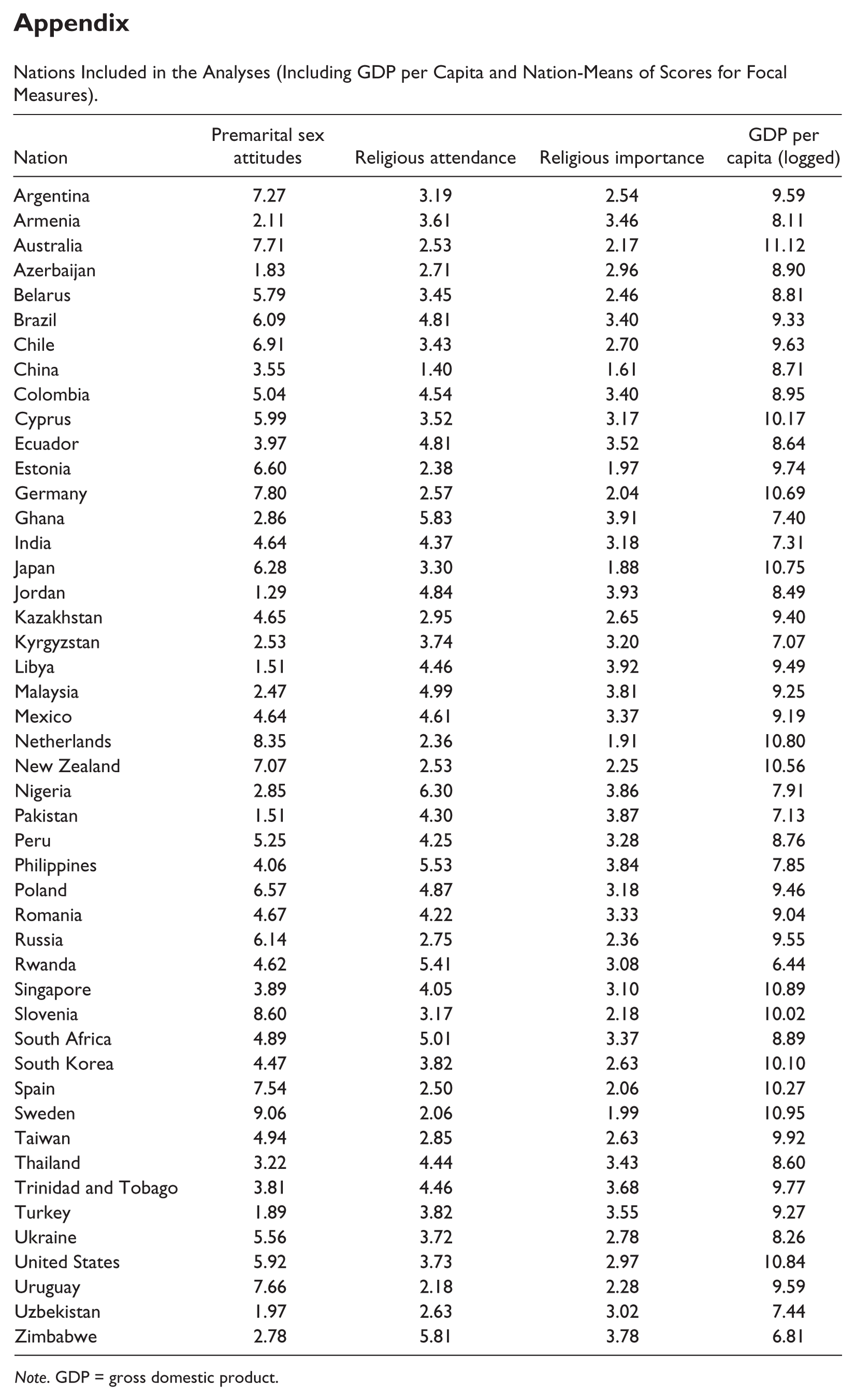
For the analyses in the study, I use data from the sixth wave of the World Values Survey (2010–2014). 1 The survey constitutes the largest set of investigations ever carried out of attitudes, beliefs, and values around the globe. It collects data from nationally representative samples of the adult population aged 18 years and above. Respondents were generally identified by probabilistic random sampling, although respondent selection varies by countries. In each country, face-to-face interviews were conducted to collect information. Originally, the sixth wave includes 85,070 respondents from 59 countries. However, only 47 countries are included in the analytical sample in the present study. 2 Furthermore, 5,565 cases were deleted because they were missing information on variables in the analysis. 3 The final sample used in the analyses below consists of 65,414 individuals from 47 countries with complete data for all study variables. The appendix lists these countries alphabetically with nation-means for focal measures and gross domestic product (GDP) per capita for each country.
Dependent variable
The dependent variable is approval of premarital sex. Respondents were asked, “Please tell me for each of the following actions whether you think it can always be justified, never be justified, or something in between . . . Sex before marriage.” Response options range from 1 = never justifiable to 10 = always justifiable.
Individual-level variables
Key individual-level independent variables include religious attendance and importance. Religious attendance is measured using responses to the following question: “Aside from weddings and funerals, about how often do you attend religious services these days?” Response options include 1 = more than once a week, 2 = once a week, 3 = once a month, 4 = only on special holy days, 5 = once a year, 6 = less often, and 7 = never, practically never. The variable is reverse coded with higher scores representing greater religious attendance. To measure religious importance, an item asks: “For each of the following, indicate how important it is in your life. Would you say religion is . . .” Response categories include 1 = very important, 2 = rather important, 3 = not very important, and 4 = not at all important. I also reverse coded the responses so that higher values indicate higher levels of religious importance.
I control for variables that prior research and theory found to be related to focal variables in the study such as religion and attitudes toward premarital sex (Barkan 2006; Kraaykamp 2002; Ogland and Hinojosa 2012; Thornton and Camburn 1987). Based on the social control theory that being well integrated within the community discourages people from deviant behaviors and attitudes (Hirschi 1969), I include two measures of attachments to others and to social institutions: marriage and the number of children. With regard to marital status, I use a series of dummy-coded variables for married, widowed, divorced/separated, and single. The “married” status serves as the reference group. Respondents were asked about how many children they have, and response options range from 0 = no children to 8 = eight or more children. Prior scholarship showed that people with large families have less permissive attitudes toward premarital sex (Thornton and Camburn 1987).
In light of the social learning theory that emphasizes exposure to norms militating against sexual deviance (Akers 1998), I control for religious affiliation and education. Religious affiliation is measured using a set of dichotomous variables including Buddhist, Catholic, Hindu, Jewish, Muslim, Orthodox Christian, Protestant, Other religion, No affiliation, and All else. The last category represents survey participants who refused to answer, did not know their affiliation, or were not asked their religious affiliation. Given that Catholics, Orthodox Christians, and Protestants share many of the same beliefs and practices, I collapsed them into a single category—Christian. Extant literature suggests that levels of condemnation of premarital sex may differ across religious groups (Cochran and Beeghley 1991). In particular, on the basis of the claim that Islam has severe doctrinal proscriptions against sexual deviance (Meekers 1994; Zaehner 1997), Muslims are expected to hold more disapproving attitudes toward premarital sex than members of other religious traditions (Finke and Adamczyk 2008). Thus, Muslim serves as the reference category. Education tends to promote social liberalism and tolerance through cultivating critical abilities (Stack and Kposowa 2011). To the extent that education reduces intolerance, I would expect that it would be associated with more approving attitudes toward premarital sex. To measure educational attainment, respondents were asked a question: “What is the highest educational level that you have attained?” Response options range from 1 = no formal education to 9 = university-level education with degree.
Recent works in comparative cultural sociology demonstrate that economic growth alters attitudes toward gender equality that constitute a central component of a wider cultural change toward tolerance and liberalism (Inglehart and Norris 2003). Given this theoretical view, I incorporate gender traditionalism as a control variable. Gender traditionalism is measured using an index that taps into respondents’ attitudes toward gender roles. This index is comprised of responses to four questions: (1) “On the whole, men make better political leaders than women do,” (2) “A university education is more important for a boy than for a girl,” (3) “On the whole, men make better business executives than women do,” and (4) “Being a housewife is just as fulfilling as working for pay.” Response options for each items range from 1 = strongly agree to 4 = strongly disagree. I reverse coded all of the four items so that higher scores indicate higher levels of gender traditionalism. Then, I averaged these items to construct the index. The Cronbach’s alpha for this index is .69, which is low by conventional standards.
Finally, I employ demographic controls including gender and age that are generally related to attitudes toward deviant behaviors (Stack, Adamczyk, and Cao 2010). Gender is measured as a binary variable where 1 = female and 0 = male. Age is measured as a continuous variable (in years). In addition, given that financial strain is often associated with deviant attitudes (Torgler and Schneider 2007), I control for financial satisfaction. I measure financial satisfaction using a question asking: “How satisfied are you with the financial situation of your household?” Response options range from 1 = completely dissatisfied to 10 = completely satisfied.
Country-level variables
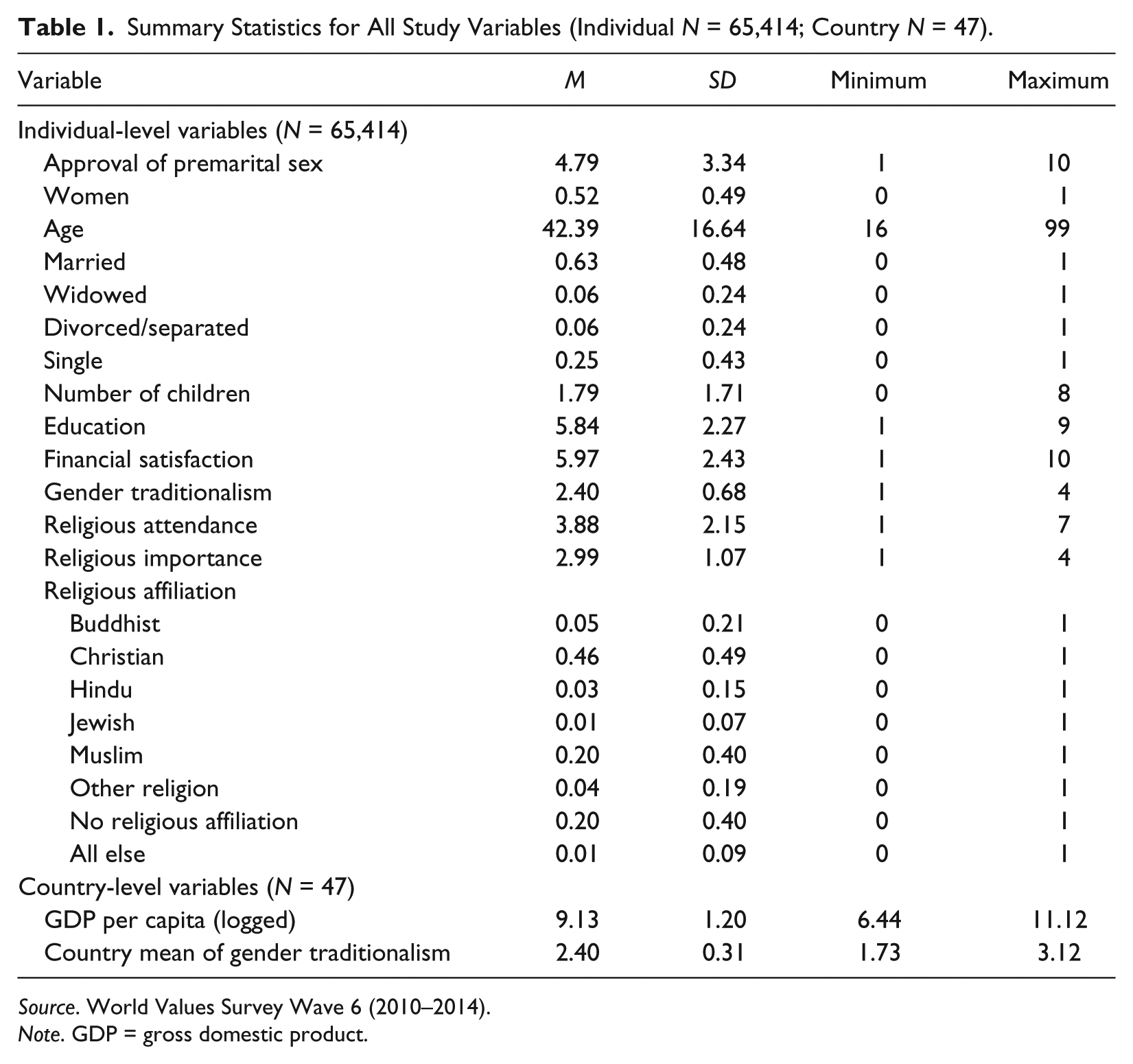
The key country-level variable is GDP per capita, an indicator of economic development that is most commonly used in the literature (Acemoglu, Johnson, and Robinson 2001). 4 I utilize a country’s GDP per capita in 2012 because it is the middle of survey years (2010–2014). These GDP per capita figures were log-transformed to reduce skew and included in the models, as is customary in the literature (Kwon 2011). As a country-level control variable, I include gender traditionalism at the national level, which is derived from aggregating the individual-level gender traditionalism index measure to the country level. Table 1 shows the descriptive statistics for all study variables, both at the individual and country level.
Summary Statistics for All Study Variables (Individual N = 65,414; Country N = 47).
Source. World Values Survey Wave 6 (2010–2014).
Note. GDP = gross domestic product.
Statistical method
To assess the effects of both individual and country-level variables on the acceptability of premarital sex, I use multilevel modeling with Stata software (Raudenbush and Bryk 2001). The individual-level model equation is as follows:
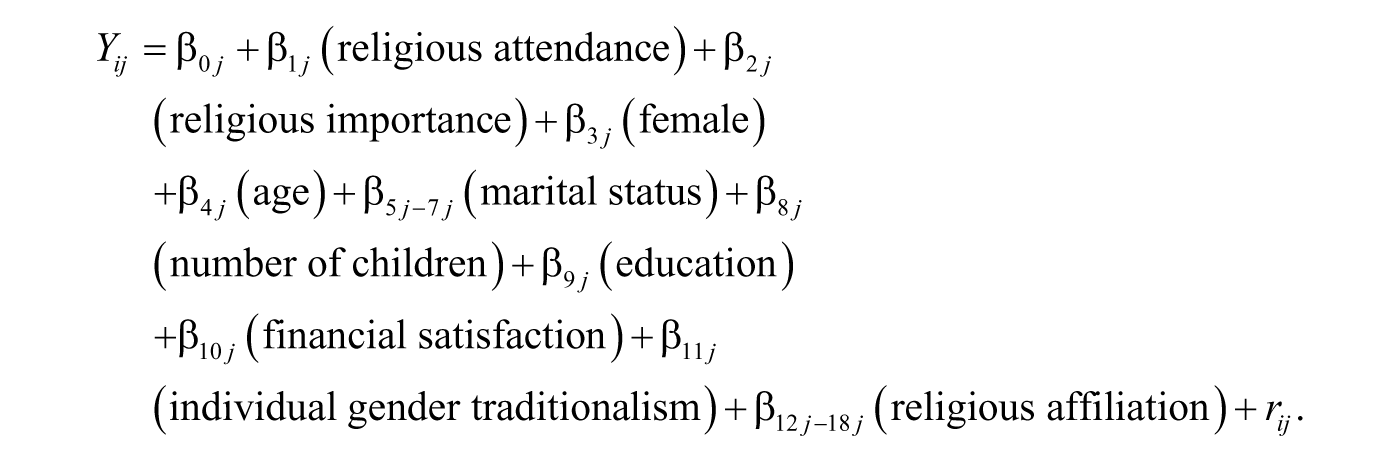
The subscript i indexes the specific individual, and the subscript j refers to country-level influences. Yij refers to individual i from country j’s opinion about premarital sex. The rij refers to the error term that provides an estimate of the within-country variability in the acceptability of premarital sex. To investigate the influences of country-level variables on individual attitudes toward premarital sex, the following model is estimated:

In this model, β0j is the national average opinion toward premarital sex in a given country as well as the intercept term from the previous individual-level equation. γ00 is the overall average opinion toward premarital sex across 47 countries. The u0j represents the error term for the country-level effects that gives the between-country variability. The gammas (γ01–γ02) denote the average for each of the country-level variables.
In the next model, I investigate whether the association between religiosity and approval of premarital sex differs significantly across countries. More specifically, I analyze whether a country’s GDP per capita influences the association between individual religiosity and approval of premarital sex. I assess the cross-level interaction effects using the equation:

β1j refers to the individual religious attendance coefficient for residents living in country j. γ10 represents the average slope of individual religious attendance controlling for all other predictors. γ11 is the effect of a country’s GDP per capita on the individual religious attendance regression slope, adjusting for all other variables. u1j refers to the error term that is assumed to be normally distributed with a mean of 0 and variance of t11. I replaced religious attendance with religious importance and went through the same process to assess how country-level GDP per capita interacts with religious importance to produce distinct outcomes on individual opinions about premarital sex.
Results
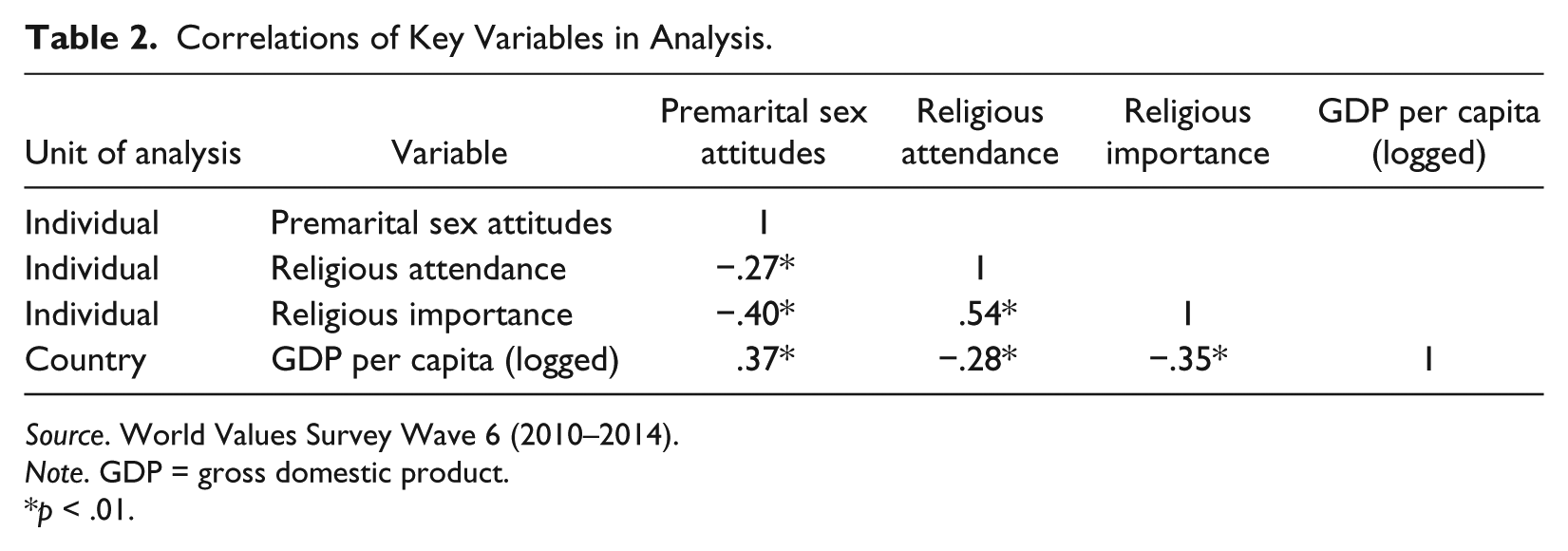
Table 2 presents correlations between attitudes toward premarital sex and focal variables. Significant correlations are detected between all of these variables. Premarital sex has a significant correlation with the individual-level religious attendance (r = −.27), religious importance (r = −.40), and GDP per capita (r = .37). Notably, GDP per capita is negatively correlated with individual religious attendance and importance.
Correlations of Key Variables in Analysis.
Source. World Values Survey Wave 6 (2010–2014).
Note. GDP = gross domestic product.
p < .01.
I start my multivariate analysis by estimating a null random-intercept-only model to assess whether there is a significant variation between countries (not shown here). For this task, the intraclass correlation (ICC) was calculated. The ICC refers to the proportion of the total variance in individual attitudes toward premarital sex that is attributable to country-level characteristics. Analysis of the ICC revealed that 38 percent of the variance in public opinion about premarital sex is between nations, whereas 62 percent of the variance is between individuals within nations. Compared with other outcomes estimated with multilevel modeling, 38 percent is quite high (Adamczyk and Pitt 2009). It is high enough to warrant multilevel modeling, suggesting that a significant portion of attitudes toward premarital sex is accounted for by the country-level variables.
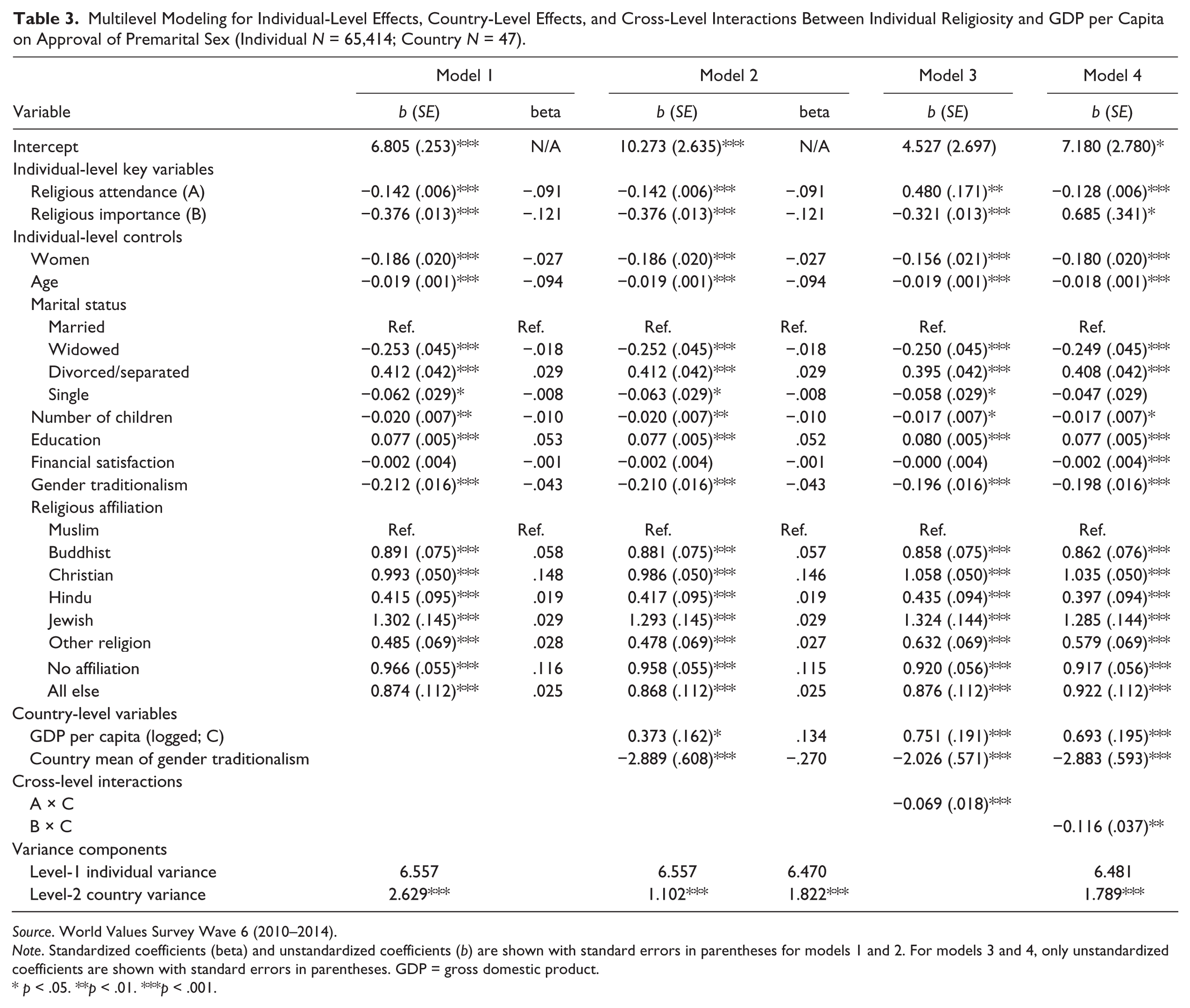
Table 3 presents the results of the multilevel analysis of the effects of the individual and country-level variables on acceptance of premarital sex. When the sample size is large, the usual tests of statistical significance are not very helpful in interpreting the findings of the analysis (Inglehart and Norris 2003). Therefore, I focus not only on the unstandardized coefficients but also the strength of the standardized beta coefficients (models 1 and 2). Model 1 reports the results for the effects of all of the individual-level variables on approval of premarital sex. Findings show that in line with H1, individuals who frequently attend religious services are less likely to approve of premarital sex. Similarly, individuals who regard religion as important in their lives are less likely to approve of premarital sex, lending support to H2. Additional analyses not shown here reveal that individuals who attend religious services “more than once a week” have levels of approval of premarital sex that are about 16.2 percent lower than for those who “never” attend. With regard to religious importance, further analyses not presented here demonstrate that those who consider religion “very important” in their lives have levels of approval of premarital sex that are about 20.1 percent lower than for those who regard religion as “not important at all.” In addition, religious attendance and importance have relatively large standardized effects; the standardized coefficients for religious attendance and importance are larger than the effects of most of the significant control variables (e.g., education and gender traditionalism).
Multilevel Modeling for Individual-Level Effects, Country-Level Effects, and Cross-Level Interactions Between Individual Religiosity and GDP per Capita on Approval of Premarital Sex (Individual N = 65,414; Country N = 47).
Source. World Values Survey Wave 6 (2010–2014).
Note. Standardized coefficients (beta) and unstandardized coefficients (b) are shown with standard errors in parentheses for models 1 and 2. For models 3 and 4, only unstandardized coefficients are shown with standard errors in parentheses. GDP = gross domestic product.
p < .05. **p < .01. ***p < .001.
In addition, model 1 shows that most of the individual control variables are statistically significant. Women, older people, and those who have more children have more disapproving attitudes toward premarital sex than their counterparts. However, those with a higher level of education show higher scores on the acceptability of premarital sex. Interestingly, divorced or separated people hold more tolerant views toward premarital sex than married individuals, but widowed people and singles have more disapproving attitudes about premarital sex than married individuals. Gender traditionalism is negatively associated with approval of premarital sex. Finally, Muslim identity is associated with more disapproving attitudes toward premarital sex compared with other religious groups. Specifically, Buddhist, Christian, Hindu, Jewish, Other religious affiliations, those without religion, and those categorized as “all else” have higher levels of approval of premarital sex than Muslim.
Model 2 introduces the country-level variables. It reveals that the coefficient for GDP per capita is significant and positive, offering support to H3. This observation indicates that people residing in countries with higher GDP per capita have higher levels of acceptability of premarital sex. Conversely, individuals living in nations where GDP per capita is lower exhibit lower levels of approval of premarital sex. The standardized effect of GDP per capita is relatively large compared with most of the significant controls. Individual religious attendance and importance continue to have significant, negative effects on approval of premarital sex. In terms of country-level controls, gender traditionalism is a significant predictor of the acceptability of premarital sex. This indicates that individuals residing in nations characterized by stronger gender traditionalism have higher levels of disapproval of premarital sex.
Models 3 and 4 assess whether GDP per capita accounts for variation in the association between individual religiosity and approval of premarital sex. 5 I include the cross-level interaction term between religious attendance and GDP per capita in model 3. 6 It turns out that the interaction term is negative and significant. The negative value of this interaction term suggests that in countries with higher GDP per capita, religious attendance has more of a deterrent effect on approval of premarital sex. Therefore, this finding offers support for H4, running counter to H5. Figure 1 graphically illustrates this cross-level interaction effect. It presents the predicted values of approval of premarital sex, separately for countries with a higher level of GDP per capita (e.g., 1 standard deviation above the mean) and countries with a lower level of GDP per capita (e.g., 1 standard deviation below the mean), at three different levels of individual religious attendance, holding all other variables constant. It shows that the slope for countries characterized by a higher level of GDP per capita is steeper than that of its counterpart, suggesting that the negative effects of individual religious attendance on the acceptability of premarital sex are greater in countries that are more economically developed.
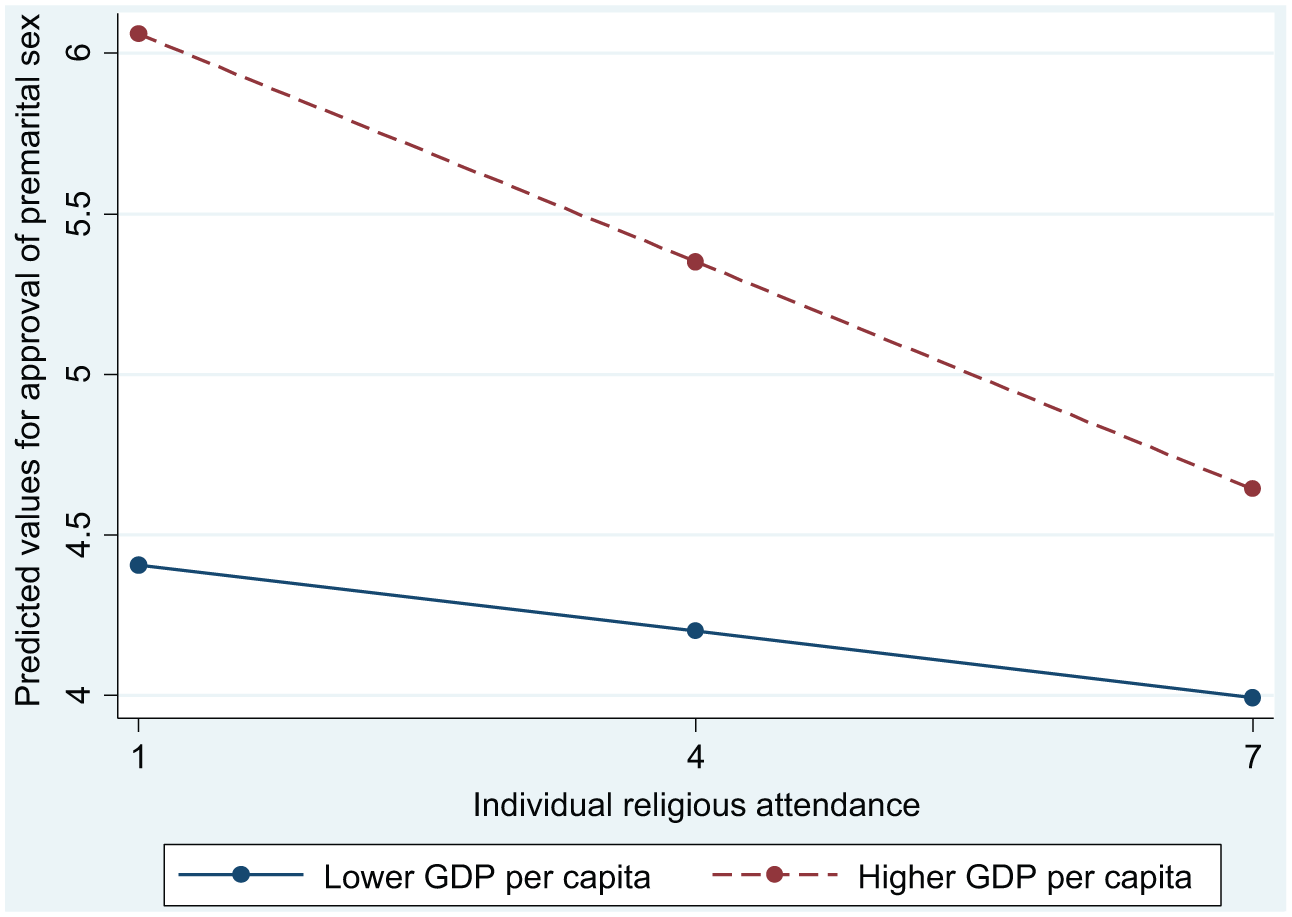
Approval of Premarital Sex for Two Different Levels of GDP per Capita by Individual Religious Attendance.
Model 4 includes the cross-level interaction term between religious importance and GDP per capita, which is also negative and significant. This finding implies that individual religious importance has stronger negative effects on approving attitudes about premarital sex in countries with higher GDP per capita, whereas in nations with lower GDP per capita, individual religious importance has less of a restraining influence on individual’s opinions about premarital sex. Thus, H4 garners empirical support, and H5 does not.
Conclusion and Discussion
This article examines the role of individual religiosity in explaining cross-national differences in acceptance of premarital sex. It then proceeds to investigate how a broader economic context of a nation, indicated by GDP per capita, affects individual approval of premarital sex. Moreover, it explores how the effects of personal religiosity on approval of premarital sex are conditioned by the economic context. Studying premarital sexuality in the context of economic development is important because it is a good opportunity to examine the more general process of how attitudes about behavior that are generally associated with traditional religious teachings are changing in societies as they become more economically developed and how this alters the role of religion in these societies.
Findings generally give support to the hypotheses presented earlier except for H5. Individuals who show higher levels of religious attendance and those who place more importance on religion are more likely to disapprove of premarital sex, net of other individual and country-level characteristics. With regard to the macro-level effects of economic circumstances of a nation, individuals residing in a nation that has a higher GDP per capita have more approving attitudes about premarital sex. Importantly, GDP per capita modifies the relationship between individual religiosity and approval of premarital sex, such that individual religiosity has a greater negative effect on approval of premarital sex in countries with a higher GDP per capita. By contrast, individual religiosity has less of an impact on approval of premarital sex in countries with a lower GDP per capita.
Several contributions emerge from these findings. First, the current work extends prior research by using a cross-national sample to assess the association between indicators of religion (e.g., religious attendance and importance) and attitudes toward premarital sex. The results in this study suggest that the negative relationship between religiosity and premarital sex identified in North American contexts can hold across other parts of the world. These observations are nothing new because previous research has already tested this possibility. Indeed, there are some works that used data from international surveys that examined the relationship between personal religiosity and attitudes about premarital sex (Finke and Adamczyk 2008; Scheepers, Te Grotenhuis, and Van Der Slik 2002). However, these prior studies suffer from two limitations: (1) They merge an item about premarital sex with items related to other sexual morality (e.g., cohabitation, extramarital sex, and homosexuality) to construct an index, such that it is difficult to single out religious effects explicitly on attitudes about premarital sex, and (2) they use data from the International Social Survey Program (ISSP) that are collected primarily in North America and Europe, which are dominated by a Christian population. The present investigation overcomes these shortcomings by solely focusing on attitudes about premarital sex and utilizing data from the World Values Survey that provide a more diverse and larger sample of countries. In this way, the current study lays a firmer foundation for the generalization that as individual religiosity increases, one’s approval of premarital sex decreases.
Second, this study is the first to highlight the importance of economic contexts of a nation in explaining individual attitudes about premarital sex. Building on theoretical developments of comparative cultural sociology, the current investigation advances our knowledge of attitudes about premarital sex in a way that moves beyond prior studies that focused on religiosity alone. One of the main findings in the study is that individual attitudes about premarital sex are closely related to the level of economic development of a nation, even after accounting for other individual-level predictors. This observation provides evidence for Émile Durkheim’s ([1897] 1952, [1915] 1947) thesis that social contexts have a sui generis effect. In other words, the economic circumstances of a nation have an effect on individuals’ attitudes toward premarital sex that is not reducible to micro-level interactions or individual-level variables. Thus, the current study reinforces Durkheim’s ideas by showing how powerful economic and social contexts are in shaping individuals’ attitudes about premarital sex.
Third, the current study finds that economic development moderates the influences of religion on approval of premarital sex. Specifically, the significant cross-level interaction between economic context and personal religiosity suggests that the effect of individual religiosity on approval of premarital sex is stronger in countries characterized by higher economic development. This observation lends supporting evidence for the contingency theory, not the moral communities thesis. 7 Here, it is worth reiterating a central point in the contingency theory: “The impact of religious constraints is increased where secular controls are absent or weak” (Tittle and Welch 1983:653). Consistent with this theoretical view, the current investigation shows that personal religiosity is most influential in wealthy countries where secular sources of messages that proscribe premarital sex are absent or weak. Overall, this finding adds to our knowledge of the ways in which religious effects on delinquency differ by social contexts. Since Travis Hirschi and Rodney Stark’s (1969) seminal work was published, scholars have provided mixed evidence that affirms or denies any linkage between religion and delinquency (Sloane and Potvin 1986). To determine the nature of the effects of religion on deviance, scholars came to focus on the conditions under which religion might exert a significant impact on delinquency. My analyses clearly demonstrate that the economic development of a nation is a contextual factor that can affect the association between religion and deviance. Future studies can benefit from investigating the ways in which a nation’s level of economic development interacts with personal religiosity to influence attitudes toward other deviant behaviors such as family violence or suicide.
Fourth, the observations in the study enable us to have a more nuanced understanding of the role of religion in the contemporary world. On one hand, the present work finds that premarital sexuality is more accepted in more economically advanced countries partly because the authority of religion diminishes in modernity, as the secularization theory predicts. On the other hand, however, in those wealthy countries, religion plays a bigger role in explaining differences among individuals in society and has greater deterrent effects on individual attitudes toward premarital sex. In interpreting these seemingly contradicting findings with regard to the effects of religion, we need to distinguish between religious effects at the micro (individual) and macro (country) level in relation to attitudes toward premarital sex, paying greater attention to how the secularization process takes place at different levels (Chaves 1994).
The findings in the present study imply that in modern countries, religious constraint is loosened over norms about premarital sex at the macro level because of the secularization process, a societal-level process that is primarily driven by functional differentiation (Dobbelaere 1988). However, at the micro level, the influence of personal religiosity becomes greater in shaping individual attitudes toward premarital sex in modern societies, which is contrary to the expectation of the secularization theory. This observation indicates that economic modernization does not necessarily lead religion to fade in salience; religion still plays a substantial role at the individual level in certain areas such as sex in developed nations (Stark and Finke 2000). In these countries, people who are religious take religion very seriously and make sexual choices that are consistent with religious teachings proscribing premarital sex. Influenced by individualism in modern culture that glorifies difference and nonconformity, religious persons living in economically developed societies characterized by low levels of religiosity seek to “stand out” from the crowd, creating clear distinctions from outgroups by exclusively relying on religion as a source of direction for sexual morality (Smith et al. 1998). In addition, in more modern countries, there is more room for personal religiosity to have influences on attitudes toward premarital sex because people show greater variations in attitudes toward premarital sex due to the emphasis on individualism and diversity, compared with less modern countries that have uniformly conservative attitudes toward premarital sex. In this sense, it may be that modernization is creating the situation for religion to become a more contentious issue in society as religion becomes more visibly linked to differences among individuals in society. This, in turn, might help understand the rise of fundamentalisms in societies experiencing liberalizations of attitudes and why religion becomes more contentious in the politics of more modern societies (Bruce 2000). Taken together, this study underscores the importance of studying the effects of religion that operate at different levels in modern societies, at least in terms of shaping individual’s attitudes about sex-related issues.
This study has several limitations that deserve a brief mention. First, this study is based on cross-sectional data. Thus, we cannot resolve the issue of causal direction regarding the focal associations. Although I argue that personal religiosity affects approval of premarital sex, it is also plausible that those who have more disapproving attitudes about premarital sex may have an array of values and beliefs that encourage them to be involved in religion. With longitudinal data, this issue can be better addressed. Second, given that attitudes about premarital sex may be partially shaped by laws regulating premarital sex, it would be ideal to include a measure of premarital sex regulation in the models. However, the present study lacks this measure in the analyses because I was not able to find a proper measure on government regulation regarding premarital sex; sexual behaviors are rarely covered under legal codes (Finke and Adamczyk 2008). Third, the current study examines factors that influence attitudes about premarital sex, not actual behaviors. Although studying attitudes can offer a window into the correlates of behaviors (Stack and Kposowa 2008), simply examining religious and contextual determinants of attitudes gives limited insight into the ways in which religion and economic context shape behavior. Fourth, the analyses in this study were conducted based on 47 countries that are not perfectly representative of the world population. For example, the sample in the current study underrepresents Buddhists and Hindus. Therefore, caution should be used in generalizing the findings in this study to the entire world population.
These limitations notwithstanding, the current study offers clear evidence that individual religiosity is a constraining force reducing approval of premarital sex, whereas economic development is a driving force for acceptance of premarital sex. Furthermore, macro-level economic factors condition the effects of individual religiosity on approval of premarital sex. Therefore, the present investigation suggests that scholars cannot assume that the association between religion and attitudes about premarital sex is similar across countries. Rather, researchers need to direct more attention to the ways in which religion has differential effects on attitudes about premarital sex based on the economic contexts of a nation. Collectively, the results in this study highlight a longstanding interest in sociological analyses that social contexts influence individuals’ attitudes and values.
Footnotes
Appendix
Nations Included in the Analyses (Including GDP per Capita and Nation-Means of Scores for Focal Measures).
| Nation | Premarital sex attitudes | Religious attendance | Religious importance | GDP per capita (logged) |
|---|---|---|---|---|
| Argentina | 7.27 | 3.19 | 2.54 | 9.59 |
| Armenia | 2.11 | 3.61 | 3.46 | 8.11 |
| Australia | 7.71 | 2.53 | 2.17 | 11.12 |
| Azerbaijan | 1.83 | 2.71 | 2.96 | 8.90 |
| Belarus | 5.79 | 3.45 | 2.46 | 8.81 |
| Brazil | 6.09 | 4.81 | 3.40 | 9.33 |
| Chile | 6.91 | 3.43 | 2.70 | 9.63 |
| China | 3.55 | 1.40 | 1.61 | 8.71 |
| Colombia | 5.04 | 4.54 | 3.40 | 8.95 |
| Cyprus | 5.99 | 3.52 | 3.17 | 10.17 |
| Ecuador | 3.97 | 4.81 | 3.52 | 8.64 |
| Estonia | 6.60 | 2.38 | 1.97 | 9.74 |
| Germany | 7.80 | 2.57 | 2.04 | 10.69 |
| Ghana | 2.86 | 5.83 | 3.91 | 7.40 |
| India | 4.64 | 4.37 | 3.18 | 7.31 |
| Japan | 6.28 | 3.30 | 1.88 | 10.75 |
| Jordan | 1.29 | 4.84 | 3.93 | 8.49 |
| Kazakhstan | 4.65 | 2.95 | 2.65 | 9.40 |
| Kyrgyzstan | 2.53 | 3.74 | 3.20 | 7.07 |
| Libya | 1.51 | 4.46 | 3.92 | 9.49 |
| Malaysia | 2.47 | 4.99 | 3.81 | 9.25 |
| Mexico | 4.64 | 4.61 | 3.37 | 9.19 |
| Netherlands | 8.35 | 2.36 | 1.91 | 10.80 |
| New Zealand | 7.07 | 2.53 | 2.25 | 10.56 |
| Nigeria | 2.85 | 6.30 | 3.86 | 7.91 |
| Pakistan | 1.51 | 4.30 | 3.87 | 7.13 |
| Peru | 5.25 | 4.25 | 3.28 | 8.76 |
| Philippines | 4.06 | 5.53 | 3.84 | 7.85 |
| Poland | 6.57 | 4.87 | 3.18 | 9.46 |
| Romania | 4.67 | 4.22 | 3.33 | 9.04 |
| Russia | 6.14 | 2.75 | 2.36 | 9.55 |
| Rwanda | 4.62 | 5.41 | 3.08 | 6.44 |
| Singapore | 3.89 | 4.05 | 3.10 | 10.89 |
| Slovenia | 8.60 | 3.17 | 2.18 | 10.02 |
| South Africa | 4.89 | 5.01 | 3.37 | 8.89 |
| South Korea | 4.47 | 3.82 | 2.63 | 10.10 |
| Spain | 7.54 | 2.50 | 2.06 | 10.27 |
| Sweden | 9.06 | 2.06 | 1.99 | 10.95 |
| Taiwan | 4.94 | 2.85 | 2.63 | 9.92 |
| Thailand | 3.22 | 4.44 | 3.43 | 8.60 |
| Trinidad and Tobago | 3.81 | 4.46 | 3.68 | 9.77 |
| Turkey | 1.89 | 3.82 | 3.55 | 9.27 |
| Ukraine | 5.56 | 3.72 | 2.78 | 8.26 |
| United States | 5.92 | 3.73 | 2.97 | 10.84 |
| Uruguay | 7.66 | 2.18 | 2.28 | 9.59 |
| Uzbekistan | 1.97 | 2.63 | 3.02 | 7.44 |
| Zimbabwe | 2.78 | 5.81 | 3.78 | 6.81 |
Note. GDP = gross domestic product.
Acknowledgements
The author thanks Daniel V. A. Olson, Daniel Winchester, Michael Vuolo, Joe Marshall, Ben Pratt, and Fanhao Nie for their valuable comments, as well as the editor and anonymous reviewers for their helpful suggestions.
Declaration of Conflicting Interests
The author(s) declared no potential conflicts of interest with respect to the research, authorship, and/or publication of this article.
Funding
The author(s) received no financial support for the research, authorship, and/or publication of this article.