







Abstract
Whereas some researchers suggest that workers face a tradeoff between job security and earnings, others imply that low earnings and high unemployment risks tend to accompany each other. Despite the contradictory views, direct evidence on whether, holding skill levels constant, insecure jobs pay more—or less—is lacking. Equally lacking is an understanding of how the national context may condition the way in which job security is associated with earnings. Using cross-national data from the International Social Survey Programme, this study examines the association between self-reported job security and earnings. Results indicate that jobs perceived to be more secure unequivocally pay more. The positive association between job security and earnings remains even after controlling an extensive set of job and individual characteristics, including detailed occupational categories, possession of irreplaceable skills, and risk-related personality traits. Furthermore, this positive association is universal; it is found within different employment sectors and occupations, as well as for both men and women. Although workers who perceive themselves as having lower risks of job loss generally earn more, they earn especially more in countries with higher unemployment rates and greater income inequality. Within Organisation for Economic Co-operation and Development (OECD) countries, however, the earnings gap between those with secure and insecure jobs is smaller when the unemployment benefits replace a greater amount of the earnings prior to the job loss.
Both economic theories and conventional wisdom assume a positive association between risks and rewards. Because the market offers a premium for risk-taking, the higher the risks involved in individuals’ asset investments, the greater financial returns they can expect from such investments (Markowitz 1952; Sharpe 1964). Extending this logic to other types of economic activities, labor economists contend that individuals’ tolerance for risks explains the rewards they receive from jobs (Budria et al. 2013; Shaw 1996). More risk-averse individuals are thought to be less likely to select occupations with high earnings variation or jobs for which the pay is based strictly on performance (Bellemare and Shearer 2010; Bonin et al. 2007; Dohmen and Falk 2011). Similarly, such individuals are likely to choose jobs with lower risks of unemployment. Because the market is expected to compensate for jobs’ greater unemployment or earnings risks with higher wages (Hartog et al. 2003; Murphy and Topel 1987; Topel 1984), risk-averse workers are likely to earn less and experience less income growth over time. This same framework is also thought to explain the gender pay gap. At least part of the gender differences in wages is argued to be attributable to women’s lower tolerance for risks and higher likelihood to select occupations with lower earnings but greater security (Le et al. 2011).
In contrast to economists, who take individuals’ risk preferences as given, sociologists are instead concerned about why certain people tolerate job-related risks more, or value job security less, than others do (e.g., Johnson 2002; Johnson and Mortimer 2011). Charles N. Halaby (2003), in particular, adopts Daniel R. Miller and Guy E. Swanson’s (1958) job orientation schema and distinguishes “entrepreneurial” from “bureaucratic” job values. Whereas the former set of values emphasizes high pay, the latter prioritizes job security. Because individuals of different social origins may be more or less prone to develop each set of values, those from certain socioeconomic backgrounds may opt for higher-income and riskier jobs, while others prefer more secure, albeit lower-wage, jobs. Such different job preferences and choices are argued to be critical for explaining intergenerational mobility and social stratification processes. By contrasting entrepreneurial and bureaucratic job values, as well as their respective career consequences, this line of argument shares the economists’ view that there is a tradeoff between job security and earnings.
Although we can find the assumption that workers face a tradeoff between job security and earnings in both economic and sociological literatures, previous research rarely provides direct evidence that among jobs with similar skill requirements, those perceived to be more secure, indeed, pay less. At the same time, much prior research shows that “bad” jobs, such as jobs of manual workers, nonstandard employees, and individuals with relatively low skill levels, tend to be both insecure and low paying (Evans and Mills 2000; Goldthorpe 2007; Kalleberg, Reskin, and Hudson 2000; McGovern, Smeaton, and Hill 2004; Stier 2015). The tendency for inferior job traits to cluster together suggests that jobs perceived to be less secure may actually pay less. Available evidence, however, is insufficient to rule out the tradeoff between job security and earnings, because previous researchers generally focus on the gap in job quality between differing occupations or workers with different skills (Evans and Mills 2000; Goldthorpe 2007; Hudson 2007; Stier 2015). We lack knowledge about the relationship between job security and earnings for workers with equivalent qualifications, who, in theory, can choose among jobs that are similar in skill requirements but different in financial compensations and risks of unemployment.
To fill the gap in the existing literature, in this paper, I use survey data from 32 countries to examine whether those with less secure jobs earn more, as expected by the argument that workers will trade off job security for earnings, or that those facing greater unemployment risks are worse compensated financially, even after taking into account education and occupational and other skills. Regardless of what the relationship between job security and earnings is, it is likely that this relationship will vary with the broader context. In the case that workers must trade job security for earnings, they are likely to experience sharper increases in earnings with rises in unemployment risks if their societies lack safety nets to alleviate the harm of unemployment. Conversely, if jobs perceived to be less secure actually pay less, as those less able to bargain for high wages also tend to fail to bargain for other preferred job traits (Petersen 1992), then the positive association between job security and earnings may be even stronger in more unequal societies, where those with relative low bargaining power are especially worse off. Because there is virtually no evidence on how the broader context may condition the association between job security and earnings, I also investigate how this association depends on various national characteristics.
Relationship between Job Security and Earnings
The notion that individuals may sacrifice job security for earnings, or vice versa, is rooted in the theory of compensating wage differentials (Smith 1979), which maintains that in addition to its pay, a job possesses a combination of desirable and undesirable features that prospective workers are willing to buy or sell at certain prices. All else being equal, jobs with unpleasant features are argued to command higher wages, as they otherwise would not be able to attract workers in a competitive market. Corroborating the theory of compensating differentials, a considerable amount of economic research shows that dangerous jobs that expose incumbents to risk of injury or death are likely to pay significant wage premiums (Cousineau, Lacroix, and Girard 1992; Garen 1988; Olson 1981). A few studies further apply this theory to other disagreeable job characteristics, such as physical work, repetitive work, and a lack of freedom in the workplace, but the results are mixed (Smith 1979).
Considering a risk of unemployment as an undesirable job trait, several economic studies testing compensating differentials theory specifically examine the relationship between wages and the likelihood of unemployment (Abowd and Ashenfelter 1981; Adams 1985; Topel 1984). Although these studies find a wage premium associated with a greater likelihood of unemployment, they estimate workers’ anticipated risks of unemployment based on either their past experience of layoffs or unemployment rates in their industries and geographical areas, or both. Because people’s histories of layoffs might reflect more of their own than their jobs’ characteristics, using such histories to determine their jobs’ unemployment risks is problematic. Similarly, industry- or economy-wide unemployment records are not sufficiently specific for identifying the unemployment risks that individuals perceive when choosing jobs. After all, for most individuals, what matters is the likelihood of losing their particular jobs, not the general employment stability of their industries or local economies. Moreover, by relying on the actual experiences of layoffs or discharges to estimate jobs’ unemployment risks, the existing research is unable to distinguish differences in perceived job security among the majority of workers, who rarely experienced layoffs during the often-short observed period. Because compensating differentials theory maintains that employers compensate workers according to the latter’s perception of the risk of job loss, the likely discrepancy between workers’ perceived job security and the unemployment risks measured in previous research constitutes a major shortcoming.
Beyond compensating wage differentials, research linking individuals’ risk attitudes to wage inequality also indirectly suggests a tradeoff between job security and pay. This research argues that like the financial market, the labor market rewards risk-taking (Halaby 2003; Shaw 1996), as employers will pay more when employees are willing to share the uncertainty in the return to production effort (Petersen 1992). Although all workers want to maximize earnings, those with lower risk tolerance are argued to prefer jobs that yield more stable, albeit lower average, earnings, whereas those with a greater tolerance for risk tend to select jobs that have a higher likelihood of earnings fluctuations, but pay more over the long run. Relying on either self-reported risk attitudes or experimental designs, research finds that individuals who are more willing to take risks are more likely to be in occupations in which wages are widely dispersed and comparatively unpredictable (Bellemare and Shearer 2010; Bonin et al. 2007). Such individuals are also more likely to take jobs for which the pay is based strictly on performance (Cadsby, Song, and Tapon 2007; Dohmen and Falk 2011). Given that occupations with greater wage variance tend to have higher average pay (King 1974), occupational sorting by risk attitudes suggests that risk aversion can be costly in the labor market. More directly, some researchers show that more risk-averse workers experience lower wage growth over time (Budria et al. 2013; Shaw 1996). As women, on average, are more risk-averse than men (Dohmen and Falk 2011), risk attitudes, which may sort women into lower-risk and lower-paying jobs, are also thought to explain a part of the gender pay gap (Dohmen et al. 2011; Le et al. 2011).
Because the greatest income risk a worker faces is the complete loss of the source of income, the tradeoff between income risk and earnings described in previous research should also apply to the relationship between job security and pay. That is to say, so long as the labor market rewards risk-taking, as does the financial market, we should find that jobs perceived to have greater unemployment risks pay more, holding the jobs’ skill requirements constant. Existing research, however, provides no direct evidence for this association. Although more risk-averse individuals are shown to experience less wage growth (Shaw 1996), we do not know whether their jobs are, indeed, more secure, and, thus, less likely to result in complete income loss.
Whereas both theories of risk attitudes and compensating differentials theories predict a negative association between job security and earnings among workers qualified to compete for the same jobs, other research on labor markets suggests that the association may instead be positive. To begin, a few economic studies demonstrate that firms frequently offer noncompetitive job rents (Fehr, Kirchsteiger, and Riedl 1996; Krueger and Summers 1988). So long as employers offer such rents, they can also attach nonpecuniary benefits, including job security, to positions that already have wage advantages, rather than making these benefits and wages compensatory. This is especially likely if certain workers are more capable than others of bargaining over the division of surplus with employers. Trond Petersen’s (1992) study of salespersons in department stores specifically supports this argument. Despite some evidence for the tradeoff between stable and high salaries within establishments, Petersen shows that salespersons with more bargaining power can secure the baseline salary—hence, reducing the risk of income loss—without lowering commission-based incentives, leading to their higher overall earnings.
Beyond responding to workers’ bargaining, employers may also supplement earnings with job security to enhance workers’ long-term commitment and prevent shirking (Fehr et al. 1996; Lincoln and Kalleberg 1990). In line with this argument, John H. Goldthorpe (2007), in particular, differentiates types of employment contracts for different social classes along two dimensions of their occupations: the level of difficulty of monitoring and the degree of specificity of human assets. He argues that for occupations in which it is very difficult for employers to assess workers’ effort and productivity and that require skills highly specific to the employing organization, such as managerial and professional occupations, employers must facilitate workers’ devotion to their jobs with the “service contract,” which provides high wages, job security, autonomy, promotion opportunities, and many other nonpecuniary benefits. By contrast, workers in occupations low in both monitoring difficulty and skill specificity, such as manufacturing and low-grade, routine nonmanual occupations, are thought to be under the “labor contract,” which offers relatively low wages, high job insecurity, and other inferior job features. Because of these different types of contracts, workers with lower pay generally face greater risks of unemployment.
Several other labor market theories similarly point to the tendency for bad jobs to be inferior in all aspects. Labor market segmentation theory, for example, contends that labor markets consist of separate sectors. Because invisible barriers exist to prevent people in the secondary sector from competing for positions in the primary sector, those with primary-sector jobs enjoy relatively great employment stability, high earnings, and many other amenities. Conversely, individuals in the secondary or open competitive sector are relegated to jobs with inferior security, pay, advancement opportunities, and working conditions (Baron and Bielby 1984; Hudson 2007; Kalleberg and Sørensen 1979). Likewise, dual economy theory, by dividing the economy into core and periphery sectors with considerably different extents of economic potential, portrays a sharp divide between core and periphery jobs, with the former featuring high pay and security and the latter lacking both (Hodson and Kaufman 1982; Tolbert, Horan, and Beck 1980). More recently, flexibility theory, with a focus on how management utilizes part-time and temporary employees alongside core, standard workers to increase firms’ capacity of handling economic fluctuations, also depicts the concentration of many undesirable traits in nonstandard, noncore jobs (Atkinson 1984; Kalleberg 2001; Kalleberg et al. 2000; McGovern et al. 2004). Under flexible staffing arrangements, those with highly insecure jobs often receive low wages, few fringe benefits, and virtually no opportunities for training and career advancement.
Although the various labor market perspectives just reviewed all seem to predict a positive association between job security and earnings, we should note that these perspectives generally postulate that workers with good and bad jobs are differentiated by educational credentials and skills at some level. For example, Goldthorpe’s (2007) theory about employment contracts primarily concerns different working conditions between individuals of differing occupational categories, who potentially possess different occupational skills. The same theory also suggests that workers with good and bad job traits differ in their possession of human assets specific to the employing organizations. In labor market segmentation and dual economy theories, not only are educational credentials key to entrance into the primary sector (Hudson 2007; Sakamoto and Powers 1995), but having high employer-specific skills is also an important factor differentiating core from periphery workers (Kalleberg 2003:164). Likewise, research on organizational flexibility and its consequences shows that those with less education are more likely to be relegated to nonstandard jobs with inferior pay and job security (Giesecke and Groß 2003; McGovern et al. 2004). Because the argument for a tradeoff between job security and earnings posits that for different jobs to attract individuals of given skill levels, those with greater unemployment risks have to provide additional financial incentives, evidence against this argument needs to show that job insecurity and low pay are closely linked even when comparing workers with similar general, occupational, and employer-specific skills. In this sense, despite the previous research finding that bad job traits often accompany each other, the question of whether workers must trade job security for earnings, or vice versa, remains to be answered.
The Moderating Roles of National Contexts
Few studies investigate how the patterns in which job traits are associated with each other differ by the national context. One rare study of this issue focuses on how national characteristics, such as the country’s level of technology and unemployment rate, moderate the gap in job quality between high- and low-skilled workers (Stier 2015). Such research, however, does not directly answer the question of whether the association between job security and earnings differs by country for workers of similar qualifications. Despite scarce research on the moderating roles of national contexts in the relationship between job security and earnings, several studies show that the consequences of unemployment vary considerably across countries (DiPrete 2002; Gangl 2004, 2006). Individuals in countries with more extensive social welfare and more generous unemployment insurance have smaller chances of falling into poverty, are less likely to be forced to move to occupations below their skill levels, and face lower long-term wage penalties after having experienced unemployment (DiPrete 2002; Gangl 2004). Moreover, unemployed workers encounter smaller earnings loss upon reemployment in countries with stricter legislation for employment protection, partly because such protection reduces workers’ likelihood of undergoing multiple unemployment spells during their careers (Gangl 2006).
Because national welfare policies affect the long-term consequences of unemployment for individuals, the extent to which job security is associated with pay may also depend on such policies. To elaborate, although job insecurity is undesirable in all labor markets, when the consequences of unemployment can be mitigated by national policies, individuals are likely to be more willing to take the risk of job loss. If the relationship between job security and earnings is compensatory, as risk tolerance and compensating differentials theories predict, then the lower concern about job loss in countries with better social safety nets will lead workers to demand smaller financial compensation for increased job insecurity. As a result, the association between job security and earnings can be expected to be weaker in those countries. The same can be expected even if the bargaining perspective holds, that workers capable of bargaining for higher earnings can also procure other nonpecuniary benefits, including job security. As policies alleviating the harm of unemployment make job security a less valuable prize for those in strong bargaining positions, the tendency for job security to be concentrated among those with extremely high earnings, and job insecurity among those with low-paying jobs, would be less pronounced in countries with such policies. Given that prior research shows that greater welfare spending, more unemployment benefits, and stricter employment protection all mitigate the negative consequences of unemployment (DiPrete 2002; Gangl 2004, 2006), I expect these same national conditions will decrease the amount of earnings associated with an increase in job security.
If the association between job security and earnings is positive, as those with relatively great bargaining power tend to be able to procure both, then the strength of this association should also depend on how far apart in bargaining power those in strong and weak bargaining positions are within each economy. When structural conditions weaken the relative positions of workers less preferred by employers, jobs available for them are likely to feature even worse conditions than those of their counterparts in other national contexts, making those with insecure jobs also likely to have especially low earnings. A higher unemployment rate is one such structural condition. Based on queuing theory, which views labor markets as queues in which workers are rank ordered according to their possession of skills and employer-preferred characteristics (Reskin 2001), workers with similar skills may still occupy different positions in the queue, thus having different extents of bargaining power. When the unemployment rate is high, job holders with unfavorable positions in the labor queue may have even weaker relative bargaining power than those before them, because employers can more easily replace the former with the unemployed. Consistent with this argument, previous research finds that job holders with low skills are especially worse off in their working conditions and job quality in countries with higher unemployment rates (Stier 2015). Following the same logic, the greater concentration of bad job traits in societies with higher unemployment rates may be expected within every skill level, as workers with similar skills may still be assigned to different parts of labor queues based on ascribed or other traits.
The argument that the level of inequality in bargaining power between those better and worse off moderates the association between job security and earnings also leads to the expectation of especially lower earnings for those lacking job security in more unequal societies. In particular, because greater income inequality signifies a greater gap in bargaining power between those in strong and weak positions in the society, I anticipate those with secure jobs to earn even more than those with insecure jobs in societies with higher levels of income inequality. Similarly, a greater dispersion in job security, also signaling greater inequality in workers’ bargaining power, can be expected to strengthen the association between job security and earnings.
Method
Data
The statistical analysis relies on data from the International Social Survey Programme (ISSP) collected in 2005. The ISSP collects survey data from various countries each year, using nearly identical questions in every country. The 2005 ISSP focuses on the issue of work orientations and includes detailed questions about respondents’ views regarding work and the traits of their current jobs. Specifically, the survey asked respondents to report the extent to which their current jobs are secure. This report enables a direct measure of job security, which prior studies examining the existence of a wage premium to compensate for unemployment risks lack (Abowd and Ashenfelter 1981; Adams 1985; Topel 1984). Although individuals’ own assessments of job security may not be identical to the actual likelihood that they will lose their jobs, they are likely to have a fairly good sense of their job security. More important, according to compensating differentials theory, what really matters is one’s subjective assessments of job security, rather than the objective risk of unemployment, as employers only need to provide wage premiums to the extent that they compensate for prospective workers’ perceived unemployment risks. Similarly, in theories about risk preferences, individuals’ job decisions ultimately depend on their tolerance of the unemployment risks they perceive for given jobs.
Because the 2005 ISSP includes comparable data from 32 countries, the data also make it possible to achieve the study’s second objective: examining how the association between job security and pay varies by national context. Specifically, the 32 countries from which the survey data were collected include Australia, Belgium, Bulgaria, Canada, Cyprus, Czech Republic, Denmark, Dominican Republic, Finland, France, Germany, Hungary, Ireland, Israel, Japan, Korea, Latvia, Mexico, the Netherlands, New Zealand, Norway, the Philippines, Portugal, Russia, Slovenia, South Africa, Spain, Sweden, Switzerland, Taiwan, the United Kingdom, and the United States. In each country, a random sample of adults aged 18 or over was selected. 1 Given that only those with current jobs answered the question about job security and have earnings, I restricted the analysis to respondents with jobs at the survey time. There were 25,160 respondents in the ISSP sample who had current jobs, distributed across 32 countries, with the sizes of the country samples ranging from 451 to 1,377 (average = 762). Although respondents with missing values on the variables included in the statistical models are generally omitted, I used multiple imputation methods to generate values for those missing information on earnings and working hours, as proportions of missing values for the two variables are relatively large (13.3 percent and 5.7 percent, respectively; Allison 2002). Because multiple imputation methods require finding systematic patterns with existing data, and each national population could exhibit somewhat different patterns, I imputed the missing values for each country separately and then combined the data. A total of five imputations were used for estimating the statistical models.
Variables and Measurement
To examine the relationship between job security and earnings, I use log earnings as the dependent variable. The logarithmic transformation of earnings helps reduce the skewedness of the distribution and enables me to show percentage changes in earnings associated with an increase in job security. The ISSP reports earnings in local currency. Because of the logarithmic transformation, however, the currency differences would not affect any of the results except for country-specific constants. The influences on country-specific constants ultimately do not matter, because the statistical analysis in this study relies on fixed-effects models that omit all constant characteristics of each country, which I elaborate in a later section. For countries in which earnings were reported in categories, I transformed the information into a continuous variable by taking the midpoint of each earnings category. I estimated the midpoint for the top earnings category of each country by assuming a Pareto distribution.
As for the independent variables, the primary one of interest is job security. The ISSP asked respondents to report, on a 5-point scale, how much they agree that their current jobs are secure. I code a job as being the most secure (coded as 5) if respondents strongly agree, and the most insecure (coded as 1) if they strongly disagree, with the statement. To show how job security is associated with earnings for people with similar occupational skills, I include occupation, measured in nine major groups as defined in the International Standard Classification of Occupations (ISCO-88): (1) managers, (2) professionals, (3) technicians and associated professionals, (4) clerks, (5) service and sales workers, (6) skilled agricultural and fishery workers, (7) craft and related trade workers, (8) plant machine operators and assemblers, and (9) elementary occupations. In part of the analysis in which I examine the relationship between job security and earnings within each broad occupational category, I further introduce a continuous index of occupational status—the International Socioeconomic Index (ISEI)—based on fine occupational categories (in 4 digits) and values proposed by Harry B. G. Ganzeboom and Donald J. Treiman (1996).
I also introduce several other job characteristics that are likely to be associated with earnings, including employment sector, the job being full-time, weekly working hours, and the job being unionized. For employment sector, I divide respondents into the private, public, and self-employment sectors. 2 I use a dummy variable to indicate that respondents had full-time jobs, as opposed to part-time jobs, family enterprise employment, or irregular freelance jobs. This indicator, along with the variable for self-employment, captures whether respondents belong to the standard employment sector, or are among the relatively disadvantaged under flexible arrangements, to some extent. Unfortunately, the ISSP did not ask respondents whether they are under fixed-term contracts. I am therefore unable to construct a more precise measure of standard versus nonstandard employment.
In addition, the models take into account many individual characteristics including gender, marital status, and the level of urbanization of the place where respondents live, and human capital. I use years of formal schooling as a measure of human capital. Although work experience is often considered as part of individuals’ human capital, the ISSP does not contain such information. Hence, I include age instead, following previous research (e.g., Mandel and Semyonov 2005; Stier, Lewin-Epstein, and Braun 2001). I also include the quadratic term of age to capture the possibility that the effect of individuals’ experience on earnings may plateau after a certain age. Because both Goldthorpe’s argument about employment contracts and labor market segmentation theory contend that job security and high pay are simultaneously offered to those with employer-specific skills (Goldthorpe 2007; Kalleberg 2003), I introduce a proxy for having such skills to test how well it explains the relationship between job security and earnings. Specifically, I measure the possession of employer-specific skills using the ISSP’s question on how easily respondents could be replaced if they were to leave their current jobs, as those harder to replace presumably have human assets that are especially valuable for their organizations. I create a dummy variable to represent those who replied fairly difficult and another dummy to represent those who answered very difficult. 3
Because the measure of job security used in the study is based on self-reports, one might wonder whether individuals with different personalities may assess their levels of job security differently, thus affecting the results regarding the association between job security and earnings. In particular, people with a propensity toward anxiety are likely to feel less secure in general and, hence, systematically underestimate their levels of job stability. Fortunately, the 2005 ISSP contains questions to tap personality differences. I create an index of anxiety-prone personality based on responses to: (1) “I see myself as someone who is relaxed, handles stress well” and (2) “I see myself as someone who gets nervous easily.” Respondents were asked to respond on a 5-point scale, from strongly agree (coded as 1) to strongly disagree (coded as 5). I reverse coded responses to the second statement and constructed the index by taking the average of the responses to the statements. This index is available for only 19 out of the 32 countries in the sample, as the ISSP makes these questions optional for its member countries to include.
To examine how national characteristics, such as countries’ levels of inequality, unemployment rates, and welfare provisions, moderate the relationship between job security and earnings, I introduce a series of nation-level variables. As discussed earlier, greater disparities in income and job security, as well as higher unemployment, can all indicate that the worse off in the economy are in especially weak bargaining positions compared with the better off, making those with relatively insecure jobs earn even less, if a positive association between job security and earnings is observed. I use the Gini coefficient for household income, reported by the United Nations Development Programme (UNDP 2007/2008), 4 to measure each country’s level of income inequality. For the national level of dispersion in job security, I create the variable by calculating the Gini coefficient for the reported level of job security among respondents of each country, given that there are no government reported statistics that specifically reflect the dispersion in job security. Furthermore, I measure the national unemployment rate using the numbers from the database of the International Labour Office (ILO). 5 Because a country may have rather diverse unemployment rates for different segments of the economy, and individuals’ relative ability to bargain for earnings and other benefits may depend on the number of unemployed people in their own occupation, rather than in the country as a whole, I also test the occupation-specific unemployment rate in respondents’ country in the models. I calculate this rate using numbers of employed and unemployed persons by occupation derived from the ILO’s database. Because Ireland, the Netherlands, and France did not report the number of unemployed people by occupation, calculating the occupation-specific unemployment rate is not possible. I, therefore, have to exclude these countries when using occupation-specific unemployment rate in the models. For all the nation-level variables constructed from official statistics, I use the numbers from 2004, just before the survey data were collected.
To test the hypothesis that national conditions that help alleviate the harm of unemployment will weaken the association between job security and earnings, I include a nation’s level of employment protection, public spending on social welfare, and unemployment replacement rate in the models. Following previous research (Gangl 2006), I measure the degree of employment protection using the employment-protection legislation index that the Organisation for Economic Co-operation and Development (OECD) provided in 2004. This index is calculated based on 18 items that cover three main areas: (1) employment protection of regular workers, (2) specific requirements for collective dismissals, and (3) regulation of temporary forms of employment, with a higher score indicating greater protection (OECD 2004). 6 I measure the nation’s welfare spending using OECD reports on the total public social expenditure, expressed as a percentage of the gross domestic product (GDP), in 2004. I also derive the country-specific gross unemployment replacement rate, which expresses the gross unemployment benefits level as a percentage of pre-unemployment gross earnings, from the same OECD database (OECD various years). 7 Because the OECD provides insufficient information on nonmembers, I create the three nation-level variables just discussed for only the 22 countries that had joined the OECD prior to the survey time. The analysis of the moderating effects of national welfare and employment-protection policies is therefore restricted to this subsample. 8 Given that the issue of the moderating effects of welfare policies is mostly relevant to countries with mature and well-developed welfare systems, the restriction to OECD countries for this part of the analysis is arguably preferable, as it leads to comparisons among countries with relatively established welfare systems. To provide greater details, Table 1 shows descriptive statistics for all the variables.
Descriptive Statistics of the Analytical Sample.
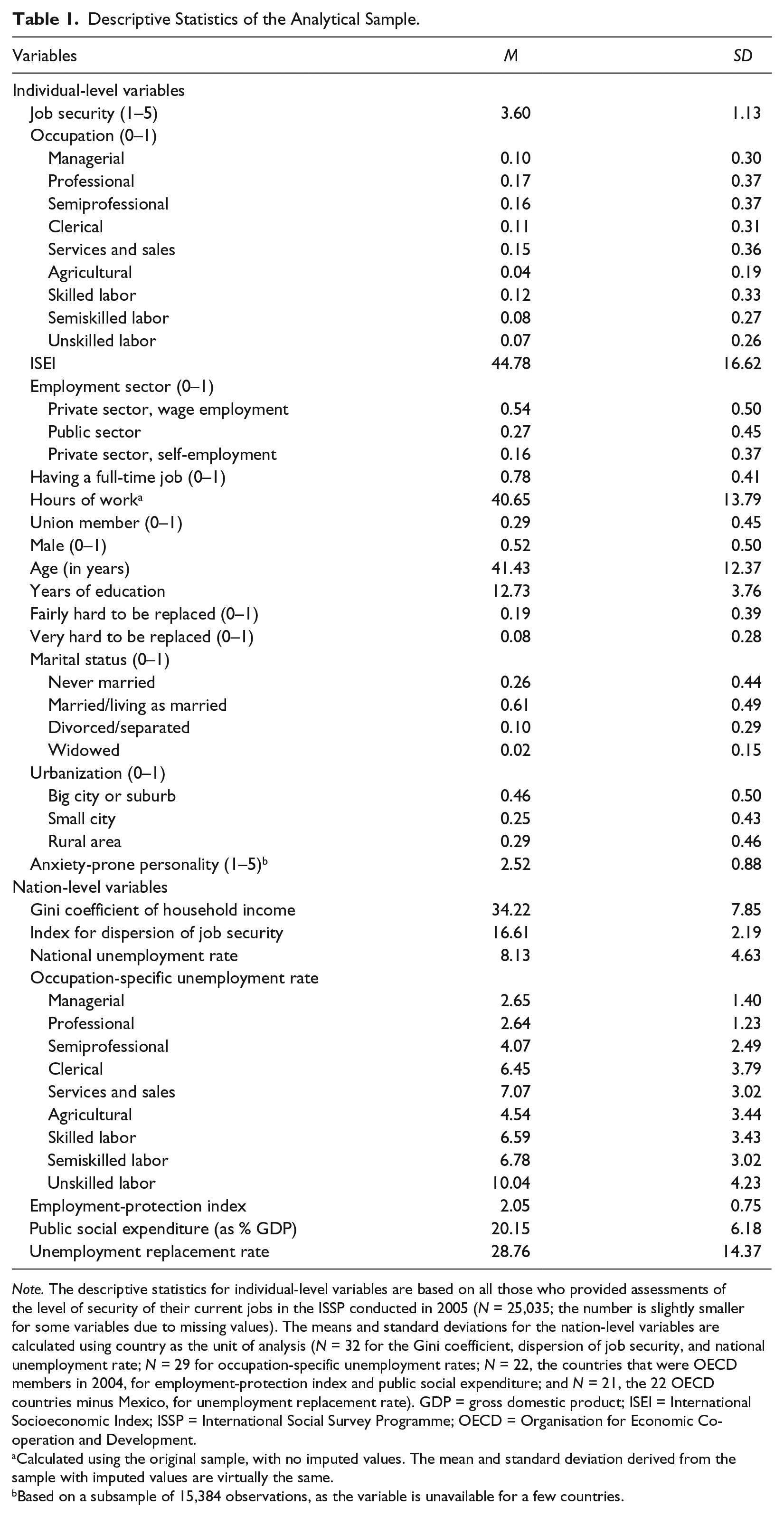
Note. The descriptive statistics for individual-level variables are based on all those who provided assessments of the level of security of their current jobs in the ISSP conducted in 2005 (N = 25,035; the number is slightly smaller for some variables due to missing values). The means and standard deviations for the nation-level variables are calculated using country as the unit of analysis (N = 32 for the Gini coefficient, dispersion of job security, and national unemployment rate; N = 29 for occupation-specific unemployment rates; N = 22, the countries that were OECD members in 2004, for employment-protection index and public social expenditure; and N = 21, the 22 OECD countries minus Mexico, for unemployment replacement rate). GDP = gross domestic product; ISEI = International Socioeconomic Index; ISSP = International Social Survey Programme; OECD = Organisation for Economic Co-operation and Development.
Calculated using the original sample, with no imputed values. The mean and standard deviation derived from the sample with imputed values are virtually the same.
Based on a subsample of 15,384 observations, as the variable is unavailable for a few countries.
Modeling Strategies
I use country-level fixed-effects models to estimate how individuals’ perceived level of job security is associated with their earnings. That is to say, the regression models include country fixed effects that capture all factors that are invariant within a country and potentially influence individuals’ earnings, such as labor market conditions, cultural views, and legal institutions. Because of the fixed-effects design, there is no need to further adjust cross-national differences in the measurement units for earnings in the sample, as the measurement unit does not vary within each country; exchange rates applied to convert the earnings to the same unit would be dropped from the country fixed-effects models anyway.
Many earlier studies with large multinational data adopt hierarchical linear models (e.g., Fuwa 2004; Mandel and Semyonov 2005), which include country-level random effects to take into account the effects of shared experiences among individuals from the same country (Raudenbush and Bryk 2002). Country-level fixed-effects models are more rigorous, however, because they do not assume that the added terms for unobserved country-level influences follow a certain distribution pattern. Conversely, hierarchical linear models with random effects assume that country-level error terms are randomly distributed. Country-level fixed-effects models are also less likely to suffer from omitted variable bias than multilevel random-effects models, as the former are able to take into account all country-specific characteristics that are constant over time (Möhring 2012; Yu 2015:32–33).
A main reason researchers opt for multilevel random-effects models is that such models allow them to examine the effects of national predictors, whereas country fixed-effects models must leave out all predictors that are invariant within countries. For the analysis in the present study, however, the objective is to examine how nation-level factors shape the association between job security and earnings, rather than how these factors influence earnings. I therefore introduce interaction terms between nation-level factors and the reported level of job security in the country fixed-effects models. Although the country fixed-effects models cannot show the main effects of nation-level predictors on individuals’ earnings, they can provide estimates regarding the extent to which national characteristics, such as unemployment rate, employment-protection laws, and public social spending, condition the relationship between job security and earnings. As previous research demonstrates (Möhring 2012), results estimated from interactions between nation- and individual-level predictors in country fixed-effects models are ultimately similar to those from cross-level interactions in hierarchical linear models with random error terms.
Results
Table 2 presents a series of country fixed-effects models predicting log earnings. Model 1, which includes individuals’ human capital and demographic attributes, shows a positive relationship between self-reported job security and earnings. Model 2 adds occupational categories, and Model 3 further includes employment sector and whether respondents hold a full-time position. The introduction of occupation decreases the coefficient for job security somewhat, indicating that a sizable part of the association between job security and earnings has to do with the fact that many occupations that provide greater job security also pay more. Adding employment sector and status also decreases the coefficient for job security, but the change is rather small. Nevertheless, even after controlling for an extensive set of individual and job characteristics, as in Model 3, those who report having greater job security still earn more. To be specific, a level of increase in perceived job security is associated with a 5 percent increase in earnings. Thus, the finding does not support a tradeoff between job security and pay. Rather, the winners in the labor market—that is, those with jobs that pay more—also enjoy higher levels of job security.
Country Fixed-Effects Models Predicting Log Earnings.
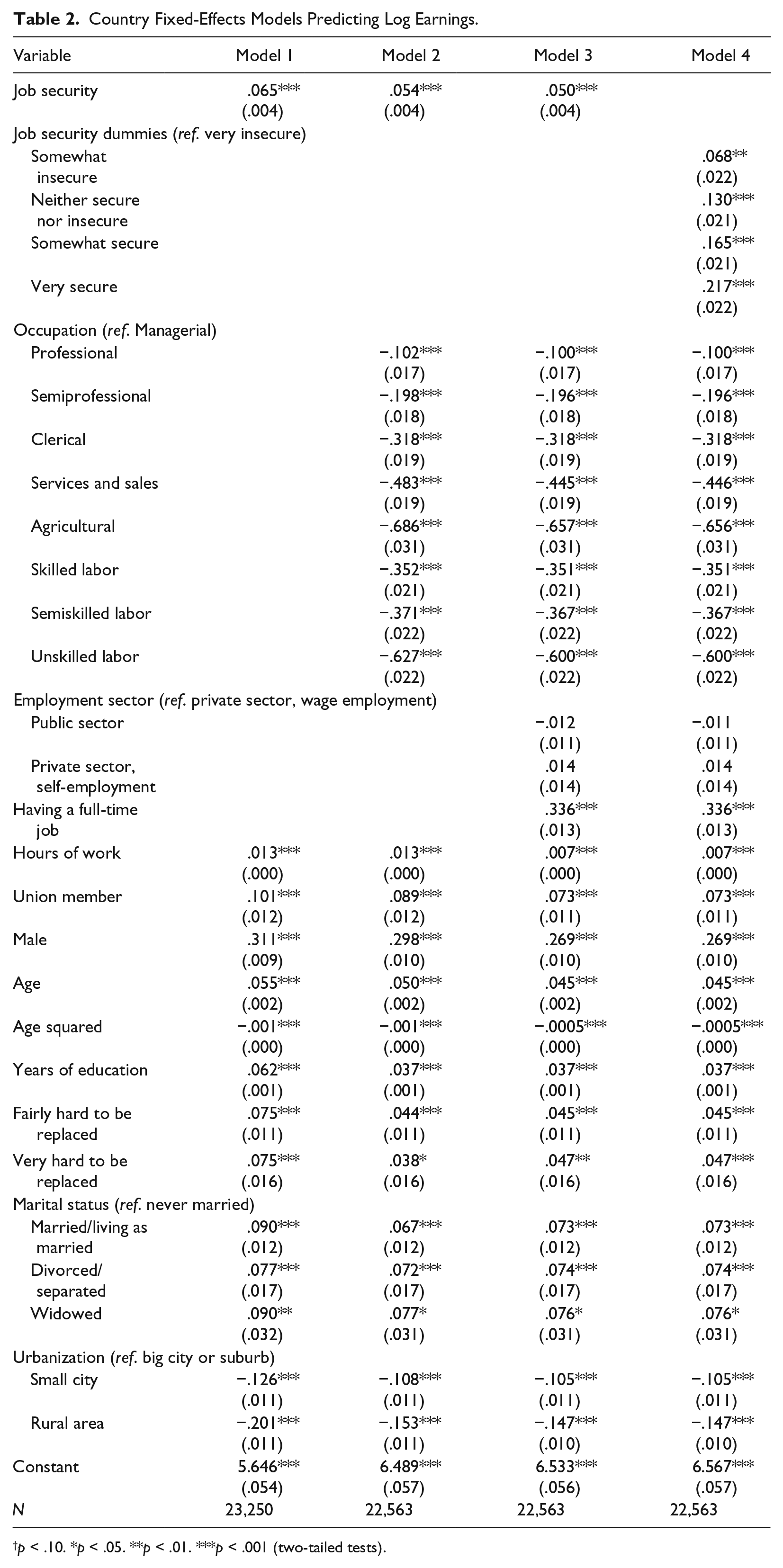
p < .10. *p < .05. **p < .01. ***p < .001 (two-tailed tests).
Because the association between job security and earnings might not be linear, I use categorical dummy variables, instead of a linear measure, for job security in Model 4 of Table 2. The results roughly resemble the ones in previous models: Each reported level of job security is associated with a certain percent increase in earnings, and the coefficient differences between each two adjacent job-security levels are similar. Given this resemblance, I treat job security as a linear measure in all the models presented below, as this enables more intuitive interpretations, especially when the interactions between job security and national-level factors are considered.
Results for the control variables in Table 2 are generally consistent with what one would expect based on previous research. For example, men, union members, those with full-time jobs, those who work more hours, and those living in more urban areas earn more. Individuals with more years of education and employer-specific skills (measured by the extent to which it would be difficult for their organizations to replace them) also receive higher income from work. In addition, compared with those in managerial occupations, those in other occupations have significantly lower earnings, with agricultural workers and unskilled laborers earning the least.
Table 3 shows separate regression models for men and women, as their likelihood of occupying different types of jobs and their potentially different preferences for job security may both affect how their perceived job security is associated with earnings. Interestingly, a comparison of the two Model 1s in the table indicates no statistical difference between men and women in the extent to which job security is linked to earnings. For both groups, jobs considered more secure pay more. Given that individuals’ personality may shape their subjective assessments of job security, Model 2s further control for anxiety-prone personality. Among both men and women, those who tend to be anxious and insecure earn less. Because such individuals generally have lower levels of risk tolerance, this finding is consistent with prior research claiming that risk-averse people receive lower wages. Results presented here, however, challenge the previous assumption that risk-averse people earn less because they trade some pay for jobs involving lower risk (e.g., Shaw 1996). Even after controlling for perceived job security, anxiety-prone individuals still earn less. It is possible that a high propensity to anxiety, or a low tolerance to risk, decreases earnings because this personality trait affects one’s job performance or how one is evaluated by others. If anything, risk-intolerant people’s preference for more secure jobs should lead them to earn more, rather than less, given that more secure jobs pay more. Because adding anxiety-prone personality does not alter the positive association between job security and earnings but reduces the sample considerably, I opt not to include this control for the rest of the analysis.
Partial Results from Country Fixed-Effects Models Predicting Log Earnings by Gender.
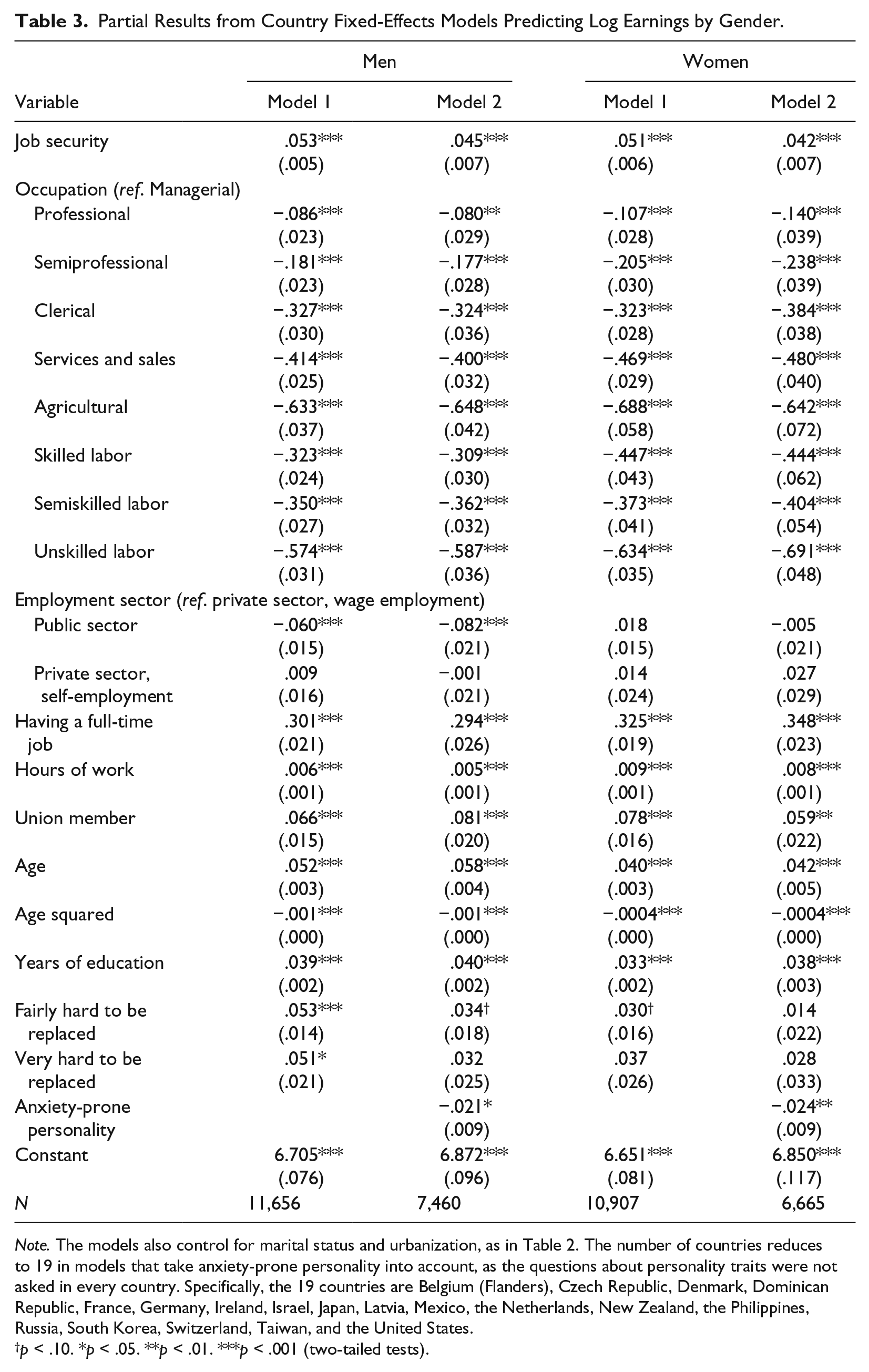
Note. The models also control for marital status and urbanization, as in Table 2. The number of countries reduces to 19 in models that take anxiety-prone personality into account, as the questions about personality traits were not asked in every country. Specifically, the 19 countries are Belgium (Flanders), Czech Republic, Denmark, Dominican Republic, France, Germany, Ireland, Israel, Japan, Latvia, Mexico, the Netherlands, New Zealand, the Philippines, Russia, South Korea, Switzerland, Taiwan, and the United States.
p < .10. *p < .05. **p < .01. ***p < .001 (two-tailed tests).
Next, to examine whether the positive association between job security and earnings is universal across different segments of the labor market, I fit country fixed-effects models for each of the nine broad occupational categories separately, with the same individual and job characteristics included in Model 3 of Table 2 (except for occupation). Within each broad occupation, however, there are still finer occupational categories with different skill requirements, and higher skill requirements can simultaneously lead to greater job security and pay for the incumbents. I therefore further include the ISEI based on 4-digit occupation codes in the regression models by broad occupation. The top panel of Table 4 presents abbreviated results from these models. As the table indicates, the positive relationship between job security and earnings holds for almost all occupational sectors, even after controlling for status differences among fine occupational categories within each sector. The coefficients for job security fall just below the .05 significance level for managerial and agricultural occupations, but both are positive and nearly significant. Moreover, the coefficients of job security for different occupational categories are largely similar. From manual labor to professional occupations, a reported level of job security is associated with an approximately 5 percent increase in earnings. The only exception is for individuals in managerial occupations, whose perceived levels of job security are associated with significantly lower increases in earnings, compared with those in almost all other occupations. 9 Perhaps the fact that job security for those in managerial occupations is generally high, with less variation than that of other occupations, makes rendering job security alongside monetary compensation less important for them. Consequently, job security is not as strongly associated with earnings as it is for other occupations. Nonetheless, even for managers, whose daily business decisions often involve the risk-reward tradeoff, and who might be more likely than those in other occupations to take this tradeoff as a norm, trading job security for higher earnings is unnecessary.
Regressions of Job Security on Log Earnings by Occupation, Employment Status, and Employment Sector.
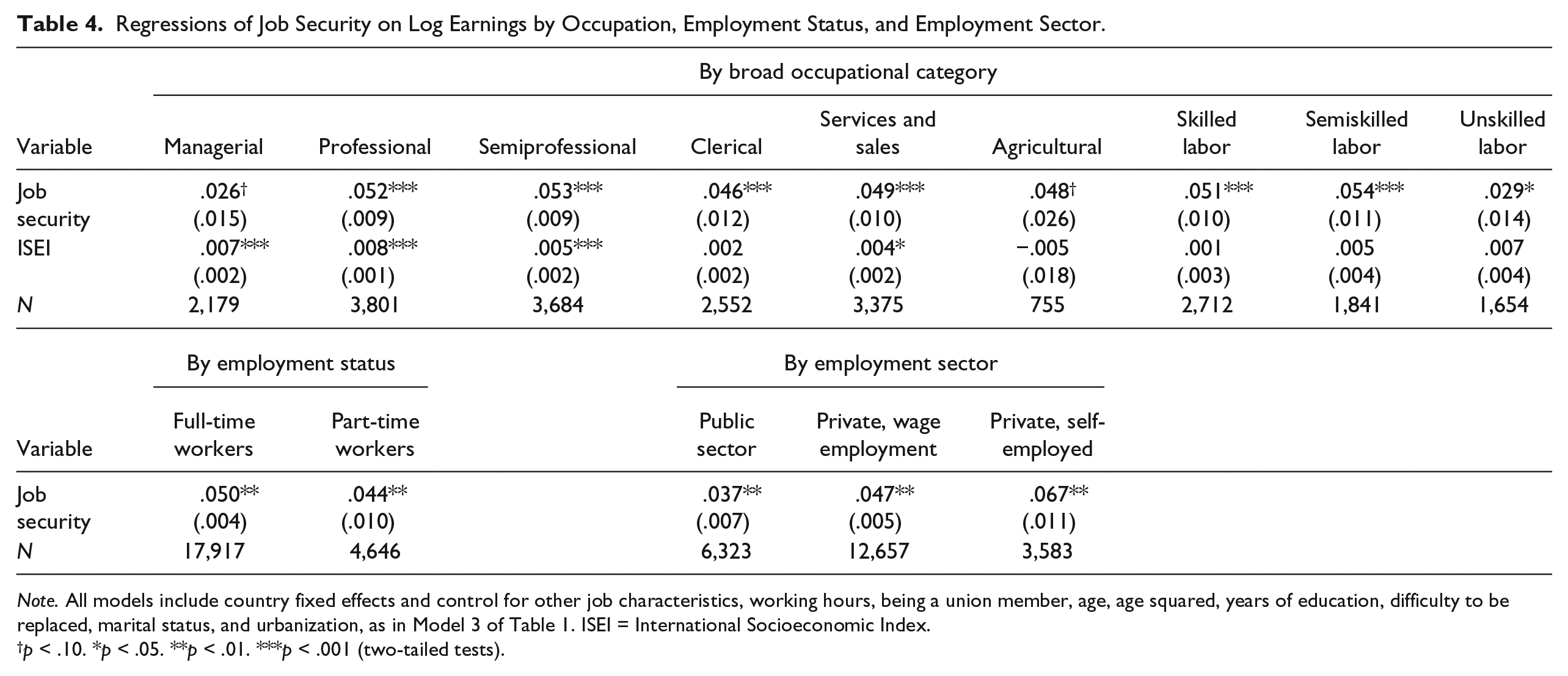
Note. All models include country fixed effects and control for other job characteristics, working hours, being a union member, age, age squared, years of education, difficulty to be replaced, marital status, and urbanization, as in Model 3 of Table 1. ISEI = International Socioeconomic Index.
p < .10. *p < .05. **p < .01. ***p < .001 (two-tailed tests).
Table 4 also includes partial results from country fixed-effects models fit separately for people of different employment statuses and in different employment sectors. Among both full- and part-time workers, those with more secure jobs receive higher earnings. Even though part-time positions are generally less regulated and more likely to be subject to economic fluctuations than full-time ones, the associations between job security and earnings are quite similar for both types of positions. Likewise, jobs that are considered more secure consistently pay more, regardless of the employment sector to which the jobs belong. Perhaps because of the greater heterogeneity among jobs in the self-employment sector, each level of job security is associated with a larger increase in earnings within this sector, compared with the public and private wage-employment sectors (differences are statistically significant at the .05 and .10 levels, respectively).
To investigate how the association between job security and earnings varies by the national context, Table 5 presents abbreviated results from a series of fixed-effects models with interaction terms between job security and nation-level factors. To better facilitate the interpretations, all the nation-level variables are centered at the country mean (the occupation-specific unemployment rate is centered at the country mean of each given occupation). Model 1 shows that a rise in the level of job security is associated with a larger increase in earnings in countries with higher values of the Gini coefficient. Thus, the more unequal a country’s income distribution, the greater is the gap in earnings between those with secure and insecure jobs. By contrast, the interaction between job security and national disparity in job security indicates that a wider dispersion in job security does not increase the extent to which earnings increase with job security (Model 2). It is possible that the measure of dispersion in job security does not fully capture the inequality in employment stability, because it is based on the reported levels of job security among those with jobs and does not take into account the ones with no job security at all—the unemployed. Specifically focusing on the unemployed, Model 3 shows that each level of increase in job security is associated with a greater percent increase in earnings in countries with higher unemployment rates. This finding is consistent with the argument that those with insecure jobs have even lower relative earnings than those with secure jobs in economies with a larger supply of unemployed workers, who can serve as substitutes for those with insecure jobs.
Partial Results from Country Fixed-Effects Models of Log Earnings, With Interactions between Job Security Nation-Level Variables.
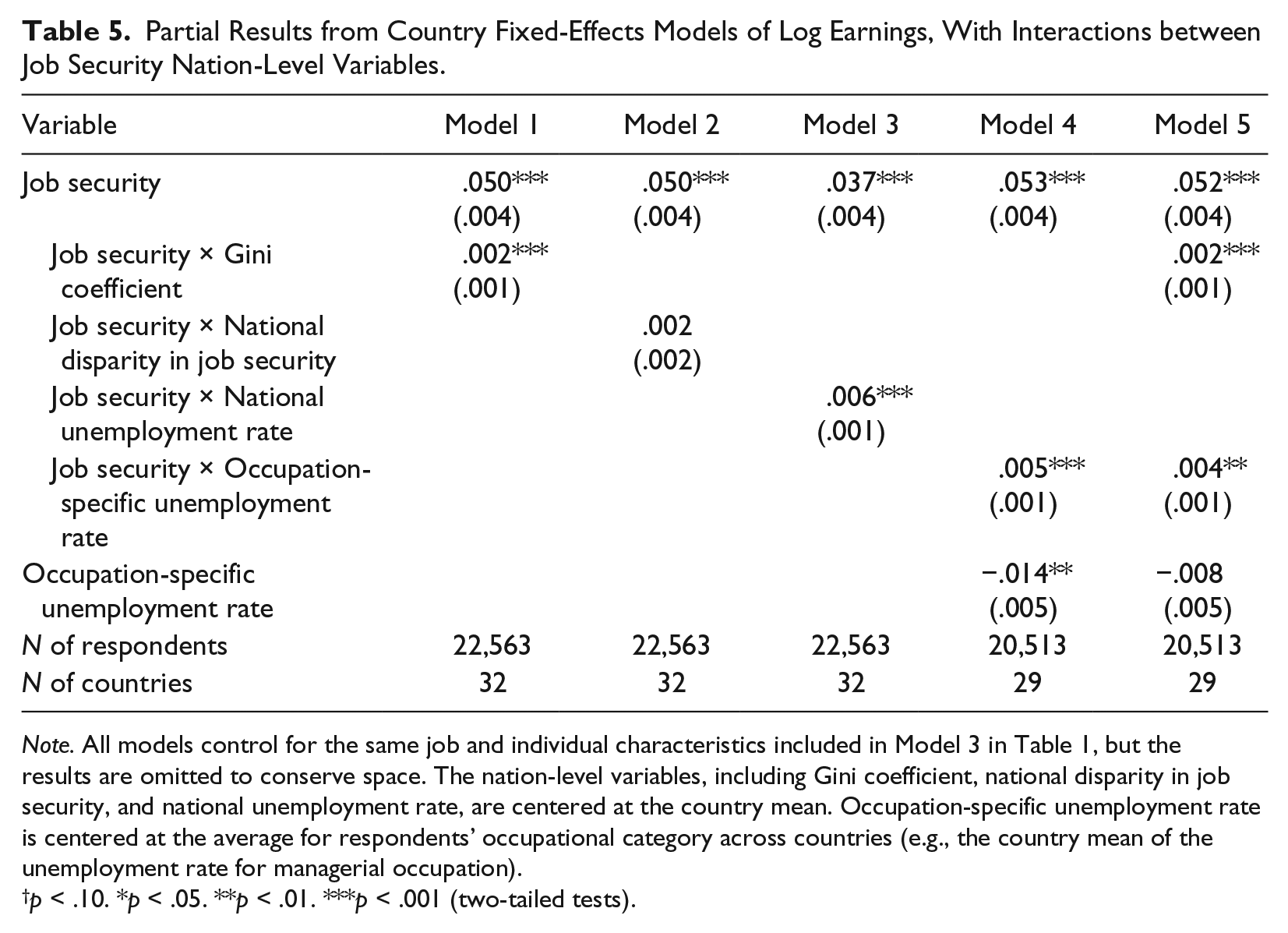
Note. All models control for the same job and individual characteristics included in Model 3 in Table 1, but the results are omitted to conserve space. The nation-level variables, including Gini coefficient, national disparity in job security, and national unemployment rate, are centered at the country mean. Occupation-specific unemployment rate is centered at the average for respondents’ occupational category across countries (e.g., the country mean of the unemployment rate for managerial occupation).
p < .10. *p < .05. **p < .01. ***p < .001 (two-tailed tests).
Model 4 replaces job security’s interaction with the national unemployment rate with the interaction with a nation’s occupation-specific unemployment rate, for the reason that individuals’ relative bargaining power may depend more on the number of unemployed people available for their own occupation than the total number unemployed in their nation. Because, unlike other nation-level variables, the unemployment rate for respondents’ occupation in their country is not constant for all within each country, the country fixed-effects included in the models would not take away the main effect of the nation-occupation-specific unemployment rate; this main effect is therefore also presented in the model. The occupation-specific unemployment rate, despite being more refined than the national unemployment rate, yields similar results. Job security is associated with especially higher earnings, and those lacking job security face even greater earnings penalties, in countries where the unemployment rate for respondents’ occupation is higher. 10
Model 5 includes both the interactions with the Gini coefficient for household income and occupation-specific unemployment rate, given that both interactions are significant in previous models. Here, I use the occupation-specific unemployment rate, instead of the national unemployment rate, because the latter is highly corrected with the Gini coefficient (but the former is not). The results from Model 5 are similar to those from previous models. Each level of increase in perceived job security is associated with an approximately 5 percent increase in earnings in a country with an average income inequality and an average unemployment rate for respondent’s occupation. Nevertheless, a rise in the level of job security is associated with a 6 percent increase in a country of which the Gini coefficient is 5 points above the mean (.052 + 5 × .002 = .062), and the percent increase becomes 8 percent if the country’s unemployment rate for respondent’s occupation is also 5 percent higher than the mean (.062 + 5 × .004 = .082).
To further investigate whether national policies conducive to less negative unemployment consequences also moderate the association between job security and earnings, Table 6 presents a series of models with OECD countries only. Perhaps because the restriction to 22 OECD countries leads to less heterogeneity in macroeconomic conditions, the coefficients for the interactions between job security and the Gini coefficient and between job security and unemployment rate are both weaker—although still positive—with the latter being marginally significant (Models 1 and 2). Model 3 tests the moderating role of the national level of employment protection, whereas Model 4 examines whether the association between job security and earnings varies with the extent of public social expenditure. Both nation-level variables yield nonsignificant results when interacted with job security. By contrast, in countries with higher unemployment replacement rates, each level of increase in job security is associated with a significantly smaller percent increase in earnings (Model 5). 11 Compared with legislation for employment-protection and public social expenditure, unemployment benefits that enable one to receive income upon job loss can most directly buffer the negative impact of unemployment, and hence, such benefits are most likely to affect individuals’ perception of the importance of job security. That is to say, although employment-protection and public social expenditure may reduce the harm of unemployment over the long run (e.g., through decreasing individuals’ likelihood to experience many more unemployment spells), they may not make workers see less need to bargain hard for job security, whereas having a higher unemployment replacement rate may have this effect. The less valuable job security is perceived in the society, the less likely it will be disproportionately distributed to those commanding especially high earnings, who generally have the most bargaining power. Thus, in countries where unemployment benefits enable higher levels of income replacement, job security is less concentrated in the hands of workers of very high earnings, making the positive association between job security and earnings less pronounced.
Partial Results from Country Fixed-Effects Models of Log Earnings in OECD Countries.
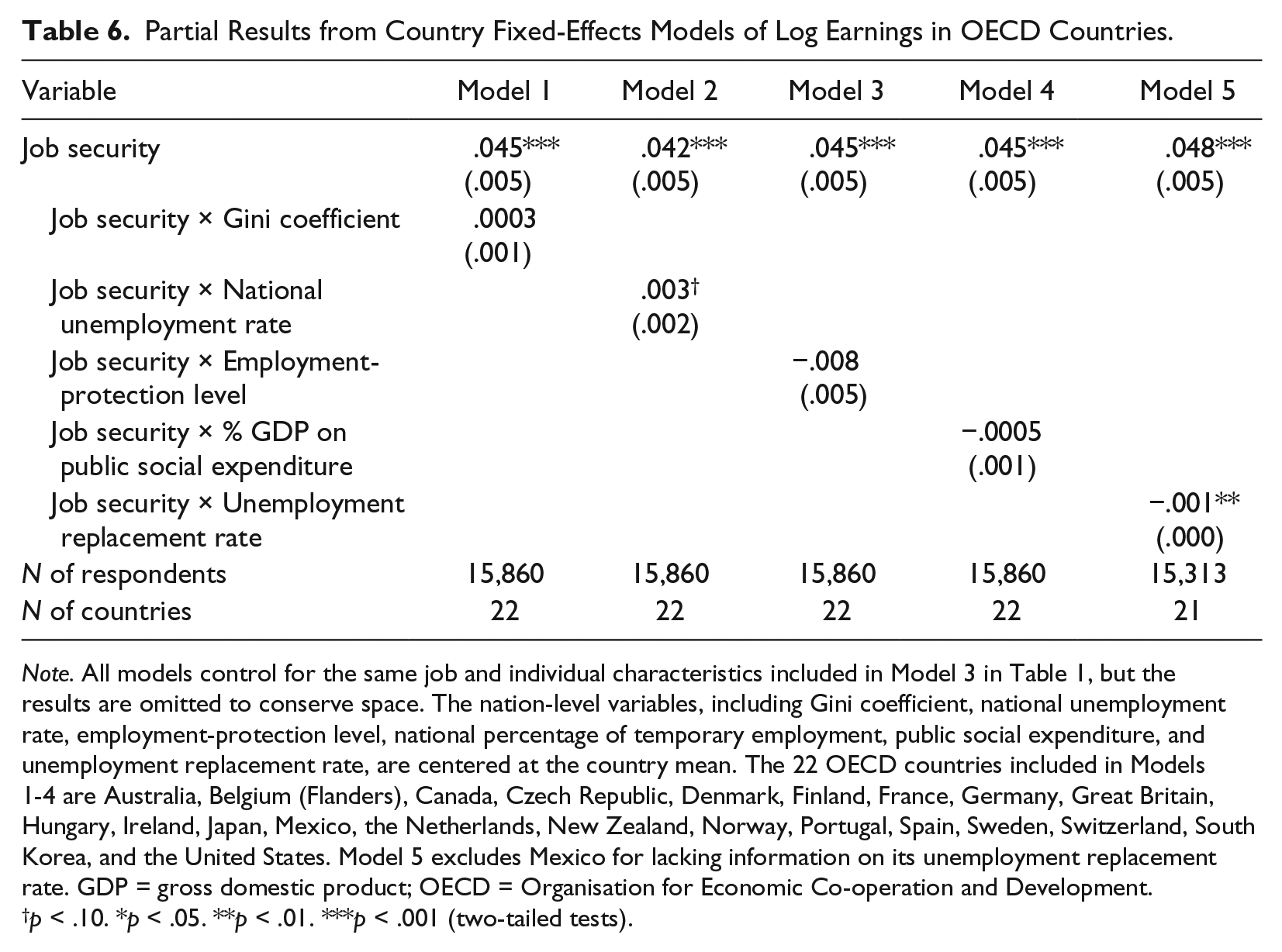
Note. All models control for the same job and individual characteristics included in Model 3 in Table 1, but the results are omitted to conserve space. The nation-level variables, including Gini coefficient, national unemployment rate, employment-protection level, national percentage of temporary employment, public social expenditure, and unemployment replacement rate, are centered at the country mean. The 22 OECD countries included in Models 1-4 are Australia, Belgium (Flanders), Canada, Czech Republic, Denmark, Finland, France, Germany, Great Britain, Hungary, Ireland, Japan, Mexico, the Netherlands, New Zealand, Norway, Portugal, Spain, Sweden, Switzerland, South Korea, and the United States. Model 5 excludes Mexico for lacking information on its unemployment replacement rate. GDP = gross domestic product; OECD = Organisation for Economic Co-operation and Development.
p < .10. *p < .05. **p < .01. ***p < .001 (two-tailed tests).
Conclusion
In this study, I test the competing views regarding the association between job security and earnings. Whereas research about workers’ risk preferences implies that jobs involving higher risk of income loss pay more, because individuals are to be compensated for their tolerance for risks, the perspectives highlighting inequality in workers’ bargaining power and employers’ interest in promoting worker commitment suggest that desirable job traits, including high pay and low unemployment risks, cluster together. The statistical analysis demonstrates that the association between job security and earnings is unequivocally positive. Not only does this association continue to be positive after controlling for a wide range of individual and job characteristics, but the positive association is nearly universal across all segments of the labor market. Regardless of the broad occupational category, public or private employment sector, or full- or part-time employment status, more secure jobs generally pay more. Moreover, even though prior research finds that women are more risk-averse and value job security more (Halaby 2003; Le et al. 2011), the way in which job security is associated with earnings is nearly identical for women and men.
Findings from this study, thus, present an important challenge to the theory that links individuals’ risk preferences to wage differences in the labor market. As the theory maintains, women and people with low risk tolerance are rewarded less in the labor market, because they are likely to opt for jobs with lower economic risk, and such jobs pay less (e.g., Le et al. 2011; Shaw 1996). Although the analysis in this study indeed shows worse earnings for anxiety-prone people, who generally are less risk-tolerant, it also indicates that such people’s perceived unemployment risks do not account for their lower earnings. Moreover, irrespective of whether those who prefer lower economic risk may be willing to sacrifice pay for job security, among workers with similar levels of skills, those with higher earnings are generally more able to enjoy job security. To the extent that individuals with similar skills can compete for the same jobs, the evidence fails to support that risk-intolerant people have to trade low unemployment risks with earnings. Results from this study suggest that proponents for risk preferences as an explanation for wage inequality must revisit the mechanism linking such preferences to wages.
Although existing theories on social classes and employment contracts, labor market segmentation, dual economy, and organizational flexibility all imply that workers with lower earnings tend to suffer more from job insecurity, studies based on such theories rarely compare job quality for workers with similar levels of skills. Findings from this study, therefore, contribute to the existing literature by demonstrating that the positive association between job security and earnings remains even after taking into account workers’ general, occupational, and employer-specific skills. Because the models control for education, occupation, and the extent of difficulty for employers to replace respondents with someone else, jobs’ skill requirements are unlikely to explain the positive relationship between job security and earnings. Rather, the positive relationship indicates that job rents exist for high-status positions in the economy, in the sense that job security, as a nonpecuniary benefit, is further added to positions already yielding high financial rewards. The existence of job rents is consistent with the argument that even workers with similar skills may still have different bargaining positions according to their possession of traits desired by employers and that those with stronger bargaining positions are able to procure both earnings and job security. 12
The finding of a positive association between job security and earnings also indirectly contributes to the debate on how individuals value different job traits. Whereas Halaby (2003) places preferences for job security and earnings in two distinct dimensions of job values, Johnson and colleagues (2007) claim that few individuals separate the importance of job security from that of earnings when evaluating jobs. The fact that a job’s security increases with its pay appears to be more consistent with Johnson and colleagues’ view. Because those who place great importance on job security also give priority to a job’s income potential, the two types of job rewards need to be distributed together; jobs with only one or another are unlikely to be sufficiently attractive. It is also possible that because the emphasis on a job’s pay tends to be inseparable from that on its security, those obtaining higher-paying positions tend to bargain for greater job security, leading to a positive association between job security and earnings.
In addition to demonstrating the positive relationship between job security and earnings, this study also shows that the relationship is stronger in societies with greater income inequality and higher unemployment rates. These findings are consistent with the expectation that the earnings gap between those with secure and insecure jobs is wider when those in weak bargaining positions in the labor market are relatively weaker compared with those in strong bargaining positions. Moreover, among OECD countries, which have more mature welfare systems and more similar unemployment rates, the association between job security and earnings is less strong in countries with higher unemployment replacement rates. I argue that a greater unemployment replacement rate directly affects workers’ perceptions of the importance of job security, making job security less a highly valued prize reserved for only those with higher-paying positions. The stronger association between job security and earnings in countries with worse unemployment benefits further means that not only do modern economies distribute job security and pay following a winner-take-all principle, but winners—that is, those with relatively secure jobs—take even more (in terms of earnings) in contexts in which having job insecurity is more consequential.
The finding that a higher unemployment rate is linked to greater earnings inequality between workers with secure and insecure jobs, making the “haves” and “have-nots” farther apart in job quality, has important implications for today’s economic world. Since the Great Global Recession in 2008, countries all over the world have experienced rapid rises in unemployment, and, in many areas, the recovery has been slow. Whereas prior research indicates that low-skilled workers’ job conditions are likely to have deteriorated more with the rising unemployment (Stier 2015), findings from this study further suggest that since the Great Recession, the concentration of relatively low earnings and relatively high job insecurity could become more pronounced for workers of any given skill level. That is to say, had the data used in this study been collected after the Great Recession, we would have been likely to see that those already having high unemployment risks earn even less than those with little such risks, holding their skill levels constant. Nevertheless, because findings from this study also suggest that more generous unemployment insurance helps mitigate the positive association between job security and earnings, countries with different unemployment benefits could have experienced different extents of polarization of job quality while undergoing economic hardships since 2008. If this is the case, then it would be especially critical for countries facing deteriorations in macroeconomic conditions to boost unemployment benefits, despite the greater welfare burden they are likely to encounter during such times. Future research on how the relationship between job security and earnings has changed for countries with different unemployment replacement levels since the Great Recession, however, would be needed to address these speculations empirically.
Footnotes
Declaration of Conflicting Interests
The author(s) declared no potential conflicts of interest with respect to the research, authorship, and/or publication of this article.
Funding
The author(s) received no financial support for the research, authorship, and/or publication of this article.