







Abstract
The 1980s brought a sharp upturn in punitive practices in U.S. schools. One negative result of harsh school discipline has been that poor students of color have been punished at disproportionate rates, with the racial disparity in sanctions being dramatic among girls. Some have argued that support services can undermine multiple inequalities in punitive exclusion, although very little research has examined how inequalities function in schools that offer support services as well as punishment. During a 13-year ethnography of girls’ experiences and school staff’s responses to students in one high school in Oahu, Hawai‘i, I found that school staff and girls had different definitions of safety. Elaborating on critical race, intersectional, and black feminist theories, I examine the disconnect between girls’ and staff’s understandings of school safety and offer a nuanced understanding of multiple exclusions in schools.
Since the 1980s, there has been an uptick in school punishments in the United States (Hirschfield 2008; Kupchik 2010; Simon 2007). Often called the “criminalization of American students,” the expansion of retributive control, according to researchers, is reflected in schools’ increasing reliance on law enforcement personnel and the rising rates of student suspensions, expulsions, and arrests between the 1980s and 2012. Exclusionary discipline was launched in the name of keeping schools safe from violence and drugs, but the implementation and consequences of these measures have been critiqued. Of concern is that poor students of color have received more severe and more frequent punishments than middle-class, white students (Gregory, Skiba, and Noguera 2010; Raffaele Mendez and Knoff 2003; Rocque 2010; Skiba et al. 2002). For girls, racial disproportionality in school sanctions is particularly pronounced. Kimberle Crenshaw, Priscilla A. Ocen, and Jyoti Nanda (2015:17) argued that “race may be a more significant factor for females than it is for males” with regard to school punishment. Crenshaw et al. (2015) found that black girls were suspended six times more frequently than white girls in U.S. public schools from 2011 to 2012, whereas black boys were suspended three times more frequently than white boys during the same period (Blake et al. 2011; Morris and Perry 2017; Raffaele Mendez and Knoff 2003).
The race, gender, and class disproportionalities in school punishment (among other problems) have led some to advocate for policies that de-emphasize exclusionary discipline and enhance support services in schools. Crenshaw et al. (2015:42) maintained that “the lack of counseling and other effective conflict intervention strategies leads many girls into contact with the criminal justice system.” The U.S. Department of Education (2014:6) urged schools to “consider crafting goals covering provision of supports for all students, including students of color, students with disabilities, and students who may be at risk for dropping out of school, trauma, social exclusion, or behavior incidents.” Although school punishment researchers have bemoaned the lack of supports, many U.S. schools have been offering counseling and other services for decades (Bradley Williams et al. 2017), indicating a need for a more comprehensive understanding of how punishment and supports operate simultaneously.
While scholars have detailed the processes through which poor students of color are disciplined (Annamma 2015; Ferguson 2001; Hope, Skoog, and Jagers 2015; Kupchik 2010; Morris 2007; Murphy, Acosta, and Kennedy-Lewis 2013; Wun 2014, 2018), most studies have focused on boys’ punishments and implied that disproportionate exclusions stem from school staff’s racial biases. This article draws from a 13-year ethnographic study of girls (n = 30) and school staff (n = 14) in one high school in Oahu, Hawai‘i. Most of the participants were girls of color (n = 24) from working-class or poor backgrounds (n = 25). Examining the girls’ and staff’s views of school safety, this study reveals a schism in what safety meant to each group. Analyzing this narrative disconnect, I outline specific mechanisms through which intersecting inequalities (i.e., race, gender, and class) operate on many levels in schools.
Multiple Inequalities and School Punishment
According to critical scholars, schools perpetuate inequalities by preparing students for their place in the class, race, and gender order. Examinations of how schools reproduce inequalities, however, tend to focus on one dimension of inequality at a time; when researchers do offer intersectional school punishment perspectives, they often overlook how race, gender, and class oppressions play out on ideological and structural levels. To advance explanations of how race, gender, and class dislocations operate on multiple planes, I review insights from color-blind racism and intersectional theories (especially black feminist frameworks).
Color-blind racism (Bonilla-Silva 1997, 2014, 2015) is foundational to discussions of race-based inequalities in America. Eduardo Bonilla-Silva (2015:77) argued that “the ‘new racism’ of the post-Civil Rights racial regime [is] characterized by subtle, institutionalized, and seemingly nonracial practices and mechanisms to reproduce racial inequality.” Encouraging scholars to separate analyses of racial structures and racial ideologies, Eduardo Bonilla-Silva (2014:9) defined racial structures as “the totality of the social relations and practices that reinforce white privilege” (emphasis in the original). Racial ideologies comprise the “frameworks used by actors to explain and justify . . .” the racial status quo. There are implications for schools in this framework. Bonilla-Silva (2015:118) examined institutionalized racism and education, suggesting that “[d]iscrimination in the realm of education, for example, has not taken a definite institutional pattern in the contemporary period.” Given the criminalization of American students since the 1980s, punishment might be one mechanism for institutionalizing racism in schools (see Hines and Wilmot 2018; Wun 2018).
The call to separate racial structures from racial ideologies has yet to be fully realized. Ashley (“Woody”) Doane (2017:976) wrote that Although Bonilla-Silva (1997) has asserted that racial ideologies occur within a “racialized social system,” too many analyses and commentaries . . . focus on the nature of racial ideologies themselves at the expense of the social structures and institutional practices in which they are embedded.
Moreover, the “frames, narratives, stereotypes, discursive styles, and particular vocabulary” that comprise racial ideologies are not “causal” (Doane 2017:977), meaning that racial ideologies do not determine racial systems. Instead, ideologies are the outcomes of and operate within structural contexts. Failure to differentiate ideologies from social systems risks conflating “color-blind racial ideology with color-blind attitudes of individuals” (Doane 2017:976).
Intersectional scholars highlight additional work to accomplish. Arguing that we should not focus solely on racial systems, these researchers assert that we need to examine the social divisions that shape the totality of inequalities and oppressions. These include (but are not limited to) “class, race, gender, ethnicity, citizenship, sexuality, and ability” (Collins and Bilge 2016:2). Bonilla-Silva’s (2015:78) admission that he “did not deal very well with the intersectionality challenge” and that “race, class, and gender matter” indicates a need to develop more robust inequalities theories.
Intersectional research regarding school punishment tends to emphasize ideologies over social systems. Patricia Hill Collins’s (1990) thesis about controlling images has become a cornerstone for research with poor schoolgirls of color and punishment. Because Collins (1990:67) defined controlling images as “ideological justifications” for the perpetuation of “race, class, and gender oppression,” her thesis allows us to see ideologies as stemming from and reinforcing white privilege, patriarchy, and capitalism. Most researchers, however, point to ideological frameworks as core mechanisms leading to disproportionate punishments along race, gender, and class axes. For example, as Jamilia J. Blake et al. (2011:93) argued, “Black females are stereotypically portrayed as angry, hostile (e.g., Sapphire), and hypersexualized (e.g., Jezebel).” Because of these constructions, teachers are apt to see black girls generally as “guilty subjects who warrant punishment” (Wun 2014:8) and specifically as loud, assertive, aggressive, resistant, and hypersexual (Crenshaw et al. 2015; Hines and Wilmot 2018; Lei 2003; Morris 2007; Murphy et al. 2013; Wun 2014, 2018). Consequently, staff are likely to punish black girls for demonstrating these traits.
Gender hegemony perspectives comprise another set of ideology-based explanations. Hegemonic gender constructions in the United States (Pyke and Johnson 2003) uphold middle-class, white expectations requiring all girls to be “docile, diffident, and selfless” (Blake et al. 2011:93), sexually modest, interested in boys, and attractive to males by being petite, pale, and frail. Literature on racialized, gendered, and class-based punishments (Blake et al. 2011; Crenshaw et al. 2015; Morris 2005, 2007; Wun 2014, 2018) confirms that poor schoolgirls of color are often punished for their failure to meet these white, middle-class femininity standards. Hegemonic constructions, however, operate as ideological frameworks and not social systems.
The review above reveals some gaps in our knowledge that this study can fill. To clarify the research goals, this study promises to achieve the following:
Extend Bonilla-Silva’s (2014) insights about racial systems and ideologies to include sexist and classist systems and ideologies;
Separate analyses of inequalities lodged in social systems from inequalities within ideologies;
Examine whether punitive school safety approaches institutionalize racism, sexism, and classism in schools; and
Explore how punishment as well as support services operate in schools.
Method
Between 2005 and 2018, I conducted an ethnographic study at Seaside High School 1 in Oahu, Hawai‘i. Trained as a youth violence prevention researcher in graduate school, I began working with teams of researchers, community leaders, and school staff to write grant proposals to implement violence prevention programs when I was first hired at the University of Hawai‘i (in 2001). In 2005, one community-university partnership with which I worked received substantial grant funds to establish a comprehensive initiative. “Violence” is a strong term requiring a definition. Federal and state grant-making agencies rely on legal definitions of “interpersonal violence,” which highlights an individual’s use of physical force leading to bodily injury. Criminologists receiving grants tend to adopt this view, and I was no exception.
Seaside High School’s principal, Ms. Takada, was a part of the planning group for the large grant and welcomed the team to develop programs within and gather data at Seaside. As part of the violence prevention team from 2005 to 2008, I spent 20 hours per week in Seaside as an active member (Adler and Adler 1987) working within a collection of researchers, parents, community leaders, teachers, and school administrators who designed, implemented, and evaluated prevention programs. I attended monthly events, including one-to-two-hour project planning meetings with Ms. Takada and other school administrators, curriculum meetings, and coffee hours with teachers. I also participated in numerous semi-regular events, such as school rallies, trainings, and school-sponsored dinner and movie nights for students and their families.
In 2007, my relationships at Seaside deepened when I met Ms. Phillips, a school counselor. During a series of meetings, Ms. Phillips and the two other school counselors (with me as a sounding board 2 ) built a group therapy program for Seaside students, which was eventually called the “lunch-bunch program.” The lunch bunch was designed to provide therapy-based support to students who were having trouble in school for a variety of reasons. From 2007 to 2018, the counselors invited 20 to 25 students each year to attend either the girls’ or the boys’ group, 3 although (on average) seven girls and seven boys participated regularly each year. Since 2007, I have been attending weekly lunch-bunch meetings, bringing pizzas, participating in activities, writing grants to support the program, and planning off-campus excursions.
There are two reasons for the length of this study (13 years). First, as an activist-scholar, I am committed to social change through research, and my goal has been to find alternatives to punishments in public schools. This research falls under the umbrella of “critical methodologies” (Weis and Fine 2004), in which researchers attempt to create social change as they research. I have articulated this critical approach elsewhere (Irwin and Umemoto 2016). Second, I have a long-term commitment to Seaside High School students and staff.
Regarding the research participants’ and my positionality, there was considerable social distance between Seaside girls and me. Of the 30 girls in this study, 25 were poor (40 percent) or working class (43.3 percent), 4 and most were students of color (80 percent). Being a middle-class, middle-aged white woman from the continental United States meant that I was socially distant from these teens. Aspects of the lunch bunch helped mitigate but could never close this chasm. The program was designed to create a “safe space,” meaning a meeting place where teens could receive support, discuss difficulties, and be free from judgment (see Lopez and Lechuga 2007). Within the first few months of each school year, the students became fairly open, sharing their thoughts about personal and stigmatizing subjects (e.g., family problems, fighting, sex, romance, and drug use) with the counselors and me; I assumed that a modicum of trust was achieved regardless of my contrasting positionality.
Interacting regularly with Seaside staff (between 2005 and 2018) and lunch-bunch teens (between 2007 and 2018) gave me a tacit knowledge of difficulties that students and school personnel faced. These observations were formalized with research with 30 girls. I conducted 24 in-depth interviews with lunch-bunch girls and 14 interviews with Seaside staff (see Table 1), and I wrote field notes about 22 lunch-bunch girls (16 of whom were also part of the interview study). 5 I wrote field notes as soon after attending lunch-bunch meetings as possible.
Data Sources and Participants’ Demographic Characteristics.
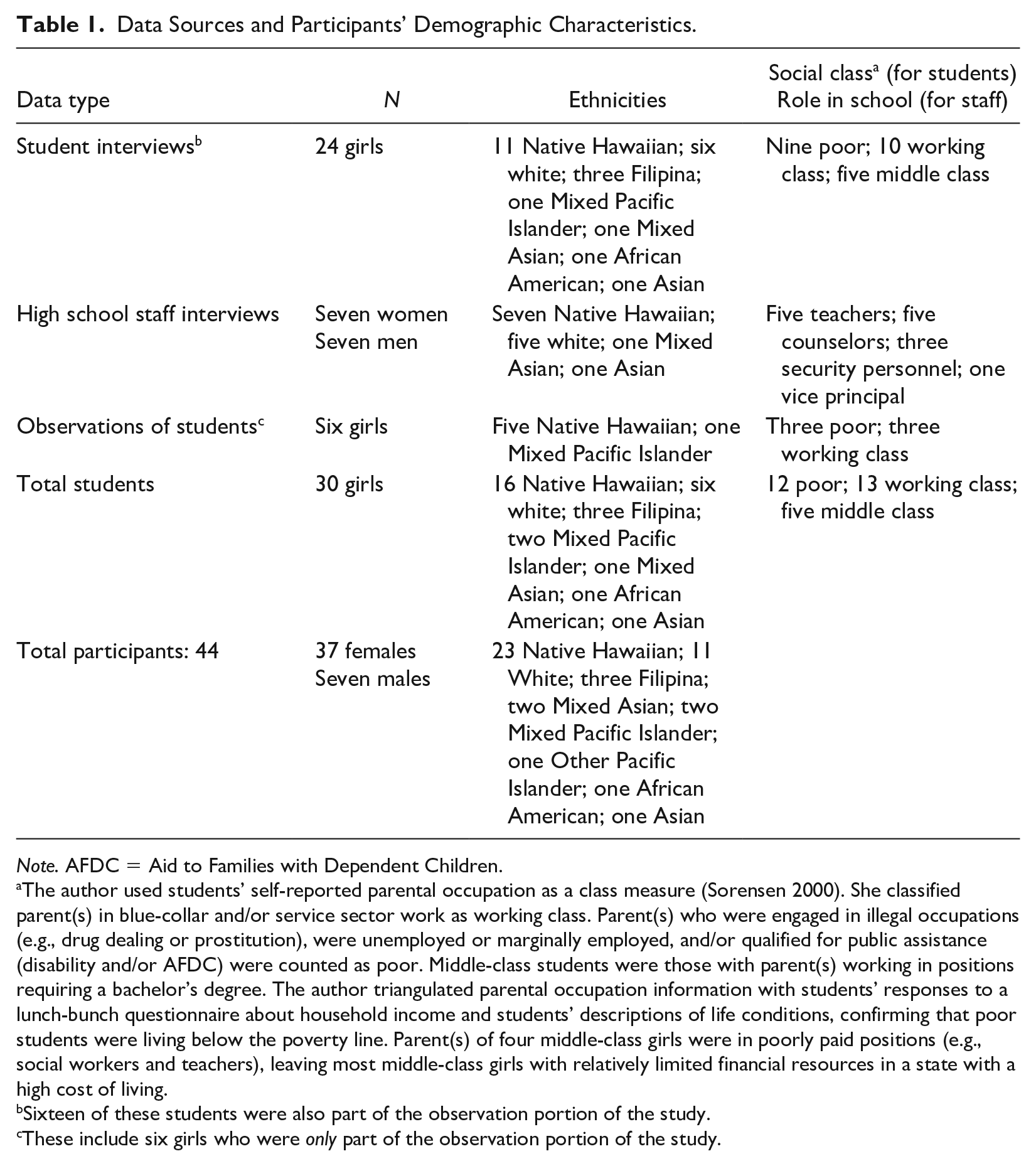
Note. AFDC = Aid to Families with Dependent Children.
The author used students’ self-reported parental occupation as a class measure (Sorensen 2000). She classified parent(s) in blue-collar and/or service sector work as working class. Parent(s) who were engaged in illegal occupations (e.g., drug dealing or prostitution), were unemployed or marginally employed, and/or qualified for public assistance (disability and/or AFDC) were counted as poor. Middle-class students were those with parent(s) working in positions requiring a bachelor’s degree. The author triangulated parental occupation information with students’ responses to a lunch-bunch questionnaire about household income and students’ descriptions of life conditions, confirming that poor students were living below the poverty line. Parent(s) of four middle-class girls were in poorly paid positions (e.g., social workers and teachers), leaving most middle-class girls with relatively limited financial resources in a state with a high cost of living.
Sixteen of these students were also part of the observation portion of the study.
These include six girls who were only part of the observation portion of the study.
To recruit students, I announced the goals of my research project and distributed consent and assent forms to students each semester. Approximately 150 students took part in the lunch groups between 2007 and 2018, but only 24 girls returned permission forms for interviews. That some of the lunch-bunch teens did not return forms was not a problem. Because youth lack power and privacy, I believed that some may have felt that they could not say no to adults. Although I reminded students that the study was voluntary, I surmised that not returning consent forms was a way for them to opt out of the study without having to openly refuse participation.
To recruit staff, I used theoretical sampling techniques (Charmaz 2014), identifying the different types of staff who intervened when students “got in trouble.” Counselors, vice principals (VPs), teachers, and security guards were usually those whose reactions to teens could propel them toward punishment and/or therapy. I interviewed five teachers, five counselors, three security personnel, and one VP. I asked these staff members whether they wanted to participate in an interview, and they all agreed.
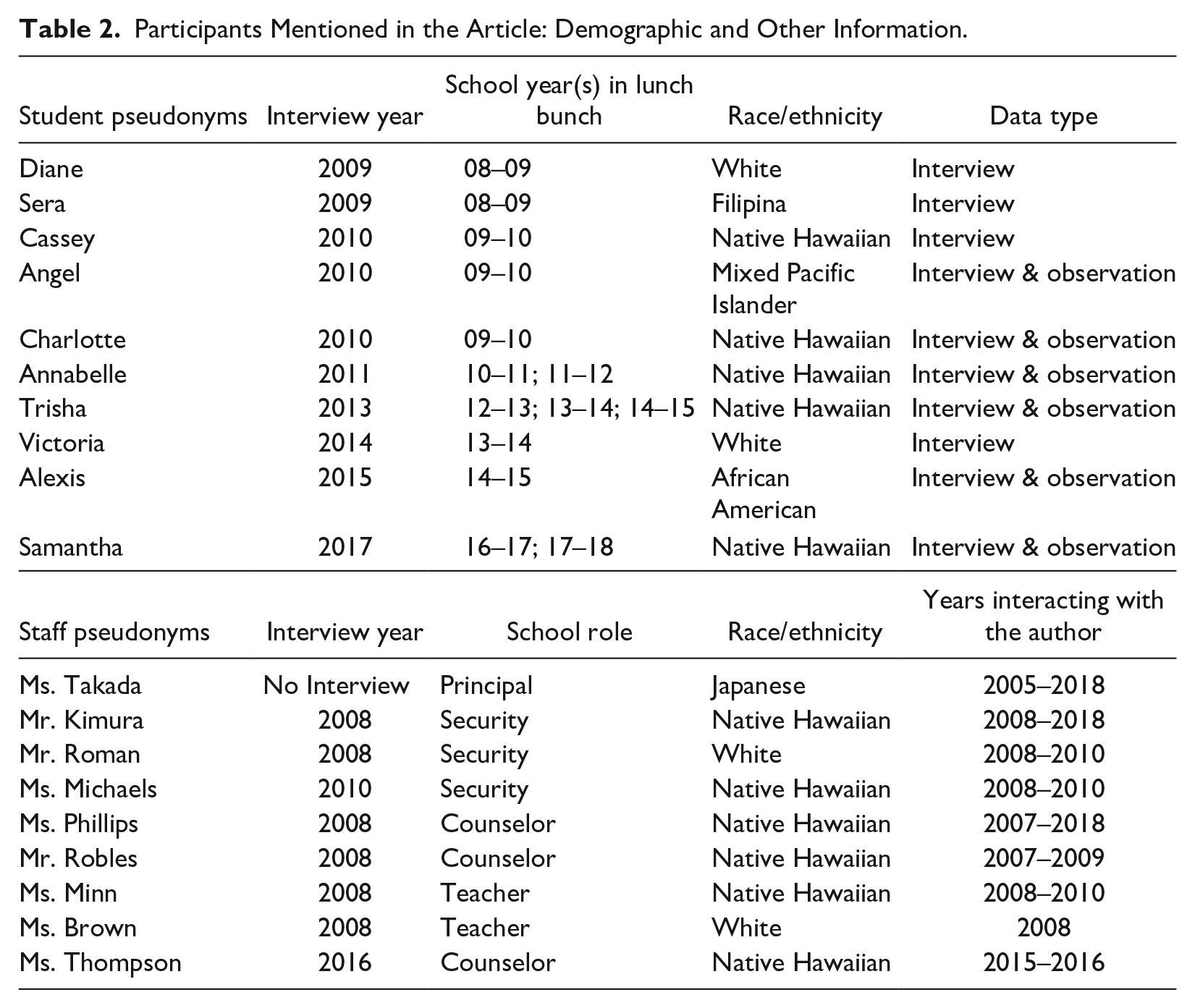
I used an open-ended interview guide, asking the teens and staff about the meanings, definitions, and nature of teen violence as well as their experiences with school punishment and student supports. Interviews also evolved in a conversational format, allowing participants to discuss facets of gender, violence, counseling, support, and punishment that were not included in my guide. Interviews lasted between 45 and 90 minutes and were conducted in an empty Seaside classroom or counseling room (see Table 2). All interviews were tape recorded and later transcribed verbatim.
Participants Mentioned in the Article: Demographic and Other Information.
Setting
Seaside High School, located near a rural community, enrolled a little less than 1,000 students during the study. Approximately half the student body was full or part Native Hawaiian (Hawai‘i State Department of Education 2008); Filipinx and Samoan students (combined) made up approximately 10 percent of enrollment 6 (Hawai‘i State Department of Education 2008). The remaining 40 percent of students were classified as Japanese, Chinese, Korean, or white. Approximately half the students received free or reduced-cost lunch in 2006–2007 (Hawai‘i State Department of Education 2008). On average, eight students were suspended each week from 2006 to 2007 (Hawai‘i State Department of Education 2008).
Analysis
I followed grounded theory (Charmaz 2014) and feminist grounded theory (Wuest 1995) techniques. I also borrowed from critical ethnography (Madison 2012; Weis and Fine 2004) and insights from indigenous ethnography (Smith 2012). Feminist, critical, and indigenous researchers explore the ways in which relations of power impinge on study participants’ everyday lives and attempt to disrupt dominant power relations. Guided by these principles, I first conducted open or initial coding to identify emerging conceptual categories (Charmaz 2014), which included codes such as girls’ definitions of violence, girls’ violence, staff’s definitions, punishment, and support. Looking at all the data attached to the initial codes, I developed more focused codes (Charmaz 2014) by teasing out themes in girls’ and staff’s accounts. For example, I started to see that staff talked frequently about school safety mandates, whereas girls focused on the many dimensions of how and why they felt threatened, overwhelmed, distracted, or upset in school (racism, sexualized control, hegemonic gender, and family conflicts), which I later referred to as their “sense of safety.” The outcomes of these competing definitions also appeared to be important and emerged as a divide between staff’s and girls’ views.
After identifying a schism in staff’s and girls’ views of safety, I wrote analytic memos (Charmaz 2014) to connect the study themes to contextual constraints described by study members and larger structural inequalities that framed girls’ and staff’s lives. I saw girls’ and staff’s worldviews as situated within institutionalized and stratified systems of power. At this point, I also drew from the extended case method (Burawoy 1998) and used what I knew about punitive control in schools to compare what I saw occurring in Seaside with what I learned from theories about and studies of race, gender, class, and school punishment in America. The emergent analysis and the extended case method allowed me to make sense of the emerging narratives, analyze underlying themes in these accounts, and elaborate on theories of multiple inequalities operating in schools.
Conflicting Tales of School Safety: School Staff’s and Girls’ Narratives
Narratives have become an increasingly important approach for criminologists. Making a bold claim, Shadd Maruna (2015) argued that narrative criminology is the “new mainstream” and is defined as stories people tell to make sense of their worlds. Specifically, narrative criminology includes “any inquiry based on the view of stories as instigating, sustaining, or effecting desistance from harmful action” (Presser and Sandberg 2015:1). In school contexts, harmful acts can include assault, theft, drug use and distribution, or any rule infraction officially defined as unsafe. Punitive responses, such as arrests, suspensions, and expulsions, are also harmful because they deny educational opportunities to youth, especially poor youth of color (Gregory et al. 2010; Crenshaw et al. 2015; Kupchik 2010; Rocque 2010; Skiba et al. 2002).
Narratives and stories 7 operate as ideologies. Dominant discursive frameworks stem from and buttress systemic race, gender, and class oppressions, while oppositional accounts resist or counter the status quo. To upset power imbalances, feminist criminologists have asked researchers to focus on the accounts of individuals uniquely burdened by punitive control. Meda Chesney-Lind and Nikki Jones (2010:2) asserted that paying attention to girls’ voices and “creating a space for girls to be heard is a central part of the enterprise of good feminist scholarship.” Answering this call, this study features the voices of two groups of actors: staff and female students.
Staff’s Views: Caught between Punishment and Compassion
Staff’s narratives present problems for researchers wanting to examine systematic inequalities. As noted, scholars looking at ideologies outside of larger structural contexts risk conflating racial, sexist, and classist ideologies with “attitudes of individuals” (Doane 2017:977). Thus, examining staff’s perceptions might imply that the problem of sexism, racism, and classism in schools rests within staff’s biases, rather than within social systems. One solution is to contextualize staff’s discussions, which I do in three ways. First, I consider historical shifts in education policies since the 1950s. Second, I examine the hierarchical system of policymaking regarding school safety and what this meant for employees. Third, I explore staff’s stories about how they negotiated larger punitive mandates while trying to support students.
Historical educational policy shifts and hierarchical policymaking
Between the 1950s and the early 2000s, national education priorities shifted. In the era leading up to and immediately following the 1954 Brown vs. Board of Education decision, national educational rhetoric focused on ending legal racial segregation and creating equal educational opportunities. Beginning in the 1980s, concerns about school discipline, order, and safety became a national obsession. President Clinton’s 1994 Safe and Drug-Free Schools and Communities Act (SDFSCA) marked the beginning of a widespread call to implement policies and practices and crystallized particular approaches to school safety. The act encouraged states receiving federal education funds to implement policies requiring a one-year expulsion for any public-school student carrying a gun, knife, or weapon to school. Thus, between 1954 and 1994, the perceived threats to educational opportunities shifted from problematic institutional practices (e.g., racial segregation) to troubling student behaviors (e.g., interpersonal violence, drug use, and drug possession). The solutions also shifted from ending educational policies viewed as problematic to punishing and excluding students seen as dangerous.
After 1994, state and local education policymakers followed and expanded the scope of the SDFSCA. Consequently, mandatory punishments were adopted for not only weapon carrying but also classroom disruptions, dress code violations, insubordination, and making verbal threats, with many of these violations being considered fairly minor and/or highly subjective. Because school safety definitions and mandatory punishments took root at state levels, school employees were forced to negotiate these directives from above, and their time and attention were often organized according to larger punitive rules and regulations.
The above-mentioned systems made punishment (and support services) unfold in a distinct fashion in Seaside. Due to mandates from larger institutional bodies, exclusionary discipline was formalized in all public schools in Hawai‘i, compelling Ms. Takada and Seaside administrators to punish students who violated any rule included in the state conduct code. Despite state-level punitive polices, there was some latitude available to staff, and principals (often referred to as “CEOs of schools”) had the most discretion. Principals could not ignore Hawai‘i State disciplinary codes. They could, however, implement additional (and nonpunitive) approaches to manage student behaviors, as long as these additions did not violate state regulations. Principal Takada favored therapeutic interventions for students who were having trouble in school, and she asked VPs to refer students who received suspensions for a week or more to see a school counselor after returning to school. Using discretionary funds, Ms. Takada employed a full-time counselor (Ms. Phillips) with training in talk-therapy approaches, and Ms. Takada campaigned the district for additional resources, placing two more counselors who offered talk therapy at Seaside. Ultimately, Ms. Takada’s innovations created a confluence of punishment and supportive responses to Seaside students. Discretionary funds were available to all principals in Hawai‘i. Some added to their teaching staff, and others employed additional security guards.
VPs also had some latitude when working under state and principals’ directives. During the study, Hawai‘i schools were required to document and report students’ infractions and the school’s response (i.e., suspension, expulsion, and/or arrest) to the state Department of Education, using a “Disciplinary Notice,” which forced VPs to classify a student’s problematic behavior as unlawful, department-prohibited conduct, or school-prohibited conduct. 8 Thus, VPs were forced to attend to and document rule violations, but they had interpretive latitude when categorizing the seriousness of incidents. The referrals to counseling sessions that Ms. Takada asked VPs to offer did not require documentation, thus pointing to the fairly informal nature of therapeutic service delivery. 9
Negotiating punishment and offering support
Teachers, counselors, and security guards were caught between punitive policies from above and more compassionate responses at the local level. While national and state guidelines dictated that staff vigilantly police schools, looking for dangerous thugs and drugs, there was also an established ethos of care and compassion in Hawai‘i. Dubbed the “Aloha State”—an expression often used to attract tourists to the state—Hawai‘i has a complicated relationship with traditional values of aloha (e.g., compassion, care, and love) and the contemporary commercialization of these beliefs. During conversations with Seaside staff, I learned that community-based values favoring kindness were central to many staff members’ identities as professionals, and this ethos often put staff at odds with punitive mandates. In response, they used various methods to moderate exclusionary discipline and enhance supports for students.
Some teachers worried that mandatory punishments placed undue burdens on Seaside students facing precarious living situations. Ms. Minn remarked, “I know of one kid who was suspended. And he said, ‘I don’t know where I’m going to go because I’m homeless. You’re going to suspend me? Mom is working, and I don’t have a home to go to.” Ms. Minn did not condemn the VP (or the school) for suspending this homeless student, believing that administrators were “doing their jobs.” Ms. Brown also believed that punishing students who “acted out” in classrooms alienated those confronting hardships. Her solution was to avoid sending students to a VP’s office. She claimed, “the whole trick” is “stopping it [student rule breaking] before it happens.” Her classroom management strategies included directing students’ “energy into something else” and talking with students facing difficulties. She detailed how she intervened with students who seemed to be on the cusp of a fight: “Just talk about it. First, you have to separate them, to calm them down. Then, just ask, ‘what’s bothering you?’” If students seemed to need (in her mind) more time to “cool down,” Ms. Brown said, “get them to a counselor,” a sentiment revealing the informal method some teachers used to bypass interpersonal violence as well as formal punishments.
Once meeting with students and talking about “what’s bothering” them, counselors usually earned students’ trust. For some students, counselors became confidants. In turn, these supportive relationships enhanced efforts to prevent students’ rule violations and punishments. Mr. Robles, a counselor, said, “One thing about the kids at Seaside is that they’re very willing to speak. They’ll say, ‘Mr. Robles, I’m going to get into a fight today.’” Ms. Phillips described how she learned about escalating problems: It’s just random sometimes. One of the kids will just see me in the hall and take me inside and be like, “Oh, this problem is happening right now, do you mind talking to this person and then getting in touch with those people, and we can prevent something?”
Ms. Thompson, a counselor, argued that it was not just teachers and counselors who attempted to bypass punitive mandates. In Ms. Thompson’s view, Ms. Takada and the VPs were primarily concerned about students’ well-being. Admitting that VPs sometimes enacted a “tough love” approach, she noted that “as an administrator, you have to. But I feel they really do care about the kids a lot. They don’t like being put in the position of having to come down hard.” Instead, Ms. Thompson felt that VPs try to discover “what is going on with the kid.” She continued, “Because research shows that you have at least one other adult who’s advocating for this kid. I mean, that’s why we’re here, to make that difference.” When I asked her why Seaside VPs focus on advocacy and support, Ms. Thompson replied, “I think it’s top down . . . because all [of Ms. Takada’s] VPs are the same. They approach things in the same manner. She [Ms. Takada] definitely chose the people that are in that [role].”
Ms. Michaels, a security guard, exemplified how supportive spaces could be enacted within a larger punitive context. When summoned by teachers to take troublesome students to the VPs’ offices, Ms. Michaels said that she usually took students on long rides “all the way around the campus” in the school’s golf cart. Mr. Kimura and Mr. Roman, Seaside’s two other security guards, confirmed that they too practiced this method of “riding and talking,” explaining that the ride helped calm students and that tranquil students were less likely to receive harsh sanctions. Angel, a student, described Ms. Michaels’ approach: I have love for Ms. Michaels. I wasn’t having a good day. So, I go to school drunk to make the day go by faster. I told Ms. Michaels I was drunk, and instead of turning me into the principal, she just watched over me, made sure I went to my classes. And if I felt like throwing up or anything, she would take me to the bathroom and hold my hair.
Ms. Michaels placed a premium on kindness over discipline. Such concern came with professional risk, as Ms. Michaels could have been sanctioned for failing to follow state rules mandating punishment for intoxicated students.
The Girls’ Views: Experiencing Race, Gender, and Class Inequalities
Drawing on what is called “structural violence” (Galtung 1969), some have noted that zero-tolerance criminal justice policing and punishment approaches that dominated in education fields after the 1980s represent a form of structural violence (Wun 2018) or spirit murder (Hines and Wilmot 2018) for girls of color. Structural violence contrasts with interpersonal violence and is understood as the systematic denial of the material, cultural, and symbolic resources necessary to thrive. The girls’ narratives about their school experiences in Hawai‘i echoed the structural violence view, as they noted the ways that they were systematically denied the material and symbolic resources necessary to secure their well-being. Specifically, the girls discussed being demoralized in multiple ways, confronting racism, racialized sexism, and class-based oppressions. Indeed, the girls had many reasons to be angry, upset, and irritated. Some irritations and frustrations were easy for girls to ignore; other troubles ended in them speaking up or striking out, often on school grounds. When a girl’s pent-up frustrations turned into public incidents of yelling or lashing out, staff felt a duty to intervene in the ensuing disorder. The following reveals how larger pressures set girls up to be angry and how schools responded when girls acted out in anger.
Confronting racism
Racism in Hawai‘i is complicated, and girls’ entanglements with the racial order were similarly intricate. In the contemporary academic literature, Hawai‘i is understood as a settler-colonial society, with settler colonialism being defined as a “persistent social and political formation” (Arvin, Tuck, and Morrill 2013:12) in which a foreign power settles in a region for the purpose of land and labor exploitation. Racism in the forms of systematic dehumanization, removal, and eradication of indigenous people is seen as necessary to meet these ends. 10 Settler-colonial societies also have complex racialized hierarchies. Elite settlers in Hawai‘i—usually white, Japanese, and Korean individuals (Okamura 2008)—often enjoyed economic, social, and political power, whereas other settler groups, like those identified as Filipinx, Samoan, Tongan, Micronesian, Latinx, Tongan, and African American, occupied precarious statuses below ethno-racial elites. For Seaside students of color, hierarchical relations translated into a reality in which there were wide-ranging racist tropes deployed against them on a regular basis.
Native Hawaiian students, for example, said that they were often depicted as “stupid.” This derogatory construction can be traced to American colonial occupation and the takeover of Hawai‘i in the 1800s, a time when colonizers openly painted the Kanaka Maoli (indigenous people) as dumb, unable to self-govern, and in need of Americans’ civilizing force (Silva 2004). Diane, a white middle-class student, illustrated the persistence of this historical stereotype: The stupid kids in the class are always singing that damn Hawaiian song, playing the ‘ukulele. It’s irritating because you stick the stupid kids with the smart kids, and the smart kids fail because of it. Well, they don’t fail, but they get distracted.
Diane conflated intelligence with one’s participation in traditional cultural expressions, thereby using “dumbness” as a proxy for cultural inferiority. Moreover, Diane saw “stupid” students as a direct threat to “smart kids,” and she later suggested a solution to the problem of distracting students: “I wonder why [the teacher] doesn’t call security and take them to jail?” Victoria, a white middle-class student, confirmed that there were negative stereotypes about Seaside students. She noted that her parents originally did not want her to attend Seaside: “Just because they’re [her parents] are like, ‘Oh, you know you’ll get beat up’ . . . [but] coming here [to Seaside], I was like, ‘Everyone is really nice.’”
First- and second-generation immigrants in Hawai‘i noted being told that they did not belong in the United States. At eight years old, Sera moved to Hawai‘i with her family. She described her early school experiences: “Once [my sister and I] started fifth, sixth, and the whole intermediate level, it was kind of racial comments. ‘Go back to the Philippines. You don’t belong here. You eat dogs.’” Dehumanizing mechanisms that Sera confronted are common in nations where elites draw strict lines between themselves as legitimate citizens (i.e., those who deserve citizenship) and undeserving “savages” (i.e., those undeserving of citizenship) who “eat dogs” and should “go back” to where they came.
Given these racist remarks, girls described being faced with a series of unsatisfactory choices, ranging from staying quiet, to speaking up, to fighting back. Sera explained that “I do get really mad. There’s times I really, really want to cry and yell and, I guess, be violent. It’s like you can’t breathe and like the smallest thing can seriously make you explode.” Sera, however, sat quietly with her anger and did not strike out. Alexis was also shocked and silenced by racism at school: When I came here [to Hawai‘i] people [fellow students] were just saying all this stuff about black people and how they don’t know how to raise their kids. I’m just like, “I want to beat the crap out of every single one of you.”
One day, Alexis explained that she was held against the wall and spat at by a group of students who uttered racist slurs against her during the attack. 11 Alexis did not raise her voice or fists to these girls. Instead, she stopped talking in school for several months afterward. Her silence piqued staff’s concerns, which led to a referral to see a school counselor. Alexis eventually joined the lunch-bunch group and discussed what happened to her.
Confronting racialized gender
As noted, hegemonic femininity norms in the United States take white, middle-class femininity standards, in which being pale, petite, and frail are idealized, and apply these standards to all girls. Girls who were constructed as the “other” were, therefore, verbally punished. Girls spoke of being told in many ways that they were too tall, big, strong, and dark to be considered beautiful. Trisha was taunted by boys at school who called her fat, sentiments that hurt her deeply. In fact, Trisha’s first suspension occurred during her elementary school years, when she hurled a pair of scissors at a boy who teased her for being overweight. Angel was suspended frequently for fighting with girls who called her “big, dark, fat, and ugly.” Regarding evaluations of her appearance, Cassey reported hearing, “‘Oh, you’re fat’ or ‘you’re just ugly’ and everything like that. That really does kill. It kills inside.” While she was profoundly upset, Cassey did not respond to these damaging remarks.
Annabelle’s two-week suspension could be traced to racialized gender. Annabelle came into contact with counselors when staff learned that she was struggling at home, and counselors suggested that she participate in the lunch-bunch program. During lunch-bunch meetings, Annabelle talked about her negative interactions with her foster mother, who, according to Annabelle, derided her, calling her “lazy” and “fat.” Consequently, Annabelle noted feeling worthless and ugly when spending time with her foster family. To escape these negative emotions, Annabelle spent most of her time with a boyfriend who made her feel “beautiful and desirable”—rare and highly coveted emotions for her.
During her senior year, Annabelle was caught at school with a large amount of marijuana in her backpack and was suspended. After returning to school, Annabelle explained the events leading up to her suspension to me. The boyfriend who made her feel beautiful broke up with her. Searching for a new relationship (and new opportunities to feel valued), Annabelle told me that she began dating a man in his 20s. This man, according to Annabelle, was “terrible” and forced her to carry marijuana to school so that he could sell it later. After her suspension, she ended the relationship with him.
There were more direct ways that racialized gender led to girls’ breaking rules and being punished. Calling a girl “fat” or “ugly” on school grounds usually prompted a set of heated verbal exchanges, which could end in physical frays. I relayed how this unfolded in a field note: Today, Angel said that there was a group of girls who were “after her.” She told us that they called her a “horse,” made “horse noises” when she walked by, and yelled out across the campus that “we have some hay for you to eat.” Angel said, “Because I am part Tongan, they say I eat and look like a horse.”
Angel explained to me the historical mythologies circulating about Tongans, including that Tongans eat horses, and, consequently, are horse-like. Racialization processes during colonial expansion (Austin 1983) included treating the racialized other as being more animal than human. Angel was doubly marked: first, for being like an animal, and second, for being too strong, forceful, and big to be considered a proper girl. Angel was not one to sit silently, and she usually “smacked down” anyone who questioned her beauty. “Big and fucking beautiful” is what Angel called herself. Angel served multiple suspensions for fighting other girls in school, explaining that negative comments made about her looks were the source of many of them.
Girls’ bodies were micro-policed in other problematic ways. Some girls were dismayed by unwanted sexualized comments and noted that they were called “sluts” or “hoochies” for being “too voluptuous” in the eyes of others (Mayeda, Chesney-Lind, and Koo 2001). According to students and staff, being called a slut was the primary motivation leading to girls’ fights on campus, suggesting that fighting for sexual virtue was a paramount concern for girls. Charlotte explained how rumors disparaging girls’ sexual purity presented considerable hardships: If there’s a girl and everyone thinks that she is like a goody good [sexually restrained]. And another girl starts saying like, “Oh yeah, she is like [a] slut and she does this and she does that.” That happened to my friend, and it really ruined them. They didn’t fight about it, but they didn’t even like coming to school.
Angel was not like Charlotte’s friend. She engaged in a fight with a girl who started a rumor, and she was suspended: A girl didn’t like me, and she heard I was from the mainland. She was like, “Oh I heard Angel gave birth on the mainland and she moved back to Hawai‘i.” They started making up stuff, and then, of course, I get mad because now everybody thinks, oh yeah, I’m a slut and I have a kid.
Angel was suspended after engaging in physical fray with the girl who Angel believed started the rumor.
Confronting gender and class inequalities
Girls discussed being overworked and undervalued at home, sentiments highlighting intersections of gender and class. American colonial occupation in Hawai‘i meant that Western patriarchal family structures were transported to Hawai‘i (Merry 2000). Fathers often acted as heads of families, and mothers were keepers of home and hearth, managing most domestic responsibilities. As noted, most lunch-bunch teens were working class or poor. Working-class parents labored long hours, some holding multiple jobs to keep families afloat. In poor families—where the parents were disabled, employed off and on, or in the underground economy—reliance on children’s housework was paramount. Feminization of domestic labor meant that domestic chores were usually delegated to girls, whereas boys had light family obligations. Girls bristled at the unfairness.
Girls’ outrage about unequal treatment at home affected their schoolwork. Burdened with cooking and babysitting duties and sibling conflicts centering on unfair labor allocation, Trisha was often unable to focus at school. Some days, Trisha burst into tears in class. Other days, she hurled herself or objects at other students when she was “stressed out.” Calling these episodes her “stress attacks,” Trisha’s outbursts were seen as “violent episodes” by staff, so Trisha was periodically referred to the VP’s office for disciplinary action. Typically, she was suspended and referred to see a school counselor. Sometimes, Trisha was sent by teachers to the counseling department (instead of a VP’s office) to calm down.
Samantha also discussed family “irritations,” and she was responsible for waking everybody up in the morning, cleaning, and cooking. She said, “Lately, I’ve been really tired, and I am getting up late, and my dad gets mad at me for waking up late.” When Samantha’s sister (Chase) left the family, Samantha noted that she had to “pick up the pace” of household labor, stating that “I can understand why [Chase] left, though, because we don’t really do anything outside of the house, like on the weekends. All we do is clean.” In fact, Samantha often had to choose between completing household chores or schoolwork: “One time, I had an essay to do, and my mom says, ‘What are you doing? You have to help with the housework.’” Too embarrassed to discuss family “troubles,” Samantha was reluctant to talk to teachers, believing that they were not apt to provide extensions. Samantha did not break school rules, yell, or lash out aggressively during the study, choosing instead to “bottle up” her feelings.
The girls’ narratives reveal how they confronted numerous unsafe, distracting, and demoralizing conditions. While these circumstances emerged in family, peer, and neighborhood contexts outside of the purview of school, these racist, sexist, and class-based demoralizations could quickly become school matters in two ways. First, girls quietly endured conditions that Cassey said “kills inside.” “Swallowing their anger,” however, often led girls to feel overwhelmed and unable to focus on schoolwork. Second, girls sometimes used words or fists against systematic demoralizations. Given the punitive policies dominating the U.S. education system, speaking up and striking out increased the chances that girls would be punished.
Conclusion
Two conflicting narratives emerged in girls’ and staff’s discussions. Staff were placed in a bind because of the punitive educational governance at the time and the hierarchical structure of public education in the United States; they were pressured to pay attention to exclusionary discipline policies at the national and state levels while also attending to their own instincts regarding supporting students. As staff struggled with competing demands, the girls were left on their own to battle unsafe, anxiety-provoking, and problematic conditions. Importantly, the circumstances that the girls found to be dangerous and unsettling were largely overlooked in national and state safety agendas.
Analyzing staff’s and girls’ conflicting stories fulfills the study goals. There were three processes that uniquely marginalized the girls, which I label rhetorical erasure, institutional distractions, and a structural setup. Looking at these processes reveals how race, gender, and class oppressions operate simultaneously in schools and on the levels of social systems and ideologies; how punitive approaches in schools institutionalize intersecting oppressions; and how support systems operate alongside national- and state-level punitive mandates.
Rhetorical erasure, the first process, points to ideological frameworks. Rhetorical erasure occurred when dominant school safety understandings rendered the struggles and dangers that the girls faced nameless and invisible. Racist comments (and one physical attack), racialized and sexualized control over girls’ bodies and comportment, and the inability to complete schoolwork due to heavy domestic labor demands were the daily sources of aggravation, upset, and, in some cases, outrage for the girls. Such conditions disrupted their ability to engage in school. Being respected, taken seriously, safe from racial and sexualized attacks, and free from oppressive amounts of domestic labor arguably represent important resources for healthy adolescent development. Insofar as girls were denied these resources in school (and elsewhere), they experienced structural violence (Galtung 1969). National and state definitions of school safety, however, were focused on interpersonal rather than structural violence.
Critical race and intersectional theories reveal facets of rhetorical erasure. Richard Delgado and Jean Stefancic (2017:32–33) noted, “[i]t is hard to think about something that has no name, and it is difficult to name something unless one’s interpretive community has begun talking and thinking about it.” It follows that national- and state-level education policymakers did not address the dangers that the girls described, and so girls’ struggles were made invisible (see also Wun 2018). The rhetorical erasure concept can be developed by combining Bonilla-Silva’s (2014) color-blind racism thesis with Collins’s (1990) controlling images framework. As Collins (1990:67) asserted, controlling images stem from and uphold “race, class, and gender oppression,” with controlling images in this study being those that erased girls’ experiences. Thus, the very visible national and state concerns about school violence and disorder reflected and supported white, middle-class male perspectives of (i.e., dominant ideologies concerning) school safety. Consequently, the national rhetoric about safe, orderly, and drug-free schools represented discourses buttressing color-blind racism, gender-blind sexism, and class-blind classism; they allowed structural violence to continue without overtly racist, sexist, or classist language.
The second marginalizing mechanism, institutional distractions, constituted the institutionalized social relations and practices in schools. For example, the threats that the girls described were ignored partly because staff were compelled to meet multiple and time-consuming institutional demands. National, state, and school-specific safety policies required staff to monitor school spaces and mete out punishments when students behaved in ways defined as dangerous according to larger educational governing systems. At Seaside (and elsewhere), institutionalized punishments became priorities organizing the time of staff (especially VPs) and, consequently, curtailing their ability to animate practices drawing from supportive sentiments common among staff. Given the many mandates bearing down on school employees, there were few guidelines about how to pay attention to the threats that the girls uniquely experienced.
Fissures in institutional distractions and exclusionary discipline appeared at Seaside, thanks to Ms. Takada’s use of her discretionary power to institute nonpunitive approaches. These fissures reveal how support services played out during a time when punitive responses were institutionalized within national and state governing systems. As a school principal, Ms. Takada could not upend exclusionary discipline at Seaside, but she could implement innovations, which became support service layers placed on top of mandatory punishments. Therefore, Ms. Takada’s therapy-as-innovation meant that students such as Angel, Trisha, and Annabelle received punishments along with counseling services when they violated school rules. In placing three counselors offering talk therapy, Ms. Takada provided a therapeutic innovation that also allowed staff and students a pathway around punishment. Upset students could walk into or be referred by teachers to a counselor’s office before a school rule was broken. Because these therapeutic responses were not broadly institutionalized, meaning that they were not mandated at the state and national levels, Ms. Takada’s emphasis on therapy (as policy and practice) was geographically and temporally limited; counseling existed at Seaside and other schools in Hawai‘i, but it would last only as long as a principal’s tenure.
The third alienating process, a structural setup, highlights the intersecting, systematic oppressions complicating girls’ lives. The structural violence that girls described (i.e., racist comments, racialized gender expectations, and the heavy reliance on their domestic labor) operated as entrenched patterns of relations and practices through which poor and working-class girls and girls of color were continuously demeaned, condemned, and overwhelmed. Because school safety policies and measures did not consider the manifestations of structural violence that the girls explained, structural violence went unrecognized and unchecked. In other words, the combination of racist, sexist, and classist realities was allowed to continue, all while any girl who responded to demoralizing conditions with forceful actions was likely to be suspended or expelled.
Looking at the structural setup more closely reveals limitations of emphasizing therapeutic interventions to solve structural violence. Therapy, as some have noted (Foucault 2006), is an individualizing intervention. Therapy-based counseling may give students a “safe space” to discuss difficult topics and help them cope with negative circumstances. The larger structural conditions, however, may remain unchanged. Future research is needed to examine the extent to which school-based support services can challenge racist, sexist, and classist systems.
The idea that the girls were punished and referred to counseling for attempting what schools failed to do—namely, keep girls from being systematically demoralized, shunned, sexualized, harassed, and overworked—adds layers to school punishment perspectives. To date, scholars have advanced the notion that poor students of color are disproportionately sanctioned because staff buy into prevailing controlling images and ideologies. While individual racial, gendered, and class-based biases in decision-making were at work in U.S. schools, focusing exclusively on staff biases as an explanation for disproportionate criminalization risks reducing America’s history of race, gender, and class oppressions to a mere set of individual personal prejudices (Doane 2017). The rhetorical erasure, institutional distractions, and structural setup processes situate the problem of disproportionate punishments within a broader scope. These challenges stem from structural violence leveled in multidimensional ways—that is to say, on ideological (i.e., rhetorical erasure), institutional (i.e., institutional distractions), and systemic (i.e., structural setup) levels.
This study has notable limitations. The small sample size (one school, 30 girls, and 14 staff) make the findings ungeneralizable. Future research with more participants is needed to examine whether and how poor and working-class girls of color confront racism, racialized gender, and class-based exclusions. The process of institutional distractions needs particular attention, given that I spent most of my time with students and counselors. My understanding of teachers’, security guards’, and administrators’ everyday work lives was limited to interview data. Observations focused on the ways that larger punitive mandates organize school staff’s time and attention are needed.
Footnotes
Acknowledgements
I would also like to offer my appreciation to many people who supported this research, including Corey Adler, Patricia Adler, Peter Adler, Meda Chesney-Lind, Earl Hishinuma, Danielle Kerr, Sanna King, Karen Umemoto, Izaak Williams, Jennifer Darrah, Krysia Mossakowski, the lunch-group students, Seaside High School counselors, the Principal of Seaside High School, and the project officers at the Centers for Disease Control and Prevention.
Declaration of Conflicting Interests
The author(s) declared no potential conflicts of interest with respect to the research, authorship, and/or publication of this article.
Funding
The author(s) disclosed receipt of the following financial support for the research, authorship, and/or publication of this article: This article was supported by the Centers for Disease Control and Prevention (1 U49 CE 000749-01). The contents of this article are solely the responsibility of the author and do not necessarily represent the official views of the funding agency.
