







Abstract
Researchers critique athletic admissions, claiming that lower academic standards for athletes lead to disengagement, retention issues, and mission-drift. Yet few studies scrutinize the athletic standards utilized. Despite the concentration of Black men in football and basketball, overall, white and middle-class athletes receive the greatest admission advantages suggesting athletic merit aligns with privilege. Drawing on 47 life-history interviews with Division I college athletes from one elite university, I apply Althusserian ideology to examine how exceptionally admitted participants interpret and (re)enact their advantages. Narratives revealed the institutional conditions, rituals, and practices that link athleticism to college access. Across three themes—access, ascendance, and admission—I consider how athletes are interpellated into meritorious recipients of preferential treatment, obscuring the structural alignments undergirding university access.
American higher education institutions often utilize different criteria to admit athletes (Smith 2011). Critiques of athletic admissions often ask whether winning a sports program justifies lowered academic requirements (e.g., Karabel 2005; Shulman and Bowen 2001; Smith 2011). This critique under-scrutinizes the athletic standards utilized by universities. In this vacuum, athletic merit is assumed as neutral, fair, and objective. Sociologists of education demonstrate that academic merit criteria are inherently ideological (Apple 2017; Giroux 1981; Karabel 2005) and favor the social, cultural, and economic dispositions and investments of elite groups (Guinier 2015; Khan 2012; Shamash 2018; Weis, Cipollone, and Jenkins 2014). As Jerome Karabel (2005:550) concludes, “the definition of ‘merit,’ including the one that now prevails at America’s leading universities, always bears the imprint of the distribution of power in the larger society.” How athletic merit may “bear the imprint” of society’s prevalent power relations requires similar scrutiny.
Research has considered who benefits from athletic admissions. Despite high numbers of Black men football and basketball players, overall, white and middle-class athletes receive the greatest admission advantages (Jayakumar and Page 2021). In part, this is due to the inequalities in youth sports that affect one’s chances of becoming a college athlete (Tompsett and Knoester 2021). White middle-class youth have more opportunities to play sports and do so at higher rates than any other demographic, (Project Play 2019) leading to their overrepresentation in the pool of eligible athletes (Hextrum 2021a). Colleges can aggravate youth sport inequalities. Kirsten Hextrum (2018, 2019) found that college coaches are more likely to scout from and build ties with youth sports programs in white suburban areas. Her research identified a “correspondence” between white suburban athletes and actions by universities leading to greater athletic admission advantages for already privileged groups.
Studies into the transmission of privilege have shown that structural alignment is never guaranteed. Reproduction of privilege requires that advantaged groups learn, negotiate, and activate their superior resources in ways that institutions reward (Kaufman 2005; Lareau 2015). In the American education system—purported to be meritocratic and upwardly mobile—privileged groups learn to “earn” their advantaged status (Khan 2012). Securing admission to elite universities is one such avenue. Middle- and upper-class families invest their economic resources into their youth to develop the merit criteria universities desire (Jayakumar and Page 2021). Privileged youth invest countless hours into academic and extracurricular activities to become standout applicants (Weis et al. 2014). Meritocratic ideology obscures the economic and labor investments by parents and youth toward university admissions (Guinier 2015; Shamash 2018). After succeeding in competitive admissions, privilege groups view their achievements as earned not conferred, and therefore become more likely to espouse the system is fair (Khan 2012; Lareau 2015).
Drawing on 47 life-history interviews with Division I college athletes from one elite university, I apply Louis Althusser’s (1971) ideology to examine how exceptionally admitted participants interpret and (re)enact their advantages. Narratives revealed the institutional conditions, rituals, and practices that link athleticism to college access. Across three themes—access, ascendance, and admission—I consider how athletes are interpellated into meritorious recipients of preferential treatment, obscuring the structural alignments undergirding university access.
Ideologies, Subject Formation, and Reproducing Inequality
Althusser (1971) begins with the premise that the reproduction of power relations, such as capitalism, require dialectic, mutually informing interactions among subjects, ideologies, and institutions. Said differently, individuals and ideologies enliven institutions (and vice versa). Maintaining power requires transforming individuals into institutional subjects who willingly reenact structural relations. Subject formation occurs through two state structures: the Repressive State Apparatus (RSA) and the Ideological State Apparatus (ISA). RSAs (e.g., police, military, and prisons) use direct violence and prosecution (or threats of) to force obedience. ISAs (e.g., schools, media, and sports) achieve compliance through formulating subjects that conform to social norms, rituals, and behaviors. ISAs, therefore, create subjects (vs. repressing them) enabling cultural institutions a more expansive reproductive reach (Hall 1985).
ISAs achieve conformity through “hailing” subjects through diverse discourses to (re)create the social order (Althusser 1971). We adopt the meanings that resonate with us resulting in subject formation. By answering the call, “ideology interpellates individuals as subjects” (Althusser 1971:115) transforming us into “the I of ideological statements” (Hall 1985:102). ISAs disseminate a range of meanings that may appear different and conflicting but in unison support the status quo. Sports, for instance, promote individualism and collectivism yet both are unified through competition. An athlete puts aside their interests for the good of the team to beat a rival. As individuals interact with multiple ISAs during their lifetime, the content people absorb can differ. These inconsistencies reflect the precarity of reproduction (Hall 1985).
By uniting institutions, individuals, and ideologies, Althusser moves ideology from the abstract to the material. Meaning cannot arise purely from an internal state, but instead requires “an apparatus, and its practice” (Althusser 1971:112). Ideology enables humans to construct “imaginary relations” to our “real conditions of existence” (Althusser 1971:109). Ideologies inform our sense of self and connection to others thereby shaping our identities, decisions, actions, and outcomes (Hall 1985). By centering subject formation in reproduction, Althusser links the symbolic and material as neither can exist without the other.
Scholars critique Marxist theories, such as ISA, for overdetermining the relationship between the state, economy, elites, and schools. Stuart Hall claims this is a misreading. Stuart Hall (1985) resuscitated Althusserian ideology by noting that neither ideology nor materialism is collapsed into the other as both are remade through indeterminant rituals and practice. By removing ideology from existing solely symbolically, Althusser examines where and how ideology manifests (Hall 1985). Reoccurring moments, such as a weekly spelling bee or yearly state-testing, communicate a range of meanings and translate to material consequences. A student’s exam performance marks their subjectivity—high/medium/low-achieving—and influences their life chances. Schools provide the apparatuses for the meaning, rituals, rewards/punishment, and subject formation. While ISAs provide determining contexts, the subject formation is unstable (Hall 1985). In Hall’s (1985:96) words, “The question is not the unfolding of some inevitable law but rather the linkages which, although they can be made, need not necessarily be.” Ideologies, such as meritocracy, create a “chain of equivalences” (Hall 1985:99) that teach us “how the social world works, what [our] place is in it and what [we] ought to do.” If reproduction is never guaranteed, nor can the social order’s disruption. Changing the status quo must be cultivated through apparatuses, rituals, ideologies, and subject formation (Hall 1985).
Transmitting Priviledge through Merit
ISAs require public acceptance and investment (Althusser 1971). Schools derive public support from the belief that they function as mobility engines—providing the skills and competencies for individuals to socially ascend (Apple 2017; Giroux 1981). Hierarchies become palatable because mobility institutions supposedly rank individuals by their earned efforts and talents, and not their inherited social positions (Guinier 2015; Khan 2012; Shamash 2018; Weis et al. 2014). This view presents individuals as individually achieving success and unconstrained by power (Weis et al. 2014).
Scholars have long scrutinized the ideological underpinnings and resulting subject formation of academic merit (Apple 2017; Giroux 1981; Killgore 2009). “Objective” measures of academic merit such as the SAT arose through eugenics and favored the knowledge and disposition of American WASPs (Guinier 2015; Karabel 2005). Today, the SAT’s own research demonstrates that it is a better measure of socioeconomic status than college readiness (Patterson and Mattern 2013). Subjective merit measures also reproduce inequality. For instance, increasing the weight of extracurricular activities advantages white, middle- and upper-class applicants (Jayakumar and Page 2021; Weis et al. 2014). Organizational imperatives such as prestige and competition among colleges induce institutions to maintain admission practices that favor elite groups (Killgore 2009). Producing prominent alumni and courting a wealthy donor base drive universities to ensure their selection processes target such students (Killgore 2009).
Higher education may court elite groups, but privileged groups must be induced to (re)invest in higher education. Lois Weis et al. (2014) found that globalism and diminished middle-class wages and benefits have galvanized suburban communities to invest in new forms of capital and status to gain an admission edge. Shamus Khan’s (2012) study of a prestigious boarding school found that elite students do not feel entitled to a well-paying job. Instead, through rigorous secondary preparatory curricula, parenting strategies, and peer cultures, they learn to “earn” their privilege by pursuing elite higher education. Along the way, participants learned that hard work and discipline drove their success, rather than their social position. Thus, fears of status loss hail privileged groups to enact ever-novel strategies to maintain their standing. Importantly, schools favorably read and reward these investments (Calarco 2018; Kaufman 2005; Lareau 2015).
A confounding factor in college access is exceptional admission. Universities have irregular channels and standards for certain applicants (e.g., legacy students and athletes) (Killgore 2009). James Shulman and William G. Bowen (2001) examined the admission standards of 30 universities, 90,000 student profiles over 50 years and found that recruited athletes had substantially lower academic marks and yet received approximately a 50 percent admission advantage compared with regular students. Legacy admits received half—25 percent—of athletes’ admission advantage. Admission officers justified such practices claiming athletes increase the revenue and reputations of universities and/or possess the qualities to succeed in school and beyond (Shulman and Bowen 2001). Shulman and Bowen (2001) countered these claims, arguing that athletic admissions detract from universities’ academic mission.
Similarly, Karabel’s (2005) study of Ivy league admissions noted athletic skill contributed to the university but received outsized weight. These studies into preferential admissions critique athletic preferences for taking spots from academically meritorious students (Karabel 2005; Shulman and Bowen 2001). This reasoning reifies athletic talent as objective—so objective that it persuades colleges to modify their academic standards. Such conclusions belie Karabel’s (2005) own thesis that merit definitions always reflect power relations.
Recent studies have linked athletic merit to class stratification. James Tompsett and Chris Knoester (2021), in the first nationwide study of predictors of college athletic admission, found SES outweighed merit criteria such as team captainship. Rick Eckstein (2017) found that privatized youth leagues induce affluent families to invest in sports for admission advantages. Kirsten Hextrum (2019, 2021a) identified a dynamic relationship between the capitals and practices deployed in white, affluent communities and the standards used in athletic recruitment. Taking a wider view, Uma M. Jayakumar and Scott E. Page (2021) scrutinized holistic review and found that extracurricular activities are proxies for SES, granting higher income students admission advantages. Cumulatively, these studies connect capital accumulation to preferential admission.
Yet the ideological dimension of athletic admissions remains underexamined. The transmission of privilege requires activation and obfuscation of the material underpinnings of social advantage. We must also understand the rituals and practices within ISAs that transform privilege applicants into deserving college athletes.
This study uses Althusserian ideology to examine how individuals become talented athletes. Using the firsthand accounts of exceptionally admitted nonrevenue college athletes, I consider the institutional conditions, rituals, and practices that link athleticism to college access. Throughout, I consider how privileged individuals are interpellated into deserving recipients of preferential treatment, disguising the material realities required to access universities through sport.
Method
Article findings emerged from a larger critical qualitative study (Hextrum 2021a) that explored the following: How does race, class, and gender shape one’s path to and through college via sport? Critical qualitative inquiries examine how power relationships create unequal material conditions, shape subjectivities, and are ideologically reproduced (Ravitch and Carl 2016). This approach assumes that people’s narratives discussing material conditions can reveal the reproduction of said conditions (Kenyon 2017; Ravitch and Carl 2016).
The primary method was life-history narratives with college athletes, an interview style allowing participants to freely narrativize and researchers to center narratives in exploring social contexts (Kenyon 2017). Studying how athletic talent emerges over a life span and is activated within institutional contexts aligned with this method. Understanding how participants accessed and interpreted their athletic opportunities were primary objectivities. To contextualize participant accounts, I also reviewed institutional documents (e.g., National Collegiate Athletic Association [NCAA] handbooks, Coastal-U admission policies) and obtained participant’s consent to collect their academic records from advisors. The latter revealed participant’s admission status, AP units, college grade point average (GPA), and degree progress.
Research Site
I selected Coastal-U, a highly selective Research-1, public university with 40,000 students. Coastal-U hosts a top Division I athletic program with nearly 100 team and 200 individual national championships. Coastal-U’s repute for academic and athletic excellence appeals to hopeful college athletes. I centered two sports—rowing and track and field—to reflect potential demographic variety. Rowing is one of the most restrictive sports, as rowers learn their sport primarily through private, expensive clubs (Hextrum 2021a). Track is widely accessible; it is one of the most common high school sports (National Federation of State High School Associations [NFHS] 2019). Combined, these teams represented 25 percent of Coastal-U’s athlete population.
I recruited volunteer participants through purposive sampling and snowball recruitment methods. Participants self-identified their race and gender positions. Twenty-eight identified as women and 19 as men, all cisgender. Eleven identified as “people of color” (nine as “Black”) and 36 identified as “white.” Three participants (all women) were low-income, 23 middle-income, and 21 upper-middle income. I created participants’ class categories through several follow-up questions. Participants described their neighborhood and school, their caregiver’s educational level, their extracurricular activities, and whether they worked to supplement the household income. I also used Census Bureau data—athletes’ hometown: family median income and racial demographics. To maintain participants’ confidentiality, pseudonyms are used.
Coastal-U and Special Admission
During data collection, Coastal-U’s undergraduate acceptance rate was 17 percent (~82,000 applicants/year) with an average unweighted high school GPA of 3.90 (weighted 4.42) and 1,425 SAT. Such metrics placed Coastal-U students above the 90th percentile in national measures. Coastal-U admissions “reserve slots for students of lesser academic achievement in order to meet larger policy ends” (Coastal-U Admission Policy 2013:2). Athletes receive “special consideration” because of the “traditional place of intercollegiate athletics [at Coastal-U] and the value that the University places on success in activities that contribute positively to the image of the University” (Coastal-U Admission Policy 2013:2).
Coastal-U coaches can recommend 300 athletes per admission cycle—about 7 percent of the incoming class—to receive “special talent” accommodation. Coaches tag certain applicants—mark applications for athletic admission—thereby routing the prospective athlete through a different process. Forty-six of 47 participants received athlete tags. Only Joy (white, upper-middle-class woman) received no tag. She joined the women’s rowing team during her sophomore year. Coastal-U has three admission tiers for tagged athletes with varying standards and quotas. All tiers utilize a sliding scale: higher GPA equates to lower SAT (and vice versa). GPA minimums arise from 15 required high school courses, including language, math, and English. Tier-1 (120 tags) could range from 3.5 GPA and 730 (combined) SAT to 2.7 GPA and 1,090 (combined) SAT. Tier-1 admits required no further review beyond the certification that they reached this academic minimum and met the coach’s athletic criteria. Forty-three athletes were Tier-1 admits. The remaining three—Chantae (Black, lower income woman, track), Anthony (Black, middle-class man, track), and Iceman (white, middle-class man, rowing) were Tier-2 admits. Tier-2 (60 tags) could miss four semesters of college requirements and/or possess 10 percent lower GPAs and SAT scores than Tier-1 admits. Tier-3 (20 tags) signified “at-risk” students with significant deficiencies in their college requirements, GPAs, and test scores (Coastal-U Admission Policy 2013:5). These slots were primarily reserved for revenue-generating athletes. A committee comprising the director of admissions, director of academic support, and the faculty athletic representative reviews Tier-2 and Tier-3 admits before offering admission.
Data Collection and Analysis
After receiving approval through my institution’s IRB, I recruited participants and conducted interviews over 12 months. Participants received no compensation. The interviews occurred in a private office at Coastal-U. Interviews averaged 3 hours and totaled 145 hours. As a former Division I nonrevenue college athlete, I developed quick rapport with participants. They used institutional jargon and at times included me in their narratives, saying, “you get it.” As a researcher, I countered these moments saying, “please assume I know nothing about . . .” As a white, cisgender woman my race and gender also influenced participant recruitment and responses. As discussed elsewhere, white athletes candidly shared racially coded accounts, assuming I shared their racial ideology (Hextrum 2020b, 2021b). Conversely, men athletes moderated their statements, at times, even apologizing when candidly referencing sexism in sport (e.g., recounting a coach calling them a P****) (Hextrum 2020a).
The interview protocol included 47 topics. Topics centered for this article discussed the pre-college social and material support systems that shape athletic talent. Questions included the following:
What is your earliest memory of sport?
How would you describe your family’s view of sport? Of school?
How did you become involved in your current college sport?
When did you first realize you wanted to become a college athlete?
What challenges did you face in becoming a college athlete? How did you overcome these challenges?
Can you describe the athletic recruitment and admission process? Did anyone help you with process? Did you receive an athletic tag?
What factors and/or individuals helped you become a college-level athlete?
What factors create a successful college athlete?
How does your athletic status influence your academic decisions? Prior to college? During college?
If you were not an athlete at the university, do you believe you would be here otherwise?
How do you think others perceive your athletic affiliation?
I paired their responses with their academic records. Their academic records and interview responses (the basis of this article) revealed different admission standards for athletes. As one example, the Coastal-U student population’s average high school GPA was a 4.42, indicating they took a significant number of honors and advanced placement courses. Twenty-three study participants took no AP classes. The remaining took between one and five. Joy, the regularly admitted participant completed 13 AP classes.
Throughout data collection, I documented my emerging insights through field notes (my perception of each interview) and research memos (themes resonating across the interviews). After transcribing the interviews verbatim, I began open coding and read each interview identifying any possible theme, repetition, or pattern (Ravitch and Carl 2016). These phases generated a lengthy initial list of codes. I then used axial coding to group the codes into categories (Jones, Torres, and Arminio 2014). During this phase, I reinterpreted passages of coded texts to refine the categories and identify higher order themes. The entire process was iterative as insights deepened through a rereading and refinement (Ravitch and Carl 2016).
The original study revealed five higher order structural themes (community infrastructure, parental involvement, sport involvement and costs, social networks, and knowledge of recruitment) underlying special athletic talent criteria. Yet when discussing how they became college athletes, participants cited individual-level factors such as hard work and discipline. This disconnect became the focus for this study. Again, I used open and fixed coding methods to reexamine excerpted text for recurring patterns (Jones et al. 2014). Althusser (1971) ideology—institutions, interactions, rituals, values, and the ideology of meritocracy—informed fixed coding. Figure 1 reflects the results of the secondary open, fixed, and axial coding analysis. The findings discuss three themes—access, ascendance, and admission—that illustrate how participants learned to misrecognize their privilege and perceive special admission as individualized, fair, and objective.
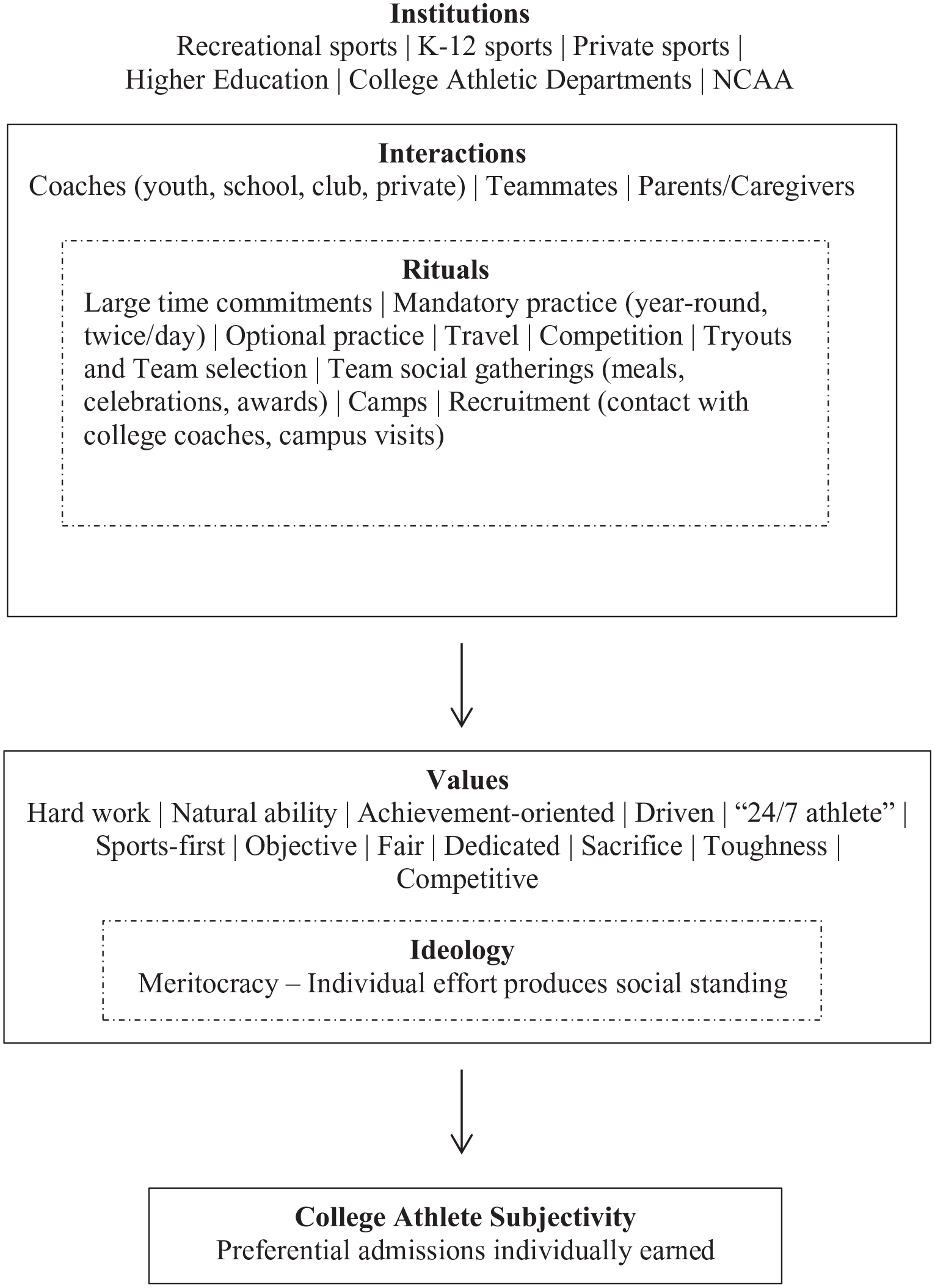
Ideological state apparatus, meritocracy, and the college athlete subjectivity.
Findings
Figure 1 depicts how institutions arise through interactions among diverse constituents and semi-regular habits, rituals, and behaviors. In becoming college athletes, participants traversed wide-ranging institutions, including recreational, club, school, national, and private sports teams; college athletic departments; and the NCAA. Varied social relationships—teammates, caregivers, and coaches—shaped their skills and knowledge to navigate the institutions. Rituals such as large time commitments shaped the social interactions and institutions. The three outer rungs (institutions, interactions, and rituals) reflect the first two findings: access and ascendance. The values emerging in and through institutional contexts, interactions, and rituals informed the imaginary relationship to the material realities, thereby obscuring the access required to produce merit. As discussed in the third study theme, admission, these values shaped their subjectivity into meritorious athletes deserving preferential admissions. While Figure 1 depicts institutions, interactions, and rituals in separate boxes, each entity is mutually informing.
Access
Life histories began with the question, What is your earliest memory of sport? Some, recounted sports participation before children from memories—reflecting how families circulate athletic stories.
Captain America (white, upper-middle-class woman, rower): Mom throwing me into a pool at two months old Victoria (white, upper-middle-class woman, rower): Skiing was my first sport. I started when I was two Terrance (white, middle-class man, track: I started skiing when I was really little—I was about three
Physical activity can take any form. Once institutionalized, physical activity transforms into organized sports, involving rules, organizations, hierarchies, and resources (Coakley 2015). By kindergarten, all but three participants played organized sports. At this phase, no youth played their eventual college sports—track and field or rowing. Instead, participants did ballet, basketball, equestrian, field hockey, football, golf, gymnastics, ice hockey, karate, rugby, skiing, swimming, tennis, volleyball, and water polo. Often, they combined sports, playing multiple sports at once or seasonally switching between sports.
Monique (white, upper-middle-class woman, rower): I did a lot of sports when I was younger. I did a little softball and I did a little soccer . . . and I started swimming Imani (Black, middle-class woman, track): I tried out a bunch of different sports. I even tried golf. I did tennis. I did some dance classes [and] I did a lot of swimming and karate. Lisa (white, middle-class woman, rower): I started playing tennis at first, [be]cause [there] was [a] club 500 meters from my house . . . Then I started to do gymnastics, and track and field, also did horse riding for awhile. So I tried everything. And then when I was ten, I [started] rowing.
Residential communities provided the infrastructure to play organized sports. Youth access sport through schools, community-subsidized leagues, private fitness centers, and pay-to-play club teams—opportunities that are concentrated in majority-white suburbs (National Women’s Law Center [NWLC] 2015; Project Play 2019; Sabo and Veliz 2008). As Lisa recalled, she played tennis because she lived close to a club. C.M.’s (white, upper-middle-class woman, track) suburb had “27 pools” and “equestrian trails”—her first sports were swimming and horseback riding. Soccer—the most common sport first played—requires large, flat, groomed fields, reservable to teams.
Forty-six participants lived in or on the fringes of middle-class, wealthy, and/or suburban neighborhoods. Eighteen came from communities where the median family income was greater than $100,000 per year. Only three (Savannah, Chantae, and Sanya)—all from lower income families—recalled finances affecting their athletic opportunity. Savannah (white, woman, and rower) played low-cost recreational sports, including softball and soccer, but never advanced into private clubs because of the high dues. In high school, Savannah’s height drew the attention of a classmate who suggested she row. After attending a practice, she told her mom, “That was so much fun. I’m so invigorated, and I’m so energetic, and I’m so excited about this new thing!” But Savannah did not return the next day. Her mom could not pay the club’s tuition. Savannah’s classmate persisted and suggested she apply for a rowing scholarship. The coach decided that Savannah’s athletic potential outweighed her lack of funds and offered her a scholarship. Savannah was the only scholarship athlete in her high school club. Still, not all her costs were covered including travel. Savannah hosted “three different fund-raising car washes just to raise money . . . I cried like ten times because I was so thankful for all the support that I got from my community.” Savannah’s presence on the rowing team presupposes she is the exception: all other members paid full-freight and came from families with disposal income to donate to her cause.
Rowing and track have yet to develop the same extensive elementary school youth programs as sports such as soccer and swimming (Hextrum 2021a). But this did not mean participants’ athletic careers began in high school. All but one study participant (Sophia) played multiple sports before settling into their college sport. Therefore, participants felt they chose their college sport after trying a variety of activities. Opportunities to test out your skills and aptitudes in a variety of sports are unequally distributed across the United States. Division I NCAA athletics currently sponsors 38 sports (18 men’s and 20 women’s). Of those sports opportunities offered at the high school level, boys’ basketball has the most teams (18,510 programs) and boys’ football the most athletes (1,035,942; NFHS 2019). Track is third with more than 600,000 boys competing for 16,990 high schools (NFHS 2019). Girls still retain far fewer opportunities to play school sports (NWLC 2015). Track is the most common girls’ program with 488,592 athletes competing for 16,951 teams and basketball is second with 412,407 athletes competing for 18,171 teams (NFHS 2019). Rowing is one of the rarest high school sports, offered in seven states, with 73 boys’ and 74 girls’ teams (NFHS 2019). Rarer sports have less competition, with fewer athletes competing for a similar proportion of college admission opportunities.
Study participants resoundingly attended schools with plentiful and rare sports.
Across the study, participants, on average, had 21 sports in their schools. They also attended schools with diverse and rare sports offerings: golf (n = 37), fencing (n = 6), field hockey (n = 10), skiing (n = 8), tennis (n = 36), and water polo (n = 21). A school may offer a sport, but not in its entirety. This is especially the case for track and field that has at least seven specialties including sprints, jumps (long, triple, pole vault, and high jump), throws (hammer, javelin, shot put, discus, and weight), mid-distance, long-distance, relays, and hurdles, all of which require distinct training and expertise. Track’s variation led eight athletes to hire a private coach. Chantae and Brittany, two such athletes, attended high schools with track teams but which lacked triple jump programs. Instead, they hired private coaches to increase their skills. Track coaching is offered between $50 and $100 per hour in most regions (Bick 2007; MarinWaves 2016).
Race also shaped participants’ sense of athletic opportunity. Only four NCAA sports include adequate Black participation: track, baseball, basketball, and football. Two of those sports—baseball and football—are male-only. All participants of color (N = 11) did track, whereas white participants did track and rowing. Black athletes gravitated to track and ended their careers in other sports sooner than white athletes. Black participants recalled spending their days immersed in white-majority environments, living in or near white suburbs. Malcolm described his upbringing as living in “enemy territory” where he was “attacked” and “singled out by his peers” and teachers. His father identified a Black-majority track club in a nearby town to expose Malcolm to “his culture.” Malcolm embraced his club track team because it was a place where he could just “breathe” and let his guard down because “we were around people that got us. A lot of times people in school didn’t get me . . . And I was able to go [to track practice] and have friends. And have mentors. I had other people I could look up to.”
Similarly, when Brittany felt rebuked by her classmates, she reminded herself that she just had to get to the end of the school day because “you get to practice and you see people who look like you,” and who made her feel “part of a family.”
No white participants recalled race limiting their athletic opportunities. When pressed, white athletes discussed how race may have shaped their opportunities. For instance, Sophia, a white woman rower correctly named rowing as “very Caucasian-based—I can’t think of anyone on the team who isn’t White.” Yet she did not see how her race facilitated her choice to row or remain in the sport: “my race is not really something I’ve noticed.” Amanda recalled how she never thought about her race or team demographics until a Black rower joined the program. “[Race had] never really been on my radar until we [had] one Black girl on the [club] team.” She went on to acknowledge “there’s no diversity at all [in rowing] . . . [but] I don’t think it’s been to my advantage.” Misunderstanding how race shapes opportunity permits white people to retain the benefits of the racial order (Bonilla-Silva 2017).
Plentiful and diverse sports enabled participants to persist until they found their fit. Twenty-one participants recalled switching sports or positions for college advantages. For instance, Laura, Captain America, Noelle, Monique, and Morgan (white women, upper-middle class, and rowers) began in swimming. A combination of burnout, dissatisfaction with their abilities, and knowledge that rowing provided admission advantages motivated their decision to switch sports. As Monique explains, I knew [rowing] got you into colleges. . . . And I was sort of plateauing in swimming. So I was like, “Oh, maybe this is something I could be good at . . .” I wasn’t getting any faster [in swimming]. If I wanted to get faster I would have had to do like year round swimming.
Laura played track, club soccer, basketball, and lacrosse prior to selecting her ultimate college sport, rowing. Laura recalled how athletes at her high school often had lower academic credentials but still attended prestigious universities. She knew that athletes received special admission. She felt she lacked the ability, skills, or discipline to improve in her current sports. Her freshmen year classmate who rowed, told her to join the team because rowing offered an “easier” path to college. In recalling the importance of rowing to her college access, Laura replied, “My Mom went to Harvard and my Dad went to Stanford. Thank God I row.” Here, it’s evident that sports, not academics, helped Laura reproduce her family’s educational privilege.
Track athletes were also drawn to their sport for college access. C.M., who played over five sports before settling on track recalled, “I literally got into school because of running. . . And I didn’t take an honors or an AP. [Track] will get you to anywhere you want to go if you’re good enough.” London, a mixed-raced upper-middle-class woman, attended a sports-focused private Catholic high school where more than 10 percent of seniors became college athletes. She characterized herself as an “average” sprinter, jumper, and long-distance runner, unable to stand-out in any one event. London (white, woman, upper-middle-class, and track) learned through her elite high school peers, teachers, and counselors that someone’s odds of attending a prestigious university increased if they could find their athletic “niche.” She decided to first specialize in triple jump because her high school “didn’t have any triple jumpers.” Yet she had limited regional success in this event. London sought out guidance from a family friend who counseled her in how to navigate college recruitment: [he] shaped a lot of my [athletic recruitment] during my junior year and senior year. He was also a track dad . . . his son was on the track team. He [said] “Why don’t you try the heptathlon? You’re pretty good at all these events but not top at all these events.”
London created a marketing portfolio that highlighted she could compete in a variety of events and therefore showed “potential” as a heptathlete. London did just one heptathlon before she received admission to Coastal-U. With only two high school programs hosting heptathlon teams, London found her niche (NFHS 2019).
Athletic merit begins with opportunity. Sports are unequally available across the United States and across neighborhoods with the largest number, highest quality, and most diverse options concentrated in majority-white, affluent suburbs (NWLC 2015). Those with the opportunity to play multiple sports invest time and money into perfecting their skill and have immediate advantages. Significant gender and racial differences in sport participation further winnow chances to play, enabling white, affluent male youth to retain the most athletic roster spots (NWLC 2015).
Ascendance
The scarcity built within sport access necessitates attrition. Ascension within sport required individual and familial investments and sacrifices. Such (relative) strife and commitment informed and justified why athletes receive special admission, obscuring youth sport inequalities. Here, I discuss one central socializer, coaches, and one central ritual, time commitments, to illustrate the values arising within ISAs that interpellate some youth into meritorious college athletes.
Once athletes found their fit, they needed technical coaching to refine their skills. Thirty-six participants joined private, fee-based club sports to gain expert coaching. Also referred to as “travel” or “all-star” teams, private clubs competed throughout the year (unlike school teams that play seasonally) and required greater financial and time contributions from families including paying for travel costs, additional uniforms, club memberships, and equipment. The cost of private club affiliation varied drastically by region or sport, but, in all cases, required family financial contributions. The average membership for the top 10 U.S. junior rowing programs was $2,674 per year. The most affordable club, located in Upstate New York costs $1,300 per year. The most expensive came from a neighboring state, Connecticut, costing $3,900 per year. The club membership fees for track were much lower than for rowing or closer to $1,000 per year. Club dues did not cover fees and travel for competition (including overnight accommodations). Clubs also required minimum parental volunteer hours to sustain the organization.
Malcolm (Black, upper-middle class, man, and track) had help from four expert coaches to excel in sprints and long jump: his father, his private coach, his club coach, and his high school coach. Malcolm explained the misnomer that track relies upon natural ability.
“No one will be great in track if you don’t have great technique. . . . You got to work your form because it’s not easy to run in a position, to run, 9 seconds in the 100 . . . if you want to run nine-something, you got to be technician.”
His father, a former college track athlete, taught Malcolm “since Day-One” that technique creates winners. “Every day he was talking to me about my arms, saying [keep them] tight. . . . [If] you run all other the place, you let your form go to trash.” Malcolm itemized his father’s involvement: “I mean, even at track practice, [Dad] was there. After track practice when I got home. Before track practice. On the weekends, he worked me. Did extra workouts . . . I got all that technical work.” Malcolm also commuted 45 minutes one-way twice per week to train with a private coach. The coach gave him workouts to do on his own, after his high school practice ended. “We’ve trained like professionals. He was a professional long jumper. He trained us like professional long jumpers.”
Training similar to professionals included specific and repeated rituals such as increasing the time, volume, and intensity. Prior to college, athletes trained 15 to 20 hours per week, year-round. Thirty-two athletes recalled playing year-round sports as youth (rotating sports per season, such as basketball in the winter, soccer in the spring). Thirty-seven did year-round sports by high school, this time, specializing in their eventual college sports.
Monique said her club rowing team “was harder than the national team. [Club] was harder than some of the workouts we do here [at Coastal-U].” Casey, also an upper-middle-class, white woman rower, attended a club known for producing college athletes. Casey’s club coach was friendly with the Coastal-U coaches and incorporated the college-level training to her high school program. Casey recalled the rigor required in her club: We trained six days a week, for three hours, required. And you had to do extra workouts . . . I would come, two hours early, do practice, stay an hour later. Literally, I was there for six hours [a day], my senior year. . . . Over the summer, I did double-days. I based it off the [Coastal-U’s] Women’s workout too. I had friends who came here. So I kinda knew the structure.
Casey’s club is enmeshed in national and college networks where she learned to train similar to a college athlete.
In addition to required practice and competitions, 32 athletes completed optional trainings. This included extra aerobic conditioning, weight lifting, and skill development. Anthony (Black man, middle-class track) recalled how his father, a former track athlete, created supplemental training plans. After spending several hours on the track—including staying after all his teammates left to do extra sprints—Anthony would do circuit and weight training exercises in their home gym. Extra conditioning included “weights, squats and stuff. I’d have to do extra sprints, extra med[icine] ball throws. Like anything extra, pretty much. We were always the last ones to leave the track, every time.”
At practice, athletes learned what it takes to ascend to college. Their teams emphasized hard work, dedication, sacrifice, competition, among other individualized routes to success. When asked what factors improved their athletic performance, 36 athletes said “hard work.” Laura recalled how she began rowing mentally “weak” but her coach taught her to toughen up. As soon as I toughened-up I started to be able to sprint the extra 500 meters, do those extra things that you couldn’t really do without the mental toughness and grit. . . I wanted to be the person like, “I see her working hard every day and its paying off.” That’s the kind of athlete I wanted to be . . . That small shift in focus translated very easily into me putting [in] more dedication, working a little bit harder. And that made my performances a lot better. Good performances, and [college] coaches calling, went hand and hand.
Similarly, Lisa (white, middle-class woman, rower) attributed her success to toughness: “I wasn’t really that talented but I was hardworking . . . You just have to put the effort in, and then you can get places.”
Precollege athletic systems require immense material resources to enter. Yet capital remained an insufficient precursor for ascendance. Social interactions and rituals in these environments required time and energy investments. Requiring effort and sacrifice and fostering discipline and achievement disguised the initial material investments. The interpellation of meritocracy becomes evident as athletes began to see their success as achieved individually instead of secured collectively. The institutional mechanisms within higher education admission that evaluate and reward athletic merit fortified an individualistic subjectivity and promoted meritocracy.
Admission
In the final theme—admission—the interpellation of meritocracy concretizes. Across the study, participants described subjective, obtuse, and inconsistent measures of athletic merit. Yet the admission process obscured the subjective measures and inequity of athletic opportunity. Instead, through exceptional admission, athletes became exceptional. The institution legitimated them as such, signifying their athletic investments as valuable and disguising inequities.
How coaches evaluated athletic merit varied widely across the study. Only 12 athletes said coaches required they reach an athletic benchmark. Among those 12, participants recalled shifting standards. This is especially remarkable considering rowing and track have numerical benchmarks. Rowing evaluates athletes on how fast they complete a 2,000-meter test on an ergometer. Yet rowers were told different minimum time standards. Some women needed to break 7:30, others 7:20, and one rower needed to break 8:00 minutes on the test. Several men’s rowers were told to break 6:20 minutes, but, when this failed, a coach’s recommendation could suffice for “evidence” of their ability. Similarly, track and field includes measurements by time and distance. A long jumper is measured by distance jumped, whereas a miler by the time they complete their race. The Coastal-U track coach told some recruits they must reach a certain time or distance, whereas others were told to “keep up the good work.”
In analyzing participants’ accounts, I found inconsistencies in who was or was not required to reach an athletic benchmark. For instance, in track and field, reaching the state-level meets are a common occurrence for college athletes (18 of 22 track athletes reached state). This measure varied widely as some were in far less competitive divisions (e.g., smaller high schools) or states (e.g., Nevada). Eight of 11 Athletes of Color had to reach the finals and/or place at state before receiving recruitment offers. Chantae—the only lower income, woman, and Black study participant—recalled performing at state with little fanfare. It was not until she nearly won the California state meet—the most competitive track and field competition—and became nationally ranked that she received recruitment offers. Rowers had a wide variety in athletic backgrounds as some, such as Noelle (white, upper-middle-class woman) and Goose (white, middle-class man), competed for a semester before receiving admission whereas others competed for their country’s national team. Savannah, the one lower-income rower in the study, was one of the highest athletic performers and competed on the US junior national team.
Participants accounts reflected how race, class, and gender shape subjective measures. Thirty-nine participants recalled coaches assessing their likeliness of “team fit”—aligning with the coaching and team cultures—as a key metric. Noelle started rowing her senior year yet Coastal-U—a top-10 college rowing program—recruited her. She discussed why her inexperience mattered little: she was a “good fit” for the “team culture.” Noelle believed recruiting for team fit elevated the program’s performance: “[Our coaches] did a good job recruiting. Even if you’re a top athlete, [Coach] is not going to invite you to the team or recruit you if she doesn’t think that you’re going to mesh well with the girls.” Yet when Noelle rowed for Coastal-U, the team was virtually all-White and all-middle or upper-class. Demographic homogeneity influences cultural rituals and practices, all of which shapes which athletes feel in/excluded (Hextrum 2020a, 2020b, 2021a, 2021b).
What constituted team fit conflicted. Women, more often than men, recalled needing to showcase aggressiveness and competitiveness during recruitment. Captain America (white, upper-middle-class woman) learned from her club coaches that she must be “aggressive” and “proactive” to highlight her athletic accomplishments. Kalie recalled emphasizing her “competitiveness” to show she “liked to win” to appeal to coaches. Conversely, Black men—Malcolm, Anthony, LeVar, and Duane—felt they had to moderate any perceived inherent aggressiveness. Duane recalled he had to be “humble . . . respectful, mindful” and use phrases such as “this is a great experience, thank you so much for the opportunity” so recruiters did not view him as “arrogant,” “aggressive,” or a “cocky kid.”
The only consistent (and low) numbers discussed related to academic scores. Seamus (white, middle-class man, and track) characterized his academic record as “I didn’t have stellar grades I had 3.5. GPA and 1800 (1200 equivalent) SAT.” He knew he lacked the “extraordinary things” required in Coastal-U’s general admissions. But the track coaches told Seamus, “‘Oh we can get you in, its fine.’” LeVar recalled how coaches were confident his academic record met admission standards. “I was sitting at above a 3.0 so [coaches] said, ‘in terms of grades, you’re not struggling.’ I think [my GPA] was my saving grace [during recruitment] because I wasn’t coming in with terrible scores.”
Forty-six participants discussed how applying as an athlete provided admission advantages. Noelle felt her “grades were good, they were right in the range of [Coastal-U] applicants. But that doesn’t mean you get in. At that point, with my grades it’s like a lottery . . . So being able to row and have [Coach] flag my application, that secured a spot.”
Brittany applied as a “regular” student to several colleges including regional state, private, and elite public schools. She recalled, “I had like a 3.5, and a 1790 (1180 equivalent) on my SATs. I didn’t get in anywhere, which is absolutely ridiculous, but I’m going to let that go.”
In discussing athletic admission, I asked participants to reflect on what facilitated their athletic talent. They overwhelmingly offered individualistic explanations: “competitive drive” (n = 39), “hard worker” (n = 38), “natural ability” (n = 37), “mental toughness” (n = 30), and “achievement oriented” (n = 20). The divergence between their candid accounts of structural privilege and individual meritocratic explanations for athletic success reflect ideological processes emerging over a lifetime (Hall 1985). Immersion in competitive athletic communities taught participants that their success was individually earned, not socially conferred. The moment of college admission codified this achievement.
Reggie and Iceman (white, middle-class men, and rowers) attended private schools with rowing programs. Rather than see their educational and family environments facilitating their opportunities to row, they characterized athletic talent as hard work. Reggie: “I’ve worked hard, I’ve worked hard to get here and I’ll continue to work hard.”
Iceman (white, middle-class man, and rower) joined rowing after a friend “got recruited to row at Harvard.” Iceman recalled thinking, “Man, I want to go there. I’m going to start rowing!” Iceman saw rowing as an opportunity to make up for the fact that I was bad student. . . . You didn’t do very well in high school, so you did much better at something else—you found a way to get around the whole “having good grades” thing, to get into a top-tier university, to get a better job.
When asked what enabled his to be a college athlete he replied, A big part of me becoming an athlete was I have a really hard work ethic . . . I remember, the first summer, I would wake up at 4:45 am to row, and then I had to go to work [for my Dad], and then I had to go to a practice or a game in the afternoon. I [told] my Dad, “I can’t do this”. . . . And he said “You’ve just got to be tough.” And that kinda stayed with me: Be tough.
Iceman’s perception that his toughness drove his college access disguises the familial, school, and communal resources he relied on throughout his rowing career.
Brittany, who attended a magnet program and supplemented her high school track team with private camps, clubs, and coaching, said of athletic admissions, Some people, study, study, study, study, study, study, get a 4.3 average, get accepted to [Coastal U]. OK. But instead of me, study, study, study, I run, run, run, jump, jump, jump, and so I get into [Coastal U]. And that’s how it is. So basically, as opposed to having your grades get you in, you have your athletic ability that gets you in.
Amanda also believed athletes deserved preferential treatment because of their work ethic: We’ve all devoted our time to rowing. If we had had that extra time to devote to high school—everyone could have been top of the class of the high school. Just based on the type of people that rowers are. Everyone wants to excel. So if all my teammates in high school hadn’t spent all their energy on rowing, they could have also done just as well in school . . . I understood that even my teammates who weren’t going to get in for academics still deserved to be there just as much as anyone else did. . . . Everyone deserves to be at wherever they ended up even if it is because of athletics.
Athletes are prominent representatives of “objective” merit in admission, as Kayla recounted, My GPA was never horrible. I think I never got lower than a 3.2 or something. . . . I just didn’t realize the importance of a lot of [college-prep] things because I just knew I was going to go to college anyways. . . A lot of the really, really smart, high achieving kids . . . would always ask, “Where are you going?” I’m like, “[Coastal-U].” And they’d be like, ‘How did you get into [Coastal-U]? We didn’t get into [Coastal-U].’ <Laughs.> “I run.” Some people understand that, like, “Oh, she must be a really good athlete.” And some people are just like, “Dude that’s not fair.”
Kayla’s quote reflects how interactions with high school nonathlete peers can further legitimate athletic merit. Her “high achieving” peers assumed Kayla deserved admission because she was a “good athlete.” Even those who thought exceptional admission are unfair, did not doubt Kayla’s merit. In both cases, her merit becomes unquestioned and legitimated through admission.
Athletes became deserving subjects of athletic admission through a lifetime of competitive, hierarchical, and rigorous sports participation. Participants’ learned that individual effort—whether applied to school or sports—secures institutional access. The seemingly “objective” measures such as GPA or a running time position admissions as neutrally awarding individual achievement. Athletes are hailed to meritocracy through the rituals and practices in sport—grueling training schedules, overcoming failure, hierarchical competitive selection—that transmit values such as worth ethic produces achievement. A lifetime of taxing winnowing mechanisms taught athletes they individually earned their success. As athletes endure the winnow, they are interpellated, becoming powerful transmitters of meritocracy. As Amanda concludes, “everyone deserves to be at wherever they ended up.” The combination of institutional process and subject formations normalizes hierarchical advancement as fair and the winners of such contests as deserving. In this way, exceptional admission confers exceptionalism and obscures social advantage.
Limitations
Site and sport selection limits study findings. Elite universities are prominent but a fraction of higher education institutions. Their elite status emanates from scarcity and competition for admissions, which may distort social trends and behavior. Understanding if these findings persist at lower ranked universities is needed. Coastal-U possessed elite academics and athletics. Participants benefited from academic and athletic prestige. Thirty-five participants received athletic scholarships. Studying different institutional types (e.g., those without athletic aid or admissions) may nuance the import of admission advantages. Ninety-eight percent of participants were specially admitted. Understanding whether this portion is common at other elite university and/or how findings would change with a different portion of special admits is also needed. Furthermore, study findings revealed differences across sport type in access and ascendance. No participant began their career in their college sport. Studying sports with earlier specialization trends such as soccer, swimming, and baseball is recommended.
Finally, this study centered the success stories of those who received special admission. Not all athletes with financial and racial advantages ascend to college. A richer explanation of special admission practices may be found by scrutinizing those who were “weeded out” or denied athletic recruitment. While class arose as a prominent driver for athletic inequities, race and gender—and its interaction with class—require further scrutiny. The athletic trajectories for Athletes of Color living in white, suburban communities were rerouted based on race. In addition, women have far fewer opportunities to play and develop athletic talent compared with men and Women of Color have less athletic access than any other group (NWLC 2015). Other forms of power, such as ableism, are equally prevalent in athletics and require study.
Discussion
Despite limitations, this study advances theory and research on athletic merit. Findings utilized Althusserian ideology to explore how exceptionally admitted Division I nonrevenue athletes accessed, embodied, and interpreted their athletic merit. Across a life span of interactions with diverse ISAs, athletes encountered institutions, rituals, and practices that linked athleticism with college access. Athletes recounted resource-rich upbringings—familial, educational, and communal cultural, social, and economic capital. Yet, in these environments, participants learned that athletic merit is individually earned.
I located athletic admissions as an important ISA in college athletes’ life span. Athletic admissions assess and reward merit, thereby transforming the amorphous and subjective features of athleticism into objective status. Recipients of athletic admission become exceptional subjects deserving preferential admission. The reproduction of athletic advantages through admission is not guaranteed; meritocratic ideology induced participants to activate their advantages. Through successfully enduring educational and athletic winnowing mechanisms, participants learned their resulting social rewards were fairly earned not socially conferred.
Critiques of academic merit identified how the organizational complexity, scarcity, and competition of admissions transforms privileged individuals into college-going subjects who earned their acceptance letter (Guinier 2015; Killgore 2009; Shamash 2018). Meritocracy obscures how academic merit aligns with advantaged groups by positioning achievement as individual outcomes (Apple 2017; Karabel 2005; Khan 2012). Far fewer examine athletic merit. Instead, public perception and academic studies assume that “empirical results of performance, wins and losses, as well as individual and team statistics” determine athletic ascendance (Tompsett and Knoester 2021:3). Commercialism in college sports presents coaches as driven by fair market competition to find the best athletes, regardless of social positions (Eckstein 2017).
Tompsett and Knoester’s (2021) quantitative, nationally representative study determined that family socioeconomic status surpassed “objective” merit measures such as team captainship in predicting college athlete participation. Adding to this research, I presented athletic merit as ideological, revealing how selection criteria reinforce inequities. I documented how college recruitment utilizes a different application with lowered academic standards and shifting notions of athletic talent. When cohesive, athletic merit standards align with talent development mechanisms that require capital, specialized knowledge and training, supplemental resources, and intensive time commitments. Proximity to athletic venues, including facilities, parks, and club and school teams correlate with higher rates of athletic participation (NWLC 2015; Project Play 2019; Sabo and Veliz 2008). Predominately white, middle-class areas have higher quality and lower cost athletics (Coakley 2015; Hextrum 2019, 2021a). These sports translate into college access through athletic talent (Hextrum 2018, 2019). Presenting athletic merit as neutral and objective conceals the unequal opportunities to access sport and refine one’s skills.
This study also contributes to research on unequal sport access by examining the rituals and practices within privileged sports communities. Once in an exclusive sport, athletes learned to misrecognize their social advantages. As privileged groups compete for scarce goods, such as preferential admission, they produce ever-novel strategies to secure advantages (Calarco 2018; Lareau 2015). In the process, mediocre (but privileged) students transform into deserving college-going subjects, often displacing opportunities for superior students from lesser advantaged communities (Khan 2012; Weis et al. 2014). Importantly, this process is never guaranteed as advantaged groups must be induced—or in Althusserian terms, interpellated—to maintain their superior standing (Kaufman 2005). Khan’s (2012) study of the new elite found that privileged families and schools teach youth that they must earn their superior standing through a rigorous academic curriculum. Similarly, I found that privileged athletes endure arduous athletic curriculums, thereby interpellating them into deserving subjects of preferential admission. The rituals of large time commitments, competitive contests, and “objective” notions of talent taught athletes they earned special treatment. As a result, athletes believed they deserved their advantages. Additional research is recommended to further explore how athletes’ sense of entitlement emerges throughout their college career and beyond. Specifically, inquiries into how certain athletes become aware of their privilege—and seek to challenge, undermine, or redefine existing definitions of merit—may reveal new policy, practice, and reform strategies to diminish social reproduction.
By offering outsized social rewards for athletic talent, universities secure the transmission of privilege. The rules and regulations of athletic admission inform definitions of athletic merit. For instance, universities choose which sports they sponsor. Studies found that universities have added (or sustained) barrier-ridden sports and/or those culturally affiliated with white elite communities to lure donors (Eckstein 2017; Shulman and Bowen 2001). The belief is that parents of college athletes will donate and/or the athletes from these communities will go on to lucrative careers and become donors themselves. By sponsoring sports such as rowing, universities attach merit to exclusivity.
Althusserian theory positions all aspects of society as ideologically laden. Therefore, we cannot seek a nonideological definition of merit. But Althusser does not assume today’s dominant ideologies must reign indefinitely. The formation of subjects is process-driven and therefore open to new, more humanizing or liberatory meanings (Hall 1985). Findings offer two openings to redefine merit. First, greater public investment in youth sports, especially neighborhoods concentrated with lower income and racial minority residents will expand the pool of possible college athletes (NWLC 2015; Project Play 2019; Sabo and Veliz 2008). Second, and equally important, athletic opportunities themselves must change. Adding sports with the same rituals, practices, and values already present within white suburban areas will not reduce inequality. Rather, all youth sports must change, moving away from competition and individualism toward collaboration and communalism as the former obscures structural inequalities. Investments in youth sport could embrace a bottom-up approach, encouraging youth to design and organize sports (Coakley 2011). This approach, especially when embracing civic and social engagement, can bring “critical awareness of the factors that negatively affect their lives” that spawns change (Coakley 2011:318).
Changing the structural and ideological conditions of youth sports remains a daunting goal. In the meantime, universities can act. Universities decide which sports to sponsor and the admission criteria. Shifting resources away from white-centric sports (e.g., lacrosse and rowing) and toward emerging sport forms, specifically those associated with underrepresented college-going opportunities may minimize reproduction. Finally, the indeterminacy of the reproduction of privilege in athletic admissions requires additional study. Understanding the specific and emerging contours of institutions defining rules that favor privileged group is necessary to design more equitable admission processes.
Footnotes
Declaration of Conflicting Interests
The author(s) declared no potential conflicts of interest with respect to the research, authorship, and/or publication of this article.
Funding
The author(s) received no financial support for the research, authorship, and/or publication of this article.
