







Abstract
This manuscript explores if memorials to collective violence can promote healing and reconciliation vis-à-vis changes in intra- and intergroup attitudes. The paper focuses on a case study: the National Memorial for Peace and Justice—the first national large-scale memorial to victims of lynching—in Montgomery, Alabama. Using data collected before and after the memorial’s 2018 opening, we assess the differential individual and community effects of the memorial by racial group, comparing residents and nonresidents on measures of racial ingroup and outgroup closeness and social distance. Overall, there was no consistent relationship between the memorial and intra-/intergroup attitudes. The results reveal that White Montgomery residents had elevated levels of ingroup closeness, in comparison with White nonresidents, and all Montgomery residents had increased feelings of social distance after the memorial’s opening, net of their racial identification. The findings inform future research on the potential ways that memorialization—both passively and directly—can impact reconciliation and intergroup relations.
Introduction
Memorialization has been a growing trend over the past few decades amid a national debate about visual representations of racial violence in public spaces. What we know about memorials and monuments is largely centered on studies of tourists (see Weaver et al. 2018 as an example), those who are drawn to them for self-selected reasons. However, we know far less about how memorials passively influence the communities where they are placed. In particular, we have limited knowledge about the reactions of and impacts on people whose histories are implicated in the memorial’s representation (Foote 2003). Therefore, the question of their full influence remains (Barsalou and Baxter 2007). One query rarely considered is how memorial placement affects group relations on the local, residential level.
Physical memorials, regardless of the specific content, stimulate an emotional response (Doss 2008; Ladino 2019); they rely more on reactions to aesthetic design and contextual presentation rather than factual and complete representation (see Ladino 2019; Pavlakoviæ and Perak 2017 for examples). It is this affective response, in part, that gives the memorial meaning to individuals consuming it (Doss 2008). Multiple studies have explored potential interpretations of and reactions to memorials (see Doss 2012 as an example); yet few have empirically explored if a memorial has a patterned effect. In a discussion of the development and reaction to the Duluth Memorial, Dora Apel (2008) asks the question, “Can the memorial produce a sense of atonement[?] . . . Do the lynching memorial and the memorializing process constitute or produce these effects?” (p. 224). Similarly, Amy Louise Wood and Susan V. Donaldson (2008) ask, “what problems or difficulties do these attempts to memorialize lynching, to represent it, to construct histories of it, inevitably produce?” (p. 8). These humanistically driven questions are philosophizing about the systematic social effects of memorialization and serve as the basis for this empirical study.
This manuscript assesses the effects of the National Memorial for Peace and Justice (NMPJ) on the residents of Montgomery, Alabama, where it was developed and built. Specifically, the research focuses on how the memorialization of lynching victims from across the nation affects intra- and intergroup relations among Black and White residents of Montgomery, in comparison with nonresidents. The NMPJ is the first large scale national memorial to victims of lynching and one of several memorials to victims of racial violence that has opened in the past decade. Given The NMPJ’s recognition of the racial harm and injustice committed against Black Americans from the founding and development of the United States onward, we suspect the interpretation of the memorial and its effects will be dependent upon racial identification, thus differentially affecting intra- and intergroup attitudes.
In conversation with literatures on collective memory, theories of identity, and race, we assess the empirical effects of memorialization by measuring the impact of the NMPJ on the surrounding community’s racial intra- and intergroup feelings. This effect is determined by comparing residential and nonresidential changes to racial ingroup closeness, racial outgroup closeness, and social distance over time. We also assess if these effects differ by race and/or residential status. We use local and statewide data from the Memorialization and Community Project, which was a National Science Foundation-funded project involving an experimental design with the NMPJ serving as the treatment. By capturing data pre and post the memorial’s opening, we can observe how the development and presence of the memorial affected the residents’ attitudes. These quantitative metrics in a longitudinal survey dataset allow us to understand how the memorialization of victims of lynching affected the intra- and intergroup attitudes of Black and White Montgomery residents.
Case Study: the NMPJ in Montgomery, AL
The NMPJ is the first national large-scale memorial to victims of lynching (see Davis 2022; Hasian and Paliewicz 2021; Simko 2020, 2021 for detailed discussions about the memorial). The Equal Justice Initiative (2024) partnered with the MASS Design group to construct a six-acre design including 800 steel pillar monuments, each representing a United States’ county where a documented lynching of an African American took place between 1877 and 1950.
This memorial is significant because America has never engaged in a national conversation about lynching. Historically, this is evidenced in at least two ways: (1) the presidential and media reluctance to address lynchings of Black Americans in real time until around 1891 (see Seguin and Nardin 2022), and (2) the legislative failure to formally criminalize lynching until the passage of the Emmett Till Antilynching Act in 2022, despite over 200 attempts to do so throughout the twentieth century (Hawdon 2024; Mbah, Hultquist, and Repp 2022). The sociohistorical mapping of criminalizing lynching demonstrates the country’s inability to develop a national narrative about racial violence against African Americans. Some local jurisdictions have attempted reconciliation processes. Examples include commissions to study reparations for slavery or for the Tulsa Massacre or the Greensboro Massacre (see Fox and Cunningham 2022). However, America has not engaged in the national transitional justice (TJ) processes that we have encouraged in other countries, such as South Africa, Chile, Argentina, and Rwanda. This fact is crucial to considering the impact that a memorial like the NMPJ could have, both nationally and locally.
To understand the NMPJ’s potential for localized effects, we need to understand its immediate environment and history. Built in Montgomery, Alabama’s state capital, the memorial is perched atop a small hill on the edge of the largely residential Cottage Hills/Five Points neighborhoods (Oseid 2019). Approximately one mile from the city center, the land plots were purchased from the city in 2015 as “a stimulus for economic development and revitalization” through the development of “a public space and memorial park . . . [that] will create a tour loop for visitors, tourists and Montgomery residents who are interested in history and civil rights” (City of Montgomery Adopted Council Notes 2015).
At the time of development, the memorial’s Census tract housed approximately 1,400 residents, within a city of about 198,220. Both the tract and the city are considered majority-minority areas, since approximately 75 and 60 percent of residents, respectively, identified as Black or African American on recent Census estimates (FFIEC 2019). Within the city, 34 percent identified as White, 2.5 percent as Asian, 3.5 percent as Hispanic or Latino, and 2 percent as two or more races. The Census tract was middle income, with the median family income being $67,775 and 26.96 percent of residents living below the poverty line. Of the 574 homes in the Census tract, 124 were owner-occupied, 303 were rented, and 147 were vacant (FFIEC 2019). Comparatively, the median family income for the city was $44,330 and 22.1 percent of people were living under the poverty line (FFIEC 2019). This indicates that the NMPJ’s Census tract had higher inequality levels than the city, when juxtaposing the tract’s higher median income and higher percentage of people in poverty to that of the wider city. Approximately 85 percent of city residents had a high school education, while 30 percent had a bachelor’s degree or higher. In addition, the majority of residents were active in the labor force (60.7 percent). All statistics come from the time of the memorial’s development and opening in 2018.
Montgomery’s past is also important when considering how residents might react to the memorial. The city is racially diverse, but it also has a racially divisive past, which is reflected in the city’s memoryscape. A memoryscape is a landscape where the memories of others are built into the local place to be interpreted and imagined by those in the present day (Butler 2006). The city is known for two distinct, yet interrelated, phases in America’s history: the Confederacy and the Civil Rights Movement (CRM). Montgomery was the first capital of the Confederate States of America (CSA). It currently hosts tourists at the CSA’s First White House and a statue of Jefferson Davis, the first and only CSA president. At the time of the NMPJ’s opening, the state Capitol’s lawn held reminders of the CSA, including statues and various iterations of flags flown by the Confederacy. Thus, Montgomery clearly offers visual celebrations of the Confederacy. Yet, Montgomery also provides visual memories and celebrations of the CRM. It was the city where Rosa Parks sat at the front of a bus and refused to yield her seat to a White man, where Martin Luther King Jr. served as a preacher and successfully led a widespread bus system boycott, and where the Selma March ended. All of these historic moments are represented with their own memorials and markers. These contested, and sometimes contradicting, memories sit side by side in uncomfortable ways, including in their juxtaposition to modern consumption (see Brand, Inwood, and Alderman 2022). Within this complicated landscape, Patricia Davis (2022) argues that the NMPJ engages in a “commemorative duality” with countervisual discourse, by challenging the city’s presentation as post-racial and in a stage of racial reconciliation; however, Davis (2022) does not directly address how the memorial converses/interacts with tourist sites that still remain to the White supremacist order of the Jim Crow era. Similarly, Marouf Hasian and Nicholas S. Paliewicz (2021) refer to the memorial as a “historical haunting that productively challenges the linear, orthodox nature of civil rights narratives” (or framings of violence as solely limited to the Ku Klux Klan) (p. 181).
Consequently, Montgomery is a city with “two histories, two sensibilities, two languages, two modes of existence, and two very different lines of flight” (Hasian and Paliewicz 2020). Its memoryscape is tense with history which puts race and racial violence front and center; the memoryscape simultaneously memorializes efforts to maintain White supremacy alongside efforts to end the systematic disenfranchisement of African Americans. As Abby Arnold-Patti (2022) notes, many Southern cities and residents “struggle to negotiate the complicated and painful narratives of Southern history” even as they place modern markers to lynching victims (p. 131). This tension in Montgomery, and across the south, suggests that Montgomery residents will have views on the memorial’s placement within their city’s limits. Consequently, we assume the memorial will have effects on the residents’ group attitudes, given it was “meant to challenge the very architecture of White supremacy in a city where it matters most” (Hasian and Paliewicz 2020). The NMPJ could potentially promote further healing and reconciliation and/or trigger historical notions of violence and divisiveness that still exist. Either way, the memorial’s placement would directly have effects on residents’ modern group views through passive consumption of the memorial as a cultural object in the city’s landscape.
In addition, the memorial’s content, size, and scope make it unique. Its footprint occupies six acres, including statues and placards connecting historical racial violence to the present, like mass incarceration. Davis (2022) argues that the use of space is important in this particular memorial because it “was designed to enable visitors to wander in, surrounded by the columns representing the victims, and contemplate the gravity of spectacle lynching via the experience of being surrounded” (p. 226). Related, Hasian and Paliewicz (2021) proclaim it to be a living memorial with emotive features (p. 173). Jenny Woodley (2023) argues that the format and flow were established to create a space for mourning, “re-enact[ing] Black loss in the wake of racial violence” (p. 1062). The design demonstrates the memorial’s attempts to intentionally engage with emotion and trauma. Christina Simko (2020) argues that the memorial “shows how the suffering of black Americans created a trauma for the nation (original emphasis) and not only the group” by encouraging White Americans “to cast themselves as fellow sufferers (but not equal sufferers) and partners in the quest for justice” (p. 67). In this way, the memorial developers are “invit[ing] white Americans into a community of memory . . . by complicating the boundaries between victim and perpetrator without erasing them altogether” (Simko 2021:159). These scholarly interpretations indicate that the memorial’s design intentionally sought to speak to modern individuals vis-à-vis a racialized lens. Numerous articles and media outlets quote Bryan Stevenson, the memorial’s founder, as saying the NMPJ is a space for White visitors to feel shame, but Woodley (2023) believes that the collective power of mourning may have a more unifying effect. The previous scholarly work as well as public statements about the NMPJ indicates its potential aesthetic and affective impact.
However, all of the above works focus on tourists. None of these works highlight the NMPJ’s potential passive effects on residents or explicitly measure if these assumed understandings translate into actual interpretations among visitors and non-visitors. The unique ways that the NMPJ and Montgomery can affect visitors are what make it an optimal case study to understand how memorial placement can affect residents’ intra-/intergroup attitudes. While the study focuses on the NMPJ’s local impact, the memorial’s intended scope is national as indicated by both its name and the inclusion of lynchings from across the country. The memorial’s national scope and potential impact are some of the many reasons to understand its effects. In addition, many studies focus on the negative effects of Confederate symbols (such as Ehrlinger et al. 2011; Lantz, Wenger, and Malcom 2024; Rahnama 2025 for diverse examples), yet we know little about what recognition of historical violence might do to promote positive intergroup relations among local residents.
Literature Review
Combining sociological and peace studies work allows us to outline theoretically what memorials could do and empirically what we know memorials do to visitors. We then utilize sociological theory on identity and collective memory to discuss why memorials might have an effect on residents who passively consume them (rather than choose to visit them) and why residents might respond to such representations in different ways based on their racial identification and experiences.
What Could Memorials Do? Theories of Identity and Identity Development
Three theories of identity that are sociologically developed or frequently used within sociology offer frameworks to consider how memorials may affect the surrounding community and its residents: Social Identity Theory (SIT; Tajfel and Turner 1986), Group Position Theory (GPT; Blumer 1958), and Identity Theory (IT; Burke and Stets 2022).
SIT attempts to understand the development of prejudice, and the initial experiments upon which it was based found that only minimal group distinction (i.e., categorization as in-/outgroup) is needed for arousal of group discrimination, even in the absence of a threat to group interests (Tajfel and Turner 1986). SIT essentially posits that people want to see themselves positively vis-à-vis their group identity and that view is primarily based on “favorable comparisons” (Tajfel and Turner 1986:284). If individuals cannot achieve a positive self-concept through a group identity, they will either disconnect from the group or try to improve the group view through cognitive alterations and explicit differentiations from the outgroup. This particular theory has been used to study how representations of an ingroup’s past violence toward an outgroup impact the ingroup’s current emotional state (see Branscombe and Doosje 2004). The literature also demonstrates that common defense mechanisms may override emotions, such as guilt and shame, neutralizing their relationship to pro-social reparative reactions.
A second relevant theory, GPT or “group threat theory,” furthers our understanding of how group identity could affect memorial interpretation. GPT theorizes that one’s membership in the dominant racial group serves as the framework through which the individual views the world. The theory posits that a group can feel “threat” vis-à-vis their views of themselves as group members, their group’s position in society, and their group’s relationships to other perceived and recognized groups. As a way to protect the ingroup’s status and/or resources, the common group orientation is associated with outgroup prejudice. This particular theory has been used to empirically assess threat numerous times (e.g., Bobo 1999; Bobo and Hutchings 1996; Bobo and Tuan 2006), including a study analyzing how thinking about slavery impacts collective emotions among White Americans (Reichelmann 2023). The theory’s basic proposition offers theoretical bases for considering why threat could be central to how group members, particularly implicated perpetrator groups, may interpret and respond to memorials about past collective violence.
IT (Burke and Stets 2022) is a third theory within sociology’s symbolic interactionism tradition that offers insight into a memorial’s potential social effects vis-à-vis group identity. At the heart of the model lies the identity process (Burke 1991:838), which identifies a causal path between identity meanings and behavior. In an oversimplified explanation, the model shows that when individuals interact in a social situation, an individual assesses appraisals of their identity, incorporates those appraisals into their self-view to evaluate if the individual is meeting their ideal identity standard, and then makes alterations to verify their identity in future interactions. Of note, the theory posits that if the individual evaluates that their identity was not verified (i.e., people did not see the individual as the individual wanted to be seen), then the individual will make an alteration. These alterations could include (1) changing physical behaviors to be perceived in a different way, (2) experiencing a negative emotion, and/or (3) cognitively reframing their identity meanings to be more in line with the identity standard. This theory is generally used to consider role and person identities (see Carter, Aguilar, and Flores 2021; Davis 2019; Stets and Lee 2021 for examples); however, its application to collective/social identity is well theorized (Stets and Burke 2000), but less commonly used (see Carter 2017; Carter and Bruene 2019; Davis, Love, and Fares 2019 for exceptions). The theory allows us to predict the types of individuals in a group who may react to a memorial based on how the representation verifies their group identity standard.
No existing work combines these theories to examine if having a group identity implicated by a memorial affects intra- and intergroup attitudes upon exposure. Yet, a combination of these theories can explain the process through which physical objects and representation emotionally and socially affect individuals vis-à-vis their attachment to their social identities. These theories offer support for the contention that certain representations, such as memorials, can facilitate a range of feelings, including both positive and negative feelings toward the ingroup and outgroup. Combining SIT, GPT, and IT provides a framework to understand how group members perceive representations of past collective violence, and how that perception impacts the ingroup’s thoughts of, and relations with, the outgroup. This framework offers a unique platform to empirically explore how representations of lynching may affect community members based on their social states and identities.
What Do Memorials Do? Empirical Work on Memorialization
While some attempts to test the empirical effects of memorialization have occurred in psychology experiments (see Watkins, Cole, and Weidemann 2010 as an example), the applied elements utilized by practitioners stem from evaluative tourism studies that often focus on citywide effects. These effects include potential relationships between increased tourism and changes in economic or criminal behavior (Albuquerque and Mcelroy 1999; Baker and Stockton 2014) or residential perception of tourism and its effects (Lindberg and Johnson 1997; Radke et al. 2020; Reichelmann, Hawdon, and Ryan 2020; Wang, Chen, and Xu 2019). These studies disproportionately capture macro-level effects, often demonstrating what a memorial does to the environment (i.e., economy) or the people who visit (see Weaver et al. 2018 as an example). But what do we know about how memorials affect the people who interact with them by accident or circumstance, as local residents might when traversing their home communities?
Considerable work demonstrates how social representations of history affect group members. Historical representations have been found to sustain social solidarity and group cohesion (Jovchelovitch 2012), through support for minority rights (i.e., the victim group whose story was silenced). Yet, others (e.g., Boateng 2021) found that representations of victimization result in higher levels of anxiety among the victim group, while also increasing social distance with outgroups (Green et al. 2017). Moreover, collective history affects implicated groups vis-à-vis the impact of collective emotions on reparative or defensive reactions (Martinovic, Freihorst, and Bobowik 2021).
In addition, research has focused on the heterogeneous nature of community responses to collective memory projects. For instance, the introduction of new symbols into a landscape can result in community conflict. John E. Tunbridge and Gregory J. Ashworth (1996) discuss conflicts based on dissonance between tourists and locals as well as those implicated as victims and perpetrators in newly enacted symbols. The city of Derry, Ireland, known for key moments during the 30-year Troubles, represents one successful case study; its presentation of the violence is assessed by all implicated parties “as being absolutely impartial and unbiased to the point of mathematical precision on the space given to the opposing communities and voices represented (interview with Dermot Francis, May 6, 1997)” (Anson 1999:60). Anson argues Derry represents a “current benchmark . . . toward which all tourism practices within contested heritages might aspire” (p. 60).
When focusing on the role of murals, the results are mixed. Katy Radford (2017) argued that murals in Belfast are a form of trauma tourism that actually leaves the community “embed[ded in] a sense of victimhood” (p. 255). Yet, Deborah Che (2017) argues specific murals in Detroit assisted in civic healing by presenting a “forum for discussing race” ands “help[ing] build a sense of place, shared purposes, community connections, and creativity in the youth and adults involved” (p. 171). Sometimes, landscape changes are a part of a broader TJ process; yet, these processes for truth-telling frequently “reflect the perspective of the teller and can be the basis for continuing conflict” (Barsalou 2005:7). These results indicate that there is no guaranteed response to a symbol’s integration into the landscape.
Moreover, the contents of the representations matter. For instance, skewed and inaccurate representations increased ethnic divisions in Rwanda (Mayersen 2014). In addition, anchoring political attitudes into the historical representation made it more difficult to change political attitudes, even though representation could affect levels of social identification with groups (Liu, Sibley, and Huang 2014). Attempts at utilizing a supraordinate identity also only work if included with acknowledgment of the individual group’s suffering (Vollhardt 2013). Thus, placing a symbolic representation of a collective memory into a current landscape may have social effects on the people who encounter it, whether as tourists or residents.
A rare empirical study that tries to isolate if and how memorial placement might affect the local population focuses on the Stolpersteine (“stumbling stones”) in Berlin, Germany (Turkoglu, Dittlmann, and Firestone 2023). Across Europe, these small bronze plaques are placed in the cobblestone ground to commemorate victims and survivors of Nazi persecution outside their last chosen residential location. The findings from a time series cross-sectional analyses and discontinuity design demonstrates that the presence of a Stolpersteine is associated with a decrease in the far-right vote share in the election following its placement (Turkoglu et al. 2023).
Two additional points about memorials should be considered based on the American context. First, a history of collective violence can influence modern behavior, as a relationship between the number of lynchings in a county and the presence of a Confederate monument demonstrates; however, there is debate about the causal direction of the relationship (Henderson et al. 2021; O’Connell 2022; Turner and Binkovitz 2021). Second, representations of collective violence have differing effects based on a range of personal as well as societal factors. Nicole Fox (2021) found that memorials about the Rwandan genocide can both heal and harm intergroup relations. Amy E. Potter et al. (2022) explored the diversity of experiences at American plantation tourist sites, including those of tourists, owners, and tour guides. They found that the individual interaction and interpretation were “always emergent” due to a “complex combination of factors at work during the particular time a visitor explores a museum as well as the narrative worldview, social position and identity that the visitor brings to the museum” (Potter et al. 2022:3). In a study of Confederate statues, Lucy Britt, Emily Wager, and Tyler Steelman (2020) found that perceptions of such statues vary by race. Specifically, Black Southern respondents had diminished feelings of state belonging, but region did not affect White respondents. The authors argue this is related to the protections that Southern states provide such statues. These findings indicate that memorials are not neutral, nor are they intended to be, which sets the stage for our attempts to isolate their direct social effects in this study.
How and Why Might Memorials Affect Residents Differently? Collective Memory, Cultural Trauma, and Identity
Literature on collective memory and trauma provides a basis for understanding how and why a memorial’s physical placement could affect local residents, even if they do not visit the memorial.
Most existing literature acknowledges collective memory’s shared collective nature as well as its theoretical and empirical links to identity. Collective memories are theorized as cultural products and practices that serve as shared symbols of the past, through which “intense conflict and debate” about identity occurs (Irwin-Zarecka 1994:67). In his groundbreaking work, Halbwachs (1992) links collective memory to place identity through the concept of “objects” which represent “bonds attaching us to various groups” (Chapter 4, p. 2). This link provides a framework for understanding how the arrival and removal of objects associated with groups vis-à-vis collective memory could affect local residents. Jeffrey K. Olick and Joyce Robbins (1998) also highlight works that theorize the multiplicity of, tension within, and dynamic meaning-making processes in memory work.
Current debates about Confederate monuments demonstrate that the meanings of these representations change for some groups as time passes. However, the representations always hold a tension between what factually happened and how the event is remembered. How the memory of Martin Luther King Jr. is (mis)used by different social movement groups demonstrates how this tension is one way collective memory continues to evolve (Yazdiha 2023). This difference between history and memory (Smith 2022) appears to harbor a very emotional and intense response, often based on racial identification and group implication in the narrative.
Despite recognizing collective memory’s contested nature, only a few studies consider the effect it has on contemporary race relations (see Lantz et al. 2024; O’Connell 2019; Rahnama 2025). Largely focused on memorialization of the Confederacy through Confederate Statues, these studies highlight the relationship between memorialization and macro-level effects: hate crime compliance, and levels of reported anti-Black biases crimes (Lantz et al. 2024), and Black-White poverty inequality (O’Connell 2019). In a rare study concentrating on the effects of Confederate symbol removals, Rahnama (2025) found that removal decreased local levels of racial resentment and reported levels of anti-Black racism, while increasing warm feelings toward Blacks and support for affirmative action. Ranhama’s results demonstrate the localized effects of removal, with the effects deteriorating as distance increased. Yet, no study has captured the effects of a memorial’s introduction into the landscape.
Theories of cultural trauma, collective harm on a group that affects their consciousness and identity for generations (Alexander 2004), also demonstrate how memorials could shape modern attitudes. While traumas can occur at the individual level, they become collective “if they are conceived as wounds to social identity” (Alexander 2012:2). After the initial crisis, the trauma develops “through a meaning struggle and a form of narration in which perpetrators and victims are named and asymmetrically positioned” (Eyerman 2011:13). Christina Simko (2020) argues for focusing on memorials as sites of cultural trauma, because their presence demonstrates a historical event’s ongoing impact and allows for recognition of victims.
Memorials can operate as points of “experiencing trauma” where the modern identity is both affected and potentially shifted (Alexander 2004:27). This can occur through the memorial serving as a “critical means for deepening psychological identification and broadening symbolic extension” (Alexander 2004:255), possibly ingroup favoritism. Other psychological processes of trauma, particularly among the perpetrator group, also have direct effects on present-day attitudes, including denial, scapegoating, and objectification of a group’s history and culture. Collective trauma explains how both Black and White Americans could experience trauma when remembering lynching, albeit in different ways and for different reasons. That is, the concept of trauma demonstrates how ancestors could feel victimized—even if the interpretation is distorted—potentially affecting contemporary intra- and intergroup attitudes. Specifically, collective trauma allows us to understand how the presence of and interaction with a memorial could affect attitudes about and toward both one’s own and other racial groups, particularly those implicated in the violence being remembered.
The above works provide a basis for considering that memorials—just as the events they are representing—do not necessarily have shared meanings across or within groups. As Erika Doss (2012) states, “assumptions that lynching photos command shared meanings and feelings discount, for example, who is looking, and how different viewers understand visual discourses of violence and trauma differently” (p. 277). Thus, the viewers’ identities influence how they interpret and respond to such representations. Previous research indicates that what makes the representation poignant and powerful is its relationship to one’s group history vis-à-vis the group’s collective memory of the given event. In other words, group history and narrativization of said history is of central importance to how one interprets a memorial and how that interpretation might affect intra- and intergroup attitudes.
Our Contribution
The works reviewed above offer support for the contention that certain representations, such as memorials, can explicitly facilitate feelings associated with healing and reconciliation, and/or result in deeper divisions between groups. The potential for healing and reconciliation are frequently cited reasons for memorialization to occur as an international and developmental action in post-conflict societies. Conceptually, healing and reconciliation refer to community level processes intended to move a post-conflict society past the immediate traumas of violence. Often focused on the immediate years following a war, the goal is to move the society toward a more stable future with less overt conflict. Ingroup healing, where the victims of trauma can recognize, acknowledge, and cope with trauma’s ongoing effects, is facilitated by intense group solidarity (Eyre 2007; Hawdon and Ryan 2011). In comparison, reconciliation refers to the process of attempting to resolve trauma at the societal level (Barsalou 2005). Some resolution efforts include addressing the legacy of past violence and rebuilding the relationships based on apology, forgiveness, newly established trust, and/or a sense of justice (Santa Barbara, Galtung, and Perliman 2012). In this way, healing pertains to one group, often the victimized group, while reconciliation requires engagement between two or more groups, often the victimized and perpetrating group (see Hawdon 2024).
Focusing on the memorialization of the lynching of African Americans, the NMPJ’s physical representation will likely have both individual and collective effects on the residential community based on racial identification, and these effects have implications for healing and reconciliation. However, even with the framing provided, there is not enough empirical basis to offer hypotheses. In an exploratory nature, we instead share our expectations. We suspect that the presence of the NMPJ will affect Black and White residents differently, prompting healing for Black residents but increased animosity among White residents. We expect the memorial to promote ingroup closeness among Black residents and feelings of decreased social distance from other racial groups, because the public display of a previously ignored history offers verification. We also expect the memorial to decrease feelings of ingroup and outgroup closeness among White residents in comparison with nonresidents, because exposure to the memorial reminds them of a negative group history where their racial group is implicated as a perpetrator. For this reason, we assess both residential status and racial identification.
Methods
Data and Sample
The study was premised on a quasi-experimental research design. The physical development and presence of the NMPJ was the “intervention” variable. Since the memorial was opening whether or not we conducted the research, it was a naturally occurring event; we captured the impact using a pre- and post-test survey distribution design. In this design, the residents of Montgomery are the treatment group as they live in a community that has been changed by the physical presence and opening of the memorial, while the nonresidential sample from wider Alabama serves as the control group.
Two sampling mechanisms were employed to gather the data. The Montgomery residents were identified through a purchased mailing list from Exact Data. The company obtains their information through public records or purchased data via warranties. The company had contact information of mailing addresses and/or email addresses for 84,169 residents. In all, 10,186 resident addresses were randomly selected by the data firm according to zip code proportions provided by the researchers. Of this potential sample, 1,656 returned to sender by mail and 305 emails bounced back, making the total viable Montgomery sample 8,225. Residents were only solicited one time via mail and three times via email for the initial contact. They were requested to participate in four data collection waves and received a survey for the next wave if they returned the prior wave’s survey. Residents were eligible to be compensated for a total of $30 in gift cards, if they completed all four waves: $10 after the first wave, the third wave, and the fourth wave. The response rate was 1.9 percent (164 of 8,225) in wave 1. While the response rate was low, this is not unusual for a “cold mailing” survey (see Wu, Zhao, and Fils-Aime 2022). The retention rate was high between waves: 57.3 percent (94 of 164 eligible respondents) in wave 2, 58.5 percent (55 of 94) in wave 3, and 85.4 percent (47 of 55) in wave 4.
The wider Alabama sample was collected in two waves using a panel from Survey Sampling International (SSI; currently known as Dynata). Panels include individuals who regularly take surveys and are compensated in a manner they prefer, such as a donation to a nonprofit or a small payment. SSI tailors panels to researcher needs based on requested demographics. In this instance, our only restrictions were age (18 years old) and location (lived in Alabama, but not Montgomery). 1 The sampling design resulted in an overrepresentation of White respondents at both the city and state level, and an underrepresentation of Black respondents at the city level, when comparing to the most recent Census data. This data collection strategy allowed us to isolate the memorial’s effect, controlling for what was happening in wider Alabama at the time of the NMPJ’s opening.
The analytical data involved the two waves that encompassed all samples: wave 1 was the pre-opening wave collected in March 2018 (referred to as time 1) and wave 3 was the post-opening wave collected in September 2018 (referred to as time 2). The NMPJ opened on April 26, 2018.
Variables of Interest
Dependent variables
We assess intra- and intergroup attitudes through ingroup closeness, outgroup closeness, and social distance.
Ingroup closeness refers to reported levels of intraracial group closeness. This variable was created from the commonly used item “In general how close do you feel to [Whites/Blacks]?” with response options ranging from 1 (Not at all) to 7 (Very close). To assess ingroup closeness for Blacks and Whites, respectively, we used the response value to the item for “in general how close do you feel to Blacks?” if the respondents identified as Black, and the response value to the item for “in general how close do you feel to Whites?” if the respondents identified as White. For analytical purposes, higher values indicate higher reported feelings of closeness to people who the respondents identify as being racially similar to them, in terms of presenting as Black or White racially.
Outgroup closeness refers to reported levels of interracial group closeness. This variable was created using the same closeness item above and was assessed for Blacks and Whites in reverse fashion from the ingroup closeness variable.
Social distance refers to how comfortable a respondent would feel in a range of social situations involving individuals of another racial group. This was measured with three items adapted from Bogardus’ social distance scale and the General Social Survey 1990–2014. These items were ordinal in nature with response options ranging from 1 (“strongly agree”) to 7 (“strongly disagree”). The items included: 1. I would feel comfortable living in a neighborhood where half my neighbors are from people of another racial identification. 2. I would feel comfortable having a close relative or friend marry a person of another racial identification. 3. I would feel comfortable sending my children to a school where half of the children are of another racial identification.
A factor analysis suggests a single underlying factor, supporting the creation of an additive mean scale that achieves high inter-item reliability (α = .8503, with .8626 at time 1 and .8141 at time 2). For analytical purposes, higher values indicate more discomfort with being socially close to people of another racial identification on a daily basis.
Independent variables
The independent variables included racial identification, experimental treatment, and visiting the memorial. These items allowed us to isolate the memorial’s effects and parse out if they differed by racial identification. The racial identification variable was dichotomized due to the sample’s lack of diversity, with respondents largely identifying as Black/African American or White. This information was captured with the question, “To which racial or ethnic group(s) do you identify?” “Check all that apply” with response options including Asian or Pacific Islander, Black or African American, Latino or Hispanic, Native American or Aleut, White, and Other. White is coded as 1 if the respondent self-identified as solely White, 2 and 0 if they self-identified as solely Black or African American. Individuals who were mixed race or did not identify as either White or Black were dropped from the sample, due to low numbers. This included seven Asian respondents, five Latino/a respondents, six Native American respondents, seven who identified as “other,” and six who identified as biracial.
The treatment variable was captured through residential status, which was assessed by if the respondent was a Montgomery resident. The variable was dichotomous with those who lived in Montgomery coded as “Montgomery resident” (1) and residents of wider Alabama coded as 0.
To account for the possibility that individual respondents could have visited the NMPJ whether or not they were Montgomery residents, we include a variable assessing if a respondent visited the memorial by time 2. Any physical visits to the memorial were measured with the question “have you visited the memorial?” where yes was coded as 1, and no as 0.
Controls
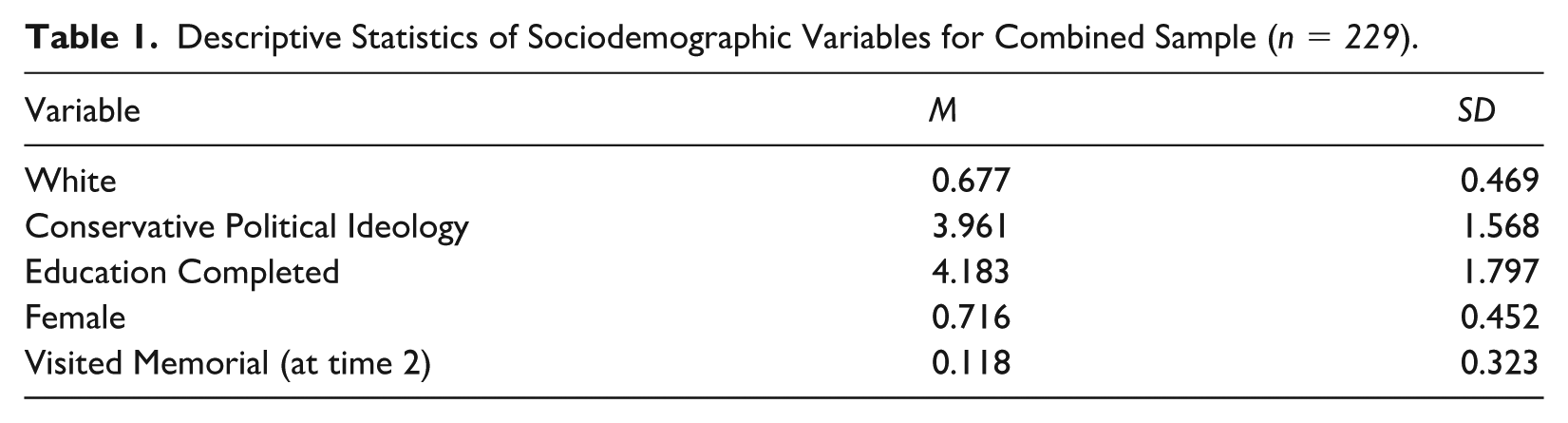
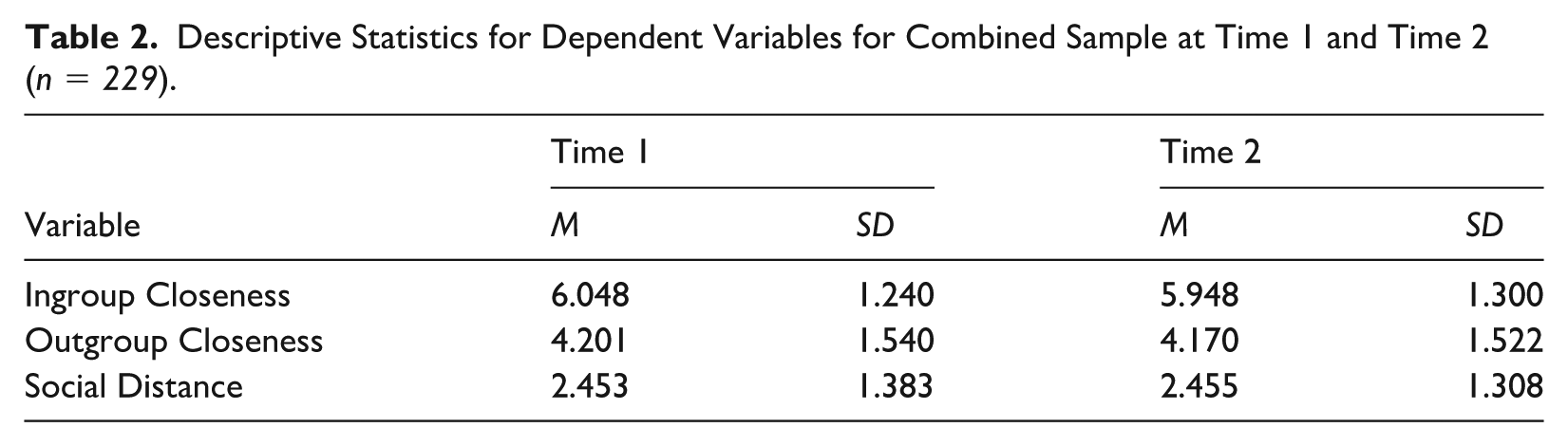
Control variables included political ideology, education, and sex. Conservative ideology refers to a respondent’s self-reported identification on a political spectrum scale and was measured with the question “how would you identify yourself on this political spectrum?” Response options ranged from extremely liberal (1), liberal (2), slightly liberal (3), moderate/middle of the road (4), slightly conservative (5), conservative (6), and extremely conservative (7). A respondent’s highest level of education completed was measured with the item “what is your highest level of education completed?” Response options ranged on a seven-point ordinal scale: less than high school (1), high school graduate (2), some college (3), associate degree (4), bachelor’s degree (5), some graduate work (6), and Graduate or professional degree (7). Sex was measured with the question “what is your gender?” with responses coded as female (1) and male (0). Table 1 provides descriptive statistics for the combined sample of all respondents on the demographic variables and Table 2 presents descriptive statistics for the combined sample at times 1 and 2 on the variables of interest.
Descriptive Statistics of Sociodemographic Variables for Combined Sample (n = 229).
Descriptive Statistics for Dependent Variables for Combined Sample at Time 1 and Time 2 (n = 229).
Analytical Method
The analysis was conducted using a mixed effects unweighted 3 regression, with the goal of assessing if the dependent variables changed across time due to the independent variables. The analysis included each dependent variable being regressed on four different models: (1) all independent and control variables, (2) model one specifications with an interaction between time and residential status, (3) model one specification with an interaction between residential status and race, and (4) model one specification with an interaction between race and time. These models were run on a final analytical sample of 229 respondents who completed all variables of interest in both waves 1 and 2.
Findings
Table 3 presents descriptive statistics comparing respondents from Montgomery, where the memorial was built (i.e., the treatment group) to a broader sample from Alabama (i.e., the control group). The table compares the variables of interest before the memorial opened at time 1 (March 2018) and after the memorial opened at time 2 (September 2018). T-Tests were run to compare changes within group means and revealed that no statistically significant changes occurred.
Comparative Descriptive Statistics by Sample, Pre- and Post-memorial Opening (Time 1 and Time 2).
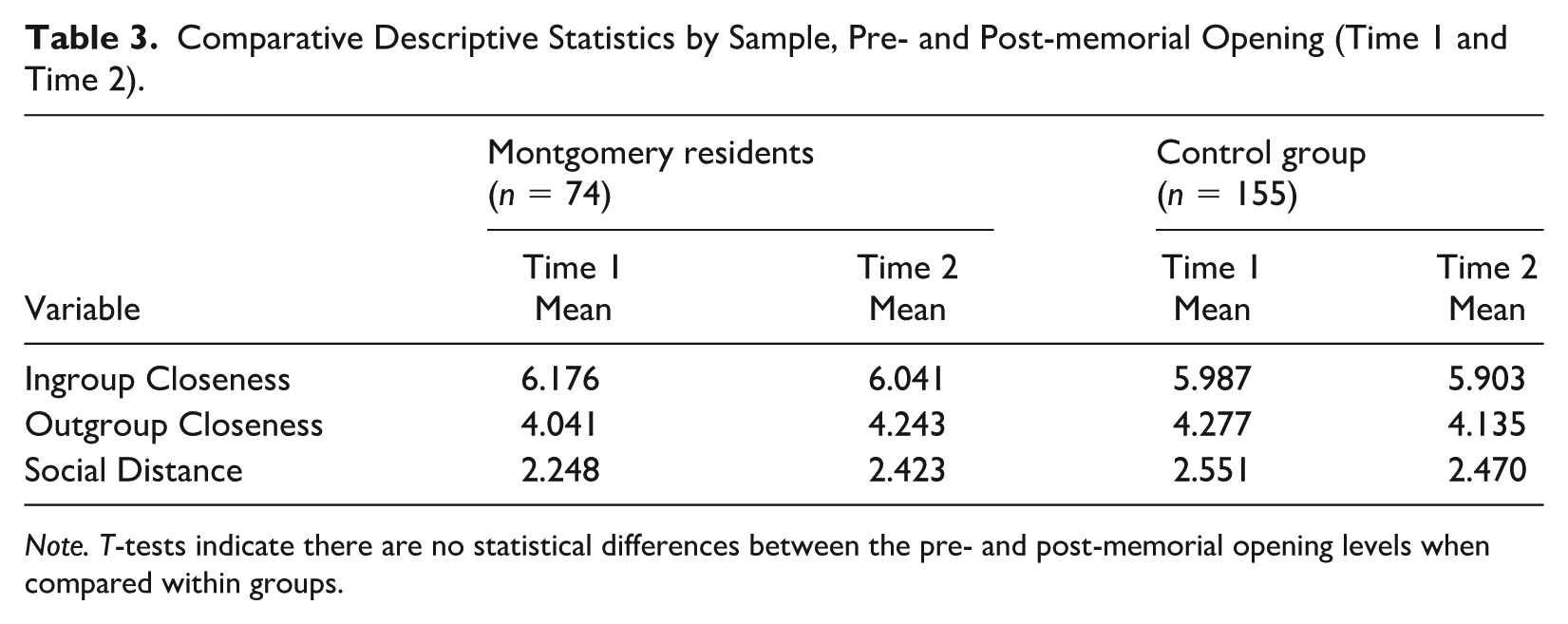
Note. T-tests indicate there are no statistical differences between the pre- and post-memorial opening levels when compared within groups.
Between groups, we note that Montgomery residents have slightly higher levels of ingroup closeness at both times 1 and 2 than those in the control group. In addition, they report slightly lower levels of social distance than those in the control group. The means for outgroup closeness are opposite. The reported outgroup closeness of Montgomery residents slightly increases between times 1 and 2, and those of the control group slightly decreases. However, as noted, the changes within group are not statistically significant.
Regression Analyses
Repeated measures mixed effects regression analyses allow us to assess our full hypotheses by controlling for other factors that would likely affect a respondent’s views of the ingroup and outgroup across time.
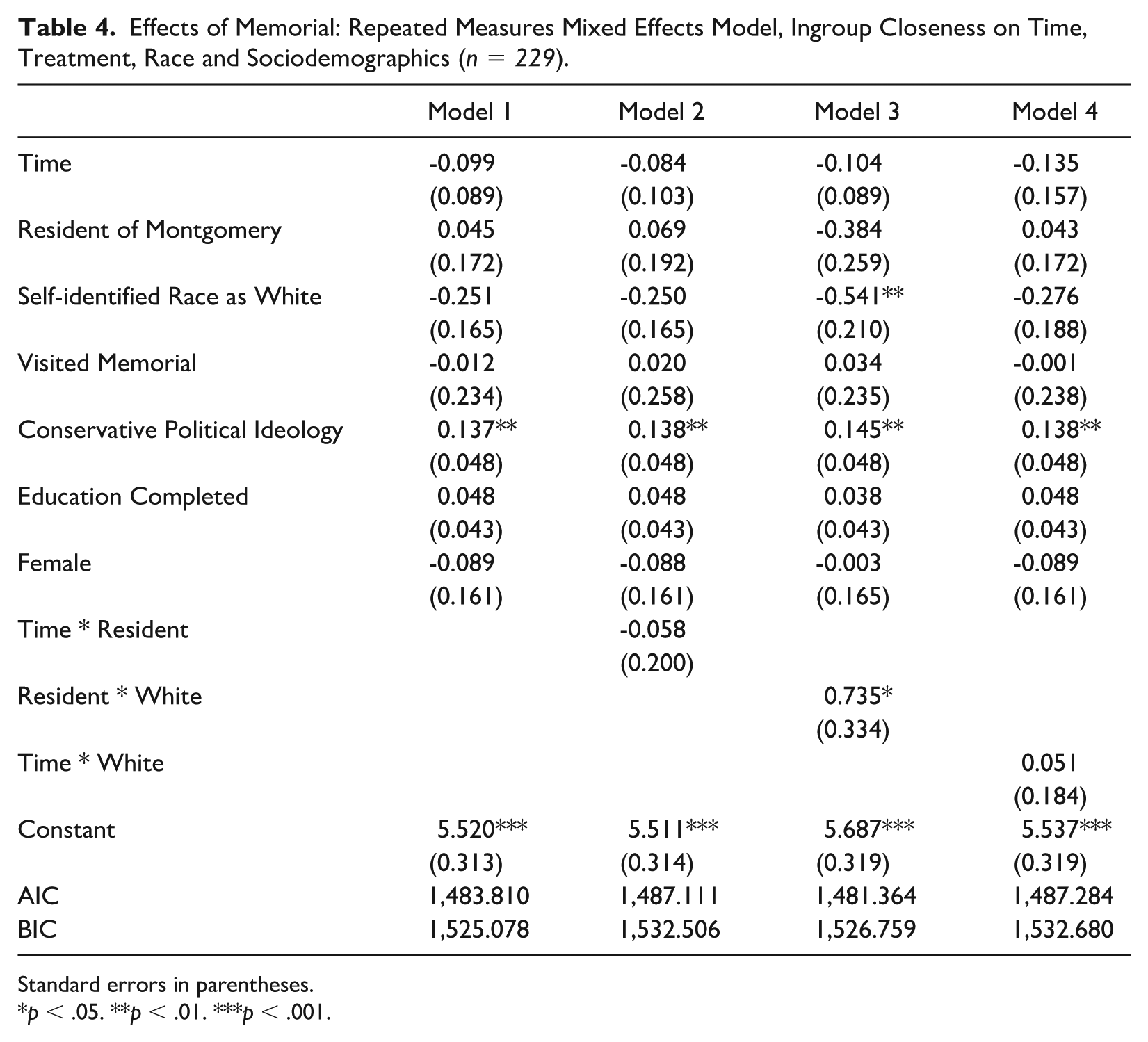
Table 4 presents the analysis of factors that impact changes in ingroup closeness. The results reveal that conservative ideology was positively related to changes in ingroup closeness between time 1 and time 2 (b’s ranging between .137 and .145; p ≤ .01). Specifically, conservativism was related to expressing higher levels of ingroup closeness at time 2 than at time 1. No other variables were significant in model 1. In addition, model 2, which included the interaction of time and residency, and model 4, which included the interaction between time and race, produced nearly identical results as model 1, since neither interaction was significant and conservative remained as the only significant predictor of changes in ingroup closeness.
Effects of Memorial: Repeated Measures Mixed Effects Model, Ingroup Closeness on Time, Treatment, Race and Sociodemographics (n = 229).
Standard errors in parentheses.
p < .05. **p < .01. ***p < .001.
The effects of the memorial manifest when we consider how race interacts with residency. Specifically, as seen in model 3, the coefficient of change of ingroup closeness across time is dependent on how a respondent identifies racially and whether they live in the city where the memorial was built. Once the interaction between residency and race is included, the main effect of race becomes statistically significant (BWhite = −.541; p < .01); however, the coefficient for the interaction effect is also statistically significant, but positive (BWhite * Montgomery = .735; p < .05). This indicates that White respondents who lived in the city where the memorial was built were more likely to report increased feelings of ingroup closeness after the memorial was built, while the reported feelings of ingroup closeness among White nonresidents decreased after the memorial was built. Time, residential status, visiting the memorial, education, and sex had no independent effects.
Figure 1 reports the predicted levels of ingroup closeness for various respondents based on race and residency at time 2.
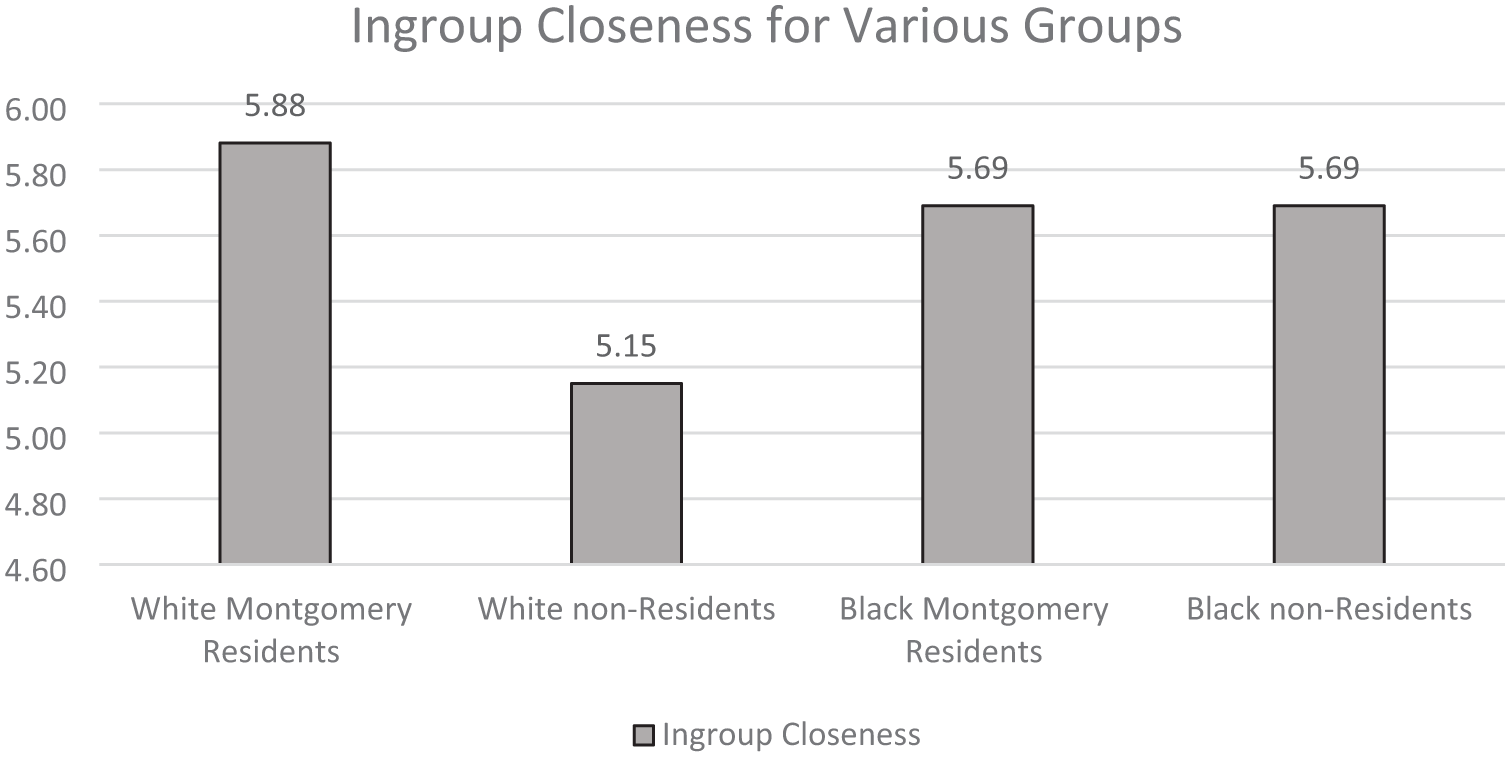
Predicted values of ingroup closeness for Black and White residents and nonresidents at time 2, while controlling for time, visiting the memorial, political ideology, education, and sex.
Looking at Figure 1, while White respondents who did not live in Montgomery reported the lowest levels of ingroup closeness, White residents of Montgomery expressed the highest levels at time 2. Since the coefficient for the main effect of residency was not statistically significant, its influence only is noticed in the interaction term; therefore, being a resident only influences White respondents, as demonstrated by the fact that Black residents and Black nonresidents have the same predicted levels of ingroup closeness.
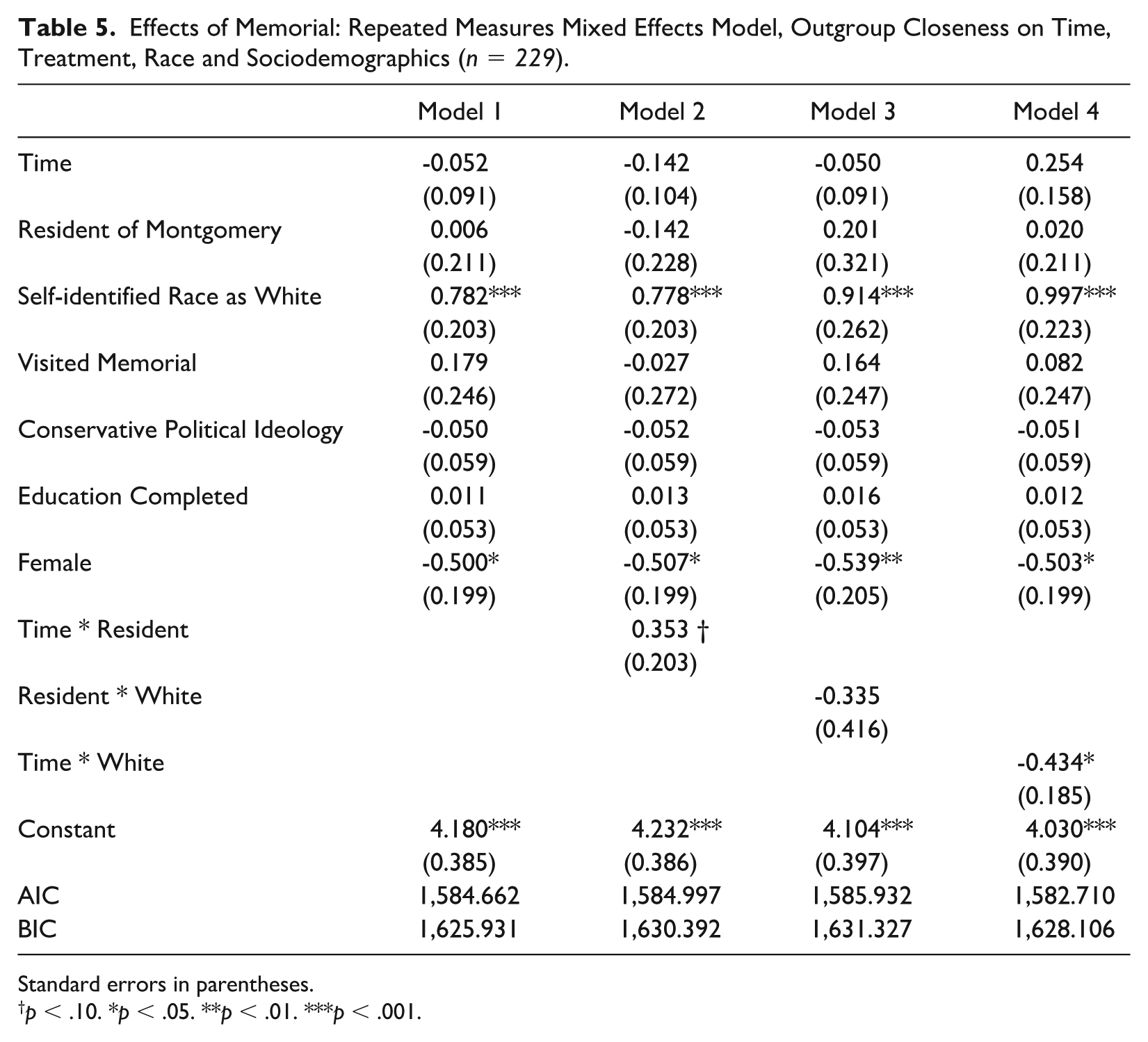
Table 5 presents the results of factors affecting changes in outgroup closeness across time. Specifically, the results demonstrate that racial identification and gender have consistent and sustained effects, despite the model specification. Identifying as White was consistently related to reported increases in outgroup closeness (b’s ranging between .778 and .997; p < .001), while identifying as female was associated with reporting decreases in feelings of outgroup closeness (b’s ranging between −.500 and −.539; p ≤ .05). The main effect of time never achieves statistical significance in any model, but time appears to have a different influence on outgroup closeness depending on the respondent’s racial identification. In model 4, the interaction between time and White is significant. This means that that White respondents were more likely to report decreases in reported feelings of outgroup closeness across time (b = −.434; p ≤ .05). 4 Thus, although Whites expressed relatively higher levels of outgroup closeness than did Blacks, the levels of expressed outgroup closeness among Whites toward Blacks decreased during this time in Alabama no matter where a respondent lived. In other words, the gap between Whites and Blacks in terms of their expressed levels of outgroup closeness became more similar at time 2 than they were at time 1. This implies that the driver of changes was not the memorial, but rather something broader in society, causing Whites to express decreased levels of closeness with Black Americans. We are unable to assess if this broader societal change was at the state level or the national level, since we do not have a comparative national sample. However, we know the change was specific to White respondents and not restricted to Montgomery respondents.
Effects of Memorial: Repeated Measures Mixed Effects Model, Outgroup Closeness on Time, Treatment, Race and Sociodemographics (n = 229).
Standard errors in parentheses.
p < .10. *p < .05. **p < .01. ***p < .001.
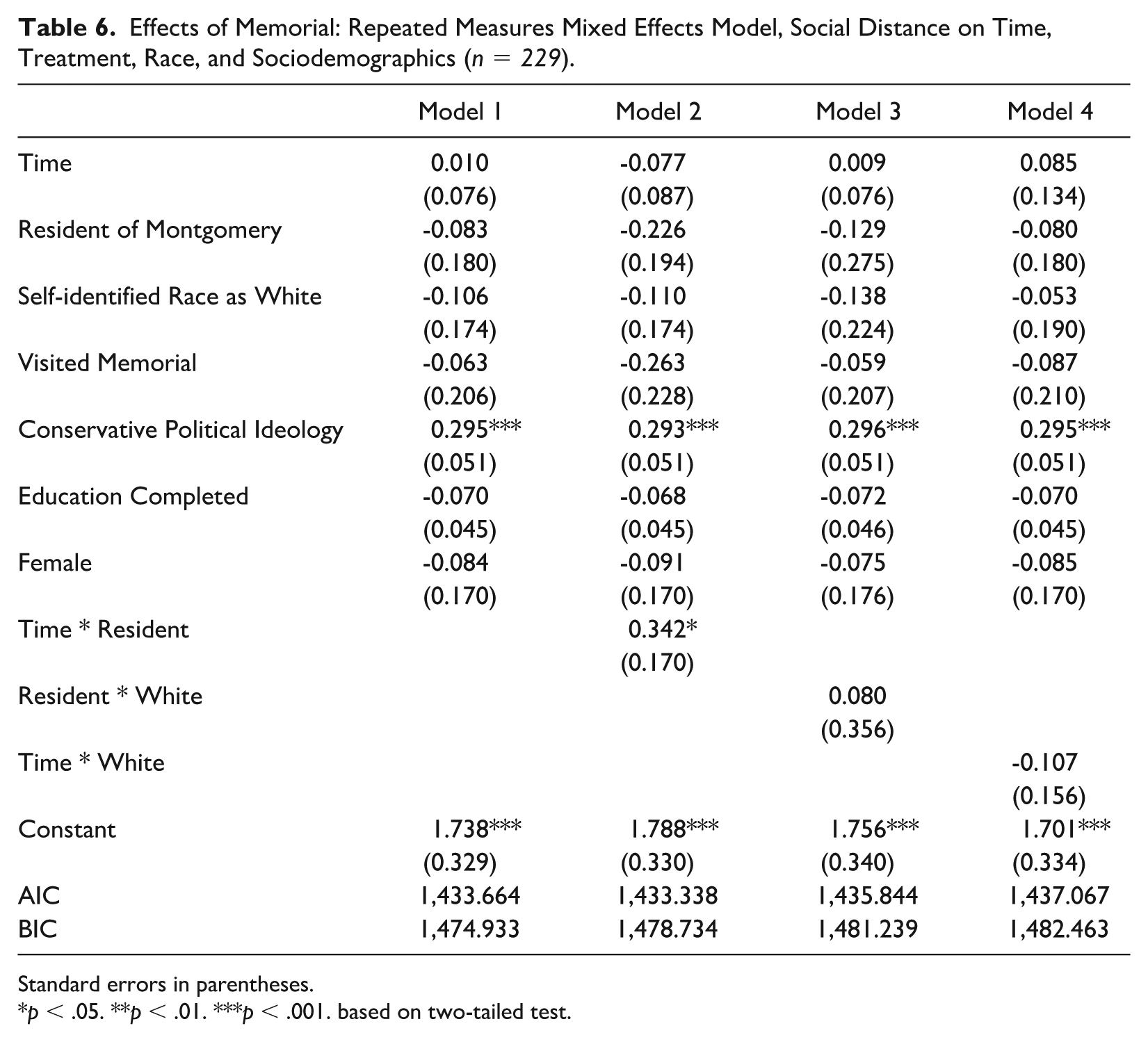
Table 6 presents the results of factors affecting changes in feelings of social distance across time. Identifying as conservative increases the likelihood of reporting feelings of more social distance between time 1 and time 2 (B’s ranging from .293 to .295; p < .001). The effects of residency do not manifest until we include a time interaction term (Btime * resident = .342; p < .05). 5 When looking at how time affects feelings of social distance among residents, we see that Montgomery residents report higher changes in social distance at time 2 than nonresidents at time 2. That is, while nonresidents’ feelings of social distance remained stable, those respondents living in Montgomery reported feeling more socially distant from members of other racial groups. This effect holds regardless of the respondent’s racial identification. These findings indicate that the memorial may have had an independent effect on increasing feelings of social distance among racial groups, at least as reported by this sample.
Effects of Memorial: Repeated Measures Mixed Effects Model, Social Distance on Time, Treatment, Race, and Sociodemographics (n = 229).
Standard errors in parentheses.
p < .05. **p < .01. ***p < .001. based on two-tailed test.
Discussion
While these findings focus on changes in intra- and intergroup views, they have both theoretical and practical implications. They are crucial to considering the roles that memorialization can play in post-conflict peace processes, particularly in the absence of a wider TJ movement. Healing is primarily an intragroup process, while reconciliation is an intergroup process; therefore, intra- and intergroup views will directly affect the viability of these processes.
Since solidarity promotes healing, healing would be demonstrated through an increase in ingroup closeness among Black residents since their group was the victim of lynching and suffered the unacknowledged collective trauma that the memorial was bringing to the forefront. The results did not offer any evidence of the intragroup process of healing. Instead, it appears that the memorial elevated the ingroup closeness of Whites, and this occurred when levels were decreasing among White nonresidents. This elevated level of closeness among Whites is possibly a result of heightened levels of threat to their identities that representations of lynching pose. That is, as SIT (Tajfel and Turner 1986) and IT (Burke and Stets 2022) would predict, when confronted with their group’s role as perpetrators of racial violence and collective trauma, Whites struggle to maintain a positive view of their White identity. This threat to their identity can result in negative feelings or attitudes about the outgroup (as all three theories might predict). A threat can also lead to creative strategies for re-envisioning the group by reframing the situation in such a way to provide ingroup protection from the perceived group threat. SIT refers to this as “in-group love” (Brewer 1999), while GPT identifies it as a protection mechanism known as ingroup insularity (Blumer 1958).
With respect to the process of reconciliation, the memorial’s impact could theoretically be seen through decreases in levels of outgroup closeness and social distance among residents. Again, the data does not indicate that memorialization facilitated the occurrence of this process. In fact, the evidence suggests the memorial’s placement in Montgomery was associated with increased feelings of social distance among both White and Black residents, potentially driving the groups further apart rather than bringing them together. Theoretically, SIT would frame such an increase as rooted in the inability for Whites or Blacks in Montgomery to see themselves positively in a representation of lynching. IT provides a framework to understand why each group would distance from the other because their views of themselves as racial group members are not being verified in the memorial representation. Finally, while White respondents express more outgroup closeness toward Blacks than Blacks do toward Whites, Whites were less willing to express outgroup closeness toward Blacks as time passed. This change indicates a more broadly occurring phenomenon among race relations. This more global change of outgroup closeness among White Americans could be understood in the recent literature on White racial identity and its relationship to conservative politics (Armaly, Buckley, and Enders 2022; Grindal and Haltinner 2023; Reichelmann and Hunt 2022; Reichelmann, Roos, and Hughs 2022). Both of these results concerning reconciliation should be interpreted with caution, due to the limited sample size.
The findings also offer insight into how memorialization affects local communities. First, it is important to reiterate that these passive effects of placement occurred in the absence of a wider TJ movement at the national level. We found that contrary to expectations of healing but in line with theories of identity and their application to race (such as Blumer 1958; Tajfel and Turner 1986), the memorial was associated with a growing gap between racial groups. Its presence was related to an insular heightening effect for White residents, increasing their ingroup closeness, but having no distinguishable effects on the ingroup closeness of Black residents. Thus, the memorial affected this proxy measurement of healing, but it did so in such a way that would not likely promote healing.
In addition, the memorial appeared to be associated with a growing gap between racial groups, which is contrary to the theoretical needs for reconciliation. The data indicate that the memorial increased feelings of social distance within the memorial city, regardless of racial identification. Given that visiting had no unique independent effects, the memorial’s sheer presence seems to have affected the relationships between racial groups within the city vis-à-vis changes in intra- and intergroup views. While these results have implications for the role memorialization might play in broader projects of healing and reconciliation, the research design’s limitations are important to acknowledge.
The project’s limitations are largely rooted in methodological issues. First, while data was longitudinal, the retention rate dropped significantly. While this is not unusual in the sampling design of “cold mailing,” it is possible and likely that only those who felt strongly about the memorial one way or the other remained in the sample across the project’s duration. Related, the final analytical sample was representative of the wider Alabama parameters, but not necessarily the population of Montgomery. Montgomery is a majority-minority city with approximately 61 percent of the city identifying as Black or African American, and yet 60 percent of the Montgomery analytical sample self-identified as White. Future projects should seek to enhance their samples through a local connection, where possible, as well as strive for proportionate representations on key parameters. Second, the ideal data collection design would have included both qualitative and quantitative data collection, since reconciliation processes are more completely captured by in-depth visits and conversations (for an example of ethnographic research on reconciliation processes, see Fox 2021; Whitlinger 2020). We were not residents of the city nor were we able to work in partnership with the memorial’s builder despite attempts to do so. For these reasons, we did not have the capacity to complete a qualitative project component as originally planned. Future projects studying memorialization and its effects should leverage both qualitative and quantitative components to fully triangulate results. We also could have employed multiple items assessing healing and reconciliation; however, that was hampered by researcher expense and wanting to protect the time of the respondents. In addition, this study was unable to assess the impact of local and international media coverage as well as potential statements from influential politicians and cultural leaders, all of which could impact the local attitudes of residents; however, these same factors would have also had effects on the nonresidential sample. All limitations represent avenues for future studies. While these limitations are important to consider, the results demonstrate that future work should strive to understand how memorials passively impact those who live with them and the relationships between residents.
The findings reveal that visiting the NMPJ did not have an independent effect on the intra- and intergroup closeness, but the memorial had some localized effects sheerly through its presence. While these findings are contextual to the NMPJ, they indicate a need to understand the nuance of memorialization. This means engaging with social scientists at all stages of memory work—including conception, introduction of concept to residents, design development, and exposure—to assess the community reaction and impact. Practically, this would mean conducting multiple evaluative tests before building a memorial, and soliciting community input prior to and during construction. Social science evaluation would allow local communities and their leaders to track the social effects of memorialization on their everyday interactions and relationships. A similar method has been regularly used to assess the economic impact of tourism sites.
Knowing how the range of community residents and demographics will respond before a memorial is built will provide the developers, community leaders, and local organizers with vital information and time to prepare for remediating any potential negative responses to the memorial. Such knowledge would also allow community leaders to plan corresponding events and openings to meet the needs of the public response. All of these recommendations echo those offered by Judy Barsalou (2005) in her international practitioner work and consultation with field experts. The pre-evaluative work could be conducted as an experimental design utilizing advances in virtual reality (VR). VR technology would allow a range of residents from different backgrounds to walk through and interact with the memorial virtually prior to its construction. These experiments could also capture implicit and latent responses that are not hampered by self-reporting, such as the use of MRI machines to record cortisol levels.
Conclusion
Our findings suggest that the effects of memorialization are complicated and have local implications for race relations. In this case, the NMPJ impacted residents’ levels of ingroup closeness (only for White residents) and social distance. These effects did not happen in the comparison samples that lived outside of Montgomery, where the memorial is located. Specifically, the results indicate that memorialization has both direct and indirect passive effects on local residents that need to be systematically and intentionally investigated. This research does not address the ways in which the NMPJ focused national and international attention on the unacknowledged history of lynching and its legacy; future research should focus on the memorial’s intended scope to understand the totality of its effect on healing and reconciliation at the national level. In this paper, our contribution was isolating the unique localized and interpersonal effects of the NMPJ, the first large-scale national memorial to victims of lynching in the United States. The NMPJ is a rare, but important case study, due to its notoriety.
For this same reason, these findings should be interpreted with caution and taken in context. The NMPJ is the first of its kind, massive in scope, and was placed in Montgomery, Alabama, a city lined with reminders, both visible and invisible, of the racial horrors of the past and the triumphs of Black Americans’ push for full and complete equality. In addition, change takes time, and our study only captured its immediate effects. If any factors about the memorial changed—for instance, its timing, its size, scope, content, aesthetic representation, or placement, among other elements—or the nation had engaged in a TJ effort, the localized effects of the memorial could have differed.
Memorials have local implications, and this is simply a fact. Indeed, any large-scale change in landscape will likely have an impact. In this case, the NMPJ introduced the first counternarrative to visually represent the massive number of Black Americans who were lynched between Reconstruction and the CRM. Given the memorial “productively challenges the linear, orthodox nature of civil rights narratives” (Hasian and Paliewicz 2021:181), it is bound to have effects, both at the national and local level. Given the content of the memorial, it is not surprising that it would affect intergroup relations, since it represents an understudied and underrepresented period in the history of American racial violence. The introduction of a counternarrative will always make waves as it attempts to complicate, contextualize, and challenge the dominant narrative; this time was no different. The knowledge of what that impact could be offers important insight to local and national leaders alike about next steps to assist their communities in facilitating the healing and reconciliation processes, while considering the connection between the past and the present. While the results are specific to the NMPJ, we hope they open a conversation among social scientists and policy makers about how we can best support communities in their decisions and desires to make the past present.
Footnotes
Acknowledgements
A special thanks to John Ryan, our late colleague, for his role in conceptualizing the methodological design and research questions. We also express gratitude to Judy Barsalou for her guiding thoughts, and audience members at the 2019 PEACE-PHS Joint Conference, and the 2024 Southern Sociological Society annual meeting for their feedback on versions of the paper.

Funding
This material is based upon work supported by the National Science Foundation under Grant No. 1822295: Memorialization and Community. Any opinions, findings, and conclusions or recommendations expressed in this material are those of the author(s) and do not necessarily reflect the views of the National Science Foundation.
Declaration of Conflicting Interests
The authors declared no potential conflicts of interest with respect to the research, authorship, and/or publication of this article.