






Abstract
Polymer composites with high dielectric permittivity and thermal conductivity are highly desired due to their potential applications in a wide range of electronic and electrical industries. In this study, the composite consisting of poly(vinyliene fluoride) (PVDF), Al, and carbon nanotubes (CNTs) was prepared. The investigation of the dielectric properties and thermal conductivities of the ternary composites while comparing with the Al/PVDF binary composites indicates that the addition of 1.0 wt% CNTs in the Al/PVDF clearly improved the dielectric permittivity due to enhanced interfacial polarization of filled matrix, whereas the dissipation factors still remained at acceptable low level owing to the insulating alumina shell and the isolation effect of Al on CNTs in the matrix. Moreover, the hybrid Al/CNTs particles obviously enhanced the thermal conductivity of the composites due to the more heat conductive pathways formed in the matrix from the CNTs bridging effect between the Al particles.
Introduction
As a kind of passive components, embedded capacitors are of great importance for a range of applications in modern electronic systems such as kinetic weapons, electromagnetic armor, high power microwaves, etc. 1 Embedded capacitors are specially printed portions of printed circuit board (PCB) laminates that perform the charge-storing function but do not require space on the surface of PCB.1–3 Embedded-capacitor technology is an important emerging technology that will enable significant improvement of performance and functionality of future electronic devices. 4 Recently, significant progress has been achieved in developing embedded capacitors that can provide improved electrical performance and reduced assembly cost compared with traditional capacitor technologies. In an effort to further enhance the energy storage property of embedded capacitors, some critical properties of dielectric materials including high dielectric permittivity but low dielectric loss are eagerly desired. 5 However, the traditional dielectric materials, such as organic polymer and inorganic ceramics, fail to meet the rigorous requirements of advanced capacitors. Since most of polymers for dielectric applications have low dielectric constant, therefore, the development of polymer composites with high dielectric permittivity but a low dielectric loss for the application in embedded capacitors has attracted ever-increasing attentions and has gained remarkable progress.1,3,4,6–8
Up to now, a great number of papers concerning the preparation of high dielectric permittivity polymer materials based on conductor particles/polymer composites have been reported. The use of various conductive fillers, such as metallic powders (Au, Ag, Cu, Al)1,3,4,6 and carbon (carbon black, carbon nano-tube, carbon fiber and graphite),5,7–12 has been explored extensively and shown to improve the polymer’s conductivity and dielectric properties. Percolative systems consisting of insulating polymers and conductive fillers show very high dielectric constants near the percolation threshold. However, this kind of composites also suffers from high dielectric loss and low breakdown strength, and it is difficult to control the dielectric constant by precisely adjusting the filler loading. After many attempts, researchers have found that forming a insulating coating or shell on the surface of conductive filler can effectively reduce the dielectric loss of the composite.13–15
Recently, the surface self-passivated micro or nanometer aluminum particles (Al) were chosen as the filler to fabricate the core-shell structured Al (Al@Al2O3)/polymer composites with high permittivity but low dielectric loss.16–22 The Al core is used to increase the dielectric constant due to the interfacial polarization (namely, MWS effect), and the Al insulator shell (Al2O3) serves as a barrier layer to control the dielectric loss efficiently through blocking the electron transfer between adjacent metallic cores.16–22 Additionally, it is essentially crucial for the heat generated and accumulated form electronics to be dissipated as quickly and effectively as possible, to maintain the operating temperatures at a desired level, Therefore, the development of polymeric dielectrics with high thermal conductivity and dielectric permittivity but low loss is very important because good heat dissipation capability facilitates prolonging the lifespan of polymer dielectrics at a higher operating temperature. Otherwise, the dielectric strength will decrease owing to the poor thermal conductivity of this dielectric materials.23–25
The core-shell Al/polymers possess a stable higher dielectric permittivity and low dielectric loss, as well as an improved thermal conductivity, whereas high Al loading (usually great than 50 vol%) is necessary to achieve high dielectric permittivity above, thereby inevitably weakening or deteriorating the processibility, flexibility and mechanical performance of the composites. In order to further improve the dielectric permittivity and thermal conductivity of Al/polymer while remaining the same filler content, a small amount of CNTs can be added into a polymer host to form more bridges between Al particles in the matrix.
The aim of current study is to prepare a high thermal conductive Al/CNTs/PVDF composite with high dielectric permittivity but low dielectric loss. Therefore, three-phase dielectric composites comprising of ferroelectric polymer PVDF, core-shell-structured Al particles, and CNTs were fabricated. Poly(vinylidene fluoride) (PVDF) was selected as the matrix due to its good thermal stability and toughness. This material can be easily processed via the injection mold/melt method. PVDF is non-toxic, resistant to heat and chemicals, and has low water absorption characteristics, very suitable for the use of fabrication of electronic components. 26 CNTs were chosen as the third component owing to its extremely high electrical conductivity, thermal conductivity, and excellent mechanical properties as well as its high aspect ratio. CNTs can change significantly the electrical properties of the polymer matrices even at very low filler loadings while keeping the main characteristics of polymer matrices.27,28 Additionally, the large aspect ratio of CNTs can easily form an interconnecting network of percolation which can transfer phonons and electrons to enhance the thermal properties of the nanocomposite.28,29 Up to now, the thermal conductivity and dielectric properties of Al/CNTs/PVDF in a wide frequency range have rarely been investigated. Therefore, the present research is expected to provide a deeper insight into the influence of the hybrid Al/CNTs content on the thermal conductivity and dielectric properties of the composite. It is anticipated that, when compared with the two-phase Al/PVDF composites with the same filler loading, such ternary composites not only have significantly increased dielectric constants but also show much higher thermal conductivity. For the sake of comparison, the Al/PVDF composites were also prepared.
Experimental
Materials
PVDF (FR901 type) with a density of 1.78 g/cm3 was purchased from 3 F New Materials Co. (Shanghai, China). The spherical mrico-Al power (m-Al, average diameter ∼1–3 µm) and nano-Al power (n-Al, average diameter ∼70 nm) were purchased from Henan Yuanyang Company (Henan, China) and Nano Science and Technology Co., (Xuzhou, China), respectively. The mutli-walled carbon nanotubes (CNTs, average diameter of 70-80 nm and average length of 15–20 µm) used in this study were supplied by Suzhou Jieda Nano Technology Co., China. The silane coupling agent was γ-(Aminopropyl)-triethoxysilane from Nanjing Shuguang Chemical Co., China. The Dimethylformamide (DMF) and dimethyl benzene were supplied by Tianjin Chemical Reagent Co., China.
Surface modification of Al particles
Surface treatment for Al particles using the silane couplers involved the following steps: (1) dispersing m-Al or n-Al particles in a high purity dimethyl benzene solvent under sonication for 30 min; (2) adding appropriate amount of silane coupler (1.2 wt% for the m-Al, and 2.5 wt% for the n-Al particles) to the mixture; (3) heating to 90–110℃ and stirring for 6 h; (4) filtrating and washing the surface-treated Al at least three times with dimethyl benzene to remove the unreacted siloxane moieties, and (5) drying at 120℃ for 10 h in a vacuum oven to remove the residual solvent. 25
Preparations
The preparations for Al/PVDF composites were carried out as follows 26 : The PVDF and Al particles were vacuum-dried at 60℃ for 4 h and 120℃ for 8 h prior to use, respectively. Then the desired amount of PVDF was dissolved in the smallest amount of DMF by stirring at room temperature. At the same time, the desired amounts of Al were dispersed in DMF under sonication for 2 h. The suspension was then added to the PVDF solution. The obtained mixture was stirred for 8 h and then at 130℃ to evaporate the majority of DMF. The resulting composite was heated at 120℃ in a vacuum oven to remove the residual solvent. Finally, it was compression-molded at 200℃ for 15 min under a pressure of about 15 MPa.
The three-phase Al/CNTs/PVDF composites were prepared according to the same procedure mentioned above. The concentration of CNTs was fixed at 1 wt% in the Al/CNTs/PVDF ternary composites after many optimized tests which implied the incorporation of higher/lower concentrations in the presence of Al filler. When lower loading of CNTs was introduced, no significant enhancement to the final properties was observed. On the other hand, the improvement was sharply limited for higher concentrations of CNTs. To investigate the effect of the addition of CNTs on the dielectric properties and thermal conductivity of the composites, 1 wt% CNTs was selected in this study.
Characterizations
The morphology of the prepared samples as well as the dispersion of fillers in the composites was carried out using scanning electron microscopy (SEM, JSM-7000F, JEOL, Japan). The fractured surfaces were prepared in liquid N2 and were sputtered with gold in vacuum prior to observation. The dielectric measurements of the samples were recorded using an impedance analyzer (Agilent model 4294). The specimens for dielectric measurements were molded in the form of circular disk (diameter = 20 mm and thickness ∼1 mm). A layer of Al foil was placed on the upper and lower surfaces of the specimens prior to measurements. The thermal conductivity performances of the samples were tested using a Hot Disk thermal analyzer (TPS 2500, Sweden). The specimens for thermal conductivity measurements were molded as a circular disk (diameter = 20 mm and thickness ∼1 mm).
Results and discussion
Permittivity of a material represents the ability to store a charge when the material is subjected to an electric field and reflects the dielectric properties of the material. Figure 1 shows plots of dielectric constant versus frequency for the Al/PVDF and Al/CNTs/PVDF hybrid composites. From Figure 1(a) and (b), we can see that the dielectric permittivity obviously increased with increasing Al content, and the dielectric permittivity of PVDF containing 50 wt% m-Al/PVDF and n-Al/PVDF at 103 Hz were 35 and 24, respectively, which are 2–3 times the values for the pure PVDF. The dielectric constant enhancement can be ascribed to interfacial polarization, also referred to as the Maxwell-Wagner-Sillars (MWS) effects, a phenomenon that appears in heterogeneous media consisting of phases with different dielectric constant and conductivity. In this experiment, when the Al content is low, they are isolated, placed so far apart that there is no interaction between them. As the Al concentration is further raised, the particle clusters are formed, leading to a greatly increased dielectric constant. The particle clusters may be considered as a region in the PVDF where Al particles are in contact or very close to each other. For the n-Al/PVDF composites, we can see that the dielectric permittivity of PVDF continued to increase as the filler content increased to 40 wt%, and subsequently decreased due to the voids and defects at the interfacial phases reducing the dielectric permittivity. Therefore, it is impossible to further increase the Al loading to obtain a higher dielectric permittivity because the composites not only show a lower permittivity, but also loses the material processability and mechanical strength. Thanks to the CNTs' special structure and great electrical and thermal conductivity, the addition of an extremely small content of CNTs to the polymer will result in remarkably enhanced dielectric permittivity. So, in order to further improve the dielectric permittivity while keeping the same filler content, the CNTs/Al/PVDF three-phase composites were prepared.
Dependence of the dielectric constant on frequency for the composites of: (a) m-Al/PVDF; (b) n-Al/PVDF; (c) CNTs/m-Al/PVDF; and (d) CNTs/n-Al/PVDF.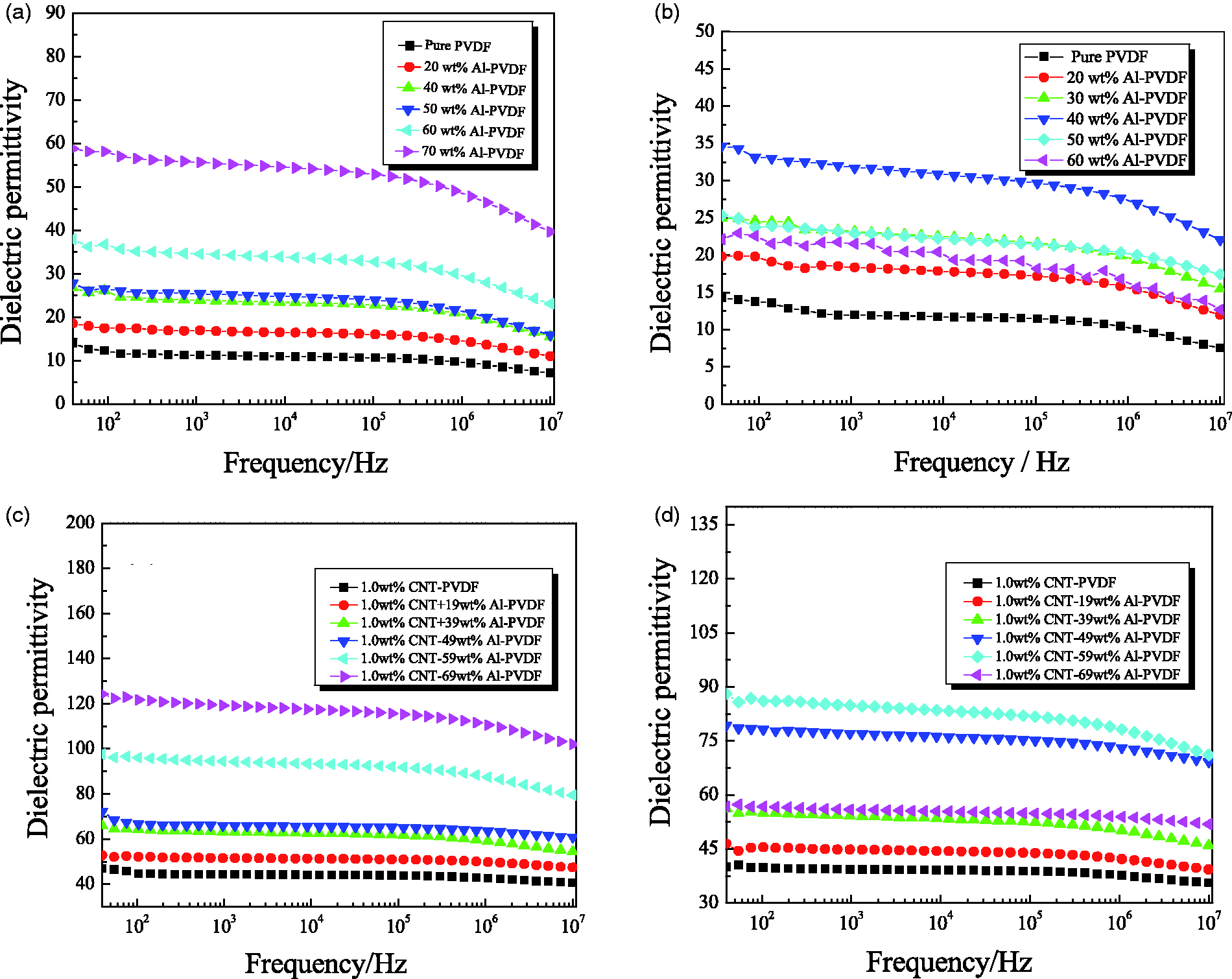
Owing to CNTs’ special structure and physical properties, the addition of an extremely small content of CNTs to the polymer, the dielectric permittivity will be greatly increased. In order to further improve the dielectric permittivity of Al/PVDF composite while keeping the same filler content, in this study, the Al/CNTs/PVDF three-phase composites were prepared. Figure 1(c) and (d) presents the dependence of the dielectric permittivity after CNTs added to the m-Al/PVDF and n-Al//PVDF, respectively. It is found that after the incorporation of 1.0 wt% CNTs into the matrix, the m-Al/CNTs/PVDF and n-Al/CNTs/PVDF displayed relatively high dielectric constants at low frequencies because of the greater difference of the electrical conductivity between the filler and the polymer resulting in a stronger interfacial polarization compared with the Al/PVDF composites. For example, the dielectric permittivity for the 50 wt% m-Al/CNTs/PVDF and n-Al/CNTs/PVDF is 66 and 77 at 103 Hz, compared with the values 34 and 23 for 50 wt% m-Al/PVDF and n-Al/PVDF, respectively. The dielectric permittivity of 69 wt% m-Al/PVDF with 1 wt% CNTs reached its peak of 121 at 100 Hz. The obvious enhancement in the dielectric permittivity can be ascribed to the CNTs’ large surface areas, high aspect ratio, and its extremely high conductivity, leading to the enhanced interfacial polarizations of the Al/PVDF. For this conductor/polymer composite, a thin insulating layer of semicrystalline PVDF was combined with the Al-CNTs to form the nanoscale structure in the composite. In this case, the large π-orbit of the CNTs could provide large domains for nomadic electrons, and strongly electrophilic groups in the Al-CNTs could intensify the MWS effect, 30 which leads to a greater average polarization and thus a greater contribution to dielectric constant. Consequently, without further increasing the total filler loading, we can obtain obviously high dielectric constant due to the higher dielectric permittivity of the CNTs/PVDF matrix providing the three-phase composites large dielectric constant. Thus, the obtained polymer composites still possess moderate flexibility and mechanical properties, thanks to the excellent reinforcement effect of CNTs.
It also can be noted that from Figure 1, for a given loading of Al, the dielectric permittivity deceased with the increase of the frequency. This behavior might be ascribed to the relaxation mechanism of the composite. As the frequency increases, polarization movement within the composites cannot keep up with the frequency of applied electric field, generating polarization weakened rapidly, which resulted in the reduction of the real part of the dielectric constant. The interfacial polarization and the dipole polarization in the nanometer-sized dielectric shells are dominant in determining the relaxation in the measured frequency range. 31
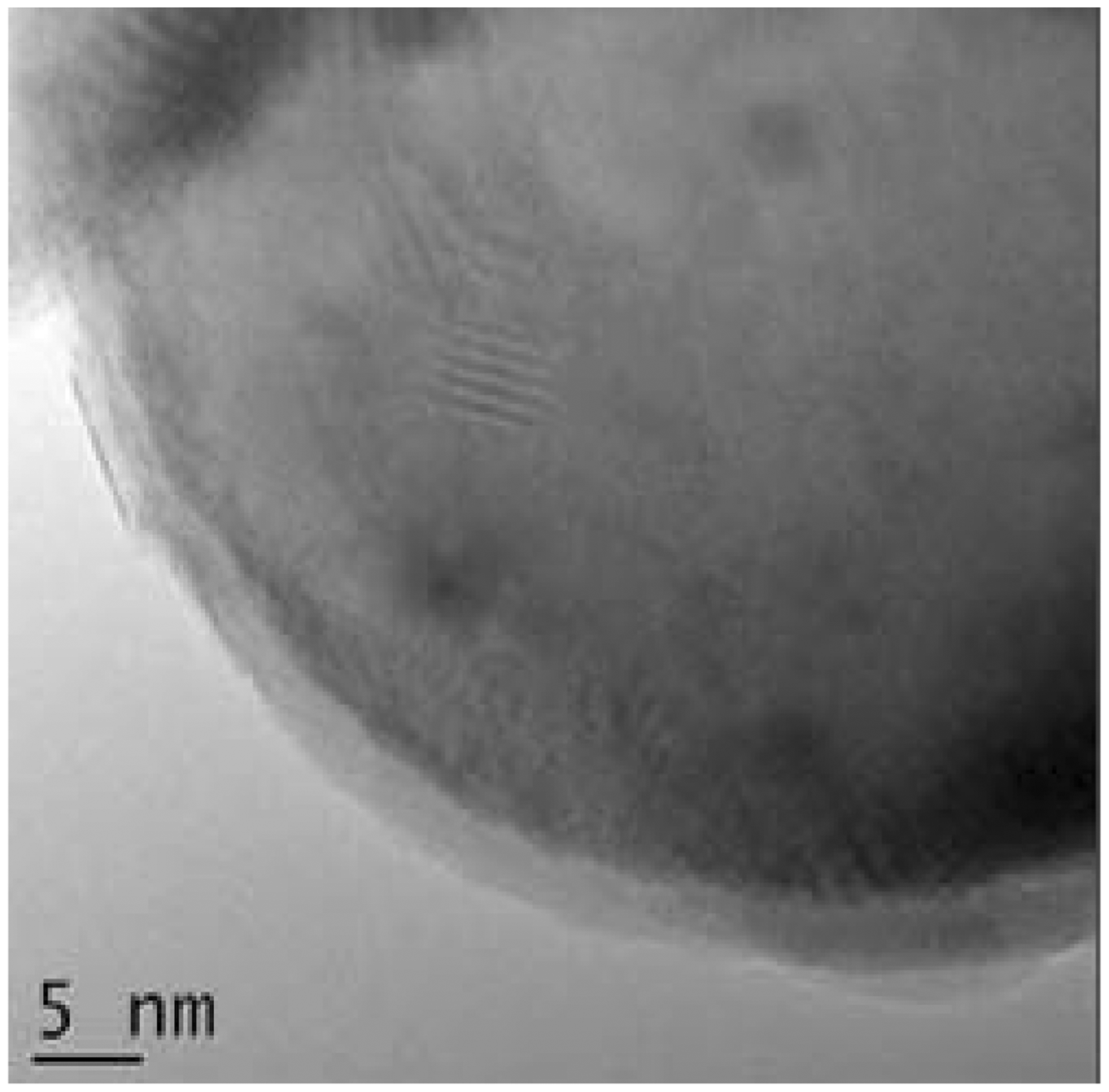
It is well known that the dielectric loss is a measurement of energy dissipation from the movement or rotation of the molecules in the external electric field. Therefore, the magnitude of dielectric loss can be used to evaluate the interfacial adhesion between the fillers and the matrix in the composites. The dielectric loss factors of the two-phase Al/PVDF and Al/CNTs/PVDF ternary composites are presented in Figure 2. From Figure 2(a) and (b), we can see that the Al particle loading did not have a appreciable influence on the dissipation factors of the composites in the frequency range of 40–107 Hz, and that the dissipation factors were generally less than 0.22, just the same as that of pure PVFD due to the formation of insulating oxide aluminum shell structure (as seen in Figure 3.) on the surface of Al particles. As an interlayer between the Al cores, the alumina shells prevent them from contacting with each other, and form electric current across the composites, thus effectively reducing the dielectric loss of the composites. Figure 2(c) and (d) demonstrates that the dissipation factor of Al/CNTs/PVDF ternary composites almost unchanged and still remained a low dielectric loss below 0.23 compared with the Al/PVDF. Generally speaking, the high permittivity is always coupled with high dielectric loss for the conductor/polymer composites. In this case, the dielectric permittivity and dissipation factor of Al/CNTs/PVDF reached 92 and 0.0469 at 100 Hz when 1.0 wt% CNTs was added. The dielectric loss is effectively reduced compared with that of pristine CNTs/PVDF because of the insulating alumina shell and the Al particles’ isolation effect on the CNTs in the matrix.
Dependence of the dielectric loss on frequency for the composites of: (a) m-Al/PVDF; (b) n-Al/PVDF; (c) (CNTs + m-Al)/PVDF; and (d) (CNTs + n-Al)/PVDF. TEM of a core-shell-structured Al particle.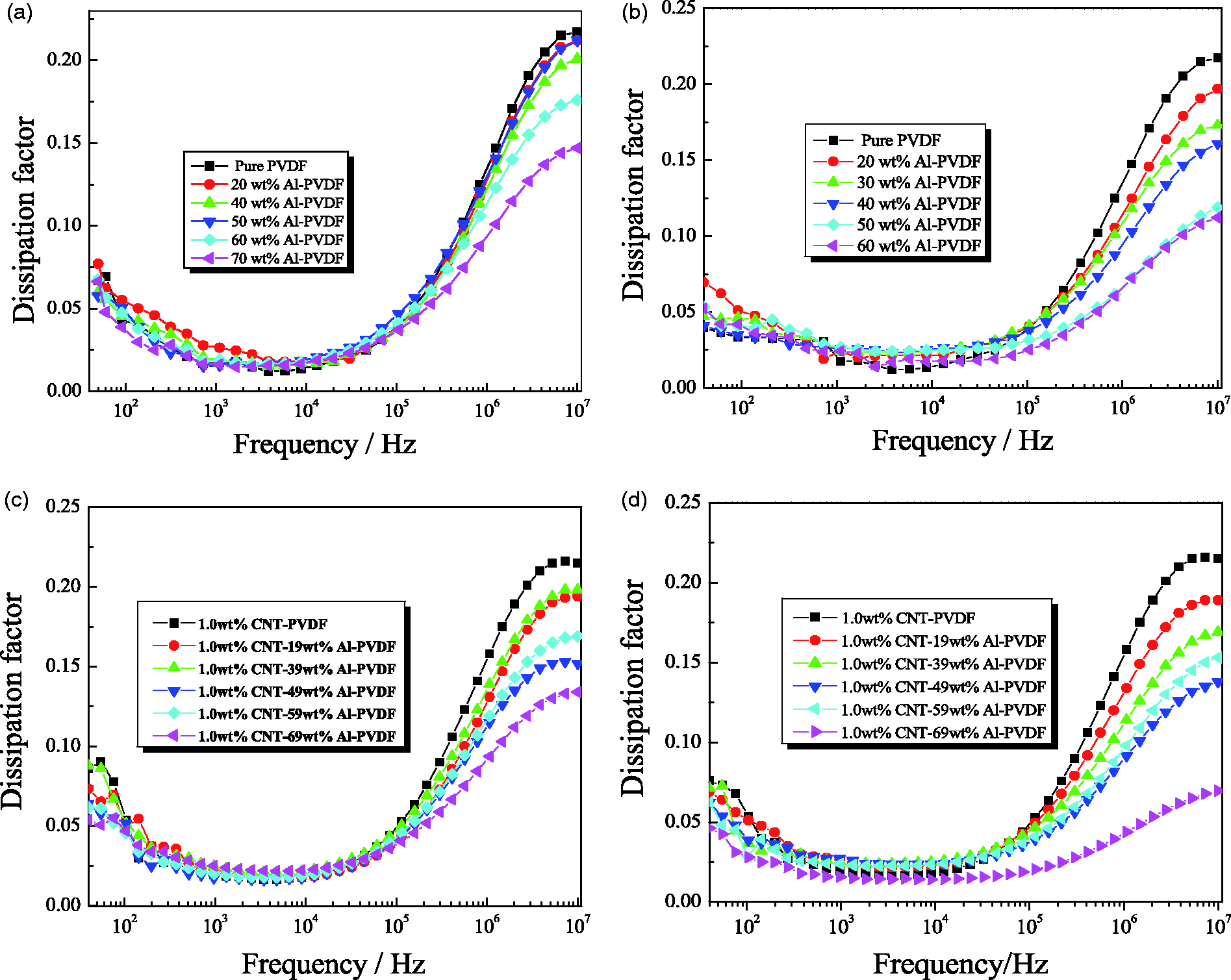
It is clear that the mass ratio of Al to CNTs loading rises with increasing the total filler concentration while keeping the CNTs content unchanged. Thus, the presence of more Al particles improves the dispersion of CNTs particles in the matrix because of the interactions between the Al and the CNTs particles (as seen in Figure 4.) and hamper the aggregation and connection between CNTs to form a electric network, which results in strong interfacial polarization leading to enhanced dielectric permittivity, and lower dielectric loss. So, such polymer reinforced with hybrid particles consisting of the core-shell structured Al and CNTs satisfies the need for a high dielectric permittivity and low loss value in a practical engendering application.
Schematic diagram of filler particles in the matrix: (a) CNTs dispersed in the matrix, (b) Al particles in the matrix, (c) the initial mixture of Al/CNTs, and (d) the final isolation of Al on the CNTs in the matrix.
It is also found that a relaxation process associated with interfacial polarization and dipole can be seen in the loss factor curves of the four types of composites. The dielectric losses continued to decrease as frequency increased to a certain high frequency, and subsequently increased remarkably. In all frequency ranges, we observed that the dissipation factor underwent two regions. The relaxation peak appears about 10 MHz is an obvious relaxation loss process related to the PVDF matrix, whereas the relaxation peak that appears below 100 Hz may be associated with the interfacial polarization owing to the charge accumulation on the boundary between the lamellar crystal and interlamellar amorphous region of PVDF.29,32 Compared with pure PVDF, the filled composites relaxation peaks exhibited a shift to high frequencies as the filler increased. As an increase in the filler content, the cluster number or size of filler cluster in the matrix increased, which causes a higher possibility for the charge carriers to accumulate on the interface between filler particles and PVDF, thus leading to a shorter relaxation time. Therefore, after the incorporation of Al or Al/CNTs particles into PVDF, the charge carrier can accumulate on the surfaces of filler, which causes the interfacial relaxation polarization peaks of the composites shifting to higher frequencies. 32
It is well known that there exists two kinds of possible electrical behaviors, i.e. the insulators with conductivity dependent on the frequency (for composites at f < fc,. fc is the percolation threshold of filler content in matrix) and the conductors with conductivity independent of the frequency (for composites at f ≥ fc).
27
The conductivity is given by equation (1)

Figure 5 shows the frequency dependence of electrical conductivity at various filler loading for the Al/PVDF and Al/CNTs/PVDF composites. Figure 5(a) and (b) reveals that the alternating current (AC) electric conductivity showed almost an independent of the Al concentration and a dependency on the frequency, suggesting the Al/PVDF is a typical insulator owing to the insulating oxide shell as an interlayer between the Al cores which prevent them from contacting with each other, and form electric current across the composites.
33
From the Figure 5(c) and (d) no percolation behavior was found due to the existent of insulator shell on the surface of Al cores, which has a dramatic effect on the electrical properties of Al particles and therefore increases the percolation threshold to a high value by reducing the corresponding conductivity.
34
The AC very slightly increased with the filler loading and exhibited nearly linear ascending with frequency, indicating the insulating nature of both composites mainly owing to the isolation effect of insulating shell on the CNTs and the insulating interlayer between the Al cores preventing them from contacting with each other and from forming electric current across the composites.
Dependence of the dielectric conductivity on frequency for the composites of: (a) m-Al/PVDF; (b) n-Al/PVDF; (c) (CNTs + m-Al)/PVDF; and (d) (CNTs + n-Al)/PVDF.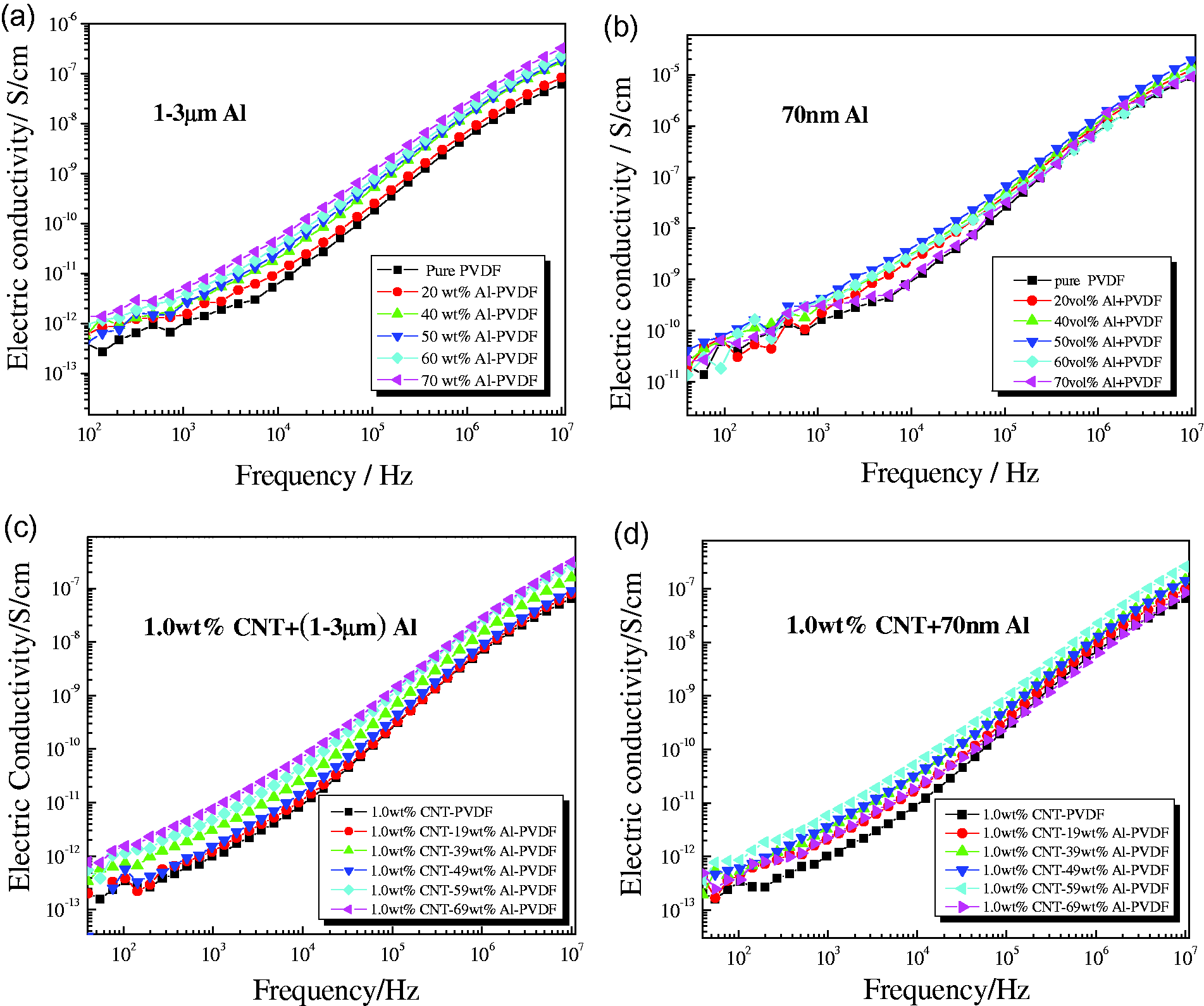
Thermal conductivity
It is well known that the thermal conductivities of composites greatly depend on the properties of polymers and fillers, such as their content, components, and the surface treatment of filler dispersion, porosity, and interactions between the two phases.
29
The thermal conductivities of PVDF with spherical Al and CNTs particles at various levels of loading are plotted in Figure 6. Figure 6 suggests that the thermal conductivity rose as the Al content increased due to the high thermal conductivity of the Al particles. At low Al loading, the thermal conductivity increases rather slowly, whereas at high filler loading, the thermal conductivity climbs sharply. This is mainly because the Al particles surrounded or encapsulated by a polymer matrix that cannot touch one another at low loading. The result of low thermal conductivity is also due to the high interfacial thermal contact resistance between filler particles and the polymer matrix. When at a high filler loading, the filler particles begin to touch each other and form particle clusters or a more compact packing structure within the matrix. This leads to improving the thermal conductivity because of the decreased interfacial thermal contact resistance.32,34 The uniform dispersion of Al particles eliminated the agglomerate of filler, and decreased the air voids and defects between filler particles. Therefore, it decreases the thermal contact resistance, facilitating improved thermal conductivity.
Thermal conductivities of the ternary composites with the filler content.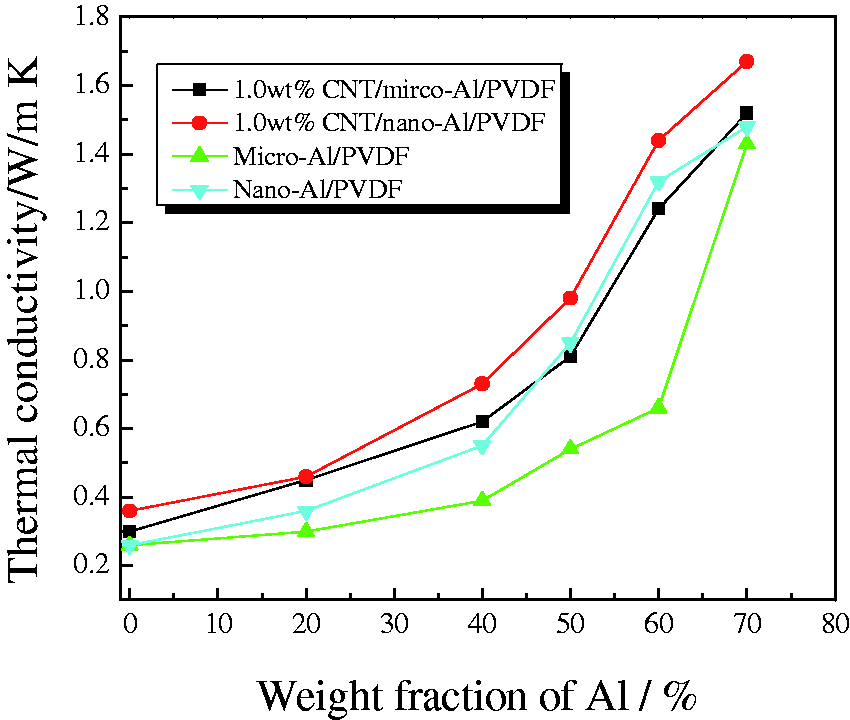
It is obvious that various sizes of Al particles play an important role in thermal conductivity of the composites. At a high filler concentration, the n-Al-reinforced PVDF exhibits higher thermal conductivity than the m-Al-filled one under the same filler content. For example, the thermal conductivity of the composites with n-Al particles at 50 wt% and 60 wt% filler content are 0.81 W/m·K and 1.32 W/m·K, respectively, corresponding to 0.54 W/m·K and 0.66 W/m·K of those composites with m-Al. At a high Al particle content, n-Al particles with high specific surface areas are desired to minimize the interfacial scattering of phonons. Moreover, the nano-sized filler particles have a higher amount of particles than the mrico-sized ones. Thus the former can form more conductive channels or pathway under the same filler loading. 35 Therefore, the PVDF composites with n-Al particles render a slightly higher thermal conductivity then those composites with m-Al filler particles.
It also should be noted that the use of 1.0 wt% CNTs improved the thermal conductivity of Al/PVDF composites. Particularly, the thermal conductivity of 1.0 wt% CNTs/PVDF composites with 59 wt% m-Al and 59 wt% n-Al/are1.24 W/m·K and 1.44 W/m·K, respectively, corresponding to 0.66 W/m·K and 1.32 W/m·K of 60 wt% m-Al/PVDF and 60 wt% n-Al/PVDF composites. It is believed that the CNTs can link several m-Al particles, which acts effectively as conducting bridges between the Al particles, thereby facilitating the electron and phonon transfer among Al particles and matrix (as seen in Figure 4). Consequently, the thermal conductivity of the ternary Al/CNTs/PVDF composite is improved considerably compared with the two-phase Al/PVDF. 36
The morphologies of the Al/PVDF and Al/CNTs/PVDF composites used in the experiments are shown in Figure 7. Figure 7 reveals that both Al particles were uniformly dispersed throughout the PVDF matrix, and the CNTs/Al were uniformly dispersed in the matrix well which resulted in the combined high thermal conductivity and dielectric constant.
SEM Microstructures of PVDF composites with: (a) 70 wt% m-Al; (b) 50 wt% n-Al; (c) 1.0 wt%CNTs+69 wt% m-Al; (d) 1.0 wt%CNTs+39 wt% n-Al.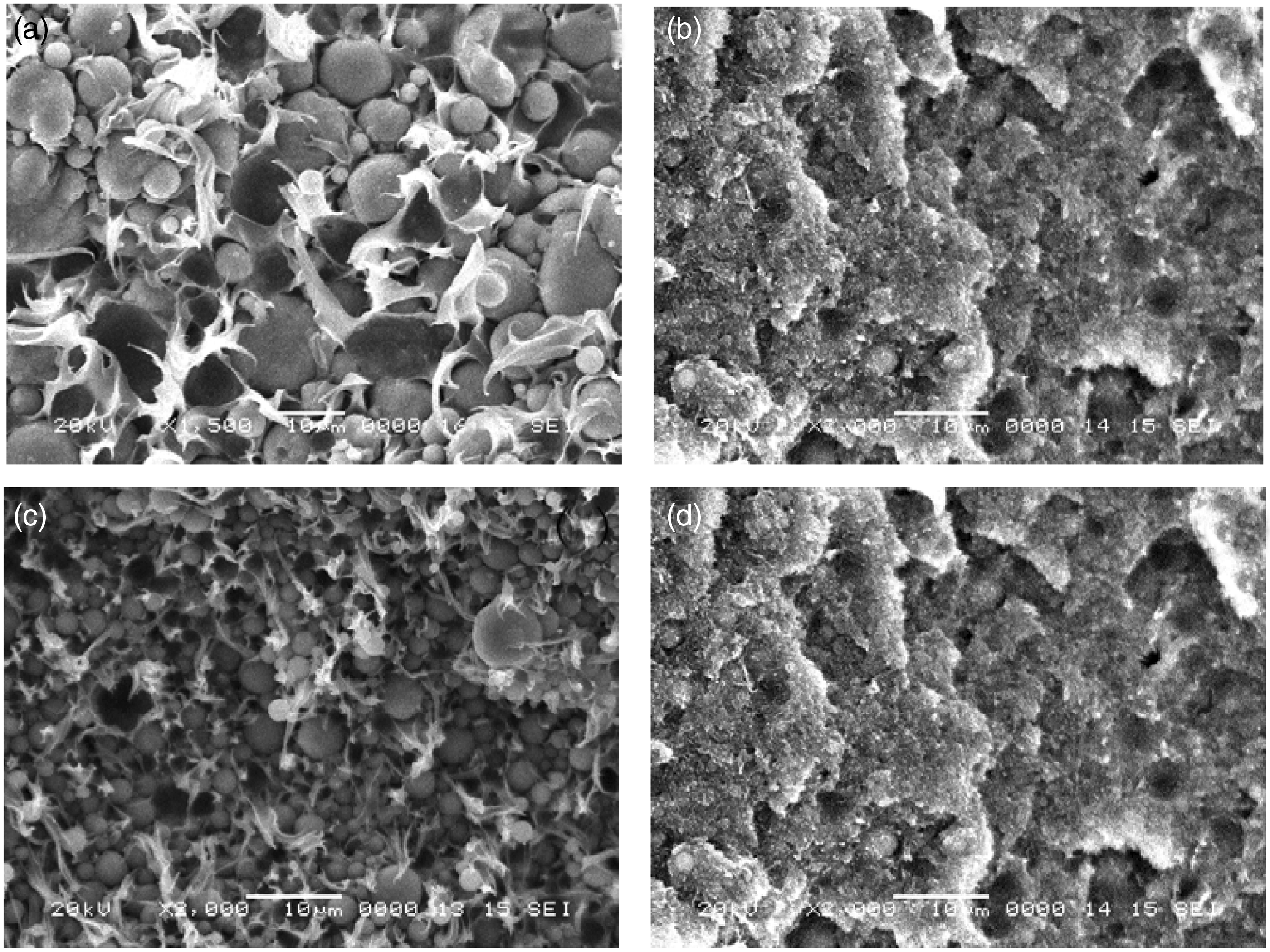
Conclusion
Three phases Al/CNTs/PVDF composites were prepared in order to improve the thermal conductivity and dielectric constant of the Al/PVDF. The dielectric permittivities of Al/PVDF composite increased with the Al content due to interfacial polarization, and the dissipation factors slightly increased with the filler loading, whereas they still remained at a low level. The addition of 1.0 wt% CNTs clearly increased the dielectric constant at 100 Hz from 58 to 92 for 60 wt% m-Al/PVDF, and from 22 to 36 for 60 wt% n-Al/PVDF, respectively due to the enhanced interfacial polarization resulted from the CNTs, and the synergistic effect between Al and CNTs. The three-phase Al/CNTs/PVDF composites still possessed a low acceptable dielectric loss and AC due to the insulating oxide Al shell structure on the surface of the Al cores, and the isolation effect of Al on the CNTs in the matrix.
The addition of CNTs content obviously enhances the thermal conductivity of Al/PVDF composites because the CNT particle acts effectively as thermally conducting bridges between the Al particles through linking several m-Al particles, thereby facilitating the electron and phonon transfer in the composites. The obtained Al/CNTs/PVDF composites possessing high thermal conductivity and high dielectric permittivity, but low dielectric loss at the measured frequency range, will be promising materials for embedded capacitors applications due to their huge potential for high energy density storage.
Footnotes
Conflict of interest
None declared.
Funding
The authors gratefully acknowledge the financial support from the Key Laboratory of Engineering Dielectrics and Its Application, Ministry of Education, Harbin University of Science and Technology (JZK201301), the Foundation for Key Program of Ministry of Education, China (212175), and the Scientific Research Program Funded by Shaanxi Provincial Education Commission (Program no. 14JK1485), and the National Science Foundation of China (no. 51073180).