






Abstract
Prediction of relative permeability is important to avoid dry spots or micro voids in the liquid composite molding process. Most of previous studies focused on plain and twill, but few are about stain and none of them provide explicit equation to calculate accurate values of unsaturated permeability. The main purpose of this work is to first propose a new model which is proposed mainly based on fractal theory and has no empirical constant in the expression, to calculate the permeability of satin fabric. And then we employ a new experimental method to calculate the unsaturated permeability. Finally, a contrast experiment of 5-harness fabric and 8-harness fabric is designed at different injection pressures, and the accurate values of permeability are obtained. The results show that unsaturated and saturated permeabilities are in the same order of magnitude; furthermore, unsaturated permeability is 77% of saturated permeability in 5-harness fabric and 73% in 8-harness fabric.
Introduction
The term liquid composite molding (LCM) encompasses a growing list of composite manufacturing processes, including resin transfer molding (RTM), compression RTM (CRTM), RTM light and resin infusion (i.e. vacuum-assisted RTM). 1 In an LCM process, dry fabric reinforcement is impregnated with liquid resin in a molding apparatus. However, inherent process variability can change the resin flow patterns during mold filling, which in turn may result in the formation of voids, including large dry spots or micro voids. 2 In an LCM process, resin impregnation is highly dependent on the permeability of fibrous reinforcement. As an important material parameter, permeability represents the degree of difficulty for a fluid to penetrate a porous medium. 3 Plain weave, twill weave, and satin weave are three basic woven structures.4,5 When the raw material, linear density, and process conditions are the same, satin fabrics possess relatively better mechanical properties, 6 such as greater density, lower fiber waviness, better toughness, higher bending strength, and drapability. So, it is meaningful to do some research on the saturated permeability of satin fabrics.
Recent studies proposed optimization of resin injection gates and vents based on resin flow simulation7–10 to address quality issues in LCM. Stochastic simulation of resin flow 11 has also been used to improve optimization of the processing conditions. However, it is almost impossible to control and forecast the permeability of fibrous reinforcement. O’Donnell et al. 12 developed composites panels of soy oil-based resin and different natural fibers (flax, hemp and cellulose mats and recycled paper). They determined the permeability of the reinforcements and, except for the case of the recycled paper, the obtained values were high enough for infusing by vacuum-assisted RTM (VARTM). Liu and Dai 13 studied the impregnation of a jute fiber mat by a thermoplastic resin. They found that natural fabrics’ permeability is an order of magnitude higher than the obtained for glass fiber mat. Due to the high viscosity melt used in their work, they did not observe impregnation inside the fiber bundles. Rodriguez et al., 14 Cosa, 15 and Henderson et al. 16 improved the Kozeny–Carman equation from different points of view. Chen and Ye 17 raised the square and hexagonal arrangement permeability model on the basis theory of approximation lubrication. However, the model is restricted to those two kinds of arrangements and only appropriate for porous media of a certain range of porosity. Amico and Lekakou, 18 Dukkipati and Dukkipati, 19 Golestanian 20 and Feser et al. 21 separately used the unidirectional flow method under constant pressure, the unidirectional flow method under constant flow rate, the radial flow method under constant pressure and the radial flow method under constant flow rate to test the permeability of fabrics. Tan and Li 22 have presented a fractal model for the permeability of fractured reservoirs; however, the relation between the transport exponent and fractal dimension in the proposed permeability model is unknown and needs to be determined by other methods. Simacek et al. 23 and Merotte et al. 24 have studied the permeability through constructing constitutive equations of fiber reinforcements. Homogenization theory was employed by Song and Youn 25 and Fuhong et al. 26 to calculate the permeability of two-dimensional woven fabrics. Xiao et al. 27 numerically simulated the transport process in a fractal object by applying a percolation model and concluded that the permeability in real porous media relates to porosity and fractal dimension. Nevertheless, no quantitative expression for the permeability was given in his work. Yu and Li 28 proposed an analytical expression for the relative permeability of unsaturated bi-dispersed porous media based on fractal capillary bundle model, where each capillary tube was assumed to be partially filled with the wetting and no wetting phase fluids.
While large number of researches have been reported for natural reinforcements, a detailed insight on the analytical expression and unsaturated permeability is still required. Therefore, it is very important is to identify the main mechanisms presented in natural fibers infiltration. One key aspect that has been studied by several authors in glass fibers is the difference between saturated and unsaturated permeability. Pillai and Advani 29 studied in detail the unsaturated flow in woven fibers preforms, taking into account the delayed impregnation of fiber tows through the use of a sink function in the equation of continuity for the macro flow. Micro flow can also occur through the micro pores generated during the stacking and compression of the layers of reinforcement. Kim et al. 30 and Diallo et al. 31 found that the saturated permeability was always lower than the unsaturated permeability, while other authors obtained opposite results.32–34 These discrepancies are usually attributed to experimental issues that could modify the saturated and unsaturated permeability ratio, such as mold deflection, capillary effect, microscopic flow, fiber channeling, and air bubbles. 35 However, most studies depend on plain twill, few on satin weave, and at the same time, many experiments employ the method of recording the position of the flow front rather than the pressure of the flow front.
In the present work, a new permeability model is put forward based on textiles, fractal theory, principle of minimum potential energy and penetration theory, to calculate the permeability of satin fabrics. Traditional permeability models have been based on empirical formula and large amounts of experimental data. However, the structural parameters are rarely applied in empirical formulas, which make the models hard to reflect the physical relationship and the seepage phenomenon. Because of the employment of fractal theory, permeability can be expressed as an organic combination of the structural parameters of porous structure, making each parameter to have a clear meaning. No doubt these are the biggest advantages and the most attractive places of fractal theory. In this study, we will use the new permeability model to calculate both saturated and unsaturated permeability. Unsaturated permeability will be the focus of this study. In addition, permeability test results obtained under the injection pressure of 0.1 MPa and 0.2 MPa, respectively, are compared in order to study the pressure effect on the permeability values. Finally, we briefly analyzed the main factors affecting the permeability values, and proposed that in natural fibers, unsaturated permeability is affected by fluid absorption and saturated permeability is affected by the swelled fiber.
The rest of the paper is organized as follows: The modeling process and the design of all parameters in the new fractal permeability model are presented in the Modeling process section. The experimental procedure is shown in the Experimental section. The results and discussions can be found in the Results and discussion section. Finally, the conclusions are given in the Conclusion section.
Modeling process
Basic structures of satin fabrics
In order to ensure the rationality of the new model, it is necessary to know more about the weaving structure of satin fabrics. As shown in Figures 1(a) and 2(a), a fabric is composed of warp and weft yarns through reciprocally interlacing and each yarn consists of hundreds of thousands of filaments. The points where warp tows interweaves with weft tows or weft tows interweaves with warp tows are called interlacing points. If the warp tows are above, then the interweaving points are warp interlacing points, and vice versa. The alternation of warp and weft interlacing points are of regulation which is addressed as repetitive unit or unit cell (see Figures 1 (b) and 2(b)). In a unit cell, there is only one weft (warp) interlacing point in each weft (warp) tow, and the rest are warp (weft) interlacing points. In textile composites, a unit cell is the epitome of the whole fabric. Therefore, we just need to choose a unit cell for analysis for each kind of fabric in the following.
Weaving structure of a 5-harness satin fabric. (a) Photography of a 5-harness satin fabric. (b) Unit cell of a 5 harness satin fabric. Weaving structure of an 8-harness satin fabric. (a) Photography of an 8-harness satin fabric. (b) Unit cell of an 8 harness satin fabric.

Usually, the equivalent diameter of pore channels among the fiber tows is at millimeter level, whereas pore channels among the filaments is at micrometer level,
36
and hence the fiber reinforcement approximately meets the new criterion deciding whether a structure is a fractal or not (see equation (1)), proposed by Yu and Li.
28
In other words, a fabric is a fractal and the fractal theory is appropriate for this kind of porous medium.

Modeling assumptions
Suppose in-plane shear deformation will not happen, then temperature and humidity have no influence on fiber structures, satin fabrics will not wrinkle and crimp, there is no energy exchange between fibers and resin, pore channels are parallel to fibers, and yarn spaces are determined by the weaving machine only.
The new fractal model
Studies show that fiber preform is a fractal.37–39 Thus, based on fractal theory, fiber preform satisfies the following equations
28
Sketch of channels.


Equation (2) implies that all the channels will be taken into account when λ is equal to λmin. Figure 4 illustrates that the minimum channel exists among three mutually contacting filaments, and therefore λmin can be figured out according to equation (5).
Ideal minimum pore.

In this study, a 5-harness satin fabric and an 8-harness satin fabric are taken as examples to illustrate how to calculate the permeability of satin fabrics using the new model. The difference between warp yarns and weft yarns is their permeability. When solving the permeability in this paper, generally considered as weft permeability, a weft cross section is ought to be used for analysis (see Figures 5 and 6), and vice versa.
Cross section of 5-harness satin fabric. Cross section of 8-harness satin fabric.

According to equation (2), we can get the derivation of “λ”

Based on equation (3), the physical length of the channel Lt can be expressed as

As a fractal medium, the quantity of flow (q) meets the Hagon–Poiseulle equation
40

Therefore, the total quantity of flow in the cross section A is expressed as formula (9)

Substituting equations (6) to (8) into equation (9), the formula can be further simplified as follow

Since 1<DT<2 and 1<Df<2, we can conclude that

Besides, based on Darcy's law
41

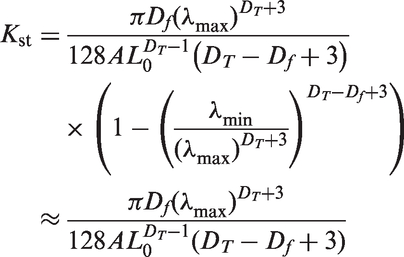

There is no empirical constant in the expression, so the warp permeability can be easily figured out only if the porosity structure fractal dimension Df, the tortuosity fractal dimension DT, the representative length of channels L0, the cross section area A, and the maximum equivalent diameter of pore channels λmax are known.
Parameters design
Based on the literature mentioned before, we use the bending potential energy and the principle of fractal to calculate the tortuosity fractal dimension DT, and along with equation (4), the structure fractal dimension Df can be figured out as equation (17).
According to equation (3),

Therefore, the tortuosity fractal dimension DT can be figured out as equation (16).


Corresponding average values.

The calculated values of all the parameters.

Experimental
Raw materials
The structural parameter of the two kinds of fabric.

Measured values of the 8-harness satin glass fiber fabric.

Experimental mold
As shown in Figures 7 and 8, the injection mold consists of a lower mold, a middle mold, an upper mold and a binder plate. The middle plate and the lower plate are steel mold, while the upper plate is a 480 mm × 480 mm × 12 mm tempered glass plate, which has one injection gate, two spare injection gates and four vents. The dimension of the cavity is 400 mm × 400 mm × 3 mm. With the help of the transparent upper plate, it is convenient for us to observe the flow and record data, and the binder plate is used to ensure the stiffness of the mold.
The assembly of the lower mold and the middle mold. The injection mold used in the experiments.

Permeability experiments
On account that the unidirectional flow is easily influenced by edge effect, radial flow was adopted in the experiments. An RTM injection machine (as shown in Figure 9), a pressure tank, a resin tank, and a recycling tank are still needed. In addition, 12 G-shaped clamps were used to keep the mold closed. The resin flows into the mold from the center gate and then permeates all around with the flow front be circular or elliptical shape as illustrated in Figures 10 and 11. And at the same time, the sensor in the back of the mold (Figure 12) records the pressure of flow front.
RTM injection machine. The flow front at 10 s in the 5-harness satin fabric experiment. The flow front at 10 s in the 8-harness satin fabric experiment. The sensor in the back of mold.


Results and discussion
The article studied the permeability of the two experimental materials under different injection pressures and different fiber numbers of glass fiber cloth, respectively. The pressure of each test point in the process of mold filling changes as shown in Figures 13 and 14. At that moment, the injection pressure is 0.1 MPa and 0.2 MPa separately in this experiment.
Pressure distribution of 8-harness satin glass fiber fabric. Pressure distribution of 5-harness satin glass fiber fabric. Unsaturated permeability account for saturated permeability.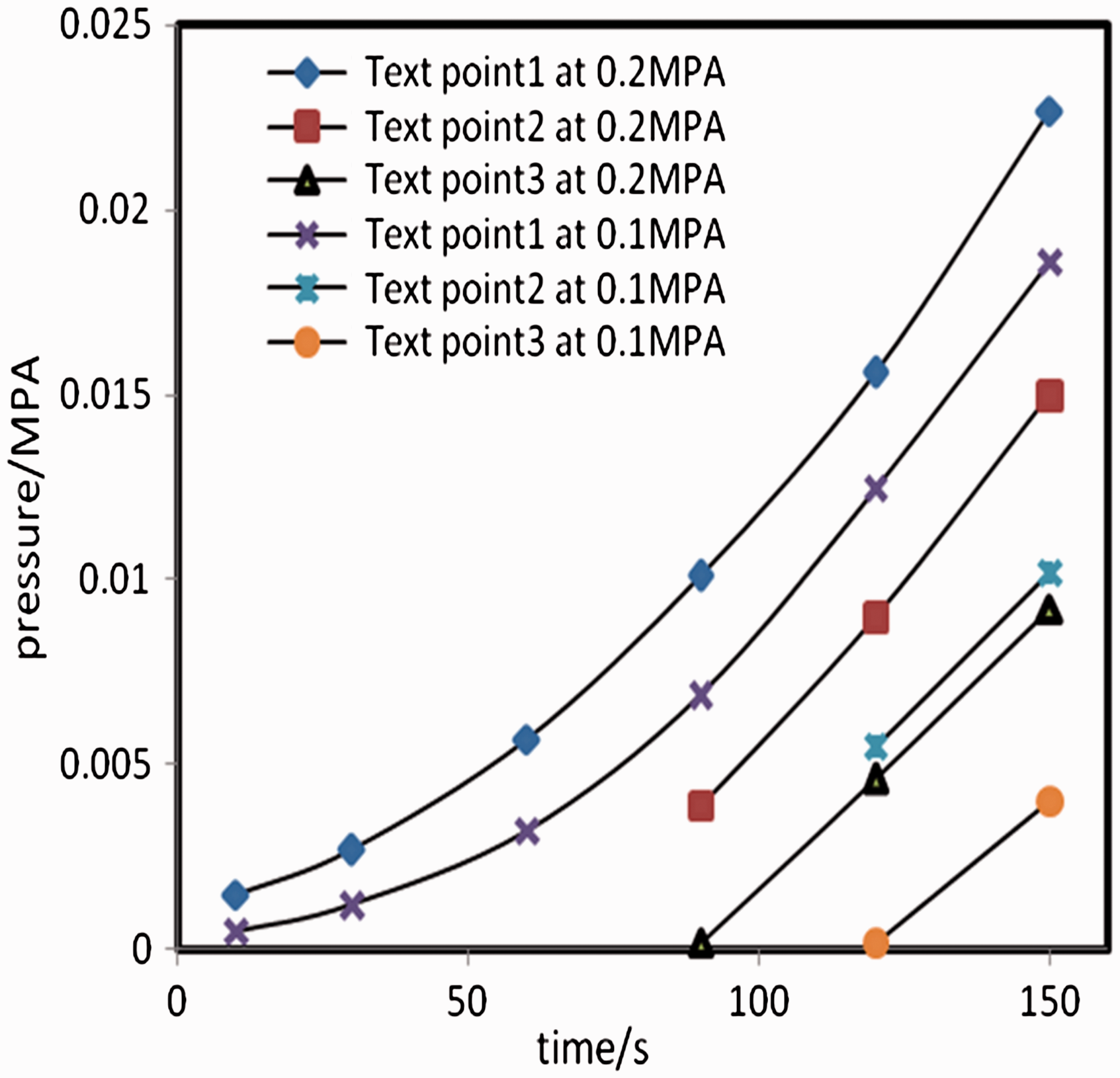
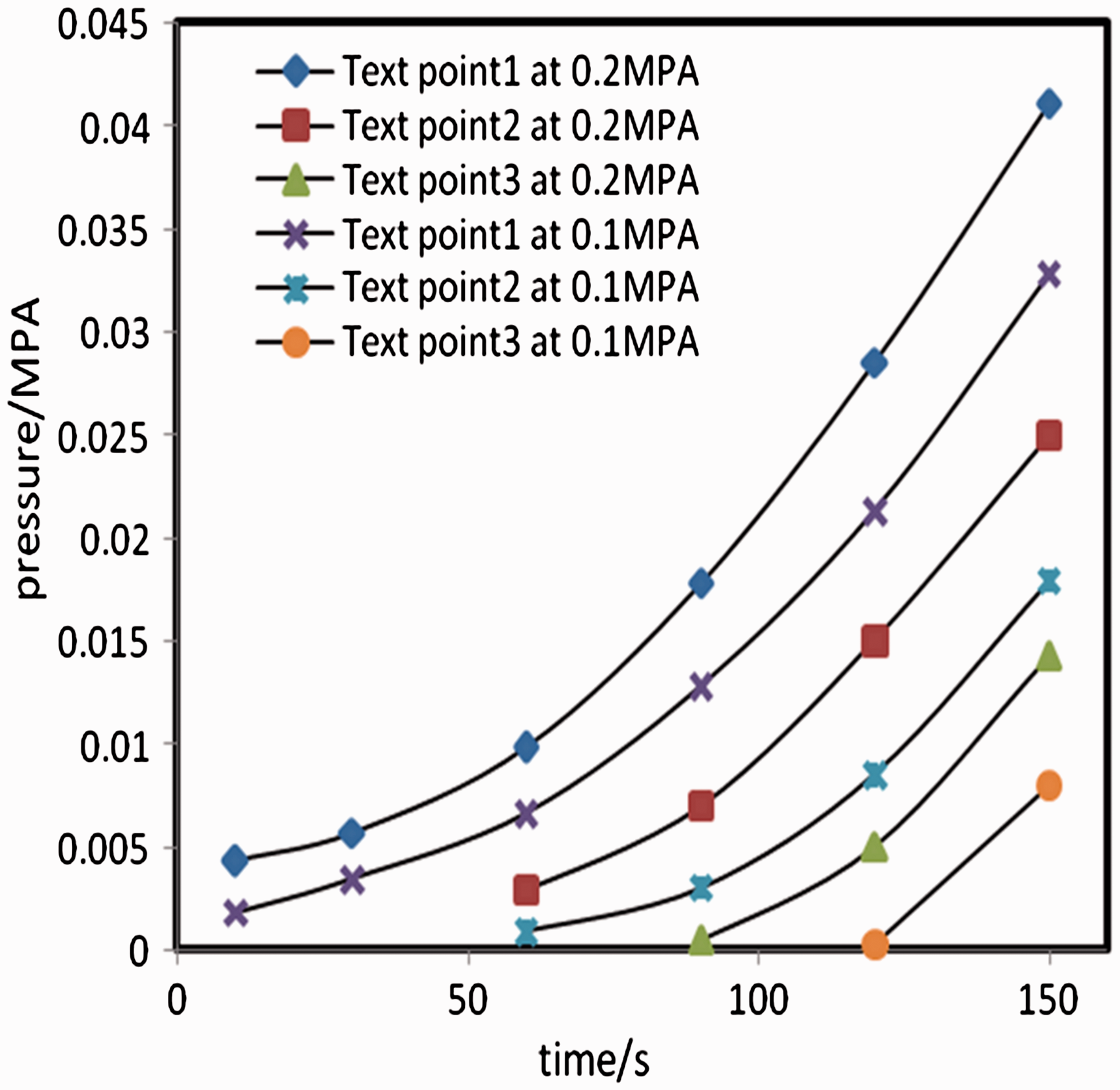

From the pressure distribution shown in Figures 13 and 14, we found that the pressure is almost a linear distribution, especially in 8-harness satin glass fiber fabric. This indicates that the unsaturated permeability of 8-harness fiber fabric is lower than that of 5-harness fiber fabric. The low unsaturated permeability makes the epoxy resin flow more smoothly. Furthermore, there is difference in pressure in the process of injection. As the liquid is flowing, the differential pressure appears to be on the rise. In the early stages of injection, the differential pressure is low (e.g. the first two experimental data in each curve); however, along with the time, it is gradually broadened.
According to the pressure distribution as shown in Tables 4 and 5, especially the pressure values at 60 s and 90 s, substituting them into equation (7), the unsaturated permeability of the fabrics can be figured out.
As illustrated in Table 6, the saturated permeability of 5-harness fabric and that of 8-harness fabric is different. The densities of 5-harness fabric and 8-harness fabric are different (as shown in Table 3). On the basis of comparison, it rises to the inequality in the representative length L0, the area of cross section A, the structure fractal dimension Df, the tortuosity fractal dimension DT, and the maximum equivalent diameter of pores λmax. This is why the permeability of 5-harness and 8-harness are different. From Tables 6, Table 7 and Figure 15, values of unsaturated permeability are in the same order of magnitude with saturated permeability. Further, no matter the injection pressure is 0.1 MPa or 0.2 MPa, unsaturated permeability is almost 77% of saturated permeability in 5-harness fabric and 73% in 8-harness fabric. Considering the unsaturated permeability is complex to calculate than saturated permeability, we can distinctly estimate it by using this conclusion in the future work. When the mold is completely filled, and the reinforcement is fully impregnated and saturated with fluid (no more micro pores impregnation or fluid absorption take place), and its sink nature vanishes, and flow rate increases (for a given-perform length), this means saturated permeability is higher than unsaturated permeability. From the whole experimental process, we can end up with a conclusion for fibers, that unsaturated permeability is affected by fluid absorption and saturated permeability is affected by the swelled fiber (a consequence of fluid absorption). Both effects are leading to a decrease in the value of the permeability. It can also be concluded from another aspect that saturated permeability results are higher than those of unsaturated permeability. As illustrated in Table 6, values of unsaturated permeability at 0.1 MPa and 0.2 MPa are almost equal. This conforms to the theory of Darcy’s Law, which describes that the seepage flow velocity is proportional to the liquid pressure. At the same time, it also shows the permeability coefficient depends only on the properties of the seepage material and fluid characteristics. In the theory, the pressure gradient is supposed to be the same with the increasing values of flow fronts, and moreover upward tendency and downward tendency are also observed in Figures 13 and 14, This is because fiber agglomeration and fiber dispersion may take place in some region of the actual fabrics. Measured values of the 5-harness satin glass fiber fabric. Values of saturated permeability and unsaturated permeability. Unsaturated permeability account for saturated permeability.


Conclusion
We have proposed a new permeability model based on the fractal theory and percolation theory to predict the saturated and unsaturated permeability of satin fabrics primarily. Like the other fractal models, there are no empirical constants in the model. Furthermore, the principle of minimum potential energy was used to calculate the actual length of a tortuous channel Lt (λ), and the fractal dimensions are expressed as the function of yarn spaces but not the warp and weft density or shrinkage any more, which makes our model differ from the previous fractal permeability models distinctly. The saturated and unsaturated permeabilities of a 5-harness and an 8-harness glass fiber fabrics were measured in this study. From some aspects, we can conclude that values of unsaturated permeability are in the same order of magnitude with saturated permeability, and values of unsaturated permeability at different injection pressures are almost equal. The results show that unsaturated permeability is 77% of saturated permeability in 5-harness fabric and 73% in 8-harness fabric. Besides, the permeability coefficient only depends on the properties of the seepage material and fluid characteristics. In this study, we roughly analyzed the influence factors of saturated and unsaturated permeabilities: unsaturated permeability is affected by fluid absorption and saturated permeability is affected by the swelled fiber (a consequence of fluid absorption). As a future work, this question will be studied deeply with other resin formulations.
Footnotes
Acknowledgements
We would like to express our special gratitude and thanks to all the respective personnels of the key technology research of composite material aircraft manufacturing process lab. We are also grateful to the teacher for giving us attention and time during our experiment and who has also offered us experimental devices.
Declaration of Conflicting Interests
The author(s) declared no potential conflicts of interest with respect to the research, authorship, and/or publication of this article.
Funding
The author(s) disclosed receipt of the following financial support for the research, authorship, and/or publication of this article: This work was supported by the National Defense Advance Project (The key technology research of composite material aircraft manufacturing process) during the 12th five-year plan under grant no. MJ-F-2012-05.