






Abstract
In the present work, the hypothesis of the existence of diverse motivational profiles in students with learning difficulties (LD) and the differential implications for intervention in the classroom are analyzed. Various assessment scales (academic goals, self-concept, and causal attributions) were administered to a sample of 259 students with LD, ages 8 to 15 years, in Spain. The data obtained were analyzed through (a) cluster analysis to study this hypothesis and (b) MANOVAs to determine the extent to which such profiles were accompanied by significant differences in self-esteem and causal attribution patterns. The results revealed four different motivational profiles and significantly different levels of self-esteem and causal attribution process.
Personal goals are a very important framework from which to explain motivational orientations and behavior patterns in the school setting. The results of past research on the role of motivational academic orientations have agreed that learning goals are beneficial for most learning-related results, including motivational results such as self-efficacy, interest, and value (Barron & Harackiewicz, 2001, 2003; Valle et al., 2008; Wolters, Yu, & Pintrich, 1996), emotional well-being (Middleton & Midgley, 1997), help seeking, and cognitive commitment (Pintrich, 2000a). In the area of learning difficulties (LD), although motivational and emotional variables are relevant (Sideridis, 2005c), only a few empirical studies have examined the topic of motivation in students with LD from the perspective of academic goals and, more specifically, from the perspective of multiple goals.
Taking into consideration the research to date, two general lines of work were observed: (a) studies that compared diverse academic goals (learning goals, performance goals, performance-avoidance goals), one by one, among students with and without LD and (b) investigations that attempted to determine the relationship between such goals and important criteria such as achievement in various curricular areas, affective variables, or even psychopathological variables. In addition, some current works have examined these children’s motivational environment from the perspective of multiple goals in comparative and explanatory studies.
Academic Goals
Although the study of personal goals has been addressed from different perspectives, they all share the idea that people establish goals for themselves, in such a way that cognitive representations of future events become potential motivators of behavior in any setting. From such proposals, and within the academic sphere, there has been increasing interest in the idea that the academic goals pursued by students organize and regulate their behavior. Certain goals are closely related to the type of motivation, which is defined by the kind of goal they hope to achieve.
Elliot and collaborators (Elliot, 1997, 1999; Elliot & Church, 1997; Elliot & Harackiewicz, 1996) proposed a tridimensional comprehensive framework of academic goals. In their proposal, they differentiated two tendencies within performance goals, an approach tendency and an avoidance tendency, and as a result defined three independent academic goals:
Performance approach, focused on achieving competence in comparison to others
Performance avoidance, focused on avoiding incompetence in comparison to others
Learning approach, focused on the development of competence and mastery of the task
Subsequently, a new construct, learning-avoidance goals, was proposed. This is the result of applying the differentiation of the tendencies of approach and avoidance toward learning goals (Pintrich, 2000a, 2000b). Students who have learning-approach goals are oriented to achieving the goal of learning and understanding, whereas those with learning-avoidance goals are concerned with not being perfect, not understanding the material completely, or failing to meet their self-referred mastery standards (Linnenbrink & Pintrich, 2002). Nevertheless, such general considerations should be taken with precaution because the results of a recent meta-analysis (Hulleman, Schrager, Bodmann, & Harackiewicz, 2010) appeared to indicate diverse dimensions within each one of these four types of goals, suggesting that the goals maintain different relations with other motivational, cognitive, behavioral, and performance variables.
Academic Goals in Students With LD
From an explanatory perspective, some investigators have attempted to find possible links between motivational, cognitive, and psychopathological variables and the academic achievement of students with LD. For example, the works of Georgios Sideridis have contributed interesting data that confirmed the significant connection between academic goals and achievement, and affect, self-esteem, anxiety, and depression (Sideridis, 2003, 2006, 2007).
Although they do not coincide, the studies that have addressed this topic from a comparative perspective have indicated that students with LD display less motivation toward learning and more fear of failure (Botsas & Padeliadu, 2003; González-Pienda et al., 2000; Pintrich, Anderman, & Klobucar, 1994; Sideridis, 2003; Sideridis & Tsorbatzoudis, 2003), and this tendency is more pronounced in boys than in girls (González-Pienda, Núñez, & González-Pumariega, 1996). In terms of academic goals, without considering possible sex differences, students with LD present lower learning goals and higher performance-avoidance goals with no differences in performance-approach goals. In other studies in which social reinforcement– or approval-seeking goals were evaluated, it was found that students with LD tend to be less motivated in this sense than do their classmates (González-Pienda et al., 1996; González-Pienda et al., 2000).
For example, in a study of 496 children (253 with LD, 243 without LD; mean age = 11 years), González-Pienda et al. (2000) reported the existence of very significant differences between students with and without LD, finding that compared to their counterparts without LD, students with LD were significantly less motivated toward learning (learning goals), less motivated toward achieving others’ approval (social goals), but equally motivated toward a certain level of performance (performance goals). These authors noted that these results could indicate that students’ motivation toward academic tasks is closely related to the beliefs they hold about their competence and their expectations of self-efficacy, and they interpreted the results in the sense that, because of their repeated failure experiences, children with LD tend to distrust their ability and to develop low self-efficacy expectations, so that rather than being motivationally oriented toward learning (learning goals), they are motivated toward a certain level of academic performance (performance goals). This is noted in the fact that students with and without LD do not display significant differences in their interest in attaining a certain level of performance (performance goals).
As in other later studies (e.g., Botsas & Padeliadu, 2003; Sideridis, 2003), no differences in performance-approach goals were found because the groups of students may have attributed both their successes and their failures mainly to effort or lack of effort; this allowed students with LD to maintain a minimum motivational level. At the level of metacognitive system functioning, because of their negative academic self-efficacy perceptions and low motivation to gain meaningful knowledge, students with LD—particularly those with a tendency to develop maladaptive attributional patterns (Núñez et al., 2005)—will probably engage only superficially in tasks and resort to using repetitive, primitive cognitive and self-regulatory strategies, thereby minimizing their efforts to learn. This leads to new failures; consequently, their interest in learning will progressively decrease. Last, according to these investigators, students with LD who have a reduced interest in achieving social acknowledgment can be explained by their perception of others’ negative expectations about their learning possibilities, especially those of their parents and teachers (Meltzer et al., 1998). Moreover, this decreased interest in approval seeking or even in defending their self-esteem may be the result of the maladaptive attributional pattern that is so typical in many of these children (Settle & Milich, 1999).
Multiple Goals Perspective
The strategy of considering the consequences of each one of the academic goals individually presents some drawbacks when educational reality indicates that students rarely adopt a single goal exclusively but instead, in most cases, choose various goals simultaneously or, depending on the circumstances, give priority to some goals over others. Almost all school situations present the opportunity to pursue diverse goals simultaneously, and many situations may require students to strive for even various goals at the same time. Therefore, when considering this diversity of goals—many of them important for students—it is impossible to assert that they can be pursued one by one, in an isolated manner.
Taking this into account, in general, the research carried out from this perspective has focused on the analysis of the combination of different academic goals and their effects on learning and on academic performance. For example, Barron and Harackiewicz (2001) suggested four ways by means of which learning goals and performance-approach goals could be combined:
Both types of goals are combined, but each one has beneficial effects on certain results, that is, their effects are additive
Interactive effects result from both types of goals, so that adopting both at the same time will be more adaptive for a certain outcome than only adopting a single type of goal
Possibility of occurrence of specialized effects, that is, unique effects for both types of goals over multiple results; for example, mastery goals could be beneficial in terms of interest or emotional well-being, whereas performance-approach goals may be more adaptive in terms of achievement outcomes
Possibility of occurrence of selective effects, so that the consequences or effects of the goals depend on whether they coincide with the goals of the context
With regard to the consequences of these diverse combinations of learning and performance goals, according to Bouffard, Boisvert, Vezeau, and Larouche (1995), the highest levels of motivation, cognitive strategies, self-regulation, and performance strategies are found in the group that combines high learning goals and high performance goals. Harackiewicz, Barron, Tauer, Carter, and Elliot (2000) found that learning goals positively predict interest but not grades, whereas performance-approach goals positively predict grades but not interest. These complementary results of learning goals and performance goals led the authors to conclude that the best strategy is for the students to adopt both types of goals concurrently. In a longitudinal study carried out with secondary students, Pintrich (2000a) concluded that students who are concerned with their performance and with being better than their classmates but, at the same time, are oriented toward learning follow a parallel trajectory to students who are oriented only toward learning. However, Pintrich also noted that this trajectory is not equally adaptive in the case of students concerned only with performance.
Currently, data are emerging that indicate that, as in samples of typical students, the combination of goals predicts the academic achievement of students with LD more effectively than if each one of the academic goals is taken individually (Sideridis, 2003, 2005b, 2006, 2007), although results in the opposite direction have also been found (Sideridis & Tsorbatzoudis, 2003). In general, Sideridis has found that being oriented toward multiple goals is less adaptive than being oriented mainly toward learning goals.
These findings thus have led important investigators to urge the development of research of individual differences in students with LD, relative to diverse domains (social, motivational, emotional, cognitive) and how they are related to various intrinsic and extrinsic factors (Margalit & Idan, 2004; Meltzer, 2004). In this sense, for example, Margalit (2004) noted that instead of other extensively studied aspects, we need to develop investigations to identify subgroups of students with LD who are capable of improvement and who still perceive themselves positively (resilient children) like their peers without LD, despite their deficient cognitive processing.
In this vein, in the present investigation, we studied the motivational profile (combination of goals) of students with LD and how it is associated with significant differences in cognitive-affective variables such as causal attributions and self-concept. We attempt to answer the following questions:
Are there subgroups of students with LD with significantly different motivational profiles and similar to those obtained in populations of students without LD?
Do LD students who have a multiple goal profile display a more adaptive pattern than students who have a profile with just one predominant goal (learning or performance)?
Predictions
In view of the lack of data on the different combinations of types of goals in students with LD, and taking as a reference the results of the studies carried out with populations without LD (i.e., Daniels et al., 2008; Valle, Núñez, Cabanach, Rodríguez, González-Pienda, & Rosário, 2009), the data from the works of Sideridis (2003, 2006, 2007), and those contributed by our own work with students with LD (i.e., González-Pienda et al., 2000; Núñez et al., 2005), we made the following predictions:
The three types of goals considered in this study (learning goals, performance goals, and social-reinforcement-seeking goals) will be associated with each other, leading to different motivational profiles (homogeneous groups of participants with a similar combination of academic goals).
Empirical evidence for the existence of four different motivational profiles will be obtained: (a) a multiple goal profile (students oriented both toward learning and performance or social reinforcement seeking), (b) a low motivational level profile (students with a low or very low level in all three types of goals), (c) a profile with predominance of learning goals (students oriented mainly toward mastery, personal progress, and learning), and (d) a profile with a predominance of extrinsic goals (students oriented mainly toward attaining better performance than their peers or toward seeking significant others’ acknowledgment).
These four motivational profiles will be associated with significantly different levels of self-concept and causal attributions. Specifically, on one hand, students with a multiple goal profile will obtain the highest levels in self-esteem, followed by the profile with predominance of learning goals, predominance of performance goals, and, last, a low motivation profile. However, students with a multiple goal profile will attribute their successes to a greater extent—and their failures to a lesser extent—to internal causes (capacity and effort) than will students with a profile with predominance of learning goals and/or performance goals and, particularly, students with a low motivation profile.
Method
Participants
Initially, we contacted representatives from the 36 educational centers of primary schools (second to sixth grade levels) and secondary schools (seventh and eighth grade levels) in two northern regions of Spain to obtain their participation in the investigation, requesting them to (a) provide data about the diagnosis of students with LD (screening to determine which children were diagnosed with LD), (b) request parents’ permission for their children’s participation in the investigation, and (c) inform the teachers and request their collaboration in providing various data. The tests were administered by postgraduates with scholarships who were collaborating with the team. The participants filled in the three questionnaires individually and without any time limit. Any doubts expressed by students about terms were cleared up.
Participants were 257 students with LD, ages 8 to 15 years (M = 11.90, SD = 1.703), distributed as follows: 6 eight-year-olds (5 boys and 1 girl), 17 nine-year-olds (12 boys and 5 girls), 36 ten-year-olds (14 boys and 22 girls), 42 eleven-year-olds (25 boys and 17 girls), 58 twelve-year-olds (44 boys and 14 girls), 37 thirteen-year-olds (25 boys and 12 girls), 55 fourteen-year-olds (37 boys and 18 girls), and 6 fifteen-year-olds (5 boys and 1 girl). The total sample comprised 167 boys (65%) and 90 girls (35%; see Table 1). None of the study participants had an IQ lower than 79 (minimum = 79, maximum = 121, M = 92.02, SD = 6.27), nor did they present with sensory disabilities, severe emotional problems (e.g., autism), or attention-deficit/hyperactivity disorder. Practically all of the students attended public schools in two northern regions of Spain.
Participant Demographic Characteristic Across Gender
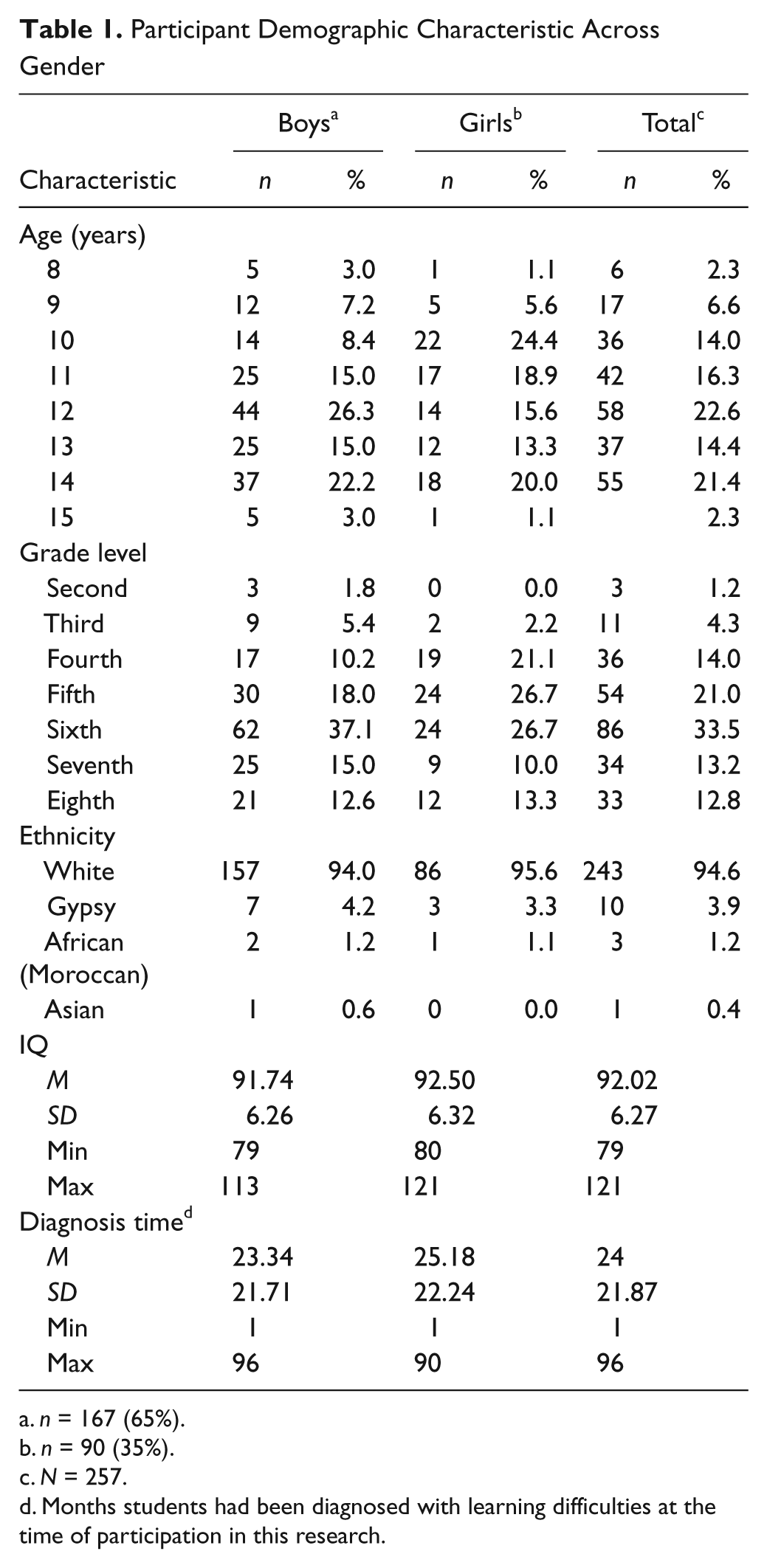
n = 167 (65%).
n = 90 (35%).
N = 257.
Months students had been diagnosed with learning difficulties at the time of participation in this research.
In the United States, use of the discrepancy model as a method of diagnosis of LD is currently being questioned, particularly since 2004, when the Individuals with Disabilities Education Improvement Act officially introduced the model of response to intervention (RTI) as an alternative to the discrepancy model (Jiménez et al., 2010). Nevertheless, although some authors believe that the RTI model is the most promising method for identifying individuals with LD (Haager, Klingener, & Vaughn, 2007), other researchers have stated that the effectiveness of RTI is significantly mediated by the child’s age (Vellutino, Scanlon, Zhang, & Schatschneider, 2008) and may not be sufficient to identify people with LD (Al Otaiba et al., 2009), or they even doubt that it can be considered a diagnostic method (Kavale, Kauffman, Bachmeier, & LeFevers, 2008).
In Spain, as in other countries (McLaughlin et al., 2006), use of the RTI model has scarce tradition because there is no clear definition of LD. Specifically, the diagnosis performed by the school district specialists, integrated in psychopedagogical teams (see Núñez & González-Pienda, 2007), was used to select the students with LD. The diagnostic process used at the public educational centers in Spain is described below. Once the general education classroom teacher detects a student with poor performance with no apparent justification (motivational problems, discipline, etc.), the specialist of the psychopedagogical team addresses the analysis of the real magnitude of the learning delay, determining whether the student’s academic performance is significantly lower than his or her intellectual ability. The discrepancy is considered significant when performance is 2 or more years lower than the general intellectual ability. Second, in the absence of some general intellectual deficit and in the presence of a significant discrepancy between intellectual abilities and performance, the specialist continues to look for a deficit in basic cognitive processes that would justify the discrepancy. Third, the specialist attempts to rule out the possibility that the existing learning problems are the result of disabilities other than LD (visual, auditory, motor, emotional, etc.). Finally, once the first three steps have been completed and the student is considered as having “potential LD,” taking into account the student’s characteristics (deficiencies and abilities), the specialist carries out modifications in the conditions of access to the general education curriculum that seem to be preventing the student from learning. If the student does not respond to the access adaptation, the specialist, in collaboration with tutors, proceeds to carry out an “individual curricular adaptation,” which means that the student is assumed to be incapable of following the curriculum—at least, at the established requirement level—and, as a result, it must be significantly modified. The adaptation is generally carried out over 2 years. Except for severe cases, the students receive instruction in the curriculum adapted to the ordinary classroom, and they also participate in supplemental instruction specific to their deficit or deficits, outside of the normal classroom.
Measures
Academic Goals Questionnaire (AGQ)
This instrument was based on an experimental questionnaire used by Hayamizu and Weiner (1991). It is composed of 20 items: 8 concerning learning goals (evaluation of students’ interest in learning as a priority goal), 6 concerning performance goals (students’ interest in obtaining a certain goal as a priority aim), and 6 referring to motivational orientation toward obtaining social reinforcement and acknowledgment. The student rates each item on a 5-point scale (never to always). Examples of the three types of goals assessed by the AGQ are the following: learning goals (“I study because, for me, it is interesting to solve problems or tasks”), performance goals (“I study chiefly because I want to get good grades”), and social reinforcement goals (“I study because I want my parents and teacher to appreciate me”). The Spanish adaptation of the AGQ shows high reliability coefficients for students with LD, learning goals (α = .85), performance goals (α = .86), social reinforcement goals (α = .83), total AGQ (α = .87), and excellent structural validity and predictive validity for various types of learning strategies and for academic achievement (González-Pienda et al., 2000; Inglés et al., 2009; Valle et al., 2003). In this study, the reliability of the global AGQ was also high (α = .919).
Self-Description Questionnaire (SDQ-I)
This multidimensional instrument (Marsh, 1988) consists of 76 items organized into eight self-concept dimensions: general, academic (general, mathematic, verbal), social (relationships with parents and peers), and physical (physical appearance, physical capacity), to which participants respond on a 5-point scale. The SDQ-I is a reliable instrument with demonstrated validity (see Byrne, 1996). In the Spanish population with LD, reliability is high (Núñez, González-Pumariega, & González-Pienda, 1995): general (α = .74), general academic (α = .84), reading (α = .92), mathematics (α = .92), physical appearance (α = .84), physical capacity (α = .81), relations with parent (α = .81), peer relations (α = .73), and total SDQ (α = .92). In this sample of students with LD, reliability of the global SDQ was high (α = .916). In addition, the Spanish version has construct validity and predictive validity for academic achievement (Núñez et al., 1995).
Sydney Attribution Scale (SAS)
Developed by Relich et al. (Marsh, Cairns, Relich, Barnes, & Debus, 1984), the SAS is a multidimensional scale that assesses individuals’ perceptions of the causes of their academic successes and failures, adopting a dispositional viewpoint. It is made up of 24 hypothetical situations, with responses on a 5-point scale. These 24 situations involve combinations of two academic areas (mathematics, verbal), three types of causes (ability, effort, external causes), and two opposite-hypothetical outcomes (success situations and failure situations). In this study, however, the academic area was not taken into account, so that six scores were obtained: Attribution of Success to Ability (ASAB), Attribution of Success to Effort (ASEF), Attribution of Success to External Causes (ASEC), Attribution of Failure to Ability (AFAB), Attribution of Failure to Effort (AFEF), Attribution of Failure to External Causes (AFEC; 3 types of causes × 2 opposite-hypothetical outcomes). The SAS adaptation for Spanish-speaking populations has been shown to have acceptable reliability (in Spain, α = .81; see González-Pienda et al., 2002; and α = .82 in Chile; see Villalobos, González-Pienda, Núñez, & Mújica, 1997) and construct validity and predictive validity for academic achievement (Núñez et al., 1995). The reliability of this scale in the present investigation was somewhat lower (α = .768).
Statistical Analyses
To contrast the first and second hypotheses, we performed several cluster analyses. Cluster analysis is not only the most appropriate procedure to establish profiles in an ample sample of study participants (Hair, Anderson, Tatham, & Black, 1998) but also one of the most recommended solutions to identify multiple goals (Pastor, Barron, Davis, & Miller, 2004). As in the predictions, we had established that four clusters or groups of students with certain levels in the three kinds of goals should be obtained; we used the K-mean method as the procedure to group the participants. The motivational profiles were defined from the different combinations of the three types of goals assessed by the AGQ scale. To eliminate the effect resulting from differences in the measurement of the goals (given that the number of items of each goal subscale is different), we carried out cluster analysis after transforming the raw scores into standardized scores (z scores).
Once the subgroups of students with LD were identified, MANOVAs were conducted in which the dependent variables were the dimensions of self-concept and attributional processes, and the independent variable was the subgroups of students established on the basis of their typical motivational profile. When the analysis involved more than two groups, post hoc Bonferroni tests were used to identify pairwise differences among the groups. Similarly, we performed various ANOVAs to verify differences among the motivational profiles on the three academic goals. The effect sizes were also calculated to determine the portion of variance of the dependent variable that was attributable to the independent variable. Following the recommendations of authors such as Tabachnick and Fidell (1989), we report the partial squared eta (ηp2). According to Aron and Aron (1999), the following criteria should be used: .10 = small effect size, .25 = medium effect size, and .40 = large effect size.
Results
Motivational Profiles in Students With DA
As initially predicted, when carrying out the cluster analysis, we indicated that four groups of participants should be extracted (and they should coincide with those obtained in previous investigations): a multiple goal profile, a low motivational level profile, a profile with a predominance of learning goals, and a profile with a predominance of extrinsic goals.
After the analyses were performed, the four-cluster solution (see Figure 1) converged in five iterations and optimally fit the predictions of this study, based on studies of students without LD. Table 2 shows the centers of the final clusters, and Figure 1 presents their graphic representations.
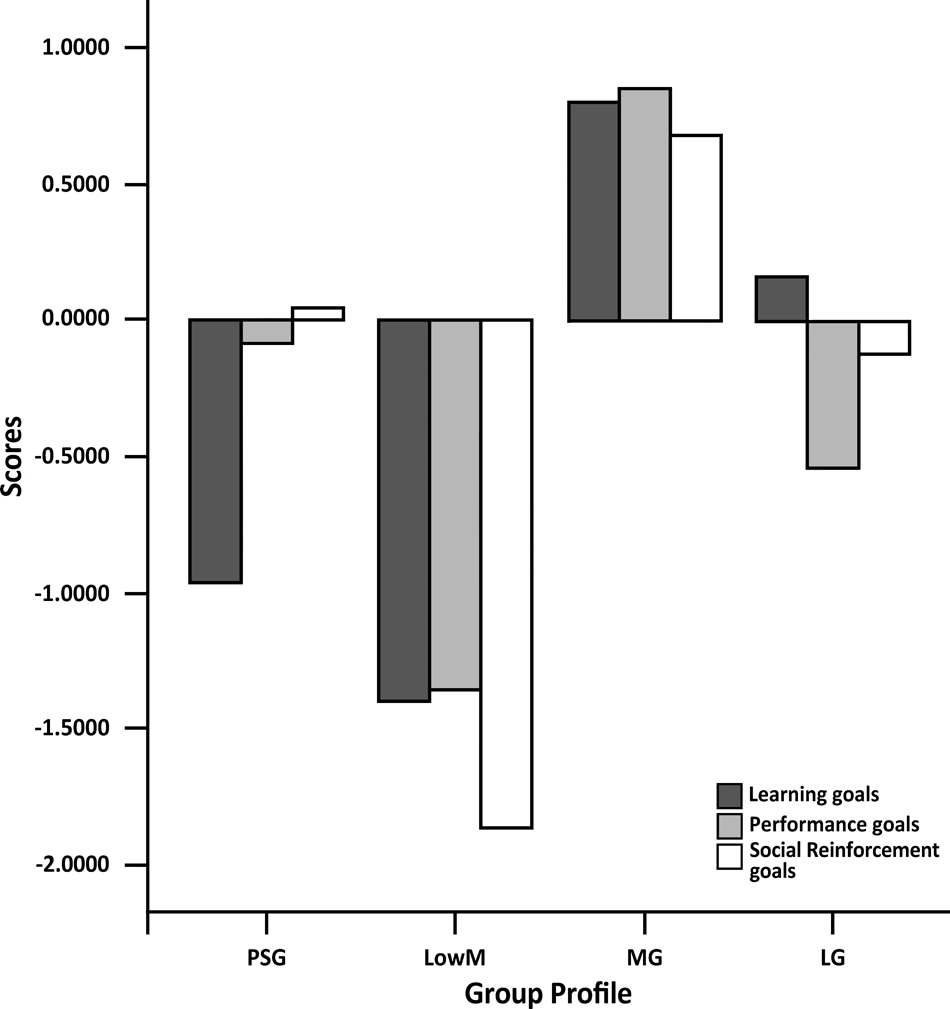
Results of cluster analysis corresponding to the three subscales from the Academic Goals Questionnaire
Final Cluster Centers Corresponding to the Groups of Students With Learning Difficulties With PSG, LowM, MG, and LG Motivational Profiles
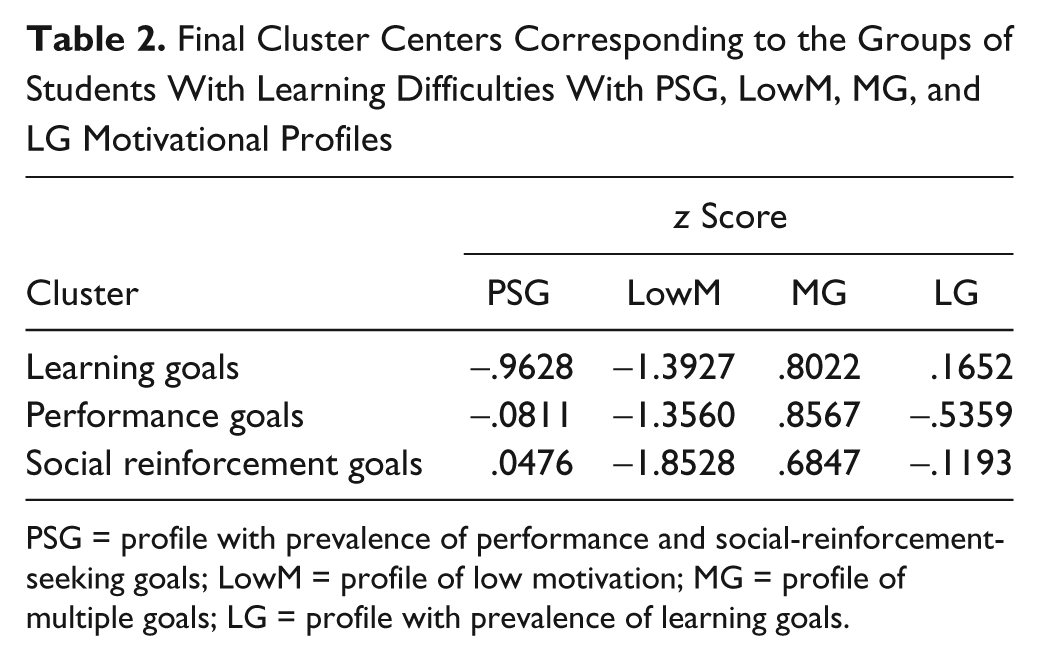
PSG = profile with prevalence of performance and social-reinforcement-seeking goals; LowM = profile of low motivation; MG = profile of multiple goals; LG = profile with prevalence of learning goals.
Cluster analysis thus allowed us to identify four groups characterized by significantly different motivational profiles, which are the result of different combinations of the four types of academic goals. The first group was made up of 47 students (18.3%; 35 boys and 12 girls) with a motivational profile with predominance of social-reinforcement-seeking and performance-approach goals (external orientation with a social comparison referent) and with low levels of learning goals (scarcely interested in the acquisition of competence and learning). This group is thus defined by a motivational profile with predominance of performance and social-reinforcement-seeking goals (PSG group).
The second group consisted of 36 students (14%; 27 boys and 9 girls) and was characterized by low scores in each one of the goals assessed. This group was defined by a profile with generalized low motivation (LowM group). If their behavior is ever motivated, they will probably engage in tasks for reasons other than those presented in the questionnaire to assess academic goals.
The third group, composed of 106 students (41.2%; 59 boys and 47 girls), was the largest and was characterized by high scores in all three types of academic goals, which indicates this is a multiple goal profile (MG group).
Last, the fourth group was made up of 68 students (26.5%; 46 boys and 22 girls); they displayed a clear predominance of learning goals (interest in improving as they learn) and a low level of performance and social-reinforcement-seeking goals (LG group). Therefore, this group of students is defined by a motivational profile with predominance of learning goals.
We carried out a MANOVA that yielded statistically significant differences among the four groups in the three types of goals that make up the profiles, λ = .093, F(9, 611) = 112.586, p < .001, η2 = .548. These general level differences are even higher if we compare the levels of each one of the three goals in the four groups of subjects: learning goals, F(3, 253) = 212.658, p < .001, η2 = .716; performance-approach goals, F(3, 253) = 153.318, p < .001, η2 = .645; and social-reinforcement-seeking goals, F(3, 253) = 180.122, p < .001, η2 = .681. Table 2 shows the means and standard deviations of the three types of goals for the four motivational profiles. The multiple comparisons were statistically significant in all cases, except for the comparison of the levels of social-reinforcement-seeking goals corresponding to the PSG and LG profiles.
Motivational Profiles, Self-Concept, and Causal Attributions
In the third working hypothesis, we proposed that the four motivational profiles would be significantly associated with the dimensions of self-concept and causal attributions. Table 3 presents the means and standard deviations for the variables of self-concept and causal attributions of the four groups of students.
Means and Standard Deviations for the Four Participant Groups on the Eight SDQ-I Scales, Three AGQ Subscales, and Six SAS Subscales
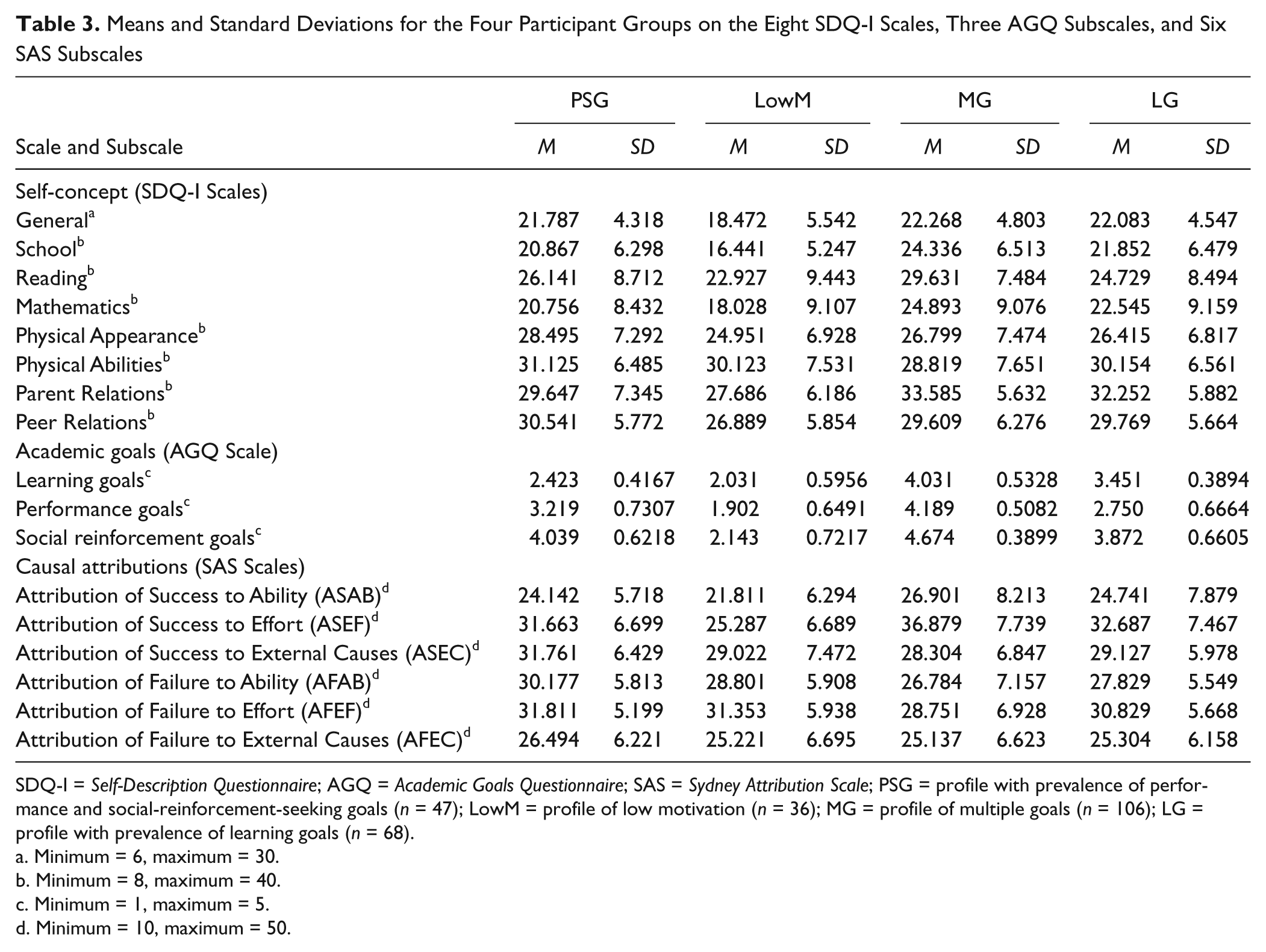
SDQ-I = Self-Description Questionnaire; AGQ = Academic Goals Questionnaire; SAS = Sydney Attribution Scale; PSG = profile with prevalence of performance and social-reinforcement-seeking goals (n = 47); LowM = profile of low motivation (n = 36); MG = profile of multiple goals (n = 106); LG = profile with prevalence of learning goals (n = 68).
Minimum = 6, maximum = 30.
Minimum = 8, maximum = 40.
Minimum = 1, maximum = 5.
Minimum = 10, maximum = 50.
We performed a MANOVA that yielded statistically significant differences among the four groups of students in the eight measures of self-concept, λ = .691, F(24, 714) = 4.051, p < .001, η2 = .116. Considering the results of each one of the dimensions separately, the data contributed by the multivariate analysis indicate that the differences are statistically significant in all the subscales (except for the two physical subscales): general self-concept, F(3, 253) = 6.128, p < .001, η2 = .068; general academic self-concept, F(3, 253) = 14.694, p < .001, η2 = .148; mathematical self-concept, F(3, 253) = 6.062, p = .001, η2 = .067; verbal self-concept, F(3, 253) = 8.276, p < .001, η2 = .089; relationship with parents, F(3, 253) = 10.466, p < .001, η2 = .110; peer relationships, F(3, 253) = 2.822, p = .039, η2 = .032; physical appearance, F(3, 253) = 1.721, p = .163, η2 = .020; and physical capacity, F(3, 253) = 1.280, p = .282, η2 = .015. The multiple comparisons were not statistically significant in all possible cases, except for the general dimensions and the general academic dimension, in which most of the possible comparisons were significant.
With regard to causal attributions, the results are fairly similar to those obtained for self-concept: statistically significant differences both at the multivariate level, λ = .737, F(18, 701) = 4.446, p < .001, η2 = .097, and in each of the specific dimensions measured by the SAS: attribution of success to capacity, F(3, 253) = 4.685, p = .003, η2 = .053; attribution of success to effort, F(3, 253) = 53.586, p < .001, η2 = .219; attribution of success to external cause, F(3, 253) = 2.972, p = .032, η2 = .034; attribution of failure to lack of capacity, F(3, 253) = 3.163, p = .025, η2 = .036; and attribution of failure to lack of effort, F(3, 253) = 3.656, p = .013, η2 = .042, except for the attribution of failure to external causes, for which the differences did not reach statistical significance, F(3, 253) = 0.521, p = .668, η2 = .006. Last, the multiple comparisons showed that the differences were statistically significant when comparing the multiple goal group with the group with predominance of social-reinforcement-seeking or performance goals and low learning goals, except for ASEF, where all the comparisons were significant.
Discussion
In accordance with our first and second hypotheses, we found empirical evidence of the existence of consistent combinations of diverse types of goals or motivational orientations. As predicted, the results of this work clearly support the existence of four motivational profiles: a multiple goal profile, a low motivational level profile, a profile with predominance of learning goals, and a profile with a predominance of extrinsic goals. Therefore, it can be concluded that students with LD behave like students without LD, insofar as regards motivational profiles. In fact, these results may not be at all random because the same four motivational profiles were found in independent investigations with populations with and without LD, from different school levels, and using different instruments to assess academic goals (i.e., Daniels et al., 2008; Valle, Núñez, Cabanach, Rodríguez, González-Pienda, & Rosário, 2009).
Besides confirming the existence of motivational profiles formed by the combination of various goals, these results also reveal the possibility of profiles that integrate certain types of goals that, although theoretically counterpoised, may be a resource and an adequate complement in some circumstances for students with LD, even though this could lead to coordination problems or even to incompatible goals. The combinations of goals mean we must accept that students have diverse reasons and motives for engaging in learning. From this perspective, students’ motivation is seen as a process of managing multiple goals, which requires coordination and effective matching of one’s personal motives to the specific demands of the learning context (Valle, Núñez, Cabanach, Rodríguez, González-Pienda, & Rosário, 2009). Moreover, each one of the combinations of goals identified represents a certain motivational profile, in the sense that they lead to a particular and different way of being motivated academically.
Nevertheless, adequate management of a broad spectrum of motives is more complex and involves more difficulties when students face a cluster of goals that can easily come into conflict under certain circumstances because of their peculiarities. There is usually no problem unless such circumstances involve some kind of comparison of a student’s results with those of his or her classmates. However, as students who are oriented toward performance goals try to display competence or to avoid seeming incompetent to others—classmates and teachers—they may sometimes engage in behaviors that are opposed to successful learning (Gabriele, 2007). Thus, when academic results and the meaning they have for many students interact, in the sense that they are a good indicator of high or low capacities in comparison to others, the expression of approach and avoidance tendencies (Sideridis, 2003, 2007)—to achieve positive results and avoid negative results—may entail obvious risks that often lead to higher levels of anxiety, more fear of failure, and, as a result, poorer academic results. In fact, as pointed out by some authors (e.g., Kaplan & Maehr, 2007; Middleton, Kaplan, & Midgley, 2004), one of the possible problems of performance-approach goals occurs when these goals—because of changes in the students’ experiences, perceived competence, or probability of failure—become performance-avoidance goals (Valle, Núñez, Cabanach, Rodríguez, González-Pienda, Rosário, et al., 2009).
With regard to the third hypothesis of this investigation, in which we expected that the four motivational profiles would be associated with significantly different levels of self-concept and causal attributions, in general the data obtained support these predictions.
According to most of the investigation carried out on multiple goals in students with LD (i.e., Botsas & Padeliadu, 2003; Sideridis, 2003, 2007), and in accordance with the hypothesis of interactive effects (Barron & Harackiewicz, 2001), the multiple goals profile is the most adaptive motivational profile. Members of this group attribute their successes significantly more to internal causes (capacity and, mainly, effort), and they attribute their academic failures, to a lesser extent, to these same causes (see Figure 2). Following attributional logic, this is an adaptive attributional pattern because it protects these students so they will persist when faced with a possible failure and will be more resilient to the development of emotional and affective problems (Núñez et al., 2005). The data about self-concept point in this same direction (see Figure 3): These students display a good general self-concept, a higher academic self-concept than any of the other three motivational groups, a higher family self-concept (positive relationship with parents), and a high social self-concept (excellent peer relations). Consequently, we can conclude that having a multiple goals motivational profile (MGP group) ensures an attributional pattern and self-dimensions that are highly protective against future motivational and emotional maladaptation.
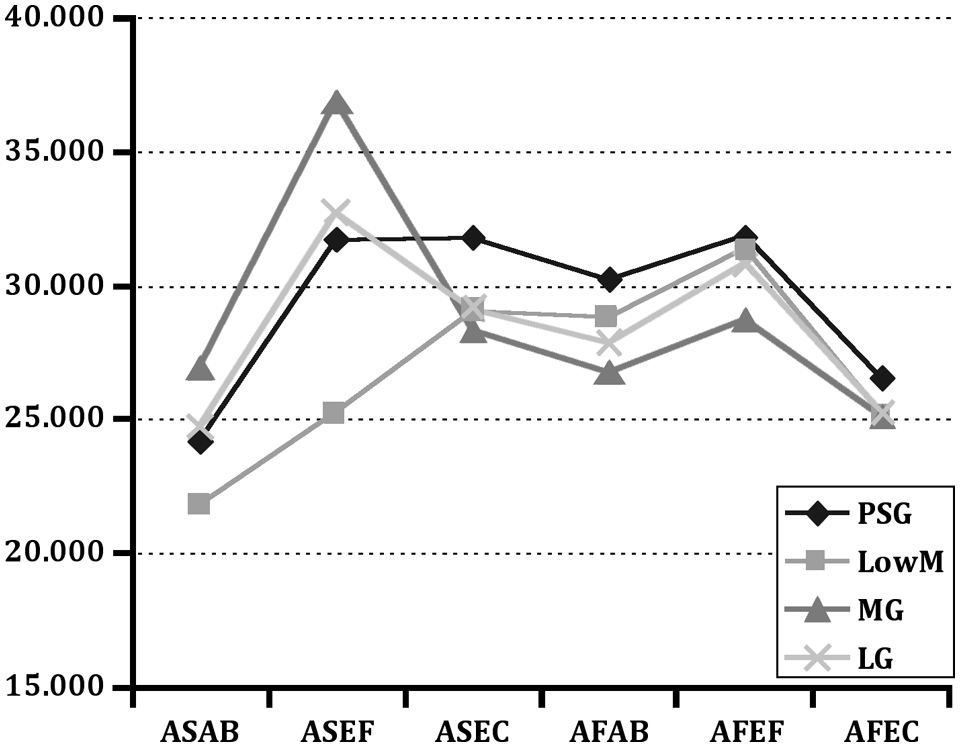
Motivational profiles and dimensions of causal attributions in students with learning difficulties
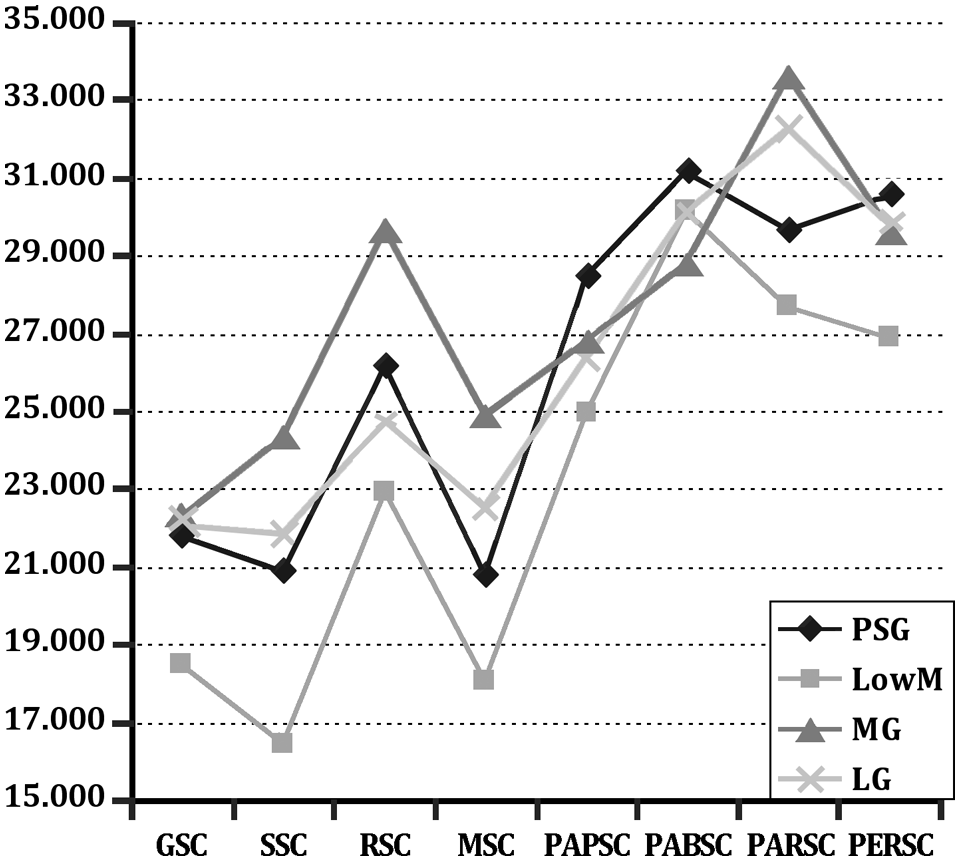
Motivational profiles and self-concept dimensions in students with learning difficulties
The exact opposite is observed in students with a low motivational profile (LowM group), who display a maladaptive pattern because (a) they hardly ever believe that their successes are the result of internal or personal causes (capacity and/or effort), but instead think they are the result of external causes, and (b) they believe their failures are mainly the result of their lack of capacity and effort. In addition, (c) their general self-concept is very negative, and their academic self-concept, family self-concept, and social self-concept are all low. Our data thus indicate that students with a LowM profile are in a clear situation of vulnerability, so they are much more susceptible to future failures and to their cognitive, motivational, and affective consequences.
Between these two groups of students are those individuals with a profile with predominance of learning goals and the students with predominance of social-reinforcement-seeking and performance goals. Although the post hoc analyses did not reveal statistically significant differences between these two groups in most of the attributional and self-concept dimensions assessed, a detailed observation of Figures 2 and 3 suggests that, of the two, the group with a predominance of learning goals (LG group) is the most similar to the multiple goals profile (MG group), although somewhat less adapted.
These results are in accordance with most of those obtained in past research (e.g., Barron & Harackiewicz, 2003; Pintrich, 2003; Sideridis, 2003, 2006; Valle, Núñez, Cabanach, Rodríguez, González-Pienda, & Rosário, 2009) because a multiple goals profile seems more adaptive than a profile with predominance of learning goals, although the opposite pattern has also been found (Sideridis & Tsorbatzoudis, 2003). However, as not many differences in causal attribution processes and self-dimensions were found between students with a predominance of learning goals and students with a predominance of social-reinforcement-seeking and performance goals, this leads us to conclude that although the former profile is more adaptive, the latter is not clearly vulnerable. Consequently, although some researchers initially advocated planning contexts that favor learning goals in students with and without LD (e.g., Sideridis, 2005a), according to other researchers, learning contexts that favor performance goals (i.e., Sideridis, 2007) or social-reinforcement-seeking goals, in addition to these teaching structures, may also be adaptive. We agree with the latter suggestion. In fact, for students in general, and in particular for students with LD, it may be a question of knowing the profile of the student’s needs and his or her level of associated vulnerability and, accordingly, establishing motivational contexts that allow the student to engage academically with some chance of success.
Implications for Practice
Research of motivational profiles could have some relevant implications from the educational viewpoint in general and for students with LD in particular. The analysis of goals provides a way to understand the dynamics of behavior as it develops in a certain situation as well as a framework from which to integrate the diverse sociocognitive variables and to understand the influence of students’ cognitions, behavior, and adaptations to the academic context.
The results of this type of investigation are also an important step forward in the attention to diversity, in this case, attention to motivational diversity. Just as students are different in their knowledge and competences, they are also different in their motivational level. To accept these differences means that the teacher should start with students’ real motives. And as we have seen in this investigation, these motives are multiple and diverse. Such attention to diversity means that the teacher has to work in that “zone of proximal development” (Brophy, 1998). Moreover, such diversity of motives can also mean that from the motivational viewpoint, there are diverse ways to achieve learning and academic success. Although it is true that some are more desirable than others, not all students must necessarily follow the same motivational track, and this is especially true in the case of students with LD.
A teacher’s capacity to adapt the academic activities and learning contexts to the multiple motivational itineraries of students with LD is one of the key elements to guaranteeing satisfactory results from the motivational viewpoint. Future motivational research should study in depth these multiple itineraries and the ways that teachers can effectively match them.
Future Research
In recent years, the paradigm of research in the field of LD has moved away from a model based on deficit toward a perspective that emphasizes the “capacity to adapt and overcome difficulties”—called the “risk and resilience model”—underlining self-esteem, motivation, effort, and persistence as personal, central variables to explain the success of some students with LD (Meltzer, Reddy, Pollica, & Roditi, 2004; Wong, 2003).
Morrison and Cosden (1997) were among the first investigators who applied the terms risk factors and protection factors to the field of research on LD. They argued that the presence of a learning disability constitutes a risk factor for the psychological well-being of the person who has one, but at the same time, diverse intrinsic and extrinsic factors are set off to make the person more resilient to the negative effects. In contrast to the deficit model (which underestimates students’ capacity to grow and feel good because it concentrates on their deficits instead of their potential), under this new paradigm investigators focus all their energy on identifying the critical predictors than can tap students’ true potential for learning and prospering in diverse areas or contexts, despite their particular learning difficulties (Damon, 2004; Murray, 2003).
In recent research based on this new perspective (i.e., Cosden, Brown, & Elliot, 2002; Meltzer et al., 2004; Murray, 2003; Núñez et al., 2005; Stone, Bradley, & Kleiner, 2002), various factors have been identified that contribute significantly to the characteristic behavior of a person who can adapt and overcome adverse conditions, among which are awareness of difficulties and skills, level of self-concept, capacity expectations, causal attributions, and degree of perceived control over their achievements, their teachers’ expectations and attributions, and their trust in the availability of social support (i.e., parents, peers, teachers). Therefore, first of all, more research is needed to attempt to determine how these internal factors (personal goals, self-esteem, causal attributions, capacity expectations, achievement expectations, etc.) interact with external factors (curricular and instructional adjustments, family support, etc.) to lead to risk and/or protection contexts for these students.
Second, the results obtained in this study reveal the need to continue to investigate from the viewpoint of motivational profiles rather than only goals considered individually. Also, the students’ response to the perceived requirements of the contexts in interaction with their own needs and interests is important. Future research needs to take into account variables such as gender, the structure of the academic tasks, or some aspects of the family context (Meece, Glienke, & Burg, 2006). Some of the very interesting issues to be investigated within this sphere could be the following: How do students prioritize their goals within the motivational profile? What is the relationship between inappropriate goal prioritization and adaptation to the academic context? How do unexpected events like failure, conflicts, and rejection by peers or by teachers affect the goal profile? How can different goals be coordinated in different situations? Regarding the last question, most of the difficulties could arise when students (a) are not aware of the goal or goals that are most appropriate to activate in each situation or (b) are incapable of maintaining the same goal profile in the face of adversity or conflict.
Third, a new line of investigation with great potential is the one already initiated by some investigators (e.g., Sideridis, 2003, 2006, 2007), which consists of using structural equation models to obtain information about the link between variables from different settings (personal, contextual, task). This methodology may provide enough information to establish intervention models adapted to different groups of students with LD, depending on their competences and deficits, their diversity of motivations and affects, and—more important—the relationships among all of them.
Study Limitations
The results obtained and the conclusions derived thereby should be considered with some caution for several reasons, among which we emphasize three. First, although the number of participants is large, the results should be interpreted with caution because there were considerable differences in the age variable (which ranged between 8 and 15 years). The data may vary somewhat as a function of this variable. Second, the data derived from this investigation should be interpreted prudently because some variables were not controlled (e.g., type of deficit that causes the LD—perceptive, attentional, working memory, linguistic, etc.—current academic achievement, family attitude and involvement, school context), and this could significantly affect the results obtained, although the size of the sample and the variety of centers and places where the data were collected may attenuate the effect of these extraneous variables. Last, as noted by Hulleman et al. (2010), the conclusions derived from studies of academic goals should be interpreted by taking into account the type of instrument used to obtain the data. Therefore, we encourage investigators in the field of LD to replicate this study with different scales from the one used here to contrast whether our results are mediated by the nature of the items of the AGQ or whether, as we expect, they may be generalized.
Footnotes
The author(s) declared no potential conflicts of interest with respect to the research, authorship, and/or publication of this article.
The author(s) received no financial support for the research, authorship, and/or publication of this article.