







Abstract
In this exploratory study, teachers’ use of standards-based, discourse practices and their students’ mathematics learning in inclusive elementary mathematics classrooms were examined. Two beginning teachers (one third-grade teacher, one fourth-grade teacher) and six students identified with disabilities or as low performing in mathematics participated in this study (three students from each classroom). Six classroom observations of teachers took place over 4 months focusing on a subset of indicators associated with Walshaw and Anthony’s framework of mathematics classroom discourse practices. Follow-up interviews were also conducted. Curriculum-based and state-accountability measures were collected on the six target students in these settings. Different patterns of student performance emerged across the two classrooms in which teachers were observed using different types and degrees of standards-based discourse practices during mathematics lessons. Findings suggest indicators of effective mathematics teaching in inclusive general education classrooms to be validated by future research efforts.
Evidence-based practices are particularly important for the 5% to 8% of school-age students with learning disabilities in mathematics (MLD) who have significant deficits in their ability to solve computation and application problems (Geary, 2004). To help these students, as well as the 25% to 35% of students in general education classes who struggle to learn mathematical knowledge and skills (Mazzocco, 2007), researchers typically design and conduct studies to evaluate the effectiveness of instructional practices on children’s learning but give less attention to how their teachers understand, design, and deliver instruction. Yet, the National Mathematics Advisory Panel (NMAP, 2008) report reveals that a substantial part of the variability in student achievement gains in mathematics is due to the teacher. Once individual student characteristics are taken into consideration, teachers are the most influential factor affecting student achievement, and this finding has been established repeatedly in general education for reading and mathematics (Nye, Konstantopoulos, & Hedges, 2004; Rivkin, Hanushek, & Kain, 2005; Wright, Horn, & Sanders, 1997). Although effective teachers are capable of promoting students’ reading and mathematics achievement, findings from value-added studies do not reveal exactly what teachers do to facilitate student achievement (Rivkin et al., 2005; Schacter, Thum, & Zifkin, 2006).
The National Council of Teachers of Mathematics (NCTM; 2000) supports reform-based mathematics teaching consistent with the Principles and Standards for School Mathematics. The standards, as well as National Science Foundation-funded reform curricula, emphasize teaching focused on students’ conceptual understanding of mathematics rather than procedural knowledge or rule-driven computation. In addition, the documents advocate a student-centered, guided discovery approach for learning in mathematics classrooms (National Research Council, 2001). Furthermore, mathematics education literature (e.g., Ball, 1993; Cobb, Wood, & Yackel, 1992; White, 2003) promotes the notion of mathematics learning as a social endeavor that is achieved through discourse (i.e., communication and interaction) in the classroom between teacher and students, and among students. Although many have argued that reform-based instruction can lead to better learning outcomes for diverse groups of students (e.g., Yackel & Hanna, 2005), as teaching pedagogies they may be insufficient for meeting the mathematics learning needs of students with learning disabilities (LD) and other struggling learners.
Research conducted in reform-oriented, or standards-based, mathematics classrooms (e.g., J. A. Baxter, Woodward, & Olson, 2001; J. Baxter, Woodward, Voorhies, & Wong, 2002) indicates that students with learning difficulties assume passive roles, encounter difficulties with the cognitive load of the activities and curricular materials, are more likely to report using limited and ineffective strategies, and their progress is substantially below that of their more competent peers. In addition, peer-mediated mathematics instruction may not be the best approach for some low-achieving students (Kunsch, Jitendra, & Sood, 2007). When students with learning problems work in pairs, both are disadvantaged learners, thus limiting the benefits of student-to-student interaction. When they interact with more competent peers, low-achieving students typically allow the more skilled learners to do most of the thinking and the work (Bottge, Heinrichs, Mehta, & Hung, 2002). Furthermore, the distinctiveness of mathematical vocabulary may create difficulties for students with LD. When designing lessons for inclusive mathematics classrooms, attention should be paid to defining and using mathematical symbols in a wide variety of contexts and with a high degree of explicitness, encouraging the use of mathematical vocabulary in classroom discourse, and creating opportunities for students to talk mathematically and receive feedback regarding their use of terminology (Baker, Simmons, & Kame’enui, 1997; Geary, 2004).
In general, a consensus among special education researchers is emerging that several approaches to assessment and instruction are effective for teaching students with difficulties in mathematics (e.g., Gersten, Chard, et al., 2009), some of which have been articulated in Assisting Students Struggling With Mathematics: Response to Intervention (RtI) for Elementary and Middle Schools (Gersten, Beckmann, et al., 2009). These approaches include screening all students for mathematics difficulties, monitoring student progress to plan for supplemental instruction, solving word problems based on common underlying structures, depicting problems visually and graphically, building fluent retrieval of basic mathematics facts, and teaching mathematics concepts and principles using explicit and systematic strategy instruction.
Within a Response-to-Intervention (RtI) approach (e.g., D. Fuchs & Fuchs, 2006), the learning needs of students and appropriate interventions are typically provided across three tiers, or levels, of instruction and include “student-centered assessment models that use problem-solving and research-based methods to identify and address learning difficulties in children” (Berkeley, Bender, Peaster, & Saunders, 2009, p. 86). The expectation is that Tier 1 instruction is the evidence-based, core instruction that all students in the classroom receive, including students with disabilities. Tier 2 provides additional support to students who have exhibited difficulty on screening measures or who are not showing adequate progress within the Tier 1 curriculum. Tier 2 consists of supplemental small group instruction aimed at building targeted concepts and skills. Finally, Tier 3 instruction provides the most intensive approaches designed for students who are not showing improvement with the Tier 2 instruction provided (e.g., Berkeley et al., 2009; Bryant, Bryant, Gersten, Scammacca, & Chavez, 2008; D. Fuchs, Fuchs, & Stecker, 2010).
With the push for standards-based instruction in mathematics education, and an emphasis on evidence-based curriculum and instruction in Tier 1 classrooms, one might expect an amalgamation of practices to emerge that successfully supports students with disabilities. Yet, distinctive differences in the nature of mathematics instruction offered in general and special education classrooms to students with disabilities suggest that a careful integration of instructional approaches may not always be the case. For example, Jackson and Neel (2006) conducted a study of mathematics instruction provided in general and special education classrooms in eight elementary schools that included students with emotional and behavior disorders. In the general education mathematics classrooms, the researchers observed that 61% of the observed time was characterized as “conceptually oriented instruction” and only half as much time was devoted to “algorithm instruction” (i.e., 30%; Jackson & Neel, 2006, p. 601). In special education classrooms in these same schools, the nature of observed instruction was nearly reversed, with 75% of the instructional time spent teaching algorithms and only 19% of the time focused on conceptual understanding in lessons. Other differences included more time spent on independent seatwork activities and small group activities in general education classrooms than in special education classrooms, with more teacher-directed instructional time coded in special education settings.
Given that many students with mathematics difficulties and disabilities struggle to develop automatic and accurate retrieval of mathematics facts and to select and use strategies (e.g., Gersten, Jordan, & Flojo, 2005), it is not surprising that teachers in these special education classrooms were found to use more procedural forms of instruction and provide more direct instruction. However, students in these special education classrooms also had few opportunities to justify their mathematical answers, tackle difficult math problems, or develop the communication skills needed to work productively within standards-based curricula and instructional environments (Jackson & Neel, 2006). Overall, results of the study suggest that neither type of observed classroom instruction provided the kind of pedagogical approaches or the support mechanisms needed to allow students with disabilities to make progress in the general education curriculum (Individuals With Disabilities Education Improvement Act, 2004). However, ensuring that students with disabilities receive high-quality Tier 1 instruction in general education classrooms can be quite challenging due to competing notions of what constitutes “high quality.” Moreover, even when evidence-based Tier 1 curricula are used in general education classrooms, fidelity of implementation issues are not uncommon (Gersten, Chard, et al., 2009; Harn, Chard, Biancarosa, & Kame’enui, 2011).
One way to address the quality of teaching for students with disabilities who receive a substantial portion of their instruction in general education settings is to recognize that effective mathematics teaching requires substantial knowledge and skill (NMAP, 2008). Unfortunately, the authors of the NMAP report reveal that
little is known from existing high quality research about what effective teachers do to generate greater gains in student learning. Further research is needed to identify and more carefully define the skills and practices underlying these differences in teachers’ effectiveness, and how to develop them in teacher preparation programs. (NMAP, 2008; p. xxi)
Consequently, additional research is indicated to further define the nature of effective, or “high-quality,” instruction in heterogeneously grouped, general education mathematics classrooms.
To develop valid theories of high-quality teaching in heterogeneously grouped, general education mathematics classrooms that include students with LD, researchers must be able to identify and define, as well as measure, teacher knowledge, dispositions, and skills (e.g., Brownell, Griffin, Leko, & Stephens, 2011).
Although varied types of valid and reliable measures can be developed to assess what teachers of mathematics know and are able to do, researchers in mathematics have advocated for the use of classroom observation as an ecologically valid way to document teacher performance (e.g., Ball & Rowan, 2004). Unfortunately, observation instruments of mathematics teaching that assess the teaching of students with disabilities in general education mathematics classrooms are rare. However, observational systems used in general education reading classrooms that capture student–teacher interactions and thus have a way of gauging the responsiveness of instruction to students’ needs (e.g., Connor et al., 2009) show promise for measuring instruction in general education mathematics classrooms that include students with LD. Data generated from these observational tools could offer insights into how effective teachers differentiate instructional practices and provide instructional support according to students’ learning needs.
As such, the current study was designed to collect preliminary data describing observed teacher practices during mathematics instruction and to monitor the learning of students with disabilities and other struggling learners in general education classrooms. Insights gleaned from this study could lead to the development of valid and reliable measures of competent mathematics teaching of students with disabilities in inclusive mathematics classrooms (i.e., Tier 1 instruction), thereby creating a knowledge base for further defining competent teaching in this area.
Study Design
Concerned that one of the most difficult aspects of standards-based mathematics instruction for students with LD is the emphasis on language and communication during lessons, we limited this study to the NCTM standard of Communication, or classroom discourse. In general, the NCTM standards describe the mathematics understanding, knowledge, and skills that students are to learn from pre-K through 12th grade. The Communication standard focuses on teaching students how to
organize and consolidate their mathematical thinking through communication; communicate their mathematical thinking coherently and clearly to peers, teachers, and others; analyze and evaluate the mathematical thinking and strategies of others; use the language of mathematics to express mathematical ideas precisely. (http://www.nctm.org/standards/content.aspx?id=26854)
For students to be able to achieve the goals of the Communication standard, teachers must be able to model the associated knowledge and skills and to offer students opportunities to engage in activities that allow for student attainment of the goals.
We considered Walshaw and Anthony’s (2008) theory of mathematics teaching as nested activity systems to inform the design of this study. This theory offers a framework for observing key dimensions of standards-based instruction that emphasize the NCTM standard of Communication, or classroom discourse. Walshaw and Anthony organized the literature on the communication, or discourse, in mathematics classrooms within four activity systems, including Activity 1, clarifying how students and teachers communicate in the classroom; Activity 2, scaffolding students’ ideas to move thinking forward; Activity 3, fine-tuning mathematical thinking through language; and Activity 4, shaping mathematical argumentation. Given the nature of observational research, we examined overt practices and behaviors of teachers that addressed mathematical discourse during lessons. Specifically, we attended to the scaffolding of students’ ideas (Activity 2) by noting teachers’ questioning of students for understanding and/or clarification of their responses, as well as the opportunities teachers provided for student-to-student communication. We also examined teachers’ use of mathematical language (Activity 3) by attending to teachers’ use of mathematics terminology, and whether they offered explicit explanations, or definitions, designed to enhance students’ understanding of the language of mathematics. In addition, the three practices align with prior research findings suggesting that mathematics teachers have inadequate mathematical understandings for teaching all children (e.g., Ball, 1990; Ma, 1999). We were also interested in closely monitoring the learning of students with disabilities in general education classrooms based on the findings of J. A. Baxter et al. (2001) and J. Baxter et al. (2002) discussed previously. Finally, these particular teacher behaviors were chosen because we considered them to be of moderately low inference (i.e., observers might readily determine whether a behavior or practice did or did not exist when viewing the videotapes; e.g., Connor, Morrison, & Katch, 2004).
In summary, the purpose of this study was to examine the use of selected mathematics discourse practices during lessons provided in inclusive general education classrooms to third- and fourth-grade students, including those with LD and other low-performing students. Walshaw and Anthony’s (2008) theory of mathematics and teaching as nested activity systems where students and teachers engage in classroom discourse, served to guide our observations of two general education teachers during their mathematics lessons. Thus, the study addressed the following research questions:
Research Question 1: How do teachers spend instructional time using three discourse practices during mathematics lessons?
Research Question 2: How do students with disabilities and other struggling learners exposed to these practices perform on mathematics assessments?
Method
Participants
Teachers
The two first-year teachers who agreed to participate in the study were recent graduates of a teacher preparation program in a large university located in the southeast United States. Both teachers were White, female, and in their early 20s. Each teacher had completed the collaborative general and special education course sequence in the undergraduate portion of their preparation program, including similar field-based experiences. The fourth-grade teacher completed the master’s year in which she received certification in elementary (Grades K–5) and special (Grades K–12) education. The third-grade teacher’s master’s degree was in elementary education with a cognate area in reading.
Both teachers taught in the same elementary school located in a rural area of the school district. The study took place in the teachers’ third- and fourth-grade inclusive mathematics classrooms that contained a subset of children with special needs. The two teachers had classes with approximately 25 students of mixed ability. Both teachers were the only two who agreed to participate in the study out of several who were recruited.
Students
Each teacher identified three of the lowest-performing students in their mathematics classrooms; these students participated in the study. Demographic information on the six target students taught by the two teachers is presented in Table 1.
Student Demographics by Teacher.
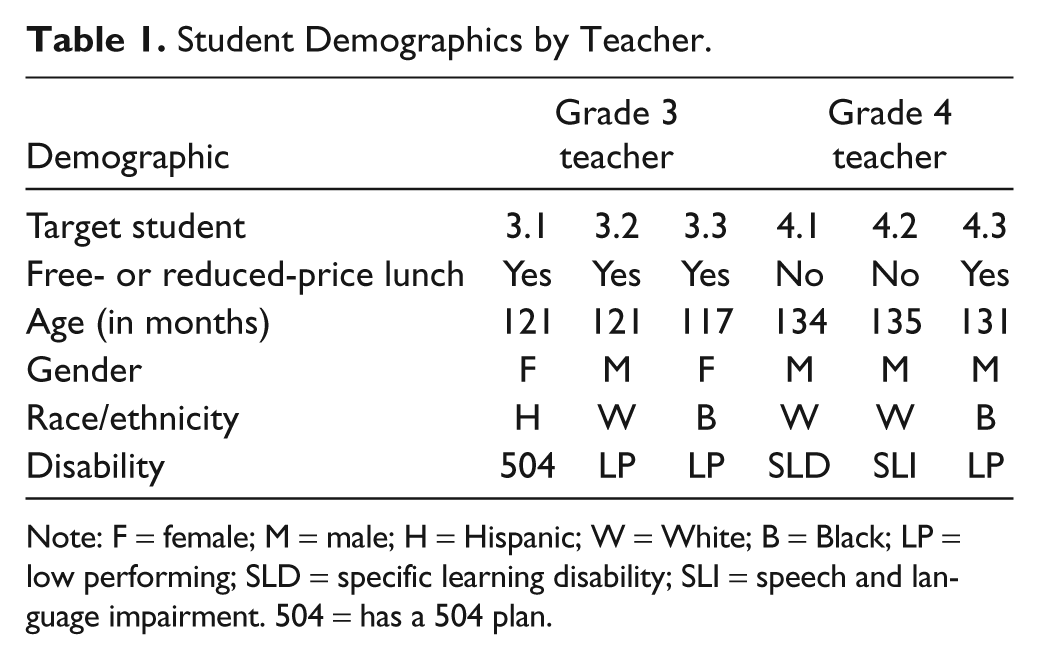
Note: F = female; M = male; H = Hispanic; W = White; B = Black; LP = low performing; SLD = specific learning disability; SLI = speech and language impairment. 504 = has a 504 plan.
Data Collection
Student assessments
Three types of data were collected on the six students who participated in the study. First, students completed written unit assessments included with the Harcourt Math (Maletsky, et al., 2002) series for either third or fourth grade. All students are tested at the end of each topical unit on the concepts and skills included in the unit. Each test in the math series contained approximately 40 multiple-choice items for Grades 3 and above. We collected scores from the teachers for the six target students on all units taught during the entire school year.
In addition, the Monitoring Basic Skills Progress: Mathematics Computations (L. S. Fuchs, Hamlett, & Fuchs, 1998) measures were administered by teachers at three points during the 4 months of the study as an additional formative measure of student progress. Students had 3 min to complete 25 problems, with a maximum score of 25 problems correct. This assessment system is known to have adequate reliability and validity (e.g., L. S. Fuchs, Fuchs, Hamlett, & Allinder, 1989).
Finally, students’ scores were collected from the Florida Comprehensive Assessment Test® (FCAT)—part of the student assessment and accountability program in the Florida Department of Education. FCAT assessments measure students’ mathematics achievement (as well as other content areas) in Grades 3 through 10 and are aligned with the Florida Sunshine State Standards. FCAT mathematics tests provide mean scale scores (100–500) and subscores in five categories: number sense, concepts, and operations; measurement; geometry and spatial sense; algebraic thinking; and data analysis and probability. Based on their scale scores, students are assigned one of five achievement level classifications. These levels range from the lowest level (i.e., Level 1) to the highest level (Level 5). Level 3 indicates that the student’s performance is on grade level. The FCAT has reliabilities similar to those of other standardized and statewide tests (FCAT Technical Report, 2007).
Teacher observations
Six whole-class, videotaped observations were conducted in each teacher’s classroom distributed across a 4-month period. Observers videotaped lessons at the back or at the side of the classroom using a digital video camera and tripod, turning the camera as necessary to capture the teachers’ activities during each lesson. As noted earlier, we examined teacher practices associated with Walshaw and Anthony’s (2008) activity system, including (a) instances when teachers checked for student understanding, or the moment-by-moment assessment teachers carried out during lessons with the intent of monitoring students’ understanding; (b) the opportunities teachers included in their lessons for student-to-student interaction, or the classroom working arrangements intended to be responsive to students’ needs (e.g., peers or pairs in groups, small group instruction); and (c) the teachers’ use of mathematical definitions during instruction. Figure 1 provides an example of each of the three types of teacher practices coded in this study with an example code for each practice.
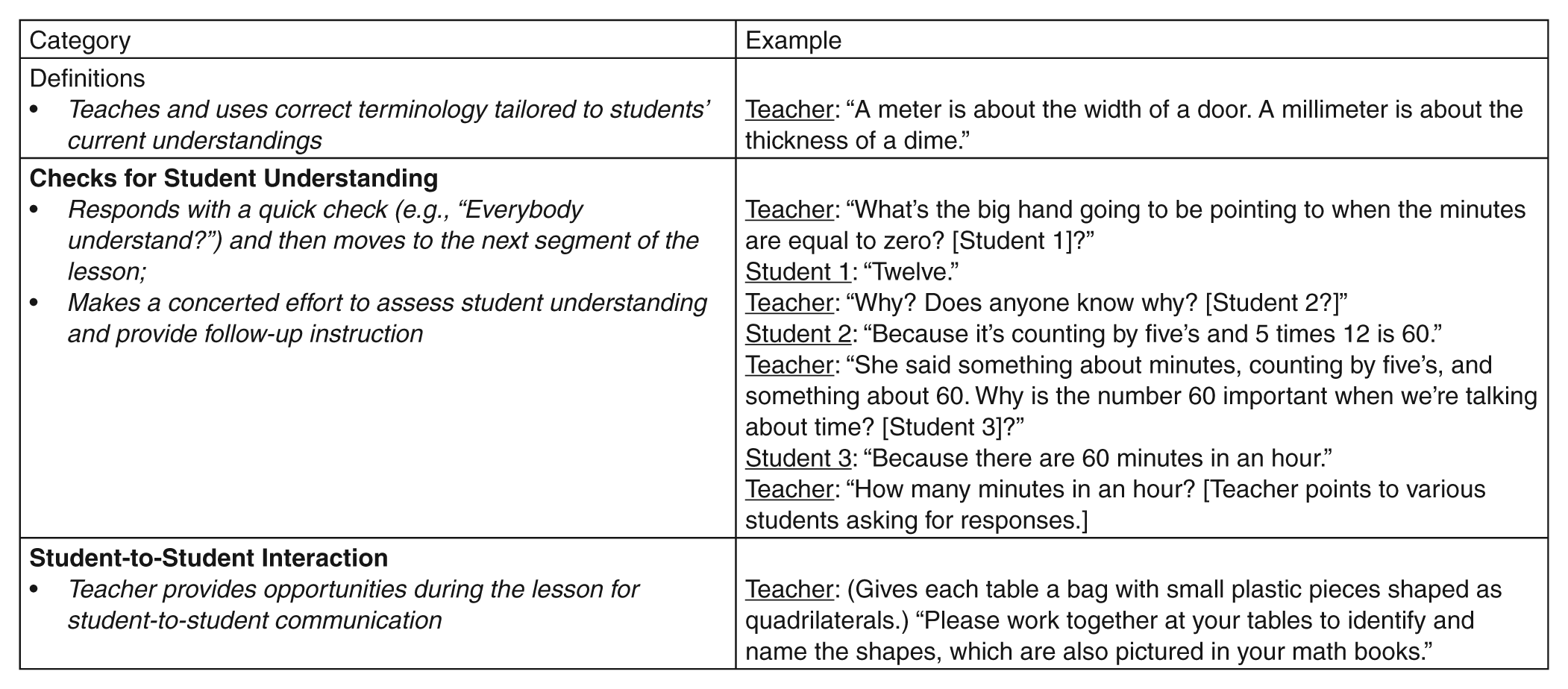
Explanation of video codes.
Interview
Following the observations, each teacher participated in a single, face-to-face interview designed to collect teachers’ perceptions of their coursework preparation in mathematics and mathematics teaching, their perceptions of their ability to teach mathematics, and their views of their students’ performance during the study. The semistructured interview lasted approximately 1 hr with each teacher. In general, the interviews served to validate and clarify findings from the classroom observations and student assessments. Questions asked of the novice teachers are presented in Figure 2.
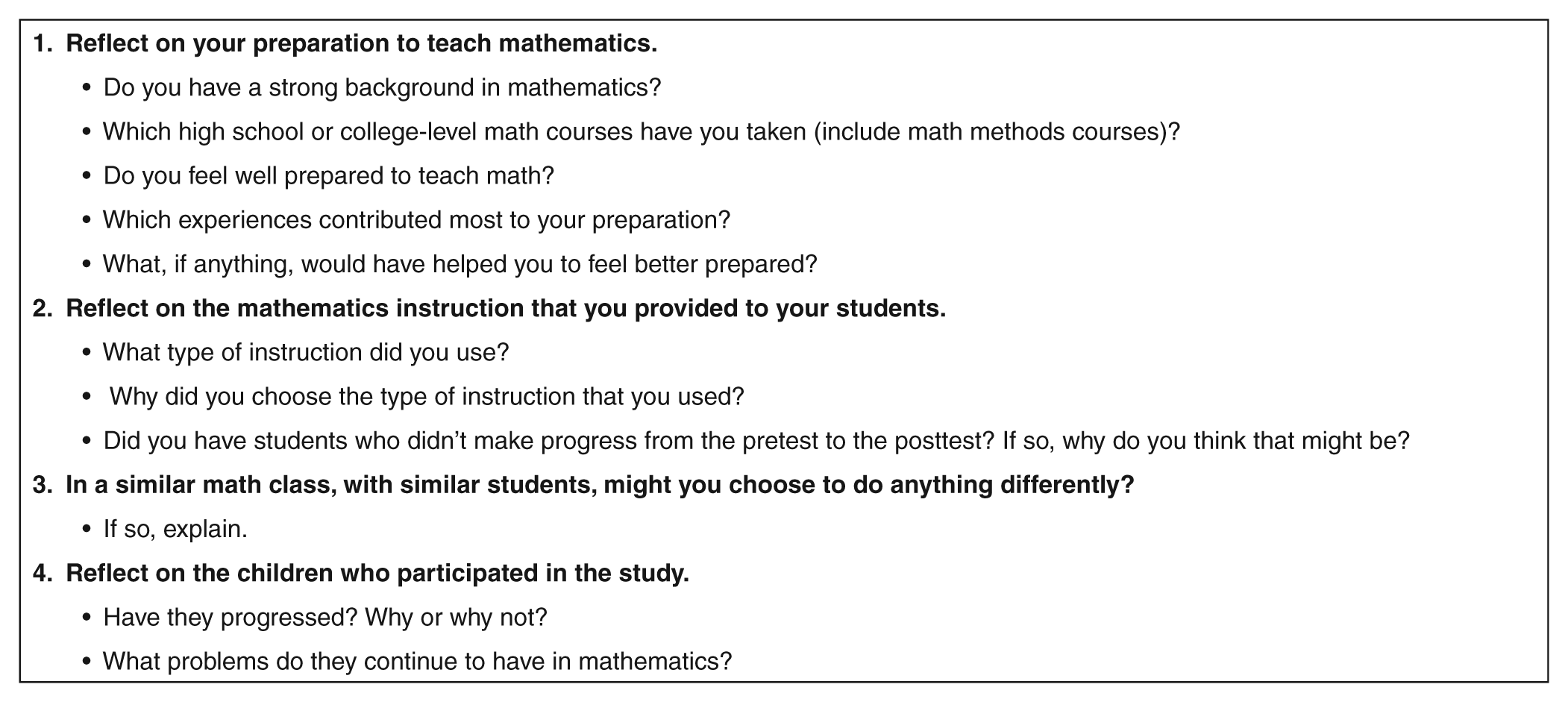
Teacher interview questions.
Results
Both teachers were videotaped for a similar amount of time (i.e., the third-grade teacher for 247 min and the fourth-grade teacher for 250 min)—an average time of 41 min per lesson over the 12 classroom observations. Video coding occurred through the use of Annotation (http://www.saysosoft.com/), a software program capable of coding real-time or captured events by type, onset, and duration (Edyburn & Basham, 2008). Videotaped lessons were coded for the three classroom practices of interest described previously across all lessons for each teacher (i.e., six lessons for each teacher). Data sets were then exported into Excel files for further analysis.
Interobserver agreement
Interobserver agreement for the three practices observed in the videotapes was calculated by dividing the number of practices that were identified by both observers by the total number of practices identified in each lesson and multiplying the quotient by 100%. All four authors of this study coded and recoded the videotaped lessons. A representative subset (i.e., four complete lessons, two for each teacher) were recoded and the percentage of interobserver agreement was established for each lesson, including 79% (third-grade teacher, Lesson 1), 84% (third-grade teacher, Lesson 2), 86% (fourth-grade teacher, Lesson 1), and 90% (fourth-grade teacher, Lesson 2). Consensus was achieved on all disagreements between coders thereby achieving 100% agreement on all four lessons.
Teacher Practices
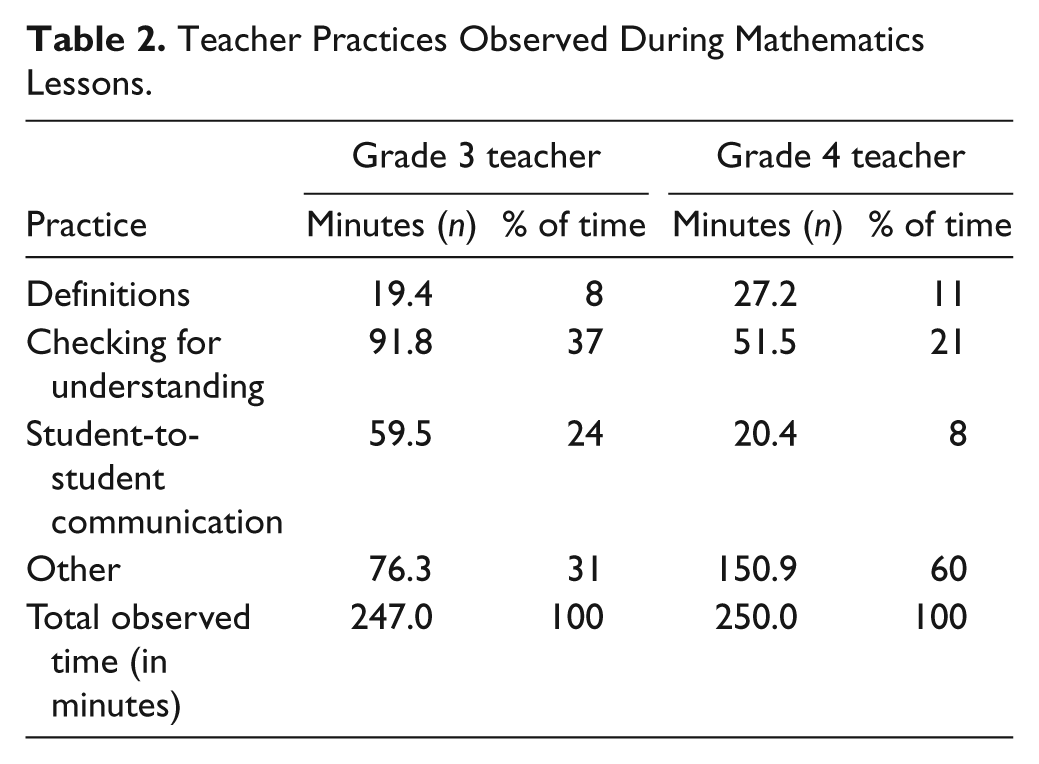
Our first research question focused on how teachers used the three discourse practices of interest. Table 2 provides a summary across all observations of the total minutes and the proportion of time that the teachers spent engaged in the three discourse practices (i.e., definitions, checking for understanding, and student-to-student communication).
Teacher Practices Observed During Mathematics Lessons.
Definitions
Both teachers spent a comparable, yet brief, amount of time teaching definitions. Across six lessons, the third-grade teacher spent 8% (19.4 min) of the observed instructional time teaching mathematical definitions. During the six lessons taught by the fourth-grade teacher, 11% (27.2 min) of the observed time was spent teaching definitions.
Checking for understanding
The third-grade teacher spent more than a third (37%, or 91.8 min) of the observed time during mathematics lessons assessing student understanding. The fourth-grade teacher spent less than a quarter of the observed time checking for understanding (i.e., 21%, or 51.5 min). Contrasting the two teachers, it appears that the third-grade teacher spent almost double the amount of time checking for student understanding than did the fourth-grade teacher.
Student-to-student communication
The third-grade teacher spent 24% (59.5 min) of the observed time during mathematics lessons involving students in peer-related activities. The fourth-grade teacher spent 8% (20.4 min) of the observed instructional time in student-to-student work. Comparisons of the two teachers reveal that the third-grade teacher spent three times the amount of instructional time allowing students to work together than the fourth-grade teacher did.
Other
Given that the three practices we coded did not capture all of the instructional time observed, we created an “Other” category as a placeholder for practices not coded. In all, 31% (76.3 min) of the third-grade teacher’s observed time was not captured by the three practices we coded. Our a priori coding schema also did not capture 60% (150.9 min) of the time we observed the fourth-grade teacher during mathematics lessons.
Interpretive Findings
The two teachers spent comparable, albeit small, amounts of the observed time teaching mathematical terminology to third- and fourth-grade students. Although we attended more closely to the amount of time spent teaching mathematical definitions during lessons, we also noted instances when teachers communicated incorrect or incomplete definitions. For example, the third-grade teacher made the following incorrect statement during one lesson segment while defining a line:
A line is 180°. Whether you begin with an acute angle or an obtuse angle, adding 90 degrees always results in a straight line.
In general, both teachers were observed teaching incorrect or inaccurate mathematical definitions during lessons. This finding suggests that the teachers lacked accurate knowledge of the mathematics content they were teaching and therefore would not understand how to help their students learn and apply the definitions. As noted previously, the lack of teacher proficiency with the mathematical understandings needed for all children to meet high academic standards is well documented (e.g., Ball, 1990; Ma, 1999; NMAP, 2008). Although our current study lends support to this finding, the individual interviews we conducted with both teachers suggest ways that they might have been better prepared to teach mathematical definitions.
I wish I would have had the math curriculum sooner than I did. We got it during pre-planning, only days before the kids arrived (third-grade teacher).
Having someone sit down with me and show me how to use the teacher’s manual [would have helped] . . . I had to learn that by myself. I think that because I’m so strong with classroom management, the administration in my school thought I knew things I didn’t know (fourth-grade teacher).
Clearly, teachers must take personal responsibility for understanding the mathematics content they teach, but schools must also be held accountable for ensuring that their teachers are knowledgeable and competent. Unfortunately, school districts typically underestimate the knowledge and skill needed by teachers to deliver effective mathematics instruction to diverse student groups (NMAP, 2008), or may mistakenly assume a teacher knows the content and how to teach it, as in the fourth-grade teacher’s case.
In contrast to the similarities in the amount of time spent teaching definitions of mathematical terminology, differences in discourse practices used were also noted. Overall, almost 70% of the observed time during the third-grade teacher’s mathematics lessons was accounted for by her use of the three discourse practices targeted in this study. That is, during the 247 min of observational time, only 76 min were spent engaging in other actions not coded. Thus, the discourse practices as defined in this study characterized her classroom practices fairly well.
Conversely, the fourth-grade teacher was observed using the three discourse practices less frequently, describing only 40% of the observed time in her classroom. Of note is the finding that the fourth-grade teacher spent considerably less time than the third-grade teacher involving her students in student-to-student activities (only 20.4 min out of the 250 min observed, or 8% of observed time). When asked in the individual interview to describe the type of instruction she typically used during mathematics lessons, the fourth-grade teacher had this to say:
I use cognitive strategies, teach rules for problem solving, and use direct instruction. In my direct instruction lessons, I introduce the lesson and set a purpose, I review content from previous lessons, I model, use guided practice, and independent practice . . . I have a very structured class. There aren’t a lot of surprises in my class. My kids know the routine and know what to do automatically.
In contrast, the third-grade teacher described her mathematics instruction in the following way:
I use direct instruction and collaborative thinking strategies. The kids are grouped as high, middle high, middle low, and low. I then pair them and place them in small groups. I never put a high and a low together.
Thus, the third-grade teacher placed considerable emphasis on student-to-student activities during her mathematics lessons consuming 24% of the instructional time observed, whereas the fourth-grade teacher provided few opportunities for student-to-student interactions.
Although the lack of allocated instructional time for peer interactions during mathematics lessons was also found in a related study of five preservice special education teachers (Griffin, Jitendra, & League, 2009), these similar findings are at odds with the NCTM (2000) standards recommendation that students spend time interacting and sharing their understandings with their peers during mathematics instruction. One explanation for a lack of allocated time for student-to-student interactions may be that teachers must carefully design, structure, and monitor peer-mediated mathematics instruction if low-performing students are to benefit from this approach (Kunsch et al., 2007). Without the knowledge or skills necessary to structure and monitor effective peer interactions during mathematics lessons, teachers may avoid using these practices.
Instead of providing frequent opportunities for peer interactions, the fourth-grade teacher reported using a teacher-directed instructional approach combining explicit and systematic approaches with cognitive strategy instruction found to enhance the learning of students with LD (Swanson, Hoskyn, & Lee, 1999). She was also observed using frequent opportunities for brief practice and review of content, as well as approaches to concept development involving the use of positive and negative examples and concrete manipulative materials. Although these practices were not formally coded in this study, the fourth-grade teacher displayed these practices as evidenced in the following example of four teaching sequences observed in a single lesson on polygons.
Sequence 1 (7 min and 18 s into the lesson):
What does “tri” mean, Alex?
Three.
[To the whole class] Thumbs up if you agree with Alex.
That’s right!
Sequence 2 (12 min and 17 s into the lesson):
[Teacher is at the front of the classroom. Shows the class plastic geometric shapes.]
Alex, come up here, pick up a shape that is a polygon, and tell me what it is.
What is it?
Triangle.
How do you know?
Because it has three sides and “tri” means three.
Okay, great! It has three sides and “tri” means three.
Sequence 3 (12 min and 55 s into the lesson):
Stephen, please come up and choose another polygon and tell me what it is?
What is it, Stephen?
[Does not respond.]
It has three sides.
[Long pause. No response.]
Tri means three. So what kind of polygon it is?
Triangle.
Good, yes, a triangle has three sides. Tri means three.
Sequence 4 (15 min and 36 s into the lesson):
So what are some polygons that are NOT quadrilaterals? Can you think of one, Laura?
[No response.]
What’s that polygon that has three sides?
Triangle.
Yeah, does a triangle have four sides?
No.
No, so it’s not a quadrilateral.
[The lesson continues with further discussion of nonexamples of polygons.]
Basically, the fourth-grade teacher offered repetition throughout her lessons, and in this example, used positive and negative examples and concrete materials to reinforce the concept taught. Both are important practices for developing and maintaining the mathematics learning of low-performing students (e.g., Gersten, Chard, et al., 2009).
Student Progress
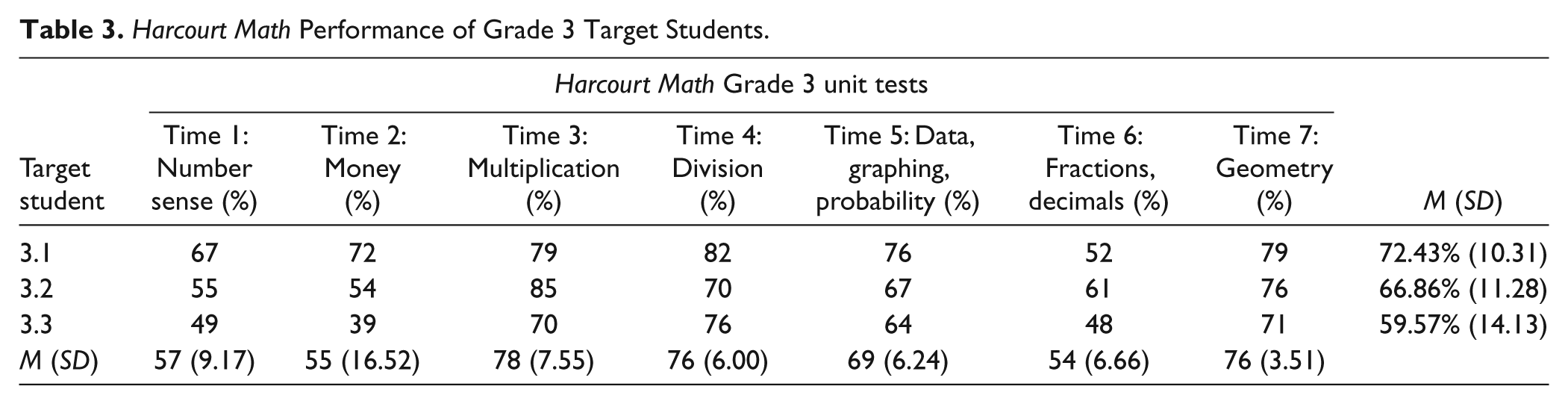
Our second research question addressed the performance of students with disabilities and other struggling learners in these classrooms on three mathematics assessments. Tables 3, 4, 5, and 6 provide summaries of the three types of assessment data collected for this study.
Harcourt Math Performance of Grade 3 Target Students.
Harcourt Math Performance of Grade 4 Target Students.
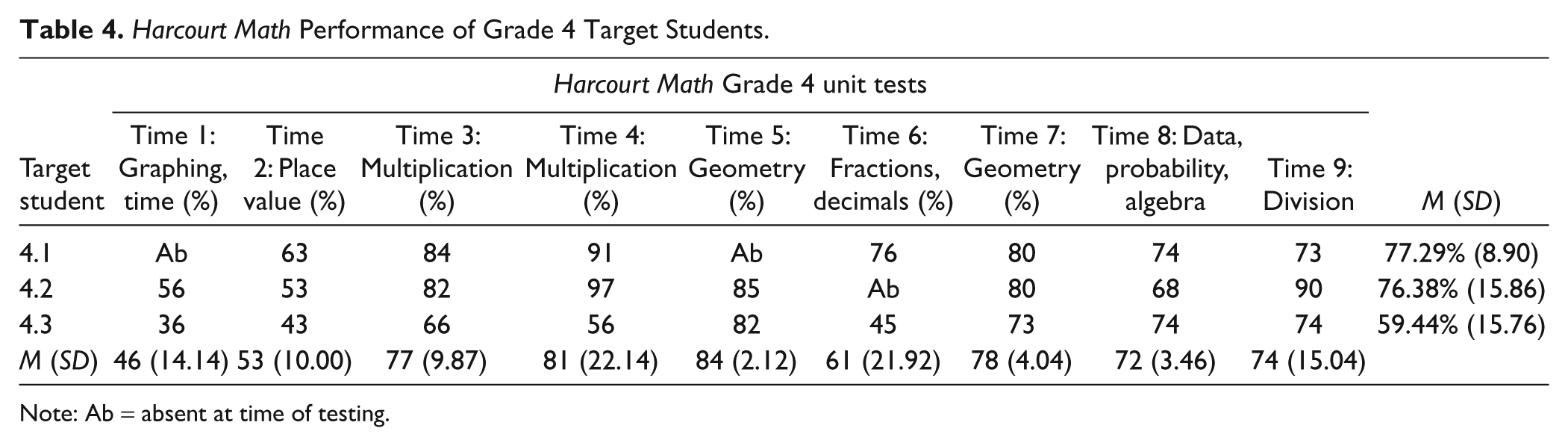
Note: Ab = absent at time of testing.
Computation Performance of Grades 3 and 4 Target Students by Time.
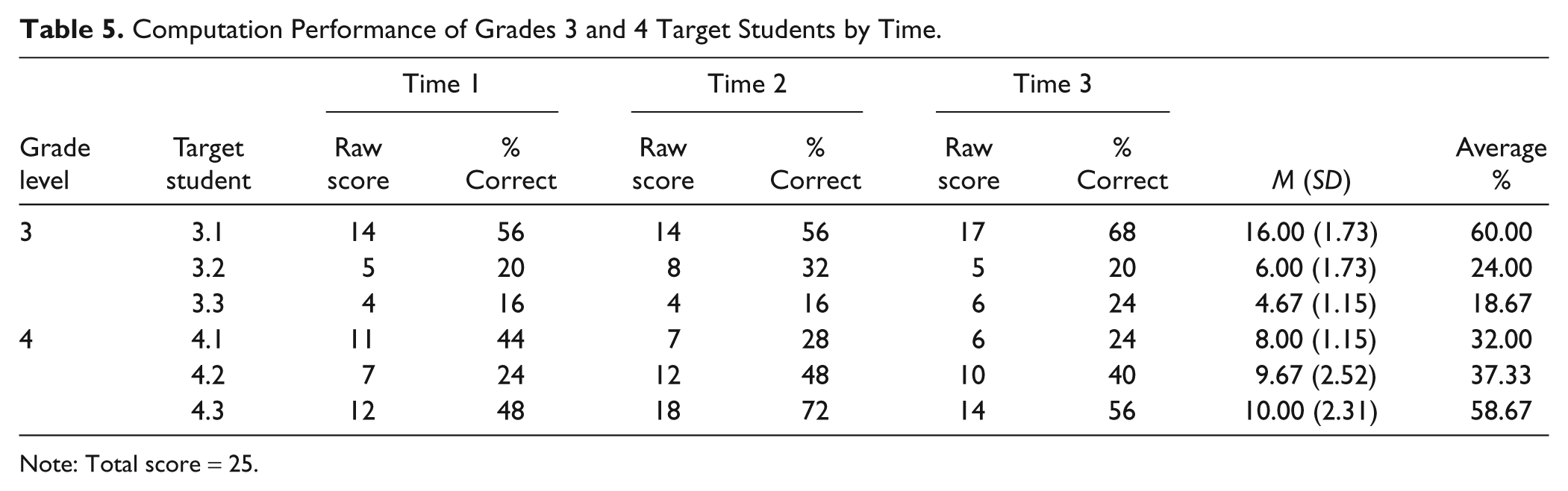
Note: Total score = 25.
FCAT Performance Levels of Grades 3 and 4 Target Students.
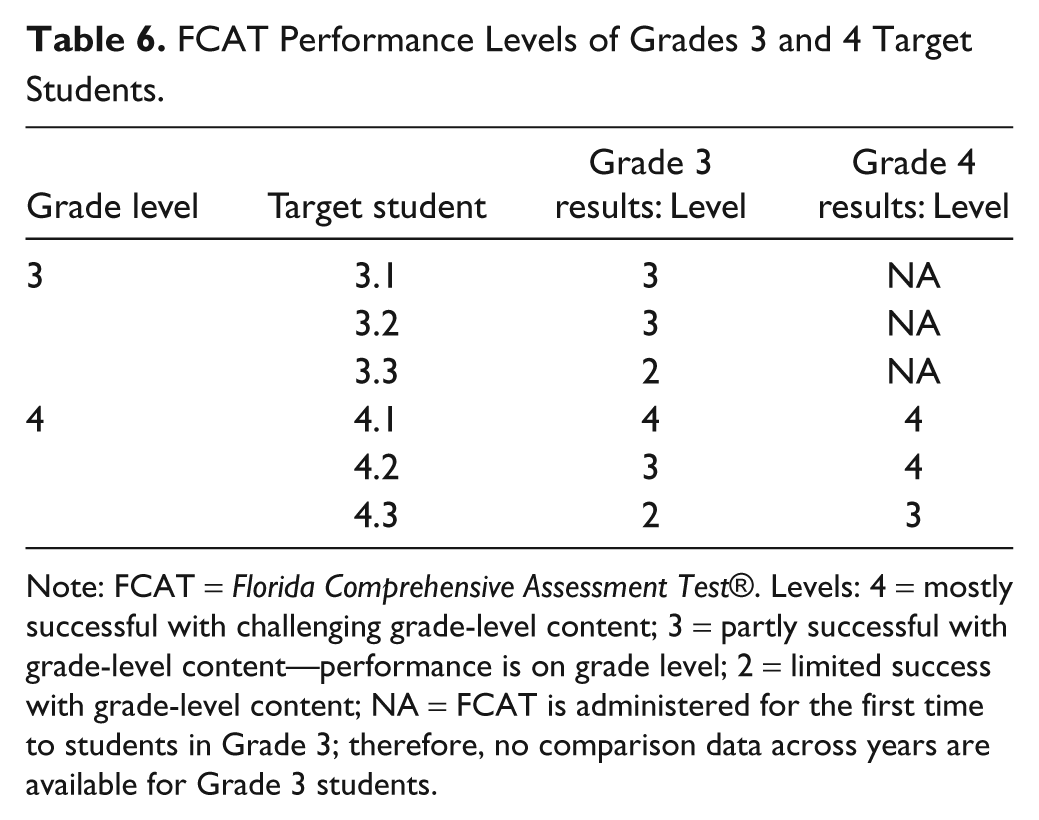
Note: FCAT = Florida Comprehensive Assessment Test®. Levels: 4 = mostly successful with challenging grade-level content; 3 = partly successful with grade-level content—performance is on grade level; 2 = limited success with grade-level content; NA = FCAT is administered for the first time to students in Grade 3; therefore, no comparison data across years are available for Grade 3 students.
Harcourt Math unit tests
Table 3 provides the results of the Harcourt Math unit tests for the three third-grade students (i.e., Student 3.1, Student 3.2, Student 3.3) in the order that the content was taught and assessed. Seven units of instruction were taught during the school year (September–May), including the following mathematics topics: (a) number sense; (b) money; (c) multiplication; (d) division; (e) data, graphing, and probability; (f) fractions and decimals; and (g) geometry. If mastery is to mean that students score at least 80% on each assessment, none of the three lowest-performing students in the third-grade teacher’s math class achieved this criterion level, with the exception of Student 3.2 (low-performing student without identified disabilities) who scored an 85% on the multiplication unit test (Time 3). All three students performed better on the unit tests for multiplication, division, and geometry. They performed less well on unit tests for number sense, money, and fractions and decimals; Student 3.3 (low-performing student without identified disabilities) performed below 50% on three of these assessments. Student 3.1 (student with a 504 plan) had the highest overall average percentage correct on the seven tests. However, overall student performance in the third-grade teacher’s class on the mathematics textbook series unit tests was variable and low, with an average score of 66.29% across all unit assessments for the three students.
Table 4 provides the results of the Harcourt Math unit tests for the three fourth-grade students (i.e., Student 4.1, Student 4.2, Student 4.3) in the order in which the content was taught and assessed. Nine instructional units were taught during the school year as noted in Table 4. Placing mastery at 80% correct on each assessment: Student 4.1 (student with LD) achieved mastery on three of the seven tests taken; Student 4.2 (student with speech and language impairment [SLI]) achieved mastery on five of the eight tests taken; and, Student 4.3 (low-performing student without identified disabilities) reached the 80% criterion on only one test (i.e., 82% on the geometry test, Time 5). All three students performed less well on the unit test for place value (Time 2) and all performed at less than 80% on the test for data, probability, and algebra (Time 8). Overall, student performance in the fourth-grade teacher’s class on the mathematics textbook unit tests was variable; however, the target students in her class scored at the 80% criterion level on a number of the unit tests and achieved an average score of 71.04% across all unit assessments.
Monitoring basic skills progress: Mathematics computations measures
Table 5 presents the scores on the computation measures. In general, target students at both grade levels performed poorly on these measures over the 4 months in which they were administered. Most of the students’ scores did not reveal upward trajectories from Time 1 to Time 3, and if increases in performance occurred over time, they were minimal.
FCAT
Table 6 provides scores collected from the school district at the end of the school year on target students’ performance on the FCAT student assessment, part of the school accountability program in the State. Students take the FCAT for the first time in third grade; hence, there is only one set of levels presented in Table 6 for the third-grade students. Two of the third-grade teacher’s students received a “Level 3” on the mathematics portion of the FCAT suggesting grade-level performance (Students 3.1 and 3.2). One student (Student 3.3) scored below grade level with a “Level 2” designation. Table 6 also reveals that of the three target students in the fourth-grade teacher’s mathematics class, one student maintained and two students improved their designated levels on the FCAT from third to fourth grades.
Interpretive Findings
Overall, student performance on the mathematics textbook unit tests (i.e., Harcourt Math) was variable. However, the performance of target students in the fourth-grade teacher’s class was compared with the struggling students in the third-grade teacher’s mathematics class; the target students in the fourth-grade teacher’s class scored at the 80% criterion level with greater frequency. Of greater consequence are the results of the FCAT. Two of the third-grade teacher’s students received a “Level 3” on the mathematics portion of the FCAT suggesting grade-level performance (Students 3.1 and 3.2), and one student (Student 3.3) scored below grade level with a “Level 2” designation. However, one student in the fourth-grade teacher’s class maintained performance on the math portion of the FCAT (Student 4.1, a student with LD) and the other two students improved their designated levels from third to fourth grades. These findings are noteworthy considering that only 15% of all fourth graders in the state improved by one level on the mathematics portion of the FCAT in the year that the target students took the test (see data presented at the following website: www.fldoe.org/schoolgrades.asp).
Conclusion
In this study, we examined the discourse practices of teachers in inclusive elementary mathematics classrooms that served students with disabilities and other struggling learners, and documented the mathematics learning of these students. In general, we answered our research questions by (a) recording observed mathematics instructional practices grounded in standards-based mathematics teaching, (b) considering teachers’ perceptions of their knowledge and skill for teaching mathematics via interviews, and (c) documenting the progress of struggling students in these classrooms using multiple measures. Findings offer patterns of teacher practices and of their struggling students’ learning in these settings. Tentatively, this study suggests that mathematics teaching in inclusive elementary classrooms that is teacher directed, includes strategy instruction, offers frequent opportunities for review and practice, involves thorough concept development through the use of manipulative materials and visual depictions, and deemphasizes opportunities for peer-mediated instruction may support the learning of students with disabilities and other struggling students taught in these settings.
In addition to these preliminary findings, another important feature of the study is the use of Walshaw and Anthony’s (2008) theory of mathematics teaching as nested activity systems to inform the study design. This theory offered a framework for the extant research, thereby enhancing our understandings of the definitions and dimensions of standards-based mathematics instruction aligned with the NCTM (2000) standard of Communication, or classroom discourse. Using a theoretical framework based on research in mathematics education also allowed us to consider alternative interpretations based on new findings. For example, findings from the current study in inclusive settings suggest that some students who struggle to learn mathematics may not benefit from a practice endorsed by the research base in mathematics education (i.e., peer-mediated instruction), suggesting a challenge to the current research base and the need for further research to explain the alleged contradiction. The framework also served to support decision making about instructional aspects upon which to focus during observations in the current study and in future studies.
Findings from observation studies can suggest specific, and observable, teacher practices capable of predicting student achievement gains (Sartain, Stoelinga, & Brown, 2011). To build upon the preliminary findings gleaned from the current observational study, researchers may choose to substantially increase the number of teacher and student participants in future studies to examine relationships between classroom observation data of teacher practice and scores generated by students on measures of mathematics learning. In addition, researchers may examine relationships among various measures of teacher performance, such as measures of teacher knowledge about mathematics instruction. If teacher knowledge predicts effective teaching practices in the classroom, then professional development personnel and school districts might assume that improving teacher knowledge is important for improving teacher practice. Such correlational studies can demonstrate interesting statistical relationships that may then be strengthened by experimental research. Results of experimental studies then have the potential to generate a stronger research base for defining effective teaching in inclusive mathematics classrooms.
Assuming that no single measure can provide all of the information needed to appropriately and accurately assess teachers’ classroom performance (Kane & Staiger, 2012), a final implication of the current study is to attend to the need for further development and use of multiple measures for understanding the range of teachers’ knowledge, dispositions, and skills. If students with disabilities are to make progress in the general education mathematics curriculum, then appropriately and accurately evaluating teachers’ professional knowledge and skills appears logical. Closely associated with teacher assessment and evaluation is teachers’ need for support to learn and implement effective classroom practices. Thus, findings from this study also point to the need to better understand effective teaching practices in inclusive elementary mathematics classrooms to design and provide rigorous and sustained opportunities for teacher professional development in preservice teacher education programs and inservice programs in schools and districts.
Footnotes
Declaration of Conflicting Interests
The author(s) declared no potential conflicts of interest with respect to the research, authorship, and/or publication of this article.
Funding
The author(s) received no financial support for the research, authorship, and/or publication of this article.