







Abstract
The purpose of the study was to compare the deficit profiles of two important types of mathematics difficulties. Three cognitive measures (working memory, processing speed, and reasoning), two mathematics measures (numerical facts retrieval and mathematics vocabulary), and reading comprehension were assessed among 237 Chinese fourth-grade students, among whom 28 were classified as students with only computational difficulties (CD), 34 were classified as having only word problem-solving difficulties (WPD), 20 were classified as students with computational and word problem-solving difficulties (CD + WPD), and 43 typically developing (TD) peers. Multivariate analysis showed that, compared with TD, CD was associated with weakness in numerical working memory; WPD was associated with weakness in reading comprehension; both CD and WPD were associated with weakness in mathematics vocabulary. However, CD and WPD did not differ from each other on any of those profiling measures. Implications for understanding mathematics competence and identification of mathematics difficulties are discussed.
Developing mathematics competency is critical for school and career success. Yet, learning mathematics is a big challenge for many children. Converging evidence shows that approximately 5% to 9% of the school-age population has some form of mathematics difficulties (MD; for example, Berch & Mazzocco, 2007). Considering the incidence of MD in the general school-age population, it is necessary to investigate the underlying mechanism of MD. Recently, an increasing number of studies have focused on the deficit profile of MD, which provided insights into the nature of MD (e.g., Cirino, Fuchs, Elias, Powell, & Schumacher, 2015; Fuchs et al., 2008; Peng, Wang, & Namkung, 2018).
However, findings were still unclear regarding subtypes of MD. Specifically, a recent meta-analysis by Peng et al. (2018) compared the deficit profiles of MD identified with calculation difficulties (CD) versus with word problem-solving difficulties (WPD). Findings showed that in comparison to typically developing (TD) peers, CD and WPD were distinguishable such that CD was related to more severe deficits in phonological processing and working memory than WPD. Yet, as pointed out by Peng et al. (2018), the reviewed studies on the identification of CD did not report whether these individuals had normal word problem-solving skills, which may confound CD and computational and word problem-solving difficulties (CD + WPD). In contrast, Fuchs et al. (2008) is the only study, according to our knowledge, that systematically identified CD and WPD using both computation and word problem-solving as screening measures. Findings revealed CD showed vocabulary strength compared with WPD. However, Fuchs et al. (2008) did not include important skills related to word problem-solving such as reading comprehension and mathematics vocabulary (Fuchs, Fuchs, Compton, Hamlett, & Wang, 2015; Powell & Nelson, 2017). The current study aimed to further contribute to our understanding of CD and WPD by specifically identifying CD and WPD and examining their performance on a set of skills guided by the theoretical framework of mathematics learning. Findings can provide not only theoretical implications for understanding the heterogeneity nature of MD but also practical implications for the identifications and interventions tailored to subgroups of MD.
Theoretical Framework for Profile Variables
The selection of profile variables in the current study was mainly based on two models of mathematics learning: the Pathway model proposed by LeFevre et al. (2010) and Word Problem-Solving model by Kintsch and Greeno (1985). In the Pathway model, LeFevre et al. (2010) proposed that children rely on three major pathways to develop early mathematics skills, including linguistic, quantitative, and cognitive skills. In contrast, Kintsch Word Problem-Solving model (Kintsch & Greeno, 1985) placed a specific emphasis on word problems, suggesting reading comprehension and the capacity to understand domain-specific vocabulary are critical for word problems. Based on these two models, we included reading comprehension, mathematics vocabulary, numerical facts retrieval, and several cognitive skills (working memory, processing speed, and reasoning) in the current study to examine whether these skills can differentiate CD from WPD. In the following sections, we discussed these skills and their relations to CD and WPD in detail (Figure 1 provides a diagram for the included skills and research questions guided by theoretical models).
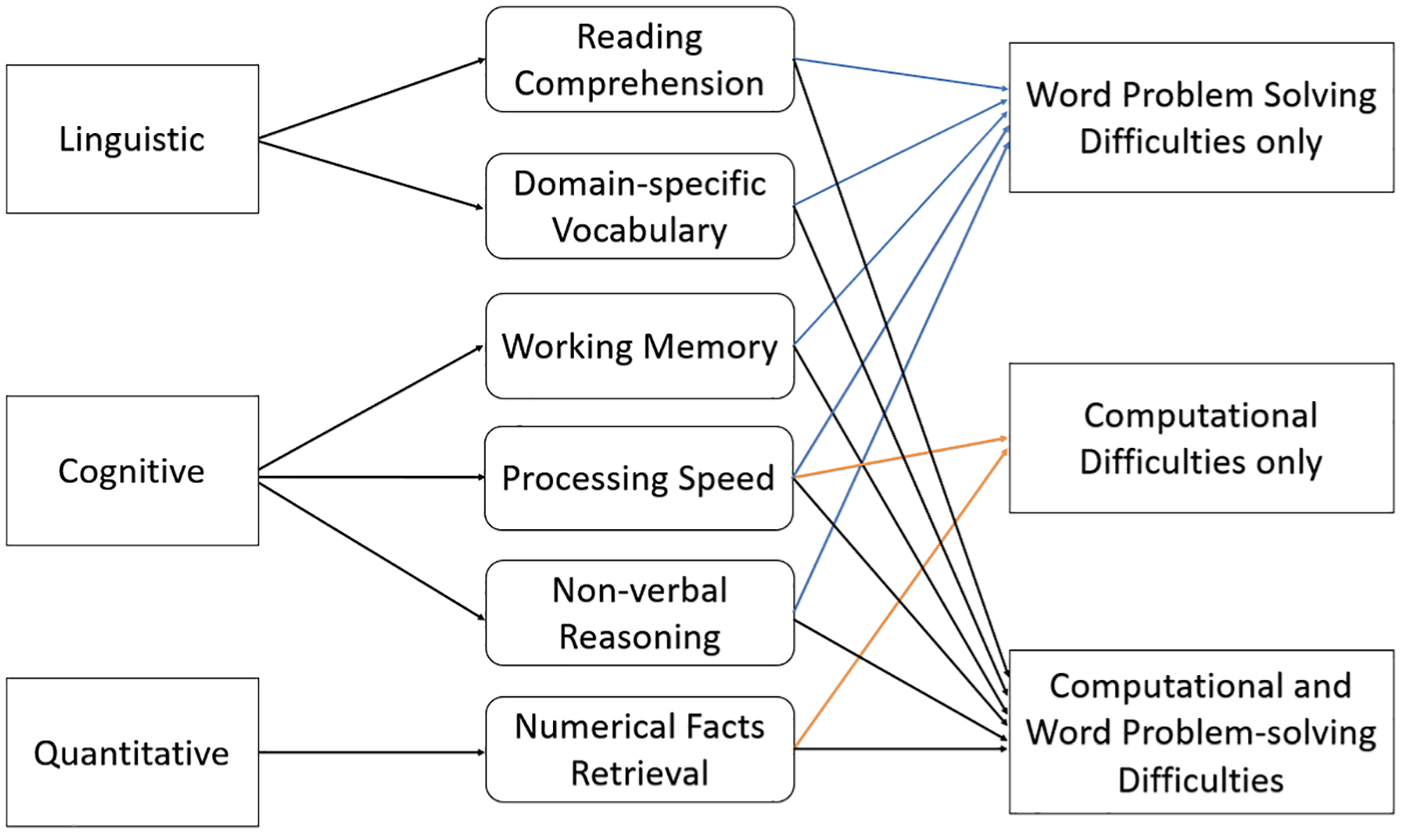
Theoretical model guiding the included skills and corresponding research questions.
Reading Comprehension
Kintsch and colleagues proposed a model on the process of solving word problems that involve reading comprehension heavily (Kintsch & Greeno, 1985; Nathan, Kintsch, & Young, 1992). This is because reading a problem to capture the meaning of the passage and organizing the propositions into a problem schema require reading comprehension. In comparison, calculation is procedural in nature, which requires less reading comprehension skill except for mastering calculation principles (Hornburg, Schmitt, & Purpura, 2018). Thus, it is expected that children with WPD may demonstrate a more severe deficit in reading comprehension compared to children with CD.
Mathematics Vocabulary
Mathematics vocabulary refers to the understanding of key words in mathematics (Hornburg et al., 2018). Recent studies suggest mathematics vocabulary has strong correlations with both computation (Forsyth & Powell, 2017; Powell, Driver, Roberts, & Fall, 2017; Powell & Nelson, 2017) and word problem-solving (Fuchs, Gilbert, Fuchs, Seethaler, & Martin, 2018; Peng & Lin, 2019). However, there are also studies indicating that mathematics vocabulary may be particularly important for word problem-solving. For example, Fuchs et al. (2015) found that mathematics vocabulary has a strong correlation with early word problems because mathematics vocabulary helps students comprehend the word problem and build a schema. Peng and Lin (2019) further demonstrated that mathematics vocabulary made a unique contribution to word problem-solving but not to calculation, even after controlling for other cognitive skills and general vocabulary. Thus, it is reasonable to hypothesize that children with WPD may have a more severe deficit in mathematics vocabulary than children with CD.
Numerical Facts Retrieval
Numerical facts retrieval refers to automatic retrieval of numerical facts for simple arithmetic problems (e.g., 2 + 3 = 5) from long-term memory (Fuchs et al., 2009). It is suggested that the deficit of numerical facts retrieval is closely related to difficulty with counting (Geary, Bow-Thomas, & Yao, 1992), immature use of mathematics strategies (Geary, Hoard, Byrd-Craven, Nugent, & Numtee, 2007), and inefficient use of working memory during mathematics tasks (Goldman, Pellegrino, & Mertz, 1988). Thus, it is reasonable to hypothesize that children with CD have more severe deficits with numerical facts retrieval than children with WPD. That said, Fuchs et al. (2008) did not find facts retrieval contributing to the deficit profile of MD. One possible explanation of this null finding is the domain-specificity of materials. Fuchs et al. (2008) used semantic facts retrieval. It is possible that numerical facts retrieval, rather than semantic retrieval, is more likely to distinguish CD and WPD and we test this hypothesis in the current study.
Working Memory
Working memory (simultaneous information storage and processing, Daneman & Carpenter, 1980) is important for mathematics learning (e.g., Peng, Namkung, Barnes, & Sun, 2016; Raghubar, Barnes, & Hecht, 2010). There are mixed findings on the role of working memory in CD and WPD. Some research did not find working memory relate to CD or WPD (Fuchs et al., 2008), some found that working memory is more important for WPD (Fuchs et al., 2006; Swanson, Beebe-Frankenberger, 2004), while some found that CD has more severe working memory deficit (Peng et al., 2018). We hypothesized that WPD has a more severe deficit in working memory relative to CD because students need to have more pieces of information being stored and manipulated simultaneously to build a word problem model and a mathematical equation than doing calculations (Kintsch & Greeno, 1985).
Processing Speed
Processing speed refers to the efficiency with which information is processed. With slower processing, the interval for deriving counted answers and for pairing a problem stem with its answer in working memory increase; this creates the possibility that “decay” sets in before completing the computational sequence (Fuchs et al., 2008). Processing speed may be a very important cognitive factor in MD, especially for young children with CD (Fuchs et al., 2006). However, others suggest that slow processing may also relate to WPD, such that students with WPD tend to use more time-consuming, inefficient strategies while solving word problems (Geary, 1993). Indeed, the meta-analysis by Peng et al. (2018) showed that although both CD and WPD showed processing speed deficits, these two groups did not differ on processing speed, indicating that processing speed may be a more general MD marker.
Reasoning
In terms of computation, reasoning facilitates the understanding of computation relations and principles (e.g., Geary, Hoard, Nugent, & Bailey, 2012). However, reasoning may not be an important predictor of computation in later grades when students mostly rely on facts retrieval or working memory in computation (Locuniak & Jordan, 2008). In contrast, reasoning may be a constant important variable for word problem-solving. As Cooper and Sweller (1987) states, students need to grasp problem-solution strategies, categorize problems into problem-types or schemas, and generalize taught problems to novel problem situations to solve word problems. The processes of categorizing a word problem as a specific problem type, or schema, and adopting appropriate solution-strategies make strong demands on reasoning ability. Thus, it is reasonable to hypothesize that children with WPD have a more severe deficit in reasoning in comparison to children with CD.
Chinese Sample
Studying Chinese sample is a unique feature of the current study and an important contribution to the MD profiling literature, as the majority of existing research is focused on children from western countries. Because number names and mathematics instruction in China differ from those among English-speaking countries (e.g., the United States), our research can investigate whether these language/instruction-specific factors influence subtypes of MD. Specifically, research suggests that compared with English, Chinese number words above 10 are generated by consistent rules, whereas English number names above 10 have a few irregular modifications. For instance, the literal translation of 11 from Chinese into English is “ten-one” and 12 from Chinese to English is “ten-two.” Because of this language advantage, it is easier for Chinese students to learn numerical knowledge (e.g., counting and calculation) than for their peers in the United States (e.g., Miller, Smith, Zhu, & Zhang, 1995). In addition, the procedural-oriented way of classroom instruction in China might also strengthen the automatic retrieval of number facts by repeated practices (Peng & Lin, 2019). As previous research indicated, in China, classroom teaching often starts with the teacher’s model of procedures, followed by repeated practices. With the accumulating practices/exposures to basic arithmetic combinations, procedural strategies are gradually replaced by direct memory retrieval, which is especially obvious for Chinese students (Campbell & Xue, 2001). Thus, given the relative clarity of numerical language and the procedural-oriented instruction, Chinese students with CD may have deficits in numerical facts retrieval, but may also have deficits in conceptual understanding of numbers and operations, associated with deficits in language comprehension or working memory.
Aims
To sum, the current study aims to add to the MD profiling literature by studying the deficit profiles of CD and WPD among Chinese students on a variety of skills. We examined (a) whether children with computational difficulties (CD and CD + WPD) have relative severe deficits in numerical facts retrieval compared with WPD; (b) whether children with WPD (WPD and CD + WPD) demonstrate relative severe deficits in reading comprehension, mathematics vocabulary, and reasoning in comparison to CD; and (c) what are the common deficits across MD subtypes. Based on the word problem-solving model by Kintsch and Greeno (1985) and recent findings (e.g., Fuchs et al., 2015; Peng et al., 2018), we hypothesized that in comparison to children with CD, children with WPD may have more severe deficits in reading comprehension, mathematics vocabulary, and reasoning, while children with CD may have more severe deficits in numerical facts retrieval in comparison to children with WPD (Figure 1 provides a diagram for research questions guided by theoretical models).
Method
Participants
Participants were 237 fourth graders (125 boys) from a typical elementary school in a southern city of China. We chose this school because according to the records of the county education bureau, this school ranks in the middle regarding the fourth graders’ academic performance in that county. The mean age of the sample was 10.19 (SD = .43) years old. All students were TD children. No students were identified with any disabilities. There was no institutional review board (IRB) for the current study because IRB was not required when the study was conducted. That said, our research was considered no risk for participants and was approved by the school principal. Students’ participation was voluntary and they were informed that they can withdraw anytime during the study.
Difficulty status group formation
We screened all 237 fourth-grade students on reasoning (Raven), computation (WRAT), and word problem-solving (factor score across WISC-word problems and WJ Applied Problems) to identify participants in this study. We excluded one student with a standard score below 90 on Raven (<25th percentile) because our interest was children with normal intellectual ability. Then, based on the total screening sample and two cutoff points (i.e., 25th percentile and the 35th percentile; for example, Swanson, Jerman, & Zheng, 2008; Peng, Sun, Li, & Tao, 2012), we identified the CD, WPD, CD + WPD, and TD group. Specifically, we first identified students with CD (<25th percentile on WRAT-Computation and >35th percentile on word problem-solving factor score), WPD (<25th percentile on word problem-solving factor score and >35th percentile on WRAT-Computation), and CD + WPD (<25th percentile on WRAT-Computation and <25th percentile on word problem-solving factor score). Then, we calculated the M and SD of the word problem-solving performance of students with CD and computation performance of children with WPD, respectively. Next, we computed the 95% confidence interval (CI) of the computation based on the WPD group and the 95% CI of the word problem based on the CD group to select TD students. All the students who scored within both CIs were selected as the TD group. The purpose of this step is to guarantee that CD has only computational difficulty compared with TD and WPD has only word problem-solving difficulty compared with TD (we excluded 118 TD students who fell out of these 95% CIs).
Based on these criteria, we identified 28 children with CD, 34 children with WPD, 20 children with CD + WPD, and 43 TD children. Table 1 shows the descriptive statistics of all groups. Overall, all groups were comparable in terms of age, F(3, 121) = 1.04, p = .38, and gender, χ2(3) = 4.27, p = .23. With respect to computation tasks, the CD and CD + WPD groups were comparable, and both groups showed statistically significantly poorer performance than the TD and WPD groups. Considering word problem-solving tasks, TD and CD groups were comparable, and both groups showed statistically significantly greater performance compared with WPD and CD + WPD groups.
Performance by Difficulty Status.
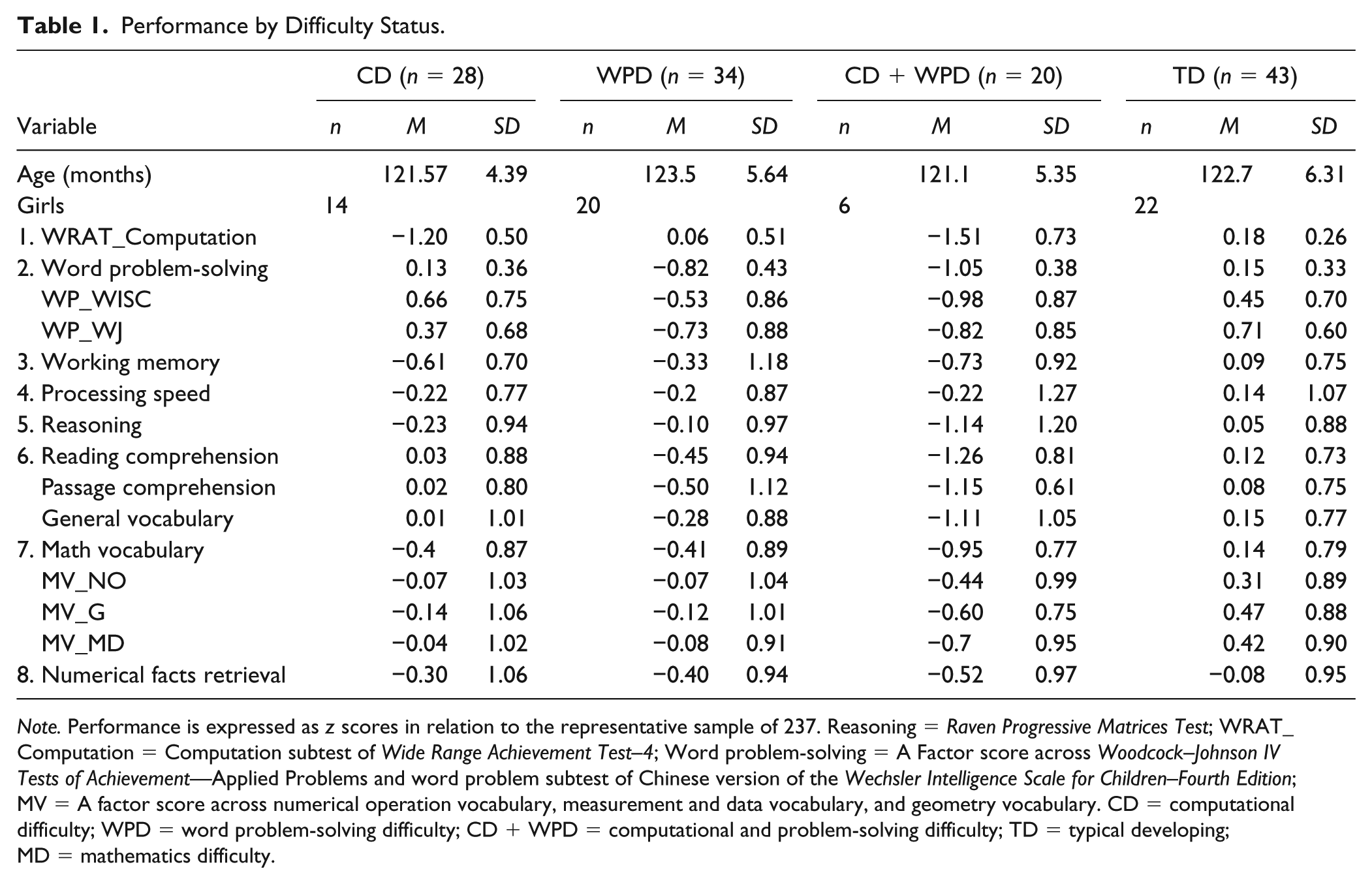
Note. Performance is expressed as z scores in relation to the representative sample of 237. Reasoning = Raven Progressive Matrices Test; WRAT_Computation = Computation subtest of Wide Range Achievement Test–4; Word problem-solving = A Factor score across Woodcock–Johnson IV Tests of Achievement—Applied Problems and word problem subtest of Chinese version of the Wechsler Intelligence Scale for Children–Fourth Edition; MV = A factor score across numerical operation vocabulary, measurement and data vocabulary, and geometry vocabulary. CD = computational difficulty; WPD = word problem-solving difficulty; CD + WPD = computational and problem-solving difficulty; TD = typical developing; MD = mathematics difficulty.
Measures
Computation
We adapted and used the calculation subtest of the Wide Range Achievement Test–4 (WRAT-4, Wilkinson & Robertson, 2006). Because WRAT-4 is a primary calculation test, current test translated a few English words in this test into the corresponding Chinese words. For this test, the child had 30 min to solve 80 calculation problems of increasing difficulty. The number of items solved correctly was the total score. Cronbach’s alpha for the current sample was .83.
Word problems
We calculated the factor score of two tests of word problems. Using principal component factor analysis, we combined the scores of these word problem tests to indicate word problem-solving ability. The first word problem test was a paper-and-pencil test adapted from the Chinese version of the Wechsler Intelligence Scale for Children–Fourth Edition (CWISC-4; Zhang, 2008; WISC-word problems). For this test, the child was asked to solve 31 mathematical word problems of increasing difficulty presented on paper. The child was given 40 min to finish this test. The tester may read problems to the student if the student had difficulty reading these problems. The total number of word problems solved correctly was the score of this test. Cronbach’s alpha for the current sample was .71.
The second word problem test was a paper-and-pencil test adapted from Woodcock–Johnson IV Tests of Achievement–Applied Problems (Schrank, Mather, & McGrew, 2014). Most test items were translated directly when items remained the same but only worded in Chinese. In contrast, some items could not be translated directly and needed to be adapted for use with Chinese-speaking individuals. For example, few test items were adapted when the quantifier concepts were not used in China (e.g., mile → kilometer). The child was given 40 min to solve 45 mathematical word problems. The examiner would read the story problems to the child if necessary. The total number of word problems solved correctly was the score of this test. Cronbach’s alpha for the current sample was .84.
Reasoning
We used the Chinese version of the Raven Progressive Matrices Test (Zhang & Wang, 1985). The child was required to circle the replacement piece that best completed a pattern presented in an item. There are 60 items of increasing difficulty in the test. The total number of problems solved correctly was the final score. Cronbach’s alpha for the current sample was .85.
Processing speed
We used the character coding speed, which is adapted from the coding speed test of the CWISC-4 (Zhang, 2008). This test consisted of nine character-symbol pairs (又/┤, 个/┴, 上/ (, 口/V, 王/┐, 了/├, 广/┼, 工/), 大/└) followed by a list of the same 126 characters. The child was required to write down the corresponding symbol for each character as fast and accurately as possible (e.g., if it is 又, write ┤ under it). The score was the number of symbols written correctly within 2 min. The reported test–retest reliability of this test was .70.
Working memory
This test was adapted from Backward Digit Recall from the Working Memory Test Battery for Children (Pickering & Gathercole, 2001). The child listened to a string of random numbers presented by an audio player at the speed of one digit per second and then said the series backward. There were 21 series, with difficulty increasing as more numbers are added to the series. We gave feedback on the first three test series to lower the floor effects of this assessment. The score was the total number of series recalled correctly. Cronbach’s alpha for the current sample was .76.
Reading comprehension
We used a principal component factor analysis to create a weighted composite variable of reading comprehension using vocabulary and passage comprehension measures. First, the Chinese Character Recognition Measure and Assessment Scale for Primary School Children (Wang & Tao, 1993) was used to measure students’ general vocabulary capacity. The child is required to identify 194 characters by using each character in a phrase/word. The score is the total number of characters used correctly in a phrase/word. Cronbach’s alpha for the current sample was .96.
The second measure, passage comprehension, was a researcher-developed measure that consisted of eight passages (four narrative passages, three expository passages, and one poem) with 40 questions (multiple-choice and short-response). Questions were designed to tap the understanding of the main idea of the passage, inferencing, and understanding vocabulary in the content. The score is the total number of questions answered correctly. Cronbach’s alpha for the current sample was .76. We choose and combine vocabulary and passage comprehension for two reasons. First, based on reading development, vocabulary and passage comprehension overlap significantly after third to fourth grades, when children transit from learning-to-read to reading-to-learn (Hoover & Gough, 1990). Second, research on Chinese reading often use vocabulary tests such as the one we used as one index of comprehension (e.g., McBride-Chang, Shu, Zhou, Wat, & Wagner, 2003; Peng, Tao, & Li, 2013) because vocabulary is highly associated with reading comprehension performance among Chinese students (e.g., Cheng, Zhang, Wu, Liu, & Li, 2016; Shu, McBride-Chang, Wu, & Liu, 2006).
Mathematics vocabulary
To measure students’ understanding of mathematics vocabulary, we selected all mathematics vocabulary terms that appeared in the elementary mathematics textbooks published by People’s Education Press (PEP) for the third, fourth, and fifth grades. The PEP edition was selected because it fully reflects the curriculum standards of math in China (Ministry of Education of China, 2011), and it is the most wildly used mathematics textbook which is also used by the students in the current study. We did not include mathematics vocabulary introduced before third grade because we found ceiling effects on those early vocabulary during our pilot study. There was a total of 91 target vocabulary from third through fifth grades (see Supplemental Appendix A). Because the Chinese mathematics curriculum in elementary grades has categorized mathematics knowledge into three types—numerical operation, geometry, and measurement—our selected mathematics vocabulary has been naturally grouped into three categories. To investigate the importance of mathematics vocabulary for students’ mathematics performance, we used a principal component factor analysis to create a weighted composite variable of mathematics vocabulary based on three types of mathematics vocabulary (i.e., measurement, geometry, and numerical operation).
Two testing formats (i.e., multiple choices and oral questions) were used to measure students’ understanding of vocabulary specific to mathematics (see Supplemental Appendix B for examples of multiple-choice and oral question items). Multiple-choice questions covered all target vocabulary from third to fifth grades. Because mathematics vocabulary terms are correlated in some ways and to better assess students’ conceptual understanding, a portion of our testing items required students to understand the relations of a group of mathematics vocabulary. For the multiple-choice test, students were given 40 min to answer 58 questions (see Supplemental Appendix B Multiple-Choice Test Item 2 for examples).
In the oral question test, we included vocabulary with multiple characteristics, while we only test one characteristic in the multiple-choice test. For example, the curriculum lists several characteristics of “parallelogram.” We tested one characteristic (altitude of the parallelogram) in the multiple-choice test and tested the other characteristic (shape and structure) in the oral test by asking “what is parallelogram by providing the definition of the shape?” For the oral question test, the tester read 35 questions to the child who had 30 s to answer each question. The testing was audiotaped and later transcribed to text for scoring. The two authors independently scored the oral question test and the inter-rater agreement was .96, and the inconsistency was solved through discussion. Cronbach’s alpha for the current sample alpha was .87.
Numerical facts retrieval
The Woodcock–Johnson IV Tests of Achievement–Calculation Fluency subtest (WJ-Calculation Fluency, Schrank et al., 2014) comprised 160 addition and subtraction number combinations. The child was given 3 min to solve the problems as fast and accurately as possible. The number of items solved correctly was the total score. Cronbach’s alpha for the current sample was .98.
Procedure
Tests were administered in several sessions in the spring semester of fourth grade during April and June (toward the end of fourth grade). General vocabulary, passage comprehension, multiple-choice mathematics vocabulary, reasoning, computation, and word problem tests were administered to students in several whole-class sessions. Processing speed, working memory, and mathematics vocabulary oral question tests were administered to students individually in the quietest place available at their schools. At the end of each testing session, all students were given a small present as a memento of their participation.
Analyses
First, we conducted factor analyses to create weighted composite variables of reading comprehension, word problem-solving, and mathematics vocabulary. Considering the correlations among included dimensions (see Table 2), we conducted a multivariate analysis of variance (MANOVA) analysis to evaluate whether groups differed on those dimensions using IBM SPSS version 24. In our multivariate analysis, the between-subjects factor was MD status (TD vs. CD vs. WPD vs. CD + WPD); the within-subjects factor was six dimensions (working memory vs. processing speed vs. reasoning vs. reading comprehension vs. mathematics vocabulary vs. numerical facts retrieval). If the interaction effects were significant in MANOVA analysis, we would conduct univariate follow-up tests. Due to unequal sample sizes across groups, Tukey honestly significant difference (HSD) correction was used to adjust the p value for six contrasts per measure. Conducting the contrasts of CD versus WPD and WPD versus CD + WPD, we can answer our first research question—whether children with CD (CD and CD + WPD) have relative severe deficits in numerical facts retrieval compared with WPD. Conducting the contrasts of CD versus WPD and CD versus CD + WPD, we were able to answer our second research question—whether children with WPD (WPD and CD + WPD) demonstrate relative severe deficits in reading comprehension, mathematics vocabulary, and reasoning in comparison to CD. Last, conducting the contrasts of TD vs. CD, TD vs. WPD, and TD vs. CD + WPD to answer the final research question—what are the common deficits across MD subtypes. Due to our small and unequal sample sizes, we used Hedge’s g to calculate the effect sizes (Hedges & Olkin, 1985).
Means, Standard Deviations, and Correlations.
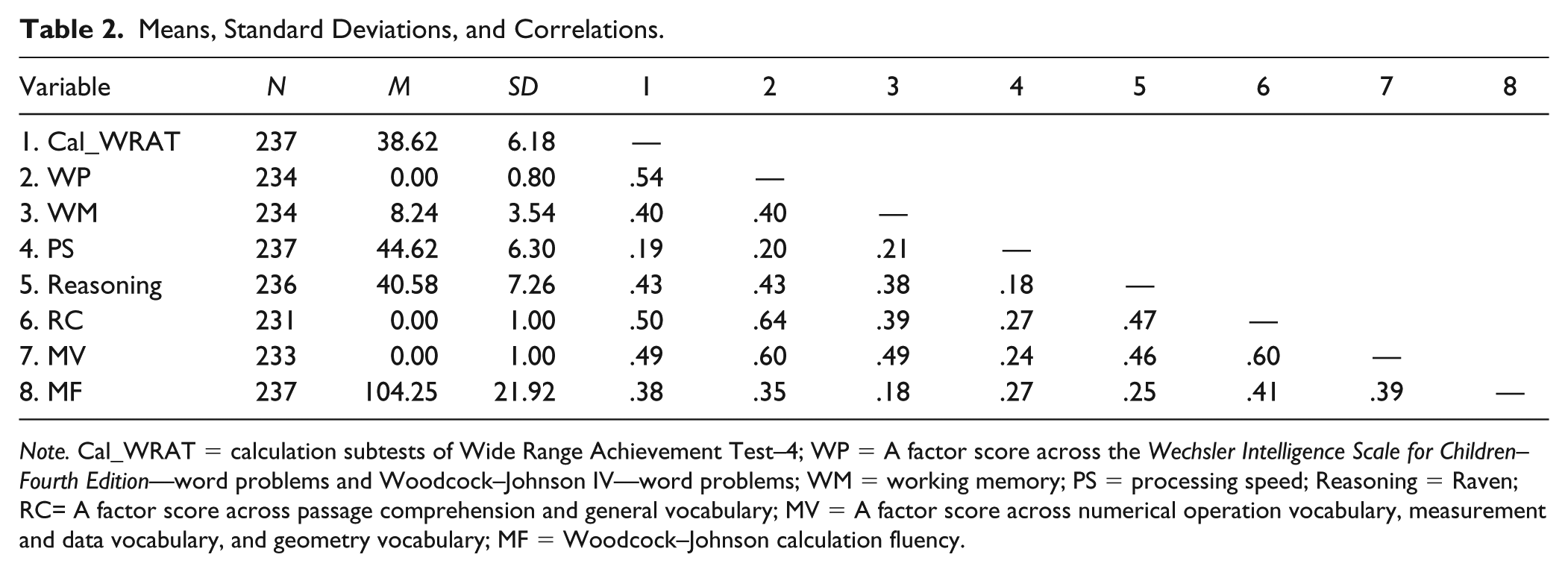
Note. Cal_WRAT = calculation subtests of Wide Range Achievement Test–4; WP = A factor score across the Wechsler Intelligence Scale for Children–Fourth Edition—word problems and Woodcock–Johnson IV—word problems; WM = working memory; PS = processing speed; Reasoning = Raven; RC= A factor score across passage comprehension and general vocabulary; MV = A factor score across numerical operation vocabulary, measurement and data vocabulary, and geometry vocabulary; MF = Woodcock–Johnson calculation fluency.
Results
In Tables 1 and 2, we display means, standard deviations, and correlations for our sample on computation, word problem-solving, three cognitive dimensions (working memory, processing speed, reasoning), reading comprehension, mathematics vocabulary, and numerical facts retrieval. There were significant and positive correlations among all dimensions, with r coefficients ranging from small (r = .18) to moderate (r = .64). The strongest relationship was between word problem-solving and reading comprehension.
Overall Analysis
The interaction between MD status and six dimensions was significant, Wilks Λ = 0.58, F(21, 305) = 3.54, p < .001. In addition, the elevation effect was also significant, Hotelling t = 0.63, F(21, 314) = 3.68, p < .001. To help interpret the interaction between math difficulty status and included dimensions, we plotted z scores on the six dimensions for each of the four difficulty status groups. Shape effects and elevation effects in the six dimensions were displayed in Figure 2. There is a slightly larger gap (approximately .5 or greater z score) between CD and WPD students in reading comprehension whereas there is a relatively small gap (approximately .25 or less z score) across all mathematics and cognitive dimensions between children with CD and WPD. The difference between CD + WPD and TD was consistently large (approximately .75 or greater z score) across all dimensions except for processing speed and numerical facts retrieval.
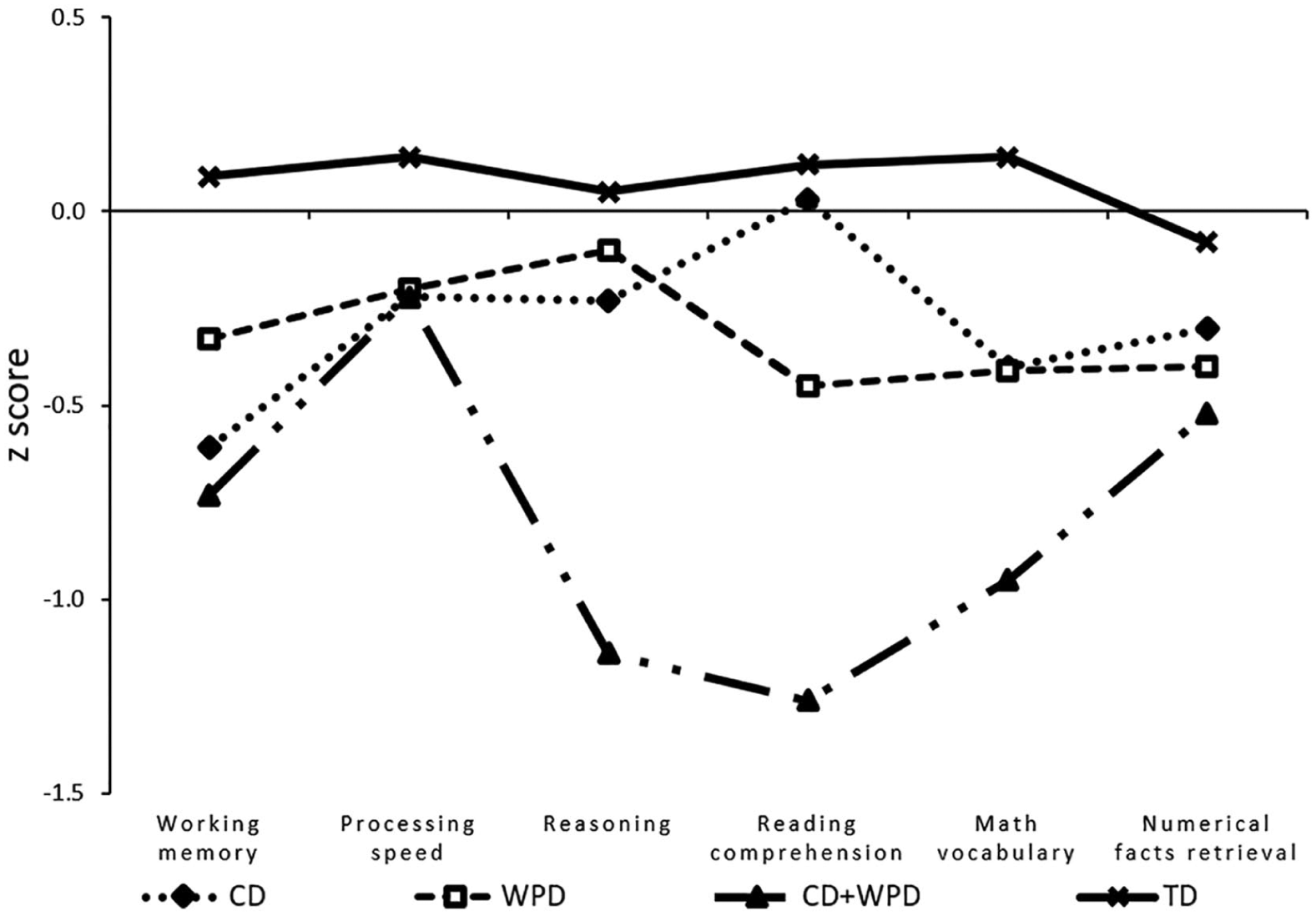
The z score on included dimensions by difficulty status.
To separate elevation effects and shape effects, we removed the elevation effects by computing the residuals in a model. Figure 3 shows the elevation-adjusted shape profile for each of the four groups along the six dimensions. Obviously, after removing the elevation effects, there was a relatively small gap (approximately .25 or less z score) across all six dimensions among TD, CD, and WPD students. There was a slightly larger gap (approximately .5 or greater z score) between CD and CD + WPD children in reading comprehension. Note that there was a relatively small gap between TD and CD + WPD, suggesting the severity effects for the comorbid group. To sum, Figures 2 and 3 provide similar information. These findings indicate that if we directly compared CD with WPD, the group difference may not be obvious. The differences among these profiles may be mainly caused by the severity of MD.
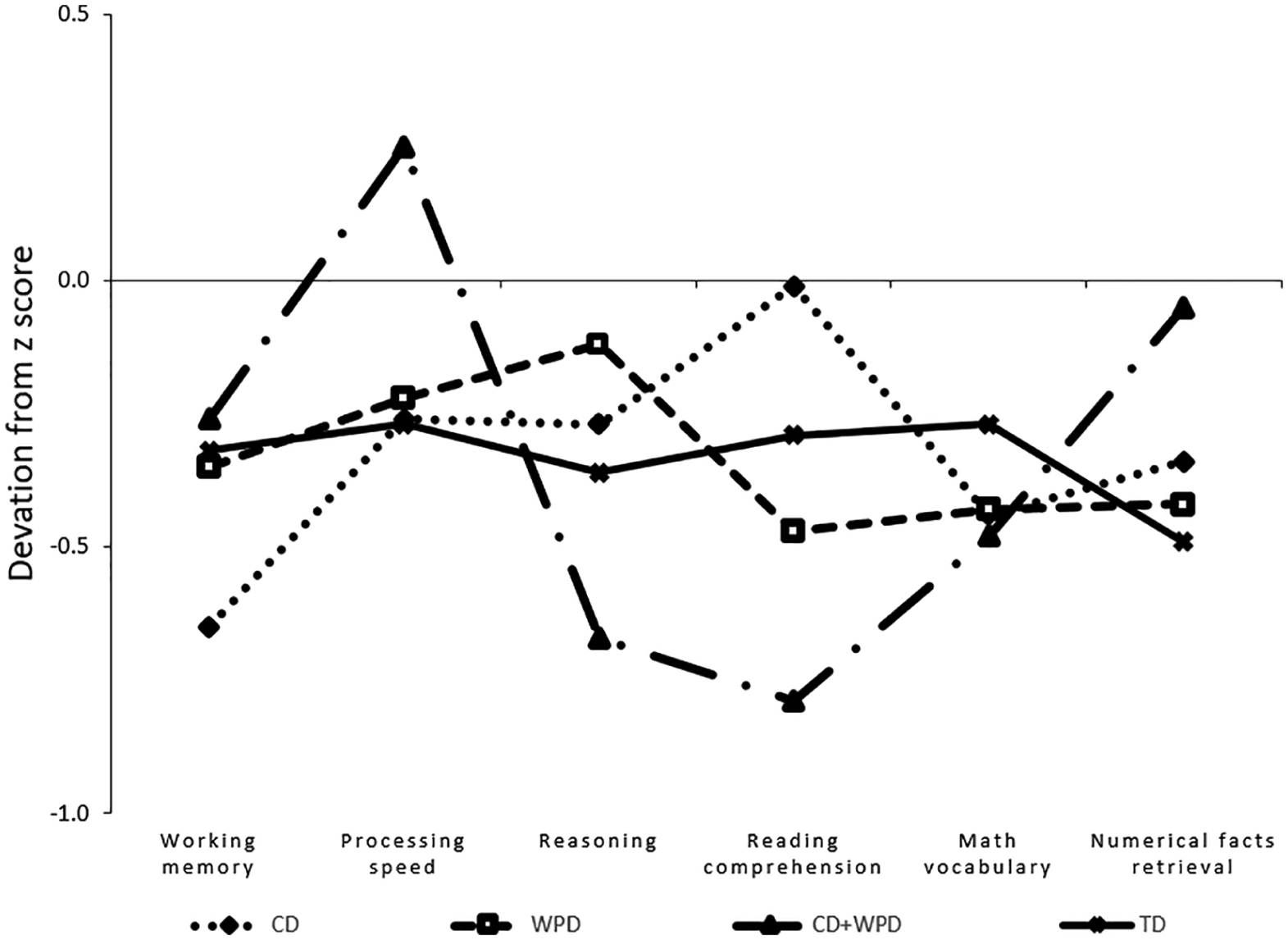
Shape effects by difficulty status.
Univariate Post Hoc Analysis
Table 3 displays the effect sizes for each comparison between difficulty status. For processing speed, there was no significant group difference among the TD group and other disability groups. The MANOVA revealed significant large group differences on both working memory, F(3, 121) = 4.89, p = .003, and reasoning, F(3, 121) = 6.65, p < .001. Post hoc for working memory revealed that TD performed significantly better than CD and CD + WPD. For reasoning, post hoc testing showed that there were no significant differences among TD, CD, and WPD, but those groups performed significantly better than CD + WPD. The MANOVA yielded a significant group effect of large effect size on reading comprehension, F(3, 121) = 13.07, p < .001. Post hoc testing showed that there was no significant difference between TD and CD groups and that the TD group scored significantly higher than the WPD and CD + WPD groups. The MANOVA revealed significant group differences on mathematics vocabulary, F(3, 121) = 8.56, p < .001. Post hoc testing revealed that the TD group scored significantly higher than all difficulty groups. In addition, there was no significant group difference among all groups on numerical facts retrieval.
Effect Sizes as a Function of Difficulty Status.
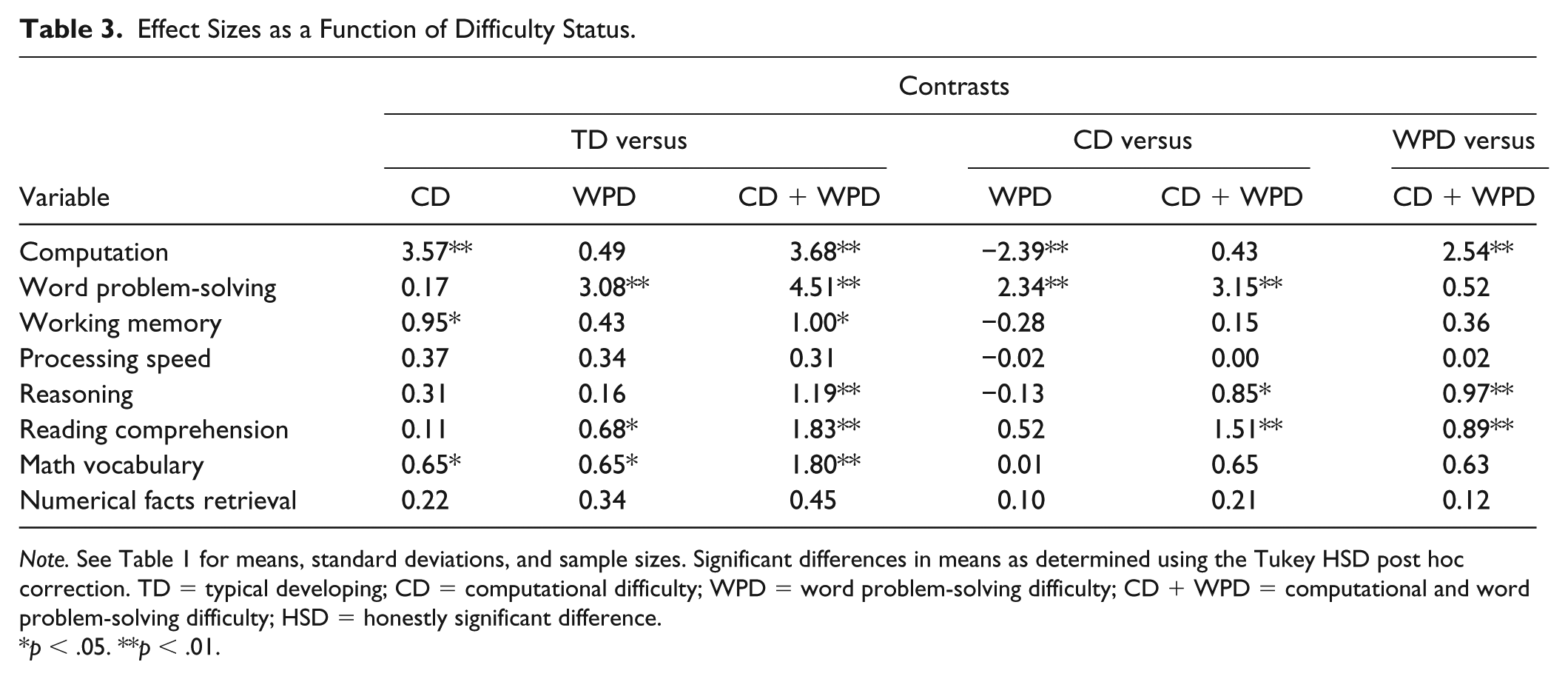
Note. See Table 1 for means, standard deviations, and sample sizes. Significant differences in means as determined using the Tukey HSD post hoc correction. TD = typical developing; CD = computational difficulty; WPD = word problem-solving difficulty; CD + WPD = computational and word problem-solving difficulty; HSD = honestly significant difference.
p < .05. **p < .01.
Discussion
The goal of the current study was to compare the deficit profiles of CD and WPD based on a Chinese sample. Our findings showed that no task can directly differentiate CD from WPD. Yet, we found differences between these two groups in comparison with TD. Specifically, students with CD performed significantly lower than TD on working memory and mathematics vocabulary; students with WPD performed significantly lower than TD on reading comprehension and mathematics vocabulary; students with CD + WPD performed significantly lower than TD on working memory, reasoning, reading comprehension, and mathematics vocabulary.
Children with WPD (WPD and CD + WPD) were associated with deficits in reading comprehension, whereas CD was not. This finding is expected. Compared with computation that does not require much reading comprehension especially for relatively older children such like our sample, word problems require students to use reading comprehension to capture the meaning of the text, identify the problem type, and construct the computation operations to find missing information (Kintsch & Greeno, 1985). This finding was also in line with previous research that showed word problem-solving may be a form of text comprehension (Fuchs et al., 2015). Fuchs et al. (2008) only used general vocabulary and found that it was the only factor that distinguished CD and WPD. In our study, we used passage comprehension and general vocabulary together to indicate reading comprehension. Thus, our findings added to Fuchs et al. (2015, 2008) that WPD was distinctively associated with reading comprehension problems.
One unique contribution of the current study, in comparison to previous research, is that we specifically compared MD subgroups on mathematics vocabulary. Our findings showed that the deficit in mathematics vocabulary was the only deficit associated with all MD subgroups in comparison to TD. It is worth noting that we used multivariate analysis to control for reading comprehension and other cognitive skills, which were suggested to confound with mathematics vocabulary (Purpura, Logan, Hassinger-Das, & Napoli, 2017). Thus, our findings demonstrated that mathematics vocabulary was not a proxy measure for other cognitive and linguistic measures (Purpura et al., 2017). Instead, mathematics vocabulary was a distinct construct and marker for MD across subtypes.
At least two explanations seem possible for the role of mathematics vocabulary in MD. First, from a linguistic perspective, language helps students transform their experience about the world into knowledge. After students enter into the higher grades, mastering discipline language becomes the focus of their academic study (Halliday, 2004). Therefore, it is reasonable that mathematics vocabulary, a major component of mathematics discipline language, is necessary for students to grasp the mathematics knowledge. Second, from a cognitive load perspective, without sufficient mathematics vocabulary, students would allocate too much of their limited working memory resources to processing and storing the mathematics vocabulary in their mind while learning new mathematics knowledge or solving mathematics problems, which would interfere with their learning processes.
Numerical facts retrieval did not distinguish CD from WPD, or distinguish MD groups from TD, which is in line with Fuchs et al. (2008), but not in line with previous research that suggested numerical facts retrieval deficit is the core deficit of MD (Geary, 1993). There are two plausible explanations. First, the screening measure we used for CD is two WRAT-computation subtests, in which only 14 items out of a total of 80 items are simple computation problems. Therefore, identifying CD using these tests may more likely reflect their struggle with more complicated computation problems. Second, Chinese mathematics instruction emphasizes the practice of procedural skills (Cai & Nie, 2007). After almost 4 years of formal schooling, students from our sample have gained enough exposures to simple arithmetic facts, which enables direct retrieval from long-term memory. It may be likely that in comparison to CD from western countries, deficits in numerical facts retrieval are remediated due to practice among Chinese students with MD, which is an interesting hypothesis and should be further investigated with cross-culture studies in the future.
As for working memory, the multivariate results of the present study corroborate its role in both CD and CD + WPD, but not in WPD. This is surprising and not in line with previous reviews (Peng et al., 2016; Raghubar et al., 2010), which suggested that working memory is critical for all types of mathematics tasks, including computation and word problem-solving. One possible explanation may lie in the domain of working memory. That is, the current study used digit span backward, whereby participants were required to manipulate numerical information. Working memory is usually considered as a domain-general skill (Baddeley, 2002), but recent research showed that working memory may also show domain-specificity, especially in the context of learning disabilities. For example, research showed that computation closely correlates with numerical working memory while word problem-solving is more associated with verbal working memory (e.g., Peng et al., 2016; Raghubar et al., 2010).
Another explanation may be the assessment of word problems. In our study, students had a written copy of the word problems rather than word problems being orally presented to students (e.g., Swanson, Beebe-Frankenberger, 2004). Compared with the oral presentation of word problems, our word problem assessment may reduce the required working memory load. Moreover, according to Pasolunghi, Cornoldi, and De Liberto (1999), working memory is related to word problem-solving processes by the inhibition of irrelevant information. Unlike Fuchs et al. (2008) that used complex word problems, irrelevant information is not included in our word problems, which may require working memory to a less extent.
Our data also did not support the suggestion that processing speed deficit is a distinguishing marker of MD (Peng et al., 2018). This may be due to the characteristics of the Chinese sample. Specifically, processing speed deficit is supposed to relate to CD because slow processing may pose a time constrain consuming working memory resources (Geary, Brown, & Samaranayake, 1991), which may impede the development of direct facts retrieval. In China, the practice of procedure skills is highlighted in classroom instruction, which enhances the connection between the problem and its answer in memory, reducing the impact of processing speed on computation. This assumption is also in line with our findings that CD is not related to numerical facts retrieval deficit but related to working memory deficit, suggesting that Chinese children with CD are more likely to demonstrate working memory deficit that impede them on understanding and solving relatively complicated computation problems.
As for reasoning, the present study found that compared with TD, WPD is not associated with weaknesses in reasoning. Only CD + WPD is associated with lower reasoning compared with TD, CD, and WPD, even given the fact that the current study only selected students with normal reasoning abilities. Research showed that the mastering of mathematics skills involves both foundational and complex skills, both of which require reasoning (Fuchs et al., 2006). Foundational mathematics skills such as computation require students to master numerical symbols and the rules in computation (Fuchs et al., 2006). More complex mathematics skills such as solving word problems rely heavily on reasoning skills (Cooper & Sweller, 1987). Because students with CD + WPD have demonstrated difficulties in both computation and word problem-solving, it is possible they were associated with lower reasoning compared with other students.
Limitations and Implications
We note several limitations when interpreting our findings. First, because of relatively small sample size, the present study may not have sufficient power to directly detect the difference between WPD and CD, although both WPD and CD showed relatively different deficit profiles in comparison to TD. Thus, findings from the current study may provide a basis for generating hypotheses for future research on WPD and CD. Second, we used one-time measures to determine difficulty status of students. According to prior studies and reviews (Geary et al., 1991; Peng et al., 2018), the cognitive deficit profile of students with low mathematics achievement may differ with grade. Third, we used standardized mathematics measures developed in the United States, which may not fully reflect the mathematics knowledge covered in China. Future studies should use both grade-specific and knowledge-comprehensive mathematics tasks to examine students’ mathematics skills. Fourth, we cannot determine the causal effects based on profiling analysis (Büttner & Hasselhorn, 2011). Hence, future studies using other methods (e.g., experimental) can reveal whether the potential markers of CD and WPD identified by the current study can be manipulated to improve computation and word problem-solving performance.
With all those limitations in mind, our findings add to the MD profiling literature and have implications for theory and practice for MD. First, we found mathematics vocabulary to be the most reliable marker for different types of MD. Powell and Nelson (2017) revealed that learning mathematics vocabulary is difficult for students starting at the very beginning of school and continue to be very challenging with grades. These findings, together with ours, suggest that mathematics vocabulary is an important mathematics skill for MD and should gain more attention in future MD research. Relatedly, the instruction of mathematics vocabulary should be emphasized. Especially for those MD students, combining multiple methods of instruction (e.g., explicit instruction, concrete-representational-abstract) or designing a specialized mathematics vocabulary training program might be helpful. Second, although our relative loose cutoff criteria might cover up the differences between CD and WPD, the current study still revealed that CD might differ from WPD on reading comprehension with large effect size, although not statistically significant. Given the importance of reading comprehension for children with WPD, future word problem-problem solving intervention might consider referring to some reading comprehension instruction components to better assist children with WPD.
Supplemental Material
MD_profile-Supplemental_File – Supplemental material for The Deficit Profile of Elementary Students With Computational Difficulties Versus Word Problem-Solving Difficulties
Supplemental material, MD_profile-Supplemental_File for The Deficit Profile of Elementary Students With Computational Difficulties Versus Word Problem-Solving Difficulties by Xin Lin, Peng Peng and Hongjing Luo in Learning Disability Quarterly
Footnotes
Acknowledgements
The authors wish to thank all participating students and teachers at Yukai School (Chongqing, China), for assisting and supporting the data collection.
Declaration of Conflicting Interests
The author(s) declared no potential conflicts of interest with respect to the research, authorship, and/or publication of this article.
Funding
The author(s) received no financial support for the research, authorship, and/or publication of this article.
Supplemental Material
Supplemental material for this article is available on the LDQ along with the online version of this article.
References
Supplementary Material
Please find the following supplemental material available below.
For Open Access articles published under a Creative Commons License, all supplemental material carries the same license as the article it is associated with.
For non-Open Access articles published, all supplemental material carries a non-exclusive license, and permission requests for re-use of supplemental material or any part of supplemental material shall be sent directly to the copyright owner as specified in the copyright notice associated with the article.
