







Abstract
This study reports the effects of instruction of elementary students in a complex package of social and academic skills designed for use in cooperative groups while studying important information in inclusive general education classes. Twenty-five teachers and 519 fourth and fifth graders, including 45 students with learning disabilities (LD), participated. A pretest/posttest control-group design with random assignment was used to determine the effects of the instructional program. Data were analyzed for students with LD, all students with exceptionalities, and average-achieving (AA) students. Results indicated that experimental students’ scores on study-group performance, study-card creation, and tests of social and academic knowledge were significantly higher than control students’ scores. Furthermore, the number of prosocial behaviors and teamwork behaviors significantly increased for all subgroups of experimental students during study-group tasks, including students with LD and students with exceptionalities. Also, the number of antisocial behaviors significantly decreased for students with LD and students with exceptionalities.
Keywords
Collaboration is becoming increasingly common in the workplace. As businesses become more global and cross-functional, silos are breaking down, connectivity is increasing, and collaboration is seen as a key to organizational success. In addition, many tasks needing to be completed within organizations can exceed the capabilities of individuals alone. Because of these realities, productive teamwork and cooperative behaviors are expected of workers. Indeed, data collected over the past two decades reveal that the time spent by managers and employees in collaborative activities has ballooned by more than 50% (Cross et al., 2016).
In light of these trends, industrial psychologists are attempting to identify the factors that enable teams to function effectively. Their research has been conducted in a broad array of fields, including the military, aviation, health care, education, and the corporate world (Galbraith & Webb, 2013; Weir, 2018). Among the factors that this research has determined to be foundational to the successful functioning of teams are team cognition (i.e., how teams learn, think, and problem-solve together), team communication (i.e., how team members communicate among one another as well as communicate with a unified message to those outside of the team), and team-building and reinforcement strategies (i.e., how teams incorporate new members into an existing team and reinforce members for productive team behaviors).
One skill area closely related to team cognition is that of effective study-group participation. Kerievsky (2000) defines a study group as a “collection of individuals who gather together regularly to improve their understanding of some non-trivial subject” (p. 2), and suggests that study groups are a method for improving members’ understanding of anything “complex or profound” (p. 2). More specifically, study groups are viewed as a way for team members to do the following: focus, learn, articulate, and integrate new information and ideas (Murphy, 1992); develop critical thinking skills and understanding through listening and communication skills (Jones, 2014); learn faster and sustain learning longer; engage in reflection and exploration of ideas; practice communicating in different subject areas; take collective responsibility to identify learning needs; and plan to meet those needs (Boud et al., 1999). Finally, Wood and McQuarie (1999) suggest that work in study groups results in an increase in knowledge, skills, and solving problems.
Because of the need to respond to employers’ requests, educators will have to devote more attention to prepare students to perform well as members of a team (e.g., Brown, 2001; Dresang & Robbins, 1999). Kozlowski and Ilgen (2006) have suggested that businesses and educators should work together to develop curricula and educational opportunities for students to gain employability skills, including the social skills needed not only to work together but also to study and learn together as members of a team.
This focus is also important because state and national education standards have been revised to include goals related to social-emotional skills (SEL; Partnership for 21st Century Skills, 2003). Thus, students must acquire the broad array of SEL skills implicitly embedded in these education standards (e.g., cooperating, working toward group goals, listening carefully and accurately, providing help to those who need it, identifying social cues, and understanding others’ points of view and perspectives (Zakrzewski, 2014).
Finding the best ways to ensure effective instruction in social skills in today’s schools, given the diversity of students in today’s inclusive classrooms, can be challenging. Although cooperative learning activities are considered to be one of the most effective ways to increase student learning in classrooms (e.g., Baloche & Brody, 2017; Johnson & Johnson, 1989, 1990; Kagan & Kagan, 2009), and, when combined with instruction in reading strategies, they have been found to be effective in increasing reading comprehension and expressive language (Klingner et al., 1998; Stevens & Slavin, 1995), these activities are frequently not used for several reasons. Many students are unlikely to know “how” to work in groups, group conflicts occur frequently, students may be off-task or unfocused, and noise levels are higher during group work versus individual work (Baloche & Brody, 2017; Vernon & Schumaker, 1993). In addition, research has shown that many students do not possess the higher order thinking skills required to perform many group tasks (e.g., group learning, team problem solving), and some students are ridiculed, belittled, and/or left out of team activities altogether (Vernon et al., 1993). Increasingly, educators are realizing that helping students learn to work together in an effective way demands instruction in special skills and cannot simply rely on assigning cooperative tasks (Chiriac, 2014). Thus, if standards related to the skills of learning and studying together in groups are to be met, explicit instruction in these skills is likely to be required (e.g., Collins, 2014; Hughes et al., 2019; Kearns et al., 2019; Pink, 2005).
Fortunately, some research has been conducted on teaching students the skills they could potentially use in study groups. For example, Vernon and Schumaker (1993) conducted a study that included two inclusive sixth-grade general education classes: an experimental class and a comparison class. They showed that students with and without different kinds of exceptionalities could cooperatively design, practice, and master four social skills presented to the class as a whole through class discussion and cooperative-group activities. Students in the experimental class made substantial gains in performance of the four social skills. When the posttest scores of students in the two classes were compared using analyses of covariance (ANCOVAs) for measures of each of the four social skills while controlling for the pretest scores, significant differences were found between the experimental and comparison students’ posttest scores. Also, the experimental students reported substantial increases in positive peer interactions and decreases in negative peer interactions after the intervention. In addition, the experimental students maintained their knowledge and performance of the four skills for 5 weeks. These gains by students in the experimental class were shown by both students with and without exceptionalities.
Similarly, Webb et al. (2004) conducted a study with 10 male adolescents with Asperger spectrum disorder, and found that these students made significant gains in performing and mastering five foundational social skills (developed by Vernon et al., 1993) that they learned in a cooperative-group setting. Other research has shown that instruction on cognitive-social strategies embedded within the curriculum can yield improved use of problem-solving and conflict-resolution skills with elementary-level students (e.g., Battistich et al., 1989).
In summary, some studies have shown that students with and without disabilities can learn basic social skills that might be useful while participating in a study group in inclusive classes. The instructional methods that have been successful for teaching a social skill in inclusive general education classes include describing the social skill, modeling the skill, ensuring students practice the skill to mastery, giving feedback on performance of the skill, and ensuring students generalize skill use in appropriate situations (e.g., Bruhn et al., 2019; Mariage et al., 2019; McDaniel et al., 2019; Vernon et al., 1993). Nevertheless, to date, no research has been published on the effects of teaching the more complex packages of social and academic skills that would be useful when studying and learning new information as a team in inclusive classroom settings.
Thus, the purpose of the current study was to determine the effects of instruction in a complex package of social and academic skills that students can use in study groups. The major research question was the following:
In addition, information was gathered on the fidelity of the instruction and the social validity of the intervention. Because students with exceptionalities are often included in general education classes for instruction so that they can have social experiences and learn appropriate social behavior with peers (Barry, 1995; Choi et al., 2016; Fuchs & Fuchs, 1995; Sailor & Roger, 2005), this study not only focused on the whole group of students but also took a more finite look at the effects of the intervention on students with exceptionalities, including those with learning disabilities (LD) who are often designated as the least socially skilled students (McDaniel et al., 2019; Price et al., 1994; Vaughn et al., 2004).
Method
Participants
Teachers
Twenty-five teachers (12 fourth-grade and 13 fifth-grade teachers) from eight elementary schools in three communities were recruited to implement the intervention in their inclusive general education classes. (See Table 1 for information about the teachers.) They signed informed consent forms giving permission to be observed. 1 Half of the teachers at each grade level were randomly assigned to either the experimental or control group.
Teacher Descriptive Data.

Students
A total of 519 fourth- and fifth-grade students regularly enrolled in the participating teachers’ inclusive general education classes participated. Their parents signed informed consent forms to allow their participation (see Note 1). Table 2 displays the demographic data for students with consent in the experimental and control groups according to their teachers’ assignment to the groups. (See Table 3 for information on the students with exceptionalities within the groups.) Because the classes and the teachers were assigned randomly to conditions, the students were also assigned randomly to the conditions. All the students in all the classes participated in the cooperative-group activities in this study; however, observational data were gathered, and test scores are reported only with respect to the students with informed consent.
Characteristics of Experimental and Control Students.
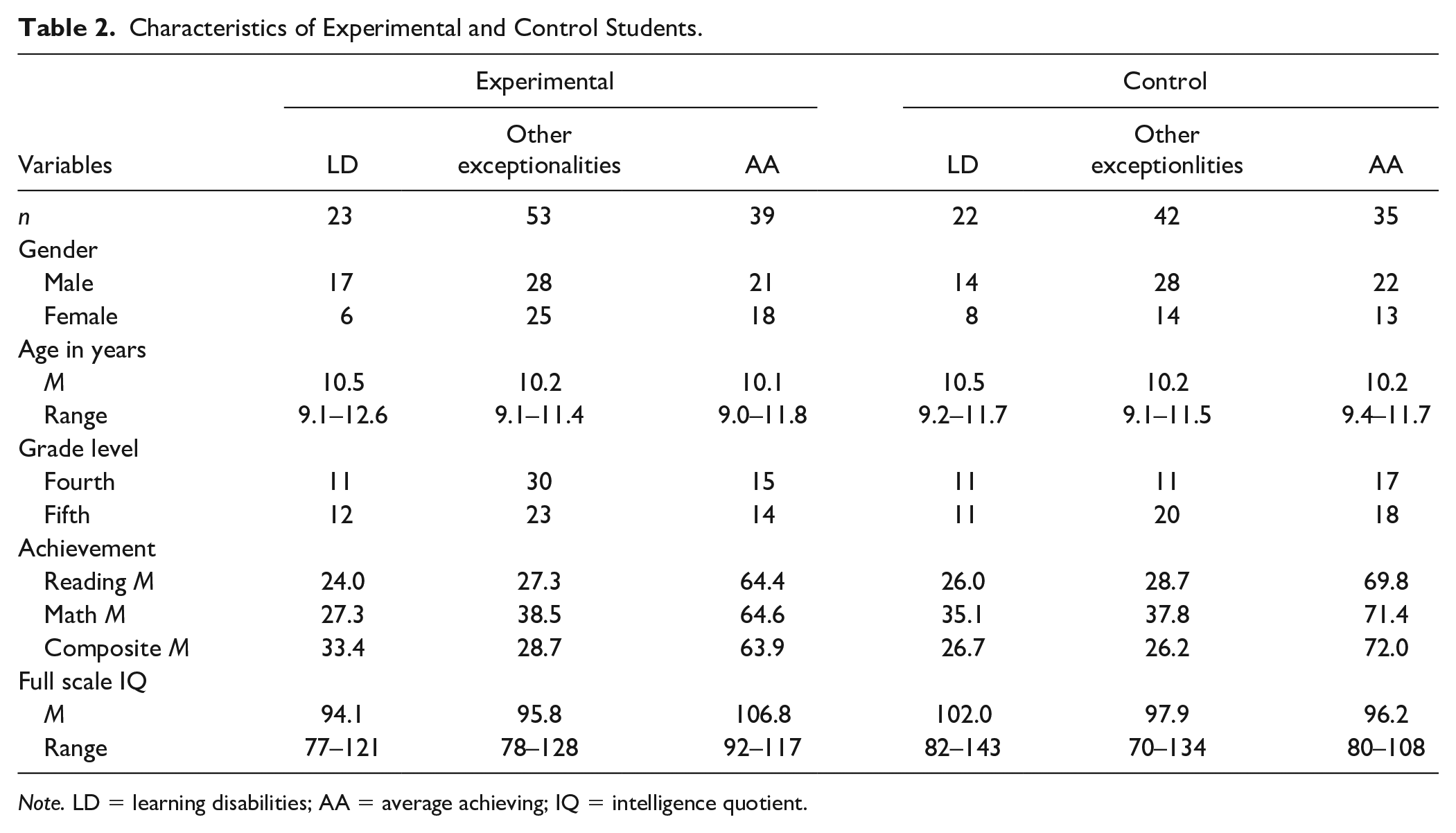
Note. LD = learning disabilities; AA = average achieving; IQ = intelligence quotient.
Students With Exceptionalities.
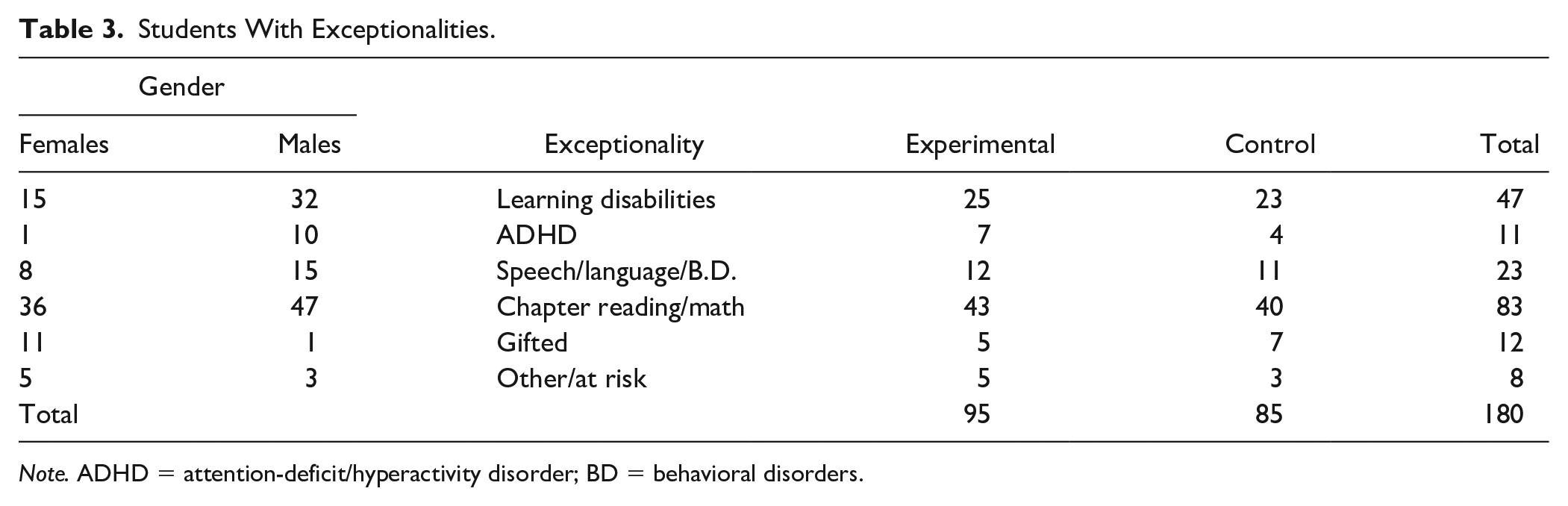
Note. ADHD = attention-deficit/hyperactivity disorder; BD = behavioral disorders.
Cooperative-group composition
“Cooperative learning activities” were defined as “students working together to accomplish shared goals” (Vernon et al., 1996, p. 1), for the purposes of this study. Three groups of four students with consent were observed engaged in cooperative learning activities in each class. Because the students with LD were not distributed evenly across the classes, most of these observed groups had one student with LD assigned to them. Where fewer than three students with LD were enrolled in a given class, one student with another designated exceptionality (e.g., students with attention-deficit/hyperactivity disorder [ADHD], other health impairment, gifted student 2 ) was assigned in the place of a student with LD. In addition, three average-achieving (AA) 3 students were assigned to each group. Then, within each group, two pairs of students were designated. One pair consisted of a student with LD (or with another exceptionality) and a randomly selected AA student. This pair will hereafter be referred to as the “target pair.” The other pair consisted of two AA students. All four students worked together during most of the activities. However, experimental students worked together in pairs when they were quizzing each other over the information to be studied.
Settings
All participating schools served students in the kindergarten through sixth grade. Two of the eight schools were inner city schools serving students living in poverty and located in large metropolitan areas. They had a federal designation as a Title I school. All six remaining schools were located in a suburban community with a total population of around 70,000. The size of the schools ranged from 131 to 575 students (M = 382 students). The percentage of minority students ranged from 7% to 88% (M = 31%). The study took place in the participating teachers’ classrooms. Students’ desks were arranged in groups of four so that the students could work together easily.
The Intervention
The LEARN Strategy
A cooperative strategy was designed to be used by the student groups while working cooperatively to study and learn new information. This cooperative strategy, called the LEARN Strategy, was based on the current researchers’ prior research on social skills instruction and their observations in classrooms, interviews with educators, and a review of the literature on cooperative learning and study-group behavior. It had not been tested in any prior research study. A “strategy” is typically defined as an individual’s approach to a task. In this case, because the cooperative strategy was designed for use by a group of individuals, a “cooperative strategy” was defined as a group’s approach to a task. It includes how a group talks about and acts when planning, executing, and evaluating performance on a group task and its outcomes.
Thus, the LEARN Strategy was designed to enable students to work together on an assigned task to study and learn certain information. In essence, students were to use the steps of the strategy to identify and discuss important information in textbooks (e.g., social studies, science); to group the key information into a pattern (such as a list containing items with a shared characteristic); to develop a mnemonic device for remembering the information; to study and learn the information with team members by using memory strategies, rehearsal strategies, and peer coaching; and to evaluate how the team worked together. Each letter of “LEARN” represents the first letter of one step in the LEARN Strategy:
Instruction of the LEARN Strategy and associated social skills
The instruction conducted in the experimental classes consisted of two phases. To standardize the instruction across the experimental classes, two written instructional protocols were created. The Score Skills: Social Skills for Cooperative Groups (Vernon et al., 1996) was used in Phase 1, and The LEARN Strategy: Instructor’s Manual (Vernon et al., 1999) was used in Phase 2. The two protocols followed a similar format containing a series of lessons. Each lesson specified information needed by the teacher such as the objectives associated with the lesson, the instructional time required, the materials needed, preparation steps, step-by-step procedures to be followed in sequence during the lesson, scripted examples of statements to be made by the teacher during the lesson, example responses to be elicited from students, materials for student activities, and trouble-shooting tips.
The SCORE Skills protocol includes seven lessons. The first lesson is an introduction to the concept of social skills, the nonverbal steps that are involved in every social skill, and the SCORE Skills. The SCORE Skills are five social skills that are to be used in cooperative-group activities. The letters in the word “SCORE” stand for the five social skills:
The LEARN Strategy written protocol also contains seven lessons specified in a step-by-step format. Lesson 1 contains a review of the SCORE Skills. Lesson 2 introduces the LEARN Strategy and the “L” Step. Lessons 3 through 7 each focuses on one of the remaining “LEARN” steps. In each lesson, the strategy step is to be introduced and modeled by the teacher, and the students practice applying the step in a short practice activity. The seventh lesson also includes a cooperative-group activity designed to enable students to practice all the steps of the LEARN Strategy and the SCORE Skills combined. The instructional methods were based on the basic methodology found to be successful in teaching strategies to students (Deshler & Schumaker, 1988; Ellis et al., 1991; Schumaker & Deshler, 1992; Vernon et al., 1993).
Measures
Instructional fidelity
A checklist specifying the instructional behaviors associated with the step-by-step instructions in each lesson was used by observers to provide a record of the experimental teachers’ implementation of the instruction. The observers were present for every lesson to record the occurrence or nonoccurrence of each listed instructional behavior. Each behavior that was completed by the teacher was recorded, the time required to complete the lesson was noted, and observations regarding the instruction (e.g., questions asked by students, examples given by students, problems experienced by the teachers) were recorded. A teacher’s score was the percentage of instructional behaviors listed on the checklists for all the lessons that were completed by the teacher. This percentage was calculated by dividing the number of behaviors emitted by the teacher by the number of behaviors specified and multiplying by 100.
Study-group behaviors
A checklist was designed that listed all of the study-group behaviors specified for performing the LEARN Strategy. Observers used the checklist to record whether or not component behaviors of the strategy were performed by students as they participated in cooperative-group activities. Three groups of students with consent were observed in each class. These groups contained the “target students.” (See the “Cooperative-Group Composition” section for an explanation.) A group could earn “2,” “1,” or “0” points per behavior performed on the checklist: “2” for completely performing a behavior, “1” for partially performing a behavior, and “0” for not performing a behavior. Observers followed a set of written directions and definitions for recording the points. A total of 36 points was available for each cooperative-group performance, with varying numbers of points available per strategy step, depending on the number of student behaviors required for a step. A cooperative group received one score. Each group’s percentage score was calculated.
Study-card measure
As students worked together in groups to study and learn information, materials to make study cards (or “flash cards”) were provided for their use. The quality of these study cards was scored to provide an additional measure of student learning of the LEARN Strategy (the “A” step of the strategy involves making study cards containing memory devices). Experimental students were taught to put a question on each side of the card and the answer to that question on the opposite side. They were also taught to write the mnemonic device they created on one side of the card and to spell all the information correctly.
Each unique study card collected at the end of a cooperative-group activity was scored by awarding points for correct information on the front and back of the card (and spelling) for a total of 14 points per card. Seven unique cards could be created for each cooperative-group activity, based on the number of pieces of information in each activity. Scorers used an answer key that displayed example study-card information for each group activity. Because one of the steps of the LEARN Strategy requires students to help each other to create quality cards, a total score was awarded to each group by summing the points earned for up to seven unique cards created by the group. Thus, up to 98 points were available to each group for study cards for each activity. The percentage of points earned by the group was determined.
Social Knowledge Test
This test measured an individual student’s knowledge about social and study skills. It was comprised of questions that used an open-ended format. The first question asked students to name and explain the steps they would use to study a page of information for a test. Two columns of blank lines were placed under the question where students could name a step in the left-hand column and then describe it in the right-hand column. Student responses were awarded 2 points for each “LEARN” Step that was named (for 10 points in all) and 2 points for each correct description of a step (for 10 more points). Thus, up to a total of 20 points were available.
The second question on the test had the same format and asked the students to list the social skills that they thought were important when studying information with classmates in a group (2 points for each skill up to 10 points) and for describing each skill (2 points for each description up to 10 points). Thus, a total of 20 points were available for the second question, and a total of 40 points were available on the whole test. Scorers used an answer key that listed example answers for each question. A student’s score was the percentage of points earned, which was determined by dividing the number of points earned by 40 and multiplying by 100.
Academic Knowledge Test associated with cooperative-group assignments
This 14-item test measured individual student retention of the information that students were asked to study in their cooperative-group activities. The information was provided on a sheet of paper on which three paragraphs containing eight sentences in all had been typed. Students were instructed to study and learn the information for a test that would be given later in the same day. Test questions were open ended and related directly to the information the students had studied earlier in the day. Thus, each test was different because it related to particular information. For example, when the students were asked to study information on bats, one test question was “Name five places bats live,” followed by five blanks.
To control for information and test difficulty, two pairs of assignments and tests were designed (A and B). For the pretest, half of the classes in each grade (fourth or fifth) in each treatment condition were given Assignment A and administered Test A; the other half were given Assignment B and administered Test B. For the posttest, the classes received the opposite assignment and test. Two points were awarded for each correct answer for a total of 28 points. The number of points earned by a student was divided by 28 and multiplied by 100.
Social behavior measure
The Contextual Assessment of Social Skills Instrument (CASSI) was used by observers to record the students’ social behavior during cooperative-group activities. This ecobehavioral instrument was developed in collaboration with Dr. Charles Greenwood and patterned after the Code for Instructional Structure and Student Academic Response (CISSAR; Stanley & Greenwood, 1983) and the Mainstream Special Education: CISSAR (MS-CISSAR; Carta et al., 1988) instruments. Social behaviors that were recorded with this adapted instrument were related to the SCORE Skills and the LEARN Strategy and included such behaviors as giving compliments, offering to help a peer, encouraging a peer, giving appropriate corrective feedback, exercising self-control, quizzing a peer, suggesting an idea, and making derogatory remarks or gestures. These behaviors were recorded continuously by an experienced observer within 3-min intervals alternating across intervals between the members of a targeted pair of students working in the same group. That is, one student in the “target pair” was observed continuously for 3 min, and then, the other student in the pair was observed continuously for 3 min, and so forth until 30 min had passed.
After the observation, behavioral occurrences were tallied for three categories: (a) prosocial behaviors (e.g., complimenting, offering help or encouragement, recommending changes nicely), (b) teamwork behaviors specific to the LEARN Strategy (e.g., sharing ideas related to the information to be learned, quizzing each other on the information), and (c) antisocial behaviors (e.g., putting others down, name calling). A student’s score was the total of behaviors recorded in each category during the 15 min that the student was observed.
Sociometric measure
Sociometric ratings were used to assess the social acceptance of each student by peers in the same class. Students rated each of their classmates on a 5-point Likert-type scale regarding “How much you would like to work with that student,” with 5 indicating very much and 1 indicating not at all. Each student’s acceptance score was determined by totaling classmates’ ratings for that student and dividing that total by the number of students.
Satisfaction questionnaires
Two questionnaires 4 were designed to measure teacher and student satisfaction with the instruction in the experimental classes. Items were related to the goals, procedures, and outcomes of the instruction. The Teacher Questionnaire contained 20 items, and the Student Questionnaire contained 15 items. On the Teacher Questionnaire, for example, items related to such aspects of the intervention as the preparation time required, the ease of application, the degree of flexibility involved, anticipated use of the program in the future, and perceived changes in the students’ performance. Example items on the Student Questionnaire related to how satisfied the student was with the instruction on how to participate in cooperative-group activities, how much the student had learned, and how competent the student felt with regard to the demands associated with working in cooperative groups. For each item, the respondent indicated his or her satisfaction using a 7-point Likert-type scale with values ranging from 7 indicating extremely satisfied to 1 indicating extremely dissatisfied. For each item on a questionnaire, a mean rating was calculated for each item by summing the ratings and dividing by the number of respondents. Also, a mean overall rating was determined for all the items.
Reliability of the measures
Interscorer reliability was determined by having two trained scorers or two trained observers 5 independently score the same measure at the same time for at least 20% of the tests or observations. Identification numbers were assigned to all students and teachers, and these were recorded on all the study cards, forms, and tests before they were scored. Recorded items were compared item-by-item. For an agreement to be scored, both scorers had to have recorded the same score for an item or the same behavior in the same time interval in the same sequence. The percentage of agreement was determined by dividing the number of agreements by the number of opportunities to agree and multiplying by 100. The percentage of agreement on the experimental teachers’ implementation of the intervention was 81% (386 agreements out of 474 opportunities to agree) when teaching the SCORE Skills, and 90% (338 agreements out of 376 opportunities to agree) when teaching the LEARN Strategy. The percentage of agreement on the LEARN Strategy Checklist was 87% (1,171 agreements within 1,351 opportunities to agree) and on study-card quality was 95% (3,433 agreements out of 3,600 opportunities for agreement). The percentage of agreement on the Social Knowledge Test was 96% (4,415 agreements out of 4,580 opportunities to agree) and on the Academic Knowledge Test was 99.9% (4,054 agreements out of 4,060 opportunities for agreement). The percentage of agreement on the CASSI was 83% (3,262 agreements out of 3,910 opportunities to agree).
Procedure
Pretest and posttest procedures
For the pretest and posttest, all students in the experimental and control classes were given a paper copy of a group assignment, which a researcher read aloud to them. They were instructed to study the information on the assignment sheet for a test that they would take later in the day. They were each given at least 12 slips of paper and were told to use the paper slips in any way that they needed. The researcher solicited and answered student questions after the assignment had been read aloud to them but did not provide substantive instruction, hints, or ideas on how to complete the activity. Students were not prompted to use the SCORE Skills or the “LEARN” Steps or to make study cards during the pretest or posttest. Thus, the posttest served as a generalization test of experimental student learning of the SCORE Skills and LEARN Strategy. At least four observers were present in each classroom during the pretests and posttests: one with each of the three targeted groups and one (or two) reliability observers.
General instructional procedures
Experimental teachers were given a copy of the instructional protocols plus all of the materials (e.g., handouts, visual aids) they would need to teach the SCORE Skills and the LEARN Strategy. After the experimental teachers read these materials, one of the researchers met with each teacher to answer questions. No training was provided. Careful notes were taken about the teachers’ questions, so related information could be included in the final materials. Once the experimental teachers’ questions had been answered, they were asked to implement the intervention as instructed in the written materials with their whole class. Following their own schedules and the instructions in the lesson protocols, experimental teachers then implemented the lessons for teaching the SCORE Skills. Experimental students worked in pairs to practice each SCORE Skill during each 45-min lesson.
Next, the teachers taught the LEARN Strategy lessons with special emphasis on the SCORE Skills that could be used during each step, and students practiced each “LEARN” Step in a brief guided-practice activity. Then, the student groups applied the SCORE Skills and the LEARN Steps to one group assignment. The lessons lasted approximately 45 to 60 min and took place as schedules permitted. At least one observer was present during all lessons to gather fidelity data. While this instruction was taking place in the experimental classes, teachers in the control classes taught their subject matter as usual.
Cooperative-group practice activities
After instruction was completed in the experimental classes, all participating teachers were asked to create six class assignments to ensure the students studied information in groups. The teachers were instructed to choose information that the students needed to learn for a test associated with their regular curricular activities and to construct six cooperative-group assignments as well as quizzes for determining whether the students had learned the information. All the teachers chose their own information and designed their own quizzes. Students in both conditions were provided with blank pieces of paper. The experimental teachers were instructed to remind the students to use the SCORE Skills and all parts of the LEARN Strategy to complete the cooperative assignments, as well as to circulate among the students and to prompt their use of the SCORE Skills and LEARN Strategy during the six cooperative-group activities.
Thus, both the experimental and control classes practiced with the same number of cooperative-group activities (six) associated with studying and taking tests over the regular curriculum in their classes. In other words, both groups had the same number of opportunities to complete cooperative assignments associated with their subject matter and to practice working cooperatively to study information together. Observers were not present in any of the classes during these activities because funding was limited.
Experimental Design
A pretest-posttest control-group design (Campbell & Stanley, 1963) was used to determine the effects of the intervention on student performance. For the pretest and posttest, all students in the 25 classes were assigned to cooperative groups with four members. Then, they were given a cooperative-group assignment to be completed in their small groups and blank slips of paper by a researcher. During the pretest and posttest activities, observers collected data using the LEARN Strategy Checklist and the CASSI. At the end of the activity, the observers collected any study cards that were created by each group. Later in the day, the students took the paper-and-pencil Social Skills Test, completed sociometric ratings of every other student in the class, and completed the Academic Skills Test over the material that they had studied during the cooperative-group activity. At the end of the study, the experimental teachers and students completed their respective satisfaction questionnaires.
Data Analysis
Because the outcome measures represented a small number of cases (e.g., three cooperative groups per class, about two students with LD per class), the students were grouped according to their teachers’ random assignment to condition rather than their association with a given teacher. As a result, one-way ANCOVAs were conducted to assess differences between the posttest scores of the students in the experimental and control groups on scores on the Social Knowledge Test and the Academic Knowledge Test, social behaviors performed during the group activities, and student sociometric ratings. In these analyses, the pretest scores served as the covariate. Prior to any analyses being performed, the posttest scores were adjusted statistically for any differences between the groups being compared (e.g., for age, test scores). Next, analyses were performed on data collected for the group scores: study-group behavior and study-card creation. For individual scores, separate analyses were then performed for all students with exceptionalities and for AA students. On the measure of social behavior during group activities, a separate analysis was conducted for the subgroup of students with LD because these students were observed individually, and research has shown that these students tend to have social deficits (Kavale & Forness, 1996; McDaniel et al., 2019; Vaughn et al., 2004; Vernon & Schumaker, 1993). For each of the ANCOVAs, the dependent variable was the posttest score for a given measure, and the covariate was the pretest score for that measure. Individual student scores were used in the analyses for the Social Knowledge Test, the Academic Knowledge Test, the social behavior (CASSI) scores, and the peer rating scores, but group scores were used in the analyses of the study-group scores and the study-card scores. In addition, dependent-samples t tests were conducted to evaluate differences between pretest scores and posttest scores for participants with and without exceptionalities in the experimental and control groups separately.
Results
Instructional Fidelity Results
Experimental teachers completed from 67% to 100% (M = 82%) of the behaviors specified and listed in the SCORE Skills protocol and from 71% to 95 % (M = 84%) of the behaviors in the LEARN Strategy protocol. All the experimental teachers completed all of the lessons specified in the protocols. All experimental and control teachers reported that they completed six cooperative-group assignments with their classes.
Study-Group Behavior Results
Experimental groups performed a mean of 18% of the LEARN Strategy behaviors during the pretest and 70% during the posttest. Control groups performed a mean of 27% of the behaviors during the pretest and 35% during the posttest. The ANCOVA revealed a significant difference between the adjusted posttest scores of the experimental and control groups, F(1, 22) = 21.23, p < .001, η2 = .49, representing a large effect size. For the experimental groups, results indicated that the students’ performance of behaviors associated with the LEARN Strategy significantly increased from the pretest mean to the posttest mean, t(13) = 8.67, p < .001, η2 = .76, representing a large effect size. No significant difference was found for the control groups.
Study-Card Results
The ANCOVA revealed that the adjusted posttest mean for the experimental cooperative groups (M = 40.97) was significantly larger than the adjusted posttest mean for the control groups (M = 17.31), and the difference was significant, F(1, 22) = 8.48, p = .008, η2 = .28, representing a large effect size. For the experimental groups, t-test results indicated a significant difference in the number of points earned, t(13) = 4.84, p < .001, η2 = .49, a large effect size, from a mean pretest score of 5.74 to a mean posttest score of 38.10. Scores also increased in control classes from a mean pretest score of 9.37 to a mean posttest score of 18.86, and this difference was also significant t(12) = 2.87, p = .015, η2 = .27, representing a large effect size.
Academic Knowledge Test Results
The Academic Knowledge Test results are shown in the top half of Table 4. The ANCOVA revealed a significant difference between the adjusted posttest results of the experimental and control groups for all students with exceptionalities, 6 F(1, 22) = 18.59, p < .001, η2 = .45, and for AA students, F(1, 22) = 6.22, p = .022, η2 = .22, representing large effect sizes. The adjusted posttest mean score for students in the experimental group was significantly larger than the adjusted posttest mean for students in the control group in both cases. For the experimental group, t-test results indicated a significant difference between the pretest and posttest results for all students with exceptionalities, t(13) = 6.58, p < .001, η2 = .64, and for AA students, t(13) = 7.35, p < .001, η2 = .69. These are both large effects. For the control group, a slight improvement occurred from pretest to posttest, but this change did not represent a significant difference for students with exceptionalities, t(12) = 1.26, p = .235, η2 = .07, or for AA students, t(12) = 0.90, p = .389, η2 = .04. These differences represent small and moderate effects and are not statistically significant.
Mean Percentage Scores on the Academic Knowledge Test and the Social Knowledge Test.
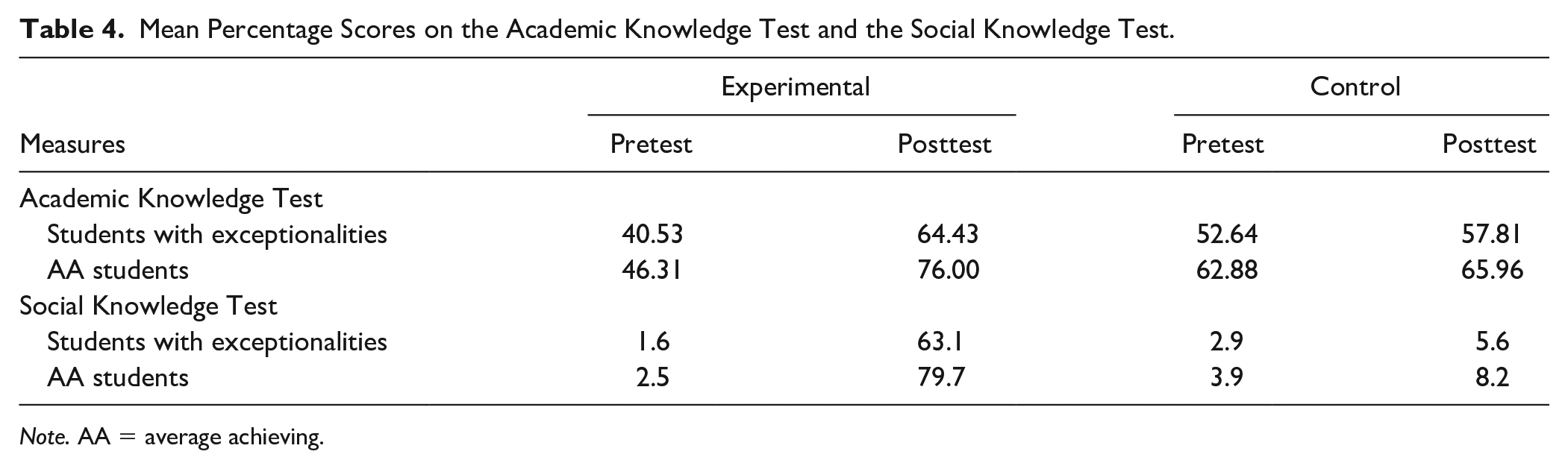
Note. AA = average achieving.
Social Knowledge Test Results
The results of the Social Knowledge Test are shown in the bottom half of Table 4. ANCOVAs revealed significant differences between the experimental and control students’ adjusted posttest scores for students with exceptionalities, F(1, 22) = 73.10, p < .001, η2 = .77, and for AA students, F(1, 22) = 400.29, p < .001, η2 = .95, representing large effect sizes. The adjusted mean for the experimental group was significantly larger than the adjusted mean for the control group. For the experimental group, the t test indicated a significant difference between the pretest and posttest scores for students with exceptionalities, t(13) = 10.23, p < .001, η2 = .81, and for AA students, t(13) = 24.06, p < .001, η2 = .96. In addition, a significant difference was found for AA control students, t(12) = 3.30, p = .007, η2 = .33, but although this is still considered a large effect size, the magnitude of this difference was small (4.3 points).
Social Behavior Results
Mean numbers of prosocial behaviors, teamwork/study behaviors, and antisocial behaviors performed during cooperative-group activities are depicted in Table 5. Statistically significant differences were not found between the adjusted posttest scores of experimental and control AA students or between the adjusted posttest scores of experimental and control students with exceptionalities. When the data of students with LD were analyzed separately, however, results of the ANCOVAs revealed significant differences between the adjusted posttest scores of students with LD in the experimental and control classes with regard to prosocial behaviors, F(1, 32) = 8.44, p = .007, η2 = .21, and teamwork/study behaviors, F(1, 32) = 6.56, p = .015, η2 = .17, representing large effect sizes.
Number of Behaviors Observed in Groups During Observations.
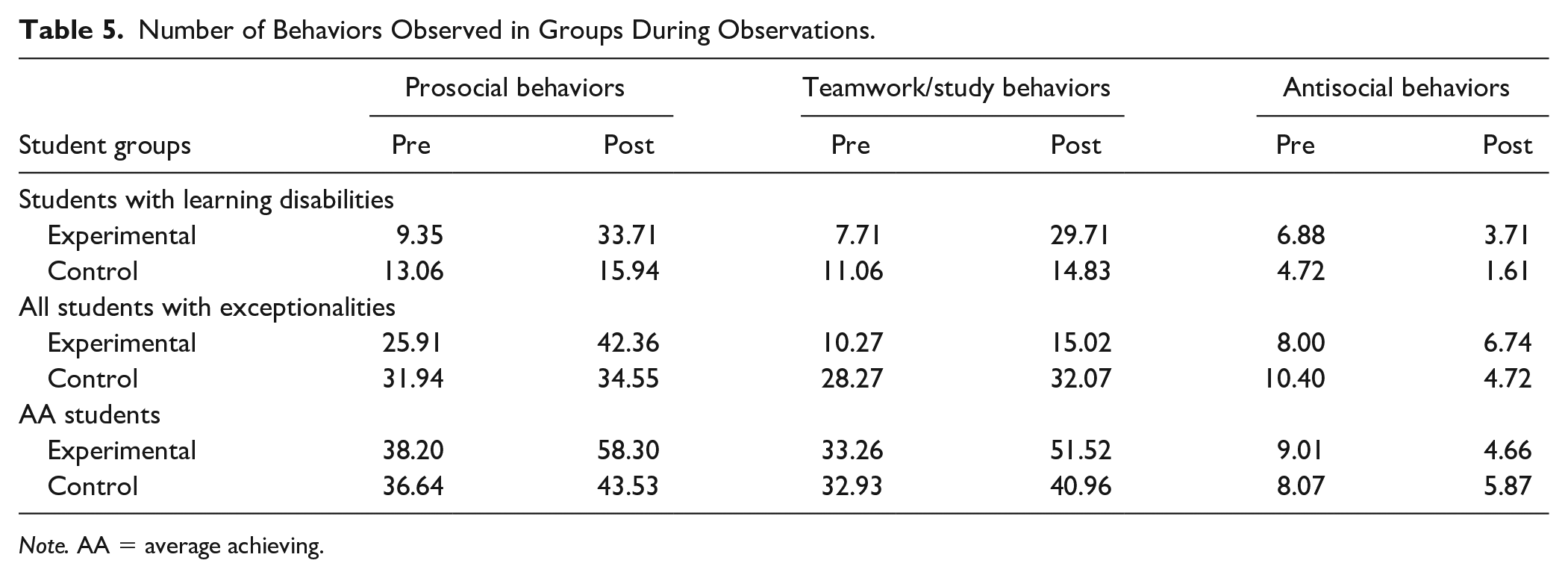
Note. AA = average achieving.
Significant differences were also evident in the t-test results. For the experimental group, t tests revealed a significant difference between the pretest and posttest in prosocial behavior for all students with exceptionalities, t(13) = 3.71, p = .03, η2 = .36, for students with LD, t(17) = 4.05, p = .001, η2 = .34, and for AA students, t(13) = 3.99, p = .002, η2 = .40. Results also revealed a significant difference related to teamwork/study behaviors between the pretest and posttest scores of experimental students with LD, t(17) = 3.90, p = .001, η2 = .32, experimental students with exceptionalities, t(13) = 3.95, p = .002, η2 = .39, and experimental AA students, t(13) = 4.06, p = .002, η2 = .41. Finally, there was a significant difference related to antisocial behaviors between the pretest and posttest scores of experimental students with exceptionalities, t(13) = 2.46, p = .030, η2 = .20, and experimental AA students, t(13) = 2.42, p = .032, η2 = .20. The number of antisocial behaviors decreased from the pretest to the posttest in these groups. No significant differences were found between the pretest and posttest scores in the control class data for prosocial or teamwork/study behaviors; however, students with exceptionalities in control classes emitted significantly fewer antisocial behaviors in group activities on the posttest versus the pretest, t(12) = 3.10, p = .010, η2 = .30.
Sociometric Rating Results
The ANCOVAs comparing experimental and control students’ adjusted posttest ratings did not reveal any significant differences between the groups of students with exceptionalities or the groups of AA students. For the experimental group, t-test results indicated a significant difference between pretest and posttest peer ratings for students with LD, t(20) = 2.60, p = .018, η2 = .15, and for all students with exceptionalities, t(13) = 2.18, p = .050, η2 = .17, but not for AA students, t(13) = 0.61, p = .555, η2 = .02. Posttest ratings for these groups were significantly higher than their pretest ratings. Similarly, in the control group, t-test results indicated a significant difference between pretest and posttest peer ratings for students with LD, t(21) = 3.90, p = .001, η2 = .28, and for all students with exceptionalities, t(12) = 3.91, p = .002, η2 = .41, but not for AA students, t(12) = 0.82, p = .431, η2 = .03. (See Table 6 for mean scores.)
Mean Sociometric Ratings for Students.
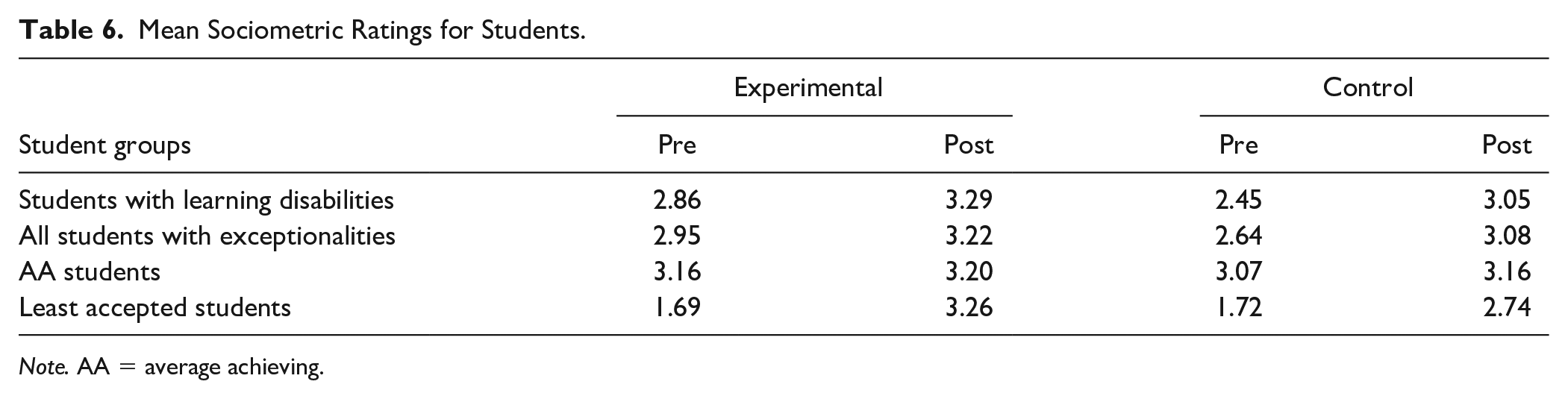
Note. AA = average achieving.
T-test analyses were also conducted for students in a “least accepted” category (i.e., those who received mean ratings of less than 2.0 on the pretest sociometric measure). Results showed that the peer ratings for the least accepted students were significantly different between the pretest and posttest for both the experimental group, t(7) = 8.85, p < .001, η2 = .87, and the control group, t(10) = 5.26, p = .001, η2 = .61, with higher ratings on the posttest.
Teacher Satisfaction Results
Experimental teachers rated the relevance (M score of 6.3 on a 7-point scale) and benefits of (also M score of 6.3 on the 7-point scale) the instructional program in the very satisfied range. In addition, mean ratings related to their satisfaction with the students’ performance, acceptance of the strategy, effectiveness in studying, the usability of the instructor’s guides and student materials were all in the satisfied range. Example comments from the teachers about what they liked most about the instruction included “The LEARN Strategy addresses a very weak area in our curriculum and has great potential for empowering students to learn more successfully,” “Lessons were great but just needed to be shortened,” “I am thrilled that I have another way to help my students succeed,” and “The kids really had fun.”
Student Satisfaction Results
Students’ mean ratings on all items regarding satisfaction with the LEARN Strategy were within the satisfied range (M = 5.3–5.8). They were satisfied that the LEARN Steps helped them study and remember important information, that they mastered the use of the strategy, that group discussions were helpful, that practicing the strategy steps was helpful, that they became a better team member after learning the strategy, and that overall, they were satisfied with the strategy. Student comments about what they liked best included, “I have a better memory now,” “It gave me a B+ in social studies,” and “It helped me study for tests and understand things.”
Discussion
The results of this study show that instruction in a cooperative strategy and basic social skills for studying in groups can improve the performance of elementary students in a variety of ways. Importantly, the experimental students learned the LEARN Strategy behaviors after instruction and generatively applied them in relation to novel study-group situations. The experimental groups’ performance of the LEARN Steps on the posttest was significantly better than the performance of the control groups, as was their performance with regard to study-card creation. The experimental groups earned more than twice the number of points on study cards as the control groups. In addition, experimental students with exceptionalities earned significantly higher scores on the Academic Knowledge Test and on the Social Knowledge Test than their control counterparts, showing that their group’s use of the cooperative strategy aided their learning.
Furthermore, with regard to social behaviors, this study showed that the students with LD in the experimental cooperative groups performed significantly more prosocial behaviors and teamwork/study behaviors than the students with LD in the control groups. In addition, the students with LD emitted significantly more prosocial behaviors and teamwork behaviors and significantly fewer antisocial behaviors during the posttest than during the pretest. These are important results for a study focusing on inclusive classes: Not only were the groups as whole performing the cooperative strategy, but the students with LD within the groups were performing more positive social behaviors and fewer negative social behaviors during group work. Peer ratings for experimental students with LD also increased significantly between the pretest and posttest, perhaps because their improved social behavior led to more acceptance.
Additional findings are worthy of note, and a few are interesting. The t-test results indicate, in a general sense, that student practice with cooperative-group study assignments can have a positive effect on both experimental and control students. Both experimental and control students realized significant gains in study-card quality and social knowledge over the course of the study. In addition, in both experimental and control classes, students with exceptionalities engaged in significantly fewer antisocial behaviors over the course of the study. Also, academic test scores and peer social ratings increased in both experimental and control classes, with students with LD and all students with exceptionalities making substantial gains. Nevertheless, in most of these cases, the gains made by experimental students were socially significant as well as statistically significant. For example, in the experimental classes, students with exceptionalities earned an average of 24% more points on the academic posttest than on the pretest, and students without exceptionalities earned an average of 30% more points. In contrast, control AA students made only marginal gains between the pretest and posttest (an average of 4% more points). Students in both experimental and control classes rated their classmates with LD and those with exceptionalities as more preferred teammates at the end of the study than at the beginning; however, the changes in the ratings for the experimental class were more substantial than those of the control students, particularly for the least liked students, and the effect sizes were larger for the experimental students as well. In fact, the magnitude of the improvement in peer ratings experienced by the experimental group was larger than that experienced by students in control classes. After the instruction, those students who were initially least accepted in the experimental classes were actually rated higher, on average, than other students with and without exceptionalities.
Limitations
The study is limited by several factors. First, the teachers were volunteers who indicated that they were interested in learning about conducting cooperative-group activities in their classrooms and open to being observed in their classes. Whether the results of the experimental classes could be replicated in classrooms where the teachers were being instructed by administrators to implement the intervention is not known. Second, only students enrolled in inclusive general education classes in Grades 4 and 5 were included in the study. How younger or older students and other types of classes might respond to the instruction is also not known.
Third, the results of the study-card instruction were disappointing. Students in the experimental classes earned, on average, less than half of the points available for study cards. Thus, the requirements for the items on the cards were too complex, the instruction was too complex, or the instruction on study cards was not designed appropriately for the teachers to carry out with fidelity. Upon close inspection, the data showed that the majority of the groups in some of the experimental classes earned close to all of the study-card points, whereas groups in other experimental classes scored poorly. Thus, these results may indicate that the implementation of study-card instruction across the teachers varied. This notion is mirrored in the implementation data, which showed that some teachers were only implementing about two thirds of the instruction on the Implementation Checklist. Perhaps the addition of coaching for the poor implementers might have changed the outcomes related to test and study-card data.
Future Research
Future research might focus on teaching the LEARN Strategy to younger and older students and students with a variety of characteristics. It might also focus on the addition of instructional coaching for teachers (Knight, 2007), especially those who are not implementing the instruction with fidelity. Future research could also focus on teaching students a variety of cooperative strategies to address such group social tasks as solving problems, resolving issues, and tackling group projects. Such research would provide teachers with a curriculum of programs to use to emphasize social skills in the classroom.
Implications for Practice
With regard to implications for practice, this study showed that teachers who simply read the written protocols and had their questions answered could teach students to use a cooperative strategy for use in study groups, enhance their students’ performance on academic tests, and improve the behavioral culture of their classes. Thus, teachers can readily learn the necessary pedagogical skills to teach whole inclusive classes to use appropriate social skills. Although some teachers might need some additional instruction or coaching, the basic instruction as supplied in the written materials appears to be robust because all the experimental teachers produced positive student outcomes. Administrators and teachers interested in changing the climate of the classroom, especially during cooperative-group activities, now have an instructional program that can produce those kinds of behavioral changes while improving academic behavior as well. Because cooperative-group activities have been one of the most productive ways of enhancing learning across all subgroups of students in a class (Johnson & Johnson, 1990), the programs used in the current study are one way of ensuring that those activities go well while building a positive and supportive culture in diverse classes.
In sum, this study uniquely demonstrates that inclusive elementary classes can learn to use a cooperative strategy for application in study groups and that students’ use of the strategy is related to higher performance on tests of academic and social knowledge, more prosocial behaviors, and higher peer ratings. Notably, the instruction can yield improved academic and social performance for students with LD and other students with exceptionalities. This field is wide open with regard to improving social and academic outcomes for students with disabilities as well as normal achievers who have been enrolled together in inclusive general education classes.
Footnotes
Acknowledgements
The authors wish to thank the teachers who allowed us to conduct research in their classrooms and the students who volunteered to participate in the study. We also thank administrators in School Districts 497, 500, and 501 in Kansas for their district’s support and participation in this project. They also are grateful to the consultants on this cooperative learning strategies project: Drs. David Johnson, Roger Johnson, and Robert Slavin.
Declaration of Conflicting Interests
The authors declared a potential conflict of interest with respect to the publication of this article because the instructional program tested within this article is commercially available.
Funding
This research was funded by two grants awarded to Edge Enterprises, Inc. by the National Institute of Mental Health through the Small Business Innovations competition: Phase I: 1R43MH47211-01A1 and Phase II: 2R44MH47211-02A1.
