







Abstract
Important articles published in Learning Disability Quarterly (LDQ) during the years 1988 to 1998 were reviewed. Ten articles were identified with citations still occurring to date (2020–2025). These articles focused on strategy instruction, metacognition, fluency training, social skills, risk factors, and identification of children with learning disabilities across the United States. Also discussed during the 1988 to 1998 time were LDQ articles that focused on the limitations of discrepancy criteria, the narrowing of research focus, limitations of the null hypothesis related to intervention research, and the politics of knowledge that permeated the field at that time. The selected articles reviewed, based upon continuing citations in the last 5 years, have continued to yield an intellectual impact on the field of learning disabilities.
Introduction
I am honored to participate in the 50th anniversary of the Learning Disability Quarterly (LDQ) with the task of identifying important articles published during my editorial tenure (1988–1998). Before this time period, the field of learning disabilities was becoming increasingly recognized as a general heterogeneous set of academic skill disorders in major diagnostic nomenclatures (e.g., American Psychiatric Association, 1980, 1994; Diagnostic and Statistical Manual of Mental Disorders). Further, there were major transitions occurring within the U.S. government in terms of noting a disabling condition that interfered with school performance. The original 1968 definition of learning disabilities (U.S. Department of Education, 1968) went through different authorizations with the 1975 special education legislation (U.S. Department of Education, 1977) that provided free appropriate public education for all children with disabilities, to finally become the Individuals with Disabilities Education Act (IDEA, 2004). In addition, the quality of science related to the study of learning disabilities was becoming refined by the National Institute of Child Health and Human Development (NICHD; Lyon, 1999).
Although publications related to learning disabilities during the 1970 and 1980’s were voluminous, the impact or importance of these publications on learning disabilities in the scientific literature was unclear. For example, the UCLA Marker Variable Project (Keogh et al., 1982) suggested that published research on learning disabilities was plagued by nonoperational definitions and methodological inadequacies (also see Gallagher, 1986). Likewise, Humphreys et al. (1983), in their analysis of research in learning disabilities, suggested that enormous conceptual and methodological problems characterize this body of research, and it has yielded little (if any) reliable information for psychology (p. 56). Fortunately, articles in LDQ played a major role in changing the direction and quality of research that included adults and children with learning disabilities. Guidelines for operationally defining, via minimum standards, were published in LDQ (Rosenberg et al., 1992). In addition, a study of prominent articles (highly cited articles) indicated that LDQ played a critical role in changing research quality in the field of learning disabilities (Swanson & Trahan, 1986). That is, a study of prominent articles on learning disabilities (Swanson & Trahan, 1986) across several journals (e.g., Child Development, Journal of Educational Psychology) indicated that 33% of the prominent articles were published in LDQ. These articles were characterized as “sophisticated in terms of research design and statistical methodology when compared with randomly selected articles” (p. 179). Further, a comprehensive meta-analysis during this time showed that LDQ was (and still is) a major outlet for scientifically based intervention research for children with specific learning disabilities (Swanson et al., 1996). Thus, given this preamble, my unenviable task from the array of approximately 250 published articles published while I was editor is to select those that had the highest impact.
Determining Articles With Impact
How does one determine which articles are most influential or have had an impact on today’s field? In a quantitative sense, “impact” is traditionally determined by how many times an article is cited. No doubt, there are other ways to track impact, such as altmetrics (i.e., the tracking of social and online information, the number of times an article is read). Unfortunately, altmetrics (digital-age indicators) were not available for this time period. Therefore, a reliance on traditional methods that use citation counts by indexing various databases, such as Web of Science, Google Scholar, and Scopus, was the only option. Critics of citation analysis suggest that such resources are limited to perhaps theoretical research, not how an article influences actual applications among practitioners (e.g., Shu, 2021). Further, outside of those researchers who write articles and cite other articles, the science link between research and translation is still developing (Kang, 2024; Nelson et al., 2022). Given these caveats, I briefly review the top ten articles, via the Web of Science, published during my tenure as editor.
The top 10 articles (in order of citation) are shown in Table 1. Based on the criteria of other studies identifying prominent articles in the field of learning disabilities (Arden et al., 2018), articles with approximately 100 citations are considered influential. Although published during my tenure as editor, these articles were still cited within the 2021 to 2025 time period. No doubt, a caveat emerged that some articles were overlooked that were highly recognized (cited) in the early time period, but were overlooked because they are no longer cited. However, it is reasonable to argue that LDQ articles still cited during the 30-year gap continue to have an intellectual impact on the field. I will briefly review the top ten cited. Their intellectual importance is listed below under four headings.
Title of Influential Articles in Order of Citations Approximately 25 to 30 Years after Publication.
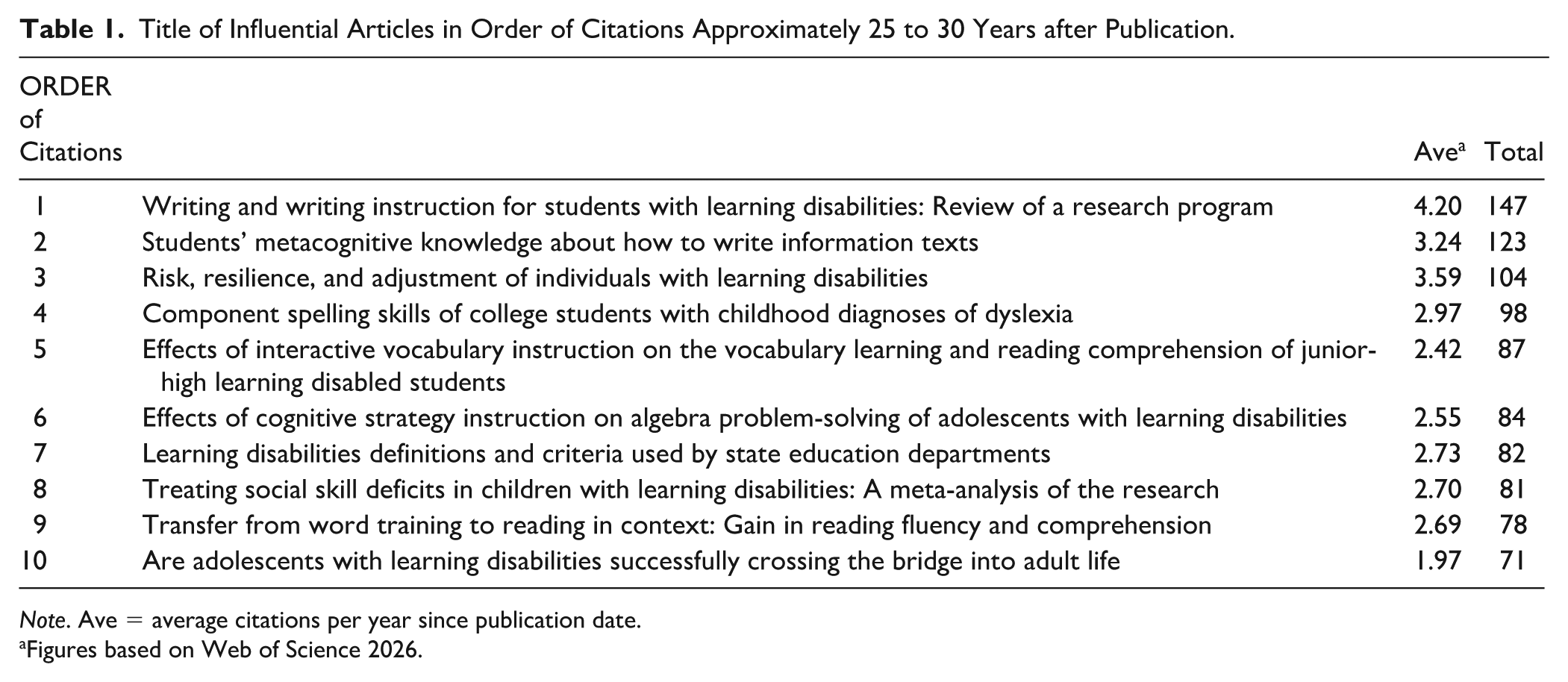
Note. Ave = average citations per year since publication date.
Figures based on Web of Science 2026.
Importance of Higher-Order Process: Strategy Instruction, Metacognition, and in Writing, Reading, and Math
Drawing from the work of Ann Brown and Joseph Campione (1976), John Flavell (1979), and Michael Pressley et al. (1989) in the field of cognitive psychology, several articles laid the intellectual groundwork linking research in cognitive psychology to the field of specific learning disabilities. One highly cited article, in response to widespread concerns, was the quality of writing instruction provided to students with specific learning disabilities (Graham et al., 1991). This article, with Steve Graham (2022) and Karen Harris (2023), reviewed an important line of research that the authors carried out in the previous 10 years before this publication, and continues to this day. This article outlined a rigorous development program focusing on written language and teaching students with learning disabilities how to write. This article, along with the continuing research of Steve and Karen, has been foundational for many other authors focusing on writing intervention programs for children with learning disabilities (e.g., C. MacArthur, R. Reid, L. Mason; see Harris et al., 2011, for review).
A second article again focused on writing (Englert et al., 1988), but preceded the earlier publication by Graham et al. (1991). This study, along with the aforementioned work of Steve and Karen, laid a foundation for the fact that students with learning disabilities were less aware of the steps for the writing process, such as the expression of ideas and procedures for selecting information across multiple sources. The study by Carol Sue Englert and her colleagues was unique at the time because it brought a focus on the role of metacognitive knowledge, which is defined as the child’s understanding and control of cognitive processes. Metacognitive knowledge or knowledge about the structures of text (as also highlighted in Graham and Harris’ work), underlies success and comprehension and production of expository messages.
Moving from writing research, another key article during this time was published by Candy Bos and Patricia Anders (1990). This article focused on the effects of “interactive” instruction on vocabulary learning and reading comprehension of junior high school students with learning disabilities. Again, within a metacognitive framework, this study supported the advantage of interactive instruction directed at expanding the depth of information content when compared to what they termed as surface processing (i.e., direct instruction). Students with learning disabilities were taught semantic mapping and syntactic feature analysis strategies. The results showed improvement in short and long-term comprehension. This article, along with the aforementioned, tapped into “metacognitive knowledge” about the writing process and text organization.
Not only was work on writing and reading comprehension a focus of highly cited articles in LDQ, but also emerging work in mathematics. Students with specific learning disabilities often lack essential problem-solving skills and exhibit deficits in executing mathematical strategies. Nancy Hutchinson (1993) argued that previous studies in math performance had primarily focused on younger students, while ignoring the math difficulties of adolescents with learning disabilities. To address this issue, Nancy, as part of her dissertation, and under the direction of Bernice Wong (Simon Fraser University), addressed a critical component of high school mathematics: Algebra. Her study investigated the effects of cognitive strategy training to enhance algebra problem-solving abilities. Overall, her study showed that, via strategy training, improved performance on algebra word problems across maintenance and transfer conditions.
Importance of Word Fluency and Spelling
Moving from the research focused on strategy instruction, emerging research has focused on the link between the speed of word recognition (fluency) and comprehension. A key assumption in reading is that for children to become fluent readers, they must learn to identify words within milliseconds to comprehend the message conveyed. Thus, there is a relationship between the speed at which one reads words and reading comprehension. Betty Ann Levy and colleagues (1997) conducted two studies that examined the relationship between word identification speed and story reading fluency on reading comprehension. Her article showed that fluency training in word identification promoted transfer to reading comprehension. In this study, poor readers in elementary school were trained to read a set of single words and were then asked to repeatedly read stories that contained the trained words or stories with words not included in the training set. Benefits of text reading from single-word practice were observed, even for children who were particularly slow namers. The key takeaway from this article was that young children who experience problems during the early stages of reading acquisition often require fluency training beyond simple word identification. To date, the focus on fluency is evident in many curriculum-based measures (see Vanderheyden & Solomon, 2023)
Reading problems noted in the younger ages are often carried on into adulthood. An article by Maggie Bruck (1993) focused on adults with the diagnosis of childhood dyslexia, primarily in the area of spelling. This article compared college students with a childhood diagnosis of dyslexia with average-achieving college students and grade 6 students on such tasks related to dictation, spelling recognition task, and nonword reading. As expected, dyslexics scored below the expected age levels and performed more poorly than average-achieving grade 6 children with comparable levels of spelling achievement. In terms of remediation, Maggie provided a rationale for incorporating technological advances at the time (word processing programs and spelling checkers) into remediation programs.
Importance of Risk and Social Adjustment Factors
Moving from work on reading, writing, spelling, and algebra, there was an increasing interest in addressing social skills in children with specific learning disabilities. Social skill deficits were viewed as prevalent among children with specific learning disabilities, but the interventions to help such children with these deficits were not well understood. In fact, one of the most highly cited articles before 1980 focused on the link between social skills and specific learning disabilities (cf. Bryan, 1976, see Swanson & Trahan, 1986 for review). Further, it was assumed that social skills played a key role in the learning difficulties of children with specific learning disabilities. Ken Kavale, along with his collaboration with Gene Glass, introduced to the field of special education a methodology referred to as meta-analysis. This procedure allowed for quantification of findings related to a broad array of topics relevant to the field of learning disabilities, especially the links between low achievement and such social skill constructs as self-concept, self-attributions, peer rejection, and psychiatric disorders. The meta-analysis study by Steve Forness and Ken Kavale (1996) evaluated the evidence on social skills training outcomes across an array of studies that included children with learning disabilities. As found, the effectiveness of social skills training on various constructs (e.g., self-concept, achievement) was only modest. More importantly, some of their analysis suggested that control groups performed better than those receiving training. The take-home message for teachers was that effects related to social skills training packages, as well as their connection to achievement, were tenuous.
Thus, given the rather cautious outcomes for children with learning disabilities for improving social skills, the question emerges as to how these nonacademic outcomes (such as social skills) relate to a host of other social outcomes. That is, do children with learning disabilities reflect a risk factor that interacts with family, school, and community environments? The article by Gail Morrison and Meridith Cosden (1997) focused on the concepts of risk and resiliency as a framework for understanding how learning disabilities affect nonacademic outcomes, such as family functioning, emotional adjustment, school dropout, substance abuse, and so forth. The presence of a learning disability could be viewed as a risk factor, but in and of itself, it does not predict positive or negative outcomes. Rather, other risk and protective factors, as highlighted in the literature, interact with the presence of a learning disability to facilitate or impede adjustment. The existence of a learning disability, combined with significant stressors in the family and school community, puts individuals with disabilities at a greater risk for negative emotional and social outcomes. The authors review several interactional models illustrating the different ways in which internal and external factors are combined to augment the risk of an individual with learning disabilities. Certain student characteristics identified as risk factors include prior school attendance, reading ability, socioeconomic status, and family intactness. The authors provided a detailed analysis of some of the factors in the existing literature that are fruitful for future study related to the risk and resilience of learning disabilities.
Of course, the findings by Gail and Meridith raise the question: what is successful adjustment, given that a host of interactions can be related to specific learning disabilities? Adjustment, at least socially speaking, for adults with specific learning disabilities, was seen as related to employment status, living arrangements, financial independence, and leisure activities. This study by Patricia Sitlington and Alan Frank (1990) investigated the adult adjustment of a large random sample of adults labeled learning disabled. Interviews of these adults with specific learning disabilities indicated that only 4% of the sample met the initial criteria for successful adjustment. The majority of employed adults held low-status jobs, primarily in labor or service sectors. A significant correlation was found between paid employment during high school and current employment status. Their findings suggest that many of the adults with learning disabilities struggle to achieve full independence and employment satisfaction. The study highlighted the need for improved transition planning and support for students with learning disabilities.
Importance of the Gap Between Policy and Practice
A final influential study considered at the time the current policies as to how children with learning disabilities were defined across states. Cecil Mercer and colleagues (1996) reported the results of a survey of the 51 state departments of education (including Washington, DC) regarding their definitions of learning disabilities, identification criteria, and operationalization procedures. The survey found that 98% of states include the discrepancy component in their definitions or criteria for determining a learning disability. Various methods for operationalizing the discrepancy, such as standard scores and regression analysis, were identified, with a majority of states using standardized measures. Interestingly, although the discrepancy notion was part of most definitions, the survey indicated that 73% of states did not explicitly include intelligence in their definitions, reflecting a shift away from reliance on IQ testing. The majority of states (92%) include reading, arithmetic, and writing in their definitions, and problems with spelling were recognized by 76% of the states. The article by Cecil Mercer and colleagues revealed that a wide gap existed between research and current practice.
To place the Mercer et al. article into a contemporary context, a follow-up study (Maki et al., 2015) provides a perspective on how things are now. This study reviewed learning disability regulations and guidelines from the 50 United States and the District of Columbia. Only 67% of states allow for the use of the ability–achievement discrepancy approach, and 20% of states explicitly prohibit its use. Approximately 16% of states require the sole use of response to intervention (RtI) models in learning disability identification. However, there is considerable variability in the guidance states provide regarding how to implement RtI models to identify students with learning disabilities. Interestingly, about half of the states do not allow the use of “pattern of strengths and weaknesses” (PSW) models but provide little information regarding ideal identification practices.
Issues: A Retrospective Perspective
Thus, ten articles published over 25 to 30 years ago are still recognized in the literature. I would be remiss, however, if I did not identify major issues during this time period and LDQ articles that served as a precursor to addressing some current issues. An overview of issues captured during this period was published in LDQ (Swanson, 2000). Four issues were identified.
The first issue was the validity of discrepancy-defined groups. Articles in LDQ brought the validity issue to the forefront. Previous studies had assumed that the salient and distinct feature of individuals classified with specific learning disabilities within the public school system was that their disability in an academic domain, such as reading, is highly discrepant from their general intellectual competence and various educational opportunities (see Mercer et al., 1996). The implicit assumption for the inclusion of discrepancy scores in the classification of specific learning disabilities was that children who experience reading, writing, and/or math difficulties, unaccompanied by a low IQ, were distinct in terms of cognitive processing from the general “run of the mill” poor, garden-variety, slow learners. Several articles published in LDQ during this period highlighted the validity issues related to discrepancy-defined procedures to identify children with specific learning disabilities (e.g., Berninger et al., 1992; Hammill et al., 1988; Reynolds, 1992; Stanovich, 1991). Articles published in LDQ argued for a focus on operational definitions (e.g., CLD, 1998; Reiff et al, 1993; Swanson, 1991) and alternatives to the discrepancy model (e.g., Kavale et al., 1991; Stanovich, 1991).
The second issue was the proliferation of published studies across several journals that focused on “isolated” rather than integrative domains of study. This was a paradoxical situation because earlier commentaries of the field suggested that a greater level of specificity was needed in identifying the deficits of children or adults suspected of a learning disability (e.g., Gallagher, 1986). As stated by Stanovich (1988), when applied to the area of reading, “When researchers went looking for cognitive differences between reading disabled and nondisabled children, they found them virtually everywhere” (p. 155). Thus, because of so many differences, the infrastructure of the field (i.e., specific learning disabilities) was threatened. To partially address this issue, there was an ever-increasing number of studies in LDQ that emphasized the role of phonological processing (Torgesen et al., 1990; Vandervelden & Siegel, 1997). However, some authors saw the emerging overemphasis on low-order constructs (phonological coding) occurring at the expense of decreasing research on high-order constructs (executive or metacognitive processing, see Pressley et al., 2004 for a relevant review). As a balance to this direction, other studies drawing from cognitive psychology focused on higher-order processes, such as metacognition and strategy instruction (Borkowski et al., 1989; Cornoldi, 1990; Wong et al., 1989).
The third major issue was identifying effective instruction for students with specific learning disabilities. Although children with specific learning disabilities at this time were seen as the largest single category of students receiving special education services, a simple question such as “Which intervention works best for students with learning disabilities?” or, more appropriately, “Which intervention works best for which type of specific learning disabilities?” was unclear. This was further captured by the U.S. Secretary of Education, who published an article in LDQ (Riley, 1996) calling for the need for effective interventions for dealing with significant academic and dropout challenges faced by these students with specific learning disabilities. Unfortunately, the reporting of treatment effectiveness, some argued, was biased by the publication of positive outcomes (for an update, see Cook, 2014; Cook et al., 2026, for a review of this issue). This bias, affectionately called “the Dodo verdict” (i.e., “everybody has won and all must have a prize”; see Weiss & Weisz, 1995), suggested that all programs published were beneficial or equally effective. However, articles in LDQ saw an increased emphasis on more rigorous evidence-based treatment outcomes (e.g., Fuchs & Fuchs, 1998). Several articles in LDQ focused on identifying effective practices (e.g., Boudah et al., 1997; Lovett & Steinbach, 1997; Talbott et al., 1994). However, it is important to note that few studies in LDQ, as with other Journals (e.g., Journal of Learning Disabilities, Exceptional Children), published negative outcomes (cf., Travers et al., 2017).
A fourth, but not necessarily a final issue, was the politics (policies) involved in the field. Some of these political issues played in the field of learning disabilities were captured in LDQ publications (e.g., Kauffman et al., 1998; Kavale et al., 1998; Lyon, 2005). For example, there was polarization at times in teaching reading to students (see Adams & Bruck, 1993; Meyer et al., 2005, for a review of these issues). Remediation was eventually boiled down (to use terms by Whitehurst & Lonigan, 1998) as reflecting two domains: inside-out skills (phonological awareness, letter knowledge) and outside-in skills (e.g., language, conceptual knowledge). Some authors viewed some polarization related to funding practices (Pressley et al., 2004). In addition, even though some articles were comparable in methodology, theory, and/or practice to highly cited articles, some articles received greater attention than others. Simply stated, as in many fields of study, there is a politics of knowledge in the field of learning disabilities (e.g., Moats & Lyon, 1993; also see a more recent metaphor, Sailor & Paul, 2004; Zell et al., 2023).
Caveats
Given the benefits of the aforementioned articles in LDQ, it is important to note that the reader will find other articles well written, methodologically rigorous, with bottom-line practitioner orientations, but not highly cited. Although theoretically acknowledging that the intellectual influence is a major reason for citing work, it is important for readers of LDQ that other factors motivate scientists to cite some articles. For example, some articles are cited highly because they share the same funding source; represent a cadre of productive doctoral students from a productive mentor, and so forth (e.g., see Grigorenko et al., 2020; Lyon, 1999). In addition, some articles are ignored because they conflict with the orientations of competing research programs. Further, there are different citation patterns across special education journals. For example, journals focusing on multiple disabilities (e.g., Exceptional Children) are more likely to be frequently cited than journals focusing on specific learning disabilities, but this is not necessarily related to the higher quality of an article.
Summary and Comment
Thus, I conclude that pinpointing articles of impact was difficult, but ten articles were identified as advancing the field of learning disabilities. These articles, based upon citations in the last 5 years, have continued to yield an intellectual impact on the field of learning disabilities. They foretold the needed changes related to definition, intervention, and gaps between research and public policy. Critical attention was given to the importance of strategy instruction, metacognition, fluency training, social skills, risk factors, and the variance in the identification of specific learning disabilities across the United States. The aforementioned articles were highlighted because they served as fundamental mechanisms for providing new knowledge and/or directing the field to make continuous improvement in providing for the instructional needs of persons with specific learning disabilities.
Also briefly reviewed were the issues occurring in the field during my editorial tenure. These issues focused on the use of discrepancy criteria to define specific learning disabilities, narrowing the concept of specificity in research studies, identifying evidence-based instruction when the majority of publications showed positive gains, and the politics that influenced the field at that time.
In summary, given the benefits of the aforementioned articles in LDQ in terms of impact (e.g., translating research into practice), it is important to note that the reader will find other articles in LDQ well written, methodologically rigorous, with bottom-line practitioner orientations, but not highly recognized. However, with more modern ways of judging impact (e.g., digital-age indicators), articles published in LDQ will be shown to have an increasing impact on the field of learning disabilities.
Footnotes

Funding
The author received no financial support for the research, authorship, and/or publication of this article.
Declaration of Conflicting Interests
The author declared no potential conflicts of interest with respect to the research, authorship, and/or publication of this article.