






Abstract
The scoping review adopts a multimodal perspective and aims to map existing empirical studies that examine communicative modes in classroom interactions involving learners with dyslexia. Although research on dyslexia has increasingly emphasized multimodal approaches to support learners’ engagement and cognitive development, limited attention has been paid to how communicative modes are configured within classroom interactions. Drawing on Norris’s Multimodal Mediated Theory, this review conceptualizes classroom practices as mediated actions and identifies learning-related interactions within selected studies on dyslexic learners. Communicative modes were analyzed based on authors’ descriptions of interactional processes. The review includes seven empirical studies published in peer-reviewed resources. The findings offer a lens for future classroom research involving learners with dyslexia and provide important implications for classroom practice.
Introduction
Dyslexia is commonly understood as a specific difficulty related to reading, which is persistent and unexpected in relation to general cognitive abilities and educational exposure (Lyon et al., 2003; Smith-Spark & Gordon, 2022; Wajuihiana & Naidoo, 2010). While there is broad agreement that dyslexia involves difficulties in aspects such as decoding, fluency, and phonological processing (e.g., Awada & Gutiérrez-Colón, 2017; Roitsch & Watson, 2019), how dyslexia is defined and identified varies across disciplines and contexts. Historically, dyslexia was defined imprecisely, with broad labels such as “reading disorders” and related terms (e.g., “word-level reading disability”, “word blindness”) used to describe reading difficulties that overlap with contemporary understandings of dyslexia (Fletcher et al., 2007). According to Wagner (1973), “dyslexia” was first coined as a term by the ophthalmologist Rudolf Berlin in his book Eine besondere Art der Wortblindheit (Dyslexie) in 1887. Later, “dyslexia” became more widely adopted after Orton’s work (Orton, 1928).
With the further development of the field, the more formal category of learning disabilities (LD/LDs) was introduced, under which dyslexia was explicitly classified as a specific subtype (Fletcher et al., 2007; Lyon et al., 2003). In the United States, this categorization has been further institutionalized through educational legislation, and many states adopt the term specific learning disability (SLD) to formally include dyslexia (Individuals with Disabilities Education Act [IDEA], 34 C.F.R.§300.8[c][10]; Reschly & Hosp, 2004).
In classrooms involving dyslexic students, teaching practices frequently draw on a range of semiotic modes beyond spoken and written language, including visual representations, material objects and bodily actions (e.g., Puccini et al., 2013; Skočić et al., 2021). These practices can be broadly understood through multimodality, which is a concept that can recognize classroom meaning-making as involving multiple semiotic resources beyond verbal resources (Kress, 2010). A more detailed discussion of this concept is provided later.
Research on dyslexia has increasingly emphasized multimodal approaches to support learners’ engagement and cognitive development. However, limited attention has been paid to how communicative modes are configured within classroom interactions. “Communicative modes” (Norris, 2004) provide an analytical lens to uncover how interactions are constructed in learning-related activities. Therefore, a scoping review that maps how modes are configured within learning-related interactions can provide a more systematic understanding of learning practices in dyslexia education.
The present scoping review adopts a multimodal perspective and aims to map existing empirical studies that examine communicative modes in classroom practices involving learners with dyslexia. Specifically, it seeks to identify the communicative modes reported in teaching-related activities in classrooms and to explore how these modes are distributed across educational contexts, thereby highlighting potential gaps in the existing research field. To achieve the research objectives, several research questions (RQs) have been generated:
Theoretical Framework
The Concept of Multimodality
According to Kress and Van Leeuwen (2001), multimodality refers to a view of communication where meaning is constructed through the interaction of multiple means governed by shared semiotic principles. Since communication is a fundamental process that underlies many forms of human activity (Berea, 2019; Heath & Bryant, 2000), this perspective has been applied across a wide range of disciplines such as semiotics, psychology, education, medical research, logistics and transport, and computer science (Jewitt et al., 2016; Mondada, 2014). The multiple means through which communication is constructed refer to various resources for meaning-making, including “all signs and social projects” (Kaplan-Weinger & Ullman, 2014, p. 19). This broad understanding of communicative resources underpins the concept of multimodality, which recognizes that meaning-making is not confined to language alone but also involves non-verbal resources and the material world. Within this perspective, meaning making is understood as inherently realized through multiple semiotic resources, and the concrete communicative means through which meaning is enacted in practice are called modes.
“Modes” are semiotic resources that make it possible to simultaneously express discourses and engage in (inter)actions, such as speech, writing, colors, gestures, textures, and objects (Kress & Van Leeuwen, 2001). Building on this social semiotic conception of modes, Norris (2004) further developed the notion by introducing the term “communicative modes” to refer to semiotic resources as they are mobilized in situated interaction. In her framework, communicative modes encompass verbal and non-verbal resources, object use, and the embeddedness of social actors within their material and spatial environments. Crucially, Norris provides a systematic account of how multiple communicative modes operate together in the coordination of action and contribute to the construction of social actors (human beings)’ communicative practices. Communicative modes do not operate in isolation but are coordinated in relation to social action; however, such coordination cannot be understood independently of the bodies and environments in which it takes place.
Multimodal Mediated Theory
Norris (2019) introduced Multimodal Mediated Theory to conceptualize action as inherently embodied and environmentally situated. She drew on the perspective that meaning emerges through mediated action (Scollon, 1998; Wertsch, 1998) rather than through isolated semiotic resources. From this standpoint, communicative modes gain analytic significance only insofar as they are mobilized by social actors within concrete material and spatial environments to accomplish actions.
Within this framework, communicative modes are understood as the semiotic and material means through which action is mediated in situated practice. Norris (2004) identified a range of communicative modes commonly involved in interaction, such as spoken language, written words (handwriting), print (text and pictures), gesture, gaze, facial expression, head/body movement, music, object handling, proxemics (distance between social actors), layout (of space), dress, and color. Crucially, these modes are not treated as discrete or self-contained resources; rather, they operate in coordination as part of mediated action, through which social actors engage with one another and with their environments in goal-directed activities.
Focus of the Scoping Review
Guided by the perspective discussed above, this scoping review adopts Norris’s Multimodal Mediated Theory as its analytic orientation to examine classroom practices involving learners with dyslexia. In this study, multimodality is not treated as an object of analysis, but as a conceptual stance that foregrounds meaning-making as inherently action-oriented, embodied, and situated within material and social environments. Accordingly, the review focuses on mediated action as the primary site through which teaching and learning activities are understood, and on communicative modes as the semiotic resources mobilized by social actors (persons involved in mediated actions) in the accomplishment of classroom practices.
This review does not aim to conduct fine-grained, micro-level analysis of interactional sequences. Instead, it adopts a cross-study analytical perspective, focusing on how communicative modes are described and mobilized across studies to accomplish interactional functions in classroom settings. Although the included studies differ in their primary research focus (e.g., engagement, cognitive development), they all involve interactional practices in which meaning is constructed through multiple communicative modes. This review adopts a multimodal interactional perspective, which allows for the analysis of communicative modes independently of the original research aims of the studies. In this sense, modes are treated as analytical units that cut across different instructional purposes.
Method
Guided by the theoretical framework underpinning the conceptualization of modes and dyslexic students, this scoping review was conducted in the following steps: First, search strings were constructed and implemented across the selected database to identify peer-reviewed studies. After the screening process, the final corpus of studies was analyzed in relation to the research objectives.
PRISMA Flow
This study adopted Scopus as the database. Scopus provides extensive and reliable coverage of peer-reviewed studies across disciplines (Wilson et al., 2023). This cross-referencing approach helped ensure a more comprehensive inclusion of studies relevant to the focus of this scoping review.
The database search was conducted with institutional access provided by the University of Leeds. The search and selection strategy in this study followed the guidance of PRISMA (Preferred Reporting Items for Systematic Reviews and Meta-Analyses—Page et al., 2021) and adopted empirical, student-based research that specifically targeted dyslexic learners within classroom settings and incorporated multiple modes of instruction. It included four steps across both search engines: identification, screening, eligibility, and inclusion. The whole process is shown in Figure 1. All resources were peer-reviewed. No limits were applied to disciplinary areas. No restrictions were placed on publication year, and studies published up to 2025 were included. Only studies published in English were included. The recordings included journal articles and book chapters. The final search was conducted on 9 February 2026.
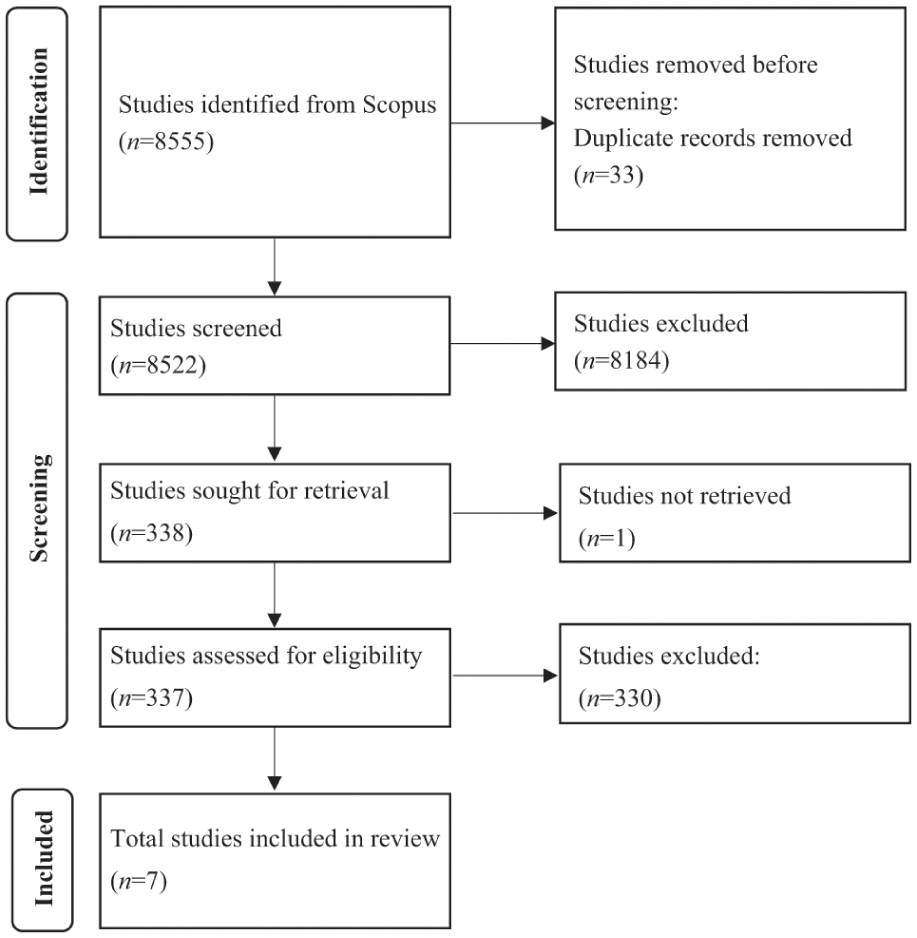
PRISMA flow for Scopus.
Different from the analytic logic guiding data extraction and interpretation, the selection of search keywords was driven by considerations of database indexing practices and term specificity. Here is the TITLE-ABS-KEYs on Scopus: (multimodal* OR multi*mode*) AND (dyslexi* OR “learning disabilit*” OR “LD” OR “LDs” OR “specific learning disability” OR “SLD”) AND (learn* OR stud* OR instruct* OR intervent* OR develop*) AND (class*)
This search string is composed of multiple components. The first component (multimodal* OR multi*mode*) was used to capture studies engaging with multimodality-related perspectives, with wildcards allowing for terminological variation. The term “mode” was not employed as a standalone search term, as the study specifically focuses on the interplay of multiple modes rather than isolated instances of a single mode. Likewise, “communicative modes” was not included in the search string, as this term derives from Norris (2004)’s theoretical framework and was adopted solely as an analytical lens during data extraction, rather than as a predefined categorization imposed on the literature. The second component was used to identify learners with dyslexia; the words used for searching were selected based on the understandings of dyslexia discussed at the beginning of this article.
While the review aims to examine communicative modes in classroom interaction, it became evident during the search process that studies explicitly framed in terms of interaction or discourse analysis are scarce in the field of dyslexia. Instead, relevant insights into multimodal interaction are often embedded within studies focusing on learning, engagement, or instructional interventions. Therefore, this review adopts a broader search strategy to capture these studies and re-analyze them from a multimodal interactional perspective. Thus, the third part restricted retrieval to studies concerned with dyslexic students’ learning—the terms are commonly used to describe educational processes in special education contexts (e.g., Houchins et al., 2022; Swanson et al., 2013). Finally, the inclusion of class ensured that the retrieved studies were situated in classroom contexts.
Initially, a total of 8,555 records were retrieved from the database. The screening process was conducted independently by the first author. Title, abstract, tag and notes were screened manually to identify studies explicitly focusing on students with dyslexia. After this process was complete, 338 studies were sought for retrieval. One study could not be retrieved due to the unavailability of the original full-text source. As a result, 337 records proceeded to the full-text review stage. Studies were systematically examined according to five predefined eligibility domains: article type, participant characteristics, classroom context, interactional practices, and the presence of multiple modes. Articles were excluded if
They were not a student-based empirical study (e.g., review articles, meta-analyses, policy discussions, theoretical articles, overview book chapters).
The participants were not explicitly diagnosed with dyslexia (e.g., studies including general LD/LDs/SLD without specifying dyslexic students, at risk for dyslexia, non-dyslexia, or teachers).
They involved studies conducted outside of classroom settings (e.g., laboratory, school offices, home-based interventions, or studies with unspecified locations).
They involved non-interactional learning (e.g., individual cognitive or perceptual performance tasks without analysis of socially organized interaction between social actors, non- individually oriented, non-interactional online learning).
They did not include at least two communicative modes (e.g., studies without a clear classroom process or insufficient information to determine use of multiple modes).
Finally, seven studies were included in the analysis stage.
Data Analysis
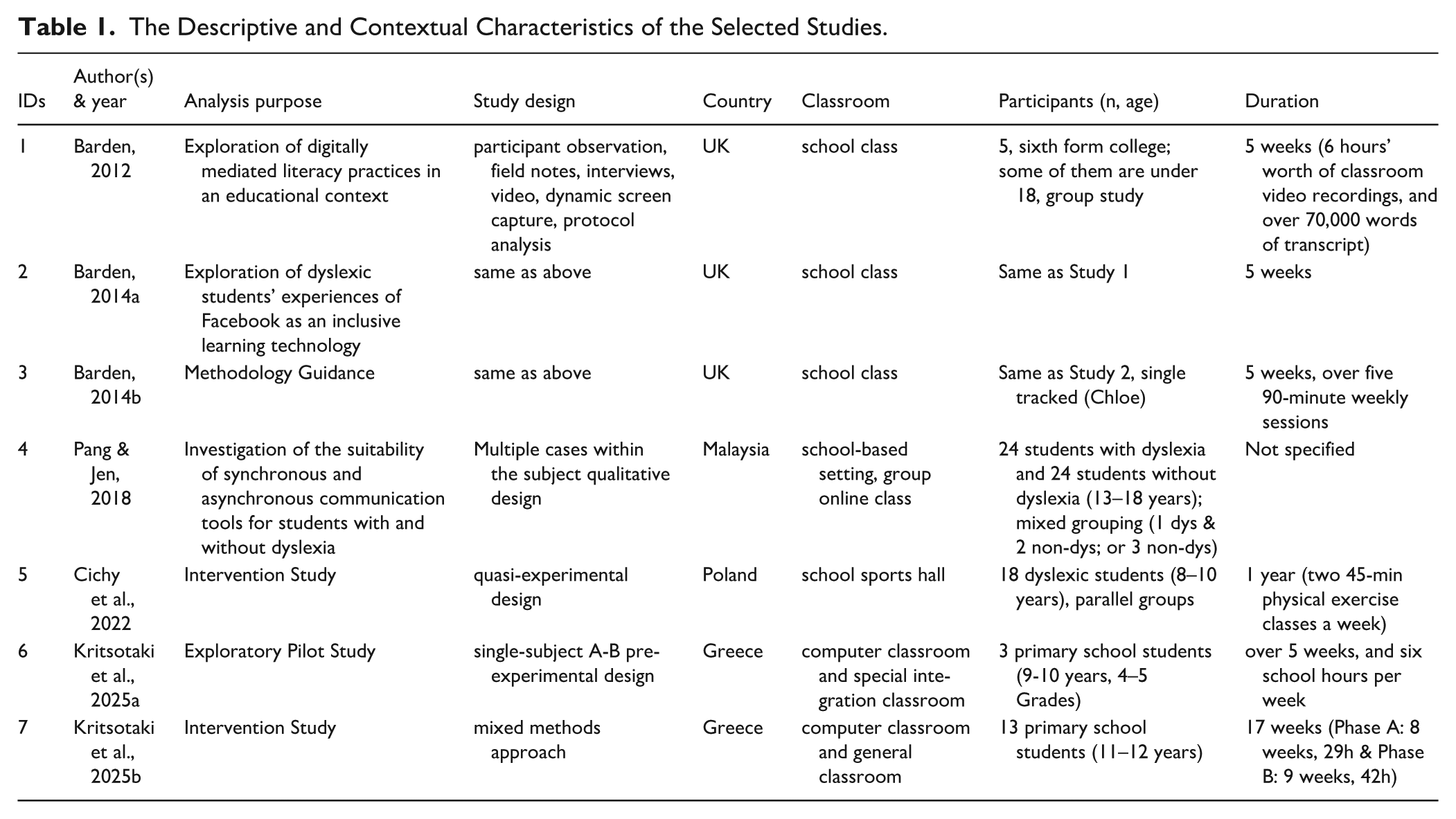
Following the final selection of seven studies, a structured coding framework was developed to enable systematic comparison across studies. Coding proceeded in three stages. First, the descriptive and contextual characteristics were identified (see Table 1), Analysis Purpose identified the primary focus of each study to clarify its analytical orientation. Study Design captured the methodological approach, which allows assessment of research rigor. Country and Classroom Context documented the educational and cultural setting in which the study was conducted. Participants (including number and age) provided information about sample characteristics, while Duration (overall research length and instructional time) enabled comparison of intervention intensity.
The Descriptive and Contextual Characteristics of the Selected Studies.
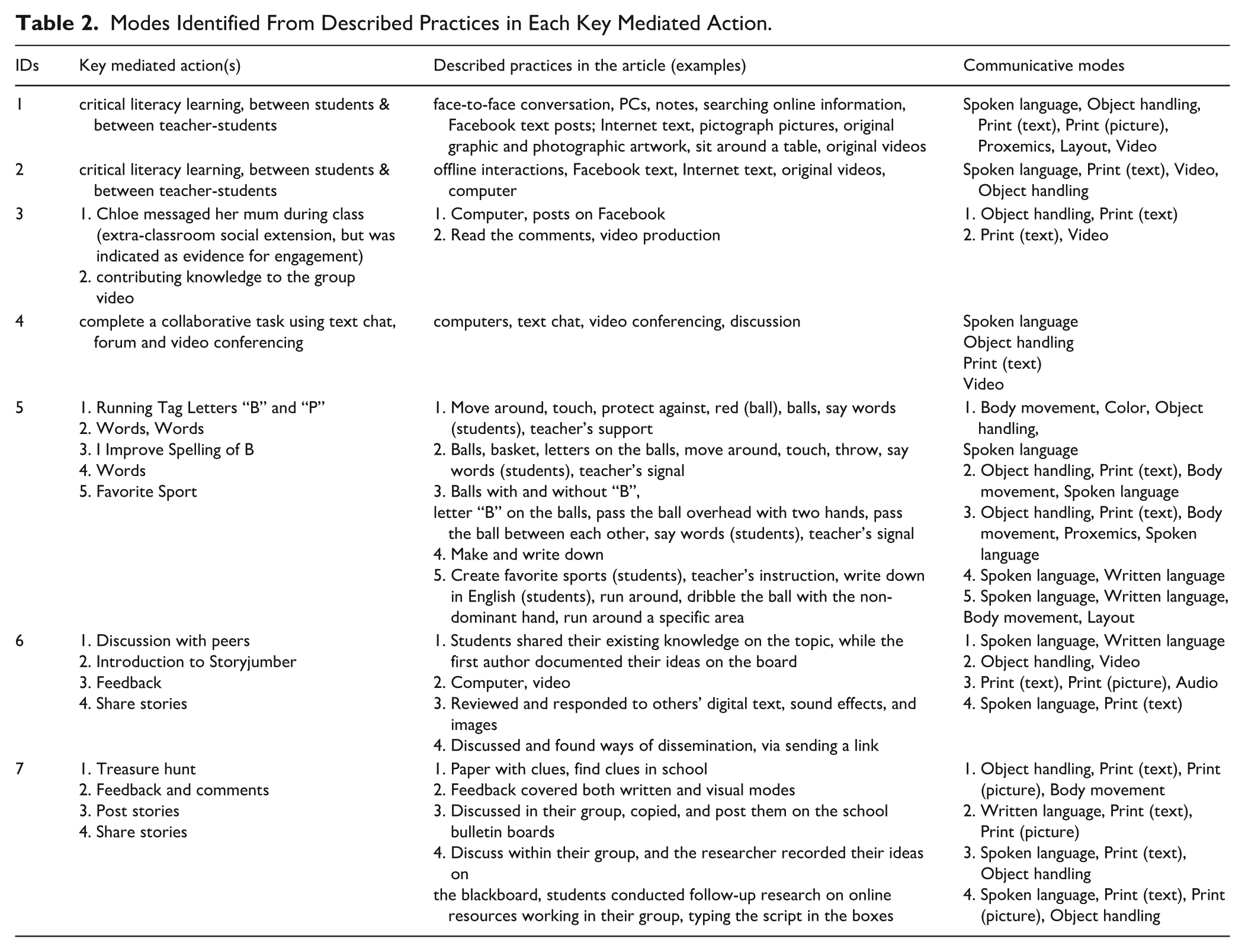
Second, aspects that are related to examining classroom practices were coded (see Table 2): Key Mediated Actions in Class were coded to identify core classroom activities through which teaching-related interactions were organized and realized. The category Described Practices recorded whether and how learning-related interaction between social actors in class was explicitly reported. Finally, Communicative modes embedded within mediated actions were deductively coded, which draws on Norris’s (2019) mediated action framework and communicative modes (Norris, 2004).
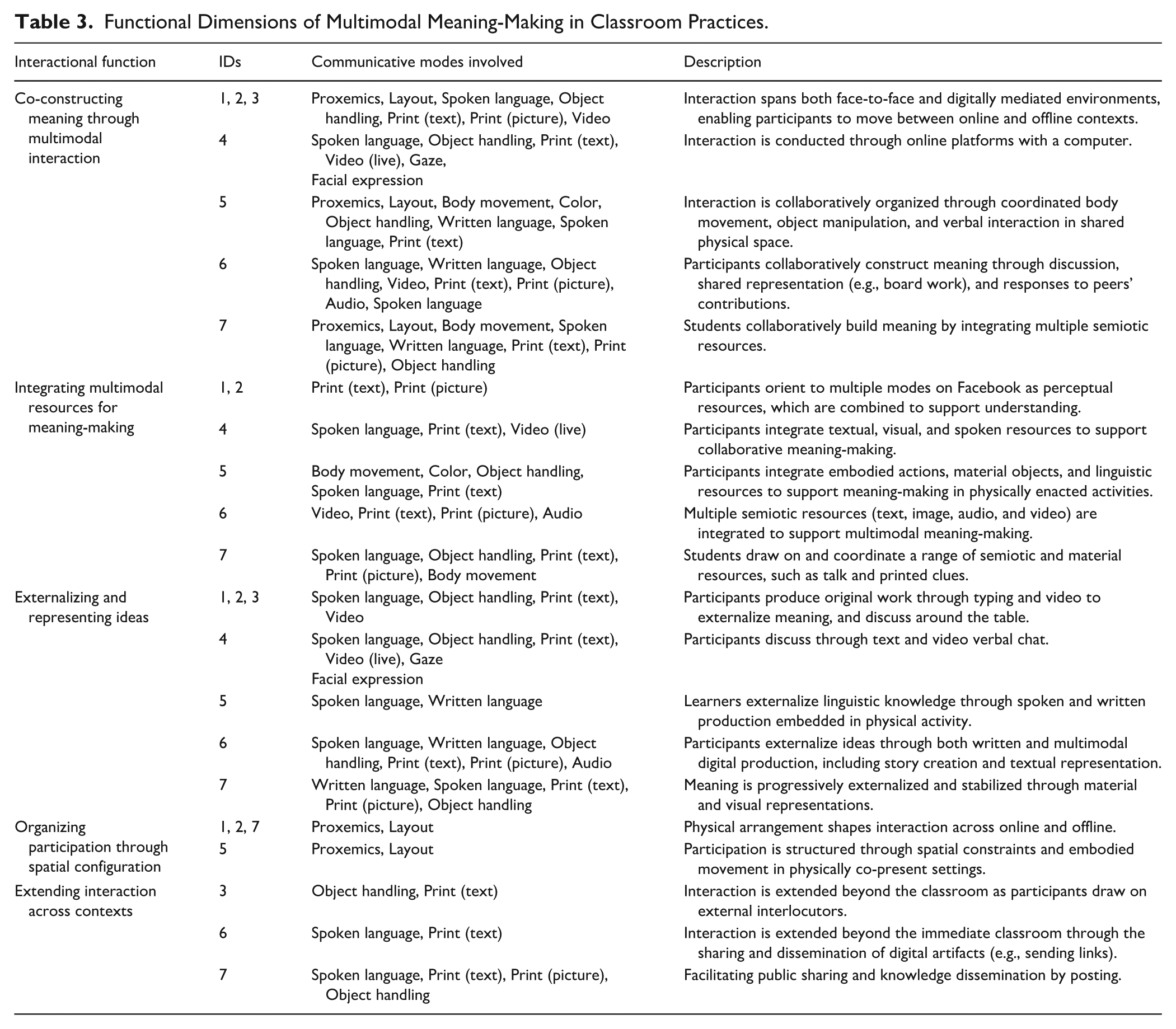
Building on the identification of communicative modes in Table 2, Table 3 presents an analytical synthesis by organizing these modes according to their recurrent interactional functions across studies. Rather than being tied to specific classroom activities, this categorization captures how multimodal resources are mobilized in interaction to accomplish pedagogical and communicative work.
Modes Identified From Described Practices in Each Key Mediated Action.
Functional Dimensions of Multimodal Meaning-Making in Classroom Practices.
While digital platforms such as Facebook provide communicative affordances, the present analysis does not treat these affordances as interaction in themselves. Instead, it focuses on how participants mobilize these affordances as part of mediated actions to accomplish interactional work across contexts. This distinction allows us to avoid attributing interactional properties to technological tools per se, and instead foregrounds the situated, action-oriented use of such tools within interaction. Consistent with this approach, digital platforms are analytically disaggregated into specific communicative modes grounded in mediated actions, rather than being treated as unified entities defined by their technological affordances. This enables a more fine-grained account of how interaction is accomplished through the coordinated deployment of semiotic resources.
The coding was completed by the first author. To ensure consistency, the coding process was conducted systematically using predefined criteria, and coding decisions were revisited during cross-case comparison.
Findings
This chapter outlines the key findings and further discussed in relation to the RQs. Three publications (see Table 1), Studies 1–3, drew on the same dataset, reporting different aspects of the project. Additionally, Study 6 functioned as a pilot preceding Study 7. In total, seven selected publications represent four empirical projects. While these publications share data sources, they were retained as separate analytical units.
Communicative Modes in Classroom Interaction
Given that communicative modes are embedded within specific mediated classroom activities rather than confined to publication boundaries, the findings below are organized according to key mediated actions identified across studies.
The research design played a decisive role in the identification of mediated actions (see Table 1). Apart from Study 5, all other studies included detailed forms of classroom observation (e.g., classroom video recordings, screen captures or screenshots, field notes, and transcripts of students’ words). Such data enabled the direct identification of learning-related interactions and the communicative modes through which they were enacted. In contrast, Study 5 adopted a quasi-experimental design and did not provide multimodal observational records. Instead, it offered detailed descriptions of classroom procedures. In this case, interactional processes and communicative modes were analytically inferred from the structured steps of the instructional activities rather than directly evidenced through recorded classroom data.
Based on the mediated actions found in Table 2, the analysis identified a range of communicative modes mobilized in classroom interaction. These modes can be grouped into several broad categories, including linguistic (spoken and written language, text in print), visual (images, color, video), auditory (audio resources), kinesthetic (body movement and object handling), spatial (proxemics and layout), and facial (gaze and facial expression) modes.
Linguistic modes were most consistently reported, often supported by visual modes and additional embodied material resources such as object handling. While some modes (e.g., video and audio) appeared across both digital and face-to-face settings, others (e.g., proxemics and body movement) were more closely associated with physically co-present interaction. These modes did not operate independently; instead, they were combined in systematic ways to support interaction.
Modes Configured to Support Classroom Interaction
The analysis identified five key interactional functions based on mediated actions through which communicative modes are configured in classroom interaction (see Table 3), with these configurations varying across different classroom contexts. In digitally mediated contexts, interactional functions were often realized through asynchronous or synchronous text-based interaction (such as Study 1–3), while in face-to-face settings, it could additionally involve embodied actions and shared attention to material objects (such as Study 5 and 7). Additionally, except for Study 4, lesson duration varies widely across the studies, ranging from approximately 6 hr to longitudinal observations over 1 year. Due to the limited dataset, no clear relationship between duration and communicative modes can be identified.
The selected articles involve participants from different age groups (see Tables 1 and 2). Across these classroom contexts, there are notable differences in the use of communicative modes. In primary school settings, embodied and physically grounded resources are more prominent in interaction. For example, Study 5 uses “eduball” activities and Study 7 involves a “treasure hunting” task; both require movement, physical engagement, and interaction with materials in offline space. In contrast, in middle school and sixth-form classrooms, interaction is more often situated in seated classroom settings. Students primarily engage in discussion and collaboration through digital platforms, with a stronger emphasis on verbal and screen-mediated communication. These contextual variations highlight how interaction is shaped by contextual conditions and point to the need to examine how communicative modes are configured to accomplish interactional functions.
Co-construction of meaning emerged as a core function, which was achieved through the coordinated use of multiple communicative modes. Rather than relying on a single semiotic resource, participants engaged in interaction by combining linguistic, visual, and in some cases, embodied resources. Meaning was therefore collaboratively developed through the interplay of multiple modes.
Meaning-making was frequently achieved through the integration of multiple communicative modes. Participants combined complementary semiotic resources to construct a layered understanding. For example, learners engaged with visual and auditory materials while drawing on textual information to interpret content (such as Studies 2 and 4). Communicative modes were also configured to externalize and represent learners’ ideas, making internal understanding visible and shareable in interaction. To be specific, participants expressed their ideas through discussion, writing, or multimodal production, which allows others to access and respond to their contributions.
Although three interactional functions mentioned above were observed across all studies, they were not realized through fixed or uniform combinations of communicative modes. Instead, the configuration of modes varied depending on the interactional context, with different semiotic resources being selectively mobilized and coordinated. This suggests that these functions are not tied to specific modes but are flexibly accomplished through context-sensitive multimodal configurations, which will be further discussed in the next section.
The mode configurations in the other two interactional functions were observed more selectively. Participation in classroom interaction was organized through the configuration of spatial modes, including proxemics and layout in the classroom. These modes structured how participants positioned themselves in relation to one another and to the activity, shaping access to interactional space. Beyond the physical classroom, communicative modes were further configured to extend interaction beyond the immediate context, enabling continuity across time and space. This function involved the use of digital and textual resources to sustain communication outside of face-to-face interaction. For example, the participant used online platforms to ask questions and receive information out of class settings (Study 2).
Certain modal categories are underrepresented in the dataset. Facial modes are only explicitly captured in Study 4, likely reflecting the need for fine-grained analytical approaches to examine such resources. While their participation in interaction can be noted, no broader patterns can be identified. Similarly, the limited use of purely audio-based materials (observed in only Study 6) prevents the identification of consistent interactional configurations.
Discussion
This discussion brings together the findings related to RQ1 and RQ2 to provide a more integrated account of multimodal interaction involving learners with dyslexia. While RQ1 identifies the range of communicative modes mobilized in classroom interaction, these modes are not analytically meaningful in isolation. From a multimodal perspective, the key issue is therefore not simply what modes are used, but how they are interplayed within communicative practices. In this sense, the following discussion examines how modes are dynamically configured to support interaction, and how such configurations vary across contexts.
Interaction cannot be understood solely in terms of verbal exchange between speakers but is constituted through mediated action (Norris, 2019), in which participants draw on a range of semiotic and material resources within their environment. This includes not only linguistic and visual modes, but also spatial and embodied resources such as proxemics, body positioning, and the arrangement of materials. The findings illustrate that these environmental and spatial dimensions are not merely contextual but actively contribute to the organization of interaction. For instance, the configuration of proxemics and layout plays a key role in organizing participants, shaping how dyslexic students access and sustain interactional space (see Table 3). In this sense, interaction emerges as a distributed process, co-constructed not only through participants’ verbal contributions, but also through their embodied engagement with the surrounding environment.
The findings further indicate that meaning-making in classroom interaction is accomplished through a set of core interactional functions, namely, co-construction of meaning, integration of multimodal resources, and externalization of ideas. Across these functions, linguistic, visual, and kinesthetic modes were most frequently mobilized in combination. Rather than operating independently, these modes were dynamically coordinated, which suggests that interaction is distributed across multiple sensory pathways.
While some studies have advocated the use of multiple modes to support dyslexic learners (e.g., Puccini et al., 2013; Skočić et al., 2021), some studies discourage teachers from employing multiple modes because some dyslexic learners experience sensory integration disorder (e.g., Stonefelt & Stein, 1998), and too many simultaneous sensory inputs from multimedia may hinder information processing and compromise learning outcomes (Mayer, 2024). However, this present review does not evaluate the effectiveness of multimodal approaches; instead, it focuses on how communicative modes are mobilized and configured in classroom interaction. As such, whether and how these multimodal practices benefit learners with dyslexia lies beyond the scope of this study. What can be observed from the present review is the consistent co-deployment of multiple communicative modes, involving engagement across different sensory channels. Regardless of their pedagogical effectiveness, this multimodal coordination constitutes a recurring feature of classroom interaction in the existing studies.
Beyond cross-category configurations, combinations also occur within individual modal categories. Linguistic modes are mobilized across nearly all interactional functions, apart from those primarily concerned with the spatial organization of participation. While dyslexia is often associated with difficulties in language processing (e.g., Richardson et al., 2004; Wiseheart & Altmann, 2018), the findings indicate that verbal resources remain central to the construction of classroom interaction. Even in cases where other modal categories are less prominent, such as in the externalization of ideas in Study 5 or the extension of interaction across contexts in Study 6, linguistic resources continue to play a key role. However, verbal resources are not realized as a single, uniform mode. They frequently involve the coordination of spoken language with visual forms such as written text or print. This suggests that the integration of auditory and visual linguistic modes may constitute a common interactional pattern in classrooms involving learners with dyslexia.
A similar pattern can be observed in visual and kinesthetic modes, where internal variation also reflects contextual conditions. Visual modes are not confined to digitally mediated environments but are equally present in offline settings through material and spatial resources. Likewise, kinesthetic modes are not limited to physical interaction (e.g., “eduball” in Study 5); they may also be realized through actions such as typing or manipulating digital interfaces in online contexts. This points out that the specific forms through which each modal category contributes to interaction are shaped by the context, rather than being inherently tied to environments.
Additionally, building on Norris’ mediated action theory, perceptual and embodied dimensions are understood as inherently intertwined in interaction rather than as separate categories (Norris, 2019). The present findings support this view by showing that these dimensions are jointly realized through the configuration of communicative modes in classroom interaction. Across the identified interactional functions, participants are required to both engage with incoming information and actively produce meaning, often within the same activity. For example, activities often require students to read or interpret information while simultaneously producing spoken or written responses (such as Study 7). This involves the simultaneous coordination of perceptual processes (e.g., reading, viewing, listening) and embodied actions (e.g., speaking, writing, manipulating materials), which together enable the accomplishment of interaction.
This interrelationship is not reducible to individual modes. The perceptual and embodied dimensions emerge through how modes are configured within mediated actions. The same semiotic resource may contribute to different dimensions depending on its role in interaction, indicating that modal functions are not fixed but contextually enacted. In this sense, multimodal interaction in classrooms involving learners with dyslexia is characterized by the dynamic integration of perceptual and embodied processes, constructed through the flexible configuration of communicative modes.
Implications for Practice
The findings suggest that teaching should not focus on the use of isolated modes but on how communicative modes are configured to support interaction. Although dyslexia is commonly associated with difficulties in written language, the findings indicate that linguistic modes remain central to classroom interaction. This highlights the importance for educators of not treating language as marginal, instead, attending to how linguistic resources are coordinated with other communicative modes. Rather than reducing reliance on language, teaching practices may benefit from supporting its integration with visual and embodied resources to facilitate participation in interaction.
Furthermore, the role of spatial and material resources in organizing participation indicates that classroom interaction is shaped not only by language but also by the arrangement of space, materials, and technologies. These insights point to the importance of designing learning environments that enable flexible and multimodal engagement, especially for learners with dyslexia.
Conclusion
The present scoping review adopts a multimodal perspective and aims to map existing empirical studies that examine communicative modes in classroom practices involving learners with dyslexia. The review adopted Norris’s (2019) Multimodal Mediated Theory to conceptualize classroom practices as mediated actions. Within these actions, learning-related interactions were identified, and communicative modes were analyzed based on the descriptions provided in the selected studies. Building on this, the analysis went a step further by abstracting interactional functions from these mediated actions, capturing how interaction is organized and accomplished in situated classroom contexts. These functions then provided an analytical framework for examining how communicative modes are configured to support interaction.
The limited number of studies highlights a significant gap in research explicitly examining dyslexic learners’ classroom interactions from a multimodal perspective. Although the present review does not assess the effectiveness of multimodal practices, it offers a lens for future classroom research involving learners with dyslexia and provides important implications for classroom practice. However, the fine-grained mechanisms through which modes operate within unfolding interaction, as well as their pedagogical implications, remain underexplored. Future research would benefit from adopting micro-analytic approaches, such as Conversation Analysis (Jewitt et al., 2016) and Multimodal Interaction Analysis (Norris, 2004), to examine how specific modes are sequentially organized and locally achieved in real-time interaction. Such approaches may offer deeper insights into how multimodal resources shape learning processes and instructional outcomes in dyslexia-supportive classrooms.
Limitations
Several limitations should be acknowledged. First, the search strategy did not include interaction-specific keywords, as preliminary searches indicated that such terms yielded a highly restricted set of studies. The search focused on teaching contexts, which may have led to the omission of relevant interaction-focused research. Second, the strict inclusion criterion requiring explicit descriptions of classroom interaction resulted in a small sample of studies (n = 7). While this ensured analytical consistency, it also limits the extent to which recurring patterns of communicative modes may be established. Finally, the screening and coding processes were conducted by a single researcher. Although efforts were made to maintain consistency, the absence of independent verification may introduce potential bias. Future reviews could benefit from multi-researcher coding procedures to further strengthen analytical reliability.
Footnotes
Acknowledgements
The authors are grateful to Zul for his help in cross-checking the database search results of this review. We would also like to acknowledge Aoife Sadlier for her professional consultancy and thoughtful comments from a reader’s perspective, which have significantly enhanced the clarity and overall quality of the manuscript.

Funding
The authors received no financial support for the research, authorship, and/or publication of this article.
Declaration of Conflicting Interests
The authors declared no potential conflicts of interest with respect to the research, authorship, and/or publication of this article.