







Abstract
Limited research exists examining video communication among cognitively intact nursing home residents to connect with family. This scoping review evaluated existing literature for video communication usage with nursing home residents, family, and nursing homes. A comprehensive search was completed using PubMed and EBSCOhost (including AgeLine, CINAHL, and PsycINFO) between 1972 and 2016 to locate English-language articles. The analysis identified five eligible studies (four involved an intervention, one assessed family views) meeting inclusion criteria. Findings included, seeing family members separated by distance, seeing other parts of their life, and visually monitoring resident’s health. Participants described frustration with technology limitations, such as video or audio lag. Current literature does not show a comprehensive assessment of video communication usage for residents, family, and nursing homes. Future studies should address the complexity of the intersection of the person, nursing home, and families in terms of potential benefits and capability of video communication use with residents.
Introduction
Communication opportunities with family and friends change when an individual transitions to a nursing home, as that person is now dependent on others to determine type and amount of contact. Factors such as relationship prior to admission (Bowers, 1988; Gaugler, Anderson, & Leach, 2004; Naleppa, 1996; Port et al., 2001; Yamamoto-Mitani, Aneshensel, & Levy-Storms, 2002), family proximity to the nursing home (Bitzan & Kruzich, 1990; Dillman, Yeatts, & Cready, 2012; Gaugler et al., 2004; Greene & Monahan, 1982; Hook, Sobal, & Oak, 1982; Montgomery, 1982; Port et al., 2001; Yamamoto-Mitani et al., 2002), and care funding sources (Geib, 1980; Port et al., 2001), may determine how often a resident receives contact from family and friends. Nursing home residents have increased chances to be socially isolated (Pinquart & Sorensen, 2001), lonely (Drageset, Kirkevold, & Espehaug, 2011; Hicks, 2000; Slettebo, 2008; Scocco, Rapattoni, & Fantoni, 2006), and have feelings of depression. Communication with family has been shown to be an important aspect of quality of life and a decrease in contact with family and/or friends may affect the quality of life of the resident (Cohn & Sugar, 1991; Hensel, Parker-Oliver, & Demiris, 2007). Older adults find value in and benefit from continued interaction with family and friends (Atchley, 1997; Drageset, 2002, 2004; Levitt, 2000; Sherman, de Vries, & Lansford, 2000; Troll, 1999).
Theoretically communication options for nursing home residents are in person, telephone calls, email, and video communication. However, little is known about the use or video communication in the nursing home setting. Communication techniques can vary in terms of quality of communication. Daft and Lengel’s (1986) media richness theory weighs the “richness” of a specific time interval communication, based on verbal and nonverbal cues. Communication that involves a high social presence (i.e., face-to-face interaction) is considered “richer” and more effective than communication with less cues (i.e., telephone, email). Telephone communication does not allow for the nonverbal communication, which can increase in importance as one ages. For example, an older adult with hearing impairment may rely on eye gaze, smiling, or body positioning to understand what is trying to be communicated to them. Older adults who rely on nursing care depend on effective communication for proper care and to create an interpersonal relationship (Caris-Verhallen, Kerkstra, & Bensing, 1999).
As technology improves and becomes more and more a part of everyday life, video communication is becoming more common. A potential way to maintain or increase communication between nursing home residents and their family and friends is by utilizing video conferencing. Video conferencing offers an alternate channel of communication while providing the opportunity for verbal and nonverbal aspects of communication, which can enhance interactions between people (Hensel et al., 2007; Short, Williams, & Christie, 1976). Video conferencing has also been found to increase older adult’s quality of life by decreasing feelings of isolation (Bensink et al., 2006; Demiris et al., 2008; Nicholas, Fellner, Koller, Chow, & Brister, 2011; Sävenstedt, Brulin, & Sandman, 2003) and feelings of loneliness (Demiris et al., 2008).
Video conferencing allows for face-to-face communication, which has shown may increase feelings of connectedness, decreased depressive symptoms, and decrease feelings of loneliness (Tsai & Tsai, 2011). The media richness theory supports the uniqueness of face-to-face communication, as it increases social presence and effective communication. However, little is known about the use of video communication among cognitively intact nursing home residents.
Due to the lack of knowledge related to supports and barriers of integrating video communication into the nursing home setting, particularly with cognitively intact residents, an evaluation of the state of current research related to the topic is needed. The purpose of this scoping review is to describe the current state of evidence involving video communication with intact nursing home residents. By understanding where we are now, gaps in knowledge will emerge. This is crucial to understand before developing future research in the area.
Method
Scoping reviews can be utilized to evaluate a wide body of research literature (Brien, Lorenzetti, Lewis, Kennedy, & Ghali, 2010). A scoping review process uses a framework of steps to map and integrate concepts in a specific field to find gaps in the present information. The iterative steps include (a) developing a research question, (b) finding appropriate studies, (c) selecting studies to use in the review, (d) finding keywords and themes in the data, and (e) explaining the results (Arksey & O’Malley, 2005). Similar to a systemic review in terms of methodological steps, the scoping review is different in that it has an emphasis on the research findings and does not focus on quality assessments. Scoping reviews are used to explore gaps in knowledge rather than to provide support for evidence based practice as systematic reviews do. The scoping review method was chosen because, currently, there is limited research for nursing home residents using video communication and our goal is to reveal gaps and opportunities for future research.
Review Process
The research question that informed the scoping review is as follows:
The search approach used Arksey and O’Malley’s (2005) scoping review framework described above. Two databases (PubMed and EBSCOhost) were chosen and searched to find publications covering different disciplines (e.g., social science, medicine, gerontology, technology, and psychology). Publications that were included in the search were those that were published between 1972 and 2016, English-language, and peer-reviewed. The search terms included “nursing home” AND “video conferencing” OR “videophone” AND “communication.” Due to the lack of information related to this scoping review question, we allowed for a very broad span of time (1972-2016) for inclusion in the project. Studies were initially included if they (a) related to cognitively intact older adults in nursing homes, (b) could be retrieved through the university library services, and (c) were written in English. In this review, we included both Qualitative and Quantitative studies. A summary of the scoping review process, using the Preferred Reporting Items for Systematic Reviews and Meta-Analyses (PRISMA flowchart), is provided in Figure 1 (Moher, Liberati, Tetzlaff, & Altman, 2009).
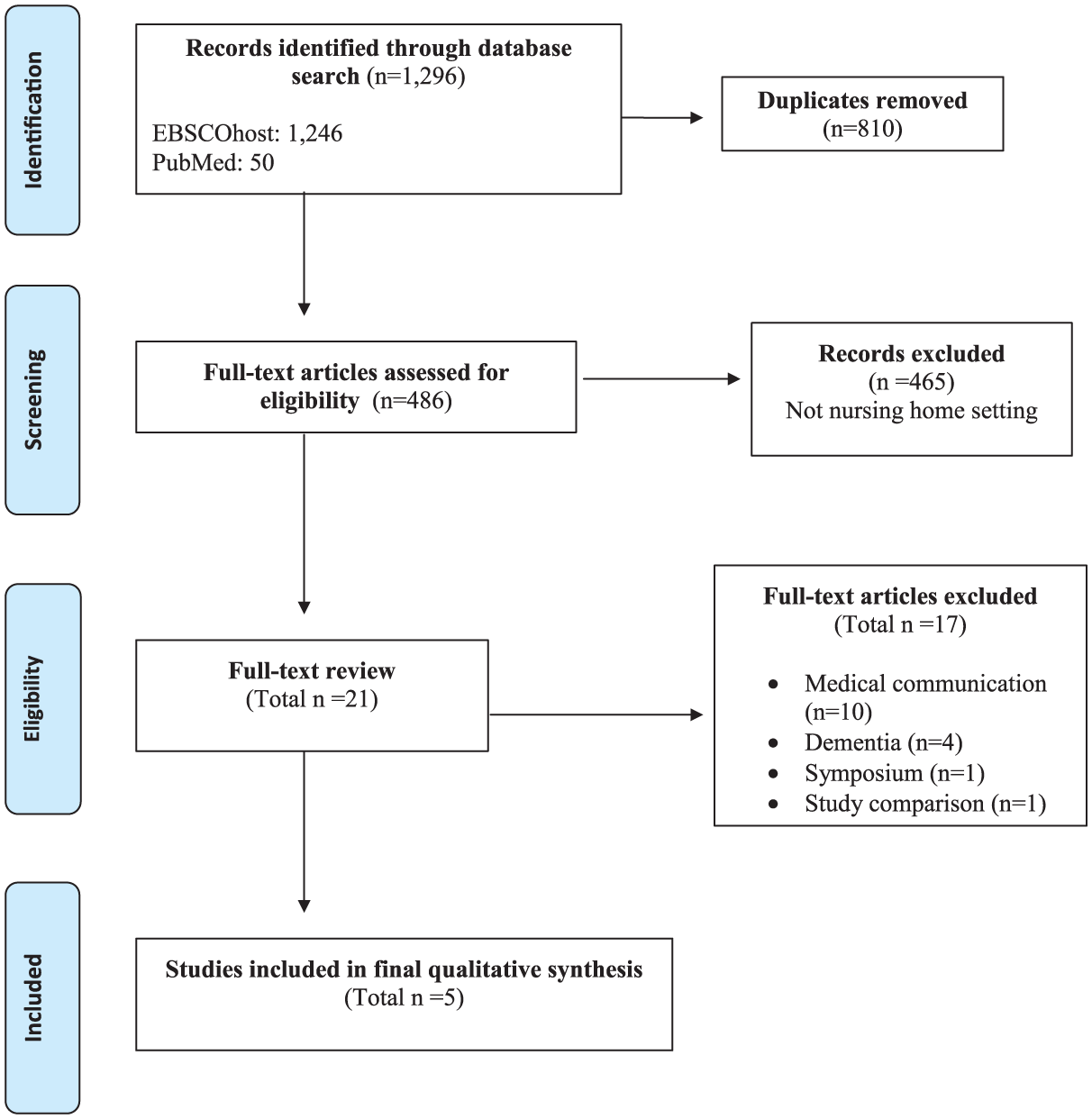
PRISMA flow diagram.
Findings
The search resulted in 487 articles, analysis of the articles resulted in 21 undergoing a full review and five being included in the final synthesis (Table 1) (Hensel et al., 2007; Mickus & Luz, 2002; Tsai & Tsai, 2010, 2011, 2015). Two of the studies were conducted in the United States, and three were conducted in Taiwan. Of the studies conducted in Taiwan (Tsai & Tsai, 2010, 2011, 2015), two were smaller data sets from a parent study (Tsai & Tsai, 2010, 2011) Studies included in the review are Level I (i.e., Systematic reviews, meta-analysis, randomized control trials), Level II (i.e., Two groups, nonrandomized studies), and Level III evidence (One group, nonrandomized). Level IV (Descriptive studies that include analysis of outcomes) and Level V (Case reports and expert opinion that include narrative literature reviews and consensus statements) evidence was included only where higher level evidence on a given topic was not found (Sackett, Rosenberg, Muir Gray, Haynes, & Richardson, 1996). The studies included in this review include one Level I randomized control trial, one Level III study, two Level IV studies, and one Level V study. Sample sizes ranged between two and 231 participants. The reviewed studies show an alternative option for social interaction by identifying how video communication affects cognitively intact nursing home residents and their families.
Studies Examining Video Communication Technology (VCT) and Nursing Home Residents.
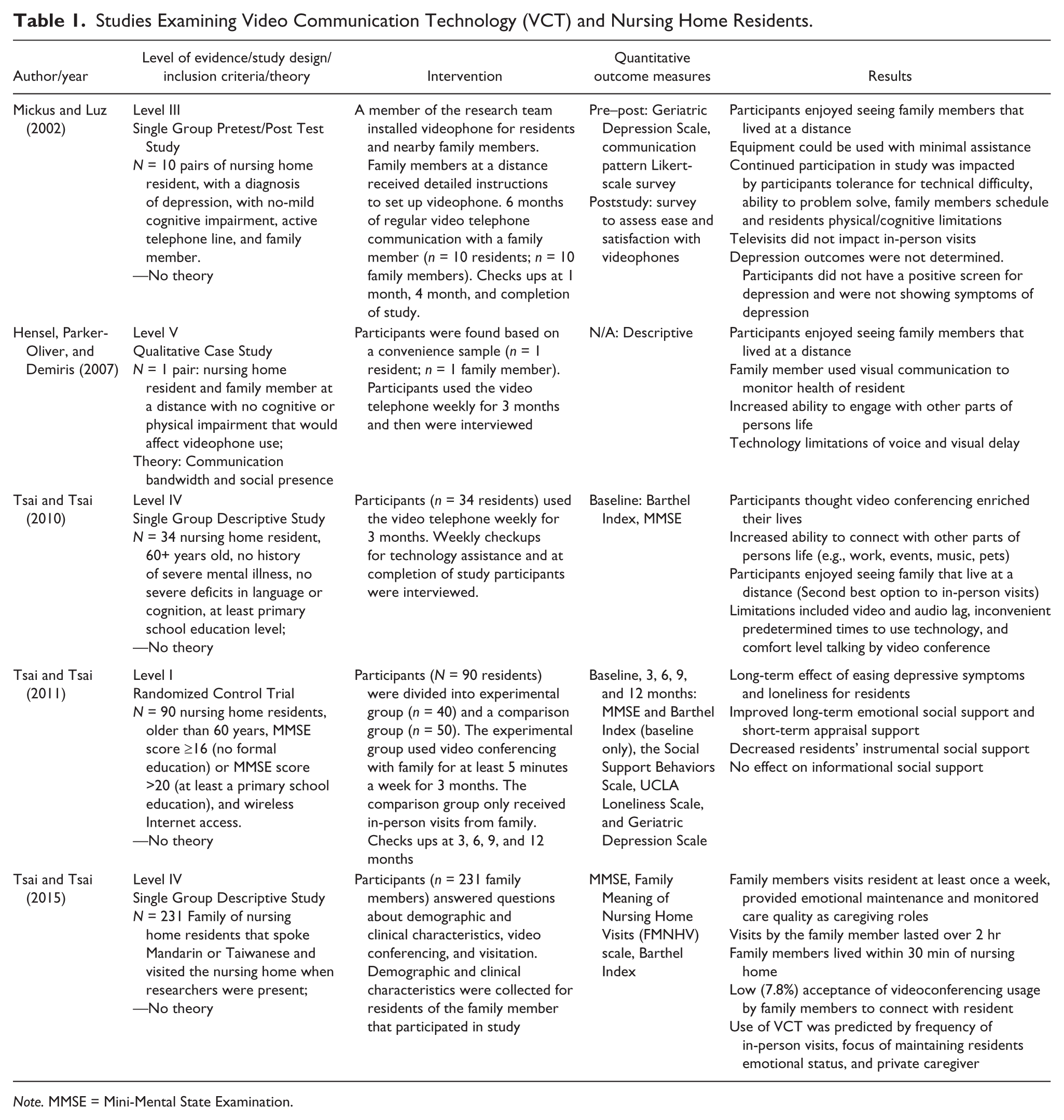
Note. MMSE = Mini-Mental State Examination.
Participants liked having the opportunity to see family members who lived at a distance, if in-person visits were not an option. Three studies (Hensel et al., 2007; Mickus & Luz, 2002; Tsai & Tsai, 2010) found that video conferencing provided the ability for the nursing home residents to see other parts of the family members life (e.g., house, pets) and the family members the ability to visually monitor the health of the resident. Both residents and family members felt a greater connection with the individual they were in contact with as a result of increased visibility. This is supported by the media richness theory which explains that communication is more effective with higher social presence (Daft & Lengel, 1986). Family members video conference use could be predicted: negatively by frequency of in-person visits, positively to maintaining the residents emotional status, and positively if there was a caregiver (Tsai & Tsai, 2015).
Tsai and Tsai (2011) examined social support using the Social Support Behaviors Scale. There are four types of social support: emotional, instrumental, informational, and appraisal. Emotional support provides caring, empathy, and love. Instrumental support is practical support or services. Informational support provides problem solving assistance. Finally, appraisal support provides information that is related to self-evaluation (Langford, Bowsher, Maloney, & Lillis, 1997). Depression status was measured using the Geriatric Depression Scale, and loneliness was measured using the UCLA Loneliness Scale over the course of a year (At baseline, 3 months, 6 months, 9months, and 12 months). The results showed that video communication had a long-term effect of easing depressive symptoms and loneliness for the residents, as well as improving long-term emotional social support. Short-term appraisal support was also improved, along with a decrease in instrumental social support for the resident. There was no change on informational social support. Participants described frustration with technology limitations, such as video or audio lag. (Hensel et al., 2007; Tsai & Tsai, 2010). Mickus and Luz (2002) found that continued participation in the study was based on how participants tolerated technical issues. As a result of the limited research in the area of video communication for cognitively intact nursing home residents, the studies presented had small sample sizes, low levels of evidence, and the duration of the studies were short.
Discussion
Current research related to the use of video communication for cognitively intact nursing home residents highlights the benefit of adding a visual component to the communication interaction (Hensel et al., 2007; Mickus & Luz, 2002; Tsai & Tsai, 2010). Both residents and family members felt the visual aspect enhanced the communication as well as the feeling of connectedness (Hensel et al., 2007; Tsai & Tsai, 2010). In addition, findings indicate that video communication is beneficial in lessening depression and loneliness, but did not influence informational social support level of support (Tsai & Tsai, 2011). The research presented provides evidence from the perspective of the nursing home resident; however, the review identifies the gap in knowledge related to the two other players in the communication interaction: the family and the nursing home facility. With a transition to a nursing home, communication complexity can increase. The communication interaction changes from a dyad to a triad. Being in an institutional setting results in the resident often having to rely on others to complete the communication. Rather than only relying on having someone to communicate with, the resident may often have to rely on facility staff to support their communication efforts.
First, the nursing home’s perspective and feasibility for video communication should be explored. Research should be developed to look at staff’s ability to use technology, interest in helping others use technology and how video conferencing would fit in with their current work tasks. Each level of employees should be evaluated from the administrator to the certified nursing assistant, as they all may have different points of view and different values and comfort related to video communication. This would also be an area where volunteer support could be used to assist residents with technology. To date, there has not been research from nursing homes’ view related to cognitively intact resident’s usage of computers. Tak, Beck, and McMahon (2007) surveyed nursing homes with a dementia unit and found that administrators think there is the potential for increased family contact when residents have computers available to them. Two studies have found none to minimal Internet access in nursing homes (Abramson, Stone, & Bollinger, 2001; Tak et al., 2007). Barriers to computer accessibility at nursing homes are unknown. Administrators perceive barriers to be due to lack of Internet access, limited computer access for nursing homes that have Internet access, or the potential for staff to use computers inappropriately (Tak et al., 2007). Research is needed to understand how or whether computers are currently utilized in nursing homes.
Second, there is a need to understand the family’s perspective of video conferencing and their ability to use technology. Research should evaluate the financial impact of video communication to the family and the capabilities of families to use the communication technology. Tsai and Tsai (2015) found that families that lived closer to the nursing home preferred in-person visits versus using video conferencing to connect with the resident. Future research should look at the usefulness and acceptance of video communication to connect with nursing home residents with families that are at a distance.
Limitations to the studies in the review include study small sample sizes, low levels of evidence, and short periods of assessment. In conclusion, video communication with nursing home residents has shown important social and health benefits for the resident. However, a need exists for in-depth studies exploring this complex multidimensional topic that can have important effects on social support, well-being, and social interactions among long-term residents of nursing homes. In particular, we need to begin to explore all the members of the communication interaction in this population, including the family and the various nursing home staff, not just the resident.
Footnotes
Declaration of Conflicting Interests
The authors declared no potential conflicts of interest with respect to the research, authorship, and/or publication of this article.
Funding
The authors received no financial support for the research, authorship, and/or publication of this article.