






Abstract
Ageism has been associated with negative perceptions of the future and the aging process. The current study argues that this connection is affected by the relevance older adults attribute to the cognitive category of age in their own self-appraisal, as well as by how they perceive this awareness in others. Accordingly, we examined the association between ageism and subjective accelerated aging (i.e., the rate the individual feels he or she is aging) and the moderating role of self-age awareness and other-age awareness on this connection. Data were collected from 267 participants (age range = 40–95; M = 64.32, SD = 14.09), using scales assessing ageism, self/other age awareness, and subjective accelerated aging. High ageism levels were associated with increased subjective accelerated aging. Moreover, this connection was moderated by both self- and other-age awareness. The study enhances the importance of personal appraisals of one’s own and others’ behaviors as age-related in this context.
Introduction
Ageism, or negative attitudes/stereotypes toward older adults, has been associated with various negative physical and psychological consequences across the life span (e.g., Cooney et al., 2020) and among older adults in particular (e.g., Allen, 2016; Bergman et al., 2018). According to the Stereotype Embodiment Theory (SET; Levy, 2009; Levy & Banaji, 2002), such stereotypes are internalized throughout the life cycle and, for older adults, contribute to negative self-views and self-evaluations (i.e., self-ageism) and subsequent cognitive, physical, and psychological stress. Recent studies have examined how ageism affects the subjective perception of time, and found that ageism was associated with a higher sense that life is nearing its end (Bergman et al., 2018), feeling older than one’s chronological age (i.e., an older subjective age; Stephan et al., 2015), and reduced future time perspective (Barber & Tan, 2018). Moreover, ageism has been associated with negative views of the aging process across the life span (Giasson et al., 2017). Accordingly, one aim of the current study is to expand this line of research and examine the connection between ageism and subjective accelerated aging (SAA)—a concept recently suggested by Palgi (2020), which assesses older adults’ subjective perception of the rate they are aging. This concept differs from existing measures of subjective aging perceptions, as it focuses on the subjective evaluation of the process of aging as slow, normal, or fast, rather than assessing general subjective perceptions of the future and one’s remaining time to live (Palgi, 2020).
Negative perceptions of the aging process and subjective perceptions of time have been linked with age awareness, that is, the extent to which older adults rely on the cognitive category of age as a defining factor in their self-appraisal, and attribute physical and psychological changes to their age (see Montepare, 1996). While similar concepts examine the individual’s perception of his or her aging process (see review by Diehl et al., 2014), little is known about the connections between age awareness and both ageism and perceptions of aging. Age awareness was linked with feeling close to death and reduced self-esteem in older adults (Bergman & Bodner, 2020), as well as with older subjective age (Montepare, 1996). Moreover, while no study has examined ageism and age awareness, ageism may promote the salience of age awareness in older adults, as such individuals may perceive physical and psychological changes as age-related (Bergman & Bodner, 2020).
In this regard, it is important to note that individuals’ self-perception may be strongly linked with how they think they are appraised and evaluated by others. As far as age is concerned, individuals tend to rely on internal psychological structures for establishing their own age awareness. However, their assessment of how others perceive them vis-à-vis their age is less clear and may be determined by their interpretation of external cues (e.g., perceiving others’ glances, speech, or behavior as deriving from others’ awareness of their age; see Pronin, 2008). Surprisingly, while research has acknowledged the role of society and its members in the formulation and consequences of ageism (e.g., Levy, 2009), no research, to date, has examined age awareness as comprised not only by individuals’ own self-perceptions but also by how they perceive others in relation to them. Thus, individuals with ageist perceptions may be primed with awareness of their age not only through their own self-judgment but also infer that others do the same toward them. Accordingly, two hypotheses were formulated:
Method
Participants and Procedure
The cohort was comprised of a convenience sample of 267 participants. Age range was 40 to 95 (M = 64.32, SD = 14.09), and 128 participants (47.9%) were male. The vast majority (n = 181, 77.7%) were Jewish and were in a relationship (n = 195, 73.3%). Subjects were recruited by trained graduate students, who approached them in their surroundings (e.g., neighborhood, work), and questionnaires were completed at subjects’ homes or at other venues convenient for them. Anonymity was guaranteed as identifying information was neither required nor noted. All scales were back-translated into Hebrew by two bilingual psychologists, except for SAA, which was originally formulated in Hebrew. The study received ethical approval by the Institutional Review Board (IRB) of the second author’s university (Approval No. 030/20), and all participants provided a written informed consent online.
Materials
Ageism was examined by North and Fiske’s (2013) scale, which focuses on expectations regarding older adults, rather than on societal expectations. Twenty items (e.g., “Older adults are too big a burden on the healthcare system”) are rated on a scale ranging from 1 (“strongly disagree”) to 5 (“strongly agree”). A mean score is calculated, and higher scores reflect higher ageism levels. The scale has demonstrated high reliability (North & Fiske, 2013), and in the current study, Cronbach’s alpha was .86.
The Age Awareness Measure (Montepare & Clements, 2001) was used to examine both SAoA and OAoA. The scale consists of four items which examine the extent to which participants feel age plays an important part in their self-views (e.g., “When I think about myself, one of the first things that come to mind is my age”). The original scale was used to examine SAoA, and was also adapted and examined separately for OAoA (e.g., “When others think about me, one of the first things that come to their mind is my age”). Items are rated on a scale ranging from 1 (“definitely no”) to 7 (“definitely yes”), and two mean scores were calculated. The original scale demonstrated high internal consistency (Bergman & Bodner, 2020), and in the current study, Cronbach’s alphas were .63 for SAoA and .76 for OAoA.
SAA was examined by a single item, which assesses the individual’s perception of his or her aging process: “In general, I feel that my aging rate is . . .,” ranked on a scale ranging from 1 (“very slow”) to 5 (“very fast”) (see Palgi, 2020).
Socio-demographic information such as age, gender, relationship status (not in a relationship/in a relationship), and religion (Jewish/non-Jewish) was also collected, and controlled in the analyses due to their connection with the study variables (see Bergman & Bodner, 2020; Bergman et al., 2013).
Data Analysis
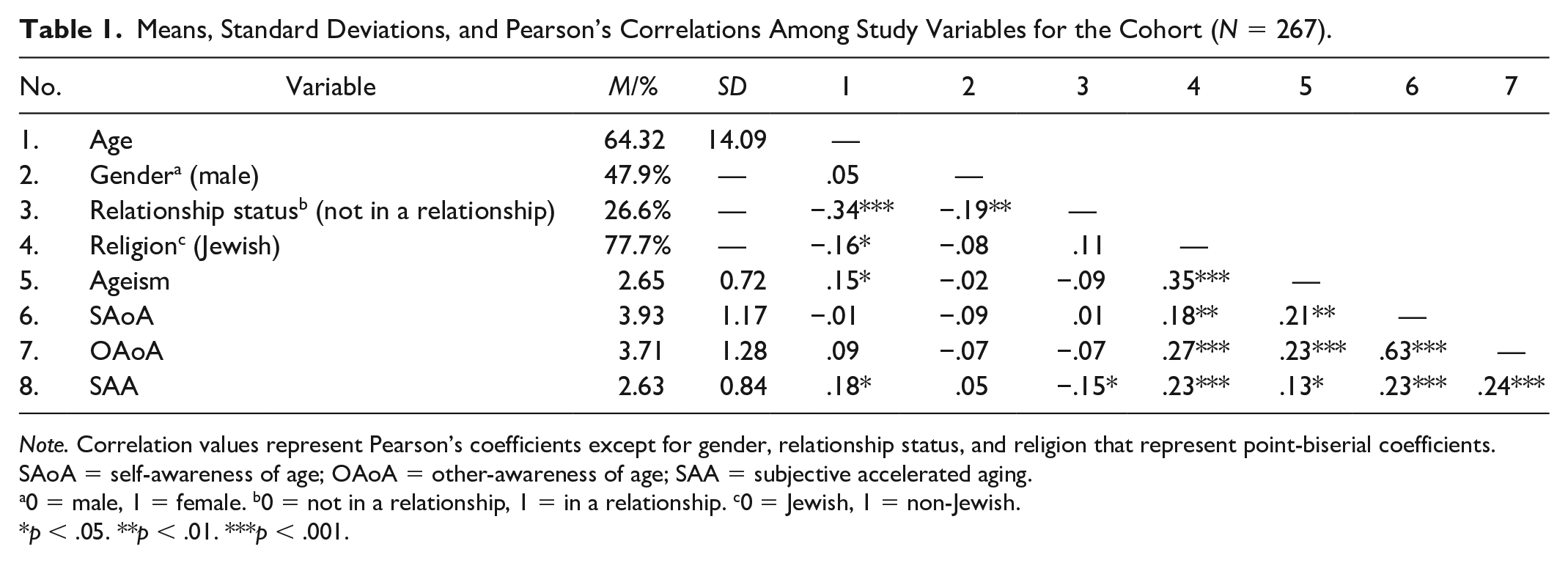
Analyses were conducted using the Statistical Package for the Social Sciences (SPSS-25; IBM) software. First, correlations were examined to establish the preliminary connections between the study variables (see Table 1 for means, standard deviations, and correlation matrix for the study variables). The hypotheses were examined by a hierarchical regression (see Supplementary File for details and regression coefficients), and interactions were probed using Model 3 of the PROCESS 3.4 Macro for SPSS (Hayes, 2018). A power analysis for detecting a medium to strong effect size (0.20) with 11 predictors required a sample size of 178, indicating that the current sample was sufficient for the study model.
Means, Standard Deviations, and Pearson’s Correlations Among Study Variables for the Cohort (N = 267).
Note. Correlation values represent Pearson’s coefficients except for gender, relationship status, and religion that represent point-biserial coefficients. SAoA = self-awareness of age; OAoA = other-awareness of age; SAA = subjective accelerated aging.
0 = male, 1 = female. b0 = not in a relationship, 1 = in a relationship. c0 = Jewish, 1 = non-Jewish.
p < .05. **p < .01. ***p < .001.
Results
Correlations between the study variables indicated that all four variables were significantly correlated with each other. Ageism was positively correlated with SAoA, OAoA, and SAA (.13 ≤ r ≤ .23). Moreover, SAA was positively correlated with SAoA and OAoA (.23 ≤ r ≤ .24; see Table 1).
In partial corroboration of the first hypothesis, a significant effect for SAoA on SAA was discovered (B = .15, β = .22, p < .01). No main effects were found for ageism (B = –.03, β = –.03, p > .05) and OAoA (B = –.01, β = –.01, p > .05). In line with the second hypothesis, a significant three-way interaction of Ageism × SAoA × OAoA was found (B = .11, β = .19, p < .05). Upon probing this interaction using PROCESS (Hayes, 2018), we found an intriguing pattern. The ageism–SAA association was not significant for individuals with low SAoA and either low OAoA (B = –.20, β = –.17, p > .05, 95% CI [–.44, .04]) or high OAoA (B = –.06, β = –.13, p > .05, 95% CI [–.59, .30]). However, individuals with high SAoA and low OAoA demonstrated a negative connection between ageism and SAA (B = –.46, β = –.40, p < .05, 95% CI [–.90, –.02]), whereas those with high levels of both SAoA and OAoA demonstrated a positive connection between ageism and SAA (B = .24, β = .21, p < .05, 95% CI [.03, .46]) (see Figure 1).
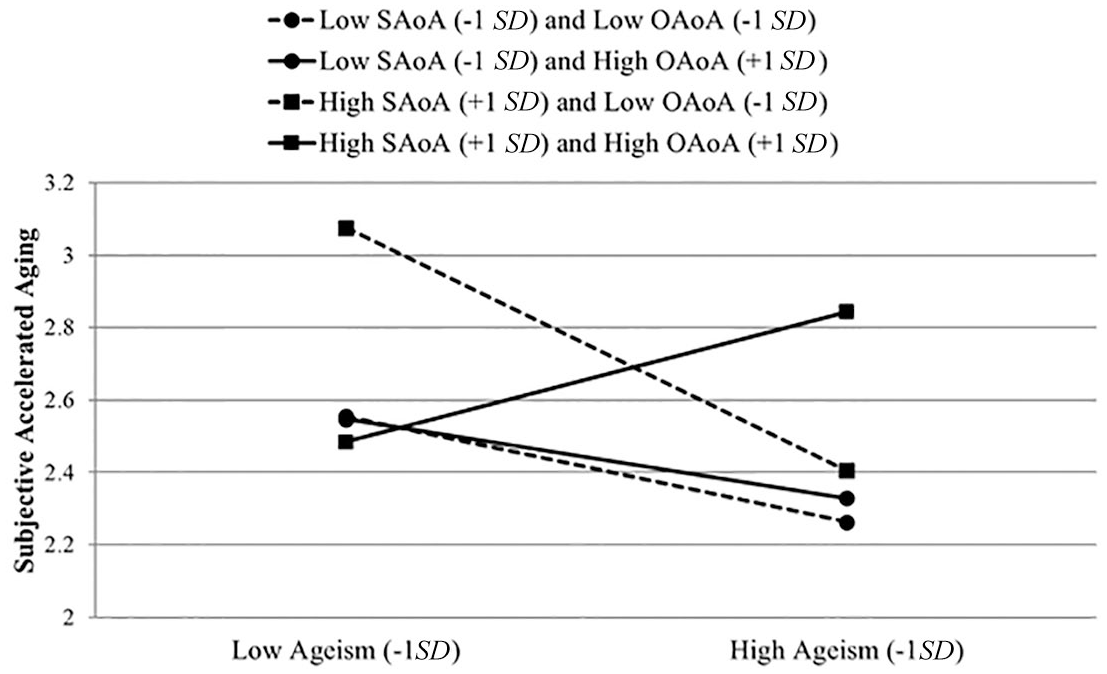
The three-way interaction between ageism, SAoA, and OAoA in predicting subjective accelerated aging.
Discussion
While previous research has demonstrated the negative effects of ageism on older adults’ perception of their remaining time (Barber & Tan, 2018; Bergman et al., 2018), little was known about the connection between ageism and the experience of aging as a fast/slow process. Moreover, while the salience of age as a cognitive category through which individuals judge themselves has been linked with similar negative time perceptions in older adulthood (Bergman & Bodner, 2020), this is the first attempt to examine not only one’s own age awareness but his or her judgment of others’ behaviors as age-connected in the connection between ageism and SAA. While no main effects were discovered for ageism and OAoA, it appears that OAoA plays a crucial role in the connection between ageism, SAoA, and SAA. More specifically, while ageism was associated with reduced SAA for individuals with high SAoA and low OAoA, the direction of this association was reversed among those with high SAoA and high OAoA. The results accentuate not only the fact that individuals may attribute different importance to their own and others’ perception of themselves through their age but also the fact that our perception of how others relate to our age greatly contributes to our perception of our aging, as individuals who have high levels of age awareness while also perceive others to be aware of their age are at a higher risk for experiencing SAA. It can be assumed that other combinations (e.g., high SAoA and low OAoA) offer a discrepancy between self- and other-views, and assist individuals in reducing the negative consequences of ageism, as all other three combinations of SAoA and OAoA resulted in a negative association (albeit not always significant) between ageism and SAA.
This finding is the first to shed light on how older adults’ perceptions of others’ behaviors as age-related affect their views of their own aging process, and opens the door to additional research which examines how the interaction of self- and other-age awareness contributes to the manner by which older adults construct their attitudes toward aging and the future. Moreover, our results expand SET (Levy, 2009), by demonstrating that ageist attitudes are not invariably linked with negative perceptions of the aging process but depend on the salience of age awareness.
Several limitations should be noted. First, the cross-sectional nature of the study precludes us from establishing a causal connection between ageism, SAoA, and OAoA regarding their effects, and longitudinal data are required to establish how these concepts are formulated across time and among different cultures. In this regard, while efforts were made to collect a sample which is as representative as possible, we cannot conclude that this is the case, and the results need to be examined further in this respect. Second, we focused on SAA as a single construct, and further research is needed for examining its validity, its connections with additional related factors (e.g., subjective acceleration of time; Lemlich, 1975), and whether ageism, SAoA, and OAoA are indicative of additional age- and aging-related perceptions. Moreover, while the scales were back-translated, further research is needed to verify their validation. Nevertheless, the current study offers an initial insight into the underlying mechanisms of SAA as a novel assessment of subjective time perception. Moreover, the findings enunciate how perception of the aging process is affected not only by individuals’ negative attitudes toward older adults or by their own appraisal of physical and psychological changes as age-related but also by their judgments of how other people see them and their interpretation of behaviors as age-related. Accordingly, although our results are indeed preliminary, it may be useful for practitioners to take into account not only individuals’ own age awareness but their perception of, and reaction to, how others see them vis-à-vis their age, when assessing aging perceptions among older adults.
Supplemental Material
Supplementary_File__Table_2_sup – Supplemental material for Ageism, Personal and Others’ Perceptions of Age Awareness, and Their Interactive Effect on Subjective Accelerated Aging
Supplemental material, Supplementary_File__Table_2_sup for Ageism, Personal and Others’ Perceptions of Age Awareness, and Their Interactive Effect on Subjective Accelerated Aging by Yoav S. Bergman and Yuval Palgi in Journal of Applied Gerontology
Footnotes
Declaration of Conflicting Interests
The author(s) declared no potential conflicts of interest with respect to the research, authorship, and/or publication of this article.
Funding
The author(s) received no financial support for the research, authorship, and/or publication of this article.
IRB Approval
The study was approved by the Institutional Review Board (IRB) of the Faculty of Social Welfare & Health Sciences, University of Haifa (Approval No. 030/20).

Supplemental Material
Supplemental material for this article is available online.
References
Supplementary Material
Please find the following supplemental material available below.
For Open Access articles published under a Creative Commons License, all supplemental material carries the same license as the article it is associated with.
For non-Open Access articles published, all supplemental material carries a non-exclusive license, and permission requests for re-use of supplemental material or any part of supplemental material shall be sent directly to the copyright owner as specified in the copyright notice associated with the article.
